Scientia Agricultura Sinica ›› 2026, Vol. 59 ›› Issue (22): 5039-5062.doi: 10.3864/j.issn.0578-1752.2026.22.007

• TILLAGE & CULTIVATION·PHYSIOLOGY & BIOCHEMISTRY·AGRICULTURE INFORMATION TECHNOLOGY • Previous Articles     Next Articles

Prediction and Analysis of the Annual Production Potential of the Winter Wheat-Summer Maize Rotation System in the Huang-Huai- Hai Plain Based on Crop Model Ensemble Simulations

DING ShuoQiu1,2(), YANG Tian1,2, DUAN YuPeng1,2, LIANG Chao1,2, GAO ChunRui1,2, CHEN BaiQing1,2, FENG Hao2,3, YU Qiang3,4, HE JianQiang1,2,4()   

  1. 1 Key Laboratory for Agricultural Soil and Water Engineering in Arid Area of Ministry of Education, Northwest A&F University, Yangling 712100, Shaanxi
    2 Institute of Water-saving Agriculture in Arid Areas of China, Northwest A&F University, Yangling 712100, Shaanxi
    3 State Key Laboratory of Soil and Water Conservation and Desertification Control, Yangling 712100, Shaanxi
    4 Key Laboratory of Eco-Environment and Meteorology for the Qinling Mountains and Loess Plateau, Shaanxi Provincial Meteorological Bureau, Xi’an 710016
  • Received:2026-03-04 Accepted:2026-06-01 Online:2026-11-16 Published:2026-11-19
  • Contact: HE JianQiang

Abstract:

【Objective】This study aimed to quantify the spatiotemporal distributions of the production potential and yield gaps of the winter wheat-summer maize rotation systems in the Huang-Huai-Hai Plain under future climate scenarios and to analyze their driving mechanisms as well, so as to offer the scientific references for regional planting layout optimization, yield stabilization and improvement, and climate change adaptation. 【Method】The study area was divided into six different agro-ecological zones (Zone1-Zone6). The crop model ensemble (including APSIM and DSSAT models) was employed to simulate the annual potential yield, actual yield, yield gap evolution, and crop phenology dynamics both in the historical baseline period (1980-2020) and two future periods (2040s and 2080s) under the SSP245 and SSP585 emission scenarios in CMIP6. Additionally, the dominant limiting factors affecting potential yield were identified. 【Result】 (1) The phenological stages of winter wheat and summer maize were generally shortened in future periods, with the most obvious reduction in the 2080s period under SSP585 scenario. In the future periods, both the accumulated temperature and the mean temperature during the growing seasons of the two crops increased significantly, while the accumulated solar radiation decreased significantly under the high-emission scenario. (2) In the baseline period (1980-2020), the annual yield gap was about 11.35-15.45 t·hm-2, with the highest value of 15.45 t·hm-2 in Zone1. In future periods, the annual yield gap generally decreased. However, Zones 1-3 still maintained relatively high annual yield gap levels (4.93-8.27 t·hm-2), while Zones 4-6 exhibited a sharp reduction to no more than 3.68 t·hm-2, and among all zones, Zone4 exhibited the most severe decline in yield gap relative to the baseline period (-10.92 t·hm-2). (3) Accumulated solar radiation was the dominant factor affecting the potential yield of summer maize during the baseline period (%IncMSE > 200). In the future period, its relative importance gradually declined, whereas that of phenological factors increased. For winter wheat, potential yield was regulated by multiple factors with no single dominant factor in the baseline period; in the future period, the relative importance of accumulated solar radiation and accumulated precipitation progressively increased. 【Conclusion】(1) The future yield difference of wheat-maize rotation system in Huang-Huai-Hai Plain showed a significant narrowing trend, and this trend had strong spatial heterogeneity. Among them, the yield-increasing potential was the greatest in the second-cropping zone around the Bohai Sea (Zone1), the piedmont second-cropping zone of the Taihang Mountains (Zone2), and the second-cropping zone of the Haihe Plain (Zone3); it was moderate in the second-cropping zone of the Huanghuai Plain (Zone5); the second-cropping zone of the Jianghuai Plain (Zone6) and the Luxi Plain second-cropping zone (Zone4) showed the weakest yield-increasing potential. (2) Compared with base period (1980-2020), the annual production potential of the wheat-maize rotation system in the Huang-Huai-Hai Plain would show a fluctuting or slow downward trend in the future. Among them, the annual potential yield level of the secondary cropping area in the Luxi Plain (Zone4) was the lowest, and under the background of high emission (SSP585), the downward trend in this area was more obvious. (3) From the historical base period to the future period, the limiting factor of the potential yield of summer maize gradually changed from cumulative solar radiation to phenological factors, while the potential yield of winter wheat was regulated by multiple factors in the historical base period. In the future period, the importance of cumulative solar radiation and cumulative precipitation in the growing season would increase and become two relatively important factors.

Key words: Huang-Huai-Hai plain, winter wheat-summer maize rotation system, yield gap, climate change, crop model

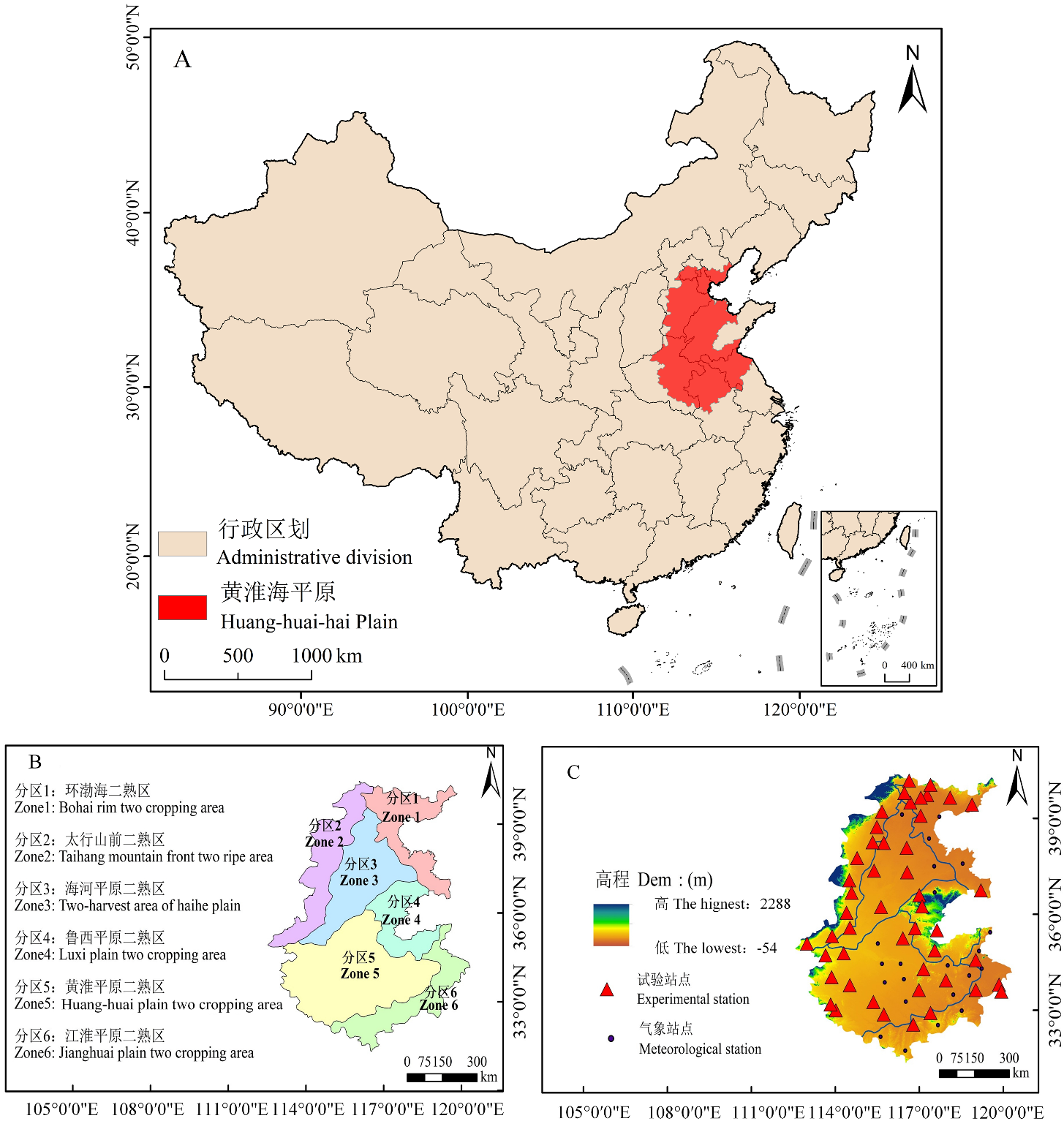
Fig. 1

Overview of the Huang-Huai-Hai Plain (A), six agro-ecological zones (B) and distribution of experimental stations and meteorological stations in the region (C)"

Table 1

Crop cultivar parameter values in the APSIM model"

作物品种
Crop cultivar
参数
Parameter
分区 Zone
分区1
Zone1
分区2
Zone2
分区3
Zone3
分区4
Zone4
分区5
Zone5
分区6
Zone6
冬小麦
Winter wheat
tt_floral_initiation
(始花期积温 Accumulated temperature at floral initiation,(℃·d))
475 496 331 176 500 427
tt_end_grain_fill
(终止灌浆积温 Accumulated temperature at the end of grain filling,(℃·d))
624 559 588 372 658 672
tt_end_of_juvenile
(拔节期积温 Accumulated temperature at jointing stage,(℃·d))
575 591 545 278 548 572
tt_start_grain_fill
(灌浆起始积温 Accumulated temperature at the start of grain filling,(℃·d))
104 141 175 139 117 152
startgf_to_mat
(灌浆结束积温 Accumulated temperature from grain filling initiation to maturity,(℃·d))
728 700 763 510 775 825
potential_grain_filling_rate
(籽粒潜在灌浆速率 Potential grain filling rate,(mg·d-1))
0.0067 0.0075 0.0065 0.0070 0.0090 0.0090
grains_per_gram_stem
(茎秆籽粒数量 Grain number per unit stem mass)
70 80 75 55 65 80
夏玉米
Summer maize
tt_emerg_to_endjuv
(出苗至三叶期积温 Accumulated temperature from emergence to the end of juvenile stage,(℃·d))
171 255 220 122 166 167
tt_flower_to_maturity
(开花至成熟期积温 Accumulated temperature from flowering to maturity,(℃·d))
740 780 796 933 789 511
tt_endjuv_to_init
(三叶期至拔节期积温 Accumulated temperature from juvenile end to jointing stage,(℃·d))
50 0 0 38 106 170
tt_flag_to_flower
(旗叶期至开花期积温 Accumulated temperature from flag leaf stage to flowering stage,(℃·d))
116 93 143 110 69 109
tt_flower_to_start_grain
(开花期至灌浆期积温 Accumulated temperature from flowering to early grain filling stage,(℃·d))
321 309 327 233 90 90
potKernelWt
(潜在籽粒重 Potential kernel weight,(mg))
500 528 300 350 300 528
photoperiod_crit1
(光周期下限 Lower limit of photoperiod,(h))
12.5 12.5 12.5 12.5 12.5 12.5
photoperiod_crit2
(光周期上限 Upper limit of photoperiod,(h))
20.0 20.0 20.0 20.0 20.0 20.0
photoperiod_slope
(光周期斜率 Photoperiod sensitivity slope,(%))
0 0 0 0 0 0

Table 2

Crop cultivar parameter values in the DSSAT model"

作物品种
Crop cultivar
参数
Parameter
分区(Zone)
分区1
Zone1
分区2
Zone2
分区3
Zone3
分区4
Zone4
分区5
Zone5
分区6
Zone6
冬小麦
Winter wheat
P1V
(最适温度条件下通过春化阶段所需天数 Days required for vernalization under optimal temperature conditions,(d))
99.20 50.20 50.20 40.20 50.20 60.20
P1D
(光周期参数 Photoperiod parameter,(%))
122.00 112.00 95.00 55.00 110.00 100.00
P5
(籽粒灌浆期积温 Accumulated temperature during grain filling period,(℃·d))
725.00 735.00 799.00 700.00 729.00 799.00
G1
(开花期单位株冠质量的籽粒数 Grain number per unit canopy weight at anthesis,(grains/g))
30.00 30.00 35.00 40.00 40.00 40.00
G2
(最佳条件下标准籽粒质量 Standard kernel weight under optimal conditions,(mg))
31.00 21.00 30.00 35.00 25.00 25.00
G3
(成熟期非胁迫下单株茎穂标准干质量 Standard dry weight of single plant stem and spike under non-stressed conditions at maturity,(g))
1.08 1.00 1.65 1.00 1.00 1.00
PHINT
(完成一片叶生长所需积温,Accumulated temperature required for the growth of one leaf(℃·d))
140.00 80.00 90.00 140.00 190.00 160.00
夏玉米
Summer maize
P1
(完成非感光幼苗期的积温(基础温度为8℃) Thermal time from seedling emergence to the end of the juvenile (base temperature is 8 ℃),(℃·d))
105.00 200.00 190.00 90.00 200.00 280.00
P2
(光周期敏感系数 Photoperiod sensitivity coefficient,(%))
0.60 0.95 0.90 0.50 0.95 1.90
P5
(灌浆特性参数 Grain filling characteristic parameter,(℃·d))
715.00 780.00 860.00 980.00 860.00 500.00
G2
(单株最大穗粒数 Maximum kernel number per plant)
850.00 820.40 840.00 880.00 820.40 745.00
G3
(最大灌浆速率参数 Maximum grain filling rate parameter,(mg/(grains·d))
13.00 6.60 7.00 7.00 6.60 19.00
PHINT
(完成一片叶生长所需积温 Accumulated temperature required for the growth of a single leaf,(℃·d))
65.00 38.90 30.00 38.90 38.90 40.00

Table 3

Parameter calibration results and weight setting of APSIM model and DSSAT model"

作物品种Crop cultivar 作物模型Crop model 指标Index 开花期Anthesis date 成熟期Maturity date 产量Yield
冬小麦
Winter wheat
APSIM R2 0.97 0.96 0.76
RMSE 3.18 2.88 1106.51
RRMSE 0.016 0.012 0.160
权重设置Weight setting 0.54 0.49 0.48
DSSAT R2 0.95 0.96 0.86
RMSE 4.03 2.87 1065.76
RRMSE 0.020 0.011 0.160
权重设置Weight setting 0.46 0.51 0.52
夏玉米
Summer maize
APSIM R2 0.93 0.78 0.55
RMSE 1.52 2.46 1279.03
RRMSE 0.029 0.025 0.156
权重设置Weight setting 0.73 0.44 0.50
DSSAT R2 0.42 0.97 0.60
RMSE 4.53 2.88 1358.52
RRMSE 0.087 0.012 0.164
权重设置Weight setting 0.27 0.56 0.50

Table 4

Calibration and validation results of the APSIM, DSSAT and integrated models"

作物品种
Crop cultivar
作物模型
Crop model
指标
Index
开花期Anthesis date 成熟期Maturity date 产量Yield
校准值
Calibration
验证值
Validration
校准值
Calibration
验证值
Validration
校准值
Calibration
验证值
Validration
冬小麦
Winter wheat
APSIM R2 0.97 0.94 0.96 0.97 0.76 0.78
RMSE 3.18 4.33 2.88 2.76 1106.51 901.89
RRMSE 0.016 0.022 0.012 0.011 0.160 0.138
DSSAT R2 0.95 0.93 0.96 0.98 0.86 0.81
RMSE 4.03 4.12 2.87 2.23 1065.76 905.57
RRMSE 0.020 0.021 0.011 0.009 0.160 0.138
模型集成
Integration
R2 0.95 0.96 0.97 0.98 0.94 0.94
RMSE 3.74 3.47 2.58 2.16 498.96 472.80
RRMSE 0.019 0.018 0.011 0.009 0.074 0.073
夏玉米
Summer maize
APSIM R2 0.93 0.93 0.78 0.82 0.55 0.32
RMSE 1.52 1.39 2.46 2.11 1279.03 1189.96
RRMSE 0.029 0.027 0.025 0.021 0.156 0.140
DSSAT R2 0.42 0.48 0.97 0.33 0.60 0.67
RMSE 4.53 4.14 2.88 3.73 1358.52 1101.19
RRMSE 0.087 0.080 0.012 0.037 0.164 0.130
模型集成
Integration
R2 0.89 0.96 0.79 0.98 0.86 0.94
RMSE 1.81 3.47 2.37 2.16 589.36 472.80
RRMSE 0.035 0.018 0.024 0.009 0.070 0.073

Table 5

Ten global climate models (GCMs) used for future climate forecast in this study"

GCM名称
GCM name
缩写
Abbreviation
国家
Country
ACCESS1.0 AC1 澳大利亚 Australia
BCC-CSM1.1 BC1 中国 China
CanESM5 Can1 加拿大 Canada
CMCC-CM2-SR5 CMCS 意大利 Italy
CNRM-CM6-2 CNR2 法国 France
CIESM CIES 中国 China
ACCESS-CM2 AC2 澳大利亚 Australia
CanESM5-CanOE Can2 加拿大 Canada
CNRM-ESM2-1 CNR3 法国 France
CNRM-CM6-1 CNR1 法国 France

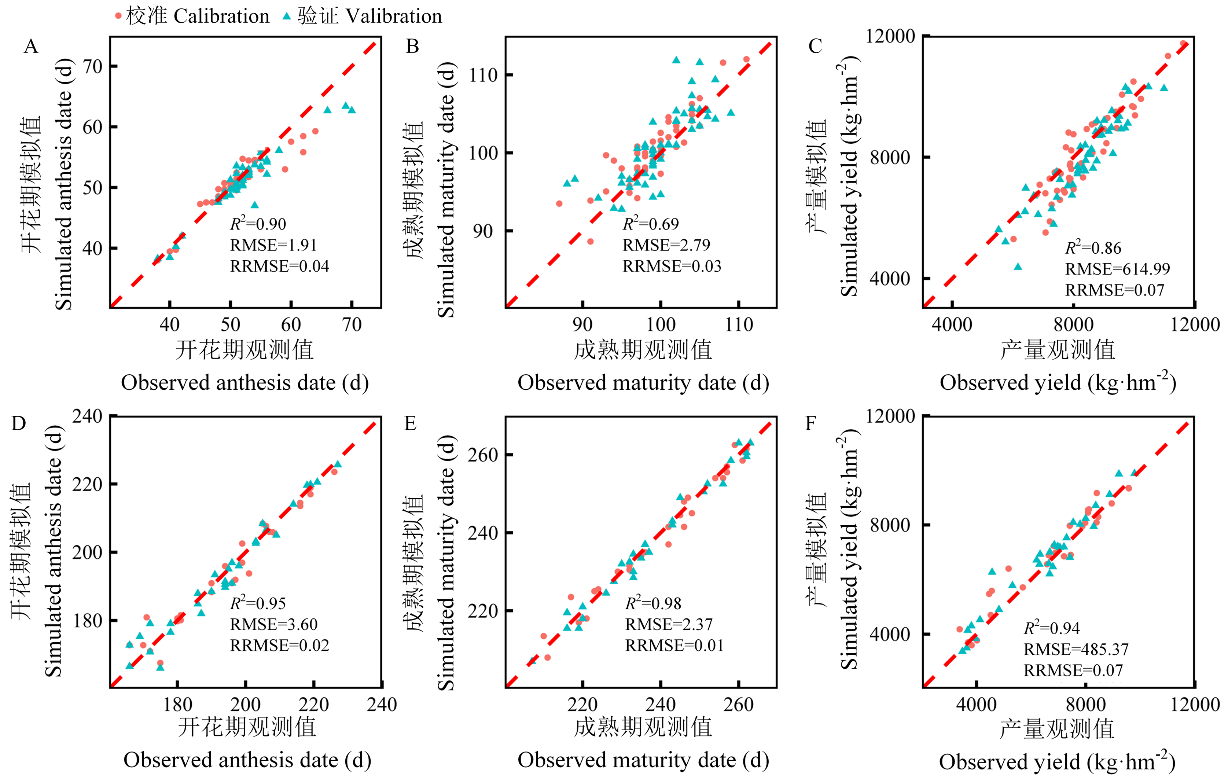
Fig. 2

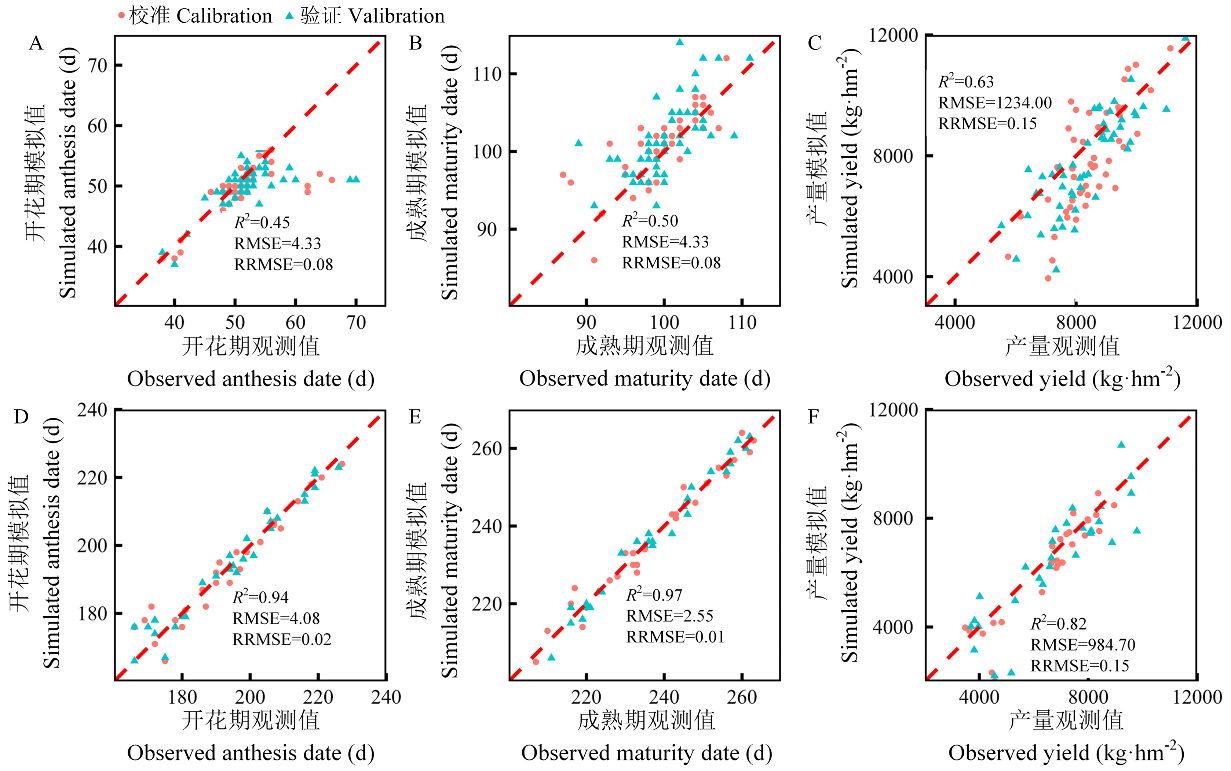
The simulation results of anthesis date, maturity date and yield of summer maize (A-C) and winter wheat (D-F) by integrated model The unit of different phenophases in the figure is days after sowing (days after sowing, das). The same as below"

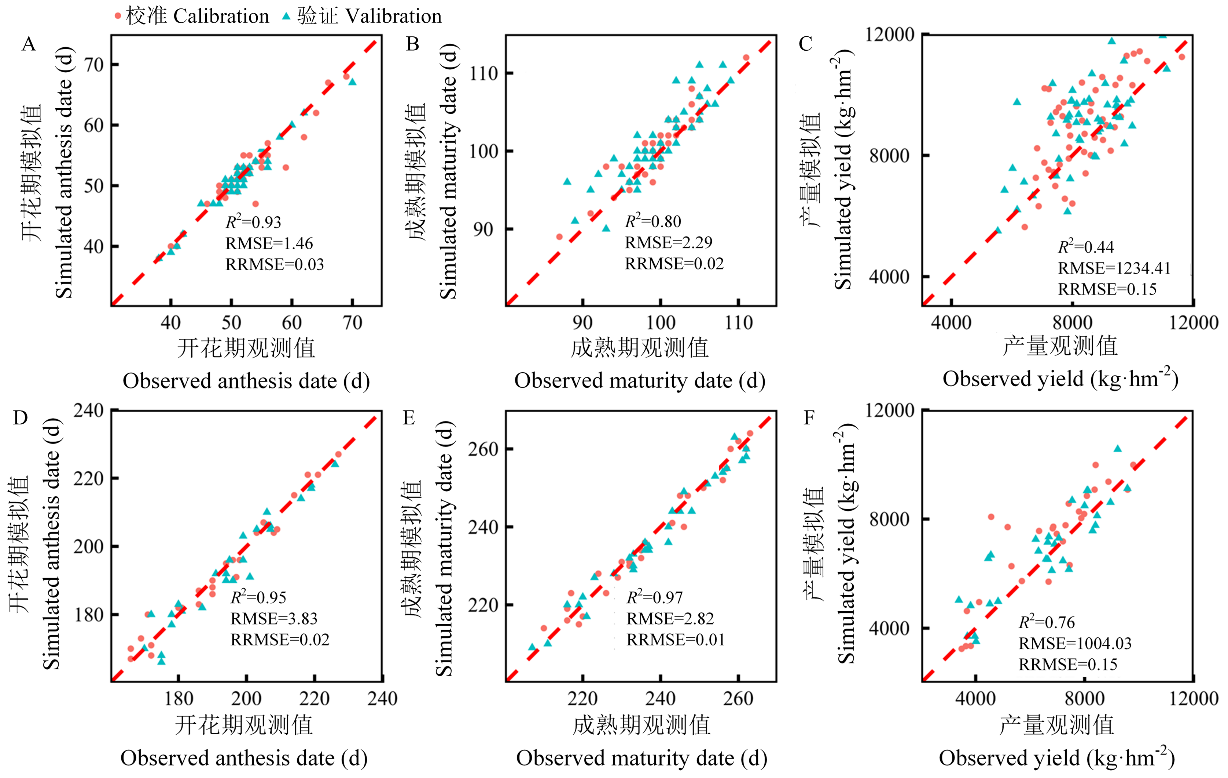
Fig. 3

The simulation results of anthesis date, maturity date and yield of summer maize (A-C) and winter wheat (D-F) by APSIM model"

Fig. 4

The simulation results of anthesis date, maturity date and yield of summer maize (A-C) and winter wheat (D-F) by DSSAT model"

Fig. 5

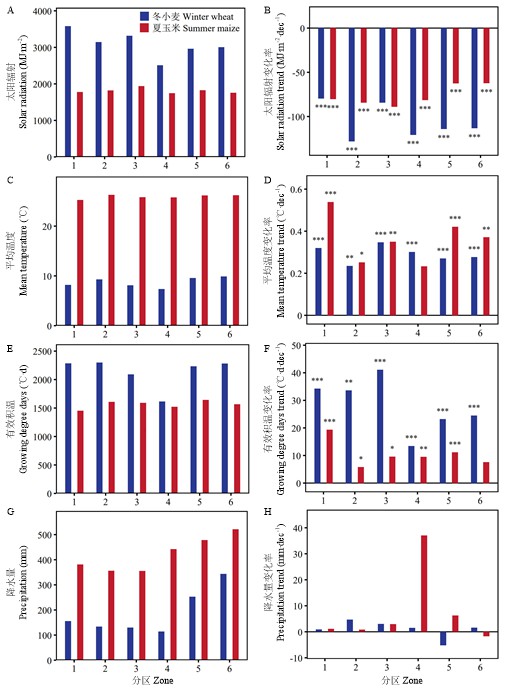
The climatic factors and trends during the growth period of winter wheat and summer maize in different regions of the Huang-Huai-Hai Plain during the historical reference period (1980-2020)"

Fig. 6

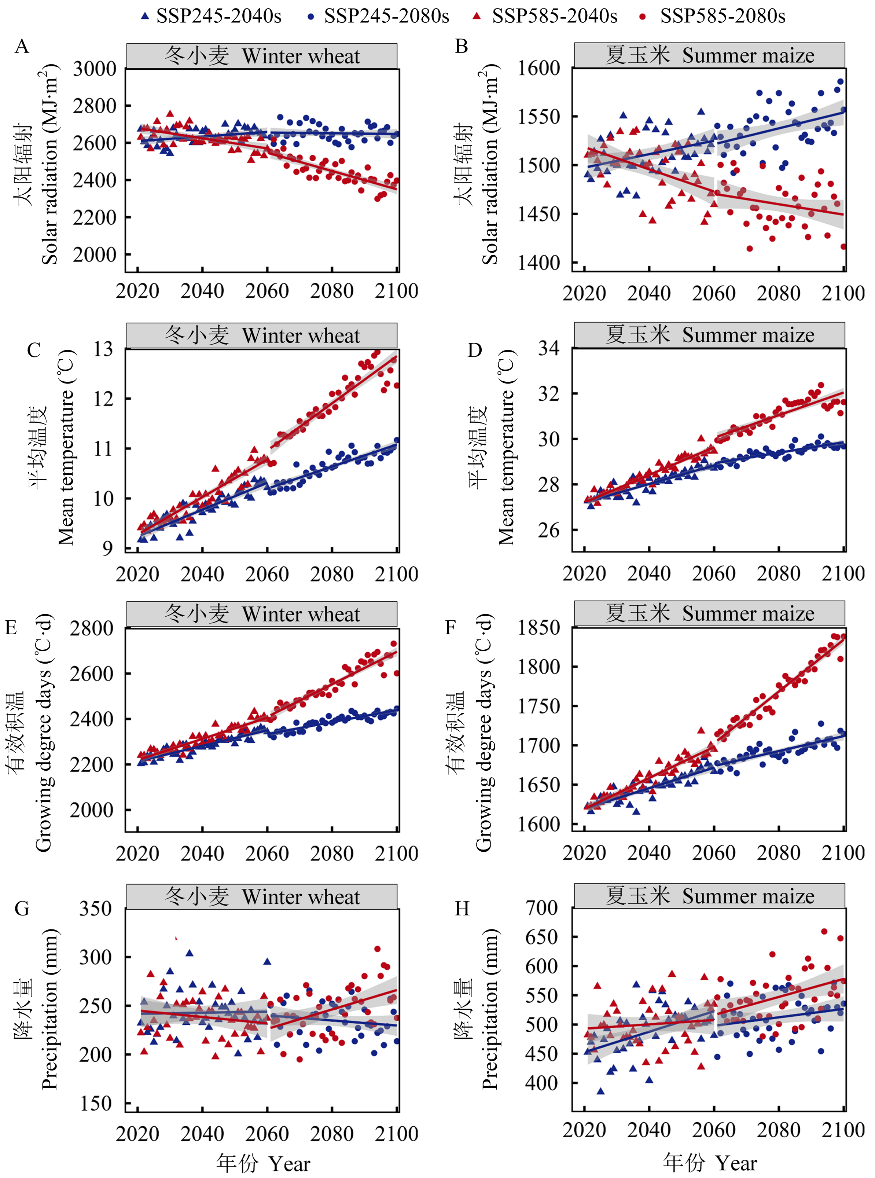
Changes of different climatic factors (accumulative solar radiation, mean temperature, effective thermal time, accumulative precipitation) during the growing seasons of winter wheat and summer maize in the Huang-Huai-Hai Plain in future periods (2040s and 2080s) under two emission scenarios (SSP245 and SSP585)"

Table 6

Dates of anthesis and maturity stages of winter wheat and summer maize in different agro-ecological zones of the Huang-Huai-Hai Plain in the historical baseline period (1980-2020) and future periods (2040s and 2080s) under two emission scenarios (SSP245 and SSP585)"

时期
Period
生育时期
Growth period
作物品种
Crop cultivar
播种后天数 Days after sowing (d)
分区1
Zone1
分区2
Zone2
分区3
Zone3
分区4
Zone4
分区5
Zone5
分区6
Zone6
基准期
Baseline period
开花期
Anthesis
冬小麦Winter wheat 217 197 197 151 186 181
夏玉米Summer maize 49 53 51 39 52 65
成熟期
Maturity
冬小麦Winter wheat 256 235 240 208 229 229
夏玉米Summer maize 95 99 100 96 101 96
SSP245_2040s 开花期
Anthesis
冬小麦Winter wheat 211 193 189 118 179 173
夏玉米Summer maize 47 52 49 36 50 61
成熟期
Maturity
冬小麦Winter wheat 251 232 233 198 223 221
夏玉米Summer maize 87 93 93 86 92 88
SSP245_2080s 开花期
Anthesis
冬小麦Winter wheat 204 186 180 94 171 163
夏玉米Summer maize 45 50 47 35 49 60
成熟期
Maturity
冬小麦Winter wheat 245 226 226 186 216 213
夏玉米Summer maize 82 89 89 82 88 84
SSP585_2040s 开花期
Anthesis
冬小麦Winter wheat 209 191 186 111 177 170
夏玉米Summer maize 46 52 49 36 50 61
成熟期
Maturity
冬小麦Winter wheat 249 230 231 194 221 219
夏玉米Summer maize 85 92 92 85 91 87
SSP585_2080s 开花期
Anthesis
冬小麦Winter wheat 194 175 165 72 161 150
夏玉米Summer maize 44 49 47 35 49 61
成熟期
Maturity
冬小麦Winter wheat 236 217 215 168 208 206
夏玉米Summer maize 78 86 86 78 85 83

Fig. 7

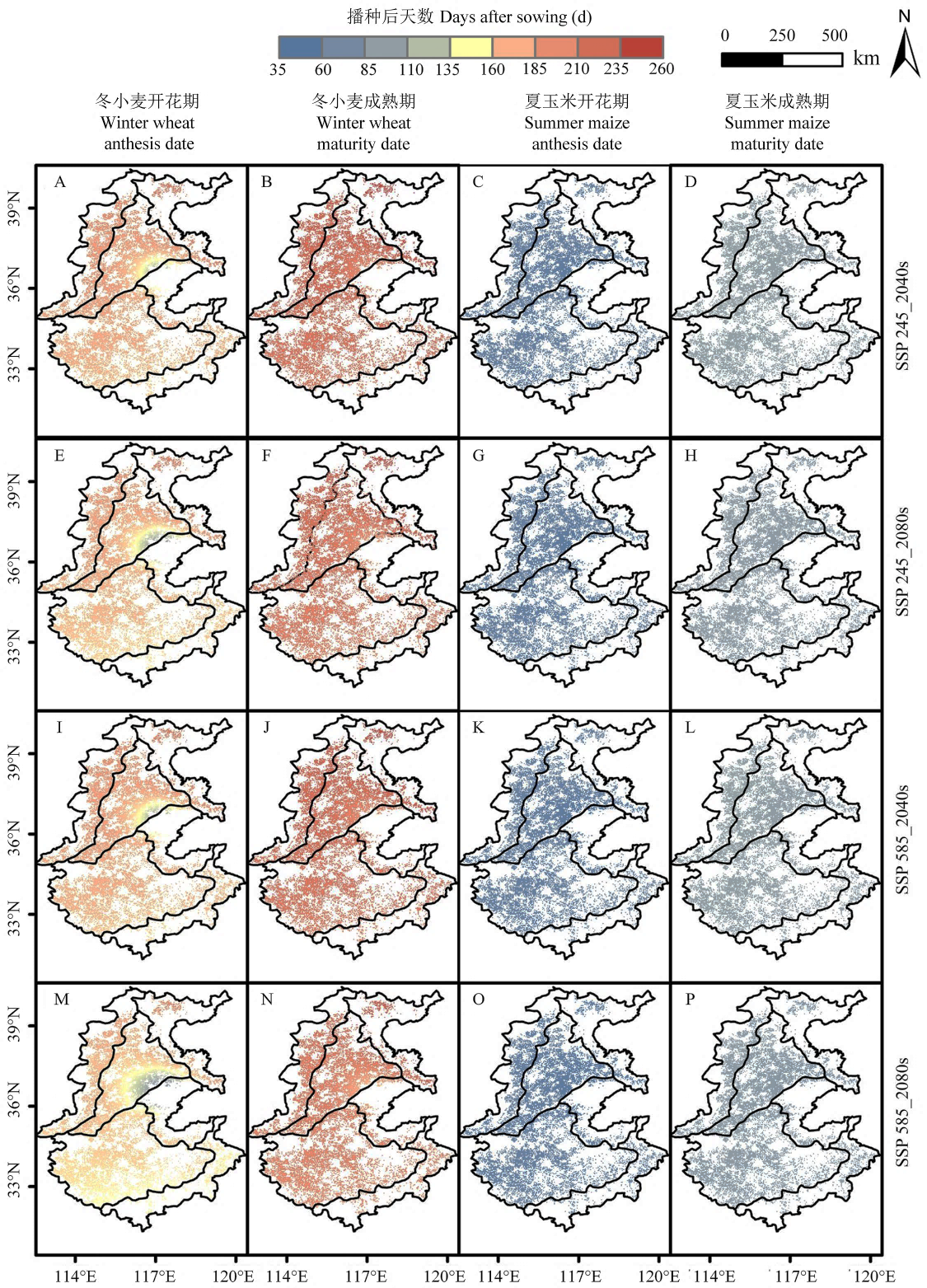
Flowering (A, E, I, M) and maturity (B, F, J, N) dates (das, days after sowing) of winter wheat, as well as the flowering (C, G, K, O) and maturity (D, H, L, P) dates (das) of summer maize in future periods (2040s and 2080s) under two emission scenarios (SSP245 and SSP585) in the Huang-Huai-Hai Plain"

Fig. 8

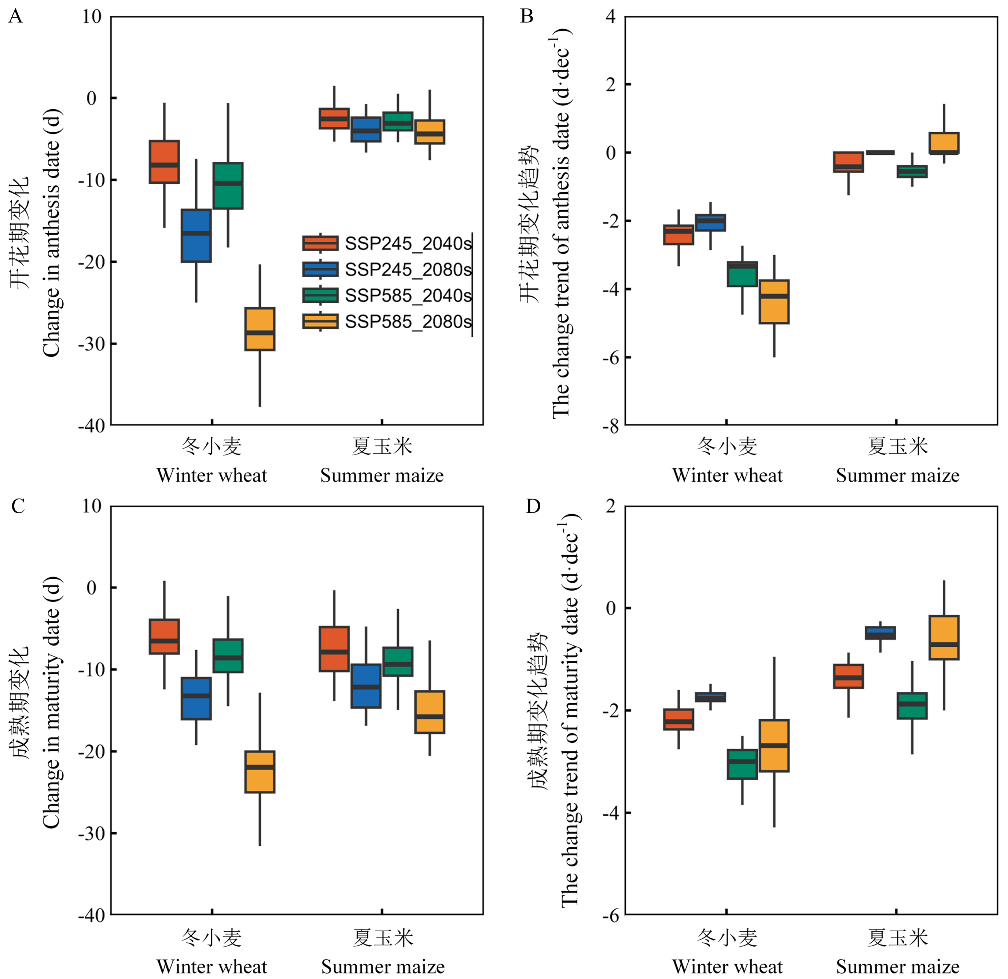
Change trends and change rates in the flowering and maturity dates of winter wheat and summer maize in future periods (2040s and 2080s) under two emission scenarios (SSP245 and SSP585) relative to the historical baseline period (1980-2020) in the Huang-Huai-Hai Plain"

Table 7

Actual yields, potential yields, and yield gaps in different agro-ecological zones (Zone1-Zone6) of the Huang-Huai-Hai Plain in the historical baseline period (1980-2020)"

作物品种
Crop cultivar
产量Yield (t·hm-2)
分区1
Zone1
分区2
Zone2
分区3
Zone3
分区4
Zone4
分区5
Zone5
分区6
Zone6
冬小麦
Winter wheat
潜在产量Potential yield 12.54 11.44 12.22 11.18 11.34 11.97
实际产量Actual yield 4.90 5.56 5.31 5.33 5.12 4.62
产量差Yield gap 7.64 5.88 6.91 5.85 6.22 7.35
夏玉米
Summer maize
潜在产量Potential yield 12.12 10.30 10.59 11.05 9.62 9.63
实际产量Actual yield 4.31 4.73 4.50 4.24 4.49 5.03
产量差Yield gap 7.81 5.57 6.09 6.81 5.13 4.60
周年产量
Annual yield
潜在产量Potential yield 24.66 21.74 22.81 22.23 20.96 21.60
实际产量Actual yield 9.21 10.29 9.81 9.57 9.61 9.65
产量差Yield gap 15.45 11.45 13.00 12.66 11.35 11.95

Table 8

Change rates in the actual yields, potential yields, and yield gaps of winter wheat, summer maize, and annual rotation system in different agro-ecological zones (Zone1-Zone6) of the Huang-Huai-Hai Plain in the historical baseline period (1980-2020)"

作物品种
Crop cultivar
产量变化速率 Yield change rate (kg·hm-2·dec-1)
分区1 Zone1 分区2 Zone2 分区3 Zone3 分区4 Zone4 分区5 Zone5 分区6 Zone6
冬小麦
Winter wheat
实际产量Actual yield 873.75 891.21 997.76 822.09 943.76 589.40
潜在产量Potential yield 107.06 -97.29 16.85 145.89 88.70 135.74
产量差Yield gap -814.65 -1013.09 -998.56 -704.06 -852.31 -454.58
夏玉米
Summer maize
实际产量Actual yield 553.35 530.36 642.78 561.30 665.25 582.10
潜在产量Potential yield -735.77 -808.87 -899.57 -772.87 -606.73 -606.67
产量差Yield gap -1277.45 -1406.76 -1561.17 -1317.22 -1342.03 -1322.12
周年产量
Annual yield
实际产量Actual yield 1495.14 1459.29 1697.55 1452.13 1674.64 1261.02
潜在产量Potential yield -629.39 -844.81 -774.83 -571.29 -493.77 -409.86
产量差Yield gap -2200.30 -2477.52 -2627.07 -2074.58 -2291.34 -1855.13

Fig. 9

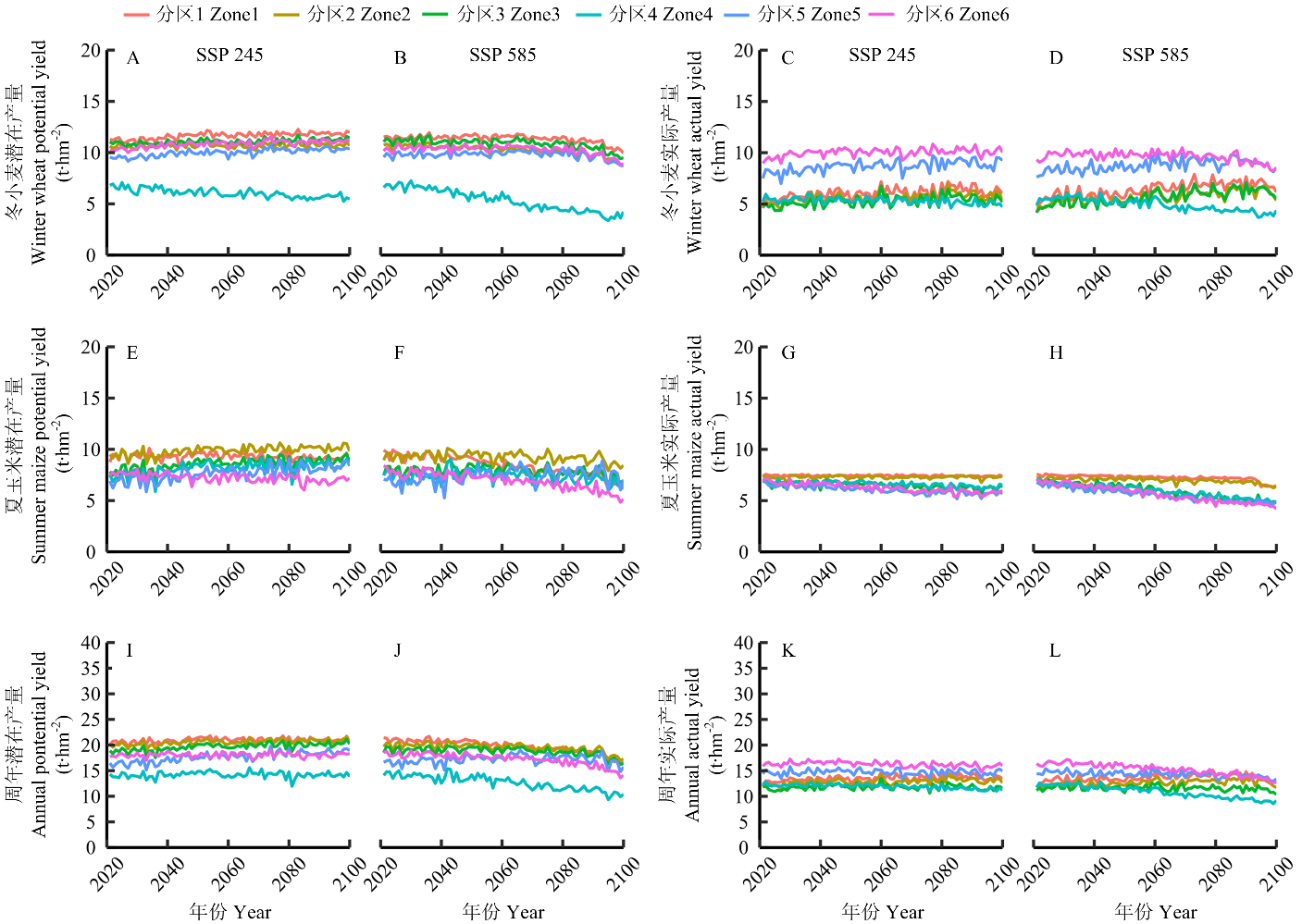
Potential yields and actual yields of winter wheat, summer maize, annual rotation system yields in the future period (2021- 2100) under two emission scenarios (SSP245 and SSP585) in different agro-ecological zones of the Huang-Huai-Hai Plain Figure A, E, I and B, F, J represent the wheat, maize and annual potential yields in different zones under the SSP245 and the SSP585 emission scenarios in the future, respectively. Figure C, G, K and D, H, L represent wheat, maize and annual actual yields in different zones under the SSP245 and SSP585 emission scenarios in the future period, respectively"

Table 9

Changes of annual yield gap of winter wheat, summer maize and rotation system in different zones (Zone1-Zone6) of Huang-Huai-Hai Plain under two emission scenarios (SSP245 and SSP585) in the future period (2040s and 2080s) compared with the base period (1980-2020)"

未来情景
Future scenario
作物品种
Crop cultivar
产量差 Yield gap (t·hm-2)
分区1
Zone1
分区2
Zone2
分区3
Zone3
分区4
Zone4
分区5
Zone5
分区6
Zone6
SSP245_2040s 冬小麦Winter wheat -1.98 -0.68 -1.01 -4.96 -4.90 -6.63
夏玉米Summer maize -5.92 -3.19 -4.46 -5.70 -4.19 -3.78
周年产量Annual yield -7.90 -3.87 -5.47 -10.66 -9.09 -10.41
SSP245_2080s 冬小麦Winter wheat -2.11 -0.94 -1.17 -5.22 -4.89 -6.43
夏玉米Summer maize -6.00 -2.76 -3.56 -4.88 -2.78 -3.46
周年产量Annual yield -8.11 -3.70 -4.73 -10.10 -7.67 -9.89
SSP585_2040s 冬小麦Winter wheat -2.01 -0.62 -0.98 -4.99 -4.84 -6.71
夏玉米Summer maize -6.05 -3.31 -4.58 -5.73 -4.06 -3.38
周年产量Annual yield -8.06 -3.93 -5.56 -10.72 -8.90 -10.09
SSP585_2080s 冬小麦Winter wheat -3.36 -1.98 -2.41 -5.84 -5.54 -6.69
夏玉米Summer maize -7.16 -3.28 -3.71 -5.08 -2.54 -3.21
周年产量Annual yield -10.52 -5.26 -6.12 -10.92 -8.08 -9.90

Fig. 10

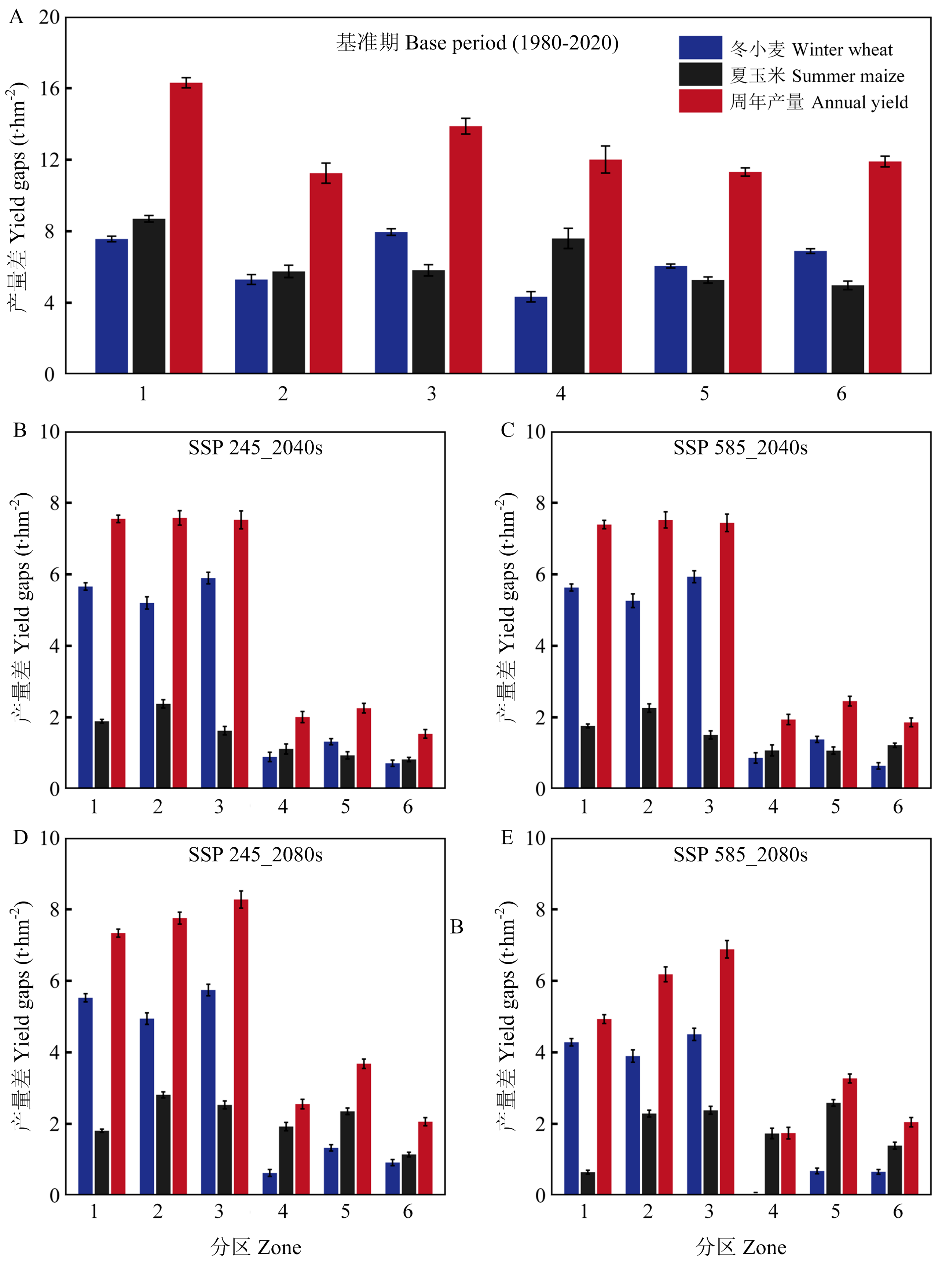
Yield gaps of winter wheat, summer maize, and annual rotation system in historical baseline period and future periods (2040s, 2080s)under two emission scenarios (SSP245, SSP585) in different agro-ecological zones of the Huang-Huai-Hai Plain"

Fig. 11

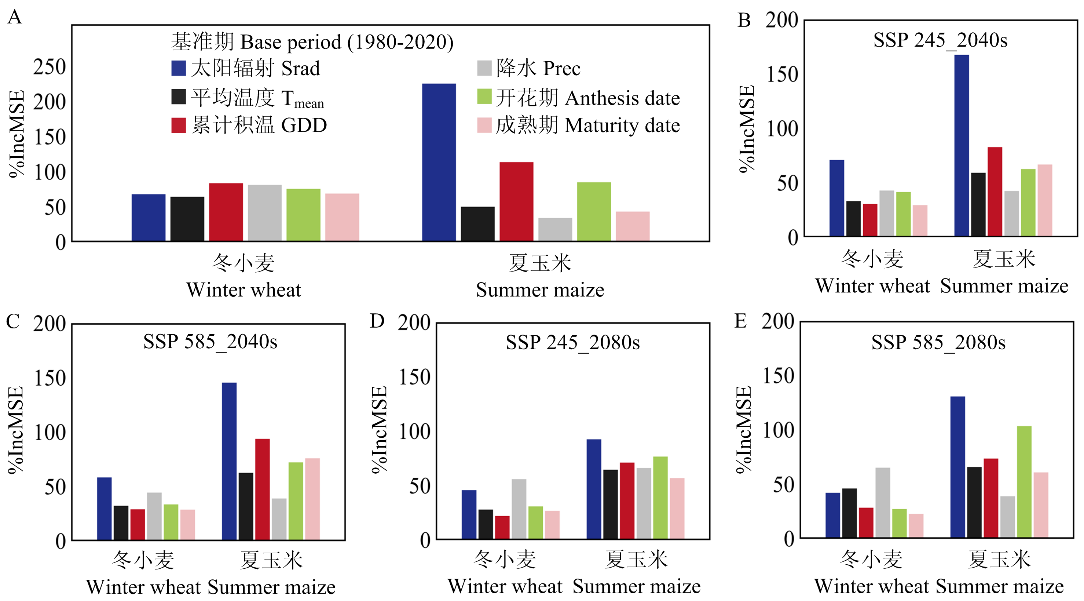
Ranking of the relative importance (%IncMSE) of different climatic and biological factors for the potential yields of winter wheat and summer maize during the historical baseline period (1980-2020; A) and future periods (2040s (B, C) and 2080s (D, E)) under two emission scenarios (SSP245 (B, D) and SSP585 (C, E)) in the Huang-Huai-Hai Plain"

[1]
Wu W B, Verburg P H, Tang H J. Climate change and the food production system: Impacts and adaptation in China[J]. Regional Environmental Change, 2014, 14(1): 1-5.
[2]
李裕瑞, 杨忆, 刘路路, 潘玮. 中国粮食生产的新空间格局及其气候灾害风险[J]. 农业工程学报, 2026, 42(2): 1-13.
Li Y R, Yang Y, Liu L L, Pan W. New spatial pattern of food production and its climatic disaster risk in China[J]. Transactions of the Chinese Society of Agricultural Engineering, 2026, 42(2): 1-13. (in Chinese)
[3]
Sena L, Mica E, Valè G, Vaccino P, Pecchioni N. Exploring the potential of endophyte-plant interactions for improving crop sustainable yields in a changing climate[J]. Frontiers in Plant Science, 2024, 15: 1349401.
[4]
刘水苗, 关小康, 赵志恒, 王景辉, 刘世龙, 高培萌, 王艳丽, 吴鹏年, 高晨凯, 李煜铭, 邵京, 于昊琳, 王同朝, 温鹏飞. 冬麦播前耕作方式对麦玉轮作体系中玉米季土壤水分、籽粒灌浆特征及产量的影响[J]. 中国农业科学, 2024, 57(18): 3568-3585. DOI: 10.3864/j.issn.0578-1752.2024.18.005.
Liu S M, Guan X K, Zhao Z H, Wang J H, Liu S L, Gao P M, Wang Y L, Wu P N, Gao C K, Li Y M, Shao J, Yu H L, Wang T C, Wen P F. Residual effects of tillage regime on soil moisture dynamics, grain filling characteristics and yield of summer maize in wheat-maize double cropping system[J]. Scientia Agricultura Sinica, 2024, 57(18): 3568-3585. DOI: 10.3864/j.issn.0578-1752.2024.18.005. (in Chinese)
[5]
de la Cruz V Y V, Tantriani, Cheng W G, Tawaraya K. Yield gap between organic and conventional farming systems across climate types and sub-types: A meta-analysis[J]. Agricultural Systems, 2023, 211: 103732.
[6]
赖奕晨, 任梦, 周袁希, 龚敏, 关浩杰. 黄淮海平原农户粮食生产行为调查分析[J]. 粮食科技与经济, 2021, 46(2): 12-15.
Lai Y C, Ren M, Zhou Y X, Gong M, Guan H J. Analysis of farmers' food production behavior in Huang-Huai-Hai Plain[J]. Grain Science and Technology and Economy, 2021, 46(2): 12-15. (in Chinese)
[7]
Mueller N D, Gerber J S, Johnston M, Ray D K, Ramankutty N, Foley J A. Closing yield gaps through nutrient and water management[J]. Nature, 2012, 490(7419): 254-257.
[8]
Wang H Z, Ren H, Han K, Zhang L H, Zhao Y L, Liu Y E, He Q J, Li G, Zhang J W, Zhao B, Ren B Z, Liu P. Experimental assessment of the yield gap associated with maize production in the North China Plain[J]. Field Crops Research, 2023, 295: 108897.
[9]
Zhang Z M, Lu C H. Assessing changes in potential yields and yield gaps of summer maize in the North China Plain[J]. Food and Energy Security, 2024, 13: e489.
[10]
Wang H Z, Ren H, Zhang L H, Zhao Y L, Liu Y E, He Q J, Li G, Han K, Zhang J W, Zhao B, Ren B Z, Liu P. A sustainable approach to narrowing the summer maize yield gap experienced by smallholders in the North China Plain[J]. Agricultural Systems, 2023, 204(C): 103541.
[11]
Senapati N, Semenov M A. Assessing yield gap in high productive countries by designing wheat ideotypes[J]. Scientific Reports, 2019, 9: 5516.
[12]
Wang H Z, Ren H, Han K, He Q J, Zhang L H, Zhao Y L, Liu Y E, Zhang J W, Zhao B, Ren B Z, Liu P. Sustainable improvement strategies for summer maize yield, nitrogen use efficiency and greenhouse gas emission intensity in the North China Plain[J]. European Journal of Agronomy, 2023, 143: 126712.
[13]
Li K N, Yang X G, Liu Z J, Zhang T Y, Lu S, Liu Y. Low yield gap of winter wheat in the North China Plain[J]. European Journal of Agronomy, 2014, 59: 1-12.
[14]
Li S, Liu J, Shang M, Jia H, Feng Y, Chu Q, Chen F. Multi-scale assessment of winter wheat yield gaps with an integrated evaluation framework in the Huang-Huai-Hai farming region in China[J]. The Journal of Agricultural Science, 2019, 157(6): 523-536.
[15]
Liu J G, Wang G Y, Kelly T, Zhang Y Y, Yang M, Chu Q Q. Effect of nitrogen and water deficit type on the yield gap between the potential and attainable wheat yield[J]. Chilean Journal of Agricultural Research, 2015, 75(4): 457-464.
[16]
Yan Z Z, Du T S. Effects of climate factors on wheat and maize under different crop rotations and irrigation strategies in the North China Plain[J]. Environmental Research Letters, 2023, 18(12): 124015.
[17]
Liang S, Li Y F, Zhang X B, Sun Z G, Sun N, Duan Y H, Xu M G, Wu L H. Response of crop yield and nitrogen use efficiency for wheat-maize cropping system to future climate change in northern China[J]. Agricultural and Forest Meteorology, 2018, 262: 310-321.
[18]
Li X X, Ju H, Sarah G, Yan C R, Batchelor W D, Liu Q. Spatiotemporal variation of drought characteristics in the Huang- Huai-Hai Plain, China under the climate change scenario[J]. Journal of Integrative Agriculture, 2017, 16(10): 2308-2322.
[19]
刘巽浩. 农作制与中国农作制区划[J]. 中国农业资源与区划, 2002, 23(5): 11-15.
Liu X H. Farming system and farming system regional planning in China[J]. Journal of China Agricultural Resources and Regional Planning, 2002, 23(5): 11-15. (in Chinese)
[20]
曹宏鑫, 赵锁劳, 葛道阔, 刘永霞, 刘岩, 孙金英, 岳延滨, 张智优, 陈煜利. 作物模型发展探讨[J]. 中国农业科学, 2011, 44(17): 3520-3528. DOI: 10.3864/j.issn.0578-1752.2011.17.004.
Cao H X, Zhao S L, Ge D K, Liu Y X, Liu Y, Sun J Y, Yue Y B, Zhang Z Y, Chen Y L. Discussion on development of crop models[J]. Scientia Agricultura Sinica, 2011, 44(17): 3520-3528. DOI: 10.3864/j.issn.0578-1752.2011.17.004. (in Chinese)
[21]
Verburg K, Pasley H R, Biggs J S, Vogeler I, Wang E L, Mielenz H, Snow V O, Smith C J, Pasut C, Basche A D, He D, Archontoulis S V, Gaydon D S, Huth N I, Holzworth D P, Sharp J M, Cichota R, Khaembah E N, Teixeira E I, Brown H E, et al. Review of APSIM’s soil nitrogen modelling capability for agricultural systems analyses[J]. Agricultural Systems, 2025, 224: 104213.
[22]
Keating B A, Carberry P S, Hammer G L, Probert M E, Robertson M J, Holzworth D, Huth N I, Hargreaves J N G, Meinke H, Hochman Z, McLean G, Verburg K, Snow V, Dimes J P, Silburn M, Wang E, Brown S, Bristow K L, Asseng S, Chapman S, et al. An overview of APSIM, a model designed for farming systems simulation[J]. European Journal of Agronomy, 2003, 18(3/4): 267-288.
[23]
Keating B A. APSIM’s origins and the forces shaping its first 30 years of evolution: A review and reflections[J]. Agronomy for Sustainable Development, 2024, 44(3): 24.
[24]
Bai H Q, Wang J, Fang Q X, Huang B X. Does a trade-off between yield and efficiency reduce water and nitrogen inputs of winter wheat in the North China Plain[J]. Agricultural Water Management, 2020, 233: 106095.
[25]
Jiang M N, Liu C S, Chen M S. Quantifying potential yield and water-limited yield of summer maize in the North China Plain[J]. Remote sensing and modeling of ecosystems for sustainability xiv, 2017, 10405.
[26]
任思洋, 张青松, 李婷玉, 张福锁. 华北平原五省冬小麦产量和氮素管理的时空变异[J]. 中国农业科学, 2019, 52(24): 4527-4539. DOI: 10.3864/j.issn.0578-1752.2019.24.008.
Ren S Y, Zhang Q S, Li T Y, Zhang F S. Spatiotemporal variation of winter wheat yield and nitrogen management in five provinces of North China Plain[J]. Scientia Agricultura Sinica, 2019, 52(24): 4527-4539. DOI: 10.3864/j.issn.0578-1752.2019.24.008. (in Chinese)
[27]
Gavasso-Rita Y L, Papalexiou S M, Li Y P, Elshorbagy A, Li Z H, Schuster-Wallace C. Crop models and their use in assessing crop production and food security: A review[J]. Food and Energy Security, 2024, 13: e503.
[28]
Gobezie A, Ademe D, Sharma L K. CERES-maize (DSSAT) model applications for maize nutrient management across agroecological zones: A systematic review[J]. Plants, 2025, 14(5): 661.
[29]
Jones J W, Hoogenboom G, Porter C H, Boote K J, Batchelor W D, Hunt L A, Wilkens P W, Singh U, Gijsman A J, Ritchie J T. The DSSAT cropping system model[J]. European Journal of Agronomy, 2003, 18(3/4): 235-265.
[30]
王亚莉, 贺立源. 作物生长模拟模型研究和应用综述[J]. 华中农业大学学报, 2005(5): 529-535.
Wang Y L, He L Y. A review on the research and application of crop simulation model[J]. Journal of Huazhong Agricultural University, 2005(5): 529-535. (in Chinese)
[31]
Dokoohaki H, Kivi M S, Martinez-Feria R, Miguez F E, Hoogenboom G. A comprehensive uncertainty quantification of large-scale process- based crop modeling frameworks[J]. Environmental Research Letters, 2021, 16(8): 084010.
[32]
Zhang Z, Luo Y C, Han J C, Xu J L, Tao F L. Estimating global wheat yields at 4 km resolution during 1982-2020 by a spatiotemporal transferable method[J]. Remote Sensing, 2024, 16(13): 2342.
[33]
Lizumi T, Sakai T. The global dataset of historical yields for major crops 1981-2016[J]. Scientific Data, 2020, 7: 97.
[34]
Cao J, Zhang Z, Luo X Z, Luo Y C, Xu J L, Xie J, Han J C, Tao F L. Mapping global yields of four major crops at 5-minute resolution from 1982 to 2015 using multi-source data and machine learning[J]. Scientific Data, 2025, 12: 357.
[35]
Qiu B W, Hu X, Chen C C, Tang Z H, Yang P, Zhu X L, Yan C, Jian Z Y. Maps of cropping patterns in China during 2015-2021[J]. Scientific Data, 2022, 9: 479.
[36]
Soci C, Hersbach H, Simmons A, Poli P, Bell B, Berrisford P, Horányi A, Muñoz-Sabater J, Nicolas J, Radu R, Schepers D, Villaume S, Haimberger L, Woollen J, Buontempo C, Thépaut J N. The ERA 5 global reanalysis from 1940 to 2022[J]. Quarterly Journal of the Royal Meteorological Society, 2024, 150(764): 4014-4048.
[37]
Eyring V, Cox P M, Flato G M, Gleckler P J, Abramowitz G, Caldwell P, Collins W D, Gier B K, Hall A D, Hoffman F M, Hurtt G C, Jahn A, Jones C D, Klein S A, Krasting J P, Kwiatkowski L, Lorenz R, Maloney E, Meehl G A, Pendergrass A G, et al. Taking climate model evaluation to the next level[J]. Nature Climate Change, 2019, 9(2): 102-110.
[38]
Liu D L, Zuo H P. Statistical downscaling of daily climate variables for climate change impact assessment over New South Wales, Australia[J]. Climatic Change, 2012, 115(3): 629-666.
[39]
Senthilkumar K. Closing rice yield gaps in Africa requires integration of good agricultural practices[J]. Field Crops Research, 2022, 285: 108591.
[40]
Anderson W, Johansen C, Siddique K H M. Addressing the yield gap in rainfed crops: A review[J]. Agronomy for Sustainable Development, 2016, 36(1): 18.
[41]
卢必慧, 邱琳, 李卫国, 王志明, 田苗, 王晶, 单捷. 基于遥感的作物产量和产量差估算研究进展[J]. 江苏农业学报, 2023, 39(3): 881-894.
Lu B H, Qiu L, Li W G, Wang Z M, Tian M, Wang J, Shan J. Research progress on crop yield and yield gap estimation based on remote sensing[J]. Jiangsu Journal of Agricultural Sciences, 2023, 39(3): 881-894. (in Chinese)
[42]
Zhao Y, Chen X P, Lobell D B. An approach to understanding persistent yield variation: A case study in North China Plain[J]. European Journal of Agronomy, 2016, 77: 10-19.
[43]
Gao Y K, Zhao H F, Zhao C, Hu G H, Zhang H, Liu X, Li N, Hou H Y, Li X. Spatial and temporal variations of maize and wheat yield gaps and their relationships with climate in China[J]. Agricultural Water Management, 2022, 270(C): 107714.
[44]
徐建文, 居辉, 梅旭荣, 刘勤, 杨建莹. 近30年黄淮海平原干旱对冬小麦产量的潜在影响模拟[J]. 农业工程学报, 2015, 31(6): 150-158.
Xu J W, Ju H, Mei X R, Liu Q, Yang J Y. Simulation on potential effects of drought on winter wheat in Huang-Huai-Hai Plain from 1981 to 2010[J]. Transactions of the Chinese Society of Agricultural Engineering, 2015, 31(6): 150-158. (in Chinese)
[45]
Hu T X, Zhang X S, Khanal S, Wilson R, Leng G Y, Toman E M, Wang X H, Li Y, Zhao K G. Climate change impacts on crop yields: A review of empirical findings, statistical crop models, and machine learning methods[J]. Environmental Modelling & Software, 2024, 179: 106119.
[46]
Silva J V, Baudron F, Ngoma H, Nyagumbo I, Simutowe E, Kalala K, Habeenzu M, Mphatso M, Thierfelder C. Narrowing maize yield gaps across smallholder farming systems in Zambia: What interventions, where, and for whom[J]. Agronomy for Sustainable Development, 2023, 43(2): 26.
[47]
Liu Y L, Zhang H, Li G C, Sun X F, Wang M. A comprehensive method to increase yield and narrow the yield gap of winter wheat for sustainable intensification[J]. Journal of the Science of Food and Agriculture, 2022, 102(10): 4238-4249.
[48]
Chen W, Zhang J J, Deng X P. Winter wheat yield improvement by genetic gain across different provinces in China[J]. Journal of Integrative Agriculture, 2024, 23(2): 468-483.
[49]
赵红. 基于Meta分析和CERES-maize模型的玉米施氮增密的产量缩差研究[D]. 北京: 中国农业科学院, 2022.
Zhao H. Reduction of yield gap effect through nitrogen fertilizerand planting density in maize based on Meta-analysisand CERES-Maize model[D]. Beijing: Chinese Academy of Agricultural Sciences, 2022. (in Chinese)
[50]
Chen Y, Zhang Z, Tao F L, Wang P, Wei X. Spatio-temporal patterns of winter wheat yield potential and yield gap during the past three decades in North China[J]. Field Crops Research, 2017, 206: 11-20.
[51]
范兰, 吕昌河, 于伯华, 王涛. 华北平原小麦-玉米两作生产潜力与产量差[J]. 中国农学通报, 2016, 32(9): 33-40.
Fan L, Lü C H, Yu B H, Wang T. Yield potential and yield gap of wheat-maize cropping system in the North China Plain[J]. Chinese Agricultural Science Bulletin, 2016, 32(9): 33-40. (in Chinese)
[52]
Farooq A, Farooq N, Akbar H, Hassan Z U, Gheewala S H. A critical review of climate change impact at a global scale on cereal crop production[J]. Agronomy, 2023, 13(1): 162.
[53]
Tollenaar M, Fridgen J, Tyagi P, Stackhouse P W Jr, Kumudini S. The contribution of solar brightening to the US maize yield trend[J]. Nature Climate Change, 2017, 7(4): 275-278.
[54]
Zahra N, Hafeez M B, Wahid A, Al Masruri M H, Ullah A, Siddique K H M, Farooq M. Impact of climate change on wheat grain composition and quality[J]. Journal of the Science of Food and Agriculture, 2023, 103(6): 2745-2751.
[55]
Xiao D P, Liu D L, Wang B, Feng P Y, Bai H Z, Tang J Z. Climate change impact on yields and water use of wheat and maize in the North China Plain under future climate change scenarios[J]. Agricultural Water Management, 2020, 238: 106238.
[56]
Singh A, Pandey H, Pandey S, Lal D, Chauhan D, Aparna, Antre S H, B S, Kumar A. Drought stress in maize: Stress perception to molecular response and strategies for its improvement[J]. Functional & Integrative Genomics, 2023, 23(4): 296.
[57]
陈佳义. 气候变化对江苏省冬小麦气候适宜性的影响[D]. 南京: 南京信息工程大学, 2023.
Chen J Y. Influence of climate change on climate suitability of winter wheat in Jiangsu Province[D]. Nanjing: Nanjing University of Information Science & Technology, 2023. (in Chinese)
[58]
Aryal J P, Sapkota T B, Khurana R, Khatri-Chhetri A, Rahut D B, Jat M L. Climate change and agriculture in South Asia: Adaptation options in smallholder production systems[J]. Environment, Development and Sustainability, 2020, 22(6): 5045-5075.
[59]
韩守威, 司纪升, 余维宝, 孔令安, 张宾, 王法宏, 张海林, 赵鑫, 李华伟, 孟鈺. 山东省冬小麦产量差与氮肥利用效率差形成机理解析[J]. 中国农业科学, 2022, 55(16): 3110-3122. DOI: 10.3864/j.issn.0578-1752.2022.16.004.
Han S W, Si J S, Yu W B, Kong L A, Zhang B, Wang F H, Zhang H L, Zhao X, Li H W, Meng Y. Mechanisms analysis on yield gap and nitrogen use efficiency gap of winter wheat in Shandong Province[J]. Scientia Agricultura Sinica, 2022, 55(16): 3110-3122. DOI: 10.3864/j.issn.0578-1752.2022.16.004. (in Chinese)
[1] LUO Wei, YU Hong, YUAN LiXin, WANG LingLing, ZHAO JinPeng, YIN Wei, WANG MingTian, WANG RuLin. Change of Geographic Distributions of Ratoon Rice in Sichuan- Chongqing Under Global Climate Change [J]. Scientia Agricultura Sinica, 2026, 59(4): 765-780.
[2] GUO ShiBo, ZHANG ZhenTao, GUO ErJing, ZHAO Jin, LIU ZhiJuan, ZHAO Chuang, YANG XiaoGuang. The Possible Effects of Global Warming on Cropping Systems in China XV. Adjustment of China’s Oil Crop Patterns to Adapt to Future Climate Change [J]. Scientia Agricultura Sinica, 2025, 58(11): 2118-2144.
[3] XUE Wei, XU LiJun, NIE YingYing, WU XinJia, YAN YiDan, YE LiMing, LIU XinWei. Study on Dominant Factors Affecting Spatial Variation of Soil Organic Carbon in Hulunbuir Grassland [J]. Scientia Agricultura Sinica, 2024, 57(12): 2378-2389.
[4] YANG WangHua, LIU ZhiJuan, GONG JingJin, FU ZhenZhen, ZHANG TaiLin, ZHANG XiaoLong, SHEN YanJun, YANG XiaoGuang. Drought Risk for Spring Maize in the Future and Response to Climate Change in the Northeast China [J]. Scientia Agricultura Sinica, 2024, 57(12): 2336-2349.
[5] MA ShengLan, KUANG FuHong, LIN HongYu, CUI JunFang, TANG JiaLiang, ZHU Bo, PU QuanBo. Effects of Straw Incorporation Quantity on Soil Physical Characteristics of Winter Wheat-Summer Maize Rotation System in the Central Hilly Area of Sichuan Basin [J]. Scientia Agricultura Sinica, 2023, 56(7): 1344-1358.
[6] ZHANG WeiJian, SHANG ZiYin, ZHANG Jun, YAN ShengJi, DENG AiXing, ZHANG Xin, ZHENG ChengYan, SONG ZhenWei. Standardized Establishment and Improvement of Accounting System of Agriculture Greenhouse Gas Emission [J]. Scientia Agricultura Sinica, 2023, 56(22): 4467-4477.
[7] SHI XinRui, HAN BaiShu, WANG ZiQian, ZHANG YuanLing, LI Ping, ZONG YuZheng, ZHANG DongSheng, GAO ZhiQiang, HAO XingYu. Investigation on the Effects of Climate Change on the Growth and Yield of Different Maturity Winter Wheat Varieties in Northern China Based on the APSIM Model [J]. Scientia Agricultura Sinica, 2023, 56(19): 3772-3787.
[8] ZHANG ZhiLiang, HE ZhiHao, RU XiaoYa, JIANG TengCong, HE YingBin, FENG Hao, YU Qiang, HE JianQiang. Influence of Future Climate Change on the Climate Suitability of Potato Cultivation in China [J]. Scientia Agricultura Sinica, 2023, 56(18): 3530-3542.
[9] SHEN Zhe, HAN TianFu, QU XiaoLin, MA ChangBao, WANG HuiYing, LIU KaiLou, HUANG Jing, DU JiangXue, ZHANG Lu, LIU LiSheng, LI JiWen, ZHANG HuiMin. Spatial-Temporal Variation of Relative Yield Gap of Wheat and Maize and Its Response to Nitrogen Fertilizer in China [J]. Scientia Agricultura Sinica, 2023, 56(14): 2724-2737.
[10] ZHANG WenJing, ZHAO Jin, CUI WenQian, LI ManYao, LI E, GONG XiaoYa, YANG XiaoGuang. Effects of Changing Normal and Extreme Climate States on Maize Meteorological Yield in Northeast China [J]. Scientia Agricultura Sinica, 2023, 56(10): 1859-1870.
[11] ZHAO ZhengXin,WANG XiaoYun,TIAN YaJie,WANG Rui,PENG Qing,CAI HuanJie. Effects of Straw Returning and Nitrogen Fertilizer Types on Summer Maize Yield and Soil Ammonia Volatilization Under Future Climate Change [J]. Scientia Agricultura Sinica, 2023, 56(1): 104-117.
[12] GUO ShiBo, ZHANG FangLiang, ZHANG ZhenTao, ZHOU LiTao, ZHAO Jin, YANG XiaoGuang. The Possible Effects of Global Warming on Cropping Systems in China XIV. Distribution of High-Stable-Yield Zones and Agro-Meteorological Disasters of Soybean in Northeast China [J]. Scientia Agricultura Sinica, 2022, 55(9): 1763-1780.
[13] YI YingJie, HAN Kun, ZHAO Bin, LIU GuoLi, LIN DianXu, CHEN GuoQiang, REN Hao, ZHANG JiWang, REN BaiZhao, LIU Peng. The Comparison of Ammonia Volatilization Loss in Winter Wheat- Summer Maize Rotation System with Long-Term Different Fertilization Measures [J]. Scientia Agricultura Sinica, 2022, 55(23): 4600-4613.
[14] REN Yifang,YANG ZhangPing,LING Fenghua,XIAO LiangWen. Risk Zoning of Heat Stress Risk Zoning of Dairy Cows in Jiangsu Province and Its Characteristics Affected by Climate Change [J]. Scientia Agricultura Sinica, 2022, 55(22): 4513-4525.
[15] WANG QiaoJuan,HE Hong,LI Liang,ZHANG Chao,CAI HuanJie. Research on Soybean Irrigation Schedule Based on AquaCrop Model [J]. Scientia Agricultura Sinica, 2022, 55(17): 3365-3379.
Viewed
Full text


Abstract

Cited

  Shared   
  Discussed   
No Suggested Reading articles found!