







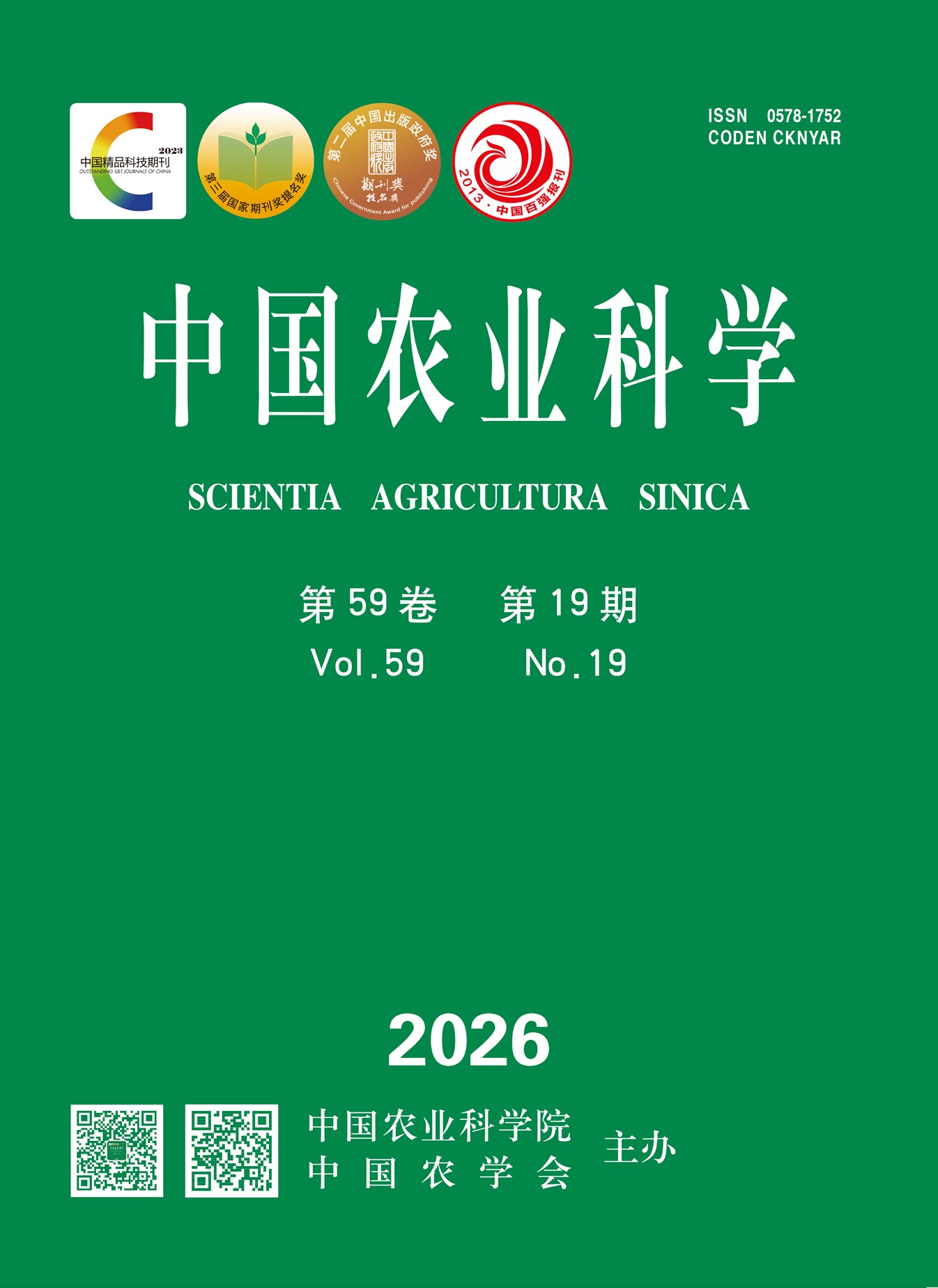

The journal publishes research findings aimed at promoting high-yield, high-quality, efficient, and environmentally friendly agriculture and animal husbandry.
The journal welcomes original research papers, research notes, and rapid communications in the applied basic research and advanced technology fields of agricultural and animal husbandry sciences, provided that the work has not been publicly published or otherwise published previously. Reviews and special articles addressing important issues in basic and applied agricultural research are also considered.
Manuscripts must present comprehensive and reliable data, use concise language, clearly state the main arguments, provide sound reasoning, and demonstrate originality in at least some aspects. Review articles should present the latest research advances, both in China and internationally, in important fields of agricultural science. They should incorporate the author's own contributions to the relevant field, offer original insights, and provide guidance for future disciplinary development. General literature reviews without these features will not be accepted.
Upon submission, authors must upload a scanned copy of the Copyright Authorization and Transfer Agreement (hereinafter referred to as the “Copyright Agreement”), bearing the signatures of all authors and the official stamp of the research administration department of the authors' institution(s). The original document must be mailed to the editorial office for recordkeeping after the manuscript has been assigned a manuscript ID.
Research papers, including research notes, should be organized in the following order: title; author names; full institutional affiliations; city and postal code; Chinese abstract; Chinese keywords; English title (consistent with the Chinese title); English author names; full institutional affiliations in English; English abstract; and English keywords.
The main text should include the following sections: 0 Introduction, 1 Materials and Methods, 2 Results, 3 Discussion, and 4 Conclusions. It should also include a footnote on the first page of the main text, acknowledgments at the end of the main text, and references.
The title should be concise, clear, and accurate, and should generally not exceed 20 Chinese characters. All levels of headings in the main text should be numbered consecutively using Arabic numerals, with no more than three heading levels.
Authorship should be limited to individuals who participated in the research and are able to answer questions concerning the paper. To avoid disputes, authors must upload a Copyright Agreement bearing the signatures of all authors.
Author names should be separated by commas. The full institutional affiliation of every author must be provided in both Chinese and English, together with the city and postal code. The first author and the corresponding author must also provide a telephone or mobile phone number and an email address to facilitate communication.
All authors should reach agreement on the order of authorship before submission. In principle, the author order should not be changed after the manuscript has been accepted for publication.
Chinese names should be written with the family name first, followed by the given name.
In the author list beneath the article title, the family name should be written entirely in uppercase letters, while the given name should begin with a capital letter. If the given name consists of two Chinese characters, the two syllables should be written together without a space. Examples: ZHAI HuQu, LIU Xu, QU DongYu, and GUO YuYuan.
In the reference list, the family name should retain only its initial capital letter, and the given name should be abbreviated using its initials. Examples: Zhai H Q, Liu X, Qu D Y, and Guo Y Y.
The journal requires structured, extended abstracts of approximately 1,000 Chinese characters to maximize the dissemination of research findings through domestic and international secondary literature databases.
Each component of the abstract must be expressed in complete sentences, and the abstract as a whole should provide a reasonably comprehensive account of the main content of the paper. The abstract should follow this order: objective, methods, principal results, and conclusions. The Chinese abstract must retain the section labels “【目的】”, “【方法】”, “【结果】”, and “【结论】”.
The English abstract must follow the same structured format, using complete sentences to describe the research objective, methods, results, and conclusions under the corresponding labels “【Objective】”, “【Method】”, “【Result】”, and “【Conclusion】”.
Funding information: Articles reporting research supported by national or provincial/ministerial-level funding programs, key research projects, or special projects funded by the Ministry of Agriculture and Rural Affairs, the Ministry of Science and Technology, the Ministry of Education, or other relevant agencies must specify the full name of each funding project, followed by the project number in parentheses. In principle, manuscripts without any research funding will not be accepted unless they demonstrate exceptional academic value.
Author information: A footnote on the first page must provide the first author's name, professional title, academic degree, telephone number, fax number, and email address. If a corresponding author is designated, the corresponding author's name, professional title, academic degree, telephone number, fax number, and email address must also be provided.
The Introduction should be organized around the following elements: research significance (academic or economic significance), progress in previous research, the specific focus of the present study, and the key questions to be addressed.
Research significance: Explain the importance of the study to agricultural production or agricultural research. The significance of the research must be clearly stated; a manuscript without clear significance is not suitable for publication.
Progress in previous research: Provide background information on the study, supported by relevant references. International literature must not be overlooked, and a substantial proportion of the cited literature should be recent. As most research builds upon previous work, the principal contributions of earlier studies should be appropriately acknowledged and summarized.
Focus of the present study: Identify the limitations, gaps, or unresolved issues in previous research, thereby establishing the rationale for the present study.
Key questions to be addressed: Specify the work to be undertaken and the scientific questions it aims to resolve.
After reading the Introduction, readers should be able to understand the general state of the research field and the relative position of the present study within the national and international research landscape.
This section should clearly describe the time and location of the experiments; the representativeness and specific identities of the experimental materials and conditions; the experimental scale and sample size; the rationale and methods of the experimental design; the number of replicates; the instruments and equipment used; the chemicals and their specifications; the statistical methods; and other relevant details.
When methods adopted from previous studies are used, the relevant references must be cited, for example, Reference [**].
The main findings from each individual experiment should be presented separately. Results should include the primary experimental data as well as secondary-, tertiary-, or higher-level data derived from statistical analyses of the original data.
Authors should describe the information revealed by the statistical analyses and may explain the logical relationships among the results of different experiments. The presentation should be clearly structured, logically organized, and easy to follow. In general, the Results section should not include evaluations of other researchers' studies.
Only figures and tables essential to the presentation of the research should be included. Redundancy between figures, tables, and the main text should be avoided.
All Chinese text in figure and table titles, notes, captions, explanatory statements, and other related elements must be accompanied by corresponding English translations. Table titles and table notes are considered integral parts of the tables.
Figures and tables must be self-explanatory, meaning that the information conveyed should be understandable from their titles, data or images, and accompanying notes.
To facilitate journal production, authors are strongly encouraged to prepare figures using Excel.
Quantities and units must comply with international standards for quantities and units and the legally prescribed measurement units of China. Land areas must be converted to hectares (hm2).
The Discussion must be presented as a separate section and must not be combined with the Results or Conclusions.
This section should compare and critically evaluate similarities and differences between the present findings and those of previous studies. Authors should explain what their findings validate, confirm, or refute; elucidate mechanisms where the available evidence permits; and further analyze and explain any unclear causes or inconsistencies.
The Discussion should enable readers to understand the differences and novel contributions of the present findings relative to existing research and provide a logical basis for the conclusions drawn.
The Conclusions must be presented as a separate section and must not be combined with the Discussion.
Conclusions should be concise, clear, and substantive, providing a logically organized summary of the fundamental findings of the study. All essential information revealed by the research should be summarized so that other researchers can readily understand and cite the findings.
The Conclusions should not consist of commentary on the results. Generic or evaluative statements such as “lays the foundation for” or “provides a guarantee for” should be avoided.
The reference list should include domestic and international literature directly relevant to the manuscript, with particular emphasis on publications from the past five years. Research papers are required to cite at least 30 references, while review articles are required to cite at least 50 references.
Unpublished literature and materials should generally not be cited. References to peer-reviewed journals are recommended.
The journal uses a numerical citation system. References must be numbered consecutively in the order in which they first appear in the main text.
In accordance with international conventions, the names of all authors must be listed in the references.
Chinese-language references must be presented in both Chinese and English. The Chinese entries should first be listed in their original Chinese form, followed by their English translations. The English translations should not be assigned separate reference numbers.
All punctuation in the reference list must use half-width English punctuation marks.
Books
The reference format for books is as follows:
Author(s). Book title. Edition (omit the edition information for the first edition). Place of publication: Publisher, Year: Page range.
Journal articles
The reference format for journal articles is as follows:
Author(s). Article title. Full journal title (journal titles must not be abbreviated; English journal titles should be italicized), Year, Volume(Issue): Page range.
For journals with continuous pagination throughout a volume, the issue number may be omitted.
Examples
[1] 景润春, 卢洪. CRISPR/Cas9基因组定向编辑技术的发展与在作物遗传育种中的应用[J]. 中国农业科学, 2016, 49(7): 1219-1229.
Jing R C, Lu H. The development of CRISPR/Cas9 system and its application in crop genome editing [J]. Scientia Agricultura Sinica, 2016, 49(7): 1219-1229. (in Chinese)
[2] 翟振. 北方春玉米农田N2O排放规律及减排措施研究—以燕山东麓为例[D]. 北京: 中国农业科学院, 2013.
Zhai Z. Studies on N2O emissions and mitigation of spring maize field in North of China-A case study from Qianxi county, in Eastern Yanshan mountain [D]. Beijing: Chinese Academy of Agricultural Sciences, 2013. (in Chinese)
[3] 徐云碧, 朱立煌. 分子数量遗传学[M]. 北京: 中国农业出版社, 1994: 108-110.
Xu Y B, Zhu L H. Molecular Quantitative Genetics [M]. Beijing: China Agriculture Press, 1994: 108-110. (in Chinese)
To submit a manuscript, please visit the journal website:
http://www.chinaagrisci.com/CN/0578-1752/home.shtml
Click the “Author Submission and Manuscript Tracking” button on the right-hand side of the page and follow the instructions to complete the submission process.
If a page cannot be opened while following the submission instructions, return to the previous step. Without entering any additional information, click “Next” to skip that step and continue.
Thank you for your interest in the journal.
We wish you every success with your submission!
