Scientia Agricultura Sinica ›› 2026, Vol. 59 ›› Issue (14): 3132-3146.doi: 10.3864/j.issn.0578-1752.2026.14.011

• HORTICULTURE • Previous Articles     Next Articles

Effects of Helianthus tuberosus Straw Biochar on Watermelon Growth, Fusarium Wilt and Soil Bacterial Communities Under Continuous Cropping

ZHOU ShengYi1(), LI Chao1, YU XinRan2, WU FengZhi1(), PAN Kai1,2()   

  1. 1 College of Horticulture and Landscape Architecture, Northeast Agricultural University, Harbin 150030
    2 School of Horticulture, Ludong University, Yantai 264025, Shandong
  • Received:2026-02-25 Accepted:2026-04-29 Online:2026-07-16 Published:2026-07-21
  • Contact: WU FengZhi, PAN Kai

Abstract:

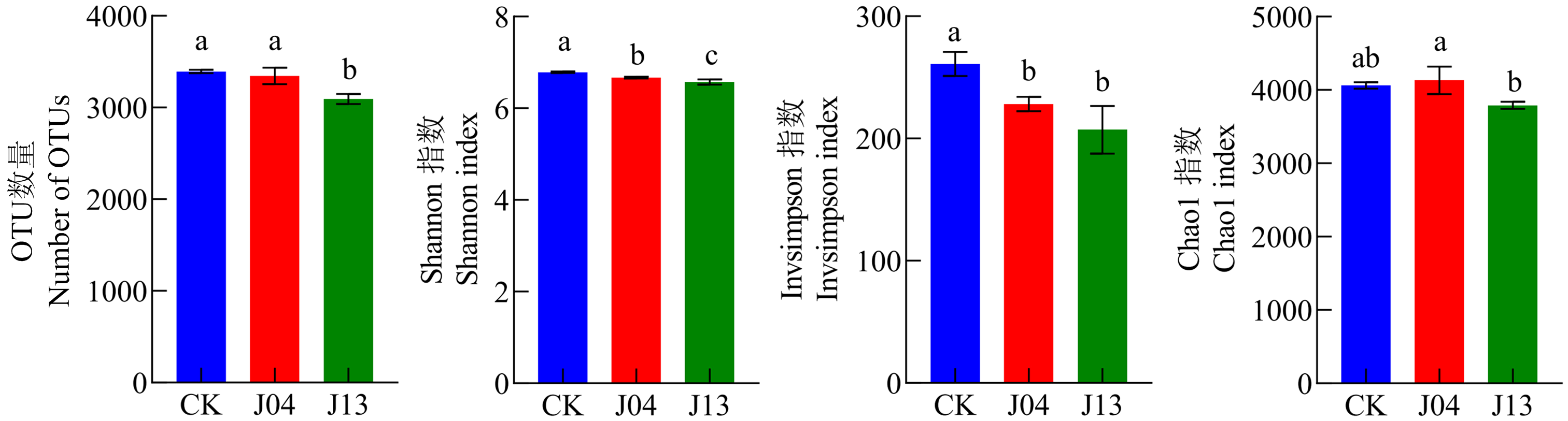
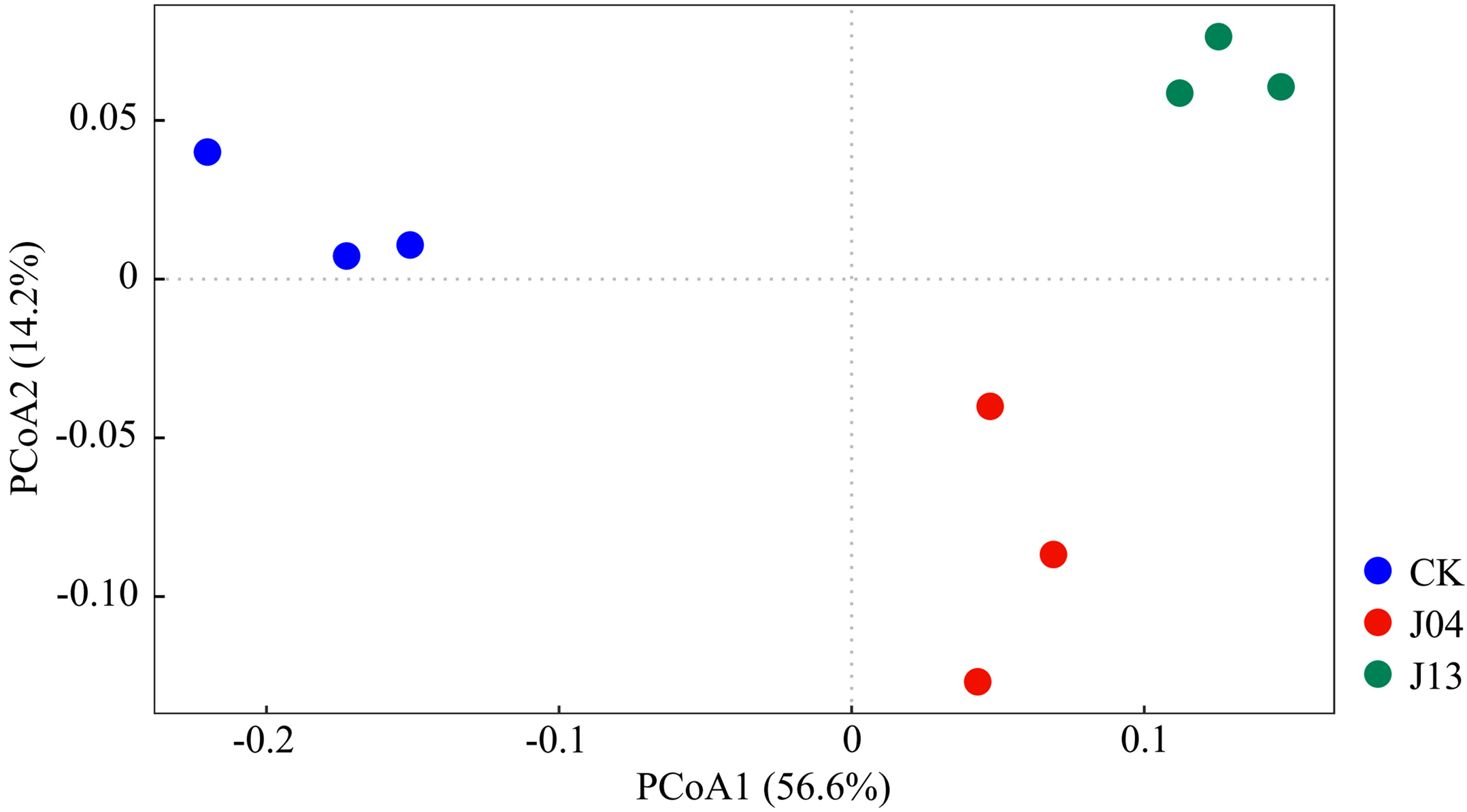
Objective】Aiming at the problems of plant growth inhibition, frequent Fusarium wilt and microbial community imbalance caused by continuous cropping obstacle of watermelon, the effects of Helianthus tuberosus straw biochar on growth promotion, disease inhibition and microbiological mechanism were explored.【Method】Two kinds of H. tuberosus straw biochar were used as test materials, and four treatments were set up, including 1% (w/w) biochar-continuous cropping soil mixed treatment (denoted as J04 and J13, respectively), carbendazim control (Y) and blank control (CK). The effects of biochar on the growth of watermelon seedlings and the occurrence of Fusarium wilt were investigated by pot experiment. The effects of H. tuberosus straw biochar on soil bacterial community structure and diversity were analyzed by Miseq high-throughput sequencing technology.【Result】Compared with CK, the two biochar treatments significantly promoted the accumulation of watermelon seedling biomass and reduced the Fusarium wilt disease index. At 35 d after transplanting, compared with CK, the whole plant dry weight of J04 and J13 treatments significantly increased by 10.8% and 27.6%, the incidence significantly decreased by 28.8% and 48.5%, and the disease index significantly decreased by 21.1 and 30.8. The incidence of carbendazim treatment (Y) was significantly lower than that of CK by 59.1%, the disease index was significantly decreased by 38.1, and the dry weight of the whole plant was significantly increased by 4.3% (P<0.05). Compared with CK, the α diversity of soil bacterial community in J04 and J13 treatments decreased significantly, and the Shannon index and Invsimpson index were significantly lower than CK. H. tuberosus biochar treatment significantly changed the soil bacterial community structure (R2=0.690, P=0.009). At the phylum level, J13 treatment significantly increased the relative abundance of Actinobacteriota and Firmicutes, and inhibited Acidobacteriota and Myxococcota. At the genus level, J13 treatment significantly enriched potential beneficial bacteria such as Gemmatimonas and Devosia. The FAPROTAX function prediction further indicated that J13 treatment significantly increased the abundance of microbial groups related to functions such as chemical heterotrophy and urea decomposition, which may promote the rhizosphere nutrient cycle.【Conclusion】The addition of H. tuberosus straw biochar (J13) can effectively alleviate the continuous cropping obstacle of watermelon, and its growth-promoting and disease-inhibiting effects are closely related to the improvement of rhizosphere bacterial community structure and the enrichment of potential beneficial bacteria with specific functions.

Key words: Helianthus tuberosus straw, biochar, watermelon Fusarium wilt, soil bacterial community, functional prediction

Table 1

Basic physicochemical properties of H. tuberosus straw biochar"

种类
Type
比表面积
Surface area (m2·g-1)
孔径
Pore size (nm)
孔体积
Pore volume (mm3·g-1)
碳氮比
C/N
pH EC值
EC value (mS·cm-1)
J04 1.8 11.8 3.5 126.1 10.8 0.18
J13 3.2 7.5 5.2 197.8 10.4 0.14

Fig. 1

Effects of different H. tuberosus straw biochars on the growth of continuously cropped watermelon seedlings"

Fig. 2

Effects of different H. tuberosus straw biochars on Fusarium wilt in continuously cropped watermelon seedlings The growth of watermelon seedlings at 25, 35 d after transplanting, respectively"

Fig. 3

Effects of inoculating soil microorganisms from different treatments on watermelon seedling growth"

Fig. 4

Effects of inoculating soil microorganisms from different treatments on watermelon seedling Fusarium wilt"

Fig. 5

Effects of different H. tuberosus straw biochars on the alpha diversity indices of bacterial communities in watermelon rhizosphere"

Fig. 6

PCoA analysis of bacterial communities in watermelon rhizosphere under different H. tuberosus straw biochar treatments"

Fig. 7

Effects of different H. tuberosus straw biochars on bacterial OTU level in watermelon rhizosphere"

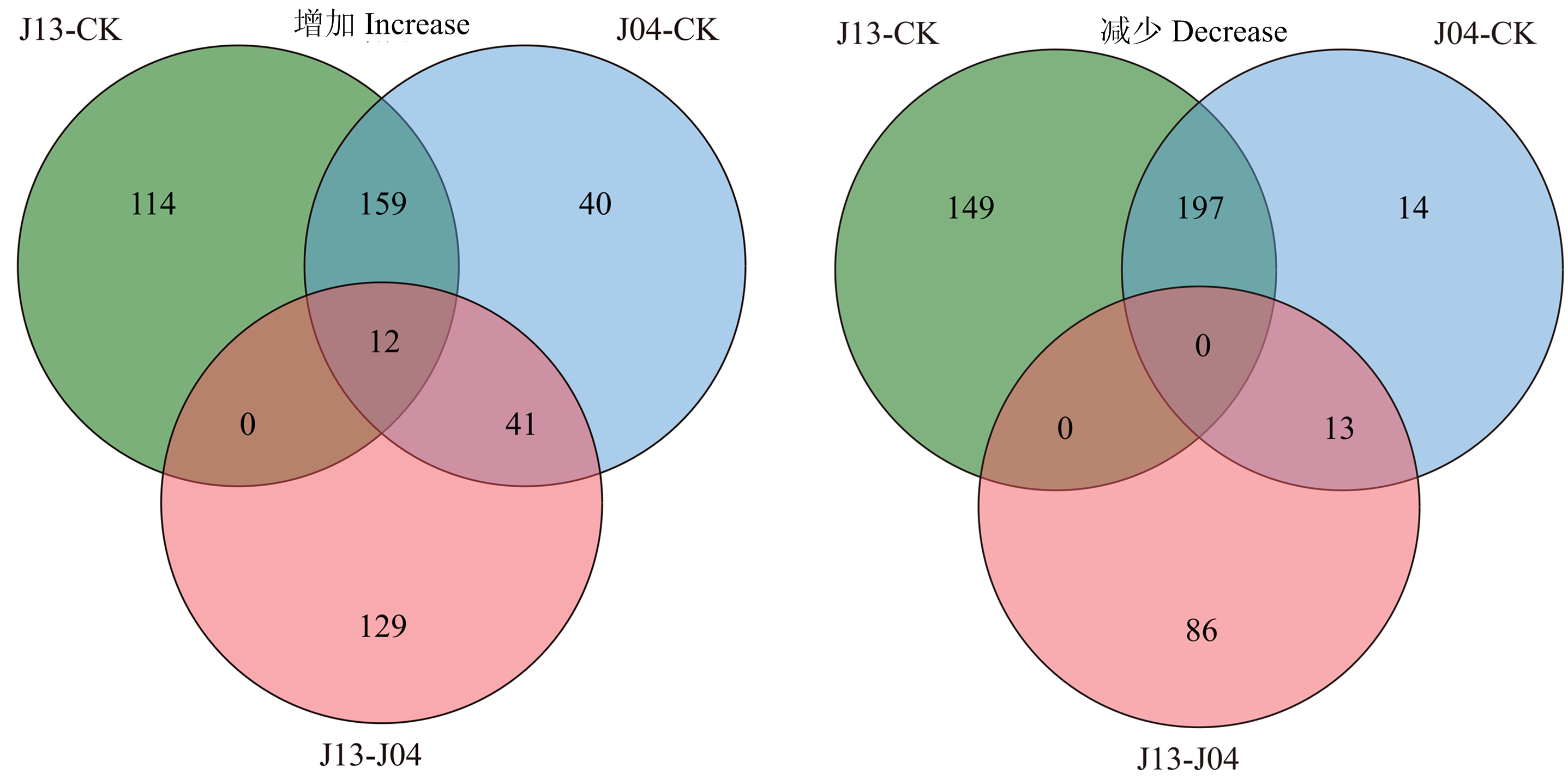
Fig. 8

Analysis of differentially expressed bacterial OTUs in watermelon rhizosphere under different H. tuberosus straw biochars"

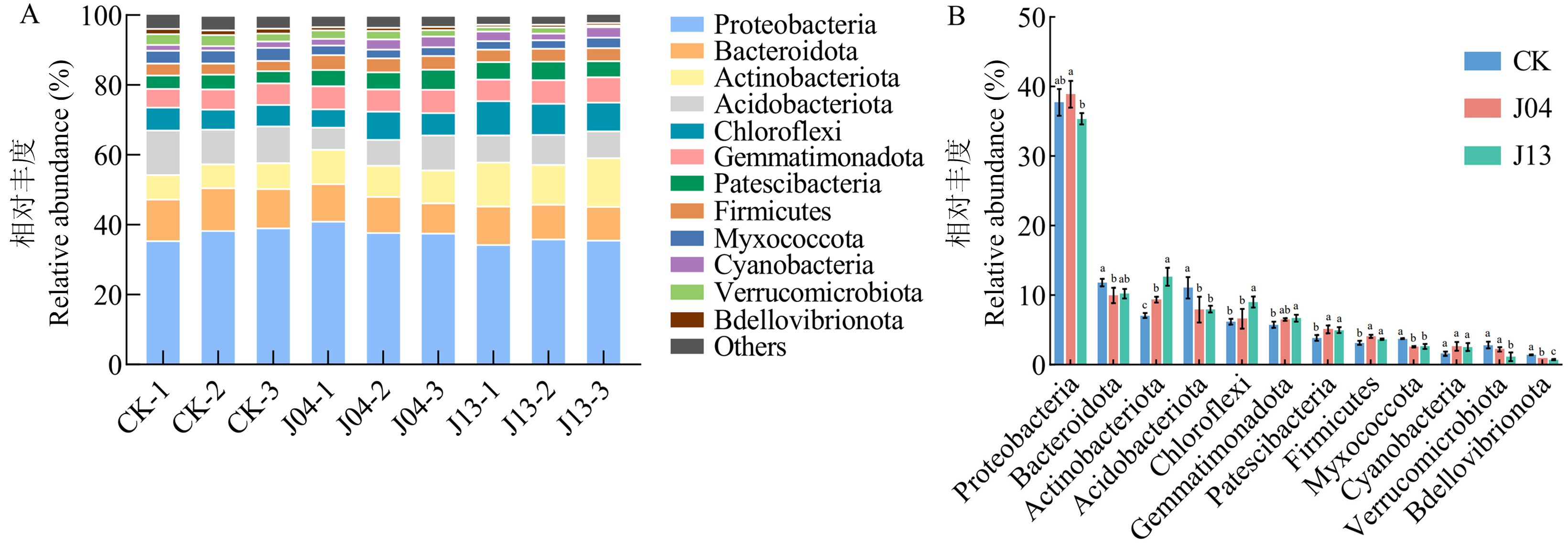
Fig. 9

Effects of different H. tuberosus straw biochars on relative abundance of bacterial phyla in watermelon rhizosphere"

Table 2

Effects of different H. tuberosus straw biochars on the relative abundance of Top 50 bacterial genera in watermelon rhizosphere (%)"

属Genus CK J04 J13
鞘氨醇单胞菌属Sphingomonas 4.166±0.351b 5.357±0.445a 5.553±0.054a
norank_o__SBR1031 1.768±0.306b 1.845±0.714b 3.572±0.669a
黄土杆菌属Flavisolibacter 1.776±0.070b 2.492±0.484a 2.547±0.087a
假双斧状菌属Pseudolabrys 1.753±0.245b 2.029±0.204ab 2.351±0.129a
芽单胞菌属Gemmatimonas 1.687±0.186b 2.056±0.163ab 2.379±0.208a
norank_o__Vicinamibacterales 2.525±0.444a 1.759±0.483a 1.799±0.052a
norank_f__Microscillaceae 2.558±0.191a 1.549±0.302b 1.715±0.154b
norank_f__Gemmatimonadaceae 2.074±0.097a 1.854±0.076b 1.777±0.025b
norank_o__Chloroplast 0.659±0.068b 2.045±0.527a 2.072±0.399a
norank_f__Vicinamibacteraceae 1.940±0.333a 1.295±0.419a 1.310±0.060a
假单胞菌属Pseudomonas 2.605±0.374a 1.565±0.094b 0.278±0.011c
norank_f__LWQ8 0.536±0.095c 1.707±0.198b 2.132±0.151a
芽孢杆菌属Bacillus 1.331±0.023a 1.279±0.066a 1.278±0.056a
MND1 1.529±0.117a 1.132±0.095b 0.880±0.036c
norank_o__Gaiellales 0.975±0.110b 1.121±0.112ab 1.336±0.141a
Allorhizobium-Neorhizobium-Pararhizobium-Rhizobium 1.177±0.076a 1.109±0.182a 0.962±0.154a
沙壤土杆菌属Ramlibacter 0.867±0.011b 1.242±0.050a 1.112±0.100a
链霉菌属Streptomyces 0.910±0.013a 1.118±0.242a 1.094±0.092a
海无柄孢囊黏细菌属Haliangium 1.193±0.068a 0.854±0.019b 0.914±0.105b
拟无枝酸菌属Amycolatopsis 0.143±0.008c 0.954±0.168b 1.799±0.259a
德沃斯氏菌属Devosia 0.848±0.035b 0.887±0.067ab 1.027±0.081a
Ellin6067 0.825±0.066a 0.899±0.078a 0.975±0.073a
norank_c__S0134_terrestrial_group 0.764±0.041a 0.901±0.124a 0.813±0.054a
韩农科技所菌属Niastella 1.531±0.139a 0.627±0.236b 0.299±0.046b
类固醇杆菌属Steroidobacter 1.096±0.139a 0.609±0.198b 0.740±0.075ab
norank_o__Saccharimonadales 0.568±0.076a 0.932±0.336a 0.933±0.060a
norank_f__SC-I-84 0.719±0.100a 0.781±0.121a 0.856±0.020a
新草小螺菌属Noviherbaspirillum 0.551±0.024b 1.097±0.254a 0.636±0.031b
unclassified_f__Comamonadaceae 0.913±0.122a 0.794±0.104ab 0.562±0.065b
苯基小杆菌属Phenylobacterium 0.516±0.038b 0.789±0.088a 0.861±0.034a
norank_o__Acidobacteriales 0.787±0.060a 0.644±0.299a 0.622±0.118a
Polyangium_brachysporum_group 0.802±0.068a 0.575±0.033b 0.608±0.042b
硝化螺菌属Nitrospira 0.733±0.016a 0.670±0.105ab 0.562±0.030b
norank_f__Longimicrobiaceae 0.432±0.022b 0.737±0.023a 0.793±0.047a
苔藓杆菌属Bryobacter 0.718±0.060a 0.642±0.052ab 0.575±0.042b
norank_f__67-14 0.353±0.025b 0.676±0.104a 0.817±0.097a
norank_f__Pedosphaeraceae 0.809±0.171a 0.636±0.042ab 0.392±0.169b
norank_f__A4b 0.802±0.084a 0.424±0.027b 0.582±0.071b
norank_f__Chitinophagaceae 0.489±0.035b 0.577±0.054ab 0.707±0.087a
norank_o__Candidatus_Kaiserbacteria 1.122±0.340a 0.510±0.077b 0.124±0.034b
norank_f__Xanthobacteraceae 0.511±0.091b 0.569±0.028ab 0.662±0.032a
norank_c__KD4-96 0.475±0.096a 0.625±0.208a 0.639±0.014a
norank_o__Subgroup_7 0.626±0.017a 0.544±0.005a 0.539±0.060a
norank_f__TRA3-20 0.629±0.035a 0.489±0.025b 0.496±0.071b
鹰嘴豆杆菌属Ciceribacter 0.121±0.015b 0.784±0.035a 0.701±0.123a
unclassified_f__Gemmatimonadaceae 0.437±0.050a 0.589±0.018a 0.570±0.092a
金黄线菌属Chryseolinea 0.306±0.091b 0.360±0.192b 0.821±0.181a
溶杆菌属Lysobacter 0.400±0.103a 0.492±0.116a 0.548±0.019a
鞘氨醇菌属Sphingobium 0.374±0.027b 0.454±0.065ab 0.581±0.078a
RB41 0.624±0.078a 0.383±0.043b 0.337±0.096b

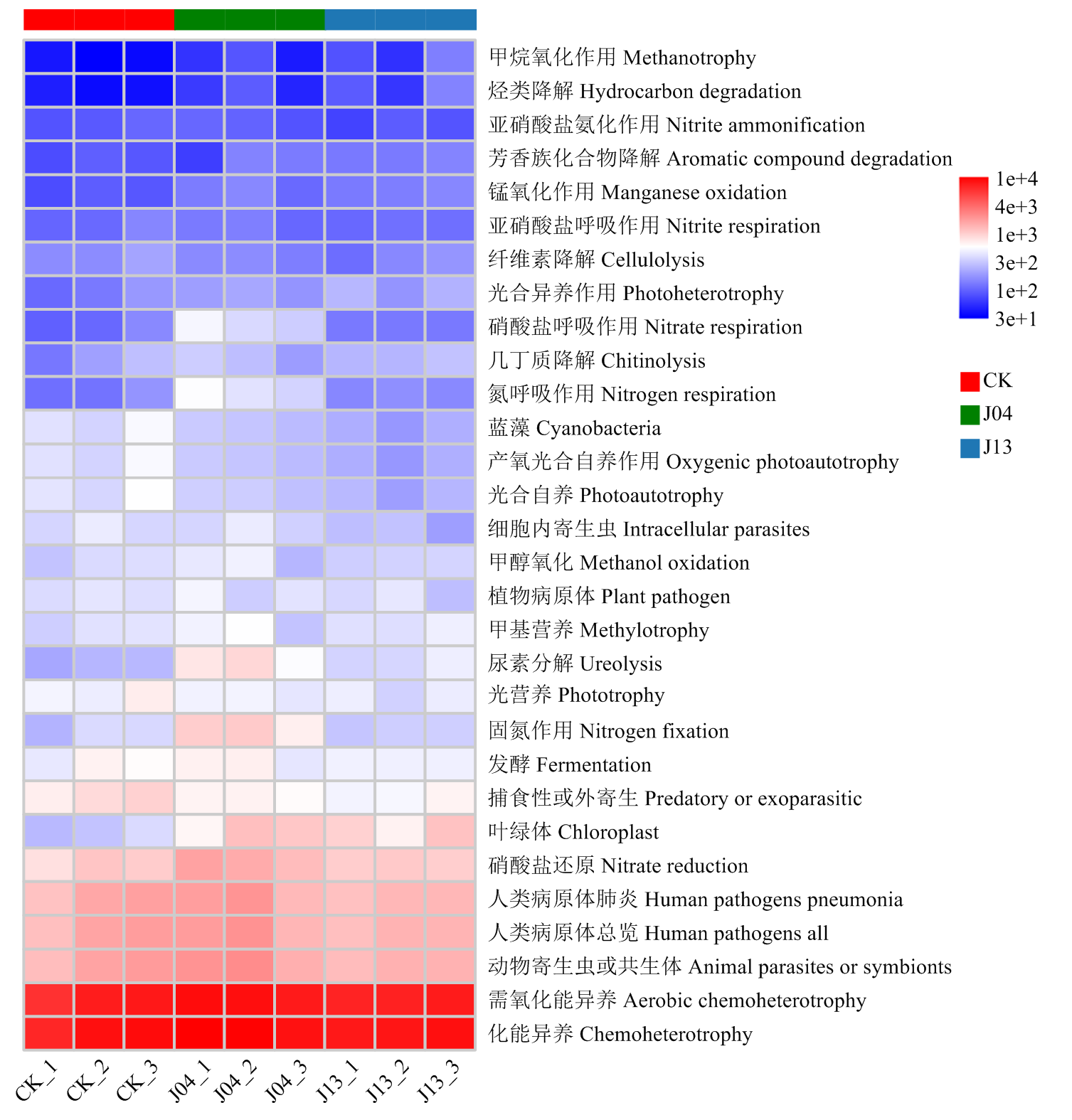
Fig. 10

Heatmap of FAPROTAX functional diversity of watermelon rhizosphere bacteria under different H. tuberosus straw biochar treatments"

[1]
姚丽娟, 田春丽, 王立河, 杜君, 校彦赟, 远兵强. 设施西瓜连作土壤生化性质及微生物群落变化[J]. 中国土壤与肥料, 2024(3): 70-78.
Yao L J, Tian C L, Wang L H, Du J, Xiao Y Y, Yuan B Q. Changes of soil biochemical properties and microbial community in continuous cropping of watermelon under greenhouse cultivation[J]. Soil and Fertilizer Sciences in China, 2024(3): 70-78. (in Chinese)
[2]
张冬明, 郑道君, 曾建华, 吉清妹, 符传良, 谢良商. 西瓜连作对土壤主要微生物数量、酶活性及果实品质的影响[J]. 北方园艺, 2017(4): 155-158.
Zhang D M, Zheng D J, Zeng J H, Ji Q M, Fu C L, Xie L S. Effects of watermelon continuous cropping on the quantity of main soil microorganisms, enzyme activities, and fruit quality[J]. Northern Horticulture, 2017(4): 155-158. (in Chinese)
[3]
Vargas-Arispuro I, Ramírez-Bustos I I, Arratia-Castro A A, Bárcena-Santana D, Fernández-Herrera E. First report of Fusarium oxysporum f. sp. niveum race 1 as causal agent of vascular wilt of watermelon in Mexico[J]. Revista Chapingo Serie Horticultura, 2023, 29(3): 47-57.

doi: 10.5154/r.rchsh
[4]
Li X, Chen D, Carrión V J, Revillini D, Yin S, Dong Y, Zhang T, Wang X, Delgado-Baquerizo M. Acidification suppresses the natural capacity of soil microbiome to fight pathogenic Fusarium infections[J]. Nature Communications, 2023, 14: 5090.

doi: 10.1038/s41467-023-40810-z
[5]
侯嘉玮, 马荣, 谷医林, 王星, 张晓霞, 马毅楠. 西瓜枯萎病对根际细菌多样性的影响[J]. 中国土壤与肥料, 2024(2): 97-104.
Hou J W, Ma R, Gu Y L, Wang X, Zhang X X, Ma Y N. Effects of watermelon Fusarium wilt on the diversity of rhizosphere bacteria[J]. Soil and Fertilizer Sciences in China, 2024(2): 97-104. (in Chinese)
[6]
贾云鹤, 王喜庆, 闫闻, 付永凯, 尤海波, 王丽冬, 刘晓飞, 刘超. 放线菌秸秆降解液对西瓜连作土壤生态结构的影响[J]. 中国瓜菜, 2025, 38(8): 101-110.
Jia Y H, Wang X Q, Yan W, Fu Y K, You H B, Wang L D, Liu X F, Liu C. Effects of actinomycetes straw-degrading solution on soil ecological structure under watermelon continuous cropping[J]. China Cucurbits and Vegetables, 2025, 38(8): 101-110. (in Chinese)
[7]
魏晓强, 孙雪梅, 张海旺, 王丽慧, 杨世鹏, 司诚, 钟启文, 芦光新. 高寒地区菊芋青贮物料耐低温乳酸菌的筛选与鉴定[J]. 草业科学, 2024, 41(2): 480-490.
Wei X Q, Sun X M, Zhang H W, Wang L H, Yang S P, Si C, Zhong Q W, Lu G X. Screening and identification of low-temperature-tolerant lactic acid bacteria in Helianthus tuberosus silage in alpine regions[J]. Pratacultural Science, 2024, 41(2): 480-490. (in Chinese)
[8]
宁冰玉, 刘海林, 朱德锐, 韩睿. 铁屑对菊芋秸秆与猪粪共消化的强化效果及机制分析[J]. 环境科学研究, 2025, 38(3): 642-652.
Ning B Y, Liu H L, Zhu D R, Han R. Enhancement effect and mechanism analysis of iron scraps on co-digestion of Helianthus tuberosus straw and pig manure[J]. Research of Environmental Sciences, 2025, 38(3): 642-652. (in Chinese)
[9]
赵宣. 西瓜枯萎病的研究进展[J]. 农村经济与科技, 2018, 29(2): 26-27, 29.
Zhao X. Research progress on Fusarium wilt of watermelon[J]. Rural Economy and Science-Technology, 2018, 29(2): 26-27, 29. (in Chinese)
[10]
刘阳, 谢露露, 张思远, 高建昌. 西瓜主要病害抗病育种研究进展[J]. 中国蔬菜, 2022(3): 17-28.
Liu Y, Xie L L, Zhang S Y, Gao J C. Research progress on main disease resistance breeding of watermelon[J]. China Vegetables, 2022(3): 17-28. (in Chinese)
[11]
吴学宏, 卢志军, 王品品, 杨腊英. 西瓜枯萎病综合防治研究进展[J]. 植物保护, 2011, 37(4): 27-32.
Wu X H, Lu Z J, Wang P P, Yang L Y. Research progress on integrated management of watermelon Fusarium wilt[J]. Plant Protection, 2011, 37(4): 27-32. (in Chinese)
[12]
陈莹, 严丹侃, 章东方, 汪涛, 顾江涛. 设施栽培西甜瓜土壤消毒技术[J]. 现代农业科技, 2020(23): 76-78.
Chen Y, Yan D K, Zhang D F, Wang T, Gu J T. Soil disinfection techniques for facilities cultivation of watermelon-muskmelon[J]. Modern Agricultural Science and Technology, 2020(23): 76-78. (in Chinese)
[13]
潘四普. 基于脉动燃烧技术的设施园艺土壤蒸汽消毒装置设计与试验研究[D]. 南京: 南京林业大学, 2018.
Pan S P. Design and experimental study of soil steam disinfection device for facility horticulture based on pulsating combustion technology[D]. Nanjing: Nanjing Forestry University, 2018. (in Chinese)
[14]
吴晓梅, 叶美锋, 吴飞龙, 徐庆贤, 李章汀, 林代炎. 农林废弃物生物炭的制备及其吸附性能[J]. 生物质化学工程, 2023, 57(4): 27-33.

doi: 10.3969/j.issn.1673-5854.2023.04.003
Wu X M, Ye M F, Wu F L, Xu Q X, Li Z T, Lin D Y. Preparation and adsorption properties of biochar from agricultural and forestry wastes[J]. Biomass Chemical Engineering, 2023, 57(4): 27-33. (in Chinese)
[15]
林少颖, 曾瑜, 杨文文, 陈斌, 阮敏敏, 尹晓雷, 阳祥, 王维奇. 添加秸秆及其生物炭对茉莉植株与土壤碳氮磷生态化学计量特征的影响[J]. 植物生态学报, 2023, 47(4): 530-545.

doi: 10.17521/cjpe.2021.0398
Lin S Y, Zeng Y, Yang W W, Chen B, Ruan M M, Yin X L, Yang X, Wang W Q. Effects of straw and biochar addition on carbon, nitrogen and phosphorus ecological stoichiometry in Jasminum sambac plant and soil[J]. Chinese Journal of Plant Ecology, 2023, 47(4): 530-545. (in Chinese)

doi: 10.17521/cjpe.2021.0398
[16]
郭晗玥, 王东升, 阮杨, 乔亦铸, 张芸滔, 李玲, 黄启为, 郭世伟, 凌宁, 沈其荣. 西瓜连作根际土壤微生物群落演替特征[J]. 中国农业科学, 2023, 56(21): 4245-4258. DOI: 10.3864/j.issn.0578-1752.2023.21.009.
Guo H Y, Wang D S, Ruan Y, Qiao Y Z, Zhang Y T, Li L, Huang Q W, Guo S W, Ling N, Shen Q R. Characteristics and succession of rhizosphere soil microbial communities in continuous cropping watermelon[J]. Scientia Agricultura Sinica, 2023, 56(21): 4245-4258. DOI: 10.3864/j.issn.0578-1752.2023.21.009. (in Chinese)
[17]
曾青, 刘四义, 向吉方, 梁志怀, 翟常春, 姚保民, 韩丽丽, 葛安辉, 张丽梅. 西瓜枯萎病抗感品种根际微生物群落特征差异及其与病害发生的关系[J]. 微生物学报, 2024, 64(8): 2882-2900.
Zeng Q, Liu S Y, Xiang J F, Liang Z H, Zhai C C, Yao B M, Han L L, Ge A H, Zhang L M. Microbial communities in the rhizosphere of watermelon varieties resistant and susceptible to Fusarium wilt: Differences and relationship with disease occurrence[J]. Acta Microbiologica Sinica, 2024, 64(8): 2882-2900. (in Chinese)
[18]
李兰若, 马飞, 王露璐, 和苗苗. 生物炭协同生物措施防治土传病害的研究进展[J]. 中国土壤与肥料, 2024(10): 249-259.
Li L R, Ma F, Wang L L, He M M. Research progress of biochar combined with biological measures to suppress soil-borne diseases[J]. Soil and Fertilizer Sciences in China, 2024(10): 249-259. (in Chinese)
[19]
李超, 王嘉敏, 卜慧琳, 潘凯. 菊芋生物炭对连作西瓜生长及枯萎病的影响[J]. 北方园艺, 2025(23): 83-93.
Li C, Wang J M, Bu H L, Pan K. Helianthus tuberosus biochars and their impacts on continuous-cropped watermelon seedlings growth and Fusarium wilt resistance[J]. Northern Horticulture, 2025(23): 83-93. (in Chinese)
[20]
卜慧琳. 不同菊芋秸秆生物炭对连作西瓜幼苗生长及枯萎病发生的影响[D]. 哈尔滨: 东北农业大学, 2023.
Bu H L. Effects of different Helianthus tuberosus straw biochars on the growth and Fusarium wilt occurrence of continuously cropped watermelon seedlings[D]. Harbin: Northeast Agricultural University, 2023. (in Chinese)
[21]
徐敬华, 黄丹枫, 支月娥. PAL活性与嫁接西瓜枯萎病抗性传递的相关性[J]. 上海交通大学学报(农业科学版), 2004, 22(1): 12-16.
Xu J H, Huang D F, Zhi Y E. Correlation between PAL activity and resistance transmission of Fusarium wilt in grafted watermelon[J]. Journal of Shanghai Jiaotong University (Agricultural Science), 2004, 22(1): 12-16. (in Chinese)
[22]
Xu N, Tan G, Wang H, Gai X. Effect of biochar additions to soil on nitrogen leaching, microbial biomass and bacterial community structure[J]. European Journal of Soil Biology, 2016, 74: 1-8.

doi: 10.1016/j.ejsobi.2016.02.004
[23]
Sharma G, Banik D, Mehta C M, Eiji N, Inubushi K, Sudo S, Hayashida S, Patra P K. Influence of biochar application rates on watermelon growth, yield, and soil nutrient availability[J]. Journal of Food Chemistry & Nanotechnology, 2025, 11: S36-S42.
[24]
金雪. 菊芋秸秆生物炭抑制番茄枯萎病发生的根际微生物学机理[D]. 哈尔滨: 东北农业大学, 2021.
Jin X. Rhizosphere microbiological mechanism of Helianthus tuberosus straw biochar suppressing the occurrence of tomato Fusarium wilt[D]. Harbin: Northeast Agricultural University, 2021. (in Chinese)
[25]
Lawal A A, Ariffin H, Ibrahim I, Yusoff M Z, Zakaria M R, Hassan M A, Shirai Y. Biochar nanopore structural formation from pyrolytic carbonization of lignocellulosic biomass - a review[J]. Biomass and Bioenergy, 2026, 212: 109308.

doi: 10.1016/j.biombioe.2026.109308
[26]
周之栋, 卜晓莉, 吴永波, 薛建辉. 生物炭对土壤微生物特性影响的研究进展[J]. 南京林业大学学报(自然科学版), 2016, 40(6): 1-8.

doi: 10.3969/j.issn.1000-2006.2016.06.001
Zhou Z D, Bu X L, Wu Y B, Xue J H. Research progress on the effects of biochar on soil microbial properties[J]. Journal of Nanjing Forestry University (Natural Sciences Edition), 2016, 40(6): 1-8. (in Chinese)
[27]
An M, Zhou X, Wu F, Ma Y, Yang P. Rhizosphere soil microorganism populations and community structures of different watermelon cultivars with differing resistance to Fusarium oxysporum f. sp. niveum [J]. Canadian Journal of Microbiology, 2011, 57(5): 355-365.

doi: 10.1139/w11-015
[28]
Zhu F, Fang Y, Wang Z, Wang P, Yang K, Xiao L, Wang R. Salicylic acid remodeling of the rhizosphere microbiome induces watermelon root resistance against Fusarium oxysporum f. sp. niveum infection[J]. Frontiers in Microbiology, 2022, 13: 1015038.

doi: 10.3389/fmicb.2022.1015038
[29]
陈坤, 徐晓楠, 彭靖, 冯小杰, 李亚朋, 战秀梅, 韩晓日. 生物炭及炭基肥对土壤微生物群落结构的影响[J]. 中国农业科学, 2018, 51(10): 1920-1930. DOI: 10.3864/j.issn.0578-1752.2018.10.011.
Chen K, Xu X N, Peng J, Feng X J, Li Y P, Zhan X M, Han X R. Effects of biochar and biochar-based fertilizer on soil microbial community structure[J]. Scientia Agricultura Sinica, 2018, 51(10): 1920-1930. DOI: 10.3864/j.issn.0578-1752.2018.10.011. (in Chinese)
[30]
Dempster D N, Gleeson D B, Solaiman Z M, Jones D L, Murphy D V. Decreased soil microbial biomass and nitrogen mineralisation with eucalyptus biochar addition to a coarse textured soil[J]. Plant and Soil, 2012, 354: 311-324.

doi: 10.1007/s11104-011-1067-5
[31]
崔熙雯, 林小锐, 李家兵, 张虹, 韩永和. 抗逆放线菌的多样性、功能特性及其在环境修复中的应用[J]. 微生物学报, 2023, 63(5): 1930-1943.
Cui X W, Lin X R, Li J B, Zhang H, Han Y H. Diversity, functional characteristics, and environmental remediation potential of stress-tolerant actinomycetes[J]. Acta Microbiologica Sinica, 2023, 63(5): 1930-1943. (in Chinese)
[32]
Dias M P, Bastos M S, Xavier V B, Cassel E, Astarita L V, Santarém E R. Plant growth and resistance promoted by Streptomyces spp. in tomato[J]. Plant Physiology & Biochemistry, 2017, 118: 479-493.
[33]
Yao Q, Liu J, Yu Z, Li Y, Jin J, Liu X, Wang G. Changes of bacterial community compositions after three years of biochar application in a black soil of Northeast China[J]. Applied Soil Ecology, 2017, 113: 11-21.

doi: 10.1016/j.apsoil.2017.01.007
[34]
陈懿, 吴春, 李彩斌, 林叶春, 程建中, 潘文杰. 炭基肥对植烟黄壤细菌、真菌群落结构和多样性的影响[J]. 微生物学报, 2020, 60(4): 653-666.
Chen Y, Wu C, Li C B, Lin Y C, Cheng J Z, Pan W J. Effect of biochar-based fertilizer on bacterial and fungal community structure and diversity in tobacco-planting yellow soil[J]. Acta Microbiologica Sinica, 2020, 60(4): 653-666. (in Chinese)
[35]
冯慧琳, 徐辰生, 何欢辉, 曾强, 陈楠, 李小龙, 任天宝, 姬小明, 刘国顺. 生物炭对土壤酶活和细菌群落的影响及其作用机制[J]. 环境科学, 2021, 42(1): 422-432.
Feng H L, Xu C S, He H H, Zeng Q, Chen N, Li X L, Ren T B, Ji X M, Liu G S. Effect of biochar on soil enzyme activity & the bacterial community and its mechanism[J]. Environmental Science, 2021, 42(1): 422-432. (in Chinese)

doi: 10.1021/es071467d
[36]
Yavuz N, Seymen M, Yavuz D, Kal Ü, Kurtar E S, Kal S, Gür A. Functional roles of plant growth-promoting rhizobacteria in ungrafted and grafted watermelons under various deficit irrigation strategies[J]. Agricultural Water Management, 2025, 318: 109687.

doi: 10.1016/j.agwat.2025.109687
[37]
Liu Y, Zhang H, Wang J, Gao W, Sun X, Xiong Q, Shu X, Miao Y, Shen Q, Xun W, Zhang R. Nonpathogenic Pseudomonas syringae derivatives and its metabolites trigger the plant “cry for help” response to assemble disease suppressing and growth promoting rhizomicrobiome[J]. Nature Communications, 2024, 15: 1907.

doi: 10.1038/s41467-024-46254-3
[38]
Siles J A, Margesin R. Abundance and diversity of bacterial, archaeal, and fungal communities along an altitudinal gradient in alpine forest soils: What are the driving factors?[J]. Microbial Ecology, 2016, 72(1): 207-220.

doi: 10.1007/s00248-016-0748-2 pmid: 26961712
[39]
Fan K, Delgado-Baquerizo M, Guo X, Wang D, Wu Y, Zhu M, Yu W, Yao H, Zhu Y G, Chu H. Suppressed N fixation and diazotrophs after four decades of fertilization[J]. Microbiome, 2019, 7(1): 143.

doi: 10.1186/s40168-019-0757-8 pmid: 31672173
[40]
吴绍军, 孟佳丽, 沈虹, 张黎杰, 周玲玲, 田福发, 余翔. 连作西瓜抗逆系统及土壤微生态对大蒜伴生的响应[J]. 西北植物学报, 2021, 41(4): 635-642.
Wu S J, Meng J L, Shen H, Zhang L J, Zhou L L, Tian F F, Yu X. Response of continuous cropping watermelon resistance system and soil micro-ecology to associative garlic[J]. Acta Botanica Boreali- Occidentalia Sinica, 2021, 41(4): 635-642. (in Chinese)
[41]
Li C X, Ma S C, Shao Y, Ma S T, Zhang L L. Effects of long-term organic fertilization on soil microbiologic characteristics, yield and sustainable production of winter wheat[J]. Journal of Integrative Agriculture, 2018, 17(1): 210-219.

doi: 10.1016/S2095-3119(17)61740-4
[1] LI YongJuan, ZHANG YueTong, WANG YiBo, ZHAO ChangJiang, SONG Jie, CHEN XueLi, YAO Qin. Effects of Biochar Application on the Abundance and Community Composition of Nitrogen-Fixing Microbial nifH Gene in Soybean Rotation and Continuous Cropping Systems [J]. Scientia Agricultura Sinica, 2026, 59(6): 1272-1285.
[2] WANG Feng, CHANG YunNi, WU ZhiDan, SUN Jun, JIANG FuYing, CHEN YuZhen, YU WenQuan. Effects of Long-Term Nitrogen Application on Soil Fungal Diversity, Functional Groups and Assembly Processes in Tea Gardens [J]. Scientia Agricultura Sinica, 2026, 59(2): 368-385.
[3] ZHANG HaiRui, JIA AngYuan, GAO QiQi, HAN ZheQun, NAN ShanShan, DUAN BiHua, WU XuePing. The Effects of Biochar Combined with Fulvic Acid on the Physical and Chemical Properties, Enzyme Activities and Multifunctionality of Soil in Coastal Saline-Alkali Land [J]. Scientia Agricultura Sinica, 2025, 58(20): 4178-4188.
[4] WANG AnXin, FANG YaTing, DUN Qian, WU YongQing, LIAO ShiPeng, LI XiaoKun, REN Tao, LU ZhiFeng, CONG RiHuan, LU JianWei. Effects of Direct and Biochar-Based Straw Incorporation on Crop Yield and Nitrogen Uptake and Utilization in a Rice-Rapeseed Rotation System [J]. Scientia Agricultura Sinica, 2025, 58(16): 3280-3292.
[5] GAO ShangJie, LIU XingRen, LI YingChun, LIU XiaoWan. Effects of Biochar and Straw Return on Greenhouse Gas Emissions and Global Warming Potential in the Farmland [J]. Scientia Agricultura Sinica, 2024, 57(5): 935-949.
[6] LI HaiPeng, DU WuYan, WU HanQian, ZHANG Jie, MENG HuiSheng, HONG JianPing, XU MingGang, HAO XianJun, GAO WenJun. Different Manures Affect Soil Nutrients and Bacterial Community Structure in Mining Reclamation Area [J]. Scientia Agricultura Sinica, 2024, 57(16): 3207-3219.
[7] WANG QingYang, CAO DianYun, WANG Di, ZHAN ZengYi, HE WanYing, SUN Qiang, CHEN WenFu, LAN Yu. Effects of Long-Term Application of Biochar on Nutrients, Fractions of Humic in Brown Soil [J]. Scientia Agricultura Sinica, 2024, 57(13): 2612-2622.
[8] PANG JinWen, WANG YuHao, TAO HongYang, WEI Ting, GAO Fei, LIU EnKe, JIA ZhiKuan, ZHANG Peng. Effects of Different Biochar Application Rates on Soil Aggregate Characteristics and Organic Carbon Contents for Film-Mulching Field in Semiarid Areas [J]. Scientia Agricultura Sinica, 2023, 56(9): 1729-1743.
[9] SONG BoYing, GUO YanJie, WANG WenZan, LÜ ZeNan, ZHAO YuQing, LIU Lu, ZHANG LiJuan. Effects of Biochar Combined with Dicyandiamide on Greenhouse Gases Emissions from Facility Vegetable Soil [J]. Scientia Agricultura Sinica, 2023, 56(10): 1935-1948.
[10] ZHONG JiaLin,XU ZiYan,ZHANG YiYun,LI Jie,LIU XiaoYu,LI LianQing,PAN GenXing. Effects of Feedstock, Pyrolyzing Temperature and Biochar Components on the Growth of Chinese Cabbage [J]. Scientia Agricultura Sinica, 2022, 55(14): 2775-2785.
[11] BIAN RongJun,LIU XiaoYu,ZHENG JuFeng,CHENG Kun,ZHANG XuHui,LI LianQing,PAN GenXing. Chemical Composition and Bioactivity of Dissolvable Organic Matter in Biochars [J]. Scientia Agricultura Sinica, 2022, 55(11): 2174-2186.
[12] GU BoWen, YANG JinFeng, LU XiaoLing, WU YiHui, LI Na, LIU Ning, AN Ning, HAN XiaoRi. Effects of Continuous Application of Biochar on Chlorophyll Fluorescence Characteristics of Peanut at Different Growth Stages [J]. Scientia Agricultura Sinica, 2021, 54(21): 4552-4561.
[13] XIANG Wei,WANG Lei,LIU TianQi,LI ShiHao,ZHAI ZhongBing,LI ChengFang. Effects of Biochar Plus Inorganic Nitrogen on the Greenhouse Gas and Nitrogen Use Efficiency from Rice Fields [J]. Scientia Agricultura Sinica, 2020, 53(22): 4634-4645.
[14] DONG Cheng,CHEN ZhiYong,XIE YingXin,ZHANG YangYang,GOU PeiXin,YANG JiaHeng,MA DongYun,WANG ChenYang,GUO TianCai. Effects of Successive Biochar Addition to Soil on Nitrogen Functional Microorganisms and Nitrous Oxide Emission [J]. Scientia Agricultura Sinica, 2020, 53(19): 4024-4034.
[15] ZHAO XinZhou,ZHANG ShiChun,LI Ying,ZHENG YiMin,ZHAO HongLiang,XIE LiYong. The Characteristics of Soil Ammonia Volatilization Under Different Fertilizer Application Measures in Corn Field of Liaohe Plain [J]. Scientia Agricultura Sinica, 2020, 53(18): 3741-3751.
Viewed
Full text


Abstract

Cited

  Shared   
  Discussed   
No Suggested Reading articles found!