Scientia Agricultura Sinica ›› 2023, Vol. 56 ›› Issue (10): 1838-1847.doi: 10.3864/j.issn.0578-1752.2023.10.002

• CROP GENETICS & BREEDING·GERMPLASM RESOURCES·MOLECULAR GENETICS • Previous Articles     Next Articles

Molecular Marker Assisted Identification and Application of Maize Germplasms for Maize Rough Dwarf Disease Resistance

WANG JiangHao(), WANG LiWei, ZHANG DongMin, GUO Rui, ZHANG QuanGuo, LI XingHua, WEI JianFeng, SONG Wei, WANG BaoQiang(), LI RongGai()   

  1. Institute of Cereal and Oil Crops, Hebei Academy of Agriculture and Forestry Sciences/Hebei Laboratory of Crop Genetics and Breeding, Shijiazhuang 050035
  • Received:2022-12-17 Accepted:2023-02-13 Online:2023-05-16 Published:2023-05-17

Abstract:

【Objective】Molecular markers tightly linked to three maize rough dwarf disease (MRDD) resistant loci were employed to identify resistant inbred lines, then the classification of heterotic groups and analysis of combining ability of these inbred lines were carried out, which proved a highly efficient way for maize MRDD resistance breeding.【Method】A recombinant inbred lines (RILs) population consisting of 263 F9 lines was developed through single seed descent method from a segregating F2 population by crossing a resistant inbred line K36 to a susceptible inbred line S221. The MRDD resistances of the RILs were identified in different growing environments. Meanwhile the RILs were genotyped by employing three pairs of molecular markers, 5FR, 6W53 and IDP25K which were closely linked to the three resistant loci, qMrdd2, Rmrdd6 and qMrdd8. The excellent lines with disease resistance and good agronomic traits were selected out after field evaluation. Totally 24 maize inbred lines including the elite lines were genotyped using Maize 56K SNP array, then the genetic distances between the selected lines and other elite inbred lines were calculated according to Roger's algorithm and cluster analysis was conducted to classify the heterotic groups. Meanwhile, hybrid combinations were generated and the combining abilities were tested to screen the combinations with strong disease resistance and heterosis.【Result】The inbred line K36 were homozygous resistant at the three loci, qMrdd2, Rmrdd6 and qMrdd8 while S221 were homozygous susceptible. All the 263 RILs were genotyped into 21 patterns in terms of genetic composition of the three resistant loci. The lowest DSI (0.281) appeared when all the three loci were homozygous resistant while the highest DSI (0.776) appeared when the three loci were homozygous susceptible, which were consistent with the resistant and susceptible parents (0.257, 0.623). The order of DSI from low to high value for one homozygous resistant locus was Rmrdd6 (0.396), qMrdd8 (0.478) and qMrdd2 (0.654) when the other two loci were homozygous susceptible, which showed that Rmrdd6 and qMrdd2 performed the strongest and the weakest resistance while qMrdd8 was in the middle. The variation range of genetic distance between JR2136 with the genotype of three homozygous resistant loci and other 23 inbred lines was 0.2234-0.2895, with an average value of 0.2612. The inbred line with the smallest genetic distance was C413, and the largest was Chang7-2. According to the results of cluster analysis, JR2136 was classified into Reid group, hybrid combinations with inbred lines H92 and H521 belonging to Huanggai group performed strong disease resistance and heterosis.【Conclusion】The resistance of K36 to MRDD was controlled by three loci, qMrdd2, Rmrdd6 and qMrdd8, and it had quantitative genetic characteristics and gene additive effect. Maize varieties with homozygous resistant genotypes demonstrated the strongest disease resistance. The developed molecular markers closely linked with the three resistant loci have proved valuable tools in disease-resistant breeding and screening of resistant germplasm resources. It is feasible to use molecular markers for assisted selection and gene aggregation to select highly heterotic combinations with strong disease resistance.

Key words: maize rough dwarf disease, resistance gene, molecular marker-assisted selection (MAS), heterotic grouping, combining ability

Table 1

Disease resistance identification results of 263 plant lines in RILs"

抗性等级 Resistance level 地点Site 免疫Immune 高抗HR 抗R 感S 高感HS
病情指数DSI 0 0.00—0.33 0.34—0.66 0.67—0.99 ≥1.00
病家系数量
No. of diseased lines
河北藁城 Gaocheng, Hebei 0 43.0 192.0 26.0 2.0
山东济宁Jining, Shandong 0 28.0 105.0 77.0 53.0
病家系率
Rate of diseased lines (%)
河北藁城Gaocheng, Hebei 0 16.3 73.0 9.9 0.8
山东济宁Jining, Shandong 0 10.8 40.0 29.2 20.0

Table 2

Comparison of maize rough dwarf disease incidence in Shandong and Hebei in 2019"

调查地点
Sites
播种期
Sowing date (M/D)
病情指数DSI
RILs K36 S221
河北藁城 Gaocheng, Hebei 5/18 0.21 0.02 0.54
山东济宁 Jining, Shandong 5/16 0.49 0.28 0.62

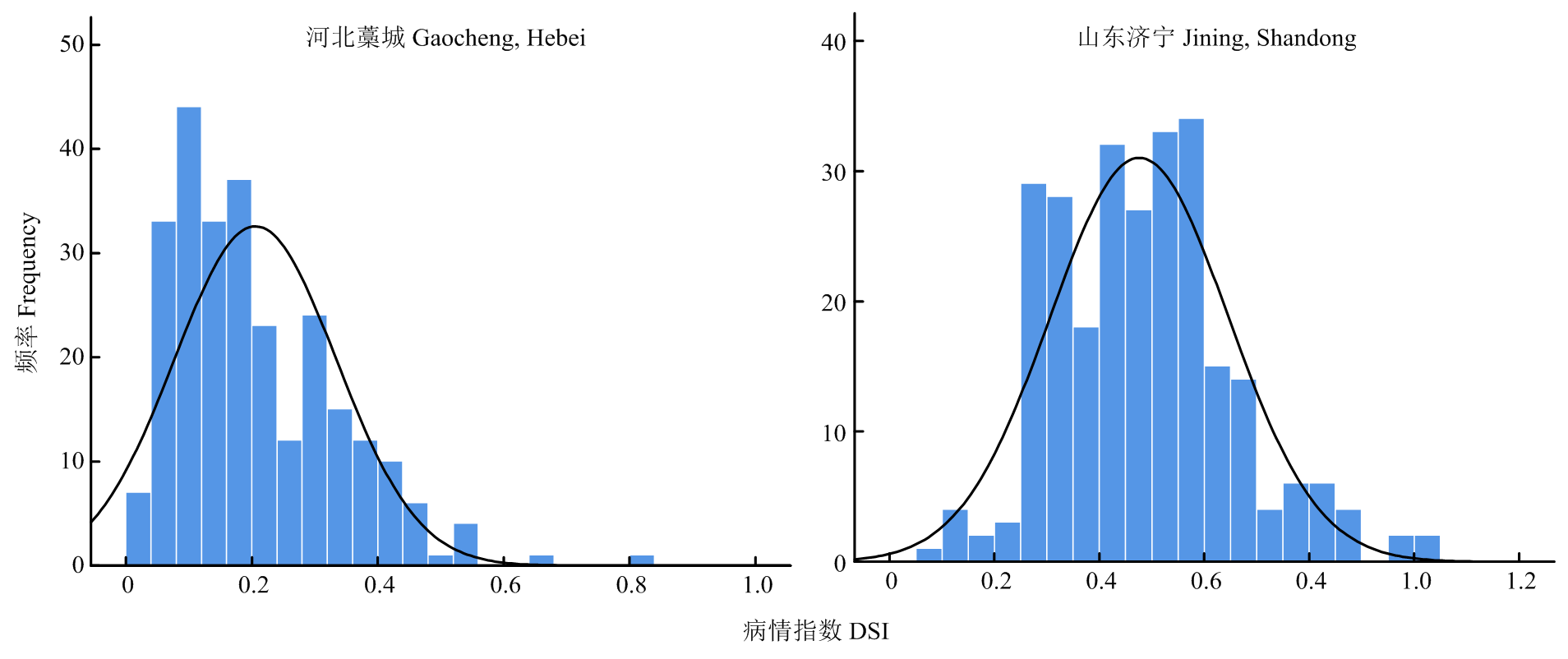
Fig. 1

DSI distribution of RILs population in Hebei and Shandong environments"

Fig. 2

Genotype of inbred lines and RILs population families at the resistant sites on chromosomes 2, 6 and 8 of maize A:IDP25K;B:MGS;C:5FR;D:6W53;E:6W19-95;1—8:100 bp DNA marker、S221、K36、JR2136、B73、X178、Ye478、Qi319。F:IDP25K;G:5FR;H:6W53;1—39:50 bp DNA marker、C1—C36、S221、K36"

Table 3

DSI of different genotype plant lines with three resistance loci in RILs population"

材料名称
Name of
varieties
家系抗性位点基因型
Genotype of resistant locus in plant lines
平均病情指数
DSI
qMrdd2 Rmrdd6 qMrdd8
K36 R R R 0.257
S221 S S S 0.623
RILs家系
RILs
R R R 0.281
S S S 0.776
S R R 0.454
R S R 0.622
S R S 0.396
S S R 0.478
R S S 0.654
S S H 0.799
S H S 0.475
H S S 0.625
R H R 0.313
H R R 0.313
R R H 0.469
S H R 0.503
H H R 0.521
R H S 0.515
H R S 0.30
R S H 0.653
R H H 0.477
S H H 0.447
H H H 0.438

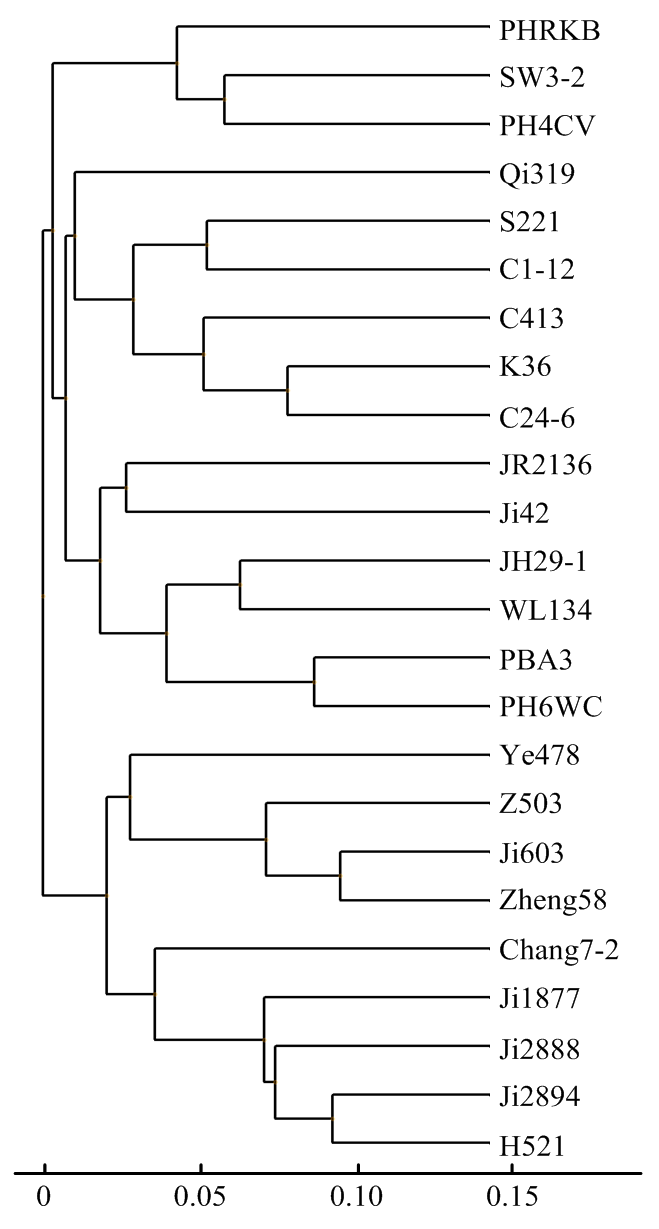
Fig. 3

UPGMA tree for 24 inbred lines based on Roger’s genetic distance"

Table 4

Comparison of important agronomic traits and yield traits of hybrid combinations"

杂交种
Hybrids
产量
Yield
(kg·hm-2)
与对照相比
Compared with control (%)
生育期
Growth period (d)
株高
Plant height (m)
穗位
Ear height (m)
穗长
Ear length (cm)
穗行数
No. of rows
行粒数
No. of grains per row
百粒重
Weight per 100 grains (g)
JR2136×H92 11334.90 7.01 106 2.95 1.29 19.0 14.8 41.4 34.5
JR2136×H521 11418.75 7.80 107 2.95 1.31 20.0 14.8 42.0 36.8
郑单958 Zhengdan 958 (CK) 10592.40 0.00 106 2.92 1.28 14.4 14.6 32.2 34.7
[1]
XIE L, LV M F, YANG J, CHEN J P, ZHANG H M. Genomic and phylogenetic evidence that Maize rough dwarf and Rice black-streaked dwarf fijiviruses should be classified as different geographic strains of a single species. Acta Virologica, 2017, 61(4): 453-462.

doi: 10.4149/av_2017_408 pmid: 29186962
[2]
FANG S, YU J, FENG J, HAN C, LI D, LIU Y. Identification of rice black-streaked dwarf fijivirus in maize with rough dwarf disease in China. Archives of Virology, 2001, 146(1): 167-170.

doi: 10.1007/s007050170200 pmid: 11266211
[3]
张恒木, 雷娟利, 陈剑平, 吕永平, 陈声祥, 薛庆中, M.J.Adams. 浙江和河北发生的一种水稻、小麦、玉米矮缩病是水稻黑条矮缩病毒引起的. 中国病毒学, 2001(3): 246-251.
ZHANG H M, LEI J L, CHEN J P, Y P, CHEN S X, XUE Q Z, ADAMS M J. A dwarf disease on rice, wheat and maize from Zhejiang and Hebei is caused by rice black-streaked dwarf virus. Virologica Sinica, 2001(3): 246-251. (in Chinese)
[4]
YIN X, XU F F, ZHENG F Q, LI X D, LIU B S, ZHANG C Q. Molecular characterization of segments S7 to S10 of a southern rice black-streaked dwarf virus isolate from maize in Northern China. Virologica Sinica, 2011, 26(1): 47-53.

doi: 10.1007/s12250-011-3170-9 pmid: 21331890
[5]
CHENG Z B, LI S, GAO R Z, SUN F, LIU W C, ZHOU G H, WU J X, ZHOU X P, ZHOU Y J. Distribution and genetic diversity of Southern rice black-streaked dwarf virus in China. Virology Journal, 2013, 10: 307.

doi: 10.1186/1743-422X-10-307 pmid: 24131521
[6]
陆虎华, 孙权星, 彭长俊, 陈小晖, 薛林, 胡加如, 陈国清, 石明亮, 黄小兰, 郝德荣, 冒宇翔, 程玉静. 不同播期对玉米粗缩病发生及鲜穗产量的影响. 江苏农业科学, 2013, 41(9): 75-76.
LU H H, SUN Q X, PENG C J, CHEN X H, XUE L, HU J R, CHEN G Q, SHI M L, HUANG X L, HAO D R, MAO Y X, CHENG Y J. Effects of different sowing dates on the occurrence of maize rough dwarf disease and fresh ear yield. Jiangsu Agricultural Sciences, 2013, 41(9): 75-76. (in Chinese)
[7]
陶永富, 刘庆彩, 徐明良. 玉米粗缩病研究进展. 玉米科学, 2013, 21(1): 149-152.
TAO Y F, LIU Q C, XU M L. Research progress on maizerough dwarf disease. Journal of Maize Sciences, 2013, 21(1): 149-152. (in Chinese)
[8]
SHI L Y, HAO Z F, WENG J F, XIE C X, LIU C L, ZHANG D G, LI M S, BAI L, LI X H, ZHANG S H. Identification of a major quantitative trait locus for resistance to maize rough dwarf virus in a Chinese maize inbred line X178 using a linkage map based on 514 gene-derived single nucleotide polymorphisms. Molecular Breeding, 2012, 30(2): 615-625.

doi: 10.1007/s11032-011-9652-0
[9]
杨海龙, 付俊, 张丽丽, 高增贵. 辽宁省玉米粗缩病的发生与综合防治. 种子, 2014, 33(3): 116-118.
YANG H L, FU J, ZHANG L L, GAO Z G. The occurrence and integrated control of corn rough dwarf in Liaoning. Seed, 2014, 33(3): 116-118. (in Chinese)
[10]
王振营, 王晓鸣. 我国玉米病虫害发生现状、趋势与防控对策. 植物保护, 2019, 45(1): 1-11.
WANG Z Y, WANG X M. Current status and management strategies for corn pestsand diseasesin China. Plant Protection, 2019, 45(1): 1-11. (in Chinese)
[11]
杨兴飞, 温广波, 杨轶. 玉米不同种质对粗缩病的抗性鉴定和分析. 玉米科学, 2010, 18(3): 144-146.
YANG X F, WEN G B, YANG Y. Resistance identification and analysis of different maize germplasms to maize rough dwarf virus. Journal of Maize Sciences, 2010, 18(3): 144-146. (in Chinese)
[12]
邸垫平, 路银贵, 张爱红, 杨菲, 田兰芝, 苗洪芹. 玉米抗粗缩病种质资源鉴定与评价. 植物遗传资源学报, 2021, 22(6): 1615-1623.
DI D P, LU Y G, ZHANG A H, YANG F, TIAN L Z, MIAO H Q. Identification and evaluation of maize germplasm resource against rice black streaked dwarf virus. Journal of Plant Genetic Resources, 2021, 22(6): 1615-1623. (in Chinese)
[13]
薛林, 张丹, 徐亮, 金萌萌, 彭长俊, 徐辰武. 玉米抗粗缩病自交系种质的发掘和遗传多样性及其在育种中的应用. 作物学报, 2011, 37(12): 2123-2129.

doi: 10.3724/SP.J.1006.2011.02123
XUE L, ZHANG D, XU L, JIN M M, PENG C J, XU C W. Mining and analyzing genetic diversity for maize rough dwarf disease resistant germplasms and its application in maize breeding. Acta Agronomica Sinica, 2011, 37(12): 2123-2129. (in Chinese)

doi: 10.3724/SP.J.1006.2011.02123
[14]
TAO Y F, LIU Q C, WANG H H, ZHANG Y J, HUANG X Y, WANG B B, LAI J S, YE J R, LIU B S, XU M L. Identification and fine-mapping of a QTL, qMrdd1, that confers recessive resistance to maize rough dwarf disease. BMC Plant Biology, 2013, 13: 145.

doi: 10.1186/1471-2229-13-145 pmid: 24079304
[15]
BONAMICO N C, DI RENZO M A, IBAÑEZ M A, BORGHI M L, DÍAZ D G, SALERNO J C, BALZARINI M G. QTL analysis of resistance to Mal de Río Cuarto disease in maize using recombinant inbred lines. The Journal of Agricultural Science, 2012, 150(5): 619-629.

doi: 10.1017/S0021859611000943
[16]
王安乐, 赵德发, 陈朝辉, 王娇娟, 邵新胜, 魏国英. 玉米自交系抗粗缩病特性的遗传基础及轮回选择效应研究. 玉米科学, 2000, 8(1): 80-82.
WANG A L, ZHAO D F, CHEN Z H, WANG J J, SHAO X S, WEI G Y. Studies on genetic basis and recurrent selection effect of inbred line maize resistance to MRDV. Journal of Maize Sciences, 2000, 8(1): 80-82. (in Chinese)
[17]
刘志增, 池书敏, 宋占权, 陈景堂, 孟义江. 玉米自交系及杂交种抗粗缩病性鉴定与分析. 玉米科学, 1996, 4(4): 68-70.
LIU Z Z, CHI S M, SONG Z Q, CHEN J T, MENG Y J. Identification and analysis of maize inbred lines and hybridsresistance to rough dwarf disease. Maize Science, 1996, 4(4): 68-70. (in Chinese)
[18]
李荣改, 陆艳梅, 王月影, 王宝强, 宋炜, 张文英. 玉米粗缩病的分子研究新进展. 植物学报, 2017, 52(3): 375-387.

doi: 10.11983/CBB16103
LI R G, LU Y M, WANG Y Y, WANG B Q, SONG W, ZHANG W Y. Molecular study on maize rough dwarf disease: A review. Chinese Bulletin of Botany, 2017, 52(3): 375-387. (in Chinese)
[19]
LIU C L, HUA J G, LIU C, ZHANG D G, HAO Z F, YONG H J, XIE C X, LI M S, ZHANG S H, WENG J F, LI X H. Fine mapping of a quantitative trait locus conferring resistance to maize rough dwarf disease. Theoretical and Applied Genetics, 2016, 129(12): 2333-2342.

pmid: 27544523
[20]
LIU Q C, DENG S N, LIU B S, TAO Y F, AI H Y, LIU J J, ZHANG Y Z, ZHAO Y, XU M L. A helitron-induced RabGDIα variant causes quantitative recessive resistance to maize rough dwarf disease. Nature Communications, 2020, 11: 495.

doi: 10.1038/s41467-020-14372-3 pmid: 31980630
[21]
ZHANG W X, DENG S N, ZHAO Y, XU W, LIU Q C, ZHANG Y Z, REN C M, CHENG Z B, XU M L, LIU B S. qMrdd2, a novel quantitative resistance locus for maize rough dwarf disease. BMC Plant Biology, 2021, 21(1): 307.

doi: 10.1186/s12870-021-03107-1 pmid: 34193031
[22]
XU Z N, WANG F F, ZHOU Z Q, MENG Q C, CHEN Y P, HAN X H, TIE S G, LIU C L, HAO Z F, LI M S, ZHANG D G, HAN J N, WANG Z H, LI X H, WENG J F. Identification and fine-mapping of a novel QTL, qMrdd2, that confers resistance to maize rough dwarf disease. Plant Disease, 2022, 106(1): 65-72.

doi: 10.1094/PDIS-03-20-0495-RE
[23]
LI R G, SONG W, WANG B Q, WANG J H, ZHANG D M, ZHANG Q G, LI X H, WEI J F, GAO Z Y. Identification of a locus conferring dominant resistance to maize rough dwarf disease in maize. Scientific Reports, 2018, 8: 3248.

doi: 10.1038/s41598-018-21677-3 pmid: 29459698
[24]
苗洪芹, 路银贵, 田兰芝, 邸垫平. 玉米粗缩病品种抗病性评价指标的初步研究. 西北农林科技大学学报(自然科学版), 2005, 33(S1): 255.
MIAO H Q, LU Y G, TIAN L Z, DI D P. A preliminary report on the criterion for evaluating the disease resistance of maize to the disease caused by maize rough dwarf fijivirus. Journal of Northwest A & F University(Natural Science Edition), 2005, 33(S1): 255. (in Chinese)
[25]
XU Z N, HUA J G, WANG F F, CHENG Z X, MENG Q C, CHEN Y P, HAN X H, TIE S G, LIU C L, LI X H, WANG Z H, WENG J F. Marker-assisted selection of qMrdd8 to improve maize resistance to rough dwarf disease. Breeding Science, 2020, 70(2): 183-192.

doi: 10.1270/jsbbs.19110
[26]
LIU C L, KONG M, YANG F, ZHU J J, QI X T, WENG J F, DI D P, XIE C X. Targeted generation of Null Mutants in ZmGDIα confers resistance against maize rough dwarf disease without agronomic penalty. Plant Biotechnology Journal, 2022, 20(5): 803-805.

doi: 10.1111/pbi.13793 pmid: 35178853
[27]
于永涛, 宋燕春, 黎裕, 石云素, 王天宇. 玉米对亚洲玉米螟抗性的QTL分析. 玉米科学, 2007, 15(5): 1-5, 11.
YU Y T, SONG Y C, LI Y, SHI Y S, WANG T Y. QTL associated with resistance to Asian corn borer(Ostrinia furnacalis) in maize. Journal of Maize Sciences, 2007, 15(5): 1-5, 11. (in Chinese)
[28]
吴金凤, 宋伟, 王蕊, 田红丽, 李雪, 王凤格, 赵久然, 蔚荣海. 利用SNP标记对51份玉米自交系进行类群划分. 玉米科学, 2014, 22(5): 29-34.
WU J F, SONG W, WANG R, WANG H L, LI X, WANG F G, ZHAO J R, WEI R H. Heterotic grouping of 51 maize inbred lines by SNP markers. Journal of Maize Sciences, 2014, 22(5): 29-34. (in Chinese)
[29]
宋炜, 王立伟, 张全国, 李荣改, 张动敏, 王宝强, 郭瑞, 宋粮, 魏剑锋, 李兴华, 高增玉, 张文英, 王江浩. 玉米杂交种‘冀玉228’选育及新杂优模式讨论. 农学通报, 2022, 12(10): 6-9.
SONG W, WANG L W, ZHANG Q G, LI R G, ZHANG D M, WANG B Q, GUO R, SONG L, WEI J F, LI X H, GAO Z Y, ZHANG W Y, WANG J H. Maize hybrid variety‘Jiyu 228’: Breeding and the new heterosis pattern. Journal of Agriculture, 2022, 12(10): 6-9. (in Chinese)

doi: 10.11923/j.issn.2095-4050.cjas2021-0066
[1] ZOU XiaoWei, XIA Lei, ZHU XiaoMin, SUN Hui, ZHOU Qi, QI Ji, ZHANG YaFeng, ZHENG Yan, JIANG ZhaoYuan. Analysis of Disease Resistance Induced by Ustilago maydis Strain with Overexpressed UM01240 Based on Transcriptome Sequencing [J]. Scientia Agricultura Sinica, 2025, 58(6): 1116-1130.
[2] XIE HuiHui, YANG QiuHua, LI WenLi, ZHU JinCheng, LI HuiXia, ZHANG Feng. Identification of Wild Potato Introgression Lines Resistant to Southern Root-Knot Nematode [J]. Scientia Agricultura Sinica, 2025, 58(14): 2924-2932.
[3] WU QiBin, XIE WanJie, ZHONG Hui, FENG ChunYan, PAN HaoRan, QI YiYing, ZHANG JiSen, WANG HengBo. Identification of the Bru1 Genomic Region for Brown Rust Resistance and Functional Analysis of Candidate Resistance Genes in Sugarcane [J]. Scientia Agricultura Sinica, 2024, 57(5): 855-867.
[4] ZHU ChunTao, REN DanDan, LIU ZhengCen, LIU ChangChuang, LIU RuiQi, ZHENG HongJian, HU ErLiang, LIN HaiJian, LI JingWei, LU YanLi, WANG QingJun. Combining Ability Analysis on Quality Traits and Breeding Potential Evaluation of 23 Waxy Maize Lines from Laos [J]. Scientia Agricultura Sinica, 2024, 57(15): 2931-2945.
[5] GUI CuiLin, MA Liang, WANG YinYing, XIE FuGui, ZHAO CaiHong, WANG WenMiao, LI Xin, WANG Qing, GAO XiQuan. Identification of Resistant Germplasms and Mining of Candidate Genes Associated with Resistance to Stalk Rot Caused by Synergistic Infection with Fusarium spp. in Maize [J]. Scientia Agricultura Sinica, 2024, 57(13): 2509-2524.
[6] SUN WeiHao, LIU Ting, SANG YiNan, YANG ZhengWei, ZHANG GaiSheng, SONG YuLong, ZHANG ShuangXi. Analysis of Heterosis and Combining Ability of Lodging Resistance Traits of Spring Wheat Varieties (Lines) in the Ningxia Yellow River Irrigation Area [J]. Scientia Agricultura Sinica, 2024, 57(13): 2497-2508.
[7] GAO Fu, WANG Rui, LIU DongJun, SUN HuiYan, WANG ZiYe, SONG WeiFu, LI TianYa. Stem Rust Resistance Genes Identification and Evaluation of 88 Wheat Cultivars (Lines) in Heilongjiang Province [J]. Scientia Agricultura Sinica, 2024, 57(13): 2568-2582.
[8] ZHOU JingWei, YE BoWei, ZHANG PengFei, ZHANG YuQing, HAO Min, YIN YuRuo, YUAN Chan, LI ZhiKang, LI ShunDa, XIA XianChun, HE ZhongHu, ZHANG HongJun, LAN CaiXia. Identification and Evaluation of Stripe Rust Resistance in 153 Wheat Collections [J]. Scientia Agricultura Sinica, 2024, 57(1): 18-33.
[9] LI ZhouShuai,DONG Yuan,LI Ting,FENG ZhiQian,DUAN YingXin,YANG MingXian,XU ShuTu,ZHANG XingHua,XUE JiQuan. Genome-Wide Association Analysis of Yield and Combining Ability Based on Maize Hybrid Population [J]. Scientia Agricultura Sinica, 2022, 55(9): 1695-1709.
[10] LIU Jiao,LIU Chang,CHEN Jin,WANG MianZhi,XIONG WenGuang,ZENG ZhenLing. Distribution Characteristics of Prophage in Multidrug Resistant Escherichia coli as well as Its Induction and Isolation [J]. Scientia Agricultura Sinica, 2022, 55(7): 1469-1478.
[11] ZHANG YaLing, GAO Qing, ZHAO Yuhan, LIU Rui, FU Zhongju, LI Xue, SUN Yujia, JIN XueHui. Evaluation of Rice Blast Resistance and Genetic Structure Analysis of Rice Germplasm in Heilongjiang Province [J]. Scientia Agricultura Sinica, 2022, 55(4): 625-640.
[12] TANG ZiYun,HU JianXin,CHEN Jin,LU YiXing,KONG LingLi,DIAO Lu,ZHANG FaFu,XIONG WenGuang,ZENG ZhenLing. Relationship Between Biofilm Formation and Molecular Typing of Staphylococcus aureus from Animal Origin [J]. Scientia Agricultura Sinica, 2022, 55(3): 602-612.
[13] HU ChaoYue, WANG FengTao, LANG XiaoWei, FENG Jing, LI JunKai, LIN RuiMing, YAO XiaoBo. Resistance Analyses on Wheat Stripe Rust Resistance Genes to the Predominant Races of Puccinia striiformis f. sp. tritici in China [J]. Scientia Agricultura Sinica, 2022, 55(3): 491-502.
[14] FANG TaoHong,ZHANG Min,MA ChunHua,ZHENG XiaoChen,TAN WenJing,TIAN Ran,YAN Qiong,ZHOU XinLi,LI Xin,YANG SuiZhuang,HUANG KeBing,WANG JianFeng,HAN DeJun,WANG XiaoJie,KANG ZhenSheng. Application of Yr52 Gene in Wheat Improvement for Stripe Rust Resistance [J]. Scientia Agricultura Sinica, 2022, 55(11): 2077-2091.
[15] CHEN ChaoXi,LI YuHan,TAN Min,WANG Lu,HUANG ZhiHong. Biofilm-Forming Phenotype, Antibacterial Resistance Genes, Integrase Genes and Virulence Genes Detection of Escherichia coli Isolated from Yaks and Tibetan Pigs in Northwest Sichuan Plateau [J]. Scientia Agricultura Sinica, 2021, 54(23): 5144-5162.
Viewed
Full text


Abstract

Cited

  Shared   
  Discussed   
No Suggested Reading articles found!