Scientia Agricultura Sinica ›› 2026, Vol. 59 ›› Issue (4): 705-722.doi: 10.3864/j.issn.0578-1752.2026.04.001

• CROP GENETICS & BREEDING·GERMPLASM RESOURCES·MOLECULAR GENETICS • Previous Articles     Next Articles

Morpho-Physiological Responses and Adaptive Strategies of Rice Germplasm Accessions from Different Subspecies Under Salt Stress

CHEN Min(), JIAO ZiLan, QIAO ChengBin, XU Hao, ZHANG Bi, MA DongHua, KONG WeiRu, WANG JingWen, SONG JiaWei, LUO ChengKe, LI PeiFu, TIAN Lei()   

  1. School of Agriculture, Ningxia University/Key Laboratory of Modern Molecular Breeding for Dominant and Special Crops in Ningxia, Yinchuan 750021
  • Received:2025-08-04 Online:2026-02-10 Published:2026-02-10
  • Contact: TIAN Lei

Abstract:

【Objective】Soil salinization severely constrains the sustainable development of rice production. The specific goals are to: comprehensively evaluate the salt tolerance of rice core germplasm accessions at the seedling stage, investigate the morphological and physiological characteristics of different rice subspecies under salt stress, clarify the associated variations in their responses, and summarize their adaptive strategies, thereby providing a theoretical foundation for screening and breeding salt-tolerant rice varieties.【Method】The salt tolerance score (STS), plant height, root length, shoot fresh weight, shoot dry weight, root dry weight and SPAD were measured for 276 rice core germplasm accessions after treatment using 125 mmol·L-1 NaCl for 6 days. The relative values of each trait, except for STS and shoot fresh weight were calculated, along with the shoot water content (SWC). T-tests, significance analysis and correlation analysis were used to explore the morphological and physiological differences for salt stress responses among different rice subspecies. Principal component analysis (PCA) and stepwise linear regression were applied to screen key indicators for salt tolerance. The D-value was calculated to identify typical salt-tolerant accessions and salt-sensitive accessions, which were used to elucidate the regulatory patterns and response strategies of salt stress in different subspecies of rice.【Result】Salt stress affected the growth of seedlings of the three subspecies of rice. Compared with japonica rice, indica rice and AUS exhibited milder inhibitory effects from salt stress, and AUS demonstrated greater phenotypic variation. The STS, relative seedling height (RSH), relative root length (RRL), relative root dry weight (RRDW), relative SPAD (RSPAD) and SWC among the three subspecies of rice accessions were not significantly different. However, the relative shoot dry weight (RSDW) of indica rice was significantly higher than that of japonica rice and AUS, and the salt tolerance of temperate japonica rice seedlings was significantly higher than that of tropical japonica rice and admixed japonica rice. Correlation patterns of the seven salt-tolerance-related traits varied between the three subspecies. Three principal components were extracted from japonica rice, indica rice and AUS, with cumulative contribution rates of 82.587%, 80.117%, and 88.700%, respectively. Based on this, the D-values for the comprehensive evaluation of salt tolerance were calculated for each accession, and key parameters for salt tolerance were screened. It was found that RSDW is a common key indicator affecting the salt tolerance of rice seedlings, while RSH and RRDW are shared by japonica rice and AUS, and STS is the common key parameter for indica rice and AUS. In the three subspecies, high-D-value accessions and low-D-value accessions were selected to analyze root characteristics, ion balance, reactive oxygen species accumulation, and osmotic regulation substance content under salt stress. The root total number (RTN), root tip number (RN), total root length (TRL), and root surface area (RSA) of high-D-value accessions in the three subspecies were significantly higher than those of the three categories of low-D-value accessions. Among the three types of high-D-value accessions, the RTN and RN of indica rice were significantly higher than those of japonica rice and AUS. The root average diameter (RAD) of indica rice and AUS was significantly higher than that of japonica rice. AUS had significantly higher surface area and volume of roots in the 0.5-1 mm diameter range than japonica rice and indica rice, while japonica rice had significantly higher root volume in the 0-0.5 mm diameter range than indica rice and AUS. In terms of ion balance, the shoot Na+ content (SNC) of the three types of high-D-value accessions was significantly lower than that of the three types of low-D-value accessions. Among the three types of high-D-value groups, AUS had significantly lower SNC and shoot Na+/K+ (SNK) than that of japonica rice, japonica rice had significantly lower root Na+ content (RNC) than AUS, indica rice had significantly higher root K+ content (RKC) than AUS, and japonica rice and indica rice had significantly lower root Na+/K+ (RNK) than AUS. In terms of reactive oxygen species content, among the three categories of high-D-value accessions, the hydrogen peroxide content of japonica rice was significantly lower than that of indica rice and AUS. In terms of osmoregulatory substance content, among the three types of high-D-value accessions, the soluble sugar content of indica rice and AUS was significantly higher than that of japonica rice, and the proline content of indica rice was significantly higher than that of japonica rice.【Conclusion】Significant differences were observed in the morphological and physiological characteristics of rice germplasm accessions from different subspecies under salt stress. RSDW is a common key indicator affecting salt tolerance of rice seedlings. In response to salt stress, typical salt-tolerant germplasm from japonica, indica, and AUS developed distinct combinatorial profiles of regulatory modes, which varied in their emphasis on four key aspects: root morphological characteristics, ion homeostasis, reactive oxygen species (ROS) scavenging and osmotic adjustment.

Key words: rice subspecies, germplasm resource, saline stress, morphology and physiology, response strategy

Table 1

Parameters statistics of each evaluation index in rice germplasm accessions of different subspecies at the seedling stage under salt stress condition"

亚种 Subspecies 性状 Trait 分布范围 Range 中值 Median 变异系数 CV (%) tt-value
粳稻
Japonica
耐盐级别STS 1.65-7.20 4.33 34.16 -
相对株高RSH 0.50-1.12 0.76 14.18 -12.504**
相对根长RRL 0.54-1.31 0.92 16.97 -4.386*
相对地上部干重RSDW 0.33-2.63 0.83 36.84 -4.376*
相对根干重RRDW 0.28-1.90 0.68 37.63 -9.476**
地上部含水量SWC % 57.15-80.42 75.52 3.60 -
相对SPAD RSPAD 0.12-1.20 0.89 23.25 -8.746**
籼稻
Indica
耐盐级别STS 2.25-7.10 4.78 29.89 -
相对株高RSH 0.49-1.05 0.77 12.75 -6.210**
相对根长RRL 0.46-1.27 0.93 18.02 -3.363*
相对地上部干重RSDW 0.42-1.88 0.85 31.77 -2.217
相对根干重RRDW 0.28-1.36 0.68 32.12 -5.752**
地上部含水量SWC % 69.83-78.36 75.28 2.39 -
相对SPAD RSPAD 0.50-1.12 0.93 14.38 -4.981*
AUS 耐盐级别STS 1.45-7.35 3.90 39.50 -
相对株高RSH 0.57-1.02 0.71 16.16 -7.813**
相对根长RRL 0.55-1.36 0.89 20.20 -2.807
相对地上部干重RSDW 0.35-2.08 0.74 48.50 -1.878
相对根干重RRDW 0.34-1.40 0.58 39.10 -5.882**
地上部含水量SWC % 67.12-78.88 75.10 4.02 -
相对SPAD RSPAD 0.15-1.15 0.87 28.34 -5.414**

Table 2

Significant difference in analysis of salt tolerance-related traits in rice germplasm accessions of different subspecies at the seedling stage"

亚种
Subspecies
耐盐级别
STS
相对株高
RSH
相对根长
RRL
相对地上部干重
RSDW
相对根干重
RRDW
地上部含水量
SWC (%)
相对SPAD
RSPAD
粳稻 Japonica 4.559±1.557a 0.762±0.108a 0.916±0.155a 0.832±0.194b 0.753±0.023a 75.158±2.696a 0.723±0.254a
籼稻 Indica 4.878±1.458a 0.762±0.097a 0.897±0.162a 0.898±0.129a 0.751±0.018a 75.088±1.852a 0.748±0.240a
AUS 4.380±1.731a 0.743±0.120a 0.891±0.177a 0.811±0.230b 0.747±0.027a 74.692±2.599a 0.665±0.258a

Fig. 1

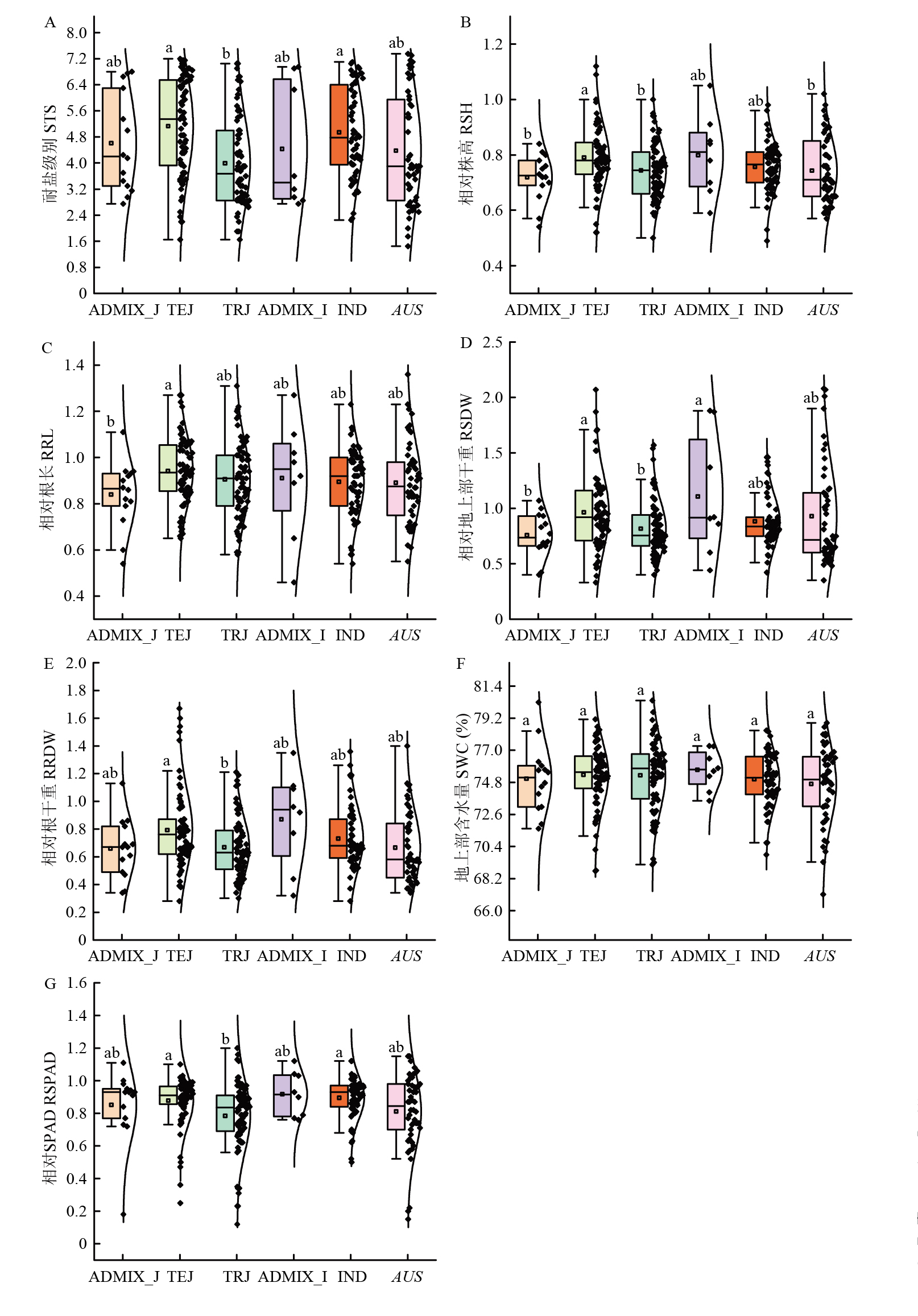
Significant difference analysis of salt tolerance-related traits among six subgroups of rice germplasm accessions A: Salt tolerance score; B: Relative seedling height; C: Relative root length; D: Relative shoot dry weight; E: Relative root dry weight; F: Shoot water content; G: Relative SPAD. ADMIX_J: Admixed japonica rice; TEJ: Temperate japonica rice; TRJ: Tropical japonica rice; ADMIX_I: Admixed indica rice; IND: Generic indica rice"

Fig. 2

Correlation analysis of salt tolerance-related traits in rice germplasm accessions of different subspecies at the seedling stage *: Significant correlation at P<0.05; **: Significant correlation at P<0.01; ***: Significant correlation at P<0.001"

Table 3

Principal component analysis of salt-tolerance indexes in rice germplasm accessions of different subspecies"

性状
Trait
粳稻 Japonica 籼稻 Indica AUS
CI1 CI2 CI3 CI1 CI2 CI3 CI1 CI2 CI3
耐盐级别STS 0.726 0.243 -0.506 0.629 0.550 -0.386 0.905 0.083 -0.230
相对株高RSH 0.874 -0.225 0.056 0.857 -0.182 -0.028 0.877 0.031 -0.065
相对根长RRL 0.681 -0.249 0.277 0.627 -0.399 -0.241 0.606 -0.682 0.258
相对地上部干重RSDW 0.903 -0.247 0.024 0.896 -0.177 0.212 0.910 -0.184 -0.001
相对根干重RRDW 0.869 -0.183 0.214 0.805 -0.296 0.380 0.918 -0.148 0.160
地上部含水量SWC 0.324 0.782 0.514 0.166 0.720 0.565 0.526 0.660 0.525
相对SPAD RSPAD 0.709 0.450 -0.348 0.631 0.535 -0.272 0.813 0.329 -0.385
特征值 Eigenvalue 3.935 1.081 0.767 3.401 1.418 0.789 4.563 1.072 0.573
贡献率 Contribution ratio (%) 56.180 15.445 10.962 48.581 20.258 11.278 65.186 15.321 8.193
累计贡献率
Cumulative contribution rate (%)
56.180 71.625 82.587 48.581 68.839 80.117 65.186 80.507 88.700

Fig. 3

Linear regression analysis between seven salt tolerance- related traits and D value of comprehensive evaluation in different rice subspecies"

Fig. 4

Phenotypes of representative salt-tolerant accessions from japonica, indica, and AUS under control (CK) and 125 mmol·L-1 NaCl stress after 6 days CK: Control; SST: Salt stress treatment. Scale bar=6 cm"

Table 4

Significant difference analysis of root morphological characteristics in typical salt-tolerant and salt-sensitive rice germplasm accessions of different subspecies"

指标
Indexes
粳稻高D
Japonica rice with high D-value
粳稻低D
Japonica rice with low D-value
籼稻高D
Indica rice with high D-value
籼稻低D
Indica rice with low D-value
AUSD
AUS rice with high D-value
AUSD
AUS rice with low D-value
根总数量RTN 80.67±12.18b 62.25±14.48c 95.96±27.83a 50.13±8.55d 81.17±23.31b 42.25±15.35d
根尖数量RN 69.21±12.02b 57.96±15.75c 82.96±21.88a 44.46±9.13d 70.71±20.39b 42.25±12.85d
根总长度TRL (cm) 84.60±16.00a 55.59±7.52b 77.40±17.72a 45.08±8.85c 76.65±31.19a 50.98±13.39bc
根平均直径RAD (mm) 0.55±0.04c 0.56±0.03bc 0.58±0.04ab 0.56±0.04bc 0.58±0.04ab 0.60±0.05a
根总表面积RSA (mm2) 1805.91±649.13a 1193.30±276.76b 1749.46±416.34a 799.93±130.96c 1815.12±762.71a 1236.25±429.34b
根总体积RV (mm3) 541.16±487.82ab 298.14±182.11cd 555.64±278.96ab 152.76±73.81d 618.84±394.47a 404.58±329.55bc
0.5—1 mm直径根总长度
TL_0.5-1 mm (cm)
14.08±8.00a 10.24±6.57bc 13.21±4.75ab 8.07±3.91cd 16.00±9.18a 5.55±3.15d
0.5—1 mm直径根总表面积
SA_0.5-1 mm (mm2)
226.10±152.97b 169.46±123.95bc 209.14±76.81b 131.48±75.65cd 290.39±175.48a 74.61±51.04d
0.5—1 mm直径根总体积
V_0.5-1 mm (mm3)
29.85±23.33b 23.39±19.26bc 28.40±13.36b 18.11±12.94cd 43.36±27.91a 8.28±6.90d
0—0.5 mm直径根总长度
TL_0-0.5 mm (cm)
16.57±13.64a 10.49±6.96bc 12.41±7.61abc 10.32±7.92c 15.08±8.23ab 3.74±3.68d
0—0.5 mm直径根总表面积
SA_0-0.5 mm (mm2)
241.65±177.72a 149.21±84.44bc 183.34±94.56abc 144.17±97.08c 205.75±108.52ab 65.91±50.66d
0—0.5 mm直径根总体积
V_0-0.5 mm (mm3)
29.02±18.03a 17.70±8.13bc 22.51±10.27bc 16.60±9.27c 22.82±11.49b 9.70±6.18d

Table 5

Significant difference analysis of ion balance-related traits in typical salt-tolerant and salt-sensitive rice germplasm accessions of different subspecies"

指标
Indexes
粳稻高D
Japonica rice with high D-value
粳稻低D
Japonica rice with low D-value
籼稻高D
Indica rice with high D-value
籼稻低D
Indica rice with low D-value
AUSD
AUS rice with high D-value
AUSD
AUS rice with low D-value
地上部Na+含量SNC (mg·g-1) 24.66±6.18c 49.47±5.80ab 20.20±3.64cd 44.16±12.86b 15.68±4.85d 56.86±10.31a
根系Na+含量RNC (mg·g-1) 17.48±2.89cd 23.30±4.11ab 20.11±3.09bc 15.85±5.84d 21.47±3.46b 26.52±4.18a
地上部K+含量SKC (mg·g-1) 19.83±2.90b 22.67±3.92b 20.11±2.84b 31.20±8.12a 20.71±3.93b 30.56±6.93a
根系K+含量RKC (mg·g-1) 4.31±1.44bc 7.61±2.65a 5.80±1.96ab 5.75±2.06ab 3.72±2.51c 6.12±2.05ab
地上部Na+/K+ SNK 1.17±0.23cd 2.06±0.28a 0.98±0.23de 1.44±0.51bc 0.67±0.11e 1.81±0.28ab
根系Na+/K+ RNK 4.61±1.81b 3.35±0.91b 3.89±1.82b 3.04±1.16b 9.18±6.98a 4.04±1.70b

Table 6

Significant difference analysis of reactive oxygen species content in typical salt-tolerant and salt-sensitive rice germplasm accessions of different subspecies"

指标
Indexes
粳稻高D
Japonica rice with high D-value
粳稻低D
Japonica rice with low D-value
籼稻高D
Indica rice with high D-value
籼稻低D
Indica rice with low D-value
AUSD
AUS rice with high D-value
AUSD
AUS rice with low D-value
过氧化氢含量
Hydrogen peroxide content (μmol·g-1)
5.46±2.41c 6.38±1.53abc 8.14±1.61ab 5.89±1.45bc 8.68±3.28a 7.43±0.98abc
超氧阴离子含量
Superoxide anion content (μmol·g-1)
0.65±0.47d 3.21±1.24a 1.17±0.50cd 1.92±0.56bc 1.21±0.19cd 2.39±1.12ab
丙二醛含量
MDA content (nmol·g-1)
30.32±21.02a 46.13±15.97a 32.10±5.43a 30.81±19.63a 28.23±14.83a 46.45±29.20a

Table 7

Significant difference analysis of osmoregulatory substance content in typical salt-tolerant and salt-sensitive rice germplasm accessions of different subspecies"

指标
Indexes
粳稻高D
Japonica rice with high D-value
粳稻低D
Japonica rice with low D-value
籼稻高D
Indica rice with high D-value
籼稻低D
Indica rice with low D-value
AUSD
AUS rice with high D-value
AUSD
AUS rice with low D-value
可溶性糖含量
Soluble sugar content (mg·g-1)
10.42±2.61b 9.98±1.91b 17.27±5.92a 8.37±5.24b 17.70±5.74a 8.83±2.33b
脯氨酸含量
Proline content (μg·g-1)
609.87±192.35c 632.20±78.34c 863.43±205.61ab 1003.67±380.04a 655.35±125.82bc 862.93±146.73ab
可溶性蛋白含量Soluble protein content (mg·g-1) 13.72±8.88ab 6.08±2.92b 7.46±4.81b 8.52±3.48b 13.56±3.77ab 21.90±15.14a

Fig. 5

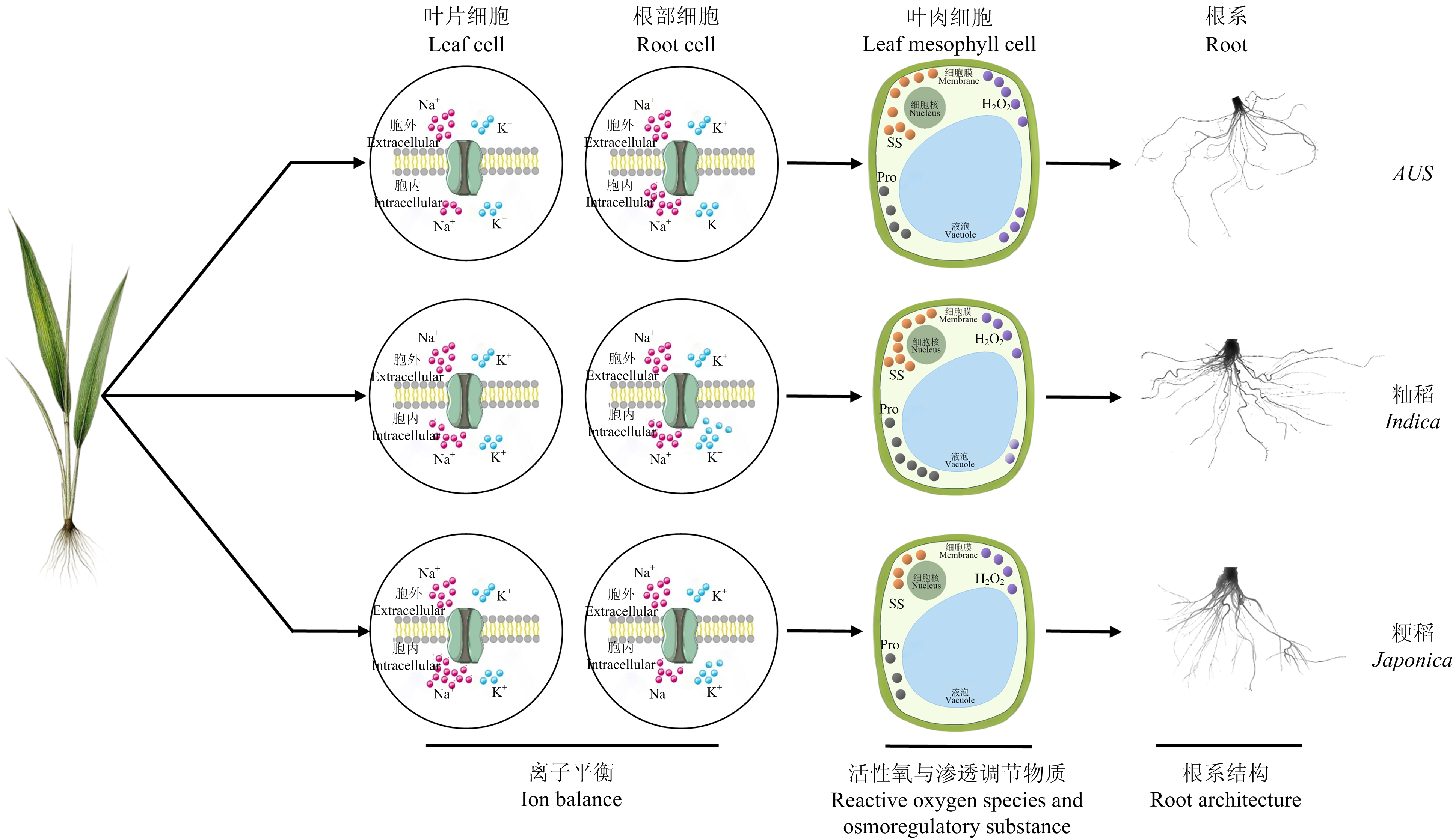
Hypothetical model of representative salt-tolerant rice germplasm accessions across subspecies responding to salt stress SS: Soluble sugars, Pro: Proline, H2O2: Hydrogen peroxide"

[1]
YU J, ZHU C S, XUAN W, AN H Z, TIAN Y L, WANG B X, CHI W C, CHEN G M, GE Y W, LI J, et al. Genome-wide association studies identify OsWRKY53 as a key regulator of salt tolerance in rice. Nature Communications, 2023, 14: 3550.

doi: 10.1038/s41467-023-39167-0 pmid: 37321989
[2]
SREENIVASULU N, PASION E, KOHLI A. Idealizing inflorescence architecture to enhance rice yield potential for feeding nine billion people in 2050. Molecular Plant, 2021, 14(6): 861-863.

doi: 10.1016/j.molp.2021.05.003 pmid: 33962061
[3]
MUNNS R, TESTER M. Mechanisms of salinity tolerance. Annual Review of Plant Biology, 2008, 59: 651-681.

doi: 10.1146/annurev.arplant.59.032607.092911 pmid: 18444910
[4]
AHMAD GANIE S, ALI MOLLA K, HENRY R J, BHAT K V, MONDAL T K. Theoretical and Applied Genetics, Advances in understanding salt tolerance in rice. 2019, 132(4): 851-870.
[5]
马帅国, 田蓉蓉, 胡慧, 吕建东, 田蕾, 罗成科, 张银霞, 李培富. 粳稻种质资源苗期耐盐性综合评价与筛选. 植物遗传资源学报, 2020, 21(5): 1089-1101.

doi: 10.13430/j.cnki.jpgr.20200115001
MA S G, TIAN R R, HU H, J D, TIAN L, LUO C K, ZHANG Y X, LI P F. Comprehensive evaluation and selection of rice (Oryza sativa japonica) germplasm for saline tolerance at seedling stage. Journal of Plant Genetic Resources, 2020, 21(5): 1089-1101. (in Chinese)

doi: 10.13430/j.cnki.jpgr.20200115001
[6]
谢留杰, 段敏, 潘晓飚, 唐兴国, 朱长志, 黄善军. 不同类型水稻品系苗期和全生育期耐盐性鉴定与分析. 江西农业大学学报, 2015, 37(3): 404-410.
XIE L J, DUAN M, PAN X B, TANG X G, ZHU C Z, HUANG S J. Identification and analysis of salt tolerance in different type rice cultivars during seedling and whole plant growth stage. Acta Agriculturae Universitatis Jiangxiensis, 2015, 37(3): 404-410. (in Chinese)
[7]
陈志德, 仲维功, 杨杰, 黄转运. 水稻新种质资源的耐盐性鉴定评价. 植物遗传资源学报, 2004, 5(4): 351-355.
CHEN Z D, ZHONG W G, YANG J, HUANG Z Y. Evaluation of salt tolerance of rice (Oryza sativa L.) germplasm. Journal of Plant Genetic Resources, 2004, 5(4): 351-355. (in Chinese)
[8]
吴其褒, 胡国成, 柯登寿, 栾维江, 杨巍, 孙宗修, 陈惠哲. 俄罗斯水稻种质资源的苗期耐盐鉴定. 植物遗传资源学报, 2008, 9(1): 32-35.
WU Q B, HU G C, KE D S, LUAN W J, YANG W, SUN Z X, CHEN H Z. Evaluation of Russian rice germplasm in salt tolerance at seedling stage. Journal of Plant Genetic Resources, 2008, 9(1): 32-35. (in Chinese)
[9]
JAISWAL S, GAUTAM R K, SINGH R K, KRISHNAMURTHY S L, ALI S, SAKTHIVEL K, IQUEBAL M A, RAI A, KUMAR D. Harmonizing technological advances in phenomics and genomics for enhanced salt tolerance in rice from a practical perspective. Rice, 2019, 12(1): 89.

doi: 10.1186/s12284-019-0347-1 pmid: 31802312
[10]
WANG Z F, CHENG J P, CHEN Z W, HUANG J, BAO Y M, WANG J F, ZHANG H S. Identification of QTLs with main, epistatic and QTL × environment interaction effects for salt tolerance in rice seedlings under different salinity conditions. Theoretical and Applied Genetics, 2012, 125(4): 807-815.

doi: 10.1007/s00122-012-1873-z pmid: 22678666
[11]
王洋, 张瑞, 刘永昊, 李荣凯, 葛建飞, 邓仕文, 张徐彬, 陈英龙, 韦还和, 戴其根. 水稻对盐胁迫的响应及耐盐机理研究进展. 中国水稻科学, 2022, 36(2): 105-117.

doi: 10.16819/j.1001-7216.2022.210609
WANG Y, ZHANG R, LIU Y H, LI R K, GE J F, DENG S W, ZHANG X B, CHEN Y L, WEI H H, DAI Q G. Rice response to salt stress and research progress in salt tolerance mechanism. Chinese Journal of Rice Science, 2022, 36(2): 105-117. (in Chinese)

doi: 10.16819/j.1001-7216.2022.210609
[12]
吴家富, 杨博文, 向珣朝, 许亮, 颜李梅. 不同水稻种质在不同生育期耐盐鉴定的差异. 植物学报, 2017, 52(1): 77-88.
WU J F, YANG B W, XIANG X C, XU L, YAN L M. Identification of salt tolerance in different rice germplasm at different growth stages. Chinese Bulletin of Botany, 2017, 52(1): 77-88. (in Chinese)
[13]
赵杰, 王晓风, 张余良, 王立艳, 李梦琦, 肖辉. 不同水稻品种萌发期与幼苗期耐盐性鉴定. 江苏农业科学, 2024, 52(23): 55-59.
ZHAO J, WANG X F, ZAHNG Y L, WANG L Y, LI M Q, XIAO H. Identification of salt tolerance at germination and seedling stage of different rice cultivars. Jiangsu Agricultural Sciences, 2024, 52(23): 55-59. (in Chinese)
[14]
夏秀忠, 张宗琼, 杨行海, 农保选, 曾宇, 刘开强, 邓国富, 荘洁, 李丹婷. 广西地方稻种资源核心种质的耐盐性鉴定评价. 南方农业学报, 2017, 48(6): 979-984.
XIA X Z, ZHANG Z Q, YANG X H, NONG B X, ZENG Y, LIU K Q, DENG G F, ZHUANG J, LI D T. Salt tolerance evaluation for core collection of rice landraces in Guangxi. Journal of Southern Agriculture, 2017, 48(6): 979-984. (in Chinese)
[15]
ZHAO H, LI Z X, WANG Y Y, WANG J Y, XIAO M G, LIU H, QUAN R D, ZHANG H W, HUANG R F, ZHU L, et al. Cellulose synthase-like protein OsCSLD4 plays an important role in the response of rice to salt stress by mediating abscisic acid biosynthesis to regulate osmotic stress tolerance. Plant Biotechnology Journal, 2022, 20(3): 468-484.

doi: 10.1111/pbi.v20.3
[16]
ZHAO C Z, ZHANG H, SONG C P, ZHU J K, SHABALA S. Mechanisms of plant responses and adaptation to soil salinity. The Innovation, 2020, 1(1): 100017.

doi: 10.1016/j.xinn.2020.100017
[17]
HUANG X Y, CHAO D Y, GAO J P, ZHU M Z, SHI M, LIN H X. A previously unknown zinc finger protein, DST, regulates drought and salt tolerance in rice via stomatal aperture control. Genes & Development, 2009, 23(15): 1805-1817.

doi: 10.1101/gad.1812409
[18]
朱春艳, 宋佳伟, 白天亮, 王娜, 马帅国, 普正菲, 董艳, 吕建东, 李杰, 田蓉蓉, 等. NaCl胁迫对不同耐盐性粳稻种质幼苗叶绿素荧光特性的影响. 中国农业科学, 2022, 55(13): 2509-2525. doi: 10.3864/j.issn.0578-1752.2022.13.003.
ZHU C Y, SONG J W, BAI T L, WANG N, MA S G, PU Z F, DONG Y, J D, LI J, TIAN R R, et al. Effects of NaCl stress on the chlorophyll fluorescence characteristics of seedlings of japonica rice germplasm with different salt tolerances. Scientia Agricultura Sinica, 2022, 55(13): 2509-2525. doi: 10.3864/j.issn.0578-1752.2022.13.003. (in Chinese)
[19]
LIU C T, MAO B G, YUAN D Y, CHU C C, DUAN M J. Salt tolerance in rice: Physiological responses and molecular mechanisms. The Crop Journal, 2022, 10(1): 13-25.

doi: 10.1016/j.cj.2021.02.010
[20]
QIN H, HUANG R F. The phytohormonal regulation of Na+/K+ and reactive oxygen species homeostasis in rice salt response. Molecular Breeding, 2020, 40(5): 47.

doi: 10.1007/s11032-020-1100-6
[21]
FAROOQ M, PARK J R, JANG Y H, KIM E G, KIM K M. Rice cultivars under salt stress show differential expression of genes related to the regulation of Na+/K+ balance. Frontiers in Plant Science, 2021, 12: 680131.

doi: 10.3389/fpls.2021.680131
[22]
ZHANG B, SHI F, ZHENG X, PAN H Y, WEN Y Q, SONG F Q. Effects of AMF compound inoculants on growth, ion homeostasis, and salt tolerance-related gene expression in Oryza sativa L. under salt treatments. Rice, 2023, 16(1): 18.
[23]
MILLER G, SUZUKI N, CIFTCI-YILMAZ S, MITTLER R. Reactive oxygen species homeostasis and signalling during drought and salinity stresses. Plant, Cell & Environment, 2010, 33(4): 453-467.

doi: 10.1111/pce.2010.33.issue-4
[24]
FENG H M, TANG Q, CAI J, XU B C, XU G H, YU L. Rice OsHAK16 functions in potassium uptake and translocation in shoot, maintaining potassium homeostasis and salt tolerance. Planta, 2019, 250(2): 549-561.

doi: 10.1007/s00425-019-03194-3 pmid: 31119363
[25]
刘梦霜, 郭海峰, 陈观秀, 莫俊杰, 许江环, 杨善, 周鸿凯. 不同水稻品种对NaCl胁迫的生理响应及耐盐性评价. 热带作物学报, 2023, 44(2): 326-336.

doi: 10.3969/j.issn.1000-2561.2023.02.012
LIU M S, GUO H F, CHEN G X, MO J J, XU J H, YANG S, ZHOU H K. Physiological response and salt tolerance evaluation of different rice (Oryza sativa L.) cultivars under NaCl stress. Chinese Journal of Tropical Crops, 2023, 44(2): 326-336. (in Chinese)
[26]
张治振, 李稳, 周起先, 孙伟, 郑崇珂, 谢先芝. 不同水稻品种幼苗期耐盐性评价. 作物杂志, 2020, (3): 92-101.
ZHANG Z Z, LI W, ZHOU Q X, SUN W, ZHENG C K, XIE X Z. Salt tolerance evaluation of different rice varieties at seedling stage. Crops, 2020, (3): 92-101. (in Chinese)
[27]
RASEL M, TAHJIB-UL-ARIF M, HOSSAIN M A, HASSAN L, FARZANA S, BRESTIC M. Screening of salt-tolerant rice landraces by seedling stage phenotyping and dissecting biochemical determinants of tolerance mechanism. Journal of Plant Growth Regulation, 2021, 40(5): 1853-1868.

doi: 10.1007/s00344-020-10235-9
[28]
TIAN L, TAN L B, LIU F X, CAI H W, SUN C Q. Identification of quantitative trait loci associated with salt tolerance at seedling stage from Oryza rufipogon. Journal of Genetics and Genomics, 2011, 38(12): 593-601.

doi: 10.1016/j.jgg.2011.11.005
[29]
耿雷跃, 马小定, 崔迪, 张启星, 韩冰, 韩龙植. 水稻全生育期耐盐性鉴定评价方法研究. 植物遗传资源学报, 2019, 20(2): 267-275.

doi: 10.13430/j.cnki.jpgr.20180815003
GENG L Y, MA X D, CUI D, ZHANG Q X, HAN B, HAN L Z. Identification and evaluation method for saline tolerance in rice during the whole growth stage. Journal of Plant Genetic Resources, 2019, 20(2): 267-275. (in Chinese)

doi: 10.13430/j.cnki.jpgr.20180815003
[30]
田蕾, 王彬, 张雪艳, 王娜, 普正菲, 董艳, 许兴. 脱硫石膏改良盐碱土对水稻秧苗素质、根系特征及质膜透性的影响. 广东农业科学, 2014, 41(21): 1-6.
TIAN L, WANG B, ZHANG X Y, WANG N, PU Z F, DONG Y, XU X. Effects of saline-alkail soil improved by desulfurized gypsum on seedling quality, root features and membrane permeability of rice. Guangdong Agricultural Sciences, 2014, 41(21): 1-6. (in Chinese)
[31]
HOUSHMAND S, ARZANI A, ALI MOHAMAD MAIBODY S, FEIZI M. Evaluation of salt-tolerant genotypes of durum wheat derived from in vitro and field experiments. Field Crops Research, 2005, 91(2/3): 345-354.

doi: 10.1016/j.fcr.2004.08.004
[32]
邹琦. 植物生理学实验指导. 北京: 中国农业出版社, 2000.
ZOU Q. Experimental Instruction of Plant Physiology. Beijing: China Agriculture Press, 2000. (in Chinese)
[33]
TAULAVUORI E, HELLSTRÖM E, TAULAVUORI K, LAINE K. Comparison of two methods used to analyse lipid peroxidation from Vaccinium myrtillus (L.) during snow removal, reacclimation and cold acclimation. Journal of Experimental Botany, 2001, 52(365): 2375-2380.

doi: 10.1093/jexbot/52.365.2375
[34]
ZHANG H, LIU X L, ZHANG R X, YUAN H Y, WANG M M, YANG H Y, MA H Y, LIU D, JIANG C J, LIANG Z W. Root damage under alkaline stress is associated with reactive oxygen species accumulation in rice (Oryza sativa L.). Frontiers in Plant Science, 2017, 8: 1580.

doi: 10.3389/fpls.2017.01580
[35]
FORNASIERO A, WING R A, RONALD P. Rice domestication. Current Biology, 2022, 32(1): R20-R24.
[36]
JING C Y, ZHANG F M, WANG X H, WANG M X, ZHOU L, CAI Z, HAN J D, GENG M F, YU W H, JIAO Z H, et al. Multiple domestications of Asian rice. Nature Plants, 2023, 9(8): 1221-1235.
[37]
SOLIS C A, YONG M T, VENKATARAMAN G, MILHAM P, ZHOU M X, SHABALA L, HOLFORD P, SHABALA S, CHEN Z H. Sodium sequestration confers salinity tolerance in an ancestral wild rice. Physiologia Plantarum, 2021, 172(3): 1594-1608.

doi: 10.1111/ppl.v172.3
[38]
LEE K S, CHOI W Y, KO J C, KIM T S, GREGORIO G B. Salinity tolerance of japonica and indica rice (Oryza sativa L.) at the seedling stage. Planta, 2003, 216(6): 1043-1046.

doi: 10.1007/s00425-002-0958-3
[39]
LIU C, CHEN K, ZHAO X Q, WANG X Q, SHEN C C, ZHU Y J, DAI M L, QIU X J, YANG R W, XING D Y, et al. Identification of genes for salt tolerance and yield-related traits in rice plants grown hydroponically and under saline field conditions by genome-wide association study. Rice, 2019, 12(1): 88.

doi: 10.1186/s12284-019-0349-z pmid: 31792643
[40]
袁杰, 王学强, 张燕红, 赵志强, 贾春平, 王奉斌, 李自超. 水稻种质资源苗期耐盐性鉴定. 分子植物育种, 2020, 18(20): 6808-6814.
YUAN J, WANG X Q, ZHANG Y H, ZHAO Z Q, JIA C P, WANG F B, LI Z C. Identification and screening of salt tolerance in rice germplasm resources at seedling stage. Molecular Plant Breeding, 2020, 18(20): 6808-6814. (in Chinese)
[41]
BIN RAHMAN A N M RZHANG J H. Preferential geographic distribution pattern of abiotic stress tolerant rice. Rice, 2018, 11(1): 10.

doi: 10.1186/s12284-018-0202-9 pmid: 29423779
[42]
ZHAO W L, WANG K, CHANG Y P, ZHANG B, LI F, MENG Y X, LI M Q, ZHAO Q Z, AN S H. OsHyPRP06/R3L1 regulates root system development and salt tolerance via apoplastic ROS homeostasis in rice (Oryza sativa L.). Plant, Cell & Environment, 2022, 45(3): 900-914.

doi: 10.1111/pce.v45.3
[43]
谷娇娇, 胡博文, 贾琰, 沙汉景, 李经纬, 马超, 赵宏伟. 盐胁迫对水稻根系相关性状及产量的影响. 作物杂志, 2019(4): 176-182.
GU J J, HU B W, JIA Y, SHA H J, LI J W, MA C, ZHAO H W. Effects of salt stress on root related traits and yield of rice. Crops, 2019(4): 176-182. (in Chinese)
[44]
DU X L, DU Y W, FENG N J, ZHENG D F, ZHOU H, HUO J X. Exogenous uniconazole promotes physiological metabolism and grain yield of rice under salt stress. Frontiers in Plant Science, 2024, 15: 1459121.

doi: 10.3389/fpls.2024.1459121
[45]
FAUZIA A N, NAMPEI M, JIADKONG K, SHINTA , SREEWONGCHAI T, UEDA A. Comparative physiological and transcriptomic profiling reveals the characteristics of tissue tolerance mechanisms in the japonica rice Landrace under salt stress. Journal of Plant Growth Regulation, 2024, 43(10): 3729-3742.

doi: 10.1007/s00344-024-11349-0
[1] HE ZhiLin, SUN CuiXia, YUE HongLi, TAN YueXia, ZHANG YaoHai, WANG FuSheng, LIU SiTao, JIANG Dong. Genetic Diversity Analysis and GWAS of Alloocimene Based on Resequencing of Citron, Lemon Germplasm Resources [J]. Scientia Agricultura Sinica, 2026, 59(2): 386-401.
[2] LÜ Tao, SUN GuoQing, GUO DongCai, CHEN QuanJia, CAI YongSheng, FAN BiaoXing, QU YanYing, ZHENG Kai. Development and Effectiveness Evaluation of InDel Molecular Markers Closely Linked to Fiber Strength QTL in Gossypium barbadense [J]. Scientia Agricultura Sinica, 2025, 58(9): 1684-1701.
[3] CHEN CaiJin, MA Lin, JIANG QingXue, LIU JinHui, MIAO Tong, ZHANG ZhiPeng, MENG Xiang, MA XiaoRan, ZHOU XinYue, ZHANG Jian, LIU WenHui, WANG XueMin. Genetic Diversity Analysis of Phenotypic Traits of 244 Forage Oat Germplasm Resources [J]. Scientia Agricultura Sinica, 2025, 58(23): 4825-4836.
[4] TIAN XianXian, FENG ShaoFang, WANG Qing, PAN ChenDong, LI Bo, FANG KaiXing, WU HuaLing, QIN DanDan. Biochemical Characteristics Analysis and Suitability Evaluation of Liannan Daye Tea Germplasm Resources [J]. Scientia Agricultura Sinica, 2025, 58(22): 4797-4812.
[5] CHEN TianXiao, CAO Rong, SONG QianNan, HU LiangLiang, WANG SuHua, WANG LiXia, CHENG XuZhen, CHEN HongLin. Comprehensive Evaluation of Salt Tolerance at the Seedling Stage and Screening of Tolerant Germplasm in Adzuki Bean (Vigna angularis) [J]. Scientia Agricultura Sinica, 2025, 58(21): 4317-4332.
[6] CHEN YongXian, CHEN RuiJiang, DU YiZhi, ZHU JunJie, CHEN WanXia, ZHAO ZiHan, WANG JiChun, DU Kang, ZHANG Kai. Screening and Identification of Drought-Tolerant Sweet Potato Germplasm Resources [J]. Scientia Agricultura Sinica, 2025, 58(2): 214-237.
[7] BAO MingFang, QIN Yan, CHEN CaiJin, ZHANG ShangPei, ZHANG GuoHui, SHA XiaoDi. Evaluation of 111 Alfalfa Germplasm Resources for Seedling Phenotypic Drought Tolerance Characterization [J]. Scientia Agricultura Sinica, 2025, 58(19): 3825-3836.
[8] MENG ZiNuo, FU ChangQing, ZHANG LingYu, GAO ShunJuan, CHANG JinHua, CUI JiangHui. Assessment of Salt Tolerance and Screening of Salt Tolerant Germplasm in Sorghum Seedling Stage [J]. Scientia Agricultura Sinica, 2025, 58(16): 3317-3326.
[9] WU HuiQin, WANG Jing, YANG Yi, LIU XueQing, ZHANG KaiXuan, WANG LuYao, LU JiaWei, ZHAI Yuan, CHENG Yan. Analysis and Evaluation of Fruit Texture Quality of 96 Pepper Germplasm Resources [J]. Scientia Agricultura Sinica, 2025, 58(14): 2854-2868.
[10] CHEN CaiJin, MA Lin, BAO MingFang, ZHANG GuoHui, JIANG QingXue, YANG TianHui, WANG Chuan, WANG XiaoChun, GAO Ting, WANG XueMin, LIU WenHui. Identification and Evaluation of Drought Resistance for 111 Germplasm Resources of Alfalfa During Germination Stage [J]. Scientia Agricultura Sinica, 2025, 58(10): 1896-1907.
[11] ZHAO HaiJuan, ZHANG YuPing, ZHANG YuJun, LIU Ning, XU Ming, LIU JiaCheng, WANG BiJun, LIU WeiSheng, LIU Shuo. Evaluation of Fruit Aroma in Chinese Plum Germplasm Based on Electronic Nose Technology [J]. Scientia Agricultura Sinica, 2024, 57(21): 4328-4341.
[12] ZHANG MingQi, WANG Rui, ZHANG ChunXiao, SUN Bo, REN Jie, LI ShuFang, WANG Lu, ZHU ShaoXi, ZHANG JiangBin, SHI XinChen, WANG HaiJie, ZHANG YunLong, TIAN HongLi, ZHAO YiKun, KUANG Meng, WANG YuanDong, YI HongMei, LI XiaoHui, WANG FengGe. The Construction and Application of SSR and SNP Molecular ID for Maize Germplasm Resources of Jilin Province [J]. Scientia Agricultura Sinica, 2024, 57(2): 236-249.
[13] LI YuShan, XIAO Jing, MA Yue, TIAN Chao, ZHAO LianJia, WANG Fan, SONG Yu, JIANG ChengYao. Identification and Evaluation of Phenotypic Characters and Genetic Diversity Analysis of 169 Tomato Germplasm Resources [J]. Scientia Agricultura Sinica, 2024, 57(18): 3671-3683.
[14] ZHU ChunTao, REN DanDan, LIU ZhengCen, LIU ChangChuang, LIU RuiQi, ZHENG HongJian, HU ErLiang, LIN HaiJian, LI JingWei, LU YanLi, WANG QingJun. Combining Ability Analysis on Quality Traits and Breeding Potential Evaluation of 23 Waxy Maize Lines from Laos [J]. Scientia Agricultura Sinica, 2024, 57(15): 2931-2945.
[15] WANG Shuai, ZHANG RuYang, WANG RongHuan, SONG Wei, ZHAO JiuRan. Research Progress of Southern Corn Rust and Resistance Breeding [J]. Scientia Agricultura Sinica, 2024, 57(14): 2732-2743.
Viewed
Full text


Abstract

Cited

  Shared   
  Discussed   
No Suggested Reading articles found!