Scientia Agricultura Sinica ›› 2026, Vol. 59 ›› Issue (4): 723-733.doi: 10.3864/j.issn.0578-1752.2026.04.002

• CROP GENETICS & BREEDING·GERMPLASM RESOURCES·MOLECULAR GENETICS • Previous Articles     Next Articles

Development and Field Evaluation of Glyphosate-Resistant Wheat Germplasm Generated Through EMS Mutagenesis

CUI ShiYou1(), CHEN PengJun2, MIAO YuanQing2, HAN JiJun2, SHEN JunMing1   

  1. 1 Nantong Ruide Agi-Tech Co. Ltd, Nantong 226008, Jiangsu
    2 Marine Geological Survey of Jiangsu Province, Nanjing 210007
  • Received:2025-10-15 Online:2026-02-10 Published:2026-02-10

Abstract:

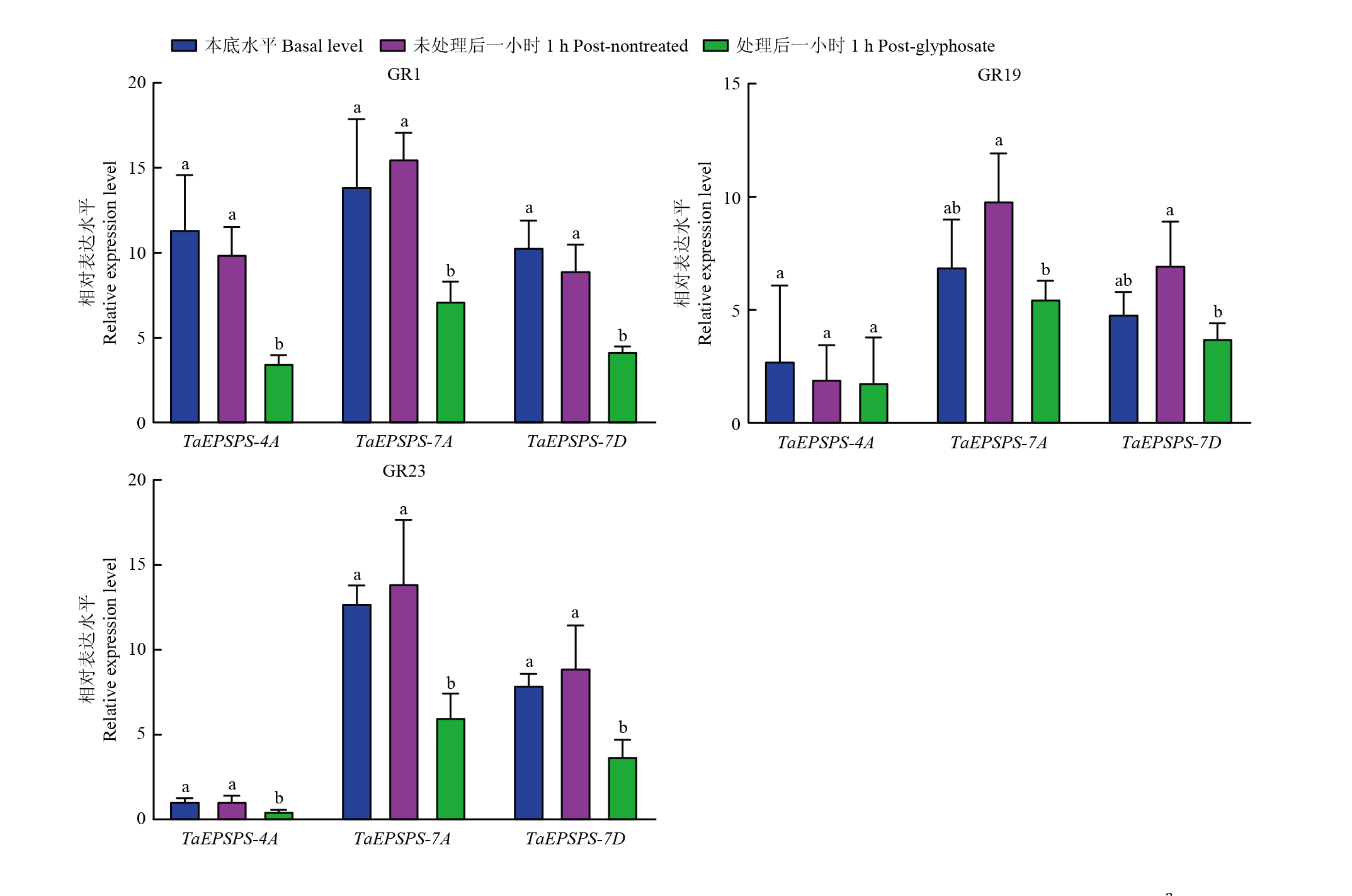
【Objective】This study aimed to develop novel glyphosate-resistant wheat germplasm using EMS mutagenesis to mitigate weed infestation in wheat fields. Resistant mutant plants were selected through field screening, and the mutation profiles of the 5-enolpyruvylshikimate-3-phosphate synthase (EPSPS) gene as well as optimal application conditions were characterized, offering a practical approach for breeding glyphosate-resistant wheat varieties.【Method】A mutant population was generated by treating newly germinated seeds of Zhenmai 9 with EMS mutagenesis. Resistant mutants were isolated through multiple rounds of glyphosate screening in the field across M2 and M3 generations. Promising lines, including GR1, GR19, and GR23, were identified via pedigree selection, combined with yield and resistance phenotype screening. Mutation sites in the EPSPS gene were detected by PCR amplification and sequencing, while expression levels of TaEPSPS-4A, TaEPSPS-7A, and TaEPSPS-7D were analyzed using RT-qPCR. Field trials involving different glyphosate doses and application growth stages were conducted to systematically evaluate herbicide efficacy and determine the appropriate dosage and timing for safe application.【Result】The resistance mutant frequency in the M2 population was 6.53×10⁻⁶. In the M3 generation, 43 mutant plants exhibiting tolerance to 4× the recommended glyphosate dose were successfully obtained. Sequencing analysis revealed that resistant lines GR1 and GR19 harbored 5 and 3 mutation sites in TaEPSPS-7D, respectively, whereas GR23 carried 5 mutation sites in TaEPSPS-4A. Expression analysis indicated that glyphosate treatment significantly downregulated most homoeolog genes in the three mutation lines, irrespective of whether those genes carried resistance mutations. Field trials demonstrated 100% weed control efficacy across all glyphosate treatments, significantly superior to isoproturon. As the glyphosate doses increased, wheat seedling height and fresh weight showed a decreasing trend, but most differences with the untreated control were not significant, indicating no substantial adverse effects on growth. Yield analysis revealed that treatment with 1× and 2× doses did not cause significant yield reduction, whereas 4× and 8× doses led to significant reductions of 3.04% and 4.63%, respectively. Growth stage-specific trials further indicated that spraying a 2× dose of glyphosate from seedling to jointing stages had no significant impact on plant growth, but application at the booting stage significantly reduced plant height, fresh weight, and grain yield, resulting in a 6.48% yield loss.【Conclusion】The combination of EMS mutagenesis and field screening successfully generated new glyphosate-resistant wheat germplasm capable of withstanding 4× the recommended glyphosate dose. Multiple point mutations in the non-active center of the EPSPS enzyme confered enhanced glyphosate resistance without compromising yield. For practical application of such resistant varieties, the optimal weed control window is during wheat green-up (early March), using 41% glyphosate isopropylamine salt at 840-1 680 g ae·hm-2, diluted in 450 L·hm-2 of water, applied as foliar spray to weeds under rain-free conditions.

Key words: glyphosate resistance, wheat (Triticum aestivum), EMS mutagenesis, mutation site, gene expression, field efficacy trial

Table 1

Primers used for homologous PCR amplification of wheat EPSPS gene"

引物Primer 序列Sequences (5′-3′)
共同正向引物Common homoeolog EPSPS forward primer ACAGTGAGGATGTCCACTACATGCTTGA
7A反向引物Chr.7A EPSPS homoeolog reverse primer ACTTCTCTGACAGAGAACAGAAGTGTGCAC
4A反向引物Chr.4A EPSPS homoeolog reverse primer TTGTGTAAGGTCGCATTGATCGTACTACCA
7D反向引物Chr.7D EPSPS homoeolog reverse primer GAAAACTAGAATCATGCTTTTGTACTCCACTATC

Table 2

Genome-specific primers performed in RT-qPCR analysis of the EPSPS transcripts"

基因Gene 正向引物Forward primer (5′-3′) 反向引物Reverse primer (5′-3′)
TaEPSPS-4A TACTTGAGATGATGGGAGCG GCAACAACGGCAAGAGTCATT
TaEPSPS-7A GAACATCACGGCGATCGAC TCTTTCGGGTGCATCCAGGG
TaEPSPS-7D GAACGTCACGGCGATCGAT TCTTTCTGGTGCACCCCGGA
TaActin GTTGGTGATGAGGCCCAATC GTGCTACACGGAGCTCATTG

Fig. 1

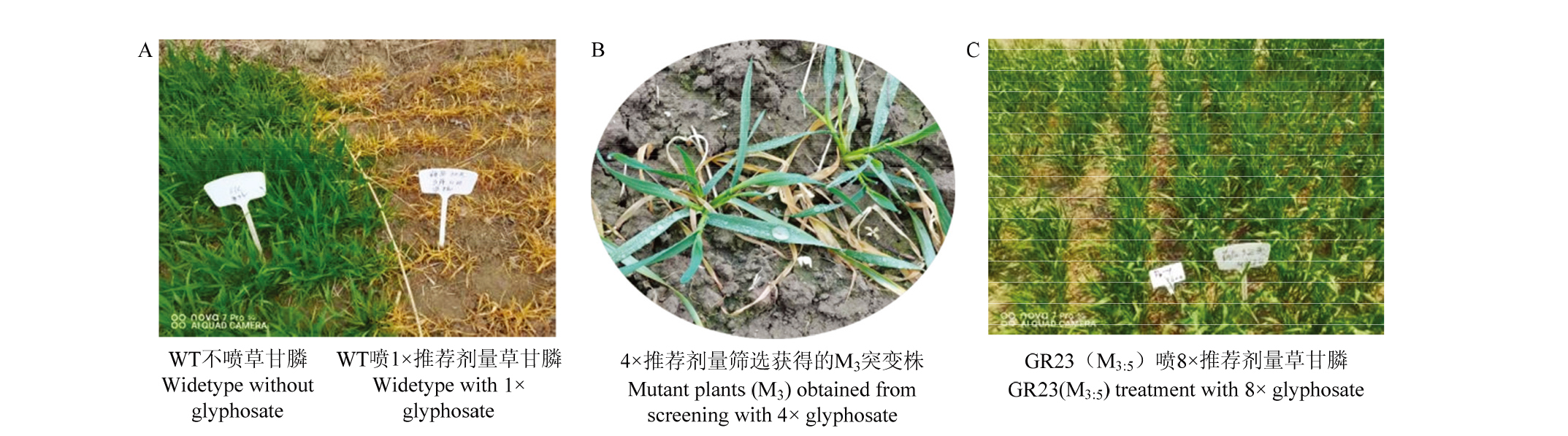
Field screening tests of glyphosate-resistant mutants A: Field plots of wild type (WT) Zhenmai 9; B: GR mutant plants of M3 generation obtained spraying 4×glyphosate; C: Field plots of GR mutant line GR23 (M3:5) with 8× glyphosate treatment"

Table 3

Yield performance of 7 glyphosate resistant mutant lines (M3:4) and its resistance to glyphosate"

突变系
Mutant line
籽粒产量Grain yield (kg·m-2) 对草甘膦的抗性
Resistance to glyphosate
喷草甘膦 With glyphosate 不喷草甘膦 Without glyphosate PP value
GR1 0.765±0.055 0.695±0.120 0.116 抗Resistant
GR2 0.525±0.019 0.648±0.017 0.000 抗Resistant
GR3 0.655±0.101 0.788±0.073 0.042 抗Resistant
GR4 0.548±0.032 0.585±0.063 0.175 抗Resistant
GR5 0.672±0.139 0.712±0.116 0.336 抗Resistant
GR6 0.462±0.079 0.407±0.021 0.130 抗Resistant
GR9 0.713±0.024 0.755±0.028 0.034 抗Resistant
GR19 0.779±0.017 0.748±0.020 0.144 抗Resistant
GR23 0.636±0.015 0.625±0.019 0.686 抗Resistant

Fig. 2

Ananlysis of mutation sites in glypphosate-resistant mutant line GR1, GR19 and GR23 The sequences marked in gray are exons, and the unmarked sequences are introns; the sequences marked in purple correspond to the base sequences of the EPSPS enzyme active center; the mutated codons are marked in bold red, and the underlined bases indicate the mutation sites; and the blue characters indicate the amino acid substitutions caused by mutations"

Fig. 3

Expression analysis of three wheat EPSPS homoeologous genes of the mutant lines GR1, GR19 and GR23 Different letters of the same gene indicate significant differences between treatments (P<0.05)"

Table 4

The effect of herbicide treatment on wheat shoot height, shoot fresh weight, and weed control"

药剂
Herbicide
剂量
Dose
(g ae·hm-2)
GR1 GR19 GR23
苗高
Shoot height
(cm)
苗鲜重
Shoot fresh weight
(cm)
株防效
Control effect of plant (%)
苗高
Shoot height
(cm)
苗鲜重
Shoot fresh weight
(cm)
株防效
Control effect of plant (%)
苗高
Shoot height
(cm)
苗鲜重
Shoot fresh weight
(cm)
株防效
Control effect of plant (%)
草甘膦1)
Glyphosate
840 42.3a 2.98a 100.0a 38.9b 2.88a 100.0a 42.0a 2.95a 100.0a
1680 43.0a 2.73b 100.0a 41.3ab 2.77b 100.0a 39.3b 2.72b 100.0a
3360 40.7ab 2.72b 100.0a 44.5a 3.00a 100.0a 41.2ab 2.65b 100.0a
6720 41.3a 2.69b 100.0a 40.6b 2.82a 100.0a 38.9b 2.74b 100.0a
异丙隆2) Isoproturon 2250 40.7ab 2.67b 77.0b 38.9b 2.71b 73.7b 40.0ab 2.71b 76.7b
空白对照3) CK - 40.5ab 2.71b - 41.1ab 2.99a - 40.9ab 2.78b -

Table 5

The effect of herbicide treatment on yield of wheat mutant lines GR1, GR19 and GR23"

药剂 Herbicide 剂量 Dose (g ae·hm-2) GR1 GR19 GR23 平均 Average
草甘膦Glyphosate 840 0.743a 0.777a 0.741a 0.754a
1680 0.730ab 0.759ab 0.734ab 0.741b
3360 0.721bc 0.749b 0.729bc 0.733c
6720 0.713c 0.739b 0.712c 0.721d
异丙隆Isoproturon 2250 0.717bc 0.745b 0.717bc 0.726cd
空白对照CK - 0.745a 0.779a 0.744a 0.756a
平均Average 0.728b 0.758a 0.730b

Table 6

The effect of glyphosate treatment at different growth stages on the growth of seedlings and yield of wheat mutant line GR1"

生育期
Growth stage
处理
Treatment
产量及构成因素Yield and its components
苗高
Shoot height
(cm)
单株鲜重
Fresh weight per plant (g)
单株分蘖数
Tillering No. per plant
籽粒产量
Grain yield
(kg·m-2)
穗数
Spike No.
(m-2)
每穗粒数
Grain No. per spike
千粒重
1000-grain weight (g)
苗期
Seedling stage
草甘膦Glyphosate 11.7a 0.49a 2.03a 0.724a 380.7a 41.1a 46.1a
CK 13.2a 0.42a 2.12a 0.725a 379.6a 41.6a 45.7a
分蘖期
Tillering stage
草甘膦Glyphosate 21.3a 2.35a 3.15a 0.721a 378.9a 41.5a 45.8a
CK 21.5a 2.37a 3.11a 0.726a 381.6a 41.3a 45.7a
拔节期
Jointing stage
草甘膦Glyphosate 60.2a 10.5a 3.23a 0.723a 379.5a 41.5a 45.6a
CK 61.4a 10.6a 3.58a 0.732a 383.2a 42.3a 45.3a
孕穗期
Booting stage
草甘膦Glyphosate 67.1b 11.5b - 0.678b 376.6a 38.8b 45.1a
CK 71.3a 12.7a - 0.725a 378.1a 41.7a 45.9a
[1]
GREEN J M. Evolution of glyphosate-resistant crop technology. Weed Science, 2009, 57(1): 108-117.

doi: 10.1614/WS-08-030.1
[2]
DUKE S O, POWLES S B, SAMMONS R D. Glyphosate-how it became a once in a hundred year herbicide and its future. Outlooks on Pest Management, 2018, 29(6): 247-251.

doi: 10.1564/v29_dec_03
[3]
LORRAINE-COLWILL D F, POWLES S B, HAWKES T R, PRESTON C. Inheritance of evolved glyphosate resistance in Lolium rigidum (Gaud.). Theoretical and Applied Genetics, 2001, 102(4): 545-550.

doi: 10.1007/s001220051680
[4]
DINELLI G, MAROTTI I, BONETTI A, CATIZONE P, URBANO J M, BARNES J. Physiological and molecular bases of glyphosate resistance in Conyza bonariensis biotypes from Spain. Weed Research, 2008, 48(3): 257-265.

doi: 10.1111/wre.2008.48.issue-3
[5]
SALAS R A, DAYAN F E, PAN Z Q, WATSON S B, DICKSON J W, SCOTT R C, BURGOS N R. EPSPS gene amplification in glyphosate-resistant Italian ryegrass (Lolium perenne ssp. multiflorum) from Arkansas. Pest Management Science, 2012, 68(9): 1223-1230.

doi: 10.1002/ps.v68.9
[6]
ARAMRAK A, LAWRENCE N C, DEMACON V L, CARTER A H, KIDWELL K K, BURKE I C, STEBER C M. Isolation of mutations conferring increased glyphosate resistance in spring wheat. Crop Science, 2018, 58(1): 84-97.

doi: 10.2135/cropsci2016.10.0861
[7]
MOEHS C P, AUSTILL W J, FACCIOTTI D, HOLM A, LOEFFLER D, LU Z J, MULLENBERG J C, SLADE A J, STEINE M N, VAN BOXTEL J, et al. Development of non-transgenic glyphosate tolerant wheat by TILLING. PLoS ONE, 2021, 16(9): e0245802.

doi: 10.1371/journal.pone.0245802
[8]
由振国. 中国麦田难治杂草的分布危害及化学解除方案//第九届全国杂草科学大会论文摘要集. 西宁, 2009: 22.
YOU Z G. Distribution, damage, and chemical control options for intractable weeds in wheat fields of China//Abstracts of the 9th National Weed Science Congress. Xining, 2009: 22. (in Chinese)
[9]
宋兴江, 王涛, 李方向, 常小箭, 李欣迪, 史岩, 王佳, 刘刚. 外来入侵植物野燕麦和节节麦对西安市小麦生产的危害研究. 中国农学通报, 2023, 39(36): 112-118.

doi: 10.11924/j.issn.1000-6850.casb2022-0778
SONG X J, WANG T, LI F X, CHANG X J, LI X D, SHI Y, WANG J, LIU G. The damage of invasive alien plants Avena fatua and Aegilops tauschii on wheat production in Xi'an. Chinese Agricultural Science Bulletin, 2023, 39(36): 112-118. (in Chinese)
[10]
VARAH A, AHODO K, COUTTS S R, HICKS H L, COMONT D, CROOK L, HULL R, NEVE P, CHILDS D Z, FRECKLETON R P, et al. The costs of human-induced evolution in an agricultural system. Nature Sustainability, 2020, 3(1): 63-71.

doi: 10.1038/s41893-019-0450-8 pmid: 31942455
[11]
ZHOU H, BERG J D, BLANK S E, CHAY C A, CHEN G, ESKELSEN S R, FRY J E, HOI S, HU T, ISAKSON P J, et al. Field efficacy assessment of transgenic roundup ready wheat. Crop Science, 2003, 43(3): 1072-1075.

doi: 10.2135/cropsci2003.1072
[12]
DILL G M. Glyphosate-resistant crops: History, status and future. Pest Management Science, 2005, 61(3): 219-224.

doi: 10.1002/ps.1008 pmid: 15662720
[13]
POZNIAK C J, BIRK I T, O'DONOUGHUE L S, MÉNARD C, HUCL P J, SINGH B K. Physiological and molecular characterization of mutation-derived imidazolinone resistance in spring wheat. Crop Science, 2004, 44(4): 1434-1443.

doi: 10.2135/cropsci2004.1434
[14]
马美艳. 基于EMS诱变小麦抗除草剂突变体创制及鉴选[D]. 杨凌: 西北农林科技大学, 2023.
MA M Y. Creation and identification of wheat herbicide-resistant mutants based on EMS mutagenesis[D]. Yangling: Northwest Sci- Tech University of Agriculture and Forestry, 2023. (in Chinese)
[15]
OSTLIE M, HALEY S D, ANDERSON V, SHANER D, MANMATHAN H, BEIL C, WESTRA P. Development and characterization of mutant winter wheat (Triticum aestivum L.) accessions resistant to the herbicide quizalofop. Theoretical and Applied Genetics, 2015, 128(2): 343-351.

doi: 10.1007/s00122-014-2434-4
[16]
HAUGHN G W, SOMERVILLE C R. LEBARON H M, MUMMA R O, HONEYCUTT R C, DUESING J H, eds, Washington DC, Selection for herbicide resistance at the whole plant level//Applications of Biotechnology to Agricultural Chemistry. American Chemical Society, 1987: 98-108.
[17]
JANDER G, BAERSON S R, HUDAK J A, GONZALEZ K A, GRUYS K J, LAST R L. Ethylmethanesulfonate saturation mutagenesis in Arabidopsis to determine frequency of herbicide resistance. Plant Physiology, 2003, 131(1): 139-146.

doi: 10.1104/pp.102.010397
[18]
CHEN L Z, DUAN L, SUN M H, YANG Z, LI H Y, HU K M, YANG H, LIU L. Current trends and insights on EMS mutagenesis application to studies on plant abiotic stress tolerance and development. Frontiers in Plant Science, 2022, 13: 1052569.

doi: 10.3389/fpls.2022.1052569
[19]
FUNKE T, HAN H, HEALY-FRIED M L, FISCHER M, SCHÖNBRUNN E. Molecular basis for the herbicide resistance of Roundup Ready crops. Proceedings of the National Academy of Sciences of the United States of America, 2006, 103(35): 13010-13015.
[20]
HEALY-FRIED M L, FUNKE T, PRIESTMAN M A, HAN H, SCHÖNBRUNN E. Structural basis of glyphosate tolerance resulting from mutations of Pro101 in Escherichia coli 5-enolpyruvylshikimate- 3-phosphate synthase. Journal of Biological Chemistry, 2007, 282(45): 32949-32955.

doi: 10.1074/jbc.M705624200
[21]
XU R, BAO Y Q, JIAO F F, LI M R, ZHANG X X, ZHANG F, GUO J J. Unraveling the atomic mechanisms underlying glyphosate insensitivity in EPSPS: Implications of distal mutations. Journal of Biomolecular Structure and Dynamics, 2025, 43(13): 6625-6636.

doi: 10.1080/07391102.2024.2318472
[22]
YU Q, JALALUDIN A, HAN H P, CHEN M, SAMMONS R D, POWLES S B. Evolution of a double amino acid substitution in the 5-enolpyruvylshikimate-3-phosphate synthase in Eleusine indica conferring high-level glyphosate resistance. Plant Physiology, 2015, 167(4): 1440-1447.

doi: 10.1104/pp.15.00146
[23]
ZHANG C, ZHONG X, LI S Y, YAN L, LI J Y, HE Y B, LIN Y, ZHANG Y J, XIA L Q. Artificial evolution of OsEPSPS through an improved dual cytosine and adenine base editor generated a novel allele conferring rice glyphosate tolerance. Journal of Integrative Plant Biology, 2023, 65(9): 2194-2203.

doi: 10.1111/jipb.v65.9
[24]
FUNKE T, YANG Y, HAN H, HEALY-FRIED M, OLESEN S, BECKER A, SCHÖNBRUNN E. Structural basis of glyphosate resistance resulting from the double mutation Thr97→Ile and Pro101Ser in 5-enolpyruvylshikimate-3-phosphate synthase from Escherichia coli. Journal of Biological Chemistry, 2009, 284(15): 9854-9860.

doi: 10.1074/jbc.M809771200
[25]
戴燚, 赵德刚. 抗草甘膦水稻突变体osgr-1 EPSPS基因克隆及生物信息学分析. 种子, 2018, 37(3): 1-6, 11.
DAI Y, ZHAO D G. Bioinformatic analysis of EPSPS gene from the rice resistant mutant osgr-1 of glyphosate. Seed, 2018, 37(3): 1-6, 11. (in Chinese)
[26]
FRANCI J, LAM K W, CHUAH T S, CHA T S. Genetic diversity and in silico evidence of target-site mutation in the EPSPS gene in endowing glyphosate resistance in Eleusine indica (L.) from Malaysia. Pesticide Biochemistry and Physiology, 2020, 165: 104556.

doi: 10.1016/j.pestbp.2020.104556
[27]
ESCHENBURG S, HEALY M L, PRIESTMAN M A, LUSHINGTON G H, SCHÖNBRUNN E. How the mutation glycine96 to alanine confers glyphosate insensitivity to 5-enolpyruvyl shikimate-3-phosphate synthase from Escherichia coli. Planta, 2002, 216(1): 129-135.

doi: 10.1007/s00425-002-0908-0
[28]
GAINES T A, ZHANG W, WANG D, BUKUN B, CHISHOLM S T, SHANER D L, NISSEN S J, PATZOLDT W L, TRANEL P J, CULPEPPER A S, et al. Gene amplification confers glyphosate resistance in Amaranthus palmeri. Proceedings of the National Academy of Sciences of the United States of America, 2009, 107(3): 1029-1034.
[29]
李燕敏, 祁显涛, 刘昌林, 刘方, 谢传晓. 除草剂抗性农作物育种研究进展. 作物杂志, 2017(2): 1-6.
LI Y M, QI X T, LIU C L, LIU F, XIE C X. Progress of crop breeding on resistance to herbicides. Crops, 2017(2): 1-6. (in Chinese)
[30]
VENCILL W K, NICHOLS R L, WEBSTER T M, SOTERES J K, MALLORY-SMITH C, BURGOS N R, JOHNSON W G, MCCLELLAND M R. Herbicide resistance: Toward an understanding of resistance development and the impact of herbicide-resistant crops. Weed Science, 2012, 60(SP1): 2-30.

doi: 10.1614/WS-D-11-00206.1
[31]
RIZWAN M, AKHTAR S, ASLAM M, ASGHAR M J. Development of herbicide resistant crops through induced mutations. Advancements in Life Sciences, 2015, 3(1): 1-8.
[32]
JIN M, CHEN L, DENG X W, TANG X Y. Development of herbicide resistance genes and their application in rice. The Crop Journal, 2022, 10(1): 26-35.

doi: 10.1016/j.cj.2021.05.007
[1] LIAO TingLu, SHI YaFei, XIAO DongHao, SHE YangMengFei, GUO FuCheng, YANG JiuJu, TANG HaiJiang, LUO ChengKe. The Effect of Exogenous Nitroprusside on Sugar Metabolism in Rice Seedlings Under Alkaline Stress [J]. Scientia Agricultura Sinica, 2026, 59(2): 265-277.
[2] WU Yu, QU XiangRu, YANG Dan, WU Qin, CHEN GuoYue, JIANG QianTao, WEI YuMing, XU Qiang. Widespread Non-Targeted Metabolomics Reveals Metabolites of Chloroplasts in Wheat Responses to Stripe Rust [J]. Scientia Agricultura Sinica, 2025, 58(7): 1333-1343.
[3] ZHANG TianYu, LI Bai, ZANG JinPing, CAO HongZhe, DONG JinGao, XING JiHong, ZHANG Kang. Genome-Wide Identification and Expression Analysis of HMG Family Genes in Botrytis cinerea [J]. Scientia Agricultura Sinica, 2025, 58(4): 704-718.
[4] ZHANG LinLin, GONG Rui, CUI YanLing, ZHONG XiongHui, LI Ye, LI RanHong, QIAN ZongWei. Effect Analysis of SmWRKY30 in Eggplant Resistance to Ralstonia solanacearum by Virus Induced Gene Silencing (VIGS) [J]. Scientia Agricultura Sinica, 2025, 58(3): 548-563.
[5] ZHANG XiangKun, LI JiaYing, QIAO RuMeng, HE JingLei, WANG Li, SHI XiaoXin, DU GuoQiang. Effects of GFabV Under Different Zn Levels on Photosynthetic Efficiency and Photosynthesis-Related Gene Expression of ‘Shine Muscat’ Grapevine [J]. Scientia Agricultura Sinica, 2025, 58(24): 5190-5200.
[6] DING Ning, QI EnFang, JIA XiaoXia, HUANG Wei, MA LiRong, LI JianWu, YAN RuNan. Screening and Identification of miRNAs in Potato Seedlings in Response to High Temperature Stress [J]. Scientia Agricultura Sinica, 2025, 58(22): 4589-4602.
[7] ZHANG Jie, HU ChenXi, QI JianBo, ZHANG YongTai, CHEN YiBo, ZHANG YongJi. Effects of Exogenous Zeatin on Photosynthetic Parameter, Antioxidant System and Expression of Genes Related to Zeatin Synthesis in Pepper Under Low-Temperature Combined with Low-Light Stress [J]. Scientia Agricultura Sinica, 2025, 58(19): 3959-3969.
[8] CHEN BingXian, ZHANG Qi, DAI ZhangYan, ZHOU Xu, LIU Jun. Physiological and Molecular Effects of Salicylic Acid on Rice Seed Germination at Low Temperature [J]. Scientia Agricultura Sinica, 2024, 57(7): 1220-1236.
[9] WANG ChengZe, ZHANG Yan, FU Wei, JIA JingZhe, DONG JinGao, SHEN Shen, HAO ZhiMin. Bioinformatics and Expression Pattern Analysis of Maize ACO Gene Family [J]. Scientia Agricultura Sinica, 2024, 57(7): 1308-1318.
[10] SU XiaoYu, TAN ZhengWei, LI ChunMing, LI Lei, LU DanDan, YU YongLiang, DONG Wei, AN SuFang, YANG Qing, SUN Yao, XU LanJie, YANG HongQi, LIANG HuiZhen. Analysis of Genome-Wide Methylation Differences and Associated Gene Expression of Sesame Varieties Under High Temperature Stress [J]. Scientia Agricultura Sinica, 2024, 57(24): 4825-4838.
[11] YANG HaoRong, JIA Fan, HU Xu, MU Rong, LIU WeiNa, LIU ChangYun, WANG ShanZhi, SUN XianChao, MA GuanHua, CHEN GuoKang. BnJAZ7 Promotes Sclerotinia sclerotiorum Infection by Affecting the Antioxidant Pathway in Brassica napus [J]. Scientia Agricultura Sinica, 2024, 57(19): 3799-3809.
[12] HU DanDan, LUO RunQi, LIANG RuiYing, WANG Lei, LIANG Lin, SI HongBin, DING JiaBo, TANG XinMing. Research Progress of ApiAP2 Transcription Factors in Regulating the Growth and Development of Toxoplasma gondii [J]. Scientia Agricultura Sinica, 2024, 57(13): 2687-2697.
[13] WEI XiaoDong, SONG XueMei, WANG Ning, ZHAO QingYong, ZHU Zhen, CHEN Tao, ZHAO Ling, WANG CaiLin, ZHANG YaDong. Distribution Characteristics of Photosynthetic Products of Nanjing Series of Super Rice During Filling Stage [J]. Scientia Agricultura Sinica, 2024, 57(12): 2309-2321.
[14] QU Qing, LIU Ning, ZOU JinPeng, ZHANG YaXuan, JIA Hui, SUN ManLi, CAO ZhiYan, DONG JinGao. Screening of Differential Genes and Analysis of Metabolic Pathways in the Interaction Between Fusarium verticillioides and Maize Kernels [J]. Scientia Agricultura Sinica, 2023, 56(6): 1086-1101.
[15] ZOU Ting, LIU LiLi, XIANG JianHua, ZHOU DingGang, WU JinFeng, LI Mei, LI Bao, ZHANG DaWei, YAN MingLi. Cloning of MYBL2 Gene from Brassica and Its PCR Identification in Genomes A, B and C [J]. Scientia Agricultura Sinica, 2023, 56(3): 416-429.
Viewed
Full text


Abstract

Cited

  Shared   
  Discussed   
No Suggested Reading articles found!