Scientia Agricultura Sinica ›› 2025, Vol. 58 ›› Issue (23): 4979-4992.doi: 10.3864/j.issn.0578-1752.2025.23.013

• SOIL & FERTILIZER·WATER-SAVING IRRIGATION·AGROECOLOGY & ENVIRONMENT • Previous Articles     Next Articles

Research on Soil Moisture Diagnosis Model of Maize Farmland Based on Remote Sensing of Unmanned Aerial Vehicles

LIANG Xue1(), JIANG Yan1,*(), WEI ChangZhou1, XUE Bing2, LI FangFang1, CUI YiRui1, ZHANG XiaRan1   

  1. 1 College of Agriculture, Shihezi University, Shihezi 832003, Xinjiang
    2 College of Geography Science and Planning, Sun Yat-sen University, Guangzhou 510275
  • Received:2024-12-09 Accepted:2025-04-15 Online:2025-12-01 Published:2025-12-09
  • Contact: JIANG Yan

Abstract:

【Objective】 Using unmanned aerial vehicle (UAV) remote sensing technology, a rapid, non-destructive and accurate diagnostic model for monitoring soil moisture in maize farmland was constructed to maximize the efficiency of agricultural water use, so as to provide the theoretical basis and scientific basis for precise irrigation management of maize. 【Method】 In this study, the field maize was used as the research object, and four water treatments were set up through field plot experiments, namely: low water treatment (W1): 495 mm, conventional drip irrigation control treatment (W2): 575 mm, high water treatment (W3): 660 mm, and (W4): 740 mm. In the key growth period of maize, the canopy temperature (Tc), air temperature (Ta), soil moisture and other information of maize were measured synchronously, and the Tc of maize was extracted and optimized by K-Means method and statistical technology. Meanwhile, water-canopy air temperature difference index (WCAI, the sum of CWSI and canopy air temperature difference) and water-canopy air relative temperature difference index (WRTI, the sum of CWSI and relative canopy air temperature difference) were constructed based on crop water stress index (CWSI), Tc, Ta and canopy air temperature difference. The optimal diagnostic model was selected to determine the soil moisture threshold. 【Result】 Tc was negatively correlated with soil moisture. The constructed model WCAI could not well reflect the trend of soil moisture change, while the coefficient of determination R2 between the predicted value and the measured value of soil moisture content based on WRTI model reached more than 0.744, indicating that WRTI was a better model for diagnosing soil moisture. Finally, by comparing the correlation between WRTI and water content in different soil layers at different growth stages of maize, it was found that WRTI had a better effect on diagnosing soil water content in 0-20 cm soil layer at jointing stage, with R2 of 0.785 and 0.859. The diagnosis of soil water content in 0-40 cm soil layer at large bell stage, heading stage and filling stage was better, and the R2 range was 0.796-0.900. Based on the correlation between WRTI and maize yield, the WRTI threshold range of each growth period was 0.218-0.301, and the soil moisture threshold range was 67.8%-80.1% according to the relationship between WRTI and soil moisture content. 【Conclusion】 Because the WCAI model parameter' canopy temperature difference' was greatly affected by the environment, compared with the change trend of WRTI and CWSI under different water treatments, WCAI had no obvious relationship with soil moisture, and WCAI was not suitable for soil moisture diagnosis. The WRTI model parameter' relative canopy temperature difference' weakens the impact of the environment, and its combination with CWSI could better reflect the change of soil moisture, improve the accuracy of soil moisture diagnosis based on remote sensing, effectively reduce the waste of water resources, and achieve water saving and high yield. The research results provided a reference for real-time monitoring of farmland soil moisture and precision irrigation by UAV remote sensing.

Key words: maize, soil moisture, UAV thermal infrared remote sensing, canopy temperature, crop water stress index, canopy air temperature difference

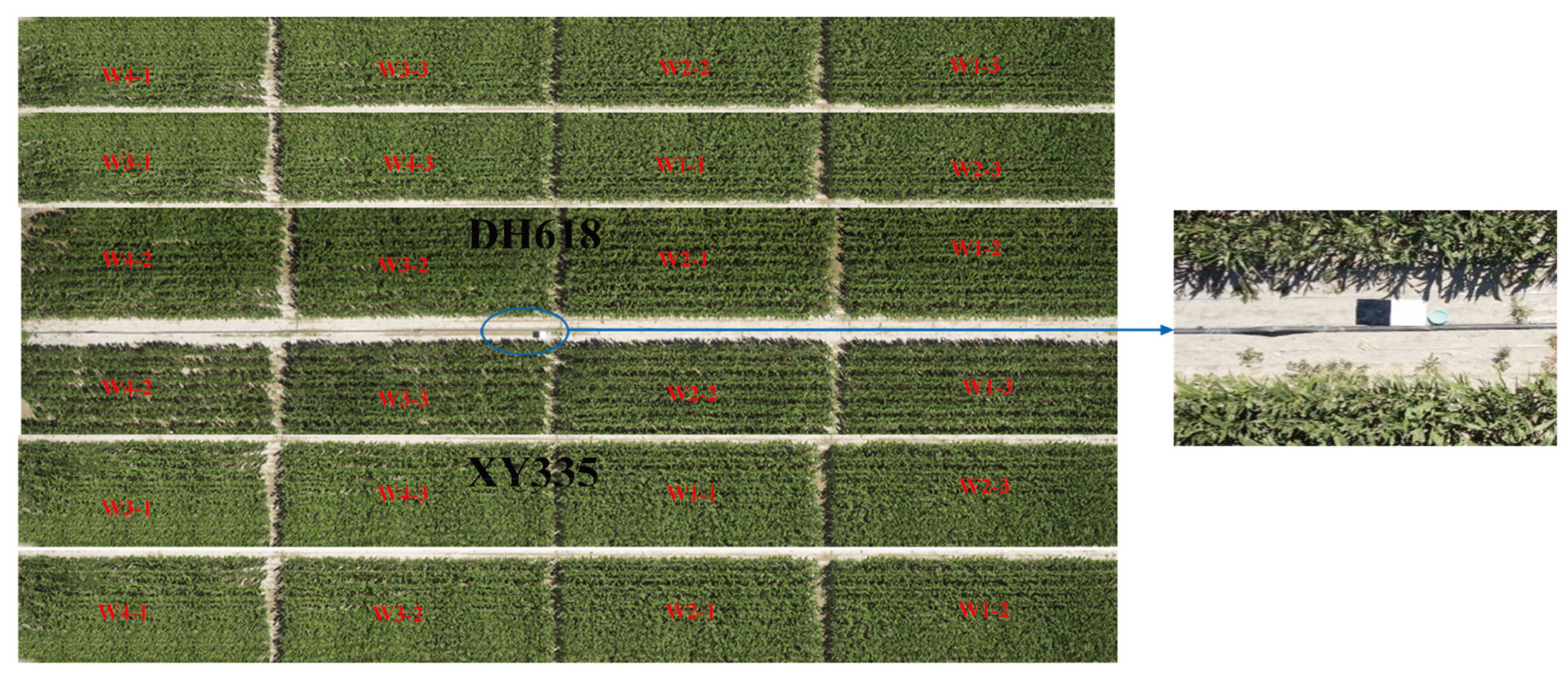
Fig. 1

Test area layout (left) and temperature calibration material (right)"

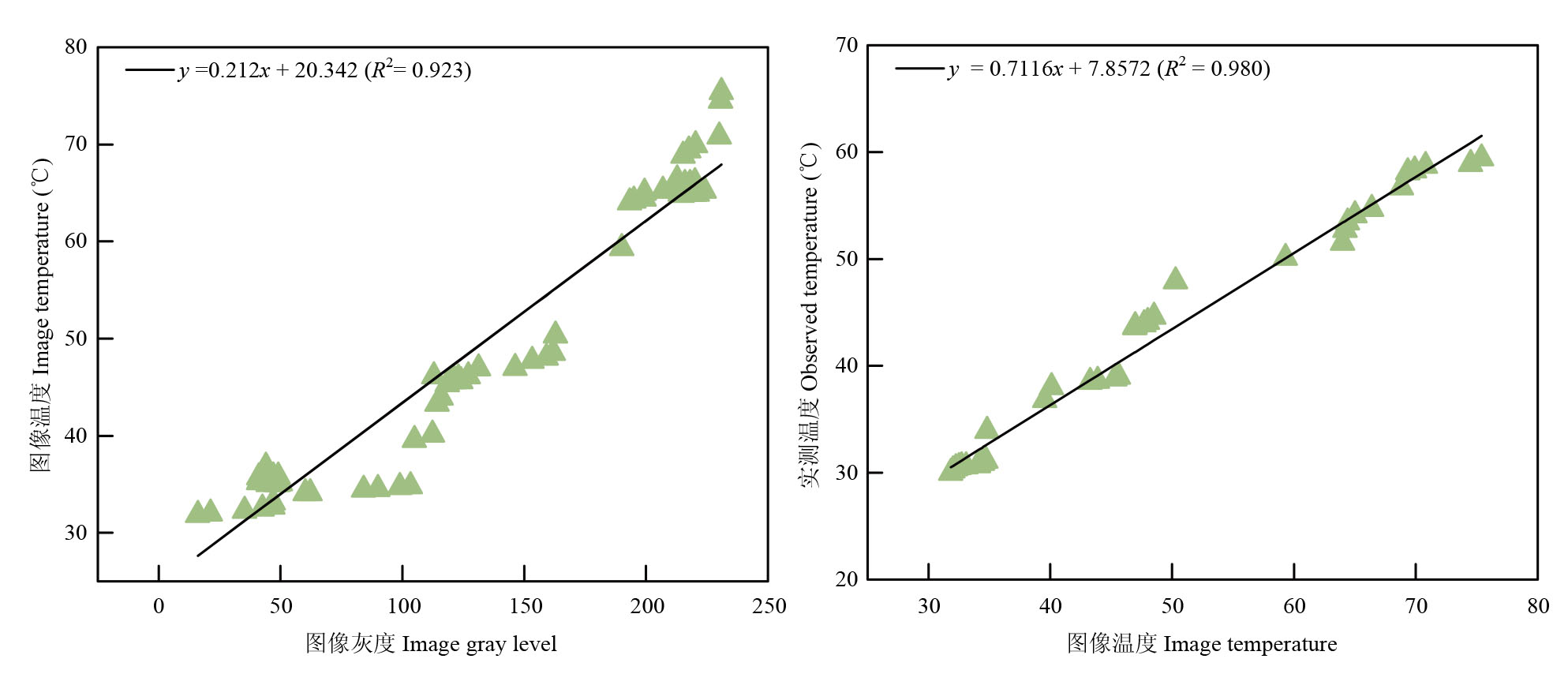
Fig. 2

The relationship between temperature conversion and calibration"

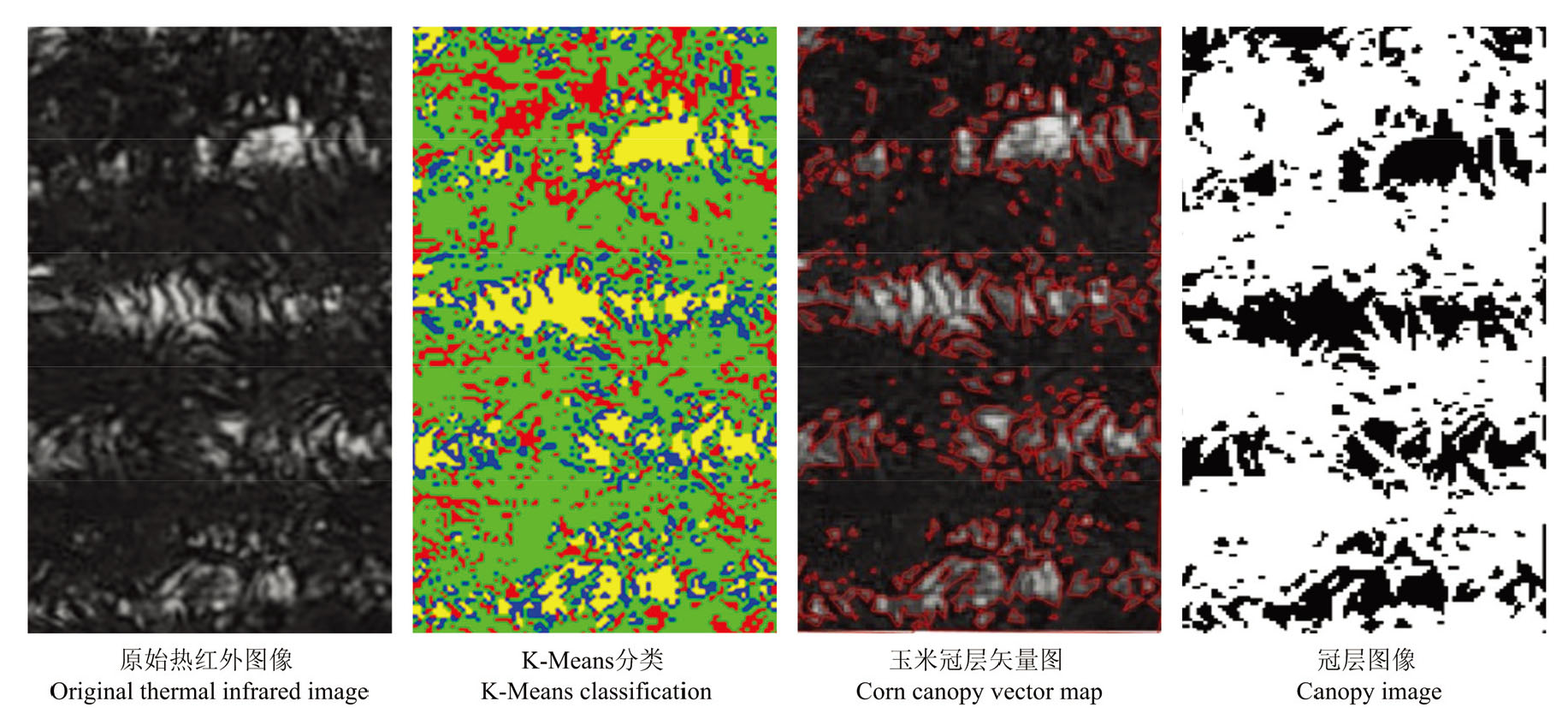
Fig. 3

Canopy temperature extraction"

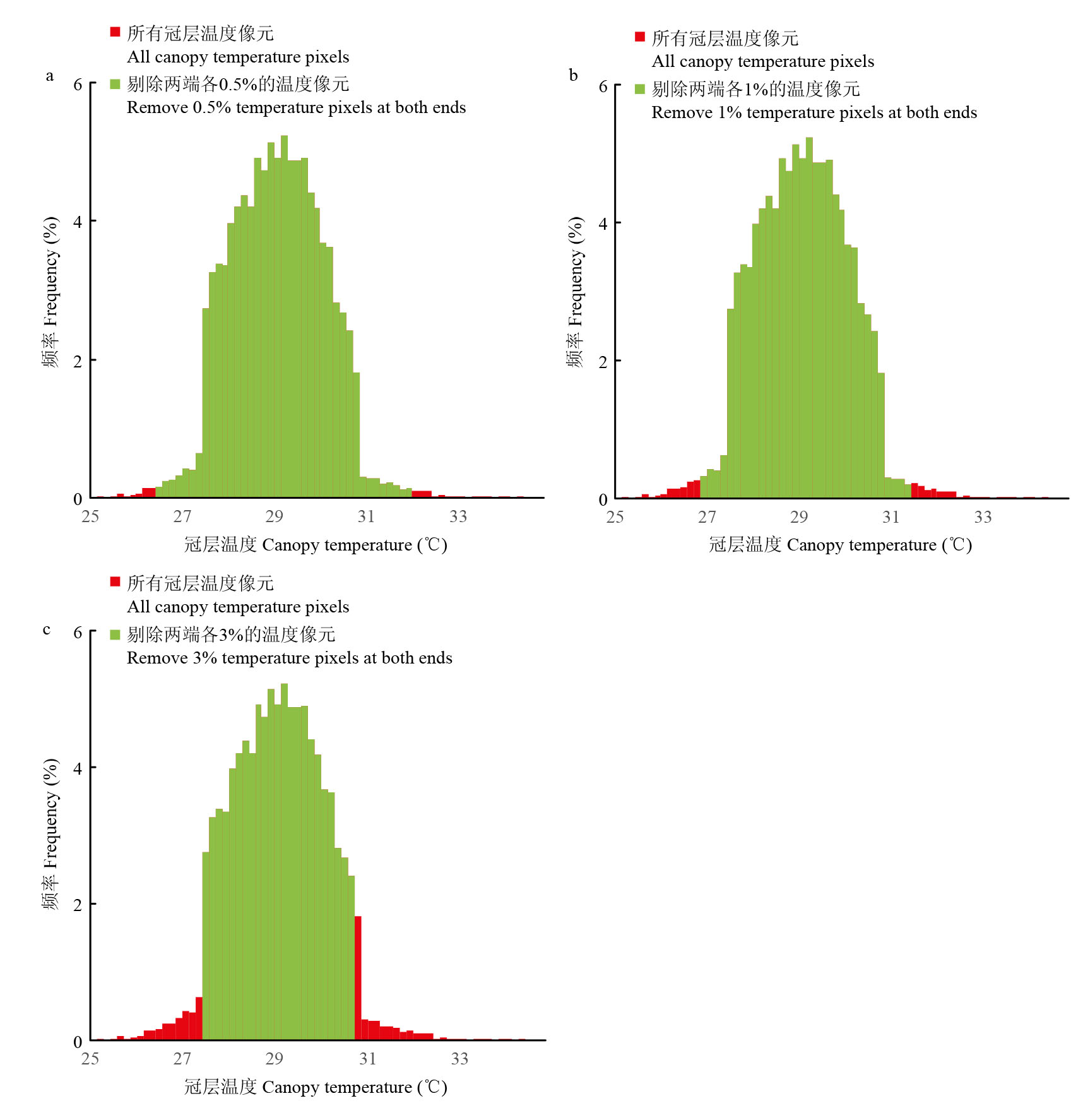
Fig. 4

Canopy temperature histogram"

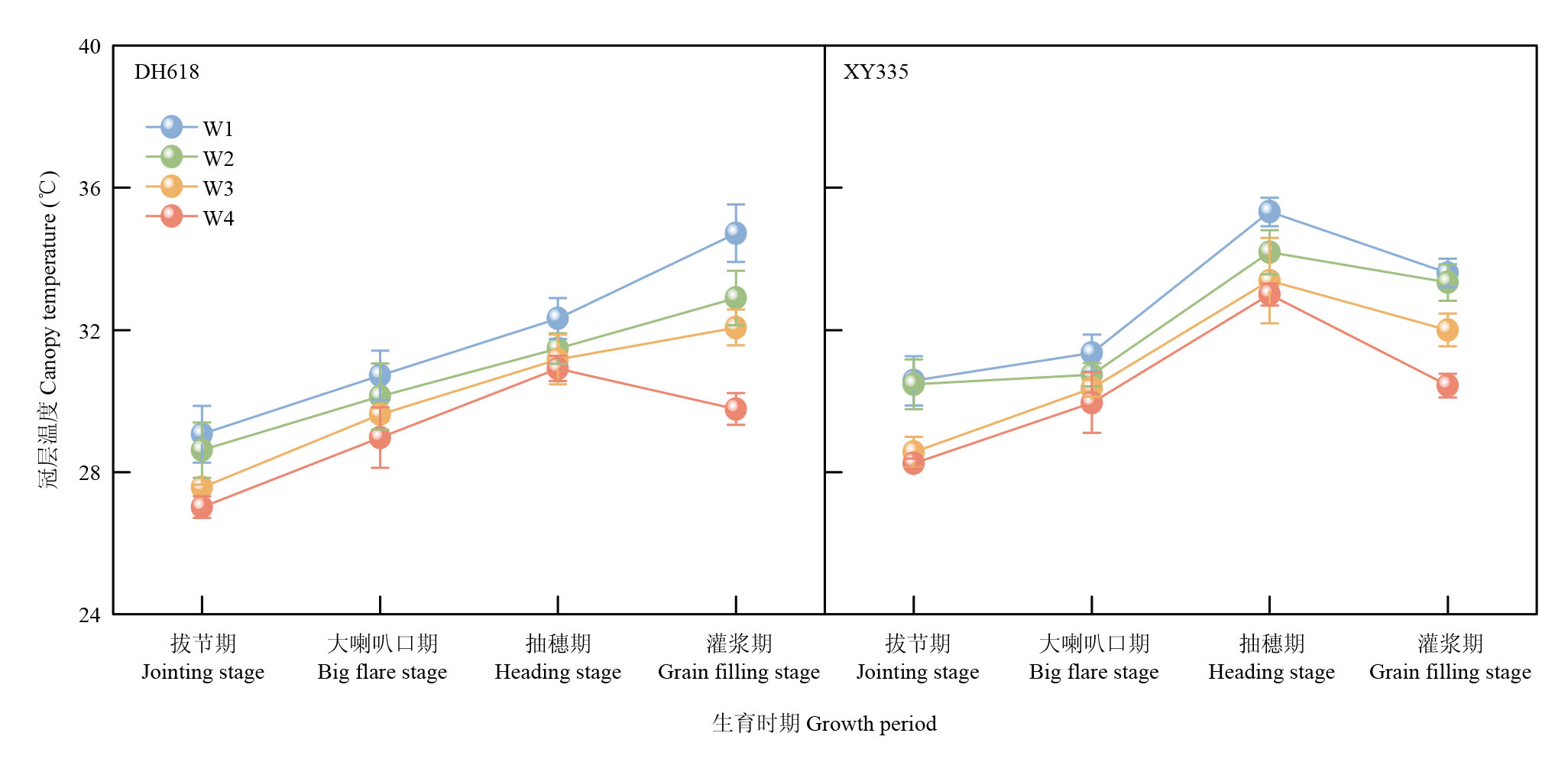
Fig. 5

Canopy temperature changes of two maize varieties at different growth stages under different water treatments"

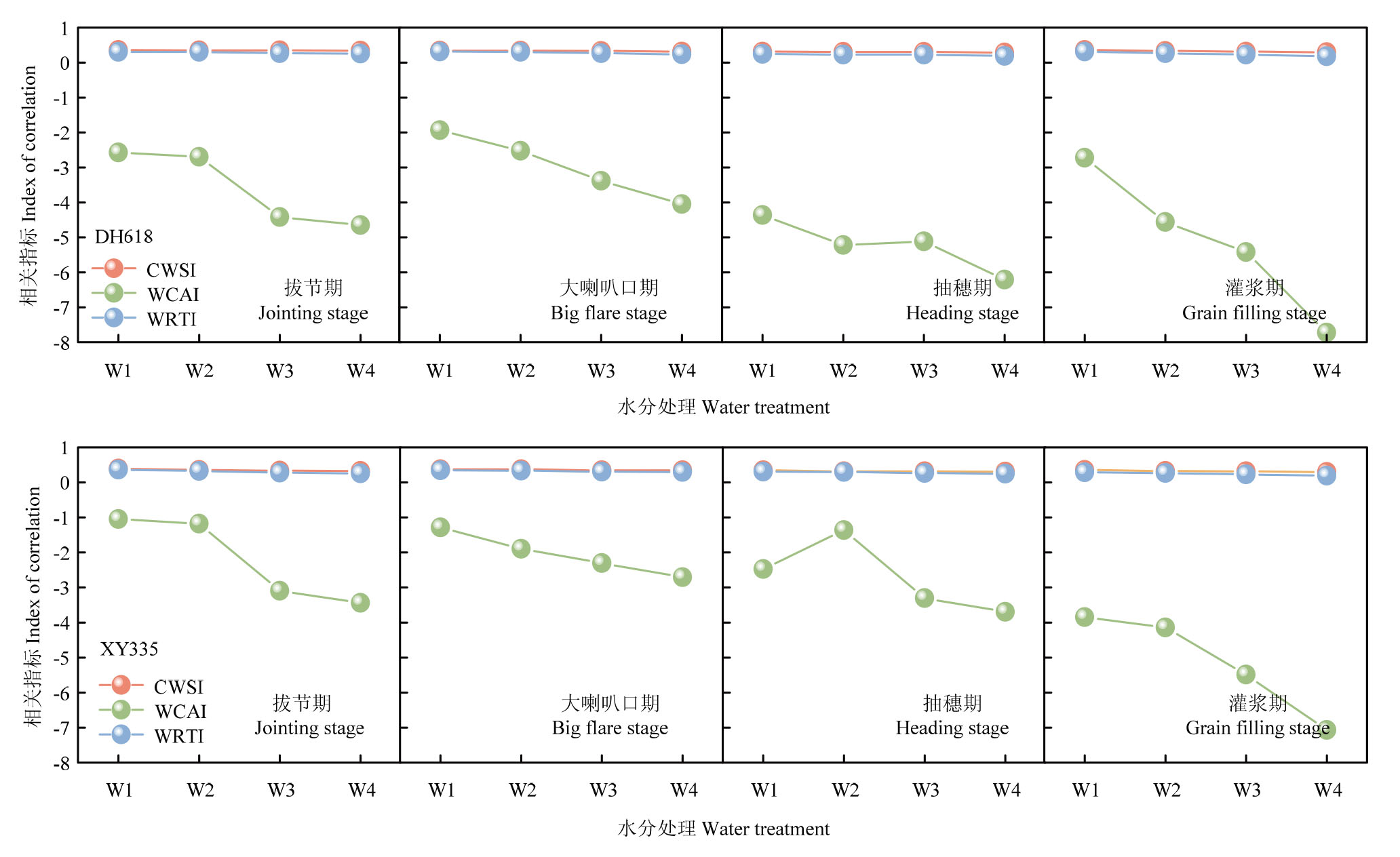
Fig. 6

Trends of CWSI, WCAI and WRTI"

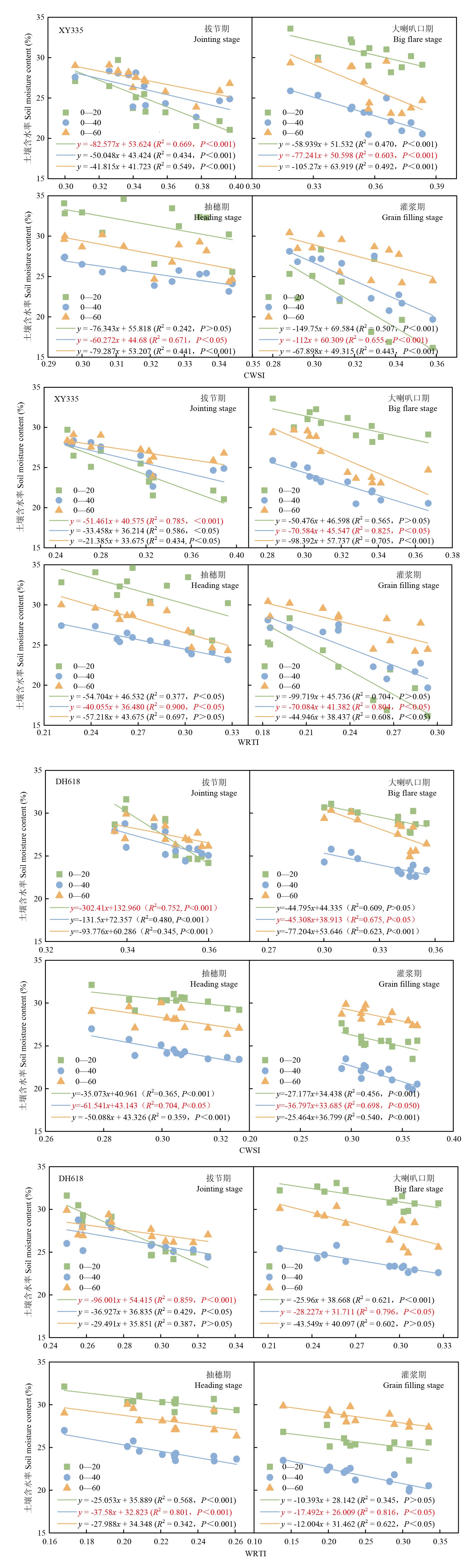
Fig. 7

Correlation between CWSI and WRTI of DH618 and XY335 and soil moisture content at different depths"

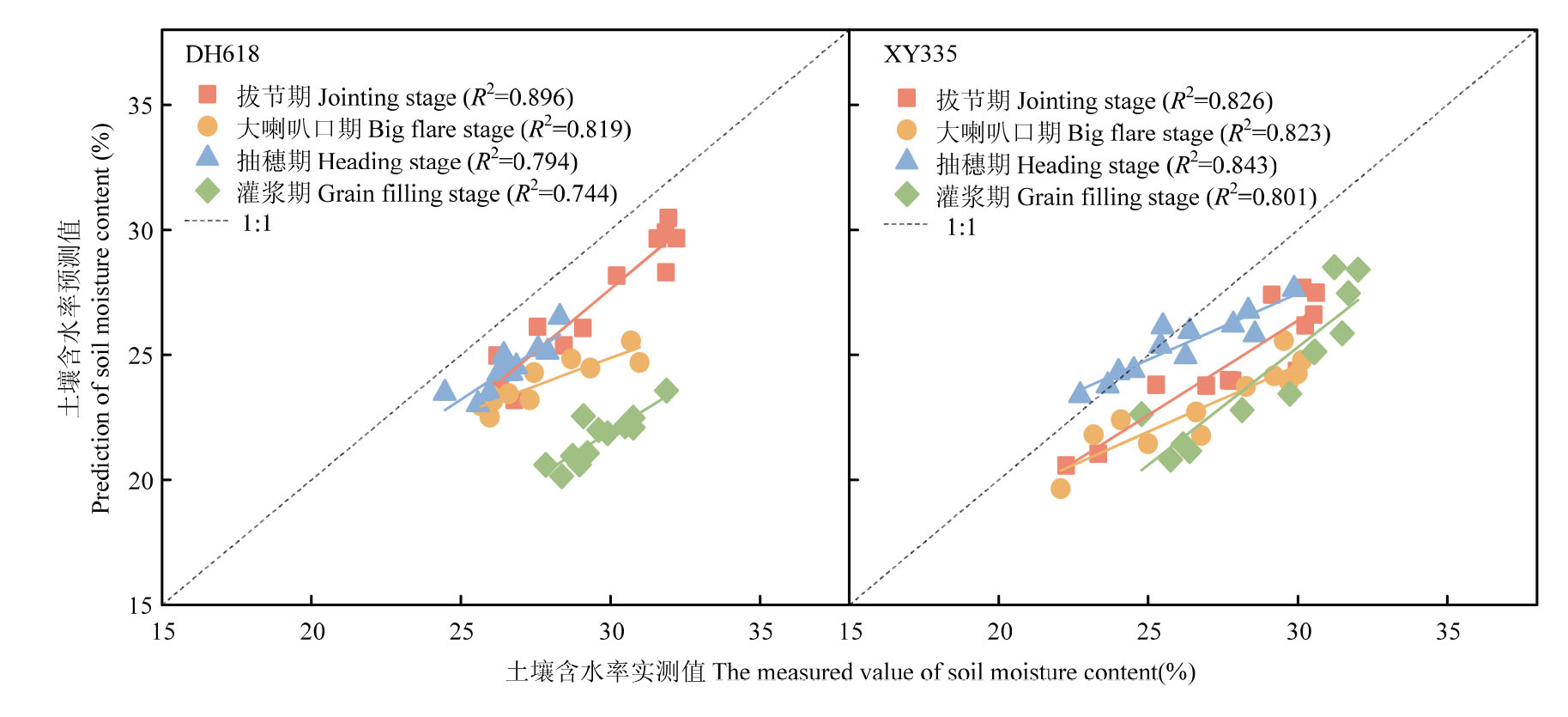
Fig. 8

Validation of the prediction effect of WRTI on soil moisture content"

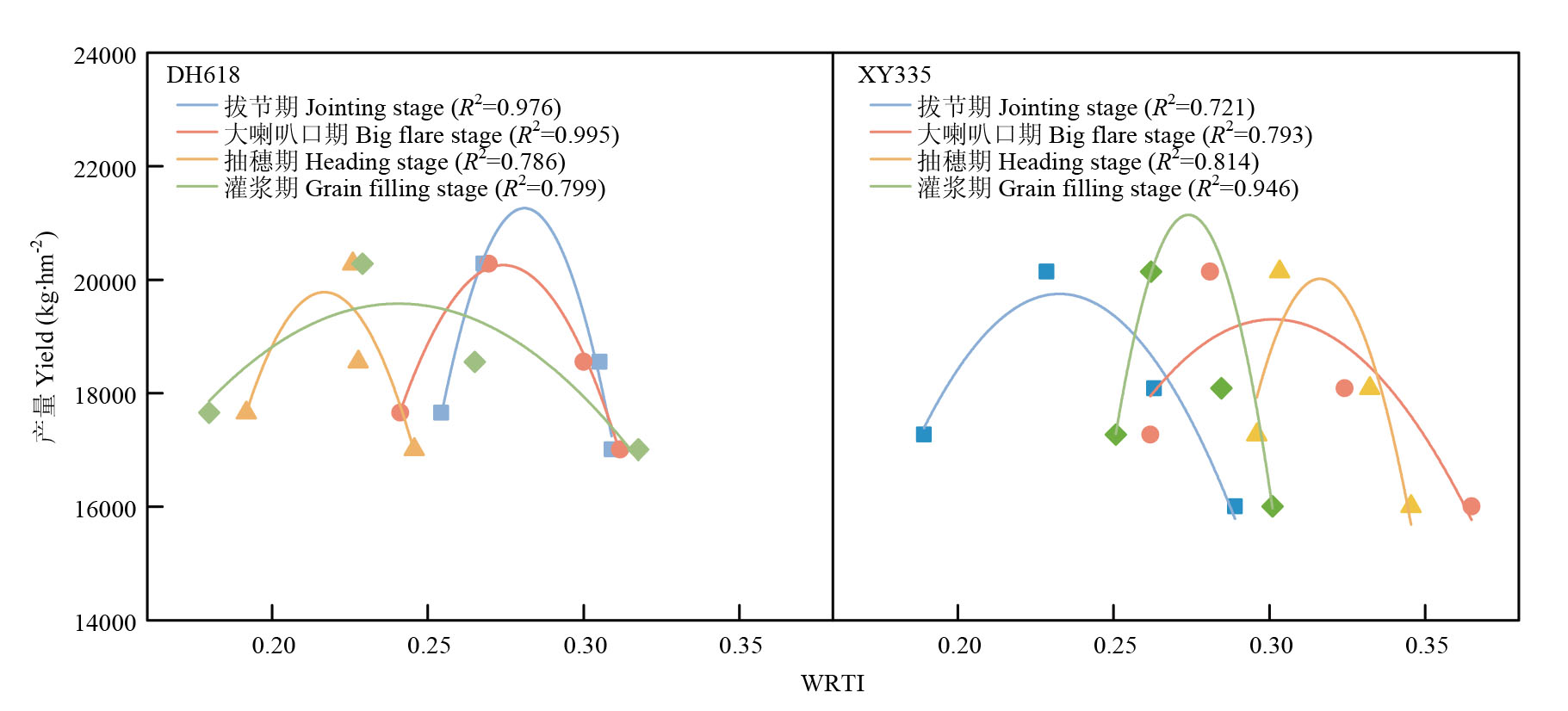
Fig. 9

Relationship between WRTI and yield"

Table 1

Changes of WRTI and soil relative water content (% of field capacity) threshold with growth period"

生育时期
Growth period
登海618 DH618 先玉335 XY335
WRTI阈值
WRTI threshold
土壤相对含水量阈值
Threshold of soil relative water content (%)
WRTI阈值
WRTI threshold
土壤相对含水量阈值
Threshold of soil relative water content (%)
拔节期 Jointing stage 0.300 75.183 0.301 73.780
大喇叭口期 Big flare stage 0.254 79.376 0.300 78.467
抽穗期 Heading stage 0.218 79.058 0.250 80.052
灌浆期 Grain filling stage 0.241 70.222 0.286 67.797
[1]
张晓斌, 冯俊杰, 刘杨, 韩启彪, 娄和, 王明. 灌溉流量自调节阀的结构设计与性能分析. 节水灌溉, 2020(6): 56-60.
ZHANG X B, FENG J J, LIU Y, HAN Q B, LOU H, WANG M. Structural design and performance analysis of irrigation flow auto-regulating valve. Water Saving Irrigation, 2020(6): 56-60. (in Chinese)
[2]
ABIOYE E A, ABIDIN M S Z, MAHMUD M S A, BUYAMIN S, ISHAK M H I, RAHMAN M K I A, OTUOZE A O, ONOTU P, RAMLI M S A. A review on monitoring and advanced control strategies for precision irrigation. Computers and Electronics in Agriculture, 2020, 173: 105441.

doi: 10.1016/j.compag.2020.105441
[3]
KHANAL S, FULTON J, SHEARER S. An overview of current and potential applications of thermal remote sensing in precision agriculture. Computers and Electronics in Agriculture, 2017, 139: 22-32.

doi: 10.1016/j.compag.2017.05.001
[4]
ZHANG B Y, LIU X N, LIU M L, WANG D M. Thermal infrared imaging of the variability of canopy-air temperature difference distribution for heavy metal stress levels discrimination in rice. Journal of Applied Remote Sensing, 2017, 11: 026036.

doi: 10.1117/1.JRS.11.026036
[5]
魏征, 许迪, 刘钰, 蔡甲冰. 基于冠气温差的冬小麦水分亏缺诊断试验研究. 水利学报, 2014, 45(8): 984-990.
WEI Z, XU D, LIU Y, CAI J B. Diagnosis and experimental study on water deficit of winter wheat based on the variation of canopy-air temperature difference. Journal of Hydraulic Engineering, 2014, 45(8): 984-990. (in Chinese)
[6]
GONTIA N K, TIWARI K N. Development of crop water stress index of wheat crop for scheduling irrigation using infrared thermometry. Agricultural Water Management, 2008, 95(10): 1144-1152.

doi: 10.1016/j.agwat.2008.04.017
[7]
GU S J, LIAO Q, GAO S Y, KANG S Z, DU T S, DING R S. Crop water stress index as a proxy of phenotyping maize performance under combined water and salt stress. Remote Sensing, 2021, 13(22): 4710.

doi: 10.3390/rs13224710
[8]
张旭东, 陈伟, 迟道才, 蔡亮. 水稻需水关键期冠气温差变化规律试验研究. 灌溉排水学报, 2011, 30(4): 80-83.
ZHANG X D, CHEN W, CHI D C, CAI L. Canopy-air temperature difference of rice in key water requirement periods. Journal of Irrigation and Drainage, 2011, 30(4): 80-83. (in Chinese)
[9]
王纯枝, 宇振荣, 孙丹峰, 刘云, 刘云慧. 夏玉米冠气温差及其影响因素关系探析. 土壤通报, 2006, 37(4): 651-658.
WANG C Z, YU Z R, SUN D F, LIU Y, LIU Y H. Analysis on the factors affecting summer maize canopy-air temperature difference. Chinese Journal of Soil Science, 2006, 37(4): 651-658. (in Chinese)
[10]
GERHARDS M, ROCK G, SCHLERF M, UDELHOVEN T. Water stress detection in potato plants using leaf temperature, emissivity, and reflectance. International Journal of Applied Earth Observation and Geoinformation, 2016, 53: 27-39.

doi: 10.1016/j.jag.2016.08.004
[11]
NA S I, AHN H Y, PARK C W, HONG S Y, HO S K, LEE K D. Crop water stress index (CWSI) mapping for evaluation of abnormal growth of spring Chinese cabbage using drone-based thermal infrared image. Korean Journal of Remote Sensing, 2020, 36(5): 667-677.
[12]
LIU L Q, GAO X, REN C H, CHENG X F, ZHOU Y, HUANG H, ZHANG J S, BA Y J. Applicability of the crop water stress index based on canopy-air temperature differences for monitoring water status in a cork oak plantation, northern China. Agricultural and Forest Meteorology, 2022, 327: 109226.

doi: 10.1016/j.agrformet.2022.109226
[13]
张吉立, 蒋雨洲, 王鹏. 作物冠层温度测定及其与水分关系研究. 青海农林科技, 2020(1): 77-80.
ZHANG J L, JIANG Y Z, WANG P. Study on the relationship between canopy temperature and water content. Science and Technology of Qinghai Agriculture and Forestry, 2020(1): 77-80. (in Chinese)
[14]
张智韬, 许崇豪, 谭丞轩, 李宇, 宁纪锋. 基于无人机热红外遥感的玉米地土壤含水率诊断方法. 农业机械学报, 2020, 51(3): 180-190.
ZHANG Z T, XU C H, TAN C X, LI Y, NING J F. Diagnosing method of soil moisture content in corn field based on thermal infrared remote sensing of UAV. Transactions of the Chinese Society for Agricultural Machinery, 2020, 51(3): 180-190. (in Chinese)
[15]
汪玉莹. 不同水分条件下冬小麦-夏玉米基于冠气温差的蒸散量模型研究[D]. 保定: 河北农业大学, 2021.
WANG Y Y. Study on evapotranspiration model of winter wheat- summer maize based on canopy-air temperature difference under different water conditions[D]. Baoding: Hebei Agricultural University, 2021. (in Chinese)
[16]
蔡焕杰, 张振华, 柴红敏. 冠层温度定量诊断覆膜作物水分状况试验研究. 灌溉排水, 2001, 20(1): 1-4.
CAI H J, ZHANG Z H, CHAI H M. Crop canopy temperature as an index for assessing quantitatively water status of cotton and corn mulched with plastic film. Irrigation and Drainage, 2001, 20(1): 1-4. (in Chinese)
[17]
刘奇, 张智韬, 刘畅, 贾江栋, 黄嘉亮, 郭宇宏, 张秋雨. 基于无人机遥感的夏玉米水分胁迫指数改进方法. 农业工程学报, 2023, 39(2): 68-77.
LIU Q, ZHANG Z T, LIU C, JIA J D, HUANG J L, GUO Y H, ZHANG Q Y. Improved method of crop water stress index based on UAV remote sensing. Transactions of the Chinese Society of Agricultural Engineering, 2023, 39(2): 68-77. (in Chinese)
[18]
ZHANG L Y, NIU Y X, ZHANG H H, HAN W T, LI G, TANG J D, PENG X S. Maize canopy temperature extracted from UAV thermal and RGB imagery and its application in water stress monitoring. Frontiers in Plant Science, 2019, 10: 1270.

doi: 10.3389/fpls.2019.01270 pmid: 31649715
[19]
BIAN J, ZHANG Z T, CHEN J Y, CHEN H Y, CUI C F, LI X W, CHEN S B, FU Q P. Simplified evaluation of cotton water stress using high resolution unmanned aerial vehicle thermal imagery. Remote Sensing, 2019, 11(3): 267.

doi: 10.3390/rs11030267
[20]
张智韬, 边江, 韩文霆, 付秋萍, 陈硕博, 崔婷. 剔除土壤背景的棉花水分胁迫无人机热红外遥感诊断. 农业机械学报, 2018, 49(10): 250-260.
ZHANG Z T, BIAN J, HAN W T, FU Q P, CHEN S B, CUI T. Diagnosis of cotton water stress using unmanned aerial vehicle thermal infrared remote sensing after removing soil background. Transactions of the Chinese Society for Agricultural Machinery, 2018, 49(10): 250-260. (in Chinese)
[21]
陈科尹, 吴崇友, 关卓怀, 李海同, 王刚. 基于统计直方图k-means聚类的水稻冠层图像分割. 江苏农业学报, 2021, 37(6): 1425-1435.
CHEN K Y, WU C Y, GUAN Z H, LI H T, WANG G. Rice canopy image segmentation based on statistical histogram k-means clustering. Jiangsu Journal of Agriculture, 2021, 37(6): 1425-1435. (in Chinese)
[22]
YANCHO J M M, COOPS N C, TOMPALSKI P, GOODBODY T R H, PLOWRIGHT A. Fine-scale spatial and spectral clustering of UAV-acquired digital aerial photogrammetric (DAP) point clouds for individual tree crown detection and segmentation. IEEE Journal of Selected Topics in Applied Earth Observations and Remote Sensing, 2019, 12(10): 4131-4148.

doi: 10.1109/JSTARS.4609443
[23]
马晓丹, 刘梦, 关海鸥, 温冯睿, 刘刚. 基于热红外图像处理技术的农作物冠层识别方法研究. 光谱学与光谱分析, 2021, 41(1): 216-222.
MA X D, LIU M, GUAN H O, WEN F R, LIU G. Research on crop canopy recognition method based on thermal infrared image processing technology. Spectroscopy and Spectral Analysis, 2021, 41(1): 216-222. (in Chinese)
[24]
赵叶萌, 刘晓英, 钟秀丽, 曹金峰, 任图生, 冯丹红. 基于产量响应诊断冬小麦水分亏缺适宜土层及其水分阈值. 农业工程学报, 2014, 30(20): 147-154.
ZHAO Y M, LIU X Y, ZHONG X L, CAO J F, REN T S, FENG D H. Diagnosis of suitable soil layer and water threshold for water deficit of winter wheat based on yield response. Transactions of the Chinese Society of Agricultural Engineering, 2014, 30 (20): 147-154. (in Chinese)
[25]
SHAN P F. Image segmentation method based on K-mean algorithm. EURASIP Journal on Image and Video Processing, 2018, 2018(1): 81.

doi: 10.1186/s13640-018-0322-6
[26]
JONES H G, SERRAJ R, LOVEYS B R, XIONG L Z, WHEATON A, PRICE A H. Thermal infrared imaging of crop canopies for the remote diagnosis and quantification of plant responses to water stress in the field. Functional Plant Biology, 2009, 36(11): 978-989.

doi: 10.1071/FP09123 pmid: 32688709
[27]
姚一飞, 王爽, 张珺锐, 黄小鱼, 陈策, 张智韬. 基于GF-1卫星遥感的河套灌区土壤含水率反演模型研究. 农业机械学报, 2022, 53(9): 239-251.
YAO Y F, WANG S, ZHANG J R, HUANG X Y, CHEN C, ZHANG Z T. Research on inversion model of soil moisture content in Hetao irrigation area based on GF-1 satellite remote sensing. Journal of Agricultural Machinery, 2022, 53 (9): 239-251. (in Chinese)
[28]
赵杰鹏, 张显峰, 廖春华, 包慧漪. 基于TVDI的大范围干旱区土壤水分遥感反演模型研究. 遥感技术与应用, 2011, 26(6): 742-750.
ZHAO J P, ZHANG X F, LIAO C H, BAO H Y. TVDI based soil moisture retrieval from remotely sensed data over large arid areas. Remote Sensing Technology and Application, 2011, 26(6): 742-750. (in Chinese)
[29]
WANG J, LI X, ZHANG Z G, LI X F, HAN Y C, FENG L, YANG B F, WANG G P, LEI Y P, XIONG S W, XIN M H, WANG Z B, LI Y B. Application of image technology to simulate optimal frequency of automatic collection of volumetric soil water content data. Agricultural Water Management, 2022, 269: 107674.

doi: 10.1016/j.agwat.2022.107674
[30]
杨宝城, 鲁向晖, 张海娜, 王倩, 陈志琪, 张杰. 基于无人机多光谱影像的矮林芳樟叶片含水率与叶水势反演. 农业机械学报, 2024, 55 (2): 220-230.
YANG B C, LU X H, ZHANG H N, WANG Q, CHEN Z Q, ZHANG J. Inversion of leaf water content and leaf water potential of dwarf forest camphor based on UAV multi-spectral image. Transactions of the Chinese Society for Agricultural Machinery, 2024, 55(2): 220-230. (in Chinese)
[31]
陈海波, 李就好, 余长洪, 张连宽. 基于茎直径变化的甘蔗水分亏缺诊断指标确定. 农业工程学报, 2014, 30(19): 115-122.
CHEN H B, LI J H, YU C H, ZHANG L K. Rational indicators for water deficiency diagnosis of sugarcane based on stem diameter variations. Transactions of the Chinese Society of Agricultural Engineering, 2014, 30(19): 115-122. (in Chinese)
[32]
陈智芳, 宋妮, 王景雷, 孙景生. 基于高光谱遥感的冬小麦叶水势估算模型. 中国农业科学, 2017, 50(5): 871-880. doi: 10.3864/j.issn.0578-1752.2017.05.010.
CHEN Z F, SONG N, WANG J L, SUN J S. Leaf water potential estimating models of winter wheat based on hyperspectral remote sensing. Scientia Agricultura Sinica, 2017, 50(5): 871-880. doi: 10.3864/j.issn.0578-1752.2017.05.010. (in Chinese)
[33]
高晨凯, 刘水苗, 李煜铭, 吴鹏年, 王艳丽, 刘长硕, 乔毅博, 关小康, 王同朝, 温鹏飞. 基于综合指标协同优化的冬小麦植株水分含量预测. 中国农业科学, 2023, 56(22): 4403-4416. doi: 10.3864/j.issn.0578-1752.2023.22.004.
GAO C K, LIU S M, LI Y M, WU P N, WANG Y L, LIU C S, QIAO Y B, GUAN X K, WANG T C, WEN P F. Prediction of water content of winter wheat plant based on comprehensive index synergetic optimization. Scientia Agricultura Sinica, 2023, 56(22): 4403-4416. doi: 10.3864/j.issn.0578-1752.2023.22.004. (in Chinese)
[34]
彭世彰, 徐俊增, 丁加丽, 李道西. 节水灌溉条件下水稻叶气温差变化规律与水分亏缺诊断试验研究. 水利学报, 2006, 37(12): 1503-1508.
PENG S Z, XU J Z, DING J L, LI D X. Leaf-air temperature difference of rice and water deficit diagnose under water saving irrigation. Journal of Hydraulic Engineering, 2006, 37(12): 1503-1508. (in Chinese)
[35]
张文旭, 祝丹凤, 崔静, 宋江辉, 史晓艳, 王金刚, 杨明凤, 王海江. 基于无人机热成像的棉花根域土壤水分含量估测研究. 中国农业大学学报, 2024, 29(1): 40-52.
ZHANG W X, ZHU D F, CUI J, SONG J H, SHI X Y, WANG J G, YANG M F, WANG H J. Estimation of soil moisture content in cotton rhizosphere based on UAV thermal imaging. Journal of China Agricultural University, 2024, 29(1): 40-52. (in Chinese)
[36]
漆栋良, 胡田田, 吴雪, 牛晓丽. 适宜灌水施氮方式利于玉米根系生长提高产量. 农业工程学报, 2015, 31(11): 144-149.
QI D L, HU T T, WU X, NIU X L. Rational irrigation and nitrogen supply methods improving root growth and yield of maize. Transactions of the Chinese Society of Agricultural Engineering, 2015, 31(11): 144-149. (in Chinese)
[37]
周始威, 胡笑涛, 王文娥, 张亚军. 春玉米不同生育期土壤湿润层深度调控的稳产节水效应. 农业工程学报, 2016, 32(21): 125-132.
ZHOU S W, HU X T, WANG W E, ZHANG Y J. Water-saving and stable yield effects of regulation on soil wetted depth in different growth stage of spring maize. Transactions of the Chinese Society of Agricultural Engineering, 2016, 32(21): 125-132. (in Chinese)
[38]
HOU C L, TIAN D L, XU B, REN J, HAO L, CHEN N, LI X Y. Use of the stable oxygen isotope method to evaluate the difference in water consumption and utilization strategy between alfalfa and maize fields in an arid shallow groundwater area. Agricultural Water Management, 2021, 256: 107065.

doi: 10.1016/j.agwat.2021.107065
[39]
司昌亮, 尚学灵, 王旭立, 张生武, 于海荣. 基于回归分析的玉米膜下滴灌适宜土壤含水量及阈值研究. 吉林水利, 2021(1): 9-12, 44.
SI C L, SHANG X L, WANG X L, ZHANG S W, YU H R. Study on soil moisture content and threshold of membrane under drip irrigation for maize. Jilin Water Resources, 2021(1): 9-12, 44. (in Chinese)
[40]
常浩, 洪明, 陈志卿, 兰茜, 高瑞. 土壤水分上下限对北疆滴灌春玉米产量和品质的影响. 水资源与水工程学报, 2023, 34(1): 207-215.
CHANG H, HONG M, CHEN Z Q, LAN X, GAO R. Effects of upper and lower limits of soil moisture on yield and quality of spring maize under drip irrigation in northern Xinjiang. Journal of Water Resources and Hydraulic Engineering, 2023, 34 (1): 207-215. (in Chinese)
[1] WEI WenHua, LI Pan, SHAO GuanGui, FAN ZhiLong, HU FaLong, FAN Hong, HE Wei, CHAI Qiang, YIN Wen, ZHAO LianHao. Response of Silage Maize Yield and Quality to Reduced Irrigation and Combined Organic-Inorganic Fertilizer in Northwest Irrigation Areas [J]. Scientia Agricultura Sinica, 2025, 58(8): 1521-1534.
[2] XUE YuQi, ZHAO JiYu, SUN WangSheng, REN BaiZhao, ZHAO Bin, LIU Peng, ZHANG JiWang. Effects of Different Nitrogen Forms on Yield and Quality of Summer Maize [J]. Scientia Agricultura Sinica, 2025, 58(8): 1535-1549.
[3] CHEN GuiPing, LI Pan, SHAO GuanGui, WU XiaYu, YIN Wen, ZHAO LianHao, FAN ZhiLong, HU FaLong. The Regulatory Effect of Reduced Irrigation and Combined Organic- Inorganic Fertilizer Application on Stay-Green Characteristics in Silage Maize Leaves After Tasseling Stage [J]. Scientia Agricultura Sinica, 2025, 58(7): 1381-1396.
[4] YUE RunQing, LI WenLan, DING ZhaoHua, MENG ZhaoDong. Molecular Characteristics and Resistance Evaluation of Transgenic Maize LD05 with Stacked Insect and Herbicide Resistance Traits [J]. Scientia Agricultura Sinica, 2025, 58(7): 1269-1283.
[5] ZHAO Yao, CHENG Qian, XU TianJun, LIU Zheng, WANG RongHuan, ZHAO JiuRan, LU DaLei, LI CongFeng. Effects of Plant Type Improvement on Root-Canopy Characteristics and Grain Yield of Spring Maize Under High Density Condition [J]. Scientia Agricultura Sinica, 2025, 58(7): 1296-1310.
[6] ZOU XiaoWei, XIA Lei, ZHU XiaoMin, SUN Hui, ZHOU Qi, QI Ji, ZHANG YaFeng, ZHENG Yan, JIANG ZhaoYuan. Analysis of Disease Resistance Induced by Ustilago maydis Strain with Overexpressed UM01240 Based on Transcriptome Sequencing [J]. Scientia Agricultura Sinica, 2025, 58(6): 1116-1130.
[7] ZHAO TongTong, GU XiaoBo, TAN ChuanDong, YAN TingLin, LI XiaoYan, CHANG Tian, DU YaDan. Effects of Water-Nitrogen Coupling on the Mineralization of Organic Carbon and Nitrogen for Mulched Farmland Soils in the Arid Regions of Northwest China [J]. Scientia Agricultura Sinica, 2025, 58(5): 929-942.
[8] ZHOU GuangFei, MA Liang, MA Lu, ZHANG ShuYu, ZHANG HuiMin, SONG XuDong, ZHANG ZhenLiang, LU HuHua, HAO DeRong, MAO YuXiang, XUE Lin, CHEN GuoQing. Genome-Wide Association Study of Husk Traits in Maize [J]. Scientia Agricultura Sinica, 2025, 58(3): 431-442.
[9] WANG JiaXin, HU JingYi, ZHANG Wei, WEI Qian, WANG Tao, WANG XiaoLin, ZHANG Xiong, ZHANG PanPan. Effects of Different Mulching Methods on the Production of Photosynthetic Substances and Water Use Efficiency of Intercropped Maize [J]. Scientia Agricultura Sinica, 2025, 58(3): 460-477.
[10] ZHANG FangFang, SONG QiLong, GAO Na, BAI Ju, LI Yang, YUE ShanChao, LI ShiQing. Effects of Long-Term Mulching Practices on Maize Yield, Soil Organic Carbon and Nitrogen Fractions and Indexes Related to Carbon and Nitrogen Pool on the Loess Plateau [J]. Scientia Agricultura Sinica, 2025, 58(3): 507-519.
[11] GAO ChunHua, ZHAO HaiJun, ZHAO FengTao, KONG WeiLin, JU FeiYan, LI ZongXin, SHI DeYang, LIU Ping. Effect of Growth Regulators on the Stem Characteristics and Yield of Summer Maize in Maize-Soybean Strip Intercropping [J]. Scientia Agricultura Sinica, 2025, 58(23): 4920-4935.
[12] YANG ShuQi, ZHAO YingXing, QIAN Xin, ZHANG XuePeng, MENG WeiWei, SUI Peng, LI ZongXin, CHEN YuanQuan. Comprehensive Evaluation of the Maize-Soybean Intercropping Pattern in the Huang-Huai Region [J]. Scientia Agricultura Sinica, 2025, 58(23): 4936-4951.
[13] WU WenQi, JIAO Yang, XI JiaZhen, WANG XuFeng, GUO BoSen, SHEN YuFang. Effects of Different Organic Materials Combined with Chemical Fertilizer on Soil Fertility and Maize Grain Yield [J]. Scientia Agricultura Sinica, 2025, 58(23): 4966-4978.
[14] FANG Jian, QIN ZhaoJi, YU YuanYuan, YU NingNing, ZHAO Bin, LIU Peng, REN BaiZhao, ZHANG JiWang. Impacts of Varying Row Ratio Arrangements on Plant Performance, Stand Yield, and Comprehensive Benefits in Soybean-Maize Strip intercropping [J]. Scientia Agricultura Sinica, 2025, 58(23): 4841-4857.
[15] SONG XuHui, ZHAO XueYing, ZHAO Bin, REN BaiZhao, ZHANG JiWang, LIU Peng, REN Hao. Effects of Row Ratio Allocation on Light Distribution and Photosynthetic Production Capacity of Maize-Soybean Strip Intercropping [J]. Scientia Agricultura Sinica, 2025, 58(23): 4858-4871.
Viewed
Full text


Abstract

Cited

  Shared   
  Discussed   
No Suggested Reading articles found!