Scientia Agricultura Sinica ›› 2025, Vol. 58 ›› Issue (23): 4936-4951.doi: 10.3864/j.issn.0578-1752.2025.23.010

• RESEARCH AND DEVELOPMENT OF TECHNOLOGY FOR ENHANCED PRODUCTIVITY • Previous Articles     Next Articles

Comprehensive Evaluation of the Maize-Soybean Intercropping Pattern in the Huang-Huai Region

YANG ShuQi1(), ZHAO YingXing3, QIAN Xin2, ZHANG XuePeng3, MENG WeiWei3, SUI Peng1, LI ZongXin2,*(), CHEN YuanQuan1,*()   

  1. 1 College of Agronomy and Biotechnology, China Agricultural University, Beijing 100193
    2 Shandong Academy of Agricultural Sciences/National Engineering Research Center of Wheat and Maize, Jinan 250100
    3 Crop Research Institute, Shandong Academy of Agricultural Sciences, Jinan 250100
  • Received:2025-04-28 Accepted:2025-08-28 Online:2025-12-01 Published:2025-12-09
  • Contact: LI ZongXin, CHEN YuanQuan

Abstract:

【Objective】 Based on of “High-Yield and High-Efficiency Maize-Soybean Intercropping Technology R&D and Integrated Demonstration” project of National Key Research and Development Program in the 14th Five-Year Plan seven demonstration sites were established across Shandong, Henan, Anhui, and Jiangsu Provinces. Key technology research and integrated demonstrations were conducted. To comprehensively evaluate the yield performance, economic benefits, and ecological effects of the project demonstration sites, this study conducted a systematic assessment using neighboring farmers as a control, so as to provide a scientific basis for optimizing maize-soybean intercropping in the region. 【Method】 A comprehensive evaluation index system was established, covering three dimensions: yield, economy, and ecology. Through field surveys in seven demonstration sites and their neighboring farms, the differences in overall benefits of maize-soybean intercropping between the demonstration fields and local farmers were assessed. 【Result】 For yield, the intercropping in the demonstration fields was about 10% to 19% higher compared with neighboring farmers. In terms of economic benefits, the net output value per unit area in the demonstration sites was 5% to 21% higher on average. However, input costs increased by 7% to 15%, resulting in a net benefit per unit area only 2% to 18% higher. From an ecological perspective, the carbon footprint of the demonstration areas was approximately 9% to 34% higher than that of surrounding farmers, and the nitrogen footprint was 5% to 45% higher. This was mainly due to the increased use of fertilizers and diesel to ensure high yields. Based on the differences in yield, economic, and ecological dimensions between surrounding farmers and the demonstration areas, the CVI (comprehensive variation index) levels of all seven demonstration areas were at a moderate difference level (corresponding value of level 3). Among them, the ECI (economic convergence index) performed well (levels 3 to 4), especially with the smallest land output rate differences (the North Shandong, North Anhui, and North Jiangsu regions reaching the optimal level 5). This further proved that although surrounding farmers had lower yields and land output, the high inputs in the demonstration areas reduced the unit output efficiency, objectively narrowing the net profit gap with surrounding farmers and supporting the higher ECI value. The main limitation for the improvement of the comprehensive index in all regions was the relatively low yield, as the YCI (yield convergence index) of all regions concentrated at the poor level of 1 to 2. 【Conclusion】 The technological innovation and application of the project had a positive effect on promoting the yield and economic benefits of maize and soybean intercropping in the Huang-Huai region. But its sustainable promotion still faces challenges, such as rising costs and increasing ecological pressure. Finding ways to reduce costs and improve efficiency was therefore a key focus for the next stage of technological innovation.

Key words: Huang-Huai region, maize-soybean intercropping, yield, economic benefits, ecological impacts, empirical analysis

Table 1

Geographic distribution of the maize and soybean intercropping survey sites"

省份
Province
调研主体
Survey subject
调研地点
Survey location
调研覆盖面积
Survey coverage area (hm2)
调研数量
Number of survey sites
山东
Shandong
鲁西北-项目示范区 Northwest Shandong-demonstration zone
鲁西北-周边种植户 Northwest Shandong-surrounding farmers
山东省德州市齐河县、禹城市
Dezhou city, Shandong: Qihe county, Yucheng city
1996 85
鲁中-项目示范区 Central Shandong-project demonstration zone
鲁中-周边种植户 Central Shandong-surrounding farmers
山东省泰安市肥城县
Taian city, Shandong: Feicheng county
鲁东-项目示范区 Eastern Shandong-project demonstration zone
鲁东-周边种植户 Eastern Shandong-surrounding farmers
山东省烟台市莱州市
Yantai city, Shandong: Laizhou city
安徽
Anhui
皖北-项目示范区 Northern Anhui-project demonstration zone
皖北-周边种植户 Northern Anhui-surrounding farmers
安徽省阜阳市太和县
Fuyang city, Anhui: Taihe county
365 25
江苏
Jiangsu
苏北-项目示范区 Northern Jiangsu-project demonstration zone
苏北-周边种植户 Northern Jiangsu-surrounding farmers
江苏省连云港市东海县
Lianyungang city, Jiangsu: Donghai county
347 23
河南
Henan
豫南-项目示范区 Southern Henan-project demonstration zone
豫南-周边种植户 Southern Henan-surrounding farmers
河南省周口市商水县
Zhoukou city, Henan: Shangshui county
878 39
豫中-项目示范区 Central Henan-project demonstration zone
豫中-周边种植户 Central Henan-surrounding farmers
河南省许昌市建安区
Xuchang city, Henan: Jian’an district

Table 2

Project core demonstration zone field configuration practices"

项目示范区
Project demonstration zone
种植面积
Planting area
(hm2)
玉米株距
Maize spacing
(cm)
大豆株距
Soybean spacing(cm)
玉米大豆
带间距
Strip distance
(cm)
玉米行距
Maize row spacing
(cm)
大豆行距
Soybean row spacing
(cm)
玉米行数
Maize rows
number
大豆行数
Soybean rows number
玉米品种
Maize variety
大豆品种
Soybean variety
鲁西北
Northwest Shandong
17 10 8 70 60 40 4 6 中间行:立原296;
边行:MY73
Border rows:
Liyuan 296;
Inner rows: MY73
齐黄34
Qihuang 34
鲁中
Central Shandong
14 10 8 65 40-80-40 40 4 4 登海605
Denghai 605
徐豆18
Xudou 18
鲁东
Eastern Shandong
13 边行12,内行14
Border rows: 12, inner rows: 14
6 70 40-80-40 40 4 4 金来705
Jinlai 705
潍豆20
Weidou 20
皖北
Northern Anhui
6 10 10 80 60-80-60 40 4 6 庐玉9105
Luyu 9105
皖豆37
Wandou 37
苏北
Northern Jiangsu
13 12.5 7 70 45-80-45 30 4 4 苏玉34
Suyu 34
齐黄34
Qihuang 34
豫中
Central Henan
13 8 10 80 40-80-40 40 4 4 金子弹1号
Jinzidan 1
菏豆21
Hedou 21
豫南
Southern Henan
13 10 8 80 50-80-50 40 4 6 M712 长义豆3号
Changyidou 3

Table 3

Project core demonstration zone field management practices"

项目示范区
Project demonstration zone
氮肥
Nitrogen fertilizer
(kg·hm-2)
磷肥
Phosphate fertilizer
(kg·hm-2)
钾肥
Potash fertilizer
(kg·hm-2)
除草剂
Herbicide
(kg·hm-2)
杀虫剂
Insecticide
(kg·hm-2)
杀菌剂
Fungicide
(kg·hm-2)
化控剂
Plant growth regulator
(kg·hm-2)
机械
Machinery
(h·hm-2)
人力
Labor
(h·hm-2)
鲁西北 Northwest Shandong 315 95 95 4 0.4 0.2 0.09 29 105
鲁中 Central Shandong 305 78 86 3 0.4 0.3 0.10 25 114
鲁东 Eastern Shandong 335 90 90 3 0.4 0.3 0.09 23 97
皖北 Northern Anhui 302 78 78 2 0.4 0.2 0 21 89
苏北 Northern Jiangsu 319 85 81 3 0.4 0.2 0.12 31 127
豫中 Central Henan 335 84 84 3 0.4 0.2 0.10 21 86
豫南 Southern Henan 327 86 83 3 0.4 0.2 0.11 18 87

Table 4

Field configuration practices of farmers surrounding the project demonstration areas"

示范区周边种植户
Surround
farmers
种植面积
Planting area
(hm2)
玉米株距
Maize spacing
(cm)
大豆株距
Soybean spacing
(cm)
玉米大豆
带间距
Strip distance
(cm)
玉米行距
Maize row spacing
(cm)
大豆行距
Soybean row spacing
(cm)
玉米行数
Maize rows
number
大豆行数
Soybean rows number
玉米品种
Maize variety
大豆品种
Soybean variety
鲁西北
Northwest Shandong
27,[1,153] 13,[6,25] 9,[5,16] 64,[40,90] 54,[40,70] 40,[20,70] 3,[2,8] 4,[2,8] 登海605、金来70、金海1908
Denghai 605,
Jinlai 705,
Jinhai 1908
齐黄34、潍豆20、菏豆22
Qihuang 34,
Weidou 20,
Hedou 22
鲁中
Central Shandong
18,[2,53] 15,[8,20] 10,[6,13] 63,[40,80] 55,[40,65] 43,[30,60] 4,[2,6] 4,[2,6]
鲁东
Eastern Shandong
19,[8,41] 12,[10,13] 9,[8,10] 65,[60,70] 62,[60,65] 40,[40,40] 4,[4,4] 5,[4,6]
皖北
Northern Anhui
17,[2,33] 13,[8,20]
10,[5,15] 70,[60,80] 54,[40,70] 42,[30,60] 3,[2,6] 4,[2,6] 黎民518、登海605、庐玉9105
Limin 518.
Denghai 605.
Luyu 9105
皖宿2156、皖豆37、齐黄34
Wansu 2156,
Wandou 37,
Qihuang 34
苏北
Northern Jiangsu
16,[6,48] 13,[10,20] 11,[7,20] 70,[60,80] 60,[40,80] 41,[30,60] 4,[2,4] 5,[2,6] 连单761、红旗968、苏玉42
Liandan 761,
Hongqi 968,
Suyu 42
徐豆18、徐豆20、齐黄34
Xudou 18,
Xudou 20,
Qihuang 34
豫中
Central Henan
23,[3,160] 14,[10,20] 11,[5,20] 66,[40,80] 56,[30,80] 41,[30,80] 4,[2,4] 5,[4,6] MY73、豪玉16、登海618
MY73, Haoyu 16,
Denghai 618
周豆25、长义豆3号、中黄301
Zhoudu 25,
Changyidou 3,
Zhonghuang 301
豫南
Southern Henan
15,[1,55] 13,[10,20] 10,[8,15] 66,[60,70] 58,[40,65] 40,[30,60] 4,[2,8] 5,[4,6]

Table 5

Field management practices of farmers surrounding the project demonstration areas"

示范区周边种植户
Surround
farmer
氮肥
Nitrogen fertilizer
(kg·hm-2)
磷肥
Phosphate fertilizer
(kg·hm-2)
钾肥
Potash fertilizer
(kg·hm-2)
除草剂
Herbicide
(kg·hm-2)
杀虫剂
Insecticide
(kg·hm-2)
杀菌剂
Fungicide
(kg·hm-2)
化控剂
Plant growth regulator
(kg·hm-2)
机械
Machinery
(h·hm-2)
人力
Labor
(h·hm-2)
鲁西北
Northwest Shandong
233,[173,284] 80,[50,101] 72,[53,89] 2,[2,4] 0.4,[0.3,0.6] 0.2,[0.1,0.6] 0.02,[0,0.2] 22,[10,31] 90,[37,135]
鲁中
Central Shandong
227,[194,330] 84,[45,129] 77,[23,129] 2,[1,3] 0.4,[0.3,0.8] 0.2,[0.2,0.5] 0.02,[0,0.1] 24,[13,34] 97,[51,152]
鲁东
Eastern Shandong
284,[245,344] 83,[80,87] 81,[75,87] 2,[2,3] 0.4,[0.3,0.7] 0.2,[0.2,0.3] 0.1,[0,0.1] 21,[11,28] 94,[74,122]
皖北
Northern Anhui
239,[188,347] 76,[48,96] 72,[48,96] 2,[1,3] 0.4,[0.3,0.8] 0.2,[0.1,0.3] 0.03,[0,0.2] 20,[10,37] 87,[37,141]
苏北
Northern Jiangsu
228,[177,261] 78,[60,95] 72,[60,91] 2,[2,3] 0.4,[0.3,0.7] 0.2,[0.2,0.5] 0.02,[0,0.2] 23,[11,35] 92,[61,118]
豫中
Central Henan
219,[177,299] 72,[45,92] 71,[53,99] 2,[1,3] 0.4,[0.3,0.6] 0.2,[0.1,0.6] 0.02,[0,0.1] 17,[8,31] 83,[29,142]
豫南
Southern Henan
228,[197,315] 78,[75,96] 71,[63,80] 2,[2,2] 0.4,[0.3,0.5] 0.2,[0.1,0.3] 0.03,[0,0.1] 18,[8,27] 83,[29,142]

Table 6

Carbon footprint emission parameters for agricultural input in the maize-soybean intercropping"

项目 Category 单位 Unit 排放系数 Emission factor (kg CO2-eq·kg-1) 来源 Source
种子Seed 玉米 Maize kg
1.93 CLCD v0.7[29]
大豆Soybean 0.37 CPCD[30]
化肥Fertilizer 氮肥 Nitrogenous fertilizer kg
7.76 [31]
磷肥 Phosphate fertilizer 2.33
钾肥 Potash fertilizer 0.66
农药Pesticide 除草剂Herbicide kg a.i.
16.61 Ecoinvent v2.2[32]
杀虫剂Insecticide 10.15
杀菌剂Fungicide 10.50
化控剂Plant growth regulator 12.40
电Electricity kWh 0.82 CLCD v0.7[29]
柴油Diesel l 4.99 CLCD v0.7[29]
机械Machinery MJ 0.07 [33]
人力Labor h 0.04 CLCD v0.7[29]

Table 7

Parameters for estimating energy input and greenhouse gas emissions associated with machinery"

项目
Machinery item
单位重量
Unit weight (kg)
使用时长
Operating duration (h)
田间工作效率
Field efficiency (%)
动力来源
Power source
犁耕机Plowing tiller 208 1500 65 柴油Diesel
收获机械 Harvester 550 2000 70 柴油Diesel
植保机Crop sprayer 50 750 85 柴油Diesel
水泵Water pump 12 1500 55 电力Electric

Table 8

Nitrogen footprint emission parameters for agricultural input in the maize-soybean intercropping system"

项目 Category 单位 Unit 排放系数 Emission Factor (kg N-eq·kg-1) 来源 Source
柴油Diesel kg 0.08×10⁻³ [33]
柴油燃烧Diesel combustion 4.58×10⁻³
化肥Fertilizer

氮肥 Nitrogenous fertilizer kg 0.89×10⁻³ CLCD v0.7[29]
磷肥 Phosphate fertilizer 0.54×10⁻³
钾肥 Potash fertilizer 0.03×10⁻³
农药Pesticide


除草剂Herbicide kg a.i. 3.53×10⁻³ IKE eBalance v3.0[38]
杀虫剂Insecticide 7.05×10⁻³
杀菌剂Fungicide 4.49×10⁻³
化控剂Plant growth regulator 4.69×10⁻³
电Electricity kWh 0.12×10⁻³
种子Seed
玉米 Maize kg 0.76×10⁻³ Ecoinvent v2.2[32]
大豆Soybean 6.50×10⁻³

Table 9

Evaluation indicators of the comprehensive variation index (CVI) for farmers compared with demonstration areas"

种植户较示范区综合差异指数
Comprehensive variance index of farmers vs. demonstration zones(CVI)
一级指标 Indicator 指标参数 Parameter 计算方法 Calculation method
产量趋近指数
Yield convergence index (YCI)
复合种植总产量
Total intercropping yield
单位面积复合玉米产量+单位面积复合大豆产量
Maize yield per unit area+soybean yield per unit area
经济趋近指数
Economic convergence index (ECI)
土地产值
Land output value
单位面积产量×市场价格
(Yield per unit area×market price)
土地产出率
Land productivity ratio
单位面积产量×市场价格-成本投入
(Yield per unit area×market price)-cost input
系统投入System cost 成本投入 Total cost input
生态友好指数
Eco-friendliness index (EFI)
单位面积氮足迹Nitrogen footprint 见1.2.2 See section 1.2.2
单位面积碳足迹Carbon footprint 见1.2.2 See section 1.2.2

Table 10

Yield performance of demonstration areas and surrounding farmers under large-scale maize-soybean intercropping"

调研地区
Survey region
复合种植总产量
Total intercropping yield
复合玉米产量
Intercropped maize yield
复合大豆产量
Intercropped soybean yield
产量趋近指数
Yield convergence index (YCI)
鲁西北-项目示范区Northwest Shandong-project demonstration zone 11145 9165 1980 0.3
鲁西北-周边种植户Northwest Shandong- surrounding farmers 9446,[8565,10355] 7880,[7253,8370] 1566,[1200,2100]
鲁中-项目示范区Central Shandong-project demonstration zone 11570 9525 2045 0.2
鲁中-周边种植户Central Shandong-surrounding farmers 9374,[8970,9810] 7801,[7350,8301] 1573,[1275,1950]
鲁东-项目示范区Eastern Shandong-project demonstration zone 11205 9180 2025 0.2
鲁东-周边种植户Eastern Shandong-surrounding farmers 9405,[8970,9810] 7940,[7650,8370] 1465,[1200,1650]
皖北-项目示范区Northern Anhui-project demonstration zone 10755 8955 1800 0.4
皖北-周边种植户Northern Anhui-surrounding farmers 9664,[8565,10230] 8093,[7545,8595] 1571,[1305,1755]
苏北-项目示范区Northern Jiangsu-project demonstration zone 10995 9195 1920 0.3
苏北-周边种植户Northern Jiangsu-surrounding farmers 9372,[8715,9750] 7899,[7470,8190] 1473,[1245,1620]
豫中-项目示范区Central Henan-project demonstration zone 11145 9180 1965 0.3
豫中-周边种植户Central Henan- surrounding farmers 9187,[8355,9660] 7677,[7125,7935] 1510,[1230,1770]
豫南-项目示范区Southern Henan-project demonstration zone 11430 9510 1920 0.4
豫南-周边种植户Southern Henan- surrounding farmers 9418,[8310,10050] 7928,[7005,8430] 1491,[1275,1620]

Table 11

Economic performance of demonstration areas and farmers under large-scale maize-soybean intercropping"

调研地区
Survey region
土地产值
Land output
value
土地产出率
Land productivity ratio
系统投入
System cost
经济趋近指数
Economic convergence index (ECI)
鲁西北-项目示范区Northwest Shandong-project demonstration zone 29353 9925 19428 0.7
鲁西北-周边种植户Northwest Shandong-surrounding farmers 27224,[23569,30352] 9104,[4934,13016] 18114,[16915,19299]
鲁中-项目示范区Central Shandong-project demonstration zone 32551 9917 19906 0.6
鲁中-周边种植户Central Shandong- surrounding farmers 26818[24369,28831] 9025,[6012,11974] 17793,[16558,19000]
鲁东-项目示范区Eastern Shandong-project demonstration zone 29531 9396 20135 0.7
鲁东-周边种植户Eastern Shandong-surrounding farmers 25982,[24597,27289] 8425,[7019,9411] 17550,[17200,17879]
皖北-项目示范区Northern Anhui-project demonstration zone 29381 8946 20435 0.8
皖北-周边种植户Northern Anhui-surrounding farmers 28096,[23848,30259] 8675,[5376,12309] 17986,[16743,19721]
苏北-项目示范区Northern Jiangsu-project demonstration zone 29902 9660 20242 0.7
苏北-周边种植户Northern Jiangsu-surrounding farmers 27375,[24926,31166] 9418,[5926,13380] 17950,[16886,19100]
豫中-项目示范区Central Henan-project demonstration zone 30966 10260 20706 0.5
豫中-周边种植户Central Henan- surrounding farmers 26461,[23862,29367] 8368,[5448,11038] 18093,[17093,18743]
豫南-项目示范区Southern Henan-project demonstration zone 30609 11081 19535 0.6
豫南-周边种植户Southern Henan- surrounding farmers 27332,[23898,29745] 9318,[5341,12152] 18007,[16872,19192]

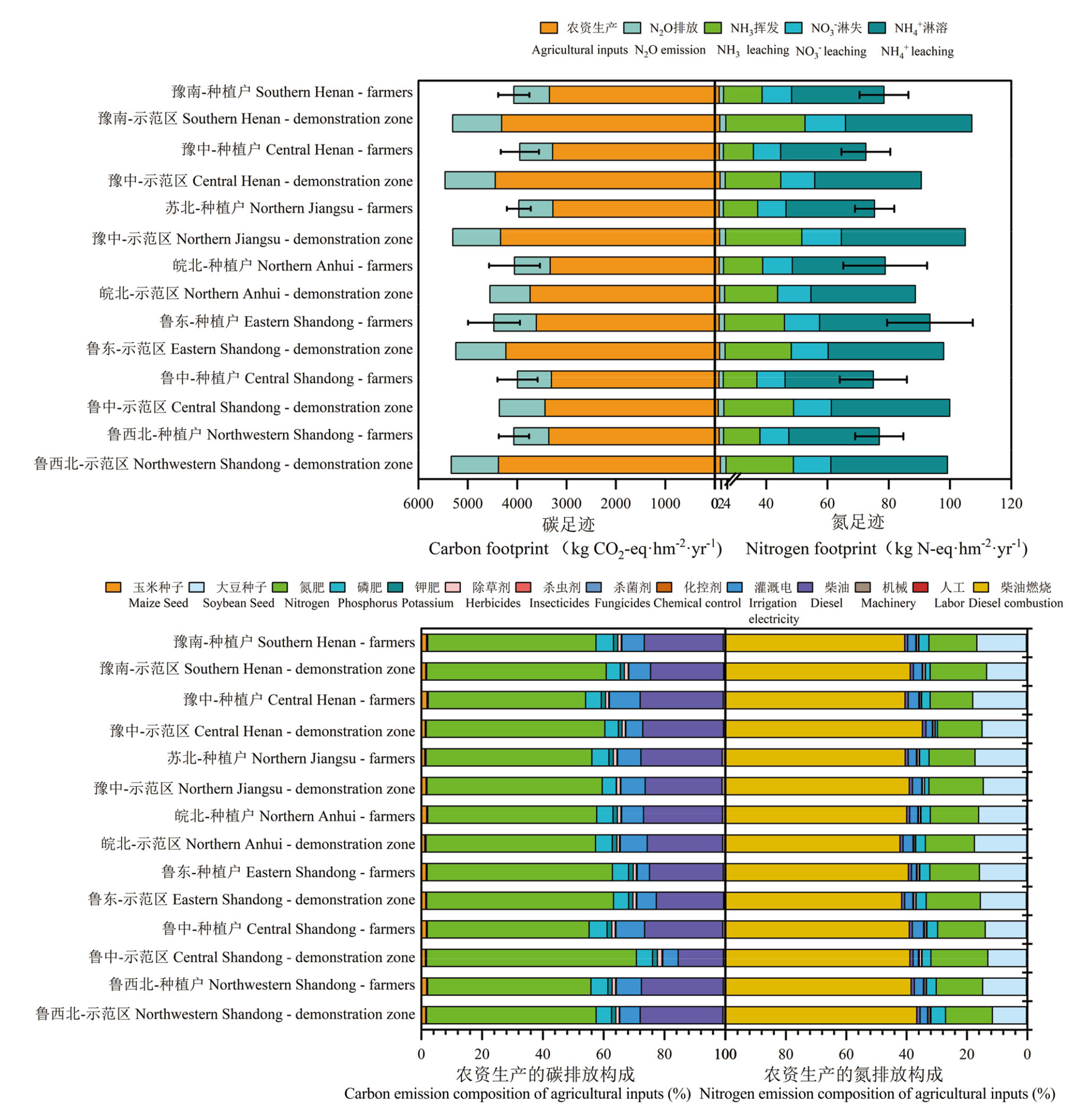
Fig. 1

Ecological footprint performance of demonstration areas and farmers under large-scale maize-soybean intercropping"

Table 12

Comparison of the yield, economic, and ecological performance of surrounding farmers with demonstration areas and the evaluation of comprehensive variation index (CVI) levels"

地区
Survey region
产量趋近指数等级
YCI level
经济趋近指数等级
ECI level
生态友好指数等级
EFI level
综合差异
指数等级
CVI level
复合种植总产量
Total intercropping
yield
土地产值
Land output value
土地产出率
Land productivity ratio
系统投入
Cost
ECI 单位面积氮足迹
Nitrogen footprint
单位面积碳足迹
Carbon footprint
EFI
鲁西北-周边种植户
Northwest Shandong-surrounding farmers
2 4 5 3 4 3 4 3 3
鲁中-周边种植户
Central Shandong-surrounding farmers
1 2 4 4 3 4 3 3 3
鲁东-周边种植户
Eastern Shandong-surrounding farmers
1 4 3 5 4 2 3 3 3
皖北-周边种植户
Northern Anhui-surrounding farmers
2 4 5 4 4 2 3 2 3
苏北-周边种植户
Northern Jiangsu-surrounding farmers
2 3 5 4 4 4 4 4 3
豫中-周边种植户
Central Henan-surrounding farmers
2 2 3 4 3 3 4 4 3
豫南-周边种植户
Southern Henan-surrounding farmers
2 3 4 3 3 4 4 4 3
[1]
中华人民共和国国家统计局. 国家数据, 2024. https://www.stats.gov.cn/sj/sjjd/202401/t20240118_1946695.html.
National Bureau of Statistics of the People's Republic of China. National Data, 2024. https://www.stats.gov.cn/sj/sjjd/202401/t20240118_1946695.html. (in Chinese)
[2]
中华人民共和国农业农村部. 全国大豆玉米带状复合种植技术方案, 2022. http://www.moa.gov.cn/gk/nszd_1/2022/202201/t20220126_6387740.htm.
Ministry of Agriculture and Rural Affairs of the People's Republic of China. Technical Plan for Maize-Soybean Strip Intercropping in China, 2022. http://www.moa.gov.cn/gk/nszd_1/2022/202201/t20220126_6387740.htm. (in Chinese)
[3]
中华人民共和国农业农村部. 2023年前三季度农业农村经济运行情况, 2023. https://www.gov.cn/zhengce/202310/content_6911099.
Ministry of Agriculture and Rural Affairs of the People's Republic of China. Agricultural and Rural Economic Operation in the First Three Quarters of 2023, 2023. https://www.gov.cn/zhengce/202310/content_ 6911099. (in Chinese)
[4]
LIU J, YANG W Y. Soybean maize strip intercropping: A solution for maintaining food security in China. Journal of Integrative Agriculture, 2024, 23(7): 2503-2506.

doi: 10.1016/j.jia.2024.02.001
[5]
王添姿. 黄淮海地区玉米||大豆行比配置对作物生长和光能利用的影响[D]. 北京: 中国农业大学, 2025.
WANG T Z. Effects of the row ratio configuration of maize and soybean intercropping on the crop growth and light energy utilization in the Huang-Huai-Hai region[D]. Beijing: China Agricultural University, 2025. (in Chinese)
[6]
ESPINOSA-TASÓN J, BERBEL J, GUTIÉRREZ-MARTÍN C. Energized water: Evolution of water-energy nexus in the Spanish irrigated agriculture, 1950-2017. Agricultural Water Management, 2020, 233: 106073.

doi: 10.1016/j.agwat.2020.106073
[7]
SADEGHI S H, SHARIFI MOGHADAM E, DELAVAR M, ZARGHAMI M. Application of water-energy-food nexus approach for designating optimal agricultural management pattern at a watershed scale. Agricultural Water Management, 2020, 233: 106071.

doi: 10.1016/j.agwat.2020.106071
[8]
WANG X Z, ZHANG Q, XU L S, TONG Y J, JIA X P, TIAN H. Water-energy-carbon nexus assessment of China’s iron and steel industry: Case study from plant level. Journal of Cleaner Production, 2020, 253: 119910.

doi: 10.1016/j.jclepro.2019.119910
[9]
FAN X, ZHANG W, CHEN W W, CHEN B. Land-water-energy nexus in agricultural management for greenhouse gas mitigation. Applied Energy, 2020, 265: 114796.

doi: 10.1016/j.apenergy.2020.114796
[10]
CHAI J, SHI H T, LU Q Y, HU Y. Quantifying and predicting the Water-Energy-Food-Economy-Society-Environment Nexus based on Bayesian networks - A case study of China. Journal of Cleaner Production, 2020, 256: 120266.

doi: 10.1016/j.jclepro.2020.120266
[11]
FAO. The state of food and agriculture 2023 - Revealing the true cost of food to transform agrifood systems, 2023. https://doi.org/10.4060/cc7724zh.
[12]
RASEDUZZAMAN M, JENSEN E S. Does intercropping enhance yield stability in arable crop production? A meta-analysis. European Journal of Agronomy, 2017, 91: 25-33.

doi: 10.1016/j.eja.2017.09.009
[13]
TILMAN D. Benefits of intensive agricultural intercropping. Nature Plants, 2020, 6(6): 604-605.

doi: 10.1038/s41477-020-0677-4 pmid: 32483327
[14]
GAO Y, DUAN A W, QIU X Q, LIU Z G, SUN J S, ZHANG J P, WANG H Z. Distribution of roots and root length density in a maize/ soybean strip intercropping system. Agricultural Water Management, 2010, 98(1): 199-212.

doi: 10.1016/j.agwat.2010.08.021
[15]
VAN OORT P A J, GOU F, STOMPH T J, VAN DER WERF W. Effects of strip width on yields in relay-strip intercropping: A simulation study. European Journal of Agronomy, 2020, 112: 125936.

doi: 10.1016/j.eja.2019.125936
[16]
VAN ASTEN P J A, WAIREGI L W I, MUKASA D, URINGI N O. Agronomic and economic benefits of coffee-banana intercropping in Uganda’s smallholder farming systems. Agricultural Systems, 2011, 104(4): 326-334.

doi: 10.1016/j.agsy.2010.12.004
[17]
AI D. Effect of monoculture and intercropping on radiation use efficiency and yield of maize and soybean. Chinese Journal of Eco-Agriculture. 2009.
[18]
LI C J, HOFFLAND E, KUYPER T W, YU Y, ZHANG C C, LI H G, ZHANG F S, VAN DER WERF W. Syndromes of production in intercropping impact yield gains. Nature Plants, 2020, 6(6): 653-660.

doi: 10.1038/s41477-020-0680-9 pmid: 32483328
[19]
LI X F, WANG Z G, BAO X G, SUN J H, YANG S C, WANG P, WANG C B, WU J P, LIU X R, TIAN X L, et al. Long-term increased grain yield and soil fertility from intercropping. Nature Sustainability, 2021, 4(11): 943-950.

doi: 10.1038/s41893-021-00767-7
[20]
WANG X L, WANG W, GUAN Y S, XIAN Y R, HUANG Z X, FENG H Y, CHEN Y. A joint use of emergy evaluation, carbon footprint and economic analysis for sustainability assessment of grain system in China during 2000-2015. Journal of Integrative Agriculture, 2018, 17(12): 2822-2835.

doi: 10.1016/S2095-3119(18)61928-8
[21]
YANG X L, SUI P, ZHANG X P, DAI H C, YAN P, LI C, WANG X L, CHEN Y Q. Environmental and economic consequences analysis of cropping systems from fragmented to concentrated farmland in the North China Plain based on a joint use of life cycle assessment, emergy and economic analysis. Journal of Environmental Management, 2019, 251: 109588.

doi: 10.1016/j.jenvman.2019.109588
[22]
袁晓婷, 汤松, 罗凯, 蒋靖怡, 杨文钰, 雍太文. 大豆玉米带状复合种植产量与效益分析: 基于全国16个示范省(市、区)的调查数据. 四川农业大学学报, 2023, 41(5): 834-841, 872.
YUAN X T, TANG S, LUO K, JIANG J Y, YANG W Y, YONG T W. Yield and benefit analysis of soybean and maize strip compound planting: Based on survey data of 16 demonstration provinces (municipalities, autonomous regions). Journal of Sichuan Agricultural University, 2023, 41(5): 834-841, 872. (in Chinese)
[23]
ZOU J, YANG Y H, SHI S H, LI W J, ZHAO X, HUANG J, ZHANG H L, LIU K, HARRISON M T, CHEN F, YIN X G. Farm-scale practical strategies to reduce carbon footprint and emergy while increasing economic benefits in crop production in the North China plain. Journal of Cleaner Production, 2022, 359: 131996.

doi: 10.1016/j.jclepro.2022.131996
[24]
ZHANG W, LU J S, BAI J, KHAN A, LIU S T, ZHAO L, WANG W, ZHU S G, LI X G, TIAN X H, LI S Q, XIONG Y C. Introduction of soybean into maize field reduces N2O emission intensity via optimizing nitrogen source utilization. Journal of Cleaner Production, 2024, 442: 141052.

doi: 10.1016/j.jclepro.2024.141052
[25]
SALVAGIOTTI F, CASSMAN K G, SPECHT J E, WALTERS D T, WEISS A, DOBERMANN A. Nitrogen uptake, fixation and response to fertilizer N in soybeans: A review. Field Crops Research, 2008, 108(1): 1-13.

doi: 10.1016/j.fcr.2008.03.001
[26]
CUI J X, SUI P, WRIGHT D L, WANG D, SUN B B, RAN M M, SHEN Y W, LI C, CHEN Y Q. Carbon emission of maize-based cropping systems in the North China Plain. Journal of Cleaner Production, 2019, 213: 300-308.

doi: 10.1016/j.jclepro.2018.12.174
[27]
N2O emissions from managed soils, and CO2 emissions from lime and urea application. Change. New York: Cambridge University Press, 2019.
[28]
YANG X L, LIU X H, XU W X, LI Z J, CHU Q Q, CHEN F. The missteps, improvement and application of carbon footprint methodology in farmland ecosystems with the case study of analyzing the carbon efficiency of China's intensive farming. Chinese Journal of Agricultural Resources and Regional Planning, 2013, 34: 1-11.
[29]
四川大学, 中国亿科环境科技有限公司. 中国生命周期基础数据库(Version.0.7). http://www.ike-global.com/#/products-2/chinese-lca-database-clcd.
Sichuan University, IKE Environmental Technology co., LTD. Chinese Life Cycle Database (CLCD) (Version 0.7). http://www.ike-global.com/#/products-2/chinese-lca-database-clcd. (in Chinese)
[30]
中国城市温室气体工作组. 中国产品全生命周期温室气体排放系数库. https://lca.cityghg.com/.
China City Greenhouse Gas Working Group (CCG). China Products Carbon Footprint Factors Database. https://lca.cityghg.com/. in Chinese)
[31]
陈舜, 逯非, 王效科. 中国氮磷钾肥制造温室气体排放系数的估算. 生态学报, 2015, 35(19): 6371-6383.
CHEN S, LU F, WANG X K. Estimation of greenhouse gases emission factors for China's nitrogen,phosphate,and potash fertilizers. Acta Ecologica Sinica, 2015, 35(19): 6371-6383. (in Chinese)
[32]
Swiss Centre for Life Cycle Inventories. Ecoinvent Database (Version 2.2), 2010. https://support.ecoinvent.org/ecoinvent-version-2.
[33]
YU X, XU L, YUAN S, YANG G D, XIANG H S, FU Y F, HUANG J L, PENG S B. Resource use efficiencies, environmental footprints and net ecosystem economic benefit of direct-seeded double-season rice in Central China. Journal of Cleaner Production, 2023, 393: 136249.

doi: 10.1016/j.jclepro.2023.136249
[34]
CHEN Z D, XU C C, JI L, FENG J F, LI F B, ZHOU X Y, FANG F P. Effects of multi-cropping system on temporal and spatial distribution of carbon and nitrogen footprint of major crops in China. Global Ecology and Conservation, 2020, 22: e00895.
[35]
姚金哲. 中国三大油料作物的碳氮足迹: 构成、时空特征及驱动因素分析[D]. 郑州: 河南农业大学, 2024.
YAO J Z. Carbon and nitrogen footprints of the three major oilseed crops in China: Composition, spatiotemporal characteristics, and driving factors analysis[D]. Zhengzhou: Henan Agricultural University, 2024. (in Chinese)
[36]
WANG C, SHEN Y, FANG X T, XIAO S Q, LIU G Y, WANG L G, GU B J, ZHOU F, CHEN D L, TIAN H Q, CIAIS P, ZOU J W, LIU S W. Reducing soil nitrogen losses from fertilizer use in global maize and wheat production. Nature Geoscience, 2024, 17(10): 1008-1015.

doi: 10.1038/s41561-024-01542-x
[37]
李云鹏. 中国作物生产的环境足迹评价及其气候变化影响预测[D]. 南京: 南京农业大学, 2022.
LI Y P. Environmental footprint evaluation of crop production in China and the prediction of its impact on climate change[D]. Nanjing: Nanjing Agricultural University, 2022. (in Chinese)
[38]
IKE ENVIRONMENTAL TECHNOLOGY CO., LTD. eBalance (Version 3.0): Life Cycle Assessment Software and LCI Database [Computer software]. 2012.
[39]
崔吉晓. 作物种植系统生态经济可持续性评价框架构建与案例应用[D]. 北京: 中国农业大学, 2020.
CUI J X. Framework construction for the ecological and economic sustainability evaluation of crop planting systems and case applications[D]. Beijing: China Agricultural University, 2020. (in Chinese)
[40]
HONG Y, HEERINK N, JIN S Q, BERENTSEN P, ZHANG L Z, VAN DER WERF W. Intercropping and agroforestry in China- Current state and trends. Agriculture, Ecosystems & Environment, 2017, 244: 52-61.

doi: 10.1016/j.agee.2017.04.019
[41]
MASVAYA E N, NYAMANGARA J, DESCHEEMAEKER K, GILLER K E. Is maize-cowpea intercropping a viable option for smallholder farms in the risky environments of semi-arid southern Africa? Field Crops Research, 2017, 209: 73-87.

doi: 10.1016/j.fcr.2017.04.016
[42]
CHEN P, SONG C, LIU X M, ZHOU L, YANG H, ZHANG X N, ZHOU Y, DU Q, PANG T, FU Z D, et al. Yield advantage and nitrogen fate in an additive maize-soybean relay intercropping system. Science of the Total Environment, 2019, 657: 987-999.

doi: 10.1016/j.scitotenv.2018.11.376
[43]
YANG S Q, LI H, XU Y N, WANG T Z, HU Y M, ZHAO Y X, QIAN X, LI Z X, SUI P, GAO W S, CHEN Y Q. The yield performance of maize-soybean intercropping in the North China Plain: From 172 sites empirical investigation. Field Crops Research, 2024, 315: 109467.

doi: 10.1016/j.fcr.2024.109467
[44]
马乐正, 刘宇航, 蔡雪梅, 罗珠珠, 赵小强, 牛伊宁. 种植密度对玉米大豆间作系统玉米光合及生长特性的影响. 甘肃农业大学学报, 2024, 59(6): 40-48.
MA L Z, LIU Y H, CAI X M, LUO Z Z, ZHAO X Q, NIU Y N. Influence of maize planting density on the photosynthetic and growth characteristics of maize in the maize and soybean intercrops. Journal of Gansu Agricultural University, 2024, 59(6): 40-48. (in Chinese)
[45]
范虹, 殷文, 柴强. 间作优势的光合生理机制及其冠层微环境特征. 中国生态农业学报(中英文), 2022, 30(11): 1750-1761.
FAN H, YIN W, CHAI Q. Research progress on photo-physiological mechanisms and characteristics of canopy microenvironment in the formation of intercropping advantages. Chinese Journal of Eco- Agriculture, 2022, 30(11): 1750-1761. (in Chinese)
[46]
WU Y S, HE D, WANG E L, LIU X, HUTH N I, ZHAO Z G, GONG W Z, YANG F, WANG X C, YONG T W, et al. Modelling soybean and maize growth and grain yield in strip intercropping systems with different row configurations. Field Crops Research, 2021, 265: 108122.

doi: 10.1016/j.fcr.2021.108122
[47]
朱冠雄, 高祺, 华方静, 田艺心, 朱金英, 李春燕, 王春雨, 曹鹏鹏, 王士岭, 高凤菊. 鲁西北地区大豆玉米间作不同行比配置对大豆生长、产量及间作系统的影响. 中国油料作物学报, 2025, 47(4): 970-979.

doi: 10.19802/j.issn.1007-9084.2024056
ZHU G X, GAO Q, HUA F J, TIAN Y X, ZHU J Y, LI C Y, WANG C Y, CAO P P, WANG S L, GAO F J. Effects of different row ratios of soybean and maize intercropping on soybean growth, yield and intercropping system in Northwest Shandong Province. Chinese Journal of Oil Crop Sciences, 2025, 47(4): 970-979. (in Chinese)
[48]
赵鑫, 张磊, 武俊男, 梁烜赫, 李善龙, 李涛, 李雨桐, 江登宇, 闫寒, 贾立辉, 李海燕, 曹铁华. 不同玉米大豆间作模式对作物生长、产量和经济效益的影响. 玉米科学, 2024, 32(10): 48-55.
ZHAO X, ZHANG L, WU J N, LIANG X H, LI S L, LI T, LI Y T, JIANG D Y, YAN H, JIA L H, LI H Y, CAO T H. Effects of different maize-soybean intercropping patterns on crop growth, yield, and economic benefits. Journal of Maize Sciences, 2024, 32(10): 48-55. (in Chinese)
[49]
LIANG Z Y, VAN DER WERF W, XU Z, CHENG J L, WANG C, CONG W F, ZHANG C C, ZHANG F S, GROOT J C J. Identifying exemplary sustainable cropping systems using a positive deviance approach: Wheat-maize double cropping in the North China Plain. Agricultural Systems, 2022, 201: 103471.

doi: 10.1016/j.agsy.2022.103471
[50]
WANG W, LI M Y, ZHU S G, KHAN A, TAO X P, HUANG G F, LIU H Y, ZHANG W, TAO H Y, GONG D S, SONG C, XIONG Y C. Plant facilitation improves carbon production efficiency while reducing nitrogen input in semiarid agroecosystem. Catena, 2023, 230: 107247.

doi: 10.1016/j.catena.2023.107247
[51]
CHENG Y, WANG H Q, LIU P, DONG S T, ZHANG J W, ZHAO B, REN B Z. Nitrogen placement at sowing affects root growth, grain yield formation, N use efficiency in maize. Plant and Soil, 2020, 457(1): 355-373.

doi: 10.1007/s11104-020-04747-2
[52]
DAI J, GUI H L, SHEN F, LIU Y Y, BAI M S, YANG J F, LIU H J, LUO P Y, HAN X R, SIDDIQUE K H M. Fertilizer (15)N balance in a soybean-maize-maize rotation system based on a 41-year long-term experiment in Northeast China. Frontiers in Plant Science, 2023, 14: 1105131.

doi: 10.3389/fpls.2023.1105131
[53]
ZOU S, YAN J, HAN X Z, ZOU W X, CHEN X, LU X C. Effects of nitrogen application on nodulation, nitrogen fixation, yield and protein content of soybean. Journal of Plant Nutrition and Fertilizers, 2022, 28(8): 1457-1465.
[54]
YANG Y, ZOU J, HUANG W H, OLESEN J E, LI W J, REES R M, HARRISON M T, FENG B, FENG Y P, CHEN F, YIN X G. Drivers of soybean-based rotations synergistically increase crop productivity and reduce GHG emissions. Agriculture, Ecosystems & Environment, 2024, 372: 109094.

doi: 10.1016/j.agee.2024.109094
[55]
常洪庆, 陈银银, 高意帆, 李思源, 董淑雅, 陈瑞雪, 张学林, 刘天学, 李鸿萍. 大豆玉米带状复合种植示范推广与应用基础研究进展. 玉米科学, 2025, 33(1): 77-83.
CHANG H Q, CHEN Y Y, GAO Y F, LI S Y, DONG S Y, CHEN R X, ZHANG X L, LIU T X, LI H P. Advances in basic research on the demonstration, extension and application of soybean-maize strip intercropping planting. Journal of Maize Sciences, 2025, 33(1): 77-83. (in Chinese)
[1] PU LiXia, ZHANG JiaRui, YE JianPing, HUANG XiuLan, FAN GaoQiong, YANG HongKun. The Combined Effects of 16, 17-Dihydro Gibberellin A5 and Straw Mulching on Tillering and Grain Yield of Dryland Wheat [J]. Scientia Agricultura Sinica, 2025, 58(9): 1735-1748.
[2] GUO ChenLi, LIU Yang, CHEN Yan, HU Wei, WANG YouHua, ZHOU ZhiGuo, ZHAO WenQing. Effects of Phosphorus Fertilizer Postpone Under Nitrogen Reduction Condition on Yield, Phosphorus Fertilizer Utilization Efficiency of Drip-Irrigated Cotton [J]. Scientia Agricultura Sinica, 2025, 58(9): 1749-1766.
[3] LIU JinSong, WU LongMei, BAO XiaoZhe, LIU ZhiXia, ZHANG Bin, YANG TaoTao. Effects of a Short-Term Reduction in Nitrogen Fertilizer Application Rates on the Grain Yield and Rice Quality of Early and Late-Season Dual-Use Rice in South China [J]. Scientia Agricultura Sinica, 2025, 58(8): 1508-1520.
[4] WEI WenHua, LI Pan, SHAO GuanGui, FAN ZhiLong, HU FaLong, FAN Hong, HE Wei, CHAI Qiang, YIN Wen, ZHAO LianHao. Response of Silage Maize Yield and Quality to Reduced Irrigation and Combined Organic-Inorganic Fertilizer in Northwest Irrigation Areas [J]. Scientia Agricultura Sinica, 2025, 58(8): 1521-1534.
[5] XUE YuQi, ZHAO JiYu, SUN WangSheng, REN BaiZhao, ZHAO Bin, LIU Peng, ZHANG JiWang. Effects of Different Nitrogen Forms on Yield and Quality of Summer Maize [J]. Scientia Agricultura Sinica, 2025, 58(8): 1535-1549.
[6] LI ShaoXing, SONG WenFeng, WEI ZeYu, ZHOU YuLing, SONG LiXia, REN Ke, MA Qun, WANG LongChang. Effects of Straw and Milk Vetch Mulching on Soil Fertility and Sweet Potato Yield [J]. Scientia Agricultura Sinica, 2025, 58(8): 1591-1603.
[7] YIN Bo, YU AiZhong, WANG PengFei, YANG XueHui, WANG YuLong, SHANG YongPan, ZHANG DongLing, LIU YaLong, LI Yue, WANG Feng. Effects of Green Manure Returning Combined with Nitrogen Fertilizer Reduction on Hydrothermal Characteristics of Wheat Field and Grain Yield in Oasis Irrigation Area [J]. Scientia Agricultura Sinica, 2025, 58(7): 1366-1380.
[8] CHEN GuiPing, LI Pan, SHAO GuanGui, WU XiaYu, YIN Wen, ZHAO LianHao, FAN ZhiLong, HU FaLong. The Regulatory Effect of Reduced Irrigation and Combined Organic- Inorganic Fertilizer Application on Stay-Green Characteristics in Silage Maize Leaves After Tasseling Stage [J]. Scientia Agricultura Sinica, 2025, 58(7): 1381-1396.
[9] TIAN LiWen, LOU ShanWei, ZHANG PengZhong, DU MingWei, LUO HongHai, LI Jie, PAHATI MaiMaiTi, MA TengFei, ZHANG LiZhen. Analysis of Problems and Pathways for Increasing Cotton Yield per Unit Area in Xinjiang Under Green and Efficient Production Mode [J]. Scientia Agricultura Sinica, 2025, 58(6): 1102-1115.
[10] ZHANG HongCheng, XING ZhiPeng, ZHANG RuiHong, SHAN Xiang, XI XiaoBo, CHENG Shuang, WENG WenAn, HU Qun, CUI PeiYuan, WEI HaiYan. Characteristics and Technical Approaches of Integrated Unmanned High-Yield Cultivation of Wheat [J]. Scientia Agricultura Sinica, 2025, 58(5): 864-876.
[11] ZHANG Han, ZHANG YuQi, LI JingLai, XU Hong, LI WeiHuan, LI Tao. Effects of LED Supplementary Lighting on Production and Leaf Physiological Properties of Substrate-Cultivated Strawberry in Chinese Solar Greenhouse [J]. Scientia Agricultura Sinica, 2025, 58(5): 975-990.
[12] CHEN Ge, GU Yu, WEN Jiong, FU YueFeng, HE Xi, LI Wei, ZHOU JunYu, LIU QiongFeng, WU HaiYong. Effects of Fallow Weeds Returning to the Field on Photosynthetic Matter Production and Yield of Rice [J]. Scientia Agricultura Sinica, 2025, 58(4): 647-659.
[13] SU Ming, LI FanGuo, HONG ZiQiang, ZHOU Tian, LIU QiangJuan, BAN WenHui, WU HongLiang, KANG JianHong. Antioxidant Characterization of Nitrogen Application for Mitigating Potato Senescence Post-Flowering Under High Temperature Stress [J]. Scientia Agricultura Sinica, 2025, 58(4): 660-675.
[14] SHI Fan, LI WenGuang, YI ShuSheng, YANG Na, CHEN YuMeng, ZHENG Wei, ZHANG XueChen, LI ZiYan, ZHAI BingNian. The Variation Characteristics of Soil Organic Carbon Fractions Under the Combined Application of Organic and Inorganic Fertilizers [J]. Scientia Agricultura Sinica, 2025, 58(4): 719-732.
[15] ZHENG Yu, CHEN Yi, TI JinSong, SHI LongFei, XU XiaoBo, LI YuLin, GUO Rui. Evaluation of Carbon Footprint and Economic Benefit of Different Tobacco Rotation Patterns [J]. Scientia Agricultura Sinica, 2025, 58(4): 733-747.
Viewed
Full text


Abstract

Cited

  Shared   
  Discussed   
No Suggested Reading articles found!