Scientia Agricultura Sinica ›› 2026, Vol. 59 ›› Issue (21): 4937-4956.doi: 10.3864/j.issn.0578-1752.2026.21.016

• HORTICULTURE • Previous Articles    

Diversity Analysis and Comprehensive Evaluation of Agronomic Traits and Biochemical Components in 128 Tea Germplasm

YANG Chun1,2(), LIANG SiHui1,2, WANG AnRan1,2, GUO Yan1,2, QIAO DaHe1,3, CHEN Juan1, MI XiaoZeng1,2, LI Yan1,2, LIN KaiQin1,2, CHEN ZhengWu1,2,3()   

  1. 1 Guizhou Tea Research Institute, Guiyang 550006
    2 Guizhou Key Laboratory of Molecular Breeding for Characteristic Horticultural Crops, Guiyang 550006
    3 Key Laboratory of Crop Genetic Resources and Germplasm Innovation in Karst Region, Ministry of Agriculture and Rural Affairs, Guiyang 550006
  • Received:2026-06-10 Accepted:2026-07-28 Online:2026-11-01 Published:2026-11-06
  • Contact: CHEN ZhengWu

Abstract:

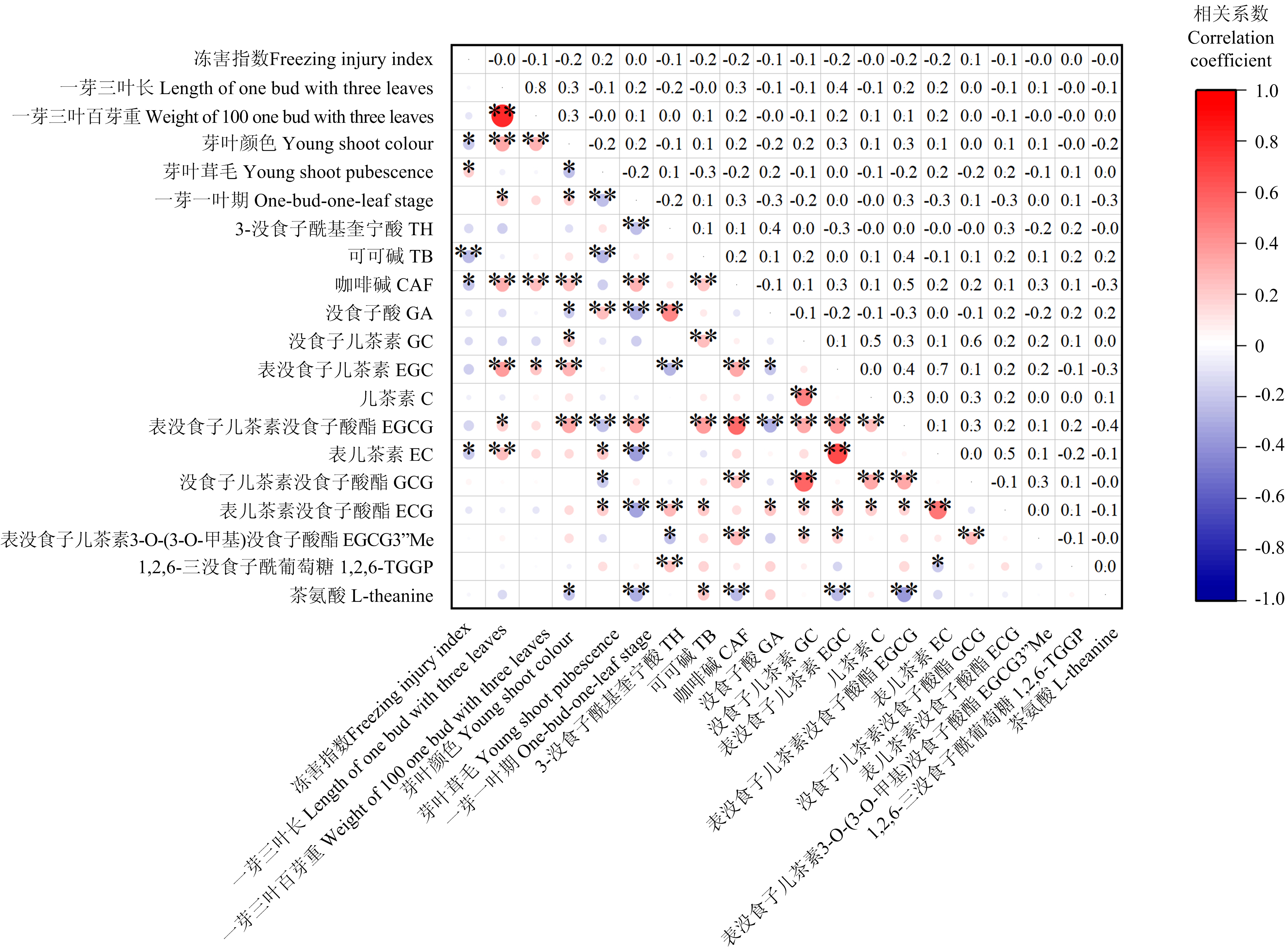
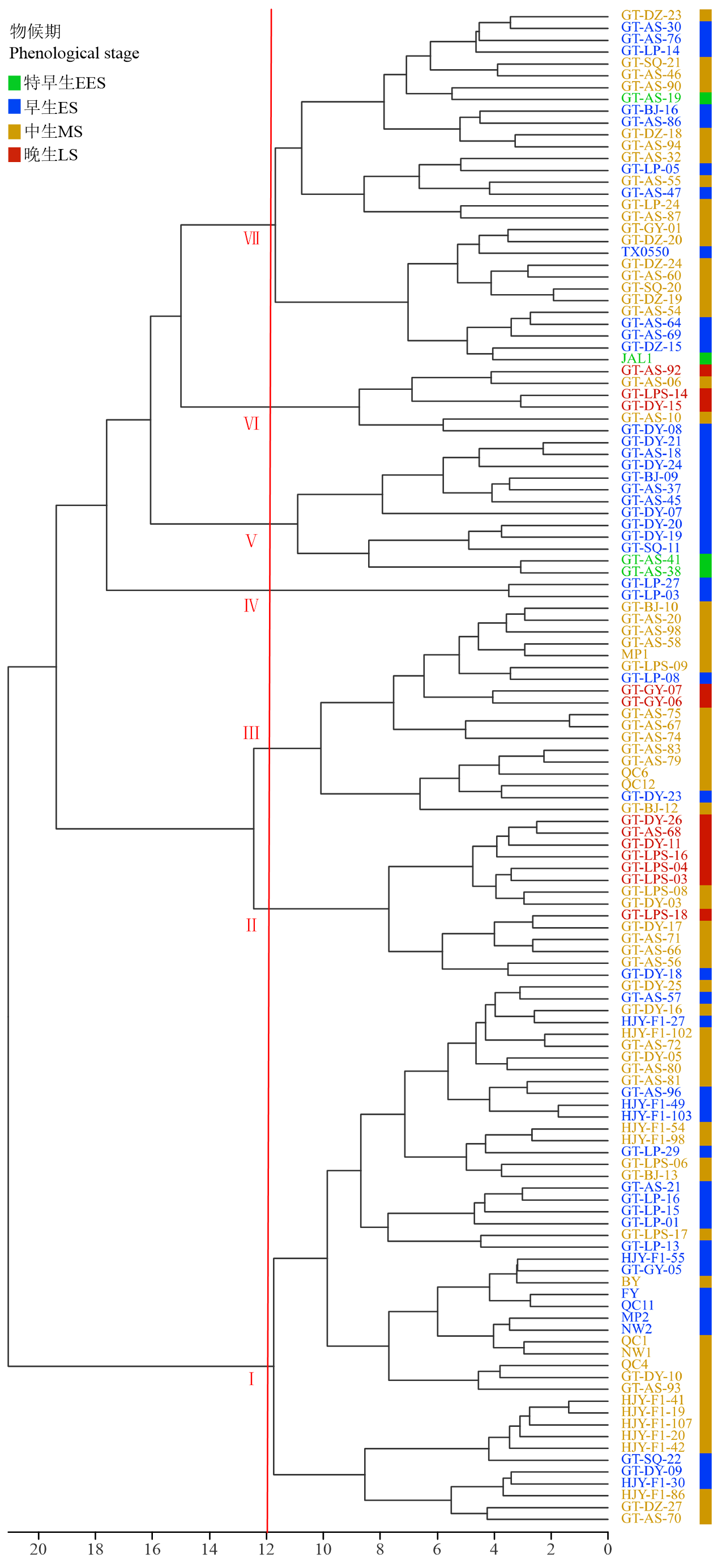
【Objective】This study aimed to explore the utilization potential of preserved tea germplasm and breed new elite tea cultivars, and to provide a theoretical and practical references for the breeding of new tea varieties and efficient identification of tea germplasm in Guizhou Province. 【Method】A total of 128 tea germplasm preserved in the resource nursery were used as materials. 6 agronomic traits (including cold resistance, phenological stage, bud and leaf morphology, etc.) and 14 biochemical components (including catechins, alkaloids, theanine, etc.) were systematically determined. Comprehensive evaluation was conducted by combining genetic diversity analysis, correlation analysis, cluster analysis, principal component analysis (PCA), and grey relational analysis (GRA). 【Result】The variation coefficients of 20 trait indices of the 128 tea germplasm ranged from 13.33% to 114.10%, and the genetic diversity indices ranged from 0.92 to 2.08. The average variation coefficient (31.66%) and genetic diversity index (1.63) of agronomic traits were lower than those of biochemical traits (49.80%, 1.86). The length of one bud and three leaves, theogallin, caffeine, epigallocatechin gallate (EGCG), epicatechin gallate (ECG), and theanine contents showed normal distribution, while the kurtosis values of gallocatechin gallate (GCG) and 1,2,6-tri-O-galloyl-β-D-glucose (1,2,6-TGGP) exceeded 20, indicating that the contents of these two components were highly concentrated in the 128 tea germplasm. Correlation analysis showed that the frost injury index was significantly positively correlated with bud and leaf pubescence (P<0.05), and significantly or extremely significantly negatively correlated with bud and leaf color, theobromine, caffeine, and epicatechin (EC) (P<0.01; P<0.05). One-bud-one-leaf stage was significantly or extremely significantly positively correlated with length of one bud with three leaves, young shoot pubescence, caffeine and EGCG contents (P<0.01; P<0.05), and extremely significantly negatively correlated with theogallin, gallic acid, EC, ECG, and theanine contents. Cluster analysis divided the 128 germplasm into 7 clusters, agronomic traits including phenological stages and yield indicators, together with major biochemical components such as caffeine, EGCG and theanine, were the key characteristics for distinguishing germplasm of different groups. PCA extracted 7 principal components with a cumulative contribution rate of 69.35%. Biochemical traits such as EGCG, caffeine, epigallocatechin (EGC), and EC were key indicators affecting F comprehensive score. Grey relational analysis was carried out by constructing an ideal cultivar based on extra-early sprouting, strong cold resistance, and high theanine content. The weighted grey relational degrees between 128 germplasm and the ideal cultivar ranged from 0.51 to 0.73, Notably, GT-GY-05, HJY-F1-55, GT-AS-41, GT-LP-01, and JAL1 exhibited values exceeding 0.7. 【Conclusion】The 128 tea accessions possessed abundant genetic diversity. Overall, biochemical traits showed higher variation coefficients and genetic diversity indices than agronomic traits. Core components including caffeine, EGCG and ECG exhibited relatively high genetic stability, whereas rare secondary metabolites such as methylated catechins and theogallin showed abundant variation, granting them great potential for breeding elite germplasm with unique traits. GT-AS-41, with a high weighted grey relational degree of 0.71, is characterized by extra-early sprouting, highly cold resistance and relatively high theanine content, showing great potential for breeding new high-quality extra-early-sprouting tea cultivars.

Key words: Camellia sinensis L., cold resistance, phenological stage, caffeine, principal component analysis, grey relational analysis

Table 1

Statistical analysis of 6 agronomic traits and 14 biochemical traits about 128 tea germplasms"

性状类别
Traits type
性状
Trait
极小值Minimum value 极大值
Maximum value
平均值
Mean value
标准差
Standard deviation
变异系数
Coefficient of variation (%)
遗传多样性指数H′
Genetic diversity index
农艺性状
Agronomic traits
冻害指数Freezing injury index 0.00 82.50 25.95 18.63 71.78 1.94
一芽三叶长
Length of one bud with three leaves (cm)
3.29 8.97 5.86 1.15 19.56 2.03
一芽三叶百芽重
Weight of 100 one bud with three leaves (g)
12.69 68.33 35.27 10.83 30.72 1.99
芽叶颜色Young shoot colour 3.00 5.00 3.69 0.62 16.93 0.92
芽叶茸毛Young shoot pubescence 1.00 5.00 3.29 0.76 23.26 1.15
一芽一叶期One-bud-one-leaf stage (d) 4.00 34.00 21.17 5.87 27.71 1.73
平均值Mean value 31.66 1.63
生化性状
Biochemical traits
3-没食子酰基奎宁酸TH (%) 0.85 2.90 1.75 0.38 21.68 2.07
可可碱TB (%) 0.07 1.18 0.46 0.23 49.97 2.01
咖啡碱CAF (%) 2.48 5.02 3.67 0.49 13.33 2.06
没食子酸GA (%) 0.01 0.19 0.04 0.03 77.85 1.56
没食子儿茶素GC (%) 0.04 1.10 0.36 0.15 42.16 1.86
表没食子儿茶素EGC (%) 0.38 2.85 1.30 0.50 38.42 2.01
儿茶素C (%) 0.03 0.79 0.18 0.11 62.63 1.86
表没食子儿茶素没食子酸酯EGCG (%) 5.26 12.30 8.59 1.45 16.84 2.08
表儿茶素EC (%) 0.14 1.60 0.62 0.24 38.18 1.90
没食子儿茶素没食子酸酯GCG (%) 0.00 1.17 0.21 0.15 69.54 1.42
表儿茶素没食子酸酯ECG (%) 1.05 3.06 2.05 0.40 19.56 2.04
表没食子儿茶素3-O-(3-O-甲基)没食子酸酯EGCG3"Me (%) 0.00 1.46 0.36 0.37 104.44 1.65
1,2,6-三没食子酰葡萄糖1,2,6-TGGP (%) 0.00 3.38 0.37 0.42 114.10 1.43
茶氨酸L-theanine (%) 0.96 4.18 2.27 0.65 28.47 2.05
平均值Mean value 49.80 1.86

Fig. 1

The distribution histogram of agronomic traits and biochemical traits about 128 tea germplasms"

Table 2

Normality test of 6 agronomic traits and 14 biochemical traits"

性状
Traits
偏度
Skewness
峰度
Kurtosis
柯尔莫戈洛夫-斯米诺夫检验
Kolmogorov-Smirnova test
冻害指数Freezing injury index 0.68 -0.14 0.00
一芽三叶长Length of one bud with three leaves 0.33 0.03 0.20+
一芽三叶百芽重Weight of 100 one bud with three leaves
0.75 0.81 0.00
芽叶颜色Young shoot colour 0.34 -0.65 0.00
芽叶茸毛Young shoot pubescence
-0.01 0.10 0.00
一芽一叶期One-bud-one-leaf stage
-0.10 1.43 0.00
3-没食子酰基奎宁酸TH 0.37 0.41 0.20+
可可碱TB 0.85 0.80 0.02
咖啡碱CAF 0.32 0.05 0.20+
没食子酸GA 2.23 5.90 0.00
没食子儿茶素GC 1.96 7.13 0.00
表没食子儿茶素EGC 0.60 -0.13 0.00
儿茶素C 1.99 6.82 0.00
表没食子儿茶素没食子酸酯EGCG 0.15 -0.38 0.20+
表儿茶素EC 1.32 2.98 0.00
没食子儿茶素没食子酸酯GCG 4.65 27.85 0.00
表儿茶素没食子酸酯ECG 0.27 -0.01 0.20+
表没食子儿茶素3-O-(3-O-甲基)没食子酸酯EGCG3"Me
0.89 -0.07 0.00
1,2,6-三没食子酰葡萄糖1,2,6-TGGP 4.31 23.98 0.00
茶氨酸L-theanine 0.43 0.33 0.20+

Fig. 2

The correlation coefficient between 6 agronomic traits and 14 biochemical traits * and ** indicate significant correlations at 0.05 and 0.01 level, respectively"

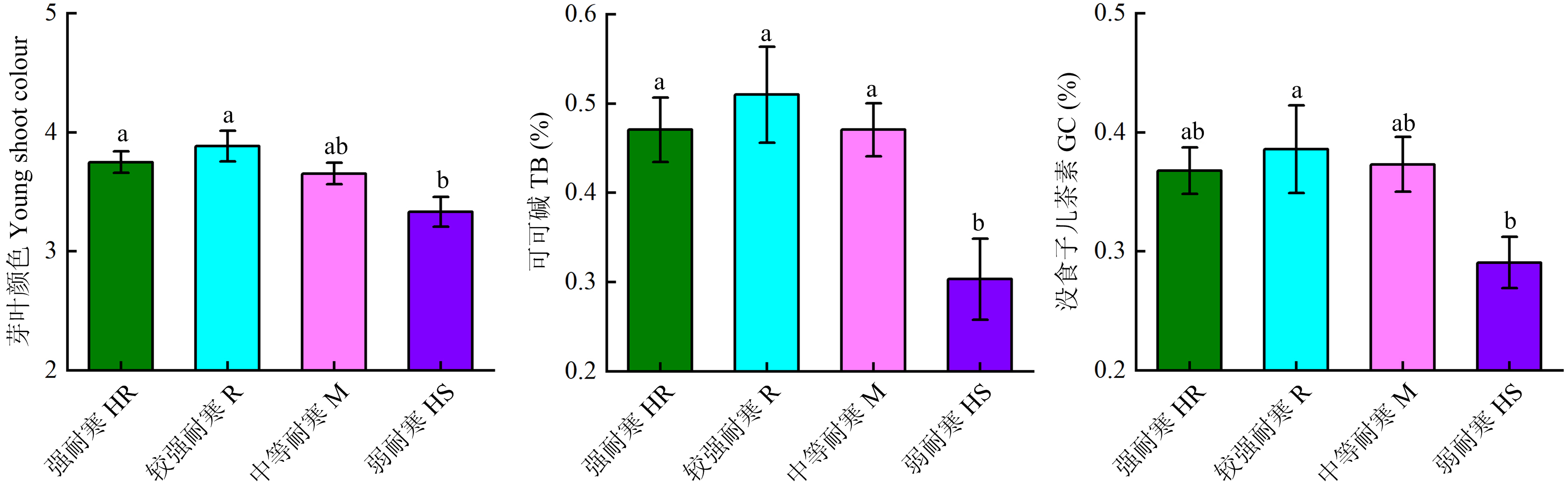
Fig. 3

Variation in traits among tea germplasm with divergent cold tolerance HR: Highly cold resistance; R: Cold resistance; M: Moderate cold resistance; HS: Highly cold sensitive. Different lowercase letters indicate significant differences at 0.05 level. The same as below"

Fig. 4

Variation in traits among tea germplasm with divergent phenological periods EES: Extra-early sprouting; ES: Early sprouting; MS: Middle sprouting; LS: Lately sprouting"

Fig. 5

Cluster dendrogram of 128 tea germplasms"

Table 3

Key agronomic traits and biochemical components of tea germplasm from different groups"

性状
Traits
类群Group
Ⅰ(n=46) Ⅱ(n=14) Ⅲ(n=18) Ⅳ(n=2) Ⅴ(n=12) Ⅵ(n=6) Ⅶ(n=30)
冻害指数Freezing injury index 32.24±20.80a 18.87±14.67a 30.26±18.57a 25.00 19.39±12.83a 29.75±24.05a 18.96±14.67a
一芽三叶长
Length of one bud with three leaves (cm)
5.25±0.98c 6.03±0.63b 7.49±0.98a 5.62 5.66±1.04bc 6.29±1.03b 5.72±0.76bc
一芽三叶百芽重
Weight of 100 one bud with three leaves (g)
31.25±9.57c 32.12±3.85bc 47.58±10.81a 32.99 34.81±11.53bc 39.39±12.54b 35.03±9.39bc
芽叶颜色Young shoot colour 3.30±0.47cd 3.86±0.36ab 4.06±0.54ab 3.50 3.25±0.45d 3.67±0.52bc 4.17±0.59a
芽叶茸毛Young shoot pubescence 3.30±0.70b 2.71±0.73c 3.22±0.55bc 2.50 4.08±0.90a 3.67±0.52ab 3.23±0.73bc
一芽一叶期One-bud-one-leaf stage (d) 20.22±3.26c 28.36±5.40a 24.22±4.48b 18.00 13.92±5.14d 26.67±6.89ab 19.47±5.22c
3-没食子酰基奎宁酸TH (%) 1.68±0.25b 1.58±0.36b 1.58±0.31b 1.50 2.10±0.26a 2.09±0.16a 1.83±0.51ab
可可碱TB (%) 0.41±0.22b 0.50±0.27ab 0.36±0.17b 0.49 0.50±0.17ab 0.61±0.07a 0.53±0.27ab
咖啡碱CAF (%) 3.44±0.46b 4.05±0.35a 3.95±0.46a 4.23 3.54±0.44b 4.23±0.39a 3.60±0.39b
没食子酸GA (%) 0.03±0.02bc 0.02±0.01c 0.03±0.01bc 0.02 0.10±0.05a 0.04±0.02bc 0.04±0.02b
没食子儿茶素GC (%) 0.32±0.09bc 0.27±0.05c 0.31±0.06bc 1.09 0.31±0.14bc 0.35±0.10b 0.49±0.12a
表没食子儿茶素EGC (%) 0.97±0.32c 1.33±0.31b 1.89±0.44a 1.17 1.38±0.47b 1.33±0.42b 1.38±0.51b
儿茶素C (%) 0.17±0.10abc 0.10±0.05c 0.16±0.09bc 0.38 0.13±0.03bc 0.19±0.06ab 0.25±0.15a
表没食子儿茶素没食子酸酯EGCG (%) 7.58±0.98c 9.43±0.88b 9.38±1.26b 9.77 7.55±1.34c 10.43±1.35a 9.23±1.18b
表儿茶素EC (%) 0.51±0.14c 0.50±0.13c 0.75±0.15ab 0.82 0.90±0.38a 0.46±0.19c 0.67±0.24b
没食子儿茶素没食子酸酯GCG (%) 0.18±0.08b 0.20±0.06ab 0.23±0.09ab 1.16 0.17±0.05b 0.25±0.12a 0.19±0.09ab
表儿茶素没食子酸酯ECG (%) 1.89±0.39d 1.83±0.20d 1.96±0.26cd 1.57 2.47±0.44a 2.19±0.43bc 2.26±0.31ab
表没食子儿茶素3-O-(3-O-甲基)没食子酸酯EGCG3"Me (%) 0.35±0.32b 0.26±0.23b 0.64±0.48a 1.13 0.24±0.32b 0.21±0.36b 0.27±0.35b
1,2,6-三没食子酰葡萄糖1,2,6-TGGP (%) 0.32±0.19bc 0.18±0.12c 0.20±0.12c 0.56 0.42±0.24b 1.91±0.86a 0.31±0.18bc
茶氨酸L-theanine (%) 2.68±0.63a 1.61±0.50c 2.06±0.57b 2.27 2.27±0.57b 1.91±0.65bc 2.15±0.40b

Table 4

Excellent tea germplasm"

优异类别
Excellent category
鉴选标准
Selection criteria
数量
Number
种质名称
Name
强耐寒性
High cold resistance
冻害指数≤10
Freezing injury index≤10
32 GT-AS-96、GT-AS-41、GT-AS-47、GT-AS-94、GT-AS-55、GT-AS-60、GT-AS-81、GT-BJ-16、GT-DY-15、GT-DY-17、GT-DY-18、GT-DY-05、GT-DY-19、GT-DY-21、GT-DY-08、GT-DY-26、GT-DZ-15、GT-DZ-24、GT-DZ-19、GT-DZ-23、MP2、FY、GT-GY-05、GT-GY-07、GT-LP-05、GT-LP-16、GT-LP-29、GT-LP-08、GT-LPS-03、GT-LPS-16、HJY-F1-103、HJY-F1-55
特早生
Extra-early sprouting
一芽一叶期较福鼎大白茶早10 d
One-bud-one-leaf stage was 10 d earlier than Fuding Dabaicha
4 GT-AS-19、GT-AS-38、GT-AS-41、JAL1
高咖啡碱
High CAF
≥5.0% 1 GT-LPS-03
高茶氨酸
High L-theanine
≥3.0% 18 GT-LP-13、GT-LP-01、GT-BJ-13、GT-LPS-17、GT-LPS-06、GT-DY-24、GT-AS-72、GT-LP-15、GT-BJ-12、NW2、GT-LP-16、MP2、GT-LP-29、GT-DY-07、GT-AS-02、GT-DY-23、GT-LP-14、HJY-F1-54
高1,2,6-TGGP
High 1,2,6-TGGP
≥3.0% 1 GT-AS-10

Table 5

Eigenvalues and contribution rate of 7 principal components"

主成分Principal component 特征值Eigenvalues 贡献率Contribution rate (%) 累计贡献率Accumulative contribution rate (%)
1 3.59 17.95 17.95
2 2.45 12.23 30.18
3 2.27 11.37 41.55
4 1.80 8.98 50.53
5 1.39 6.95 57.48
6 1.30 6.50 63.98
7 1.07 5.37 69.35

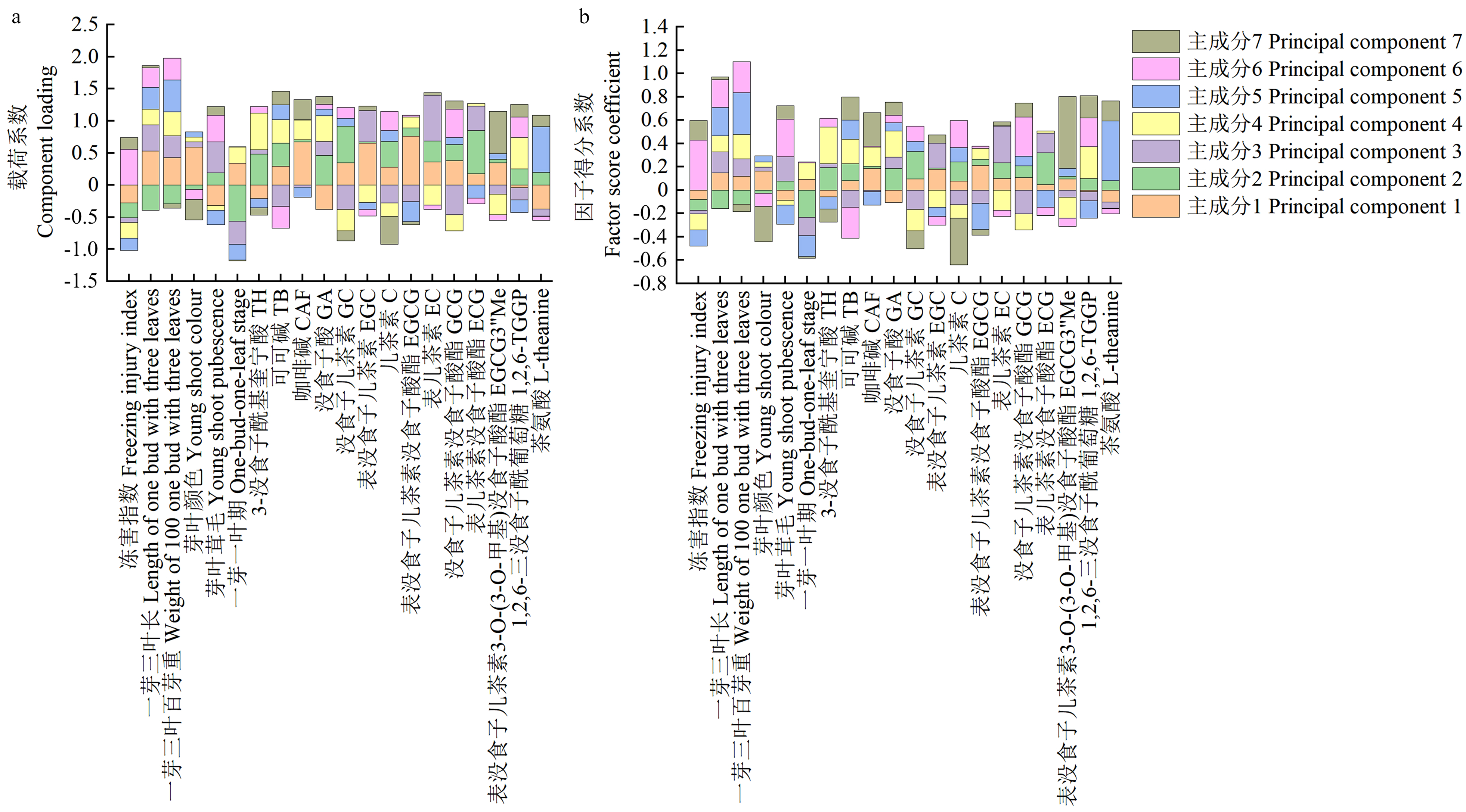
Fig. 6

Component loadings (a) and factor score coefficients (b) of 7 principal components"

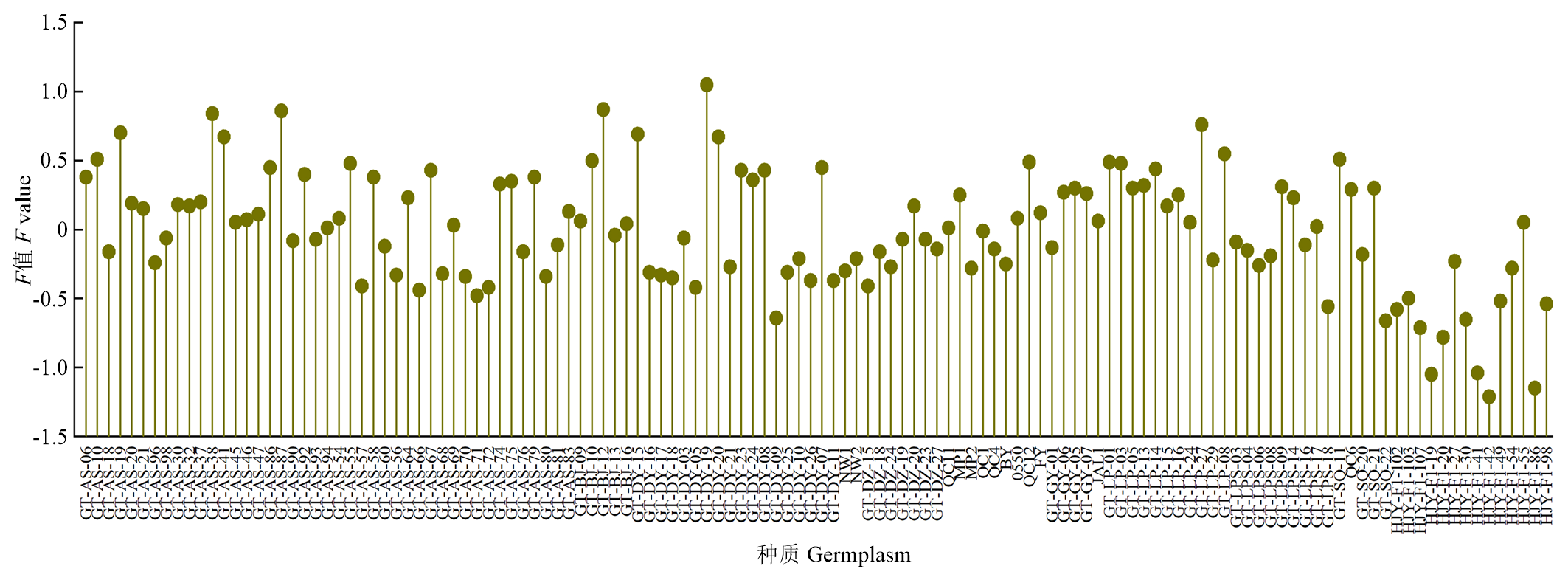
Fig. 7

F values from principal component analysis of 128 tea germplasms"

Table 6

L0 values in grey relation analysis"

性状Traits 理想品种L0 Ideal variety L0
冻害指数Freezing injury index 0.00
一芽三叶长Length of one bud with three leaves (cm)
Lengthofonebudwiththreeleaves(cm)
5.86
一芽三叶百芽重Weight of 100 one bud with three leaves (g) 35.27
芽叶颜色Young shoot colour
Youngshootcolour
3.69
芽叶茸毛Young shoot pubescence
Youngshootpubescence
3.29
一芽一叶期One-bud-one-leaf stage (d)
One-bud-one-leafstage(d)
4.00
3-没食子酰基奎宁酸TH (%) 1.75
可可碱TB (%) 0.46
咖啡碱CAF (%) 3.67
没食子酸GA (%) 0.04
没食子儿茶素GC (%) 0.36
表没食子儿茶素EGC (%) 1.30
儿茶素C (%) 0.18
表没食子儿茶素没食子酸酯EGCG (%) 8.59
表儿茶素EC (%) 0.62
没食子儿茶素没食子酸酯GCG (%) 0.21
表儿茶素没食子酸酯ECG (%) 2.05
表没食子儿茶素3-O-(3-O-甲基)没食子酸酯EGCG3"Me (%) 0.36
1,2,6-三没食子酰葡萄糖1,2,6-TGGP (%) 0.37
茶氨酸L-theanine (%) 4.18

Fig. 8

Weighted grey relational degree of 128 tea germplasm"

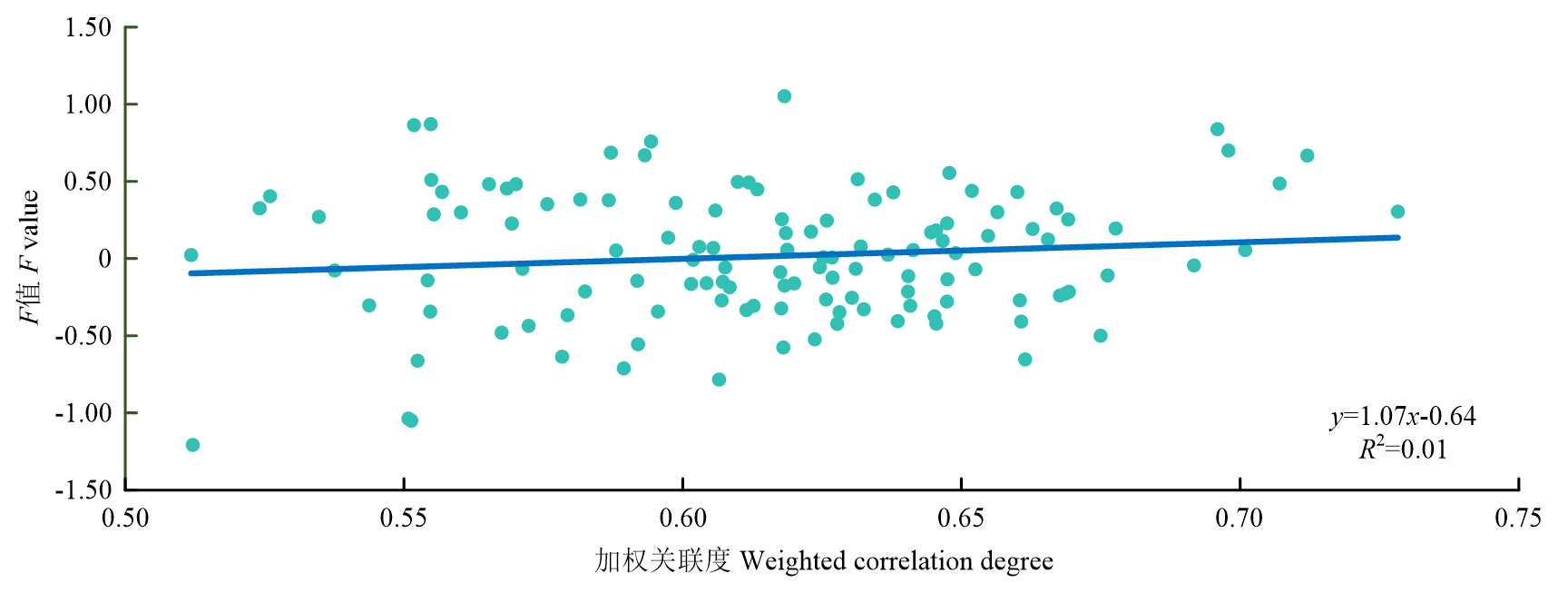
Fig. 9

Linear regression relationship between weighted grey relational degree and F value"

[1]
吴芹瑶, 杨江帆, 林程, 管曦. 中国茶叶生产布局变迁研究[J]. 茶叶科学, 2022, 42(2): 290-300.
Wu Q Y, Yang J F, Lin C, Guan X. Research on the changes of China’s tea production layout[J]. Journal of Tea Science, 2022, 42(2): 290-300. (in Chinese)
[2]
李润杰, 赵小风, 王瑾, 王柏源, 戴劲. 耕地 “占补平衡” 新机制下规模化茶产区整治路径[J]. 农业工程学报, 2025, 41(16): 290-298.
Li R J, Zhao X F, Wang J, Wang B Y, Dai J. Integrated governance pathways for large-scale tea plantations under the new cultivated land requisition-compensation balance mechanism[J]. Transactions of the Chinese Society of Agricultural Engineering, 2025, 41(16): 290-298. (in Chinese)
[3]
刘梦月, 孙悦, 韦朝领, 宋博, 陈志丹, 曹士先, 孙威江. 茶树功能性成分的遗传多样性分析及综合评价[J]. 植物资源与环境学报, 2023, 32(5): 28-38.
Liu M Y, Sun Y, Wei C L, Song B, Chen Z D, Cao S X, Sun W J. Genetic diversity analysis and comprehensive evaluation on functional components of tea tree (Camellia sinensis)[J]. Journal of Plant Resources and Environment, 2023, 32(5): 28-38. (in Chinese)
[4]
Konwar T, Sarma R N, Sarmah B K. Genome wide association analysis of flavour related metabolites in tea germplasm [Camellia sinensis (L.) Kuntze] from Assam using a genotyping by sequencing strategy[J]. BMC Plant Biology, 2025, 25(1): 911.

doi: 10.1186/s12870-025-06889-w
[5]
Payne E R, Aceves-Martins M, Dubost J, Greyling A, de Roos B. The effects of tea (Camellia sinensis) or its bioactive compounds L-theanine or L-theanine plus caffeine on cognition, sleep, and mood in healthy participants: A systematic review and meta-analysis of randomised controlled trials[J]. Proceedings of the Nutrition Society, 2024, 83(OCE4): E282.
[6]
Shibata S, Noguchi-Shinohara M, Shima A, Ozaki T, Usui Y, Taki Y, Uchida K, Honda T, Jun H T, Ohara T, Mikami T, Maeda T, Mimura M, Nakashima K, Iga J I, Takebayashi M, Ninomiya T, Ono K. Green tea consumption and cerebral white matter lesions in community- dwelling older adults without dementia[J]. Nature Partner Journals, 2025, 9: 2.
[7]
Tong X Y, Hu J B, Wen H L, Chen C L, Tao L L, Wu J, Tian Y P, Jiang H P, Chen L B, Qiao D H, Shu M T, Xia E H, Dong K, Fei Y, Liu S R, Wei C L, Zhu J Y. ddRAD sequencing of 1076 Camellia accessions reveals the genetic diversity and population introgression of the tea plant in China[J]. Plant Diversity, 2026, 48(3): 451-459.

doi: 10.1016/j.pld.2025.09.002
[8]
Kong W L, Kong X R, Xia Z Q, Li X F, Wang F, Shan R Y, Chen Z H, You X M, Zhao Y Y, Hu Y P, Zheng S Q, Zhong S T, Zhang S C, Zhang Y B, Fang K X, Wang Y H, Liu H, Zhang Y Z, Li X L, Wu H L, et al. Genomic analysis of 1, 325 Camellia accessions sheds light on agronomic and metabolic traits for tea plant improvement[J]. Nature Genetics, 2025, 57(4): 997-1007.

doi: 10.1038/s41588-025-02135-z
[9]
Wang Y H, Niu S Z, Deng X Y, Bai D C, Chen Z W, Deng X L, Huang D J. Genome-wide association study, population structure, and genetic diversity of the tea plant in Guizhou Plateau[J]. BMC Plant Biology, 2024, 24(1): 79.

doi: 10.1186/s12870-024-04761-x pmid: 38287242
[10]
Zhang C C, Wang L Y, Wei K, Wu L Y, Li H L, Zhang F, Cheng H, Ni D J. Transcriptome analysis reveals self-incompatibility in the tea plant (Camellia sinensis) might be under gametophytic control[J]. BMC Genomics, 2016, 17(1): 359.

doi: 10.1186/s12864-016-2703-5
[11]
李赛君, 段继华, 康彦凯, 雷雨, 黄飞毅, 罗意, 丁玎, 陈莹玉, 董丽娟. 特早生抗寒茶树新品种‘玉叶’选育报告[J]. 茶叶通讯, 2023, 50(1): 32-37.
Li S J, Duan J H, Kang Y K, Lei Y, Huang F Y, Luo Y, Ding D, Chen Y Y, Dong L J. Breeding report on a novel cold-resistant tea cultivar Yuye[J]. Journal of Tea Communication, 2023, 50(1): 32-37. (in Chinese)
[12]
任志红, 吴焕焕, 肖文敏, 张虹, 杨圣祥, 孙海伟, 王健, 高文星. 抗寒茶树新品种‘岱鼎御丰’[J]. 园艺学报, 2022, 49(增刊2): 287-288.
Ren Z H, Wu H H, Xiao W M, Zhang H, Yang S X, Sun H W, Wang J, Gao W X. A new cold tolerant tea cultivar ‘daiding Yufeng’[J]. Acta Horticulturae Sinica, 2022, 49(S2): 287-288. (in Chinese)
[13]
颜诗语, 方开星, 倪尔冬, 王秋霜, 王青, 潘晨东, 李波, 李红建, 冯韶芳, 田先先, 吴华玲, 秦丹丹. 高表没食子儿茶素没食子酸酯兼苦茶碱茶树品种功能成分叶位分布差异[J]. 食品安全质量检测学报, 2025, 16(24): 306-316.
Yan S Y, Fang K X, Ni E D, Wang Q S, Wang Q, Pan C D, Li B, Li H J, Feng S F, Tian X X, Wu H L, Qin D D. Distribution characteristics of functional components in different leaf positions of a dual-high tea cultivar with high epigallocatechin gallate and theacrine[J]. Journal of Food Safety & Quality, 2025, 16(24): 306-316. (in Chinese)
[14]
王飞权, 冯花, 罗盛财, 陈荣冰, 杨慧珠, 李少华, 张见明, 张渤, 叶江华. 武夷名丛茶树种质资源农艺性状多样性分析[J]. 中国农业科技导报, 2019, 21(6): 43-54.

doi: 10.13304/j.nykjdb.2018.0665
Wang F Q, Feng H, Luo S C, Chen R B, Yang H Z, Li S H, Zhang J M, Zhang B, Ye J H. Diversity analysis of agronomic traits of Wuyi mingcong tea plant germplasm resources[J]. Journal of Agricultural Science and Technology, 2019, 21(6): 43-54. (in Chinese)

doi: 10.13304/j.nykjdb.2018.0665
[15]
牛小军, 包兴伟, 郑旭霞, 秦秀珍, 邱金华, 王小亚, 沈世魁, 辛国田, 赵芸, 黄海涛. 四川九龙古茶树种质资源农艺性状遗传多样性研究[J]. 植物遗传资源学报, 2024, 25(2): 249-258.

doi: 10.13430/j.cnki.jpgr.20230731001
Niu X J, Bao X W, Zheng X X, Qin X Z, Qiu J H, Wang X Y, Shen S K, Xin G T, Zhao Y, Huang H T. The phenotypic diversity analysis of ancient tea germplasm resources in Jiulong County, Sichuan Province, China[J]. Journal of Plant Genetic Resources, 2024, 25(2): 249-258. (in Chinese)
[16]
李泽楷, 段子旭, 卢秀梅, 黄铭浩, Dylan O’Neill ROTHENBERG, 肖遂, 刘助生, 黄亚辉. 广东罗坑鳄蜥国家级自然保护区56份茶树资源的生化成分[J]. 云南农业大学学报, 2025, 40(3): 119-130.
Li Z K, Duan Z X, Lu X M, Huang M H, Rothenberg D, Xiao S, Liu Z S, Huang Y H. Biochemical components of 56 tea plant resources in Guangdong Luokeng crocodile lizard national nature reserve[J]. Journal of Yunnan Agricultural University (Social Science), 2025, 40(3): 119-130. (in Chinese)
[17]
田先先, 冯韶芳, 王青, 潘晨东, 李波, 方开星, 吴华玲, 秦丹丹. 连南大叶茶树种质资源生化特性分析与适制性评价[J]. 中国农业科学, 2025, 58(22): 4797-4812. DOI: 10.3864/j.issn.0578-1752.2025.22.018.
Tian X X, Feng S F, Wang Q, Pan C D, Li B, Fang K X, Wu H L, Qin D D. Biochemical characteristics analysis and suitability evaluation of Liannan Daye tea germplasm resources[J]. Scientia Agricultura Sinica, 2025, 58(22): 4797-4812. DOI: 10.3864/j.issn.0578-1752.2025.22.018. (in Chinese)
[18]
郭佳璐, 璩馥榕, 蔡天晨, 赵洋, 杨培迪, 刘勇, 周跃斌, 刘振. 基于农艺性状和SNP分子标记的湖南78份茶树种质资源遗传多样性研究[J]. 茶叶科学, 2025, 45(2): 219-233.
Guo J L, Ju F R, Cai T C, Zhao Y, Yang P D, Liu Y, Zhou Y B, Liu Z. Study on the genetic diversity of 78 tea germplasm resources in Hunan based on agronomic traits and SNP molecular markers[J]. Journal of Tea Science, 2025, 45(2): 219-233. (in Chinese)
[19]
刘瑜, 严芳, 邵静娜, 周慧娟, 郑生宏, 何卫中. 浙江丽水市地方茶树种质资源鉴定评价[J]. 南方农业学报, 2022, 53(2): 401-409.
Liu Y, Yan F, Shao J N, Zhou H J, Zheng S H, He W Z. Germplasm evaluation of tea plants in Lishui, Zhejiang[J]. Journal of Southern Agriculture, 2022, 53(2): 401-409. (in Chinese)
[20]
翟秀明, 李解, 唐敏, 胡方洁, 张军, 侯渝嘉, 徐泽. 重庆30份茶树种质资源农艺性状与生化成分多样性[J]. 浙江农业学报, 2021, 33(7): 1244-1255.

doi: 10.3969/j.issn.1004-1524.2021.07.10
Zhai X M, Li J, Tang M, Hu F J, Zhang J, Hou Y J, Xu Z. Diversity analysis of 30 tea (Camelia sinensis) germplasm resources in Chongqing based on agronomic traits and biochemical components[J]. Acta Agriculturae Zhejiangensis, 2021, 33(7): 1244-1255. (in Chinese)
[21]
杨春, 梁思慧, 汪安然, 陈娟, 李燕, 林开勤, 密孝增, 乔大河, 陈正武, 郭燕. 五十四份茶树种质的特征性代谢产物含量与耐寒性[J]. 浙江农业学报, 2025, 37(9): 1860-1871.

doi: 10.3969/j.issn.1004-1524.20240563
Yang C, Liang S H, Wang A R, Chen J, Li Y, Lin K Q, Mi X Z, Qiao D H, Chen Z W, Guo Y. Characteristic metabolite content and cold resistance of 54 tea germplasms[J]. Acta Agriculturae Zhejiangensis, 2025, 37(9): 1860-1871. (in Chinese)

doi: 10.3969/j.issn.1004-1524.20240563
[22]
黄政, 李芳, 尹杰, 牛素贞. 贵州低热河谷地方茶树种质资源基于表型性状的遗传多样性分析[J]. 分子植物育种, 2024, 22(4): 1193-1204.
Huang Z, Li F, Yin J, Niu S Z. Analysis of genetic diversity based on phenotypic traits of local tea germplasm resources in low heat valley of Guizhou[J]. Molecular Plant Breeding, 2024, 22(4): 1193-1204. (in Chinese)
[23]
李燕, 密孝增, 张小琴, 乔大河, 代新龙, 陈正武. 普安古茶树种质资源茶叶生化成分多样性分析[J]. 江苏农业学报, 2025, 41(5): 984-995.
Li Y, Mi X Z, Zhang X Q, Qiao D H, Dai X L, Chen Z W. Diversity analysis of biochemical components of ancient tea germplasm resources in Pu’an[J]. Jiangsu Journal of Agricultural Sciences, 2025, 41(5): 984-995. (in Chinese)
[24]
杨春, 郭燕, 乔大河, 梁思慧, 李燕, 李彦福, 密孝增, 杨世雄, 陈正武. 盘州大厂茶(Camellia tachangensis)的生物碱类、儿茶素类及氨基酸类组成特性分析[J]. 西南农业学报, 2025, 38(3): 507-518.
Yang C, Guo Y, Qiao D H, Liang S H, Li Y, Li Y F, Mi X Z, Yang S X, Chen Z W. Composition characteristics of alkaloids, catechins and amino acids in Panzhou Camellia tachangensis[J]. Southwest China Journal of Agricultural Sciences, 2025, 38(3): 507-518. (in Chinese)
[25]
NY/T 2943—2016 茶树种质资源描述规范[S]. 2016.
NY/T 2943—2016 Descriptors for tea germplasm resources[S]. 2016. (in Chinese)
[26]
杨春, 孟泽洪, 李帅, 郭燕, 梁思慧, 乔大河, 陈正武. 贵州茶园茶棍蓟马和小贯小绿叶蝉种群动态及主栽茶树品种寄主抗性[J]. 南方农业学报, 2021, 52(3): 671-681.
Yang C, Meng Z H, Li S, Guo Y, Liang S H, Qiao D H, Chen Z W. Population dynamics of Dendrothrips minowai Priesner and Empoasca onukii Matsuda and host resistance of major tea varieties in Guizhou[J]. Journal of Southern Agriculture, 2021, 52(3): 671-681. (in Chinese)
[27]
项丽慧, 林清霞, 王丽丽, 陈林, 余文权. 不同固样方法对茶鲜叶主要品质成分的影响[J]. 福建农业学报, 2018, 33(5): 525-529.
Xiang L H, Lin Q X, Wang L L, Chen L, Yu W Q. Effect of preservation methods on retention of main quality compnents in fresh tea leaves[J]. Fujian Journal of Agricultural Sciences, 2018, 33(5): 525-529. (in Chinese)
[28]
乔大河. 鲜叶摊放时间对太平猴魁茶风味品质形成的影响研究[D]. 合肥: 安徽农业大学, 2022.
Qiao D H. Effects of fresh leaf spreading time on the formation of flavor quality of Taiping HouKui tea[D]. Hefei: Anhui Agricultural University, 2022. (in Chinese)
[29]
杨春, 梁思慧, 陈正武, 陈娟, 李燕, 乔大河, 郭燕, 张小琴. 黄色芽叶茶树新品种黄金芽自然杂交后代的生化品质分析[J]. 西南农业学报, 2023, 36(9): 1859-1868.
Yang C, Liang S H, Chen Z W, Chen J, Li Y, Qiao D H, Guo Y, Zhang X Q. Biochemical quality analysis and evaluation of natural hybrid progenies from new tea variety with yellow bud leaf ‘Huangjinya’[J]. Southwest China Journal of Agricultural Sciences, 2023, 36(9): 1859-1868. (in Chinese)
[30]
罗旭婷, 刘伟, 张群, 王春发, 付复华, 杨明之. 湖南23个桃品种果实品质分析及综合评价[J]. 食品科学, 2025, 46(20): 36-46.
Luo X T, Liu W, Zhang Q, Wang C F, Fu F H, Yang M Z. Quality analysis and comprehensive evaluation of 23 varieties of peach fruits in Hunan[J]. Food Science, 2025, 46(20): 36-46. (in Chinese)
[31]
Kushwah A, Sharma P K, Kushwaha H L, Sharma B B, Shrivastava A K, Nag R H, Chowdhury M, Carpenter G, Yadav R. Hybrid taguchi- grey relational analysis approach for optimizing cutter operational parameters in selective cauliflower harvesting[J]. Scientific Reports, 2024, 14: 29709.

doi: 10.1038/s41598-024-81323-z
[32]
唐桂梅, 李卫东, 周宇霞, 孔佑涵, 肖晓玲, 彭颖姝, 张力, 符红艳, 刘洋, 黄国林. 基于表型性状分析蕙兰种质资源遗传多样性[J]. 中国农业科学, 2025, 58(2): 339-354. DOI: 10.3864/j.issn.0578-1752.2025.02.010.
Tang G M, Li W D, Zhou Y X, Kong Y H, Xiao X L, Peng Y S, Zhang L, Fu H Y, Liu Y, Huang G L. Genetic diversity analysis of Cymbidium faberi germplasm resources based on phenotypic traits[J]. Scientia Agricultura Sinica, 2025, 58(2): 339-354. DOI: 10.3864/j.issn.0578-1752.2025.02.010. (in Chinese)
[33]
NY/T 2031—2011 农作物优异种质资源评价规范茶树[S]. 2011.
NY/T 2031—2011 Evaluating standards for elite and rare germplasm resources-Tea plant (Camellia sinensis (L.) O. Kuntze)[S]. 2011. (in Chinese)
[34]
Wei K, He H F, Li H L, Wang L Y, Ruan L, Pang D D, Cheng H. Gallotannin 1, 2, 6-tri-O-galloyl-β-d-glucopyranose: Its availability and changing patterns in tea (Camellia sinensis)[J]. Food Chemistry, 2019, 296: 40-46.

doi: 10.1016/j.foodchem.2019.05.144
[35]
荀涵硕, 王留彬, 张睿, 王丽鸳, 韦康. 219份茶树资源1, 2, 6-三没食子酰葡萄糖变异分析[J]. 茶叶通讯, 2023, 50(3): 317-326.
Xun H S, Wang L B, Zhang R, Wang L Y, Wei K. Variation analysis of 1, 2, 6-tri-O-galloyl-β-D-glucopyranose in 219 tea germplasms[J]. Journal of Tea Communication, 2023, 50(3): 317-326. (in Chinese)
[36]
丁帅涛, 程晓梅, 张亚, 万斌, 任华江, 江昌俊, 余有本, 纪晓明, 胡歆. 基于表型性状和生化成分的陕西茶树种质资源遗传多样性研究[J]. 西北农业学报, 2019, 28(4): 607-619.
Ding S T, Cheng X M, Zhang Y, Wan B, Ren H J, Jiang C J, Yu Y B, Ji X M, Hu X. Genetic diversity in phenotypic traits and biochemical components of tea germplasm resources in Shaanxi[J]. Acta Agriculturae Boreali-occidentalis Sinica, 2019, 28(4): 607-619. (in Chinese)
[37]
Niu J Q, Ma S W, Zheng S S, Zhang C, Lu Y R, Si Y Q, Tian S Q, Shi X L, Liu X L, Naeem M K, Sun H, Hu Y F, Wu H L, Cui Y, Chen C L, Long W B, Zhang Y, Gu M J, Cui M, Lu Q, et al. Whole-genome sequencing of diverse wheat accessions uncovers genetic changes during modern breeding in China and the United States[J]. The Plant Cell, 2023, 35(12): 4199-4216.

doi: 10.1093/plcell/koad229 pmid: 37647532
[38]
Xie H, Zhu J Y, Wang H, Zhang L, Tong X Y, Huang F Y, Zhang C M, Mi X Z, Qiao D H, Li F D, Yao Y J, Gu H L, Zhou Q Q, Liu S R, Li S J, Xia E H, Xie D Y, Wei C L. An enhancer-transposable element from purple leaf tea varieties underlies the transition from evergreen to purple leaf color[J]. Plant Communications, 2025, 6(2): 101176.

doi: 10.1016/j.xplc.2024.101176
[39]
Hao X Y, Tang J W, Chen Y, Huang C, Zhang W F, Liu Y, Yue C, Wang L, Ding C Q, Dai W H, Yang Y J, Horvath D P, Wang X C. CsCBF1/CsZHD9-CsMADS27, a critical gene module controlling dormancy and bud break in tea plants[J]. The Plant Journal, 2025, 121: e17165.
[40]
Kottawa-Arachchi J D, Ranatunga M A B, Amarakoon A M T, Gunasekare M T K, Attanayake R N, Sharma R K, Chaudhary H K, Sood V K, Katoch R, Banyal D K, Piyasena K G N P, Edirisinghe E N U. Variation of catechin and caffeine content in exotic collection of tea [Camellia sinensis (L.) O. Kuntze] in Sri Lanka and potential implication in breeding cultivars with enhanced quality and medicinal properties[J]. Food Chemistry Advances, 2022, 1: 100108.

doi: 10.1016/j.focha.2022.100108
[41]
Wang Y L, Samarina L, Mallano A I, Tong W, Xia E H. Recent progress and perspectives on physiological and molecular mechanisms underlying cold tolerance of tea plants[J]. Frontiers in Plant Science, 2023, 14: 1145609.

doi: 10.3389/fpls.2023.1145609
[42]
李建波, 邓珂. 作物种质资源常用综合评价方法[J]. 江苏农业科学, 2024, 52(3): 40-46.
Li J B, Deng K. Commonly used comprehensive evaluation method of crop germplasm resources[J]. Jiangsu Agricultural Sciences, 2024, 52(3): 40-46. (in Chinese)
[43]
张琦, 蒲婷婷, 王艺儒, 胡银凤, 李华威, 韩卫娟, 索玉静, 傅建敏. 不同柿种质果实品质多样性评价[J]. 中国农业大学学报, 2025, 30(2): 61-71.
Zhang Q, Pu T T, Wang Y R, Hu Y F, Li H W, Han W J, Suo Y J, Fu J M. Quality diversity evaluation of different persimmon fruits[J]. Journal of China Agricultural University, 2025, 30(2): 61-71. (in Chinese)
[44]
陈彩锦, 马琳, 蒋庆雪, 刘金晖, 苗童, 张志鹏, 孟翔, 马晓冉, 周昕越, 张建, 刘文辉, 王学敏. 244份饲用燕麦种质资源表型性状遗传多样性分析[J]. 中国农业科学, 2025, 58(23): 4825-4836. DOI: 10.3864/j.issn.0578-1752.2025.23.002.
Chen C J, Ma L, Jiang Q X, Liu J H, Miao T, Zhang Z P, Meng X, Ma X R, Zhou X Y, Zhang J, Liu W H, Wang X M. Genetic diversity analysis of phenotypic traits of 244 forage oat germplasm resources[J]. Scientia Agricultura Sinica, 2025, 58(23): 4825-4836. DOI: 10.3864/j.issn.0578-1752.2025.23.002. (in Chinese)
[45]
葛玉彬, 贺春贵, 王宁, 张国琴, 张正英, 吕鑫. 基于表型性状的热带高粱种质资源遗传多样性分析与创新利用[J]. 中国农业科学, 2026, 59(8): 1622-1638. DOI: 10.3864/j.issn.0578-1752.2026.08.003.
Ge Y B, He C G, Wang N, Zhang G Q, Zhang Z Y, Lü X. Genetic diversity analysis and innovative utilization of introduced tropical sorghum germplasm resources based on phenotypic traits[J]. Scientia Agricultura Sinica, 2026, 59(8): 1622-1638. DOI: 10.3864/j.issn.0578-1752.2026.08.003. (in Chinese)
[46]
张悦青, 张玉亭, 薛晨飞, 韩秦宇, 贺一容, 徐紫娟, 范秀梅, 王军娥, 罗丹, 冯雪, 孙胜. 364份樱桃番茄种质资源表型性状的遗传多样性分析及综合评价[J]. 中国农业科学, 2026, 59(11): 2468-2483. DOI: 10.3864/j.issn.0578-1752.2026.11.012.
Zhang Y Q, Zhang Y T, Xue C F, Han Q Y, He Y R, Xu Z J, Fan X M, Wang J E, Luo D, Feng X, Sun S. Genetic diversity analysis and comprehensive evaluation of phenotypic traits in 364 cherry tomato germplasm resources[J]. Scientia Agricultura Sinica, 2026, 59(11): 2468-2483. DOI: 10.3864/j.issn.0578-1752.2026.11.012. (in Chinese)
[47]
郭晓雨, 王茜, 沈高健, 罗理勇, 袁连玉, 曾亮. 特早生茶树种质资源特征及其早芽调控机理研究进展[J]. 西北林学院学报, 2025, 40(6): 138-147.
Guo X Y, Wang Q, Shen G J, Luo L Y, Yuan L Y, Zeng L. Research progress on germplasm resource characteristics and early sprout regulation mechanism of extra-early sprouting tea trees[J]. Journal of Northwest Forestry University, 2025, 40(6): 138-147. (in Chinese)
[48]
王培娟, 唐俊贤, 金志凤, 马玉平, 陈惠. 中国茶树春霜冻害研究进展[J]. 应用气象学报, 2021, 32(2): 129-145.
Wang P J, Tang J X, Jin Z F, Ma Y P, Chen H. Review on spring frost disaster for tea plant in China[J]. Journal of Applied Meteorological Science, 2021, 32(2): 129-145. (in Chinese)
[49]
邢瑶, 李松, 唐锁海, 杨亦扬, 虞斌, 魏爱华. 茶树品种抗寒性试验[J]. 茶叶, 2022, 48(1): 34-38.
Xing Y, Li S, Tang S H, Yang Y Y, Yu B, Wei A H. Investigation on extreme low temperature freezing injury of different tea varieties during overwintering[J]. Journal of Tea, 2022, 48(1): 34-38. (in Chinese)
[50]
Shan X J, Jiang Y W, Zhang S, Chen L, Niu L C, Zhang Q T, Zhou Q H, Wang Y J, Yuan H B, Li J. Key umami taste contributors in Longjing green tea uncovered by integrated means of sensory quantitative descriptive analysis, metabolomics, quantification analysis and taste addition experiments[J]. Food Chemistry, 2024, 453: 139628.

doi: 10.1016/j.foodchem.2024.139628
[51]
Yu Y S, Feng X X, Blank I, Wang H L, Zhu Y W, Liu Z B, Ni L, Lin C C, Wang K Q, Liu Y. A review of umami taste of Tea: Substances, perception mechanism, and physiological measurement prospects[J]. Trends in Food Science & Technology, 2025, 162: 105082.
[1] WANG XiaoWei, DU FoLi, YAN HongCai, LANG ZhengDong, DANG ZhiJuan, LI BaoChun, WANG JunCheng, MA XiaoLe, WANG HuaJun, ZHANG Hong, YAO LiRong. Evaluation of Drought Resistance of 396 Spring Wheat Varieties at Grain Filling Stage and Maturity Stage [J]. Scientia Agricultura Sinica, 2026, 59(8): 1608-1621.
[2] LIU HaiQing, JIN JiaoJiao, SUN WanCang, CHAI Peng, QI WeiLiang, YANG Gang, LI Chan, LUO XueMei, SU YunYun, QIN XueXue. Morphogenesis of the Low-Growth Point and Its Multi-Hormonal Regulatory Mechanism During Overwintering in Winter Rapeseed (Brassica napus L.) [J]. Scientia Agricultura Sinica, 2026, 59(5): 951-966.
[3] LIANG HaiYan, SU ZhanMing, SONG XiaoQiang, YANG Fang, JIANG Chao, ZHANG XiangYu, LI Hai. Differences in Root Traits Among 75 Broomcorn Millet Varieties and Their Correlation with Root Lodging Resistance [J]. Scientia Agricultura Sinica, 2026, 59(12): 2563-2575.
[4] XU DuoDuo, DU QianQian, ZHAO LiXiang, LI Yan, HUANG Gan, LI YongHua, LU JiuXing. Genome-Wide Analysis of AP2/ERF Transcription Factors in Peony [J]. Scientia Agricultura Sinica, 2025, 58(23): 5031-5045.
[5] CHEN CaiJin, MA Lin, JIANG QingXue, LIU JinHui, MIAO Tong, ZHANG ZhiPeng, MENG Xiang, MA XiaoRan, ZHOU XinYue, ZHANG Jian, LIU WenHui, WANG XueMin. Genetic Diversity Analysis of Phenotypic Traits of 244 Forage Oat Germplasm Resources [J]. Scientia Agricultura Sinica, 2025, 58(23): 4825-4836.
[6] ZHANG TianYu, LIU LiJun, YANG Gang, WU JunYan, PU YuanYuan, MA Li, WANG WangTian, LU XiaoMing, MA YuanQiang, SUN WanCang. Genetic Gain Analysis of Agronomic Traits of Brassica rapa L. in Northern China from 2006 to 2022 [J]. Scientia Agricultura Sinica, 2025, 58(11): 2081-2095.
[7] LI JiaHui, LI YueQi, ZHOU XiaoFang, FAN GuoYuan, LI AiHua, TAO YongSheng. Analysis of Multidimensional Characterization Methods for Tannin Quality in Dry Red Wine [J]. Scientia Agricultura Sinica, 2025, 58(10): 2022-2034.
[8] ZHANG Yi, LIU Ying, CHENG CunGang, LI YanQing, LI Zhuang. Effects of Combined Application Proportion of Cow Manure and Chemical Fertilizer on Soil Organic Carbon Pool and Enzyme Activity in Apple Orchard [J]. Scientia Agricultura Sinica, 2024, 57(20): 4107-4118.
[9] RONG YaSi, LI Feng, ZHANG PengYu, WANG DongYong, SU XiaoYu, TIAN Yuan, GAO TongMei. Evaluation of High Temperature Tolerance and Selection of Sesame (Sesamum indicum L.) Cultivars at Full Flowering Stage Based on Principal Components-Cluster Analysis [J]. Scientia Agricultura Sinica, 2024, 57(20): 3957-3973.
[10] YANG Chun, YANG DaiXing, LI Yan, LIANG SiHui, DENG XiaoQiang, QIAO DaHe, CHEN Juan, GUO Yan, LIN KaiQin, CHEN ZhengWu. Comprehensive Analysis of Morphologic Characters and Biochemical Components of Guizhou Dashu Tea Germplasms [J]. Scientia Agricultura Sinica, 2024, 57(19): 3894-3916.
[11] FAN JunQiang, WU JunYan, LIU LiJun, MA Li, YANG Gang, PU YuanYuan, LI XueCai, SUN WanCang. Correlation Between Stomatal Characteristics and Cold Resistance of Brassica napus L. [J]. Scientia Agricultura Sinica, 2023, 56(4): 599-618.
[12] HOU ZhaoYu, GONG YiZhao, QIAN Yi, CHENG ZhuoYa, TAO Jun, ZHAO DaQiu. Evaluation of Heat Tolerance of Herbaceous Peony and Screening of Its Identification Indices [J]. Scientia Agricultura Sinica, 2023, 56(23): 4742-4756.
[13] WANG XiuXiu,XING AiShuang,YANG Ru,HE ShouPu,JIA YinHua,PAN ZhaoE,WANG LiRu,DU XiongMing,SONG XianLiang. Comprehensive Evaluation of Phenotypic Characters of Nature Population in Upland Cotton [J]. Scientia Agricultura Sinica, 2022, 55(6): 1082-1094.
[14] DU JinXia,LI YiSha,LI MeiLin,CHEN WenHan,ZHANG MuQing. Evaluation of Resistance to Leaf Scald Disease in Different Sugarcane Genotypes [J]. Scientia Agricultura Sinica, 2022, 55(21): 4118-4130.
[15] MA YuYang,GUAN HaiXiang,YANG HaoXuan,SHAO Shuai,SHAO YiQun,LIU HuanJun. A New Method to Improve the Accuracy of Digital Elevation Model in Northeast China by Using Terrain, Soil and Crop Information [J]. Scientia Agricultura Sinica, 2021, 54(8): 1715-1727.
Viewed
Full text


Abstract

Cited

  Shared   
  Discussed   
No Suggested Reading articles found!