Scientia Agricultura Sinica ›› 2026, Vol. 59 ›› Issue (5): 951-966.doi: 10.3864/j.issn.0578-1752.2026.05.003

• CROP GENETICS & BREEDING·GERMPLASM RESOURCES·MOLECULAR GENETICS • Previous Articles     Next Articles

Morphogenesis of the Low-Growth Point and Its Multi-Hormonal Regulatory Mechanism During Overwintering in Winter Rapeseed (Brassica napus L.)

LIU HaiQing1,2(), JIN JiaoJiao1,2, SUN WanCang3, CHAI Peng4, QI WeiLiang1,2, YANG Gang3, LI Chan1, LUO XueMei1, SU YunYun1,2, QIN XueXue1   

  1. 1 School of Agriculture and Bioengineering, Longdong Univerisity, Qingyang 745000, Gansu
    2 Gansu Key Laboratory of Protection and Utilization for Biological Resources and Ecological Restoration, Qingyang 745000, Gansu
    3 College of Agronomy, Gansu Agricultural University, Lanzhou 730070
    4 Xifeng Agricultural Technology Extension Center, Qingyang 745000, Gansu
  • Received:2025-08-19 Accepted:2025-11-12 Online:2026-03-01 Published:2026-03-06

Abstract:

【Objective】 This study aims to clarify the mechanism of plant hormones on the morphology of growth point and their response to cold resistance of Brassica napus, to provide a theoretical basis for breeding winter Brassica napus varieties, expanding its planting area, and increasing yield per unit.【Method】 Using 9 rapeseed varieties with distinct winter hardiness as experimental materials, a two year (2023-2025) consecutive field identification of overwintering rate was conducted in Qingyang, Gansu Province. Mid-November samplings were used to quantify shoot to root ratio, growth point height and additional phenotypic indicators of overwintering potential. Paraffin sectioning and trypan-blue/nitroblue tetrazolium staining were used to visualize growth cone morphology, cell death, and superoxide accumulation to evaluate the cold tolerance of different cultivars. Growth point of three representative genotypes that span the full range of cold hardiness (NTS309>Tianyou 14>Qinzao 1) were simultaneously analysed by targeted LC-MS/MS targeted phytohormone profiling and RNA-seq. PCA and O2PLS integrative analyses of the metabolome and transcriptome, the physiological and molecular mechanisms underlying the differences in growth point height among these varieties were systematically analyzed.【Result】 The results showed the following: Significant differences were observed among cultivars in overwintering rate, root collar diameter, dry weight, root/shoot ratio, and height of the growing point. Strong cold-tolerant varieties, less reactive oxygen species (ROS) and fewer dead cells observed following cold stress, accompanied by a lower proportion of cells damaged by low temperature, the opposite was true for weak cold-tolerant varieties. Statistical analysis revealed that the overwintering rate was extremely significantly and negatively correlated with growth point height (correlation coefficient r=-0.972, P<0.001). Rapeseed varieties with strong cold-tolerance (e.g., NTS309) which exhibited an overwintering rate exceeding 70%, had a relatively lower growth point height (approximately 3 cm), additionally, the height of the growth cone (observed in paraffin sections) was only 161.5 μm. In contrast, varieties with weak cold-tolerance (e.g., Qinzao 1) had growth points that protruded above the soil surface (approximately 5 cm), and their growth cone measured approximately 252.9 μm in height. Integrated analysis of hormone metabolomics and transcriptomics data revealed that the height of rapeseed growth point is regulated by a multi-dimensional regulatory network involving the phytohormones IAA, CKs, GA, JA and ABA. In strong cold-tolerant varieties, the levels of free IAA, conjugated IAA, JA-Ile, GA19, and ABA-GE were significantly up-regulated, whereas those of iP9G, mT9G, and BAP9G were significantly down-regulated. Differentially expressed genes (DEGs) between strong and weak cold-tolerant varieties were significantly enriched in pathways including “tryptophan metabolism”, “zeatin biosynthesis”, “plant hormone signal transduction”, and “α-linolenic acid metabolism”. The orthogonal partial least squares (O2PLS) model indicated that metabolites including IAA-Glu, tZR, and JA-Ile exhibited strong covariance with transcriptional modules, these interactions collectively form a hormone-transcription factor-metabolite feedback loop, which exerts three key regulatory effects: inhibiting cell elongation, promoting meristem dormancy and reducing the height of growth cone and growth points. Ultimately, this regulatory loop enhances the defense capacity of rapeseed against low-temperature freezing damage.【Conclusion】 This study is the first to confirm that the “dwarf growth point” of rapeseed is a key morphological marker for overwintering survival, and its formation is finely regulated by a multi-hormone network.

Key words: winter rapeseed (Brassica napus L.), plant hormone, growth point, growth cone, cold resistance

Table 1

Cultivar characteristics and origin"

序号No 品种(系)Varieties (Lines) 冬性Winterness 选育单位Source
1 GAU30 强冬性Strong winterness 甘肃农业大学Gansu Agricultural University
2 NTS309 强冬性Strong winterness 甘肃农业大学Gansu Agricultural University
3 GAU24 强冬性Strong winterness 甘肃农业大学Gansu Agricultural University
4 16-2444 强冬性Strong winterness 甘肃农业大学Gansu Agricultural University
5 天油14号Tianyou 14 冬性Winterness 天水市农业科学研究所Tianshui Agricultural Science Research Institute
6 天油2238 Tianyou 2238 冬性Winterness 天水市农业科学研究所Tianshui Agricultural Science Research Institute
7 天油2288 Tianyou 2288 冬性Winterness 天水市农业科学研究所Tianshui Agricultural Science Research Institute
8 甘杂9号Ganza 9 弱冬性Weak winterness 西北农林科技大学Northwest Agriculture & Forestry University
9 秦早1号Qinzao 1 弱冬性Weak winterness 陕西省杂交油菜中心Shaanxi Hybrid Rapeseed Center

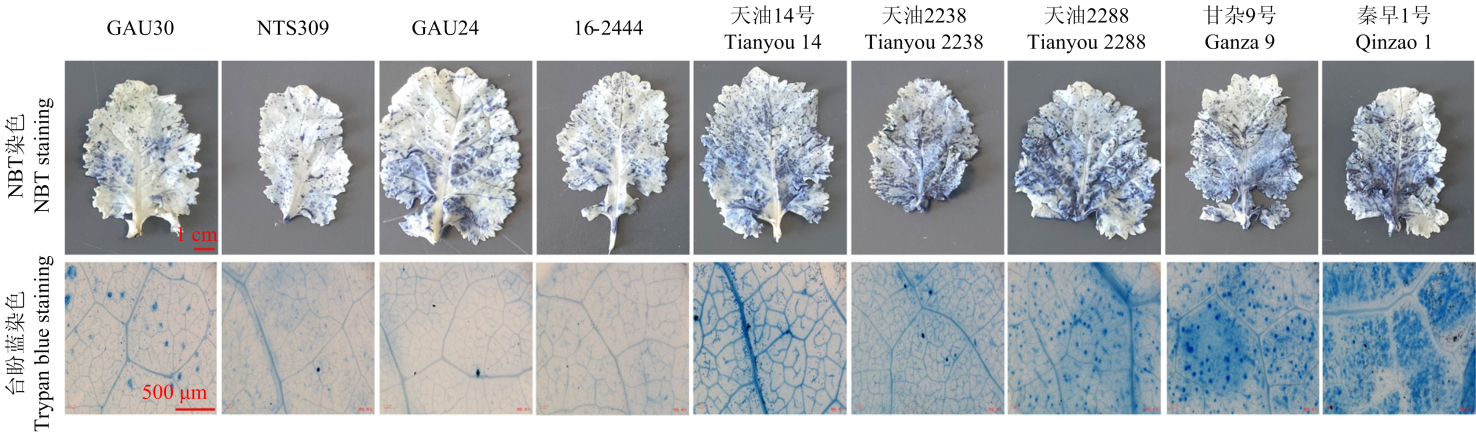
Fig. 1

Cytochemical staining of leaves in different winter rapeseed (Brassica napus L.) cultivarsd under cold stress"

Table 2

Evaluation of cold tolerance in different winter rapeseed (Brassica napus L.) cultivars"

品种
Varieties
越冬率
Overwintering rate (%)
根颈直径
Collar diameter (mm)
干重
Dry weight
(g)
根/冠
Root/crown
生长点高度
The height of growth point (cm)
GAU30 75.00±3.06a 26.38±0.20ab 63.84±6.07ab 0.15±0.02ab 3.17±0.18de
NTS309 74.00±2.31a 27.40±1.49ab 67.41±8.99ab 0.15±0.03ab 3.07±0.25e
GAU24 73.67±2.33a 25.63±1.59b 71.41±2.93ab 0.14±0.03ab 3.27±0.14 cde
16-2444 74.33±2.19a 25.61±1.94b 52.65±6.68b 0.20±0.03a 3.13±0.29de
天油14号Tianyou 14 65.00±3.21b 27.01±0.85ab 80.82±4.53a 0.16±0.04ab 4.06±0.12abc
天油2238 Tianyou 2238 61.67±2.19b 23.20±2.06bc 75.17±10.94ab 0.12±0.01ab 3.96±0.06bcd
天油2288 Tianyou 2288 64.00±2.08b 19.04±0.97c 50.54±8.15b 0.11±0.01b 4.14±0.57ab
甘杂9号Ganza 9 57.00±2.53bc 25.77±0.40b 57.16±4.03ab 0.14±0.01ab 4.75±0.17ab
秦旱1号Qinzao 1 49.67±2.60c 30.65±1.96a 63.80±2.41ab 0.10±0.000b 4.89±0.25a
与越冬率的相关性
The correlation with overwintering rate
1 -0.191(P=0.622) 0.012 (P=0.976) 0.677* (P=0.045) -0.972** (P<0.001)

Fig. 2

Measurement of growth cone height in different winter rapeseed (Brassica napus L.) a1-a3: Anatomical morphology of the shoot apical meristem (SAM) in NTS309, Tianyou 14, and Qinzao 1, respectively; the distance between the two red lines indicate meristem height; b: Schematic model illustrating how plant hormones regulate SAM morphology. AUX: Auxin, GA: Gibberellic acid, CK: Cytokinin, IAA: Indole acetic acid, GA19: Gibberellic acid 19, IAA-Glu: Indole-3-acetyl-glutamic acid, ME-IAA: Methyl indole-3-acetate, IAM: 3-Indolylacetylamine, IAN: Indole-3-acetonitrile, mT9G: 3-[[(9-beta-D-xylopyranosyl-9H-purin-6-yl)amino] methyl]phenol, iP9G: Isoaminal adenine-9-glucoside, BAP9G: 6-Benzyloxy-9-(α-D-xylopyranosyl) pyrrole; c1-c3: Paraffin sections of the growth cone in NTS309, Tianyou 14, and Qinzao 1, respectively; the red arrow points to newly differentiated meristematic tissue. Bar=200 μm"

Fig. 3

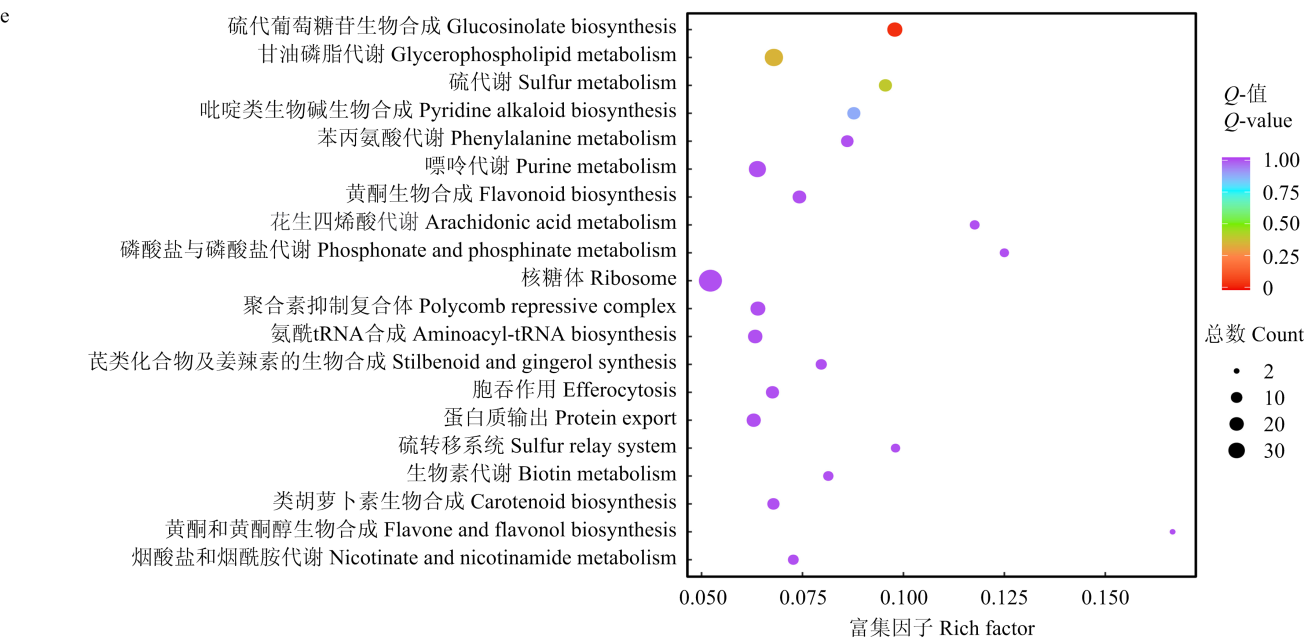
Hormonomics analysis of different winter rapeseed (Brassica napus L.) cultivars a: Venn diagram of differential metabolites; b: Cluster heatmap of differential metabolites; c: KEGG enrichment analysis of NTS309 vs Tianyou 14; d: KEGG enrichment analysis of NTS309 vs Qinzao 1; e: KEGG enrichment analysis of Tianyou 14 vs Qinzao 1"

Fig. 4

Transcriptome analysis of different winter rapeseed (Brassica napus L.) cultivars a: Venn diagram of differential genes; b: Volcano plot of differential gene in NTS309 vs Tianyou 14; c: Column diagram of GO analysis in NTS309 vs Tianyou 14; d: KEGG enrichment analysis of NTS309 vs Tianyou 14; e: KEGG enrichment analysis of Tianyou 14 vs Qinzao 1"

Fig. 5

Integrated metabolomic and transcriptomic analyses of winter rapeseed with different cold resistance a: Hormonomic PCA; b: Transcriptomic PCA; c: KEGG enrichment of NTS309 vs Tianyou 14; d: KEGG enrichment of NTS309 vs Qinzao 1; e: O2PLS metabolite loading plot,IAA-Phe: Indoleacetic acid-phenylalanine, IAA-Glu: Indole-3-acetyl-glutamic acid, ME-IAA: Methyl indole-3-acetate, IAM: 3-Indolylacetylamine, IAN: Indole-3-acetonitrile, IPA: Indole-3-butyrate, iP9G: Isoaminal adenine-9-glucoside, tZR: trans-Zeatin, MeSAG: Methyl Salicylate Glucoside, JA-ILE: Jasmonic acid-isoleucine; f: O2PLS gene loading plot"

Table 3

Analysis of endogenous hormone contents in different winter cultivars of rapeseed"

缩略词Index 化合物
Compounds
类别
Class
NTS309 天油14号
Tianyou 14
秦早1号
Qinzao 1
P
P value
IAA 吲哚-3-乙酸Indole-3-acetic acid 生长素Auxin 24.37±0.56a 17.49±0.19b 28.34±3.34a 0.021
IAA-Glu 吲哚乙酸-谷氨酸Indole-3-acetyl glutamic acid 生长素Auxin 1.79±0.17a 0.38±0.04b 1.58±0.15a <0.001
MEIAA 吲哚-3-乙酸甲酯Methyl indole-3-acetate 生长Auxin 285.43±30.95a 82.37±14.75b 276.44±18.63a 0.001
IAM 3-吲哚乙酰胺3-Indole acetamide 生长素Auxin 85.23±9.41a 22.91 ±2.23c 55.20±5.32b 0.001
IAN 吲哚-3-乙腈3-Indoleacetonitrile 生长素Auxin 1796.08±69.00a 611.95±67.05b 1597.89±93.47a <0.001
ICA 吲哚-3-甲酸Indole-3-carboxylic acid 生长素Auxin 45.63±2.15a 22.72±0.56b 22.11±0.48b <0.001
ICAld 吲哚-3-甲醛Indole-3-carboxaldehyde 生长素Auxin 156.42±24.31a 59.26 ±4.07b 108.93±8.58ab 0.011
IPA 3-吲哚丙酸3-Indolepropionic acid 生长素Auxin 0.00±0.00b 0.55±0.03a 0.00±0.00b <0.001
tZR 玉米素核苷Trans-Zeatin riboside 细胞分裂素CK 2.27±0.15a 1.60±0.15b 0.40±0.03c <0.001
BAP9G 6-苄氨基-9-(Α-D-吡喃葡萄糖基)呤
N6-Benzyladenine-9-glucoside
细胞分裂素CK 0.00±0.00b 0.11±0.01a 0.11±0.01a <0.001
mT9G 3-[[(9-BETA-D-吡喃葡萄糖基-9H-嘌呤-6-基)氨基]甲基]苯酚meta-Topolin-9-glucoside 细胞分裂素CK 0.00±0.00b 0.26±0.04a 0.32±0.05a 0.002
iP9G 异戊烯腺嘌呤-9-葡糖苷N6-Isopentenyl-adenine-9-glucoside 细胞分裂素CK 0.00±0.00c 1.71±0.20b 4.40±0.34a <0.001
GA19 赤霉素19 Gibberellin A19 赤霉素GA 0.73±0.12a 0.00±0.00b 0.00±0.00b <0.001
JA 茉莉酸Jasmonic acid 茉莉酸JA 100.61±8.17a 37.79±2.67b 36.24±4.34b <0.001
OPC-4 氧化戊烯基环戊烷丁酸
3-oxo-2-(2-(Z)-Pentenyl) cyclopentane-1-butyric acid
茉莉酸JA 45.98±3.93a 12.21±0.70b 18.33±1.96b <0.001
JA-ILE 茉莉酸-异亮氨酸Jasmonoyl-L-isoleucine 茉莉酸JA 8.09±0.71a 4.56±0.05b 0.00±0.00c <0.001
MeJA 茉莉酸甲酯Methyl jasmonate 茉莉酸JA 2.84±0.08a 0.00±0.00b 0.00±0.00b <0.001
JA-Val 茉莉酸-缬氨酸N-[(-)-Jasmonoyl]-(L)-valine 茉莉酸JA 0.11±0.004a 0.00±0.00b 0.00±0.00b <0.001
ABA-GE 脱落酸葡萄糖酯ABA-glucosyl ester 脱落酸ABA 21.61±1.07a 0.00±0b 0.00±0b <0.001
[1]
孙万仓, 裴新梧, 马骊, 王学芳, 武军艳, 李学才, 蒲媛媛, 刘丽君, 柴鹏, 李孝泽, 等. 我国北方冬季覆盖作物研究进展及发展前景. 中国农业科技导报, 2022, 24(1): 128-136.

doi: 10.13304/j.nykjdb.2020.0689
SUN W C, PEI X W, MA L, WANG X F, WU J Y, LI X C, PU Y Y, LIU L J, CHAI P, LI X Z, et al. Advances and outlook of winter cover crop development research in northern China. Journal of Agricultural Science and Technology, 2022, 24(1): 128-136. (in Chinese)

doi: 10.13304/j.nykjdb.2020.0689
[2]
王汉中. 中国油料产业发展的现状、问题与对策. 中国油料作物学报, 2005, 27(4): 100-105.
WANG H Z. Problem in the development of oilseed industry and it’s countermeasure in China. Chinese Journal of Oil Crop Sciences, 2005, 27(4): 100-105. (in Chinese)
[3]
傅廷栋. 中国油菜生产和品种改良的现状与前景. 安徽农学通报, 2000, 6(1): 3-10.
FU T D. Present situation and prospect of rapeseed production and variety improvement in China. Anhui Agricultural Science Bulletin, 2000, 6(1): 3-10. (in Chinese)
[4]
王瑞元. 2022年我国粮油产销和进出口情况. 中国油脂, 2023, 48(6): 1-7.
WANG R Y. Introduction of grain and oil production, marketing, import and export in 2022 in China. China Oils and Fats, 2023, 48(6): 1-7. (in Chinese)
[5]
方振, 李谷成. 我国油菜籽增产潜力与实现路径. 中国油脂, 2025, 50(4): 1-9.
FANG Z, LI G C. Potential and realization path of rapeseed yield increase in China. China Oils and Fats, 2025, 50(4): 1-9. (in Chinese)
[6]
冯海棠, 王汉中. 新形势下的我国食用植物油供给安全对策. 中国油料作物学报, 2024, 46(2): 221-227.

doi: 10.19802/j.issn.1007-9084.2024021
FENG H T, WANG H Z. Security strategy for the nation’s edible vegetable oil supplies under the new circumstances. Chinese Journal of Oil Crop Sciences, 2024, 46(2): 221-227. (in Chinese)
[7]
孙万仓, 武军艳, 方彦, 刘秦, 杨仁义, 马维国, 李学才, 张俊杰, 张鹏飞, 曹建明, 等. 北方旱寒区北移冬油菜生长发育特性. 作物学报, 2010, 36(12): 2124-2134.

doi: 10.3724/SP.J.1006.2010.02124
SUN W C, WU J Y, FANG Y, LIU Q, YANG R Y, MA W G, LI X C, ZHANG J J, ZHANG P F, CAO J M, et al. Growth and development characteristics of winter rapeseed northern-extended from the cold and arid regions in China. Acta Agronomica Sinica, 2010, 36(12): 2124-2134. (in Chinese)

doi: 10.3724/SP.J.1006.2010.02124
[8]
刘自刚, 张长生, 孙万仓, 杨宁宁, 王月, 何丽, 赵彩霞, 武军艳, 方彦, 曾秀存. 不同生态区冬前低温下白菜型冬油菜不同抗寒品种(系)的比较. 作物学报, 2014, 40(2): 346-354.
LIU Z G, ZHANG C S, SUN W C, YANG N N, WANG Y, HE L, ZHAO C X, WU J Y, FANG Y, ZENG X C. Comparison of winter rapeseed varieties(lines) with different cold resistance planted in the northern-extending regions in China under low temperature before winter. Acta Agronomica Sinica, 2014, 40(2): 346-354. (in Chinese)

doi: 10.3724/SP.J.1006.2014.00346
[9]
刘自刚, 孙万仓, 方彦, 李学才, 杨宁宁, 武军艳, 曾秀存, 王月. 夜间低温对白菜型冬油菜光合机构的影响. 中国农业科学, 2015, 48(4): 672-682. doi: 10.3864/j.issn.0578-1752.2015.04.05.
LIU Z G, SUN W C, FANG Y, LI X C, YANG N N, WU J Y, ZENG X C, WANG Y. Effects of low nocturnal temperature on photosynthetic apparatus of winter rapeseed (Brassica campestris L.). Scientia Agricultura Sinica, 2015, 48(4): 672-682. doi: 10.3864/j.issn.0578-1752.2015.04.05. (in Chinese)
[10]
QI W L, WANG F, MA L, QI Z, LIU S Q, CHEN C, WU J Y, WANG P, YANG C R, WU Y, et al. Physiological and biochemical mechanisms and cytology of cold tolerance in Brassica napus. Frontiers in Plant Science, 2020, 11: 1241.

doi: 10.3389/fpls.2020.01241
[11]
MA L, QI W L, BAI J, LI H Y, FANG Y, XU J, XU Y Z, ZENG X C, PU Y Y, WANG W T, et al. Genome-wide identification and analysis of the ascorbate peroxidase (APX) gene family of winter rapeseed (Brassica rapa L.) under abiotic stress. Frontiers in Genetics, 2022, 12: 753624.

doi: 10.3389/fgene.2021.753624
[12]
姚彦林, 马骊, 刘丽君, 李学才, 李鹏, 王旺田, 蒲媛媛, 牛早霞, 徐芳, 孙万仓, 等. 北方白菜型冬油菜BrFLC家族的全基因组鉴定、克隆及表达分析. 中国油料作物学报, 2023, 45(1): 83-94.

doi: 10.19802/j.issn.1007-9084.2021314
YAO Y L, MA L, LIU L J, LI X C, LI P, WANG W T, PU Y Y, NIU Z X, XU F, SUN W C, et al. Genome-wide identification, cloning and analysis of BrFLC family in northern winter rapeseed (Brassica rapa). Chinese Journal of Oil Crop Sciences, 2023, 45(1): 83-94. (in Chinese)
[13]
许金苗, 孙柏林, 王万鹏, 武军艳, 刘丽君, 李爱国, 缪纯庆, 孙万仓, 马骊. 白菜型油菜WUS基因的克隆与表达分析. 分子植物育种, 2023, 21(19): 6265-6275.
XU J M, SUN B L, WANG W P, WU J Y, LIU L J, LI A G, MIAO C Q, SUN W C, MA L. Cloning and expression analysis of WUS gene in Brassica rapa L.. Molecular Plant Breeding, 2023, 21(19): 6265-6275. (in Chinese)
[14]
刘自刚, 魏家萍, 崔俊美, 武泽峰, 方彦, 董小云, 郑国强. 我国冬油菜北移的现状、问题与对策. 中国农业科学, 2023, 56(15): 2854-2862. doi: 10.3864/j.issn.0578-1752.2023.15.002.
LIU Z G, WEI J P, CUI J M, WU Z F, FANG Y, DONG X Y, ZHENG G Q. Status, existing problems and strategy discussion on northward expansion of winter rapeseed in China. Scientia Agricultura Sinica, 2023, 56(15): 2854-2862. doi: 10.3864/j.issn.0578-1752.2023.15.002. (in Chinese)
[15]
SHANI E, YANAI O, ORI N. The role of hormones in shoot apical meristem function. Current Opinion in Plant Biology, 2006, 9(5): 484-489.

doi: 10.1016/j.pbi.2006.07.008 pmid: 16877025
[16]
李学才, 金姣姣, 马骊, 武军艳, 陈其鲜, 曾瑞, 曾秀存, 崔小茹, 孙万仓. 北方强冬性甘蓝型冬油菜生长锥与抗寒性的关系研究. 中国油料作物学报, 2022, 44(4): 739-750.

doi: 10.19802/j.issn.1007-9084.2022021
LI X C, JIN J J, MA L, WU J Y, CHEN Q X, ZENG R, ZENG X C, CUI X R, SUN W C. Relationship between height of growth point and cold resistance in strong winter rape (Brassica napus L.) in Northern China. Chinese Journal of Oil Crop Sciences, 2022, 44(4): 739-750. (in Chinese)
[17]
王跃华, 刘洪明, 刘鑫, 杨淮, 李瑞, 黄鹏. 红景天植物石蜡切片的制作和结构观察研究. 种子, 2018, 37(7): 28-30, 34.
WANG Y H, LIU H M, LIU X, YANG H, LI R, HUANG P. Study on preparation and structural observation of paraffin sections of three kinds of Rhodiola. Seed, 2018, 37(7): 28-30, 34. (in Chinese)
[18]
曾瑞, 马骊, 武军艳, 杨刚, 张娜, 徐佳, 朱明川, 马敏, 陶肖蕾, 李学才, 等. 低温胁迫下白菜型冬油菜枯叶期早晚与抗寒性的关系. 中国油料作物学报, 2023, 45(4): 766-775.

doi: 10.19802/j.issn.1007-9084.2022164
ZENG R, MA L, WU J Y, YANG G, ZHANG N, XU J, ZHU M C, MA M, TAO X L, LI X C, et al. Relationship between withered leaf stage and cold resistance of winter Brassica rapa under low temperature stress. Chinese Journal of Oil Crop Sciences, 2023, 45(4): 766-775. (in Chinese)

doi: 10.19802/j.issn.1007-9084.2022164
[19]
FAN J Q, YANG G, WU J Y, PU Y Y, LIU L J, MA L, FAN T T, WANG W T, ZHANG Y H, LEI J M, et al. Feasibility analysis of expanding winter rapeseed northwards in China. Agricultural and Forest Meteorology, 2025, 361: 110297.

doi: 10.1016/j.agrformet.2024.110297
[20]
李鹏, 马骊, 徐芳, 刘丽君, 姚彦林, 蒲媛媛, 王旺田, 李学才, 方彦, 孙万仓, 等. 越冬前北方不同类型强冬性冬油菜形态及生理响应研究. 干旱地区农业研究, 2022, 40(5): 42-51.
LI P, MA L, XU F, LIU L J, YAO Y L, PU Y Y, WANG W T, LI X C, FANG Y, SUN W C, et al. Comparison of morphological and physiological responses of two different species of northern winter rapeseed before overwintering. Agricultural Research in the Arid Areas, 2022, 40(5): 42-51. (in Chinese)
[21]
蒲媛媛, 赵玉红, 武军艳, 刘丽君, 白静, 马骊, 牛早霞, 金姣姣, 方彦, 李学才, 等. 北方强冬性甘蓝型冬油菜品种(系)抗寒性评价. 中国农业科学, 2019, 52(19): 3291-3308. doi: 10.3864/j.issn.0578-1752.2019.19.002.
PU Y Y, ZHAO Y H, WU J Y, LIU L J, BAI J, MA L, NIU Z X, JIN J J, FANG Y, LI X C, et al. Comprehensive assessment on cold tolerance of the strong winter Brassica napus L. cultivated in northern China. Scientia Agricultura Sinica, 2019, 52(19): 3291-3308. doi: 10.3864/j.issn.0578-1752.2019.19.002. (in Chinese)
[22]
刘海卿, 李静, 刘海霞, 王燕琴, 周莹莹, 张忠财, 苏芸芸, 孙于卜, 孙万仓. 北方寒旱区甘蓝型冬油菜的春化特性与抗寒性. 西北农林科技大学学报(自然科学版), 2024, 52(9): 62-71.
LIU H Q, LI J, LIU H X, WANG Y Q, ZHOU Y Y, ZHANG Z C, SU Y Y, SUN Y B, SUN W C. Vernalization characteristics and cold resistance of winter rapeseed (Brassica napus L.) in cold and arid regions in Northern China. Journal of Northwest A & F University (Natural Science Edition), 2024, 52(9): 62-71. (in Chinese)
[23]
BENKOVÁ E, MICHNIEWICZ M, SAUER M, TEICHMANN T, SEIFERTOVÁ D, JÜRGENS G, FRIML J. Local, efflux-dependent auxin gradients as a common module for plant organ formation. Cell, 2003, 115(5): 591-602.

doi: 10.1016/s0092-8674(03)00924-3 pmid: 14651850
[24]
ROSS J, O’NEILL D. New interactions between classical plant hormones. Trends in Plant Science, 2001, 6(1): 2-4.

doi: 10.1016/s1360-1385(00)01795-7 pmid: 11164356
[25]
范业赓, 丘立杭, 黄杏, 周慧文, 甘崇琨, 李杨瑞, 杨荣仲, 吴建明, 陈荣发. 甘蔗节间伸长过程赤霉素生物合成关键基因的表达及相关植物激素动态变化. 植物学报, 2019, 54(4): 486-496.

doi: 10.11983/CBB18139
FAN Y G, QIU L H, HUANG X, ZHOU H W, GAN C K, LI Y R, YANG R Z, WU J M, CHEN R F. Expression analysis of key genes in gibberellin biosynthesis and related phytohormonal dynamics during sugarcane internode elongation. Chinese Bulletin of Botany, 2019, 54(4): 486-496. (in Chinese)
[26]
MOUBAYIDIN L, PERILLI S, DELLO IOIO R, DI MAMBRO R, COSTANTINO P, SABATINI S. The rate of cell differentiation controls the Arabidopsis root meristem growth phase. Current Biology, 2010, 20(12): 1138-1143.

doi: 10.1016/j.cub.2010.05.035
[27]
CHICKARMANE V S, GORDON S P, TARR P T, HEISLER M G, MEYEROWITZ E M. Cytokinin signaling as a positional cue for patterning the apical-basal axis of the growing Arabidopsis shoot meristem. Proceedings of the National Academy of Sciences of the United States of America, 2012, 109(10): 4002-4007.
[28]
YOSHIDA T, FUJITA Y, SAYAMA H, KIDOKORO S, MARUYAMA K, MIZOI J, SHINOZAKI K, YAMAGUCHI-SHINOZAKI K. AREB1, AREB2, and ABF3 are master transcription factors that cooperatively regulate ABRE-dependent ABA signaling involved in drought stress tolerance and require ABA for full activation. The Plant Journal, 2010, 61(4): 672-685.

doi: 10.1111/tpj.2010.61.issue-4
[29]
NAKASHIMA K, FUJITA Y, KANAMORI N, KATAGIRI T, UMEZAWA T, KIDOKORO S, MARUYAMA K, YOSHIDA T, ISHIYAMA K, KOBAYASHI M, et al. Three Arabidopsis SnRK2 protein kinases, SRK2D/SnRK2.2, SRK2E/SnRK2.6/OST1 and SRK2I/SnRK2.3, involved in ABA signaling are essential for the control of seed development and dormancy. Plant & Cell Physiology, 2009, 50(7): 1345-1363.
[30]
LIU F, ZHANG H, DING L, SOPPE W J J, XIANG Y. REVERSAL OF RDO5 1, a homolog of rice seed Dormancy4, interacts with bHLH57 and controls ABA biosynthesis and seed dormancy in Arabidopsis. The Plant Cell, 2020, 32(6): 1933-1948.

doi: 10.1105/tpc.20.00026
[31]
洪林, 杨蕾, 杨海健, 王武. AP2/ERF转录因子调控植物非生物胁迫响应研究进展. 植物学报, 2020, 55(4): 481-496.

doi: 10.11983/CBB19243
HONG L, YANG L, YANG H J, WANG W. Research advances in AP2/ERF transcription factors in regulating plant responses to abiotic stress. Chinese Bulletin of Botany, 2020, 55(4): 481-496. (in Chinese)
[32]
ZHANG F, JI S J, WEI B D, CHENG S C, WANG Y J, HAO J, WANG S Y, ZHOU Q. Transcriptome analysis of postharvest blueberries (Vaccinium corymbosum ‘Duke’) in response to cold stress. BMC Plant Biology, 2020, 20(1): 80.
[1] ZHANG HaiQing, ZHANG HengTao, GAO QiMing, YAO JiaLong, WANG YaRong, LIU ZhenZhen, MENG XiangPeng, ZHOU Zhe, YAN ZhenLi. Transcriptome Analysis for Screening Key Genes Related to Regulating Branching Ability in Apple [J]. Scientia Agricultura Sinica, 2024, 57(10): 1995-2009.
[2] FAN JunQiang, WU JunYan, LIU LiJun, MA Li, YANG Gang, PU YuanYuan, LI XueCai, SUN WanCang. Correlation Between Stomatal Characteristics and Cold Resistance of Brassica napus L. [J]. Scientia Agricultura Sinica, 2023, 56(4): 599-618.
[3] LIU Xin,ZHANG YaHong,YUAN Miao,DANG ShiZhuo,ZHOU Juan. Transcriptome Analysis During Flower Bud Differentiation of Red Globe Grape [J]. Scientia Agricultura Sinica, 2022, 55(20): 4020-4035.
[4] QIN Ming, WANG HongFang, LIU ZhenGuo, WANG Ying, WANG Shuai, CHI XuePeng, LIU ChunLei, ZHANG WeiXing, XU BaoHua. Comparison of Different Cold Resistance betweenApis cerana cerana and Apis mellifera ligustica [J]. Scientia Agricultura Sinica, 2017, 50(12): 2380-2388.
[5] GAO Meng-zhu, ZHAO Ya-lin, YAN Qing-di, ZHANG Hai-li, WANG Feng-ru, DONG Jin-gao. Analysis of the Role of the PMRP Gene in the Accumulation of Chloroplast Starch and Cold Resistance in Arabidopsis thaliana [J]. Scientia Agricultura Sinica, 2016, 49(5): 832-839.
[6] LIU Lin-bo, SUN Wan-cang, LIU Zi-gang, WU Jun-yan, FANG Yan, LI Xue-cai, ZENG Xiu-cun, YANG Gang, DONG yun, CHEN Qi, FANG Yuan, YUAN Jin-hai. Genetic Analysis of Traits Related to Cold Resistance in Winter Rapeseed (Brassica rapa L.) [J]. Scientia Agricultura Sinica, 2016, 49(21): 4085-4095.
[7] WANG Jun-juan, WANG De-long, YIN Zu-jun, WANG Shuai, FAN Wei-li, LU Xu-ke, MU Min, GUO Li-xue, YE Wu-wei, YU Shu-xun. Identification of the Chilling Resistance from Germination Stage to Seedling Stage in Upland Cotton [J]. Scientia Agricultura Sinica, 2016, 49(17): 3332-3346.
[8] LIU Hai-qing, SUN Wan-cang, LIU Zi-gang, WU Jun-yan, QIAN Wu, WANG Zhi-jiang, GUO Ren-di, MA Li, HOU Xian-fei, LIU Lin-bo. Evaluation of Drought Resistance and Cold Resistance and Research of Their Relationship at Seedling Stage of Winter Rapeseed (Brassica campestris L.) in Cold and Arid Regions in North China [J]. Scientia Agricultura Sinica, 2015, 48(18): 3743-3756.
[9] YANG Ning-Ning-1, 3 , SUN Wan-Cang-2, 3 , LIU Zi-Gang-1, 2 , 3 , SHI Peng-Hui-1, 3 , FANG Yan-1, 2 , 3 , WU Jun-Yan-2, 3 , ZENG Xiu-Cun-1, 3 , KONG De-Jing-1, 3 , LU Mei-Hong-1, 3 , WANG Yue-1, 3 . Morphological Characters and Physiological Mechanisms of Cold Resistance of Winter Rapeseed in Northern China [J]. Scientia Agricultura Sinica, 2014, 47(3): 452-461.
[10] LIU Kai, HU Chun-Hua, DU Fa-Xiu, ZHANG Yu-E, WEI Yue-Rong, YI Gan-Jun. Over-Expression of the Arabidopsis CBF1 Gene in Dongguandajiao (Musa spp.ABB group) and Detection of Its Cold Resistance [J]. Scientia Agricultura Sinica, 2012, 45(8): 1653-1660.
[11] ZHANG Xiao-yan,XU Kun. Effect of Interaction Between Rootstock and Scion on Chilling Tolerance of Grafted Eggplant Seedlings Under Low Temperature and Light Conditions
[J]. Scientia Agricultura Sinica, 2009, 42(10): 3734-3740 .
[12] . Effects of Nitrogen Forms on Endogenous plant Hormones Content in Grains of Two Wheat Genotypes [J]. Scientia Agricultura Sinica, 2008, 41(1): 63-69 .
Viewed
Full text


Abstract

Cited

  Shared   
  Discussed   
No Suggested Reading articles found!