Scientia Agricultura Sinica ›› 2026, Vol. 59 ›› Issue (4): 874-886.doi: 10.3864/j.issn.0578-1752.2026.04.013

• HORTICULTURE • Previous Articles     Next Articles

Bioactive Polyphenolic Composition and Antioxidant Activities in Leaves of 34 Vaccinium Species

LI SaiYa1(), XU YaPing2(), ZHENG JiaXing1, ZHENG Yang1, YU JiaHui1, LI YongQiang1,3, PU ShouCheng1,3, YANG Li1,3(), GUO WeiDong1,3()   

  1. 1 College of Life Sciences, Zhejiang Normal University, Jinhua 321004, Zhejiang
    2 Economic Specialty Station, Wucheng District, Jinhua 321004, Zhejiang
    3 Jinhua Key Laboratory of Biotechnology on Specialty Economic Plants, Jinhua 321004, Zhejiang
  • Received:2025-08-25 Online:2026-02-10 Published:2026-02-10
  • Contact: YANG Li, GUO WeiDong

Abstract:

【Objective】The leaves of Vaccinium species are the main by-products in blueberry cultivation, which are rich in polyphenolic active compounds, but their resource values have not been fully developed and utilized. This study aimed to systematically investigate the accumulation patterns of polyphenolic components and their antioxidant activities in leaves at different developmental stages across 34 Vaccinium species, including wild resources and commercial cultivars. The objective was to identify germplasm with high nutritional value, thereby providing a theoretical basis for the high-value utilization of Vaccinium leaves and the development of functional products.【Method】Young (tender) leaves in spring, mature leaves and senescent leaves in winter from 34 Vaccinium species were used as experimental materials to detect the contents of total flavonoids, quercetin, anthocyanins, and proanthocyanidins. Antioxidant activities were comprehensively evaluated by three in vitro methods of hydroxyl radical (·OH) scavenging rates, 2,2'-azino-bis (3-ethylbenzothiazoline-6-sulfonic acid) (ABTS) radical scavenging rates, and ferric reducing antioxidant power (FRAP). Correlation analysis and principal component analysis (PCA) were applied to elucidate the relationships between polyphenolic components and antioxidant activities.【Result】Polyphenol contents and antioxidant activities in Vaccinium leaves were generally high and exhibited significant variations among species, cultivars, and leaf developmental stages. The average total flavonoid contents of young, mature, and senescent leaves were 189.92, 89.05 and 99.51 mg·g-1 DW, respectively. Notably, young leaves of V. duclouxii (YNY316) exhibited an exceptionally high total flavonoid content of 561.43 mg·g-1 DW. The average quercetin contents were 4.51, 12.56 and 8.95 mg·g-1 DW, with mature leaves of V. mandarinorum (MFH4) showing the highest level (38.85 mg·g-1 DW). The average anthocyanin contents were 0.83, 1.41 and 1.70 mg·g-1 DW, while the average proanthocyanidin contents were 36.52, 38.45 and 44.42 mg·g-1 DW. Antioxidant activity assessment revealed that senescent leaves showed the highest ·OH scavenging rate (65.14%) and FRAP value (1.23), whereas mature leaves exhibited the strongest ABTS radical scavenging capacity (33.66%). Correlation analysis indicated that quercetin contents in mature and senescent leaves were significantly positively correlated (P<0.01) with FRAP values and ABTS radical scavenging rates, indicating that quercetin is a major contributor to the antioxidant activity of Vaccinium leaves. Furthermore, wild resources such as V. duclouxii, V. trichophyllum, and V. mandarinorum, along with blueberry cultivars including ‘Eureka' ‘Beckyblue' and ‘Sringhigh', exhibited superior performance across multiple indices.【Conclusion】Wild Vaccinium germplasm and selected superior cultivars are rich in polyphenols, particularly flavonoids and proanthocyanidins, and exhibit remarkable antioxidant potential. The optimal developmental stages for leaf harvesting aimed at different functional components were clarified (e.g., young leaves for flavonoid extraction and mature leaves for quercetin extraction). These findings provide a theoretical foundation for the breeding of high-polyphenol blueberry cultivars and the high-value utilization of Vaccinium leaf resources.

Key words: Vaccinium spp., leaf, polyphenol, bioactive composition, antioxidant activity

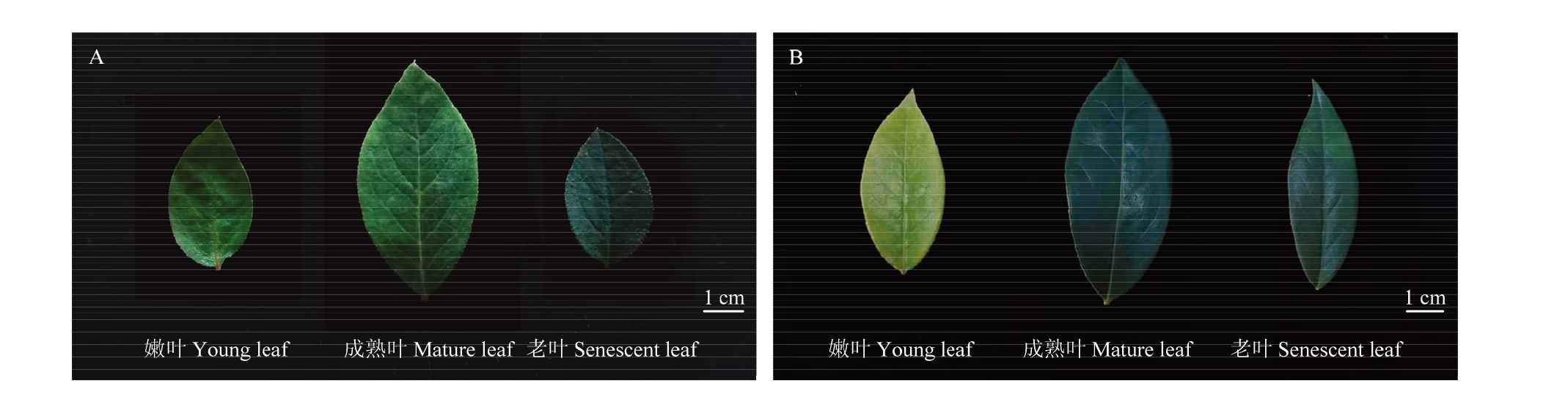
Fig. 1

Sampling standard of developmental cultivated and wild Vaccinium leaves"

Table 1

Total flavonoid, quercetin, anthocyanin, and proanthocyanidin contents in different developmental leaves of 34 Vaccinium species"

品种/种质
Cultivar/germplasm
代码
Sample code
总黄酮含量 Total flavonoid content (mg·g-1 DW) 槲皮素含量 Quercetin content (mg·g-1 DW)
嫩叶
Young leaf
成熟叶
Mature leaf
老叶
Senescent leaf
嫩叶
Young leaf
成熟叶
Mature leaf
老叶
Senescent leaf
南高丛蓝莓,栽培品种Southern highbush blueberry (V. corymbosum), cultivar
蓝雨Bluerain BLR 156.06±1.73 74.85±0.78 177.18±4.21 1.64±0.77 18.31±0.67 18.31±0.51
库珀Cooper CPR 276.12±2.64 167.65±1.15 82.33±3.00 10.34±0.29 22.29±0.53 5.20±0.39
艾美瑞Emerald EMD 121.46±3.60 35.80±0.78 52.11±1.01 6.15±0.29 21.56±0.90 1.54±0.78
佐治亚宝石Georgiagerm GGM 69.20±1.73 109.95±3.46 80.99±2.84 5.10±0.88 4.47±0.25 7.82±0.53
珠宝Jewel JUE 372.17±2.99 14.33±0.34 50.56±5.32 5.21±0.53 2.06±0.29 15.58±0.82
密斯提Misty MST 118.63±0.99 125.84±1.60 143.49±2.33 2.80±0.78 0.91±0.29 10.24±0.97
奥尼尔O'Neal ONL 198.44±6.23 73.72±5.42 51.83±2.16 7.20±0.78 22.50±0.53 10.34±0.78
夏普蓝Sharpblue SHP 132.05±1.99 54.23±2.94 127.04±1.41 3.74±0.64 37.17±0.92 3.11±0.97
普林Springhigh SPR 477.39±2.64 66.73±1.63 37.07±2.52 2.17±0.59 16.42±0.44 14.74±0.39
明星Star STR 116.52±5.56 31.70±3.89 79.86±2.52 8.77±0.59 17.36±0.67 8.14±0.39
优瑞卡Eureka URK 366.52±2.64 67.15±4.49 94.83±2.56 4.27±0.53 2.27±0.67 12.12±0.29
兔眼蓝莓,栽培品种Rabbiteye blueberry (V. ashei), cultivar
巴尔德温Baldwin BDW 216.09±7.99 91.94±2.16 98.58±5.79 3.53±0.25 11.81±0.39 3.63±0.14
贝姬蓝Beckyblue BKB 252.11±2.64 167.29±1.82 130.07±5.36 5.42±0.92 1.64±0.44 14.01±0.59
灿烂Brightwell BRW 101.69±5.28 82.83±2.02 68.56±5.57 2.59±0.00 31.30±0.82 14.11±0.29
园蓝Garden Blue GDB 97.45±4.35 97.24±2.11 121.04±1.38 4.58±0.90 22.19±0.78 2.27±0.67
杰兔Premier PRM 82.62±6.07 74.07±2.03 134.52±4.35 0.49±0.29 10.34±0.53 1.01±0.25
蓝宝石Saphire SPH 90.39±1.73 31.20±4.91 35.16±2.30 0.81±0.59 22.71±0.67 12.33±0.25
乌达德Woodard WDD 205.50±1.99 99.85±4.39 132.62±4.35 5.94±0.64 4.89±0.90 11.81±0.39
北高丛蓝莓,栽培品种Northern highbush blueberry (V. corymbosum), cultivar
钱德勒Chandler CHD 129.93±0.99 57.48±5.40 105.92±2.69 1.44±0.82 15.48±0.92 11.07±0.88
德雷伯Draper DRP 76.26±4.35 56.91±2.76 68.35±2.37 0.91±0.14 12.54±0.74 14.74±0.82
杜克Duke DUK 116.52±2.64 137.42±0.86 68.7±2.04 2.06±0.53 2.06±0.29 12.65±0.44
早蓝Earlyblue ELB 156.06±2.99 89.54±4.81 99.85±5.021 3.74±0.39 3.74±0.39 5.83±0.97
莱格西Legacy LGC 161.71±5.56 193.49±2.64 80.99±1.40 2.27±0.25 0.91±0.14 1.85±0.29
野生越橘Wild species
江南越橘
V. mandarinorum
MFH1 112.28±3.60 28.17±1.22 93.92±3.99 5.10±0.44 22.92±0.97 17.78±0.53
MFH2 158.89±1.99 168.78±4.57 127.81±4.35 8.67±0.14 6.25±0.53 2.06±0.39
MFH3 351.69±2.64 151.83±5.19 132.62±3.88 4.37±0.82 4.16±0.25 8.77±0.53
MFH4 263.41±1.99 39.19±0.72 143.70±4.31 2.17±0.14 38.85±0.39 3.21±0.51
MFH5 201.26±4.35 65.88±4.18 120.61±3.83 0.28±0.33 12.54±0.14 14.53±0.92
云南越橘
V. duclouxii
YNY 146.18±1.99 109.95±4.94 98.15±3.81 7.41±0.39 5.83±0.59 2.37±0.39
YNY316 561.43±3.60 43.92±4.71 130.15±3.04 17.26±0.78 1.33±0.51 15.58±0.59
乌饭树
V. bracteatum
WFS1 9.17±2.64 11.85±3.33 32.48±0.78 1.96±0.25 2.27±0.51 10.00±0.39
WFS6 75.56±2.71 11.43±3.51 5.10±0.67 3.11±0.90
刺毛越橘V. trichocladum CMY 251.40±3.45 242.93±1.73 221.74±3.46 8.04±0.29 2.37±0.39 8.66±0.39
乌鸦果V. fragile WYG1 120.75±2.64 88.55±4.96 149.00±2.44 2.38±0.53 20.19±0.51 5.41±0.51
品种/种质
Cultivar/germplasm
代码
Sample code
花色苷含量 Anthocyanin content (mg·g-1 DW) 原花青素含量 Proanthocyanidin content (mg·g-1 DW)
嫩叶
Young leaf
成熟叶
Mature leaf
老叶
Senescent leaf
嫩叶
Young leaf
成熟叶
Mature leaf
老叶
Senescent leaf
南高丛蓝莓,栽培品种Southern highbush blueberry (V. corymbosum), cultivar
蓝雨Bluerain BLR 0.21±0.01 5.79±0.15 1.87±0.21 25.91±0.63 29.80±0.08 33.53±0.04
库珀Cooper CPR 1.08±0.03 1.27±0.02 1.19±0.16 67.76±0.22 59.63±0.08 37.86±0.05
艾美瑞Emerald EMD 0.53±0.01 0.08±0.01 1.52±0.09 12.93±0.92 15.14±0.03 41.94±0.03
佐治亚宝石Georgiagerm GGM 0.41±0.01 0.82±0.02 3.06±0.11 14.12±1.69 61.17±0.78 34.03±0.15
珠宝Jewel JUE 0.35±0.04 1.91±0.08 1.06±0.03 70.27±0.59 16.13±0.10 23.31±0.32
密斯提Misty MST 0.80±0.01 1.89±0.10 1.96±0.11 13.27±1.35 28.37±0.07 42.77±0.53
奥尼尔O'Neal ONL 0.47±0.04 5.07±0.16 1.25±0.12 17.42±0.41 23.20±0.32 44.30±0.20
夏普蓝Sharpblue SHP 0.84±0.03 1.55±0.08 2.18±0.12 16.80±0.51 20.97±0.11 34.56±0.81
普林Springhigh SPR 0.57±0.03 0.33±0.04 1.58±0.05 67.10±0.78 28.36±0.10 30.90±0.58
明星Star STR 0.69±0.05 0.11±0.01 2.18±0.06 14.10±1.65 18.68±0.27 48.07±0.72
优瑞卡Eureka URK 0.67±0.02 0.28±0.02 3.10±0.02 80.24±3.04 31.97±0.60 42.31±0.45
兔眼蓝莓,栽培品种Rabbiteye blueberry (V. ashei), cultivar
巴尔德温Baldwin BDW 0.37±0.01 0.29±0.03 0.53±0.05 27.67±0.23 38.51±0.07 33.45±0.04
贝姬蓝Beckyblue BKB 0.06±0.01 4.14±0.17 2.86±0.18 62.48±1.79 96.67±0.11 71.85±0.13
灿烂Brightwell BRW 0.50±0.02 3.45±0.15 2.34±0.18 20.85±1.40 22.97±0.01 26.11±0.01
园蓝Garden Blue GDB 0.08±0.01 0.09±0.01 1.25±0.11 12.86±1.69 26.03±0.19 45.92±0.03
杰兔Premier PRM 0.16±0.01 1.25±0.06 3.36±0.10 9.11±0.85 70.06±0.71 83.07±1.07
蓝宝石Saphire SPH 0.90±0.06 0.93±0.12 0.44±0.04 12.90±1.78 10.05±0.13 25.80±0.18
乌达德Woodard WDD 0.94±0.04 0.86±0.05 0.97±0.07 65.63±2.37 56.92±0.55 60.99±0.60
北高丛蓝莓,栽培品种Northern highbush blueberry (V. corymbosum), cultivar
钱德勒Chandler CHD 0.40±0.01 2.23±0.17 0.86±0.06 40.97±0.85 28.95±0.05 50.97±0.17
德雷伯Draper DRP 0.12±0.01 1.44±0.03 2.70±0.18 13.33±1.15 23.12±0.19 40.85±0.04
杜克Duke DUK 1.00±0.01 2.28±0.05 3.03±0.13 12.81±0.15 74.56±0.18 50.13±0.13
早蓝Earlyblue ELB 0.25±0.02 1.04±0.10 2.18±0.05 64.74±2.19 27.63±0.08 60.76±0.03
莱格西Legacy LGC 0.49±0.05 2.03±0.07 2.06±0.15 23.12±1.41 62.85±0.30 31.57±0.46
野生越橘Wild species
江南越橘
V. mandarinorum
MFH1 0.60±0.01 0.39±0.03 0.11±0.01 14.41±1.51 23.30±0.32 38.24±0.26
MFH2 1.93±0.09 0.08±0.01 1.43±0.05 12.75±0.22 39.65±0.93 51.48±0.51
MFH3 1.83±0.13 0.09±0.01 2.23±0.11 66.40±1.30 78.24±0.13 42.16±0.75
MFH4 0.78±0.03 2.94±0.13 0.10±0.01 58.98±1.00 15.08±0.37 73.53±0.91
MFH5 0.43±0.02 2.29±0.06 2.92±0.06 80.07±1.97 16.42±0.41 45.84±0.40
云南越橘
V. duclouxii
YNY 0.33±0.04 0.35±0.04 0.57±0.04 29.95±0.14 43.09±0.52 46.52±0.89
YNY316 4.77±0.17 1.13±0.12 2.50±0.21 135.56±4.45 51.99±0.91 55.16±0.64
乌饭树
V. bracteatum
WFS1 0.06±0.01 0.09±0.01 0.10±0.01 27.67±0.23 31.29±0.65 54.65±0.66
WFS6 0.26±0.01 2.12±0.11 49.79±0.60 21.50±0.17
刺毛越橘V. trichocladum CMY 1.21±0.04 0.08±0.01 0.66±0.02 24.38±0.38 60.85±0.08 67.42±0.02
乌鸦果V. fragile WYG1 3.59±0.17 1.27±0.12 1.42±0.03 25.23±0.93 25.95±0.44 18.71±0.21

Fig. 2

·OH scavenging rate (A), ABTS radical scavenging rate (B) and FRAP value (C) in leaves of Vaccinium germplasm Sample codes correspond to full germplasm information in Table 1. S, R, N, and W represent southern highbush, rabbiteye, northern highbush blueberry, and wild Vaccinium species, respectively. Significant differences in antioxidant indices of mature and senescent leaves were compared with those of young leaves of each germplasm by Student's t-test. *: P<0.05; **: P<0. 01"

Table 2

Statistical analysis of polyphenolic components and antioxidant activity indices in Vaccinium leaves"

参数
Parameter
总黄酮含量
Total flavonoid content
(mg·g-1 DW)
槲皮素含量
Quercetin content
(mg·g-1 DW)
花色苷含量
Anthocyanin content
(mg·g-1 DW)
原花青素含量Proanthocyanidin content
(mg·g-1 DW)
·OH清除率
·OH scavenging
rate
(%)
ABTS自由基清除率
ABTS radical scavenging rate
(%)
FRAP值
FRAP value
嫩叶Young leaf
最小值Min. 9.17 0.28 0.06 9.11 17.08 1.71 0.02
最大值Max. 561.43 17.26 4.77 135.56 60.85 57.45 1.85
均值Mean 189.92 4.51 0.83 37.63 41.98 14.01 0.44
标准偏差Std. 121.84 3.48 0.98 29.71 10.96 12.87 0.60
变异系数CV (%) 64.74 75.98 116.57 79.25 26.53 89.57 139.00
成熟叶Mature leaf
最小值Min. 11.85 0.91 0.08 10.05 32.52 12.36 0.02
最大值Max. 242.93 38.85 5.79 96.67 80.08 68.18 1.92
均值Mean 89.05 12.56 1.41 38.45 55.48 33.66 0.80
标准偏差Std. 54.16 10.78 1.45 21.61 12.55 12.18 0.57
变异系数CV (%) 60.83 85.87 103.09 56.21 22.63 36.21 71.64
老叶Senescent leaf
最小值Min. 11.43 1.02 0.10 18.71 22.51 4.91 0.03
最大值Max. 221.74 18.31 3.36 83.07 90.18 89.27 7.51
均值Mean 99.51 8.95 1.70 44.42 65.14 30.28 1.23
标准偏差Std. 44.92 5.30 0.95 15.32 18.93 17.06 1.56
变异系数CV (%) 45.15 59.28 56.25 34.49 29.07 56.35 127.45

Fig. 3

Correlation analysis of polyphenolic components and antioxidant indices in 34 Vaccinium leaves"

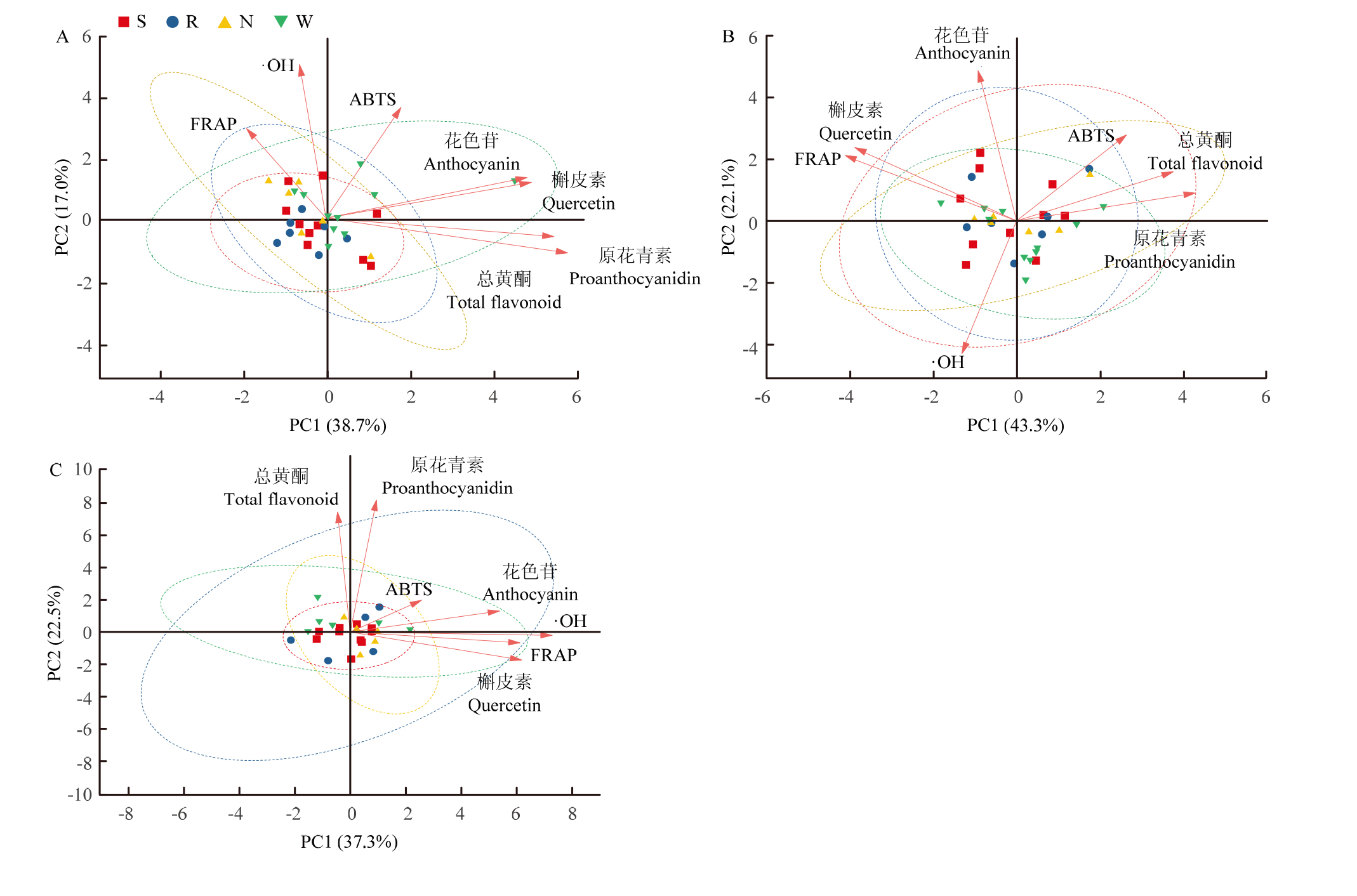
Fig. 4

Principal component analysis of polyphenolic components and antioxidant indices in Vaccinium leaves"

[1]
LIU C, WEI X, YANG Y, LIU Y, YUAN X, TAO C. The full-length transcriptome analysis of blueberry under different pH conditions. BMC Plant Biology, 2025, 25: 732.

doi: 10.1186/s12870-025-06721-5 pmid: 40448243
[2]
WANG J, TIAN J, LI D, GAO N, DENG J, YANG X, WANG L, HE Y, LI B, WANG L. Blueberry leaves as a promising sustainable source of polyphenols: Chemical composition, functional activities and future application perspectives. Food Research International, 2025, 207: 116110.

doi: 10.1016/j.foodres.2025.116110
[3]
EHLENFELDT M K, PRIOR R L. Oxygen radical absorbance capacity (ORAC) and phenolic and anthocyanin concentrations in fruit and leaf tissues of highbush blueberry. Journal of Agricultural & Food Chemistry, 2001, 49(5): 2222-2227.
[4]
BUCHANAN B B, GRUISSEM W, JONES R L. Biochemistry & Molecular Biology of Plants. 2nd ed. Hoboken, NJ: Wiley, 2015.
[5]
周勤文, 孙力军, 卢蓓蓓, 侯北伟, 李楠楠, 张锋伦, 姚正颖. 小浆果多酚生物活性功效研究进展. 中国野生植物资源, 2023, 42(2): 94-97, 102.
ZHOU Q W, SUN L J, LU B B, HOU B W, LI N N, ZHANG F L, YAO Z Y. Research progress on bioactivity of polyphenols of small berries. Chinese Wild Plant Resources, 2023, 42(2): 94-97, 102. (in Chinese)
[6]
RAUF A, IMRAN M, ABU-IZNEID T, IAHFISHAM-UL-HAQ, PATEL S, PAN X, NAZ S, SILVA A S, SAEED F, SULERIA H A R. Proanthocyanidins: A comprehensive review. Biomedicine & Pharmacotherapy, 2019, 116: 108999.

doi: 10.1016/j.biopha.2019.108999
[7]
XIE C, WANG Q, YING R, WANG Y, WANG Z, HUANG M. Binding a chondroitin sulfate-based nanocomplex with kappa- carrageenan to enhance the stability of anthocyanins. Food Hydrocolloids, 2020, 100: 105448.

doi: 10.1016/j.foodhyd.2019.105448
[8]
WU Q, ZHANG F, WANG Y, YAN J, ZHOU C, XU Y, XU J, SHI L, XIONG H, FENG N. Inhibitory mechanism of carboxymethyl chitosan-lotus seedpod oligomeric procyanidin nanoparticles on dietary advanced glycation end products released from glycated casein during digestion. Food Research International, 2023, 173(2): 113412.

doi: 10.1016/j.foodres.2023.113412
[9]
谭西北, 兰徐颖, 刘崇怀, 樊秀彩, 姜建福, 孙磊, 李鹏, 余书鑫, 张颖. 不同抗性葡萄响应白腐病侵染的次生代谢物变化. 中国农业科学, 2025, 58(9): 1767-1778. doi: 10.3864/j.issn.0578-1752.2025.09.007.
TAN X B, LAN X Y, LIU C H, FAN X C, JIANG J F, SUN L, LI P, YU S X, ZHANG Y. Changes of secondary metabolites in grapes with different resistance levels in response to white rot infection. Scientia Agricultura Sinica, 2025, 58(9): 1767-1778. doi: 10.3864/j.issn.0578-1752.2025.09.007. (in Chinese)
[10]
WU H, CHAI Z, HUTABARAT R P, ZENG Q, NIU L, LI D, YU H, HUANG W. Blueberry leaves from 73 different cultivars in southeastern China as nutraceutical supplements rich in antioxidants. Food Research International, 2019, 122: 548-560.

doi: S0963-9969(19)30325-4 pmid: 31229110
[11]
苏上, 王丽金, 吴杰, 李冰, 王伟伟, 王亮生. 笃斯越桔化学成分及其功能活性的研究进展. 植物学报, 2016, 51(5): 691-704.

doi: 10.11983/CBB15172
SU S, WANG L J, WU J, LI B, WANG W W, WANG L S. Review: Chemical compositions and functions of Vaccinium uliginosum. Chinese Bulletin of Botany, 2016, 51(5): 691-704. (in Chinese)
[12]
公旭彤, 杜乾慧, 刘桂婷, 卢雅妮, 李雨彤, 宋清秋, 吕梓茜, 王楠, 张文基, 王贺新, 赵丽娜, 刘国玲, 徐国辉. 近30年世界蓝莓新品种资源及育种趋势分析. 植物遗传资源学报, 2025, 26(2): 218-236.
GONG X T, DU Q H, LIU G T, LU Y N, LI Y T, SONG Q Q, Z X, WANG N, ZHANG W J, WANG H X, ZHAO L N, LIU G L, XU G H. Analysis of new blueberry varieties and breeding trends in the world in recent 30 years. Journal of Plant Genetic Resources, 2025, 26(2): 218-236. (in Chinese)
[13]
李亚东, 刘成, 魏鑫, 刘佳欣, 郝佳, 陈丽, 孙海悦. 2024年中国蓝莓产业发展报告. 吉林农业大学学报, 2025, 47(1): 1-14.
LI Y D, LIU C, WEI X, LIU J X, HAO J, CHEN L, SUN H Y. Development report of 2024 China blueberry industry. Journal of Jilin Agricultural University, 2025, 47(1): 1-14. (in Chinese)
[14]
王利枝. 蓝莓叶活性成分及体外保健功能研究[D]. 金华: 浙江师范大学, 2018.
WANG L Z. Study on active components of blueberry leaves and healthy functions in vitro[D]. Jinhua: Zhejiang Normal University, 2018. (in Chinese)
[15]
PÁSCOA R N, GOMES M J, SOUSA C. Antioxidant activity of blueberry (Vaccinium spp.) cultivar leaves: Differences across the vegetative stage and the application of near infrared spectroscopy. Molecules, 2019, 24(21): 3900.

doi: 10.3390/molecules24213900
[16]
TELESZKO M, WOJDYŁO A. Comparison of phenolic compounds and antioxidant potential between selected edible fruits and their leaves. Journal of Functional Foods, 2015, 14: 736-746.

doi: 10.1016/j.jff.2015.02.041
[17]
ABD-ELSALAM H A H, GAMAL M, NAGUIB I A, AL- GHOBASHY M A, ZAAZAA H E, ABDELKAWY M. Development of green and efficient extraction methods of quercetin from red onion scales wastes using factorial design for method optimization: A comparative study. Separations, 2021, 8(9): 137.

doi: 10.3390/separations8090137
[18]
LEE J, DURST R W, WROLSTAD R E. Determination of total monomeric anthocyanin pigment content of fruit juices, beverages, natural colorants, and wines by the pH differential method: Collaborative study. Journal of AOAC International, 2005, 88(5): 1269-1278.

pmid: 16385975
[19]
NAKAMURA Y, TSUJI S, TONOGAI Y. Analysis of proanthocyanidins in grape seed extracts, health foods and grape seed oils. Journal of Health Science, 2003, 49(1): 45-54.

doi: 10.1248/jhs.49.45
[20]
MABEKU L B K, BILLE B E, TCHOUANGUEU T F, NGUEPI E, LEUNDJI H. Treatment of Helicobacter pylori infected mice with Bryophyllum pinnatum, a medicinal plant with antioxidant and antimicrobial properties, reduces bacterial load. Pharmaceutical Biology, 2017, 55(1): 603-610.

doi: 10.1080/13880209.2016.1266668
[21]
OZGEN M, REESE R N, TULIO A Z, SCHEERENS J C, MILLER A R. Modified 2, 2-azino-bis-3-ethylbenzothiazoline-6-sulfonic acid (ABTS) method to measure antioxidant capacity of selected small fruits and comparison to ferric reducing antioxidant power (FRAP) and 2, 2'-diphenyl-1-picrylhydrazyl (DPPH) methods. Journal of Agricultural & Food Chemistry, 2006, 54(4): 1151-1157.
[22]
ZHANG S T, CUI Y, LI L X, LI Y, ZHOU P, LUO L, SUN B. Preparative HSCCC isolation of phloroglucinolysis products from grape seed polymeric proanthocyanidins as new powerful antioxidants. Food Chemistry, 2015, 188(1): 422-429.

doi: 10.1016/j.foodchem.2015.05.030
[23]
AGHABABAEI F, HADIDI M. Recent advances in potential health benefits of quercetin. Pharmaceuticals, 2023, 16(7): 1020.

doi: 10.3390/ph16071020
[24]
胡雅馨, 李京, 惠伯棣. 蓝莓果实中主要营养及花青素成分的研究. 食品科学, 2006, 27(10): 600-603.
HU Y X, LI J, HUI B D. Study on major nutrition and anthocyanins of blueberry. Food Science, 2006, 27(10): 600-603. (in Chinese)
[25]
苏全胜, 王爽, 孙玉强, 梅俊, 柯丽萍. 植物原花青素生物合成及调控研究进展. 中国细胞生物学学报, 2021, 43(1): 219-229.
SU Q S, WANG S, SUN Y Q, MEI J, KE L P. Advances in biosynthesis and regulation of plant proanthocyanidins. Chinese Journal of Cell Biology, 2021, 43(1): 219-229. (in Chinese)
[26]
GIOVANELLI G, BURATTI S. Comparison of polyphenolic composition and antioxidant activity of wild Italian blueberries and some cultivated varieties. Food Chemistry, 2009, 112(4): 903-908.

doi: 10.1016/j.foodchem.2008.06.066
[27]
WANG L J, WU J, WANG H X, LI S S, ZHENG X C, DU H, XU Y J, WANG L S. Composition of phenolic compounds and antioxidant activity in the leaves of blueberry cultivars. Journal of Functional Foods, 2015, 16: 295-304.

doi: 10.1016/j.jff.2015.04.027
[28]
STEFANESCU B E, CALINOIU L F, RANGA F, FETEA F, MOCAN A, VODNAR D C, CRISAN G. The chemical and biological profiles of leaves from commercial blueberry varieties. Plants, 2020, 9(9): 1193.

doi: 10.3390/plants9091193
[29]
ZHU L, LIU X, TAN J, WANG B. Influence of harvest season on antioxidant activity and constituents of rabbiteye blueberry (Vaccinium ashei) leaves. Journal of Agricultural & Food Chemistry, 2013, 61(47): 11477-11483.
[30]
AKSIC M F, ZAGORAC D D, SREDOJEVIC M, MILIVOJEVIC J, GASIC U, MELAND M, NATIC M. Chemometric characterization of strawberries and blueberries according to their phenolic profile: Combined effect of cultivar and cultivation system. Molecules, 2019, 24(23): 4310.

doi: 10.3390/molecules24234310
[31]
ZHANG C, LIU H, JIA C, LIU Y, WANG F, WANG J. Cloning, characterization and functional analysis of a flavonol synthase from Vaccinium corymbosum. Trees, 2016, 30(5): 1595-1605.

doi: 10.1007/s00468-016-1393-6
[32]
TOYAMA Y, FUJITA Y, TOSHIMA S, HIRANO T, YAMASAKI M, KUNITAKE H. Comparison of proanthocyanidin content in rabbiteye blueberry (Vaccinium virgatum Aiton) leaves and the promotion of apoptosis against HL-60 promyelocytic leukemia cells using ‘Kunisato 35 Gou' leaf extract. Plants, 2023, 12(4): 948.

doi: 10.3390/plants12040948
[33]
BORDA-YEPES V H, CHEJNE F, GRANADOS D, LARGO E, ROJANO B, RAGHAVAN G S V. Microwave-assisted forced convection drying effect on bioactive compounds of the Canadian blueberry leaves (Vaccinium corymbosum). Journal of Food Processing and Preservation, 2021, 45(6): e15455.
[34]
PERTUZATTI P B, BARCIA M T, RODRIGUES D, DA CRUZ P N, HERMOSÍN-GUTIÉRREZ I, SMITH R, GODOY H T. Antioxidant activity of hydrophilic and lipophilic extracts of Brazilian blueberries. Food Chemistry, 2014, 164(3): 81-88.

doi: 10.1016/j.foodchem.2014.04.114
[35]
LI X B, LI C N, SUN J, JACKSON A. Dynamic changes of enzymes involved in sugar and organic acid level modification during blueberry fruit maturation. Food Chemistry, 2020, 309(2): 125617.

doi: 10.1016/j.foodchem.2019.125617
[36]
ZHOU L, XIE M, YANG F, LIU J. Antioxidant activity of high purity blueberry anthocyanins and the effects on human intestinal microbiota. LWT-Food Science & Technology, 2020, 117: 108621.
[37]
BUJOR O C, TANASE C, POPA M E. Phenolic antioxidants in aerial parts of wild Vaccinium species: Towards pharmaceutical and biological properties. Antioxidants, 2019, 8(12): 649.

doi: 10.3390/antiox8120649
[38]
赵慧芳, 吴文龙, 黄正金, 赵俸艺, 闾连飞, 李维林. 34个蓝莓品种果实品质评价. 植物资源与环境学报, 2023, 32(4): 44-53, 72.
ZHAO H F, WU W L, HUANG Z J, ZHAO F Y, L F, LI W L. Evaluation on fruit quality of 34 Vaccinium spp. cultivars. Journal of Plant Resources and Environment, 2023, 32(4): 44-53, 72. (in Chinese)
[39]
POTTER R J, CONEVA E D. Assessment of newly released and well-established rabbiteye blueberry (Vaccinium ashei Reade) cultivars in North Alabama. Agricultural Sciences, 2018, 9(1): 78-98.

doi: 10.4236/as.2018.91007
[40]
ZHANG C, LI J, WANG J, LYU L, WU W, LI W, WU Y. Fruit quality and metabolomic analyses of fresh food accessions provide insights into the key carbohydrate metabolism in blueberry. Plants, 2023, 12(18): 3200.

doi: 10.3390/plants12183200
[1] WANG AiDong, LI RuiJie, FENG XiangQian, HONG WeiYuan, LI ZiQiu, ZHANG XiaoGuo, WANG DanYing, CHEN Song. Multi-Angle Imaging and Machine Learning Approaches for Accurate Rice Leaf Area Estimation [J]. Scientia Agricultura Sinica, 2025, 58(9): 1719-1734.
[2] YIN Bo, YU AiZhong, WANG PengFei, YANG XueHui, WANG YuLong, SHANG YongPan, ZHANG DongLing, LIU YaLong, LI Yue, WANG Feng. Effects of Green Manure Returning Combined with Nitrogen Fertilizer Reduction on Hydrothermal Characteristics of Wheat Field and Grain Yield in Oasis Irrigation Area [J]. Scientia Agricultura Sinica, 2025, 58(7): 1366-1380.
[3] CHEN Ge, GU Yu, WEN Jiong, FU YueFeng, HE Xi, LI Wei, ZHOU JunYu, LIU QiongFeng, WU HaiYong. Effects of Fallow Weeds Returning to the Field on Photosynthetic Matter Production and Yield of Rice [J]. Scientia Agricultura Sinica, 2025, 58(4): 647-659.
[4] WEI ChenXi, DONG ShanRong, WANG XiaoMan, LUO JianRang. Analysis of Red Color Leaf Traits in Tree Peony Based on Leaf Color Phenotypes and Anthocyanin Accumulation Characteristics [J]. Scientia Agricultura Sinica, 2025, 58(23): 5046-5056.
[5] SONG XuHui, ZHAO XueYing, ZHAO Bin, REN BaiZhao, ZHANG JiWang, LIU Peng, REN Hao. Effects of Row Ratio Allocation on Light Distribution and Photosynthetic Production Capacity of Maize-Soybean Strip Intercropping [J]. Scientia Agricultura Sinica, 2025, 58(23): 4858-4871.
[6] LUO ZiShu, ZHANG YiJia, ZHOU Rong, ZHANG YanXin, ZHOU Ting, YOU Jun, WANG LinHai. Characterization of Antioxidant Activities in Sesame Leaves and Screening of High Antioxidant Germplasm [J]. Scientia Agricultura Sinica, 2025, 58(19): 3814-3824.
[7] GUO MengZe, ZHANG Lei, SUN PingPing, JIANG Biao, YAN JinQiang, LI ZhengNan. Molecular Characterization and Evolutionary Dynamics of Tomato Leaf Curl New Delhi Virus Isolate from Wax Gourd (Benincasa hispida) in Guangdong [J]. Scientia Agricultura Sinica, 2025, 58(19): 3890-3904.
[8] HU JiaYan, SHEN ZhiHan, WEN LiHui, YU JiaHao, ZHANG YuJun, JIANG DongHua. Identification and Evaluation of Biocontrol Actinomycetes Against Xanthomonas oryzae pv. oryzicola for Disease Suppression and Growth Promotion in Rice [J]. Scientia Agricultura Sinica, 2025, 58(17): 3434-3450.
[9] YANG WenJuan, GAO JiaCheng, WANG YanTing, LI Yan, GUO Ming, WANG JunCheng, MENG YaXiong, WANG HuaJun, SI ErJing. Function of Effector Pg00778 Regulation on the Pathogenicity of Pyrenophora graminea to Barley [J]. Scientia Agricultura Sinica, 2025, 58(15): 3020-3035.
[10] LIAO Kai, LI Xin, SHI YanXia, XIE XueWen, LI Lei, FAN TengFei, WANG ShaoHui, LI BaoJu, CHAI ALi. Effect of Different Ventilation Methods in Plastic Sheds on the Spread of Cucumber Bacterial Angular Leaf Spot [J]. Scientia Agricultura Sinica, 2025, 58(10): 1934-1946.
[11] LI YongFei, LI ZhanKui, ZHANG ZhanSheng, CHEN YongWei, KANG JianHong, WU HongLiang. Effects of Postponing Nitrogen Fertilizer Application on Flag Leaf Physiological Characteristics and Yield of Spring Wheat Under High Temperature Stress [J]. Scientia Agricultura Sinica, 2024, 57(8): 1455-1468.
[12] HOU Shuai, ZHANG YiJia, ZHOU DanDan, MA FeiYang, WANG DaPeng, ZHAO SiQi, DING Chao, LIU Qiang. Analysis of the Effect of Dielectric Barrier Discharge Cold Plasma on Phenolic Metabolism of Stored Paddy Rice Under High Temperature Stress [J]. Scientia Agricultura Sinica, 2024, 57(6): 1180-1190.
[13] GUAN ZhiLin, JIN FengWei, LIU TingTing, WANG Yi, TAN YingYing, YANG ChunHui, LI RuiTong, WANG Bo, LIU KeDe, DONG Yun. Genetic Analysis and Gene Mapping of Glossy Leaf in Brassica napus [J]. Scientia Agricultura Sinica, 2024, 57(4): 650-662.
[14] LI Fei, XIONG Cai, GU JiaJia, CAO Xin, WANG ShanShan, HU Wei, ZHOU ZhiGuo, CHEN BingLin. Effects of Late Sowing on Yield, Quality, Photosynthetic Source Succession and Loadability Characteristics of Rape [J]. Scientia Agricultura Sinica, 2024, 57(23): 4673-4685.
[15] YE XueLian, CHEN JingWen, YAO XiangTan, QUAN XinHua, HUANG Li. Genetic Analysis of Leaf Wrinkling Traits in Non-Heading Chinese Cabbage [J]. Scientia Agricultura Sinica, 2024, 57(18): 3684-3694.
Viewed
Full text


Abstract

Cited

  Shared   
  Discussed   
No Suggested Reading articles found!