Scientia Agricultura Sinica ›› 2024, Vol. 57 ›› Issue (18): 3671-3683.doi: 10.3864/j.issn.0578-1752.2024.18.012

• HORTICULTURE • Previous Articles     Next Articles

Identification and Evaluation of Phenotypic Characters and Genetic Diversity Analysis of 169 Tomato Germplasm Resources

LI YuShan1(), XIAO Jing1, MA Yue1, TIAN Chao1, ZHAO LianJia1, WANG Fan1, SONG Yu1(), JIANG ChengYao2()   

  1. 1 Crop Variety Resources Research Institute, Xinjiang Academy of Agricultural Sciences/National Central Asian Characteristic Crop Germplasm Resources Medium-Term Gene Bank (Urumqi), Urumqi 830091
    2 College of Horticulture, Sichuan Agricultural University, Chengdu 610000
  • Received:2024-02-07 Accepted:2024-06-14 Online:2024-09-16 Published:2024-09-29
  • Contact: SONG Yu, JIANG ChengYao

Abstract:

【Objective】 The phenotypic genetic diversity and taste performance of cultivated and wild tomato germplasm resources from around the world was analyzed, in order to screen specific and high-quality tomato resources, so as to provide the germplasm and theoretical support for the exploration of excellent tomato genes and tomato breeding. 【Method】 A total of 169 tomato resources collected domestically and internationally were used as the research object, and 38 phenotypic traits of them were measured throughout the entire growth period. The genetic diversity analysis, cluster analysis, and comprehensive evaluation of tomato germplasm phenotypes were conducted through multiple statistical analysis methods, such as genetic diversity index, principal component analysis, weight, systematic clustering, and membership function. 【Result】 The variation coefficient of phenotypic traits in 169 tomato samples ranged from 18% to 368%, and the genetic diversity index ranged from 0.036 to 2.302. There were 26 traits with a genetic diversity index >1, among which the genetic diversity index for mature fruit color was the highest (2.302), indicating that the 169 tomato samples in this study were diverse in type and rich in genetic diversity. Correlation analysis showed that tomatoes with the higher plant height, the more flowers per inflorescence, and the smaller fruits had a higher sugar-to-acid ratio. Principal component analysis showed that 16 phenotypic traits (single fruit weight, number of ventricles, fruit shoulder shape, fruit shoulder furrows, longitudinal and transverse diameters of fruits, ratio of sugar to acid, soluble solids, cork size, growth habits, plant height, second inflorescence node position, inflorescence type, mature fruit color, number of inflorescence flowers, and plant type) had a relatively large contribution rate to resource variation, and could be used as the main indicator for cluster analysis. The clustering analysis results showed that 169 tomato resources were divided into 10 major groups at a Euclidean distance of 5.0. The first and second groups were Solanum cheesmanii, the third and tenth groups were upright tomatoes with different fruit sizes, the fourth and fifth groups were ordinary large fruit tomatoes with unlimited growth, the sixth group was large fruit tomatoes in the upright type, the seventh and eighth groups were mostly cherry tomatoes and a small number of Solanum Pimpinellifolium, and the ninth group was limited growth large fruit tomatoes. Using the membership function method and weight analysis, a comprehensive evaluation was conducted on the taste and flavor of tomato fruits. Based on the D-value ranking of the comprehensive evaluation, 10 sweet and sour-tasting Solanum Pimpinellifolium and cherry tomatoes with good taste were selected, and 5 sweet, fleshy, and sandy-soft-tasting large fruit tomato resources were selected. 【Conclusion】 The research results clarified the phenotypic specificity and rich genetic diversity of 169 tomato germplasm resources. Cluster analysis screened out tomato resources specific to each group and used fruit taste-related indicators to screen cherry tomatoes and ordinary large fruit tomato resources for better performance. This study could serve as the theoretical and material basis for the genetic improvement of excellent tomato resources and new variety breeding.

Key words: tomatoes, germplasm resource, phenotypic identification, cluster analysis, genetic diversity, comprehensive evaluation

Table 1

Genetic diversity and frequency distribution of quality traits of tomato germplasm resources"

性状
Trait
频率分布 Frequency distribution (%)
H' 1 2 3 4 5 6 7 8 9 10 11 12 13 14 15 16 17
下胚轴颜色Hypocotyl color (HC) 0.036 1 99
生长习性 Growth habit (GH) 0.654 64 36
株型Plant type (PT) 0.891 26 63 11
茎叶茸毛 Stem and leaf fuzz (SALF) 1.191 5 49 5 35 6
叶状态 Leaf state (LS) 1.068 22 41 37
花序类型 Inflorescence type (IT) 0.904 60 10 30
花柱长度 Style length (SL) 1.041 47 33 20
花柱形状 Style shape (SS) 0.769 70 7 23
花色 Flower color (FC) 0.493 3 12 85
成熟果色 Mature fruit color (MFC) 2.302 1 2 14 10 2 7 33 4 2 5 4 2 4 1 1 7 3
果肩棱沟
Fruit shoulder ridge gully (FSRG)
0.988 60 29 7 4
果面茸毛 Fruit surface fuzz (FSF) 0.894 8 70 17 5
果顶形状 Fruit top shape (FTS) 1.019 3 8 69 10 9
果肩形状 Fruit shoulder shape (FSS) 0.962 33 54 13
果形 Fruit shaped (FS) 1.495 9 8 57 11 7 1 2 2 1 1
果实横切面形状
Fruit cross-sectional shape (SOFC)
0.426 87 2 11
果肉色 Pulp color (PC) 1.885 9 5 15 28 27 6 1 2 2 1 3
胎座胶状物颜色
Color of placenta gelatinous substancel (COPG)
1.324 11 57 8 15 6 1 1
肉质 Pulip flavor (PF) 1.000 66 14 13 7
风味 Fruit flavor (FF) 1.331 14 32 19 34
综合品质 Comprehensive quality (CQ) 0.997 5 20 55

Fig. 1

Tomato fruit with rich genetic diversity"

Table 2

Genetic diversity analysis of quantitative traits in tomato germplasm resources"

性状
Trait
遗传多样性指数
H'
均值
Mean
标准差
SD
变异系数
CV
最大值
Max
最小值
Minimum
极差
Range
株高 Plant height (PH) (cm) 2.017 146.89 72.81 50% 273.00 9.00 264.00
首花序节位 First inflorescence node (PNP) 1.422 8.18 1.52 19% 13.50 4.67 8.83
第二花序节位 Second inflorescence node (SIN) 1.447 10.73 1.90 18% 16.00 6.50 9.5
单花序花数 Number of flowers per inflorescence (NOFPI) 0.110 21.73 79.97 368% 853.5 3.00 850.5
果实纵经 Fruit longitudinal longitude (FLL) (cm) 1.350 3.95 1.48 38% 8.85 1.34 7.52
果实横径Fruit diameter (FD) (cm) 1.580 4.25 2.06 48% 9.82 1.22 8.60
果梗洼大小 Fruit stem depression size (FSDS) (cm) 1.630 0.53 0.28 54% 1.5 0.08 1.42
果实木栓化大小 Fruit cork size (FCS) (cm) 1.820 0.70 0.66 95% 2.4 0 2.4
果柄长度 Fruit stem length (FSL) (cm) 1.274 0.85 0.32 37% 2.85 0.30 2.55
果肉厚 Fruit pulp thickness (FPT) (cm) 1.970 0.47 0.17 37% 1.00 0.10 0.90
心室数 Number of ventricles (NOV) 1.234 4.27 3.00 70% 16.00 1.67 14.33
单果重 Single fruit weight (SFW) (g) 1.761 59.57 66.84 112% 327.43 1.29 326.14
硬度 Fruit Hardness (FH) 1.650 10.79 2.54 24% 22.51 4.22 18.29
可溶性固形物 Soluble solids (SS) (%) 1.880 6.36 1.61 25% 11.65 3.88 7.77
糖度 Sugar content (SC) 1.920 6.20 1.50 24% 10.95 3.44 7.51
酸度 Acidity (AC) 1.790 1.28 0.37 29% 2.34 0.53 1.81
糖酸比 Sugar acid ratio (SAR) 1.520 5.77 2.77 48% 22.04 2.38 19.66

Fig. 2

Correlation analysis of 17 quantitative traits in tomato germplasm resource * represents a significant level of 0.05; ** represents a significant level of 0.01"

Table 3

KMO test and Bartlett spherical test results"

Kaiser-Meyer-Olkin度量值
Kaiser-Meyer-Olkin measurement value
Bartlett的球形度检验
Bartlett’s sphericity test
0.722 近似卡方 Approximate Chi-squared value df Sig.
544.386 21 0.000

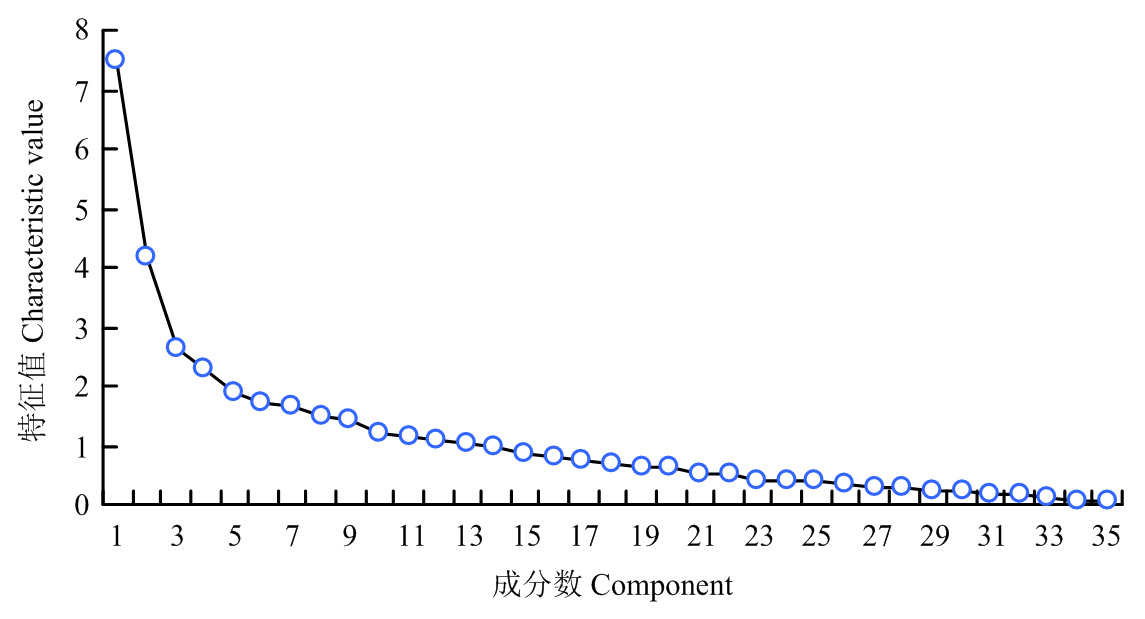
Fig. 3

Principal component gravel map"

Table 4

Principal component analysis of 35 phenotypic traits of tomato resources"

性状
Trait
主成分 Principal component
PC1 PC2 PC3 PC4 PC5 PC6 PC7 PC8 PC9 PC10 PC11 PC12 PC13
单果重 Single fruit weight (SFW) 0.838 0.095 -0.196 -0.075 -0.019 -0.053 0.073 0.114 -0.181 -0.106 0.062 0.061 -0.041
心室数 Number of ventricles (NOV) 0.829 0.163 -0.182 0.139 0.028 -0.037 0.146 0.022 -0.146 -0.057 0.106 0.036 -0.04
果肩形状 Fruit shoulder shape (FSS) 0.798 0.004 -0.188 0.031 -0.08 0.025 0.017 0.019 0.018 -0.207 -0.006 -0.096 -0.031
果肩棱沟 Fruit shoulder ridge gully (FSRG) 0.698 0.221 -0.279 0.108 0.015 0.101 0.169 -0.148 -0.045 -0.022 0.361 -0.018 0.077
果实横径 Fruit diameter (FD) 0.685 0.006 0.662 0.042 0.067 0.022 -0.034 -0.026 -0.019 -0.064 -0.061 -0.072 0.087
木栓化大小 Fruit cork size (FCS) 0.668 -0.047 0.624 0.074 0.046 -0.03 0.02 -0.002 -0.017 -0.034 -0.157 -0.116 0.094
果梗洼大小 Fruit stem depression size (FSDS) 0.667 -0.002 0.636 -0.026 0.047 0.012 -0.017 -0.074 0.02 -0.103 -0.064 -0.138 0.064
糖酸比 Sugar acid ratio (SAR) -0.606 0.432 0.266 0.285 -0.194 -0.065 -0.016 0.058 -0.153 -0.207 0.192 0.176 0.167
可溶性固形物含量Soluble solids (SS) -0.602 0.565 0.159 0.172 0.161 -0.056 0.11 -0.084 -0.171 -0.067 -0.035 -0.072 -0.099
果肉厚度 Fruit pulp thickness (FPT) 0.577 -0.046 -0.031 -0.427 -0.076 0.027 -0.139 0.19 -0.242 0.013 -0.034 0.188 0.081
果顶形状 Fruit top shape (FTS) -0.538 -0.051 0.194 -0.3 0.236 0.153 0.088 0.259 -0.152 0.045 0.098 0.171 -0.114
果形 Fruit shaped (FS) -0.478 -0.017 0.231 -0.218 0.191 0.269 0.093 0.156 -0.122 0.336 0.082 0.026 -0.019
综合品质 Comprehensive quality (CQ) 0.395 -0.268 0.046 0.372 -0.138 0.307 0.234 0.22 0.251 0.172 -0.054 0.149 -0.195
茎叶茸毛Stem and leaf fuzz (SALF) 0.38 0.233 -0.056 -0.294 -0.192 -0.371 -0.073 0.007 -0.003 -0.069 -0.036 0.039 -0.052
生长习性 Growth habit (GH) -0.183 -0.804 -0.14 0.29 -0.011 0.078 -0.055 -0.101 -0.165 -0.123 0.005 -0.09 -0.032
株高 Plant height (PH) 0.053 0.789 0.154 -0.318 0.037 -0.06 0.008 0.025 0.106 0.224 0.035 0.093 -0.036
第二花序节位 Second inflorescence node (SIN) 0.153 0.752 -0.053 0.112 0.002 0.279 -0.371 0.217 0.173 0.038 -0.075 0.011 0.117
糖度 Sugar content (SC) -0.464 0.579 0.181 0.259 0.265 -0.018 0.17 -0.125 -0.157 -0.063 -0.058 -0.057 -0.128
首花序节位 First inflorescence node (PNP) 0.119 0.533 -0.181 0.2 -0.023 0.388 -0.485 0.268 0.187 -0.023 -0.079 -0.028 0.111
果皮色 Peel color 0.04 -0.427 0.201 0.207 0.16 0.243 -0.124 -0.134 0.358 -0.261 0.083 0.183 0.112
叶状态 Leaf state (LS) -0.084 0.426 -0.004 -0.304 0.051 0.361 0.132 -0.072 0.184 -0.054 0.115 -0.042 -0.248
果实纵经 Fruit longitudinal longitude (FLL) 0.403 0.016 0.655 -0.11 0.039 0.17 0.014 0.077 -0.322 -0.028 0.01 -0.134 0.043
花序类型 Inflorescence type (IT) 0.276 0.381 -0.198 0.452 0.128 -0.106 0.349 0.222 -0.223 0.092 -0.124 -0.12 0.019
肉质 Pulip flavor (PF) 0.065 -0.309 -0.124 -0.397 0.251 0.268 -0.121 0.132 -0.185 0.254 0.324 -0.098 0.315
成熟果色 Mature fruit color (MFC) 0.022 -0.132 -0.001 0.192 0.541 -0.023 0.204 0.132 0.34 0.036 -0.038 0.174 0.435
果肉色 Pulp color (PC) 0.14 0 0.148 0.297 0.508 -0.347 -0.18 -0.171 0.232 0.11 0.318 0.1 -0.127
硬度 Fruit Hardness (FH) 0.404 0.025 -0.295 -0.091 0.485 -0.057 -0.178 0.103 -0.31 -0.092 -0.036 0.142 0.015
酸度 Acidity (AC) 0.374 -0.138 -0.205 -0.192 0.439 0.064 0.061 -0.184 0.051 0.26 -0.27 -0.331 -0.324
下胚轴颜色 Hypocotyl color (HC) 0.058 0.086 0.091 0.098 -0.196 -0.438 0.189 -0.116 -0.134 0.311 0.035 0.304 0.185
花柱长度 Style length (SL) 0.321 0.185 -0.105 0.31 -0.11 0.088 -0.434 -0.176 -0.056 0.083 -0.158 0.047 -0.168
胎座胶状物颜色
Color of placenta gelatinous substancel (COPG)
0.253 -0.086 0.098 0.186 0.413 -0.306 -0.416 0.031 -0.02 0.215 0.052 0.162 -0.226
单花序花数
Number of flowers per inflorescence (NOFPI)
-0.212 0.106 -0.126 0.185 0.14 -0.292 0.21 0.553 0.159 -0.033 -0.037 -0.463 0.148
果柄长度 Fruit stem length (FSL) 0.37 -0.23 -0.029 -0.208 -0.1 -0.288 0.072 0.507 0.278 -0.074 0.005 0.066 -0.128
果面茸毛 果面茸毛 Fruit surface fuzz (FSF) 0.229 0.12 -0.104 -0.125 -0.1 0.079 0.207 -0.435 0.234 0.391 -0.29 -0.062 0.333
株型 Plant type (PT) 0.226 0.326 0.11 -0.42 -0.009 -0.168 0.211 -0.055 0.428 -0.121 0.081 0.162 -0.15
花色 Flower color (FC) -0.028 -0.063 0.11 0.118 -0.368 -0.291 -0.408 0.101 0.025 0.437 0.114 -0.199 0.07
横切面形状 Fruit cross-sectional shape (SOFC) 0.489 0.309 -0.225 0.11 -0.011 0.099 0.108 -0.261 -0.013 -0.001 0.508 -0.19 0.105
风味 Fruit flavor (FF) 0.162 -0.194 0.285 0.316 -0.278 0.222 0.187 0.194 0.082 0.305 0.354 -0.043 -0.291
花柱形状 Style shape (SS) 0.409 0.041 -0.106 0.288 -0.026 0.251 0.264 0.104 -0.181 0.187 -0.252 0.422 -0.024
特征值Characteristic value (CV) 7.509 4.194 2.621 2.305 1.868 1.723 1.667 1.489 1.418 1.218 1.152 1.071 1.047
贡献率 Contribution rate(CR) 19.253 10.753 6.72 5.909 4.79 4.418 4.273 3.819 3.637 3.124 2.955 2.746 2.683
累积贡献率 Accumulating contribution rate (ACR) 19.253 30.007 36.727 42.636 47.427 51.844 56.118 59.937 63.573 66.697 69.652 72.398 75.081

Fig. 4

Cluster dendrogram of different tomato germplasm resources"

Table 5

Principal component analysis results and weights of different fruit taste indexes"

性状
Trait
载荷数
Load number
线性组合中的系数
Coefficients in linear combinations
主成分方差
Principal component variance
权重
Weight
第一主成分F1 第二主成分F2 第一主成分F1 第二主成分F2
可溶性固形物 SSC 0.905 0.309 0.550 0.258 0.449 0.293
糖酸比 SAR 0.890 -0.306 0.541 -0.255 0.265 0.173
糖度 SC 0.850 0.412 0.517 0.344 0.457 0.299
酸度 AC -0.473 0.737 -0.288 0.615 0.025 0.017
硬度 FH -0.213 0.620 -0.129 0.517 0.095 0.062
综合品质 CQ 0.320 0.387 0.195 0.323 0.239 0.156
[1]
原静云, 原让花, 李贞霞, 王晓玲. 我国番茄种质资源研究进展. 种业导刊, 2016(4): 9-14.
YUAN J Y, YUAN R H, LI Z X, WANG X L. Research progress of tomato germplasm resources in China. Journal of Seed Industry Guide, 2016(4): 9-14. (in Chinese)
[2]
The Tomato Genome Consortium. The tomato genome sequence provides insights into fleshy fruit evolution. Nature, 2012, 485: 635-641.
[3]
ZHOU Y, ZHANG Z Y, BAO Z G, LI H B, LYU Y Q, ZAN Y J, WU Y Y, CHENG L, FANG Y H, WU K, ZHANG J Z, LYU H J, LIN T, GAO Q, SAHA S, MUELLER L, FEI Z J, STÄDLER T, XU S Z, ZHANG Z W, SPEED D, HUANG S W. Graph pangenome captures missing heritability and empowers tomato breeding. Nature, 2022, 606: 527-534.
[4]
TIEMAN D, ZHU G T, RESENDE M F R J, LIN T, NGUYEN C, BIES D, RAMBLA J L, BELTRAN K S O, TAYLOR M, ZHANG B, IKEDA H, LIU Z Y, FISHER J, ZEMACH I, MONFORTE A, ZAMIR D, GRANELL A, KIRST M, HUANG S W, KLEE H. A chemical genetic roadmap to improved tomato flavor. Science, 2017, 355(6323): 391-394.

doi: 10.1126/science.aal1556 pmid: 28126817
[5]
HU J, ZHU J, XU H M. Methods of constructing core collections by stepwise clustering with three sampling strategies based on the genotypic values of crops. Theoretical and Applied Genetics, 2000, 101(1): 264-268.
[6]
李岳雁, 李玉姗, 王帆, 郭雅文, 王飞燕, 高杰, 宋羽. 不同品种番茄果实性状遗传多样性及聚类分析. 新疆农业科学, 2022, 59(9): 2147-2157.

doi: 10.6048/j.issn.1001-4330.2022.09.008
LI Y Y, LI Y S, WANG F, GUO Y W, WANG F Y, GAO J, SONG Y. Genetic diversity and cluster analysis of tomato fruit characters in different varieties. Xinjiang Agricultural Sciences, 2022, 59(9): 2147-2157. (in Chinese)

doi: 10.6048/j.issn.1001-4330.2022.09.008
[7]
芮文婧, 王晓敏, 张倩男, 胡学义, 胡新华, 付金军, 高艳明, 李建设. 番茄353份种质资源表型性状遗传多样性分析. 园艺学报, 2018, 45(3): 561-570.
RUI W J, WANG X M, ZHANG Q N, HU X Y, HU X H, FU J J, GAO Y M, LI J S. Genetic diversity analysis of 353 tomato germplasm resources by phenotypic traits. Acta Horticulturae Sinica, 2018, 45(3): 561-570. (in Chinese)

doi: 10.16420/j.issn.0513-353x.2017-0274
[8]
李云洲, 闫见敏, 须文, 王勇, 梁燕. 番茄种质资源主要植物学性状的遗传多样性及相关性. 贵州农业科学, 2019, 47(2): 68-74.
LI Y Z, YAN J M, XU W, WANG Y, LIANG Y. Genetic diversity and correlation analysis of main botanical traits in tomato germplasm resources. Guizhou Agricultural Sciences, 2019, 47(2): 68-74. (in Chinese)
[9]
袁东升, 王晓敏, 赵宇飞, 潘兵青, 白嫆熔, 胡新华, 付金军, 高艳明, 李建设. 100份番茄种质资源表型性状的遗传多样性分析. 西北农业学报, 2019, 28(4): 594-601.
YUAN D S, WANG X M, ZHAO Y F, PAN B Q, BAI R R, HU X H, FU J J, GAO Y M, LI J S. Genetic diversity analysis of 100 tomato germplasm resources based on phenotypic traits. Acta Agriculturae Boreali-occidentalis Sinica, 2019, 28(4): 594-601. (in Chinese)
[10]
王晓静, 梁燕, 徐加新, 孙亚东, 闫见敏. 番茄品质性状的多元统计分析. 西北农业学报, 2010, 19(9): 103-108.
WANG X J, LIANG Y, XU J X, SUN Y D, YAN J M. Multiple statistics analysis of the quality traits of tomato(Solanum lycopersicum L.). Acta Agriculturae Boreali-occidentalis Sinica, 2010, 19(9): 103-108. (in Chinese)
[11]
冯晶晶, 刘磊, 郑峥, 邓学斌, 刘希艳, 白金瑞, 舒金帅, 宋燕, 李君明. 醋栗番茄Solanum pimpinellifolium遗传多样性分析. 植物遗传资源学报, 2017, 18(4): 611-619, 628.

doi: 10.13430/j.cnki.jpgr.2017.04.002
FENG J J, LIU L, ZHENG Z, DENG X B, LIU X Y, BAI J R, SHU J S, SONG Y, LI J M. Genetic diversity of wild tomato species Solanum pimpinellifolium. Journal of Plant Genetic Resources, 2017, 18(4): 611-619, 628. (in Chinese)
[12]
LI N, HE Q, WANG J, WANG B K, ZHAO J T, HUANG S Y, YANG T, TANG Y P, YANG S B, AISIMUTUOLA P, XU R Q, HU J H, JIA C P, MA K, LI Z Q, JIANG F L, GAO J, LAN H Y, ZHOU Y F, ZHANG X Y, HUANG S W, FEI Z J, WANG H, LI H B, YU Q H. Super-pangenome analyses highlight genomic diversity and structural variation across wild and cultivated tomato species. Nature Genetics, 2023, 55: 852-860.

doi: 10.1038/s41588-023-01340-y pmid: 37024581
[13]
李锡香, 杜永臣. 番茄种质资源描述规范和数据标准. 北京: 中国农业出版社, 2006.
LI X X, DU Y C. Descriptors and Data Standard for Tomato (Lycopersicon esculentum Mill.). Beijing: China Agriculture Press, 2006. (in Chinese)
[14]
赵凌侠. 番茄野生资源. 上海: 上海交通大学出版社, 2012.
ZHAO L X. Wild Tomato Resources. Shanghai: Shanghai Jiao Tong University Press, 2012. (in Chinese)
[15]
魏仕伟, 杨华, 张前荣, 陈海荣, 罗利军, 龙萍. 基于表型性状的叶用莴苣资源多样性分析. 植物遗传资源学报, 2016, 17(5): 871-876.

doi: 10.13430/j.cnki.jpgr.2016.05.012
WEI S W, YANG H, ZHANG Q R, CHEN H R, LUO L J, LONG P. The diversity of lettuce resource based on the analysis of phenotypic traits. Journal of Plant Genetic Resources, 2016, 17(5): 871-876. (in Chinese)

doi: 10.13430/j.cnki.jpgr.2016.05.012
[16]
刘胤, 陈涛, 张静, 王珏, 王浩, 汤浩茹, 王小蓉. 中国樱桃地方种质资源表型性状遗传多样性分析. 园艺学报, 2016, 43(11): 2119-2132.
LIU Y, CHEN T, ZHANG J, WANG J, WANG H, TANG H R, WANG X R. Genetic diversity analysis of Chinese cherry landraces (Prunus pseudocerasus) based on phenotypic traits. Acta Horticulturae Sinica, 2016, 43(11): 2119-2132. (in Chinese)
[17]
李冬景. 番茄果实花青素合成调控基因ATROVIOLACIUM候选基因的功能验证与分析[D]. 广州: 华南农业大学, 2020.
LI D J. Functional verification and analysis of candidate genes of candidate genes for ATROVIOLACIUM[D]. Guangzhou: South China Agricultural University, 2020. (in Chinese)
[18]
何润铭, 黎振兴, 郭汉权, 黄智文, 田永红, 沈颖, 刘洪标. 基于表型性状的番茄品种遗传多样性分析. 湖北农业科学, 2021, 60(18): 115-120.
HE R M, LI Z X, GUO H Q, HUANG Z W, TIAN Y H, SHEN Y, LIU H B. Genetic diversity analysis of tomato varieties based on phenotypic traits. Hubei Agricultural Sciences, 2021, 60(18): 115-120. (in Chinese)
[19]
韩兰兰, 刘燕, 郑于莉, 王亮明, 李凯, 郭凯, 袁鹤, 包九月. 130份番茄种质资源表型性状的综合评价. 江苏农业科学, 2023, 51(18): 148-156.
HAN L L, LIU Y, ZHENG Y L, WANG L M, LI K, GUO K, YUAN H, BAO J Y. Comprehensive evaluation of phenotypic traits of 130 tomato germplasm resources. Jiangsu Agricultural Sciences, 2023, 51(18): 148-156. (in Chinese)
[20]
吕维梧, 但忠, 苏银玲, 杜康华, 木万福, 张娟. 69份大果番茄种质资源的遗传多样性和聚类分析. 中国果菜, 2022, 42(12): 73-78.
W W, DAN Z, SU Y L, DU K H, MU W F, ZHANG J. Genetic diversity and cluster analysis of 69 large fruit tomato germplasm resources. China Fruit & Vegetable, 2022, 42(12): 73-78. (in Chinese)
[21]
赵云霞, 颜秀娟, 王学梅, 杨冬艳, 苏慧. 246份番茄种质资源表型性状的遗传多样性. 江苏农业科学, 2021, 49(17): 134-140.
ZHAO Y X, YAN X J, WANG X M, YANG D Y, SU H. Genetic diversity of phenotypic traits in 246 tomato germplasm resources. Jiangsu Agricultural Sciences, 2021, 49(17): 134-140. (in Chinese)
[22]
瞿海鸥, 王玉婷, 舒雅娟, 赵子刚, 彭勇政, 赵凌侠. 番茄传家宝资源核心种质构建及评价. 上海交通大学学报(农业科学版), 2015, 33(6): 1-11.
QU H O, WANG Y T, SHU Y J, ZHAO Z G, PENG Y Z, ZHAO L X. Establishment of the core collection and evaluation for tomato heirloom resources. Journal of Shanghai Jiao Tong University (Agricultural Science), 2015, 33(6): 1-11. (in Chinese)
[23]
ANDREAS W. EBERT, ROLAND SCHAFLEITNER. Utilization of wild relatives in the breeding of tomato and other major vegetables. John Wiley & Sons, Inc, 2015: 141-172.
[24]
赵凌侠, 李景富. 番茄起源、传播及分类的回顾. 作物品种资源, 1999(3): 31-33.
ZHAO L X, LI J F. A Review of the origin, spread and classification of tomato. Crop Variety Resources, 1999(3): 31-33. (in Chinese)
[25]
李艳红, 聂俊, 郑锦荣, 谭德龙, 张长远, 史亮亮, 谢玉明. 华南地区樱桃番茄表型性状遗传多样性分析及综合评价. 园艺学报, 2021, 48(9): 1717-1730.

doi: 10.16420/j.issn.0513-353x.2020-0926
LI Y H, NIE J, ZHENG J R, TAN D L, ZHANG C Y, SHI L L, XIE Y M. Genetic diversity analysis and multivariate evaluation of cherry tomato by phenotypic traits in South China. Acta Horticulturae Sinica, 2021, 48(9): 1717-1730. (in Chinese)

doi: 10.16420/j.issn.0513-353x.2020-0926
[26]
王小娟, 陈健晓, 李雪峤, 伍壮生, 吴月燕, 高芳华. 13份矮生番茄种质资源表型性状遗传多样性分析. 分子植物育种, 2022, 20(6): 1955-1964.
WANG X J, CHEN J X, LI X Q, WU Z S, WU Y Y, GAO F H. Genetic diversity analysis of 13 dwarf tomato germplasm resources by phenotypic traits. Molecular Plant Breeding, 2022, 20(6): 1955-1964. (in Chinese)
[27]
牛玉, 刘维侠, 杨衍, 刘子记. 樱桃番茄核心种质资源构建策略. 热带作物学报, 2019, 40(12): 2356-2363.

doi: 10.3969/j.issn.1000-2561.2019.12.007
NIU Y, LIU W X, YANG Y, LIU Z J. Construction strategy of core germplasm of cherry tomato. Chinese Journal of Tropical Crops, 2019, 40(12): 2356-2363. (in Chinese)

doi: 10.3969/j.issn.1000-2561.2019.12.007
[28]
郑福顺, 王晓敏, 李国花, 李洪磊, 周鹏泽, 王林, 白圣懿, 刘珮君, 张雪艳, 胡新华, 付金军, 高艳明, 李建设. 基于表型性状的宁夏番茄种质资源核心种质构建. 浙江大学学报(农业与生命科学版), 2021, 47(2): 171-181.
ZHENG F S, WANG X M, LI G H, LI H L, ZHOU P Z, WANG L, BAI S Y, LIU P J, ZHANG X Y, HU X H, FU J J, GAO Y M, LI J S. Core collection construction of Ningxia tomato germplasm resources based on phenotypic traits. Journal of Zhejiang University (Agriculture and Life Sciences), 2021, 47(2): 171-181. (in Chinese)
[29]
邓学斌, 刘磊, 闫喆, 李涛, 刘希艳, 冯晶晶, 池海娟, 郑峥, 李君明. 加工番茄核心种质构建及其遗传背景分析. 园艺学报, 2015, 42(7): 1299-1312.

doi: 10.16420/j.issn.0513-353x.2015-0134
DENG X B, LIU L, YAN Z, LI T, LIU X Y, FENG J J, CHI H J, ZHENG Z, LI J M. Development of a core collection of processing tomato germplasms and analysis of genetic background. Acta Horticulturae Sinica, 2015, 42(7): 1299-1312. (in Chinese)
[30]
郑福顺, 王晓敏, 李国花, 李洪磊, 刘珮君, 胡新华, 付金军. 宁夏地区番茄种质资源核心种质构建策略. 浙江农业学报, 2022, 34(9): 1877-1888.

doi: 10.3969/j.issn.1004-1524.2022.09.07
ZHENG F S, WANG X M, LI G H, LI H L, LIU P J, HU X H, FU J J. Construction strategy of core collections of tomato germplasm resources in Ningxia, China. Acta Agriculturae Zhejiangensis, 2022, 34(9): 1877-1888. (in Chinese)

doi: 10.3969/j.issn.1004-1524.2022.09.07
[31]
张会芳, 齐红志, 孙岩, 冯晓, 杨翠苹, 卓文飞, 燕照玲, 齐学礼. 黄淮冬麦区不同来源地新育成小麦品种性状多样性分析. 植物遗传资源学报, 2023, 24(3): 719-731.

doi: 10.13430/j.cnki.jpgr.20220703001
ZHANG H F, QI H Z, SUN Y, FENG X, YANG C P, ZHUO W F, YAN Z L, QI X L. Genetic diversity analysis of new wheat varieties from different origins in Huang-huai wheat region. Journal of Plant Genetic Resources, 2023, 24(3): 719-731. (in Chinese)

doi: 10.13430/j.cnki.jpgr.20220703001
[32]
李欢, 鄢小青, 杨占烈, 谭金玉, 黎小冰, 陈能刚, 吴荣菊, 陈惠查, 阮仁超. 贵州香禾糯地方稻种资源表型遗传多样性分析与综合评价. 中国农业科学, 2023, 56(11): 2035-2046. doi: 10.3864/j.issn.0578-1752.2023.11.001.
LI H, YAN X Q, YANG Z L, TAN J Y, LI X B, CHEN N G, WU R J, CHEN H C, RUAN R C. Analysis and comprehensive evaluation of phenotype genetic diversity in kam sweet rice germplasm resources in Guizhou. Scientia Agricultura Sinica, 2023, 56(11): 2035-2046. doi: 10.3864/j.issn.0578-1752.2023.11.001. (in Chinese)
[33]
杨涛, 黄雅婕, 李生梅, 任丹, 崔进鑫, 庞博, 于爽, 高文伟. 海岛棉种质资源表型性状的遗传多样性分析及综合评价. 中国农业科学, 2021, 54(12): 2499-2509. doi: 10.3864/j.issn.0578-1752.2021.12.002.
YANG T, HUANG Y J, LI S M, REN D, CUI J X, PANG B, YU S, GAO W W. Genetic diversity and comprehensive evaluation of phenotypic traits in sea-island cotton germplasm resources. Scientia Agricultura Sinica, 2021, 54(12): 2499-2509. doi: 10.3864/j.issn.0578-1752.2021.12.002. (in Chinese)
[1] CUI JieHao, ZHANG Meng, WANG Qin, YU JiaYan, LIN Kun, LI ShangZe, LAN Heng, GENG YanQiu, ZHANG Qiang, GUO LiYing, SHAO XiWen. Evaluation of Lodging Resistance and Its Physiological Mechanisms in Japonica Rice Resources [J]. Scientia Agricultura Sinica, 2026, 59(7): 1420-1438.
[2] CHEN MinDong, QIU BoYin, HUANG Hao, LI YongPing, WEN QingFang. Evaluation of Curd Texture Quality in Loose-Curd Cauliflower Germplasm [J]. Scientia Agricultura Sinica, 2026, 59(6): 1302-1316.
[3] CHEN Min, JIAO ZiLan, QIAO ChengBin, XU Hao, ZHANG Bi, MA DongHua, KONG WeiRu, WANG JingWen, SONG JiaWei, LUO ChengKe, LI PeiFu, TIAN Lei. Morpho-Physiological Responses and Adaptive Strategies of Rice Germplasm Accessions from Different Subspecies Under Salt Stress [J]. Scientia Agricultura Sinica, 2026, 59(4): 705-722.
[4] HAO Kun, CHEN HongDe, ZHANG Wei, ZHONG Yun, DANG MeiRong, ZHU ShiJiang, HUANG ZhiKun, JIN Ying. Comprehensive Evaluation of Water-Nitrogen Management Under Surge-Root Irrigation Based on Citrus Yield, Quality, and Water- Nitrogen Use Efficiency [J]. Scientia Agricultura Sinica, 2026, 59(4): 862-873.
[5] HE ZhiLin, SUN CuiXia, YUE HongLi, TAN YueXia, ZHANG YaoHai, WANG FuSheng, LIU SiTao, JIANG Dong. Genetic Diversity Analysis and GWAS of Alloocimene Based on Resequencing of Citron, Lemon Germplasm Resources [J]. Scientia Agricultura Sinica, 2026, 59(2): 386-401.
[6] LÜ Tao, SUN GuoQing, GUO DongCai, CHEN QuanJia, CAI YongSheng, FAN BiaoXing, QU YanYing, ZHENG Kai. Development and Effectiveness Evaluation of InDel Molecular Markers Closely Linked to Fiber Strength QTL in Gossypium barbadense [J]. Scientia Agricultura Sinica, 2025, 58(9): 1684-1701.
[7] XU YuJuan, ZHANG Jie, WANG TianYi, CHEN HaoYang, ZHAO JiaJia, WU BangBang, HAO YuQiong, LI XiaoHua, ZHENG XingWei, ZUO JingJing, ZHENG Jun. Identification of Glu-A3 and Glu-B3 of Low-Molecular-Weight Glutenin in Shanxi Wheat and Its Effect on Quality [J]. Scientia Agricultura Sinica, 2025, 58(24): 5110-5127.
[8] CHEN CaiJin, MA Lin, JIANG QingXue, LIU JinHui, MIAO Tong, ZHANG ZhiPeng, MENG Xiang, MA XiaoRan, ZHOU XinYue, ZHANG Jian, LIU WenHui, WANG XueMin. Genetic Diversity Analysis of Phenotypic Traits of 244 Forage Oat Germplasm Resources [J]. Scientia Agricultura Sinica, 2025, 58(23): 4825-4836.
[9] TIAN XianXian, FENG ShaoFang, WANG Qing, PAN ChenDong, LI Bo, FANG KaiXing, WU HuaLing, QIN DanDan. Biochemical Characteristics Analysis and Suitability Evaluation of Liannan Daye Tea Germplasm Resources [J]. Scientia Agricultura Sinica, 2025, 58(22): 4797-4812.
[10] WEI YiMin, ZHOU MeiLiang, TANG Yu. Origin, Evolution and Spread of Crop Buckwheat [J]. Scientia Agricultura Sinica, 2025, 58(21): 4305-4316.
[11] CHEN TianXiao, CAO Rong, SONG QianNan, HU LiangLiang, WANG SuHua, WANG LiXia, CHENG XuZhen, CHEN HongLin. Comprehensive Evaluation of Salt Tolerance at the Seedling Stage and Screening of Tolerant Germplasm in Adzuki Bean (Vigna angularis) [J]. Scientia Agricultura Sinica, 2025, 58(21): 4317-4332.
[12] LIU XiaoXu, ZHONG ZeXin, QIU JiaRen, YANG ChunXiao, ZHANG YongJun, XIE Wen, ZHANG YouJun, PAN HuiPeng. GENETIC DIVERSITY OF MTCO1 IN DIFFERENT GEOGRAPHICAL POPULATIONS OF MEGALUROTHRIPS USITATUS [J]. Scientia Agricultura Sinica, 2025, 58(21): 4361-4371.
[13] CHEN YongXian, CHEN RuiJiang, DU YiZhi, ZHU JunJie, CHEN WanXia, ZHAO ZiHan, WANG JiChun, DU Kang, ZHANG Kai. Screening and Identification of Drought-Tolerant Sweet Potato Germplasm Resources [J]. Scientia Agricultura Sinica, 2025, 58(2): 214-237.
[14] TANG GuiMei, LI WeiDong, ZHOU YuXia, KONG YouHan, XIAO XiaoLing, PENG YingShu, ZHANG Li, FU HongYan, LIU Yang, HUANG GuoLin. Genetic Diversity Analysis of Cymbidium faberi Germplasm Resources Based on Phenotypic Traits [J]. Scientia Agricultura Sinica, 2025, 58(2): 339-354.
[15] BAO MingFang, QIN Yan, CHEN CaiJin, ZHANG ShangPei, ZHANG GuoHui, SHA XiaoDi. Evaluation of 111 Alfalfa Germplasm Resources for Seedling Phenotypic Drought Tolerance Characterization [J]. Scientia Agricultura Sinica, 2025, 58(19): 3825-3836.
Viewed
Full text


Abstract

Cited

  Shared   
  Discussed   
No Suggested Reading articles found!