Scientia Agricultura Sinica ›› 2023, Vol. 56 ›› Issue (7): 1275-1282.doi: 10.3864/j.issn.0578-1752.2023.07.006

;

• SPECIAL FOCUS: PANICLE DEVELOPMENT AND YIELD BREEDING IN RICE • Previous Articles     Next Articles

Expression Pattern of the Rice α-Amylase Genes Related with the Process of Floret Opening

ZHANG Ji(), ZHOU ShangLing, HE Fa, LIU LiSha, ZHANG YuJuan, HE JinYu, DU XiaoQiu()   

  1. Nanchong Academy of Agricultural Sciences, Nanchong 637000, Sichuan
  • Received:2022-10-31 Accepted:2023-01-19 Online:2023-04-01 Published:2023-04-03

Abstract:

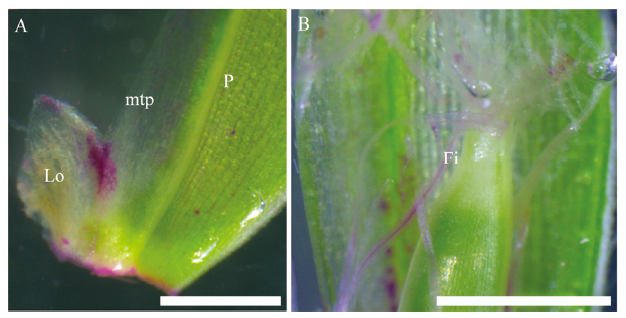
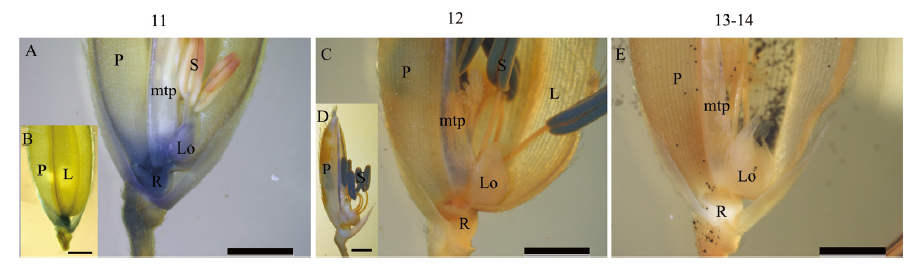
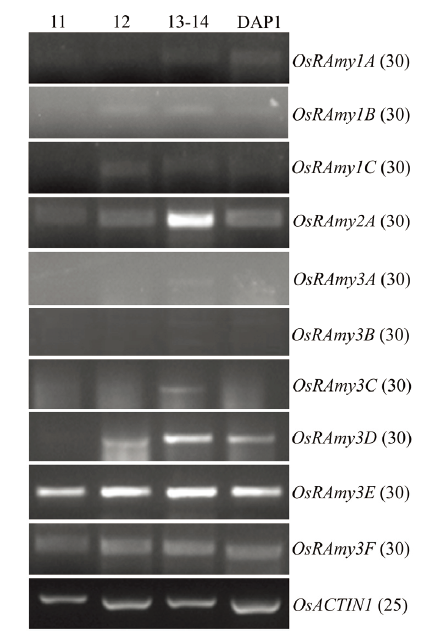
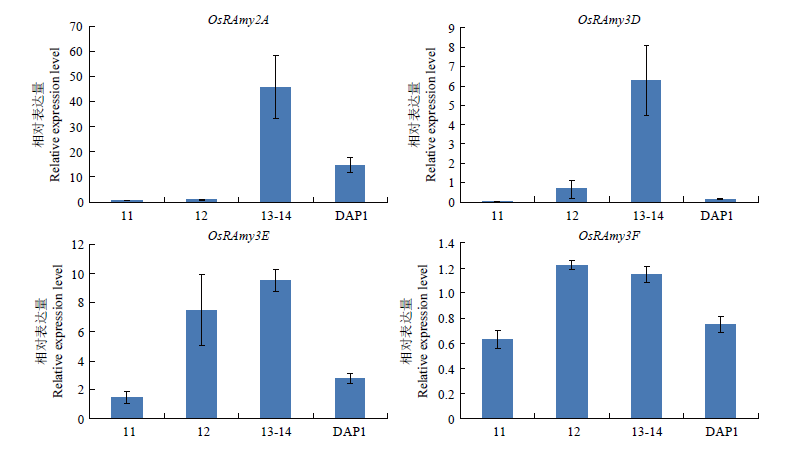
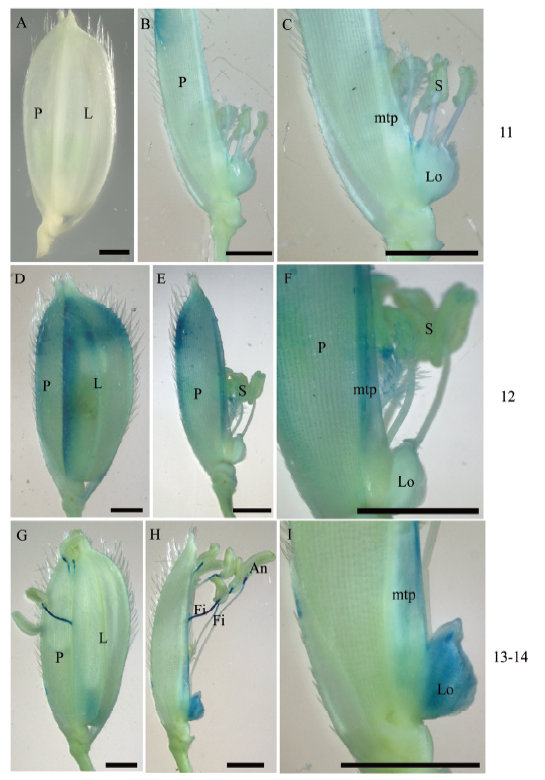
【Objective】 Starch degradation is involved in lodicule absorbing abundant water and swelling during rice floret opening, but the amylase genes associated with this process have not been identified yet. 【Method】 To identify the swelling of tissues during floret opening, the in vitro rice panicles absorbed diluted Fuchsin basic and the dye remains were observed after florets were closing again. The starch grain distribution in rice florets before and during anthesis from stage 11 to stage 14 (according to 14 stages of rice anther development) was detected using iodide staining. The spatial-temporal expression patterns of 10 α-amylase genes were detected by RT-PCR, RT-qPCR and GUS staining. 【Result】 Before floret opening, the stamens, pistils and lodicules are enclosed by the lemma and palea through marginal tissues of palea (mtp). Rapid swelling of the lodicules causes floret opening by separating the lemma from the palea. After the in vitro panicles absorbed diluted Fuchsin basic during floret opening, the dye remains were observed located in the joint between mtp and lodicules and filaments. Iodide staining showed that the starch grains were mainly located in the stamens and mtp and a small amount of starch grains in the lodicules at stage 12 (before floret opening), whereas the starch grains in the mtp and lodicules were almost completely degraded at stage 13-14 (during floret opening). RT-PCR showed that OsRAmy2A and OsRAmy3D began to express from stage 12 and were expressed with high levels at stage 13-14. The expression levels of the two genes decreased at DAP1 (1 day after pollination). OsRAmy3E and OsRAmy3F kept expressed during this process. The expression level of OsRAmy3E was higher than that of OsRAmy3F. The RT-qPCR analysis showed that the expression level of OsRAmy2A increased most dramatically at stage 13-14, followed by OsRAMy3A and OsRAMy3E. Further, the transgenic plants expressing the GUS reporter gene driven by the OsRAmy2A promoter were generated. The GUS signaling was located only in the lemma, palea and mtp at stage 12 and the expression of the GUS gene driven by the RAmy2A promoter was induced in the mtp, lodicules and filaments at stage 13-14. 【Conclusion】 These data indicated that starch grain degradation in the mtp and lodicules at stage 13-14 might be related with high expression levels of some α-amylase genes such as OsRAmy2A and OsRAmy3D, probably involved in controlling lodicules swelling and floret opening in rice.

Key words: rice, α-amylase, floret opening, starch grain, lodicules swelling

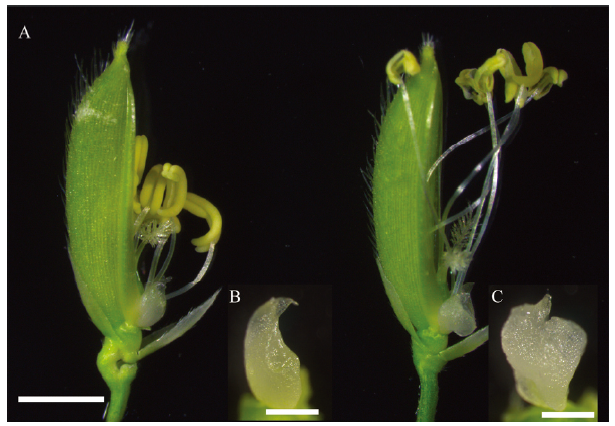
Fig. 1

The phenotype of rice floret opening A: Stage 13 (Left), stage14 (Right); Bar=2 mm; B: Imagination of lodicules at stage 13, Bar=0.5 mm; C: Imagination of lodicules at stage 14, Bar=0.5 mm"

Fig. 2

Absorption and remains of diluted Fuchsin basic during floret opening A: The joint between mtp and lodicules; B: Filaments, Bar=2 mm. Lo: Lodicules; mtp: Marginal tissues of palea; P: Palea; Fi: Filaments. The same as below"

Fig. 3

Lodine staining reaction of rice florets during 11-14 stages A-B: Stage 11, A, magnification of B with lemma removed; C-D: Stage 12, C, magnification of D; E: Stage 13-14. Bar=2 mm. L: Lemma; S: Stamen; R: Rachilla. The same as below "

Fig. 4

The analysis of 10 α-amylase genes before and during rice floret opening by RT-PCR DAP1: 1 day after pollination. The numbers in parentheses are cycles of RT-PCR for the genes"

Fig. 5

The analysis of 4 α-amylase genes before and during rice floret opening by RT-qPCR"

Fig. 6

The expression profiling of the OsRAmy2A Promotor::GUS transgenic rice in florets before and during anthesis by GUS staining A-C: Stage 11; D-F: Stage 12; G-I: Stage 13-14, Bar=2 mm. An: Anther"

[1]
王忠, 顾蕴洁, 高煜珠. 水稻开颖机理的探讨: Ⅲ. 浆片的结构及其在开颖过程中内含物的变化. 作物学报, 1991, 17(2): 96-101, 161.
WANG Z, GU Y J, GAO Y Z. Studies on the mechanism of the anthesis of rice: III. Structure of the lodicule and changes of its contents during flowering. Acta Agronomica Sinica, 1991, 17(2): 96-101, 161. (in Chinese)
[2]
YADAV S R, PRASAD K, VIJAYRAGHAVAN U. Divergent regulatory OsMADS2 functions control size, shape and differentiation of the highly derived rice floret second-whorl organ. Genetics, 2007, 176(1): 283-294.

pmid: 17409064
[3]
PISSAREK H. Untersuchungen über Bau und Funktion der Gramineen. Lodiculae. Beitrage zur Biologie der Pflanzen, 1971, 47: 313-370.
[4]
YAN Z Q, DENG R Y, ZHANG H W, LI J L, ZHU S S. Transcriptome analysis of floret opening and closure both Indica and Japonica rice. 3 Biotech, 2022, 12(9): 188.

doi: 10.1007/s13205-022-03226-y pmid: 35879964
[5]
BECK E, ZIEGLER P. Biosynthesis and degradation of starch in higher plants. Annual Review of Plant Physiology and Plant Molecular Biology, 1989, 40: 95-117.

doi: 10.1146/arplant.1989.40.issue-1
[6]
PREISS J. Regulation of the biosynthesis and degradation of starch. Annual Review of Plant Physiology, 1982, 33: 431-454.

doi: 10.1146/arplant.1982.33.issue-1
[7]
SHINKE R. Plant α-amylase//Handbook of Amylases and Related Enzymes. Edited by The Amylase Research Society of Japan, Pergamon, Oxford, 1988: 26-32.
[8]
NIE L X, SONG S K, YIN Q, ZHAO T C, LIU H Y, HE A B, WANG W Q. Enhancement in seed priming-induced starch degradation of rice seed under chilling stress via GA-Mediated α-amylase expression. Rice (New York, N.Y.), 2022, 15(1): 19.
[9]
AKAZAWA T, MITSUI T, HAYASHI M. Recent progress in α- amylase biosynthesis. The Biochemistry of Plants, 1988, 14: 465-492.
[10]
LI H X, LI X Z, WANG G J, ZHANG J H, WANG G Q. Analysis of gene expression in early seed germination of rice: Landscape and genetic regulation. BMC Plant Biology, 2022, 22(1): 70.

doi: 10.1186/s12870-022-03458-3 pmid: 35176996
[11]
HUANG N, REINL S J, RODRIGUEZ R L. RAmy2A, a novel αalpha-amylase-encoding gene in rice. Gene, 1992, 111(2): 223-228.

doi: 10.1016/0378-1119(92)90690-Q
[12]
MITSUI T, ITOH K. The α-amylase multigene family. Trends in Plant Science, 1997, 2(7): 255-261.

doi: 10.1016/S1360-1385(97)86347-9
[13]
DAMARIS R N, LIN Z Y, YANG P F, HE D L. The rice alpha- amylase, conserved regulator of seed maturation and germination. International Journal of Molecular Sciences, 2019, 20(2): 450.

doi: 10.3390/ijms20020450
[14]
SUGIMOTO N, TAKEDA G, NAGATO Y, YAMAGUCHI J. Temporal and spatial expression of the α-amylase gene during seed germination in rice and barley. Plant and Cell Physiology, 1998, 39(3): 323-333.

doi: 10.1093/oxfordjournals.pcp.a029373
[15]
HUANG N, STEBBINS G L, RODRIGUEZ R L. Classification and evolution of α-amylase genes in plants. Proceedings of the National Academy of Sciences of the Unites States of America, 1992, 89(16): 7526-7530.
[16]
ZHAO Z G, ZHANG Y H, LIU X, ZHANG X, LIU S C, YU X W, REN Y L, ZHENG X M, ZHOU K N, JIANG L, GUO X P, GAI Y, WU C Y, ZHAI H Q, WANG H Y, WAN J M. A role for a dioxygenase in auxin metabolism and reproductive development in rice. Developmental Cell, 2013, 27(1): 113-122.

doi: 10.1016/j.devcel.2013.09.005 pmid: 24094741
[17]
HAYASHI K I, ARAI K, AOI Y, TANAKA Y, HIRA H, GUO R P, HU Y, GE C N, ZHAO Y D, KASAHARA H, FUKUI K. The main oxidative inactivation pathway of the plant hormone auxin. Nature Communications, 2021, 12(1): 6752.

doi: 10.1038/s41467-021-27020-1
[18]
ZHAO Z X, YIN X X, LI S, PENG Y T, YAN X L, CHEN C, HASSAN B, ZHOU S X, PU M, ZHAO J H, HU X H, LI G B, WANG H, ZHANG J W, HUANG Y Y, FAN J, LI Y, WANG W M. miR167d-ARFs module regulates flower opening and stigma size in rice. Rice (New York, N Y), 2022, 15(1): 40.
[19]
XU P Z, WU T K, ALI A, ZHANG H Y, LIAO Y X, CHEN X Q, TIAN Y H, WANG W M, FU X D, LI Y, FAN J, WANG H, TIAN Y F, LIU Y T, JIANG Q S, SUN C H, ZHOU H, WU X J. EARLY MORNING FLOWERING1 (EMF1) regulates the floret opening time by mediating lodicule cell wall formation in rice. Plant Biotechnology Journal, 2022, 20(8): 1441-1443.

doi: 10.1111/pbi.v20.8
[20]
XIAO Y G, CHEN Y, CHARNIKHOVA T, MULDER P P J, HEIJMANS J, HOOGENBOOM A, AGALOU A, MICHEL C, MOREL J B, DRENI L, KATER M M, BOUWMEESTER K MH, WANG HM, ZHU Z, OUWERKERK P B F. OsJAR1 is required for JA-regulated floret opening and anther dehiscence in rice. Plant Molecular Biology, 2014, 86(1): 19-33.

doi: 10.1007/s11103-014-0212-y
[21]
JEFFERSON R A, KAVANAGH T A, BEVAN M W. GUS fusions: Beta-glucuronidase as a sensitive and versatile gene fusion marker in higher plants. The EMBO Journal, 1987, 6(13): 3901-3907.

doi: 10.1002/embj.1987.6.issue-13
[22]
ZHANG D B, WILSON Z A. Stamen specification and anther development in rice. Chinese Science Bulletin, 2009, 54(14): 2342-2353.

doi: 10.1007/s11434-009-0348-3
[23]
NANJO Y, ASATSUMA S, ITOH K, HORI H, MITSUI T. Proteomic identification of alpha-amylase isoforms encoded by RAmy3B/3C from germinating rice seeds. Bioscience, Biotechnology, and Biochemistry, 2004, 68(1): 112-118.

pmid: 14745172
[24]
徐长帅. 水稻和高粱开花期浆片细胞淀粉粒的变化[D]. 南昌: 江西农业大学, 2012.
XU C S. Changes of starch grains in lodicule cells during the flowering time of rice and sorghum[D]. Nanchang: Jiangxi Agricultural University, 2012. (in Chinese)
[25]
ZHAO Z G, WANG C L, YU X W, TIAN Y L, WANG W X, ZHANG Y H, BAI W T, YANG N, ZHANG T, ZHENG H, WANG Q M, LU J Y, LEI D K, HE X D, CHEN K Y, GAO J W, LIU X, LIU S J, JIANG L, WANG H Y, WAN J W. Auxin regulates source-sink carbohydrate partitioning and reproductive organ development in rice. Proceedings of the National Academy of Sciences of the Unites States of America, 2022, 119(36): e2121671119.
[26]
CRAIG S, O’BRIEN T, PBRIEN O. The lodicules of wheat: Pre- and post-anthesis. Australia Journal of Botany, 1975, 23(3): 451-458.
[27]
曾晓春, 周燮, 吴晓玉. 水稻颖花开放机理研究进展. 中国农业科学, 2004, 37(2): 188-195.
ZENG X C, ZHOU X, WU X Y. Advances in study of opening mechanism in rice florets. Scientia Agricultura Sinica, 2004, 37(2): 188-195. (in Chinese)
[28]
HESLOP-HARRISON Y, HESLOP-HARRISON J S. Lodicule function and filament extension in the grasses: Potassium ion movement and tissue specialization. Annals of Botany, 1996, 77(6): 573-582.

doi: 10.1093/aob/77.6.573
[29]
廖登群, 张洪亮, 李自超, John Bennett J. 水稻(Oryza sativa L.)α-淀粉酶基因的进化及组织表达模式. 作物学报, 2010, 36(1): 17-27.

doi: 10.3724/SP.J.1006.2010.00017
LIAO D Q, ZHANG H L, LI Z C, BENNETT J. Characterization of evolution and tissuer-expression of rice (Oryza Sativa sativa L.) α-amylase genes. Acta Agronomica Sinica, 2010, 36(1): 17-27. (in Chinese)

doi: 10.3724/SP.J.1006.2010.00017
[30]
CHEN H J, WANG S J. Molecular regulation of sink-source transition in rice leaf sheaths during the heading period. Acta Physiologiae Plantarum, 2008, 30(5): 639-649.

doi: 10.1007/s11738-008-0160-8
[1] PENG TingShen, LU JiuYan, WU MeiLin, YAN YuXin, LIU HongZhou, NAN WenBin, QIN XiaoJian, LI Ming, GONG JunYi, LIANG YongShu. QTL Analysis of Yield-Related Traits in Both Huangnuo2# and Changbai7# of Perennial Chinese Rice [J]. Scientia Agricultura Sinica, 2026, 59(7): 1361-1379.
[2] CUI JieHao, ZHANG Meng, WANG Qin, YU JiaYan, LIN Kun, LI ShangZe, LAN Heng, GENG YanQiu, ZHANG Qiang, GUO LiYing, SHAO XiWen. Evaluation of Lodging Resistance and Its Physiological Mechanisms in Japonica Rice Resources [J]. Scientia Agricultura Sinica, 2026, 59(7): 1420-1438.
[3] YUAN HaoLiang, NIE Jun, LI Peng, LU YanHong, LIAO YuLin, XU ChangXu, LI ZhongYi, CAO WeiDong, ZHANG JiangLin. Effects of Co-Utilization of Chinese Milk Vetch and Rice Straw on Soil Phosphorus Composition and Phosphorus Activation of Paddy Field in Southern China [J]. Scientia Agricultura Sinica, 2026, 59(7): 1480-1491.
[4] XU YangHaoJun, CHEN LiMing, YANG ShiQi, TANG YiFan, TAN XueMing, ZENG YongJun, PAN XiaoHua, ZENG YanHua. Effects of Long-Term Different Straw Returning Methods on Soil Organic Carbon, Nutrients and Aggregate Formation in Different Soil Layers of Double Cropping Rice Field [J]. Scientia Agricultura Sinica, 2026, 59(7): 1492-1506.
[5] LI XingYu, HUANG Rong, XIAN YiMing, TIAN JiaoJiao, MA XiaoJin, YANG QiaoXi, LI Bing, WANG ChangQuan. Characteristics of Organic Carbon Fractions and Carbon Dioxide Emissions of Different Size Aggregates in Rice Field Soils in Response to Long-Term Fertilization [J]. Scientia Agricultura Sinica, 2026, 59(6): 1255-1271.
[6] MA ZhaoHui, QUAN ChengZhe, CHENG HaiTao, YANG KanJie, LI XinRui, LÜ WenYan. The Breeding Goals and Strategies of Northeast Japonica Rice Under the Background of Zhongke Fa No.5 [J]. Scientia Agricultura Sinica, 2026, 59(5): 927-936.
[7] ZHANG WeiJian, YAN ShengJi, SHANG ZiYin, TANG ZhiWei, WU LiuGe, LI JiaRui, CHEN HaoTian, DENG AiXing, ZHANG Jun, ZHANG Xin, ZHENG ChengYan, SONG ZhenWei. Methane Emissions from Paddy Fields: Not Entirely Attributable to Rice Cultivation [J]. Scientia Agricultura Sinica, 2026, 59(4): 824-833.
[8] CHEN Min, JIAO ZiLan, QIAO ChengBin, XU Hao, ZHANG Bi, MA DongHua, KONG WeiRu, WANG JingWen, SONG JiaWei, LUO ChengKe, LI PeiFu, TIAN Lei. Morpho-Physiological Responses and Adaptive Strategies of Rice Germplasm Accessions from Different Subspecies Under Salt Stress [J]. Scientia Agricultura Sinica, 2026, 59(4): 705-722.
[9] GUO FuCheng, TANG HaiJiang, HAO XinYi, MA GuoLin, YANG JiuJu, HUANG LinFeng, TIAN Lei, WANG Bin, LUO ChengKe. Effects of Different Irrigation Methods on Water-Salt Transport, Rice Yield, and Water Use Efficiency in Saline Soil in Ningxia [J]. Scientia Agricultura Sinica, 2026, 59(4): 750-764.
[10] LUO Wei, YU Hong, YUAN LiXin, WANG LingLing, ZHAO JinPeng, YIN Wei, WANG MingTian, WANG RuLin. Change of Geographic Distributions of Ratoon Rice in Sichuan- Chongqing Under Global Climate Change [J]. Scientia Agricultura Sinica, 2026, 59(4): 765-780.
[11] ZHU Shu, GUO ZhiPeng, SUN Ying. Functional Analysis of Rice Target of Rapamycin OsTOR in Regulating Root Elongation [J]. Scientia Agricultura Sinica, 2026, 59(3): 475-485.
[12] LÜ WenYan, CHENG HaiTao, MA ZhaoHui, TIAN ShuHua. Discussion on Hybridization Breeding Technology and Strategy of Rice in the New Era of Breeding [J]. Scientia Agricultura Sinica, 2026, 59(2): 233-238.
[13] LIAO TingLu, SHI YaFei, XIAO DongHao, SHE YangMengFei, GUO FuCheng, YANG JiuJu, TANG HaiJiang, LUO ChengKe. The Effect of Exogenous Nitroprusside on Sugar Metabolism in Rice Seedlings Under Alkaline Stress [J]. Scientia Agricultura Sinica, 2026, 59(2): 265-277.
[14] LIU TianSheng, LIU GengYuan, ZHAO AnQi, YANG Xu, CAI MingXue, YANG AiWen, LOU MingXuan, LI MuKai, WANG Han, ZHANG YaLing. Pathogenic Population of Rice Bakanae Disease in Heilongjiang Province [J]. Scientia Agricultura Sinica, 2026, 59(2): 305-321.
[15] WANG ZhongNi, LEI Yue, LI JiaLi, GONG YanLong, ZHU SuSong. Functions of ABC Transporter OsARG1 in Rice Heading Date Regulation [J]. Scientia Agricultura Sinica, 2026, 59(1): 1-16.
Viewed
Full text


Abstract

Cited

  Shared   
  Discussed   
No Suggested Reading articles found!