Scientia Agricultura Sinica ›› 2026, Vol. 59 ›› Issue (2): 305-321.doi: 10.3864/j.issn.0578-1752.2026.02.007

• PLANT PROTECTION • Previous Articles     Next Articles

Pathogenic Population of Rice Bakanae Disease in Heilongjiang Province

LIU TianSheng(), LIU GengYuan, ZHAO AnQi, YANG Xu, CAI MingXue, YANG AiWen, LOU MingXuan, LI MuKai, WANG Han, ZHANG YaLing()   

  1. College of Agronomy, Heilongjiang Bayi Agricultural University/Heilongjiang Provincial Research Center of Plant Resistance, Daqing 163319, Heilongjiang
  • Received:2025-09-18 Accepted:2025-11-08 Online:2026-01-16 Published:2026-01-22
  • Contact: ZHANG YaLing

Abstract:

【Objective】 The objective of this study is to investigate pathogen species and dominant pathogenic fungi of rice bakanae disease in Heilongjiang Province, and to provide a basis for precise prevention and control of rice bakanae disease. 【Method】 In 2023, rice bakanae disease samples were collected from 8 cities and 15 counties (districts) in Heilongjiang Province. A total of 172 single-spore strains were isolated and purified from the samples using tissue separation method and dilution plating method. Morphological identification, combined with multilocus phylogenetic analysis using ITS, RPB2, TEF1-α, LSU, and TUB2, and validation via Koch’s postulates, was used to complete the identification of the pathogen causing rice bakanae disease. 【Result】 172 strains of the pathogenic fungi causing rice bakanae disease were classified into 31 morphotypes based on their morphological characteristics. Multilocus phylogenetic analysis identified 15 genotypes, and the isolated pathogenic fungi included four species complexes: FFSC, FNSC, FOSC, and FIESC. Among them, the dominant pathogenic fungus was Fusarium fujikuroi in the FFSC. A total of 148 strains were obtained, accounting for 86.05% of the total number of isolated strains, and comprising 4 genotypes and 18 morphotypes. Nine strains of Fusarium madaense were also obtained from this species complex, accounting for 5.23% of the total strains, with 1 genotype and 3 morphotypes. In addition, 1 strain of Fusarium subglutinans was identified, representing 0.58% of the total, with 1 genotype and 1 morphotype. In the FIESC, 2 strains of Fusarium wereldwijsianum were obtained, accounting for 1.16% of the total strains, with 2 genotypes and 2 morphotypes; 7 strains of Fusarium ipomoeae were also identified, representing 4.07% of the total, with 5 genotypes and 5 morphotypes. From each of the FNSC and FOSC, 4 strains of Fusarium arbusti and 1 strain of Fusarium cugenangense were obtained, accounting for 2.33% and 0.58% of the total strains, respectively, with 1 genotype and 1 morphotype for each species. All 7 Fusarium species were pathogenic, but with varying degrees of pathogenicity. The dominant pathogenic fungus, F. fujikuroi, caused rice bud rot and etiolation; F. arbusti induced only rice bud rot; F. ipomoeae, F. subglutinans and F. wereldwijsianum inhibited rice growth; F. madaense and F. cugenangense resulted in rice etiolation. 【Conclusion】 The pathogens causing rice bakanae disease in Heilongjiang Province include 7 species: F. fujikuroi, F. madaense, F. ipomoeae, F. arbusti, F. wereldwijsianum, F. subglutinans, and F. cugenangense. Obvious differences exist in pathogenic types and geographical distribution depending on the pathogen species. Of these, F. fujikuroi and F. arbusti exhibited the strongest pathogenicity; F. fujikuroi was detected in all regions of Heilongjiang Province and served as the dominant pathogenic fungus.

Key words: rice, rice bakanae disease, fungal pathogen, dominant pathogen, Heilongjiang Province

Table 1

Primer sequences for target fragment amplification and PCR reaction procedures"

基因Gene 引物Primer 序列Sequence (5′-3′) PCR反应程序PCR amplification procedure
ITS ITS1 TCCGTAGGTGAACCTGCGG 94 ℃ 2 min; 94 ℃ 30 s, 55 ℃ 30 s, 72 ℃ 30 s, 35 cycles; 72 ℃ 10 min
ITS4 TCCTCCGCTTATTGATATGC
TEF1-α EF1 ATGGGTAAGGAAGACAAGAC 94 ℃ 2 min; 94 ℃ 1 min, 55 ℃ 1 min, 72 ℃ 1 min, 35 cycles; 72 ℃ 10 min
EF2 GGAAGTACCAGTGATCATGTT
TUB2 T1 AACATGCGTGAGATTGTAAGT 94 ℃ 2 min; 94 ℃ 35 s, 52 ℃ 55 s, 72 ℃ 2 min, 35 cycles; 72 ℃ 10 min
T22 TCTGGATGTTGTTGGGAATCC
LSU LSU1 CTTTTGATGCGGTGCCTTCC 94 ℃ 5 min; 94 ℃ 45 s, 55 ℃ 45 s, 72 ℃ 105 s, 35 cycles; 72 ℃ 5 min
LSU2 TACGCGTAGGGGTTTGACAC
RPB2 5f2 GGGGWGAYCAGAAGAAGGC 94 ℃ 5 min; 94 ℃ 15 s, 50 ℃ 45 s, 72 ℃ 45 s, 35 cycles; 72 ℃ 5 min
7cr CCCATRGCTTGYTTRCCCAT

Table 2

Downloaded species, strains and sequences for multigene phylogenetic analysis"

菌株编号
Strain number
复合种
Species complex
物种
Species
GenBank编号GenBank number
ITS RPB2 LSU TEF1-α TUB2
CBS221.76 FFSC 藤仓镰孢Fusarium fujikuroi AB725607 KU604255 KU604096 AB725605 AB725606
CBS130308 FOSC Fusarium cugenangense MW827607 MH484920 MH877308 MH485011 MH485102
CBS747.97 FFSC Fusarium subglutinans U34559 JX171599 HM057336 MW402351
LC13614 FFSC Fusarium madaense MW016405 MW474391 MW580445 MW533727
GUCC197425.1 FIESC Fusarium radicigenum OR034266 OR043852 OR043908 OR043953
CGMCC3.19493 FIESC Fusarium arcuatisporum MK280802 MK289739 MK289584 MW533837
GUCC190154.1 FNSC Fusarium arbusti MZ724826 OR043837 OR043893 OR043940
Indo174 FIESC Fusarium ipomoeae LS479418 LS479861 LS479891
NL19-057012 FIESC Fusarium wereldwijsianum MZ890508 MZ921719 MZ890364
CBS173.57 Curvularia hawaiiensis MH857687.1 LT715683.1 MH869226.1 KT021343.1 KT021342.1

Table 3

Species, strains and sequences uploaded to NMDC for multigenic phylogenetic analysis"

菌株编号
Strain number
各基因登录号Gene accession number
ITS TEF1-α TUB2 RPB2 LSU
JH04 NMDCN00092TE NMDCN00092UR NMDCN00092UC NMDCN00092TT NMDCN00092UT
HL34 NMDCN00092TD NMDCN00092UQ NMDCN00092UB NMDCN00092TS NMDCN00092UU
HL20 NMDCN00092TC NMDCN00092UP NMDCN00092UA NMDCN00092TR NMDCN00092UV
WK01 NMDCN00092TB NMDCN00092UO NMDCN00092U9 NMDCN00092TQ NMDCN00092V0
JH03 NMDCN00092TA NMDCN00092UN NMDCN00092U8 NMDCN00092TP NMDCN00092V1
AD04 NMDCN00092T9 NMDCN00092UM NMDCN00092U7 NMDCN00092TO NMDCN00092V2
HSB04 NMDCN00092T8 NMDCN00092UL NMDCN00092U6 NMDCN00092TN NMDCN00092V3
HL18 NMDCN00092T7 NMDCN00092UK NMDCN00092U5 NMDCN00092TM
HL14 NMDCN00092T6 NMDCN00092UJ NMDCN00092U4 NMDCN00092TL
WK03 NMDCN00092T5 NMDCN00092UI NMDCN00092U3 NMDCN00092TK
LF09 NMDCN00092T4 NMDCN00092UH NMDCN00092U2 NMDCN00092TJ
MS04 NMDCN00092T3 NMDCN00092UG NMDCN00092U1 NMDCN00092TI
LJ07 NMDCN00092T2 NMDCN00092UF NMDCN00092U0 NMDCN00092TH
HL09 NMDCN00092T1 NMDCN00092UE NMDCN00092TV NMDCN00092TG
LB02 NMDCN00092T0 NMDCN00092UD NMDCN00092TU NMDCN00092TF

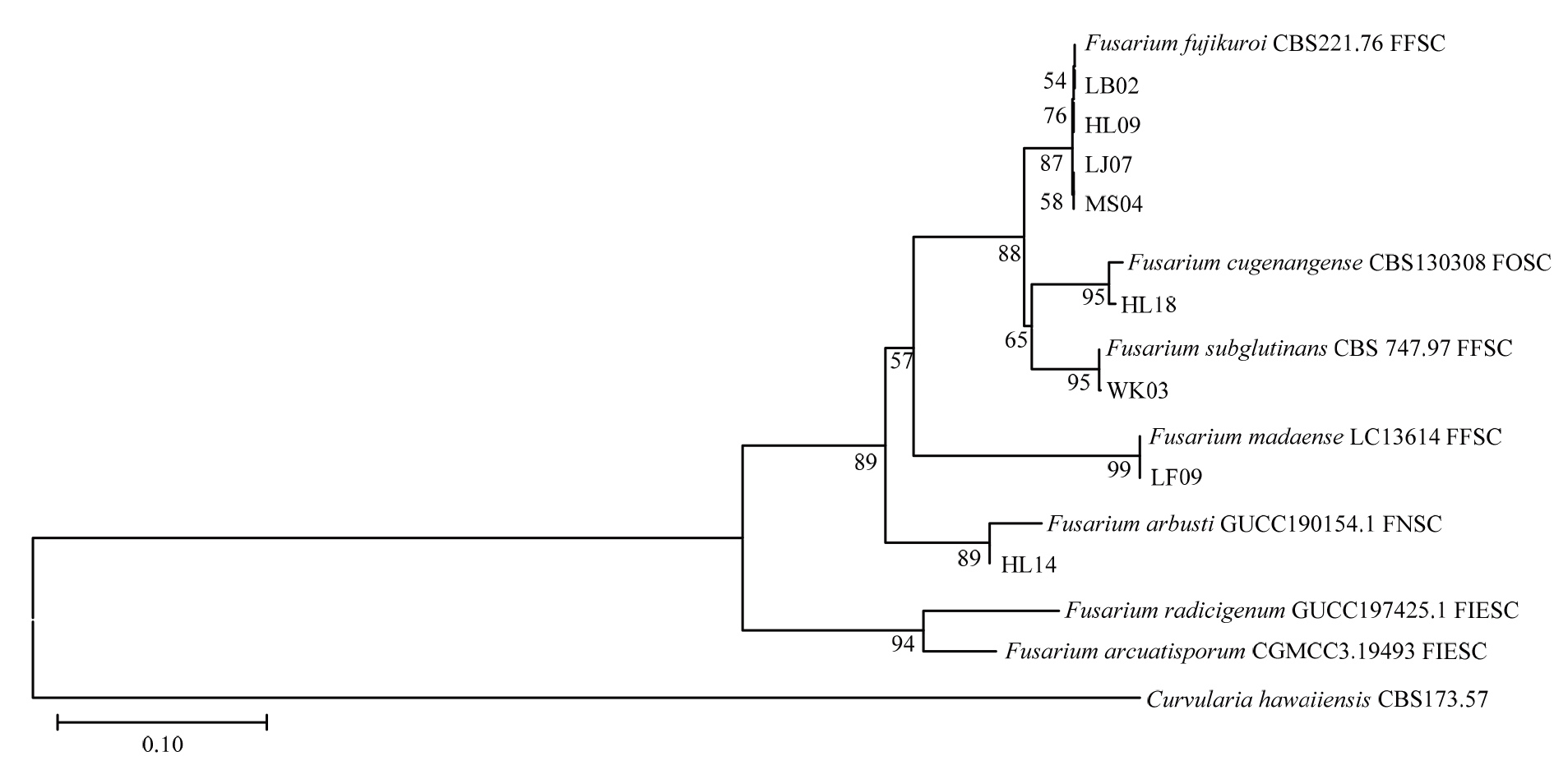
Fig. 1

Phylogenetic tree constructed by NJ method based on ITS, TEF1-α, TUB2, and RPB2 polygene sequences"

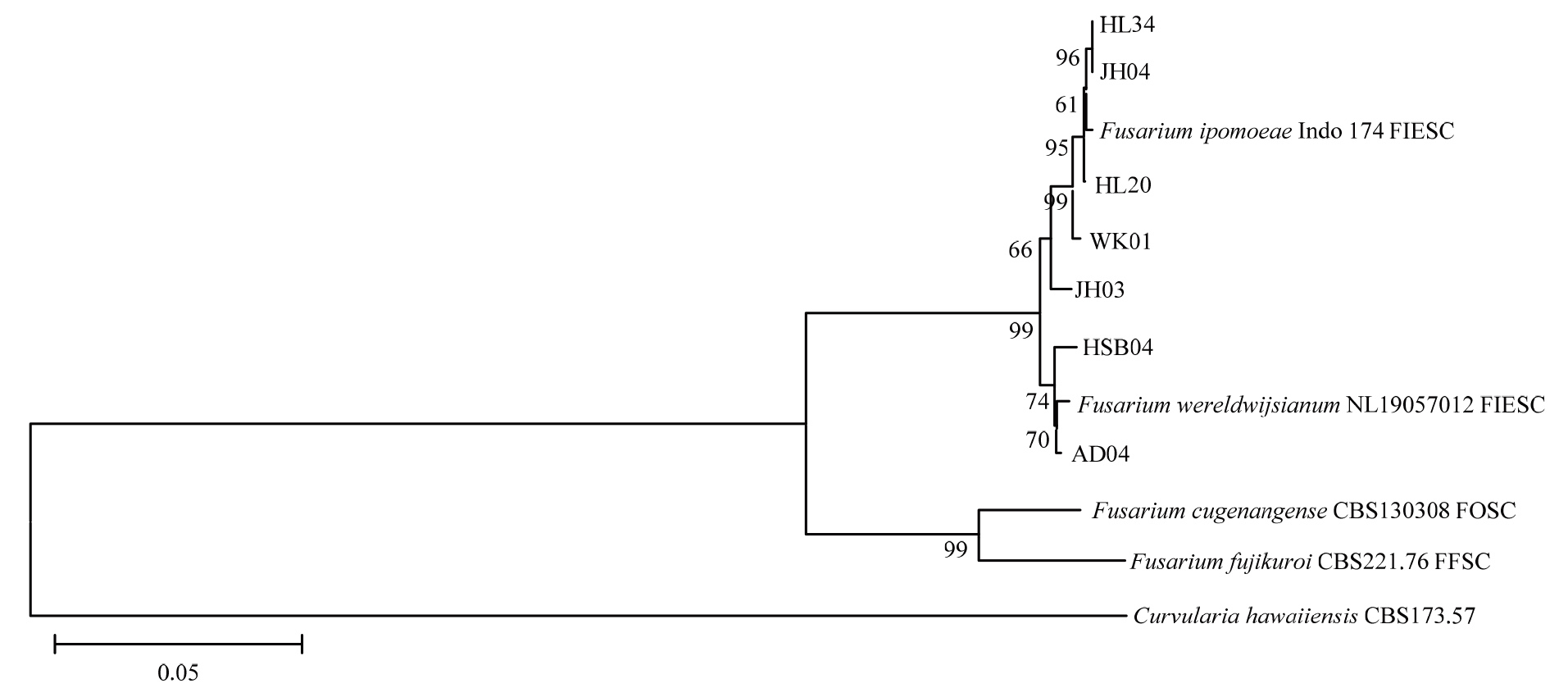
Fig. 2

Phylogenetic tree constructed by NJ method based on ITS, RPB2, and LSU polygene sequences"

Table 4

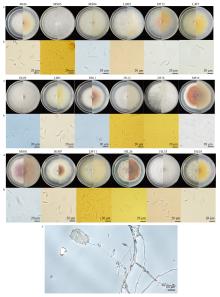
Morphology of pathogenic fungi"

菌株编号
Strain number
菌株产生色素
Pigment produced by the strain
菌落形态
Colony morphology
大孢子形态
Macrospore morphology
隔膜数
Spore septum
大孢子大小
Macrospore size
HL06 中心紫色逐渐变浅
The center gradually fades from purple
气生菌丝发达蓬松,呈棉絮状,边缘整齐
Abundant aerial mycelium presents a fluffy, cottony texture and exhibits
even margins
镰刀形
Falciform
3-5 (21.63-34.27) μm× (2.99-4.04) μm
MS03 白色
White
微弯,多数两端较钝
Slightly curved, mostly with blunt ends
0-2 (9.23-20.01) μm× (1.89-3.01) μm
MS04 淡紫色
Pale purple
不弯或微弯,长梭形
Straight or slightly curved, fusiform
3-5 (27.23-43.52) μm× (4.08-4.45) μm
LB02 淡黄色
Pale yellow
一端渐尖一端微钝
Acutely tapered at one end and slightly obtuse at the other
3-5 (14.01-19.82) μm× (2.22-2.73) μm
DF12 橙色
Orange
长梭形或两端微弯
Fusiform or slightly curved at both ends
3-5 (18.49-41.81) μm× (2.16-3.47) μm
LJ07 中心橙色,向外黄色
The center is orange with a yellow periphery
长梭形
Fusiform
3-5 (28.18-38.60) μm× (3.83-4.20) μm
HL09 中心紫色,向外淡黄色
The center is purple with a pale yellow periphery
微弯,两端较钝
Slightly curved with blunt ends
3-5 (28.94-43.43) μm× (3.14-3.93) μm
LB01 中心橙色,向外黄色
The center is orange with a yellow periphery
长梭形或两端微弯
Fusiform or slightly curved at both ends
3-5 (17.74-34.97) μm× (2.53-3.83) μm
RH11 中心深紫色,向外逐渐变白
A deep purple core gradually transitions to white at the edges
菌丝生长均匀,气生菌丝发达致密接近颗粒状,边缘整齐
The mycelium grows evenly, with dense, nearly granular aerial mycelia and a well- defined margin
长梭形
Fusiform
3-5 (33.60-41.53) μm× (1.82-3.28) μm
HL15 淡黄色
Pale yellow
长梭形,两端较钝
Fusiform with blunt ends
0-1 (23.02-27.12) μm× (2.67-3.39) μm
DF10 中心橙色,向外黄色
The center is orange with a yellow periphery
长梭形,两端较钝
Fusiform with blunt ends
0-3 (14.06-36.36) μm× (2.65-4.00) μm
MS10 中心深紫色向外变浅
A deep purple center gradually fades toward the edges
菌丝红色,表面有纹理,呈绒毛状
The mycelium is red, with a textured surface and a velvety appearance
两端较钝,一端微弯
Blunt-ended, slightly curved at one end
3-5 (22.01-34.95) μm× (3.08-3.40) μm
MS01 紫红色
Fuchsia
中心隆起,边缘平整
The center is raised and the margins
are flat
长梭形
Fusiform
1-3 (20.56-33.49) μm× (2.62-3.78) μm
RH07 中心深紫色,向外白色
The center is deep purple with a white periphery
一端较钝,一端微弯渐尖
Blunt at one end, gradually tapered and slightly curved at the other
3-5 (19.70-30.29) μm× (2.80-3.53) μm
DF11 黄色
Yellow
菌丝细密呈绒毛状并微微隆起,边缘菌丝略稀疏但整齐
The mycelium is fine, velvety and slightly raised, with the margin mycelium being slightly sparse but neat
饱满,一端圆润
Plump and round at one end
1-3 (11.06-25.20) μm× (3.18-3.99) μm
HL26 紫色
Purple
长梭形,两端较钝
Fusiform with blunt ends
不明显Not clear (15.38-23.98) μm× (2.95-3.35) μm
HL33 中心紫色,边缘大部分浅黄色
The center is purple with a mostly pale yellow margin
菌丝浓密,呈绒毛状,边缘呈轻微波浪状
The mycelium is dense, velvety, and has a slightly undulated margin
镰刀形
Falciform
1-5 (11.56-36.94) μm× (1.82-3.88) μm
HL03 中心紫色,向外黄色
The center is purple with a yellow periphery
菌丝短且致密,边缘整齐
The mycelium is short and dense, with a neat margin
微弯
Slightly curved
3-5 (19.00-30.69) μm× (3.10-4.88) μm
LF09 中心橙色向外变浅
An orange core gradually lightens toward the edges
中间密呈毡状,有高度
The middle is dense and felt-like, with a certain height
微弯,两端渐尖或较钝
Slightly curved, with both ends gradually pointed or relatively blunt
1-4 (9.26-19.77) μm× (2.04-3.82) μm
LF03 橙黄色
Orange-yellow
菌丝稀疏蓬松,呈放射状
The mycelial growth exhibits a sparse, fluffy texture and a radial arrangement
两端较钝
Both ends are relatively blunt
0-2 (17.06-24.53) μm× (2.75-3.15) μm
LF14 黄色
Yellow
生长速度慢,菌丝细密呈毡状,中心高四周低
The growth rate is slow, the mycelium is fine and felt-like, with a higher center and lower margin
微弯,两端渐尖
Slightly curved, with both ends gradually pointed
1-3 (11.02-34.42) μm× (2.75-3.15) μm
HSB04 白色
White
菌丝稀疏
Mycelial growth is sparse
一端微弯
Slightly curved at one end
3-5 (21.18-49.57) μm× (2.07-4.81) μm
AD04 棕色
Brown
菌丝浓密呈毡状,生长速度慢
The mycelium is dense, felt-like, and exhibits a slow growth rate
微弯,两端渐尖
Slightly curved, with both ends gradually pointed
1-3 (10.57-30.37) μm× (2.89-3.15) μm
JH04 橙色
Orange
菌丝橙色,有高度
The mycelium is orange in color, forming a raised structure
镰刀形
Falciform
3-5 (18.87-34.89) μm× (1.76-4.23) μm
JH03 淡黄色
Pale yellow
菌丝较茂密,呈羊毛状
The mycelial growth exhibits a fairly dense, woolly texture
HL34 白色
White
菌丝杂乱交织
The mycelium grows in a dense, tangled, and interwoven manner
大孢子微弯,产生厚垣孢子
Macroconidia slightly curved, forming chlamydospores
1-5 (13.15-38.99) μm× (2.00-3.30) μm
HL20 中心棕色向外变浅
A brown core gradually lightens toward the edges
中心棕色,菌丝茂密较长
A dense growth of elongated mycelium is noted in the brown central region
镰刀形
Falciform
3-5 (25.36-45.08) μm× (3.15-4.45) μm
WK01 淡黄色
Pale yellow
菌丝淡黄色
The mycelium appears light yellow
微弯
Slightly curved
2-4 (12.67-34.94) μm× (2.80-4.59) μm
HL18 紫色
Purple
紫红色菌丝,边缘白色
Fuchsia mycelium is observed, exhibiting a white margin
微弯,两端渐尖
Slightly curved, with both ends gradually pointed
1-4 (11.67-31.65) μm× (2.23-2.93) μm
HL14 淡黄色
Pale yellow
整体高,中间菌丝乱
It is generally elevated with tangled mycelia in the center
微弯或不弯,两端较钝
Slightly bent or not bent at all, with both ends being relatively blunt
0-1 (16.11-30.58) μm× (1.75-2.41) μm
WK03 中心橙色向外变浅
The orange center gradually lightens toward the edges
生长速度较慢,菌丝蓬松
The growth rate is slow, the mycelium is fluffy
长梭形,较长
Elongated fusiform
0-4 (23.44-61.35) μm× (1.82-3.30) μm

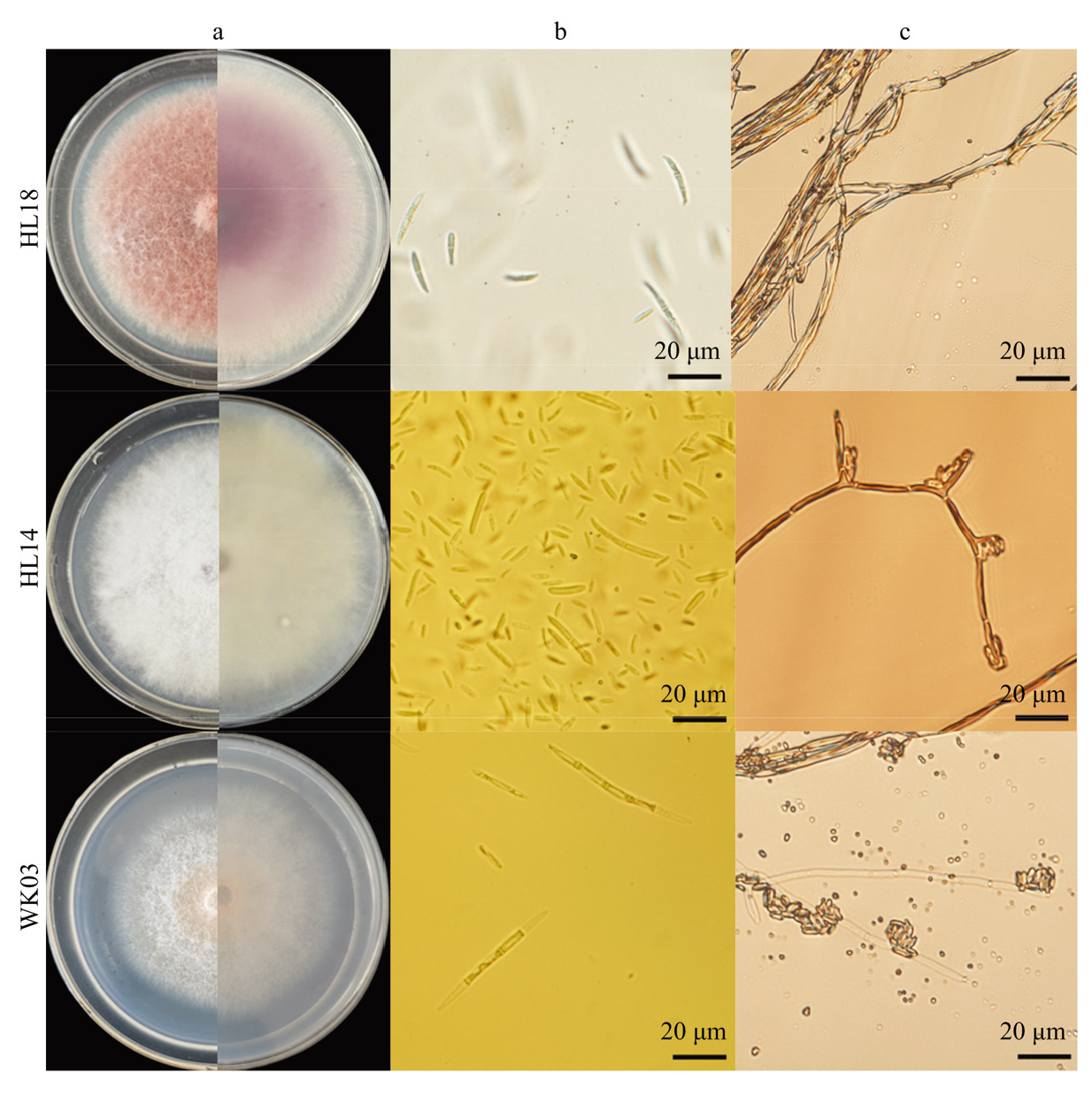
Fig. 3

Morphological characteristics of F. fujikuroi"

Fig. 4

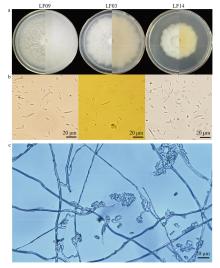
Morphological characteristics of F. madaense"

Fig. 5

Morphological characteristics of F. wereldwijsianum"

Fig. 6

Morphological characteristics of F. ipomoeae"

Fig. 7

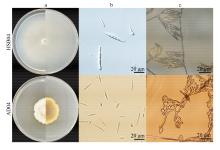
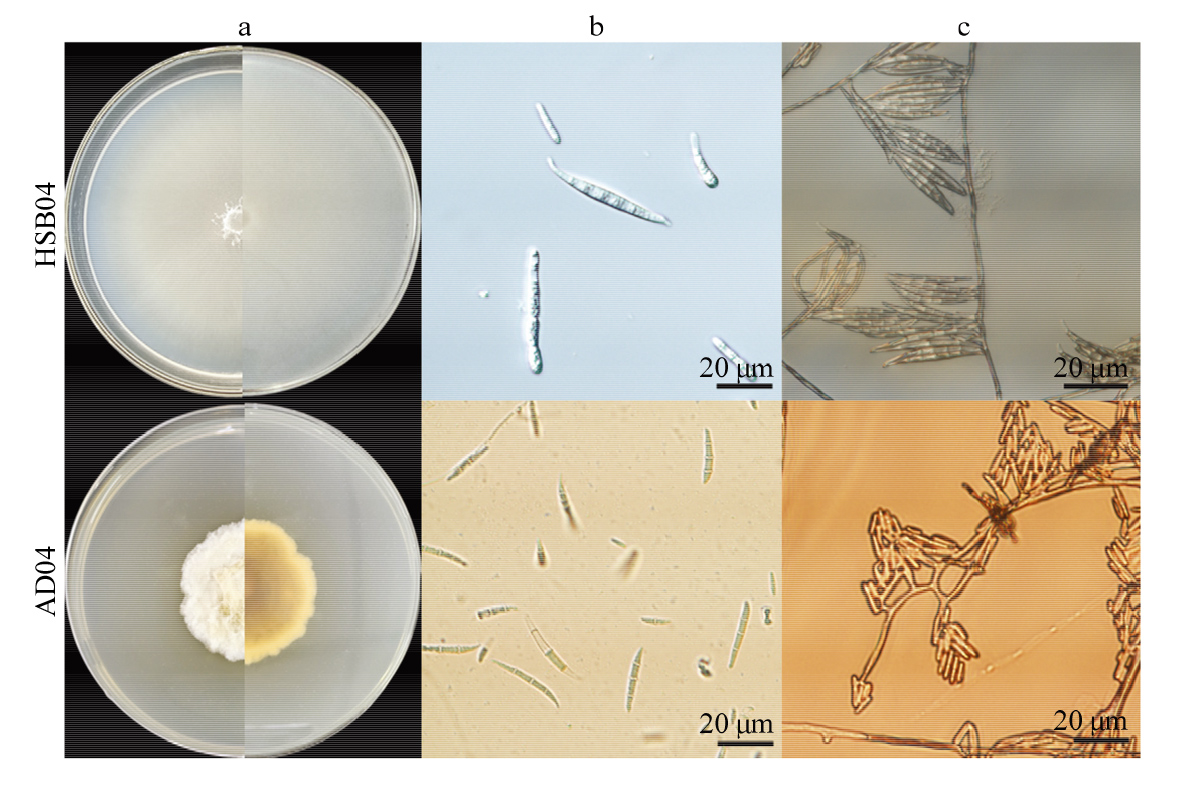
Morphological characteristics of F. cugenangense, F. arbusti, and F. subglutinans"

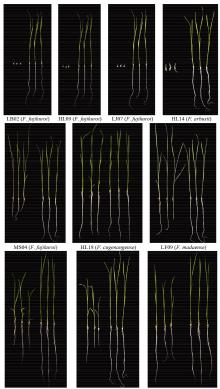
Fig. 8

Symptoms of rice bakanae disease after 21 days of inoculation with different strains"

Table 5

Species and distribution of rice bakanae disease pathogen in Heilongjiang Province"

[1]
刘瑞, 赵羽涵, 顾欣怡, 王艳霞, 靳学慧, 吴伟怀, 张亚玲. 黑龙江省和海南省稻瘟病菌中AVR-Pita家族的分布及变异分析. 中国农业科学, 2023, 56(3): 466-480. doi: 10.3864/j.issn.0578-1752.2023.03.006.
LIU R, ZHAO Y H, GU X Y, WANG Y X, JIN X H, WU W H, ZHANG Y L. Distribution and variation analysis of AVR-Pita family in Magnaporthe oryzae from Heilongjiang Province and Hainan Province. Scientia Agricultura Sinica, 2023, 56(3): 466-480. doi: 10.3864/j.issn.0578-1752.2023.03.006. (in Chinese)
[2]
王瑞峰, 李爽, 孔凡娜. 粮食安全保障能力: 内涵特征、指标测度与提升路径. 四川农业大学学报, 2022, 40(3): 301-311.
WANG R F, LI S, KONG F N. Food security capacity: Connotation characteristics, index measurement and promotion path. Journal of Sichuan Agricultural University, 2022, 40(3): 301-311. (in Chinese)
[3]
刘宝海, 聂守军, 高世伟, 刘晴, 刘宇强, 马成, 常汇琳, 张佳柠, 薛英会, 白瑞. 基于遗传算法和熵权评价法的寒地水稻育种多目标优化设计. 中国农业大学学报, 2022, 27(1): 38-49.
LIU B H, NIE S J, GAO S W, LIU Q, LIU Y Q, MA C, CHANG H L, ZHANG J N, XUE Y H, BAI R. Multi-objective optimization design for rice breeding in cold region based on genetic algorithm and entropy weight evaluation method. Journal of China Agricultural University, 2022, 27(1): 38-49. (in Chinese)
[4]
高洪儒, 杨传铭, 赵北平, 张喜娟, 肖明纲, 杨贤莉, 张擘, 王立志, 孙中义, 姜树坤. 黑龙江省五常优质稻区2008—2022年水稻育种趋势分析. 中国稻米, 2025, 31(3): 87-94.

doi: 10.3969/j.issn.1006-8082.2025.03.0014
GAO H R, YANG C M, ZHAO B P, ZHANG X J, XIAO M G, YANG X L, ZHANG B, WANG L Z, SUN Z Y, JIANG S K. Analysis of rice breeding trends in 2008-2022 in Wuchang high quality rice region of Heilongjiang Province. China Rice, 2025, 31(3): 87-94. (in Chinese)
[5]
TORRES-CRUZ T J, WHITAKER B K, PROCTOR R H, BRODERS K, LARABA I, KIM H S, BROWN D W, O’DONNELL K, ESTRADA-RODRIGUEZ T L, LEE Y H, CHEONG K, WALLACE E C, MCGEE C T, KANG S, GEISER D M. FUSARIUM-ID v. FUSARIUM-ID v.3.0: An updated, downloadable resource for Fusarium species identification. Plant Disease, 2022, 106(6): 1610-1616.

doi: 10.1094/PDIS-09-21-2105-SR
[6]
KARTHIK C, SHU Q. Current insights on rice (Oryza sativa L.) bakanae disease and exploration of its management strategies. Journal of Zhejiang University-Science B, 2023, 24(9): 755-778.

doi: 10.1631/jzus.B2300085
[7]
RONG Z Y, YUAN Y T, YE W W, WANG X L, ZHENG X B. Rapid diagnosis of rice bakanae caused by Fusarium fujikuroi and F. proliferatum using loop-mediated isothermal amplification assays. Journal of Phytopathology, 2018, 166(4): 283-290.

doi: 10.1111/jph.2018.166.issue-4
[8]
WULFF E G, SORENSEN J L, LUBECK M, NIELSEN K F, THRANE U, TORP J. Fusarium spp. associated with rice bakanae: Ecology, genetic diversity, pathogenicity and toxigenicity. Environmental Microbiology, 2010, 12(3): 649-657.

doi: 10.1111/emi.2010.12.issue-3
[9]
JEON Y A, YU S H, LEE Y Y, PARK H J, LEE S, SUNG J S, KIM Y G, LEE H S. Incidence, molecular characteristics and pathogenicity of Gibberella fujikuroi species complex associated with rice seeds from Asian countries. Mycobiology, 2013, 41(4): 225-233.

doi: 10.5941/MYCO.2013.41.4.225
[10]
CHENG A P, CHEN S Y, LAI M H, WU D H, LIN S S, CHEN C Y, CHUNG C L. Transcriptome analysis of early defenses in rice against Fusarium fujikuroi. Rice, 2020, 13(1): 65.
[11]
PIOMBO E, BOSIO P, ACQUADRO A, ABBRUSCATO P, SPADARO D. Different phenotypes, similar genomes: Three newly sequenced Fusarium fujikuroi strains induce different symptoms in rice depending on temperature. Phytopathology, 2020, 110(3): 656-665.

doi: 10.1094/PHYTO-09-19-0359-R
[12]
李广胜, 李月娇, 孙淑琴, 李岩, 朱祥茂, 杨秀荣, 冯学良. 水稻恶苗病病菌鉴定及其对化学药剂的敏感性分析. 江苏农业科学, 2023, 51(24): 114-122.
LI G S, LI Y J, SUN S Q, LI Y, ZHU X M, YANG X R, FENG X L. Identification of pathogenic bacteria of rice bakanae disease and its sensitivity to chemical agents. Jiangsu Agricultural Sciences, 2023, 51(24): 114-122. (in Chinese)
[13]
LEE S B, HUR Y J, CHO J H, LEE J H, KIM T H, CHO S M, SONG Y C, SEO Y S, LEE J, KIM T S, PARK Y J, OH M K, PARK D S. Molecular mapping of qBK1WD, a major QTL for bakanae disease resistance in rice. Rice, 2018, 11(1): 3.

doi: 10.1186/s12284-017-0197-7
[14]
SEEMÜLLER E. Untersuchungen über die morphologische und biologische Differenzierung in der Fusarium-Sektion Sporotrichiella. Journal of Plant Nutrition and Soil Science, 1968, 121(1): 79.
[15]
陈宏州, 周晨, 庄义庆, 姚克兵, 杨红福, 徐超, 侯毅平, 朱凤. 江苏省水稻恶苗病菌种群鉴定及抗药性检测. 植物保护, 2022, 48(2): 48-62.
CHEN H Z, ZHOU C, ZHUANG Y Q, YAO K B, YANG H F, XU C, HOU Y P, ZHU F. Population identification and resistance detection of the pathogen causing rice bakanae disease in Jiangsu Province. Plant Protection, 2022, 48(2): 48-62. (in Chinese)
[16]
孙丹. 水稻干尖线虫病与恶苗病防治药剂的筛选[D]. 合肥: 安徽农业大学, 2023.
SUN D. Studies on screening of pesticide formulation for controlling rice white-tip and bakanae disease[D]. Hefei: Anhui Agricultural University, 2023. (in Chinese)
[17]
DESJARDINS A E, MANANDHAR H K, PLATTNER R D, MANANDHAR G G, POLING S M, MARAGOS C M. Fusarium species from Nepalese rice and production of mycotoxins and gibberellic acid by selected species. Applied and Environmental Microbiology, 2000, 66(3): 1020-1025.

doi: 10.1128/AEM.66.3.1020-1025.2000
[18]
郑睿, 聂亚锋, 于俊杰, 黄磊, 俞咪娜, 尹小乐, 黄星, 王亚会, 郑梦婷, 刘永锋. 江苏省水稻恶苗病菌对咪鲜胺和氰烯菌酯的敏感性. 农药学学报, 2014, 16(6): 693-698.
ZHENG R, NIE Y F, YU J J, HUANG L, YU M N, YIN X L, HUANG X, WANG Y H, ZHENG M T, LIU Y F. Sensitivity of Fusarium fujikuroi to prochloraz and JS399-19 in Jiangsu Province. Chinese Journal of Pesticide Science, 2014, 16(6): 693-698. (in Chinese)
[19]
赵渊, 高松, 刘连盟, 黎起秦, 黄世文. 水稻恶苗病菌对咪鲜胺的抗性初探. 浙江农业科学, 2019, 60(1): 89-91.

doi: 10.16178/j.issn.0528-9017.20190129
ZHAO Y, GAO S, LIU L M, LI Q Q, HUANG S W. Resistance of Fusarium monilifore to prochloraz. Journal of Zhejiang Agricultural Sciences, 2019, 60(1): 89-91. (in Chinese)
[20]
MOHD ZAINUDIN N, RAZAK A, SALLEH B. Bakanae disease of rice in Malaysia and Indonesia: Etiology of the causal agent based on morphological, physiological and pathogenicity characteristics. Journal of Plant Protection Research, 2008, 48(4): 475-485.

doi: 10.2478/v10045-008-0056-z
[21]
于艳敏, 武洪涛, 刘海英, 徐振华, 吴立成, 杨忠良, 张书利, 高大伟, 闫平. 水稻品种恶苗病抗性评价与筛选. 农学学报, 2024, 14(7): 1-5.

doi: 10.11923/j.issn.2095-4050.cjas2022-0115
YU Y M, WU H T, LIU H Y, XU Z H, WU L C, YANG Z L, ZHANG S L, GAO D W, YAN P. Rice bakanae disease in rice varieties: Resistance evaluation and screening. Journal of Agriculture, 2024, 14(7): 1-5. (in Chinese)

doi: 10.11923/j.issn.2095-4050.cjas2022-0115
[22]
冯锡君, 张颖, 梁孝莉, 朴明浩, 王立柱. 水稻恶苗病种子带菌率与田间发病率的相关分析. 延边大学农学学报, 2003, 25(4): 264-267.
FENG X J, ZHANG Y, LIANG X L, PIAO M H, WANG L Z. Correlation analysis of bacterial bearing rate and field morbidity of rice seeds with bakanae disease. Agricultural Science Journal of Yanbian University, 2003, 25(4): 264-267. (in Chinese)
[23]
孟凡. 芦笋茎枯病菌生物学特性及抗药性研究[D]. 南昌: 江西农业大学, 2013.
MENG F. Study on the biological characteristics and resistance of the asparagus stem blight[D]. Nanchang: Jiangxi Agricultural University, 2013. (in Chinese)
[24]
尹良芬. 滤纸片低温干燥法保存丝状真菌. 安徽农业科学, 2022, 50(12): 5-10.
YIN L F. Drying filter paper at low temperature to preserve filamentous fungi. Journal of Anhui Agricultural Sciences, 2022, 50(12): 5-10. (in Chinese)
[25]
庞云超, 王秋京, 房明明, 褚春燕, 石慕真, 李秀芬, 朱海霞, 姜丽霞. 东北冷涡型冷害时空特征及对黑龙江水稻产量的影响. 中国农业气象, 2025, 46(6): 827-838.
PANG Y C, WANG Q J, FANG M M, CHU C Y, SHI M Z, LI X F, ZHU H X, JIANG L X. Spatial-temporal characteristics of northeast cold vortex-type chilling injury and its impact on rice yield in Heilongjiang Province. Chinese Journal of Agrometeorology, 2025, 46(6): 827-838. (in Chinese)

doi: 10.3969/j.issn.1000-6362.2025.06.008
[26]
MONTOYA A M, GRIMALDO J, GONZÁLEZ G M. Phenotypic and molecular identification of Fusarium spp. clinical and environmental isolates. Gaceta Medica de Mexico, 2024, 160(5): 527-534.
[27]
CROUS P W, LOMBARD L, SANDOVAL-DENIS M, SEIFERT K A, SCHROERS H J, CHAVERRI P, GENÉ J, GUARRO J, HIROOKA Y, BENSCH K, et al. Fusarium: More than a node or a foot-shaped basal cell. Studies in Mycology, 2021, 98: 100116.

doi: 10.1016/j.simyco.2021.100116
[28]
张国芳, 杨肖芳, 郁瑜雯, 沈岚. 浙江省草莓炭疽病病原菌鉴定、致病力分析及室内药剂筛选. 植物保护, 2025, 51(3): 206-217.
ZHANG G F, YANG X F, YU Y W, SHEN L. Identification, pathogenicity analysis, and fungicide screening of Colletotrichum species causing strawberry anthracnose in Zhejiang Province. Plant Protection, 2025, 51(3): 206-217. (in Chinese)
[29]
黄智星, 李月, 丁洁欣, 林海蔚, 程艳波, 年海, 周而勋. 一种新发大豆根腐病的病原鉴定及防治药剂筛选. 华中农业大学学报, 2024, 43(6): 229-239.
HUANG Z X, LI Y, DING J X, LIN H W, CHENG Y B, NIAN H, ZHOU E X. Pathogen identification and control fungicide screening of a novel soybean root rot. Journal of Huazhong Agricultural University, 2024, 43(6): 229-239. (in Chinese)
[30]
HUSNA A, MIAH M A, ZAKARIA L, MOHD M H, IZZATI MOHD ZAINUDIN N A, MOHAMED NOR N M I. Fusarium species associated with bakanae disease of rice in Bangladesh. Plant Disease, 2025, 109(4): 779-791.

doi: 10.1094/PDIS-03-24-0655-SR
[31]
KIM J H, KANG M R, KIM H K, LEE S H, LEE T, YUN S H. Population structure of the Gibberella fujikuroi species complex associated with rice and corn in Korea. Plant Pathology Journal, 2012, 28(4): 357-363.
[32]
HWANG I S, KANG W R, HWANG D J, BAE S C, YUN S H, AHN I P. Evaluation of bakanae disease progression caused by Fusarium fujikuroi in Oryza sativa L. Journal of Microbiology, 2013, 51(6): 858-865.

doi: 10.1007/s12275-013-3472-3
[33]
GUPTA A K, SOLANKI I S, BASHYAL B M, SINGH Y, SRIVASTAVA K. Bakanae of rice - An emerging disease in Asia. The Journal of Animal and Plant Sciences, 2015, 25(6): 1499-1514.
[34]
PUYAM A, PANNU P P S, KAUR J, SETHI S. Variability in production of gibberellic acid and fusaric acid by Fusarium moniliforme and their relationship. Journal of Plant Pathology, 2017, 99(1): 103-108.
[35]
LEE Y H, CRILL J P, LAPIS D B. Role of gibberellic acid and fusaric acid in rice plant inoculated with Gibberella fujikuroi (Sawada) ito and kimura. The Plant Pathology Journal, 1989, 5(2): 126-130.
[36]
QUAZI S A J, SARIAH M, AHMAD Z A B, HAWA J. Detection of fungal metabolites from bakanae diseased plants and their relationship with bakanae disease symptoms expression. American Journal of Bioscience and Bioengineering, 2017, 4(6): 77-89.

doi: 10.11648/j.bio.20160406.14
[37]
杨艺帅, 谭琳, 牛丽, 舒坪, 史子涵, 方洁, 胡秋龙. 茶树根腐病菌生物学特征及室内药剂筛选. 中国农业科技导报, 2025, 27(7): 133-141.
YANG Y S, TAN L, NIU L, SHU P, SHI Z H, FANG J, HU Q L. Biological characteristics and fungicides screening in laboratory of Fusarium cugenangense causing Camellia sinensis root rot. Journal of Agricultural Science and Technology, 2025, 27(7): 133-141. (in Chinese)
[38]
LI C H, LI X G, SUN W B, ZHAO Y N, JIA Y F, HAN C Y, GONG P J, TAO S T, ZHAO Y C, LIU F Q. Identification of Fusarium cugenangense as a causal agent of wilt disease on Pyrus pyrifolia in China. Journal of Integrative Agriculture, 2026, 25(1): 157-165.

doi: 10.1016/j.jia.2024.02.018
[39]
SHRESTHA U, DEE M E, LITTRELL J, RICE J H, OUMA W, OWNLEY B H, BUTLER D M. First report of root rot of strawberry caused by Fusarium cugenangense, a member of the F. oxysporum species complex, in Tennessee, U.S.A. Plant Disease, 2024, 108(7): 2238.
[40]
COSTA M M, SALEH A A, MELO M P, GUIMARÃES E A, ESELE J P, ZELLER K A, SUMMERELL B A, PFENNING L H, LESLIE J F. Fusarium mirum sp. nov, intertwining Fusarium madaense and Fusarium andiyazi, pathogens of tropical grasses. Fungal Biology, 2022, 126(3): 250-266.
[41]
HUSNA A, MIAH M A, ZAKARIA L, NOR N M I M. Fusarium andiyazi, a pathogenic species associated with rice bakanae disease in Malaysia. Current Microbiology, 2024, 81(10): 308.

doi: 10.1007/s00284-024-03823-5 pmid: 39150554
[42]
HAO F M, ZANG Q Y, DING W H, MA E L, HUANG Y P, WANG Y H. First report of fruit rot of melon caused by Fusarium asiaticum in China. Plant Disease, 2021, 105(4): 1225.
[43]
MA G P, WANG H, QI K, MA L G, ZHANG B, ZHANG Y L, JIANG H, WU X H, QI J S. Isolation, characterization, and pathogenicity of Fusarium species causing crown rot of wheat. Frontiers in Microbiology, 2024, 15: 1405115.

doi: 10.3389/fmicb.2024.1405115
[44]
XU M L, ZHANG X, YU J, GUO Z Q, LI Y, WU J X, CHI Y C. First report of Fusarium ipomoeae causing peanut leaf spot in China. Plant Disease, 2021, 105(11): 3754.
[45]
STEPIEŃ Ł, GROMADZKA K, CHEŁKOWSKI J, BASIŃSKA- BARCZAK A, LALAK-KAŃCZUGOWSKA J. Diversity and mycotoxin production by Fusarium temperatum and Fusarium subglutinans as causal agents of pre-harvest Fusarium maize ear rot in Poland. Journal of Applied Genetics, 2019, 60(1): 113-121.

doi: 10.1007/s13353-018-0478-x
[46]
孟有儒, 邢会琴, 李万苍, 王多成, 李文明. 玉米顶腐病鉴定. 植物保护, 2008, 34(4): 107-110.
MENG Y R, XING H Q, LI W C, WANG D C, LI W M. Studies on the symptoms and pathogen identification of maize top rot disease. Plant Protection, 2008, 34(4): 107-110. (in Chinese)
[47]
CAMPOS-MACÍAS P, ARENAS-GUZMÁN R, HERNANDEZ- HERNANDEZ F. Fusarium subglutinans: A new eumycetoma agent. Medical Mycology Case Reports, 2013, 2: 128-131.

doi: 10.1016/j.mmcr.2013.06.004
[1] LÜ WenYan, CHENG HaiTao, MA ZhaoHui, TIAN ShuHua. Discussion on Hybridization Breeding Technology and Strategy of Rice in the New Era of Breeding [J]. Scientia Agricultura Sinica, 2026, 59(2): 233-238.
[2] LIAO TingLu, SHI YaFei, XIAO DongHao, SHE YangMengFei, GUO FuCheng, YANG JiuJu, TANG HaiJiang, LUO ChengKe. The Effect of Exogenous Nitroprusside on Sugar Metabolism in Rice Seedlings Under Alkaline Stress [J]. Scientia Agricultura Sinica, 2026, 59(2): 265-277.
[3] WANG ZhongNi, LEI Yue, LI JiaLi, GONG YanLong, ZHU SuSong. Functions of ABC Transporter OsARG1 in Rice Heading Date Regulation [J]. Scientia Agricultura Sinica, 2026, 59(1): 1-16.
[4] FEI YaoYing, WANG Di, TANG WeiJie, GUO CaiLi, ZHANG XiaoHu, QIU XiaoLei, CHENG Tao, YAO Xia, JIANG ChongYa, ZHU Yan, CAO WeiXing, ZHENG HengBiao. Estimation of Rice Grain Protein Content Using Fusion Imagery from UAV-based Multi-Sensors [J]. Scientia Agricultura Sinica, 2026, 59(1): 41-56.
[5] DONG GuiChun, WANG ZiHan, WANG ShuShen, LI Jie, HUO XiaoQing, YANG Rui, ZHOU Juan, SHU XiaoWei, LI Yan, CAO LiangJing, WANG ZiRui, YAO YouLi, HUANG JianYe. Technical Approaches for Enhancing Rice Yield and Nitrogen Use Efficiency with Sulfur-Coated Controlled-Release Fertilizers [J]. Scientia Agricultura Sinica, 2026, 59(1): 57-77.
[6] WANG AiDong, LI RuiJie, FENG XiangQian, HONG WeiYuan, LI ZiQiu, ZHANG XiaoGuo, WANG DanYing, CHEN Song. Multi-Angle Imaging and Machine Learning Approaches for Accurate Rice Leaf Area Estimation [J]. Scientia Agricultura Sinica, 2025, 58(9): 1719-1734.
[7] WEI Ping, PAN JuZhong, ZHU DePing, SHAO ShengXue, CHEN ShanShan, WEI YaQian, GAO WeiWei. The Function of OsDREB1J in Regulating Rice Grain Size [J]. Scientia Agricultura Sinica, 2025, 58(8): 1463-1478.
[8] LIU JinSong, WU LongMei, BAO XiaoZhe, LIU ZhiXia, ZHANG Bin, YANG TaoTao. Effects of a Short-Term Reduction in Nitrogen Fertilizer Application Rates on the Grain Yield and Rice Quality of Early and Late-Season Dual-Use Rice in South China [J]. Scientia Agricultura Sinica, 2025, 58(8): 1508-1520.
[9] WANG Bin, WU PengHao, LU JianWei, REN Tao, CONG RiHuan, LU ZhiFeng, LI XiaoKun. Water Demand Characteristics of Rice-Oilseed Rape Rotation System in the Middle Reaches of the Yangtze River [J]. Scientia Agricultura Sinica, 2025, 58(7): 1355-1365.
[10] XIONG JiaNi, LI ZongYue, HU HengLiang, GU TianYu, GAO Yan, PENG JiaShi. Influence of Expressing OsNRAMP5 Under the Driving of the OsLCT1 Promoter on Cadmium Migration to Rice Seeds [J]. Scientia Agricultura Sinica, 2025, 58(7): 1259-1268.
[11] JIN YiDan, HE NiQing, CHENG ZhaoPing, LIN ShaoJun, HUANG FengHuang, BAI KangCheng, ZHANG Tao, WANG WenXiao, YU MinXiang, YANG DeWei. Screening and Identification of Pigm-1 Interaction Proteins for Disease Resistance of Rice Blast [J]. Scientia Agricultura Sinica, 2025, 58(6): 1043-1051.
[12] JIN YaRu, CHEN Bin, WANG XinKai, ZHOU TianTian, LI Xiao, DENG JingJing, YANG YuWen, GUO DongShu, ZHANG BaoLong. Generation of Low-Glutelin Rice (Oryza sativa L.) Germplasm Through Long Fragment Deletion Using CRISPR/Cas9-Mediated Targeted Mutagenesis [J]. Scientia Agricultura Sinica, 2025, 58(6): 1052-1064.
[13] XIAO ChangChun, WEI XinYu, ZENG YueHui, HUANG JianHong, XU XuMing. Accumulation Characteristics of Anthocyanins in Black Rice Under Different Sowing Dates and Its Relationship with Meteorological Factors [J]. Scientia Agricultura Sinica, 2025, 58(5): 890-906.
[14] XU YuanYuan, JIA DongSheng, BIN Yu, WEI TaiYun. PGRP6 Negatively Regulates Symbiotic Bacteria to Prevent the Transovarial Transmission of RDV in Nephotettix cincticeps [J]. Scientia Agricultura Sinica, 2025, 58(5): 907-917.
[15] CHEN Ge, GU Yu, WEN Jiong, FU YueFeng, HE Xi, LI Wei, ZHOU JunYu, LIU QiongFeng, WU HaiYong. Effects of Fallow Weeds Returning to the Field on Photosynthetic Matter Production and Yield of Rice [J]. Scientia Agricultura Sinica, 2025, 58(4): 647-659.
Viewed
Full text


Abstract

Cited

  Shared   
  Discussed   
No Suggested Reading articles found!