Scientia Agricultura Sinica ›› 2023, Vol. 56 ›› Issue (15): 3032-3039.doi: 10.3864/j.issn.0578-1752.2023.15.016

• ANIMAL SCIENCE·VETERINARY SCIENCE • Previous Articles     Next Articles

Assessment of Genomic Selection Accuracy for Slaughter Traits in Broilers Based on Microarray and Imputed Sequencing Data

YIN Chang1(), ZHU Mo1, CHEN YanRu1, TONG ShiFeng1, ZHAO GuiPing2, LIU Yang1()   

  1. 1 College of Animal Science and Technology, Nanjing Agricultural University, Nanjing 210095
    2 Institute of Animal Sciences, Chinese Academy of Agricultural Sciences/State Key Laboratory of Animal Nutrition and Feeding, Beijing 100193
  • Received:2022-05-18 Accepted:2022-11-15 Online:2023-08-01 Published:2023-08-05

Abstract:

【Background】 In the breeding work of livestock and poultry, the core of which is the accuracy of genomic estimated breeding values. Different levels of genetic marker densities have a great impact on estimated breeding values, and with the development of genotyping technology and the decrease of high-throughput sequencing prices, genomic selection studies based on sequencing data have emerged. Theoretically, higher marker density can obtain higher prediction accuracy. This is because Quantitative Trait Loci (QTL) affecting the target trait are in linkage disequilibrium with at least one of the high-density markers covering the entire genome. A higher density of marker levels theoretically ensures tight linkage between markers and QTL, thus ensuring higher prediction accuracy. However, compared with microarray data, it has also been shown that the accuracy of genomic prediction for imputed sequencing data is not significantly improved. 【Objective】 Using the GBLUP method, we compared the genomic selection accuracy of imputed sequencing data and microarray data for slaughter traits in broiler chickens to provide a theoretical basis for genotyping strategies for broiler genomic selection breeding. 【Method】 In this study, we used SNP array data and imputed whole-genome sequence level (WGS) data to perform genomic prediction for the traits of breast muscle weight, carcass weight and thigh muscle weight in white feather broilers using the GBLUP method, and then we conducted a comparative study on their accuracy in genomic prediction. First, 3 362 chickens were genotyped using the Jingxin No. 1 chicken 55 K SNP chip, and 230 chickens were randomly selected from the ninth batch of generation 7 for whole-genome resequencing, and then the 55 K SNP chip data were imputed to the resequencing data level using Beagle 5.1 software. Considering the effect of chromosome size on the filling accuracy, the larger chromosome 3 and the smaller chromosome 14 were used to calculate the allele correct rate (CR) and genotype correlation coefficient (Cor), and the imputed WGS accuracy was determined by this study. The genomic breeding values of three slaughter traits were predicted using the imputed WGS data, and the accuracy, rank correlation and unbiasedness of the prediction results were evaluated using a 5-fold cross-validation method. 【Result】 The results showed that the average allelic accuracy of the two chromosomes was 0.924 and the average genotype correlation was 0.885, and the imputed WGS accuracy was high enough to be used for genomic prediction studies at a later stage. The accuracy of the predicted genomic breeding values calculated from microarray data ranged from 0.2194 to 0.2629, and the accuracy of the predicted genomic breeding values calculated from imputed sequencing data ranged from 0.2110 to 0.2695. The results show that the difference in the accuracy of the prediction of genomic breeding values from the imputed sequencing data was not significant compared with the 55 K SNP chip results. 【Conclusion】 Compared with the results of 55 K SNP microarray, the improvement in the accuracy of genomic breeding value prediction for three slaughter traits (breast muscle weight, carcass weight and leg muscle) in white feather broiler using imputed genomic level data was not significant, which provides a reference for the selection of data types in livestock genetic breeding work.

Key words: white feather broiler, slaughter traits, genomic breeding value prediction, imputed sequencing data, microarray data, assessment

Table 1

Descriptive statistics of breast muscle weight, carcass weight and thigh muscle weight"

性状
Traits
个体数
Count
最小值
Minimum (g)
最大值
Maximum (g)
平均值
Mean (g)
标准差
Standard deviation (g)
遗传力
Coefficient of variation (%)
胸肌重BrW 2409 220.20 686.40 434.84 86.34 0.34±0.05
屠体重CW 2421 1165.20 2650.00 1879.51 268.18 0.35±0.05
腿肌重ThW 2405 242.80 691.60 464.53 74.73 0.31±0.05

Table 2

Genotypic (below diagonal) and phenotypic (above diagonal) correlations and standard error (SE) among all pairs of three traits"

胸肌重
BrW
屠体重
CW
腿肌重
ThW
胸肌重BrW 1 0.819±0.007 0.625±0.013
屠体重CW 0.792±0.041 1 0.854±0.006
腿肌重ThW 0.555±0.080 0.871±0.029 1

Table 3

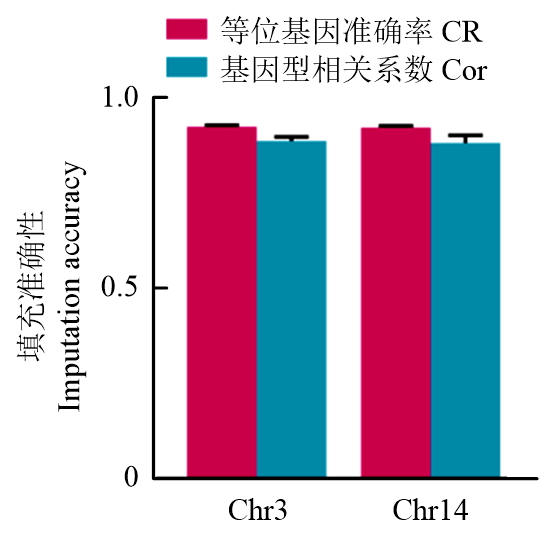
Imputation accuracy obtained with Beagle 5.1 on Chr3 and Chr14"

染色体
Chromosome
等位基因准确率
Correct rate
基因型相关系数
Correlation
3号 0.9250±0.0043 0.8876±0.0099
14号 0.9226±0.0045 0.8830±0.0175

Fig. 1

Imputation accuracy obtained with Beagle 5.1 on Chr3 and Chr14 Chr3, Chromosome3; Chr14, Chromosome 14"

Table 4

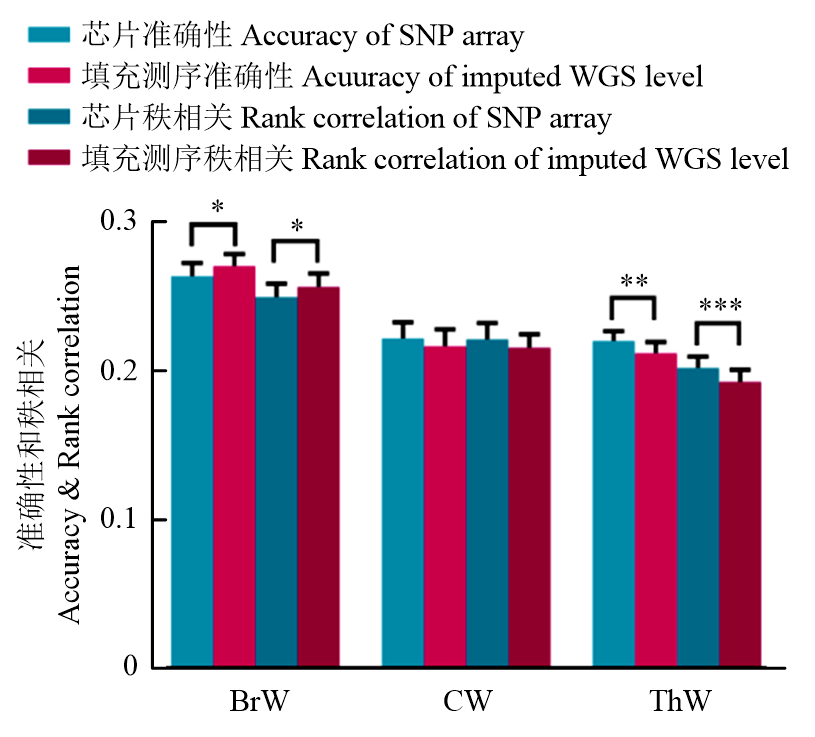
Accuracy of genomic prediction among three white- feathered broiler carcass traits"

性状
Traits
准确性 Accuracy
芯片数据
SNP array
填充测序数据
Imputed WGS level
胸肌重BrW 0.2629±0.0087 0.2695±0.0081
屠体重CW 0.2210±0.0109 0.2158±0.0114
腿肌重ThW 0.2194±0.0065 0.2110±0.0075

Fig. 2

Accuracy and rank of genomic prediction among three white-feathered broiler carcass traits based on SNP array and imputed WGS level data * P<0.05,** P<0.01,*** P<0.001 BrW, Breast muscle Weight; CW, Carcass Weight; ThW, Thigh muscle Weight"

Table 5

Rank of genomic prediction among three white- feathered broiler carcass traits"

性状
Traits
秩相关 Rank correlation
芯片数据
SNP array
填充测序数据
Imputed WGS level
胸肌重BrW 0.2489±0.0089 0.2555±0.0092
屠体重CW 0.2204±0.0110 0.2148±0.0091
腿肌重ThW 0.2013±0.0075 0.1920±0.0081

Table 6

Unbiasedness of genomic prediction among three white-feathered broiler carcass traits"

性状
Traits
无偏性 Unbiasedness
芯片数据
SNP array
填充测序数据
Imputed WGS level
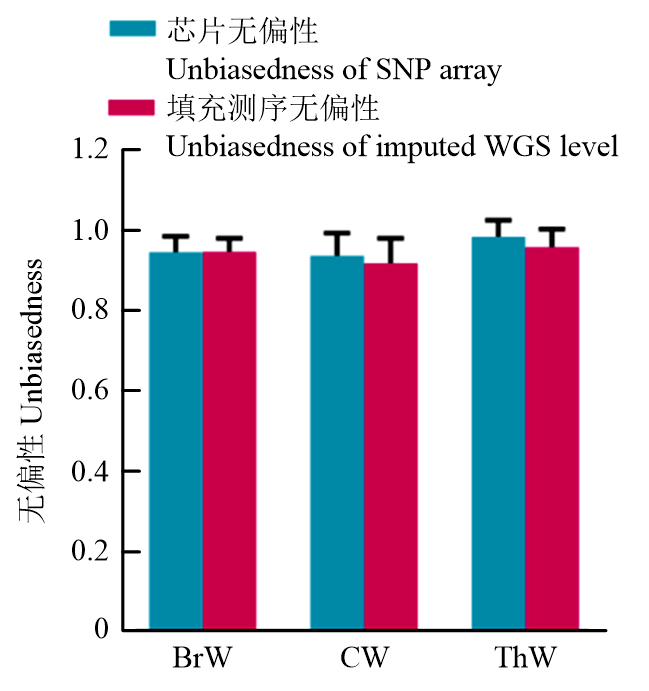
胸肌重BrW 0.9432±0.0392 0.9443±0.0334
屠体重CW 0.9340±0.0564 0.9153±0.0625
腿肌重ThW 0.9814±0.0409 0.9553±0.0448

Fig. 3

Unbiasedness of genomic prediction among three white-feathered broiler carcass traits based on SNP array and imputed WGS level data"

[1]
朱墨, 郑麦青, 崔焕先, 赵桂苹, 刘杨. 基于GBLUP和Bayes B方法对肉鸡屠宰性状基因组预测准确性的比较. 中国农业科学, 2021, 54(23): 5125-5131.

doi: 10.3864/j.issn.0578-1752.2021.23.016
ZHU M, ZHENG M Q, CUI H X, ZHAO G P, LIU Y. Comparison of genomic prediction accuracy for meat type chicken carcass traits based on GBLUP and BayesB method. Scientia Agricultura Sinica, 2021, 54(23): 5125-5131. (in Chinese)

doi: 10.3864/j.issn.0578-1752.2021.23.016
[2]
LIU J, ZHOU J, LI J, BAO H. Identification of candidate genes associated with slaughter traits in F2 chicken population using genome-wide association study. Animal Genetics, 2021, 52(4): 532-535.

doi: 10.1111/age.v52.4
[3]
VANRADEN P M, O'CONNELL J R, WIGGANS G R, WEIGEL K A. Genomic evaluations with many more genotypes. Genetics, Selection, Evolution, 2011, 43(1): 10.

doi: 10.1186/1297-9686-43-10
[4]
BENEDICT M N, MUNDY M B, HENRY C S, CHIA N, PRICE N D. Likelihood-based gene annotations for gap filling and quality assessment in genome-scale metabolic models. PLoS Computational Biology, 2014, 10(10): e1003882.

doi: 10.1371/journal.pcbi.1003882
[5]
MEUWISSEN T, GODDARD M. Accurate prediction of genetic values for complex traits by whole-genome resequencing. Genetics, 2010, 185(2): 623-631.

doi: 10.1534/genetics.110.116590 pmid: 20308278
[6]
IHESHIULOR O O M, WOOLLIAMS J A, YU X J, WELLMANN R, MEUWISSEN T H E. Within- and across-breed genomic prediction using whole-genome sequence and single nucleotide polymorphism panels. Genetics, Selection, Evolution, 2016, 48: 15.

doi: 10.1186/s12711-016-0193-1 pmid: 26895843
[7]
MISZTAL I, LOURENCO D, LEGARRA A. Current status of genomic evaluation. Journal of Animal Science, 2020, 98(4): skaa101.

doi: 10.1093/jas/skaa101
[8]
HEIDARITABAR M, CALUS M P L, MEGENS H J, VEREIJKEN A, GROENEN M A M, BASTIAANSEN J W M. Accuracy of genomic prediction using imputed whole-genome sequence data in white layers. Journal of Animal Breeding and Genetics, 2016, 133(3): 167-179.

doi: 10.1111/jbg.12199 pmid: 26776363
[9]
HAYES B J, DAETWYLER H D. 1000 bull genomes project to map simple and complex genetic traits in cattle: Applications and outcomes. Annual Review of Animal Biosciences, 2019, 7: 89-102.

doi: 10.1146/annurev-animal-020518-115024 pmid: 30508490
[10]
KHATKAR M S, MOSER G, HAYES B J, RAADSMA H W. Strategies and utility of imputed SNP genotypes for genomic analysis in dairy cattle. BMC Genomics, 2012, 13: 538.

doi: 10.1186/1471-2164-13-538 pmid: 23043356
[11]
BHUIYAN M S A, KIM Y K, KIM H J, LEE D H, LEE S H, YOON H B, LEE S H. Genome-wide association study and prediction of genomic breeding values for fatty-acid composition in Korean Hanwoo cattle using a high-density single-nucleotide polymorphism array. Journal of Animal Science, 2018, 96(10): 4063-4075.

doi: 10.1093/jas/sky280 pmid: 30265318
[12]
AL KALALDEH M, GIBSON J, DUIJVESTEIJN N, DAETWYLER H D, MACLEOD I, MOGHADDAR N, LEE S H, VAN DER WERF J H J. Using imputed whole-genome sequence data to improve the accuracy of genomic prediction for parasite resistance in Australian sheep. Genetics, Selection, Evolution, 2019, 51(1): 32.

doi: 10.1186/s12711-019-0476-4 pmid: 31242855
[13]
YE S P, YUAN X L, LIN X R, GAO N, LUO Y Y, CHEN Z M, LI J Q, ZHANG X Q, ZHANG Z. Imputation from SNP chip to sequence: A case study in a Chinese indigenous chicken population. Journal of Animal Science and Biotechnology, 2018, 9: 30.

doi: 10.1186/s40104-018-0241-5 pmid: 29581880
[14]
LIU R R, XING S Y, WANG J, ZHENG M Q, CUI H X, CROOIJMANS R P M A, LI Q H, ZHAO G P, WEN J. A new chicken 55K SNP genotyping array. BMC Genomics, 2019, 20(1): 410.

doi: 10.1186/s12864-019-5736-8 pmid: 31117951
[15]
PURCELL S, NEALE B, TODD-BROWN K, THOMAS L, FERREIRA M A R, BENDER D, MALLER J, SKLAR P, DE BAKKER P I W, DALY M J, SHAM P C. PLINK: A tool set for whole-genome association and population-based linkage analyses. The American Journal of Human Genetics, 2007, 81(3): 559-575.

doi: 10.1086/519795
[16]
BROWNING B L, ZHOU Y, BROWNING S R. A one-penny imputed genome from next-generation reference panels. The American Journal of Human Genetics, 2018, 103(3): 338-348.

doi: 10.1016/j.ajhg.2018.07.015
[17]
STAHL K, GOLA D, KÖNIG I R. Assessment of imputation quality: Comparison of phasing and imputation algorithms in real data. Frontiers in Genetics, 2021, 12: 724037.

doi: 10.3389/fgene.2021.724037
[18]
VANRADEN P M. Efficient methods to compute genomic predictions. Journal of Dairy Science, 2008, 91(11): 4414-4423.

doi: 10.3168/jds.2007-0980 pmid: 18946147
[19]
YANG J, LEE S H, GODDARD M E, VISSCHER P M. GCTA: A tool for genome-wide complex trait analysis. The American Journal of Human Genetics, 2011, 88(1): 76-82.

doi: 10.1016/j.ajhg.2010.11.011
[20]
NI G Y, CAVERO D, FANGMANN A, ERBE M, SIMIANER H. Whole-genome sequence-based genomic prediction in laying chickens with different genomic relationship matrices to account for genetic architecture. Genetics, Selection, Evolution, 2017, 49(1): 8.

doi: 10.1186/s12711-016-0277-y pmid: 28093063
[21]
ELBASYONI I S, LORENZ A J, GUTTIERI M, FRELS K, BAENZIGER P S, POLAND J, AKHUNOV E. A comparison between genotyping-by-sequencing and array-based scoring of SNPs for genomic prediction accuracy in winter wheat. Plant Science, 2018, 270: 123-130.

doi: S0168-9452(17)30945-7 pmid: 29576064
[22]
王家迎. 基于填充序列数据的基因组选择研究[D]. 广州: 华南农业大学, 2018.
WANG J Y. The study of genome selection by using imputed whole sequence data[D]. Guangzhou: South China Agricultural University, 2018. (in Chinese)
[23]
SU G, BRØNDUM R F, MA P, GULDBRANDTSEN B, AAMAND G P, LUND M S. Comparison of genomic predictions using medium- density (-54, 000) and high-density (-777, 000) single nucleotide polymorphism marker panels in Nordic Holstein and Red Dairy Cattle populations. Journal of Dairy Science, 2012, 95(8): 4657-4665.

doi: 10.3168/jds.2012-5379
[24]
PÉREZ-ENCISO M, RINCÓN J C, LEGARRA A. Sequence- vs. chip-assisted genomic selection: Accurate biological information is advised. Genetics, Selection, Evolution, 2015, 47(1): 43.

doi: 10.1186/s12711-015-0117-5
[25]
MANOLIO T A, COLLINS F S, COX N J, GOLDSTEIN D B, HINDORFF L A, HUNTER D J, MCCARTHY M I, RAMOS E M, CARDON L R, CHAKRAVARTI A, et al. Finding the missing heritability of complex diseases. Nature, 2009, 461(7265): 747-753.

doi: 10.1038/nature08494
[26]
HAYES B J, BOWMAN P J, DAETWYLER H D, KIJAS J W, VAN DER WERF J H J. Accuracy of genotype imputation in sheep breeds. Animal Genetics, 2012, 43(1): 72-80.

doi: 10.1111/j.1365-2052.2011.02208.x pmid: 22221027
[27]
HICKEY J M, CROSSA J, BABU R, DE LOS CAMPOS G. Factors affecting the accuracy of genotype imputation in populations from several maize breeding programs. Crop Science, 2012, 52(2): 654-663.

doi: 10.2135/cropsci2011.07.0358
[28]
LIN P, HARTZ S M, ZHANG Z H, SACCONE S F, WANG J, TISCHFIELD J A, EDENBERG H J, KRAMER J R, M GOATE A, BIERUT L J, RICE J P. A new statistic to evaluate imputation reliability. PLoS ONE, 2010, 5(3): e9697.

doi: 10.1371/journal.pone.0009697
[29]
MA P, BRØNDUM R F, ZHANG Q, LUND M S, SU G. Comparison of different methods for imputing genome-wide marker genotypes in Swedish and Finnish Red Cattle. Journal of Dairy Science, 2013, 96(7): 4666-4677.

doi: 10.3168/jds.2012-6316 pmid: 23684022
[30]
NI G Y, STROM T M, PAUSCH H, REIMER C, PREISINGER R, SIMIANER H, ERBE M. Comparison among three variant callers and assessment of the accuracy of imputation from SNP array data to whole-genome sequence level in chicken. BMC Genomics, 2015, 16: 824.

doi: 10.1186/s12864-015-2059-2 pmid: 26486989
[1] YANG Fan, HU XiaoQian, WANG Yu, YUE CaiXia, ZHANG Rui, TIAN Wen, WANG TingTing, LI Yang, JI MeiQuan, ZHANG LiHui, AN KeJing. Optimization of Detection Conditions for Aerobic Spore-Forming Bacillus in Honey and Analysis of Its Contamination Characteristics [J]. Scientia Agricultura Sinica, 2026, 59(4): 887-899.
[2] WU LiDong, LIN ShuTing, QIU YinHui, LIU YaTing, ZHANG Rui, LI YongQing, SHANG Wei, ZHONG LiuQing. Variation of Different Drying Methods on the Quality of Capsicum annuum L. [J]. Scientia Agricultura Sinica, 2025, 58(3): 582-599.
[3] CHEN JunQuan, MA ChiYuan, HU Xin, LI Duo, GUO YanQi, LIU Can, ZHOU Kai, ZHENG TaiHui. Effects of Incorporation of Inorganic-Organic Fertilizers on Soil Fertility, Ecological Stoichiometric Characteristics, and Yields of Rice Cropping System in the Red Soil Region of China [J]. Scientia Agricultura Sinica, 2025, 58(23): 4952-4966.
[4] BAO MingFang, QIN Yan, CHEN CaiJin, ZHANG ShangPei, ZHANG GuoHui, SHA XiaoDi. Evaluation of 111 Alfalfa Germplasm Resources for Seedling Phenotypic Drought Tolerance Characterization [J]. Scientia Agricultura Sinica, 2025, 58(19): 3825-3836.
[5] SHAO MingChao, AN JingWei, LIU BoRui, WU JianShuang, ZHANG Qi, YAO Xia, CHENG Tao, JIANG ChongYa, CAO WeiXing, ZHENG HengBiao, ZHU Yan. Comprehensive Assessment of Wheat Seedling Growth Status Based on Multimodal Data [J]. Scientia Agricultura Sinica, 2025, 58(19): 3857-3871.
[6] CHEN CaiJin, MA Lin, BAO MingFang, ZHANG GuoHui, JIANG QingXue, YANG TianHui, WANG Chuan, WANG XiaoChun, GAO Ting, WANG XueMin, LIU WenHui. Identification and Evaluation of Drought Resistance for 111 Germplasm Resources of Alfalfa During Germination Stage [J]. Scientia Agricultura Sinica, 2025, 58(10): 1896-1907.
[7] ZHANG AiHong, YANG Fei, ZHAO YuanYe, ZHAO YiHan, DI DianPing, MIAO HongQin. Pathogenicity and Epidemic Risk of Barley Yellow Striate Mosaic Virus [J]. Scientia Agricultura Sinica, 2024, 57(23): 4686-4697.
[8] ZHAO SiJian, NIE Qian, ZHANG Qiao, CHEN AiLian, LI Yue. Study on Production Risk Assessment of Three Major Grain Crops in China Based on Multi-Source Data [J]. Scientia Agricultura Sinica, 2024, 57(21): 4276-4289.
[9] ZHOU YuanQing, DONG HongMin, ZHU ZhiPing, WANG Yue, LI NanXi. Review on Carbon Footprint Assessment of Pig Farming System [J]. Scientia Agricultura Sinica, 2024, 57(2): 379-389.
[10] CHEN XiaoWei, WANG XiaoLong. Accounting Framework of Carbon Footprint on Integrated Cropping-Breeding Farming System: A Case on Maize-Cow-Recycling Manure Model [J]. Scientia Agricultura Sinica, 2023, 56(2): 314-332.
[11] WANG AnNa, WANG Yun, PENG XiaoWei, WU YuFang, KAN Huan, LIU Yun, QUAN Wei, LU Bin. Effects of Different Drying Methods on the Quality Characteristics of Dried Zanthoxylum armatum Leaves [J]. Scientia Agricultura Sinica, 2023, 56(18): 3655-3669.
[12] ZHENG ChunYu, SHA ShanYi, ZHU Lin, WANG ShaoJie, FENG GuoZhong, GAO Qiang, WANG Yin. Optimizing Nitrogen Fertilizer Rate for High-Yield Maize in Black Soil Region Based on Ecological and Social Benefits [J]. Scientia Agricultura Sinica, 2023, 56(11): 2129-2140.
[13] QIAO Yuan,YANG Huan,LUO JinLin,WANG SiXian,LIANG LanYue,CHEN XinPing,ZHANG WuShuai. Inputs and Ecological Environment Risks Assessment of Maize Production in Northwest China [J]. Scientia Agricultura Sinica, 2022, 55(5): 962-976.
[14] REN Yifang,YANG ZhangPing,LING Fenghua,XIAO LiangWen. Risk Zoning of Heat Stress Risk Zoning of Dairy Cows in Jiangsu Province and Its Characteristics Affected by Climate Change [J]. Scientia Agricultura Sinica, 2022, 55(22): 4513-4525.
[15] JU Ming, MIAO HongMei, HUANG YingYing, MA Qin, WANG HuiLi, WANG CuiYing, DUAN YingHui, HAN XiuHua, ZHANG HaiYang. Analysis of Cross Compatibility Variation Among Diverse Sesamum Species and Biological Characteristics of the Interspecific Hybrid Progenies [J]. Scientia Agricultura Sinica, 2022, 55(20): 3897-3909.
Viewed
Full text


Abstract

Cited

  Shared   
  Discussed   
No Suggested Reading articles found!