Scientia Agricultura Sinica ›› 2026, Vol. 59 ›› Issue (17): 3842-3852.doi: 10.3864/j.issn.0578-1752.2026.17.010

• HORTICULTURE • Previous Articles     Next Articles

Construction of An EMS-Induced Garlic Mutant Library and Evaluation of Major Agronomic Traits

LUO XingYuan1(), ZHU Pin1(), WANG Yi1, ZHOU Yan1, LIU TouMing1(), WANG YanZhou2(), GAO Song1()   

  1. 1 College of Horticulture and Landscape Architecture, Yangzhou University, Yangzhou 225009, Jiangsu
    2 Institute of Bast Fiber Crops, Chinese Academy of Agricultural Sciences, Changsha 410205
  • Received:2026-04-01 Accepted:2026-05-30 Online:2026-09-03 Published:2026-09-03
  • Contact: LIU TouMing, WANG YanZhou, GAO Song

Abstract:

【Objective】This study conducted chemical induction breeding experiments using EMS to overcome the bottleneck in germplasm improvement caused by the asexual reproduction of garlic. The results provide valuable support for the genetic mapping, functional analysis and molecular breeding of garlic bolting traits, and form the basis for selecting parents in garlic induction breeding.【Method】In this study, two widely cultivated, early-maturing garlic varieties, ESZ and ZYZ, were selected as mutagenic materials. These materials were treated using ethyl methanesulfonate (EMS) chemical mutagenesis technology to systematically construct a library of early-bolting garlic EMS mutants. Field surveys were conducted at fixed locations for two consecutive years on the second-generation (M2) and third-generation (M3) clonal plants of the mutagenised population under standardised field cultivation and management conditions. 11 core agronomic traits were measured, including pseudostem height, pseudostem diameter, leaf length, leaf width, number of leaves, flower stem length, flower bud length, flower stem diameter, flower stem weight, bulb weight and bulb diameter. Statistical analysis of the coefficients of variation for each trait, population variation characteristics and inter-annual trait differences was used to systematically investigate the patterns of trait variation, genetic segregation characteristics and inter-annual genetic stability of the EMS-induced population. Combining trait variation advantages and genetic stability, directed screening was conducted to identify superior mutant materials with high yield potential, improved maturity and special breeding value.【Result】EMS mutagenesis effectively induced extensive phenotypic variation in garlic. The coefficients of variation for yield-related traits-such as pseudostem height, single scape weight, and bulb weight-all exceeded 25%, indicating high-frequency variation. The coefficients of variation for conservative morphological traits, such as the number of leaves and bulb diameter, were below 15%, indicating greater genetic stability. The mutant library as a whole exhibited predominantly negative variation, and the population stability of traits related to M3-generation plants, scapes, and bulbs was significantly improved compared to the M2 generation. Regarding quality traits, 7 early-bolting and 12 late-bolting stable genetic mutants were selected, and unique mutants such as ESZ046 (yellowing due to lack of cutin on leaves) and ZYZ053 (folded cotyledons) were also obtained. Annual trait correlations indicated that ZYZ exhibited overall superior genetic stability compared to ESZ. Pseudostem height, single scape weight, and bulb weight were identified as traits with mutagenic instability, while bulb diameter was the trait with the highest stability. Key mutagenic mutants were predominantly concentrated in yield-related traits, with a higher proportion of deleterious mutations. ZYZ demonstrated greater tolerance to EMS mutagenesis, making it easier to obtain superior mutants.【Conclusion】This study confirms that EMS mutagenesis can induce significant variation in agronomic traits in early-maturing garlic, and that different traits respond distinctly to EMS mutagenesis. Genetically stable mutants were obtained by continuously identifying and screening M2 and M3 generation populations.

Key words: garlic (Allium sativum L.), EMS, mutant library, agronomic traits, bolting traits, germplasm development

Table 1

Variation in plant traits in the mutant library prior to flowering"

性状
Characteristics
品种-年份
Variety-year
样本数
Number of samples
平均值
Mean
变异系数
Coefficient of variation (%)
最小值
Minimum
最大值
Maximum
母本值
Parent value
假茎高
Pseudostem height (cm)
ESZ-2024 47 19.54 30.99 8.80 31.51 20.72
ZYZ-2024 43 23.64 26.81 1075 40.33 24.65
ESZ-2025 59 12.86 30.30 3.20 21.21 14.90
ZYZ-2025 51 17.12 30.67 6.40 29.01 18.21
假茎粗
Pseudostem diameter (mm)
ESZ-2024 47 13.15 17.24 8.31 18.12 14.30
ZYZ-2024 43 13.77 12.66 10.58 17.83 14.25
ESZ-2025 59 15.58 13.00 10.23 19.70 15.76
ZYZ-2025 51 17.14 10.99 11.59 20.54 17.85
叶长
Leaf length (cm)
ESZ-2024 47 45.78 12.69 33.81 58.59 46.80
ZYZ-2024 43 47.74 14.98 34.76 63.22 48.70
ESZ-2025 59 36.89 10.90 27.39 43.81 39.40
ZYZ-2025 51 41.68 11.67 28.41 53.78 43.20
叶宽
Leaf width (cm)
ESZ-2024 47 2.91 20.57 1.82 4.03 2.93
ZYZ-2024 43 3.00 15.44 2.20 3.93 3.30
ESZ-2025 59 3.35 11.93 2.47 4.23 3.42
ZYZ-2025 51 3.58 9.99 2.67 4.29 3.62
叶片数
Number of leaves
ESZ-2024 47 7.13 10.71 5.40 8.60 7.50
ZYZ-2024 43 7.25 10.40 5.00 8.70 7.60
ESZ-2025 59 8.39 13.12 5.82 10.61 8.62
ZYZ-2025 51 9.24 9.71 6.40 10.75 9.41

Table 2

Variation in flower stem traits in the mutant library"

性状
Characteristics
品种-年份
Variety-year
样本数
Number of samples
平均值
Mean
变异系数
Coefficient of variation (%)
最小值
Minimum
最大值
Maximum
母本值
Parent value
花茎长
Flower stem length (cm)
ESZ-2024 47 31.66 16.01 22.49 46.63 32.62
ZYZ-2024 48 32.79 16.94 21.01 47.42 35.91
ESZ-2025 55 39.99 13.30 20.22 50.92 43.90
ZYZ-2025 50 44.05 11.50 30.13 54.00 44.65
花苞长
Flower bud length (cm)
ESZ-2024 47 21.75 15.87 15.51 28.67 22.49
ZYZ-2024 48 21.82 17.92 15.50 34.25 21.83
ESZ-2025 55 19.45 12.57 14.46 24.50 21.49
ZYZ-2025 50 20.37 12.79 16.15 28.67 21.82
蒜薹粗
Flower stem diameter (mm)
ESZ-2024 47 6.05 16.29 4.23 8.38 6.22
ZYZ-2024 48 6.17 14.00 4.00 8.11 6.36
ESZ-2025 55 6.71 13.09 4.96 9.40 7.21
ZYZ-2025 50 7.17 9.16 5.72 8.88 7.37
单薹重
Flower stem weight (g)
ESZ-2024 47 10.61 38.72 4.23 27.22 11.67
ZYZ-2024 48 11.36 37.14 4.14 25.71 13.10
ESZ-2025 55 14.22 30.13 5.36 27.12 17.40
ZYZ-2025 50 17.25 23.97 9.20 27.30 18.13

Table 3

Variation in bulb traits in the mutant library"

性状
Characteristics
品种-年份
Variety-year
样本数
Number of samples
平均值
Mean
变异系数
Coefficient of variation (%)
最小值
Minimum
最大值
Maximum
母本值
Parent value
鳞茎重量
Bulb weight (g)
ESZ-2024 59 24.35 36.99 6.10 46.19 28.87
ZYZ-2024 51 28.02 38.12 12.23 61.00 31.42
ESZ-2025 59 33.35 26.48 16.14 57.57 38.37
ZYZ-2025 51 38.88 24.23 19.48 85.61 43.28
鳞茎横径
Bulb diameter (mm)
ESZ-2024 59 43.57 14.56 25.78 55.38 46.01
ZYZ-2024 51 45.61 13.59 32.76 64.70 46.71
ESZ-2025 59 49.26 9.19 40.22 59.06 51.42
ZYZ-2025 51 51.58 7.21 41.28 61.44 52.09

Table 4

Statistics on the number of mutants in the mutant library that exhibit significant variations in quality traits"

品种
Characteristics
早抽薹
Early bolting
晚抽薹
Late bolting
叶片发黄
Yellowing leaves
二次发芽严重
Severe secondary sprouting
无薹植株
No bolting
极端变异
Extreme mutations
ESZ 2 8 6 4 4 1
ZYZ 5 4 3 4 1 1

Fig. 1

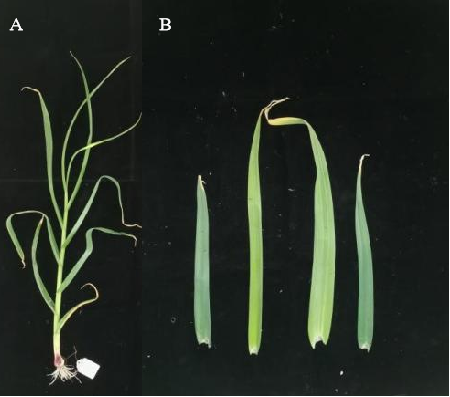
Phenotypic characteristics of leaf chlorosis due to wax deficiency in mutant JE046 A: Whole-plant phenotype; B: Leaf phenotype. From left to right: dark green, waxy yellow, yellow, dark green"

Fig. 2

Phenotypic characteristics of the folded terminal leaflet in mutant JZ053 A: 2024 field phenotype; B: 2025 phenotype; C: 2025 phenotype showing the folded terminal leaflet after removal of outer leaves"

Table 5

Correlations among phenotypic traits of mutant plants (2024 vs 2025)"

品种
Variety
假茎高
Pseudostem height
叶长
Leaf
length
叶片数
Number
of leaves
假茎粗
Pseudostem diameter
叶宽
Leaf
width
花茎长
Flower stem length
花苞长
Flower
bud length
蒜薹粗
Flower stem diameter
单薹重
Flower
stem weight
鳞茎重量
Bulb
weight
鳞茎横径
Bulb diameter
ESZ 0.635 0.499 -0.043 0.517 0.493 0.449 0.770 0.728 0.710 0.635 0.679
*** *** *** *** ** *** *** *** *** ***
ZYZ 0.732 0.692 0.450 0.404 0.463 0.381 0.617 0.475 0.528 0.738 0.589
*** *** ** ** ** ** *** *** *** *** ***

Table 6

Statistics on the number of key mutations for traits in the mutant library"

品种
Variety
性状
Characteristics
2024年优异
Outstanding
in 2024
2024年劣变
Deterioration
in 2024
2025年优异
Outstanding
in 2025
2025年劣变
Deterioration
in 2025
2年优异
Two years of outstanding mutation
2年劣变
Two years of deterioration
ESZ 假茎高Pseudostem height 7 11 2 15 2 8
叶长Leaf length 0 0 0 1 0 0
叶片数Number of leaves 0 0 0 2 0 0
假茎粗Pseudostem diameter 0 4 0 2 0 1
叶宽Leaf width 4 2 0 0 0 0
花茎长Flower stem length 2 2 0 1 0 1
花苞长Flower bud length 0 1 0 1 0 1
蒜薹粗Flower stem diameter 1 1 1 2 0 0
单薹重Flower stem weight 6 13 3 18 2 15
鳞茎重量Bulb weight 6 20 1 15 3 16
鳞茎横径Bulb diameter 0 1 0 0 0 1
ZYZ 假茎高Pseudostem height 3 4 9 11 3 5
叶长Leaf length 0 0 0 1 0 1
叶片数Number of leaves 0 1 0 1 0 0
假茎粗Pseudostem diameter 0 0 0 2 0 0
叶宽Leaf width 0 3 0 0 0 0
花茎长Flower stem length 1 2 0 1 0 1
花苞长Flower bud length 4 0 1 0 1 0
蒜薹粗Flower stem diameter 0 1 0 0 0 0
单薹重Flower stem weight 4 14 4 5 5 7
鳞茎重量Bulb weight 6 17 1 7 2 10
鳞茎横径Bulb diameter 1 0 0 0 0 0

Table 7

Statistics on the number of key mutations affecting traits in mutants"

品种
Variety
年份
Year
关键突变性状个数Number of key mutant traits
1 2 3 4 5 ≥6
ESZ 2024 22 16 4 0 3 0
2025 20 11 1 3 0 1
2年2 years 17 10 3 1 0 0
ZYZ 2024 18 10 5 2 0 0
2025 20 6 0 1 0 1
2年2 years 17 6 2 0 0 0

Table 8

Two-year stability analysis of mutant traits (compared to controls, %)"

品种
Variety
性状
Characteristics
假茎高
Pseudostem height
叶长
Leaf length
叶片数
Number
of leaves
假茎粗
Pseudostem diameter
叶宽
Leaf width
花茎长
Flower stem length
花苞长
Flower bud length
蒜薹粗
Flower stem diameter
单薹重
Flower stem weight
鳞茎重量
Bulb weight
鳞茎横径
Bulb diameter
ESZ 平均值Mean 17.57 9.29 13.94 14.11 14.96 12.60 9.85 9.87 20.76 19.00 7.43
高稳定占比Highly stable 38.30 61.70 38.30 38.30 36.17 55.32 65.96 59.57 34.04 33.90 74.58
稳定占比Stable 63.83 89.36 80.85 76.60 76.60 80.85 89.36 85.11 53.19 61.02 93.22
ZYZ 平均值Mean 17.47 8.81 8.55 9.17 12.27 14.36 11.50 8.98 21.91 16.84 8.30
高稳定占比Highly stable 23.26 62.79 62.79 62.79 51.16 35.42 56.25 66.67 31.25 37.25 60.78
稳定占比Stable 67.44 95.35 95.35 90.70 81.40 79.17 87.50 91.67 54.17 66.67 96.08
[1]
王子天, 范硕, 林榕姗, 谢亚铭, 魏海雷, 高淼, 林敏. 我国大蒜产业发展现状与展望[J]. 生物技术进展, 2025, 15(2): 179-188.

doi: 10.19586/j.2095-2341.2024.0173
Wang Z T, Fan S, Lin R S, Xie Y M, Wei H L, Gao M, Lin M. Current situation and prospect of garlic industry development in China[J]. Current Biotechnology, 2025, 15(2): 179-188. (in Chinese)

doi: 10.19586/j.2095-2341.2024.0173
[2]
彭丹, 齐传东, 赵晴晴, 周洁, 杨文杰, 吴金平, 郭凤领. 大蒜种质资源适应性的综合评价与筛选[J]. 中国蔬菜, 2025(5): 59-69.
Peng D, Qi C D, Zhao Q Q, Zhou J, Yang W J, Wu J P, Guo F L. Comprehensive evaluation and screening of adaptability of garlic germplasm resources[J]. China Vegetables, 2025(5): 59-69. (in Chinese)
[3]
Wang H P, Shemesh-Mayer E, Zhang J J, Gao S, Zeng Z, Yang Z M, Zhang X Y, Jia H X, Wang Y Z, Song J P, Zhang X H, Yang W L, He Q Y, Sherman A, Li L, Kamenetsky R, Liu T M. Genome resequencing reveals the evolutionary history of garlic reproduction traits[J]. Horticulture Research, 2023, 10(11): uhad208.
[4]
Shemesh-Mayer E, Faigenboim A, Sherman A, Gao S, Zeng Z, Liu T M, Kamenetsky-Goldstein R. Deprivation of sexual reproduction during garlic domestication and crop evolution[J]. International Journal of Molecular Sciences, 2023, 24(23): 16777.
[5]
何巧芸. 大蒜种质资源农艺性状评价及抽薹相关FT基因功能分析[D]. 北京: 中国农业科学院, 2022.
He Q Y. Evaluation of gronomic traits of garlic germplasm resources and functional analysis of bolting-related FT genes[D]. Beijing: Chinese Academy of Agricultural Sciences, 2022. (in Chinese)
[6]
吕厚军, 马静芝, 徐国启. 早薹蒜高产栽培技术[J]. 河南农业科学, 1994, 23(8): 41.
H J, Ma J Z, Xu G Q. High-yield cultivation techniques of early bolting garlic[J]. Journal of Henan Agricultural Sciences, 1994, 23(8): 41. (in Chinese)
[7]
薛艳, 席彦军, 蒋建华, 黄重. 汉中地区早薹蒜品种比较试验[J]. 长江蔬菜, 2011(2): 40-42.
Xue Y, Xi Y J, Jiang J H, Huang C. Comparison of early bolting garlic cultivars in Hanzhong[J]. Journal of Changjiang Vegetables, 2011(2): 40-42. (in Chinese)
[8]
Xu P Z, Zhang Q L, Xue L, Zhang Z, Luo N H, Cheng Z Y, Xia D, Zheng S Q, Wu X J, Zhou H. Genome-wide association analyses reveal the genetic basis of EMS mutagenesis efficiency in rice[J]. Advanced Science, 2026, 13(8): e17647.
[9]
Takagi H, Tamiru M, Abe A, Yoshida K, Uemura A, Yaegashi H, Obara T, Oikawa K, Utsushi H, Kanzaki E, Mitsuoka C, Natsume S, Kosugi S, Kanzaki H, Matsumura H, Urasaki N, Kamoun S, Terauchi R. MutMap accelerates breeding of a salt-tolerant rice cultivar[J]. Nature Biotechnology, 2015, 33(5): 445-449.

doi: 10.1038/nbt.3188 pmid: 25798936
[10]
Greene E A, Codomo C A, Taylor N E, Henikoff J G, Till B J, Reynolds S H, Enns L C, Burtner C, Johnson J E, Odden A R, Comai L, Henikoff S. Spectrum of chemically induced mutations from a large-scale reverse-genetic screen in Arabidopsis[J]. Genetics, 2003, 164(2): 731-740.
[11]
范昕琦, 王海燕, 陈静, 张晓娟, 郭琦, 梁笃, 周福平, 聂萌恩, 张一中, 柳青山. EMS诱变对高粱成苗及M1主要农艺性状的影响[J]. 生物技术通报, 2023, 39(7): 173-184.

doi: 10.13560/j.cnki.biotech.bull.1985.2022-1499
Fan X Q, Wang H Y, Chen J, Zhang X J, Guo Q, Liang D, Zhou F P, Nie M E, Zhang Y Z, Liu Q S. Effects of EMS mutagenesis on the seeding survival and major agronomic traits of sorghum in M1 generation[J]. Biotechnology Bulletin, 2023, 39(7): 173-184. (in Chinese)
[12]
Chen L Z, Duan L, Sun M H, Yang Z, Li H Y, Hu K M, Yang H, Liu L. Current trends and insights on EMS mutagenesis application to studies on plant abiotic stress tolerance and development[J]. Frontiers in Plant Science, 2023, 13: 1052569.
[13]
罗洪发, 查仁明, 杨洪海, 田永航, 薛建蜂, 张鹏. 水稻突变体的创制[J]. 中国农学通报, 2011, 27(27): 45-49.
Luo H F, Zha R M, Yang H H, Tian Y H, Xue J F, Zhang P. Creation of rice (Oryza sativa L.) mutant[J]. Chinese Agricultural Science Bulletin, 2011, 27(27): 45-49. (in Chinese)
[14]
Serrat X, Esteban R, Guibourt N, Moysset L, Nogués S, Lalanne E. EMS mutagenesis in mature seed-derived rice calli as a new method for rapidly obtaining TILLING mutant populations[J]. Plant Methods, 2014, 10(1): 5.

doi: 10.1186/1746-4811-10-5 pmid: 24475756
[15]
张纪元, 张平平, 姚金保, 杨丹, 杨学明, 马鸿翔. 以EMS诱变创制软质小麦宁麦9号高分子量谷蛋白亚基突变体[J]. 作物学报, 2014, 40(9): 1579-1584.
Zhang J Y, Zhang P P, Yao J B, Yang D, Yang X M, Ma H X. EMS induced HMW-GS mutants from soft wheat ningmai 9[J]. Acta Agronomica Sinica, 2014, 40(9): 1579-1584. (in Chinese)
[16]
黄永娟, 张凤启, 杨甜甜, 刘葛山, 蒋守华, 陈健美, 管荣展. EMS诱变甘蓝型油菜获得高油酸突变体[J]. 分子植物育种, 2011, 9(5): 611-616.
Huang Y J, Zhang F Q, Yang T T, Liu G S, Jiang S H, Chen J M, Guan R Z. High oleate mutants of Brassica napus produced by EMS inducement[J]. Molecular Plant Breeding, 2011, 9(5): 611-616. (in Chinese)
[17]
Hohmann U, Jacobs G, Jung C. An EMS mutagenesis protocol for sugar beet and isolation of non-bolting mutants[J]. Plant Breeding, 2005, 124(4): 317-321.
[18]
吴美骞. EMS诱导大蒜抗叶枯病突变体的筛选与鉴定[D]. 杨凌: 西北农林科技大学, 2021.
Wu M Q. Screening and identification of garlic leaf blight resistant mutants induced by ethyl methanesulfonate[D]. Yangling: Northwest A & F University, 2021. (in Chinese)
[19]
Hassan Hamza Abdel-halim Mostafa. 大蒜种质资源评价与愈伤组织的物理化学诱变技术研究[D]. 北京: 中国农业科学院, 2014.
Mostafa H H A. Garlic germplasm resources evaluation and somaclonal mutagenesis technology study based on gamma radiation and EMS treatment on callus[D]. Beijing: Chinese Academy of Agricultural Sciences, 2014. (in Chinese)
[20]
刘头明, 何巧芸, 王延周, 李富. 一种诱导大蒜多倍体或突变体的方法: CN202110518694.8[P]. 2022-07-19.
Liu T M, He Q Y, Wang Y Z, Li F. A method for inducing polyploidy or mutagenesis in garlic: CN202110518694.8[P]. 2022-07-19. (in Chinese)
[21]
臧辉, 任卫波. EMS诱变在植物育种中的研究与应用[J]. 分子植物育种, 2018, 16(17): 5782-5788.
Zang H, Ren W B. Research and application of EMS mutation in plant breeding[J]. Molecular Plant Breeding, 2018, 16(17): 5782-5788. (in Chinese)
[22]
陈天龙, 王彦荣, 王宇, 张吉宇, 刘志鹏. 蒺藜苜蓿EMS诱变突变体库的构建及突变体表型的分析[J]. 草业科学, 2015, 32(1): 71-77.
Chen T L, Wang Y R, Wang Y, Zhang J Y, Liu Z P. Construction of mutant populations by EMS and phenotypic analysis of Medicago truncatula[J]. Pratacultural Science, 2015, 32(1): 71-77. (in Chinese)
[23]
陈洋, 高兰英, 邵艳军, 张增艳. EMS诱导小麦易位系YW642突变体的鉴定与分子标记分析[J]. 核农学报, 2011, 25(4): 617-621, 651.
Chen Y, Gao L Y, Shao Y J, Zhang Z Y. Phenotypic identification and molecular analysis of a wheat line mutant YW642 induced by EMS[J]. Acta Agriculturae Nucleatae Sinica, 2011, 25(4): 617-621, 651. (in Chinese)
[24]
刘翔. EMS诱变技术在植物育种中的研究进展[J]. 激光生物学报, 2014, 23(3): 197-201.
Liu X. Progresses on EMS mutagenesis in plant breeding[J]. Acta Laser Biology Sinica, 2014, 23(3): 197-201. (in Chinese)
[25]
陈碧云, 吕培军, 张天瑶, 许鲲, 伍晓明. EMS诱变后甘蓝型油菜植株性状、种子粒重与含油量变异分析[J]. 中国油料作物学报, 2016, 38(6): 705-712.

doi: 10.7505/j.issn.1007-9084.2016.06.001
Chen B Y, P J, Zhang T Y, Xu K, Wu X M. Phenotypic variation of plant, seed-weight and oil content in Brassica napus induced by EMS[J]. Chinese Journal of Oil Crop Sciences, 2016, 38(6): 705-712. (in Chinese)
[26]
豆飞飞, 任毓昭, 王石磊, 刘春颖, 王晓东, 王昭懿, 刘彩霞, 刘凤楼, 王掌军, 李清峰. 宁春4号小麦EMS突变体库的构建及表型变异分析[J]. 生物技术通报, 2025, 41(8): 92-101.

doi: 10.13560/j.cnki.biotech.bull.1985.2025-0027
Dou F F, Ren Y Z, Wang S L, Liu C Y, Wang X D, Wang Z Y, Liu C X, Liu F L, Wang Z J, Li Q F. Construction and phenotypic variation analysis of ningchun No.4 wheat EMS mutant library[J]. Biotechnology Bulletin, 2025, 41(8): 92-101. (in Chinese)
[27]
Yan W, Deng X W, Yang C W, Tang X Y. The genome-wide EMS mutagenesis bias correlates with sequence context and chromatin structure in rice[J]. Frontiers in Plant Science, 2021, 12: 579675.
[28]
Türkoğlu A, Haliloğlu K, Tosun M, Bujak H, Eren B, Demirel F, Szulc P, Karagöz H, Selwet M, Özkan G, Niedbała G. Ethyl methanesulfonate (EMS) mutagen toxicity-induced DNA damage, cytosine methylation alteration, and iPBS-retrotransposon polymorphisms in wheat (Triticum aestivum L.)[J]. Agronomy, 2023, 13(7): 1767.
[29]
石海春, 陈超杰, 夏伟, 余学杰, 柯永培. EMS对三个玉米自交系的诱变效应分析[J]. 广西植物, 2016, 36(8): 906-914.
Shi H C, Chen C J, Xia W, Yu X J, Ke Y P. Analysis on mutagenic effects of EMS on three maize inbred lines[J]. Guihaia, 2016, 36(8): 906-914. (in Chinese)
[30]
杨一之, 邵明宇, 张嘉敏, 陈昌强, 邢虎成. 亚麻EMS诱变体系研究[J]. 中国麻业科学, 2025, 47(5): 255-260.
Yang Y Z, Shao M Y, Zhang J M, Chen C Q, Xing H C. Exploration of EMS mutagenesis dosage in flax[J]. Plant Fiber Sciences in China, 2025, 47(5): 255-260. (in Chinese)
[1] YE MeJin, WU Lei, MD NAHIBUZZAMAN Lohani, YIN Li, HU XinRong, LIU YaXi, JIANG YunFeng, CHEN GuoYue, PU ZhiEn, LI Yang, LI Ting, ZOU YaYa, WU JiaYi, MA Jian. Genome-Wide Association Study-Based Identification of Loci Controlling Mature Embryo Size in Chinese Wheat Landraces and Their Genetic Effects Analysis [J]. Scientia Agricultura Sinica, 2026, 59(6): 1157-1171.
[2] CUI ShiYou, CHEN PengJun, MIAO YuanQing, HAN JiJun, SHEN JunMing. Development and Field Evaluation of Glyphosate-Resistant Wheat Germplasm Generated Through EMS Mutagenesis [J]. Scientia Agricultura Sinica, 2026, 59(4): 723-733.
[3] YE MeiJin, WANG TongZhu, CHEN Bin, LOHANI Md Nahibuzzaman, CHEN JiaTing, HU XinRong, YIN Li, WANG Chao, ZHANG HaoPeng, YANG Xia, WANG JiaLin, YAO QiFu, DING PuYang, WANG Feng, LI XiaoYu, MA Jian. Genetic Dissection of Stem Internode Length and Its Effects in Wheat Based on a Genome-Wide Association Study [J]. Scientia Agricultura Sinica, 2026, 59(12): 2551-2562.
[4] ZHANG TianYu, LIU LiJun, YANG Gang, WU JunYan, PU YuanYuan, MA Li, WANG WangTian, LU XiaoMing, MA YuanQiang, SUN WanCang. Genetic Gain Analysis of Agronomic Traits of Brassica rapa L. in Northern China from 2006 to 2022 [J]. Scientia Agricultura Sinica, 2025, 58(11): 2081-2095.
[5] CHEN WuRong, XIAO ShuangShuang, XIAO Jun, CHEN Dan. Effects of Land Utilization Methods on Soil Organic Carbon and Its Labile Fractions in Karst Peak-Cluster Depression [J]. Scientia Agricultura Sinica, 2025, 58(10): 1969-1981.
[6] DUAN HuiMin, LIU LingLing, XIA LuLu, YUAN JianLong, CHENG LiXiang, CHEN AiRong, ZHANG Feng. Screening of Low Glycemic Potato Varieties [J]. Scientia Agricultura Sinica, 2024, 57(12): 2295-2308.
[7] NAN Rui, YANG YuCun, SHI FangHui, ZHANG LiNing, MI TongXi, ZHANG LiQiang, LI ChunYan, SUN FengLi, XI YaJun, ZHANG Chao. Identification of Excellent Wheat Germplasms and Classification of Source-Sink Types [J]. Scientia Agricultura Sinica, 2023, 56(6): 1019-1034.
[8] FAN Tao,LI Zhi,JIANG Qing,CHEN ShuLin,OU Xia,CHEN YongYan,REN TianHeng. Development and Effect Evaluation of KASP Markers Closely Linked to Major QTLs of Spike Number Per Unit Area and Grain Length in Wheat [J]. Scientia Agricultura Sinica, 2021, 54(14): 2941-2951.
[9] YaLin LI,XuBo ZHANG,FengLing REN,Nan SUN,Meng XU,MingGang XU. A Meta-Analysis of Long-Term Fertilization Impact on Soil Dissolved Organic Carbon and Nitrogen Across Chinese Cropland [J]. Scientia Agricultura Sinica, 2020, 53(6): 1224-1233.
[10] WenJing HU,ChunMei ZHANG,Di WU,ChengBin LU,YaChao DONG,XiaoMing CHENG,Yong ZHANG,DeRong GAO. Screening for Resistance to Fusarium Head Blight and Agronomic Traits of Wheat Germplasms from Yangtze River Region [J]. Scientia Agricultura Sinica, 2020, 53(21): 4313-4321.
[11] WU CaoYang,LIANG ShiHan,QIU Jun,GAO JinFeng,GAO XiaoLi,WANG PengKe,FENG BaiLi,YANG Pu. An Examination on Breeding Status Quo of Chinese Tartary Buckwheat Varieties Based on the National Cross-Country Tests of Tartary Buckwheat Varieties in China over 12 Consecutive Years [J]. Scientia Agricultura Sinica, 2020, 53(19): 3878-3892.
[12] WANG HaiLian,WANG RunFeng,LIU Bin,ZHANG HuaWen. Effects of Harvesting at Different Growth Stage on Agronomic and Nutritional Quality Related Traits of Sweet Sorghum [J]. Scientia Agricultura Sinica, 2020, 53(14): 2804-2813.
[13] SUN Hua,MA HongXia,DING MengJun,LI Po,SHI Jie,LIU ShuSen. Construction and Evaluation of ATMT Mutant Library of Fusarium verticillioides [J]. Scientia Agricultura Sinica, 2019, 52(8): 1380-1388.
[14] WANG HuiLing,WANG XiaoYue,YAN AiLing,SUN Lei,ZHANG GuoJun,REN JianCheng,XU HaiYing. The Accumulation of Monoterpenes and the Expression of Its Biosynthesis Related Genes in ‘Aishen Meigui’ Grape Berries Cultivated in Different Trellis Systems During Ripening Stage [J]. Scientia Agricultura Sinica, 2019, 52(7): 1136-1149.
[15] JianFeng LI,Bo ZHANG,JianZhang QUAN,YongFang WANG,XiaoMei ZHANG,Yuan ZHAO,XiLei YUAN,XiaoPing JIA,ZhiPing DONG. Associated Loci Detection and Elite Allelic Variations Analysis of Main Agronomic Traits in Foxtail Millet (Setaria italica L.) Based on SSR Markers [J]. Scientia Agricultura Sinica, 2019, 52(24): 4453-4469.
Viewed
Full text


Abstract

Cited

  Shared   
  Discussed   
No Suggested Reading articles found!