Scientia Agricultura Sinica ›› 2026, Vol. 59 ›› Issue (8): 1760-1774.doi: 10.3864/j.issn.0578-1752.2026.08.012

• HORTICULTURE • Previous Articles     Next Articles

Polyphenolic Diversity and Genotypic Analysis of Tea Plants with Different Parents and Their F1 Progeny

YAO Lin1,2,3(), PENG LüWen1,2,3, YANG Hong1,2,3, RAO JiaYi1,2,3, GAO HaoRan1,2,3, TAO QianYi1,2,3, XIE NianCi2, CHEN YingYu2, LI SaiJun2,*(), LIU ShuoQian1,3,*(), HUANG FeiYi2,3,4,*()   

  1. 1 College of Horticulture, Hunan Agricultural University, Changsha 410128
    2 Tea Research Institute, Hunan Academy of Agricultural Sciences/National Tea Plant Improvement Centre Hunan Branch/National Small-Leaf Tea Germplasm Resource Nursery (Changsha), Changsha 410000
    3 Yuelu Mountain Laboratory, Changsha 410000
    4 Hunan Provincial Institute of Microbiology, Changsha 410007
  • Received:2025-12-01 Accepted:2026-01-27 Online:2026-04-16 Published:2026-04-21
  • Contact: LI SaiJun, LIU ShuoQian, HUANG FeiYi

Abstract:

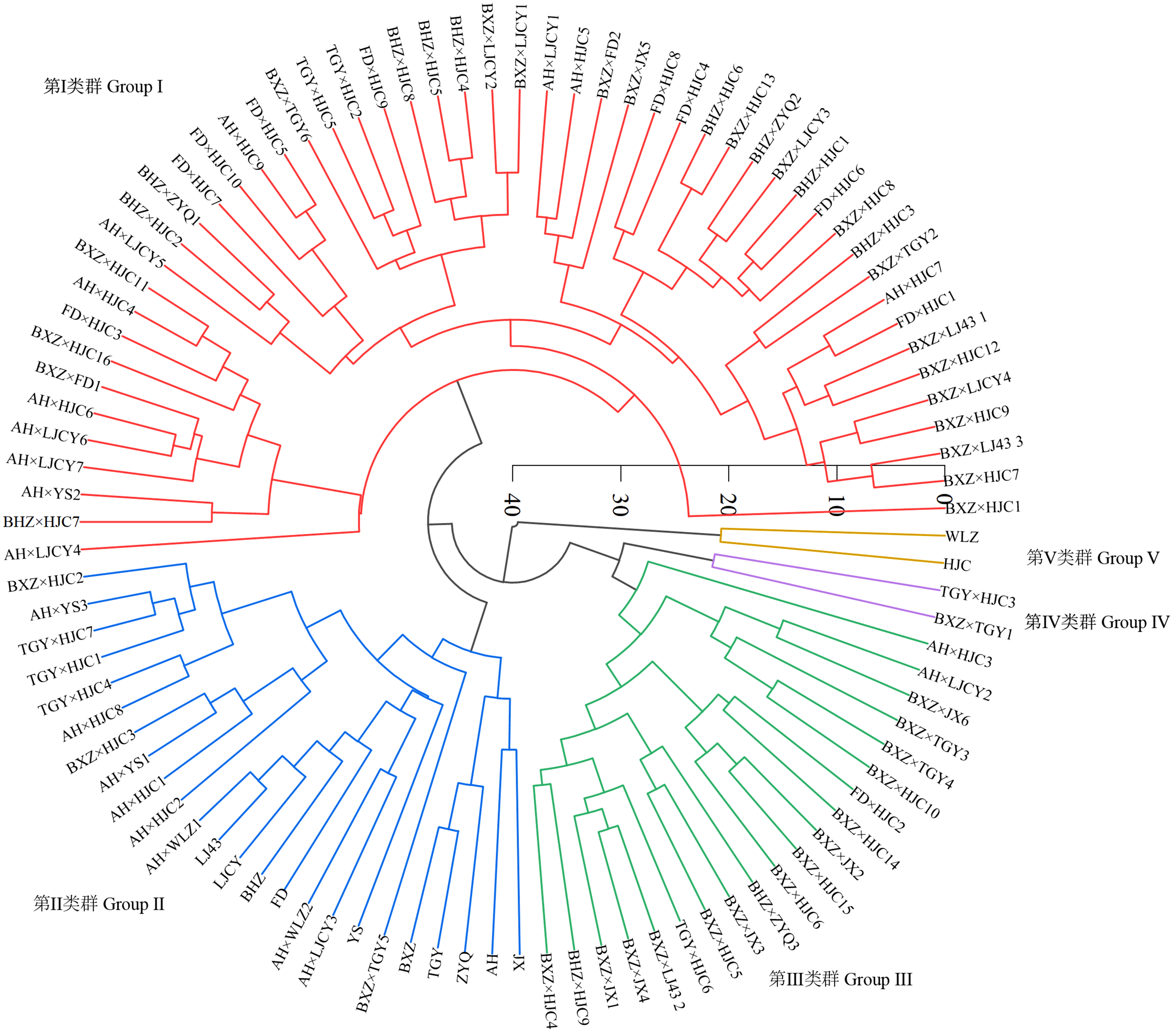
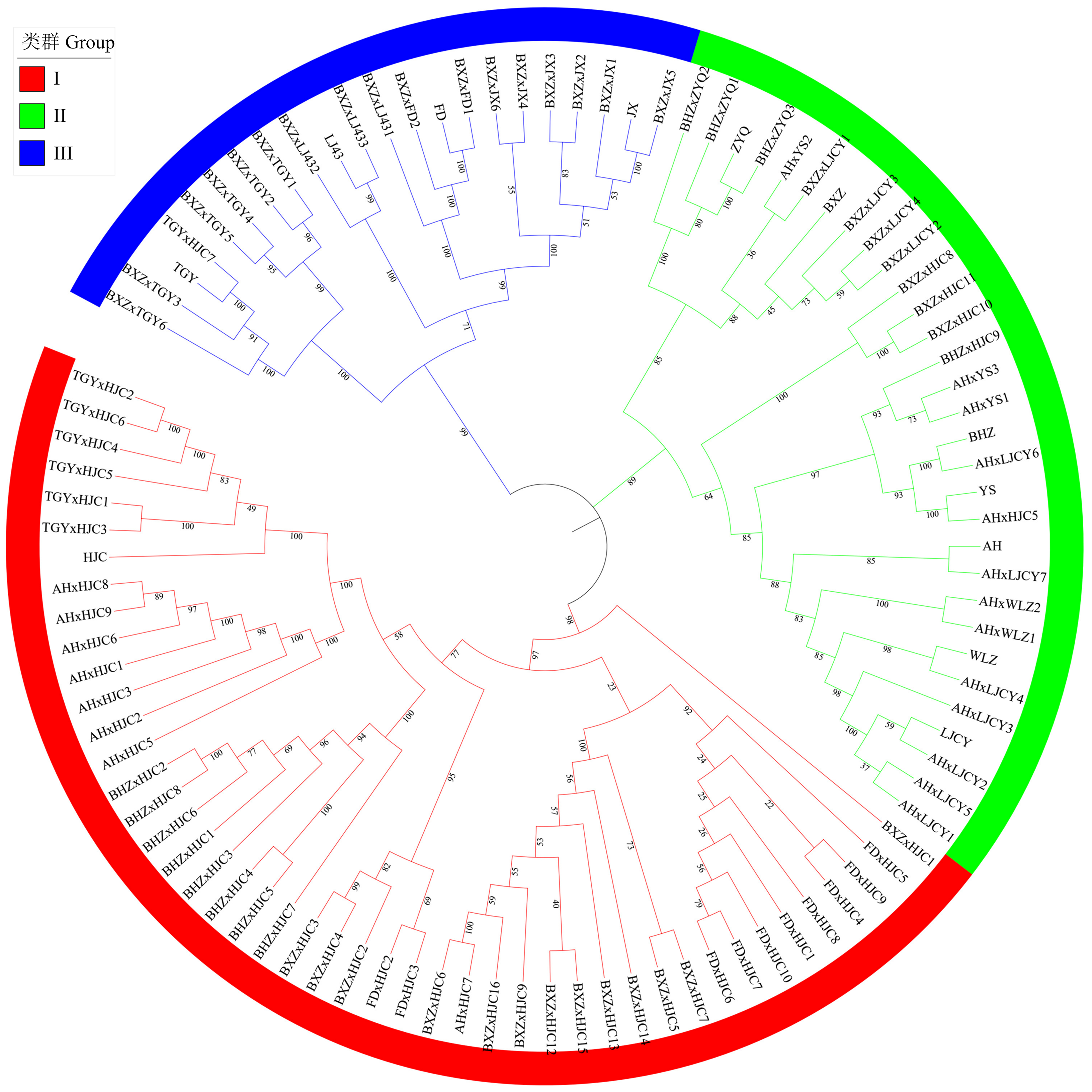
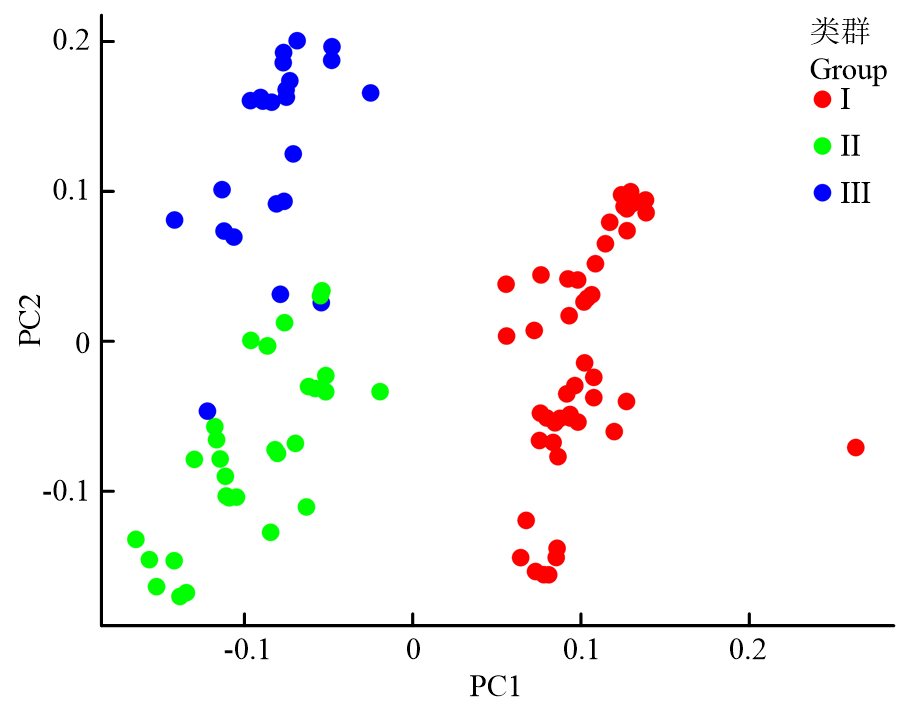
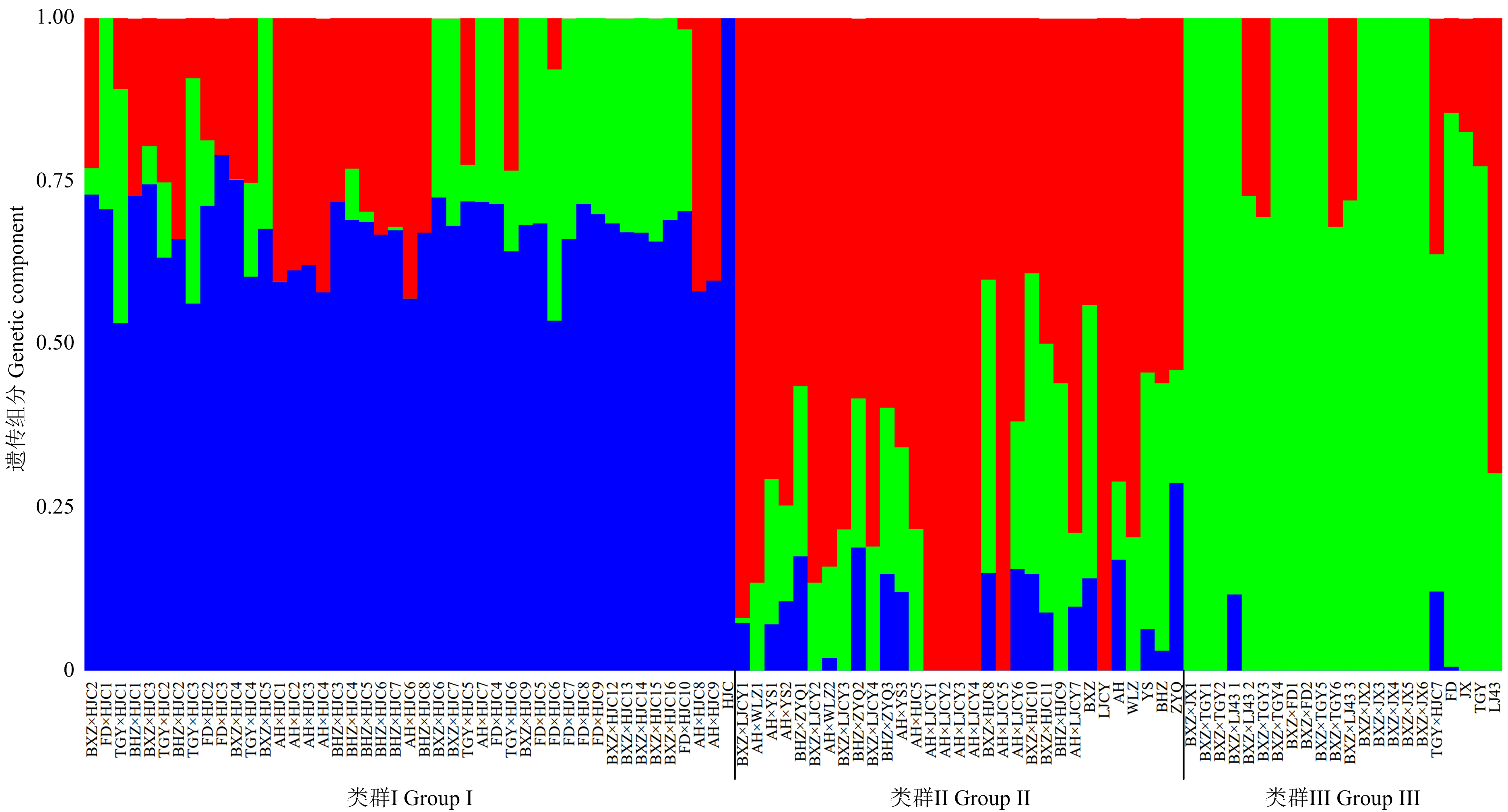
【Objective】To investigate the genetic diversity of polyphenolic compounds in tea plant parents and their F1 progeny, and to elucidate variations in polyphenolic composition among different hybrid combinations, as well as the population structure and genetic relationships of their genotypes, thereby providing support for parental selection and quality improvement in tea plant breeding.【Method】Twelve parental tea plant samples and 87 F1 progenies were used as experimental materials. Twelve polyphenolic polyphenolic indices were determined during 2024-2025, and multidimensional evaluations were performed using methods including systematic clustering, hybrid combination difference analysis, and population structure analysis. 【Result】The coefficients of variation for polyphenols varied between 14.50% and 89.34%. Notably, Strictinin (STR), 1,2,6-trigalloylglucose (1,2,6-TGG), epigallocatechin 3-O-(3-O-methyl) gallate (EGCG3″Me), gallocatechin gallate (GCG), and catechin gallate (CG) exhibited high coefficients of variation of 89.34%, 66.45%, 64.22%, 59.34%, and 58.12%, respectively. The Shannon Wiener indices ranged from 1.86 to 4.57, with the highest indices observed for epigallocatechin gallate (EGCG), trigalloyl quinuclidinic acid (TH), and gallocatechin gallate (GCG), which were 4.57, 4.45, and 4.23, respectively. In the differential analysis of polyphenolic compounds, the F1 progeny resulting from the cross between HJC and AH demonstrated higher levels of catechin gallate (CG) and trigalloylquinic acid (TH) compared to both parental lines. While the levels of epicatechin 3-O-(3-O-methyl) gallate (EGCG3"Me) were consistent with those of the parents. Using polyphenol cluster analysis, the 99 samples were grouped into five clusters: Group Ⅰ contained 49 samples, Group Ⅱ contained 26 samples, Group Ⅲ contained 20 samples, and Group Ⅳ and Ⅴ each contained 2 samples. Analysis of population structure based on SNP loci classified the 12 parental lines and 87 F1 offspring into three groups: Group Ⅰ comprised 46 accessions, Group Ⅱ comprised 31 accessions, and Group Ⅲ comprised 22 accessions. Notably, Group Ⅰ consisted entirely of the parental line HJC and its F1 offspring sired by this male parent. The levels of genetic diversity among the three groups were similar. The results of the kinship analysis show that the F1 offspring are more closely related to their paternal parent (♂).【Conclusion】The 99 tea plant accessions exhibited rich genetic diversity. Biochemical component-based clustering divided the 99 tea plant accessions into five groups. CG and TH may exhibit overdominant heterosis, while EGCG3"Me exhibited a largely consistent accumulation pattern between the parental lines and their F1 progeny, with no evident transgressive segregation or pronounced non-additive effects. Biochemical profiling grouped the 99 tea accessions into five groups, while SNP-based population structure identified three genetically similar subpopulations. Genome-wide analyses also revealed that, in the majority of crosses, F1 progeny exhibited greater similarity to the paternal parent.

Key words: tea plants, hybridisation, polyphenolic constituents, genotype, genetic diversity

Table 1

Polyphenolic compounds statistics and genetic diversity of tea germplasm resources"

生化成分
Biochemical components
最小值
Min
最大值
Max
平均值
Mean
标准差
SD
变异系数
CV (%)
香农维纳指数
H'
没食子儿茶素GC (mg·g-1) 1.00 4.90 2.16 0.74 37.05 3.91
表没食子儿茶素EGC (mg·g-1) 1.23 32.75 14.13 5.56 44.33 4.12
儿茶素C (mg·g-1) 0.29 2.75 1.29 0.45 32.15 3.88
表儿茶素EC (mg·g-1) 2.99 11.72 5.61 1.59 31.20 4.01
表没食子儿茶素没食子酸酯EGCG (mg·g-1) 62.50 129.13 93.10 13.92 16.28 4.57
没食子儿茶素没食子酸酯GCG (mg·g-1) 1.47 28.60 11.67 7.06 59.34 4.23
表儿茶素没食子酸酯ECG (mg·g-1) 14.70 39.64 28.22 5.49 24.50 4.18
儿茶素没食子酸酯CG (mg·g-1) 0.09 2.98 1.04 0.63 58.12 3.26
小木麻黄STR (mg·g-1) 0.70 18.03 6.24 4.35 89.34 3.57
三没食子酰基奎宁酸TH (mg·g-1) 27.94 93.01 60.65 13.16 20.18 4.45
1,2,6-三没食子酰基葡萄糖1,2,6-TGG (mg·g-1) 0.02 5.28 0.87 0.66 66.45 2.99
表儿茶素3-O-(3-O-甲基)没食子酸酯EGCG3"Me (mg·g-1) 0.30 6.53 2.19 1.27 64.22 3.35
酯型儿茶素Ester catechins (mg·g-1) 101.20 176.21 133.92 17.11 15.00 2.18
非酯型儿茶素Non-ester catechins (mg·g-1) 8.75 49.82 23.78 7.84 33.33 1.86
儿茶素总量Total catechins (mg·g-1) 118.85 200.52 157.56 19.12 14.50 2.20
平均值Mean 40.40 3.52

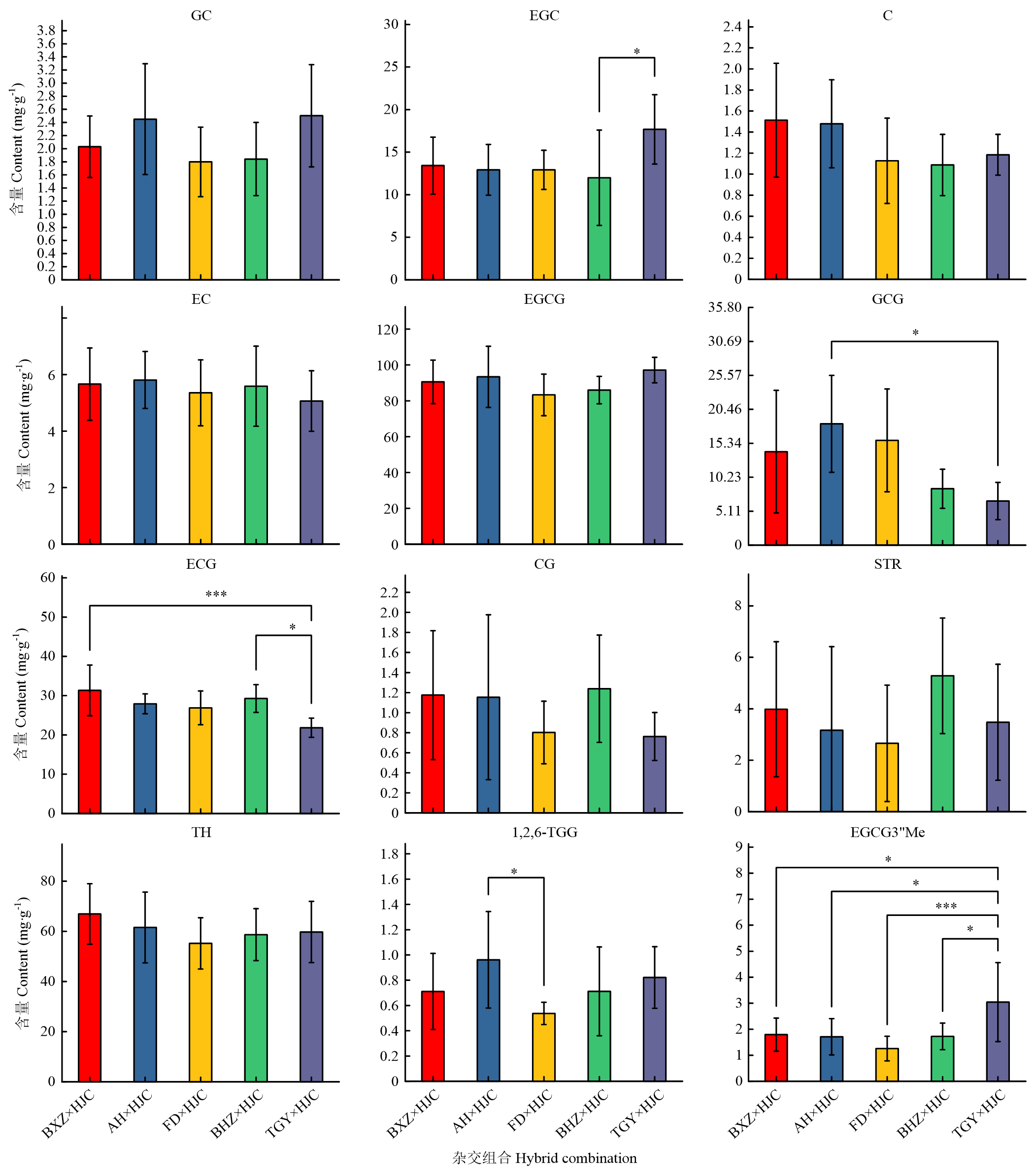
Fig. 1

Analysis of polyphenolic compounds in F1 hybrids of hjc as the male parent and various female parents *: P<0.05; **: P<0.01; ***: P<0.001. The same as below"

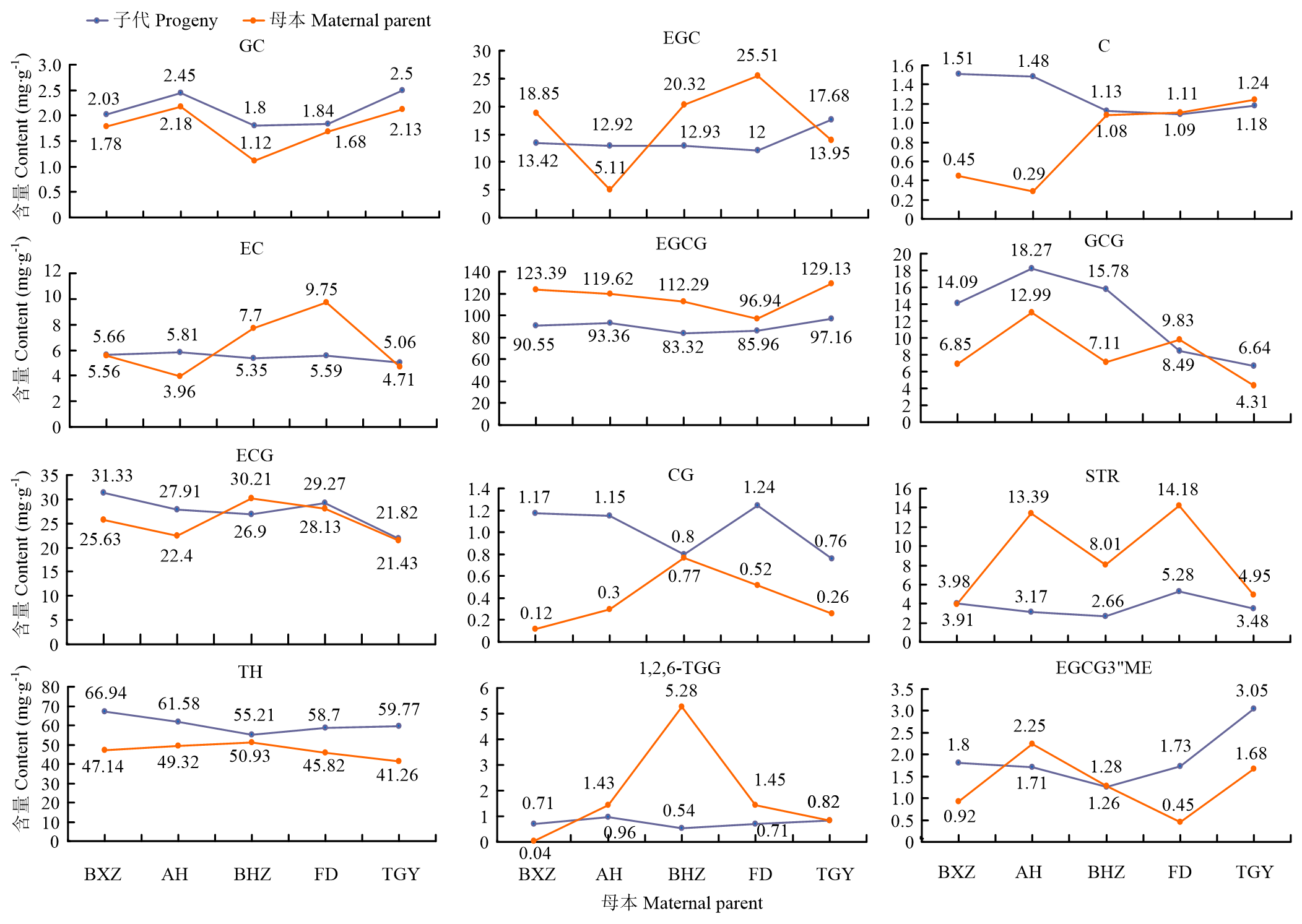
Fig. 2

Trend chart of polyphenol content in F1 hybrids resulting from crosses between HJC (paternal parent) and different maternal parents"

Table 2

Analysis of polyphenolic compounds in F1 hybrids resulting from crosses between HJC as the male parent and various female parents"

生化成分
Biochemical components
父本
Paternal parent HJC (♂)
母本Maternal parent (♀) 杂交组合Hybrid combination (♀×♂)
BXZ AH FD BHZ TGY BXZ×HJC AH×HJC FD×HJC BHZ×HJC TGY×HJC
没食子儿茶素GC (mg·g-1) 1.91 1.78 2.18 1.12 1.68 2.13 2.03 2.45 1.80 1.84 2.50
表没食子儿茶素EGC (mg·g-1) 32.75 18.85 5.11 20.32 25.51 13.95 13.42 12.94 12.93 12.00 17.68
儿茶素C (mg·g-1) 1.46 0.45 0.29 1.08 1.11 1.24 1.51 1.48 1.13 1.09 1.18
表儿茶素EC (mg·g-1) 8.64 5.56 3.96 7.70 9.75 4.71 5.66 5.81 5.35 5.59 5.06
表没食子儿茶素没食子酸酯
EGCG (mg·g-1)
98.52 123.39 119.62 112.29 96.94 129.13 90.55 93.36 83.32 85.96 97.16
没食子儿茶素没食子酸酯
GCG (mg·g-1)
11.10 6.85 12.99 7.11 9.83 4.31 14.09 18.27 15.78 8.49 6.64
表儿茶素没食子酸酯ECG (mg·g-1) 26.54 25.63 22.4 30.21 28.13 21.43 31.33 27.91 26.90 29.27 21.82
儿茶素没食子酸酯CG (mg·g-1) 0.30 0.12 0.30 0.77 0.52 0.26 1.17 1.15 0.80 1.24 0.76
小木麻黄素STR (mg·g-1) 1.23 3.91 13.39 8.01 14.18 4.95 3.98 3.17 2.66 5.28 3.48
三没食子酰基奎宁酸TH (mg·g-1) 41.43 47.14 49.32 50.93 45.82 41.26 66.94 61.58 55.21 58.70 59.77
1,2,6-三没食子酰基葡萄糖1,2,6-TGG (mg·g-1) 2.12 0.04 1.43 5.28 1.45 0.82 0.71 0.96 0.54 0.71 0.82
表儿茶素3-O-(3-O-甲基)
没食子酸酯EGCG3"Me (mg·g-1)
0.89 0.92 2.25 1.28 0.45 1.70 1.80 1.71 1.26 1.73 3.05

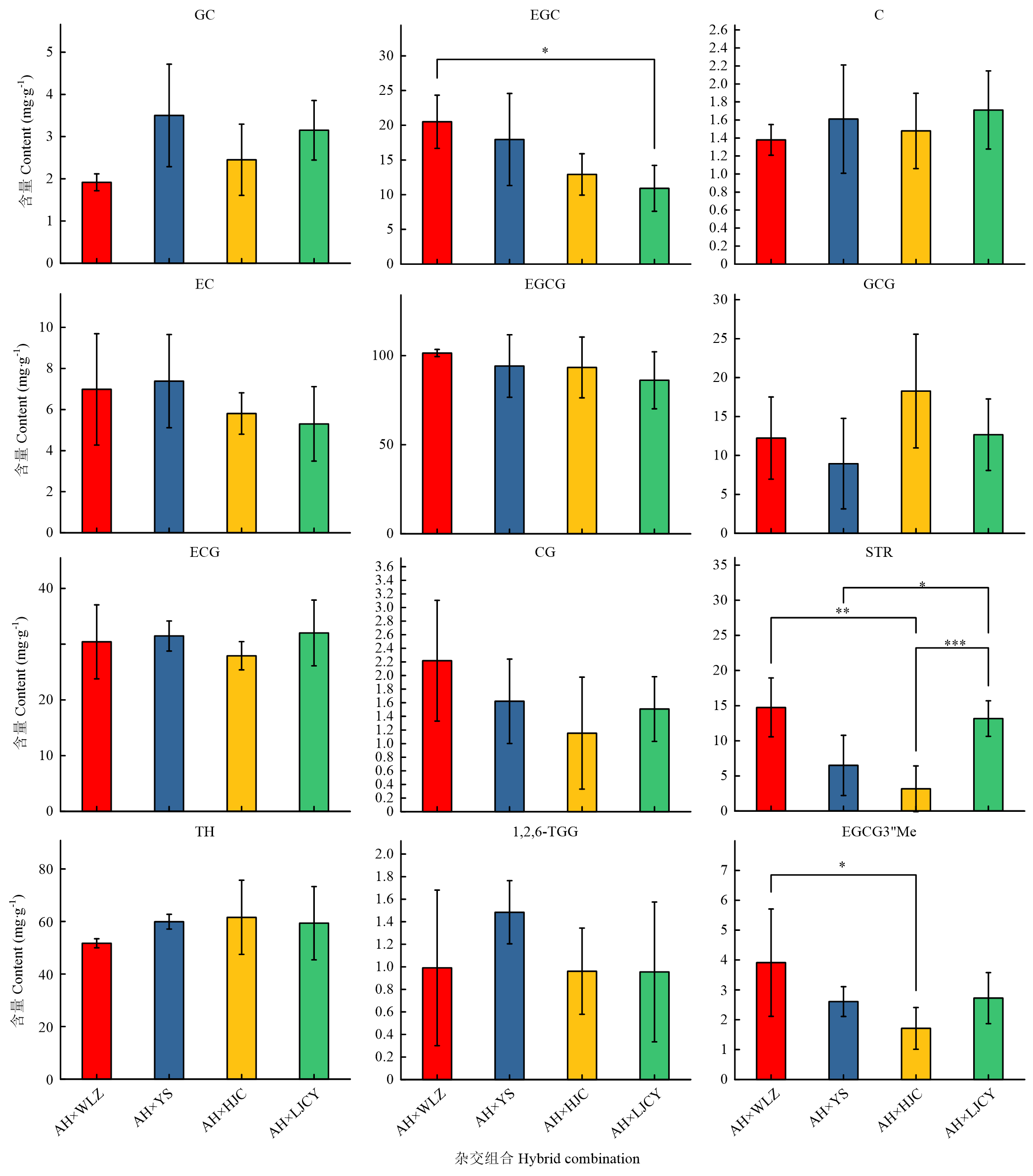
Fig. 3

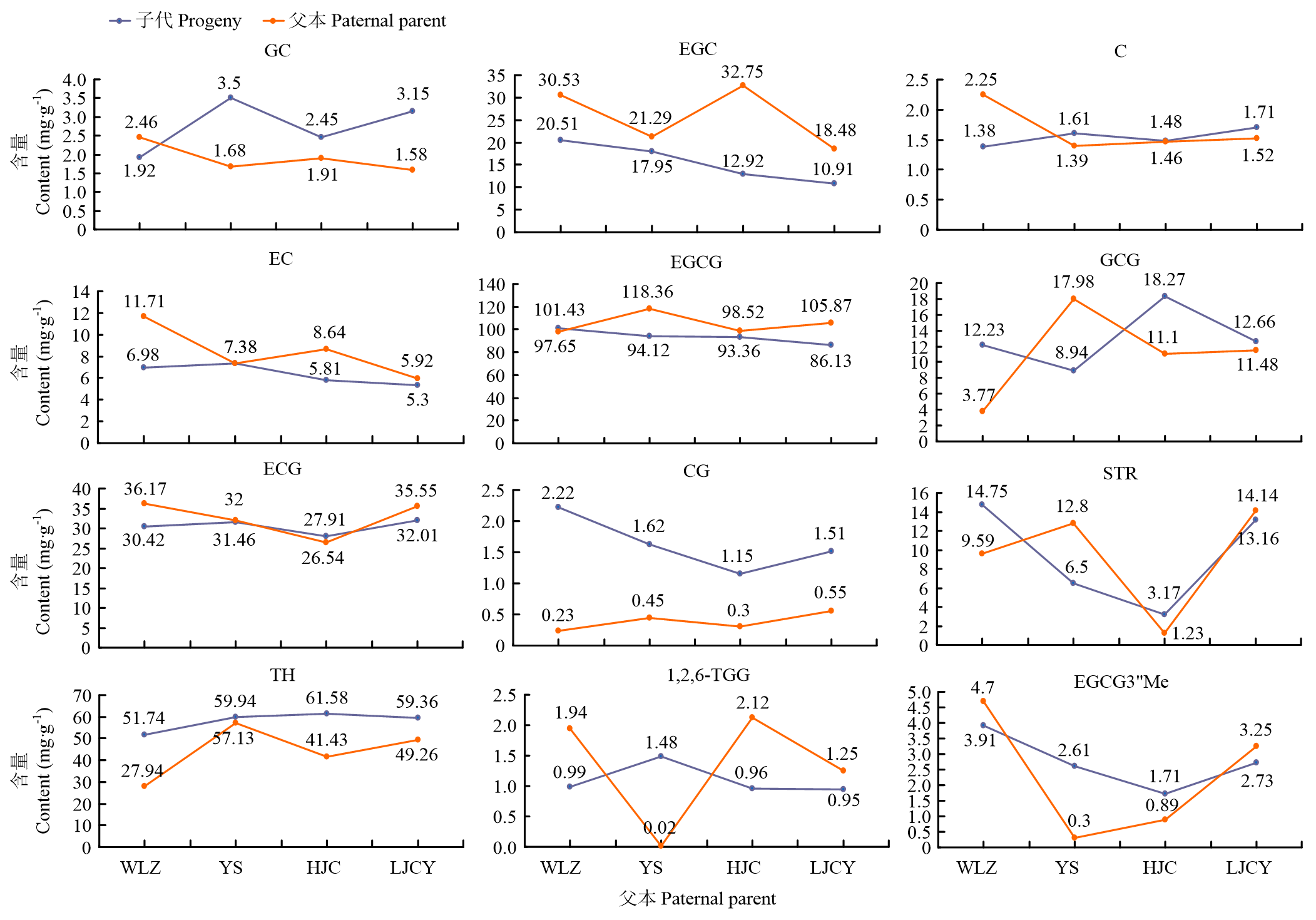
Analysis of polyphenolic compounds in F1 hybrids of ah as the female parent and various male parents"

Fig. 4

Trend chart of polyphenolic compounds in F1 progeny from crosses between AH (maternal line) and different paternal lines"

Table 3

Analysis of polyphenolic compounds in F1 hybrids of AH as the female parent and various male parents"

生化成分
Biochemical components
母本
Maternal
parent AH (♀)
父本Paternal parent (♂) 杂交组合Hybrid combination (♀×♂)
WLZ YS HJC LJCY AH×WLZ AH×YS AH×HJC AH×LJCY
没食子儿茶素GC (mg·g-1) 2.18 2.46 1.68 1.91 1.58 1.92 3.50 2.45 3.15
表没食子儿茶素EGC (mg·g-1) 5.11 30.53 21.29 32.75 18.48 20.51 17.95 12.92 10.91
儿茶素C (mg·g-1) 0.29 2.25 1.39 1.46 1.52 1.38 1.61 1.48 1.71
表儿茶素EC (mg·g-1) 3.96 11.71 7.38 8.64 5.92 6.98 7.38 5.81 5.30
表没食子儿茶素没食子酸酯EGCG (mg·g-1) 119.62 97.65 118.36 98.52 105.87 101.43 94.12 93.36 86.13
没食子儿茶素没食子酸酯GCG (mg·g-1) 12.99 3.77 17.98 11.10 11.48 12.23 8.94 18.27 12.66
表儿茶素没食子酸酯ECG (mg·g-1) 22.40 36.17 32.00 26.54 35.55 30.42 31.46 27.91 32.01
儿茶素没食子酸酯CG (mg·g-1) 0.30 0.23 0.45 0.30 0.55 2.22 1.62 1.15 1.51
小木麻黄素STR (mg·g-1) 13.39 9.59 12.80 1.23 14.14 14.75 6.50 3.17 13.16
三没食子酰基奎宁酸TH (mg·g-1) 49.32 27.94 57.13 41.43 49.26 51.74 59.94 61.58 59.36
1,2,6-三没食子酰基葡萄糖 1,2,6-TGG (mg·g-1) 1.43 1.94 0.02 2.12 1.25 0.99 1.48 0.96 0.95
表儿茶素3-O-(3-O-甲基)没食子酸酯EGCG3"Me (mg·g-1) 2.25 4.70 0.30 0.89 3.25 3.91 2.61 1.71 2.73

Fig. 5

Clustering of 12 parents as well as 87 F1 progeny The names of the varieties shown in the diagram correspond to those in Supplementary Table 1"

Table 4

Comparison of polyphenolic compounds among different groups"

生化成分
Biochemical components
第Ⅰ类群Group Ⅰ 变异系数CV (%) 第Ⅱ类群Group Ⅱ 变异系数CV (%) 第Ⅲ类群Group Ⅲ 变异系数CV (%) 第Ⅳ类群Group Ⅳ 变异系数CV (%) 第Ⅴ类群Group Ⅴ 变异系数CV (%)
没食子儿茶素GC (mg·g-1) 2.01±0.69 38.31 2.30±0.84 36.02 2.27±0.68 29.15 3.03±0.46 15.13 2.19±0.39 17.75
表没食子儿茶素
EGC (mg·g-1)
12.07±3.78 37.53 16.41±6.03 37.71 14.84±4.80 34.91 10.60±2.09 19.68 31.64±1.57 4.95
儿茶素C (mg·g-1) 1.21±0.42 34.92 1.22±0.40 34.88 1.47±0.51 34.23 1.50±0.36 24.13 1.85±0.56 30.26
表儿茶素EC (mg·g-1) 5.37±1.31 28.28 5.85±1.55 30.51 5.52±1.64 31.02 4.66±0.28 6.07 10.18±2.18 21.43
表没食子儿茶素没食子酸酯EGCG* (mg·g-1) 83.35±9.28 14.99 106.41±10.65 10.96 98.24±10.26 11.52 102.43±3.81 3.72 98.08±0.62 0.63
没食子儿茶素没食子酸酯
GCG (mg·g-1)
27.75±5.24 60.93 27.61±5.12 67.86 29.34±6.56 65.41 33.34±2.05 24.08 31.35±6.18 69.60
表儿茶素没食子酸酯
ECG (mg·g-1)
11.68±5.88 19.25 10.23±6.50 19.91 11.69±7.07 21.74 34.46±8.30 6.15 7.44±5.18 21.74
儿茶素没食子酸酯
CG (mg·g-1)
1.17±0.64 59.13 0.75±0.61 82.35 1.17±0.53 54.31 1.31±0.07 5.00 0.26±0.05 18.24
小木麻黄素STR (mg·g-1) 5.78±4.09 69.91 6.97±5.22 68.38 6.97±3.65 56.91 1.35±0.67 49.45 5.41±5.91 109.43
三没食子酰基奎宁酸
TH* (mg·g-1)
56.39±8.65 18.55 54.67±7.03 13.40 78.42±6.17 9.22 90.94±3.93 3.22 34.68±9.53 27.49
1,2,6-三没食子酰基葡萄糖
1,2,6-TGG* (mg·g-1)
0.73±0.41 61.73 1.17±1.01 100.00 0.72±0.31 42.47 0.77±0.26 33.84 2.03±0.13 6.39
表儿茶素3-O-(3-O-甲基)
没食子酸酯
EGCG3"Me (mg·g-1)
2.15±1.19 49.78 2.20±1.40 61.33 2.26±1.33 55.36 1.69±0.08 4.94 2.79±2.69 94.40
酯型儿茶素
Ester catechins* (mg·g-1)
123.94±11.52
9.26
145.00±13.74
9.47
140.44±15.22
10.84
171.54±6.60
3.85
137.14±0.69
0.50
非酯型儿茶素
Non-ester catechins (mg·g-1)
20.66±5.23
25.41
25.78±7.38
28.63
24.10±6.72
27.88
19.79±3.19
16.12
45.86±1.10
2.40
儿茶素总量
Total catechins* (mg·g-1)
144.61±13.49 9.31 170.79±15.91 9.31 164.54±17.07 10.37 191.33±3.42 1.79 183.00±1.79 0.98

Fig. 6

Phylogenetic tree of 99 tea germplasms"

Fig. 7

PCA plot based on cluster analysis"

Fig. 8

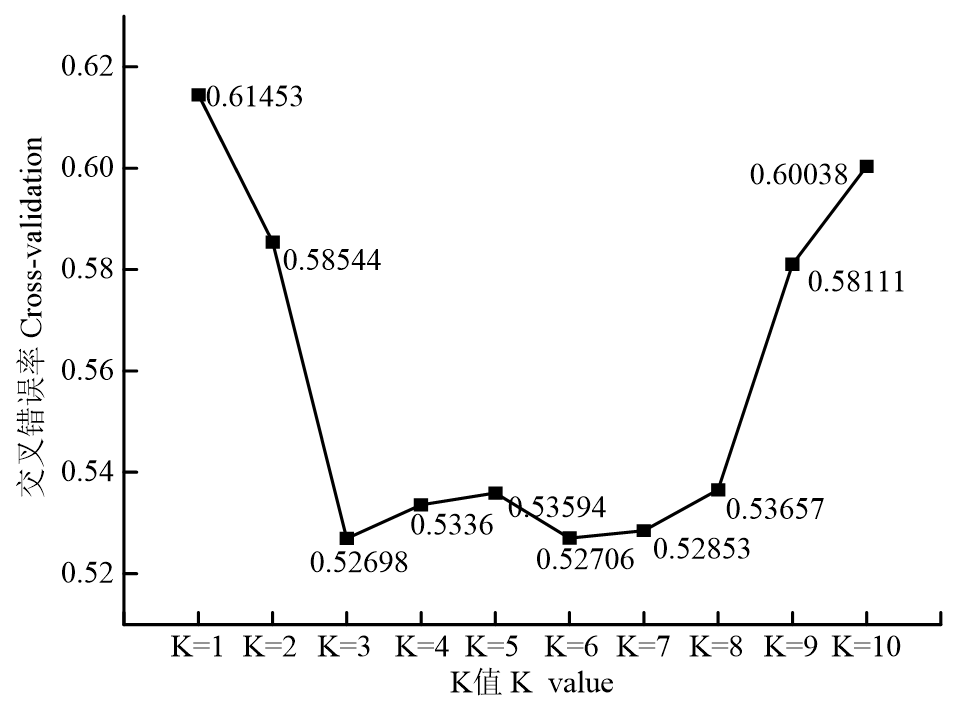
Plot of cross-validation error results for different K values"

Fig. 9

Population genetic picture of 99 tea plant germplasm (K=3)"

Table 5

Population genetic analysis based on phylogenetic trees and PCA"

群体Group 统计值Statistical value 观测杂合度Ho 核苷酸多样性Pi 次要等位基因频率MAF Tajima D
类群I
GroupⅠ
均值Mean 0.3593 0.3347 0.2438 1.4076
范围Scope 0.2722-0.4682 0.0217-0.5072 0.0109-0.4891 1.7320-4.1697
标准差Standard deviation 0.0366 0.1479 0.1398 1.0458
类群Ⅱ
GroupⅡ
均值Mean 0.333 0.3567 0.2601 1.4692
范围Scope 0.2222-0.4575 0.0323-0.5128 0.0161-0.4839 1.6765-3.7968
标准差Standard deviation 0.0458 0.1384 0.1352 0.9778
类群Ⅲ
GroupⅢ
均值Mean 0.3514 0.3612 0.2605 1.3231
范围Scope 0.2813-0.4039 0.0455-0.5185 0.0227-0.4773 1.9984-3.5123
标准差Standard deviation 0.0313 0.1395 0.1345 0.9295

Table 6

Affinities of different hybrid combinations"

亲本
Progenitor
杂交组合Hybrid combination (♀×♂)
BXZ×HJC FD×HJC TGY×HJC BHZ×HJC AH×HJC AH×WLZ AH×YS AH×LJCY
HJC 0.212605 0.23019 0.293631 0.172983 0.236611 -0.28373 -0.21252 -0.27177
BXZ 0.015267 0.054041 -0.1455 -0.14531 -0.16359 -0.04902 0.029275 -0.06216
FD -0.04485 0.168739 -0.28169 -0.06509 -0.22244 -0.00501 -0.01567 -0.02824
TGY -0.17103 -0.18002 0.227238 -0.1377 -0.12389 0.051176 -0.00375 0.057699
BHZ -0.12608 -0.04959 -0.19383 0.196244 -0.15651 0.189376 0.128366 0.074549
AH -0.07723 -0.11747 -0.03005 -0.10445 0.122742 0.175107 0.100038 0.20454
WLZ -0.1396 -0.13541 -0.07616 -0.07392 -0.01897 0.308916 0.146261 0.222057
YS -0.09951 -0.06611 -0.12021 0.04361 -0.06821 0.081748 0.119565 0.066444
LJCY -0.16854 -0.16633 -0.10071 -0.10107 -0.0772 0.147376 0.069976 0.446203
[1]
陈亮, 杨亚军, 虞富莲. 中国茶树种质资源研究的主要进展和展望. 植物遗传资源学报, 2004, 5(4): 389-392.
CHEN L, YANG Y J, YU F L. Tea germplasm research in China: Recent progresses and prospects. Journal of Plant Genetic Resources, 2004, 5(4): 389-392. (in Chinese)
[2]
雷雨, 李赛君, 罗意, 黄飞毅, 段继华, 康彦凯, 陈莹玉, 丁玎, 董丽娟. 特早生优质茶树新品种'金栀'选育报告. 茶叶通讯, 2022, 49(4): 458-463.
LEI Y, LI S J, LUO Y, HUANG F Y, DUAN J H, KANG Y K, CHEN Y Y, DING D, DONG L J. Research on breeding of new tea cultivar Jinzhi with ultra-early bud breaking and high quality traits. Tea Communication, 2022, 49(4): 458-463. (in Chinese)
[3]
李赛君, 段继华, 康彦凯, 雷雨, 黄飞毅, 罗意, 丁玎, 陈莹玉, 董丽娟. 特早生抗寒茶树新品种‘玉叶’选育报告. 茶叶通讯, 2023, 50(1): 32-37.
LI S J, DUAN J H, KANG Y K, LEI Y, HUANG F Y, LUO Y, DING D, CHEN Y Y, DONG L J. Breeding report on a novel cold-resistant tea cultivar Yuye. Journal of Tea Communication, 2023, 50(1): 32-37. (in Chinese)
[4]
李赛君, 罗意, 雷雨, 段继华, 黄飞毅, 康彦凯, 陈莹玉, 丁玎, 董丽娟. 高产高抗型茶树新品种‘渐荣齐’选育报告. 茶叶通讯, 2023, 50(3): 305-311.
LI S J, LUO Y, LEI Y, DUAN J H, HUANG F Y, KANG Y K, CHEN Y Y, DING D, DONG L J. Report on breeding of a new tea cultivar jianrongqi with high yield and high resistance. Journal of Tea Communication, 2023, 50(3): 305-311. (in Chinese)
[5]
雷雨, 李赛君, 段继华, 黄飞毅, 罗意, 康彦凯, 陈莹玉, 丁玎, 董丽娟. 高香型红绿茶兼制茶树新品种'湘茶研18号'选育报告. 茶叶通讯, 2023, 50(4): 454-459.
LEI Y, LI S J, DUAN J H, HUANG F Y, LUO Y, KANG Y K, CHEN Y Y, DING D, DONG L J. Report on the breeding of a new tea cultivar xiangchayan 18 with high aroma suitable for making black tea and green tea. Tea Communication, 2023, 50(4): 454-459. (in Chinese)
[6]
姜毅, 陈洁宇, 龚涵, 李楠昕, 郭鑫淼, 袁迎春, 胡观兴, 龚文芳. 油茶种间杂交F1代枝叶性状及花期分析. 林业科学研究, 2025, 38(2): 127-136.
JIANG Y, CHEN J Y, GONG H, LI N X, GUO X M, YUAN Y C, HU G X, GONG W F. Analysis of foliar-branch traits and flowering phenology in F1 progeny of interspecific hybridization in Camellia oleifera. Forest Research, 2025, 38(2): 127-136. (in Chinese)
[7]
王雪敏, 马建强, 金基强, 马春雷, 姚明哲, 陈亮. 茶树杂交一代儿茶素类和生物碱的遗传变异分析. 茶叶科学, 2013, 33(5): 397-404.
WANG X M, MA J Q, JIN J Q, MA C L, YAO M Z, CHEN L. Genetic variation of catechins and alkaloids in first generation of tea plants. Journal of Tea Science, 2013, 33(5): 397-404. (in Chinese)
[8]
黄飞毅, 陈宇宏, 刘伟, 丁玎, 雷雨, 段继华, 邓晶, 康彦凯, 罗意, 张秀军, 等. 湖南莽山茶树种质资源调查与品质性状的遗传多样性分析. 植物遗传资源学报, 2021, 22(2): 328-337.

doi: 10.13430/j.cnki.jpgr.20200807001
HUANG F Y, CHEN Y H, LIU W, DING D, LEI Y, DUAN J H, DENG J, KANG Y K, LUO Y, ZHANG X J, et al. Germplasm resources and genetic diversity of quality characters of tea plants from Mangshan in Hunan. Journal of Plant Genetic Resources, 2021, 22(2): 328-337. (in Chinese)
[9]
ZHANG J, YANG J J, ZHANG L K, LUO J, ZHAO H, ZHANG J N, WEN C L. A new SNP genotyping technology Target SNP-seq and its application in genetic analysis of cucumber varieties. Scientific Reports, 2020, 10: 5623.

doi: 10.1038/s41598-020-62518-6 pmid: 32221398
[10]
LIU D D, ZHANG C Y, YE Y Y, MEI P, GONG Y, LIU Z, SUN C, ZHAO X C, DING S Q, CHEN J D, et al. TEA5K: A high-resolution and liquid-phase multiple-SNP array for molecular breeding in tea plant. Journal of Nanobiotechnology, 2025, 23(1): 481.

doi: 10.1186/s12951-025-03533-5 pmid: 40605004
[11]
梅飘, 刘丁丁, 叶圆圆, 张晨禹, 丁诗琦, 李亚奇, 王培鑫, 梅菊芬, 马春雷. 基于茶树液相功能芯片的白化茶树资源遗传多样性分析. 作物学报, 2025, 51(9): 2358-2370.

doi: 10.3724/SP.J.1006.2025.54043
MEI P, LIU D D, YE Y Y, ZHANG C Y, DING S Q, LI Y Q, WANG P X, MEI J F, MA C L. Genetic diversity analysis of domestic albino tea germplasm resources based on the tea plant liquid phase functional chip. Acta Agronomica Sinica, 2025, 51(9): 2358-2370. (in Chinese)

doi: 10.3724/SP.J.1006.2025.54043
[12]
刘庆帅, 璩馥榕, 魏梦园, 钟红, 王熠, 陈亮, 金基强. 基于UPLC技术解析金萱×紫娟F1分离群体代谢物的遗传变异. 茶叶科学, 2022, 42(1): 29-40.
LIU Q S, QU F R, WEI M Y, ZHONG H, WANG Y, CHEN L, JIN J Q. The genetic variation of the chemical components of the ‘Jinxuan’ × ‘Zijuan’ F1 segregating population based on UPLC. Journal of Tea Science, 2022, 42(1): 29-40. (in Chinese)
[13]
张海平, 房伟民, 陈发棣, 丁跃生, 崔娜欣, 顾俊杰. 部分睡莲属植物形态性状的多样性分析. 南京农业大学学报, 2009, 32(4): 47-52.
ZHANG H P, FANG W M, CHEN F D, DING Y S, CUI N X, GU J J. Investigation on the morphological diversity of taxa in genus Nymphaea. Journal of Nanjing Agricultural University, 2009, 32(4): 47-52. (in Chinese)
[14]
宋科峰, 邢远航, 赵慧玲, 张传量, 李月月, 宋鹏博, 赵文莎, 张傲琰, 简俊涛, 孙道杰. 普通小麦产量相关农艺性状的全基因组关联分析. 麦类作物学报, 2026, 46(1): 32-43.
SONG K F, XING Y H, ZHAO H L, ZHANG C L, LI Y Y, SONG P B, ZHAO W S, ZHANG A Y, JIAN J T, SUN D J. Genome-wide association analysis of agronomic traits related to common wheat yield. Journal of Cereal Crops, 2026, 46(1): 32-43. (in Chinese)
[15]
徐云碧, 杨泉女, 郑洪建, 许彦芬, 桑志勤, 郭子锋, 彭海, 张丛, 蓝昊发, 王蕴波, 等. 靶向测序基因型检测(GBTS)技术及其应用. 中国农业科学, 2020, 53(15): 2983-3004. doi: 10.3864/j.issn.0578-1752.2020.15.001.
XU Y B, YANG Q N, ZHENG H J, XU Y F, SANG Z Q, GUO Z F, PENG H, ZHANG C, LAN H F, WANG Y B, et al. Genotyping by target sequencing (GBTS) and its applications. Scientia Agricultura Sinica, 2020, 53(15): 2983-3004. doi: 10.3864/j.issn.0578-1752.2020.15.001. (in Chinese)
[16]
ALEXANDER D H, NOVEMBRE J, LANGE K. Fast model-based estimation of ancestry in unrelated individuals. Genome Research, 2009, 19(9): 1655-1664.

doi: 10.1101/gr.094052.109 pmid: 19648217
[17]
HUANG F Y, DUAN J H, LEI Y, LIU Z, KANG Y K, LUO Y, CHEN Y Y, LI Y Y, LIU S Q, LI S J, et al. Genetic diversity, population structure and core collection analysis of Hunan tea plant germplasm through genotyping-by-sequencing. Beverage Plant Research, 2022, 2(1): 1-7.
[18]
DANECEK P, AUTON A, ABECASIS G, ALBERS C A, BANKS E, DEPRISTO M A, HANDSAKER R E, LUNTER G, MARTH G T, SHERRY S T, et al. The variant call format and VCFtools. Bioinformatics, 2011, 27(15): 2156-2158.

doi: 10.1093/bioinformatics/btr330 pmid: 21653522
[19]
王盼乔, 吕梦瑶, 连珠, 李纪锁, 李继德, 胡建斌, 贾芝琪. 西葫芦主要农艺性状的全基因组关联分析. 河南农业大学学报, 2025, 57(2): 1-16.
WANG P Q, M Y, LIAN Z, LI J S, LI J D, HU J B, JIA Z Q. Genome-wide association analysis of major agronomic traits in courgettes. Journal of Henan Agricultural University, 2025, 57(2): 1-16. (in Chinese)
[20]
WANG P J, GU M Y, SHAO S X, CHEN X M, HOU B H, YE N X, ZHANG X T. Changes in non-volatile and volatile metabolites associated with heterosis in tea plants (Camellia sinensis). Journal of Agricultural and Food Chemistry, 2022, 70(9): 3067-3078.

doi: 10.1021/acs.jafc.1c08248
[21]
罗莉. 茶树远缘杂交叶片表型和主要生化成分遗传变异的研究[D]. 广州: 华南农业大学, 2020.
LUO L. Study on genetic variation of leaf phenotype and main biochemical components of tea distant hybridization[D]. Guangzhou: South China Agricultural University, 2020. (in Chinese)
[22]
XIA E H, ZHANG H B, SHENG J, LI K, ZHANG Q J, KIM C, ZHANG Y, LIU Y, ZHU T, LI W, et al. The tea tree genome provides insights into tea flavor and independent evolution of caffeine biosynthesis. Molecular Plant, 2017, 10(6): 866-877.

doi: 10.1016/j.molp.2017.04.002
[23]
XIA E H, TONG W, HOU Y, AN Y L, CHEN L B, WU Q, LIU Y L, YU J, LI F D, LI R P, et al. The reference genome of tea plant and resequencing of 81 diverse accessions provide insights into its genome evolution and adaptation. Molecular Plant, 2020, 13(7): 1013-1026.

doi: S1674-2052(20)30134-9 pmid: 32353625
[24]
ZHANG W Y, ZHANG Y J, QIU H J, GUO Y F, WAN H L, ZHANG X L, SCOSSA F, ALSEEKH S, ZHANG Q H, WANG P, et al. Genome assembly of wild tea tree DASZ reveals pedigree and selection history of tea varieties. Nature Communications, 2020, 11(1): 3719.

doi: 10.1038/s41467-020-17498-6 pmid: 32709943
[25]
WANG X C, FENG H, CHANG Y X, MA C L, WANG L Y, HAO X Y, LI A L, CHENG H, WANG L, CUI P, et al. Population sequencing enhances understanding of tea plant evolution. Nature Communications, 2020, 11(1): 4447.

doi: 10.1038/s41467-020-18228-8 pmid: 32895382
[26]
ZHANG X T, CHEN S, SHI L Q, GONG D P, ZHANG S C, ZHAO Q, ZHAN D L, VASSEUR L, WANG Y B, YU J X, et al. Haplotype- resolved genome assembly provides insights into evolutionary history of the tea plant Camellia sinensis. Nature Genetics, 2021, 53(8): 1250-1259.

doi: 10.1038/s41588-021-00895-y
[27]
ZHANG Q J, LI W, LI K, NAN H, SHI C, ZHANG Y, DAI Z Y, LIN Y L, YANG X L, TONG Y, et al. The chromosome level reference genome of tea tree unveils recent bursts of non autonomous LTR retrotransposons in driving genome size evolution. Molecular Plant, 2020, 13(7): 935-938.

doi: 10.1016/j.molp.2020.04.009
[28]
WANG P J, YU J X, JIN S, CHEN S, YUE C, WANG W L, GAO S L, CAO H L, ZHENG Y C, GU M Y, et al. Genetic basis of high aroma and stress tolerance in the oolong tea cultivar genome. Horticulture Research, 2021, 8: 107.

doi: 10.1038/s41438-021-00542-x pmid: 33931633
[29]
NIU S Z, SONG Q F, KOIWA H, QIAO D H, ZHAO D G, CHEN Z W, LIU X, WEN X P. Genetic diversity, linkage disequilibrium, and population structure analysis of the tea plant (Camellia sinensis) from an origin center, Guizhou plateau, using genome-wide SNPs developed by genotyping-by sequencing. BMC Plant Biology, 2019, 19(1): 328.

doi: 10.1186/s12870-019-1917-5
[30]
YANG H, WEI C L, LIU H W, WU J L, LI Z G, ZHANG L, JIAN J B, LI Y Y, TAI Y L, ZHANG J, et al. Genetic divergence between Camellia sinensis and its wild relatives revealed via genome-wide SNPs from RAD sequencing. PLoS ONE, 2016, 11(3): e0151424.

doi: 10.1371/journal.pone.0151424
[31]
HAZRA A, KUMAR R, SENGUPTA C, DAS S. Genome-wide SNP discovery from Darjeeling tea cultivars-their functional impacts and application toward population structure and trait associations. Genomics, 2021, 113(1): 66-78.

doi: 10.1016/j.ygeno.2020.11.028
[1] GE YuBin, HE ChunGui, WANG Ning, ZHANG GuoQin, ZHANG ZhengYing, LÜ Xin. Genetic Diversity Analysis and Innovative Utilization of Introduced Tropical Sorghum Germplasm Resources Based on Phenotypic Traits [J]. Scientia Agricultura Sinica, 2026, 59(8): 1622-1638.
[2] HE ZhiLin, SUN CuiXia, YUE HongLi, TAN YueXia, ZHANG YaoHai, WANG FuSheng, LIU SiTao, JIANG Dong. Genetic Diversity Analysis and GWAS of Alloocimene Based on Resequencing of Citron, Lemon Germplasm Resources [J]. Scientia Agricultura Sinica, 2026, 59(2): 386-401.
[3] XU YuJuan, ZHANG Jie, WANG TianYi, CHEN HaoYang, ZHAO JiaJia, WU BangBang, HAO YuQiong, LI XiaoHua, ZHENG XingWei, ZUO JingJing, ZHENG Jun. Identification of Glu-A3 and Glu-B3 of Low-Molecular-Weight Glutenin in Shanxi Wheat and Its Effect on Quality [J]. Scientia Agricultura Sinica, 2025, 58(24): 5110-5127.
[4] CHEN CaiJin, MA Lin, JIANG QingXue, LIU JinHui, MIAO Tong, ZHANG ZhiPeng, MENG Xiang, MA XiaoRan, ZHOU XinYue, ZHANG Jian, LIU WenHui, WANG XueMin. Genetic Diversity Analysis of Phenotypic Traits of 244 Forage Oat Germplasm Resources [J]. Scientia Agricultura Sinica, 2025, 58(23): 4825-4836.
[5] WEI YiMin, ZHOU MeiLiang, TANG Yu. Origin, Evolution and Spread of Crop Buckwheat [J]. Scientia Agricultura Sinica, 2025, 58(21): 4305-4316.
[6] LIU XiaoXu, ZHONG ZeXin, QIU JiaRen, YANG ChunXiao, ZHANG YongJun, XIE Wen, ZHANG YouJun, PAN HuiPeng. GENETIC DIVERSITY OF MTCO1 IN DIFFERENT GEOGRAPHICAL POPULATIONS OF MEGALUROTHRIPS USITATUS [J]. Scientia Agricultura Sinica, 2025, 58(21): 4361-4371.
[7] GUO MengZe, ZHANG Lei, SUN PingPing, JIANG Biao, YAN JinQiang, LI ZhengNan. Molecular Characterization and Evolutionary Dynamics of Tomato Leaf Curl New Delhi Virus Isolate from Wax Gourd (Benincasa hispida) in Guangdong [J]. Scientia Agricultura Sinica, 2025, 58(19): 3890-3904.
[8] LIU PengPeng, LI JiangBo, XU HongJun, NIE YingBin, HAN XinNian, KONG DeZhen, SANG Wei. Genetic Diversity Analysis of Protein Fractions and Quality in Xinjiang Winter Wheat Cultivar Resources [J]. Scientia Agricultura Sinica, 2025, 58(15): 2948-2959.
[9] WANG Hui, DING BaoPeng, LI YuXian, REN QuanRu, ZHOU Hai, ZHAO JunLiang, HU HaiFei. Research Progress and Prospects on Crop Pan-Genomics [J]. Scientia Agricultura Sinica, 2025, 58(11): 2045-2061.
[10] LI Pei, HE ZhiLin, TAN YueXia, ZHAO WanTong, FENG JinYing, CHEN GuiHu, YAN Chi, WANG ZiHao, HUANG Ping, JIANG Dong. Genetic Diversity Analysis of Mandarin and Excellent Germplasm Screening Based on Whole-Genome Resequencing Data and Phenotypic Traits [J]. Scientia Agricultura Sinica, 2024, 57(23): 4761-4773.
[11] YANG Chun, YANG DaiXing, LI Yan, LIANG SiHui, DENG XiaoQiang, QIAO DaHe, CHEN Juan, GUO Yan, LIN KaiQin, CHEN ZhengWu. Comprehensive Analysis of Morphologic Characters and Biochemical Components of Guizhou Dashu Tea Germplasms [J]. Scientia Agricultura Sinica, 2024, 57(19): 3894-3916.
[12] LI YuShan, XIAO Jing, MA Yue, TIAN Chao, ZHAO LianJia, WANG Fan, SONG Yu, JIANG ChengYao. Identification and Evaluation of Phenotypic Characters and Genetic Diversity Analysis of 169 Tomato Germplasm Resources [J]. Scientia Agricultura Sinica, 2024, 57(18): 3671-3683.
[13] ZHAI CaiJiao, GE LiJiao, CHENG YuJing, QIU Liang, WANG XiaoQiu, LIU ShuiDong. Genetic Diversity Analysis of Wax Gourd and Chieh-Qua Germplasm Resources Based on Phenotypic Traits and SSR Markers [J]. Scientia Agricultura Sinica, 2024, 57(17): 3440-3457.
[14] LEI MengLin, LIU Xia, WANG YanZhen, CUI GuoQing, MU ZhiXin, LIU LongLong, LI Xin, LU LaHu, LI XiaoLi, ZHANG XiaoJun. Genetic Diversity Analysis of Winter Wheat Germplasm Resources in Shanxi Province Based on 55K SNP Array [J]. Scientia Agricultura Sinica, 2024, 57(10): 1845-1856.
[15] WANG ChunXiao, YU JunZhu, ZHOU WenYa, XU YinHu. Research Progress on the Application of Non-Saccharomyces During Wine Fermentation [J]. Scientia Agricultura Sinica, 2023, 56(3): 529-548.
Viewed
Full text


Abstract

Cited

  Shared   
  Discussed   
No Suggested Reading articles found!