Scientia Agricultura Sinica ›› 2026, Vol. 59 ›› Issue (6): 1302-1316.doi: 10.3864/j.issn.0578-1752.2026.06.012

• HORTICULTURE • Previous Articles     Next Articles

Evaluation of Curd Texture Quality in Loose-Curd Cauliflower Germplasm

CHEN MinDong(), QIU BoYin, HUANG Hao, LI YongPing, WEN QingFang()   

  1. Crops Research Institute, Fujian Academy of Agricultural Sciences/Fujian Key Laboratory of Vegetable Genetics and Breeding/ Fujian Engineering Research Center for Vegetables, Fuzhou 350013
  • Received:2025-10-13 Accepted:2026-01-10 Online:2026-03-16 Published:2026-03-24
  • Contact: WEN QingFang

Abstract:

【Objective】By analyzing the curd texture trait data of loose-curd cauliflower germplasm resources, a unified and objective evaluation method for loose-curd cauliflower curd texture was established. The potential factors affecting curd texture were also studied to provide references for the evaluation of loose-curd cauliflower edible quality and quality breeding. 【Method】Texture Profile Analysis (TPA) and sensory evaluation method were used to evaluate 166 loose-curd cauliflower germplasm resources. Data of 5 TPA indicators (hardness, cohesiveness, springiness, chewiness, resilience) and 3 sensory evaluation indicators (sensory crispness, sensory hardness, sensory chewiness) were obtained. Correlation analysis and linear regression analysis were carried out to construct the relationship model between sensory evaluation indicators and texture parameters. Through principal component analysis, membership function analysis and cluster analysis, a mathematical model for loose-curd cauliflower curd texture evaluation was established, and the texture groups of loose-curd cauliflower germplasm resources were divided. Furthermore, the differences in cell microstructure and cell wall component contents of loose-curd cauliflower curds among different groups were analyzed to explore the potential factors affecting loose-curd cauliflower curd texture. 【Result】Significant differences were observed in eight curd texture indicators among different loose-curd cauliflower germplasms, with chewiness showing the greatest degree of dispersion. Sensory evaluation indicators were positively correlated with TPA indicators to varying extents. By establishing linear regression equations between them, it was found that hardness has important predictive value in sensory texture evaluation. Principal Component Analysis (PCA) extracted two principal components affecting loose-curd cauliflower curd texture, with a cumulative contribution rate of 90.22%. Among them, the first principal component mainly includes hardness, chewiness, and springiness, which are key parameters determining the palatability of loose-curd cauliflower. A mathematical model for evaluating loose-curd cauliflower curd texture was established: Comprehensive texture score C=-2.045+0.017×chewiness+3.108×resilience+0.555×springiness+0.010×hardness+1.950×cohesiveness. Based on the C values, 166 loose-curd cauliflower germplasms were classified into three groups. GroupⅠhad the lowest C values (0.01≤C≤0.35), characterized by low hardness and poor chewiness, and was classified as the soft type; GroupⅡ had moderate C values (0.37≤C≤0.62), with balanced texture and good palatability, and was classified as the crisp-tender type; GroupⅢhad the highest C values (0.65≤C≤1.00), exhibiting high hardness and chewiness, and was classified as the crisp-springy type. Significant differences in cell structure and cell wall components were detected among cauliflower florets of different textures. The crisp-springy type featured florets with high cell roundness, compact structure, and high contents of cellulose and hemicellulose; the crisp-tender type had florets with plump and uniformly structured cells, and an appropriate ratio of cellulose, hemicellulose, and soluble pectin contents; the soft type displayed florets with obvious cell gaps and loose structure, along with a higher soluble pectin content. 【Conclusion】A mathematical model for loose-curd cauliflower curd texture evaluation was established: C=-2.045+0.017×chewiness+3.108×resilience+0.555×springiness+0.010×hardness+1.950×cohesiveness. The C value ranges dividing different loose-curd cauliflower curd texture types can be used for the identification of loose-curd cauliflower germplasm resources. It was also found that cell structure and cell wall components have important effects on the texture quality of loose-curd cauliflower curds.

Key words: loose-curd cauliflower, germplasm resources, curd texture evaluation, texture profile analysis (TPA), sensory evaluation method

Table 1

Sensory evaluation standard of loose-curd cauliflower"

指标
Index
指标描述
Index description
评价标准Evaluation standard
0—4分0-4 points 5—7分5-7 points 8—10分8-10 points
感官脆度
Sensory crispness
样品出现折断时的力
The force at which the sample breaks
不脆
Not crisp
较脆
Relatively crisp
很脆
Very crisp
感官硬度
Sensory hardness
牙齿挤压样品的力量
The force of teeth squeezing the sample
不硬
Not hard
较硬
Relatively hard
很硬
Very hard
感官咀嚼性
Sensory chewiness
咀嚼固体样品时需要的能量
The energy required for chewing solid sample
咀嚼性差
Poor chewiness
咀嚼性适中
Moderate chewiness
耐咀嚼
Chewy

Table 2

Definition of 5 TPA indexs"

指标Index 指标描述Index description
硬度
Hardness
第一次挤压循环的最大力量峰值,单位N
The maximum peak force of the first squeezing cycle, Unit N
内聚性
Cohesiveness
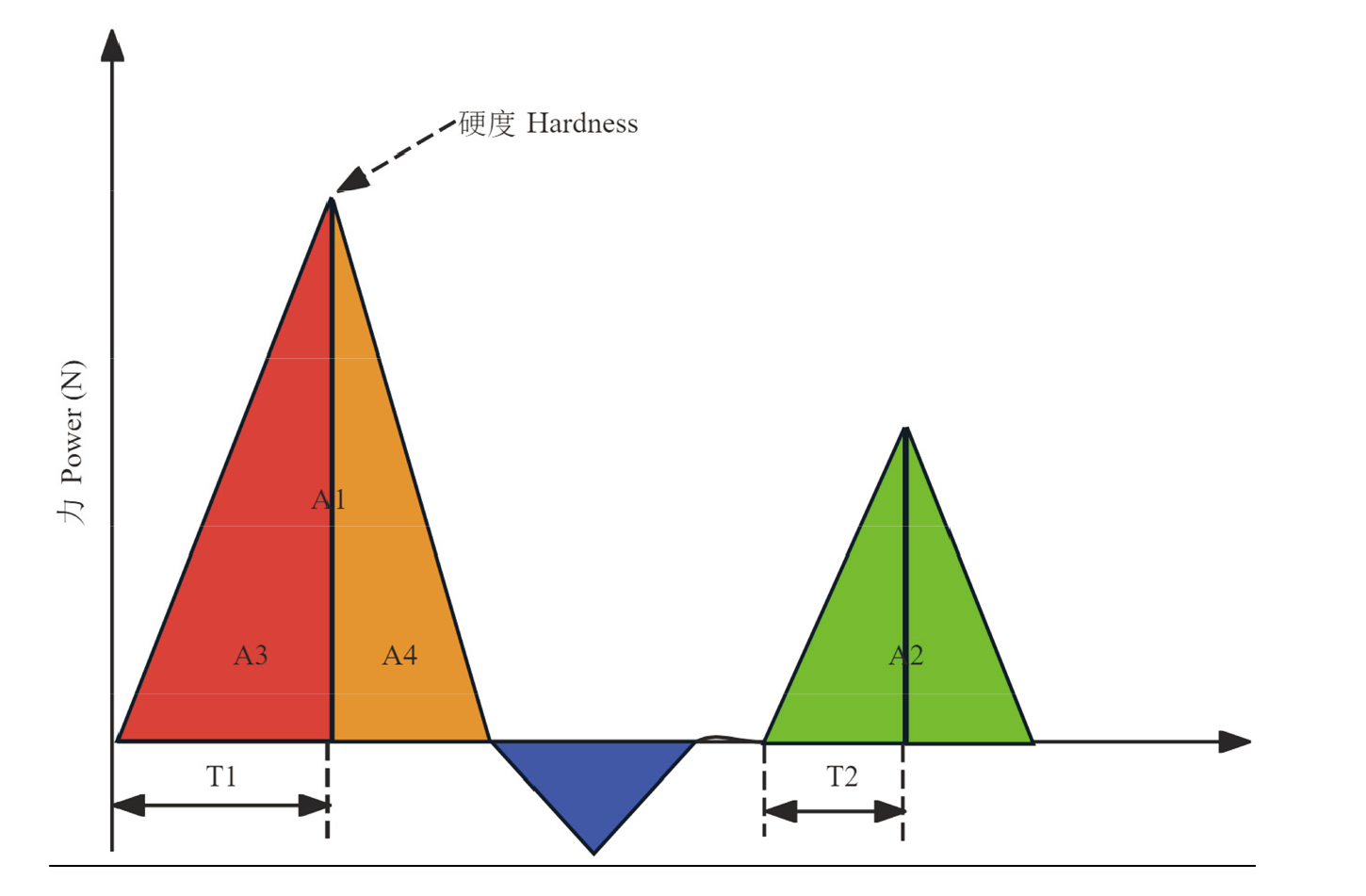
第二次挤压循环的正峰面积同第一次挤压循环的正峰面积的比值,计算方式为A2/A1
The ratio of the positive peak area of the second extrusion cycle to the positive peak area of the first extrusion cycle. The calculation method is A2/A1
弹性
Springiness
第一挤压结束后第二次挤压开始前样品恢复的高度,计算方式为T2/T1
The height at which the sample recovers after the first compression is completed and before the second compression begins. The calculation method is T2/T1
咀嚼性
Chewiness
咀嚼样品所需的能量,计算方式为内聚性×硬度×弹性,单位mJ
The energy required to chew the sample. The calculation method is cohesiveness×hardness ×springiness, Unit mJ
回复性
Responsiveness
样品在第1次压缩过程中回弹的能力,计算方式为A4/A3
The ability of the sample to rebound during the first compression process. The calculation method is A4/A3

Fig. 1

TPA characteristic curve The meaning of the text in the figure is the same as in Table 2"

Table 3

Variation and variance analysis in sensory evaluation index and TPA index of loose-curd cauliflower curd"

指标Index 最大值Max 最小值Min 平均值Average 标准差SD 变异系数CV (%) FF-value
感官指标
Sensory index
感官脆度 Sensory crispness 7.66 3.29 6.04 0.92 15.22 6.246**
感官硬度 Sensory hardness 7.30 3.70 6.12 0.89 14.60 8.357**
感官咀嚼性 Sensory chewiness 7.80 3.00 6.24 0.97 15.60 7.011**
TPA指标
TPA index
硬度 Hardness 50.82 22.50 35.62 6.20 17.40 46.033**
内聚性 Cohesiveness 0.41 0.27 0.33 0.03 8.60 4.330**
弹性 Springiness 1.46 0.98 1.21 0.12 10.20 24.530**
咀嚼性 Chewiness 26.95 6.47 14.69 4.67 31.80 30.032**
回复性 Responsiveness 0.24 0.16 0.20 0.02 10.08 10.506**

Table 4

Correlation analysis in sensory evaluation index and TPA index"

指标Index 感官脆度Sensory crispness 感官硬度Sensory hardness 感官咀嚼性Sensory chewiness
硬度Hardness 0.438** 0.471** 0.755**
内聚性Cohesiveness 0.135** 0.051** 0.188**
弹性Springiness 0.280** 0.203** 0.366**
咀嚼性Chewiness 0.393** 0.363** 0.637**
回复性Responsiveness 0.227** 0.295** 0.520**

Table 5

Multiple linear regression analysis of sensory evaluation index and TPA index"

感官指标Sensoryindex 预测模型Predictionmodel R2 PP value
感官脆度Sensory crispness Y=2.825+0.091X1 0.279 <0.001
感官硬度Sensory hardness Y=3.112+0.085X1 0.258 <0.001
感官咀嚼性Sensory chewiness Y=-0.146+0.172X1-0.092X4+8.051X5 0.548 <0.001

Table 6

Correlation analysis between 5 TPA index"

指标Index 硬度Hardness 内聚性Cohesiveness 弹性Springiness 咀嚼性Chewiness 回复性Responsiveness
硬度Hardness 1.000
内聚性Cohesiveness 0.225** 1.000
弹性Springiness 0.536** 0.564** 1.000
咀嚼性Chewiness 0.868** 0.536** 0.807** 1.000
回复性Responsiveness 0.685** 0.500** 0.673** 0.803** 1.000

Table 7

Load matrix, eigenvalues, contribution rate, and cumulative contribution rate of each principal component after rotation"

指标 Index 第一主成分 First principal component 第二主成分 Second principal component
硬度Hardness 0.907 -0.544
内聚性Cohesiveness 0.646 0.713
弹性Springiness 0.862 0.419
咀嚼性Chewiness 0.901 -0.230
回复性Responsiveness 0.813 -0.150
特征值Eigenvalues 3.456 1.055
贡献率Contribution rate (%) 69.12 21.10
累计贡献率Cumulative contribution rate (%) 69.12 90.22

Table 8

Comprehensive score value C of curd texture in 166 loose-curd cauliflower germplasm resources"

编号No. CC value 编号No. CC value 编号No. CC value 编号No. CC value
1 0.02 43 0.96 85 0.27 127 0.74
2 0.05 44 0.33 86 0.41 128 0.69
3 0.47 45 0.26 87 0.77 129 0.82
4 0.12 46 0.71 88 0.80 130 0.89
5 0.40 47 0.43 89 0.24 131 0.55
6 0.20 48 0.92 90 0.27 132 0.76
7 0.06 49 0.22 91 0.33 133 0.81
8 0.42 50 0.52 92 0.37 134 0.40
9 0.55 51 0.55 93 0.46 135 0.97
10 0.39 52 0.33 94 0.61 136 0.98
11 0.77 53 0.60 95 0.38 137 0.85
12 0.46 54 0.46 96 0.27 138 0.43
13 0.45 55 0.73 97 0.26 139 0.62
14 0.39 56 0.39 98 0.55 140 0.73
15 0.44 57 0.62 99 0.75 141 0.76
16 0.32 58 0.28 100 0.48 142 0.69
17 0.30 59 0.87 101 0.31 143 0.73
18 0.12 60 0.66 102 0.33 144 0.87
19 0.20 61 0.53 103 0.62 145 0.78
20 0.27 62 0.79 104 0.57 146 0.69
21 0.09 63 0.53 105 0.49 147 0.80
22 0.47 64 0.23 106 0.59 148 0.42
23 0.26 65 0.45 107 0.87 149 0.38
24 0.09 66 0.65 108 0.65 150 0.61
25 0.09 67 0.30 109 0.50 151 0.52
26 0.19 68 0.68 110 0.45 152 0.91
27 0.16 69 0.54 111 0.31 153 0.98
28 0.01 70 0.28 112 0.51 154 0.79
29 0.28 71 0.33 113 0.58 155 0.71
30 0.28 72 0.28 114 0.88 156 0.60
31 0.14 73 0.34 115 0.67 157 0.53
32 0.09 74 0.56 116 0.53 158 0.82
33 0.28 75 0.37 117 0.45 159 0.97
34 0.24 76 0.27 118 0.76 160 0.54
35 0.28 77 0.41 119 0.81 161 0.48
36 0.29 78 0.37 120 0.29 162 0.61
37 0.28 79 0.40 121 0.50 163 0.71
38 0.28 80 0.35 122 0.29 164 0.77
39 0.52 81 0.28 123 0.73 165 0.75
40 0.62 82 0.28 124 0.61 166 0.74
41 0.55 83 0.45 125 0.74
42 0.97 84 0.19 126 1.00

Fig. 2

Curd texture cluster analysis of 166 loose-curd cauliflower germplasms"

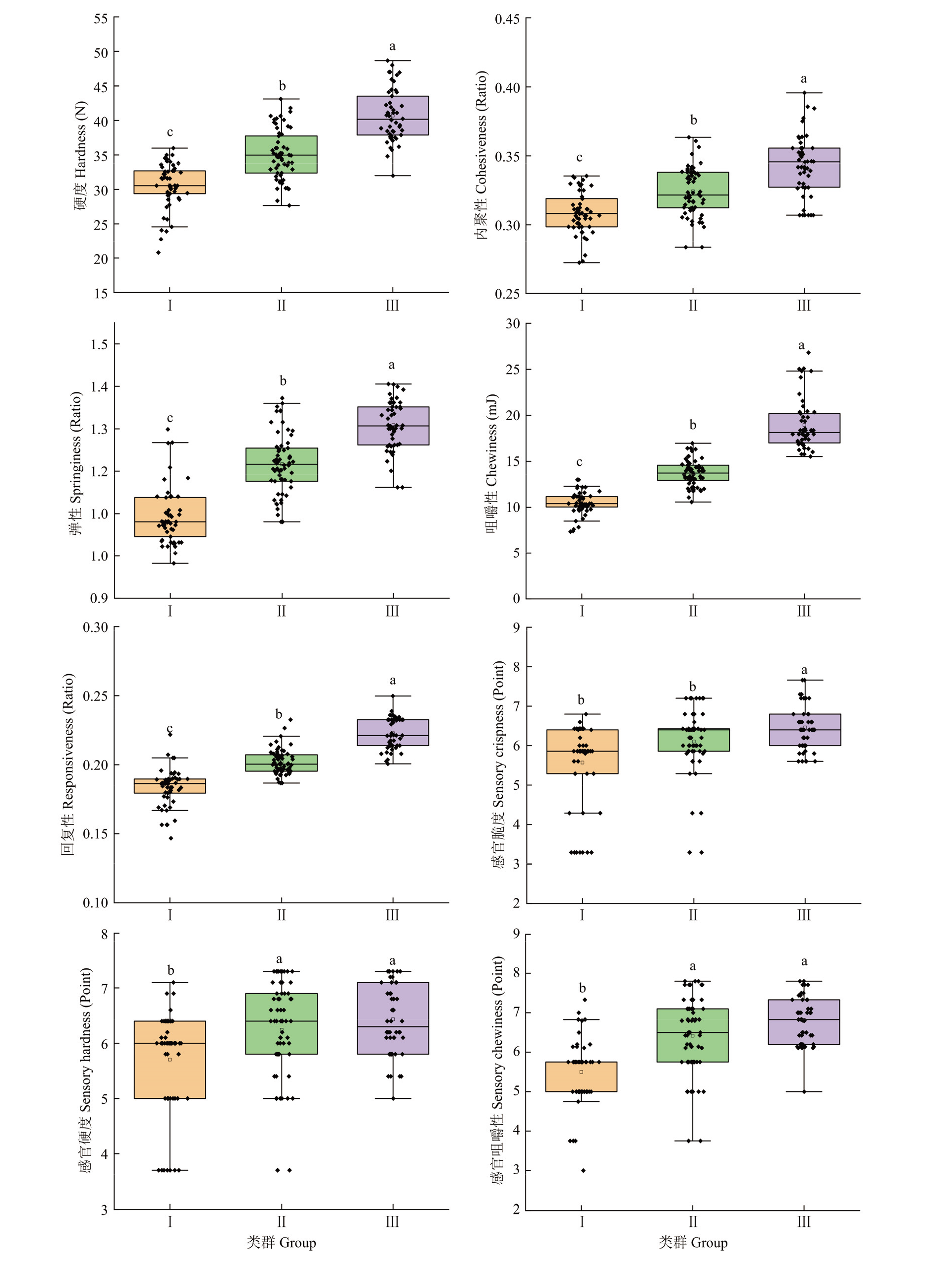
Fig. 3

Box plot of texture traits of different groups of loose-curd cauliflower germplasm Different letters indicate significant differences (P<0.05)"

Table 9

Cell morphology of different groups of loose-curd cauliflower germplasm"

类群
Group
编号
No.
长度
Length (μm)
宽度
Width (μm)
面积
Area (μm2)
周长
Circumference (μm)
横纵比
Aspectratio
圆度
Roundness
25 103.10 56.66 6269.00 327.74 1.82 0.73
103 95.23 61.13 5261.29 290.90 1.56 0.77
128 96.01 65.08 5403.58 297.26 1.48 0.78

Fig. 4

Microstructure of flower branch cells in different groups of loose-curd cauliflower germplasm A: Group Ⅰ (Germplasm 25); b: Group Ⅱ (Germplasm 103); c: Group Ⅲ (Germplasm 128). Scale bar: 50 μm; Magnification: 200×"

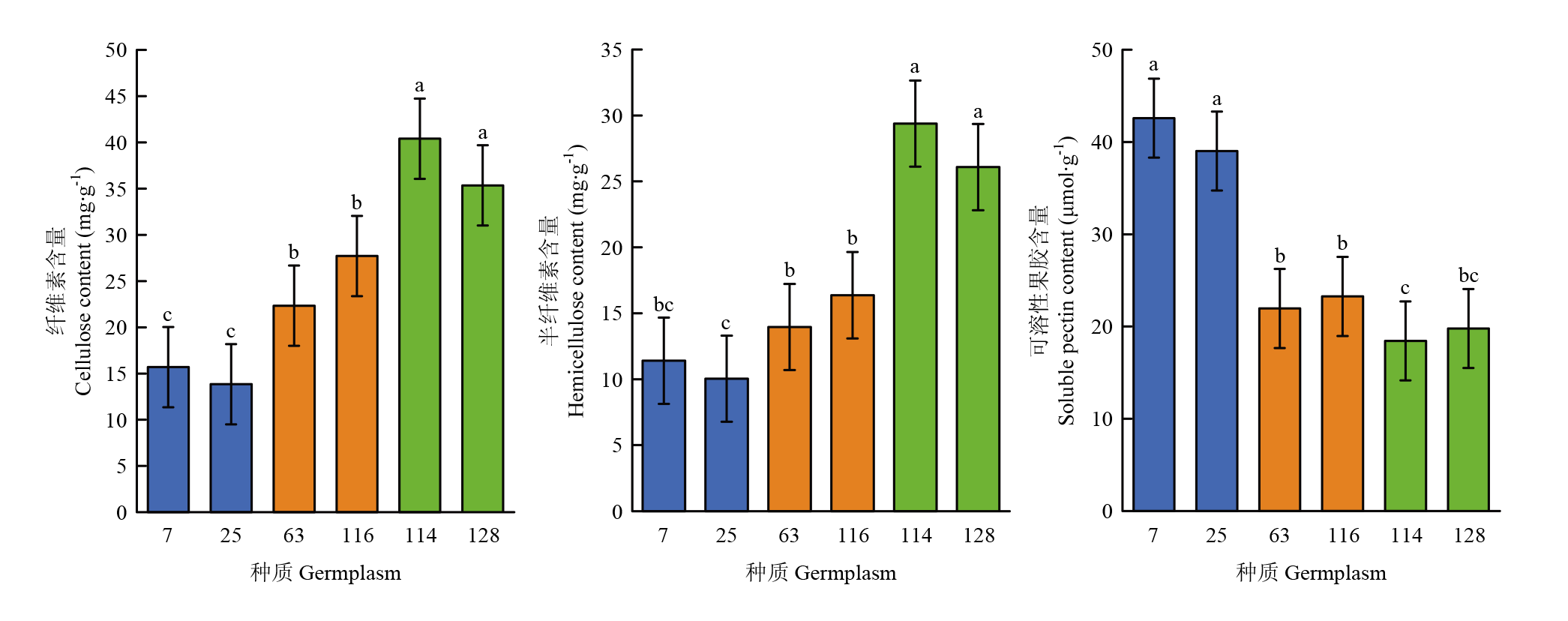
Fig. 5

Content of cell wall components in different populations of loose-curd cauliflower germplasm"

[1]
KAPUSTA-DUCH J, KOPEĆ A, PIATKOWSKA E, BORCZAK B, LESZCZYŃSKA T. The beneficial effects of Brassica vegetables on human health. Roczniki Państwowego Zakadu Higieny, 2012, 63(4): 389-395.
[2]
宋晓玉, 韩硕, 甘德芳, 宋顺华, 刘凡, 郭宁, 孟淑春. 基于SSR标记的花椰菜育种种质遗传多样性分析. 农业生物技术学报, 2024, 32(9): 1982-1995.
SONG X Y, HAN S, GAN D F, SONG S H, LIU F, GUO N, MENG S C. Genetic diversity analysis of cauliflower (Brassica oleracea var. botrytis) breeding germplasm based on SSR markers. Journal of Agricultural Biotechnology, 2024, 32(9): 1982-1995. (in Chinese)
[3]
单晓政, 张小丽, 眭丽英, 辛燕, 李戍彤, 文正华, 牛国保, 江汉民, 张伟, 田立鹏. 松散型花椰菜种质创制及新品种选育. 中国科技成果, 2023, 24(23): 10-11.
SHAN X Z, ZHANG X L, SUI L Y, XIN Y, LI S T, WEN Z H, NIU G B, JIANG H M, ZHANG W, TIAN L P. Creation of loose cauliflower germplasm and breeding of new varieties. China Science and Technology Achievements, 2023, 24(23): 10-11. (in Chinese)
[4]
陈淳, 李惠华. 厦门地区夏季播种的松花型花椰菜营养品质评价. 亚热带植物科学, 2019, 48(4): 349-353.
CHEN C, LI H H. Evaluation of nutritional quality of summer-planted loose-curd cawliflowers (Brassica oleracea var. Botrytis) in Xiamen. Subtropical Plant Science, 2019, 48(4): 349-353. (in Chinese)
[5]
LI J L, CHEN Y, CAO X L, TANG J, XIE L Y, LIU L X, WAN Y, HU R P. Unveiling the texture secrets of Morchella germplasm: Advanced grading and quality assessment through texture profile analysis (TPA). Foods, 2025, 14(1): 87.

doi: 10.3390/foods14010087
[6]
AGUIRRE M E, OWENS C M, MILLER R K, ALVARADO C Z. Descriptive sensory and instrumental texture profile analysis of woody breast in marinated chicken. Poultry Science, 2018, 97(4): 1456-1461.

doi: 10.3382/ps/pex428 pmid: 29438548
[7]
刘亚平, 李红波. 物性分析仪及TPA在果蔬质构测试中的应用综述. 山西农业大学学报(自然科学版), 2010, 30(2): 188-192.
LIU Y P, LI H B. Review on the application of texture analyzer and TPA in the assessment for fruits and vegetables texture. Journal of Shanxi Agricultural University (Natural Science Edition), 2010, 30(2): 188-192. (in Chinese)
[8]
张红肖, 严立斌, 孟雅宁, 范妍芹. TPA试验测定鲜食甜椒果实质地的研究. 河北农业科学, 2021, 25(4): 39-43.
ZHANG H X, YAN L B, MENG Y N, FAN Y Q. Study on the determination of fruit texture of fresh sweet pepper by TPA test. Journal of Hebei Agricultural Sciences, 2021, 25(4): 39-43. (in Chinese)
[9]
赵彦婷, 岳智臣, 陶鹏, 雷娟利, 胡齐赞, 李必元. 质构仪在大白菜口感品质评价中的应用. 分子植物育种, 2023, 21(16): 5429-5436.
ZHAO Y T, YUE Z C, TAO P, LEI J L, HU Q Z, LI B Y. Application of texture analyzer in the evaluation of Chinese cabbage texture quality. Molecular Plant Breeding, 2023, 21(16): 5429-5436. (in Chinese)
[10]
潘少香, 刘雪梅, 郑晓冬, 谭梦男, 曹宁, 宋烨, 闫新焕. 基于质构分析的鲜食草莓质地感官品质综合评价. 食品科技, 2023, 48(8): 37-43.
PAN S X, LIU X M, ZHENG X D, TAN M N, CAO N, SONG Y, YAN X H. Comprehensive evaluation of texture sensory quality of fresh strawberry based on texture analysis. Food Science and Technology, 2023, 48(8): 37-43. (in Chinese)
[11]
王燕, 杨丽, 刘新琦, 马依楠, 张华启, 罗效糠. 基于TPA法与感官评价法研究果蔬冻干前后质地变化. 中国果菜, 2025, 45(6): 12-19.
WANG Y, YANG L, LIU X Q, MA Y N, ZHANG H Q, LUO X K. Investigating texture changes of fruits and vegetables before and after freeze-drying using TPA and sensory evaluation methods. China Fruit & Vegetable, 2025, 45(6): 12-19. (in Chinese)
[12]
衡周, 谢炳春, 李涛, 孙保娟, 游倩, 李植良. 不同茄子品种感官评价及品质指标研究. 中国蔬菜, 2023(7): 39-44.
HENG Z, XIE B C, LI T, SUN B J, YOU Q, LI Z L. Studies on sensory evaluation and quality indicators of different eggplant varieties. China Vegetables, 2023(7): 39-44. (in Chinese)
[13]
陈月清, 牛坡. 热风干燥下不同品种猕猴桃果干感官评价与质构特性的相关性分析. 食品工业科技, 2024, 45(17): 273-281.
CHEN Y Q, NIU P. Correlation analysis of sensory evaluation and texture characteristics of dried kiwifruit of different varieties under hot air drying. Science and Technology of Food Industry, 2024, 45(17): 273-281. (in Chinese)
[14]
LETAIEF H, MAURY C, SYMONEAUX R, SIRET R. Sensory and instrumental texture measurements for assessing grape seed parameters during fruit development. Journal of the Science of Food and Agriculture, 2013, 93(10): 2531-2540.

doi: 10.1002/jsfa.6071 pmid: 23520063
[15]
赵邯, 刘春菊, 李越, 李大婧, 李斌, 牛丽影, 肖亚冬, 于蕊. 果蔬成分与细胞结构对其质地特性的影响. 核农学报, 2024, 38(5): 931-942.

doi: 10.11869/j.issn.1000-8551.2024.05.0931
ZHAO H, LIU C J, LI Y, LI D J, LI B, NIU L Y, XIAO Y D, YU R. Effects of composition and cell structure on textural characteristics of fruits and vegetables. Journal of Nuclear Agricultural Sciences, 2024, 38(5): 931-942. (in Chinese)

doi: 10.11869/j.issn.1000-8551.2024.05.0931
[16]
王红娟, 陈复生, 杨宏顺, 陈亚敏. 采后果蔬质地调控中细胞壁多糖骨架的演化机理研究. 农业机械, 2012(21): 107-110.
WANG H J, CHEN F S, YANG H S, CHEN Y M. Study on evolution mechanism of cell wall polysaccharide skeleton in texture regulation of postharvest fruits and vegetables. Farm Machinery, 2012(21): 107-110. (in Chinese)
[17]
刘春香, 何启伟, 于占东. 黄瓜质地与组织结构、纤维素及果胶含量的关系. 中国蔬菜, 2003(5): 3-7.
LIU C X, HE Q W, YU Z D. Relationship between fruit texture and tissue structures, fiber content, pectin content on cucumber. China Vegetables, 2003(5): 3-7. (in Chinese)
[18]
赵思颖, 李璐, 刘小茜, 赵钢军, 吴海滨, 罗剑宁, 龚浩, 郑晓明, 李俊星. 基于感官品质、质构特征及理化成分分析的中国南瓜果实感官综合评价预测模型. 食品科学, 2022, 43(23): 63-71.
ZHAO S Y, LI L, LIU X Q, ZHAO G J, WU H B, LUO J N, GONG H, ZHENG X M, LI J X. Predictive model for comprehensive quality evaluation of pumpkin (Cucurbita moschata) fruit based on sensory analysis, texture characteristics and physicochemical components. Food Science, 2022, 43(23): 63-71. (in Chinese)

doi: 10.7506/spkx1002-6630-20211011-105
[19]
周田田. 花椰菜营养物质和感官品质分析与评价[D]. 武汉: 华中农业大学, 2024.
ZHOU T T. Analysis and evaluation of nutrients and sensory quality of cauliflower[D]. Wuhan: Huazhong Agricultural University, 2024. (in Chinese)
[20]
WANG J, MUJUMDAR A S, WANG H, FANG X M, XIAO H W, RAGHAVAN V. Effect of drying method and cultivar on sensory attributes, textural profiles, and volatile characteristics of grape raisins. Drying Technology, 2021, 39(4): 495-506.

doi: 10.1080/07373937.2019.1709199
[21]
BLAKER K M, OLMSTEAD J W. Cell wall composition of the skin and flesh tissue of crisp and standard texture southern highbush blueberry genotypes. Journal of Berry Research, 2015, 5(1): 9-15.

doi: 10.3233/JBR-140085
[22]
叶志彪. 园艺产品品质分析. 北京: 中国农业出版社, 2011.
YE Z B. Quality Analysis of Horticultural Products. Beijing: China Agriculture Press, 2011. (in Chinese)
[23]
杨植, 王振磊. 基于TPA法评价枣果实质地及聚类分析. 新疆农业科学, 2019, 56(10): 1860-1868.

doi: 10.6048/j.issn.1001-4330.2019.10.011
YANG Z, WANG Z L. Evaluation and cluster analysis of jujube fruit texture based on TPA method. Xinjiang Agricultural Sciences, 2019, 56(10): 1860-1868. (in Chinese)

doi: 10.6048/j.issn.1001-4330.2019.10.011
[24]
范霞, 崔心平. 基于HS-SPME-GC-MS和电子鼻技术研究不同肉质桃子采后贮藏期的香气成分. 食品科学, 2021, 42(20): 222-229.
FAN X, CUI X P. Analysis of aroma compounds of different peach flesh types during postharvest storage by headspace solid-phase microextraction combined with gas chromatography-mass spectrometry and electronic nose. Food Science, 2021, 42(20): 222-229. (in Chinese)

doi: 10.7506/spkx1002-6630-20201026-261
[25]
王洋, 张明生, 李祥栋, 任明见, 高翔. 不同高粱种质资源形态多样性及其形态标记聚类分析. 贵州农业科学, 2014, 42(6): 1-5.
WANG Y, ZHANG M S, LI X D, REN M J, GAO X. Morphological diversity and cluster analysis on markers of sorghum germplasms. Guizhou Agricultural Sciences, 2014, 42(6): 1-5. (in Chinese)
[26]
李晓玲, 李金泉, 卢永根. 水稻核心种质的构建策略研究. 沈阳农业大学学报, 2007, 38(5): 681-687.
LI X L, LI J Q, LU Y G. Constructing strategy of core collection for Oryza sativa L.. Journal of Shenyang Agricultural University, 2007, 38(5): 681-687. (in Chinese)
[27]
杨亚恒, 贾培龙, 乜兰春, 赵文圣, 赵佳腾, 王金祥, 刘杰. 厚皮甜瓜种质材料果实质地品质评价. 中国农业科学, 2024, 57(8): 1560-1574. doi: 10.3864/j.issn.0578-1752.2024.08.011.
YANG Y H, JIA P L, NIE L C, ZHAO W S, ZHAO J T, WANG J X, LIU J. Evaluation of fruit texture quality in melon. Scientia Agricultura Sinica, 2024, 57(8): 1560-1574. doi: 10.3864/j.issn.0578-1752.2024.08.011. (in Chinese)
[28]
张杨, 梁怡蕾, 潘琦雯, 张文. 猕猴桃感官评定与质地剖面分析的相关性. 食品工业科技, 2018, 39(16): 243-247, 252.
ZHANG Y, LIANG Y L, PAN Q W, ZHANG W. Correlation between the sensory evaluation and texture profile analysis of kiwifruit. Science and Technology of Food Industry, 2018, 39(16): 243-247, 252. (in Chinese)
[29]
李丽娜, 赵武奇, 曾祥源, 薛珊, 霍瑶瑶, 方媛, 郭玉蓉. 苹果的质构与感官评定相关性研究. 食品与机械, 2017, 33(6): 37-41, 45.
LI L N, ZHAO W Q, ZENG X Y, XUE S, HUO Y Y, FANG Y, GUO Y R. Correlation between texture and sensory evaluation of apple. Food & Machinery, 2017, 33(6): 37-41, 45. (in Chinese)
[30]
刘丙花, 王开芳, 王小芳, 梁静, 白瑞亮, 解小锋, 孙蕾. 基于主成分分析的蓝莓果实质地品质评价. 核农学报, 2019, 33(5): 927-935.

doi: 10.11869/j.issn.100-8551.2019.05.0927
LIU B H, WANG K F, WANG X F, LIANG J, BAI R L, XIE X F, SUN L. Evaluation of fruit texture quality of blueberry based on principal component analysis. Journal of Nuclear Agricultural Sciences, 2019, 33(5): 927-935. (in Chinese)

doi: 10.11869/j.issn.100-8551.2019.05.0927
[31]
吴慧琴, 王静, 阳宜, 刘雪晴, 张凯旋, 王麓尧, 路佳伟, 翟源, 成妍. 96份辣椒种质资源的果实质地品质分析及评价. 中国农业科学, 2025, 58(14): 2854-2868. doi: 10.3864/j.issn.0578-1752.2025.14.011.
WU H Q, WANG J, YANG Y, LIU X Q, ZHANG K X, WANG L Y, LU J W, ZHAI Y, CHENG Y. Analysis and evaluation of fruit texture quality of 96 pepper germplasm resources. Scientia Agricultura Sinica, 2025, 58(14): 2854-2868. doi: 10.3864/j.issn.0578-1752.2025.14.011. (in Chinese)
[32]
付山, 梁邺, 徐玖亮, 阮云泽, 罗剑, 李婷玉. 基于多种方法的菠萝果实质地及食味品质综合评价. 中国农业科学, 2023, 56(15): 3006-3019. doi: 10.3864/j.issn.0578-1752.2023.15.014.
FU S, LIANG Y, XU J L, RUAN Y Z, LUO J, LI T Y. Comprehensive evaluation of fruit texture and taste quality of pineapple based on multiple methods. Scientia Agricultura Sinica, 2023, 56(15): 3006-3019. doi: 10.3864/j.issn.0578-1752.2023.15.014. (in Chinese)
[33]
黄聪丽, 朱凤林, 刘景春, 邱煜辉, 张春叶. 我国花椰菜品种资源的分布与类型. 中国蔬菜, 1999(3): 35-38.
HUANG C L, ZHU F L, LIU J C, QIU Y H, ZHANG C Y. Distribution and types of cauliflower variety resources in China. China Vegetables, 1999(3): 35-38. (in Chinese)
[34]
肖瑜, 牛国保, 单晓政, 刘莉莉, 张小丽, 文正华, 江汉民, 李戍彤, 马云生, 兰璞, 等. 花椰菜农艺性状相关性、主成分及聚类分析. 分子植物育种, 2024, 22(9): 3016-3027.
XIAO Y, NIU G B, SHAN X Z, LIU L L, ZHANG X L, WEN Z H, JIANG H M, LI S T, MA Y S, LAN P, et al. Correlation, principal component and cluster analysis for agronomic traits of cauliflower germplasm resource. Molecular Plant Breeding, 2024, 22(9): 3016-3027. (in Chinese)
[35]
武新慧, 郭玉明, 冯慧敏. 高压脉冲电场预处理对果蔬动态黏弹特性的影响. 农业工程学报, 2016, 32(18): 247-254.
WU X H, GUO Y M, FENG H M. Effect of high pulsed electric field pretreatment on dynamic viscoelasticity of fruits and vegetables. Transactions of the Chinese Society of Agricultural Engineering, 2016, 32(18): 247-254. (in Chinese)
[36]
吴一璇, 高冉, 周小萱, 郝建雄, 赵丹丹. 果蔬细胞壁果胶在贮藏和干燥过程中的理化及结构特性变化规律. 食品与发酵工业, 2025, 51(15): 384-391.

doi: 10.13995/j.cnki.11-1802/ts.041235
WU Y X, GAO R, ZHOU X X, HAO J X, ZHAO D D. Changes of cell wall pectin in fruits and vegetables during storage and drying process. Food and Fermentation Industries, 2025, 51(15): 384-391. (in Chinese)

doi: 10.13995/j.cnki.11-1802/ts.041235
[37]
田青兰, 张英俊, 刘洁云, 吴艳艳, 韦毅刚, 温放, 黄伟华, 辛子兵, 韦弟, 牟海飞. 西番莲果皮质构特性和显微结构特征分析. 果树学报, 2022, 39(12): 2365-2375.
TIAN Q L, ZHANG Y J, LIU J Y, WU Y Y, WEI Y G, WEN F, HUANG W H, XIN Z B, WEI D, MOU H F. Analysis of texture characteristics and microstructure of passion fruit pericarp. Journal of Fruit Science, 2022, 39(12): 2365-2375. (in Chinese)
[38]
李三培, 华德平, 高星, 徐伟欣, 杨旭辉, 刘莉. 不同类型甜瓜成熟过程中果肉质地及其细胞显微结构的变化. 西北植物学报, 2017, 37(6): 1118-1125.
LI S P, HUA D P, GAO X, XU W X, YANG X H, LIU L. Variation characteristics of flesh texture and cell microstructure of different types of melon during ripening. Acta Botanica Boreali-Occidentalia Sinica, 2017, 37(6): 1118-1125. (in Chinese)
[39]
李红光, 刘俊灵, 党美乐, 杨惠娟, 范献光, 杨亚州, 赵政阳. 苹果新品种‘瑞阳’及其亲本果实组织结构的比较分析. 果树学报, 2018, 35(10): 1182-1189.
LI H G, LIU J L, DANG M L, YANG H J, FAN X G, YANG Y Z, ZHAO Z Y. Comparative the anatomy of the fruit between a new apple cultivar ‘Ruiyang’ and its parents. Journal of Fruit Science, 2018, 35(10): 1182-1189. (in Chinese)
[1] HE ZhiLin, SUN CuiXia, YUE HongLi, TAN YueXia, ZHANG YaoHai, WANG FuSheng, LIU SiTao, JIANG Dong. Genetic Diversity Analysis and GWAS of Alloocimene Based on Resequencing of Citron, Lemon Germplasm Resources [J]. Scientia Agricultura Sinica, 2026, 59(2): 386-401.
[2] LÜ Tao, SUN GuoQing, GUO DongCai, CHEN QuanJia, CAI YongSheng, FAN BiaoXing, QU YanYing, ZHENG Kai. Development and Effectiveness Evaluation of InDel Molecular Markers Closely Linked to Fiber Strength QTL in Gossypium barbadense [J]. Scientia Agricultura Sinica, 2025, 58(9): 1684-1701.
[3] CHEN CaiJin, MA Lin, JIANG QingXue, LIU JinHui, MIAO Tong, ZHANG ZhiPeng, MENG Xiang, MA XiaoRan, ZHOU XinYue, ZHANG Jian, LIU WenHui, WANG XueMin. Genetic Diversity Analysis of Phenotypic Traits of 244 Forage Oat Germplasm Resources [J]. Scientia Agricultura Sinica, 2025, 58(23): 4825-4836.
[4] TIAN XianXian, FENG ShaoFang, WANG Qing, PAN ChenDong, LI Bo, FANG KaiXing, WU HuaLing, QIN DanDan. Biochemical Characteristics Analysis and Suitability Evaluation of Liannan Daye Tea Germplasm Resources [J]. Scientia Agricultura Sinica, 2025, 58(22): 4797-4812.
[5] CHEN TianXiao, CAO Rong, SONG QianNan, HU LiangLiang, WANG SuHua, WANG LiXia, CHENG XuZhen, CHEN HongLin. Comprehensive Evaluation of Salt Tolerance at the Seedling Stage and Screening of Tolerant Germplasm in Adzuki Bean (Vigna angularis) [J]. Scientia Agricultura Sinica, 2025, 58(21): 4317-4332.
[6] CHEN YongXian, CHEN RuiJiang, DU YiZhi, ZHU JunJie, CHEN WanXia, ZHAO ZiHan, WANG JiChun, DU Kang, ZHANG Kai. Screening and Identification of Drought-Tolerant Sweet Potato Germplasm Resources [J]. Scientia Agricultura Sinica, 2025, 58(2): 214-237.
[7] BAO MingFang, QIN Yan, CHEN CaiJin, ZHANG ShangPei, ZHANG GuoHui, SHA XiaoDi. Evaluation of 111 Alfalfa Germplasm Resources for Seedling Phenotypic Drought Tolerance Characterization [J]. Scientia Agricultura Sinica, 2025, 58(19): 3825-3836.
[8] MENG ZiNuo, FU ChangQing, ZHANG LingYu, GAO ShunJuan, CHANG JinHua, CUI JiangHui. Assessment of Salt Tolerance and Screening of Salt Tolerant Germplasm in Sorghum Seedling Stage [J]. Scientia Agricultura Sinica, 2025, 58(16): 3317-3326.
[9] WU HuiQin, WANG Jing, YANG Yi, LIU XueQing, ZHANG KaiXuan, WANG LuYao, LU JiaWei, ZHAI Yuan, CHENG Yan. Analysis and Evaluation of Fruit Texture Quality of 96 Pepper Germplasm Resources [J]. Scientia Agricultura Sinica, 2025, 58(14): 2854-2868.
[10] CHEN CaiJin, MA Lin, BAO MingFang, ZHANG GuoHui, JIANG QingXue, YANG TianHui, WANG Chuan, WANG XiaoChun, GAO Ting, WANG XueMin, LIU WenHui. Identification and Evaluation of Drought Resistance for 111 Germplasm Resources of Alfalfa During Germination Stage [J]. Scientia Agricultura Sinica, 2025, 58(10): 1896-1907.
[11] ZHU ChunTao, REN DanDan, LIU ZhengCen, LIU ChangChuang, LIU RuiQi, ZHENG HongJian, HU ErLiang, LIN HaiJian, LI JingWei, LU YanLi, WANG QingJun. Combining Ability Analysis on Quality Traits and Breeding Potential Evaluation of 23 Waxy Maize Lines from Laos [J]. Scientia Agricultura Sinica, 2024, 57(15): 2931-2945.
[12] WANG Shuai, ZHANG RuYang, WANG RongHuan, SONG Wei, ZHAO JiuRan. Research Progress of Southern Corn Rust and Resistance Breeding [J]. Scientia Agricultura Sinica, 2024, 57(14): 2732-2743.
[13] LI Huan, YAN XiaoQing, YANG ZhanLie, TAN JinYu, LI XiaoBing, CHEN NengGang, WU RongJu, CHEN HuiCha, RUAN RenChao. Analysis and Comprehensive Evaluation of Phenotype Genetic Diversity in Kam Sweet Rice Germplasm Resources in Guizhou [J]. Scientia Agricultura Sinica, 2023, 56(11): 2035-2046.
[14] WANG XiuXiu,XING AiShuang,YANG Ru,HE ShouPu,JIA YinHua,PAN ZhaoE,WANG LiRu,DU XiongMing,SONG XianLiang. Comprehensive Evaluation of Phenotypic Characters of Nature Population in Upland Cotton [J]. Scientia Agricultura Sinica, 2022, 55(6): 1082-1094.
[15] YingLing WAN,MengTing ZHU,AiQing LIU,YiJia JIN,Yan LIU. Phenotypic Diversity Analysis of Chinese Ornamental Herbaceous Peonies and Its Germplasm Resource Evaluation [J]. Scientia Agricultura Sinica, 2022, 55(18): 3629-3639.
Viewed
Full text


Abstract

Cited

  Shared   
  Discussed   
No Suggested Reading articles found!