Scientia Agricultura Sinica ›› 2024, Vol. 57 ›› Issue (16): 3127-3141.doi: 10.3864/j.issn.0578-1752.2024.16.003

• CROP GENETICS & BREEDING·GERMPLASM RESOURCES·MOLECULAR GENETICS • Previous Articles     Next Articles

Function Analysis of bHLH93 Transcription Factor in Tartary Buckwheat in Response to Aluminum Stress

LIU Tong1,2(), WANG ZhiRong2, LI Wei2, LIU Yang2, WANG XiangRu2, LAI DiLi2, HE YuQi2, ZHANG KaiXuan2, ZHAO ZhenJun1(), ZHOU MeiLiang2()   

  1. 1 College of Life Science, Yantai University, Yantai 264000, Shandong
    2 Institute of Crop Science, Chinese Academy of Agricultural Sciences, Beijing 100081
  • Received:2024-02-09 Accepted:2024-05-08 Online:2024-08-16 Published:2024-08-27
  • Contact: ZHAO ZhenJun, ZHOU MeiLiang

Abstract:

【Objective】Buckwheat is an important cereal and economic crop. Compared with other crops, buckwheat has strong aluminum tolerance. A transcription factor FtbHLH93 in response to aluminum stress was identified in transcriptome data of aluminum treatment. Exploring the function of FtbHLH93 will provide ideas and clues for solving the problem of aluminum toxicity in acidic soil and molecular breeding of new varieties of buckwheat with aluminum tolerant, and provide theoretical basis for the molecular mechanism of tolerance aluminum in buckwheat.【Method】 The cDNA of Pinku1 was used as a template to clone FtbHLH93. qRT-PCR was used to detect the expression of FTbHLH93 in different tissues of Tartary buckwheat and at different time points after aluminum treatment. Yeast system was used to identify the transcriptional activation activity. The localization of intracellular expression was determined by subcellular localization. The flavonoid content of the overexpressed materials was examined, and SOD and POD activities were measured under untreated and Al-treated conditions. The differentially expressed genes were analyzed by transcriptome analysis, potential downstream target genes were screened, and their promoters were predicted. The dual luciferase reporter gene assay was used to verify the results.【Result】The coding region of FtbHLH93 transcription factor was 573 bp in length, encoding 190 amino acid residues. The predicted molecular weight of FtbHLH93 was 21.759 kDa, and its isoelectric point was 8.64. qRT-PCR results showed that FtbHLH93 was highly expressed in roots. The expression level of FtbHLH93 is highest at 24 h after aluminum treatment. FtbHLH93 is localized in the nucleus without self-activating activity. Overexpression of FtbHLH93 in Tartary buckwheat hairy roots enhanced aluminum tolerance, and the activities of SOD and POD were significantly higher than those of the control group. The detection results of flavonoid metabolites in the overexpressed FtbHLH93 hairy roots showed that the contents of rutin, catechin, and fireworks were significantly higher than those of the control group. GO enrichment analysis showed that it was related to metal ion transport and cadmium and manganese ion entries, and KEGG enrichment analysis showed that it was related to ABC transporter. Three genes responsive to aluminum stress may be downstream target genes of FtbHLH93, and co-expression analysis showed that two of the candidate downstream target genes had a similar expression pattern to FtbHLH93.【Conclusion】FtbHLH93 transcription factor may alleviate aluminum toxicity by promoting the accumulation of flavonoids and the increase of SOD and POD activities. FtbHLH93 may act as an upstream regulator to regulate the expression of FtPinG0100930100.01, FtPinG0303102000.01 and FtPinG0403996200.01.

Key words: tartary buckwheat, aluminum, bHLH, overexpression, transcriptome, Dual-luciferase

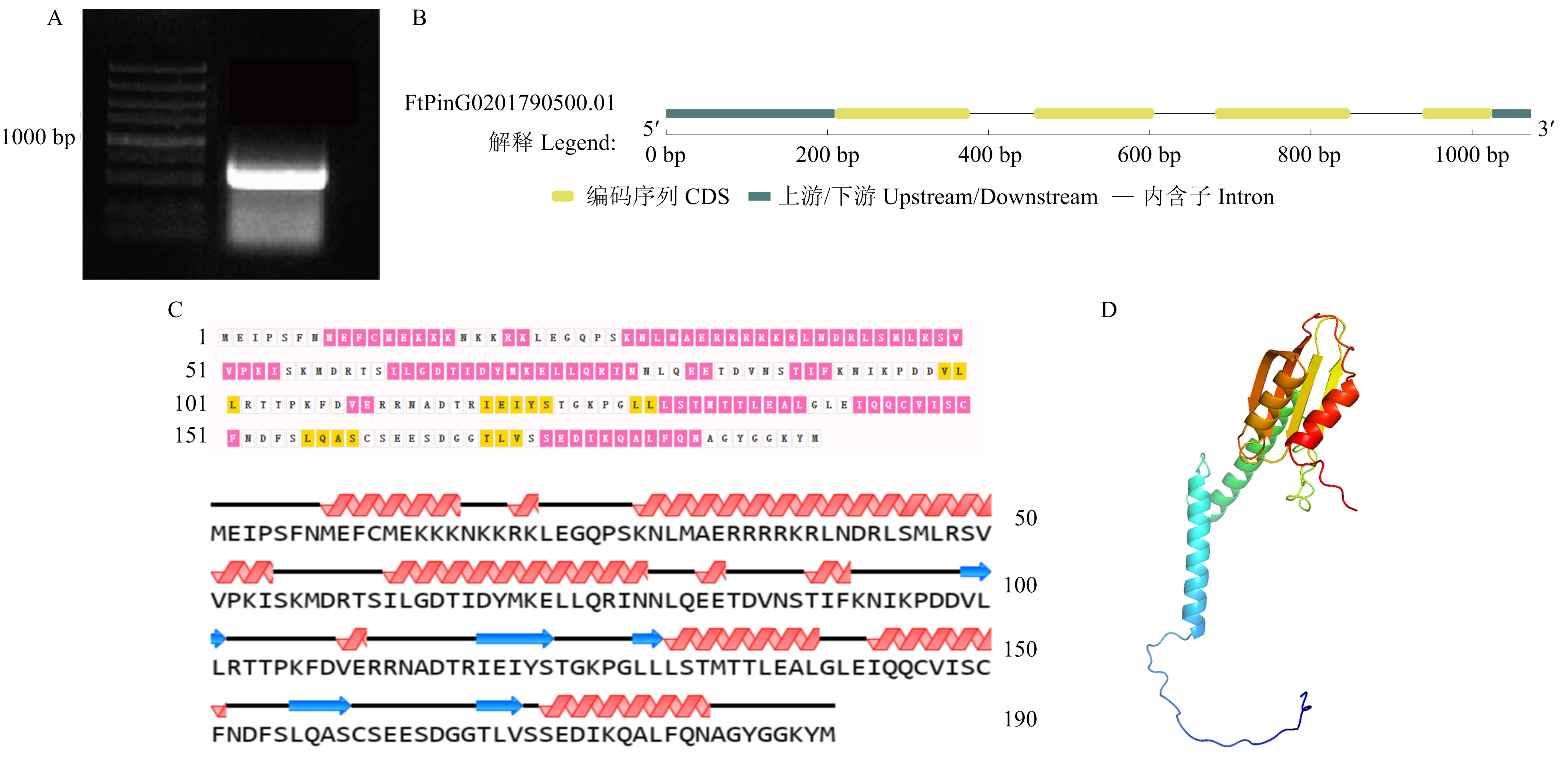
Fig. 1

Cloning and bioinformatics analysis of FtbHLH93 in Tartary buckwheat A: Buckwheat FtbHLH93 clone; B: Gene structure of Tartary buckwheat FtbHLH93; C: Secondary structure of Tartary buckwheat FtbHLH93 protein; D: Tertiary structure of Tartary buckwheat FtbHLH93 protein"

Fig. 2

Expression pattern, yeast autoactivation, and subcellular localization of the FtbHLH93 A: Differential expression of FtbHLH93 in different tissues; B: Differential expression of FtbHLH93 induced by aluminum at different times; C: Yeast autoactivation of FtbHLH93; D: Subcellular localization of FtbHLH93; **: Significant difference at 0.01 level; ***: Significant difference at 0.001 level; ****: Significant difference at 0.0001 level. The same as below"

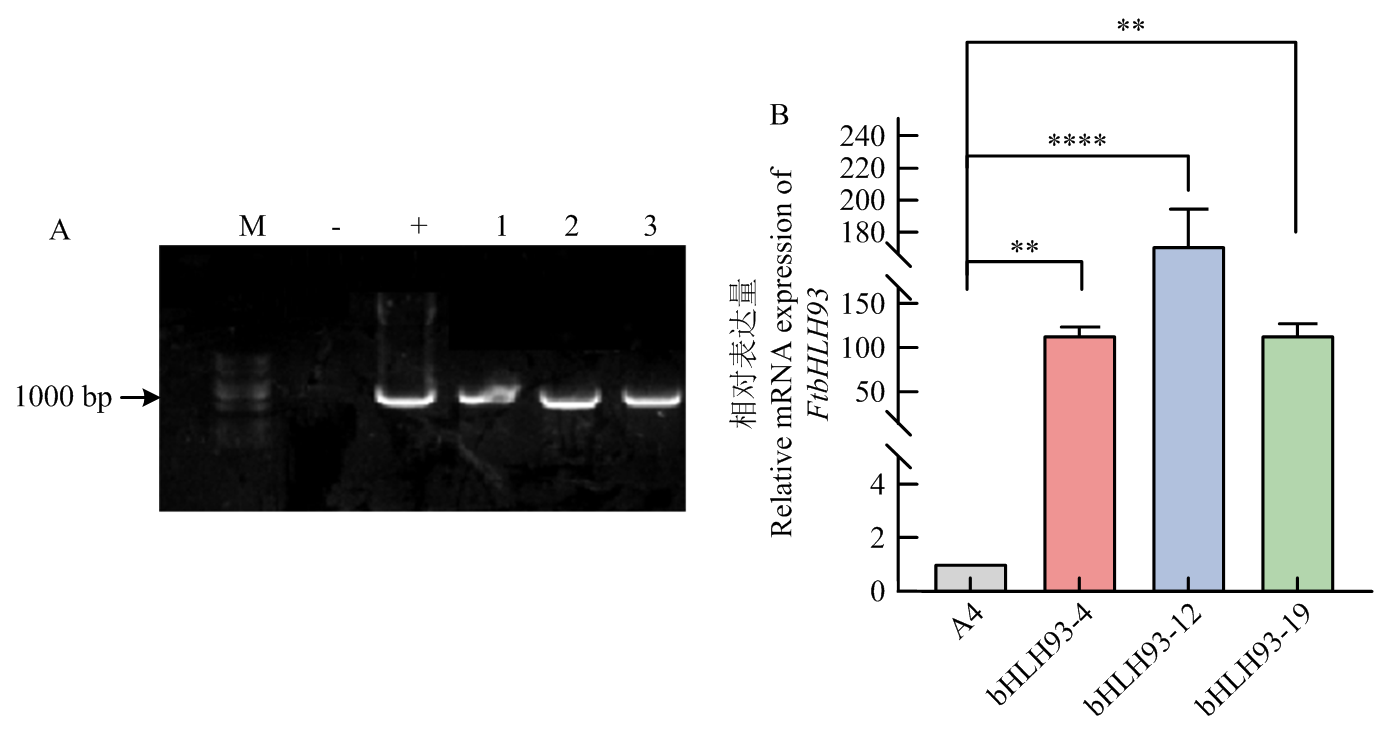
Fig. 3

Identification of positive hairy roots A: Identification of FtbHLH93 overexpression hairy root DNA level; M: DNA Marker; -: Negative control (Tartary buckwheat DNA as template); +: Positive control (FtbHLH93-1307 plasmid as template); 1: FtbHLH93 overexpressed hairy root strain 4; 2: FtbHLH93 overexpressed hairy root line 12; 3: FtbHLH93 overexpressed hairy root line 19; B: Identification of FtbHLH93 overexpression hairy root RNA levels"

Fig. 4

Analysis of hairy root system function and physiological indexes under aluminum stress A: Phenotype of FtbHLH93 overexpressing strain 19 after aluminum treatment; 1: Empty A4 hairy roots cultured in MS liquid medium; 2: Empty A4 hairy roots cultured in MS liquid medium with 100 µmol·L-1 aluminum chloride; 3: FtbHLH93 overexpression line 19 hairy roots cultured in MS liquid medium; 4: FtbHLH93 overexpression line 19 hairy roots cultured in MS liquid medium supplemented with 100 µmol·L-1 aluminum chloride; B: Fresh and dry weight of FtbHLH93 overexpressing strain 19; C: SOD and POD activity determination of FtbHLH93 overexpressing hairy roots; D: FtbHLH93 overexpression of rutin, catechin, kaempferol-3-O-rutinoside content in hairy roots. Different lowercase letters show significant differences(P<0.05); ns: The difference was not significant; *: Significant difference at the 0.05 level. The same as below"

Fig. 5

Differential expression analysis and GO and KEGG enrichment analysis of FtbHLH93 A: All differentially expressed genes in FtbHLH93-vs-CK; B: The top 20 items of KEGG enrichment analysis of all differentially expressed genes in FtbHLH93-vs-CK; C: Top 30 items of GO enrichment analysis of differentially expressed genes down-regulated by FtbHLH93-vs-CK; D: Top 30 entries from GO enrichment analysis of all differentially expressed genes in FtbHLH93-vs-CK"

Table 1

Significantly differentially expressed genes related to metal ions"

基因ID Gene ID 表达水平Expression level GO条目 GO term
FtPinG0707878600.01 下调 Down 铁离子结合,酸还原双加氧酶[需要铁]活性
Iron-binding, acid-reducing dioxygenase [iron required] activity
FtPinG0303292100.01 上调 Up 金属离子结合Metal ion binding
FtPinG0303287700.01 上调 Up 金属离子结合Metal ion binding
FtPinG0201816600.01 上调 Up 金属离子结合,负调控对缺水的反应
Metal ion binding and negative regulation of water deficiency response

Table 2

Candidate downstream target genes of FtbHLH93"

基因ID
Gene ID
表达水平Expression
level
基因命名
Gene symbol
注释
Description
GO条目
GO term
表达集群
Express
cluster
FC值
log2 (FoldChange)
P
P-value
FtPinG0100930100.01 下调
Down
ABCB25 ABC转运蛋白B家族成员25
A member of the ABC transporter B family 25
铝离子跨膜转运活性Aluminium ion transmembrane transport activity 14 -1.045611368 0.002076521
FtPinG0303102000.01 上调
Up
ALMT4 铝活化苹果酸转运蛋白4
Aluminum activates malate transporter 4
离子通道活性
Ion channel activity
13 2.282465572 2.69E-10
FtPinG0403996200.01 上调
Up
PLDGAMMA1 磷脂酶Dγ1
Phospholipase Dγ1
响应铝离子,钙离子结合
In response to aluminum ions, calcium ions binding
13 1.168803299 3.45E-08

Fig. 6

Co-expression analysis of FtbHLH93 (A), promoter prediction of downstream target genes (B, C, D), and Dual Luciferase reporter assay (E)"

[1]
MARON L G, KIRST M, MAO C Z, MILNER M J, MENOSSI M, KOCHIAN L V. Transcriptional profiling of aluminum toxicity and tolerance responses in maize roots. The New Phytologist, 2008, 179(1): 116-128.
[2]
朱海凤. 水稻和荞麦抗铝毒转录因子ART1调控机制的研究[D]. 南京: 南京农业大学, 2016.
ZHU H F. Regulation mechanisms of Art1, an aluminum- resistant transcription factor, in rice and buckwheat (Fagopyrum tataricum)[D]. Nanjing: Nanjing Agricultural University, 2016. (in Chinese)
[3]
FAN Y, JIN Y N, DING M Q, TANG Y, CHENG J P, ZHANG K X, ZHOU M L. The complete chloroplast genome sequences of eight fagopyrum species: Insights into genome evolution and phylogenetic relationships. Frontiers in Plant Science, 2021, 12: 799904.
[4]
WANG H, CHEN R F, IWASHITA T, SHEN R F, MA J F. Physiological characterization of aluminum tolerance and accumulation in Tartary and wild buckwheat. The New Phytologist, 2015, 205(1): 273-279.
[5]
胡湘云, 王奕文, 方幽文, 邵烨瑶, 姚慧, 唐星宇, 连旖晴, 谭莹, 朱怡杰, 江帆, 李春俣, 吴玉环, 蔡妙珍, 徐根娣, 刘鹏. 酸性土壤下缓解大豆铝胁迫的研究进展. 科学通报, 2023, 68(33): 4517-4531.
HU X Y, WANG Y W, FANG Y W, SHAO Y Y, YAO H, TANG X Y, LIAN Y Q, TAN Y, ZHU Y J, JIANG F, LI C Y, WU Y H, CAI M Z, XU G D, LIU P. Research progress on alleviating aluminum stress in soybean under acid soil. Chinese Science Bulletin, 2019, 68(33): 4517-4531. (in Chinese)
[6]
赵学强, 潘贤章, 马海艺, 董晓英, 车景, 王超, 时玉, 柳开楼, 沈仁芳. 中国酸性土壤利用的科学问题与策略. 土壤学报, 2023, 60(5): 1248-1263.
ZHAO X Q, PAN X Z, MA H Y, DONG X Y, CHE J, WANG C, SHI Y, LIU K L, SHEN R F. Scientific issues and strategies of acid soil use in China. Acta Pedologica Sinica, 2023, 60(5): 1248-1263. (in Chinese)
[7]
邓晓霞, 李月明, 姚堃姝, 乔婧文, 王竞红, 蔺吉祥. 植物适应酸铝胁迫机理的研究进展. 生物工程学报, 2022, 38(8): 2754-2766.
DENG X X, LI Y M, YAO K S, QIAO J W, WANG J H, LIN J X. Advances in the mechanism of plant adaptation to acid aluminum stress. Journal of Biotechnology, 2022, 38(8): 2754-2766. (in Chinese)
[8]
JIAN Z S, FENG M J, MATSUMOTO H. High aluminum resistance in buckwheat. I. Al-induced specific secretion of oxalic acid from root tips. Plant Physiology, 1998, 117(3): 745-751.
[9]
杨建立. 植物耐铝毒基因型差异及荞麦耐铝机理研究[D]. 杭州: 浙江大学, 2004.
YANG J L. Genotypic difference among plant species in response to aluminum stress and mechanisms of aluminum resistance in buckwheat (fygopyrum esculentum moench)[D]. Hangzhou: Zhejiang University, 2004. (in Chinese)
[10]
SHEN R F, CHEN R F, MA J F. Buckwheat accumulates aluminum in leaves but not in seeds. Plant and Soil, 2006, 284(1): 265-271.
[11]
LEI G J, YOKOSHO K, YAMAJI N, FUJII-KASHINO M, MA J F. Functional characterization of two half-size ABC transporter genes in aluminium-accumulating buckwheat. The New Phytologist, 2017, 215(3): 1080-1089.
[12]
ROIG-VILLANOVA I, BOU-TORRENT J, GALSTYAN A, CARRETERO-PAULET L, PORTOLÉS S, RODRÍGUEZ- CONCEPCIÓN M, MARTÍNEZ-GARCÍA J F. Interaction of shade avoidance and auxin responses: A role for two novel atypical bHLH proteins. The EMBO Journal, 2007, 26(22): 4756-4767.
[13]
王翠, 兰海燕. 植物bHLH转录因子在非生物胁迫中的功能研究进展. 生命科学研究, 2016, 20(4): 358-364.
WANG C, LAN H Y. Research progresses on functions of plant bHLH transcription factors involved in abiotic stresses. Life Science Research, 2016, 20(4): 358-364. (in Chinese)
[14]
XU J M, FAN W, JIN J F, LOU H Q, CHEN W W, YANG J L, ZHENG S J. Transcriptome analysis of al-induced genes in buckwheat (Fagopyrum esculentum Moench) root apex: New insight into Al toxicity and resistance mechanisms in an Al accumulating species. Frontiers in Plant Science, 2017, 8: 1141.
[15]
LARSEN P B, CANCEL J, ROUNDS M, OCHOA V. Arabidopsis ALS1 encodes a root tip and stele localized half type ABC transporter required for root growth in an aluminum toxic environment. Planta, 2007, 225(6): 1447-1458.
[16]
DONG J S, PIÑEROS M A, LI X X, YANG H B, LIU Y, MURPHY A S, KOCHIAN L V, LIU D. An Arabidopsis ABC transporter mediates phosphate deficiency-induced remodeling of root architecture by modulating iron homeostasis in roots. Molecular Plant, 2017, 10(2): 244-259.
[17]
时玮玮. 两种不同铝剂对甘肃黄花烟草抗病性的不同效应[D]. 兰州: 兰州大学, 2008.
SHI W W. Effects of two different valence of aluminum on tobacco disease resistance[D]. Lanzhou: Lanzhou University, 2008. (in Chinese)
[18]
钱绍方. 丹波黑大豆bHLH30转录因子功能研究[D]. 昆明: 昆明理工大学, 2012.
QIAN S F. The study on the function of transcription factor bHLH30 Glycine max tamba[D]. Kunming: Kunming University of Science and Technology, 2012. (in Chinese)
[19]
宋倩, 钱绍方, 陈宣钦, 陈丽梅, 李昆志. 丹波黑大豆GmbHLH30转录因子耐铝功能初步研究. 生命科学研究, 2014, 18(4): 332-337.
SONG Q, QIAN S F, CHEN X Q, CHEN L M, LI K Z. Study on the function of transcription factor GmbHLH30 on aluminum tolerance preliminary in Tampa black soybean. Life Science Research, 2014, 18(4): 332-337. (in Chinese)
[20]
LAI D L, ZHANG K X, HE Y Q, FAN Y, LI W, SHI Y L, GAO Y F, HUANG X, HE J Y, ZHAO H, LU X, XIAO Y W, CHENG J P, RUAN J J, GEORGIEV M I, FERNIE A R, ZHOU M L. Multi-omics identification of a key glycosyl hydrolase gene FtGH1 involved in rutin hydrolysis in Tartary buckwheat (Fagopyrum tataricum). Plant Biotechnology Journal, 2024, 22(5): 1206-1223.
[21]
ZHANG K X, HE M, FAN Y, ZHAO H, GAO B, YANG K L, LI F L, TANG Y, GAO Q, LIN T, QUINET M, JANOVSKÁ D, MEGLIČ V, KWIATKOWSKI J, ROMANOVA O, CHRUNGOO N, SUZUKI T, LUTHAR Z, GERM M, WOO S H, GEORGIEV M I, ZHOU M L. Resequencing of global Tartary buckwheat accessions reveals multiple domestication events and key loci associated with agronomic traits. Genome Biology, 2021, 22(1): 23.
[22]
ZHANG W H, RYAN P R, SASAKI T, YAMAMOTO Y, SULLIVAN W, TYERMAN S D. Characterization of the TaALMT1 protein as an Al3+-activated anion channel in transformed tobacco (Nicotiana tabacum L.) cells. Plant & Cell Physiology, 2008, 49(9): 1316-1330.
[23]
SASAKI T, YAMAMOTO Y, EZAKI B, KATSUHARA M, AHN S J, RYAN P R, DELHAIZE E, MATSUMOTO H. A wheat gene encoding an aluminum-activated malate transporter. The Plant Journal, 2004, 37(5): 645-653.
[24]
唐德松. 儿茶素与Al3+的作用及饮茶与铝的聚集性研究[D]. 杭州: 浙江大学, 2003.
TANG D S. Study on the interaction between catechins and Al3+ and the aggregation of tea and aluminum[D]. Hangzhou: Zhejiang University, 2003. (in Chinese)
[25]
姑丽巴哈尔·艾木都拉, 张石蕾, 刘涛, 姚雨含, 赵军. 烟花苷对H2O2致LO2细胞损伤的保护作用. 中国药业, 2020, 29(15): 42-46.
GULIBAHAR A, ZHANG S L, LIU T, YAO Y H, ZHAO J. Protective effect of nicotiflorin from Nymphaea candida on H2O2-induced LO2 cells damage. China Pharmaceuticals, 2020, 29(15): 42-46. (in Chinese)
[26]
KIDD P S, LLUGANY M, POSCHENRIEDER C, GUNSÉ B, BARCELÓ J. The role of root exudates in aluminium resistance and silicon-induced amelioration of aluminium toxicity in three varieties of maize (Zea mays L.). Journal of Experimental Botany, 2001, 52(359): 1339-1352.
[27]
朱美红, 吴韶辉, 刘鹏, 徐根娣, 蔡妙珍. 铝胁迫下磷对荞麦根系和根边缘细胞抗性生理的影响. 浙江农业学报, 2009, 21(3): 264-268.
ZHU M H, WU S H, LIU P, XU G D, CAI M Z. Effect of phosphorus on the resistance of roots and border cells to aluminum in buckwheat. Acta Agriculturae Zhejiangensis, 2009, 21(3): 264-268. (in Chinese)
[28]
贾莲, 张冬, 张吉斯, 吕琳琳, 刁全平. 镉胁迫对忍冬抗氧化酶活性及内源激素含量的影响. 地球与环境, 2024, 52(1): 21-28.
JIA L, ZHANG D, ZHANG J S, L L, DIAO Q P. Effect of cadmium stress on antioxidant enzyme activity and endogenous hormones content in Lonicera japonica thunb. Earth and the Environment, 2024, 52(1): 21-28. (in Chinese)
[29]
YANG Z, YANG F, LIU J L, WU H T, YANG H, SHI Y, LIU J, ZHANG Y F, LUO Y R, CHEN K M. Heavy metal transporters: Functional mechanisms, regulation, and application in phytoremediation. The Science of the Total Environment, 2022, 809: 151099.
[30]
HUANG C F, YAMAJI N, CHEN Z C, MA J F. A tonoplast-localized half-size ABC transporter is required for internal detoxification of aluminum in rice. The Plant Journal, 2012, 69(5): 857-867.
[31]
ZHAO J, WANG C X, BEDAIR M, WELTI R, SUMNER L W, BAXTER I, WANG X M. Suppression of phospholipase Dgammas confers increased aluminum resistance in Arabidopsis thaliana. PLoS ONE, 2011, 6(12): e28086.
[1] WANG ZhongNi, LEI Yue, LI JiaLi, GONG YanLong, ZHU SuSong. Functions of ABC Transporter OsARG1 in Rice Heading Date Regulation [J]. Scientia Agricultura Sinica, 2026, 59(1): 1-16.
[2] WANG SiQi, ZOU LiRen, BAI RuiWen, YAN Ke, WANG SiYang, QI XiaoGuang, SHEN HaiLin, WEN JingHui. Screening of Key Genes Related to Gibberellic Acid Regulation of Rachis Hardening in Honey Grapes [J]. Scientia Agricultura Sinica, 2026, 59(1): 179-189.
[3] JIN YiDan, HE NiQing, CHENG ZhaoPing, LIN ShaoJun, HUANG FengHuang, BAI KangCheng, ZHANG Tao, WANG WenXiao, YU MinXiang, YANG DeWei. Screening and Identification of Pigm-1 Interaction Proteins for Disease Resistance of Rice Blast [J]. Scientia Agricultura Sinica, 2025, 58(6): 1043-1051.
[4] ZOU XiaoWei, XIA Lei, ZHU XiaoMin, SUN Hui, ZHOU Qi, QI Ji, ZHANG YaFeng, ZHENG Yan, JIANG ZhaoYuan. Analysis of Disease Resistance Induced by Ustilago maydis Strain with Overexpressed UM01240 Based on Transcriptome Sequencing [J]. Scientia Agricultura Sinica, 2025, 58(6): 1116-1130.
[5] SUN Ping, ZHU WenCan, LIN XianRui, WU JiaQi, CAO YiWen, CHEN ChenFei, WANG Yi, ZHU JianXi, JIA HuiJuan, QIAN MinJie, SHEN JianSheng. Effects of Rainy and Low Light Conditions on Coloration and Flavonoid Accumulation in Peach Peel Based on Metabolomic and Transcriptomic Analyses [J]. Scientia Agricultura Sinica, 2025, 58(6): 1173-1194.
[6] XIE LuLu, LI Fu, ZHANG SiYuan, GAO JianChang. Analysis of Conserved Genes in Adventitious Root Formation Based on Cross Species Transcriptomes [J]. Scientia Agricultura Sinica, 2025, 58(6): 1195-1209.
[7] GAO YanHao, WANG TingTing, BAI WeiWei, DU XingJie, LIU Xian, QIN BenYuan, FU Tong, SUN Yu, GAO TengYun, ZHANG TianLiu. The Combination of Lipidome and Transcriptome Revealed the Differential Expression Patterns of Lipid Characteristics in Different Muscle Tissues for Nanyang Cattle [J]. Scientia Agricultura Sinica, 2025, 58(6): 1239-1258.
[8] GUO AoLin, LIN JunXuan, LAI GongTi, HE LiYuan, CHE JianMei, PAN Ruo, YANG FangXue, HUANG YuJi, CHEN GuiXin, LAI ChengChun. Effect of VdF3′5′H2 Overexpression on the Accumulation of Anthocyanin Composition in Spine Grape Cells [J]. Scientia Agricultura Sinica, 2025, 58(4): 802-818.
[9] WANG Fan, LIU ChenWei, LU HongChen, XU RenChao, BIAN XiaoChun. Transcriptome Analysis of Vicia faba Response to Alternaria alternata Infection and Validation of the Disease Resistance Function of VfPR4 [J]. Scientia Agricultura Sinica, 2025, 58(22): 4656-4672.
[10] LÜ HuanHuan, LI RuYue, LIU QingSong, XU Lei, XU YanRan, YU HaoJie, GUO ChangHong, LONG RuiCai. Cloning and Salt Tolerance Function Analysis of MsKTI3 Gene in Alfalfa [J]. Scientia Agricultura Sinica, 2025, 58(21): 4497-4511.
[11] MU YingTong, LU JingShi, ZHANG YuTong, SHI FengLing. Identification of Key Drought-Responsive Genes in Upright Medicago ruthenica Sojak cv. Zhilixing Based on Transcriptome Sequencing and WGCNA [J]. Scientia Agricultura Sinica, 2025, 58(21): 4528-4543.
[12] LI MingZhu, TIAN RongRong, LI Ran, WANG ShuJuan, WANG WeiNi, WANG Jing, LIU JunMei, LIU Jia, LI YuYi, XU LiZhen, LI Yan, ZHAO YongGan. Effects of Calcium/Aluminum-Based Amendments on Saline-Alkali Soil Quality and Sunflower Yield in the Hetao Irrigation District [J]. Scientia Agricultura Sinica, 2025, 58(20): 4231-4245.
[13] PAN Yuan, WANG De, LIU Nan, MENG XiangLong, DAI PengBo, LI Bo, HU TongLe, WANG ShuTong, CAO KeQiang, WANG YaNan. Evaluation of the Effectiveness of Two High-Throughput Sequencing Techniques in Identifying Apple Viruses and Identification of Two Novel Viruses [J]. Scientia Agricultura Sinica, 2025, 58(2): 266-280.
[14] LIN Yan, ZHENG LingLing, TIAN Jia, WEN Yue, CHEN Chen, WANG Lei. Based on Transcriptomics and Proteomics to Provide Insights into the Molecular Mechanisms of Calyx Abscission in Korla Xiangli [J]. Scientia Agricultura Sinica, 2025, 58(18): 3744-3765.
[15] YANG WenJuan, GAO JiaCheng, WANG YanTing, LI Yan, GUO Ming, WANG JunCheng, MENG YaXiong, WANG HuaJun, SI ErJing. Function of Effector Pg00778 Regulation on the Pathogenicity of Pyrenophora graminea to Barley [J]. Scientia Agricultura Sinica, 2025, 58(15): 3020-3035.
Viewed
Full text


Abstract

Cited

  Shared   
  Discussed   
No Suggested Reading articles found!