Scientia Agricultura Sinica ›› 2023, Vol. 56 ›› Issue (24): 4842-4853.doi: 10.3864/j.issn.0578-1752.2023.24.004

• TILLAGE & CULTIVATION・PHYSIOLOGY & BIOCHEMISTRY・AGRICULTURE INFORMATION TECHNOLOGY • Previous Articles     Next Articles

Comparative Analysis of the Effects of Different Types of Plastic Film on Peanut Growth and Rhizobacterial Community

YU TianYi(), YANG JiShun(), WU ZhengFeng, ZHANG ZhiMeng, SHEN Pu, ZHENG YongMei, LI ShangXia, WU JuXiang, SUN QiQi, WU Yue()   

  1. Shandong Peanut Research Institute, Qingdao 266100, Shandong
  • Received:2023-04-30 Accepted:2023-08-06 Online:2023-12-16 Published:2023-12-21
  • Contact: WU Yue

Abstract:

【Objective】This study was carried out to investigate the effects of different types of plastic film on peanut rhizobacterial community and peanut growth/yield, explore the relationships between rhizobacterial community and peanut growth/yield, and provide a basis for further improving peanut yield.【Method】Four treatments were set up and conducted for 9 continuous years, including control treatment (LU), black film treatment (HEI), bio-degradable film treatment (JI) and conventional film treatment (PU). Taking the rhizosphere soil of peanut at the flowering stage and mature stage in 2022 as the research object, Illumina MiSeq PE300 as the sequencing platform, and 16S rRNA gene as the target gene, effects of different types of film treatments on the structure and function of rhizobacterial community and the growth and yield of peanut were studied.【Result】Compared with LU, peanut yield was increased by -0.45%-2.34%, 2.44%-14.36% and 6.14%-24.69% in HEI, JI and PU treatment, respectively. At the flowering stage and mature stage, HEI treatment totally altered the relative abundances of 6 rhizobacterial communities at the levels of class and genus, while results of correlation analysis showed that there was no correlation between rhizobacterial community and peanut growth or yield. JI treatment totally altered 6 rhizobacterial communities at the levels of class and genus, among which, 1 class (Blastocatellia) showed positive relationship with peanut yield. PU treatment totally influenced 12 rhizobacterial communities at the levels of class and genus, of these, 1 class (Acidobacteriae) and 1 genus (Ellin6067) were correlated with peanut main stem height and lateral branch number at the flowering stage, 1 class (Clostridia) and 2 genera (Pseudomonas, Ellin6067) were correlated with peanut yield at the mature stage. The functional prediction results of rhizobacterial community showed that HEI treatment reduced the nitrogen and nitrate respiration functions at the flowering stage and mature stage; JI treatment reduced the functions of nitrate reduction, nitrogen respiration and nitrate respiration at the flowering stage, but had no significant effect on nitrogen metabolism at the mature stage; PU treatment decreased aerobic ammonia oxidation and nitrate respiration at the flowering stage, and increased these two nitrogen metabolism functions at the mature stage.【Conclusion】Black film has no significant effect on peanut yield and rhizobacterial community; Bio-degradable film can improve the structure of rhizobacterial community and yield at the mature stage, but its yield increasing effect is not stable; Conventional film possesses better improving effects than bio-degradable film in peanut yield and rhizobacterial community structure and function.

Key words: black film, bio-degradable film, conventional film, peanut, rhizobacterial community

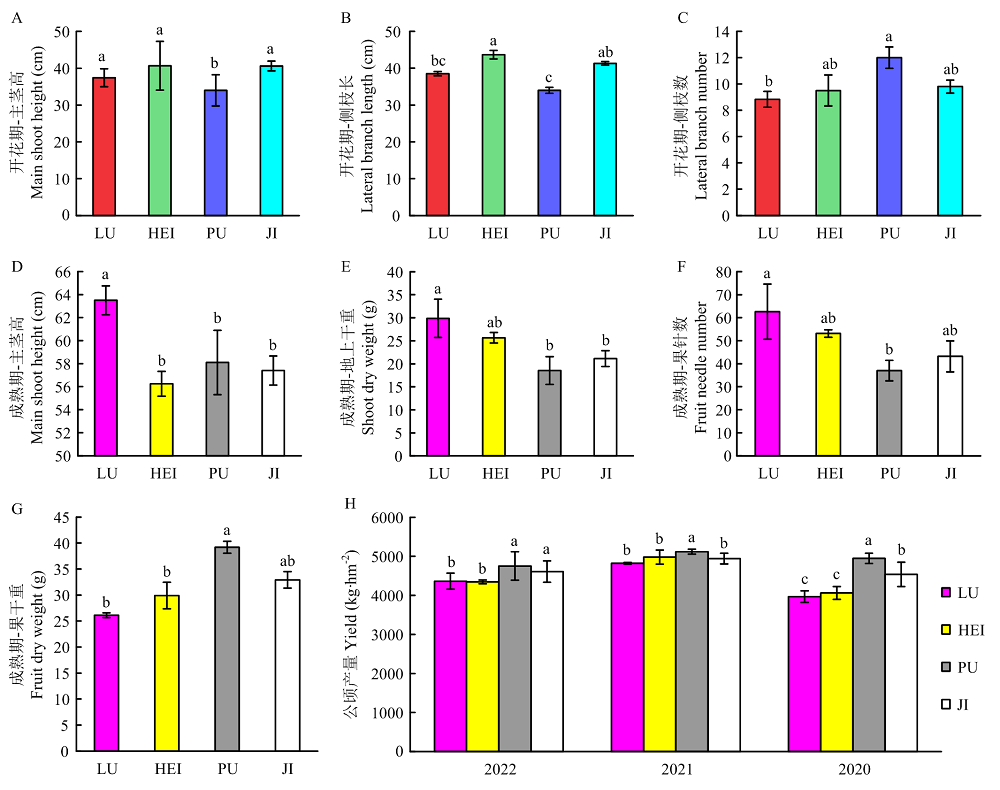
Fig. 1

Effects of different kinds of plastic film treatments on peanut growth and yield"

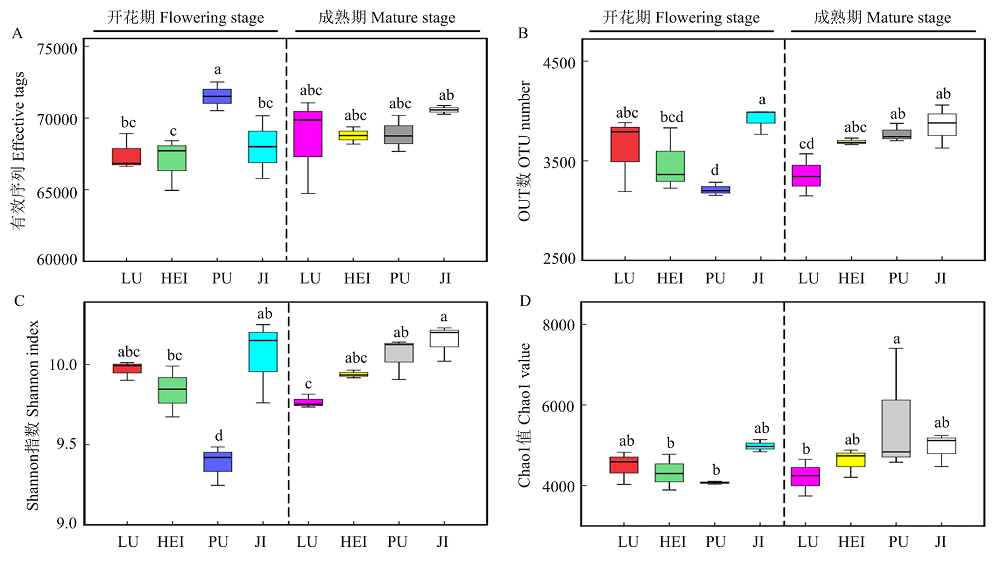
Fig. 2

Effective tags (A), OTU number (B), Shannon index (C) and Chao1 value (D) of peanut rhizosphere soil samples at the flowering stage and mature stage"

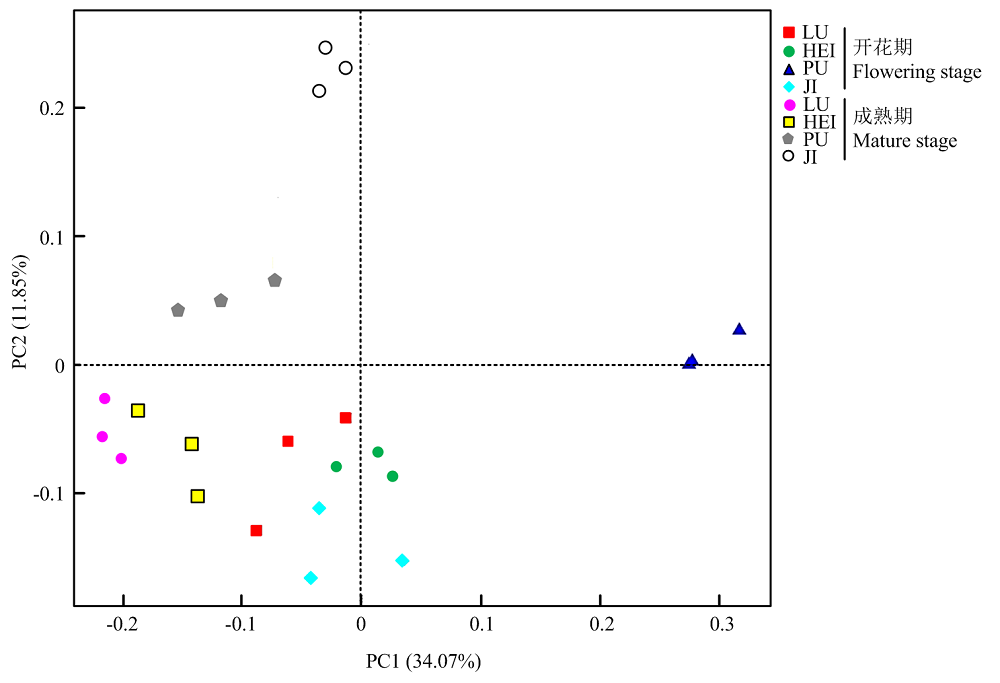
Fig. 3

Rhizobacterial community structure of different kinds of plastic film treatments assessed by principal coordinate analysis at the flowering stage and mature stage"

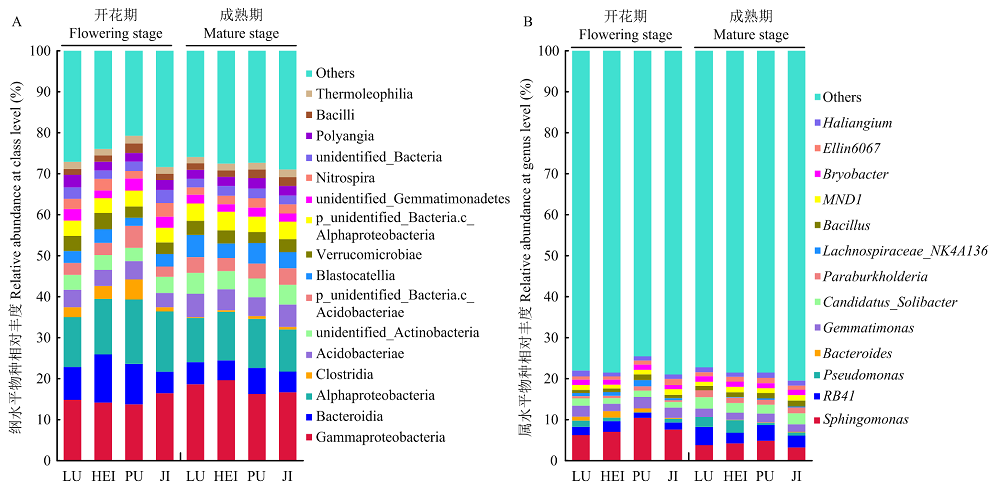
Fig. 4

Relative abundance (>1%) of rhizobacterial community at class and genus levels at the flowering stage and mature stage"

Table 1

Correlation coefficients between OTU number of rhizobacterial community and peanut growth/yield"

时期Stage 指标Index LU-HEI LU-PU LU-JI
开花期Flowering stage OTU-主茎高Main shoot height 0.269 0.035* 0.060
OTU-侧枝数Lateral branch number 0.107 0.328 0.320
OTU-侧枝长Lateral branch length 0.119 0** 0.005**
成熟期Mature stage OTU-主茎高Main shoot height 0.807 0.587 0.899
OTU-地上干重Shoot dry weight 0.573 0.541 0.605
OTU-果针数Fruit needle number 0.384 0.487 0.713
OTU果干重Fruit dry weight 0.341 0.028* 0.042*
OTU-产量Yield 0.074 0.041* 0.044*

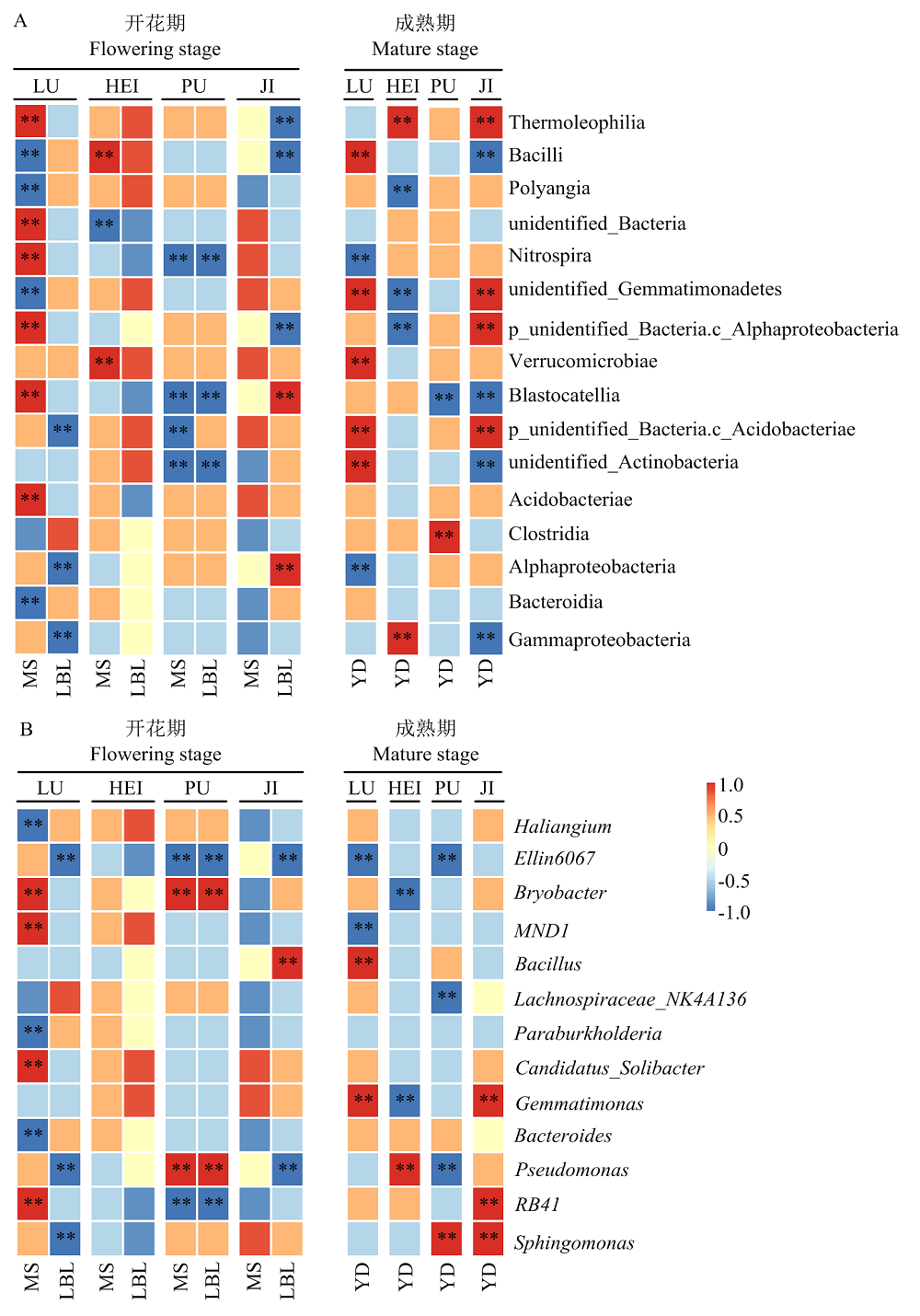
Fig. 5

Spearman’s correlation analysis between rhizobacterial community at class (A), genus (B) levels and peanut growth/yield at the flowering stage and mature stage"

Table 2

Functional prediction of rhizobacterial communities at the flowering stage and mature stage (relative abundance>0.2%)"

功能
Function
开花期Flowering stage 成熟期Mature stage
LU HEI PU JI LU HEI PU JI
化能异养
Chemoheterotrophy
13.96±0.23a 14.03±0.23a 14.53±0.03a 12.26±0.10b 11.81±0.52a 12.06±0.27a 11.44±0.53ab 10.26±0.12b
需氧异养
Aerobic chemoheterotrophy
9.65±0.37bc 9.44±0.26c 11.48±0.49a 10.63±0.02ab 10.96±0.63a 11.13±0.42a 9.37±0.31b 9.31±0.33b
发酵
Fermentation
0.45±0.02c 4.11±0.53a 3.56±0.08a 1.36±0.12b 0.58±0.03b 0.56±0.04b 1.21±0.05a 0.49±0.03b
尿素分解
Ureolysis
0.78±0.02a 0.71±0.07a 0.55±0.02b 0.67±0.05ab 0.52±0.03a 0.52±0.07a 0.63±0.05a 0.57±0.04a
硝酸盐还原
Nitrate reduction
0.72±0.08a 0.74±0.06a 0.64±0.01ab 0.55±0.03b 0.95±0.04a 0.75±0.05b 0.99±0.05a 1.01±0.09a
需氧氨氧化
Aerobic ammonia oxidation
0.72±0.01a 0.42±0.06b 0.38±0.08b 0.63±0.05a 0.14±0.02b 0.16±0.02b 0.41±0.0004a 0.17±0.03b
硝化作用
Nitrification
0.72±0.01a 0.51±0.03bc 0.38±0.08c 0.63±0.05ab 0.15±0.02a 0.18±0.03a 0.29±0.08a 0.17±0.03a
氮呼吸
Nitrogen respiration
0.38±0.02a 0.28±0.04b 0.25±0.01b 0.25±0.01b 0.28±0.02a 0.16±0.03b 0.33±0.02a 0.28±0.01a
硝酸盐呼吸
Nitrate respiration
0.38±0.02a 0.28±0.04b 0.28±0.02b 0.25±0.01b 0.28±0.02b 0.12±0.01c 0.33±0.02a 0.28±0.01b
芳香化合物降解
Aromatic compound degradation
0.26±0.01b 0.39±0.01a 0.20±0.02c 0.31±0.03b 0.55±0.02a 0.34±0.04c 0.59±0.01a 0.43±0.01b
[1]
KADER M A, SENGE M, MOJID M A, ONISHI T, ITO K. Effects of plastic-hole mulching on effective rainfall and readily available soil moisture under soybean (Glycine max) cultivation. Paddy and Water Environment, 2017, 15: 659-668.

doi: 10.1007/s10333-017-0585-z
[2]
KONG S, JI Y, LIU L, CHEN L, ZHAO X, WANG J, BAI Z, SUN Z. Diversities of phthalate esters in suburban agricultural soils and wasteland soil appeared with urbanization in China. Environmental Pollution, 2012, 170: 161-168.

doi: 10.1016/j.envpol.2012.06.017 pmid: 22813629
[3]
KAPANEN A, STEPHEN J R, BRUEGGEMANN J, KIVIRANTA A, WHITE D C, ITÄVAARA M. Diethyl phthalate in compost: Ecotoxicological effects and response of the microbial community. Chemosphere, 2007, 67(11): 2201-2209.

pmid: 17258270
[4]
郝四平. 覆盖黑色地膜对花生生长发育及产量的效应研究[D]. 郑州: 河南农业大学, 2004.
HAO S P. Effects of black plastic film mulching on growth and yield in peanut (Arachis hypogaea L.)[D]. Zhengzhou: Henan Agricultural University, 2004. (in Chinese)
[5]
QI Y, OSSOWICKI A, YANG X, HUERTA LWANGA E, DINI-ANDREOTE F, GEISSEN V, GARBEVA P. Effects of plastic mulch film residues on wheat rhizosphere and soil properties. Journal of Hazardous Materials, 2020, 387: 121711.

doi: 10.1016/j.jhazmat.2019.121711
[6]
WANG W, LEUNG A O W, CHU L H, WONG M H. Phthalates contamination in China: Status, trends and human exposure-with an emphasis on oral intake. Environmental Pollution, 2018, 238: 771-782.

doi: 10.1016/j.envpol.2018.02.088
[7]
KRASHEVSKA V, KLARNER B, WIDYASTUTI R, MARAUN M, SCHEU S. Impact of tropical lowland rainforest conversion into rubber and oil palm plantations on soil microbial communities. Biology and Fertility of Soils, 2015, 51(6): 697-705.

doi: 10.1007/s00374-015-1021-4
[8]
张俊丽, 索龙, 景鹏娟, 焦雪丽. 生物降解地膜的增温保墒及增产效应研究进展. 农业与技术, 2021, 41(15): 113-115.
ZHANG J L, SUO L, JING P J, JIAO X L. Research progress on the effects of biodegradable plastic film on increasing temperature, moisture, and yield. Agriculture and Technology, 2021, 41(15): 113-115. (in Chinese)
[9]
门洪文, 黄庆银, 陆广梅, 吕振永, 宋波, 张建兴, 侯兆武, 魏训培, 王磊善, 朱利. 不同地膜覆盖对谷子产量及田间杂草防效影响. 农业科技通讯, 2022(3): 117-120.
MEN H W, HUANG Q Y, LU G M, Z Y, SONG B, ZHANG J X, HOU Z W, WEI X P, WANG L S, ZHU L. Effects of different plastic film mulching on millet yield and weed control efficiency in the field. Bulletin of Agricultural Science and Technology, 2022(3): 117-120. (in Chinese)
[10]
翟勇全, 魏雪, 付江鹏, 马琨, 贾彪. 全生物降解膜覆盖对玉米生长、产量及氮素利用的影响. 植物营养与肥料学报, 2022, 28(11): 2041-2051.
ZHAI Y Q, WEI X, FU J P, MA K, JIA B. Effects of fully biodegradable film mulch on growth, yield and nitrogen utilization of maize. Journal of Plant Nutrition and Fertilizers, 2022, 28(11): 2041-2051. (in Chinese)
[11]
王晓光, 孔雪梅, 蒋春姬, 赵新华, 邢静, 赵凯能, 党现什, 于海秋, 潘德成. 不同材质地膜覆盖对花生产量品质的影响及防风蚀效果研究. 干旱地区农业研究, 2017, 35(2): 57-61.
WANG X G, KONG X M, JIANG C J, ZHAO X H, XING J, ZHAO K N, DANG X S, YU H Q, PAN D C. Effects of film with different materials on yield and quality of peanut and wind erosion prevention. Agricultural Research in the Arid Areas, 2017, 35(2): 57-61. (in Chinese)
[12]
杨吉顺, 李尚霞, 李飞, 梁秀通. 可降解地膜对花生生长发育及产量的影响. 现代农业科技, 2021(18): 13-14.
YANG J S, LI S X, LI F, LIANG X T. Effects of degradable plastic film on the growth, development and yield of peanut. Modern Agricultural Science and Technology, 2021(18): 13-14. (in Chinese)
[13]
李佳奇, 史建国, 陈启航, 常风云, 段义忠, 柴乖强, 贾磊, 陈涛. 陕北风沙草滩区覆膜对玉米根际土壤微生物群落的影响. 作物杂志,
LI J Q, SHI J G, CHEN Q H, CHANG F Y, DUAN Y Z, CHAI G Q, JIA L, CHEN T. Effects of film mulching on rhizosphere soil microbial community of maize in wind-sand grassy shoal area of Northern Shaanxi Province. Crops, in Chinese)
[14]
WANG J, HUANG M K, WANG Q, SUN Y Z, ZHAO Y R, HUANG Y. LDPE microplastics significantly alter the temporal turnover of soil microbial communities. The Science of the Total Environment, 2020, 726: 138682.

doi: 10.1016/j.scitotenv.2020.138682
[15]
路露, 韩荧, 刘梓桐, 钱晶晶, 闫妍, 孙玉军. 两种新型生物降解地膜对番茄生长及土壤微生物、酶活性的影响. 山东农业科学, 2023, 55(5): 101-106.
LU L, HAN Y, LIU Z T, QIAN J J, YAN Y, SUN Y J. Effects of two new biodegradable films on tomato growth and soil microbial and enzyme activity. Shandong Agricultural Sciences, 2023, 55(5): 101-106. (in Chinese)
[16]
林英杰, 李向东, 周录英, 李宝龙, 赵华建, 高芳, 张佳蕾. 花生不同种植方式对田间土壤微环境和产量的影响. 水土保持学报, 2010, 24(3): 131-135.
LIN Y J, LI X D, ZHOU L Y, LI B L, ZHAO H J, GAO F, ZHANG J L. Effects of different peanut planting patterns on field soil microenvironment and pod yield. Journal of Soil and Water Conservation, 2010, 24(3): 131-135. (in Chinese)
[17]
孙涛. 有色和生物降解地膜覆盖对花生产量形成与土壤微环境的影响[D]. 泰安: 山东农业大学, 2015.
SUN T. Effects of covered with colored and biodegradable films on the soil condition and yield formation in peanut field[D]. Taian: Shandong Agricultural University, 2015. (in Chinese)
[18]
CHEN L, HAO Z, LI K, SHA Y, WANG E, SUI X, MI G, TIAN C, CHEN W. Effects of growth-promoting rhizobacteria on maize growth and rhizosphere microbial community under conservation tillage in Northeast China. Microbial Biotechnology, 2021, 14(2): 535-550.

doi: 10.1111/mbt2.v14.2
[19]
CAPORASO J G, KUCZYNSKI J, STOMBAUGH J, BITTINGER K, BUSHMAN F D, COSTELLO E K, FIERER N, PENA A G, GOODRICH J K, GORDON J I, et al. QIIME allows analysis of high-throughput community sequencing data. Nature Methods, 2010, 7(5): 335-336.

doi: 10.1038/nmeth.f.303 pmid: 20383131
[20]
EDGAR R C. UPARSE: Highly accurate OTU sequences from microbial amplicon reads. Nature Methods, 2013, 10(10): 996-998.

doi: 10.1038/nmeth.2604 pmid: 23955772
[21]
LI Y, LI T, WANG Z, WANG S, QIN X, LIAO Y. Plastic film mulch changes the microbial community in maize root-associated compartments. Plant and Soil, 2022, 470: 5-20.

doi: 10.1007/s11104-021-05060-2
[22]
XUE Y, JIN T, GAO C, LI C, ZHOU T, WAN D, YANG M. Effects of biodegradable film mulching on bacterial diversity in soils. Archives of Microbiology, 2022, 204: 195.

doi: 10.1007/s00203-022-02799-9 pmid: 35217920
[23]
刘岳飞, 吴人敏, 张传进, 姚华开, 杨尚东. 地膜对植椒土壤生物学特性和细菌多样性的影响. 土壤学报, 2019, 56(4): 986-993.
LIU Y F, WU R M, ZHANG C J, YAO H K, YANG S D. Effects of film mulching on soil biological properties and bacterial diversity in pepper fields. Acta Pedologica Sinica, 2019, 56(4): 986-993. (in Chinese)
[24]
ZHANG M, ZHAO G, LI Y, WANG Q, DANG P, QIN X, ZOU Y, CHEN Y, SIDDIQUE K H M. Straw incorporation with ridge-furrow plastic film mulch alters soil fungal community and increases maize yield in a semiarid region of China. Applied Soil Ecology, 2021, 167: 104038.

doi: 10.1016/j.apsoil.2021.104038
[25]
WU Z, ZHENG Y, SUI X, ZHANG Z, WANG E, LIU Y, YU T, YANG J, WU Y. Comparative analysis of the effects of conventional and biodegradable plastic mulching films on soil-peanut ecology and soil pollution. Chemosphere, 2023, 334: 139044.

doi: 10.1016/j.chemosphere.2023.139044
[26]
SHI M, KANG Y, ZHANG W, YANG X, FAN Y, YU H, ZHANG R, GUO A, QIN S. Plastic film mulching with ridge planting alters soil chemical and biological properties to increase potato yields in semiarid Northwest China. Chemical and Biological Technologies in Agriculture, 2022, 9: 16.

doi: 10.1186/s40538-022-00284-5
[27]
QIAN H, ZHANG M, LIU G, LU T, QU Q, DU B, PAN X. Effects of soil residual plastic film on soil microbial community structure and fertility. Water, Air, and Soil Pollution, 2018, 229: 261.

doi: 10.1007/s11270-018-3916-9
[28]
CHEN L, LI K, SHANG J, WU Y, CHEN T, WANYAN Y, WANG E, TIAN C, CHEN W, CHEN W, MI G, SUI X. Plant growth-promoting bacteria improve maize growth through reshaping the rhizobacterial community in low-nitrogen and low-phosphorus soil. Biology and Fertility of Soils, 2021, 57: 1075-1088.

doi: 10.1007/s00374-021-01598-6
[29]
CHEN Q, DING J, ZHU Y, HE J, HU H. Soil bacterial taxonomic diversity is critical to maintaining the plant productivity. Environment International, 2020, 140: 105766.

doi: 10.1016/j.envint.2020.105766
[30]
CORDOVEZ V, DINI-ANDREOTE F, CARRION V J, RAAIJMAKERS J M. Ecology and evolution of plant microbiomes. Annual Review of Microbiology, 2019, 73: 69-88.

doi: 10.1146/annurev-micro-090817-062524 pmid: 31091418
[31]
FANG S, XIE B, LIU D, LIU J J. Effects of mulching materials on nitrogen mineralization, nitrogen availability and poplar growth on degraded agricultural soil. New Forests, 2011, 41: 147-162.

doi: 10.1007/s11056-010-9217-9
[32]
KUYPERS M M, MARCHANT H K, KARTAL B. The microbial nitrogen-cycling network. Nature Reviews Microbiology, 2018, 16(5): 263-276.

doi: 10.1038/nrmicro.2018.9 pmid: 29398704
[33]
WANG Y P, LI X G, HAI L, SIDDIQUE K H M, GAN Y T, LI F M. Film fully-mulched ridge-furrow cropping affects soil biochemical properties and maize nutrient uptake in a rainfed semi-arid environment. Soil Science and Plant Nutrition, 2014, 60(4): 486-498.

doi: 10.1080/00380768.2014.909709
[34]
ZOU W, YE G, ZHANG K. Diversity, function, and application of Clostridium in Chinese strong flavor Baijiu ecosystem: A review. Journal of Food Science, 2018, 83(5): 1193-1199.

doi: 10.1111/jfds.2018.83.issue-5
[35]
ONI F E, ESMAEEL Q, ONYEKA J T, ADELEKE R, JACQUARD C, CLEMENT C, GROSS H, AIT BARKA E, HÖFTE M. Pseudomonas lipopeptide-mediated biocontrol: Chemotaxonomy and biological activity. Molecules, 2022, 27(2): 372.

doi: 10.3390/molecules27020372
[36]
IVANOVA A A, ZHELEZOVA A D, CHERNOV T I, DEDYSH S N. Linking ecology and systematics of acidobacteria: Distinct habitat preferences of the Acidobacteriia and Blastocatellia in tundra soils. PLoS ONE, 2020, 15(3): e0230157.

doi: 10.1371/journal.pone.0230157
[37]
BANDOPADHYAY S, MARTIN-CLOSAS L, PELACHO A M, DEBRUYN J M. Biodegradable plastic mulch films: Impacts on soil microbial communities and ecosystem functions. Frontiers in Microbiology, 2018, 9: 819.

doi: 10.3389/fmicb.2018.00819 pmid: 29755440
[1] LI XinYu, HOU MingYu, CUI ShunLi, LIU YingRu, LI XiuKun, LIU LiFeng. Construction of Near Infrared Spectrometry Model for Flavonoids Content of Peanut with Red and Black Testa [J]. Scientia Agricultura Sinica, 2025, 58(7): 1284-1295.
[2] YANG YongQing, HU PengJu, SONG YaHui, JIN XinXin, SU Qiao, WANG Jin. QTL Mapping of Quality Traits for A Peanut Germplasm SW9721-3 with Ultra-High Oil Content [J]. Scientia Agricultura Sinica, 2025, 58(4): 635-646.
[3] ZHAO Ya, ZHANG Wen, WANG Du, ZHANG LiangXiao, ZHANG Qi, HAN Qin, WANG Wei, LI PeiWu. Effects of ARC Microbial Agent on Alleviating Functional Decline of Peanut Root Nodules Under Dark Stress [J]. Scientia Agricultura Sinica, 2025, 58(22): 4617-4627.
[4] LI QiongWei, BI YanLiang, YAN Ning, ZOU XiaoXia, SI Tong. The Physiological Mechanism of Graphene Oxide-Induced Enhancement of Peanut Seed Germination and Seedling Salinity Tolerance [J]. Scientia Agricultura Sinica, 2025, 58(15): 2993-3006.
[5] LIANG Na, WANG JiangTao, WANG YingChao, ZHENG Bin, WANG XiaoXiao, LIU Juan, LIU Ling, FU GuoZhan, JIAO NianYuan. Effects of Co-Ridge Planting on the Distribution Characteristics of Soil Available Phosphorus and the Absorption and Utilization of Phosphorus by Crops in Maize||Peanut [J]. Scientia Agricultura Sinica, 2025, 58(13): 2564-2577.
[6] WANG ShiJi, LI YueYing, CHEN Chen, JIANG GuiYing, LIU ChaoLin, ZHU ChangWei, YANG Jin, WANG MengRu, JIE XiaoLei, LIU Fang, LIU ShiLiang. The Characteristics of Ammonia Volatilization and Crop Yield Under Legume-Wheat Rotation System in Fluvo-Aquic Soil in Northern Henan Province [J]. Scientia Agricultura Sinica, 2025, 58(13): 2614-2629.
[7] CUI MengJie, SUN ZiQi, QI FeiYan, LIU Hua, XU Jing, DU Pei, HUANG BingYan, DONG WenZhao, HAN SuoYi, ZHANG XinYou. Evaluation of 322 Peanut Germplasms for Resistance to Aspergillus flavus Infection [J]. Scientia Agricultura Sinica, 2025, 58(12): 2303-2315.
[8] YANG QiRui, LI LanTao, ZHANG Xiao, ZHANG Qian, ZHANG YinJie, ZHANG Duo, WANG YiLun. Effects of Potassium Application Dosage on Yield, Quality and Light Temperature Physiological Characteristics of Summer Peanut [J]. Scientia Agricultura Sinica, 2024, 57(7): 1335-1349.
[9] ZHU YanTing, DANG Hao, NIU SiJie, LIN JingYi, YANG Hua, YANG Qiang, ZHANG Chong, CAI TieCheng, ZHUANG WeiJian, CHEN Hua. Screening of Interaction Proteins with AhSAP1 in Peanut Using the Yeast Two-Hybrid System [J]. Scientia Agricultura Sinica, 2024, 57(21): 4376-4390.
[10] LIU Han, DING Di, WANG JiangTao, ZHENG Bin, WANG XiaoXiao, ZHU ChenXu, LIU Juan, LIU Ling, FU GuoZhan, JIAO NianYuan. Coordinated Effects of Maize Ear Type and Planting Density on Interspecific Competition in Maize-Peanut Intercropping System [J]. Scientia Agricultura Sinica, 2024, 57(19): 3758-3769.
[11] HU JiaYu, GAO BingYang, GAO YiFan, YUAN ShiLun, QI Xin, HUANG YuFang, YAN JunYing, ZHAO YaNan, YE YouLiang. Effects of Magnesium Fertilizer Dosage on Nutrient Absorption and Photosynthetic Characteristics in Peanuts [J]. Scientia Agricultura Sinica, 2024, 57(16): 3220-3233.
[12] LIU Hua, ZENG FanPei, WANG Qian, CHEN GuoQuan, MIAO LiJuan, QIN Li, HAN SuoYi, DONG WenZhao, DU Pei, ZHANG XinYou. Development and Identification of an Interspecific Hexaploid Hybrid Between an A. hypogaea Cultivar and a Wild Species Arachis sp. 30119 in Peanut [J]. Scientia Agricultura Sinica, 2024, 57(10): 1870-1881.
[13] LIU Na, XIE Chang, HUANG HaiYun, YAO Rui, XU Shuang, SONG HaiLing, YU HaiQiu, ZHAO XinHua, WANG Jing, JIANG ChunJi, WANG XiaoGuang. Effects of Potassium Application on Root and Nodule Characteristics, Nutrient Uptake and Yield of Peanut [J]. Scientia Agricultura Sinica, 2023, 56(4): 635-648.
[14] JIANG WenYang, CHEN JunNan, ZAN ZhiMan, WANG JiangTao, ZHENG Bin, LIU Ling, LIU Juan, JIAO NianYuan. Regulation of Single-Seed Sowing and Phosphorus Application on Interspecific Competition and Growth of Intercropping Peanut [J]. Scientia Agricultura Sinica, 2023, 56(23): 4660-4670.
[15] YANG Sha, LIU KeKe, LIU Ying, GUO Feng, WANG JianGuo, GAO HuaXin, MENG JingJing, ZHANG JiaLei, WAN ShuBo. The Molecular Mechanism of Pod Yield Difference Between Single- Seeding Precision Sowing and Multi-Seeds Sowing of Peanut Based on Transcriptome Analysis [J]. Scientia Agricultura Sinica, 2023, 56(22): 4386-4402.
Viewed
Full text


Abstract

Cited

  Shared   
  Discussed   
No Suggested Reading articles found!