Scientia Agricultura Sinica ›› 2020, Vol. 53 ›› Issue (13): 2678-2690.doi: 10.3864/j.issn.0578-1752.2020.13.016

;

• TECHNOLOGY AND MECHANISM FOR RECOVERY OF ABANDONED CROPLAND • Previous Articles     Next Articles

Responses of Soil Organic Carbon Fractionation and Microbial Community to Nitrogen and Water Addition in Artificial Grassland

XU Meng1,XU LiJun2,CHENG ShuLan3,FANG HuaJun1,3(),LU MingZhu1,YU GuangXia3,YANG Yan1,GENG Jing1,CAO ZiCheng3,LI YuNa3   
  1. 1Key Laboratory of Ecosystem Network Observation and Modeling, Institute of Geographic Sciences and Natural Resources Research, Chinese Academy of Sciences, Beijing 100101
    2Institute of Agricultural Resources and Regional Planning, Chinese Academy of Agricultural Sciences/Hulunber Grassland Ecosystem Observation and Research Station, Beijing 100081
    3College of Resources and Environment, University of Chinese Academy of Sciences, Beijing 100049
  • Received:2019-09-13 Accepted:2019-12-08 Online:2020-07-01 Published:2020-07-16
  • Contact: HuaJun FANG E-mail:fanghj@igsnrr.ac.cn

Abstract:

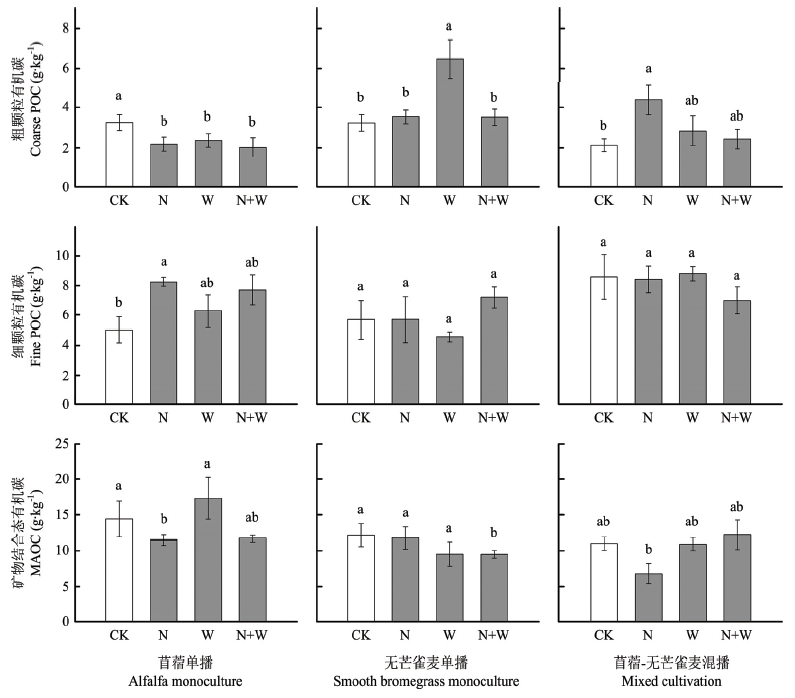
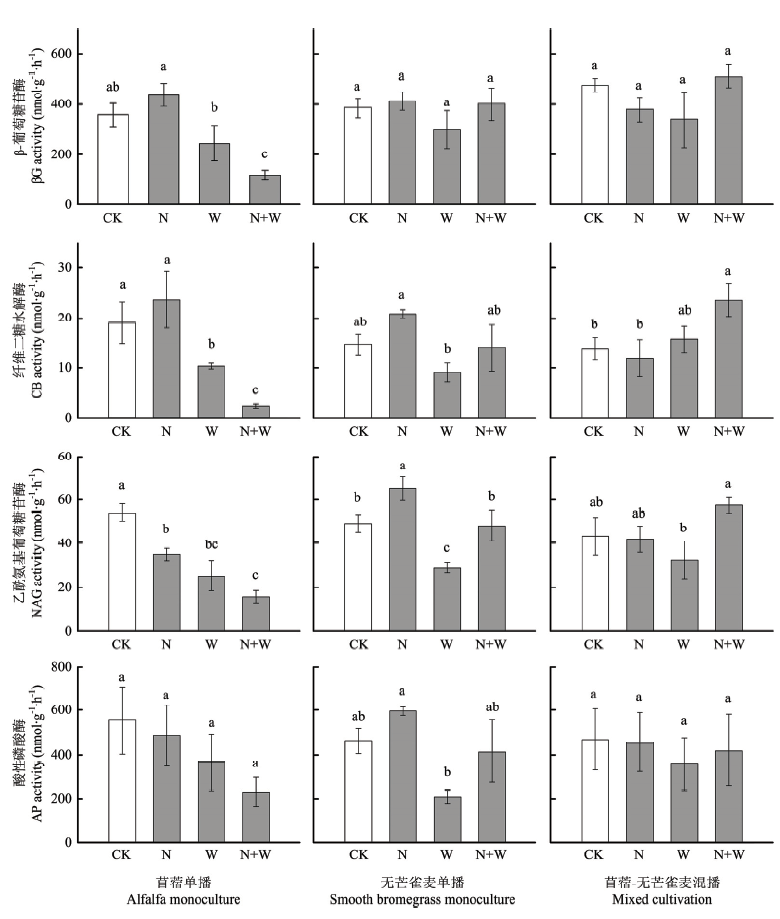
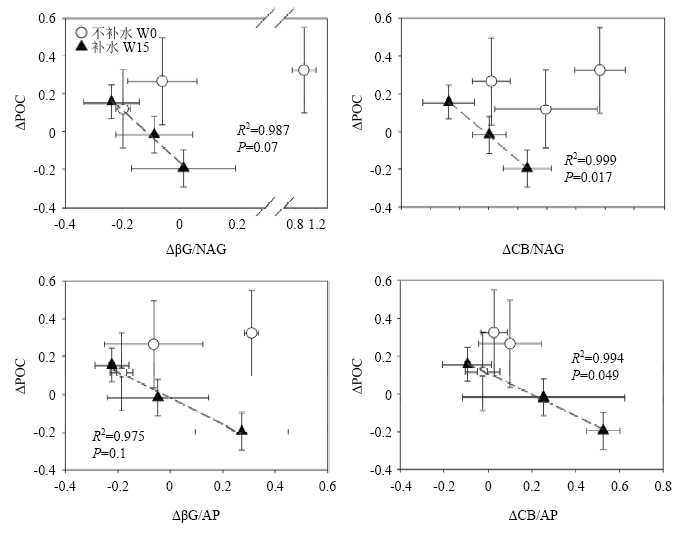
【Objective】 Establishment of artificial grassland provides one solution for releasing some of the grazing pressure on natural grassland, and thus is conducive to the restoration of degraded grassland. The present study aimed to investigate the effects of nitrogen (N) addition and water supplement on soil organic carbon (SOC) fractionation, composition and activity of soil microbial community on artificial grassland established in Hulunber region, so as to provide insight into the effect of management practices on SOC sequestration and stability of artificial grassland. 【Method Experimental plots were designed with two factors of N addition (0, and 150 kg N·hm-2·a-1) and water addition (0, and 60 mm), and were constructed under three types of artificial grasslands, i.e., alfalfa monoculture, smooth bromegrass monoculture, and the mixed cultivation of alfalfa and smooth bromegrass. Soil samples were collected from experimental plots and SOC of bulk soil was fractionated into different particulate-size fractions by wet-sieving method. The abundance, composition and activity of soil microbial community were measured by phospholipid fatty acids (PLFA) and extracellular enzyme activity. Then, the effects of N addition and watering treatments on SOC fractions and soil microbial community, and investigated the relationship between these two components were analyzed. 【Result】 Three years of N fertilization and water addition exerted significant impact on SOC fractionation. Addition of N generally increased the content of particulate organic carbon (POC) in soils of alfalfa monoculture and the mixed cultivation but decreased the content of mineral associated organic carbon (MAOC), while water addition significantly increased the content of coarse POC in soils of smooth bromegrass monoculture. The activities of four soil extracellular enzymes but not the abundance or composition of soil microbial community were significantly affected by N and water addition. Nitrogen application without water addition significantly inhibited the activity of β-N-acetylglucosidase (NAG) in soils of alfalfa monoculture, but promoted that in soils of smooth bromegrass monoculture. The activities of cellobiohydorlase (CB) and NAG were significantly decreased by water addition in soils of two monoculture grasslands. Nitrogen application with water addition significantly inhibited the activities of β-glucosidase (βG), CB and NAG in soils of alfalfa monoculture, but significantly promoted CB activity in soils of the mixed cultivation. The changes in PLFA concentration of total community and specific microbial groups were positively correlated with changes in content of POC, but negatively correlated with MAOC. There were negative correlations between the activities of βG and CB, as well as the ratio of enzyme C/N and C/P with changes in POC content, and these correlations were stronger under treatments with water addition. 【Conclusion】 Results of the present study showed that in artificial grassland established in semi-arid Hulunbeier region, the addition of N fertilization significantly promoted the accumulation of labile SOC fraction, but decreased the proportion of recalcitrant fraction, which reduced the stability of soil carbon sequestration. Nitrogen fertilization and water supplement induced significant changes in activity of soil microbial communities, and these changes in enzyme stoichiometric ratios were closely related to changes in SOC fractions. These results implied that the differential demands for C, N and P by microbial communities were crucial in regulating the turnover of labile SOC fraction in artificial grassland.

Key words: artificial grassland, nitrogen addition, water addition, soil organic carbon, soil microbial community, extracellular enzyme activity, enzyme stoichiometric ratio, Hulunber

Table 1

Soil extracellular enzymes and corresponding substrates"

酶 Enzyme 缩写 Abbreviation 底物 Substrate
β-葡萄糖苷酶β-glucosidase βG 4-MUB-β-D-glucoside
纤维二糖水解酶 Cellobiohydorlase CB 4-MUB-β-D-cellobioside
β-N-乙酰氨基葡萄糖苷酶β-N-acetylglucosidase NAG 4-MUB-N-acetyl-β-D-glucosaminide
酸性磷酸酶 Acid phosphatase AP 4-MUB-phosphate

Table 2

Effect of N and water treatment on soil general properties under three forage cultivation types"

处理
Treatment
pH 有机碳
SOC
(g·kg-1)
总氮
TN
(g·kg-1)
硝态氮
NO3--N
(mg·kg-1)
铵态氮
NH4+-N (mg·kg-1)
总可溶性氮
TDN
(mg kg-1)
土壤水分
Soil moisture
(%)
苜蓿单播 Alfalfa monoculture
CK 7.0±0.4a 21.6±1.5a 2.1±0.1a 27.0±2.6c 4.6±0.4a 51.3±1.2c 12.4±0.3a
N 7.1±0.4a 20.2±0.7a 2.0±0.1a 52.9±6.9b 6.1±0.8a 78.8±6.8b 12.8±0.4a
W 6.6±0.5a 22.0±1.0a 2.1±0.1a 28.7±1.8c 5.4±0.8a 54.3±3.3c 13.6±0.6a
N+W 6.4±0.5a 21.3±1.0a 2.2±0.1a 78.3±11.4a 6.6±1.4a 103.8±11.4a 12.7±0.8a
无芒雀麦单播 Smooth bromegrass monoculture
CK 7.2±0.2a 20.6±0.1a 2.1±0.0a 28.6±2.2b 4.7±0.8a 54.7±2.9b 12.5±0.9a
N 6.6±0.2a 21.4±0.5a 2.2±0.0a 81.3±19.4a 6.4±0.9a 121.2±26.1a 13.0±0.9a
W 7.2±0.2a 19.6±1.3a 2.0±0.1a 40.4±9.0b 4.9±0.4a 67.1±10.0b 13.0±1.1a
N+W 7.0±0.3a 20.4±0.8a 2.0±0.1a 55.4±7.6ab 4.8±0.9a 80.9±9.0ab 12.2±0.5a
苜蓿-无芒雀麦混播 Mixed cultivation
CK 6.8±0.2a 21.6±1.2a 2.1±0.1a 29.9±3.0b 5.6±1.0a 55.7±4.7b 12.9±0.5a
N 6.8±0.3a 21.8±1.4a 2.2±0.1a 72.3±7.8a 6.0±1.7a 104.6±6.8a 13.1±0.7a
W 7.0±0.2a 22.5±0.8a 2.2±0.1a 25.8±3.8b 6.0±0.9a 54.4±4.3b 12.4±0.3a
N+W 7.1±0.3a 21.8±2.3a 2.2±0.2a 78.1±10.3a 5.8±0.7a 109.1±11.6a 12.4±0.4a

Fig. 1

Reponses of different SOC fractions to N and water treatments under three forage cultivation types Different lowercase letters indicate significant differences in individual SOC fraction among different N and water addition treatments by Duncan’s multiple range tests (P<0.05)"

Table 3

PLFA concentration (μmol·g-1 soil) in response to N and water treatment under three forage cultivation types"

处理
Treatment
总磷脂脂肪酸含量
Total PLFA
革兰氏阳性细菌
Gram-positive bacteria
革兰氏阴性细菌
Gram-negative bacteria
真菌
Fungi
丛枝菌根真菌
AMF
真菌细菌比
F/B
革兰氏阳性/
阴性细菌比
G+/G-
苜蓿单播 Alfalfa monoculture
CK 25.1±1.7a 10.2±0.8a 8.3±0.5a 2.5±0.2a 0.86±0.07a 0.137±0.003a 1.23±0.05a
N 21.7±2.7a 8.7±1.1a 7.3±0.8a 2.4±0.4a 0.72±0.09a 0.147±0.006a 1.19±0.03a
W 25.6±3.2a 10.3±1.2a 8.6±1.1a 2.6±0.4a 0.87±0.12a 0.137±0.006a 1.21±0.04a
N+W 26.0±2.3a 10.5±0.9a 8.6±0.8a 2.7±0.3a 0.83±0.09a 0.143±0.002a 1.22±0.03a
无芒雀麦单播 Smooth bromegrass monoculture
CK 23.9±2.6a 9.7±1.1a 7.8±0.8a 2.4±0.3a 0.88±0.10a 0.138±0.008a 1.24±0.02a
N 22.8±2.3a 9.5±0.8a 7.4±0.8a 2.2±0.2a 0.79±0.14a 0.128±0.003a 1.28±0.02a
W 21.7±1.6a 8.8±0.6a 7.1±0.6a 2.3±0.2a 0.75±0.06a 0.143±0.001a 1.25±0.04a
N+W 22.6±1.8a 9.2±0.7a 7.5±0.6a 2.2±0.2a 0.79±0.04a 0.133±0.004a 1.22±0.02a
苜蓿-无芒雀麦混播 Mixed cultivation
CK 22.1±1.1ab 9.1±0.5ab 7.3±0.3ab 2.2±0.1a 0.73±0.03ab 0.132±0.004a 1.25±0.04a
N 25.9±1.6a 10.2±0.7a 8.8±0.5a 2.6±0.2a 0.95±0.07a 0.135±0.003a 1.16±0.02a
W 21.2±2.4ab 8.7±0.9ab 6.9±0.7ab 2.1±0.3a 0.73±0.10ab 0.135±0.005a 1.26±0.05a
N+W 19.8±1.4b 7.8±0.6b 6.8±0.5b 3.0±0.2a 0.69±0.06b 0.144±0.002a 1.15±0.04a

Fig. 2

Responses of extracellular enzyme activity to different N and water treatments under three forage cultivation types Bars indicate mean value ± SE. Different lowercase letters indicate significant differences in individual enzyme activity among different N and water addition treatments by Duncan’s multiple range tests (P<0.05)"

Table 4

Responses of enzyme stoichiometric ratios to N and water treatment under three forage cultivation types"

处理
Treatment
土壤酶C/N比 Enzyme C/N 土壤酶C/P比 Enzyme C/P
βG/NAG CB/NAG βG/AP CB/AP
苜蓿单播 Alfalfa monoculture
CK 6.5±0.6c 0.33±0.11b 0.58±0.05a 0.033±0.004a
N 12.4±0.6a 0.65±0.11a 0.75±0.06a 0.035±0.006a
W 10.2±1.6ab 0.30±0.02b 0.77±0.14a 0.037±0.006a
N+W 7.7±1.3bc 0.15±0.04b 0.61±0.13a 0.032±0.001a
无芒雀麦单播 Smooth bromegrass monoculture
CK 7.7±0.3a 0.30±0.05a 0.84±0.07a 0.057±0.010a
N 6.4±0.1a 0.32±0.01a 0.70±0.07a 0.052±0.009a
W 8.0±1.0a 0.32±0.07a 1.47±0.33a 0.069±0.006a
N+W 6.8±0.6a 0.28±0.08a 1.25±0.27a 0.087±0.027a
苜蓿-无芒雀麦混播 Mixed cultivation
CK 9.9±0.7a 0.32±0.03ab 0.86±0.12a 0.034±0.003b
N 9.0±0.4a 0.26±0.05b 0.75±0.08a 0.036±0.002b
W 9.5±1.5a 0.40±0.05a 0.91±0.10a 0.038±0.006ab
N+W 8.9±0.5a 0.40±0.04a 1.15±0.20a 0.059±0.012a

Table 5

Pearson correlation coefficient (r) of relative changes (Δ) in PLFA concentration, enzyme activity and SOC fractions under N and water addition"

项目
Item
全部处理 All treatments 不补水 No water addition 补水 With water addition
Coarse POC Fine POC POC MAOC Coarse POC POC MAOC Coarse POC Fine POC POC MAOC
土壤微生物量 Soil microbial biomass
PLFA总量
Total PLFA
0.424* 0.486* -0.657** 0.554? -0.679* 0.679* 0.534? -0.767**
革兰氏阳性细菌
G+
0.426* 0.461* -0.628** 0.520? -0.616* 0.682* -0.781**
革兰氏阴性细菌
G-
0.390? 0.366? 0.435* -0.629** 0.538? -0.772** 0.585? -0.635*
真菌 Fungi 0.419* 0.498* -0.623** 0.574? -0.660* 0.585? 0.564? 0.550? -0.733*
丛枝菌根真菌
AMF
0.464* 0.378? 0.508* -0.632** 0.558? -0.710* 0.617* 0.627* 0.563? -0.596?
土壤酶活性 Extracellular enzyme activity
βG -0.642* 0.685* -0.709*
CB -0.651* 0.711* -0.748*
土壤酶化学计量比 Enzyme stoichiometric ratio
βG/NAG -0.581?
CB/NAG -0.691* 0.607? -0.540?
βG/AP -0.463* -0.476* 0.404? -0.797** -0.821**
CB/AP 0.572? -0.572? -0.667*

Fig. 3

Relationships between relative changes (Δ) in POC content and enzyme stoichiometric ratios"

[1] 白永飞, 玉柱, 杨青川, 万宏伟, 黄建辉, 纪宝明, 李昂. 人工草地生产力和稳定性的调控机理研究: 问题、进展与展望. 科学通报, 2018,63(5/6):511-520.
BAI Y F, YU Z, YANG Q C, WAN H W, HUANG J H, JI B M, LI A. Mechanisms regulating the productivity and stability of artificial grasslands in China: Issues, progress, and prospects. Chinese Science Bulletin, 2018,63(5/6):511-520. (in Chinese)
[2] LAL R. Intensive agriculture and the soil carbon pool. Journal of Crop Improvement, 2013,27(6):735-751.
[3] CONANT R T, PAUSTIAN K, ELLIOTT E T. Grassland management and conservation into grassland: effects on soil carbon. Ecological Applications, 2001,11:343-355.
[4] SOUSSANA J F, LOISEAU P, VUICHARD N, CESCHIA E, BALESDENT J, CHEVALLIER T, ARROUAYS D. Carbon cycling and sequestration opportunities in temperate grasslands. Soil Use and Management, 2004,20(2):219-230.
[5] VAN GROENIGEN K, SIX J, HUBGATE B A, DE GRAAFF M, VAN BREEMEN N, VAN KESSEL C. Element interactions limit soil carbon storage. Proceedings of the National Academy of Science of the United States of America, 2006,103(17):6571-6574.
[6] POEPLAU C, ZOPF D, GREINER B, GEERTS R, KORVAAR H, THUMM U, DON M, HEIDKAMP A, FLESSA H. Why does mineral fertilization increase soil carbon stocks in temperate grasslands? Agricultural Ecosystems and Environment, 2018,265:144-155.
[7] ALVAREZ R. A review of nitrogen fertilizer and conservation tillage effects on soil organic carbon storage. Soil Use and Management, 2005,21(1):38-52.
[8] SIX J, CONANT R T, PAUL E A, PAUSTIAN K. Stabilization mechanisms of soil organic matter: Implications for C-saturation of soils. Plant and Soil, 2002,241(2):155-176.
[9] VON LÜTZOW M, KÖGEL-KNABNER I, EKSCHMITT K, FLESSA H, GUGGENBERGER G, MATZNER E, MARSCHNER B. SOM fractionation methods: relevance to functional pools and to stabilization mechanisms. Soil Biology and Biochemisty, 2007,39(9):2183-2207
[10] CAMBARDELLA C A, ELLIOTT E T. Particulate soil organic matter changes across a grassland cultivation sequence. Soil Science Society of America Journal, 1992,56(3):777-783.
[11] RIGGS C E, HOBBIE S E, BACH E M, HOFMOCKEL K S, KAZANSKI C E. Nitrogen addition changes grassland soil organic matter decomposition. Biogeochemistry, 2015,125(2):203-219.
[12] TAN W, WANG G, HUANG C, GAO R, XI B, ZHU B. Physico- chemical protection, rather than biochemical composition, governs the responses of soil organic carbon decomposition to nitrogen addition in a temperate agroecosystem. Science of the Total Environment, 2017,598:282-288.
[13] ZAK D R, FREEDMAN Z B, UPCHURCH R A, STEFFENS M, KÖGEL-KNABNER I. Anthropogenic N deposition increases soil organic matter accumulation without altering its biochemical composition. Global Chang Biology, 2017,23(2):933-944.
[14] LIANG C, GUTKNECHT J L M, BALSER T C. Microbial lipid and amino sugar responses to long-term simulated global environmental changes in a California annual grassland. Frontiers in Microbiology, 2015,6:385.
[15] RIGGS C E, HOBBIE S E. Mechanisms driving the soil organic matter decomposition response to nitrogen enrichment in grassland soils. Soil Biology Biochemistry, 2016,99:54-65.
[16] AVERILL C, WARING B. Nitrogen limitation of decomposition and decay: How can it occur? Global Chang Biology, 2018,24(4):1417-1427.
[17] FIERRER N, BRADFORD M A, JACKSON R B. Toward an ecological classification of soil bacteria. Ecology, 2007,88(6):1354-1364.
[18] WARING B G, AVERILL C, HAWKES C V. Differences in fungal and bacterial physiology alter soil carbon and nitrogen cycling: insights from meta-analysis and theoretical models. Ecology Letters, 2013,16(7):887-894.
[19] SOCHOROVA L, JANSA J, VERBRUGGEN E, HEJCMAN M, SCHELLBERG J, KIERS E T, JOHNSON N C. Long-term agricultural management maximizing hay production can significantly reduce belowground C storage. Agricultural Ecosystems and Environment, 2016,220:104-114.
[20] ROUSK J, BROOKES P C, BAATH E. Fungal and bacterial growth responses to N fertilization and pH in the 150-year ‘Park Grass’ UK grassland experiment. FEMS Microbiology Ecology, 2011,76:89-99.
[21] YANG S, XU Z, WANG R, ZHANG Y, YAO F, ZHANG Y, TURCO R F, JIANG Y, ZOU H, LI H. Variations in soil microbial community composition and enzymatic activities in response to increased N deposition and precipitation in Inner Mongolian grassland. Applied Soil Ecology, 2017,119:275-285.
[22] ZHANG N, WAN S, GUO J, HAN G, GUTKNECHT J, SCHMID B, YU L, LIU W, BI J, WANG Z. Precipitation modifies the effects of warming and nitrogen addition on soil microbial communities in northern Chinese grasslands. Soil Biology and Biochemistry, 2015,89:12-23.
[23] HUANG G, LI Y, SU Y G. Divergent responses of soil microbial communities to water and nitrogen addition in a temperate desert. Geoderma, 2015,251:55-64.
[24] KOTAS P, CHOMA M, ŠANTRUCKOVA H, LEPS J, TRISKA J, KASTOVSKA E. Linking above-and belowground responses to 16 years of fertilization, mowing, and removal of the dominant species in a temperate grassland. Ecosystems, 2017,20:354-367.
[25] HENRY H A. Reprint of Soil extracellular enzyme dynamics in a changing climate. Soil Biology and Biochemistry, 2013,56:53-59.
[26] SINSABAUGH R L, SHAH J J F. Ecoenzymatic stoichiometry and ecological theory. Annual Review of Ecology Evolution and Systematics, 2012,43(1):313-343.
[27] LEFF J W, JONES S E, PROBER S M, BARBERAN A, BORER E T, FIRN J L, HARPOLE WS, HOBBIE S E, HOFMOCKEL K S, KNOPS J M H, et al. Consistent responses of soil microbial communities to elevated nutrient inputs in grasslands across the globe. Proceedings of the National Academy of Science of the United States of America, 2015,112(35):10967-10972.
[28] FROSTEGÅRD A, BÅÅTH E. The use of phospholipid fatty acid analysis to estimate bacterial and fungal biomass in soil. Biology and Fertility of Soils. 1996,22(1/2):59-65.
[29] CHENG S, FANG H, YU G. Threshold responses of soil organic carbon concentration and composition to multi-level nitrogen addition in a temperate needle-broadleaved forest. Biogeochemistry, 2018,137(1/2):219-233.
[30] ZHANG N, LIU W, YANG H, YU X, GUTKNECHT J L, ZHANG Z, WAN S, MA K. Soil microbial responses to warming and increased precipitation and their implications for ecosystem C cycling. Oecologia, 2013,173:1125-1142.
[31] SUN L J, QI Y C, DONG Y S, HE Y T, PENG L, LIU X C, JIA J Q, GUO S F, CAO C C. Interactions of water and nitrogen addition on soil microbial community composition and functional diversity depending on the inter-annual precipitation in a Chinese steppe. Journal of Integrative Agriculture, 2015,14:788-799.
[32] GUTKNECHT J L, FIELD C B, BALSER T C. Variation in long-term microbial com- munity response to simulated global change. Global Change Biology, 2012,18:2256-2269.
[33] YANG H, LI Y, WU M, ZHANG Z, LI L, WAN S. Plant community responses to nitrogen addition and increased precipitation: The importance of water availability and species traits. Global Change Biology, 2011,17:2936-2944.
[34] ALSTER C J, GERMAN D P, LU Y, ALLISON S D. Microbial enzymatic responses to drought and to nitrogen addition in a southern California grassland. Soil Biology and Biochemistry, 2013,64:68-79.
[35] GUTKNECHT J L, HENRY H A, BALSE T C. Inter-annual variation in soil extracellular enzyme activity in response to simulated global change and fire disturbance. Pedobiologia, 2010,53:283-293.
[36] 韦泽秀, 梁银丽, 井上光弘, 周茂娟, 黄茂林, 古建锋, 吴燕. 水肥处理对黄瓜土壤养分、酶及微生物多样性的影响. 应用生态学报, 2009,20(7):1678-1684.
WEI Z X, LIANG Y L, MITSUHIRO I, ZHOU M J, HUANG M L, GU J F, WU Y. Effects of different water and fertilizer supply on cucumber soil nutrient content, enzyme activity, and microbial diversity. Chinese Journal of Applied Ecology, 2009,20(7):1678-1684.
[37] BURNS R G, DEFOREST J L, MARXSEN J, SINSABAUGH R L, STROMBERGER M E, WALLENSTEIN M D, WEINTRAUB M N, ZOPPINI A. Soil enzymes in a changing environment: Current knowledge and future directions. Soil Biology and Biochemistry, 2013,58:216-234.
[38] SARDANS J, PENUELAS J, ESTIARTE M. Changes in soil enzymes related to C and N cycle and in soil C and N content under prolonged warming and drought in Mediterranean shrubland. Applied Soil Ecology, 2008,39(2):223-235.
[39] 闫钟清, 齐玉春, 彭琴, 董云社, 郭树芳, 贺云龙, 王丽芹, 李兆林. 降水和氮沉降增加对草地土壤酶活性的影响. 生态学报, 2017,37(9):3019-3027.
YAN Z Q, QI Y C, PENG Q, DONG Y S, GUO S F, HE Y L, WANG L Q, LI Z L. Effects of increased precipitation and nitrogen deposition on soil enzyme activities. Acta Ecologica Sinica, 2017,37(9):3019-3027. (in Chinese)
[40] SILVEIRA M L, LIU K S, SOLLENBERGER L E, FOLLETT R F, VENDRAMINI J M B. Short-term effects of grazing intensity and nitrogen fertilization on soil organic carbon pools under perennial grass pastures in the southeastern USA. Soil Biology and Biochemistry, 2013,58(2):42-49.
[41] FORNARA D A, TILMAN D. Plant functional composition influences rates of soil carbon and nitrogen accumulation. Journal of Ecology, 2008,96(2):314-322.
[42] DHAKA L D, ISLAM M A. Grass-legume mixtures for improved soil health in cultivated agroecosystem. Sustainability, 2018,10(8):2718.
[1] WEI YuanHui, YU YiHui, LI ZiJun, DING WenJie, TU WenLong, MAO YanLing. Effects of Long-Term Fertilization on Soil Organic Carbon Structure and Carbon-Fixing Bacterial Community Structure in Yellow-Mud Paddy Soil [J]. Scientia Agricultura Sinica, 2026, 59(5): 1020-1033.
[2] WU XinJia, XUE Wei, YAN YiDan, NIE YingYing, YE LiMing, XU LiJun. Temporal and Spatial Variation Characteristics of Soil Organic Carbon in Hulunbuir and Its Influencing Factors [J]. Scientia Agricultura Sinica, 2025, 58(6): 1145-1158.
[3] SHI Fan, LI WenGuang, YI ShuSheng, YANG Na, CHEN YuMeng, ZHENG Wei, ZHANG XueChen, LI ZiYan, ZHAI BingNian. The Variation Characteristics of Soil Organic Carbon Fractions Under the Combined Application of Organic and Inorganic Fertilizers [J]. Scientia Agricultura Sinica, 2025, 58(4): 719-732.
[4] MA HeXiao, GE GuoLong, ZHANG XiangQian, LU ZhanYuan, WANG ManXiu, RONG MeiRen, SHI JingJing, ZHANG DeJian, SUN XuePing. Effects of Different Crop Rotation Systems on Soil Readily Oxidized Organic Carbon and Carbon Pool Activity Differences [J]. Scientia Agricultura Sinica, 2025, 58(24): 5201-5215.
[5] JIN XiaoYing, XIAO BingZheng, ZHANG TianJin, LIU ZhongKuan, FENG Wei, DU ZhangLiu. Winter Green Manure Enhances Soil Aggregation and Plant- and Microbial-Derived Carbon Sequestration in Coastal Saline-Alkali Soils [J]. Scientia Agricultura Sinica, 2025, 58(20): 4203-4215.
[6] YUAN Bo, XU LiJun, CUO MeJi, NIE YingYing, ZHANG HongZhi, LIU XinWei, YANG Min, GUO MingYing. The Impact of Nitrogen Addition on the Species Stability of Artificial Grasslands Under Different Planting Patterns [J]. Scientia Agricultura Sinica, 2025, 58(15): 3007-3019.
[7] MA YuJie, LI Xu, ZHAI YingFang, LI JingYu, FU Xin, PENG ZhengPing. Effects of Straw Returning Methods and Nitrogen Application Rates on Soil Organic Carbon Components and Enzyme Activity [J]. Scientia Agricultura Sinica, 2025, 58(12): 2397-2410.
[8] CHEN WuRong, XIAO ShuangShuang, XIAO Jun, CHEN Dan. Effects of Land Utilization Methods on Soil Organic Carbon and Its Labile Fractions in Karst Peak-Cluster Depression [J]. Scientia Agricultura Sinica, 2025, 58(10): 1969-1981.
[9] GAO ShangJie, LIU XingRen, LI YingChun, LIU XiaoWan. Effects of Biochar and Straw Return on Greenhouse Gas Emissions and Global Warming Potential in the Farmland [J]. Scientia Agricultura Sinica, 2024, 57(5): 935-949.
[10] SUN Yue, REN KeYu, ZOU HongQin, GAO HongJun, ZHANG ShuiQing, LI DeJin, LI BingJie, LIAO ChuQian, DUAN YingHua, XU MingGang. Effect of Long-Term Straw Returning on the Soil Organic Carbon Bound to Iron Oxides in Black Soil and Fluvo-Aquic Soil [J]. Scientia Agricultura Sinica, 2024, 57(19): 3823-3834.
[11] WANG WenJun, LIANG AiZhen, ZHANG Yan, CHEN XueWen, HUANG DanDan. Model Simulation Research of Soil Organic Carbon Dynamics of Long-Term Conservation Tillage in Black Soil [J]. Scientia Agricultura Sinica, 2024, 57(10): 1943-1960.
[12] PANG JinWen, WANG YuHao, TAO HongYang, WEI Ting, GAO Fei, LIU EnKe, JIA ZhiKuan, ZHANG Peng. Effects of Different Biochar Application Rates on Soil Aggregate Characteristics and Organic Carbon Contents for Film-Mulching Field in Semiarid Areas [J]. Scientia Agricultura Sinica, 2023, 56(9): 1729-1743.
[13] DONG Xiu, ZHANG Yan, MUNYAMPIRWA Tito, TAO HaiNing, SHEN YuYing. Effects of Long-Term Conservation Tillage on Soil Carbon Content and Invertase Activity in Dry Farmland on the Loess Plateau [J]. Scientia Agricultura Sinica, 2023, 56(5): 907-919.
[14] MA Nan, AN TingTing, ZHANG JiuMing, WANG JingKuan. Effects of Maize Shoot and Root Residues Added on Microbial Residue Carbon and Nitrogen in Different Fertility Levels of Black Soil [J]. Scientia Agricultura Sinica, 2023, 56(4): 686-696.
[15] XIE Xue, LU YanHong, LIAO YuLin, NIE Jun, ZHANG JiangLin, SUN YuTao, CAO WeiDong, GAO YaJie. Effects of Returning Chinese Milk Vetch and Rice Straw to Replace Partial Fertilizers on Double Season Rice Yield and Soil Labile Organic Carbon [J]. Scientia Agricultura Sinica, 2023, 56(18): 3585-3598.
Viewed
Full text


Abstract

Cited

  Shared   
  Discussed   
No Suggested Reading articles found!