Scientia Agricultura Sinica ›› 2026, Vol. 59 ›› Issue (21): 4924-4936.doi: 10.3864/j.issn.0578-1752.2026.21.015

• HORTICULTURE • Previous Articles     Next Articles

Bioactive Components in Different Tissues of Xiangshui Lemon Fruits in Dry and Humid Tropical Areas of Yunnan

ZHU YinXiao1,2(), ZHANG BiRong1, YAN SuYun1, SHI WenBin1, LIU WeiJie1,2, DUAN MinXian1, CHENG YunJiang2(), ZHOU XianYan1()   

  1. 1 Institute of Tropical and Subtropical Cash Crops, Yunnan Academy of Agricultural Sciences/Yunnan Key Laboratory of Citrus, Baoshan 678000, Yunnan
    2 College of Horticulture & Forestry Sciences, Huazhong Agricultural University, Wuhan 430000
  • Received:2026-04-29 Accepted:2026-08-19 Online:2026-11-01 Published:2026-11-06
  • Contact: CHENG YunJiang, ZHOU XianYan

Abstract:

【Objective】 To systematically investigate the differences in bioactive components in different tissues of Xiangshui lemon (Citrus medica) from dry and humid tropical areas in Yunnan, this study clarified the distribution patterns of bioactive ingredients across various tissues (flavedo, albedo, pulp, central axis, and segment membrane) of Xiangshui lemon from dry and humid tropical areas, so as to provide the theoretical references for the further development and utilization of bioactive components of Xiangshui lemon. 【Method】 In this study, Xiangshui lemon fruits were collected from the dry‑hot region of Weishan and the humid region of Ruili in Yunnan Province as experimental materials. Ultra‑performance liquid chromatography coupled with quadrupole time‑of‑ flight high‑resolution mass spectrometry (UPLC‑Q‑TOF‑HRMS) was adopted for sample detection. One‑way analysis of variance (ANOVA), principal component analysis (PCA) and orthogonal partial least‑squares discriminant analysis (OPLS‑DA) were used for comprehensive evaluation, so as to screen characteristic bioactive components that could distinguish different producing areas and tissues. 【Result】 A total of 31 bioactive components were identified in Xiangshui lemon fruits from the two regions, including 12 phenolic acids, 18 flavonoids, and 1 limonoid. The contents of all bioactive components in Xiangshui lemon from Weishan dry-hot region were higher than those from Ruili humid-hot region. In different fruit tissues, the content order of phenolic acids was: flavedo > albedo > pulp > central axis and segment membrane; the content order of flavonoids was: flavedo > pulp > central axis and segment membrane > albedo; the content order of limonin was: central axis and segment membrane > pulp > albedo > flavedo. Multivariate statistical analysis showed that the PCA model could effectively distinguish samples from the two producing regions. OPLS-DA was further performed on metabolic data of different tissues from the two regions. With VIP ≥ 2 as the screening threshold, 4, 3, 2 and 2 differential metabolites were identified in flavedo, albedo, pulp, central axis and segment membrane, respectively. Based on the threshold of VIP ≥ 2, eriocitrin and apigenin-C-pentoside-C-arabinoside isomer were screened as the characteristic differential substances of four tissues in Weishan dry-hot region, which were predominantly accumulated in central axis & segment membrane and flavedo, respectively, while eriocitrin was identified as the key differential metabolite across all four tissues in Ruili humid-hot region. 【Conclusion】 Benefiting from the unique climatic conditions of dry-hot river valley, the total content of bioactive components in Xiangshui lemon fruits from Weishan dry-hot region was significantly higher than that in Ruili humid-hot region, and vanillic acid was exclusively detected in Weishan dry-hot region. The distribution of bioactive components presented obvious tissue specificity: flavedo was the primary enrichment tissue for phenolic acids and flavonoids, while central axis and segment membrane were the main accumulation tissue of limonin.

Key words: Xiangshui lemon, fruit tissues, dry and humid tropical areas, metabolomics, flavonoids, phenolic acids, limonin

Table 1

Content of phenolic acids, flavonoids and limonoids in different tissues of Xiangshui lemon from Weishan(WS) and Ruili (RL) producing‑areas (μg·g-1)"

组织
Tissue
瑞丽湿热区Ruili humid-hot region (RL) 巍山干热区Weishan dry-hot region (WS)
酚酸
Phenolic acids
类黄酮
Flavonoids
柠檬苦素
Limonoids
酚酸
Phenolic acids
类黄酮
Flavonoids
柠檬苦素
Limonoids
黄皮层Flavedo (HPC) 2620.61±177.16aA 9569.34±772.72aB 8.18±1.06cB 2604.74±284.46aA 10542.53±994.58aA 10.44±8.72cA
白皮层Albedo (BPC) 1749.87±202.02bA 5512.04±220.34cB 11.03±1.22cB 1738.74±146.13bA 5793.92±147.97cA 17.3±0.68cA
果肉Pulp (GR) 1291.71±44.87cA 6340.37±166.51bB 23.91±7.26bB 1301.85±134.94cA 7557.06±556.46bA 35.61±1.71bA
中心柱及囊衣
Central axis and segment membrane (ZXZ)
736.37±64.16dA 6809.37±410.86bB 78.43±10.76aB 896.79±55.54dA 7556.44±567.49bA 107.96±4.25aA
总含量Total content 6398.57±100.99A 28231.13±1005.91B 121.55±9.11B 6542.12±133.17A 31449.95±100.99A 171.15±6.77A

Table 2

Types and content of bioactive substances in different tissues of Xiangshui lemon from Weishan (WS) and Ruili (RL) producing areas (μg·g-1)"

化合物
Compound
瑞丽湿热区 RL 巍山干热区 WS
黄皮层
Flavedo
白皮层
Albedo
果肉
Pulp
中心柱及囊衣
Central axis and segment membrane
黄皮层
Flavedo
白皮层
Albedo
果肉
Pulp
中心柱及囊衣
Central axis and segment membrane
酚酸Phenolic acids
二氢阿魏酸-O-葡萄糖苷
Dihydro-feruloyl-O-glucoside
1582.06±48.87aA 918.79±135.22bA 3.88±2.63cA 17.01±9.63cA 1547.76±97.92aA 832.34±103.35bA 2.06±0.57cA 18.62±8.65cA
阿魏酸Ferulic acid 4.25±2.10aA — 1.71±0.39bcA — 1.5±1.32bcA 1.08±0.43bcA 1.97±0.31bA 1.88±0.83bA
阿魏酸-O-葡萄糖苷
Feruloyl-O-glucose
199.90±37.05bcA 195.16±23.62bcA 726.51±22.67aA 119.76±33.12cA 198.71±58.77bcA 218.29±45.06bA 787.44±77.97aA 125.01±16.06cA
阿魏酸-衍生物Ferulic acid derivative 213.27±53.52aA 1.10±0.08dA 64.16±5.51bA 24.19±4.53cdA 84.56±11.81bB 1.40±0.33dA 50.65±6.93bcA 21.1±3.06bdA
咖啡酸Caffeic acid 0.06±0.03bA — 0.10±0bA 0.11±0.02bA 0.02±0.02bA — 0.16±0.04bA 0.56±0.3aA
咖啡酸-O-葡萄糖苷异构体
Caffeic acid-O-glucoside isomer
9.62±1.70dA 15.32±3.16dA 95.88±2.96bA 60.19±7.25cA 13.89±4.27dA 14.33±2.48dA 106.44±12.27aA 67.58±1.85cA
对香豆酸p-coumaric acid 0.62±0.06aA 0.03±0.03cA 0.12±0.06bcA 0.18±0.26bcA 0.39±0.29abA 0.15±0.13bcA 0.16±0.06bcA 0.36±0.16abA
对香豆酸-O-六碳糖苷
p-Coumaric acid hexoside
45.60±10.16cA 5.29±1.60dB 79.25±4.55cA 13.99±3.71dA 36.43±7.57cA 12.55±2.97dA 94.7±18.78aA 16.76±2.19bA
绿原酸-O-葡萄糖苷异构体
Chlorogenic acid-O-glucoside isomer
25.44±6.83dB 341.15±8.61cA 4.77±2.32dA 433.12±60.27bB 50.15±11.01dA 365.76±26.06cA 5.34±0.72dA 606.82±60.06aA
香草酸Vanillic acid — — — — 2.00±1.66a — 2.13±0.34a —
香草酸-β-D-葡萄糖苷异构体
Vanillic acid-β-D-glucopyranose isomer
102.68±12.25bB 152.83±14.22aA 67.19±4.65cA 33.34±3.42dA 143.49±21.23aA 142.76±22.41aA 84.78±14.46bcA 37.92±2.55dA
阿魏酰奎宁酸
Feruloyl quinic acid
437.12±16.55bA 120.20±38.83dA 248.15±17.87cA 34.49±12.00eA 525.83±79.38aA 150.09±32.28dA 166.03±46.2dB 0.18±0.14eB
类黄酮Flavonoids
原花青素Proanthocyanidin 1382.50±398.12aA — 148.91±10.40bA — 880.59±872aA — 110.4±42.28bA —
表儿茶素Epicatechin 6.51±0.83aA — — 2.24±1.95bB — — —
橙皮苷异构体
Hesperidin isomer
352.09±139.06fA 2418.05±98.46bA 1310.32±185.92dA 2823.88±179.43abA 823.97±406.28eA 2571.18±69.25abA 1736.56±286.58cA 2982.22±293.55aA
圣草次甙Eriocitrin 101.63±15.17dB 286.23±28.82cA 383.28±33.08bA 844.39±106.94aA 142.87±17.97dA 263.37±15.33cA 412.53±27.1bA 893.26±35.08aA
荭草苷Orientin 2.95±0.35cA 3.20±0.74cA 6.13±0.49baA 9.07±0.25bB 5.64±5.03bcA 4.37±0.21cA 8.21±0.13bA 15.40±2.06aA
4'-甲基-异荭草苷
Isoorientin-4'-methyl ether
254.26±70.50cB 741.84±75.49aA 332.06±28.18cB 775.96±19.77aA 591.17±158.54bA 878.33±2.79aA 509.71±82.38bA 884.80±98.45aA
芹菜素-C-五碳糖苷-C-阿拉伯糖苷异构体
Apigenin-C-pentoside-C-glucoside isomer
1265.48±244.41bA 28.55±8.27cB 19.10±1.50cA 73.72±10.62cA 1728.11±511.08aA 48.17±3.79cA 39.38±12.71cA 144.71±46.33cA
木犀草素-7-O-芸香糖苷
Luteolin-7-O-rutinoside
419.14±31.52bB 85.21±22.82eA 179.41±7.98dB 98.82±9.13eB 499.82±34.88aA 97.73±0.82eA 238.69±24.11aA 148.23±11.36dA
香叶木苷Diosmin 1083.23±61.60aA 711.67±61.32bcA 1083.86±29.38aB 685.88±185.82bcA 1133.38±84.14aA 581.58±58.8cA 1216.87±44.40aA 788.32±47.33bA
卢塞宁-2, 4'-甲醚
Lucenin-2, 4'-methyl ether
1529.86±71.25bB 1057.41±133.64cdA 986.90±22.58dB 1097.59±55.76cdA 1796.52±43.45aA 1117.92±47.04cdA 1177.10±74.31cA 1147.40±65.61cA
二氢异鼠李素-3-O-芸香糖苷
Dihydro-isorhamnetin-3-rutinoside
21.23±3.75bA 8.58±1.44cA 32.56±1.41aA 22.52±2.40bA 23.37±7.31bA 8.09±0.49cA 31.63±3.66aA 8.19±3.83cB
异鼠李素-3-O-芸香糖苷
Isorhamnetin-3-rutinoside
345.82±61.93bA 15.25±1.99dA 410.34±23.25abA 63.67±8.08cdA 399.36±88.19abA 18.74±0.96dA 467.19±34.02aA 101.62±33.08cA
芦丁Rutin 1322.07±222.08aA 9.15±2.69cA 675.37±53.92bA 90.97±28.42cA 855.68±745.57abA 8.65±0.35cA 722.78±103.41dA 121.05±11.16cA
金丝桃苷Hyperoside 0.17±0.09bA — 0.75±0.17bA 0.09±0.07bA 0.06±0.03bA — 3.31±1.91aA 1.20±0.66bA
槲皮素-3-O-葡萄糖苷
Quercetin-3-O-glucoside
25.30±8.13aA 28.76±24.83aA — — 2.51±0.51bB 6.39±2.40bA 2.05±0.58bA 6.27±0.76bA
山柰酚-3-O-芸香糖苷
Kaempfeol-3-O-rutinoside
2.11±0.33abA 0.53±0.12bcA 0.39±0.18cA 0.95±0.17bcB 2.69±2.35aA 0.60±0.02bcA 1.02±0.43bcA 2.04±0.25abcA
木犀草素-C-五碳糖苷-O-五碳糖苷
Luteolin-C-pentoside-O-pentoside
1449.98±229.26bA 109.59±18.71dB 770.17±53.22cA 216.90±28.65dB 1643.80±179.87aA 173.64±11.04dA 878.28±88.41cA 301.83±50.00dA
刺槐黄素-7-糖醛酸异构体
Acacetin-7-glucuronide isomer
5.02±0.16dB 8.01±0.22cB 0.83±0.15eA 4.96±0.39dB 10.75±0.81bA 15.15±2.34aA 1.34±0.21eA 9.89±1.52bA
柠檬苦素Limonin 8.18±1.06eA 10.44±8.72eB 23.91±7.26dA 35.61±1.71bB 11.03±1.22eA 17.13±0.68deA 78.43±10.76cA 107.96±4.25aA
同行

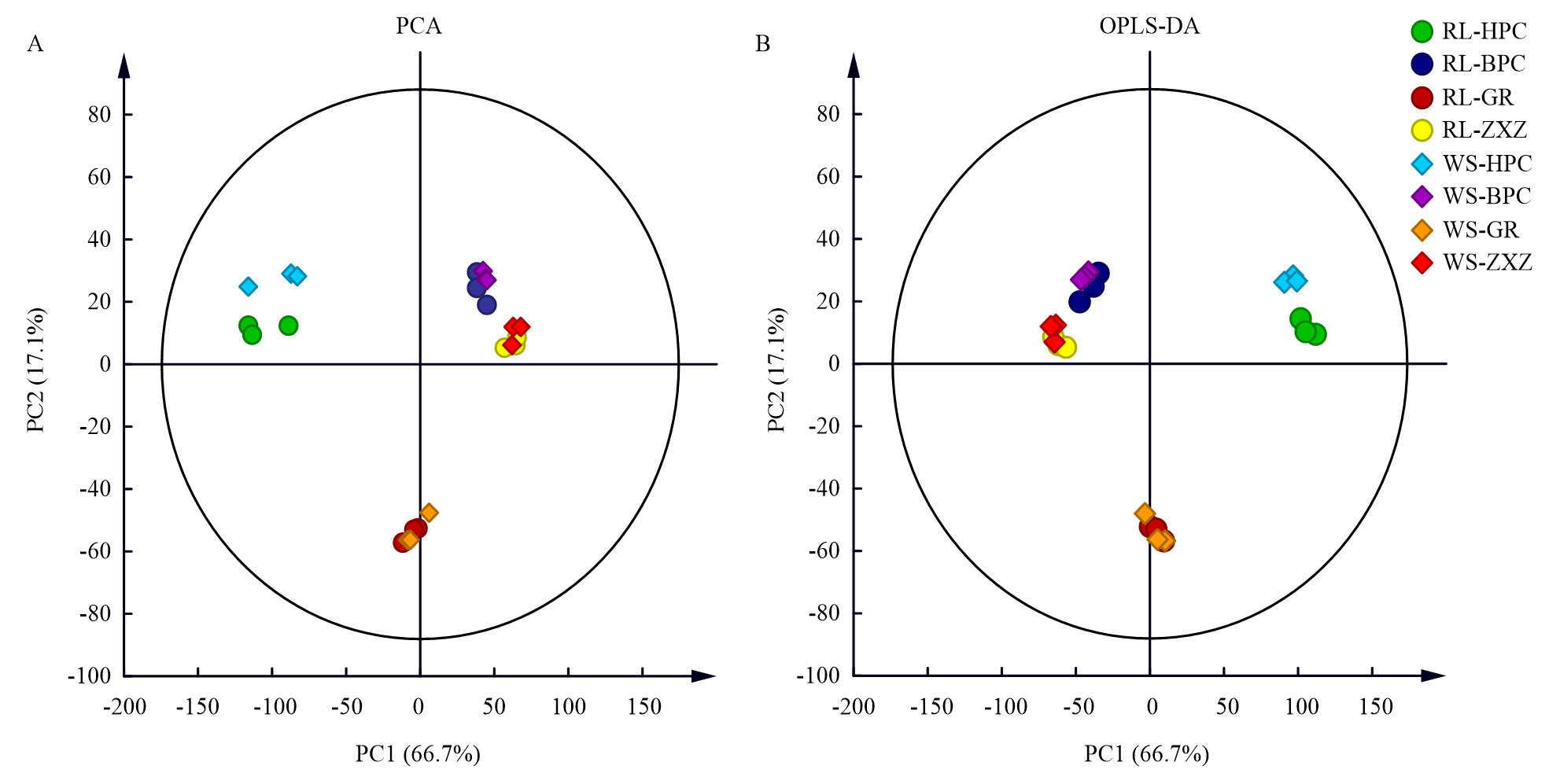
Fig. 1

PCA (A) and OPLS‑DA (B) score plots of bioactive substances in different tissues of Xiangshui lemon from Ruili (RL) and Weishan (WS) RL: Ruili humid-hot region; WS: Weishan dry-hot region; ZXZ: Central column and vesicle membrane; GR: Pulp; BPC: Albedo; HPC: Flavedo. The same as below"

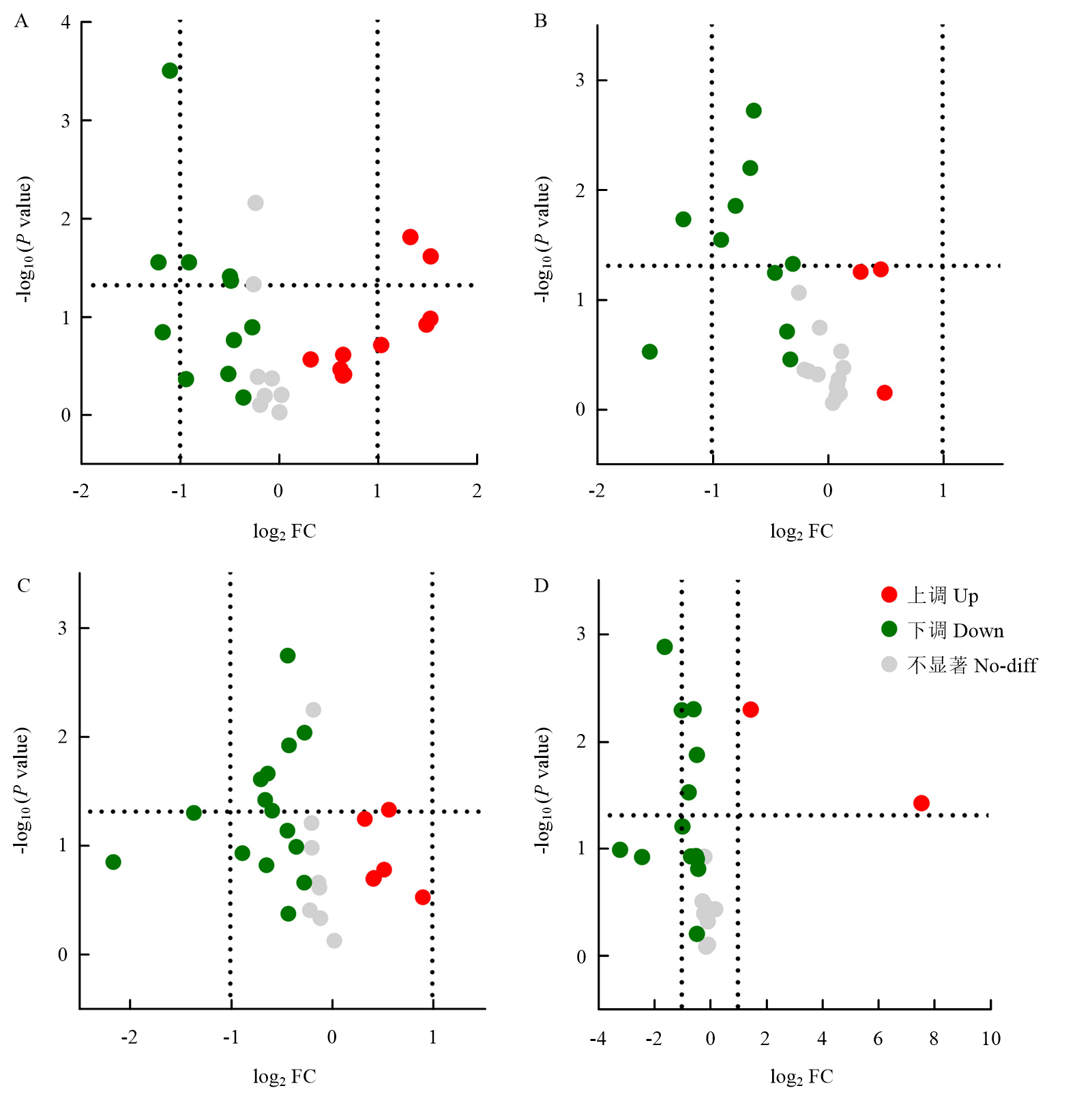
Fig. 2

Volcano plots of differential expression of metabolites in different tissues of Xiangshui lemon from Weishan (WS) and Ruili (RL) A: Volcano plot of differentially expressed metabolites in the flavedo of Xiangshui lemon from Ruili and Weishan producing areas; B: Volcano plot of differentially expressed metabolites in the albedo of Xiangshui lemon from Ruili and Weishan producing areas; C: Volcano plot of differentially expressed metabolites in the pulp of Xiangshui lemon from Ruili and Weishan producing areas; D: Volcano plot of differentially expressed metabolites in the core axis and segment membrane of Xiangshui lemon from Ruili and Weishan producing areas"

Table 3

Differential metabolites (VIP≥1) in different tissues of Xiangshui lemon from Weishan (WS) and Ruili (RL)"

黄皮层
Flavedo
白皮层
Albedo
果肉
Pulp
中心柱及囊衣
Central axis and segment membrane
物质
Metabolites
VIP
物质
Metabolites
VIP
物质
Metabolites
VIP
物质
Metabolites
VIP
原花青素
Proanthocyanidin
2.25 橙皮苷异构体
Hesperidin isomer
2.22 橙皮苷异构体
Hesperidin isomer
3.00 绿原酸-O-葡萄糖苷异构体
Chlorogenic acid-O-glucoside isomer
2.22
芦丁
Rutin
2.13 4'-甲基-异荭草苷
Isoorientin-4'-methyl ether
2.12 卢塞宁-2, 4'-甲醚
Lucenin-2, 4'-methyl ether
2.00 橙皮苷异构体
Hesperidin isomer
2.19
橙皮苷异构体
Hesperidin isomer
2.12 香叶木苷
Diosmin
2.06 4'-甲基-异荭草苷
Isoorientin-4'-methyl ether
1.93 香叶木苷
Diosmin
1.71
芹菜素-C-五碳糖苷-C-阿拉伯糖苷异构体
Apigenin-C-pentoside-C-glucoside isomer
2.09 二氢阿魏酸-O-葡萄糖苷
Dihydro-feruloyl-O-glucoside
1.75 香叶木苷
Diosmin
1.68 4'-甲基-异荭草苷
Isoorientin -4'-methyl ether
1.71
4'-甲基-异荭草苷
Isoorientin-4'-methyl ether
1.84 卢塞宁-2 4'-甲醚
Lucenin-2 4'-methyl ether
1.52 木犀草素-C-五碳糖苷-O-五碳糖苷
Luteolin-C-pentoside-O-
pentoside
1.5 木犀草素-C-五碳糖苷-O-五碳糖苷
Luteolin-C-pentoside-O-pentoside
1.53
卢塞宁-2, 4'-甲醚
Lucenin-2, 4'-methyl ether
1.67 木犀草素-C-五碳糖苷
-O-五碳糖苷
Luteolin-C-pentoside-O-
pentoside
1.48 阿魏酰奎宁酸
Feruloyl quinic acid
1.29 芹菜素-C-五碳糖苷-C-阿拉伯糖苷异构体
Apigenin-C-pentoside-C-glucoside isomer
1.40
木犀草素-C-五碳糖苷-O-五碳糖苷
Luteolin-C-pentoside-O-
pentoside
1.36 阿魏酰奎宁酸
Feruloyl quinic acid
1.00 芦丁
Rutin
1.17 圣草次甙
Eriocitrin
1.23
阿魏酸-衍生物
Ferulic acid derivative
1.15 — — 阿魏酸-O-葡萄糖苷
Feruloyl-O-glucose
1.16 木犀草素-7-O-芸香糖苷
Luteolin-7-O-rutinoside
1.20
— — — 木犀草素-7-O-芸香糖苷
Luteolin-7-O-rutinoside
1.12 卢塞宁-2, 4'-甲醚
Lucenin-2, 4'-methyl ether
1.18
— — — 异鼠李素-3-O-芸香糖苷
Isorhamnetin-3-rutinoside
1.02 异鼠李素-3-O-芸香糖苷
Isorhamnetin-3-rutinoside
1.00

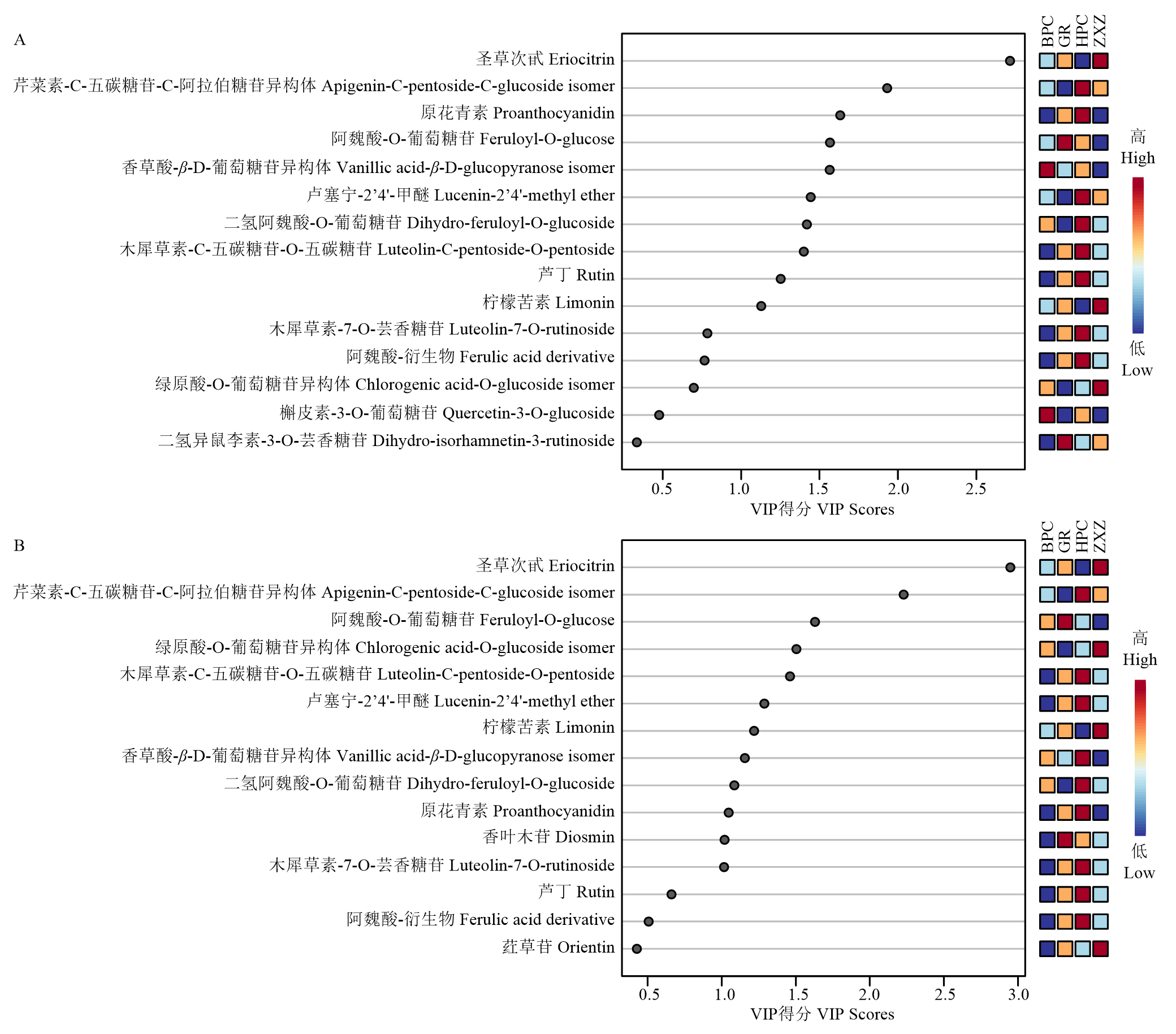
Fig. 3

VIP scores and content Heatmap of differential metabolites in Xiangshui lemon from Weishan (WS) and Ruili (RL) A: Heat map of VIP scores and contents of differential metabolites in different parts of Xiangshui lemon fruit from Weishan dry-hot region; B: Heat map of VIP scores and contents of differential metabolites in different parts of Xiangshui lemon fruit from Ruili humid-hot region"

[1]
白昕晨, 董建梅, 李晶, 付小猛, 刘红明, 胡承孝, 杜玉霞. 缺镁胁迫对不同砧木柠檬幼树养分吸收利用的影响[J]. 华中农业大学学报, 2026, 45(2): 165-172.
Bai X C, Dong J M, Li J, Fu X M, Liu H M, Hu C X, Du Y X. Effects of magnesium deficiency on uptake and utilization of nutrients in young lemon trees with different rootstocks[J]. Journal of Huazhong Agricultural University, 2026, 45(2): 165-172. (in Chinese)
[2]
张思凝, 张兴蕊, 吴东轩, 康婧博, 陈晓琳, 耿丽君, 殷光敏, 陈嘉景, 高俊燕, 蔡中虎, 刘园, 徐娟. 基于分子感官技术解析‘广东香水’柠檬香气品质[J]. 中国农业科学, 2025, 58(1): 141-155. DOI: 10.3864/j.issn.0578-1752.2025.01.011.
Zhang S N, Zhang X R, Wu D X, Kang J B, Chen X L, Geng L J, Yin G M, Chen J J, Gao J Y, Cai Z H, Liu Y, Xu J. Aroma quality analysis of Guangdongxiangshui lemon based on molecular sensory technology[J]. Scientia Agricultura Sinica, 2025, 58(1): 141-155. DOI: 10.3864/j.issn.0578-1752.2025.01.011. (in Chinese)
[3]
郭雁君, 郭丽英, 刘婕, 蒋惠, 杨凤梅, 吉前华. 广东香水柠檬由来浅析[J]. 中国果业信息, 2024, 41(2): 70-72.
Guo Y J, Guo L Y, Liu J, Jiang H, Yang F M, Ji Q H. Brief analysis on the origin of Guangdong Xiangshui lemon[J]. China Fruit News, 2024, 41(2): 70-72. (in Chinese)
[4]
周开隆, 叶荫民. 中国果树志-柑橘卷[M]. 北京: 中国林业出版社, 2010: 85-97.
Zhou K L, Ye Y M. Chinese Fruit Tree Flora·Citrus Volume[M]. Beijing: China Forestry Publishing House, 2010: 85-97. (in Chinese)
[5]
Cicero N, Corsaro C, Salvo A, Vasi S, Giofré S V, Ferrantelli V, Di Stefano V, Mallamace D, Dugo G. The metabolic profile of lemon juice by proton HR-MAS NMR: The case of the PGI Interdonato Lemon of Messina[J]. Natural Product Research, 2015, 29(20): 1894-1902.

doi: 10.1080/14786419.2015.1012166 pmid: 25702767
[6]
Salvo A, Bruno M, La Torre G L, Vadalà R, Mottese A F, Saija E, Mangano V, Casale K E, Cicero N, Dugo G. Interdonato lemon from Nizza di Sicilia (Italy): Chemical composition of hexane extract of lemon peel and histochemical investigation[J]. Natural Product Research, 2016, 30(13): 1517-1525.

doi: 10.1080/14786419.2015.1115999 pmid: 26649795
[7]
Yu H, Wang C, Deng S T, Bi Y G. Optimization of ultrasonic-assisted extraction and UPLC-TOF/MS analysis of limonoids from lemon seed[J]. LWT, 2017, 84: 135-142.

doi: 10.1016/j.lwt.2017.05.059
[8]
Khan M K, Zill-E-Huma, Dangles O. A comprehensive review on flavanones, the major Citrus polyphenols[J]. Journal of Food Composition and Analysis, 2014, 33(1): 85-104.

doi: 10.1016/j.jfca.2013.11.004
[9]
Lorente J, Vegara S, Martí N, Ibarz A, Coll L, Hernández J, Valero M, Saura D. Chemical guide parameters for Spanish lemon (Citrus limon (L.) Burm.) juices[J]. Food Chemistry, 2014, 162: 186-191.

doi: 10.1016/j.foodchem.2014.04.042 pmid: 24874375
[10]
庞雯辉, 赵希娟, 陈西, 张耀海, 王成秋, 赵其阳, 焦必宁. 超高效液相色谱-四极杆-飞行时间高分辨质谱法快速筛查柠檬果实中的生物活性成分[J]. 食品与发酵工业, 2021, 47(4): 222-230.

doi: 10.13995/j.cnki.11-1802/ts.025855
Pang W H, Zhao X J, Chen X, Zhang Y H, Wang C Q, Zhao Q Y, Jiao B N. Ultra-performance liquid chromatography-quadrupole-time-of- flight high-resolution mass spectrometry method for rapid screening of bioactive compounds in lemon fruits[J]. Food and Fermentation Industries, 2021, 47(4): 222-230. (in Chinese)
[11]
Di Vaio C, Graziani G, Gaspari A, Scaglione G, Nocerino S, Ritieni A. Essential oils content and antioxidant properties of peel ethanol extract in 18 lemon cultivars[J]. Scientia Horticulturae, 2010, 126(1): 50-55.

doi: 10.1016/j.scienta.2010.06.010
[12]
Gironés-Vilaplana A, Valentão P, Andrade P B, Ferreres F, Moreno D A, García-Viguera C. Phytochemical profile of a blend of black chokeberry and lemon juice with cholinesterase inhibitory effect and antioxidant potential[J]. Food Chemistry, 2012, 134(4): 2090-2096.

doi: 10.1016/j.foodchem.2012.04.010 pmid: 23442660
[13]
赵希娟, 庞雯辉, 谭涛, 张耀海, 焦必宁. UPLC-Q-TOF-HRMS技术结合SWATH采集方法同时测定柠檬果实中26种生物活性成分的含量[J]. 食品与发酵工业, 2022, 48(23): 306-314.

doi: 10.13995/j.cnki.11-1802/ts.030869
Zhao X J, Pang W H, Tan T, Zhang Y H, Jiao B N. Simultaneous determination of 26 bioactive components in lemon fruits based on UPLC-Q-TOF-HRMS and SWATH acquisition mode[J]. Food and Fermentation Industries, 2022, 48(23): 306-314. (in Chinese)
[14]
庞雯辉. 基于UPLC-Q-TOF-HRMS技术的柠檬生物活性成分筛查定量方法的建立与应用[D]. 重庆: 西南大学, 2021.
Pang W H. Establishment and application of the screening and quantitative method of bioactive compounds in lemons by UPLC- Q-TOF-HRMS[D]. Chongqing: Southwest University, 2021. (in Chinese)
[15]
Xi W P, Lu J F, Qun J P, Jiao B N. Characterization of phenolic profile and antioxidant capacity of different fruit part from lemon (Citrus limon Burm.) cultivars[J]. Journal of Food Science and Technology, 2017, 54(5): 1108-1118.

doi: 10.1007/s13197-017-2544-5
[16]
范丹华, 杨弘伟, 邵晨扬, 王鹏云, 朱勇. 未来气候变化对云南柠檬气候适宜性的影响[J]. 气象科技, 2021, 49(6): 968-974.
Fan D H, Yang H W, Shao C Y, Wang P Y, Zhu Y. Effects of future climate change on climate suitability of lemon in Yunnan[J]. Meteorological Science and Technology, 2021, 49(6): 968-974. (in Chinese)
[17]
秦芸桦, 钟世欢, 陈青俊, 王京, 王岳, 叶佳明, 陈云义, 孙崇德. 分散固相萃取-液相色谱-串联质谱法测定不同品种柑橘果实不同部位中3种柠檬苦素类似物的含量[J]. 理化检验-化学分册, 2024, 60(2): 171-179.
Qin Y H, Zhong S H, Chen Q J, Wang J, Wang Y, Ye J M, Chen Y Y, Sun C D. Determination of 3 limonin analogues in different parts of Citrus fruits of different varieties by liquid chromatography-tandem mass spectrometry with dispersed solid phase extraction[J]. Physical Testing and Chemical Analysis Part B (Chemical Analysis), 2024, 60(2): 171-179. (in Chinese)
[18]
Veberic R, Slatnar A, Bizjak J, Stampar F, Mikulic-Petkovsek M. Anthocyanin composition of different wild and cultivated berry species[J]. LWT-Food Science and Technology, 2015, 60(1): 509-517.

doi: 10.1016/j.lwt.2014.08.033
[19]
Hanny B W. Gossypol, flavonoid, and condensed tannin content of cream and yellow anthers of five cotton (Gossypium hirsutum L.) cultivars[J]. Journal of Agricultural and Food Chemistry, 1980, 28(3): 504-506.

doi: 10.1021/jf60229a021
[20]
张才喜, 殷纯金, 王云祥, 谢凤琦, 李化, 应建华, 王磊, 马超, 李树锋. 云南省大理州甜樱桃引种栽培研究初报[J]. 中国南方果树, 2018, 47(4): 117-122, 125.
Zhang C X, Yin C J, Wang Y X, Xie F Q, Li H, Ying J H, Wang L, Ma C, Li S F. Introduction and cultivation of sweet cherries in Dali district of Yunnan Province[J]. South China Fruits, 2018, 47(4): 117-122, 125. (in Chinese)
[21]
刘存宏, 徐玉芳, 贾志军, 乔云萍, 李太祥. 18个葡萄品种的光合特性比较[J]. 中国农学通报, 2006, 22(7): 404-406.
Liu C H, Xu Y F, Jia Z J, Qiao Y P, Li T X. Compare of photosynthetic parameters of 18 grape varieties[J]. Chinese Agricultural Science Bulletin, 2006, 22(7): 404-406. (in Chinese)
[22]
郭春芳, 孙云, 陈常颂, 陈荣冰, 张木清. 茶树品种光合与水分利用特性比较及聚类分析[J]. 作物学报, 2008, 34(10): 1797-1804.

doi: 10.3724/SP.J.1006.2008.01797
Guo C F, Sun Y, Chen C S, Chen R B, Zhang M Q. Comparison and cluster analysis of photosynthetic characters and water use efficiency in tea(Camellia sinensis) cultivars[J]. Acta Agronomica Sinica, 2008, 34(10): 1797-1804. (in Chinese)
[23]
李亦君, 夏琳, 杨小贝, 谢小东, 李锋, 杨军, 宁黔冀, 武明珠. 光照调控植物多酚类物质合成的研究进展[J]. 生物技术进展, 2024, 14(4): 509-518.

doi: 10.19586/j.2095-2341.2024.0015
Li Y J, Xia L, Yang X B, Xie X D, Li F, Yang J, Ning Q J, Wu M Z. Research progress on light-regulated synthesis of plant polyphenols[J]. Current Biotechnology, 2024, 14(4): 509-518. (in Chinese)

doi: 10.19586/j.2095-2341.2024.0015
[24]
刘红明, 龙春瑞, 李进学, 付小猛, 周东果, 高俊燕, 董美超, 岳建强. 3个柠檬品种在云南干热河谷区的光合特性及结果性能分析[J]. 果树学报, 2017, 34(1): 59-68.
Liu H M, Long C R, Li J X, Fu X M, Zhou D G, Gao J Y, Dong M C, Yue J Q. A study on photosynthetic characteristics and fruiting performance of three lemon varieties in dry-hot valley regions in Yunnan Province[J]. Journal of Fruit Science, 2017, 34(1): 59-68. (in Chinese)
[25]
李鸾翔, 唐小霄, 李美莹, 谭海, 黄桂香. 气象因子驱动的红宝石青柚综合品质评价模型构建[J]. 果树学报, 2025, 42(12): 3018-3032.
Li L X, Tang X X, Li M Y, Tan H, Huang G X. Meteorological-driven modeling of comprehensive quality evaluation for ruby green pomelo(Citrus grandis)[J]. Journal of Fruit Science, 2025, 42(12): 3018-3032. (in Chinese)
[26]
龙春瑞, 王绍华, 李进学, 刘红明, 付小猛, 毛加梅, 周先艳, 岳建强, 高俊燕. “英特多纳托”柠檬在云南干热河谷地区的表现及栽培技术[J]. 中国南方果树, 2017, 46(6): 128-130.
Long C R, Wang S H, Li J X, Liu H M, Fu X M, Mao J M, Zhou X Y, Yue J Q, Gao J Y. Performance and cultivation techniques of Inter donato lemon in Yunnan dry-hot valley[J]. South China Fruits, 2017, 46(6): 128-130. (in Chinese)
[27]
胡江, 谭礼鸿, 孙志龙, 董建梅, 李晶, 杨笛, 赖新朴, 杜玉霞, 刘永忠. 云南瑞丽春季不同月份露骨修剪对柠檬生长结果及果实品质的影响[J]. 中国南方果树, 2025, 54(1): 16-20.
Hu J, Tan L H, Sun Z L, Dong J M, Li J, Yang D, Lai X P, Du Y X, Liu Y Z. Effects of bare-bones pruning in different months of spring in Yunnan Ruili on the growth and fruiting and fruit quality of lemon[J]. South China Fruits, 2025, 54(1): 16-20. (in Chinese)
[28]
朱丽莎, 张静, 张耀海, 焦必宁. 不同品种甜橙类酚类物质检测及含量差异性研究[J]. 食品与发酵工业, 2019, 45(10): 216-224.

doi: 10.13995/j.cnki.11-1802/ts.019215
Zhu L S, Zhang J, Zhang Y H, Jiao B N. Detection and content variation of phenols in different sweet oranges[J]. Food and Fermentation Industries, 2019, 45(10): 216-224. (in Chinese)

doi: 10.13995/j.cnki.11-1802/ts.019215
[29]
范七君, 陈传武, 刘萍, 牛英, 唐艳, 邓崇岭. 树冠覆膜对沙糖橘光合作用及果实品质的影响[J]. 中国农学通报, 2021, 37(22): 57-62.

doi: 10.11924/j.issn.1000-6850.casb2020-0478
Fan Q J, Chen C W, Liu P, Niu Y, Tang Y, Deng C L. Influence of canopy film-covering on photosynthesis and fruit quality of Citrus reticulata Shiyueju[J]. Chinese Agricultural Science Bulletin, 2021, 37(22): 57-62. (in Chinese)
[30]
敖艳. 宽皮柑桔中活性成分的检测及差异性研究[D]. 重庆: 西南大学, 2018.
Ao Y. Analysis of active constituents’ content and its distribution in different Mandarin[D]. Chongqing: Southwest University, 2018. (in Chinese)
[31]
杨华夏, 曹雪丹, 林玉丹, 叶丽姿, 汤莹琪, 李佳. 4种柑橘籽油脂肪酸组成及生物活性成分[J]. 食品研究与开发, 2024, 45(2): 80-86.
Yang H X, Cao X D, Lin Y D, Ye L Z, Tang Y Q, Li J. Fatty acids and bioactive components in four Citrus seed oils[J]. Food Research and Development, 2024, 45(2): 80-86. (in Chinese)
[32]
白玫, 吴鸿. 柑橘属植物分泌囊形态建成的研究进展[J]. 华南农业大学学报, 2022, 43(6): 130-135.
Bai M, Wu H. Research progress in secretory cavity morphogenesis in Citrus[J]. Journal of South China Agricultural University, 2022, 43(6): 130-135. (in Chinese)
[33]
秦艳, 赵希娟, 郭鹏妹, 庞雯辉, 董超, 张耀海, 王成秋, 赵其阳, 焦必宁. 基于超高效液相色谱-四极杆-飞行时间高分辨质谱分析酸橙果实中的生物活性成分[J]. 食品与发酵工业, 2022, 48(5): 268-274.

doi: 10.13995/j.cnki.11-1802/ts.028237
Qin Y, Zhao X J, Guo P M, Pang W H, Dong C, Zhang Y H, Wang C Q, Zhao Q Y, Jiao B N. Analysis of bioactive compounds in sour orange fruit based on UPLC-Q-TOF-HRMS[J]. Food and Fermentation Industries, 2022, 48(5): 268-274. (in Chinese)

doi: 10.13995/j.cnki.11-1802/ts.028237
[34]
张静, 朱丽莎, 张耀海, 赵静, 董超, 焦必宁. 不同晚熟柑橘中酚类物质的含量检测及分析[J]. 食品与机械, 2018, 34(12): 27-33, 69.
Zhang J, Zhu L S, Zhang Y H, Zhao J, Dong C, Jiao B N. Determination and content analysis of phenolic compounds in different late-maturing Citrus of China[J]. Food & Machinery, 2018, 34(12): 27-33, 69. (in Chinese)
[35]
吴桂苹. 柑桔果实主要类黄酮成分检测及含量分析[D]. 重庆: 西南大学, 2007.
Wu G P. Determinantion and characteristic of flavonoids in Citrus fruits of different species[D]. Chongqing: Southwest University, 2007. (in Chinese)
[36]
郑洁, 赵其阳, 张耀海, 焦必宁. 超高效液相色谱法同时测定柑橘中主要酚酸和类黄酮物质[J]. 中国农业科学, 2014, 47(23): 4676-4687. DOI: 10.3864/j.issn.0578-1752.2014.23.015.
Zheng J, Zhao Q Y, Zhang Y H, Jiao B N. Simultaneous determination of main flavonoids and phenolic acids in Citrus fruit by ultra performance liquid chromatography[J]. Scientia Agricultura Sinica, 2014, 47(23): 4676-4687. DOI: 10.3864/j.issn.0578-1752.2014.23.015. (in Chinese)
[37]
王夜梅, 李江南, 尹会平, 张耀海, 陈爱华, 苏学素, 焦必宁. 柑橘中类柠檬苦素的提取、分离纯化及检测技术研究进展[J]. 食品工业科技, 2023, 44(12): 470-479.
Wang Y M, Li J N, Yin H P, Zhang Y H, Chen A H, Su X S, Jiao B N. Research progress on extraction, separation, purification and detection technology of limonins in Citrus[J]. Science and Technology of Food Industry, 2023, 44(12): 470-479. (in Chinese)
[38]
张娜威, 潘思轶, 范刚, 任婧楠. 柑橘果汁中的苦味物质及脱苦技术研究进展[J]. 华中农业大学学报, 2021, 40(1): 40-48.
Zhang N W, Pan S Y, Fan G, Ren J N. Bitter substances and progress of debittering technology in Citrus juice[J]. Journal of Huazhong Agricultural University, 2021, 40(1): 40-48. (in Chinese)
[1] YUE NanDong, JIANG BingTing, NIE JingGui, FANG Yue, TANG JunRong, YUE ZhenSheng, ZHOU Ying, LI NengBo, HE XiaHong, ZHANG XueChun. Analysis of Chemical Components, Functional Activities and Metabolomics of Stems, Leaves and Flowers of Dendrobium devonianum Paxt. [J]. Scientia Agricultura Sinica, 2026, 59(8): 1775-1796.
[2] YUE LiXin, WANG QingHua, WANG ZhenBao, NIMAQIONGJI, LIU ZeZhou, KONG SuPing, ZHANG LiFeng, GAO LiMin. Widely Targeted Metabolomics-Based Analysis of the Differences in Tibetan Bunching Onion and Chive on Nutritional Quality and Flavonoid Metabolites [J]. Scientia Agricultura Sinica, 2026, 59(5): 1070-1086.
[3] YUE JingWen, GUO XinXin, ZHOU Jia, SHI TianLe, YANG YuZhang, ZHANG JunKe, LI XingLiang. Identification and Ecological Impact Factor Analysis of Nutritional Component Pinoresinol in Apple Fruits [J]. Scientia Agricultura Sinica, 2026, 59(18): 4121-4134.
[4] WU PeiJing, SU Ling, CHEN YingChun, MENG Dong, YANG Qing, ZHANG Man, ZHOU XiaoMiao, TAO JianMin, ZHENG Huan, LI Bo, GONG Lei. Integrative Transcriptomic and Metabolomic Analyses Reveal Flavonoid Accumulation Characteristics in the Flesh of Red-Fleshed Grape and Self-Pollinated Progenies [J]. Scientia Agricultura Sinica, 2026, 59(16): 3655-3672.
[5] MA XiaoYing, QU XiaoYu, LI Tao, LIU WeiFan, LIU Hao, MA FengLan, WAN MengHu, WU Na, LIU JiLi. Analysis of Physiological and Metabolic Response Mechanisms in Maize Varieties with Different Salt Tolerances Under Salt Stress [J]. Scientia Agricultura Sinica, 2026, 59(13): 2815-2827.
[6] DONG Xue, LIU JiaLe, SHAO Jin, CHEN MengQiu, WU XueYou, TANG PeiAn. Multi-Omics Reveals Mechanisms of Lipid Stabilization in Japonica Rice During Prolonged Low-Temperature Storage [J]. Scientia Agricultura Sinica, 2026, 59(10): 2249-2264.
[7] TAN XiBei, LAN XuYing, LIU ChongHuai, FAN XiuCai, JIANG JianFu, SUN Lei, LI Peng, YU ShuXin, ZHANG Ying. Changes of Secondary Metabolites in Grapes with Different Resistance Levels in Response to White Rot Infection [J]. Scientia Agricultura Sinica, 2025, 58(9): 1767-1778.
[8] YANG CaiLi, LI YongZhou, HE LiangLiang, SONG YinHua, ZHANG Peng, LIU ZhaoXian, LI PengHui, LIU SanJun. Genome-Wide Identification and Analysis of TPS Gene Family and Functional Verification of VvTPS4 in the Formation of Monoterpenes in Grape [J]. Scientia Agricultura Sinica, 2025, 58(7): 1397-1417.
[9] GUO AoLin, LIN JunXuan, LAI GongTi, HE LiYuan, CHE JianMei, PAN Ruo, YANG FangXue, HUANG YuJi, CHEN GuiXin, LAI ChengChun. Effect of VdF3′5′H2 Overexpression on the Accumulation of Anthocyanin Composition in Spine Grape Cells [J]. Scientia Agricultura Sinica, 2025, 58(4): 802-818.
[10] LUO ChaoDan, FENG ChunMei, LI JianQiang, LI XinRong, WEI Yong, YANG LiYi, LIU XiaoJin, TAN He, REN ErFang, LUO XiaoJie. Analysis of Differential Aroma Volatiles of Tainong No.1 Mango of Different Ripeness by Non-Targeted Metabolomics Based on Gas Chromatography-Mass Spectrometry [J]. Scientia Agricultura Sinica, 2025, 58(3): 564-581.
[11] LUO ZiShu, ZHANG YiJia, ZHOU Rong, ZHANG YanXin, ZHOU Ting, YOU Jun, WANG LinHai. Characterization of Antioxidant Activities in Sesame Leaves and Screening of High Antioxidant Germplasm [J]. Scientia Agricultura Sinica, 2025, 58(19): 3814-3824.
[12] ZHAN Li, LIANG ZongSuo, YU Jing, LU Jun, LIANG Qian. Insecticidal Active Component Identification of Camellia oleifera Shell Against Mythimna separata and Its Action Mechanism [J]. Scientia Agricultura Sinica, 2025, 58(13): 2591-2603.
[13] ZHANG SiNing, ZHANG XingRui, WU DongXuan, KANG JingBo, CHEN XiaoLin, GENG LiJun, YIN GuangMin, CHEN JiaJing, GAO JunYan, CAI ZhongHu, LIU Yuan, XU Juan. Aroma Quality Analysis of Guangdongxiangshui Lemon Based on Molecular Sensory Technology [J]. Scientia Agricultura Sinica, 2025, 58(1): 141-155.
[14] XIE Qian, JIANG Lai, DING MingYue, LIU LingLing, CHEN QingXi. Metabolomic Analysis of Canarium album Fresh Food Quality Differences Based on Sensory Evaluation [J]. Scientia Agricultura Sinica, 2024, 57(2): 363-378.
[15] QI XiaoYu, KONG XiaoPing, ZHOU HongWei, YAN XiangPing. Crucial Factors Impacting Carrot Flavor Analysis Based on Broad Target Metabolomics [J]. Scientia Agricultura Sinica, 2024, 57(16): 3250-3263.
Viewed
Full text


Abstract

Cited

  Shared   
  Discussed   
No Suggested Reading articles found!