Scientia Agricultura Sinica ›› 2026, Vol. 59 ›› Issue (16): 3621-3639.doi: 10.3864/j.issn.0578-1752.2026.16.011

• SOIL & FERTILIZER·WATER-SAVING IRRIGATION·AGROECOLOGY & ENVIRONMENT • Previous Articles     Next Articles

Effects of Reduced Nitrogen and Controlled Water Combined with Biochar and Nitrification Inhibitor on Nitrogen Losses in a Facility Soil-Tomato System

LI JinJin1,2(), ZHAO YuQing1,2, LIU RuiYi1,2, JI YanZhi1,2,3, XIE JianZhi1,2, GUO YanJie1,2,3(), ZHANG LiJuan1,2,3()   

  1. 1 College of Resources and Environmental Sciences, Hebei Agricultural University, Baoding 071001, Hebei
    2 Key Laboratory for Farmland Eco-Environment of Hebei Province, Baoding 071001, Hebei
    3 Collaborative Innovation Center for Vegetable Industry of Hebei, Baoding 071001, Hebei
  • Received:2025-10-25 Accepted:2025-12-19 Online:2026-08-16 Published:2026-08-17
  • Contact: GUO YanJie, ZHANG LiJuan

Abstract:

【Objective】 This study aimed to clarify the regulatory effects of the reduced nitrogen combined with controlled water, biochar, and the nitrification inhibitor dicyandiamide (DCD) on nitrogen losses within a facility soil-tomato system, so as to provide a scientific basis for efficient nitrogen use and sustainable green development in facility vegetable production.【Method】 A field plot experiment was conducted using facility tomato as the research object, with two irrigation treatments including traditional drip irrigation (TD) and reduced drip irrigation (CD). Based on this, eight nitrogen treatments were designed, including no nitrogen (TDN0, and CDN0), traditional nitrogen (TDN1, and CDN1), reduced nitrogen (TDN2, and CDN2), and reduced nitrogen combined with biochar and dicyandiamide (DCD) (TDN2+BD, and CDN2+BD). During the topdressing period, soil N2O emission and NH3 volatilization, NO3--N accumulation in the 0-100 cm soil profile, and tomato nitrogen uptake, yield, and fruit quality indicators were systematically monitored to quantitatively evaluate the synergistic regulatory effects of biochar and DCD under reduced nitrogen and controlled water conditions. 【Result】 Nitrogen application significantly increased soil N2O emissions and NH3 volatilization, with peak fluxes occurring 2-3 days after topdressing. Nitrogen reduction effectively suppressed gaseous nitrogen losses, and the combined application of biochar and the nitrification inhibitor DCD further enhanced the mitigation effect on N2O emissions. Although biochar and DCD posed a potential risk of increasing NH3 volatilization, this adverse effect was substantially alleviated by reduced nitrogen and controlled water conditions. Compared with conventional nitrogen application, nitrogen reduction significantly decreased total gaseous nitrogen losses by 45.7%-56.6% and reduced NO3--N accumulation in the 0-100 cm soil profile by 13.7%-16.2%. When biochar and DCD were applied on the basis of nitrogen reduction, total gaseous nitrogen losses further declined by 49.4%-59.0%, while the reduction in NO3--N accumulation expanded to 27.4%-30.0%, with a clear suppression of deep leaching. Both irrigation methods enhanced the synergistic mitigation effects of water nitrogen regulation. However, controlled drip irrigation demonstrated superior performance compared with conventional drip irrigation. Under controlled irrigation, the CDN2+BD treatment reduced total nitrogen losses by 30.0% compared with CDN1, with decreasing the net nitrogen loss rate from 3.3% to 2.5%. This treatment also significantly inhibited deep NO3--N accumulation and increased NO3--N retention in the 20-40 cm soil layer by 27.1%. In addition, biochar and DCD increased the apparent nitrogen use efficiency under controlled irrigation to 28.9%; TDN2+BD and CDN2+BD improved nitrogen use efficiency by 53.0% and 30.2%, respectively, compared with their corresponding nitrogen-reduction treatments (TDN2 and CDN2) (P<0.05). Furthermore, the controlled irrigation with biochar and DCD (CDN2+BD) achieved the highest tomato yield (115.93 t·hm-2), while significantly enhancing fruit vitamin C content and improving soluble protein, soluble sugar, and total soluble solid levels.【Conclusion】 Reduced nitrogen application combined with controlled water, biochar, and the nitrification inhibitor dicyandiamide (DCD) significantly decreased gaseous and leaching nitrogen losses, optimized soil nitrogen distribution, and improved nitrogen use efficiency and tomato quality, representing an optimal technical approach for nitrogen reduction and efficiency enhancement in facility vegetable production.

Key words: reduced nitrogen and controlled water, biochar, nitrification inhibitor, nitrogen losses regulation, facility tomato

Table 1

Soil basic physical and chemical properties of experimental site"

土壤层次
Soil layer
(cm)
全氮
Total N
(g·kg-1)
有机质
SOM
(g·kg-1)
硝态氮
NO3--N
(mg·kg-1)
铵态氮
NH4+-N
(mg·kg-1)
有效磷
Olsen-P
(mg·kg-1)
速效钾
NH4OAc-K
(mg·kg-1)
pH
(水:土=2.5:1)
粒径组成 Particle size composition (%) 容重
Bulk density
(g·cm-3)
砂粒
Sand
粉粒
Silt
黏粒
Clay
0-20 1.07 17.49 150.67 27.71 113.65 172.72 7.92 59.99 16.66 23.35 1.21
20-40 0.75 11.78 123.86 29.38 78.16 115.51 8.02 67.91 15.32 16.77 1.25
40-60 0.54 8.79 106.71 25.28 52.05 191.33 8.13 73.89 12.93 13.18 1.35
60-80 0.50 8.91 84.07 20.87 57.44 184.89 8.16 77.57 11.05 11.38 1.46
80-100 0.57 11.70 82.29 13.01 59.61 285.99 8.18 72.03 13.41 14.56 1.45

Table 2

Fertilization methods, application rates, and timing under different treatments"

处理
Treatment
基肥
(2022-10-5)
Basal fertilizer
(October 5, 2022)
追肥Topdressing 总计
Total
(kg·hm-2)
灌水 Irrigation 总计
Total (m3·hm-2)
第1次
(2023-1-16)
First
(January 16, 2023)
第2次
(2023-3-14)
Second
(March 14, 2023)
第3次
(2023-4-15)
Third
(April 15,
2023)
第1次
(2022-10-12)
First
(October 12, 2022)
第2次
(2022-10-17)
Second
(October 17, 2023)
第3次
(2023-1-16)
Third
(January 16, 2023)
第4次
(2023-3-14)
Forth
(March 14, 2023)
第5次
(2023-4-15)
Fifth
(April 15, 2023)
第6次
(2023-5-5)
Sixth
(May 5, 2023)
第7次
(2023-6-1)
Seventh
(June 1, 2023)
N P2O5 K2O N P2O5 K2O N P2O5 K2O N P2O5 K2O N P2O5 K2O
TDN0 0 194 205 0 30 32 0 52 70 0 52 70 0 328 377 225 360 540 810 900 990 675 4500
TDN1 207 194 205 45 30 32 100 52 70 100 52 70 452 328 377 225 360 540 810 900 990 675 4500
TDN2 145 194 205 32 30 32 70 52 70 70 52 70 317 328 377 225 360 540 810 900 990 675 4500
TDN2+BD 145 194 205 32 30 32 70 52 70 70 52 70 317 328 377 225 360 540 810 900 990 675 4500
CDN0 0 194 205 0 30 32 0 52 70 0 52 70 0 328 377 169 270 405 608 675 743 506 3375
CDN1 207 194 205 45 30 32 100 52 70 100 52 70 452 328 377 169 270 405 608 675 743 506 3375
CDN2 145 194 205 32 30 32 70 52 70 70 52 70 317 328 377 169 270 405 608 675 743 506 3375
CDN2+BD 145 194 205 32 30 32 70 52 70 70 52 70 317 328 377 169 270 405 608 675 743 506 3375

Fig. 1

Temporal dynamics of soil N2O emission fluxes under different treatments during the topdressing period"

Table 3

Repeated measured analysis of variance (ANOVA) of soil N2O emission flux under different treatments"

指标 Index 因素 Factor 自由度 df 标准差 MS F检验 F test P P value
N2O排放通量
N2O emission flux
处理 Treatment 7 28456.892 18.73 <0.001
时间 Time 24 8923.417 35.62 <0.001
处理×时间Treatment×Time 168 1876.539 7.49 <0.001

Table 4

Two-way analysis of variance (ANOVA) of soil N2O emission flux under different treatments"

指标 Index 因素 Factor 自由度 df 标准差 MS F检验 F test PP value
N2O排放通量
N2O emission flux
灌水 Irrigation 1 519.059 13.579 0.002
氮素调控Nitrogen regulation 3 7079.078 185.199 <0.001
灌水×氮素调控 Irrigation×Nitrogen regulation 3 51.432 1.346 0.295

Fig. 2

Temporal dynamics of soil NH3 volatilization rate under different treatments during the topdressing period"

Table 5

Repeated measured analysis of variance (ANOVA) of soil NH3 volatilization rate under different treatments"

指标 Index 因素 Factor 自由度 df 标准差 MS F F value P P value
NH3挥发速率
NH3 volatilization rate
处理 Treatment 7 45.327 22.156 <0.001
时间 Time 41 28.641 48.773 <0.001
处理×时间Treatment×Time 287 6.892 11.734 <0.001

Table 6

Two-way analysis of variance (ANOVA) of soil NH3 volatilization rate under different treatments"

指标 Index 因素 Factor 自由度 df 标准差 MS F检验 F test PP value
NH3挥发速率
NH3 volatilization rate
灌水 Irrigation 1 16.609 52.123 <0.001
氮素调控Nitrogen regulation 3 281.212 882.511 <0.001
灌水×氮素调控 Irrigation×Nitrogen regulation 3 1.687 5.295 0.010

Table 7

Soil cumulative N2O emissions, NH3 cumulative volatilization, and net loss rate under different treatments during the topdressing period"

处理
Treatment
N2O NH3 N2O+NH3
累积排放量
Accumulated emission amount (kg·hm-2)
损失率
Loss rate
(%)
累积排放量
Accumulated emission amount (kg·hm-2)
损失率
Loss rate
(%)
总损失量
Total losses
(kg·hm-2)
净损失率
Net loss rate
(%)
TDN0 0.25±0.05 e 4.47±0.47 d 4.72+0.53 e
TDN1 2.18±0.14 a 0.79±0.43 a 18.44±1.55 a 5.70±0.79 a 20.62±1.59 a 6.49±0.65 a
TDN2 1.30+0.18 b 0.61±0.33 b 9.90±0.79 b 3.16±0.33 b 11.20±0.63 b 3.77±0.16 b
TDN2+BD 0.96±0.10 c 0.41±0.22 c 9.47±0.33 bc 2.91±0.35b 10.43±0.31 bc 3.32±0.46 bc
CDN0 0.22+0.05 e 3.91±0.35 d 4.13+0.30 e
CDN1 0.97±0.11 c 0.31±0.17 c 11.12±1.57 b 2.94±0.57 b 12.09±1.68 b 3.25±0.73 bc
CDN2 0.80+0.08 c 0.33±0.18 c 8.15±0.73 c 2.46±0.73 b 8.95+0.66 cd 2.79±0.27 bc
CDN2+BD 0.51±0.03 d 0.17±0.09 d 7.95±0.62 c 2.35±0.62 b 8.46±0.65 d 2.52±0.55 d

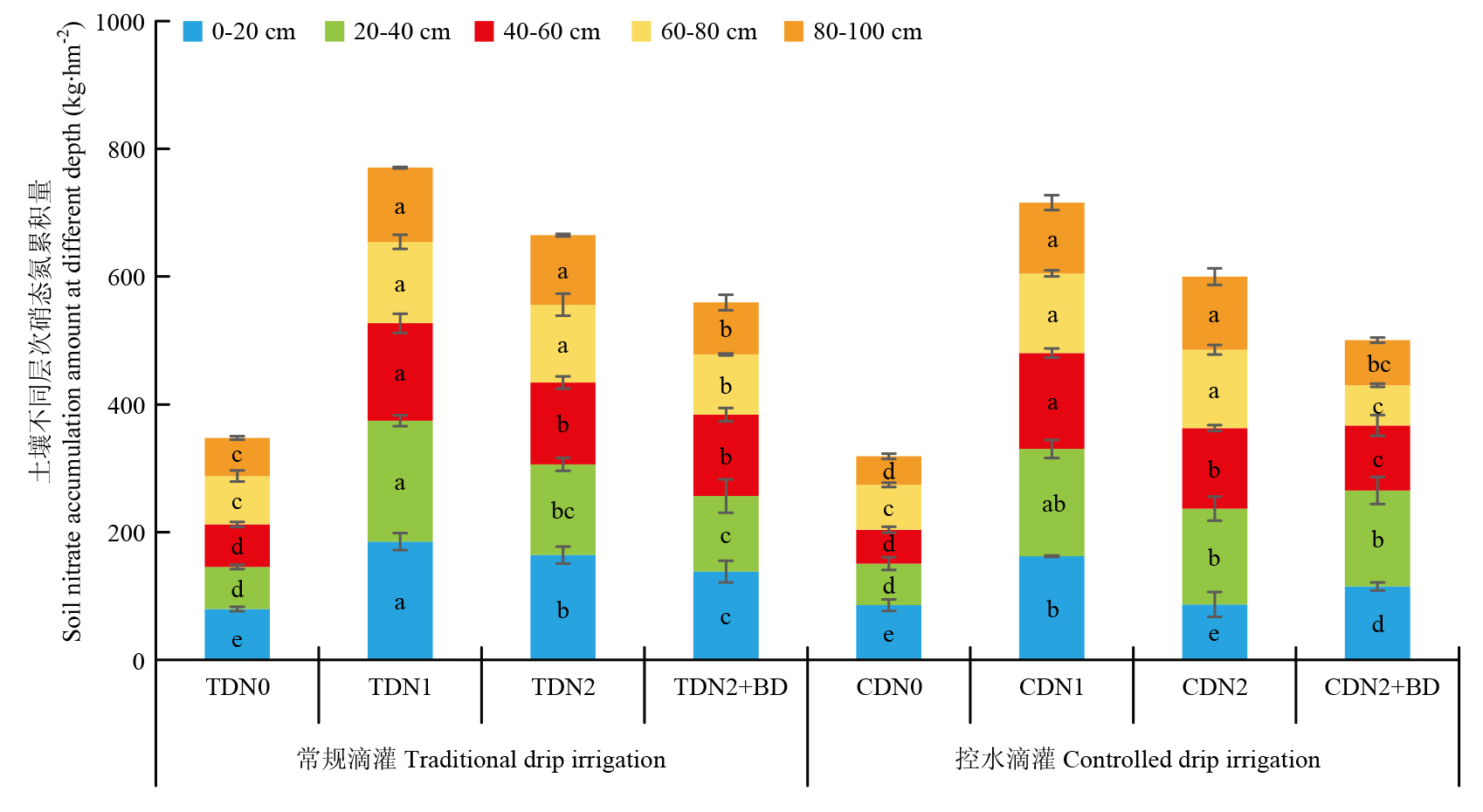
Fig. 3

Nitrate nitrogen accumulation in 0-100 cm soil profile after harvest Different lowercase letters within the same soil layer of the figure indicate significant differences among treatments at the 0.05 level. The same as below"

Table 8

Two-way analysis of variance (ANOVA) of NO3--N accumulation in the soil profile under different treatments"

指标 Index 因素 Factor 自由度 df 标准差 MS F检验 F test P P value
0-20 cm土层硝态氮累积
Nitrate accumulation in 0-20 cm soil layer
灌水 Irrigation 1 4378.937 31.271 0.000
氮素调控Nitrogen regulation 3 6572.520 46.936 0.000
灌水×氮素调控 Irrigation×Nitrogen regulation 3 1348.067 9.627 0.001
20-40 cm土层硝态氮累积
Nitrate accumulation in 20-40 cm soil layer
灌水 Irrigation 1 59.143 0.233 0.636
氮素调控Nitrogen regulation 3 10214.254 40.263 0.000
灌水×氮素调控 Irrigation×Nitrogen regulation 3 723.765 2.853 0.072
40-60 cm土层硝态氮累积
Nitrate accumulation in 40-60 cm soil layer
灌水 Irrigation 1 583.208 5.595 0.032
氮素调控Nitrogen regulation 3 6778.893 65.039 0.000
灌水×氮素调控 Irrigation×Nitrogen regulation 3 197.226 1.892 0.174
60-80 cm土层硝态氮累积
Nitrate accumulation in 60-80 cm soil layer
灌水 Irrigation 1 515.565 6.455 0.023
氮素调控Nitrogen regulation 3 3586.607 44.908 0.000
灌水×氮素调控 Irrigation×Nitrogen regulation 3 326.159 4.084 0.026
80-100 cm土层硝态氮累积
Nitrate accumulation in 80-100 cm soil layer
灌水 Irrigation 1 163.375 2.795 0.115
氮素调控Nitrogen regulation 3 4002.020 68.474 0.000
灌水×氮素调控 Irrigation×Nitrogen regulation 3 147.159 2.518 0.097

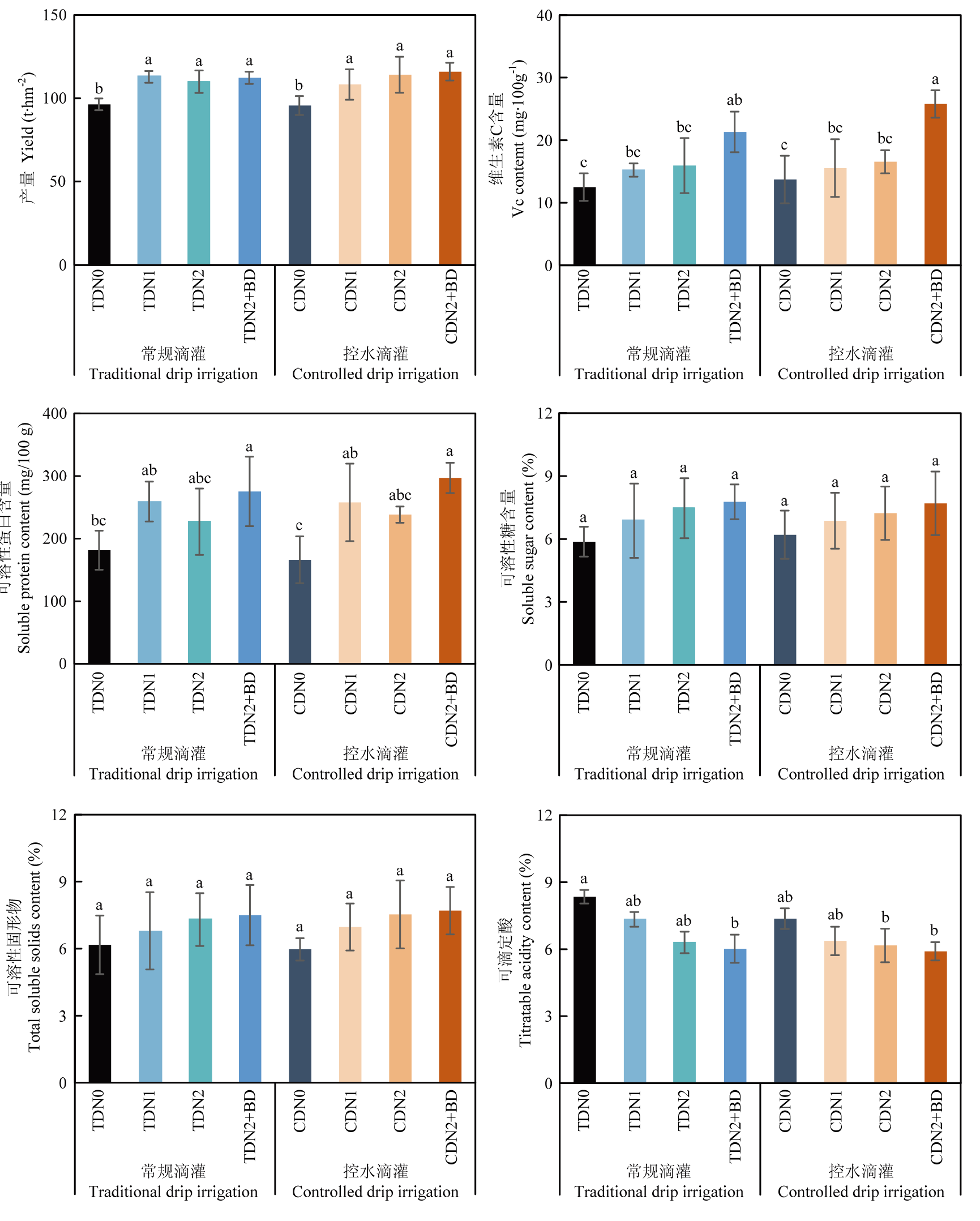
Fig. 4

Tomato yield and fruit quality indicators under different treatments"

Table 9

Two-way analysis of variance (ANOVA) of tomato yield and fruit quality in different treatments"

指标 Index 因素 Factor 自由度 df 标准差 MS F检验 F test P P value
番茄产量
Tomato yield
灌水 Irrigation 1 27.290 0.896 0.359
氮素调控Nitrogen regulation 3 354.798 11.644 0.000
灌水×氮素调控 Irrigation×Nitrogen regulation 3 55.133 1.809 0.189
维生素C含量
Vc content
灌水 Irrigation 1 12.627 1.128 0.305
氮素调控Nitrogen regulation 3 92.285 8.241 0.001
灌水×氮素调控 Irrigation×Nitrogen regulation 3 6.027 0.538 0.663
可溶性糖含量
Soluble sugar content
灌水 Irrigation 1 0.127 0.077 0.785
氮素调控Nitrogen regulation 3 2.929 1.774 0.187
灌水×氮素调控 Irrigation×Nitrogen regulation 3 0.065 0.039 0.989
可溶性蛋白含量
Soluble protein content
灌水 Irrigation 1 28.769 0.016 0.902
氮素调控Nitrogen regulation 3 10434.447 5.710 0.005
灌水×氮素调控 Irrigation×Nitrogen regulation 3 350.094 0.192 0.900
可溶性固形物含量
Soluble solid content
灌水 Irrigation 1 0.025 0.015 0.905
氮素调控Nitrogen regulation 3 2.161 1.278 0.322
灌水×氮素调控 Irrigation×Nitrogen regulation 3 0.050 0.030 0.993
可滴定酸含量
Titratable acid content
灌水 Irrigation 1 1.734 1.306 0.271
氮素调控Nitrogen regulation 3 3.149 2.371 0.099
灌水×氮素调控 Irrigation×Nitrogen regulation 3 0.337 0.254 0.857

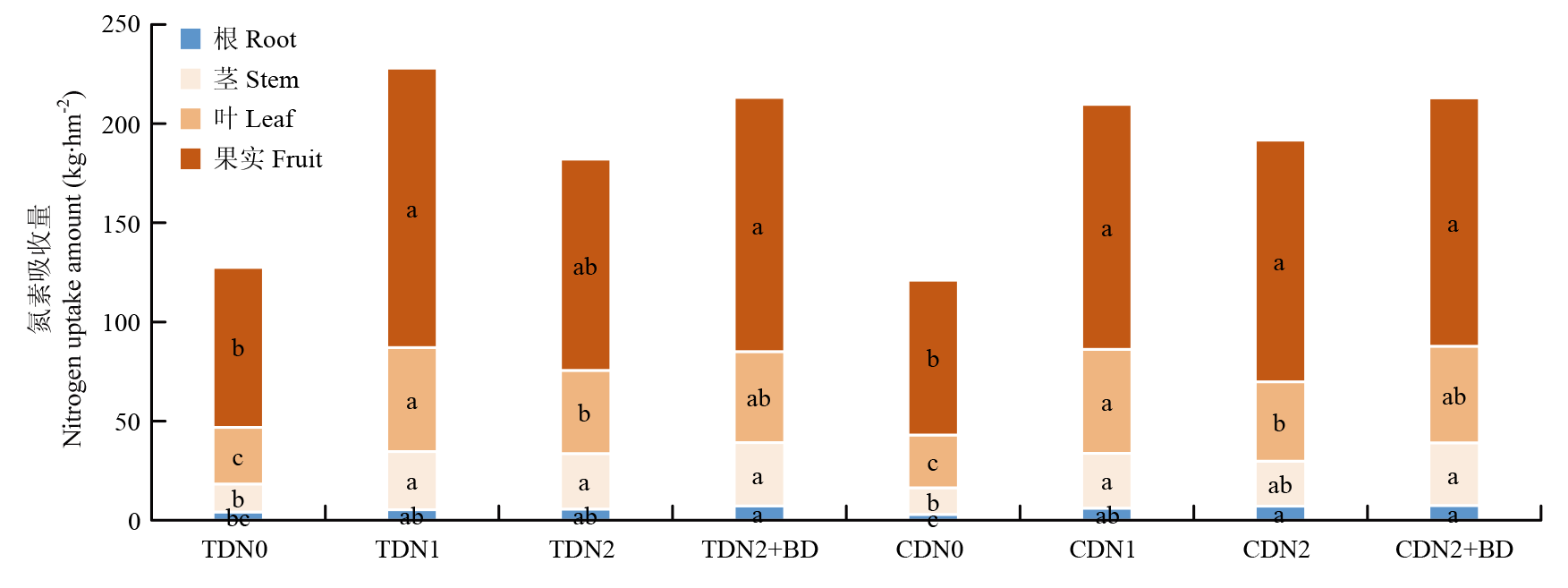
Fig. 5

Nitrogen accumulation in tomato plant organs under different treatments"

Table 10

Two-way analysis of variance (ANOVA) of nitrogen accumulation in tomato plant organs under different treatments"

指标 Index 因素 Factor 自由度 df 标准差 MS F检验 F test P P value
根氮素累积
Root N accumulation
灌水 Irrigation 1 0.235 0.162 0.693
氮素调控Nitrogen regulation 3 12.728 8.801 0.001
灌水×氮素调控 Irrigation×Nitrogen regulation 3 1.311 0.907 0.461
茎氮素累积
Stem N accumulation
灌水 Irrigation 1 15.079 0.533 0.477
氮素调控Nitrogen regulation 3 278.588 9.839 0.000
灌水×氮素调控 Irrigation×Nitrogen regulation 3 3.146 0.111 0.952
叶氮素累积
Leaf N accumulation
灌水 Irrigation 1 0.243 0.010 0.923
氮素调控Nitrogen regulation 3 521.503 20.897 0.000
灌水×氮素调控 Irrigation×Nitrogen regulation 3 7.411 0.297 0.827
果实氮素累积
Fruit N accumulation
灌水 Irrigation 1 0.086 0.000 0.989
氮素调控Nitrogen regulation 3 2567.785 5.393 0.007
灌水×氮素调控 Irrigation×Nitrogen regulation 3 375.604 0.789 0.519

Table 11

Total nitrogen uptake, apparent nitrogen use efficiency, and agronomic efficiency of nitrogen fertilizer in tomato plants under different treatments"

处理 Treatment 总吸收氮量 Total N uptake (kg·hm-2) 氮肥表观利用率 RE (%) 氮肥农学效率 AE (kg·kg-1)
TDN0 127.4±3.9c
TDN1 228.0±7.0a 23.1±1.6ab 33.5±7.8b
TDN2 182.1±4.4b 18.5±2.5b 37.0±8.3ab
TDN2+BD 213.2±9.5ab 28.3±2.5a 49.7±8.5ab
CDN0 121.1±6.3c
CDN1 209.7±5.8ab 19.6±3.3b 36.4±9.7ab
CDN2 191.6±8.1ab 22.2±4.6ab 43.3±7.1ab
CDN2+BD 212.9±10.1ab 28.9±3.7a 60.7±6.1a
[1]
李天来. 设施蔬菜产业发展(一) 我国设施蔬菜产业发展现状及展望[J]. 中国蔬菜, 2023(9): 1-6.
Li T L. Development status of China’s facility vegetable industry and outlook[J]. China Vegetables, 2023(9): 1-6. (in Chinese)
[2]
张怀志, 唐继伟, 袁硕, 黄绍文. 津冀设施蔬菜施肥调查分析[J]. 中国土壤与肥料, 2018(2): 54-60.
Zhang H Z, Tang J W, Yuan S, Huang S W. Investigation and analysis of greenhouse vegetable fertilization in Tianjin and Hebei Province[J]. Soil and Fertilizer Sciences in China, 2018(2): 54-60. (in Chinese)
[3]
石生伟, 刘衎, 郭利娜, 任天婧, 李彤, 刘云, 段碧华, 李玉娥. 天津市设施菜地施肥现状及减施潜力和对策[J]. 植物营养与肥料学报, 2020, 26(6): 1091-1105.
Shi S W, Liu K, Guo L N, Ren T J, Li T, Liu Y, Duan B H, Li Y E. Fertilization status-quo in greenhouse vegetable production in Tianjin and the potential and countermeasures of fertilizer reduction[J]. Journal of Plant Nutrition and Fertilizers, 2020, 26(6): 1091-1105. (in Chinese)
[4]
仲子文, 邵鹏, 井永苹, 徐建玲, 刘兆东, 曹学东, 李彦, 张英鹏. 沂南县典型设施蔬菜施肥现状调查与分析[J]. 中国蔬菜, 2023(8): 103-110.
Zhong Z W, Shao P, Jing Y P, Xu J L, Liu Z D, Cao X D, Li Y, Zhang Y P. Investigation and analysis of fertilization status of typical protected vegetables in Yinan County[J]. China Vegetables, 2023(8): 103-110. (in Chinese)
[5]
黄梓翀, 刘善江, 孙昊, 侯立柱, 吴荣, 薛文涛. 我国蔬菜肥料利用率现状与提高对策[J]. 蔬菜, 2021(7): 43-50.
Huang Z C, Liu S J, Sun H, Hou L Z, Wu R, Xue W T. Current situation and improvement countermeasures of fertilizer utilization rate in vegetables of China[J]. Vegetables, 2021(7): 43-50. (in Chinese)
[6]
张福锁, 王激清, 张卫峰, 崔振岭, 马文奇, 陈新平, 江荣风. 中国主要粮食作物肥料利用率现状与提高途径[J]. 土壤学报, 2008, 45(5): 915-924.
Zhang F S, Wang J Q, Zhang W F, Cui Z L, Ma W Q, Chen X P, Jiang R F. Nutrient use efficiencies of major cereal crops in China and measures for improvement[J]. Acta Pedologica Sinica, 2008, 45(5): 915-924. (in Chinese)
[7]
Ju X T, Xing G X, Chen X P, Zhang S L, Zhang L J, Liu X J, Cui Z L, Yin B, Christie P, Zhu Z L, Zhang F S. Reducing environmental risk by improving N management in intensive Chinese agricultural systems[J]. PNAS, 2009, 106(9): 3041-3046.

doi: 10.1073/pnas.0813417106
[8]
王丽英, 赵小翠, 曲明山, 袁会敏, 陈清, 赵永志, 王克武. 京郊设施果类蔬菜土肥水管理现状及技术需求[J]. 华北农学报, 2012, 27(S1): 298-303.

doi: 10.3969/j.issn.1000-7091.2012.z1.059
Wang L Y, Zhao X C, Qu M S, Yuan H M, Chen Q, Zhao Y Z, Wang K W. The status and technique requirement of soil fertilization and irrigation for fruit vegetable in greenhouse[J]. Acta Agriculturae Boreali-Sinica, 2012, 27(S1): 298-303. (in Chinese)
[9]
郑育锁. 天津市设施蔬菜灌溉施肥情况调查[J]. 中国农技推广, 2012, 28(7): 44-46, 50.
Zheng Y S. Investigation on irrigation and fertilization of protected vegetables in Tianjin[J]. China Agricultural Technology Extension, 2012, 28(7): 44-46, 50. (in Chinese)
[10]
张余良, 单晓政, 牛国保, 郭锐, 王坤, 张远芳, 孙德岭, 任华中, 张振贤, 高丽红. 设施蔬菜耗水时空特征及水敏感期研究[J]. 湖北农业科学, 2016, 55(3): 595-598, 611.
Zhang Y L, Shan X Z, Niu G B, Guo R, Wang K, Zhang Y F, Sun D L, Ren H Z, Zhang Z X, Gao L H. Study on spatial and temporal characteristics of water consumption and water-sensitive stage of facility vegetables[J]. Hubei Agricultural Sciences, 2016, 55(3): 595-598, 611. (in Chinese)
[11]
H F, Lin S, Wang Y F, Lian X J, Zhao Y M, Li Y J, Du J Y, Wang Z X, Wang J G, Butterbach-Bahl K. Drip fertigation significantly reduces nitrogen leaching in solar greenhouse vegetable production system[J]. Environmental Pollution, 2019, 245: 694-701.

doi: S0269-7491(18)34040-5 pmid: 30500748
[12]
Sun Y, Zhang J, Wang H Y, Wang L G, Li H. Identifying optimal water and nitrogen inputs for high efficiency and low environment impacts of a greenhouse summer cucumber with a model method[J]. Agricultural Water Management, 2019, 212: 23-34.

doi: 10.1016/j.agwat.2018.08.028
[13]
Shen J L, Li Y, Wang Y, Li Y Y, Zhu X, Jiang W Q, Li Y Y, Wu J S. Soil nitrogen cycling and environmental impacts in the subtropical hilly region of China: evidence from measurements and modeling[J]. Frontiers of Agricultural Science and Engineering, 2022, 9(3): 407-424.
[14]
Min J, Zhang H L, Shi W M. Optimizing nitrogen input to reduce nitrate leaching loss in greenhouse vegetable production[J]. Agricultural Water Management, 2012, 111: 53-59.

doi: 10.1016/j.agwat.2012.05.003
[15]
张琳, 孙卓玲, 马理, 吉艳芝, 巨晓棠, 张丽娟. 不同水氮条件下双氰胺(DCD)对温室黄瓜土壤氮素损失的影响[J]. 植物营养与肥料学报, 2015, 21(1): 128-137.
Zhang L, Sun Z L, Ma L, Ji Y Z, Ju X T, Zhang L J. Effects of dicyandiamide on nitrogen loss from cucumber planting soil in intensive greenhouse under different irrigation and nitrogen conditions[J]. Journal of Plant Nutrition and Fertilizer, 2015, 21(1): 128-137. (in Chinese)
[16]
薄录吉, 李彦, 王艳芹, 仲子文, 井永苹. 设施番茄土壤氮素淋失控制技术措施比较[J]. 中国生态农业学报(中英文), 2025, 33(2): 278-285.
Bo L J, Li Y, Wang Y Q, Zhong Z W, Jing Y P. Comparison of various technical measures for controlling nitrogen leaching from tomato- grown soil in greenhouse facilities[J]. Chinese Journal of Eco- Agriculture, 2025, 33(2): 278-285. (in Chinese)
[17]
Norton J, Ouyang Y. Controls and adaptive management of nitrification in agricultural soils[J]. Frontiers in Microbiology, 2019, 10: 1931.

doi: 10.3389/fmicb.2019.01931 pmid: 31543867
[18]
Gao J C, Luo J F, Lindsey S, Shi Y L, Sun Z L, Wei Z B, Wang L L. Benefits and risks for the environment and crop production with application of nitrification inhibitors in China[J]. Journal of Soil Science and Plant Nutrition, 2021, 21(1): 497-512.

doi: 10.1007/s42729-020-00378-9
[19]
Wu D, Zhang Y X, Dong G, Du Z L, Wu W L, Chadwick D, Bol R. The importance of ammonia volatilization in estimating the efficacy of nitrification inhibitors to reduce N2O emissions: A global meta-analysis[J]. Environmental Pollution, 2021, 271: 116365.

doi: 10.1016/j.envpol.2020.116365
[20]
宋博影, 郭艳杰, 王文赞, 吕泽楠, 赵宇晴, 柳鹭, 张丽娟. 生物炭和双氰胺对设施蔬菜土壤温室气体排放的影响[J]. 中国农业科学, 2023, 56(10): 1935-1948. doi: 10.3864/j.issn.0578-1752.2023.10.010.
Song B Y, Guo Y J, Wang W Z, Z N, Zhao Y Q, Liu L, Zhang L J. Effects of biochar combined with dicyandiamide on greenhouse gases emissions from facility vegetable soil[J]. Scientia Agricultura Sinica, 2023, 56(10): 1935-1948. doi: 10.3864/j.issn.0578-1752.2023.10.010. (in Chinese)
[21]
Zerulla W, Barth T, Dressel J, Erhardt K, Horchler Von Locquenghien K, Pasda G, Rädle M, Wissemeier A. 3,4-Dimethylpyrazole phosphate (DMPP) -a new nitrification inhibitor for agriculture and horticulture[J]. Biology and Fertility of Soils, 2001, 34(2): 79-84.

doi: 10.1007/s003740100380
[22]
Wang J Y, Xiong Z Q, Kuzyakov Y. Biochar stability in soil: Meta- analysis of decomposition and priming effects[J]. GCB Bioenergy, 2016, 8(3): 512-523.

doi: 10.1111/gcbb.2016.8.issue-3
[23]
Mandal S, Thangarajan R, Bolan N S, Sarkar B, Khan N, Ok Y S, Naidu R. Biochar-induced concomitant decrease in ammonia volatilization and increase in nitrogen use efficiency by wheat[J]. Chemosphere, 2016, 142: 120-127.

doi: 10.1016/j.chemosphere.2015.04.086 pmid: 25959224
[24]
Ahmed R, Li Y Z, Mao L L, Xu C Y, Lin W, Ahmed S, Ahmed W. Biochar effects on mineral nitrogen leaching, moisture content, and evapotranspiration after 15N urea fertilization for vegetable crop[J]. Agronomy, 2019, 9(6): 331.

doi: 10.3390/agronomy9060331
[25]
Zhang H H, He P J, Shao L M. N2O emissions from municipal solid waste landfills with selected infertile cover soils and leachate subsurface irrigation[J]. Environmental Pollution, 2008, 156(3): 959-965.

doi: 10.1016/j.envpol.2008.05.008
[26]
Zhang T K, Tang Y, Gao W C, Lee X Q, Li H, Hu W, Cheng J Z. Combined effects of biochar and inhibitors on greenhouse gas emissions, global warming potential, and nitrogen use efficiency in the tobacco field[J]. Sustainability, 2023, 15(7): 6100.

doi: 10.3390/su15076100
[27]
邹琦. 植物生理学实验指导[M]. 北京: 中国农业出版社, 2000.
Zou Q. Experimental Instruction of Plant Physiology[M]. Beijing: China Agriculture Press, 2000. (in Chinese)
[28]
程晓楠, 田晓楠, 郭艳杰, 李瑞娟, 张丽娟, 吉艳芝, 李博文. 硝化抑制剂/菌剂对设施土壤-蔬菜体系中氮素去向的影响[J]. 植物营养与肥料学报, 2022, 28(8): 1466-1477.
Cheng X N, Tian X N, Guo Y J, Li R J, Zhang L J, Ji Y Z, Li B W. Effects of nitrification inhibitor/microbial inoculum on nitrogen fate in soil-vegetable system of greenhouse[J]. Journal of Plant Nutrition and Fertilizers, 2022, 28(8): 1466-1477. (in Chinese)
[29]
巨晓棠, 张福锁. 中国北方土壤硝态氮的累积及其对环境的影响[J]. 生态环境, 2003, 12(1): 24-28.
Ju X T, Zhang F S. Nitrate accumulation and its implication to environment in North China[J]. Ecology and Environmental Sciences, 2003, 12(1): 24-28. (in Chinese)
[30]
Zhou J Y, Gu B J, Schlesinger W H, Ju X T. Significant accumulation of nitrate in Chinese semi-humid croplands[J]. Scientific Reports, 2016, 6: 25088.

doi: 10.1038/srep25088 pmid: 27114032
[31]
Shcherbak I, Millar N, Robertson G P. Global meta analysis of the nonlinear response of soil nitrous oxide (N2O) emissions to fertilizer nitrogen[J]. PNAS, 2014, 111(25): 9199-9204.

doi: 10.1073/pnas.1322434111 pmid: 24927583
[32]
Kuang W N, Gao X P, Tenuta M, Zeng F J. A global meta-analysis of nitrous oxide emission from drip-irrigated cropping system[J]. Global Change Biology, 2021, 27(14): 3244-3256.

doi: 10.1111/gcb.15636 pmid: 33931928
[33]
Lei J L, Fan Q Y, Yu J Y, Ma Y, Yin J H, Liu R. A meta-analysis to examine whether nitrification inhibitors work through selectively inhibiting ammonia-oxidizing bacteria[J]. Frontiers in Microbiology, 2022, 13: 962146.

doi: 10.3389/fmicb.2022.962146
[34]
Yang M, Fang Y T, Sun D, Shi Y L. Efficiency of two nitrification inhibitors (dicyandiamide and 3,4-dimethypyrazole phosphate) on soil nitrogen transformations and plant productivity: A meta-analysis[J]. Scientific Reports, 2016, 6: 22075.

doi: 10.1038/srep22075
[35]
Ang Y, Li W, Zhou X B, Du Y G. Effect of dicyandiamide on grassland nitrous oxide emission rates by a meta-analysis[J]. Polish Journal of Environmental Studies, 2024, 33(3): 2019-2025.

doi: 10.15244/pjoes/173114
[36]
Tang Z M, Liu X R, Li G C, Liu X W. Mechanism of biochar on nitrification and denitrification to N2O emissions based on isotope characteristic values[J]. Environmental Research, 2022, 212(Pt A): 113219.
[37]
Deng B L, Wang S L, Xu X T, Wang H, Hu D N, Guo X M, Shi Q H, Siemann E, Zhang L. Effects of biochar and dicyandiamide combination on nitrous oxide emissions from Camellia oleifera field soil[J]. Environmental Science and Pollution Research, 2019, 26(4): 4070-4077.

doi: 10.1007/s11356-018-3900-3
[38]
Chen H, Yin C, Fan X P, Ye M J, Peng H Y, Li T Q, Zhao Y H, Wakelin S A, Chu G X, Liang Y C. Reduction of N2O emission by biochar and/or 3,4-dimethylpyrazole phosphate (DMPP) is closely linked to soil ammonia oxidizing bacteria and nosZI-N2O reducer populations[J]. Science of the Total Environment, 2019, 694: 133658.

doi: 10.1016/j.scitotenv.2019.133658
[39]
何莉莉, 黄佳佳, 王梦洁, 刘玉学, 吕豪豪, 汪玉瑛, 杨生茂. 生物炭配施硝化抑制剂降低稻田土壤NH3和N2O排放的微生物机制[J]. 植物营养与肥料学报, 2023, 29(11): 2030-2041.
He L L, Huang J J, Wang M J, Liu Y X, H H, Wang Y Y, Yang S M. Effects of biochar combined with nitrification inhibitor (DMPP) on reducing NH3 and N2O emission in paddy soil and its microbial mechanism[J]. Journal of Plant Nutrition and Fertilizers, 2023, 29(11): 2030-2041. (in Chinese)
[40]
Zhang P Y, Liu J Z, Zhang H C, Wang M D, Xu J, Yu L Y, Cai H J. Deficit irrigation interacting with biochar mitigates N2O emissions from farmland in a wheat-maize rotation system[J]. Agricultural Water Management, 2024, 297: 108843.

doi: 10.1016/j.agwat.2024.108843
[41]
Treweek G, Di H J, Cameron K C, Podolyan A. Effectiveness of the nitrification inhibitor dicyandiamide and biochar to reduce nitrous oxide emissions[J]. New Zealand Journal of Agricultural Research, 2016, 59(2): 165-173.

doi: 10.1080/00288233.2016.1161651
[42]
Miao T T, Wang B, Cai A D, Ren T J, Wan Y F, Meng Y, Li Y E. Large differences in ammonia emission factors between greenhouse and open-field systems under different practices across Chinese vegetable cultivation[J]. Science of the Total Environment, 2022, 852: 158339.

doi: 10.1016/j.scitotenv.2022.158339
[43]
Sommer S G, Hutchings N J. Ammonia emission from field applied manure and its reduction: Invited paper[J]. European Journal of Agronomy, 2001, 15(1): 1-15.

doi: 10.1016/S1161-0301(01)00112-5
[44]
屈田华, 李永夫, 张少博, 郦琳琳, 李永春, 刘娟. 生物质炭输入影响土壤氮素转化与氧化亚氮排放的研究进展[J]. 浙江农林大学学报, 2021, 38(5): 926-936.
Qu T H, Li Y F, Zhang S B, Li L L, Li Y C, Liu J. Effects of biochar application on soil nitrogen transformation and N2O emissions: A review[J]. Journal of Zhejiang A&F University, 2021, 38(5): 926-936. (in Chinese)
[45]
Liu Z Q, He T Y, Cao T, Yang T X, Meng J, Chen W F. Effects of biochar application on nitrogen leaching, ammonia volatilization and nitrogen use efficiency in two distinct soils[J]. Journal of Soil Science and Plant Nutrition, 2017.
[46]
王翰琨, 吴永波, 刘俊萍, 薛建辉. 生物炭对土壤氮循环及其功能微生物的影响研究进展[J]. 生态与农村环境学报, 2022, 38(6): 689-701.
Wang H K, Wu Y B, Liu J P, Xue J H. A review of research advances in the effects of biochar on soil nitrogen cycling and its functional microorganisms[J]. Journal of Ecology and Rural Environment, 2022, 38(6): 689-701. (in Chinese)
[47]
Sha Z P, Li Q Q, T T, Misselbrook T, Liu X J. Response of ammonia volatilization to biochar addition: A meta-analysis[J]. Science of the Total Environment, 2019, 655: 1387-1396.

doi: 10.1016/j.scitotenv.2018.11.316
[48]
Zotarelli L, Dukes M D, Scholberg J M S, Muñoz-Carpena R, Icerman J. Tomato nitrogen accumulation and fertilizer use efficiency on a sandy soil, as affected by nitrogen rate and irrigation scheduling[J]. Agricultural Water Management, 2009, 96(8): 1247-1258.

doi: 10.1016/j.agwat.2009.03.019
[49]
Phogat V, Skewes M A, Mahadevan M, Cox J W. Evaluation of soil plant system response to pulsed drip irrigation of an almond tree under sustained stress conditions[J]. Agricultural Water Management, 2013, 118: 1-11.

doi: 10.1016/j.agwat.2012.11.015
[50]
Yao Y, Gao B, Zhang M, Inyang M, Zimmerman A R. Effect of biochar amendment on sorption and leaching of nitrate, ammonium, and phosphate in a sandy soil[J]. Chemosphere, 2012, 89(11): 1467-1471.

doi: 10.1016/j.chemosphere.2012.06.002 pmid: 22763330
[51]
Clough T, Condron L, Kammann C, Müller C. A review of biochar and soil nitrogen dynamics[J]. Agronomy, 2013, 3(2): 275-293.

doi: 10.3390/agronomy3020275
[52]
Li Z T, Xu P S, Han Z Q, Wu J, Bo X M, Wang J Y, Zou J W. Effect of biochar and DMPP application alone or in combination on nitrous oxide emissions differed by soil types[J]. Biology and Fertility of Soils, 2023, 59(2): 123-138.

doi: 10.1007/s00374-022-01688-z
[53]
Cristóbal-Muñoz I, Prado-Hernández J V, Martínez-Ruiz A, Pascual-Ramírez F, Cristóbal-Acevedo D, Cristóbal-Muñoz D. An improved empirical model for estimating the geometry of the soil wetting front with surface drip irrigation[J]. Water, 2022, 14(11): 1827.

doi: 10.3390/w14111827
[54]
Yu C X, Wang G M, Zhang H B, Chen H P, Ma Q, Yu C X, Wang G M, Zhang H B, Chen H P, Ma Q. Biochar and nitrification inhibitor (dicyandiamide) combination had a double-win effect on saline-alkali soil improvement and soybean production in the Yellow River Delta, China[J]. Agronomy, 2022, 12(12): 3154.

doi: 10.3390/agronomy12123154
[55]
Guo Y J, Li B W, Di H J, Zhang L J, Gao Z L. Effects of dicyandiamide (DCD) on nitrate leaching, gaseous emissions of ammonia and nitrous oxide in a greenhouse vegetable production system in northern China[J]. Soil Science and Plant Nutrition, 2012, 58(5): 647-658.

doi: 10.1080/00380768.2012.726921
[56]
Abdelghany A E, Dou Z Y, Alashram M G, Eltohamy K M, Elrys A S, Liu X Q, Wu Y, Cheng M H, Fan J L, Zhang F C. The joint application of biochar and nitrogen enhances fruit yield, quality and water-nitrogen productivity of water-stressed greenhouse tomato under drip fertigation[J]. Agricultural Water Management, 2023, 290: 108605.

doi: 10.1016/j.agwat.2023.108605
[57]
Hu J, Gettel G, Fan Z B, H F, Zhao Y M, Yu Y L, Wang J G, Butterbach-Bahl K, Li G Y, Lin S. Drip fertigation promotes water and nitrogen use efficiency and yield stability through improved root growth for tomatoes in plastic greenhouse production[J]. Agriculture, Ecosystems & Environment, 2021, 313: 107379.

doi: 10.1016/j.agee.2021.107379
[58]
Ayankojo I T, Morgan K T, Kadyampakeni D M, Liu G D. Tomato growth, yield, and root development, soil nitrogen and water distribution as affected by nitrogen and irrigation rates on a Florida sandy soil[J]. HortScience, 2020, 55(11): 1744-1755.

doi: 10.21273/HORTSCI15177-20
[1] LI YongJuan, ZHANG YueTong, WANG YiBo, ZHAO ChangJiang, SONG Jie, CHEN XueLi, YAO Qin. Effects of Biochar Application on the Abundance and Community Composition of Nitrogen-Fixing Microbial nifH Gene in Soybean Rotation and Continuous Cropping Systems [J]. Scientia Agricultura Sinica, 2026, 59(6): 1272-1285.
[2] WU JiaJia, LIU Rui, LI XinYan, ZHANG JiuDong, CHANG DanNa, CAO WeiDong. Reducing Nitrogen Footprint of Maize Production with Intercropping Green Manure, Nitrogen Reduction, and Sesbania Biochar [J]. Scientia Agricultura Sinica, 2026, 59(16): 3605-3620.
[3] WANG Shen, LI Pan, LIANG Miao, WANG LiPing, ZHANG DianKai, ZHAO LianHao, FAN ZhiLong, HU FaLong, NAN YunYou, YIN Wen, CHAI Qiang. Regulation Effect of Biochar Combined with Slow-Release Fertilizer on Soil Water Use in Oasis Irrigation Area [J]. Scientia Agricultura Sinica, 2026, 59(15): 3374-3386.
[4] WANG XiaoLi, FAN ZhiLong, NAN YunYou, CHEN GuiPing, JIANG LongXiu, YIN Wen, HU FaLong, CHAI Qiang. Response of Dry Matter Accumulation and Yield Stability in Intercropped Maize to Biochar Application Under Nitrogen Reduction [J]. Scientia Agricultura Sinica, 2026, 59(15): 3302-3314.
[5] ZHOU ShengYi, LI Chao, YU XinRan, WU FengZhi, PAN Kai. Effects of Helianthus tuberosus Straw Biochar on Watermelon Growth, Fusarium Wilt and Soil Bacterial Communities Under Continuous Cropping [J]. Scientia Agricultura Sinica, 2026, 59(14): 3132-3146.
[6] ZHANG HaiRui, JIA AngYuan, GAO QiQi, HAN ZheQun, NAN ShanShan, DUAN BiHua, WU XuePing. The Effects of Biochar Combined with Fulvic Acid on the Physical and Chemical Properties, Enzyme Activities and Multifunctionality of Soil in Coastal Saline-Alkali Land [J]. Scientia Agricultura Sinica, 2025, 58(20): 4178-4188.
[7] WANG AnXin, FANG YaTing, DUN Qian, WU YongQing, LIAO ShiPeng, LI XiaoKun, REN Tao, LU ZhiFeng, CONG RiHuan, LU JianWei. Effects of Direct and Biochar-Based Straw Incorporation on Crop Yield and Nitrogen Uptake and Utilization in a Rice-Rapeseed Rotation System [J]. Scientia Agricultura Sinica, 2025, 58(16): 3280-3292.
[8] GAO ShangJie, LIU XingRen, LI YingChun, LIU XiaoWan. Effects of Biochar and Straw Return on Greenhouse Gas Emissions and Global Warming Potential in the Farmland [J]. Scientia Agricultura Sinica, 2024, 57(5): 935-949.
[9] WANG QingYang, CAO DianYun, WANG Di, ZHAN ZengYi, HE WanYing, SUN Qiang, CHEN WenFu, LAN Yu. Effects of Long-Term Application of Biochar on Nutrients, Fractions of Humic in Brown Soil [J]. Scientia Agricultura Sinica, 2024, 57(13): 2612-2622.
[10] PANG JinWen, WANG YuHao, TAO HongYang, WEI Ting, GAO Fei, LIU EnKe, JIA ZhiKuan, ZHANG Peng. Effects of Different Biochar Application Rates on Soil Aggregate Characteristics and Organic Carbon Contents for Film-Mulching Field in Semiarid Areas [J]. Scientia Agricultura Sinica, 2023, 56(9): 1729-1743.
[11] SONG BoYing, GUO YanJie, WANG WenZan, LÜ ZeNan, ZHAO YuQing, LIU Lu, ZHANG LiJuan. Effects of Biochar Combined with Dicyandiamide on Greenhouse Gases Emissions from Facility Vegetable Soil [J]. Scientia Agricultura Sinica, 2023, 56(10): 1935-1948.
[12] ZHONG JiaLin,XU ZiYan,ZHANG YiYun,LI Jie,LIU XiaoYu,LI LianQing,PAN GenXing. Effects of Feedstock, Pyrolyzing Temperature and Biochar Components on the Growth of Chinese Cabbage [J]. Scientia Agricultura Sinica, 2022, 55(14): 2775-2785.
[13] BIAN RongJun,LIU XiaoYu,ZHENG JuFeng,CHENG Kun,ZHANG XuHui,LI LianQing,PAN GenXing. Chemical Composition and Bioactivity of Dissolvable Organic Matter in Biochars [J]. Scientia Agricultura Sinica, 2022, 55(11): 2174-2186.
[14] GU BoWen, YANG JinFeng, LU XiaoLing, WU YiHui, LI Na, LIU Ning, AN Ning, HAN XiaoRi. Effects of Continuous Application of Biochar on Chlorophyll Fluorescence Characteristics of Peanut at Different Growth Stages [J]. Scientia Agricultura Sinica, 2021, 54(21): 4552-4561.
[15] XIANG Wei,WANG Lei,LIU TianQi,LI ShiHao,ZHAI ZhongBing,LI ChengFang. Effects of Biochar Plus Inorganic Nitrogen on the Greenhouse Gas and Nitrogen Use Efficiency from Rice Fields [J]. Scientia Agricultura Sinica, 2020, 53(22): 4634-4645.
Viewed
Full text


Abstract

Cited

  Shared   
  Discussed   
No Suggested Reading articles found!