Scientia Agricultura Sinica ›› 2026, Vol. 59 ›› Issue (11): 2387-2404.doi: 10.3864/j.issn.0578-1752.2026.11.007

• PLANT PROTECTION • Previous Articles     Next Articles

Effects of Different Pest Management Strategies on the Community Structure of Arthropods in Cotton Fields

HU ZiYu(), ZHANG WenHui, ZHOU XiaoTong, WANG XinYi, ZHANG YunHe, TIAN YongQi, ZHANG JianPing(), CAI ZhiPing()   

  1. College of Agriculture, Shihezi University/Key Laboratory of Pest Management and Plant Protection Resource Utilization in Oasis Agriculture, Xinjiang, Shihezi 832000, Xinjiang
  • Received:2026-02-09 Accepted:2026-03-23 Online:2026-06-01 Published:2026-06-03
  • Contact: ZHANG JianPing, CAI ZhiPing

Abstract:

【Objective】The objective of this study is to investigate the impact of different pest management strategies on arthropod community diversity in cotton fields, and to provide a theoretical foundation for establishing an eco-friendly cotton field management approach centered on ecological control.【Method】Three management models—ecological control, no control, and chemical control—were established in cotton fields in Xinjiang. Six methods (visual inspection, Marshall net, sweep net, yellow sticky traps, basin-sweeping, and pitfall traps) were employed to systematically survey the species and abundance of arthropods in cotton fields. Differences in arthropod community composition among the three management models, structural and diversity characteristics of various arthropod functional groups, temporal changes in arthropod diversity indices, and the beneficial-to-pest ratio of the communities were analyzed.【Result】Insect species richness and abundance varied significantly across management models: highest in no control fields (12 orders, 61 families, 85 426 individuals), followed by ecological control fields (14 orders, 78 families, 75 072 individuals), and lowest in chemical control fields (10 orders, 48 families, 41 237 individuals). Hemiptera (Aphidae) and Thysanoptera (Thripidae) were the dominant groups across all three cotton fields. Carnivorous groups were most abundant in ecological control fields (34 families), followed by no control fields (23 families) and chemical control fields (20 families). Phytophagous groups were most abundant in ecological control fields (30 families), followed by no control fields (26 families), and least abundant in chemical control fields (19 families). The species richness of arthropods in cotton fields under ecological control remained at the highest level throughout the entire cotton growth cycle. The trends in diversity indices, concentration, and evenness were consistent across the three treatment groups, while dominance exhibited an inverse relationship with these three indicators. Moreover, the positive effect of ecological control on arthropod species richness and diversity indices was most pronounced during the cotton bud stage. Furthermore, ecological control fields exhibited the highest individual number ratio (1﹕0.882) and family number ratio (1﹕16.825) between carnivorous and phytophagous groups among the three models.【Conclusion】Ecological control can increase the abundance of arthropods and the number of natural enemies in cotton fields, thereby reducing pest populations and positively influencing the structure of arthropod communities in these ecosystems.

Key words: cotton field, ecological pest control, arthropod community, biodiversity, species richness

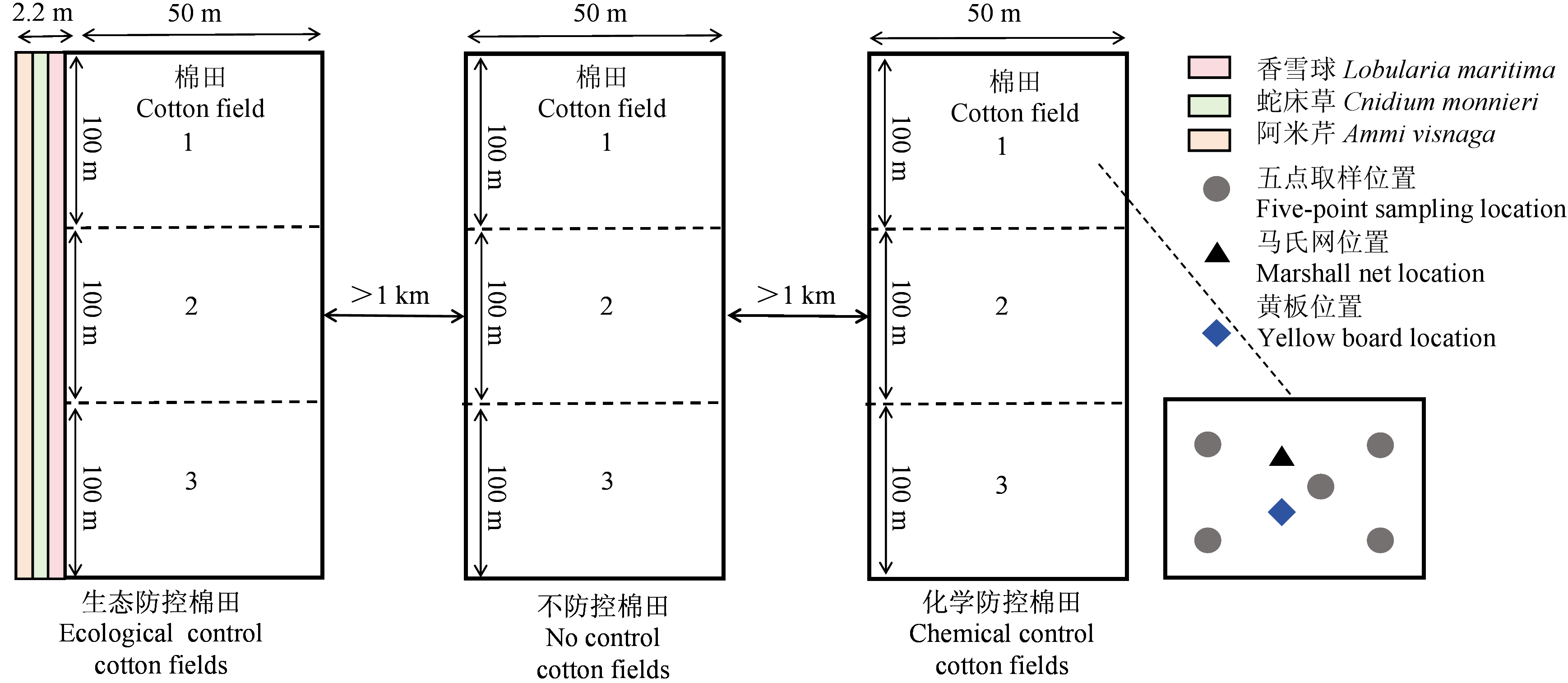
Fig. 1

Plot layout of cotton field under three management models"

Table 1

Levels of pesticide application in cotton fields under chemical control"

棉花生育期
Cotton growing
period
日期
Date
(m-d)
施用农药名称
Name of pesticide applied
生产厂家
Manufacturer
有效成分含量
Active ingredient
content
使用浓度
Usage
concentration
苗期
Seedling stage
05-06 高效氯氰菊酯
Beta-cypermethrin
河北安格诺农化有限公司
Hebei Angeno Agrochemical Co., Ltd.
4.5% 375 mL·hm-2
甲哌鎓
Mepiquat chloride
山东戴盟得生物科技有限公司
Shandong Daimengde Biotechnology Co., Ltd.
98% 46.5 g·hm-2
05-14 甲哌鎓
Mepiquat chloride
山东戴盟得生物科技有限公司
Shandong Daimengde Biotechnology Co., Ltd.
98% 46.5 g·hm-2
啶虫脒
Acetamiprid
河北中天邦正生物科技股份公司
Hebei Zhongtian Bangzheng Biotechnology Co., Ltd.
20% 75 g·hm-2
阿维菌素
Abamectin
河北润达农药化工有限公司
Hebei Runda Pesticide & Chemical Co., Ltd.
5% 180 mL·hm-2
05-29 阿维菌素
Abamectin
河北润达农药化工有限公司
Hebei Runda Pesticide & Chemical Co., Ltd.
5% 180 mL·hm-2
啶虫脒
Acetamiprid
河北中天邦正生物科技股份公司
Hebei Zhongtian Bangzheng Biotechnology Co., Ltd.
20% 75 g·hm-2
高氯·甲维盐
Emamectin·benzoate
河南波尔森农业科技有限公司
Henan Borsen Agricultural Technology Co., Ltd.
3.8% 750 g·hm-2
苗期-蕾期
Seedling-
budding stage
06-09 啶虫脒
Acetamiprid
河北中天邦正生物科技股份公司
Hebei Zhongtian Bangzheng Biotechnology Co., Ltd.
20% 75 g·hm-2
阿维菌素
Abamectin
河北润达农药化工有限公司
Hebei Runda Pesticide & Chemical Co., Ltd.
5% 180 mL·hm-2
06-18 烯啶虫胺
Nitenpyram
青岛海纳生物科技有限公司
Qingdao Haina Biotechnology Co., Ltd.
10% 150 mL·hm-2
高氯·甲维盐
Emamectin·benzoate
河南波尔森农业科技有限公司
Henan Borsen Agricultural Technology Co., Ltd.
3.8% 750 g·hm-2
乙螨唑
Etoxazole
青岛中达农业科技有限公司
Qingdao Zhongda Agricultural Technology Co., Ltd.
20% 120 mL·hm-2
甲哌鎓
Mepiquat chloride
山东戴盟得生物科技有限公司
Shandong Daimengde Biotechnology Co., Ltd.
98% 46.5 g·hm-2
蕾期
Budding stage
06-26 啶虫脒
Acetamiprid
河北中天邦正生物科技股份公司
Hebei Zhongtian Bangzheng Biotechnology Co., Ltd.
20% 75 g·hm-2
乙螨唑
Etoxazole
青岛中达农业科技有限公司
Qingdao Zhongda Agricultural Technology Co., Ltd.
20% 120 mL·hm-2
阿维菌素
Abamectin
河北润达农药化工有限公司
Hebei Runda Pesticide & Chemical Co., Ltd.
5% 180 mL·hm-2
高氯·甲维盐
Emamectin·benzoate
河南波尔森农业科技有限公司
Henan Borsen Agricultural Technology Co., Ltd.
3.8% 750 g·hm-2
甲哌鎓
Mepiquat chloride
山东戴盟得生物科技有限公司
Shandong Daimengde Biotechnology Co., Ltd.
98% 46.5 g·hm-2
07-04 烯啶虫胺
Nitenpyram
青岛海纳生物科技有限公司
Qingdao Haina Biotechnology Co., Ltd.
10% 150 mL·hm-2
螺螨酯
Spirodiclofen
拜耳作物科学(中国)有限公司
Bayer Crop Science (China) Co., Ltd.
240 g·L-1 150 mL·hm-2
高氯·甲维盐
Emamectin·benzoate
河南波尔森农业科技有限公司
Henan Borsen Agricultural Technology Co., Ltd.
3.8% 750 g·hm-2
甲哌鎓
Mepiquat chloride
山东戴盟得生物科技有限公司
Shandong Daimengde Biotechnology Co., Ltd.
98% 46.5 g·hm-2
蕾期-花铃期
Budding-
Flower bud stage
07-10 啶虫脒
Acetamiprid
河北中天邦正生物科技股份公司
Hebei Zhongtian Bangzheng Biotechnology Co., Ltd.
20% 75 g·hm-2
阿维菌素
Abamectin
河北润达农药化工有限公司
Hebei Runda Pesticide & Chemical Co., Ltd.
5% 180 mL·hm-2
氯虫苯甲酰胺
Chlorantraniliprole
深圳诺普信作物科学股份有限公司
Shenzhen Nopxin Crop Science Co., Ltd.
5% 450 mL·hm-2
花铃期
Flower bud stage
07-20 烯啶虫胺
Nitenpyram
青岛海纳生物科技有限公司
Qingdao Haina Biotechnology Co., Ltd.
10% 150 mL·hm-2
乙螨唑
Etoxazole
青岛中达农业科技有限公司
Qingdao Zhongda Agricultural Technology Co., Ltd.
20% 120 mL·hm-2
高氯·甲维盐
Emamectin Benzoate
河南波尔森农业科技有限公司
Henan Borsen Agricultural Technology Co., Ltd.
3.8% 750 g·hm-2
07-30 螺螨酯
Spirodiclofen
拜耳作物科学(中国)有限公司
Bayer Crop Science (China) Co., Ltd.
240 g·L-1 150 mL·hm-2
08-18 乙螨唑
Etoxazole
青岛中达农业科技有限公司
Qingdao Zhongda Agricultural Technology Co., Ltd.
20% 120 mL·hm-2
高氯·甲维盐
Emamectin·benzoate
河南波尔森农业科技有限公司
Henan Borsen Agricultural Technology Co., Ltd.
3.8% 750 g·hm-2
联苯肼酯
Bifenazate
浙江新安化工集团股份有限公司
Zhejiang Xin’an Chemical Group Co., Ltd.
43% 180 mL·hm-2
吡蚜酮
Pymetrozine
陕西上格之路生物科学有限公司
Shaanxi Shangge Road Biological Sciences Co., Ltd.
25% 240 mL·hm-2
吐絮初期
Early stage of
cotton boll
opening
08-28 氯虫苯甲酰胺
Chlorantraniliprole
深圳诺普信作物科学股份有限公司
Shenzhen Nopxin Crop Science Co., Ltd.
5% 450 mL·hm-2
阿维菌素
Abamectin
河北润达农药化工有限公司
Hebei Runda Pesticide & Chemical Co., Ltd.
5% 180 mL·hm-2
啶虫脒
Acetamiprid
河北中天邦正生物科技股份公司
Hebei Zhongtian Bangzheng Biotechnology Co., Ltd.
20% 75 g·hm-2
乙螨唑
Etoxazole
青岛中达农业科技有限公司
Qingdao Zhongda Agricultural Technology Co., Ltd.
20% 120 mL·hm-2

Table 2

Arthropod community composition in cotton fields under three pest management models"


Order

Family
生态防控棉田
个体数
Individual number of ecological control
cotton fields
所占比例Proportion
(%)
化学防控棉田
个体数
Individual number of chemical control
cotton fields
所占比例Proportion
(%)
不防控棉田个体数
Individual number of no control cotton fields
所占比例Proportion
(%)
类群
Community
脉翅目
Neuroptera
草蛉科Chrysopidae 353 0.466 124 0.301 211 0.247 肉食性Carnivorous
缨翅目
Thysanoptera
蓟马科Thripinae 15874 20.969 18939 45.927 17354 20.315 植食性Phytophagous
纹蓟马科Aeolothripidae 243 0.321 115 0.279 198 0.232 肉食性Carnivorous
管蓟马科Phlaeothripidae 19 0.025 8 0.019 23 0.027 植食性Phytophagous
鞘翅目
Coleoptera
瓢甲科Coccinellidae 2607 3.444 731 1.773 2077 2.431 肉食性Carnivorous
步甲科Carabidae 2 0.003 1 0.002 0 0 肉食性Carnivorous
叶甲科Chrysomelidae 95 0.125 2 0.005 12 0.014 植食性Phytophagous
薪甲科Latridiidae 12 0.016 20 0.049 13 0.015 植食性Phytophagous
隐翅甲科Staphylinidae 2 0.003 1 0.002 1 0.001 肉食性Carnivorous
金龟甲科Scarabaeoidae 11 0.015 2 0.005 8 0.009 其他Other
半翅目
Hemiptera
盲蝽科Miridae 204 0.269 32 0.078 224 0.262 肉食性Carnivorous
盲蝽科Miridae 65 0.086 17 0.041 61 0.071 植食性Phytophagous
姬蝽科Nabidae 1 0.001 0 0 0 0 肉食性Carnivorous
长蝽科Lygaeidae 2 0.003 0 0 1 0.001 肉食性Carnivorous
小花蝽科Anthocoridae 297 0.392 22 0.053 209 0.245 肉食性Carnivorous
猎蝽科Reduviidae 1 0.001 0 0 0 0 肉食性Carnivorous
蚜科Aphididae 54333 71.772 20329 49.298 62790 73.502 植食性Phytophagous
叶蝉科Cicadellidae 49 0.065 12 0.029 42 0.049 植食性Phytophagous
飞虱科Delphacidae 9 0.012 10 0.024 4 0.005 植食性Phytophagous
木虱科Psyllidae 6 0.008 1 0.002 0 0 植食性Phytophagous
蝽科Pentatomidae 7 0.009 1 0.002 2 0.002 植食性Phytophagous
姬蝽科Nabidae 4 0.005 0 0 0 0 肉食性Carnivorous
划蝽科Corixidae 0 0 1 0.002 0 0 植食性Phytophagous
网蝽科Tingidae 0 0 0 0 1 0.001 植食性Phytophagous
蜘蛛目
Araneida
蟹蛛科Thomisidae 12 0.016 0 0 12 0.014 肉食性Carnivorous
狼蛛科Lycosidae 5 0.007 5 0.012 2 0.002 肉食性Carnivorous
跳蛛科Salticidae 1 0.001 1 0.002 7 0.008 肉食性Carnivorous
皿蛛科Linyphiidae 7 0.009 1 0.002 14 0.016 肉食性Carnivorous
园蛛科Araneidae 1 0.001 0 0 0 0 肉食性Carnivorous
平腹蛛科Gnaphosidae 0 0 0 0 1 0.001 肉食性Carnivorous
膜翅目
Hymenoptera
茧蜂科Braconidae 27 0.036 8 0.019 2 0.002 肉食性Carnivorous
蚜茧蜂科Braconidae 175 0.231 87 0.211 134 0.157 肉食性Carnivorous
寄生蜂总科Platygaster sp. 3 0.004 4 0.010 0 0 肉食性Carnivorous
跳小蜂科Encyrtidae 1 0.001 0 0 0 0 肉食性Carnivorous
榕小蜂科Agaonidae 1 0.001 1 0.002 2 0.002 植食性Phytophagous
旗腹蜂科Evaniidae 1 0.001 0 0 0 0 肉食性Carnivorous
姬蜂科Ichneumonidae 32 0.042 26 0.063 3 0.004 肉食性Carnivorous
金小蜂科Pteromalidae 3 0.004 2 0.005 0 0 肉食性Carnivorous
隧蜂科Halictidae 2 0.003 0 0 0 0 植食性Phytophagous
蜜蜂总科Apoidea 1 0.001 0 0 3 0.004 植食性Phytophagous
叶蜂科Tenthredinidae 1 0.001 0 0 2 0.002 植食性Phytophagous
小蜂科Chalcididae 33 0.044 0 0 27 0.032 肉食性Carnivorous
细蜂科Proctotrupidae 75 0.099 0 0 69 0.081 肉食性Carnivorous
长尾小蜂科Torymidae 1 0.001 0 0 0 0 植食性Phytophagous
树蜂科Siricidae 1 0.001 0 0 0 0 植食性Phytophagous
蚁科Formicidae 22 0.029 7 0.017 17 0.020 其他Other
瘿蜂科Cynipidae 0 0 0 0 33 0.039 植食性Phytophagous
双翅目
Diptera
食蚜蝇科Syrphidae 17 0.022 3 0.007 9 0.011 肉食性Carnivorous
寄蝇科Tachinidae 9 0.012 0 0 7 0.008 肉食性Carnivorous
水虻科Stratiomyidae 1 0.001 2 0.005 4 0.005 其他Other
长足虻科Dolichopodidae 5 0.007 0 0 0 0 肉食性Carnivorous
实蝇科Tephritidae 61 0.081 18 0.044 36 0.042 植食性Phytophagous
潜蝇科Agromyzidae 3 0.004 1 0.002 1 0.001 植食性Phytophagous
果蝇科Drosophilidae 30 0.040 7 0.017 35 0.041 植食性Phytophagous
叶蝇科Milichiidae 1 0.001 0 0 1 0.001 植食性Phytophagous
蚊科Culicidae 14 0.018 0 0 15 0.018 植食性Phytophagous
眼蕈蚊科Sciaridae 4 0.005 1 0.002 1 0.001 植食性Phytophagous
瘿蚊科Cecidomyiidae 30 0.040 20 0.049 50 0.059 植食性Phytophagous
菌蚊科Mycetophilidae 5 0.007 0 0 1 0.001 植食性Phytophagous
大蚊科Tipulidae 1 0.001 0 0 0 0 其他Other
蝇科Muscidae 24 0.032 1 0.002 4 0.005 肉食性Carnivorous
秆蝇科Chloropidae 2 0.003 0 0 4 0.005 植食性Phytophagous
秆蝇科Chloropidae 12 0.016 16 0.039 61 0.071 其他Other
花蝇科Anthomyiidae 43 0.057 0 0 83 0.097 植食性Phytophagous
丽蝇科Calliphoridae 1 0.001 1 0.002 1 0.001 其他Other
蚤蝇科Phoridae 708 0.935 624 1.513 1450 1.697 其他Other
摇蚊科Chironomidae 16 0.021 7 0.017 14 0.016 其他Other
水蝇科Hydrocoridae 1 0.001 0 0 0 0 植食性Phytophagous
寡脉蝇科Asteiidae 2 0.003 0 0 0 0 其他Other
缟蝇科Lauxaniidae 8 0.011 2 0.005 3 0.004 其他Other
尖翅蝇科Lonchopteridae 25 0.033 0 0 3 0.004 其他Other
鼓翅蝇科epsidae 2 0.003 0 0 1 0.001 其他Other
斑蝇科Physiphora 1 0.001 0 0 1 0.001 其他Other
革翅目
Dermaptera
蠼螋科Labiduridae 50 0.066 15 0.036 40 0.047 肉食性Carnivorous
球螋科Forficulidae 5 0.007 1 0.002 2 0.002 肉食性Carnivorous
蜻蜓目Odonata 蟌科Coenagrionidae 1 0.001 0 0 0 0 肉食性Carnivorous
螳螂目Mantodea 螳螂科Mantodea 2 0.003 0 0 0 0 肉食性Carnivorous
鳞翅目
Lepidoptera
粉蝶科Pieridae 1 0.001 0 0 0 0 植食性Phytophagous
夜蛾科Noctuidae 9 0.012 3 0.007 13 0.015 植食性Phytophagous
螟蛾科Pyralidae 0 0 1 0.002 0 0 植食性Phytophagous
等足目Isopoda 鼠妇科Porcellionidae 4 0.005 2 0.005 3 0.004 其他Other
啮虫目
Corrodentia
半啮科Hemibrycon 2 0.003 2 0.005 21 0.025 肉食性Carnivorous
直翅目
Orthoptera
蟋蟀科Gryllidae 1 0.001 0 0 0 0 植食性Phytophagous
蜚蠊目Blattaria 斑蠊科Blattidae 0 0 0 0 3 0.004 植食性Phytophagous
总计Total 75072 41237 85426

Table 3

Composition of functional groups in arthropod communities in cotton fields under three pest management models"

类群
Group
生态防控棉田
Ecological control cotton fields
化学防控棉田
Chemical control cotton fields
不防控棉田
No control cotton fields
数量
Number
百分比
Percent (%)
数量
Number
百分比
Percent (%)
数量
Number
百分比
Percent (%)
肉食性类群
Carnivorous
group
科数Family 34 43.59 20 41.67 23 37.70
个体数Individual 1402±1798a 5.56 393±173c 2.87 1091±246b 3.83
植食性类群Phytophagous
group
科数Family 30 38.46 19 39.58 26 42.62
个体数Individual 23594±2573b 93.36 13130±3166c 95.52 26862±1366a 94.34
其他类群
Other group
科数Family 14 17.95 9 18.75 12 19.67
个体数Individual 271±26b 1.08 221±22b 1.61 522±125a 1.83

Table 4

Diversity characteristics of arthropod communities in cotton fields under three pest management systems"

类群
Group
处理
Treatment
物种丰富度
Species richness
香农多样性指数
Shannon-Wiener index
优势集中性
Simpon index
优势度
Dominance index
均匀度
Evenness index
肉食性类群
Carnivorous group
生态防控棉田Ecological control cotton field 3.955±0.239a 1.537±0.068a 0.596±0.040a 0.404±0.010a 0.435±0.012a
化学防控棉田Chemical control cotton field 2.686±0.128b 1.421±0.043a 0.590±0.013a 0.410±0.026a 0.472±0.011a
不防控棉田No control cotton field 2.718±0.087b 1.457±0.047a 0.579±0.034a 0.421±0.021a 0.464±0.020a
植食性类群
Phytophagous group
生态防控棉田Ecological control cotton field 2.597±0.053a 0.588±0.035b 0.359±0.011b 0.641±0.028a 0.173±0.004b
化学防控棉田Chemical control cotton field 1.701±0.065c 0.719±0.023a 0.503±0.015a 0.498±0.028b 0.244±0.012a
不防控棉田No control cotton field 2.213±0.080b 0.568±0.015b 0.347±0.010b 0.654±0.011a 0.174±0.009b
其他类群
Other group
生态防控棉田Ecological control cotton field 1.749±0.066a 0.601±0.023a 0.220±0.020a 0.780±0.023b 0.232±0.024a
化学防控棉田Chemical control cotton field 1.078±0.071c 0.309±0.017b 0.108±0.003b 0.892±0.019a 0.146±0.021b
不防控棉田No control cotton field 1.357±0.064b 0.354±0.029b 0.132±0.003b 0.868±0.034ab 0.146±0.005b
总群落
Total arthropod community
生态防控棉田Ecological control cotton field 6.945±0.123a 0.895±0.018a 0.436±0.039ab 0.720±0.057a 0.206±0.007b
化学防控棉田Chemical control cotton field 4.518±0.020c 0.928±0.037a 0.543±0.019a 0.494±0.034b 0.240±0.009a
不防控棉田No control cotton field 5.549±0.003b 0.836±0.021a 0.415±0.036b 0.737±0.027a 0.202±0.007b

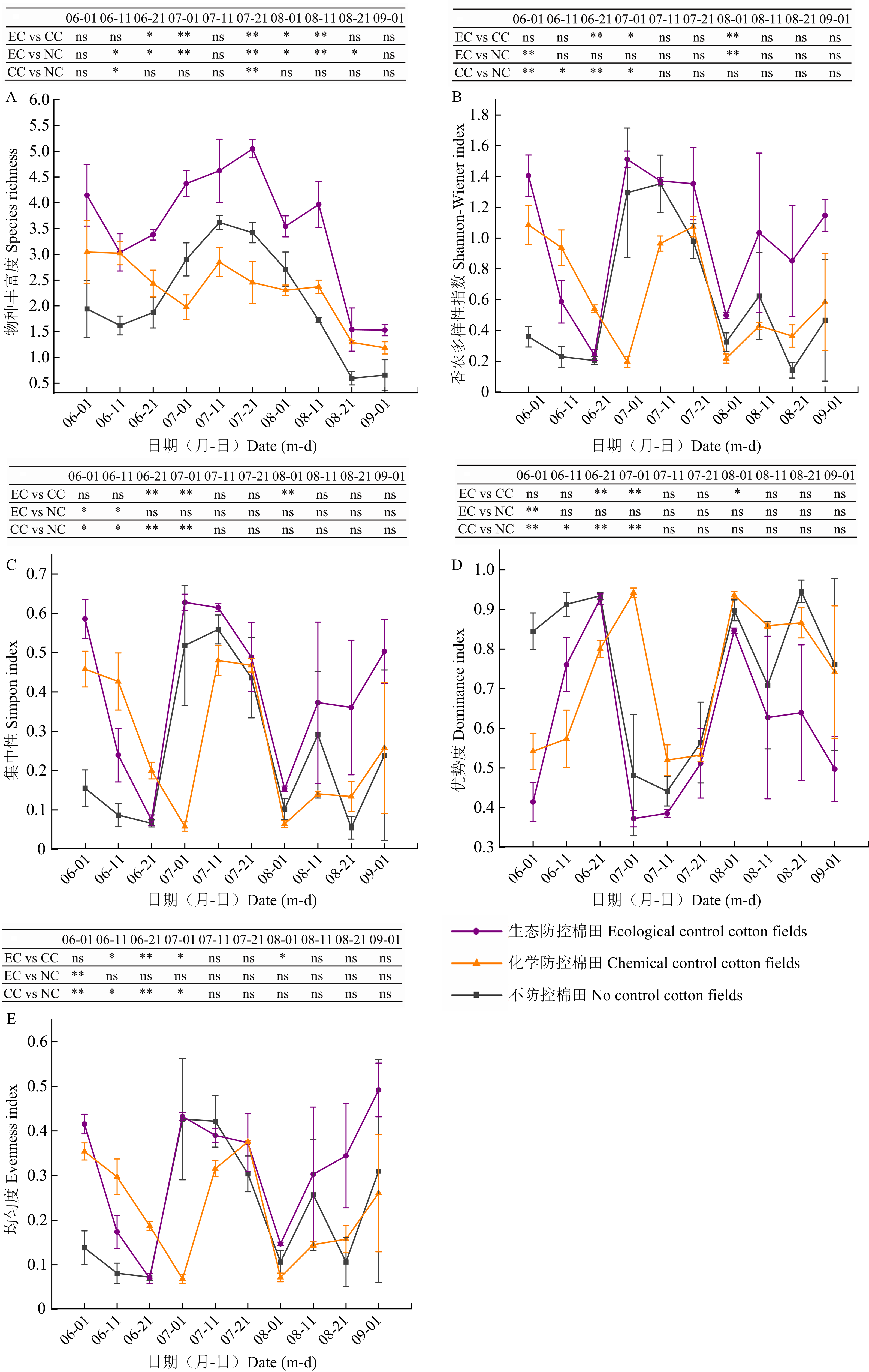
Fig. 2

Temporal changes in the arthropod community diversity index in cotton fields under three pest management models EC, CC, and NC represent ecological control cotton fields, chemical control cotton fields, and no control cotton fields, respectively. * and ** are the significant difference levels of P<0.05 and P<0.01, respectively, in the Duncan’s new complex range test, while ns shows no significant difference"

[1]
TIAN W, ZHANG T, ZHAO J H, DONG Y M, LI Y Z, ZHAO Z Q, GAO F, WU X M, ZHANG B S, FANG Y Y, XIE Z M, GUO H S. HIGS-mediated crop protection against cotton aphids. Plant Biotechnology Journal, 2025, 23(3): 692-694.

doi: 10.1111/pbi.14529 pmid: 39636291
[2]
马俊良. 新疆植棉区棉花生育期模型比较与密度及水氮优化模拟研究[D]. 乌鲁木齐: 新疆农业大学, 2025.
MA J L. Comparison of cotton growth period models and simulation study on optimization of planting density, water, and nitrogen in Xinjiang cotton-growing regions[D]. Urumqi: Xinjiang Agricultural University, 2025. (in Chinese)
[3]
赵世航, 宋萍, 王新星, 马允冲, 王勤英. 生物防治对苹果园节肢动物群落结构的影响. 中国植保导刊, 2025, 45(8): 51-54.
ZHAO S H, SONG P, WANG X X, MA Y C, WANG Q Y. Effects of biological control on arthropod community structure in apple orchards. China Plant Protection, 2025, 45(8): 51-54. (in Chinese)
[4]
门兴元, 戈峰. 基于农田景观的害虫生态防控方法与实践. 植物保护, 2025, 51(5): 257-266, 355.
MEN X Y, GE F. Methods and practices of ecological pest control based on farmland landscape. Plant Protection, 2025, 51(5): 257-266, 355. (in Chinese)
[5]
李娜. 不同杀虫剂对新疆棉田蚜虫及天敌种群发生的影响[D]. 乌鲁木齐: 新疆农业大学, 2021.
LI N. Effects of different insecticides on the occurrence of aphid and natural enemy populations in cotton fields of Xinjiang[D]. Urumqi: Xinjiang Agricultural University, 2021. (in Chinese)
[6]
戈峰. 昆虫生态学原理与方法. 北京: 高等教育出版社, 2008: 201-223.
GE F. Principles and Methods of Insect Ecology. Beijing: Higher Education Press, 2008: 201-223. (in Chinese)
[7]
YANG L, PAN Y F, WYCKHUYS K A G, LI M L, WANG K T, LIU B, LIU Y T, JIA S S, LI Q, LI Y, DESNEUX N, LU Y H. Context-dependent response of crop pests to landscape composition. Entomologia Generalis, 2025, 45(2): 339-350.

doi: 10.1127/entomologia/2025/3010
[8]
HAN P, RODRIGUEZ-SAONA C, ZALUCKI M P, LIU S S, DESNEUX N. A theoretical framework to improve the adoption of green integrated pest management tactics. Communications Biology, 2024, 7: 337.

doi: 10.1038/s42003-024-06027-6 pmid: 38499741
[9]
HAN P, LAVOIR A V, RODRIGUEZ-SAONA C, DESNEUX N. Bottom-up forces in agroecosystems and their potential impact on arthropod pest management. Annual Review of Entomology, 2022, 67: 239-259.

doi: 10.1146/ento.2022.67.issue-1
[10]
COSTAMAGNA A C, LANDIS D A. Predators exert top-down control of soybean aphid across a gradient of agricultural management systems. Ecological Applications, 2006, 16(4): 1619-1628.

doi: 10.1890/1051-0761(2006)016[1619:petcos]2.0.co;2 pmid: 16937822
[11]
杨泉峰, 欧阳芳, 门兴元, 戈峰. 功能植物的作用原理、方式及研究展望. 应用昆虫学报, 2020, 57(1): 41-48.
YANG Q F, OUYANG F, MEN X Y, GE F. Action principles, modes and research prospects of functional plants. Chinese Journal of Applied Entomology, 2020, 57(1): 41-48. (in Chinese)
[12]
PERRI D V, GOROSITO N B, SCHILMAN P E, CASAUBÓN E A, DÁVILA C, FERNÁNDEZ P C. Push-pull to manage leaf-cutting ants: An effective strategy in forestry plantations. Pest Management Science, 2021, 77(1): 432-439.

doi: 10.1002/ps.v77.1
[13]
LANG J, RAMOS S E, REICHERT L, AMBOKA G M, APEL C, CHIDAWANYIKA F, DETEBO A, LIBRÁN-EMBID F, MEINHOF D, BIGLER L, SCHUMAN M C. Push-pull intercropping increases the antiherbivore benzoxazinoid glycoside content in maize leaf tissue. ACS Agricultural Science & Technology, 2024, 4(10): 1074-1082.
[14]
COOK S M, KHAN Z R, PICKETT J A. The use of push-pull strategies in integrated pest management. Annual Review of Entomology, 2007, 52: 375-400.

pmid: 16968206
[15]
THEI S R, ABADI A L, MUDJIONO G, SUPRAYOGO D. Study of arthropod communities in a Virginia tobacco agro-ecosystem. The Journal of Tropical Life Science, 2013, 3(2): 138-142.

doi: 10.11594/jtls
[16]
HEBERT P D N, CYWINSKA A, BALL S L, DE WAARD J R. Biological identifications through DNA barcodes. Proceedings of the Royal Society of London Series B: Biological Sciences, 2003, 270(1512): 313-321.
[17]
葛有茂, 卢刚, 张宏. 施用杀虫剂对泽泻田节肢动物群落的影响研究. 福建农业学报, 2008, 22(4): 20-24.
GE Y M, LU G, ZHANG H. Study on the effects of insecticide application on arthropod community in Alisma orientale fields. Fujian Journal of Agricultural Sciences, 2008, 22(4): 20-24. (in Chinese)
[18]
王向阳, 邹运鼎, 孟庆雷, 章炳旺, 代海敏. 两种除草剂对棉田节肢动物群落多样性指数的影响. 应用生态学报, 2005, 16(3): 514-518.
WANG X Y, ZOU Y D, MENG Q L, ZHANG B W, DAI H M. Effects of two herbicides on the diversity indices of cotton field arthropod community. Chinese Journal of Applied Ecology, 2005, 16(3): 514-518. (in Chinese)
[19]
吕昭智, 陈键, 吴志勇, 马桂龙. 新疆棉区主要有害生物与可持续发展. 干旱区研究, 1999, 16(3): 28-32.

doi: 10.13866/j.azr.1999.03.006
Z Z, CHEN J, WU Z Y, MA G L. Major harmful organisms and sustainable development in cotton growing areas of Xinjiang. Arid Zone Research, 1999, 16(3): 28-32. (in Chinese)
[20]
游帅. 两种邻作模式对棉田天敌多样性的影响及其在棉蚜防控减药中的作用评价[D]. 阿拉尔: 塔里木大学, 2024.
YOU S. Evaluation of the effects of two intercropping systems on predator diversity in cotton fields and their role in Aphis gossypii management with reduced pesticide usage[D]. Alaer: Tarim University, 2024. (in Chinese)
[21]
PAPAPOSTOLOU K M, RIGA M, CHARAMIS J, SKOUFA E, SOUCHLAS V, ILIAS A, DERMAUW W, IOANNIDIS P, VAN LEEUWEN T, VONTAS J. Identification and characterization of striking multiple-insecticide resistance in a Tetranychus urticae field population from Greece. Pest Management Science, 2021, 77(2): 666-676.

doi: 10.1002/ps.v77.2
[22]
武宁宁, 梁沛. 昆虫抗药性机制研究进展. 应用昆虫学报, 2025, 62(5): 1496-1507.
WU N N, LIANG P. Advances in research on the mechanisms underlying insecticide resistance in insects. Chinese Journal of Applied Entomology, 2025, 62(5): 1496-1507. (in Chinese)
[23]
雒珺瑜, 张帅, 朱香镇, 姬继超, 张开心, 王春义, 张利娟, 王丽, 李春花, 崔金杰. 蓖麻诱集带对棉田节肢动物群落及生物多样性的影响. 中国棉花, 2018, 45(8): 9-11, 19.

doi: 10.11963/1000-632X.ljycjj.20180817
LUO J Y, ZHANG S, ZHU X Z, JI J C, ZHANG K X, WANG C Y, ZHANG L J, WANG L, LI C H, CUI J J. Effect of trap Castor on cotton arthropod animal communities and biodiversity. China Cotton, 2018, 45(8): 9-11, 19. (in Chinese)
[24]
吴怡瑄, 刘至幸, 张家辉, 潘光凤, 东方龙, 李晓维, 黄俊, 吕要斌, 饶琼, 张治军. 西兰花-小麦间作对田间天敌群落及生态防控作用的影响. 应用昆虫学报, 2025, 62(3): 638-645.
WU Y X, LIU Z X, ZHANG J H, PAN G F, DONGFANG L, LI X W, HUANG J, Y B, RAO Q, ZHANG Z J. Effects of broccoli-wheat intercropping on field natural enemy community and ecological pest control function. Chinese Journal of Applied Entomology, 2025, 62(3): 638-645. (in Chinese)
[25]
OBANYI J N, OGENDO J O, MULWA R M S, NYAANGA J G, CHERUIYOT E K, BETT P K, BELMAIN S R, ARNOLD S E J, NASH-WOOLLEY V C, STEVENSON P C. Field margins and cropping system influence diversity and abundance of aphid natural enemies in Lablab purpureus. Journal of Applied Entomology, 2023, 147(7): 439-451.

doi: 10.1111/jen.v147.7
[26]
ZANG L S, WANG S, ZHANG F, DESNEUX N. Biological control with Trichogramma in China: History, present status, and perspectives. Annual Review of Entomology, 2021, 66: 463-484.

doi: 10.1146/ento.2021.66.issue-1
[27]
CHI B J, ZHANG D M, DONG H Z. Control of cotton pests and diseases by intercropping: A review. Journal of Integrative Agriculture, 2021, 20(12): 3089-3100.

doi: 10.1016/S2095-3119(20)63318-4
[28]
乔浪, 李德昊, 杨佳乐, 李玲, 李艳艳, 张文兵, 韩海斌, 谭瑶. 诱集植物的研究进展及在紫花苜蓿害虫治理中的应用前景. 应用昆虫学报, 2025, 62(2): 271-287.
QIAO L, LI D H, YANG J L, LI L, LI Y Y, ZHANG W B, HAN H B, TAN Y. Research progress of trap plants and their application prospects in pest management of alfalfa. Chinese Journal of Applied Entomology, 2025, 62(2): 271-287. (in Chinese)
[29]
彭佳敏, 帕提玛·乌木尔汗, 郭小虎, 库尔班妮萨古丽·奥布力喀斯木, 杨世平, 李泰峰, 王新翠, 朱丽华, 马德英. 棉田诱集植物对棉蚜及捕食性天敌种群动态的影响. 中国生物防治学报, 2023, 39(5): 1038-1048.

doi: 10.16409/j.cnki.2095-039x.2022.11.030
PENG J M, PATIMA W, GUO X H, KURBANISAGUI O, YANG S P, LI T F, WANG X C, ZHU L H, MA D Y. Effects of trap plants in cotton fields on population dynamics of cotton aphids and predatory natural enemies. Chinese Journal of Biological Control, 2023, 39(5): 1038-1048. (in Chinese)
[30]
范千千, 杨淑珂, 李凡, 徐晓辉, 郝超峰, 孙红炜. 转基因抗虫耐除草剂玉米LP026-2对田间节肢动物群落多样性的影响. 生物安全学报, 2025, 34(4): 361-368.
FAN Q Q, YANG S K, LI F, XU X H, HAO C F, SUN H W. Impacts of transgenic insect-resistant and herbicide-tolerant maize LP026-2 on the arthropod community diversity in the field. Journal of Biosafety, 2025, 34(4): 361-368. (in Chinese)
[31]
顾伟, 马玲, 丁新华, 张静, 韩争伟. 扎龙湿地不同生境的昆虫多样性. 应用生态学报, 2011, 22(9): 2405-2412.
GU W, MA L, DING X H, ZHANG J, HAN Z W. Insect diversity of different habitat types of Zhalong Wetland. Chinese Journal of Applied Ecology, 2011, 22(9): 2405-2412. (in Chinese)
[32]
宋备舟, 王美超, 孔云, 姚允聪, 吴红英, 胡竞辉, 亓丽萍, 毕宁宁. 梨园芳香植物间作区节肢动物群落的结构特征. 中国农业科学, 2010, 43(4): 769-779. doi: 10.3864/j.issn.0578-1752.2010.04.014.
SONG B Z, WANG M C, KONG Y, YAO Y C, WU H Y, HU J H, QI L P, BI N N. The structure characteristics of arthropod community in plots of pear orchard intercropped with different aromatic plants. Scientia Agricultura Sinica, 2010, 43(4): 769-779. doi: 10.3864/j.issn.0578-1752.2010.04.014. (in Chinese)
[33]
薛正轩. 田边甘草对棉田多异瓢虫保育功能的探究[D]. 石河子: 石河子大学, 2022.
XUE Z X. Study on the conservation function of Glycyrrhiza uralensis at field edges to Hippodamia variegata in cotton fields[D]. Shihezi: Shihezi University, 2022. (in Chinese)
[34]
米莹莹, 杨亚洁, 王甦, 金振宇, 李姝. 基于捕食性天敌及害虫种群动态筛选功能植物的研究. 环境昆虫学报, 2024, 46(2): 489-497.
MI Y Y, YANG Y J, WANG S, JIN Z Y, LI S. Screening of functional plants based on population dynamics of natural predators and pests. Journal of Environmental Entomology, 2024, 46(2): 489-497. (in Chinese)
[35]
李海强, 张建萍, 陆宴辉. 果棉间作对棉田节肢动物群落结构的影响. 植物保护, 2021, 47(2): 233-238.
LI H Q, ZHANG J P, LU Y H. Effects of fruit trees-cotton intercropping on arthropod community structure in cotton fields. Plant Protection, 2021, 47(2): 233-238. (in Chinese)
[36]
李琼, 李强, 张晓明. 大豆/玉米间作密度对大豆田节肢动物群落多样性和稳定性的影响. 南方农业学报, 2019, 50(6): 1247-1255.
LI Q, LI Q, ZHANG X M. Effects of soybean/maize intercropping densities on arthropod community diversity and stability in soybean field. Journal of Southern Agriculture, 2019, 50(6): 1247-1255. (in Chinese)
[37]
田耀加, 梁广文, 曾玲, 陆永跃. 间作对甜玉米田主要害虫与天敌动态的影响. 植物保护学报, 2012, 39(1): 1-6.
TIAN Y J, LIANG G W, ZENG L, LU Y Y. Effects of intercropping on population dynamics of major pests and natural enemies in sweet corn fields. Acta Phytophylacica Sinica, 2012, 39(1): 1-6. (in Chinese)
[38]
BRANDMEIER J, REININGHAUS H, PAPPAGALLO S, KARLEY A J, SCHERBER C. Intercropping in high input agriculture supports arthropod diversity without risking significant yield losses. Basic and Applied Ecology, 2021, 53: 26-38.

doi: 10.1016/j.baae.2021.02.011
[39]
缪勇, 高希武, 江俊起, 王云. 甘蓝与大蒜间作对甘蓝田主要害虫及节肢动物群落的影响. 华南农业大学学报, 2013, 34(3): 352-355.
MIAO Y, GAO X W, JIANG J Q, WANG Y. Effects of cabbage-garlic intercropping on major pests and arthropod communities in cabbage fields. Journal of South China Agricultural University, 2013, 34(3): 352-355. (in Chinese)
[40]
潘云飞. 南疆农田景观组成与农药使用对棉田天敌发生及其控蚜功能的影响[D]. 北京: 中国农业科学院, 2020.
PAN Y F. Effects of farmland landscape composition and pesticide application in southern Xinjiang on the occurrence of natural enemies and their aphid-controlling function in cotton fields[D]. Beijing: Chinese Academy of Agricultural Sciences, 2020. (in Chinese)
[41]
苏丽, 戈峰, 刘向辉. 化学防治对不同类型棉田害虫和捕食性天敌群落多样性的影响. 昆虫学报, 2002, 45(6): 777-784.
SU L, GE F, LIU X H. Effects of chemical control on diversity of insect pests and predatory natural enemy communities in cotton fields under different cultivating regimes. Acta Entomologica Sinica, 2002, 45(6): 777-784. (in Chinese)
[42]
周浩辉, 张大为, 刘沛林, 王森山, 陆宴辉. 张掖地区不同施药强度苹果园节肢动物群落结构及种群动态. 植物保护, 2025, 51(2): 237-244.
ZHOU H H, ZHANG D W, LIU P L, WANG S S, LU Y H. Community structure and population dynamics of arthropods in apple orchards with different pesticide application intensities in Zhangye area. Plant Protection, 2025, 51(2): 237-244. (in Chinese)
[43]
高晓阳. 生境对棉田节肢动物群落结构与功能的影响[D]. 合肥: 安徽农业大学, 2016.
GAO X Y. Effects of habitat on the community structure and function of arthropods in cotton fields[D]. Hefei: Anhui Agricultural University, 2016. (in Chinese)
[44]
陆宴辉, 赵紫华, 蔡晓明, 崔丽, 张浩男, 肖海军, 李振宇, 张礼生, 曾娟. 我国农业害虫综合防治研究进展. 应用昆虫学报, 2017, 54(3): 349-363.
LU Y H, ZHAO Z H, CAI X M, CUI L, ZHANG H N, XIAO H J, LI Z Y, ZHANG L S, ZENG J. Progresses on integrated pest management (IPM) of agricultural insect pests in China. Chinese Journal of Applied Entomology, 2017, 54(3): 349-363. (in Chinese)
[45]
LANDIS D A, WRATTEN S D, GURR G M. Habitat management to conserve natural enemies of arthropod pests in agriculture. Annual Review of Entomology, 2000, 45: 175-201.

pmid: 10761575
[46]
YE G Y, XIAO Q, CHEN M, CHEN X X, YUAN Z J, STANLEY D W, HU C. Tea: Biological control of insect and mite pests in China. Biological Control, 2014, 68: 73-91.

doi: 10.1016/j.biocontrol.2013.06.013
[47]
彭雪凡, 周晓通, 维尼热·买合木提, 上官一磊, 戈峰, 张建萍, 蔡志平. 不同功能植物对棉花蚜虫及其捕食性天敌的影响. 植物保护学报, 2024, 51(1): 39-49.
PENG X F, ZHOU X T, WENIRE M, SHANGGUAN Y L, GE F, ZHANG J P, CAI Z P. Effects of different functional plants on cotton aphids and their predatory natural enemies. Journal of Plant Protection, 2024, 51(1): 39-49. (in Chinese)
[48]
潘洪生, 姜玉英, 王佩玲, 刘建, 陆宴辉. 新疆棉花害虫发生演替与综合防治研究进展. 植物保护, 2018, 44(5): 42-50.
PAN H S, JIANG Y Y, WANG P L, LIU J, LU Y H. Research progress on occurrence succession and integrated control of cotton pests in Xinjiang. Plant Protection, 2018, 44(5): 42-50. (in Chinese)
[49]
HATT S, LOPES T, BOERAEVE F, CHEN J, FRANCIS F. Pest regulation and support of natural enemies in agriculture: Experimental evidence of within field wildflower strips. Ecological Engineering, 2017, 98: 240-245.

doi: 10.1016/j.ecoleng.2016.10.080
[50]
SCHADER C, ZALLER J G, KÖPKE U. Cotton-basil intercropping: Effects on pests, yields and economical parameters in an organic field in Fayoum, Egypt. Biological Agriculture & Horticulture, 2005, 23: 59-72.
[51]
YANG Q F, LI Z, OUYANG F, MEN X Y, ZHANG K N, LIU M, GUO W, ZHU C G, ZHAO W L, REDDY G V P, GE F. Flower strips promote natural enemies, provide efficient aphid biocontrol, and reduce insecticide requirement in cotton crops. Entomologia Generalis, 2022, 43(2): 421-432.

doi: 10.1127/entomologia/2022/1545
[52]
雒珺瑜, 张帅, 王春义, 吕丽敏, 李春花, 崔金杰. 不同诱集作物对棉田刺吸性害虫及其天敌的生态作用比较. 中国棉花, 2014, 41(8): 14-16.

doi: 10.11963/issn.1000-632X.20140805
LUO J Y, ZHANG S, WANG C Y, L M, LI C H, CUI J J. Comparative study on the ecological effects of different trap crops on sucking pests and their natural enemies in cotton fields. China Cotton, 2014, 41(8): 14-16. (in Chinese)
[53]
胡竞辉, 王美超, 孔云, 姚允聪, 魏巍, 宋备舟, 李振茹. 梨园芳香植物间作区节肢动物群落多样性时序特征. 中国农业科学, 2010, 43(5): 1007-1016. doi: 10.3864/j.issn.0578-1752.2010.05.016.
HU J H, WANG M C, KONG Y, YAO Y C, WEI W, SONG B Z, LI Z R. Temporal characteristics of arthropod community diversity in pear orchards intercropped with aromatic plants. Scientia Agricultura Sinica, 2010, 43(5): 1007-1016. doi: 10.3864/j.issn.0578-1752.2010.05.016. (in Chinese)
[54]
陈明. 间作豆科牧草对棉田节肢动物群落结构和动态的影响[D]. 兰州: 兰州大学, 2008.
CHEN M. Effects of intercropping leguminous forages on the community structure and dynamics of arthropods in cotton fields[D]. Lanzhou: Lanzhou University, 2008. (in Chinese)
[55]
尤民生, 刘雨芳, 侯有明. 农田生物多样性与害虫综合治理. 生态学报, 2004, 24(1): 117-122.
YOU M S, LIU Y F, HOU Y M. Biodiversity and integrated pest management in agroecosystems. Acta Ecologica Sinica, 2004, 24(1): 117-122. (in Chinese)
[56]
霍丽慧. 具有年龄结构的捕食者猎物模型的研究[D]. 杨凌: 西北农林科技大学, 2010.
HUO L H. Study on a predator-prey model with age structure[D]. Yangling: Northwest A&F University, 2010. (in Chinese)
[57]
王巧. 南疆农田景观中核桃黑斑蚜天敌发生动态及其生物控害功能[D]. 北京: 中国农业科学院, 2024.
WANG Q. Occurrence dynamics of natural enemies of Chromaphis juglandicola and their biological control function in farmland landscapes of Southern Xinjiang[D]. Beijing: Chinese Academy of Agricultural Sciences, 2024. (in Chinese)
[58]
MARTIN E A, REINEKING B, SEO B, STEFFAN-DEWENTER I. Natural enemy interactions constrain pest control in complex agricultural landscapes. Proceedings of the National Academy of Sciences of the United States of America, 2013, 110(14): 5534-5539.
[1] WANG KaiLi,YANG HeLong,XIAO Hong,SUN Wei,RONG YuPing. Effects of Nitrogen Application and Clipping Height on Vegetation Productivity and Plant Community Composition of Haying Meadow Steppe [J]. Scientia Agricultura Sinica, 2020, 53(13): 2625-2636.
[2] YAN RuiRui,ZHANG Yu,XIN XiaoPing,WEI ZhiJun,Wuren qiqige,GUO MeiLan. Effects of Mowing Disturbance on Grassland Plant Functional Groups and Diversity in Leymus chinensis Meadow Steppe [J]. Scientia Agricultura Sinica, 2020, 53(13): 2573-2583.
[3] LI GuanNan, MIAO ChangJian, LI WeiZheng, WANG GaoPing, LIU XiaoLan, GUO XianRu, YAN FengMing. Effects of Imidacloprid Flowable Concentrate for Maize Seed Coating on the Arthropod Community and the Main Non-Targeted Insect Pests in Maize Field [J]. Scientia Agricultura Sinica, 2017, 50(24): 4735-4746.
[4] REN ZhenTao, SHEN WenJing, LIU Biao, XUE Kun. Effects of Transgenic Maize on Biodiversity of Arthropod Communities in the Fields [J]. Scientia Agricultura Sinica, 2017, 50(12): 2315-2325.
[5] FU Xiao-wei, WU Kong-ming. Responses of Migratory Insects to Global Climate Change [J]. Scientia Agricultura Sinica, 2015, 48(S): 1-15.
[6] ZHANG Qian-bing, YANG Ling, ZHANG Wang-feng, LUO Hong-hai, ZHANG Ya-li, WANG Jin. Effects of Agronomic Measures on Soil Organic Carbon and Microbial Carbon Content in Cotton in Arid Region [J]. Scientia Agricultura Sinica, 2014, 47(22): 4463-4474.
[7] YAO Bao-lin, LI Guang-yong, LI Fa-yong. Soil Infiltration Characteristics in Fallow Period of Drip Irrigation Cotton Fields in South Xinjiang [J]. Scientia Agricultura Sinica, 2014, 47(22): 4453-4462.
[8] GU Mei-ying, LIU Hong-liang, LI Zhi-qiang, LIU Xiao-wei, TANG Guang-mu, XU Wan-li. Impact of Biochar Application on Soil Nutrients and Microbial Diversities in Continuous Cultivated Cotton Fields in Xinjiang [J]. Scientia Agricultura Sinica, 2014, 47(20): 4128-4138.
[9] CHEN Wan-Quan-1, KANG Zhen-Sheng-2, MA Zhan-Hong-3, XU Shi-Chang-1, JIN She-Lin-4, JIANG Yu-Ying-5. Integrated Management of Wheat Stripe Rust Caused by Puccinia striiformis f. sp. tritici in China [J]. Scientia Agricultura Sinica, 2013, 46(20): 4254-4262.
[10] SHI Lin-Lin, SHEN Ming-Xing, JIANG Min, LU Chang-Ying, WANG Hai-Hou, WU Tong-Dong, ZHOU Xin-Wei, SHEN Xin-Ping. Effect of Long-Term Different Fertilization Management on Weed Community in Rice-Wheat Rotation Field [J]. Scientia Agricultura Sinica, 2013, 46(2): 310-316.
[11] FENG Min, WANG Chun-Xiao, LIU Yan-Lin. Genetic Diversity of Saccharomyces cerevisiae Strains Revealed by Microsatellite Sequence Polymorphism [J]. Scientia Agricultura Sinica, 2012, 45(12): 2537-2543.
[12] HU Jing-hui,WANG Mei-chao,KONG Yun,YAO Yun-cong,WEI Wei,SONG Bei-zhou,LI Zhen-ru
.

The Dynamic Response of Arthropod Community Diversity to the Treatments of Intercropping Aromatic Plants in Pear Orchard

[J]. Scientia Agricultura Sinica, 2010, 43(5): 1007-1016 .
[13] ZHOU Hai-bo,CHEN Lin,CHEN Ju-lian,CHENG Deng-fa,LIU Yong,SUN Jing-rui
. Effect of Intercropping Between Wheat and Pea on Spatial Distribution of Sitobion avenae Based on GIS
[J]. Scientia Agricultura Sinica, 2009, 42(11): 3904-3913 .
[14] . Diagnosing Cotton Field Quality with Multi-temporal Remote Sensing Data of Cotton Growth [J]. Scientia Agricultura Sinica, 2008, 41(4): 1003-1011 .
[15] CHEN Wan-quan, XU Shi-chang, WU Li-ren. Epidemiology and Sustainable Management of Wheat Stripe Rust Caused by Puccinia striiformis West. in China: A Historical Retrospect and Prospect [J]. Scientia Agricultura Sinica, 2007, 40(增刊): 3107-3113.
Viewed
Full text


Abstract

Cited

  Shared   
  Discussed   
No Suggested Reading articles found!