Scientia Agricultura Sinica ›› 2025, Vol. 58 ›› Issue (23): 5071-5080.doi: 10.3864/j.issn.0578-1752.2025.23.020

• ANIMAL SCIENCE·VETERINARY SCIENCE • Previous Articles     Next Articles

Study on the Origin Traceability of Beijing Black Pig Based on Stable Isotope Technology

LIU Jing2(), ZHAO ShiLin2(), YANG XiaoTing2, WEI YiXuan1, LI JiaPeng1,*(), ZHAO Yan2,*()   

  1. 1 China Meat Food Comprehensive Research Center, Beijing 100068
    2 Institute of Agricultural Quality Standards, Chinese Academy of Agricultural Sciences/Key Laboratory of Agricultural Product Quality and Safety, Ministry of Agriculture and Rural Areas, Beijing 100081
  • Received:2024-09-30 Accepted:2025-11-01 Online:2025-12-01 Published:2025-12-09
  • Contact: LI JiaPeng, ZHAO Yan

Abstract:

【Background】 Under the background of the quality and safety supervision of agricultural products facing severe challenges, the traceability of characteristic pork products has become a key link to ensure food safety. In recent years, there has been frequent chaos in the market, such as shoddy goods and fake places of origin, which have seriously damaged consumers' rights and interests as well as the healthy development of the industry. 【Objective】 In this study, the characteristics of stable isotope ratio of black pig samples from three producing areas (Yanqing, Beijing; Chengde, Hebei province; Laiwu, Shandong province) were analyzed, so as to establish the traceability technology of Beijing black pig based on stable isotope analysis and provide a support for the traceability identification of meat products. 【Method】 A total of 110 pork samples from three regions were collected in the experiment. The ratios of four stable isotopes, namely carbon, nitrogen, hydrogen and oxygen, in pork samples were determined by elemental analysis and isotope ratio mass spectrometry (EA-IRMS), and the origin discrimination model was established by chemometrics. Specifically, it included: one-way analysis of variance (ANOVA) to test the significant difference between groups; Principal component analysis (PCA) was used to visualize the data distribution. Orthogonal partial least squares discriminant analysis (OPLS-DA) was used to screen key discriminant indexes; according to the linear discriminant analysis (LDA), the data were statistically analyzed, and the traceability model of Beijing black pig with stable isotope index was established. 【Result】 Analysis of variance showed that there were significant differences in δ13C, δ15N, δ2H and δ18O stable isotopic ratios among the samples from three producing areas (P<0.05), which were mainly due to the differences in feed composition, fertilization methods and water source characteristics. Through principal component analysis, it was found that the cumulative contribution rate of the first two principal components reached 90.9%, which effectively distinguished pork samples from three producing areas. Orthogonal partial least squares discriminant analysis further verified the differentiation effect (R2X=1, R2Y=0.876, Q2=0.866). In the linear discriminant model based on four stable isotope combinations, the discriminant accuracy of the training set and the test set were both 100%, and the area under the ROC curve (AUC value) was 1.000, which showed that the model had extremely high stability and reliability, and provided the strong technical support for the traceability of Beijing black pig products. 【Conclusion】 In this study, the stable isotope technique was successfully used to accurately identify the origin of Beijing black pig, and the application potential of this method in security traceability was verified. The stable isotope characteristic fingerprints formed by different regional environmental factors provided the scientific and reliable technical support for the origin certification of pork products.

Key words: Beijing black pig, stable isotope, origin traceability, chemometrics, discriminant model

Table 1

Content of four stable isotopes in pork from different areas"

元素 Element 北京延庆 Yanqing, Beijing 河北承德 Chengde, Hebei 山东莱芜 Laiwu, Shandong
δ13C (‰) -17.24±0.36c -14.71±0.38a -15.80±0.43b
δ15N (‰) 3.38±0.22b 3.01±0.20c 4.09±0.40a
δ2H (‰) -107.54±2.16b -113.17±2.31c -102.22±1.92a
δ18O (‰) 13.70±0.64a 10.16±0.92c 12.58±0.57b

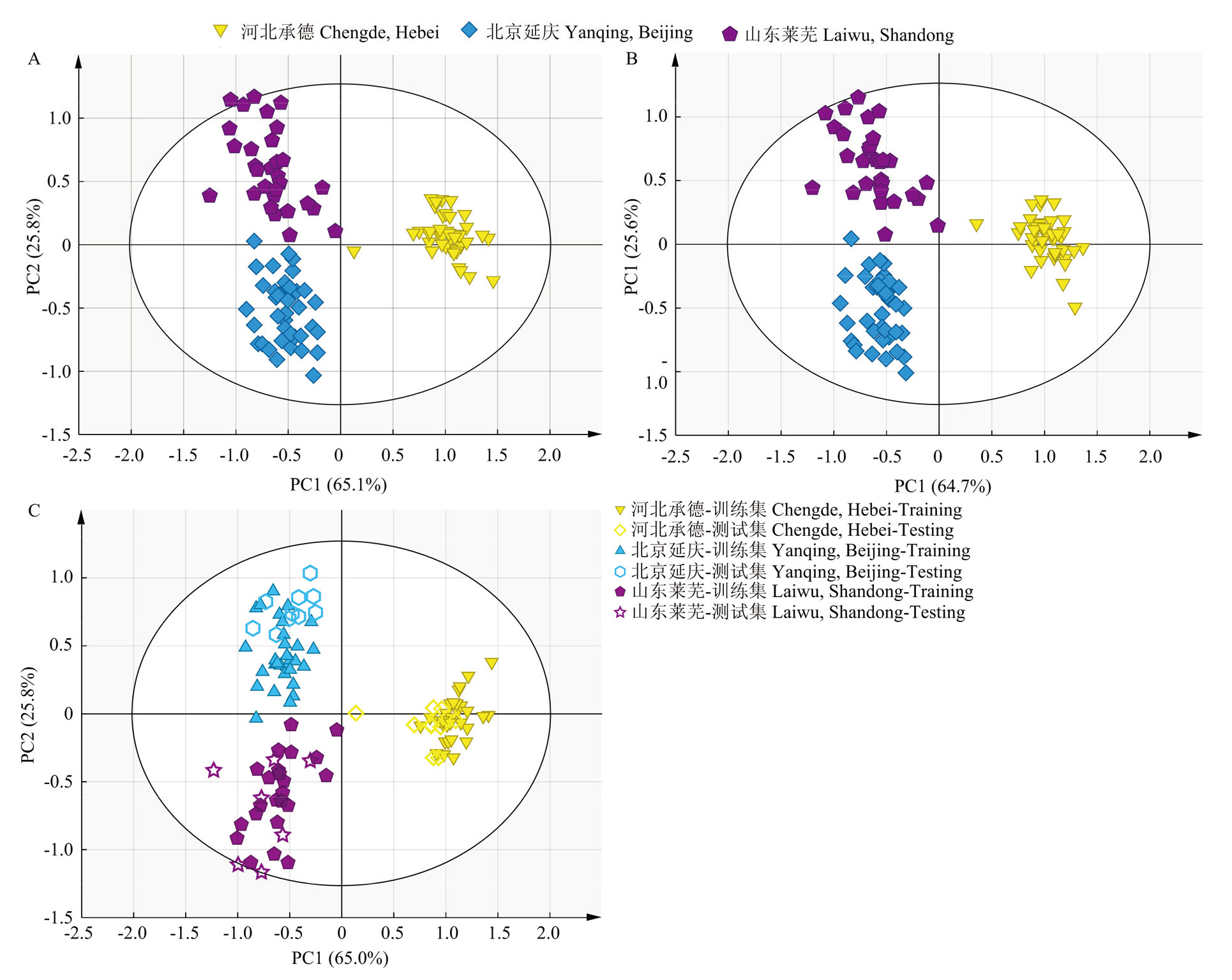
Fig. 1

PCA and OPLS-DA diagrams for pork from different producing areas based on stable isotopes of δ13C, δ15N, δ2H, δ18O A: PCA score diagram; B: OPLS-DA score chart; C: OPLS-DA model with training set and test set"

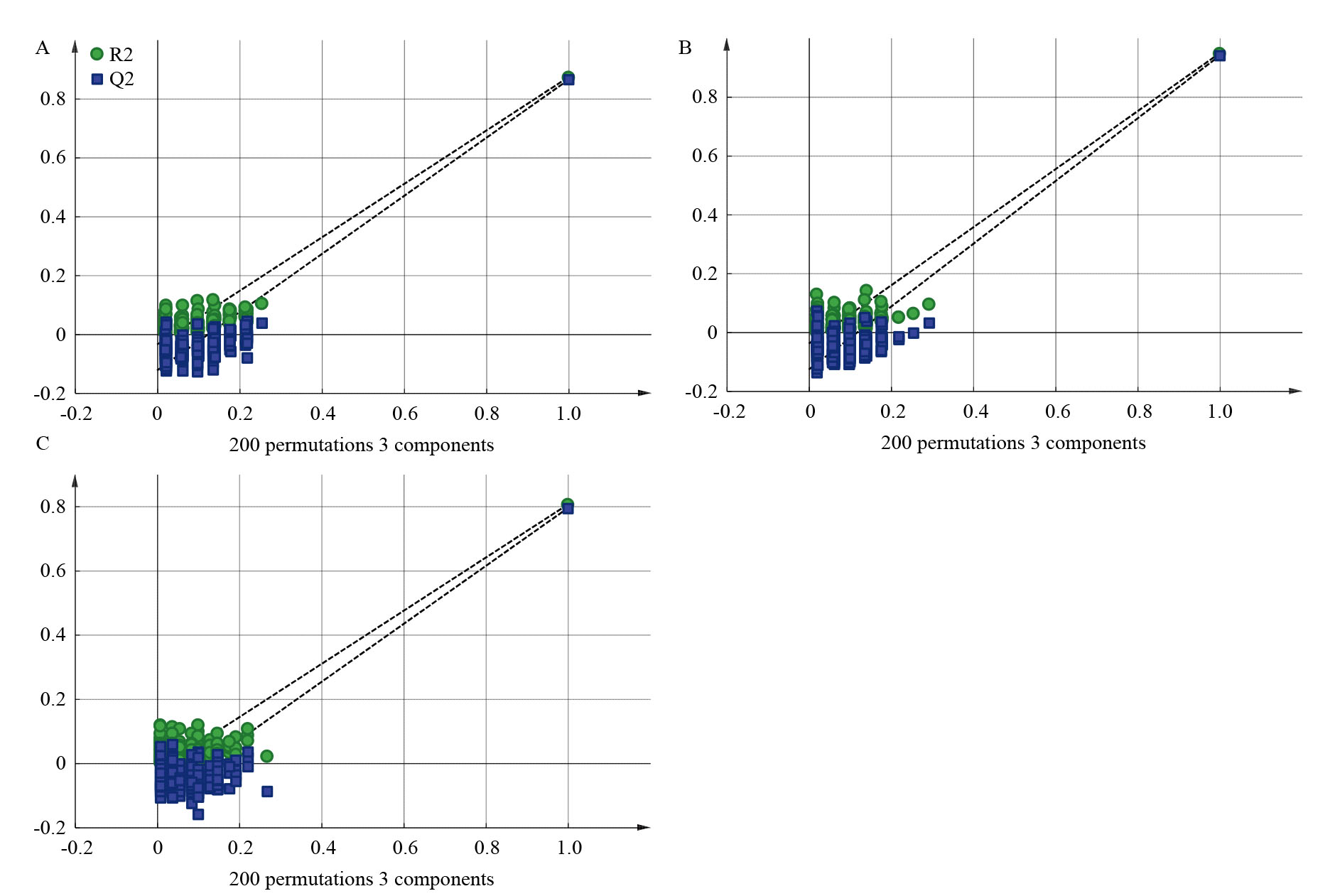
Fig. 2

Verification of the OPLS-DA model for pork from different producing areas based on δ13C, δ15N, δ2H, δ18O"

Table 2

Prediction accuracy of stable isotope OPLS-DA model for pork"

数据集
Data set
产地
Origin
样本量
Sample size
北京延庆
Yanqing, Beijing
河北承德
Chengde, Hebei
山东莱芜
Laiwu, Shandong
准确率
Accuracy rate (%)
训练集
Training set
北京延庆 Yanqing, Beijing 30 30 0 0 100.0
河北承德 Chengde, Hebei 30 0 30 0 100.0
山东莱芜 Laiwu, Shandong 23 0 0 23 100.0
测试集
Testing set
北京延庆 Yanqing, Beijing 10 10 0 0 100.0
河北承德 Chengde, Hebei 10 0 10 0 100.0
山东莱芜 Laiwu, Shandong 7 0 0 7 100.0

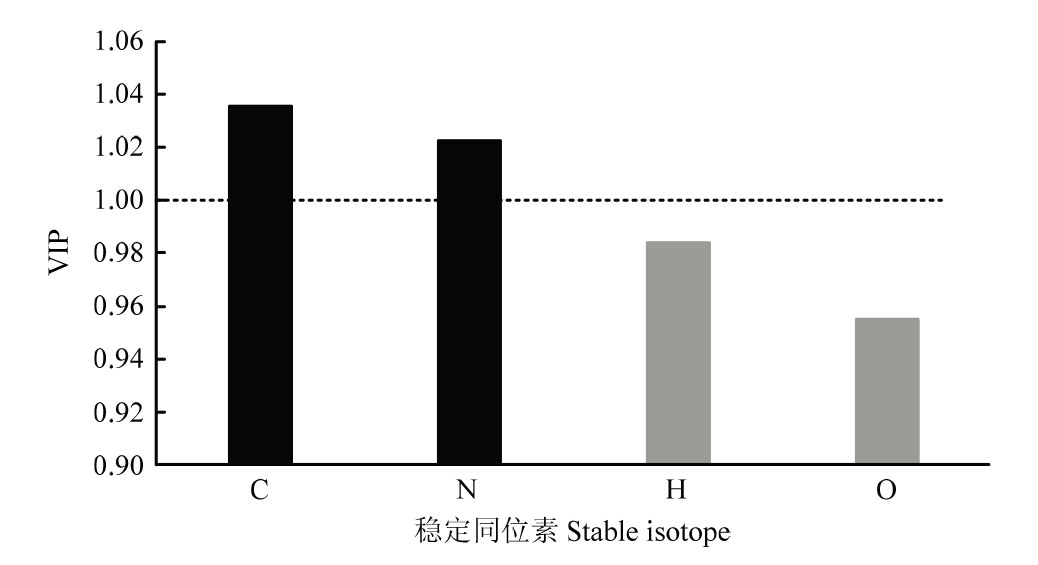
Fig. 3

Distribution of VIP values of stable isotope in OPLS-DA model"

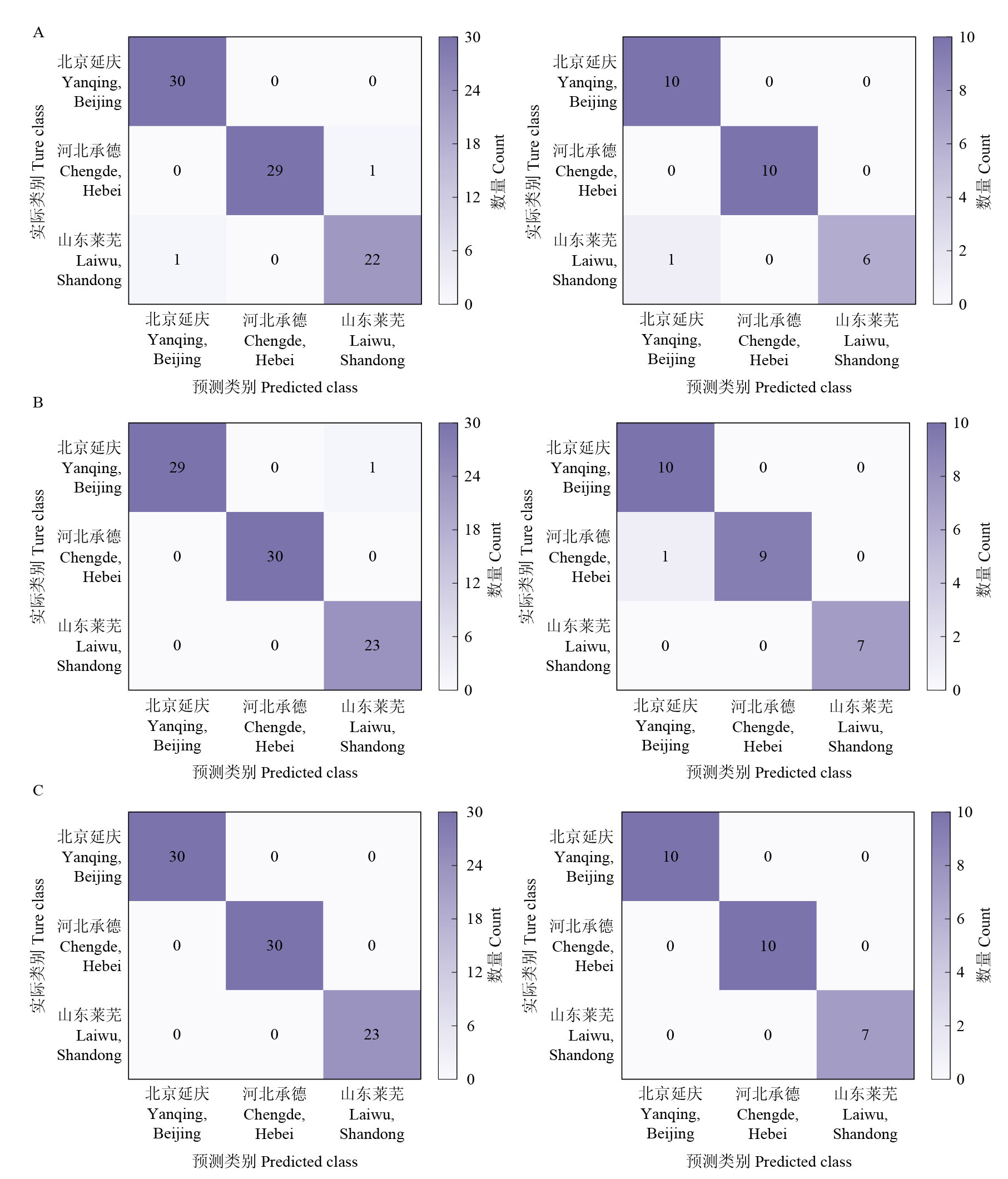
Fig. 4

Confusion matrix for stable isotope classification in pork origin discrimination model based on LDA A: δ13C和δ15N training set (left) and test set (right); B: δ2H和δ18O training set (left) and test set (right); C: δ13C、δ15N、δ2H和δ18O training set (left) and test set (right)"

Table 3

Prediction accuracy of the LDA-based pork origin identification model"

稳定同位素组合
Stable isotope combination
训练集预测正确率
Training set prediction accuracy (%)
测试集预测正确率
Testing set prediction accuracy rate (%)
训练集AUC值
Training set
AUC value
测试集AUC值
Testing set
AUC value
δ13C&δ15N 97.6 96.3 0.995 0.975
δ2H&δ18O 98.8 96.3 0.983 0.992
δ13C&δ15N&δ2H&δ18O 100.0 100.0 1.000 1.000
[1]
KIM J S, HWANG I M, LEE G H, PARK Y M, CHOI J Y, JAMILA N, KHAN N, KIM K S. Geographical origin authentication of pork using multi-element and multivariate data analyses. Meat Science, 2017, 123: 13-20.

doi: S0309-1740(16)30263-7 pmid: 27589244
[2]
HAN D, ZHANG C H, FAUCONNIER M L, MI S. Characterization and differentiation of boiled pork from Tibetan, Sanmenxia and Duroc × (Landrac × Yorkshire) pigs by volatiles profiling and chemometrics analysis. Food Research International, 2020, 130: 108910.

doi: 10.1016/j.foodres.2019.108910
[3]
侯鹏. 我国大宗肉类农产品供给安全影响因素研究——以生猪产业为例[D]. 昆明: 云南财经大学, 2021.
HOU P. Research on the factors influencing the supply safety of mycountry's bulk meat agricultural products—Take the pig industry as an example[D]. Kunming: Yunnan University of Finance and Economics, 2021. (in Chinese)
[4]
汪志铮. 北京黑猪一枝独秀. 当代畜禽养殖业, 2010(8): 28.
WANG Z Z. Beijing black pig outshines others. Modern Animal Husbandry, 2010(8): 28. (in Chinese)
[5]
北京首农食品集团有限公司. 北京黑猪顺利回归助力北京打造“种业之都”. 中国农垦, 2022(8): 21.
Beijing Capital Agribusiness & Foods Group. Beijing Black Pig's smooth return helps Beijing build "Seed Industry Capital". China State Farm, 2022(8): 21. (in Chinese)
[6]
任琳, 张春江, 赵冰, 申思, 刘世永. 北京黑猪的肉质特性研究. 食品科学, 2011, 32(23): 43-46.

doi: 10.7506/spkx1002-6630-201123007
REN L, ZHANG C J, ZHAO B, SHEN S, LIU S Y. Meat quality characteristics of Beijing black pigs. Food Science, 2011, 32(23): 43-46. (in Chinese)

doi: 10.7506/spkx1002-6630-201123007
[7]
王浩, 赵少伟, 张爽, 柴方红, 张树敏, 王大林, 贾立军. 杜仲粉对松辽黑猪与北京黑猪杂交后代黑猪免疫功能的影响. 黑龙江畜牧兽医, 2020(18): 105-108.
WANG H, ZHAO S W, ZHANG S, CHAI F H, ZHANG S M, WANG D L, JIA L J. Effect of Eucommia ulmoides powder on immune function of hybrid offspring of Songliao black pig and Beijing Black pig. Heilongjiang Animal Science and Veterinary Medicine, 2020(18): 105-108. (in Chinese)
[8]
章勇. 为地方猪资源保护与开发寻找突破口. 中国畜牧兽医报, 2024-06-09 (001).
ZHANG Y. Find a breakthrough for the protection and development of local pig resources. China Animal Husbandry and Veterinary News, 2024-06-09 (001). (in Chinese)
[9]
魏益民, 郭波莉, 魏帅, 孙淑敏, 赵海燕. 食品产地溯源及确证技术研究和应用方法探析. 中国农业科学, 2012, 45(24): 5073-5081. doi: 10.3864/j.issn.0578-1752.2012.24.013.
WEI Y M, GUO B L, WEI S, SUN S M, ZHAO H Y. The principle of food geographical origin traceability and authenticity technique. Scientia Agricultura Sinica, 2012, 45(24): 5073-5081. doi: 10.3864/j.issn.0578-1752.2012.24.013. (in Chinese)
[10]
贾翁力, 李秀林, 刘汗青, 武梦琦, 白明懂, 岩瑞. 食品溯源方法分析研究. 食品工业, 2022, 43(10): 186-189.
JIA W L, LI X L, LIU H Q, WU M Q, BAI M D, YAN R. Analysis and research on food traceability method. The Food Industry, 2022, 43(10): 186-189. (in Chinese)
[11]
陈坡, 曹进, 李梦怡, 宁霄, 侯筱宇. 食品产地溯源技术及结合化学计量学应用进展. 食品安全质量检测学报, 2023, 14(22): 116-125.
CHEN P, CAO J, LI M Y, NING X, HOU X Y. Progress in traceability technology of food origin and its application in combination with chemometrics. Journal of Food Safety & Quality, 2023, 14(22): 116-125. (in Chinese)
[12]
姜莎, 范鑫, 张彦斌, 张宏博. 肉类食品产地溯源技术研究进展. 食品安全导刊, 2020(21): 155-157, 159.
JIANG S, FAN X, ZHANG Y B, ZHANG H B. Research progress on traceability technology of meat food origin. China Food Safety Magazine, 2020(21): 155-157, 159. (in Chinese)
[13]
MONAHAN F J, SCHMIDT O, MOLONEY A P. Meat provenance: Authentication of geographical origin and dietary background of meat. Meat Science, 2018, 144: 2-14.

doi: S0309-1740(18)30138-4 pmid: 29859716
[14]
HORACEK M, MIN J S. Discrimination of Korean beef from beef of other origin by stable isotope measurements. Food Chemistry, 2010, 121(2): 517-520.

doi: 10.1016/j.foodchem.2009.12.018
[15]
吕军, 王东华, 杨曙明, 赵燕. 利用稳定同位素进行牛肉产地溯源的研究. 农产品质量与安全, 2015(3): 32-36.
J, WANG D H, YANG S M, ZHAO Y. Study on traceability of beef origin using stable isotopes. Quality and Safety of Agro-Products, 2015(3): 32-36. (in Chinese)
[16]
ZONG W L, ZHAO S S, LI Y L, YANG X T, QIE M J, ZHANG P, ZHAO Y. Trace the origin of yak meat in Xizang based on stable isotope combined with multivariate statistics. Science of the Total Environment, 2024, 926: 171949.

doi: 10.1016/j.scitotenv.2024.171949
[17]
米瑞芳, 陈曦, 戚彪, 熊苏玥, 李家鹏, 乔晓玲, 王尚轩. 不同产地羊肉稳定同位素特征差异及其溯源应用. 核农学报, 2020, 34(S1): 89-95.

doi: 10.11869/j.issn.100-8551.2020.34.0089
MI R F, CHEN X, QI B, XIONG S Y, LI J P, QIAO X L, WANG S X. Difference of stable isotope characteristics of mutton from different producing areas and its traceability application. Journal of Nuclear Agricultural Sciences, 2020, 34(S1): 89-95. (in Chinese)
[18]
赵汝婷. 地理标志产品苏尼特羊肉的产地溯源研究[D]. 北京: 中国农业科学院, 2022.
ZHAO R T. Study on geographical origin of sunite lamb with geographical indication[D]. Beijing: Chinese Academy of Agricultural Sciences, 2022. (in Chinese)
[19]
郄梦洁, 李政, 赵姗姗, 阳晓婷, 赵燕. 稳定同位素技术在甘肃环县不同乡镇肉羊溯源中的应用. 核农学报, 2023, 37(9): 1782-1789.

doi: 10.11869/j.issn.1000-8551.2023.09.1782
QIE M J, LI Z, ZHAO S S, YANG X T, ZHAO Y. Application of stable isotope technique in traceability of mutton sheep in different towns in Huan County, Gansu Province, China. Journal of Nuclear Agricultural Sciences, 2023, 37(9): 1782-1789. (in Chinese)

doi: 10.11869/j.issn.1000-8551.2023.09.1782
[20]
KIM K S, KIM J S, HWANG I M, JEONG I S, KHAN N, LEE S I, JEON D B, SONG Y H, KIM K S. Application of stable isotope ratio analysis for origin authentication of pork. Korean Journal for Food Science of Animal Resources, 2013, 33(1): 39-44.

doi: 10.5851/kosfa.2013.33.1.39
[21]
ZHAO Y, TU T, TANG X Y, ZHAO S S, QIE M J, CHEN A L, YANG S M. Authentication of organic pork and identification of geographical origins of pork in four regions of China by combined analysis of stable isotopes and multi-elements. Meat Science, 2020, 165: 108129.

doi: 10.1016/j.meatsci.2020.108129
[22]
李少辉, 赵巍, 刘松雁, 李朋亮, 张爱霞, 刘敬科. SDE-GC-MS结合OPLS-DA分析不同生态区谷子品种香气特征. 中国农业科学, 2023, 56(13): 2586-2596. doi: 10.3864/j.issn.0578-1752.2023.13.012.
LI S H, ZHAO W, LIU S Y, LI P L, ZHANG A X, LIU J K. Aroma characteristics of foxtail millet varieties from different ecological regions by analysis of SDE-GC-MS combined with OPLS-DA. Scientia Agricultura Sinica, 2023, 56(13): 2586-2596. doi: 10.3864/j.issn.0578-1752.2023.13.012. (in Chinese)
[23]
ZHAO J, LI A, JIN X X, PAN L G. Technologies in individual animal identification and meat products traceability. Biotechnology & Biotechnological Equipment, 2020, 34(1): 48-57.
[24]
XIE L N, ZHAO S S, ROGERS K M, XIA Y N, ZHANG B, SUO R, ZHAO Y. A case of milk traceability in small-scale districts-Inner Mongolia of China by nutritional and geographical parameters. Food Chemistry, 2020, 316: 126332.

doi: 10.1016/j.foodchem.2020.126332
[25]
CAMIN F, BONTEMPO L, PERINI M, PIASENTIER E. Stable isotope ratio analysis for assessing the authenticity of food of animal origin. Comprehensive Reviews in Food Science and Food Safety, 2016, 15(5): 868-877.

doi: 10.1111/crf3.2016.15.issue-5
[26]
互联网综合. 莱芜黑猪饲养管理技术要点. 农村新技术, 2021(9): 34-35.
Internet Synthesis. Technical points of feeding management in laiwu black pig. New Rural Technology, 2021(9): 34-35. (in Chinese)
[27]
NIE J, SHAO S Z, XIA W, LIU Z, YU C C, LI R, WANG W, LI J R, YUAN Y W, ROGERS K M. Stable isotopes verify geographical origin of yak meat from Qinghai-Tibet plateau. Meat Science, 2020, 165: 108113.

doi: 10.1016/j.meatsci.2020.108113
[28]
王倩. 内蒙古羊肉中稳定同位素与矿物质指纹特征研究[D]. 呼和浩特: 内蒙古农业大学, 2021.
WANG Q. Stable Isotope and Mineral Fingerprint Characteristics of Muttonin Inner Mongolia. Chinese Academy of Agricultural Sciences[D]. Huhhot: Inner Mongolia Agricultural University, 2021. (in Chinese)
[29]
ZHAO S S, ZHAO Y, ROGERS K M, CHEN G, CHEN A L, YANG S M. Application of multi-element (C, N, H, O) stable isotope ratio analysis for the traceability of milk samples from China. Food Chemistry, 2020, 310: 125826.

doi: 10.1016/j.foodchem.2019.125826
[30]
HOBSON K A, KOEHLER G. On the use of stable oxygen isotope (δ18O) measurements for tracking avian movements in North America. Ecology and Evolution, 2015, 5(3): 799-806.

doi: 10.1002/ece3.2015.5.issue-3
[31]
HARRISON S M, SCHMIDT O, MOLONEY A P, KELLY S D, ROSSMANN A, SCHELLENBERG A, CAMIN F, PERINI M, HOOGEWERFF J, MONAHAN F J. Tissue turnover in ovine muscles and lipids as recorded by multiple (H, C, O, S) stable isotope ratios. Food Chemistry, 2011, 124(1): 291-297.

doi: 10.1016/j.foodchem.2010.06.035
[32]
SHIN W J, CHOI S H, RYU J S, SONG B Y, SONG J H, PARK S, MIN J S. Discrimination of the geographic origin of pork using multi-isotopes and statistical analysis. Rapid Communications in Mass Spectrometry, 2018, 32(21): 1843-1850.

doi: 10.1002/rcm.v32.21
[33]
BRO R, SMILDE A K. Principal component analysis. Analytical Methods, 2014, 6(9): 2812-2831.

doi: 10.1039/C3AY41907J
[34]
张婷, 黄领梅, 孔晓乐, 裴宏伟, 马全伟, 沈彦军. 冀西北降水同位素特征及其水汽来源分析. 中国生态农业学报(中英文), 2025, 33(4): 759-768.
ZHANG T, HUANG L M, KONG X L, PEI H W, MA Q W, SHEN Y J. Isotopic characteristics of precipitation and its water vapor sources in Northwest Hebei Province. Chinese Journal of Eco-Agriculture, 2025, 33(4): 759-768. (in Chinese)
[35]
ROSSINI K, VERDUN S, CARIOU V, QANNARI E M, FOGLIATTO F S. PLS discriminant analysis applied to conventional sensory profiling data. Food Quality and Preference, 2012, 23(1): 18-24.

doi: 10.1016/j.foodqual.2011.01.005
[36]
ERASMUS S W, MULLER M, VAN DER RIJST M, HOFFMAN L C. Stable isotope ratio analysis: A potential analytical tool for the authentication of South African lamb meat. Food Chemistry, 2016, 192: 997-1005.

doi: 10.1016/j.foodchem.2015.07.121 pmid: 26304440
[1] LUO Qin, CHEN XieYong, XU YuYing, WEI Hang, HUANG Biao, YAO QingHua, YE NaiXing, ZHENG DeYong, YAN MingJuan. Characterization of Non-Volatile Metabolites of White Peony Tea Make of Camellia sinensis Fu’an-dabaicha from Different Origins [J]. Scientia Agricultura Sinica, 2025, 58(22): 4757-4770.
[2] LI JiaYan,SUN LiangJie,MA Nan,WANG Feng,WANG JingKuan. Carbon and Nitrogen Fixation Characteristics of Maize Root and Straw Residues in Brown Soil Under High and Low Fertility [J]. Scientia Agricultura Sinica, 2022, 55(23): 4664-4677.
[3] WANG Qian,LI Zheng,ZHAO ShanShan,QIE MengJie,ZHANG JiuKai,WANG MingLin,GUO Jun,ZHAO Yan. Application of Stable Isotope Technology in the Origin Traceability of Sheep [J]. Scientia Agricultura Sinica, 2021, 54(2): 392-399.
[4] LI Na,SUN ZhanXiang,ZHANG YanQing,LIU EnKe,LI FengMing,LI ChunQian,LI Fei. Contribution of Carbon Sources in Sedimentary Soils Combining Carbon and Nitrogen Isotope with Stable Isotope Model [J]. Scientia Agricultura Sinica, 2021, 54(14): 3057-3064.
[5] FAN FangYuan,TANG GuiZhen,GONG ShuYing,ZONG BangZheng,GUO HaoWei,LI ChunLin. Typical Yellow Tea Taste Characteristic and Its Related Taste-Chemical Compositions [J]. Scientia Agricultura Sinica, 2020, 53(2): 371-382.
[6] JiRong LI,TangWei ZHANG,DeJi CIREN,XiaoJun YANG,Dun CI. Fractionation Effect of Stable Isotopic Ratios in Tsamba Processing [J]. Scientia Agricultura Sinica, 2019, 52(24): 4592-4602.
[7] GUO BoLi, WEI YiMin, WEI Shuai, SUN QianQian, ZHANG Lei, SHI ZhenQiang. The Characters and Influence Factors of Stable Isotope Fingerprints in Yak Muscle [J]. Scientia Agricultura Sinica, 2018, 51(12): 2391-2397.
[8] ZHENG Qian, DING JunJun, LI YuZhong, LIN Wei1, XU ChunYing, LI QiaoZhen, MAO LiLi. The Effects of Soil Water Content on N2O Emissions and Isotopic Signature of Nitrification and Denitrification [J]. Scientia Agricultura Sinica, 2017, 50(24): 4747-4758.
[9] WEI Yi-Min, GUO Bo-Li, WEI Shuai, SUN Shu-Min, ZHAO Hai-Yan. The Principle of Food Geographical Origin Traceability and Authenticity Technique [J]. Scientia Agricultura Sinica, 2012, 45(24): 5073-5081.
[10] LIU Bo, HU Gui-Ping, XIAO Rong-Feng. Identification of the Characteristics for Forma Specials of Fusarium oxysporum Schl. Based on the Analysis of Fatty Acid Biomarkers [J]. Scientia Agricultura Sinica, 2012, 45(24): 4998-5012.
[11] SUN Shu-Min, GUO Bo-Li, WEI Yi-Min, FAN Ming-Tao. Application of Stable Hydrogen Isotope in the Origin Traceability of Lamb Meat [J]. Scientia Agricultura Sinica, 2011, 44(24): 5050-5057.
[12] SUN Shu-min,GUO Bo-li,WEI Yi-min,FAN Ming-tao
. Analysis of Stable Carbon and Nitrogen Isotope Compositions and Geographical Origins of Sheep Tissues #br# [J]. Scientia Agricultura Sinica, 2010, 43(8): 1670-1676 .
Viewed
Full text


Abstract

Cited

  Shared   
  Discussed   
No Suggested Reading articles found!