Scientia Agricultura Sinica ›› 2025, Vol. 58 ›› Issue (2): 326-338.doi: 10.3864/j.issn.0578-1752.2025.02.009

• HORTICULTURE • Previous Articles     Next Articles

Relationship Between the Formation of Non-Red Color in the Fruit Skin of Xinjiang Local Peach Varieties and the Variation of PpMYB10.1 Promoter

GUO TianFa1,2(), WU JinLong2, QIU QianQian3, MA XinChao1, WANG LiRong2(), WU CuiYun1()   

  1. 1 College of Horticulture and Forestry, Tarim University/The National and Local Joint Engineering Laboratory of High Efficiency and Superior-Quality Cultivation and Fruit Deep Processing Technology of Characteristic Fruit Trees in South Xinjiang, Aral 843300, Xinjiang
    2 Zhengzhou Fruit Research Institute, Chinese Academy of Agricultural Sciences, Zhengzhou 450009
    3 Aral National Agricultural Science and Technology Park, Aral 843300, Xinjiang
  • Received:2024-05-16 Accepted:2024-07-01 Online:2025-01-21 Published:2025-01-21
  • Contact: WANG LiRong, WU CuiYun

Abstract:

【Objective】This study aims to explore the molecular mechanisms underlying the formation of Non-red ground color in Xinjiang local peach (Prunus ferganensis and P. persica), providing a theoretical basis for the breeding of new peach varieties with Non-red skin color. 【Method】A phenotypic survey of the skin color of 85 progenies of Xinjiang peach and three cultivated varieties was conducted. The activity of various lengths of the PpMYB10.1 promoter was assessed using β-glucuronidase (GUS) staining. Predictive analysis of the cis-acting elements of the PpMYB10.1 promoter from different materials was performed using the PlantCARE (https://bioinformatics.psb.ugent.be/webtools/plantcare/html/). Genotypes with a 5 243 base pairs (bp) transposon insertion and a 483 bp deletion in the PpMYB10.1 promoter of 88 materials were identified and cloned using polymerase chain reaction (PCR). The transcriptional activation of PpMYB10.1 by Pp.4G186800 was validated through dual-luciferase assays. 【Result】Based on skin color, 85 Xinjiang peach progenies were classified into Non-red and red types. The majority exhibited Non-red colors (green or light yellow) with minimal or no anthocyanin accumulation. Compared to the fully red variety Zhongtao Jinmi, these exhibited significantly lower levels of anthocyanins and reduced expression of PpMYB10.1. Using GUS staining to assess the effects of promoter mutations on activity, the results showed that a 5 243 bp insertion in the PpMYB10.1 promoter caused the fruit discs to display a lighter blue, indicating decreased activity. Conversely, a 483 bp deletion resulted in a darker blue, suggesting increased promoter activity. No such insertions or deletions were found in the PpMYB10.1 promoter of the Xinjiang peach progenies. The promoter sequences of PpMYB10.1 were cloned, and cis-acting elements were categorized into four groups: light-responsive, plant hormone-responsive, abiotic stress and growth development-responsive, and elements of unknown function. Due to the late maturation of the Xinjiang peach progenies, all were found to have a 0 bp/0 bp genotype for the maturity-regulating gene Pp.4G186800. Dual-luciferase assays showed that Pp.4G186800 could bind to the PpMYB10.1 promoter. Notably, when the promoter had a 483 bp deletion, Pp.4G186800 (+9 bp) formed a strong interaction, potentially enhancing early maturation and anthocyanin accumulation in the peach skin. However, in late-ripening peaches, Pp.4G186800 (-9 bp) had no enhancing effect on the promoter’s activity; If the PpMYB10.1 promoter lacked the 483 bp deletion, its intrinsic activity was weak, even though Pp.4G186800 could still interact with it, the effect was minimal.【Conclusion】The presence of insertions and deletions in the PpMYB10.1 promoter is not directly related to the Non-red skin color of Xinjiang peach. In early and mid-ripening varieties, Pp.4G186800 can activate the transcription of PpMYB10.1, facilitating anthocyanin synthesis; however, its influence is reduced or absent in late-ripening peaches.

Key words: Xinjiang, local peach, fruit skin, PpMYB10.1, promoter activity, anthocyanin

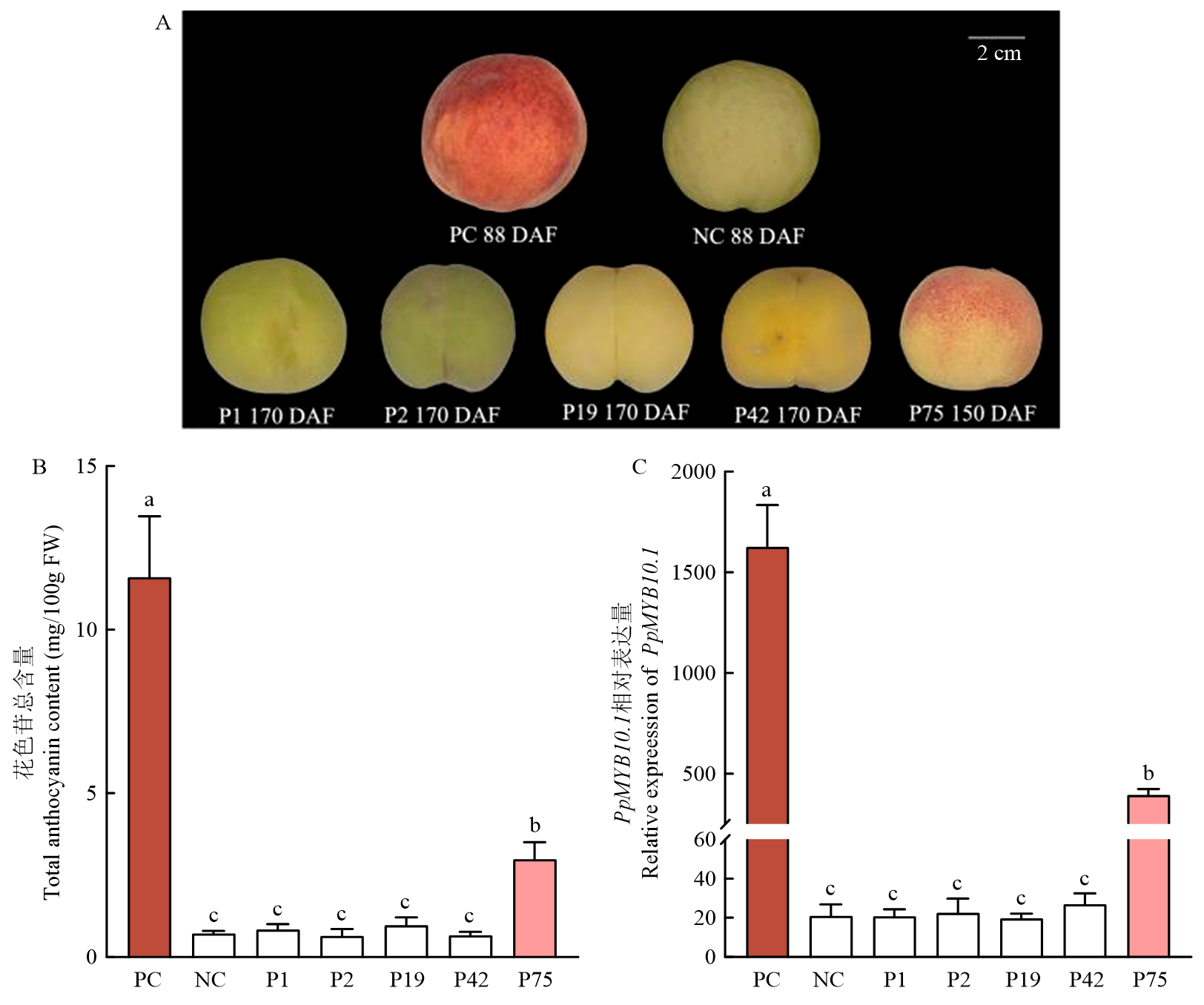
Fig. 1

Difference in anthocyanin accumulation in peach skin with different degrees of red color A: Phenotypes of skin color at maturity of seven peach materials, PC: Zhongtao jinmi, NC: Shiyu baitao, P1, P2, P19, P42, and P75 are Xinjiang peach progeny, Day after full blooming (DAF); B: Determination of anthocyanin content; C: Expression analysis of PpMYB10.1. Different lowercase letters indicate significant of differences at P<0.05. The same as below"

Fig. 2

The effect of mutation on the activity of PpMYB10.1 promoter A: Physical map of transient transformations in peach skin; B: Schematic representation of PpMYB10.1 promoter vectors of different lengths; C: PpMYB10.1 promoter activity effect assay, # represents repetitions"

Fig. 3

Prediction of cis-acting elements of PpMYB10.1 promoter A: Schematic diagram of PpMYB10.1 promoter amplification electrophoresis of different materials; B: Type and number of cis-acting elements; C: Cis-acting element class function and specific location"

Fig. 4

Detection of the transposon insertion and deletion in PpMYB10.1 promoter A: Amplification of PpMYB10.1 promoter with P1-P2_F/R and P2-P3_F/R primers; B: Amplification of PpMYB10.1 promoter with DEL_F/R primers. M:DNA marker; R, W, Y and G represent rind colors of red, white, yellow and green, respectively (PC, NC, PN as control varieties). Red circle for full red rind, red semi-circle for semi-red rind, white circle for non-red rind"

Fig. 5

Detection of Pp.4G186800 activation ability to PpMYB10.1 promoter A: Pp.4G186800 genotype types; B: Schematic diagram of dual luciferase test carrier; C and D: Expression of Pp.4G186800 and Pp.4G187100 in materials at different maturity stages; E: Detection of the ability of Pp.4G186800 (±9 bp) and Pp.4G187100 to activate the PpMYB10.1 promoter (with or without 483 bp deletion), a and b represent schematic diagrams of different infestation sites, respectively; F and G: LUC/REN activity assay. ** indicates a significant difference at P<0.01 and ns indicates a non-significant difference at P<0.01"

[1]
YU Y, FU J, XU Y G, ZHANG J W, REN F, ZHAO H W, TIAN S L, GUO W, TU X L, ZHAO J, JIANG D W, ZHAO J B, WU W Y, WANG G C, MA R C, JIANG Q, WEI J H, XIE H. Genome re-sequencing reveals the evolutionary history of peach fruit edibility. Nature Communications, 2018, 9(1): 5404.

doi: 10.1038/s41467-018-07744-3 pmid: 30573726
[2]
FAUST M, TIMON B. Origin and dissemination of peach. Agricultural and Food Sciences, 2010, 17: 331-339.
[3]
ZHOU H, LIAO L, XU S L, REN F, ZHAO J B, OGUTU C, WANG L, JIANG Q, HAN Y P. Two amino acid changes in the R3 repeat cause functional divergence of two clustered MYB10 genes in peach. Plant Molecular Biology, 2018, 98(1/2): 169-183.
[4]
RAHIM M A, BUSATTO N, TRAINOTTI L. Regulation of anthocyanin biosynthesis in peach fruits. Planta, 2014, 240(5): 913-929.

doi: 10.1007/s00425-014-2078-2 pmid: 24827911
[5]
LI Y, CAO K, LI N, ZHU G R, FANG W C, CHEN C W, WANG X W, GUO J, WANG Q, DING T Y, WANG J, GUAN L P, WANG J X, LIU K Z, GUO W W, ARÚS P, HUANG S W, FEI Z J, WANG L R. Genomic analyses provide insights into peach local adaptation and responses to climate change. Genome Research, 2021, 31(4): 592-606.

doi: 10.1101/gr.261032.120 pmid: 33687945
[6]
LU Z H, CAO H H, PAN L, NIU L, WEI B, CUI G C, WANG L W, YAO J L, ZENG W F, WANG Z Q. Two loss-of-function alleles of the glutathione S-transferase (GST) gene cause anthocyanin deficiency in flower and fruit skin of peach (Prunus persica). The Plant Journal, 2021, 107(5): 1320-1331.
[7]
CAMPA M, MIRANDA S, LICCIARDELLO C, LASHBROOKE J G, DALLA COSTA L, GUAN Q M, SPÖK A, MALNOY M. Application of new breeding techniques in fruit trees. Plant Physiology, 2024, 194(3): 1304-1322.
[8]
BECKMAN T G, ALCAZAR J R, SHERMAN W B, WERNER D J. Evidence for qualitative suppression of red skin color in peach. HortScience, 2005, 40(3): 523-524.
[9]
BECKMAN T G, SHERMAN W B. Probable qualitative inheritance of full red skin color in peach. HortScience, 2003, 38(6): 1184-1185.
[10]
RAVAGLIA D, ESPLEY R V, HENRY-KIRK R A, ANDREOTTI C, ZIOSI V, HELLENS R P, COSTA G, ALLAN A C. Transcriptional regulation of flavonoid biosynthesis in nectarine (Prunus persica) by a set of R2R3 MYB transcription factors. BMC Plant Biology, 2013, 13: 68.

doi: 10.1186/1471-2229-13-68 pmid: 23617716
[11]
INITIATIVE I P G, VERDE I, ABBOTT A G, SCALABRIN S, JUNG S, SHU S Q, MARRONI F, ZHEBENTYAYEVA T, DETTORI M T, GRIMWOOD J, et al. The high-quality draft genome of peach (Prunus persica) identifies unique patterns of genetic diversity, domestication and genome evolution. Nature Genetics, 2013, 45(5): 487-494.

doi: 10.1038/ng.2586 pmid: 23525075
[12]
TUAN P A, BAI S L, YAEGAKI H, TAMURA T, HIHARA S, MORIGUCHI T, ODA K. The crucial role of PpMYB10.1 in anthocyanin accumulation in peach and relationships between its allelic type and skin color phenotype. BMC Plant Biology, 2015, 15(1): 280.
[13]
BRETÓ M P, CANTÍN C M, IGLESIAS I, ARÚS P, EDUARDO I. Mapping a major gene for red skin color suppression (highlighter) in peach. Euphytica, 2016, 213(1): 14.
[14]
ZHAO L, SUN J L, CAI Y M, YANG Q R, ZHANG Y Q, OGUTU C O, LIU J J, ZHAO Y, WANG F R, HE H P, ZHENG B B, HAN Y P. PpHYH is responsible for light-induced anthocyanin accumulation in fruit peel of Prunus persica. Tree Physiology, 2022, 42(8): 1662-1677.
[15]
赵慧芳, 王小敏, 闾连飞, 吴文龙, 李维林. 黑莓果实中花色苷的提取和测定方法研究. 食品工业科技, 2008, 29(5): 176-179.
ZHAO H F, WANG X M, L F, WU W L, LI W L. Study on the extraction and assay method of anthocyanin in blackberry fruits. Science and Technology of Food Industry, 2008, 29(5): 176-179. (in Chinese)
[16]
CHEN C J, CHEN H, ZHANG Y, THOMAS H R, FRANK M H, HE Y H, XIA R. TBtools: An integrative toolkit developed for interactive analyses of big biological data. Molecular Plant, 2020, 13(8): 1194-1202.

doi: S1674-2052(20)30187-8 pmid: 32585190
[17]
LIVAK K J, SCHMITTGEN T D. Analysis of relative gene expression data using real-time quantitative PCR and the 2(-Delta Delta C(T)) method. Methods, 2001, 25(4): 402-408.

doi: 10.1006/meth.2001.1262 pmid: 11846609
[18]
ZHOU H, KUI L W, WANG H L, GU C, DARE A P, ESPLEY R V, HE H P, ALLAN A C, HAN Y P. Molecular genetics of blood-fleshed peach reveals activation of anthocyanin biosynthesis by NAC transcription factors. The Plant Journal, 2015, 82(1): 105-121.

doi: 10.1111/tpj.12792 pmid: 25688923
[19]
GUO J, CAO K, DENG C, LI Y, ZHU G R, FANG W C, CHEN C W, WANG X W, WU J L, GUAN L P, WU S, GUO W W, YAO J L, FEI Z J, WANG L R. An integrated peach genome structural variation map uncovers genes associated with fruit traits. Genome Biology, 2020, 21(1): 258.

doi: 10.1186/s13059-020-02169-y pmid: 33023652
[20]
王蛟, 曹珂, 王玲玲, 王力荣. PpMYB10.1启动子483 bp缺失与红肉桃果肉颜色形成关系的研究. 植物遗传资源学报, 2023, 24(3): 758-766.

doi: 10.13430/j.cnki.jpgr.20220909001
WANG J, CAO K, WANG L L, WANG L R. Deciphering the genetic effect of a 483 bp deletion in the PpMYB10.1 promoter to determine intensities of the red-colored flesh peach. Journal of Plant Genetic Resources, 2023, 24(3): 758-766. (in Chinese)

doi: 10.13430/j.cnki.jpgr.20220909001
[21]
FALCHI R, VENDRAMIN E, ZANON L, SCALABRIN S, CIPRIANI G, VERDE I, VIZZOTTO G, MORGANTE M. Three distinct mutational mechanisms acting on a single gene underpin the origin of yellow flesh in peach. The Plant Journal, 2013, 76(2): 175-187.

doi: 10.1111/tpj.12283 pmid: 23855972
[22]
WANG J, CAO K, LI Y, WU J L, LI W Q, WANG Q, ZHU G R, FANG W C, CHEN C W, WANG X W, DONG W X, LIU W S, WANG L R. Genome variation and LTR-RT analyses of an ancient peach landrace reveal mechanism of blood-flesh fruit color formation and fruit maturity date advancement. Horticulture Research, 2023, 11(1): uhad265.
[23]
ZHOU P, LEI S R, ZHANG X D, WANG Y H, GUO R, YAN S B, JIN G, ZHANG X T. Genome sequencing revealed the red-flower trait candidate gene of a peach landrace. Horticulture Research, 2023, 10(11): uhad210.
[24]
CHENG J, LIAO L, ZHOU H, GU C, WANG L, HAN Y P. A small indel mutation in an anthocyanin transporter causes variegated colouration of peach flowers. Journal of Experimental Botany, 2015, 66(22): 7227-7239.

doi: 10.1093/jxb/erv419 pmid: 26357885
[25]
ZHAO Y L, LI Y, CAO K, YAO J L, BIE H L, KHAN I A, FANG W C, CHEN C W, WANG X W, WU J L, GUO W W, WANG L R. MADS-box protein PpDAM6 regulates chilling requirement-mediated dormancy and bud break in peach. Plant Physiology, 2023, 193(1): 448-465.
[26]
LIAN X D, ZHANG H P, JIANG C, GAO F, YAN L, ZHENG X B, CHENG J, WANG W, WANG X B, YE X, LI J D, ZHANG L L, LI Z Q, TAN B, FENG J C. De novo chromosome-level genome of a semi-dwarf cultivar of Prunus persica identifies the aquaporin PpTIP2 as responsible for temperature-sensitive semi-dwarf trait and PpB3-1 for flower type and size. Plant Biotechnology Journal, 2022, 20(5): 886-902.
[27]
KIM H J, KIM Y K, PARK J Y, KIM J. Light signalling mediated by phytochrome plays an important role in cold-induced gene expression through the C-repeat/dehydration responsive element (C/DRE) in Arabidopsis thaliana. The Plant Journal, 2002, 29(6): 693-704.
[28]
FUKAMATSU Y, TAMURA T, HIHARA S, ODA K. Mutations in the CCD4 carotenoid cleavage dioxygenase gene of yellow-flesh peaches. Bioscience, Biotechnology, and Biochemistry, 2013, 77(12): 2514-2516.
[29]
范家琪, 吴金龙, 李勇, 别航灵, 王蛟, 郭健, 曹珂, 王力荣. 桃类胡萝卜素合成关键基因PpCCD4的表达与启动子活性分析. 果树学报, 2020, 37(9): 1271-1280.
FAN J Q, WU J L, LI Y, BIE H L, WANG J, GUO J, CAO K, WANG L R. Expression and promoter activity analysis of PpCCD4 closely related to carotenoid synthesis in peach. Journal of Fruit Science, 2020, 37(9): 1271-1280. (in Chinese)
[30]
HUANG D, YUAN Y, TANG Z Z, HUANG Y, KANG C Y, DENG X X, XU Q. Retrotransposon promoter of Ruby1 controls both light- and cold-induced accumulation of anthocyanins in blood orange. Plant, Cell & Environment, 2019, 42(11): 3092-3104.
[31]
程莉, 杨胜男, 朱延松, 王旭, 赵婉彤, 李仁静, 李沛, 苑忠杰, 江东. 柚果肉颜色遗传变异分析及候选基因挖掘. 中国农业科学, 2023, 56(17): 3420-3434. doi: 10.3864/j.issn.0578-1752.2023.17.015.
CHENG L, YANG S N, ZHU Y S, WANG X, ZHAO W T, LI R J, LI P, YUAN Z J, JIANG D. Genetic variation analysis and candidate genes mining of regulating flesh color in pomelo. Scientia Agricultura Sinica, 2023, 56(17): 3420-3434. doi: 10.3864/j.issn.0578-1752.2023.17.015. (in Chinese)
[32]
LU P J, WANG S S, GRIERSON D, XU C J. Transcriptomic changes triggered by carotenoid biosynthesis inhibitors and role of Citrus sinensis phosphate transporter 4;2 (CsPHT4;2) in enhancing carotenoid accumulation. Planta, 2019, 249(1): 257-270.
[33]
WANG S, LI L X, FANG Y, LI D, MAO Z L, ZHU Z H, CHEN X S, FENG S Q. MdERF1B-MdMYC2 module integrates ethylene and jasmonic acid to regulate the biosynthesis of anthocyanin in apple. Horticulture Research, 2022, 9: uhac142.
[34]
WANG S, LI L X, ZHANG Z, FANG Y, LI D, CHEN X S, FENG S Q. Ethylene precisely regulates anthocyanin synthesis in apple via a module comprising MdEIL1, MdMYB1, and MdMYB17. Horticulture Research, 2022, 9: uhac034.
[35]
NI J B, WANG S M, YU W J, LIAO Y F, PAN C, ZHANG M M, TAO R Y, WEI J, GAO Y H, WANG D S, BAI S L, TENG Y W. The ethylene-responsive transcription factor PpERF9 represses PpRAP2.4 and PpMYB114 via histone deacetylation to inhibit anthocyanin biosynthesis in pear. The Plant Cell, 2023, 35(6): 2271-2292.

doi: 10.1093/plcell/koad077 pmid: 36916511
[36]
NI J B, PREMATHILAKE A T, GAO Y H, YU W J, TAO R Y, TENG Y W, BAI S L. Ethylene-activated PpERF105 induces the expression of the repressor-type R2R3-MYB gene PpMYB140 to inhibit anthocyanin biosynthesis in red pear fruit. The Plant Journal, 2021, 105(1): 167-181.

doi: 10.1111/tpj.15049 pmid: 33111423
[37]
NI J B, ZHAO Y, TAO R Y, YIN L, GAO L, STRID Å, QIAN M J, LI J C, LI Y J, SHEN J Q, TENG Y W, BAI S L. Ethylene mediates the branching of the jasmonate-induced flavonoid biosynthesis pathway by suppressing anthocyanin biosynthesis in red Chinese pear fruits. Plant Biotechnology Journal, 2020, 18(5): 1223-1240.

doi: 10.1111/pbi.13287 pmid: 31675761
[38]
PIRONA R, EDUARDO I, PACHECO I, DA SILVA LINGE C, MICULAN M, VERDE I, TARTARINI S, DONDINI L, PEA G, BASSI D, ROSSINI L. Fine mapping and identification of a candidate gene for a major locus controlling maturity date in peach. BMC Plant Biology, 2013, 13: 166.

doi: 10.1186/1471-2229-13-166 pmid: 24148786
[39]
CAO K, PAN H F, ZHAO Y L, BIE H L, WANG J, ZHU G R, FANG W C, CHEN C W, WANG X W, LI Y, WU J L, KHAN I A, ZHANG J Y, WANG L R. Discovery of a key gene associated with fruit maturity date and analysis of its regulatory pathway in peach. Plant Science, 2023, 333: 111735.
[40]
ZHANG L, XU Y, LI Y T, ZHENG S S, ZHAO Z M, CHEN M L, YANG H J, YI H L, WU J X. Transcription factor CsMYB77 negatively regulates fruit ripening and fruit size in citrus. Plant Physiology, 2024, 194(2): 867-883.
[41]
QIAN M J, SUN Y W, ALLAN A C, TENG Y W, ZHANG D. The red sport of 'Zaosu' pear and its red-striped pigmentation pattern are associated with demethylation of the PyMYB10 promoter. Phytochemistry, 2014, 107: 16-23.

doi: 10.1016/j.phytochem.2014.08.001 pmid: 25168359
[42]
JIANG S H, WANG N, CHEN M, ZHANG R, SUN Q G, XU H F, ZHANG Z Y, WANG Y C, SUI X Q, WANG S F, FANG H C, ZUO W F, SU M Y, ZHANG J, FEI Z J, CHEN X S. Methylation of MdMYB1 locus mediated by RdDM pathway regulates anthocyanin biosynthesis in apple. Plant Biotechnology Journal, 2020, 18(8): 1736-1748.

doi: 10.1111/pbi.13337 pmid: 31930634
[43]
XIA H, SHEN Y Q, HU R P, WANG J, DENG H H, LIN L J, LV X L, DENG Q X, XU K F, LIANG D. Methylation of MYBA1 is associated with the coloration in "Manicure Finger" grape skin. Journal of Agricultural and Food Chemistry, 2021, 69(51): 15649-15659.
[1] JIAO WenJuan, HE WanLong, GENG HongWei, BAI Bin, LI JianFeng, CHENG YuKun. Stripe Rust Resistance Evaluation and Molecular Characterization of Yr Genes for 155 Spring Wheat Varieties (Lines) [J]. Scientia Agricultura Sinica, 2026, 59(5): 937-950.
[2] TANG Yu, LEI BiXin, WANG ChuanWei, YAN XuanTao, WANG Hao, ZHENG Jie, ZHANG WenJing, MA ShangYu, HUANG ZhengLai, FAN YongHui. Response Mechanism of Anthocyanin Accumulation in Colored Wheat to Post-Anthesis High Temperature Stress [J]. Scientia Agricultura Sinica, 2025, 58(6): 1083-1101.
[3] TIAN LiWen, LOU ShanWei, ZHANG PengZhong, DU MingWei, LUO HongHai, LI Jie, PAHATI MaiMaiTi, MA TengFei, ZHANG LiZhen. Analysis of Problems and Pathways for Increasing Cotton Yield per Unit Area in Xinjiang Under Green and Efficient Production Mode [J]. Scientia Agricultura Sinica, 2025, 58(6): 1102-1115.
[4] XIAO ChangChun, WEI XinYu, ZENG YueHui, HUANG JianHong, XU XuMing. Accumulation Characteristics of Anthocyanins in Black Rice Under Different Sowing Dates and Its Relationship with Meteorological Factors [J]. Scientia Agricultura Sinica, 2025, 58(5): 890-906.
[5] GUO AoLin, LIN JunXuan, LAI GongTi, HE LiYuan, CHE JianMei, PAN Ruo, YANG FangXue, HUANG YuJi, CHEN GuiXin, LAI ChengChun. Effect of VdF3′5′H2 Overexpression on the Accumulation of Anthocyanin Composition in Spine Grape Cells [J]. Scientia Agricultura Sinica, 2025, 58(4): 802-818.
[6] WEI ChenXi, DONG ShanRong, WANG XiaoMan, LUO JianRang. Analysis of Red Color Leaf Traits in Tree Peony Based on Leaf Color Phenotypes and Anthocyanin Accumulation Characteristics [J]. Scientia Agricultura Sinica, 2025, 58(23): 5046-5056.
[7] WANG Long, WANG Jun, JIANG Jing, LIU Hao, LIU DeZhao, LI JiuSheng. Effects of Nitrogen and Potassium Application Rate on Soil Salinity, Yield and Quality of Korla Fragrant Pear Under Drip Irrigation in Southern Xinjiang [J]. Scientia Agricultura Sinica, 2025, 58(17): 3473-3487.
[8] WANG HuiLing, ZHANG YingYing, YAN AiLing, WANG XiaoYue, LIU ZhenHua, REN JianCheng, XU HaiYing, SUN Lei. Multi-Omics Analysis Reveals the Changes of Monoterpenes and Anthocyanins Accumulation During Veraison in Red Muscat-Type Grape [J]. Scientia Agricultura Sinica, 2025, 58(13): 2645-2662.
[9] HE Jing, WANG ZhenHua, LIU Jian, MA ZhanLi, WEN Yue. Effects of Irrigation Water Temperature and Nitrogen Application Rate on Soil Hydrothermal Environment and Cotton Growth and Yield Under Mulched Drip Irrigation [J]. Scientia Agricultura Sinica, 2024, 57(2): 319-335.
[10] YIN YuQin, XU HuanHuan, TANG LiPing, WANG XinYa, HU ChunMei, HOU XiLin, LI Ying. Genome-Wide Identification of GST Gene Family and Functional Analysis of the BcGSTF6 Gene Related to Anthocyanin in Pak Choi [J]. Scientia Agricultura Sinica, 2024, 57(16): 3234-3249.
[11] GUO RongKun, DONG NingGuang, NONG HuiLan, WANG Han, TENG WeiChao, MENG JiaXin. Targeted Metabolomics-Based Analysis of Peel Color Differences Between Yellow and Red Hawthorn [J]. Scientia Agricultura Sinica, 2024, 57(12): 2439-2453.
[12] LIU MengJie, LIANG Fei, LI QuanSheng, TIAN YuXin, WANG GuoDong, JIA HongTao. Effects of Drip Irrigation Under Film and Trickle Furrow Irrigation on Maize Growth and Yield [J]. Scientia Agricultura Sinica, 2023, 56(8): 1515-1530.
[13] WANG YueNing, DAI HongJun, HE Yan, WEI Qiang, GUO XueLiang, LIU Yan, YIN MengTing, WANG ZhenPing. Regulation Mechanism of Brassinolide on Anthocyanins Synthesis and Fruit Quality in Wine Grapes Under High Temperature Stress Based on Transcriptome Analysis [J]. Scientia Agricultura Sinica, 2023, 56(6): 1139-1153.
[14] CHEN JinRong, LÜ ZiJian, FAN LiSha, YOU Qian, LI Tao, GONG Chao, SUN GuangWen, LI ZhiLiang, SUN BaoJuan. Analysis of Genetic Effect of Fruit Color Controlled by Epistatic Genes in Eggplant [J]. Scientia Agricultura Sinica, 2023, 56(23): 4729-4741.
[15] CAO Jie, GU YongZhe, HONG HuiLong, WU HaiTao, ZHANG Xia, SUN JianQiang, BAO LiGao, QIU LiJuan. Pigment Identification and Gene Mapping in Red Seed Coat of Soybean [J]. Scientia Agricultura Sinica, 2023, 56(14): 2643-2659.
Viewed
Full text


Abstract

Cited

  Shared   
  Discussed   
No Suggested Reading articles found!