Scientia Agricultura Sinica ›› 2024, Vol. 57 ›› Issue (8): 1417-1429.doi: 10.3864/j.issn.0578-1752.2024.08.001

• CROP GENETICS & BREEDING·GERMPLASM RESOURCES·MOLECULAR GENETICS • Previous Articles     Next Articles

Genetic Analysis and Candidate Gene Identification on Fertility and Inheritance of Hybrid Sterility of XI and GJ Cross

XU Na(), TANG Ying, XU ZhengJin, SUN Jian(), XU Quan()   

  1. Rice Research Institute, Shenyang Agricultural University, Shenyang 110866
  • Received:2023-10-23 Accepted:2023-11-29 Online:2024-04-16 Published:2024-04-24
  • Contact: SUN Jian, XU Quan

Abstract:

【Objective】The F1 hybrid sterility between XI/indica and GJ/japonica severely hinders the utilization of hybrid advantage between subspecies. Exploring the genetic mechanism and identifying new regulatory genes for XI/GJ hybrid sterility will provide theoretical basis for promoting genetic improvement of XI/GJ hybrid seed setting rate. 【Method】A series of stable genetic recombination inbred lines (RILs) containing 95 plant lines were derived from the cross between XI variety Habataki and GJ variety Sasanishiki after 10 generations inbred using single seed descent method. High throughput sequencing was performed on both parents and RILs on the Illumina platform, and the distribution of Habataki pedigree in RILs was analyzed at the whole genome level. The segregation distortion regions were identified, and hybrid sterile related gene loci were screened within the segregation distortion regions, then identified candidate genes through sequence alignment comparison. The targeted gene was knockout to verify the function using CRISPR gene editing technology. 【Result】The hybrid F1 plants derived from the cross between Habataki and Sasanishiki showed significant heterosis in panicles, grains per panicle, and thousand grain weight, but its seed setting rate significantly decreased. I2-KI microscopy revealed a significant decrease in F1 pollen fertility. High throughput sequencing of the entire genome of RILs revealed significant segregation distortion on Chr.1, Chr.3, Chr.5, Chr.6, Chr.7, and Chr.12, indicating that the genotype in this region tends towards the Habataki. Sequence alignment comparison revealed that Sc, S5, and HSA1 are target genes for the segregation distortion on Chr.3, Chr.6, and Chr.12. The CRISPR gene editing mutants with a knock-out Sc-Haba-3 allele in Habataki successfully improved the pollen fertility and seed setting rate of F1 hybrid with Sasanishiki. A complex structural variation was found between Sasanishiki and Habataki in the segregation distortion of Chr.1. A 24.7 kb segment containing 4 predicted genes in the Sasanishiki genome was replaced by a 64.8 kb segment containing 10 predicted genes in Habataki, the structural variation may involve in controlling the hybrid sterility of XI and GJ cross. 【Conclusion】This study detected multiple XI/GJ hybrid infertility related loci, and successfully improved F1 fertility by using CRISPR gene editing to knock out multiple copies of Sc in Habataki, locking in the target gene in the Sd region of Chr.1.

Key words: rice, hybrid sterility, high throughput sequencing, gene editing, Sd candidate genes

Fig. 1

The heterosis of the cross between Sasa and Haba A: Plant architecture; B: Panicle architecture; C: Plant height; D: Panicle number; E: Grain number per panicle; F: 1000 grain weight; G: Setting rate. Different letters indicate significant differences (P<0.05). The same as below"

Fig. 2

The fertile pollen of Sasa, Haba and F1 plants A: Pollen phenotypes of Sasa; B: Pollen phenotypes of Haba; C: Pollen phenotypes of F1 (Sasa/Haba); D: The fertile pollen rate of Sasa, F1, and Haba"

Fig. 3

The genetic analysis of the hybrid sterility between Sasa and Haba A: The genetic map of RILs; B: The Haba pedigree introgression ratio of RILs; C: The loci corresponding to the XI/GJ hybrid sterile"

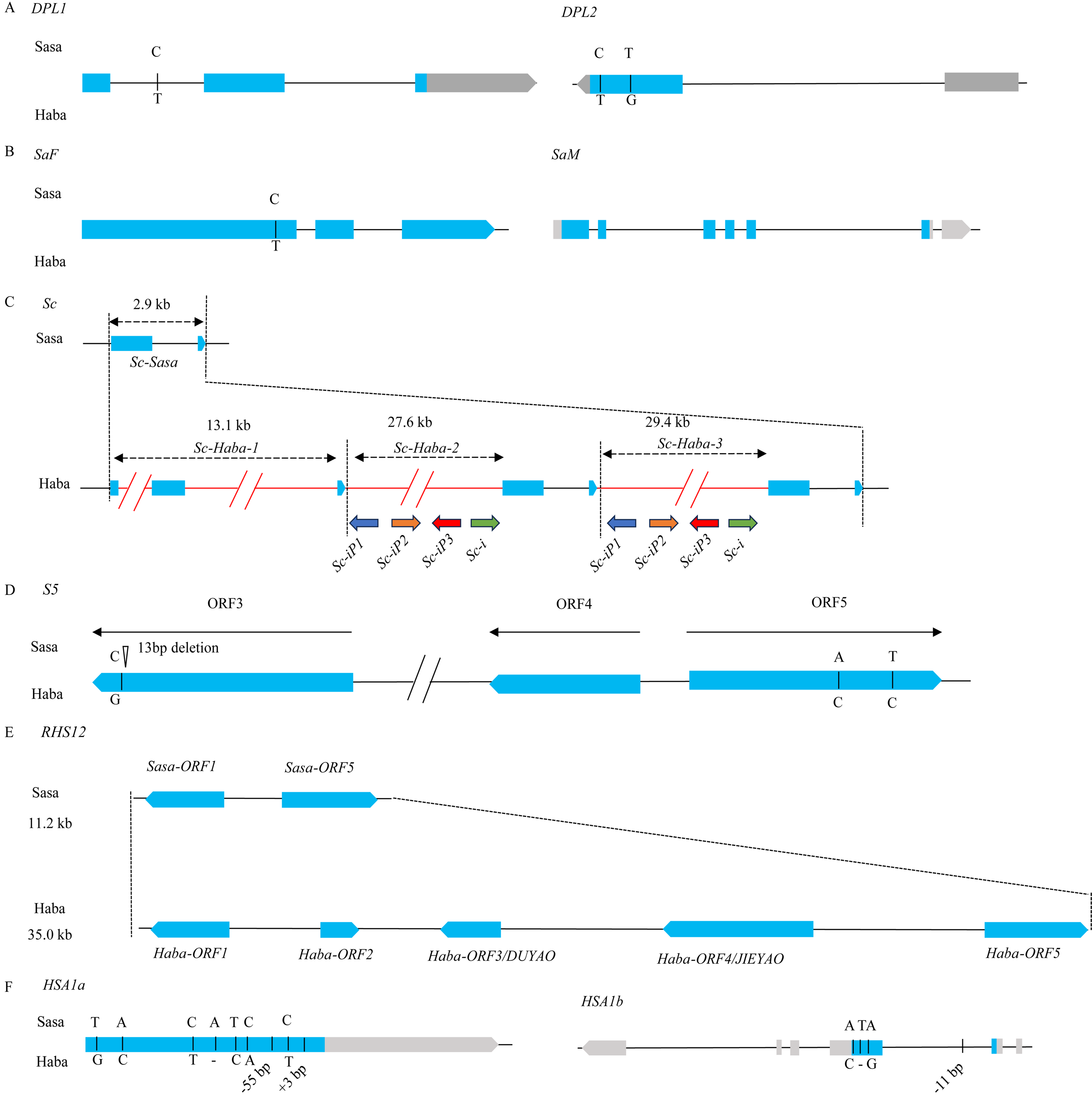
Fig. 4

The sequence differences of XI/GJ hybrid sterile related locus between Sasa and Haba A: The sequence differences of DPL1 and DPL2 between Sasa and Haba; B: The sequence differences of SaF and SaM between Sasa and Haba; C: The structure variation of Sc between Sasa and Haba; D: The sequence differences of S5 between Sasa and Haba; E: The structure variation of RHS12 between Sasa and Haba; F: The sequence differences of HSA1a and HSA1b between Sasa and Haba"

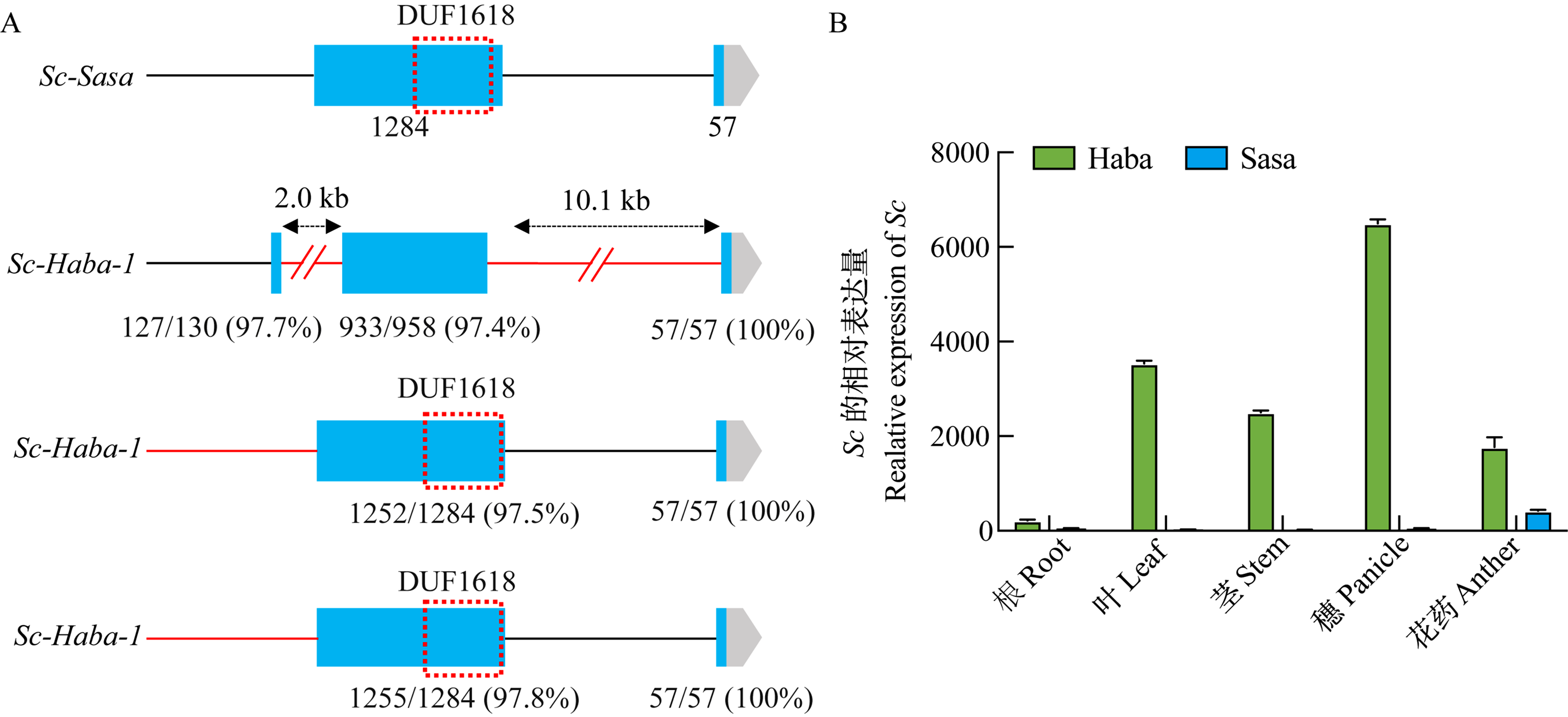
Fig. 5

The sequence difference and expression pattern of Sc locus between Sasa and Haba A: The multiple copies of Sc in Haba; B: The expression pattern of Sc in Sasa and Haba"

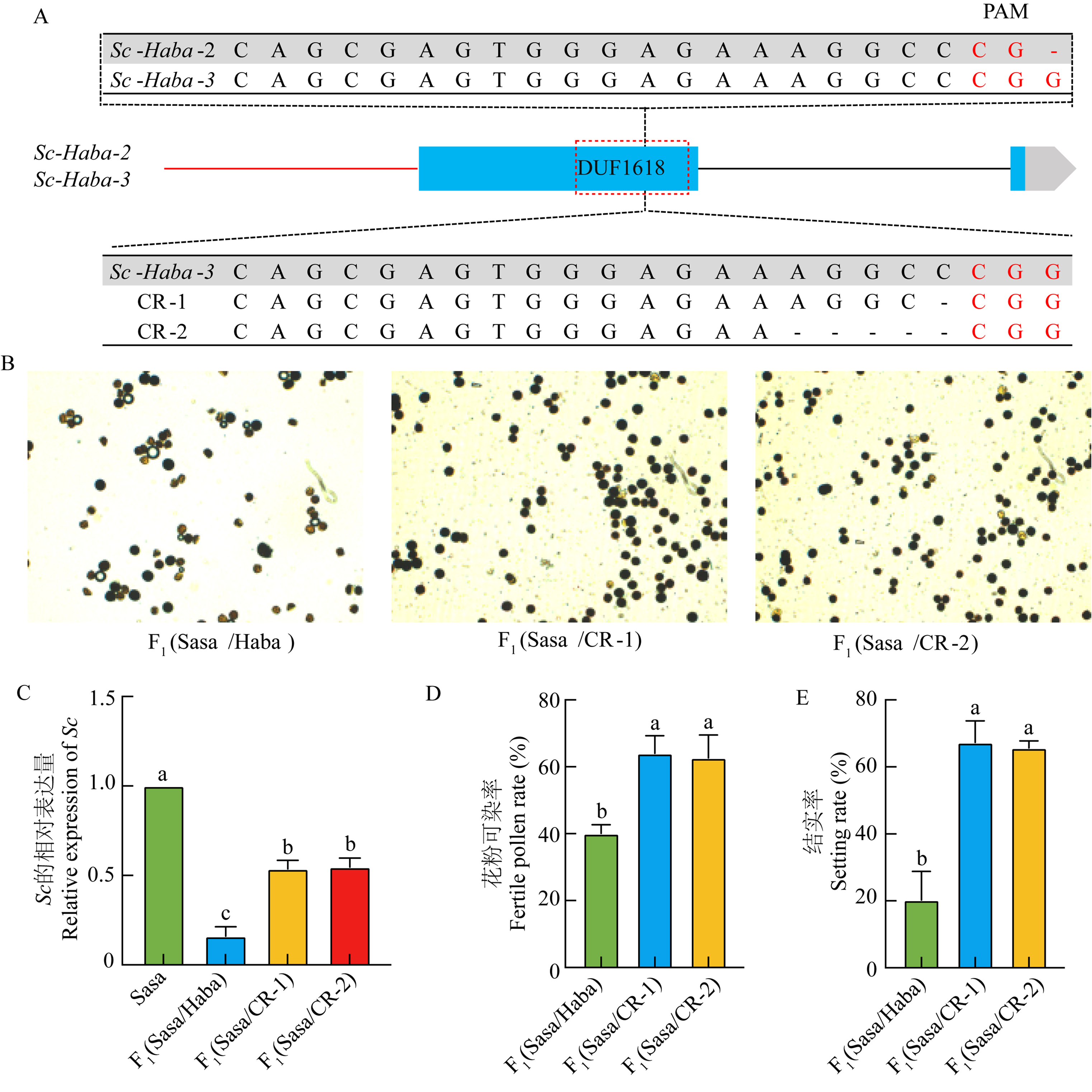
Fig. 6

The sequence and phenotypes of Sc-haba-3 CRISPR gene edited plants in Haba A: Editing site specific to Sc-Haba-3, and the sequence of CRISPR edited plants; B; Pollen phenotypes of F1(Sasa/Haba), F1(Sasa/CR-1), and F1(Sasa/CR-2); C: The relative expression level of Sc-Sasa in Sasa, F1(Sasa/Haba), F1(Sasa/CR-1), and F1(Sasa/CR-2); D: The fertile pollen rate of F1(Sasa/Haba), F1(Sasa/CR-1), and F1(Sasa/CR-2); E: The setting rate of F1(Sasa/Haba), F1(Sasa/CR-1), and F1(Sasa/CR-2)"

Fig. 7

The candidate gene of Sasa and Haba hybrid sterility locus Sd A: Chr1's 100 kb window and 10 kb sliding population differentiation Fst region; The pink region represents the upstream and downstream 1 Mb genomic region radiated by the Fst differentiation signal peak at a 3.8 Mb physical location B: The Haba pedigree introgression in Chr.1 of RILs; C: The structure variation of candidate region of Sd between Sasa and Haba"

[1]
GARRIS A J, TAI T H, COBURN J, KRESOVICH S, McCOUCH S. Genetic structure and diversity in Oryza sativa L.. Genetics, 2005, 169(3): 1631-1638.

doi: 10.1534/genetics.104.035642
[2]
HUANG X H, WEI X H, SANG T, ZHAO Q, FENG Q, ZHAO Y, LI C Y, ZHU C R, LU T T, ZHANG Z W, LI M, FAN D L, GUO Y L, WANG A H, WANG L, DENG L W, LI W J, LU Y Q, WENG Q J, LIU K Y, HUANG T, ZHOU T Y, JING Y F, LI W, LIN Z, BUCKLER E S, QIAN Q, ZHANG Q F, LI J Y, HAN B. Genome-wide association studies of 14 agronomic traits in rice landraces. Nature Genetics, 2010, 42(11): 961-967.

doi: 10.1038/ng.695 pmid: 20972439
[3]
HUANG X H, ZHAO Y, WEI X H, LI C Y, WANG A H, ZHAO Q, LI W J, GUO Y L, DENG L W, ZHU C R, FAN D L, LU Y Q, WENG Q J, LIU K Y, ZHOU T Y, JING Y F, SI L Z, DONG G J, HUANG T, LU T T, FENG Q, QIAN Q, LI J Y, HAN B. Genome-wide association study of flowering time and grain yield traits in a worldwide collection of rice germplasm. Nature Genetics, 2012, 44(1): 32-39.

doi: 10.1038/ng.1018
[4]
YU H, LIN T, MENG X B, DU H L, ZHANG J K, LIU G F, CHEN M J, JING Y H, KOU L Q, LI X X, GAO Q, LIANG Y, LIU X D, FAN Z L, LIANG Y T, CHENG Z K, CHEN M S, TIAN Z X, WANG Y H, CHU C C, ZUO J R, WAN J M, QIAN Q, HAN B, ZUCCOLO A, WING R A, GAO C X, LIANG C Z, LI J Y. A route to de novo domestication of wild allotetraploid rice. Cell, 2021, 184(5): 1156-1170.

doi: 10.1016/j.cell.2021.01.013 pmid: 33539781
[5]
WANG W S, MAULEON R, HU Z Q, CHEBOTAROV D, TAI S S, WU Z C, LI M, ZHENG T Q, FUENTES R R, ZHANG F, MANSUETO L, COPETTI D, SANCIANGCO M, PALIS K C, XU J L, SUN C, FU B Y, ZHANG H L, GAO Y M, ZHAO X Q, SHEN F, CUI X, YU H, LI Z C, CHEN M L, DETRAS J, ZHOU Y L, ZHANG X Y, ZHAO Y, KUDRNA D, WANG C C, LI R, JIA B, LU J Y, HE X C, DONG Z T, XU J B, LI Y H, WANG M, SHI J X, LI J, ZHANG D B, LEE S, HU W S, POLIAKOV A, DUBCHAK I, ULAT V J, BORJA F N, MENDOZA J R, ALI J, LI J, GAO Q, NIU Y C, YUE Z, NAREDO M E B, TALAG J, WANG X Q, LI J J, FANG X D, YIN Y, GLASZMANN J C, ZHANG J W, LI J Y, HAMILTON R S, WING R A, RUAN J, ZHANG G Y, WEI C C, ALEXANDROV N, MCNALLY K L, LI Z K, LEUNG H. Genomic variation in 3,010 diverse accessions of Asian cultivated rice. Nature, 2018, 557(7703): 43-49.

doi: 10.1038/s41586-018-0063-9
[6]
WEI X, QIU J, YONG K C, FAN J J, ZHANG Q, HUA H, LIU J, WANG Q, OLSEN K M, HAN B, HUANG X H. A quantitative genomics map of rice provides genetic insights and guides breeding. Nature Genetics, 2021, 53(2): 243-253.

doi: 10.1038/s41588-020-00769-9 pmid: 33526925
[7]
LIU Y Q, WANG H R, JIANG Z M, WANG W, XU R N, WANG Q H, ZHANG Z H, LI A F, LIANG Y, OU S J, LIU X J, CAO S Y, TONG H N, WANG Y H, ZHOU F, LIAO H, HU B, CHU C C. Genomic basis of geographical adaptation to soil nitrogen in rice. Nature, 2021, 590(7847): 600-605.

doi: 10.1038/s41586-020-03091-w
[8]
ZHOU G, CHEN Y, YAO W, ZHANG C J, XIE W B, HUA J P, XING Y Z, XIAO J H, ZHANG Q F. Genetic composition of yield heterosis in an elite rice hybrid. Proceedings of the National Academy of Sciences of the United States of America, 2012, 109(39): 15847-15852.
[9]
袁隆平. 杂交水稻的育种战略设想. 杂交水稻, 1987(1): 1-3.
YUAN L P. The strategy of hybrid rice breeding. Hybrid Rice, 1987(1): 1-3. (in Chinese)
[10]
CHENG S H, ZHUANG J Y, FAN Y Y, DU J H, CAO L Y. Progress in research and development on hybrid rice: a super-domesticate in China. Annals of Botany, 2007, 100(5): 959-966.

doi: 10.1093/aob/mcm121
[11]
OKA H. Analysis of genes controlling f(1) sterility in rice by the use of isogenic lines. Genetics, 1974, 77(3): 521-534.

doi: 10.1093/genetics/77.3.521 pmid: 17248657
[12]
SANO Y. The genic nature of gamete eliminator in rice. Genetics, 1990, 125(1): 183-191.

doi: 10.1093/genetics/125.1.183 pmid: 2341030
[13]
LONG Y M, ZHAO L F, NIU B X, SU J, WU H, CHEN Y L, ZHANG Q Y, GUO J X, ZHUANG C X, MEI M T, XIA J X, WANG L, WU H B, LIU Y G. Hybrid male sterility in rice controlled by interaction between divergent alleles of two adjacent genes. Proceedings of the National Academy of Sciences of the United States of America, 2008, 105(48): 18871-18876.
[14]
SHEN R X, WANG L, LIU X P, WU J, JIN W W, ZHAO X C, XIE X R, ZHU Q L, TANG H W, LI Q, CHEN L T, LIU Y G. Genomic structural variation-mediated allelic suppression causes hybrid male sterility in rice. Nature Communications, 2017, 8: 1310.

doi: 10.1038/s41467-017-01400-y pmid: 29101356
[15]
YANG J Y, ZHAO X B, CHENG K, DU H Y, OUYANG Y D, CHEN J J, QIU S Q, HUANG J Y, JIANG Y H, JIANG L W, DING J H, WANG J, XU C G, LI X H, ZHANG Q F. A killer-protector system regulates both hybrid sterility and segregation distortion in rice. Science, 2012, 337(6100): 1336-1340.

doi: 10.1126/science.1223702 pmid: 22984070
[16]
KUBO T, TAKASHI T, ASHIKARI M, YOSHIMURA A, KURATA N. Two tightly linked genes at the hsa1 locus cause both F1 and F2 hybrid sterility in rice. Molecular Plant, 2016, 9(2): 221-232.

doi: 10.1016/j.molp.2015.09.014
[17]
MIZUTA Y, HARUSHIMA Y, KURATA N. Rice pollen hybrid incompatibility caused by reciprocal gene loss of duplicated genes. Proceedings of the National Academy of Sciences of the United States of America, 2010, 107(47): 20417-20422.
[18]
WANG C L, WANG J, LU J Y, XIONG Y H, ZHAO Z G, YU X W, ZHENG X M, LI J, LIN Q B, REN Y L, HU Y, HE X D, LI C, ZENG Y L, MIAO R, GUO M L, ZHANG B S, ZHU Y, ZHANG Y H, TANG W J, WANG Y L, HAO B Y, WANG Q M, CHENG S Q, HE X J, YAO B W, GAO J W, ZHU X F, YU H, WANG Y, SUN Y, ZHOU C L, DONG H, MA X D, GUO X P, LIU X, TIAN Y L, LIU S J, WANG C M, CHENG Z J, JIANG L, ZHOU J W, GUO H S, JIANG L W, TAO D Y, CHAI J J, ZHANG W, WANG H Y, WU C Y, WAN J M. A natural gene drive system confers reproductive isolation in rice. Cell, 2023, 186(17): 3577-3592.

doi: 10.1016/j.cell.2023.06.023
[19]
LI X K, WU L, WANG J H, SUN J, XIA X H, GENG X, WANG X H, XU Z J, XU Q. Genome sequencing of rice subspecies and genetic analysis of recombinant lines reveals regional yield- and quality- associated loci. BMC Biology, 2018, 16(1): 102.

doi: 10.1186/s12915-018-0572-x
[20]
LI W T, ZENG R Z, ZHANG Z M, DING X H, ZHANG G Q. Identification and fine mapping of S-d, a new locus conferring the partial pollen sterility of intersubspecific F1 hybrids in rice (Oryza sativa L.). Theoretical and Applied Genetics, 2008, 116(7): 915-922.

doi: 10.1007/s00122-008-0723-5
[21]
张桂权, 卢永根, 张华, 杨进昌, 刘桂富. 栽培稻(Oryza sativa)杂种不育性的遗传研究: Ⅳ.F1花粉不育性的基因型. 遗传学报, 1994, 21(1): 34-41.
ZHANG G Q, LU Y G, ZHANG H, YANG J C, LIU G F. Genetic studies on the hybrid sterility in cultivated rice (Oryza sativa): IV. Genotypes for F1 pollen sterility. Acta Genetica Sinica, 1994, 21(1): 34-41. (in Chinese)
[22]
LI W T, ZENG R Z, ZHANG Z M, DING X H, ZHANG G Q. Fine mapping of locus S-b for F1 pollen sterility in rice (Oryza sativa L.). Chinese Science Bulletin, 2006, 51(6): 675-680.

doi: 10.1007/s11434-006-0675-6
[23]
ZHANG G Q. Prospects of utilization of inter-subspecific heterosis between indica and japonica rice. Journal of Integrative Agriculture, 2020, 19(1): 1-10.

doi: 10.1016/S2095-3119(19)62843-1
[24]
WANG D Q, WANG H R, XU X M, WANG M, WANG Y H, CHEN H, PING F, ZHONG H H, MU Z K, XIE W T, LI X Y, FENG J B, ZHANG M L, FAN Z L, YANG T F, ZHAO J L, LIU B, RUAN Y, ZHANG G Q, LIU C L, LIU Z Q. Two complementary genes in a presence-absence variation contribute to indica-japonica reproductive isolation in rice. Nature Communications, 2023, 14(1): 4531.

doi: 10.1038/s41467-023-40189-x
[25]
ZHOU P H, WANG Z J, ZHU X C, TANG Y, YE L, YU H H, LI Y T, ZHANG N K, LIU T, WANG T, WU Y Y, CAO D Y, CHEN Y, LI X, ZHANG Q L, XIAO J H, YU S B, ZHANG Q F, MI J M, OUYANG Y D. A minimal genome design to maximally guarantee fertile inter-subspecific hybrid rice. Molecular Plant, 2023, 16(4): 726-738.

doi: 10.1016/j.molp.2023.02.009
[26]
QIN P, LU H W, DU H L, WANG H, CHEN W L, CHEN Z, HE Q, OU S J, ZHANG H Y, LI X Z, LI X X, LI Y, LIAO Y, GAO Q, TU B, YUAN H, MA B T, WANG Y P, QIAN Y W, FAN S J, LI W T, WANG J, HE M, YIN J J, LI T, JIANG N, CHEN X W, LIANG C Z, LI S G. Pan-genome analysis of 33 genetically diverse rice accessions reveals hidden genomic variations. Cell, 2021, 184(13): 3542-3558.

doi: 10.1016/j.cell.2021.04.046 pmid: 34051138
[27]
LYE Z N, PURUGGANAN M D. Copy number variation in domestication. Trends in Plant Science, 2019, 24(4): 352-365.

doi: S1360-1385(19)30015-9 pmid: 30745056
[28]
SHANG L G, LI X X, HE H Y, YUAN Q L, SONG Y N, WEI Z R, LIN H, HU M, ZHAO F L, ZHANG C, LI Y H, GAO H S, WANG T Y, LIU X P, ZHANG H, ZHANG Y, CAO S M, YU X M, ZHANG B T, ZHANG Y, TAN Y Q, QIN M, AI C, YANG Y X, ZHANG B, HU Z Q, WANG H R, LV Y, WANG Y X, MA J, WANG Q, LU H W, WU Z, LIU S L, SUN Z Y, ZHANG H L, GUO L B, LI Z C, ZHOU Y F, LI J Y, ZHU Z F, XIONG G S, RUAN J, QIAN Q. A super pan-genomic landscape of rice. Cell Research, 2022, 32(10): 878-896.

doi: 10.1038/s41422-022-00685-z pmid: 35821092
[29]
WANG Y, LI F C, ZHANG F, WU L A, XU N, SUN Q, CHEN H, YU Z W, LU J H, JIANG K, WANG X C, WEN S Y, ZHOU Y, ZHAO H, JIANG Q, WANG J H, JIA R Z, SUN J, TANG L, XU H, HU W, XU Z J, CHEN W F, GUO A P, XU Q. Time-ordering japonica/geng genomes analysis indicates the importance of large structural variants in rice breeding. Plant Biotechnology Journal, 2023, 21(1): 202-218.

doi: 10.1111/pbi.v21.1
[30]
WANG Y X, XIONG G S, HU J, JIANG L, YU H, XU J, FANG Y X, ZENG L J, XU E B, XU J, YE W J, MENG X B, LIU R F, CHEN H Q, JING Y H, WANG Y H, ZHU X D, LI J Y, QIAN Q. Copy number variation at the GL7 locus contributes to grain size diversity in rice. Nature Genetics, 2015, 47(8): 944-948.

doi: 10.1038/ng.3346
[31]
WU Y, WANG Y, MI X F, SHAN J X, LI X M, XU J L, LIN H X. The QTL GNP1 encodes GA20ox1, which increases grain number and yield by increasing cytokinin activity in rice panicle meristems. PLoS Genetics, 2016, 12(10): e1006386.

doi: 10.1371/journal.pgen.1006386
[32]
FORNARA F, PARENICOVÁ L, FALASCA G, PELUCCHI N, MASIERO S, CIANNAMEA S, LOPEZ-DEE Z, ALTAMURA M M, COLOMBO L, KATER M M. Functional characterization of OsMADS18, a member of the AP1/SQUA subfamily of MADS box genes. Plant Physiology, 2004, 135(4): 2207-2219.

doi: 10.1104/pp.104.045039
[33]
吴疆. 水稻Sc座位蛋白复合体参与籼粳杂种雄性不育的研究[D]. 广州: 华南农业大学, 2017.
WU J. A protein complex of the Sc locus controls Indica-Japonica hybrid male sterility in rice[D]. Guangzhou: South China Agricultural University, 2017.(in chinese)
[34]
袁隆平. 超级杂交水稻育种研究新进展. 中国农村科技, 2010, Z1: 24-25.
YUAN L P. New progress in super hybrid breeding. China Rural Science & Technology, 2010, Z1: 24-25. (in Chinese)
[35]
XIE Y Y, NIU B X, LONG Y M, LI G S, TANG J T, ZHANG Y L, REN D, LIU Y G, CHEN L T. Suppression or knockout of SaF/SaM overcomes the Sa-mediated hybrid male sterility in rice. Journal of Integrative Plant Biology, 2017, 59(9): 669-679.

doi: 10.1111/jipb.v59.9
[1] PENG TingShen, LU JiuYan, WU MeiLin, YAN YuXin, LIU HongZhou, NAN WenBin, QIN XiaoJian, LI Ming, GONG JunYi, LIANG YongShu. QTL Analysis of Yield-Related Traits in Both Huangnuo2# and Changbai7# of Perennial Chinese Rice [J]. Scientia Agricultura Sinica, 2026, 59(7): 1361-1379.
[2] CUI JieHao, ZHANG Meng, WANG Qin, YU JiaYan, LIN Kun, LI ShangZe, LAN Heng, GENG YanQiu, ZHANG Qiang, GUO LiYing, SHAO XiWen. Evaluation of Lodging Resistance and Its Physiological Mechanisms in Japonica Rice Resources [J]. Scientia Agricultura Sinica, 2026, 59(7): 1420-1438.
[3] YUAN HaoLiang, NIE Jun, LI Peng, LU YanHong, LIAO YuLin, XU ChangXu, LI ZhongYi, CAO WeiDong, ZHANG JiangLin. Effects of Co-Utilization of Chinese Milk Vetch and Rice Straw on Soil Phosphorus Composition and Phosphorus Activation of Paddy Field in Southern China [J]. Scientia Agricultura Sinica, 2026, 59(7): 1480-1491.
[4] XU YangHaoJun, CHEN LiMing, YANG ShiQi, TANG YiFan, TAN XueMing, ZENG YongJun, PAN XiaoHua, ZENG YanHua. Effects of Long-Term Different Straw Returning Methods on Soil Organic Carbon, Nutrients and Aggregate Formation in Different Soil Layers of Double Cropping Rice Field [J]. Scientia Agricultura Sinica, 2026, 59(7): 1492-1506.
[5] LI XingYu, HUANG Rong, XIAN YiMing, TIAN JiaoJiao, MA XiaoJin, YANG QiaoXi, LI Bing, WANG ChangQuan. Characteristics of Organic Carbon Fractions and Carbon Dioxide Emissions of Different Size Aggregates in Rice Field Soils in Response to Long-Term Fertilization [J]. Scientia Agricultura Sinica, 2026, 59(6): 1255-1271.
[6] MA ZhaoHui, QUAN ChengZhe, CHENG HaiTao, YANG KanJie, LI XinRui, LÜ WenYan. The Breeding Goals and Strategies of Northeast Japonica Rice Under the Background of Zhongke Fa No.5 [J]. Scientia Agricultura Sinica, 2026, 59(5): 927-936.
[7] ZHANG WeiJian, YAN ShengJi, SHANG ZiYin, TANG ZhiWei, WU LiuGe, LI JiaRui, CHEN HaoTian, DENG AiXing, ZHANG Jun, ZHANG Xin, ZHENG ChengYan, SONG ZhenWei. Methane Emissions from Paddy Fields: Not Entirely Attributable to Rice Cultivation [J]. Scientia Agricultura Sinica, 2026, 59(4): 824-833.
[8] CHEN Min, JIAO ZiLan, QIAO ChengBin, XU Hao, ZHANG Bi, MA DongHua, KONG WeiRu, WANG JingWen, SONG JiaWei, LUO ChengKe, LI PeiFu, TIAN Lei. Morpho-Physiological Responses and Adaptive Strategies of Rice Germplasm Accessions from Different Subspecies Under Salt Stress [J]. Scientia Agricultura Sinica, 2026, 59(4): 705-722.
[9] GUO FuCheng, TANG HaiJiang, HAO XinYi, MA GuoLin, YANG JiuJu, HUANG LinFeng, TIAN Lei, WANG Bin, LUO ChengKe. Effects of Different Irrigation Methods on Water-Salt Transport, Rice Yield, and Water Use Efficiency in Saline Soil in Ningxia [J]. Scientia Agricultura Sinica, 2026, 59(4): 750-764.
[10] LUO Wei, YU Hong, YUAN LiXin, WANG LingLing, ZHAO JinPeng, YIN Wei, WANG MingTian, WANG RuLin. Change of Geographic Distributions of Ratoon Rice in Sichuan- Chongqing Under Global Climate Change [J]. Scientia Agricultura Sinica, 2026, 59(4): 765-780.
[11] ZHU Shu, GUO ZhiPeng, SUN Ying. Functional Analysis of Rice Target of Rapamycin OsTOR in Regulating Root Elongation [J]. Scientia Agricultura Sinica, 2026, 59(3): 475-485.
[12] LÜ WenYan, CHENG HaiTao, MA ZhaoHui, TIAN ShuHua. Discussion on Hybridization Breeding Technology and Strategy of Rice in the New Era of Breeding [J]. Scientia Agricultura Sinica, 2026, 59(2): 233-238.
[13] LIAO TingLu, SHI YaFei, XIAO DongHao, SHE YangMengFei, GUO FuCheng, YANG JiuJu, TANG HaiJiang, LUO ChengKe. The Effect of Exogenous Nitroprusside on Sugar Metabolism in Rice Seedlings Under Alkaline Stress [J]. Scientia Agricultura Sinica, 2026, 59(2): 265-277.
[14] LIU TianSheng, LIU GengYuan, ZHAO AnQi, YANG Xu, CAI MingXue, YANG AiWen, LOU MingXuan, LI MuKai, WANG Han, ZHANG YaLing. Pathogenic Population of Rice Bakanae Disease in Heilongjiang Province [J]. Scientia Agricultura Sinica, 2026, 59(2): 305-321.
[15] WANG ZhongNi, LEI Yue, LI JiaLi, GONG YanLong, ZHU SuSong. Functions of ABC Transporter OsARG1 in Rice Heading Date Regulation [J]. Scientia Agricultura Sinica, 2026, 59(1): 1-16.
Viewed
Full text


Abstract

Cited

  Shared   
  Discussed   
No Suggested Reading articles found!