Scientia Agricultura Sinica ›› 2023, Vol. 56 ›› Issue (7): 1228-1247.doi: 10.3864/j.issn.0578-1752.2023.07.003

;

• SPECIAL FOCUS: PANICLE DEVELOPMENT AND YIELD BREEDING IN RICE • Previous Articles     Next Articles

Analysis of QTLs and Breeding of Secondary Substitution Lines for Panicle Traits Based on Rice Chromosome Segment Substitution Line CSSL-Z481

LI RuXiang(), ZHOU Kai, WANG DaChuan, LI QiaoLong, XIANG AoNi, LI Lu, LI MiaoMiao, XIANG SiQian, LING YingHua, HE GuangHua, ZHAO FangMing()   

  1. Rice Research Institute, Southwest University/Academy of Agricultural Sciences, Southwest University/Engineering Research Center of South Upland Agriculture, Ministry of Education, Chongqing 400715
  • Received:2022-11-13 Accepted:2022-12-23 Online:2023-04-01 Published:2023-04-03

Abstract:

【Background】 Food safety is key for ensuring national security. Rice is the staple food crop upon which people life depend. It is an important breeding target to improve its yield. Rice yield is composed of panicle number per plant, grain number per panicle and grain weight, among which grain weight relates closely to grain size and filling degree. However, these traits are controlled by multiple genes, and their genetic basis are complex. Chromosome segment substitution lines (CSSLs) can accurately dissect QTL for complex trait into a single Mendel’s factor, which is closely linked with the breeding work, so they are ideal materials for genetic research and breeding. 【Objective】 In the early stage, we fine-mapped a seed shattering gene SH6 using a rice chromosome segment substitution line Z481 carrying four substitution segments, However, there are still some significant differences in the panicle traits between Z481 and its recipient parent Nipponbare. It is important to understand how to distribute for these QTLs controlling panicle traits on 4 substitution segments of Z481 and then to dissect them into single segment substitution lines (SSSLs) for map-cloning of target QTL in theory meaning and for rice breeding by design in application value.【Method】 Here, the secondary F2 population constructed by crossing Nipponbare with Z481 was used to map QTL for these traits by mixed linear model (MLM) method in SAS9.3 statictic shoftware (P<0.05), and then by MAS method to develop SSSLs and dual-segment substitution lines (DSSLs) in F3 derived from 42 F2 indiviuals according to their genotypes and phynotypes. Finally, the additive effect and epistasis effect of QTL were analyzed using these SSSLs and DSSLs by ONE-WAY ANOVA,TWO-WAY ANOVA, LSD and Duncan’s multiple comparasion (P<0.05) in IBM SPSS Statistics 25.0.【Result】 12 QTLs controlling rice panicle traits are mapped from the secondary F2 population constructed by Nipponbare/Z481, and 11 single segment substitution lines (S1-S11) and 3 dual-segment substitution lines (D1-D3) with each corresponding single substitution segment are developed. Among them, 8 QTLs (qGL1, qGL3, qGL6, qG-W1, qGW3, qRLW1, qRLW3, qRLW6) can be verified by 11 SSSLs, indicating that these QTLs are genetically stable. In addition, 33 QTLs such as qGL1-2, qGL1-3, qGL3-2 etc. are only detected by 11 single segment substitution lines. Among them, 15 QTLs such as qNSB1-1 etc. might be novel QTLs identified in the study. Furthermore, the epistasis effect between non-allelic QTLs was analyzed by three DSSLs and corresponding SSSLs, the results showed that pyramid of different QTL produce various epistasis effect. For example, the pyramid of qGL3 (a=1.26) and qGL6-2(a=0.86) yield epistasis effect of -0.77, according to the genetic model of DSSL, D2 with the genetic effect of 1.35 produce longer grain length than any of two SSSLs with qGL3 or qGL6-2; the pyramid of qGWT3-2 (a=3.18) and qGWT6-2 (a=3.39) produce epistasis effect of -5.46, making the 1000-grain weight of D2 significantly smaller than that of the corresponding SSSLs due to its genetic effect of 1.11.【Conclusion】 In total 45 QTLs for rice panicle traits are deteted on the 4 substitution segments of Z481 and then further dissected into 11 secondary SSSLs. SSSL have higher efficiency for QTL detection than the F2 population. The additive effect and epistasis effect of these QTLs detected by SSSL and DSSL are necessary for breeders to predict the phenotype of the designed genotype according to these genetic informations and then to screen favorable SSSLs to breed by design.

Key words: rice, panicle traits, QTL, chromosome segment substitution line, additive effect, epistasis effect

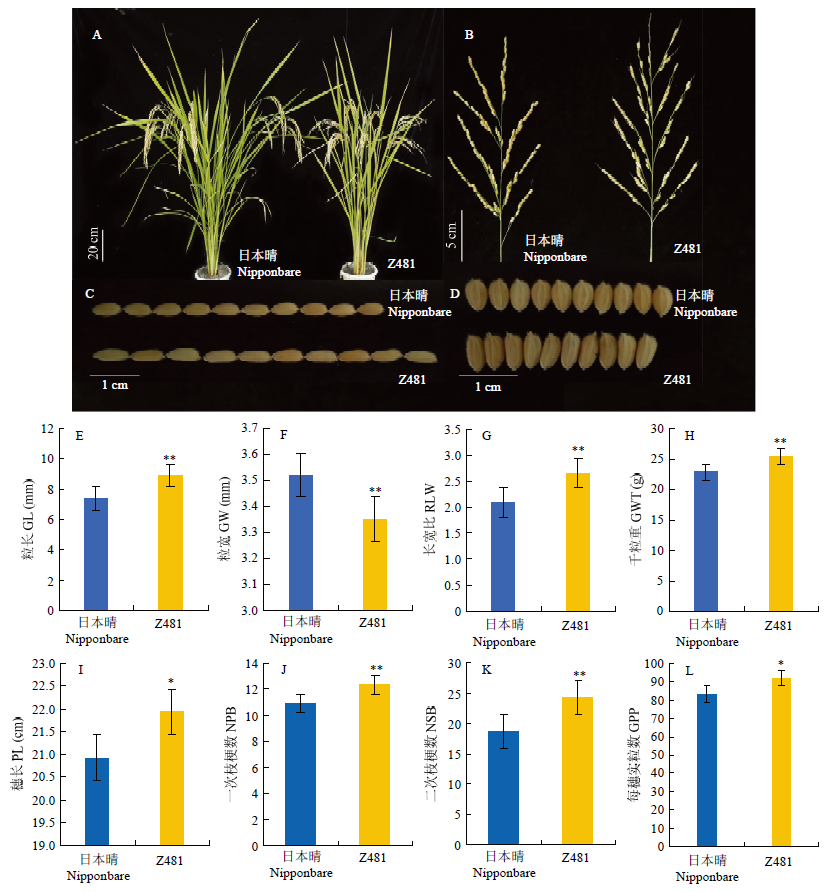
Fig. 1

Phenotype and statistical analysis of panicle traits between Nipponbare and CSSL Z481 with 4 substitution segments A: Plant type; B: Panicle type; C: 10-grain length; D: 10-grain width; E-M: Statistical analysis of panicle traits. GL: Grain length; GW: Grain width; RLW: Ratio of grain length to width; GWT: 1000-grain weight; PL: Panicle length; NPB: Number of primary branches; NSB: Number of secondary branches; GPP: Grain number per panicle. ** indicate difference between traits of Nipponbare and Z481 at P<0.01 respectively. * indicate difference between traits of Nipponbare and Z481 at P<0.05 respectively. The same as below"

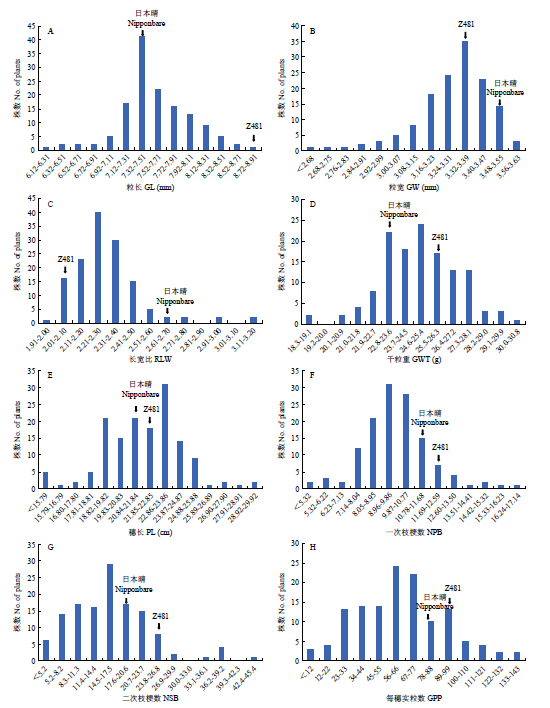
Fig.2

Frequency distribution of 8 panicle traits in the F2 secondary population from Nipponbare/Z481"

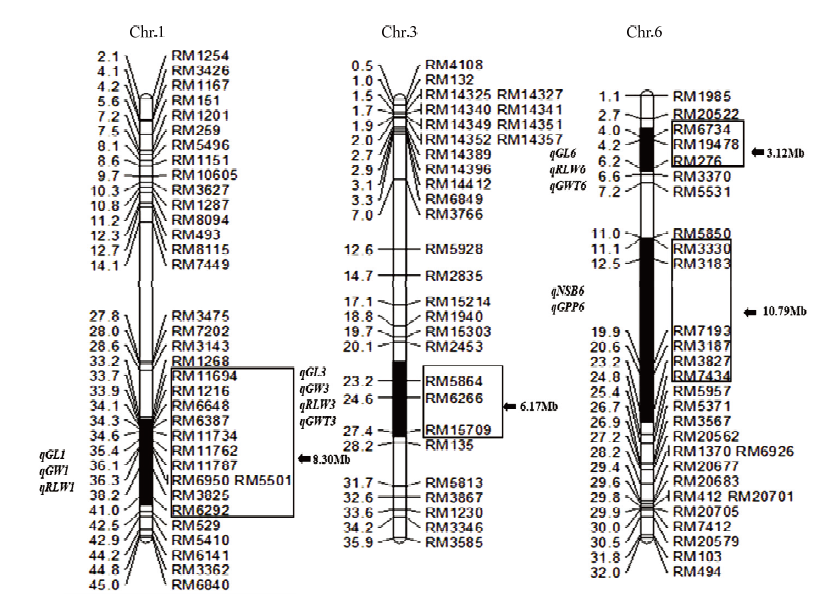
Fig.3

QTL located on 4 Substituted segments of chromosome segment substitution line Z481 Physical distances (Mb) and mapped QTL are marked at the left of each chromosome; substitution length (black arrow direction) are displayed at the right of each chromosome. GL: Grain length; GW: Grain width; RLW: Ratio of grain length to width; GWT: 1000-grain weight; NSB: Number of secondary branches; GPP: Grain number per panicle"

Table 1

QTL for rice panicle related traits in secondary F2 population from Nipponbare/Z481"

性状
Trait
QTL 染色体
Chr.
临近连锁标记
Near liked- marker
加性效应
Additive effect
贡献率
Var. (%)
P
P-value
二次枝梗数NSB qNSB6 6 RM3183 2.32 10.53 0.0106
每穗实粒数GPP qGPP6 6 RM3183 9.10 5.76 0.0482
粒长GL (mm) qGL1 1 RM5501 0.12 10.15 0.0317
qGL3 3 RM6266 0.20 26.67 <.0001
qGL6 6 RM276 0.10 7.00 0.0199
粒宽GW (mm) qGW1 1 RM5501 -0.05 9.30 0.0464
qGW3 3 RM6266 -0.04 5.90 0.0375
长宽比RLW qRLW1 1 RM5501 0.16 89.81 <.0001
qRLW3 3 RM6266 0.11 46.66 <.0001
qRLW6 6 RM276 0.06 11.25 0.0436
千粒重GWT (g) qGWT3 3 RM6266 0.43 4.66 0.0403
qGWT6 6 RM276 0.41 4.15 0.0430

Table 2

Pearson’s correlation coefficients among panicle related traits in secondary F2 population derived from Nipponbare/Z481"

性状 Trait 粒长GL 粒宽GW 长宽比RLW 二次枝梗数NSB 千粒重GWT 每穗实粒数GPP
粒长GL 1
粒宽GW -0.062 1
长宽比RLW 0.751** -0.699** 1
二次枝梗数NSB 0.114 -0.394** 0.345** 1
千粒重GWT 0.220* 0.213* 0.025 -0.128 1
实粒数GPP 0.133 -0.423** 0.380** 0.876** -0.054 1

Fig. 4

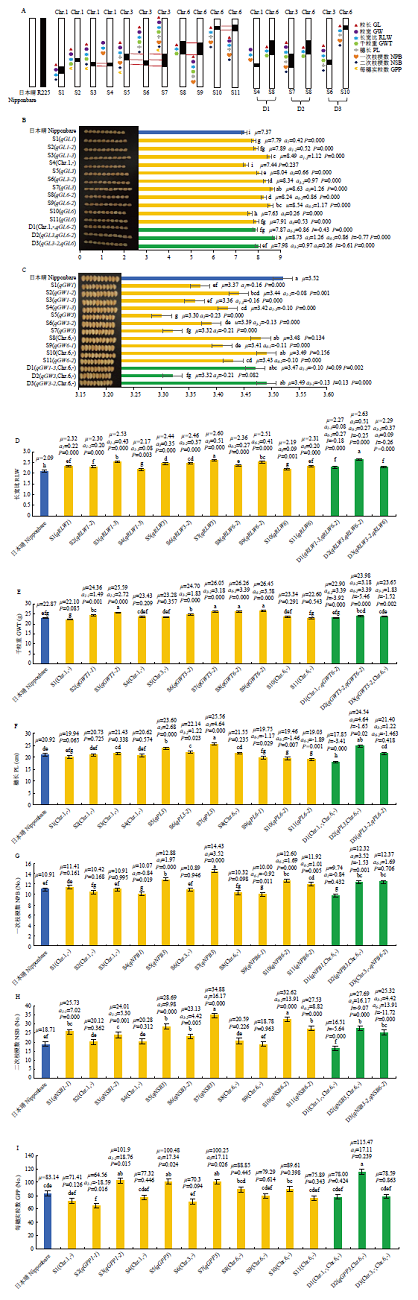
Development of secondary single segment substitution lines and double segment substitution lines and analysis of additive and epistasis effects of QTLs for panicle related traits A: Sketch map of developed SSSL (S1-S11) and DSSL (D1-D3); S: SSSL; D: DSSL. B-I: Genetic parameters of grain length (B), grain width (C) etc. Different small letters at bars top indicate a significant difference (P<0.05) among substitution lines as determined by Duncan’s multiple comparison. µ is the mean value of each line, ai denotes the additive effect of QTL, I denote the additive × additive epistasis effect between Q1 and Q2 in DSSL. P<0.05 in SSSL indicates that a QTL existed in the substitution segment of the SSSL, as determined by one-way ANOVA and LSD multiple comparison with Xihui 18; P<0.05 in DSSL indicates that epistasis effect of Q1 × Q2 existed in DSSL, as detected by two-way ANOVA. S1: RM11787--RM6950,RM5501--RM3825; S2: RM1268--RM11694--RM1216; S3: RM6648--RM6387-RM11734--RM11762; S4: RM6387--RM11734--RM11762; S5: RM5864--RM6266-15709; S6: RM6266--RM15709--RM135; S7: RM5864--RM6266-RM15709--RM135; S8: RM5850--RM3330-RM3183--RM7193; S9: RM3330--RM3183--RM7193; S10: RM6734--RM19478--RM276; S11: RM20522--RM6734-RM19478-RM276--RM3370; D1: RM6387--RM11734--RM11762, RM5850--RM3330-RM3183-- RM7193; D2: RM5864--RM6266-RM15709--RM135, RM5850--RM3330-RM3183--RM7193; D3: RM6266--RM15709--RM135, RM6734--RM19478-- RM276"

Table 3

Epistatic interaction detected between QTLs in DSSL by two-way ANOVA"

性状
Trait
模型Model 代换系
Substitution line
座位1 Q1 座位2 Q2 座位1×座位2 Q1×Q2
粒长GL -(P=0.237) qGL6-2(P=0.000) qGL6-2(P=0.000) D1
qGL3(P=0.000) qGL6-2(P=0.000) qGL3×qGL6-2(P=0.000) D2
qGL3-2(P=0.000) qGL6 (P=0.000) qGL3-2×qGL6 (P=0.000) D3
粒宽GW qGW1-3(P=0.000) -(P=0.134) qGW1-3×-(P=0.002) D1
qGW3(P=0.000) -(P=0.134) qGW3×-(P=0.082) D2
qGW3-2(P=0.000) -(P=0.156) qGW3-2×-(P=0.000) D3
长宽比RLW qRLW1-3(P=0.003) qRLW6-2(P=0.000) qRLW1-3×qRLW6-2(P=0.000) D1
qRLW3(P=0.000) qRLW6-2(P=0.000) qRLW3×qRLW6-2(P=0.000) D2
qRLW3-2(P=0.000) qRLW6(P=0.001) qRLW3-2×qRLW6 (P=0.000) D3
千粒重GWT -(P=0.209) qGWT6-2(P=0.000) qGWT6-2(P=0.000) D1
qGWT3-2(P=0.000) qGWT6-2(P=0.000) qGWT3-2×qGWT6-2(P=0.000) D2
qGWT3-2(P=0.000) -(P=0.291) qGWT3-2×-(P=0.002) D3
穗长PL -(P=0.574) -(P=0.235) - (P=0.000) D1
qPL3(P=0.000) -(P=0.235) qPL3×-(P=0.020) D2
qPL3-2(P=0.023) qPL6-2(P=0.007) qPL3-2×qPL6-2(P=0.418) D3
一次枝梗数NPB qNPB1(P=0.019) -(P=0.098) qNPB1×-(P=0.432) D1
qNPB3(P=0.000) -(P=0.098) qNPB3×-(P=0.001) D2
-(P=0.946) qNPB6-2(P=0.000) qNPB6-2(P=0.706) D3
二次枝梗数NSB -(P=0.109) -(P=0.042) -×-(P=0.000) D1
qNSB3(P=0.000) -(P=0.042) qNSB3×-(P=0.000) D2
qNSB3-2(P=0.001) qNSB6-2(P=0.000) qNSB3-2×qNSB6-2(P=0.000) D3
每穗实粒数GPP -(P=0.446) -(P=0.455) -×-(P=0.424) D1
qGPP3(P=0.026) -(P=0.455) qGPP3×-(P=0.239) D2
-(P=0.094) -(P=0.398) -×-(P=0.863) D3
[1]
GUO T, CHEN K, DONG N Q, SHI C L, YE W W, GAO J P, SHAN J X, LIN H X. Grain size and NUMBER 1 negatively regulates the OsMKKK10-OsMKK4-OsMPK6 cascade to coordinate the trade-off between grain number per panicle and grain size in rice. The Plant Cell, 2018, 30(4): 871-888.

doi: 10.1105/tpc.17.00959
[2]
ZHAO M Z, MA Z B, WANG L L, TANG Z Q, MAO J, LIANG C B, GAO H, ZHANG L Y, HE N, FU L, WANG C H, SUI G M, ZHANG W J. SNP-based QTL mapping for panicle traits in the japonica super rice cultivar Liaoxing 1. The Crop Journal, 2020, 8(5): 769-780.

doi: 10.1016/j.cj.2020.07.002
[3]
SEPTININGSIH E M, PRASETIYONO J, LUBIS E, TAI T h, TJUBARYAT T, MOELJOPAWIRO S, MCCOUCH S R. Identification of quantitative trait loci for yield and yield components in an advanced backcross population derived from the Oryza sativa variety IR64 and the wild relative O-rufipogon. Theoretical and Applied Genetics, 2003, 107(8): 1419-1432.

doi: 10.1007/s00122-003-1373-2
[4]
曾瑞珍, Akshay TALUKDAR, 刘芳, 张桂权. 利用单片段代换系定位水稻粒形QTL. 中国农业科学, 2006, 39(4): 647-654.
ZENG R Z, TALUKDAR A, LIU F, ZHANG G Q. Mapping of the QTLs for grain shape using single segment substitution lines in rice. Scientia Agricultura Sinica, 2006, 39(4): 647-654. (in Chinese)
[5]
WENG J F, GU S H, WAN X Y, GAO H, GUO T, SU N, LEI C L, ZHANG X, CHENG Z J, GUO X P, WANG J L, JIANG L, ZHAI H Q, WAN J M. Isolation and initial characterization of GW5, a major QTL associated with rice grain width and weight. Cell Research, 2008, 18(12): 1199-1209.

doi: 10.1038/cr.2008.307 pmid: 19015668
[6]
DESHMUKH R, SINGH A, JAIN N, ANAND S, GACCHE R, SINGH A, GAIKWAD K, SHARMA T, MOHAPATRA T, SINGH N. Identification of candidate genes for grain number in rice (Oryza sativa L.). Functional & Integrative Genomics, 2010, 10(3): 339-347.
[7]
BIAN J M, HE H H, LI C J, SHI H, ZHU C L, PENG X S, FU J R, HE X P, CHEN X R, HU L F, OUYANG L J. Identification and validation of a new grain weight QTL in rice. Genetics and Molecular Research, 2013, 12(4): 5623-5633.

doi: 10.4238/2013.November.18.11 pmid: 24301931
[8]
高方远, 罗正良, 任鄄胜, 吴贤婷, 陆贤军, 苏相文, 吕建群, 任光俊. 水稻粒厚主效位点qGT8精细定位和候选基因分析. 中国农业科学, 2015, 48(24): 4859-4871.

doi: 10.3864/j.issn.0578-1752.2015.24.001
GAO F Y, LUO Z L, REN J S, WU X T, LU X J, SU X W, J Q, REN G J. Fine mapping and candidate gene analysis of the main effect locus qGT8, a major QTL for grain thickness in rice. Scientia Agricultura Sinica, 2015, 48(24): 4859-4871. (in Chinese)
[9]
刘颖, 叶生鑫, 彭强, 张大双, 吴健强, 王际凤, 黄培英, 朱速松. 水稻穗长和有效穗数的QTL定位分析. 江苏农业科学, 2016, 44(4): 86-89.
LIU Y, YE S X, PENG Q, ZHANG D S, WU J Q, WANG J F, HUANG P Y, ZHU S S. QTL mapping analysis of panicle length and effective panicle number in rice. Jiangsu Agricultural Sciences, 2016, 44(4): 86-89. (in Chinese)
[10]
陈昊. 水稻穗粒数基因GN2的克隆与功能分析[D]. 北京: 中国农业大学, 2017.
CHEN H. Cloning and functional analysis of a novel gene, GN2, controlling grain number of rice (Oriyza sativa)[D]. Beijing: China Agricultural University, 2017. (in Chinese)
[11]
HU Z J, CAO L M, SUN X J, ZHU Y, ZHANG T Y, JIANG L, LIU Y H, DONG S Q, SUN D Y, YANG J S, HE H H, LUO X J. Fine mapping of a major quantitative trait locus, qgnp7(t), controlling grain number per panicle in African rice (Oryza glaberrima S.). Breeding Science, 2018, 68(5): 606-613.

doi: 10.1270/jsbbs.18084
[12]
张健, 杨靖, 王豪, 李冬秀, 杨瑰丽, 黄翠红, 周丹华, 郭涛, 陈志强, 王慧. 基于高密度遗传图谱定位水稻籽粒大小相关性状QTL. 中国农业科学, 2020, 53(2): 225-238.

doi: 10.3864/j.issn.0578-1752.2020.02.001
ZHANG J, YANG J, WANG H, LI D X, YANG G L, HUANG C H, ZHOU D H, GUO T, CHEN Z Q, WANG H. QTL mapping for grain size related traits based on a high-density map in rice. Scientia Agricultura Sinica, 2020, 53(2): 225-238. (in Chinese)

doi: 10.3864/j.issn.0578-1752.2020.02.001
[13]
WANG D C, ZHOU K, XIANG S Q, ZHANG Q L, LI R X, LI M M, LIANG P X, FARKHANDA N, HE G H, LING Y H, ZHAO F M. Identification pyramid and candidate genes of QTLs for associated traits based on a dense erect panicle rice CSSL-Z749 and five SSSLs, three DSSLs and one TSSL. Rice, 2021, 14(1): 55.

doi: 10.1186/s12284-021-00496-7
[14]
LIANG P X, WANG H, ZHANG Q L, ZHOU K, LI M M, LI R X, XIANG S Q, ZHANG T, LING Y H, YANG Z L, HE G H, ZHAO F M. Identification and pyramiding of QTLs for rice grain size based on short-wide grain CSSL-Z563 and fine-mapping of qGL3-2. Rice, 2021, 14(1): 35.

doi: 10.1186/s12284-021-00477-w
[15]
宋博文, 王朝欢, 赵哲, 陈淳, 黄明, 陈伟雄, 梁克勤, 肖武名. 基于高密度遗传图谱对水稻粒形QTL定位及分析. 作物学报, 2022, 48(11): 2813-2829.

doi: 10.3724/SP.J.1006.2022.12069
SONG B W, WANG C H, ZHAO Z, CHEN C, HUANG M, CHEN W X, LIANG K Q, XIAO W M. QTL Mapping and analysis of QTLs for grain size in rice based on high density genetic map. Acta Agronomica Sinica, 2022, 48(11): 2813-2829. (in Chinese)
[16]
ZHANG T, WANG S M, SUN S F, ZHANG Y, LI J, YOU J, SU T, CHEN W B, LING Y H, HE G H, ZHAO F M. Analysis of QTL for grain size in a rice chromosome segment substitution line Z1392 with long grains and fine mapping of qGL-6. Rice, 2020, 13(1): 40.

doi: 10.1186/s12284-020-00399-z
[17]
MA F Y, ZHU X Y, WANG H, WANG S M, CUI G Q, ZHANG T, YANG Z L, HE G H, LING Y H, WANG N, ZHAO F M. Identification of QTL for kernel number-related traits in a rice chromosome segment substitution line and fine mapping of qSP1. The Crop Journal, 2019, 7(4): 494-503.

doi: 10.1016/j.cj.2018.12.009
[18]
MA F Y, DU J, WANG D C, WANG H, ZHAO B B, HE G H, YANG Z L, ZANG T, WU R H, ZHAO F M. Identification of long-grain chromosome segment substitution line Z744 and QTL analysis for agronomic traits in rice. Journal of Integrative Agriculture, 2020, 19(5): 1163-1169.

doi: 10.1016/S2095-3119(19)62751-6
[19]
WANG S M, CUI G Q, WANG H, MA F Y, XIA S S, LI Y F, YANG Z L, LING Y H, ZHANG C W, HE G H, ZHAO F M. Identification and QTL mapping of Z550, a rice backcrossed inbred line with increased grains per panicle. Journal of Integrative Agriculture, 2019, 18(3): 526-531.

doi: 10.1016/S2095-3119(18)61996-3
[20]
LI N, XU R, DUAN P G, LI Y H. Control of grain size in rice. Plant Reproduction, 2018, 31(3): 237-251.

doi: 10.1007/s00497-018-0333-6 pmid: 29523952
[21]
HUANG J, LI Z Y, ZHAO D Z. Deregulation of the OsmiR160 target gene OsARF18 causes growth and developmental defects with an alteration of auxin signaling in rice. Scientific Reports, 2016, 6: 29938.

doi: 10.1038/srep29938
[22]
XU Y X, XIAO M Z, LIU Y, FU J L, HE Y, JIANG D A. The small auxin-up RNA OsSAUR45 affects auxin synthesis and transport in rice. Plant Molecular Biology, 2017, 94(1/2): 97-107.

doi: 10.1007/s11103-017-0595-7
[23]
ASHIKARI M, SAKAKIBARA H, LIN S Y, YAMAMOTO T, TAKASHI T, NISHIMURA A, ANGELES E R, QIAN Q, KITANO H, MATSUOKA M. Cytokinin oxidase regulates rice grain production. Science, 2005, 309: 741-745.

doi: 10.1126/science.1113373 pmid: 15976269
[24]
LI S Y, ZHAO B R, YUAN D Y, DUAN M J, QIAN Q, TANG L, WANG B, LIU X Q, ZHANG J, WANG J, SUN J Q, LIU Z, FENG Y Q, YUAN L P, LI C Y, Rice zinc finger protein DST enhances grain production through controlling Gn1a/OsCKX2 expression. Proceedings of the National Academy of Sciences of the United States of America, 2013, 110(8): 3167-3172.
[25]
WU Y, WANG Y, MI X F, SHAN J X, LI X M, XU J L, LIN H X. The QTL GNP1 Encodes GA20ox1, which increases grain number and yield by increasing cytokinin activity in rice panicle meristems. PLoS Genetics, 2016, 12(10): e1006386.

doi: 10.1371/journal.pgen.1006386
[26]
FANG N, XU R, HUANG L J, ZHANG B L, DUAN P G, LI N, LUO Y H, LI Y H. SMALL GRAIN 11 controls grain size, grain number and grain yield in rice. Rice, 2016, 9(1): 64.

doi: 10.1186/s12284-016-0136-z
[27]
WU Y Z, FU Y C, ZHAO S S, GU P, ZHU Z F, SUN C Q, TAN L B. CLUSTERED PRIMARY BRANCH 1, a new allele of DWARF 11, controls panicle architecture and seed size in rice. Plant Biotechnology Journal, 2016, 14(1): 377-386.

doi: 10.1111/pbi.12391
[28]
QIAO S L, SUN S Y, WANG L L, WU Z H, LI C X, LI X M, WANG T, LENG L N, TIAN W S, LU T G, WANG X L. The RLA1/SMOS1 transcription factor functions with OsBZR1 to regulate brassinosteroid signaling and rice architecture. The Plant Cell, 2017, 29(2): 292-309.

doi: 10.1105/tpc.16.00611
[29]
HUANG X Z, QIAN Q, LIU Z B, SUN H Y, HE S Y, LUO D, XIA G M, CHU C C, LI J Y, FU X D. Natural variation at the DEP1 locus enhances grain yield in rice. Nature Genetics, 2009, 41(4): 494-497.

doi: 10.1038/ng.352
[30]
LI S, LIU W, ZHANG X, LIU Y, LI N, LI Y. Roles of the Arabidopsis G protein gamma subunit AGG3 and its rice homologs GS3 and DEP1 in seed and organ size control. Plant Signaling Behavior, 2012, 7(10): 1357-1359.

doi: 10.4161/psb.21620
[31]
LI F, LIU W B, TANG J Y, CHEN J F, TONG H N, HU B, LI C L, FANG J, CHEN M S, CHU C C. Rice DENSE AND ERECT PANICLE 2 is essential for determining panicle outgrowth and elongation. Cell Research, 2010, 20(7): 838-849.

doi: 10.1038/cr.2010.69
[32]
QIAO Y L, PIAO R H, SHI J X, LEE S I, JIANG W Z, KIM B K, LEE J, HAN L Z, MA W B, KOH H J. Fine mapping and candidate gene analysis of dense and erect panicle 3, DEP3, which confers high grain yield in rice (Oryza sativa L.). Theoretical and Applied Genetics, 2011, 122(7): 1439-1449.

doi: 10.1007/s00122-011-1543-6
[33]
YANG T F, ZHANG S H, ZHAO J L, LIU Q, HUANG Z H, MAO X X, DONG J F, WANG X F, ZHANG G Q, LIU B. Identification and pyramiding of QTLs for cold tolerance at the bud bursting and the seedling stages by use of single segment substitution lines in rice (Oryza sativa L.). Molecular Breeding, 2016, 36(7): 1-10.

doi: 10.1007/s11032-015-0425-z
[34]
ZHOU Y L, XIE Y H, CAI J L, LIU C B, ZHU H T, JIANG R, ZHONG Y Y, ZHANG G L, TAN B, LIU G F, FU X L, LIU Z Q, WANG S K, ZHANG G Q, ZENG R Z. Substitution mapping of QTLs controlling seed dormancy using single segment substitution lines derived from multiple cultivated rice donors in seven cropping seasons. Theoretical and Applied Genetics, 2017, 130(6): 1191-1205.

doi: 10.1007/s00122-017-2881-9 pmid: 28283703
[35]
LI Z H, RIAZ A, ZHANG Y X, ANIS G B, ZHU A K, CAO L Y, CHENG S H. Quantitative trait loci mapping for rice yield-related traits using chromosomal segment substitution lines. Rice Science, 2019, 26(5): 261: 264.

doi: 10.1016/j.rsci.2019.02.001
[36]
BALAKRISHNAN D, SURAPANENI M, MESAPOGU S, NEELAMRAJU S. Development and use of chromosome segment substitution lines as a genetic resource for crop improvement. Theoretical and Applied Genetics, 2019, 132(1): 1-25.

doi: 10.1007/s00122-018-3219-y pmid: 30483819
[37]
YUAN H, GAO P, HU X L, YUAN M, XU Z Y, JIN M Y, SONG W C, ZHAN S J, ZHU X B, TU B, LI T, WANG Y P, MA B T, QIN P, CHEN W L, LI S G. Fine mapping and candidate gene analysis of qGSN5, a novel quantitative trait locus coordinating grain size and grain number in rice. Theoretical and Applied Genetics, 2022, 135(1): 51-64.

doi: 10.1007/s00122-021-03951-7
[38]
张桂权. 基于SSSL文库的水稻设计育种平台. 遗传, 2019, 41(8): 754-760.
ZHANG G Q. The platform of breeding by designbased on the SSSL library in rice. Hereditas, 2019, 41(8): 754-760. (in Chinese)
[39]
郑丽媛, 魏霞, 周可, 向佳, 李燕, 刘宝玉, 何光华, 凌英华赵芳明. 携带主效落粒基因的水稻染色体片段代换系Z481的鉴定及和SH6(t)的定位. 科学通报, 2016, 61(7): 748-758.
ZHENG L Y, WEI X, ZHOU K, XIANG J, LI Y, LIU B Y, HE G H, LING Y H, ZHAO F M. Identification of a rice chromosome segment substitution line Z481 carrying a major gene for seed shattering and mapping of SH6 (t). Chinese Science Bulletin, 2016, 61(7): 748-758. (in Chinese)
[40]
WANG H, ZHANG J Y, Naz F, LI J, SUN S F, HE G H, ZHANG T, LING Y H, ZHAO F M. Identification of rice QTLs for important agronomic traits with long-kernel CSSL-Z741 and three SSSLs. Rice Science, 2020, 27(5): 414-422.

doi: 10.1016/j.rsci.2020.04.008
[41]
MCCOUCH S R, KOCHERT G, YU Z H, WANG Z Y, KHUSH G S, COFFMAN W R, TANKSLEY S D. Molecular mapping of rice chromosomes. Theoretical and Applied Genetics, 1988, 76(6): 815-829.
[42]
ZHAO F M, TAN Y, ZHENG L Y, ZHOU K, HE G H, LING Y H, ZHANG L H, XU S Z. Identification of rice chromosome segment substitution line Z322-1-10 and mapping QTL for agronomic traits from the F3 population. Cereal Research Communications, 2016, 44(3): 370-380.

doi: 10.1556/0806.44.2016.022
[43]
SAS Institute. 2009. SAS/STAT: Users’ guide. version 9.3. http://suport.sus.com/publishing.
[44]
YANG W F, LIANG J Y, HAO Q W, LUAN X, TAN Q Y, LIN S W, ZHU H T, LIU G F, LIU Z P, BU S H, WANG S K, ZHANG G Q. Fine mapping of two grain chalkiness QTLs sensitive to high temperature in rice. Rice, 2021, 14(1): 33.

doi: 10.1186/s12284-021-00476-x pmid: 33792792
[45]
LI J, YANG H X, XU G Y, DENG K L, YU J J, XIANG S Q, ZHOU K, ZHANG Q L, LI R X, LI M M, LING Y H, YANG Z L, HE G H, ZHAO F M. QTL analysis of Z414, a chromosome segment substitution line with short, wide grains, and substitution mapping of qGL11 in rice. Rice, 2022, 15(1): 25.

doi: 10.1186/s12284-022-00571-7
[46]
张分云, 李宏, 周向阳, 王重荣, 周德贵, 赖穗春, 陈立云, 周少川. 水稻产量分子设计育种研究进展. 分子植物育种, 2013, 11(6): 663-672.
ZHANG F Y, LI H, ZHOU X Y, WANG C R, ZHOU D G, LAI S C, CHEN L Y, ZHOU S C. Approach to rice breeding by molecular design in grain yield. Molecular Plant Breeding, 2013, 11(6): 663-672. (in Chinese)
[47]
赵芳明, 张桂权, 曾瑞珍, 杨正林, 凌英华, 桑贤春, 何光华. 利用单片段代换系研究水稻产量相关性状QTL加性及上位性效应. 作物学报, 2012, 38(11): 2007-2014.

doi: 10.3724/SP.J.1006.2012.02007
ZHAO F M, ZHANG G Q, ZENG R Z, YANG Z L, LING Y H, SANG X C, HE G H. Study on the additive and epistasis effects of QTL in rice yield related traits using single segment substitution lines. Acta Agronomica Sinica, 2012, 38(11): 2007-2014. (in Chinese)

doi: 10.3724/SP.J.1006.2012.02007
[48]
ZHAO F M, ZHU H T, ZENG R Z, ZHANG G Q, XU S Z. Detection of additive and additive × environment interaction effects of QTLs for yield component traits of rice using single segment substitution lines (SSSLs). Plant Breeding, 2016, 135(4): 452-458.

doi: 10.1111/pbr.2016.135.issue-4
[49]
ESHED Y, ZAMIR D. An introgression line population of Lycopersicon pennellii in the cultivated tomato enables the identification and fine mapping of yield-associated QTL. Genetics, 1995, 141(3): 1147-1162.

doi: 10.1093/genetics/141.3.1147
[50]
CHAN A N, WANG L L, ZHU Y J, FAN Y Y, ZHUANG J Y, ZHANG Z H. Identification through fine mapping and verification using CRISPR/Cas9-targeted mutagenesis for a minor QTL controlling grain weight in rice. Theoretical and Applied Genetics, 2021, 134(1): 327-337.

doi: 10.1007/s00122-020-03699-6 pmid: 33068118
[51]
SUN W, XU X H, LI Y P, XIE L X, HE Y N, LI W, LU X B, SUN H W, XIE X Z. OsmiR530 acts downstream of OsPIL15 to regulate grain yield in rice. New Phytologist, 2020, 226(3): 823-837.

doi: 10.1111/nph.16399 pmid: 31883119
[52]
TAO Y J, MIAO J, WANG J, LI W Q, XU Y, WANG F Q, JIANG Y J, CHEN Z H, FAN F J, XU M B, ZHOU Y, LIANG G H, YANG J. RGG1, involved in the cytokinin regulatory pathway, controls grain size in rice. Rice, 2020, 13(1): 76.

doi: 10.1186/s12284-020-00436-x pmid: 33169285
[53]
QI P, LIN Y S, SONG X J, SHEN J B, HUANG W, SHAN J X, ZHU M Z, JIANG L W, GAO J P, LIN H X. The novel quantitative trait locus GL3.1 controls rice grain size and yield by regulating Cyclin-T1;3. Cell Research, 2012, 22(12): 1666-1680.

doi: 10.1038/cr.2012.151
[54]
LI C N, ZHU S S, ZHANG H, CHEN L P, CAI M H, WANG J C, CHAI J T, WU F Q, CHENG Z J, GUO X P, ZHANG X, WAN J M. OsLBD37 and OsLBD38, two class II type LBD proteins, are involved in the regulation of heading date by controlling the expression of Ehd1 in rice. Biochemical and Biophysical Research Communications, 2017, 486(3): 720-725.

doi: 10.1016/j.bbrc.2017.03.104
[55]
沈文强, 赵冰冰, 于国玲, 李凤菲, 朱小燕, 马福盈李云峰, 何光华, 赵芳明. 优良水稻染色体片段代换系Z746的鉴定及重要农艺性状QTL定位及其验证. 作物学报, 2021, 47(3): 451-461.

doi: 10.3724/SP.J.1006.2021.92002
SHEN W Q, ZHAO B B, YU G L, LI F F, ZHU X Y, MA F Y, LI Y F, HE G H, ZHAO F M. Identification and QTL mapping of important agronomic traits of an excellent rice chromosome fragment substitution line Z746. Acta Agronomica Sinica, 2021, 47(3): 451-461 (in Chinese)

doi: 10.3724/SP.J.1006.2021.92002
[56]
SUN S F, XIANG S Q, LV M, ZHOU K, LI J, LIANG P X, LI M M, LI R X, LING Y H, HE G H, ZHAO F M. Identifcation, pyramid, and candidate gene of QTL for yield‑related traits based on rice CSSLs in indica Xihui18 background. Molecular Breeding, 2022, 42(4): 19.

doi: 10.1007/s11032-022-01284-x
[57]
ZHANG D P, ZHANG M Y, LIANG J S. RGB1 regulates grain development and starch accumulation through its effect on OsYUC11- mediated auxin biosynthesis in rice endosperm cells. Frontiers in Plant Science, 2021, 12: 585174.

doi: 10.3389/fpls.2021.585174
[58]
LI Y, LI T T, HE X R, ZHU Y, FENG Q, YANG X M, ZHOU X H, LI G B, JI Y P, ZHAO J H, ZHAO Z X, PU M, ZHOU S X, ZHANG J W, HUANG Y Y, FAN J, WANG W M. Blocking Osa-miR1871 enhances rice resistance against Magnaporthe oryzae and yield. Plant Biotechnology Journal, 2022, 20(4): 646-659.

doi: 10.1111/pbi.v20.4
[59]
崔国庆, 王世明, 马福盈, 汪会, 向朝中, 李云峰, 何光华, 张长伟, 杨正林, 凌英华, 赵芳明. 水稻高秆染色体片段代换系Z1377的鉴定及重要农艺性状QTL定位. 作物学报, 2018, 44(10): 1477-1484.

doi: 10.3724/SP.J.1006.2018.01477
CUI G Q, WANG S M, MA F Y, WANG H, XIANG C Z, LI Y F, HE G H, ZHANG C W, YANG Z L, LING Y H, ZHAO F M. Identification and QTL mapping of important agronomic traits in rice Z1377. Acta Agronomica Sinica, 2018, 44(10): 1477-1484. (in Chinese)

doi: 10.3724/SP.J.1006.2018.01477
[60]
YANG X F, ZHAO X L, DAI Z Y, MA F L, MIAO X X, SHI Z Y. OsmiR396/growth regulating factor modulate rice grain size through direct regulation of embryo-specific miR408. Plant Physiology, 2021, 186(1): 519-533.

doi: 10.1093/plphys/kiab084 pmid: 33620493
[1] PENG TingShen, LU JiuYan, WU MeiLin, YAN YuXin, LIU HongZhou, NAN WenBin, QIN XiaoJian, LI Ming, GONG JunYi, LIANG YongShu. QTL Analysis of Yield-Related Traits in Both Huangnuo2# and Changbai7# of Perennial Chinese Rice [J]. Scientia Agricultura Sinica, 2026, 59(7): 1361-1379.
[2] CUI JieHao, ZHANG Meng, WANG Qin, YU JiaYan, LIN Kun, LI ShangZe, LAN Heng, GENG YanQiu, ZHANG Qiang, GUO LiYing, SHAO XiWen. Evaluation of Lodging Resistance and Its Physiological Mechanisms in Japonica Rice Resources [J]. Scientia Agricultura Sinica, 2026, 59(7): 1420-1438.
[3] YUAN HaoLiang, NIE Jun, LI Peng, LU YanHong, LIAO YuLin, XU ChangXu, LI ZhongYi, CAO WeiDong, ZHANG JiangLin. Effects of Co-Utilization of Chinese Milk Vetch and Rice Straw on Soil Phosphorus Composition and Phosphorus Activation of Paddy Field in Southern China [J]. Scientia Agricultura Sinica, 2026, 59(7): 1480-1491.
[4] XU YangHaoJun, CHEN LiMing, YANG ShiQi, TANG YiFan, TAN XueMing, ZENG YongJun, PAN XiaoHua, ZENG YanHua. Effects of Long-Term Different Straw Returning Methods on Soil Organic Carbon, Nutrients and Aggregate Formation in Different Soil Layers of Double Cropping Rice Field [J]. Scientia Agricultura Sinica, 2026, 59(7): 1492-1506.
[5] LI XingYu, HUANG Rong, XIAN YiMing, TIAN JiaoJiao, MA XiaoJin, YANG QiaoXi, LI Bing, WANG ChangQuan. Characteristics of Organic Carbon Fractions and Carbon Dioxide Emissions of Different Size Aggregates in Rice Field Soils in Response to Long-Term Fertilization [J]. Scientia Agricultura Sinica, 2026, 59(6): 1255-1271.
[6] MA ZhaoHui, QUAN ChengZhe, CHENG HaiTao, YANG KanJie, LI XinRui, LÜ WenYan. The Breeding Goals and Strategies of Northeast Japonica Rice Under the Background of Zhongke Fa No.5 [J]. Scientia Agricultura Sinica, 2026, 59(5): 927-936.
[7] ZHANG WeiJian, YAN ShengJi, SHANG ZiYin, TANG ZhiWei, WU LiuGe, LI JiaRui, CHEN HaoTian, DENG AiXing, ZHANG Jun, ZHANG Xin, ZHENG ChengYan, SONG ZhenWei. Methane Emissions from Paddy Fields: Not Entirely Attributable to Rice Cultivation [J]. Scientia Agricultura Sinica, 2026, 59(4): 824-833.
[8] CHEN Min, JIAO ZiLan, QIAO ChengBin, XU Hao, ZHANG Bi, MA DongHua, KONG WeiRu, WANG JingWen, SONG JiaWei, LUO ChengKe, LI PeiFu, TIAN Lei. Morpho-Physiological Responses and Adaptive Strategies of Rice Germplasm Accessions from Different Subspecies Under Salt Stress [J]. Scientia Agricultura Sinica, 2026, 59(4): 705-722.
[9] GUO FuCheng, TANG HaiJiang, HAO XinYi, MA GuoLin, YANG JiuJu, HUANG LinFeng, TIAN Lei, WANG Bin, LUO ChengKe. Effects of Different Irrigation Methods on Water-Salt Transport, Rice Yield, and Water Use Efficiency in Saline Soil in Ningxia [J]. Scientia Agricultura Sinica, 2026, 59(4): 750-764.
[10] LUO Wei, YU Hong, YUAN LiXin, WANG LingLing, ZHAO JinPeng, YIN Wei, WANG MingTian, WANG RuLin. Change of Geographic Distributions of Ratoon Rice in Sichuan- Chongqing Under Global Climate Change [J]. Scientia Agricultura Sinica, 2026, 59(4): 765-780.
[11] ZHU Shu, GUO ZhiPeng, SUN Ying. Functional Analysis of Rice Target of Rapamycin OsTOR in Regulating Root Elongation [J]. Scientia Agricultura Sinica, 2026, 59(3): 475-485.
[12] LÜ WenYan, CHENG HaiTao, MA ZhaoHui, TIAN ShuHua. Discussion on Hybridization Breeding Technology and Strategy of Rice in the New Era of Breeding [J]. Scientia Agricultura Sinica, 2026, 59(2): 233-238.
[13] LIAO TingLu, SHI YaFei, XIAO DongHao, SHE YangMengFei, GUO FuCheng, YANG JiuJu, TANG HaiJiang, LUO ChengKe. The Effect of Exogenous Nitroprusside on Sugar Metabolism in Rice Seedlings Under Alkaline Stress [J]. Scientia Agricultura Sinica, 2026, 59(2): 265-277.
[14] LIU TianSheng, LIU GengYuan, ZHAO AnQi, YANG Xu, CAI MingXue, YANG AiWen, LOU MingXuan, LI MuKai, WANG Han, ZHANG YaLing. Pathogenic Population of Rice Bakanae Disease in Heilongjiang Province [J]. Scientia Agricultura Sinica, 2026, 59(2): 305-321.
[15] WANG ZhongNi, LEI Yue, LI JiaLi, GONG YanLong, ZHU SuSong. Functions of ABC Transporter OsARG1 in Rice Heading Date Regulation [J]. Scientia Agricultura Sinica, 2026, 59(1): 1-16.
Viewed
Full text


Abstract

Cited

  Shared   
  Discussed   
No Suggested Reading articles found!