Scientia Agricultura Sinica ›› 2026, Vol. 59 ›› Issue (5): 1060-1069.doi: 10.3864/j.issn.0578-1752.2026.05.011

• HORTICULTURE • Previous Articles     Next Articles

Mixed Major Gene+Polygene Genetic Analysis of Blossom-End Scar Size in Tomato Fruit

WU YuanYuan1(), LÜ ShuWen1, ZHANG ZiJun1, WANG Tao1, ZHANG YiMing1, BU LingChao2, ZOU QingDao1(), JIANG Jing2()   

  1. 1 Vegetable Research Institute, Liaoning Academy of Agricultural Sciences, Shenyang 110161
    2 College of Horticulture, Shenyang Agricultural University, Shenyang 110866
  • Received:2025-09-25 Accepted:2025-11-13 Online:2026-03-01 Published:2026-03-06
  • Contact: ZOU QingDao, JIANG Jing

Abstract:

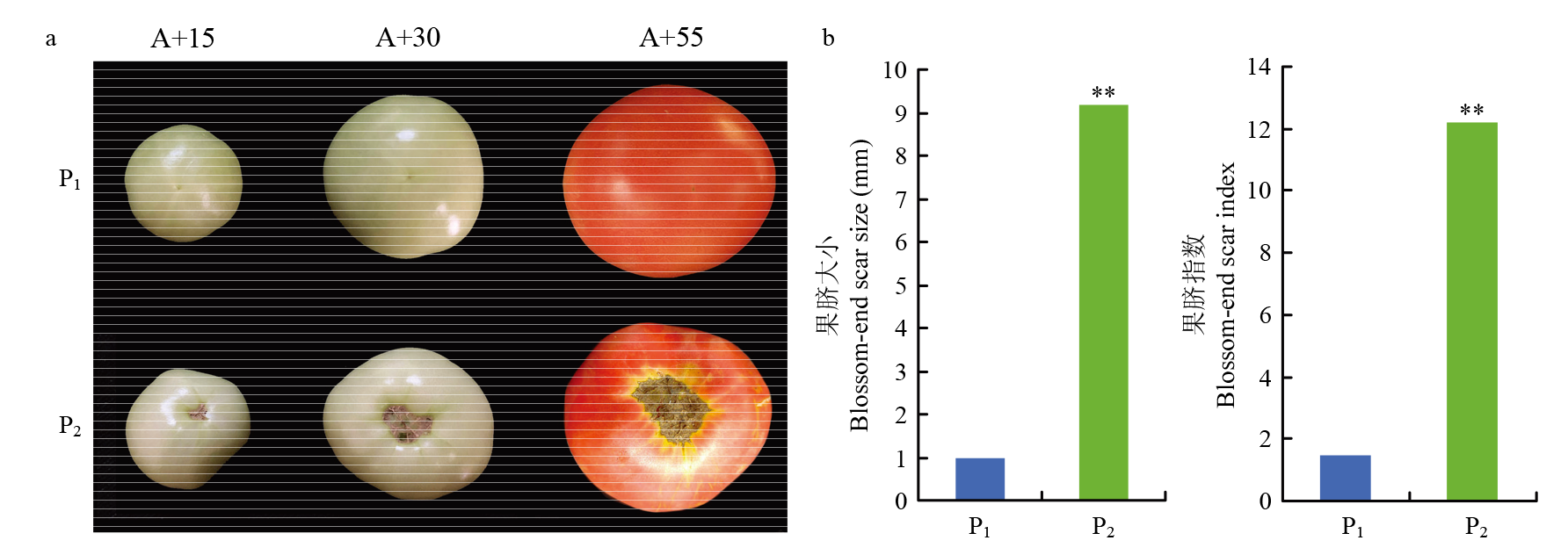
【Objective】 This study was conducted to perform a genetic analysis of tomato blossom-end scar size, with the aim of enhancing selection efficiency for this trait, accelerating the breeding process for small scar tomatoes, and laying a foundation for discovering key genes controlling blossom-end scar size and the genetic improvement of tomato varieties.【Method】 A small blossom-end scar line (P1) was crossed with a large blossom-end scar line (P2) to obtain F1. The F1 was self-pollinated and backcrossed with both parents to generate F2, BC1P1 and BC1P2 populations. Blossom-end scar size and blossom-end scar index were evaluated across the six generations during the red ripening period of fruits. Genetic analysis was performed using the major gene plus polygene mixed inheritance model. The SEA software was employed to fit 24 potential genetic models. Candidate models were selected based on the maximum likelihood value (MLV) and Akaike’s information criterion (AIC), and the optimal genetic model was determined by integrating the results of the Smirnov test, Kolmogorov test, and homogeneity test. Finally, based on the optimal model, the least squares method was used to estimate genetic parameters, including additive effects, dominance effects, epistatic effects, as well as major gene heritability and polygene heritability.【Result】 The differences in blossom-end scar size between the parental lines were extremely significant. At 55 days after the peak flowering period, the average blossom-end scar size and scar index of the large blossom-end scar parent (P2) were 9.44 times and 8.29 times greater than those of the small blossom-end scar parent (P1), respectively. The average blossom-end scar size and blossom-end scar index of the F1 population were intermediate between the two parental lines. The BC1P1, BC1P2 and F2 populations exhibited continuous variation in both blossom-end scar size and blossom-end scar index, with a wide range of variability and coefficients of variation ranging from 61.2% to 87.4%. The frequency distribution of the F2 population showed a continuous skewed normal distribution. Genetic model analysis suggested that the optimal model for tomato fruit blossom-end scar size was a mixed two major gene plus polygene inheritance model with additive-dominance-epistatic effects (MX2-ADI-ADI). The heritability of major genes in the F2 population was 93.05%, while the polygenic heritability was 4.68%. The two major genes mainly control this trait through negative additive effects. In terms of dominance, the first major gene tended to decrease the fruit blossom-end scar size, whereas the second major gene tended to increase it. These two genes showed partial dominance, with the second having a stronger dominant effect. Additive × additive and dominance × additive interactions increased blossom-end scar size, whereas dominance × dominance and additive × dominance interactions decreased it. 【Conclusion】 Tomato blossom-end scar size is a quantitative trait principally controlled by two major genes.

Key words: tomato, blossom-end scar size, quantitative trait, major gene plus polygene model, genetic analysis

Fig. 1

Phenotype analysis of the small blossom-end scar (P1) and large blossom-end scar (P2) self-pollinated lines fruits at different developmental stages a: Fruit morphology of different developmental stages. A+15, A+30, and A+55 represent different stages of fruit development, which are 15 days, 30 days, and 55 days after anthesis, respectively; b: The blossom-end scar size and blossom-end scar index of 55 days after anthesis. ** means significant difference at P<0.01"

Table 1

Statistical values of blossom-end scar size of each generation"

世代
Generation
最大值
Maximum (mm)
最小值
Minimum (mm)
平均值
Mean (mm)
标准差
SD
变异系数
CV (%)
偏度
Skewness
峰度
Kurtosis
P1 1.2 0.8 1.0 0.1 15.2 0.122 -0.379
P2 10.9 7.5 9.2 1.1 12.4 -0.191 -1.291
F1 4.6 3.2 3.9 0.4 10.6 0.267 -1.124
BC1P1 11.3 1.2 3.5 2.3 66.0 1.534 2.059
BC1P2 19.0 1.1 7.1 4.6 65.8 0.779 -0.433
F2 24.0 0.7 6.0 5.3 87.4 1.364 1.174

Table 2

Statistical values of blossom-end scar index of each generation"

世代Generation 最大值Maximum 最小值Minimum 平均值Mean 标准差SD 变异系数CV (%) 偏度Skewness 峰度Kurtosis
P1 1.8 1.2 1.5 0.2 13.3 0.121 -1.083
P2 16.0 9.6 12.2 2.0 16.5 0.754 -0.370
F1 6.0 4.4 5.1 0.5 9.4 -0.056 -0.860
BC1P1 16.5 1.7 5.3 3.3 61.7 1.291 1.337
BC1P2 20.3 1.5 8.1 5.0 61.2 0.772 -0.343
F2 33.8 1.0 7.4 6.0 81.1 1.410 1.664

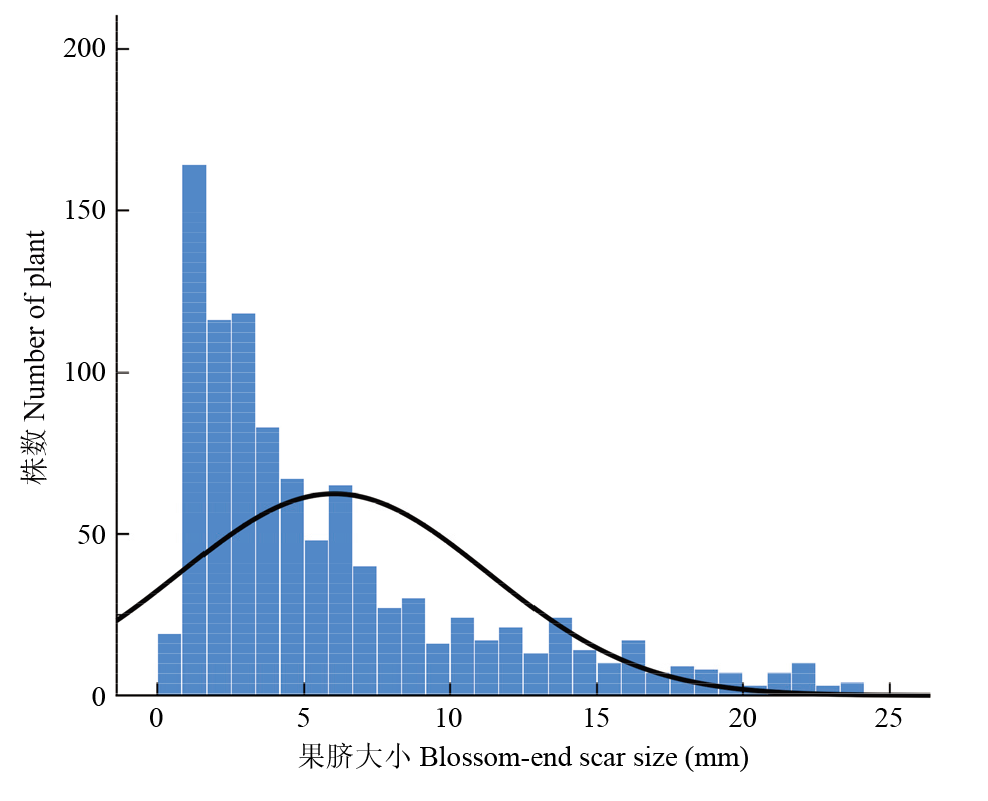
Fig. 2

Frequency distribution of Blossom-end scar size in the F2 population"

Table 3

Maximum likelihood and AIC values of the blossom-end scar size in the two methods"

模型
Model code
模型意义
Model implication
果脐大小BSS 果脐指数BSI
极大似然值
Maximum likelihood value
AIC值
AIC value
极大似然值Maximum likelihood value AIC值
AIC value
A-1 1MG-AD -3671.2871 7350.5742 -3631.8838 7271.7677
A-2 1MG-A -3630.0267 7266.0535 -3740.9917 7487.9833
A-3 1MG-EAD -3348.2441 6702.4882 -3541.2858 7088.5716
A-4 1MG-AEND -3585.3170 7176.6340 -3736.0471 7478.0942
B-1 2MG-ADI -4010.0772 8040.1543 -3758.8838 7537.7675
B-2 2MG-AD -3597.3140 7206.6279 -3601.1417 7214.2833
B-3 2MG-A -3858.7825 7725.5651 -3925.1470 7858.2939
B-4 2MG-EA -3614.6217 7235.2435 -3721.9482 7449.8964
B-5 2MG-AED -4014.7516 8037.5033 -3620.2142 7248.4283
B-6 2MG-EEAD -3994.1598 7994.3195 -3756.9094 7519.8188
C-0 PG-ADI -3482.3412 6984.6824 -3658.7715 7337.5429
C-1 PG-AD -3518.5710 7051.1421 -3678.3726 7370.7451
D-0 MX1-AD-ADI -3277.3668 6578.7336 -3493.8351 7011.6701
D-1 MX1-AD-AD -3343.6342 6705.2685 -3540.1682 7098.3365
D-2 MX1-A-AD -3501.3004 7018.6008 -3670.8361 7357.6722
D-3 MX1-EAD-AD -3455.0475 6926.0951 -3558.5083 7133.0166
D-4 MX1-AEND-AD -3516.3418 7048.6837 -3677.7386 7371.4773
E-0 MX2-ADI-ADI -3126.9814 6289.9628 -3380.5097 6797.0195
E-1 MX2-ADI-AD -3205.2282 6440.4563 -3436.7827 6903.5655
E-2 MX2-AD-AD -3406.8472 6835.6943 -3514.5103 7051.0206
E-3 MX2-A-AD -4095.1183 8208.2365 -3483.0877 6984.1754
E-4 MX2-EA-AD -3517.8101 7051.6203 -3678.2384 7372.4768
E-5 MX2-AED-AD -3406.9183 6831.8366 -3514.6131 7047.2261
E-6 MX2-EEAD-AD -3465.0335 6946.0670 -3540.0679 7096.1357

Table 4

The adaptability test results of candidate models for two methods"

方法
Method
模型
Model code
世代
Generation
均匀性检验
U12
均匀性检验
U22
均匀性检验
U32
Smirnov检验
nW2
Kolmogorov检验
Dn
果脐大小
BSS
MX2-ADI-ADI P1 0.0005(0.9817) 0.0009(0.9766) 0.0008(0.9775) 0.0202(0.9968) 0.0577(1.0000)
P2 0.0059(0.9389) 0.0282(0.8667) 0.1402(0.7081) 0.0480(0.8886) 0.0693(1.0000)
F1 0.0275(0.8682) 0.0001(0.9934) 0.3716(0.5421) 0.0833(0.6848) 0.0493(1.0000)
BC1P1 0.8099(0.3682) 0.8147(0.3667) 0.0156(0.9005) 0.3225(0.1231) 0.0156(1.0000)
BC1P2 0.0192(0.8898) 0.0171(0.8959) 1.1236(0.2891) 0.0768(0.7204) 0.0075(1.0000)
F2 0.2130(0.6444) 0.1860(0.6663) 0.0039(0.9501) 0.2437(0.2019) 0.0008(1.0000)
MX2-ADI-AD P1 1.2662(0.2605) 1.0631(0.3025) 0.0547(0.8152) 0.1404(0.4227) 0.0861(1.0000)
P2 0.0087(0.9255) 0.0000(0.9957) 0.1162(0.7332) 0.0455(0.9028) 0.0773(1.0000)
F1 0.5765(0.4477) 0.2815(0.5957) 0.6701(0.4130) 0.1504(0.3899) 0.0653(0.9999)
BC1P1 0.4957(0.4814) 0.1159(0.7335) 1.8633(0.1722) 0.2503(0.1937) 0.0274(1.0000)
BC1P2 1.9829(0.1591) 1.7068(0.1914) 0.0520(0.8197) 0.3277(0.1191) 0.0094(1.0000)
F2 2.0100(0.1563) 0.9546(0.3286) 2.5051(0.1135) 1.2463(0.0007)** 0.0007(1.0000)
果脐指数
BSI
MX2-ADI-ADI P1 0.0010(0.9753) 0.0017(0.9671) 0.0813(0.7756) 0.0307(0.9738) 0.0544(1.0000)
P2 0.0544(0.8156) 0.0474(0.8277) 0.0011(0.9739) 0.0490(0.8827) 0.0641(1.0000)
F1 0.0043(0.9477) 0.0197(0.8883) 0.0949(0.7581) 0.0679(0.7705) 0.0435(1.0000)
BC1P1 0.8602(0.3537) 0.5100(0.4751) 0.5412(0.4619) 0.3984(0.0759) 0.0153(1.0000)
BC1P2 0.0300(0.8625) 0.0525(0.8188) 2.5196(0.1124) 0.0973(0.6096) 0.0337(1.0000)
F2 0.2850(0.5934) 0.3294(0.5660) 0.0521(0.8195) 0.2569(0.1857) 0.0010(1.0000)
MX2-ADI-AD P1 0.0520(1.0000) 0.0325(0.9672) 0.0227(0.8801) 0.0468(0.8287) 0.0793(0.7782)
P2 0.0675(1.0000) 0.0412(0.9268) 0.0095(0.9223) 0.0103(0.9193) 0.0008(0.9780)
F1 0.0350(1.0000) 0.1015(0.5881) 0.2569(0.6123) 0.3525(0.5527) 0.1696(0.6805)
BC1P1 0.0234(1.0000) 0.1611(0.3584) 0.1204(0.7286) 0.0061(0.9377) 2.7443(0.0976)
BC1P2 0.0066(1.0000) 0.2766(0.1643) 0.3823(0.5364) 0.2223(0.6373) 0.2588(0.6109)
F2 0.0010(1.0000) 1.3033(0.0005)** 2.5591(0.1097) 1.6824(0.1946) 1.0149(0.3137)
MX2-A-AD P1 0.1000(0.9996) 3.3304(0.0003)** 29.9798(0.0000)** 49.9495(0.0000)** 49.899(0.0000)**
P2 0.0933(0.9999) 0.3354(0.1134) 3.4678(0.0626) 3.3027(0.0692) 0.0033(0.9545)
F1 0.0476(1.0000) 5.2353(0.0025)** 49.9167(0.0000)** 75.7528(0.0000)** 55.5194(0.0000)**
BC1P1 0.0110(1.0000) 0.3714(0.0901) 0.6817(0.409) 0.0031(0.9558) 8.8552(0.0029)**
BC1P2 0.0755(0.7296) 0.1251(0.4803) 0.0003(0.9864) 0.0183(0.8924) 0.3684(0.5439)
F2 0.0010(1.0000) 2.0633(0.0000)** 7.3314(0.0068)** 4.9253(0.0265)* 2.5906(0.1075)

Table 5

The 1st order parameters of blossom-end scar size in tomato"

方法
Method
一阶遗传参数1st order parameter
da db ha hb i l jab jba ha/da hb/db
果脐大小BSS -4.5826 -4.5826 -0.6656 1.6842 4.5296 -1.8193 -1.6922 0.6575 0.15 -0.37
果脐指数BSI -5.3741 -5.3741 -0.9316 1.7358 5.3011 -1.7515 -1.7427 0.9247 0.17 -0.32

Table 6

The 2nd order parameters of blossom-end scar size in tomato"

二阶遗传参数
2nd order parameter
方法Method
果脐大小BSS 果脐指数BSI
BC1P1 BC1P2 F2 BC1P1 BC1P2 F2
σ2mg 3.3719 20.9380 26.1250 6.0629 22.1673 33.5117
σ2pg 1.5902 1.4540 1.2564 3.8923 1.5904 1.7569
h2mg (%) 62.77 91.83 94.00 54.76 89.12 92.10
h2pg (%) 29.60 6.38 4.52 35.15 6.39 4.83
E (%) 7.63 1.79 1.48 10.09 4.49 3.07
[1]
王志文, 王惠林, 孙思琼, 杨奎, 徐宝林. 甜瓜果脐大小与雌花、果实性状相关性分析. 新疆农业大学学报, 2020, 43(6): 429-435.
WANG Z W, WANG H L, SUN S Q, YANG K, XU B L. Correlation analysis of blossom-end scar size, female flower and fruit traits in melons. Journal of Xinjiang Agricultural University, 2020, 43(6): 429-435. (in Chinese)
[2]
王利英, 石瑶, 刘文明, 于海龙, 黄国清. 茄子果实主要性状与果脐因素的相关和通径分析. 天津农业科学, 2008, 14(5): 11-13.
WANG L Y, SHI Y, LIU W M, YU H L, HUANG G Q. Correlation and path analysis of main fruit character and hilum factors of eggplant. Tianjin Agricultural Sciences, 2008, 14(5): 11-13. (in Chinese)
[3]
李仁静, 申晚霞, 赵婉彤, 程莉, 李沛, 江东. 利用SLAF-seq 简化基因组数据挖掘甜橙果实品质性状基因. 中国农业科学, 2023, 56(16): 3168-3182. doi: 10.3864/j.issn.0578-1752.2023.16.010.
LI R J, SHEN W X, ZHAO W T, CHENG L, LI P, JIANG D. Mining genes related to fruit quality in sweet oranges based on specific locus amplified fragment sequencing. Scientia Agricultura Sinica, 2023, 56(16): 3168-3182. doi: 10.3864/j.issn.0578-1752.2023.16.010. (in Chinese)
[4]
SHERMAN M, ALLEN J J. Blossom-end disorders of Florida tomatoes. Florida State Horticultural Society, 1981, 94: 283-284.
[5]
WIEN H C, TURNER A D. Severity of tomato blossom-end scarring is determined by plant age at induction. Journal of the American Society for Horticultural Science, 1994, 119(1): 32-35.

doi: 10.21273/JASHS.119.1.32
[6]
BARTEN J H M, ELKIND Y, SCOTT J W, VIDAVSKI S, KEDAR N. Diallel analysis over two environments for blossom-end scar size in tomato. Euphytica, 1992, 65(3): 229-237.

doi: 10.1007/BF00023087
[7]
ELKIND Y, GALPER O B, SCOTT J W, KEDAR N. Genotype by environment interaction of tomato blossom-end scar size. Euphytica, 1990, 50(1): 91-95.

doi: 10.1007/BF00023165
[8]
ELKIND Y, GALPER O B, VIDAVSKI S, SCOTT J W, KEDAR N. Genetic variation and heritability of blossom-end scar size in tomato. Euphytica, 1990, 50(3): 241-248.

doi: 10.1007/BF00023649
[9]
盖钧镒. 植物数量性状遗传体系的分离分析方法研究. 遗传, 2005, 27(1): 130-136.
GAI J Y. Segregation analysis of genetic system of quantitativetraits in plants. Hereditas (Beijing), 2005, 27(1): 130-136. (in Chinese)
[10]
路昭亮, 柳李旺, 龚义勤, 李小艳, 宋立君, 杨金兰, 汪隆植. 萝卜干物重和可溶性总糖含量的遗传分析. 南京农业大学学报, 2009, 32(3): 25-29.
LU Z L, LIU L W, GONG Y Q, LI X Y, SONG L J, YANG J L, WANG L Z. Genetic analysis of dry matter weight and total soluble sugar contents in radish (Raphanus sativus L.). Journal of Nanjing Agricultural University, 2009, 32(3): 25-29. (in Chinese)
[11]
何艳龙. 番茄果实硬度遗传规律研究. 北方园艺, 2016(14): 17-22.
HE Y L. Study on genetic law of fruit firmness of tomato. Northern Horticulture, 2016(14): 17-22. (in Chinese)
[12]
李毅丰, 唐贝贝, 王帅, 张宁, 邓晓霞, 毛秀杰. 短节间黄果番茄单果重的遗传分析. 安徽农业科学, 2021, 49(5): 65-68.
LI Y F, TANG B B, WANG S, ZHANG N, DENG X X, MAO X J. Genetic analysis of single fruit weight of short internode yellow fruit tomato. Journal of Anhui Agricultural Sciences, 2021, 49(5): 65-68. (in Chinese)
[13]
任婧. 番茄果实可溶性糖含量遗传规律的研究及QTL定位[D]. 哈尔滨: 东北农业大学, 2018.
REN J. Tomato soluble sugar content genetic regularity analysis and QTL mapping[D]. Harbin: Northeast Agricultural University, 2018. (in Chinese)
[14]
李珊珊. 番茄果实相关性状遗传分析和糖含量的QTL定位[D]. 杨凌: 西北农林科技大学, 2025.
LI S S. Genetic analysis of tomato fruit related characters and QTL mapping of sugar content[D]. Yangling: Northwest A & F University, 2025. (in Chinese)
[15]
翟英. 番茄果实色泽和色素含量的遗传特征. 分子植物育种, 2019, 17(1): 264-269.
ZHAI Y. Genetic characteristics of color and pigment content in tomato fruits. Molecular Plant Breeding, 2019, 17(1): 264-269. (in Chinese)
[16]
李珊珊, 梁盼, 孟繁艺, 马梦秋, 胡体旭, 梁燕, 蔡义勇, 战祥强. 番茄叶面积的遗传分析和BSA-QTL定位. 中国瓜菜, 2025, 38(2): 40-49.
LI S S, LIANG P, MENG F Y, MA M Q, HU T X, LIANG Y, CAI Y Y, ZHAN X Q. Genetic analysis and BSA-QTL mapping of tomato leaf area. China Cucurbits and Vegetables, 2025, 38(2): 40-49. (in Chinese)
[17]
王晶, 刘婧仪, 梁燕. 番茄萼片形态性状遗传分析. 西北农林科技大学学报(自然科学版), 2020, 48(6): 62-69, 78.
WANG J, LIU J Y, LIANG Y. Inheritance analysis on tomato sepal morphology. Journal of Northwest A & F University (Natural Science Edition), 2020, 48(6): 62-69, 78. (in Chinese)
[18]
刘德海, 付尚谭, 金彤, 汪淑芬. 番茄萼片形态性状遗传规律及其与果实性状相关性分析. 分子植物育种, 2023: 1-13. (2023 -04-12). https://kns.cnki.net/kcms/detail/46.1068.S.20230412.1101.002.html.
LIU D H, FU S T, JIN T, WANG S F. Genetic regularity of sepal morphological traits and its correlation analysis with fruit traits in tomato. Molecular Plant Breeding, 2023: 1-13. (2023-04-12). https://kns.cnki.net/kcms/detail/46.1068.S.20230412.1101.002.html. (in Chinese)
[19]
沈渊博. 番茄萼片上翘度遗传规律分析与QTL定位[D]. 杨凌: 西北农林科技大学, 2022.
SHEN Y B. Genetic analysis and QTL mapping of tomato sepal upwarping[D]. Yangling: Northwest A & F University, 2022. (in Chinese)
[20]
马雅琳, 梁燕. 番茄长花柱性状遗传规律与QTL分析. 园艺学报, 2020, 47(2): 264-274.
MA Y L, LIANG Y. Inheritance and QTL analysis of long-style trait in tomato. Acta Horticulturae Sinica, 2020, 47(2): 264-274. (in Chinese)

doi: 10.16420/j.issn.0513-353x.2019-0458
[21]
张娜. 番茄封顶花序数遗传规律及BSA分析[D]. 秦皇岛: 河北科技师范学院, 2020.
ZHANG N. Genetic law and BSA analysis of self-pruning inflorescence numbers in tomato[D]. Qinhuangdao: Hebei Normal University of Science & Technology, 2020. (in Chinese)
[22]
李艳琪, 曹晓宇, 李博宇, 王亦希, 张德楷, 战祥强, 胡体旭. 番茄花序梗部长度的遗传分析. 中国蔬菜, 2023(9): 38-47.
LI Y Q, CAO X Y, LI B Y, WANG Y X, ZHANG D K, ZHAN X Q, HU T X. Genetic analysis of peduncle length in tomato. China Vegetables, 2023(9): 38-47. (in Chinese)
[23]
董晨晨. 番茄果穗性状的遗传分析与果穗长度主效QTL的定位[D]. 北京: 中国农业科学院, 2023.
DONG C C. Genetic analysis of tomato fruit cluster traits and mapping of major effect QTL for cluster length[D]. Beijing: Chinese Academy of Agricultural Sciences, 2023. (in Chinese)
[24]
张宁, 刘文超, 李毅丰, 王帅, 曹霞, 毛秀杰. 番茄苗期节间长度的遗传规律分析. 中国果菜, 2022, 42(3): 62-66, 71.
ZHANG N, LIU W C, LI Y F, WANG S, CAO X, MAO X J. Genetic analysis of internode length in tomato seedlings stage. China Fruit & Vegetable, 2022, 42(3): 62-66, 71. (in Chinese)
[25]
谷雨. 番茄苗期上胚轴长度性状遗传特征与相关基因鉴定分析[D]. 沈阳: 沈阳农业大学, 2022.
GU Y. Identification and analysis of genetic characteristics and related genes of epicotyl length traits in tomato seedling stage[D]. Shenyang: Shenyang Agricultural University, 2022. (in Chinese)
[26]
王茜. 番茄耐低钾性状的遗传分析及精细定位[D]. 沈阳: 沈阳农业大学, 2021.
WANG X. Genetic analysis of low potassium resistance and fine mapping of the determinate gene in tomato[D]. Shenyang: Shenyang Agricultural University, 2021. (in Chinese)
[27]
苏百童, 阎世江. 番茄苗期耐低温性主基因-多基因联合遗传分析. 中国瓜菜, 2023, 36(12): 54-58.
SU B T, YAN S J. Genetic analysis of chilling tolerance of tomato seedling under low temperature using major gene-polygenes inheritance model. China Cucurbits and Vegetables, 2023, 36(12): 54-58. (in Chinese)
[28]
盖钧镒, 章元明, 王建康. 植物数量性状遗传体系. 北京: 科学出版社, 2003: 22-25.
GAI J Y, ZHANG Y M, WANG J K. Genetic System of Quantitative Traits in Plants. Beijing: Science Press, 2003: 22-25. (in Chinese)
[29]
ZHANG Y M, GAI J Y, YANG Y H. The EIM algorithm in the joint segregation analysis of quantitative traits. Genetical Research, 2003, 81(2): 157-163.

doi: 10.1017/S0016672303006141
[30]
CAI C C, TU J X, FU T D, CHEN B Y. The genetic basis of flowering time and photoperiod sensitivity in rapeseed Brassica napus L.. Russian Journal of Genetics, 2008, 44(3): 326-333.

doi: 10.1134/S1022795408030137
[31]
梁长志, 李静, 白若宇, 陈艳丽, 李永财, 徐文静, 牛旭旭, 胡建斌. 基于多世代群体的甜瓜果实色泽和外形性状的遗传分析. 中国瓜菜, 2019, 32(10): 6-10.
LIANG C Z, LI J, BAI R Y, CHEN Y L, LI Y C, XU W J, NIU X X, HU J B. Genetic inheritance analysis of fruit color and external properties of melon based on several generations. China Cucurbits and Vegetables, 2019, 32(10): 6-10. (in Chinese)
[32]
王志文. 甜瓜果脐大小性状遗传分析及其影响因素研究[D]. 乌鲁木齐: 新疆农业大学, 2021.
WANG Z W. Study on genetic analysis and influencing factors of blossom-end scar size traits in melon[D]. Urumqi: Xinjiang Agricultural University, 2021. (in Chinese)
[1] ZHANG Min, LI Xin, ZHANG Yong, ZHONG DePing, LU XiaoXiao, HE ShuMin, CHEN DongHong, LI Ye, LI RongXia, HUANG ZeJun, WANG XiaoXuan, GUO YanMei, DU YongChen, LIU HongHai, LI JunMing, LIU Lei. Genetic and Interaction Analysis of High Soluble Solid Content Loci in Processing Tomato [J]. Scientia Agricultura Sinica, 2025, 58(9): 1816-1829.
[2] ZHANG YaFeng, DONG WeiJin, LI QiYun, LU Yang, ZHANG ZhengKun, SUI Li. Effect of Interaction Between Beauveria bassiana and Potassium on Tomato Fruit Quality [J]. Scientia Agricultura Sinica, 2025, 58(6): 1131-1144.
[3] YANG YongQing, HU PengJu, SONG YaHui, JIN XinXin, SU Qiao, WANG Jin. QTL Mapping of Quality Traits for A Peanut Germplasm SW9721-3 with Ultra-High Oil Content [J]. Scientia Agricultura Sinica, 2025, 58(4): 635-646.
[4] WANG ShaoHua, SHEN NianQiao, CHU TianRan, WU YongHan, LI KangNing, SHI YanXia, XIE XueWen, LI Lei, FAN TengFei, LI BaoJu, CHAI ALi. Effects of Tomato-Rice Rotation on Physicochemical Properties and Microbial Communities of Soil with Continuous Cropping Obstacles in Cangnan, Zhejiang [J]. Scientia Agricultura Sinica, 2025, 58(4): 692-703.
[5] SU XiaoMei, YANG ZongHui, LIU ShuMei, ZHANG ZongJie, LÜ HongJun, HOU LiXia. Development and Application of A KASP Marker-Based Identification System for Tomato Varieties [J]. Scientia Agricultura Sinica, 2025, 58(22): 4746-4756.
[6] GUO MengZe, ZHANG Lei, SUN PingPing, JIANG Biao, YAN JinQiang, LI ZhengNan. Molecular Characterization and Evolutionary Dynamics of Tomato Leaf Curl New Delhi Virus Isolate from Wax Gourd (Benincasa hispida) in Guangdong [J]. Scientia Agricultura Sinica, 2025, 58(19): 3890-3904.
[7] MA Jia, PENG JieLi, WANG Xu, JIA Nan, LI MengKai, HU Dong. Effects of Streptomyces sp. TOR3209 on Chlorophyll Synthesis and Polyamine Content in Tomato Plants Under Low Temperature Stress [J]. Scientia Agricultura Sinica, 2025, 58(15): 3064-3080.
[8] ZHENG MinHua, CHEN Luo, XING JiaLe, XIE YueLan, JIANG XianYa, NIE Shuai, CAI FuGe, WU HaoXiang, LU ZhanHua, SUN Wei, HUO Xing, BAI Song, ZHAO JunLiang, YANG Wu. Genome-Wide Association Study and Genetic Improvement Study of Rice Blast Resistance [J]. Scientia Agricultura Sinica, 2025, 58(14): 2707-2719.
[9] LI XiaoYan, DU YaDan, HU XiaoTao, LU YiNing, GU XiaoBo. The Influence of Nitrogen Application Under Aerated Drip Irrigation on the Hydraulic Characteristics and Photosynthetic Capacity of Tomato [J]. Scientia Agricultura Sinica, 2025, 58(11): 2225-2238.
[10] SUN ZhaoAn, ZHANG YiWen, JIANG LiHua, LI ZhaoJun, GUO Xin, CAO Hui, MENG FanQiao. Effects of Tomato Grafting and Nitrogen Fertilization on Fertilizer Nitrogen Fate and Nitrogen Balance [J]. Scientia Agricultura Sinica, 2024, 57(4): 755-764.
[11] PEI ShuYao, CAO HongXia, ZHANG ZeYu, ZHAO FangYang, LI ZhiJun. Physiological Response of Potted Tomatoes to NaCl and Na2SO4 Brackish Water Irrigation [J]. Scientia Agricultura Sinica, 2024, 57(3): 570-583.
[12] MA Jia, PENG JieLi, JIA Nan, WANG Xu, WANG ZhanWu, HU Dong. Effects of Streptomyces sp. TOR3209 on Chlorophyll Fluorescence Characteristics and Xanthophyll Cycle in Tomato Plants Under Cold Stress [J]. Scientia Agricultura Sinica, 2024, 57(22): 4522-4540.
[13] LI Jie, LIANG ZhiLin, SUN Yan, TAN GenJia, HUAI BaoYu. Functional Analysis of SlSnRK1.2 in Regulating Tomato Resistance to Grey Mould [J]. Scientia Agricultura Sinica, 2024, 57(21): 4238-4247.
[14] XIN Lang, SONG JiaWen, FU YuanYuan, TANG MaoSong, JING LingKun, WANG XingPeng. Effects of Saline-Fresh Water Rotation Irrigation on Photosynthetic Characteristics and Leaf Ultrastructure of Tomato Plants in Greenhouse [J]. Scientia Agricultura Sinica, 2024, 57(19): 3784-3798.
[15] LI YuShan, XIAO Jing, MA Yue, TIAN Chao, ZHAO LianJia, WANG Fan, SONG Yu, JIANG ChengYao. Identification and Evaluation of Phenotypic Characters and Genetic Diversity Analysis of 169 Tomato Germplasm Resources [J]. Scientia Agricultura Sinica, 2024, 57(18): 3671-3683.
Viewed
Full text


Abstract

Cited

  Shared   
  Discussed   
No Suggested Reading articles found!