Scientia Agricultura Sinica ›› 2026, Vol. 59 ›› Issue (15): 3400-3411.doi: 10.3864/j.issn.0578-1752.2026.15.012

• HORTICULTURE • Previous Articles     Next Articles

Effects of Pneumatic Atomization Spraying on Pesticide Deposition Efficiency and Control Efficacy Against Postharvest Gray Mold in Cut Roses

LI Lei1(), YANG MingShan2, HUA WeiHan2, LIU Xin2, SHAO Qing2, CHEN Rui2, WANG WenSheng3, GAO JunPing1, SUN XiaoMing1()   

  1. 1 College of Horticulture, China Agricultural University, Beijing 100193
    2 Yunnan Flower Technology Training and Promotion Center, Kunming 650228
    3 Tianjin Academy of Agricultural Sciences/National Engineering and Technology Research Center for Preservation of Agricultural Products, Tianjin 300384
  • Received:2026-03-11 Accepted:2026-04-18 Online:2026-08-01 Published:2026-08-03
  • Contact: SUN XiaoMing

Abstract:

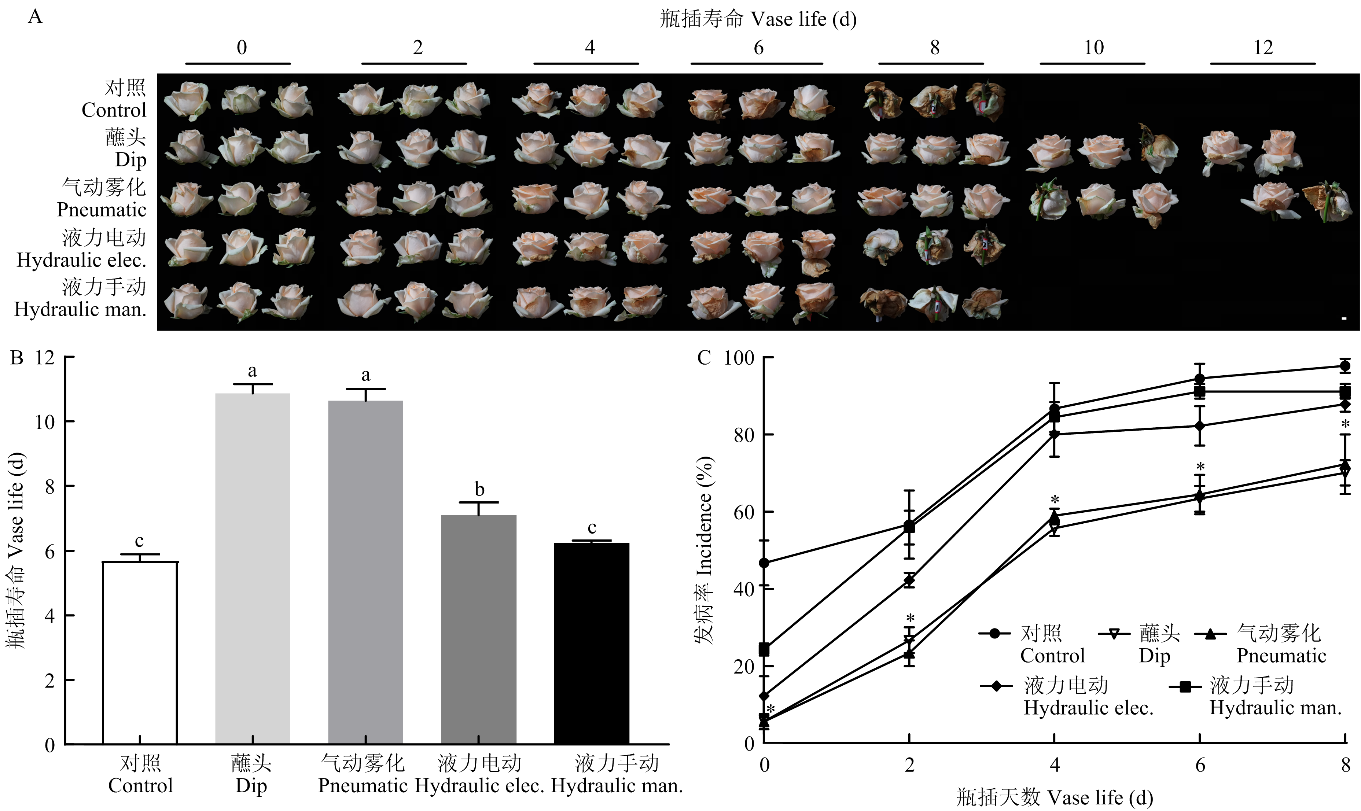
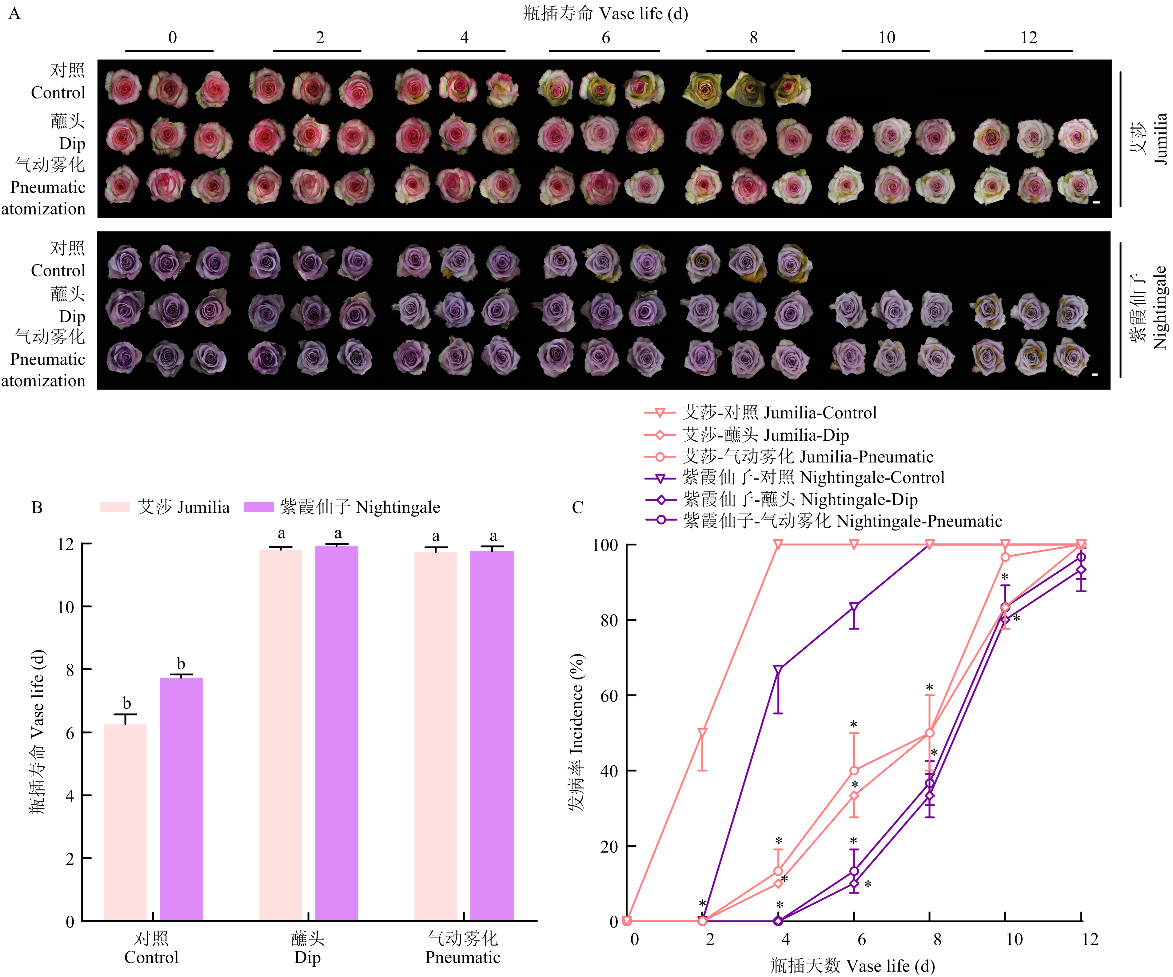
【Objective】To address the problems of pesticide waste, cross-infection, and low efficiency associated with traditional postharvest gray mold control in cut roses, this study aims to explore and establish an efficient and low-pesticide-consumption chemical control technique.【Method】The droplet size and density of pesticide were determined using the water-sensitive paper method to optimize the operational parameters for pneumatic atomization spraying. Three main cut rose cultivars, ‘Peach Avalanche’ ‘Nightingale’ and ‘Jumilia’, were used as test materials to systematically compare four pesticide application methods. The treatments included: (1) pneumatic atomization spraying at 0.40 MPa, (2) hydraulic electric spraying at 0.25 MPa, (3) hydraulic manual spraying at 0.16 MPa, and (4) traditional flower head dipping. Their effects on pesticide deposition parameters and gray mold control efficacy were evaluated. Pesticide deposition parameters were determined using the allura red tracer method and the water-sensitive paper method. Two-level multiple linear regression models of deposition and control efficacy were constructed to quantitatively analyze the relationships among application parameters, deposition efficiency and control efficacy, and to explore the internal mechanism underlying the differences in control efficacy among different treatments.【Result】(1) Spray pressure and target distance significantly affected droplet characteristics during pneumatic atomization spraying. The volume median diameter (VMD) was the smallest and droplet density the highest at 0.4 MPa and 40 cm target distance, representing the optimal application parameter combination. (2) The droplet volume diameter produced by pneumatic atomization spraying was 87.7 μm, the droplet density was 332.6 droplets/cm2, and the uniformity (CV=8.85%) was significantly better than that of hydraulic electric spraying and hydraulic manual spraying. (3) The pesticide deposition rate of pneumatic atomization spraying reached 67.6%, which was equivalent to 89.0% of that of flower head dipping (76.0%). This value was significantly higher than that obtained with hydraulic electric spraying (33.7%) and hydraulic manual spraying (24.7%). (4) After 96 h of simulated postharvest cold-chain transportation, the gray mold incidence of ‘Peach Avalanche’ treated with pneumatic atomization spraying was only 5.56%, with a control efficacy of 82.18%, which did not differ significantly from that of traditional flower head dipping, but was significantly superior to that of conventional hydraulic spraying methods. Notably, the pesticide dosage per stem was merely 0.27 mL, representing an 84.66% reduction compared with that of flower head dipping (1.76 mL/stem). On the 8th day of vase life, the survival rate of cut flowers treated with pneumatic atomization spraying ranged from 60% to 70%, comparable to that of traditional flower head dipping. Two-level multiple linear regression models were constructed for droplet parameters-deposition efficiency (adjusted R2=0.964) and deposition efficiency- control efficacy (adjusted R2=0.838). The results confirmed that pneumatic atomization spraying, with its high droplet density and superior deposition performance, achieved optimal control efficacy. (5) Verification tests on ‘Nightingale’ and ‘Jumilia’ confirmed that pneumatic atomization spraying achieved stable control efficacy across cultivars with differing resistance levels, exhibiting no significant difference from traditional flower head dipping.【Conclusion】Pneumatic atomization spraying is a postharvest gray mold control technology with the advantages of high efficiency, pesticide use reduction and cost savings, which can provide important support for improving the quality and efficiency of the cut rose industry.

Key words: cut rose, gray mold, pneumatic atomization spraying, pesticide deposition rate, control efficacy, postharvest treatment

Table 1

Operational parameters of different spraying methods"

施药方式
Spraying method
喷雾压力
Spray pressure (MPa)
喷头孔径
Nozzle diameter (mm)
喷雾距离
Spray distance (cm)
喷雾流量
Spray flow rate (mL∙s-1)
气动雾化喷雾Pneumatic atomization spraying 0.40 0.8 40 1.82
液力电动喷雾Hydraulic electric spraying 0.25 0.8 40 5.42
液力手动喷雾Hydraulic manual spraying 0.16 0.8 40 4.01

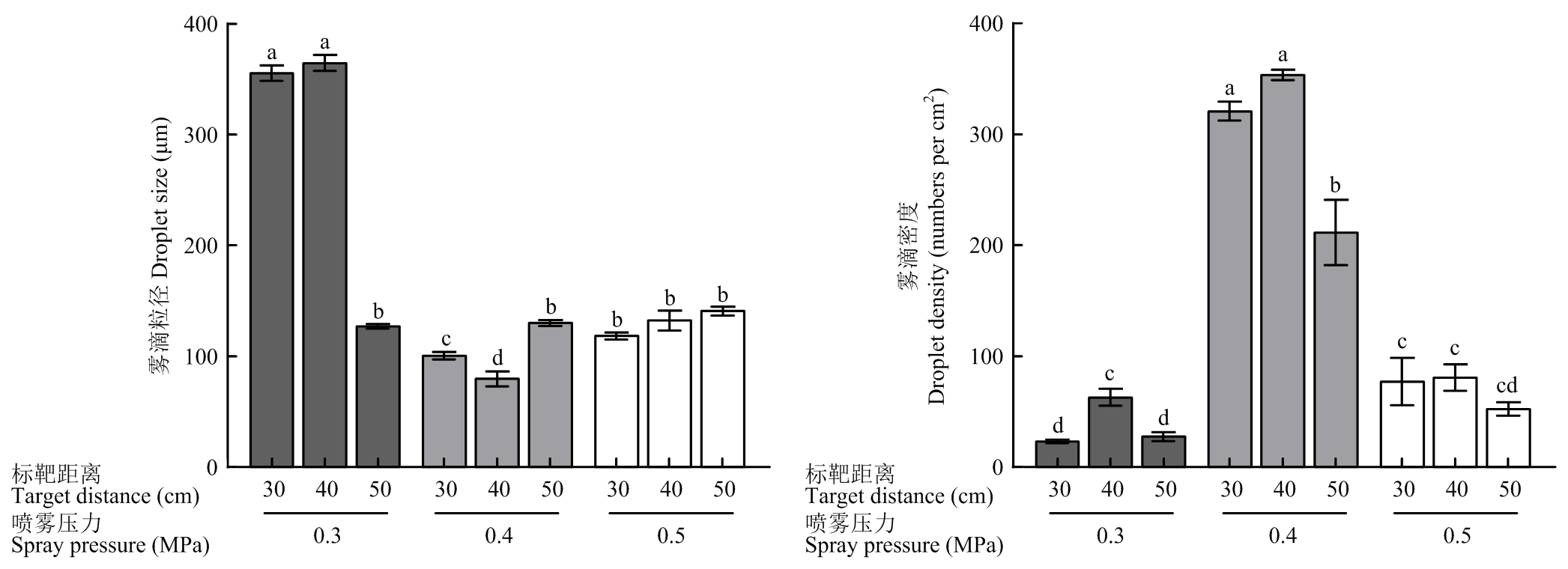
Fig. 1

Droplet size and density under different spray pressures and distances (n=9) Data were average±SE, different lowercase letters indicate significant differences at the 0.05 level. The same as below"

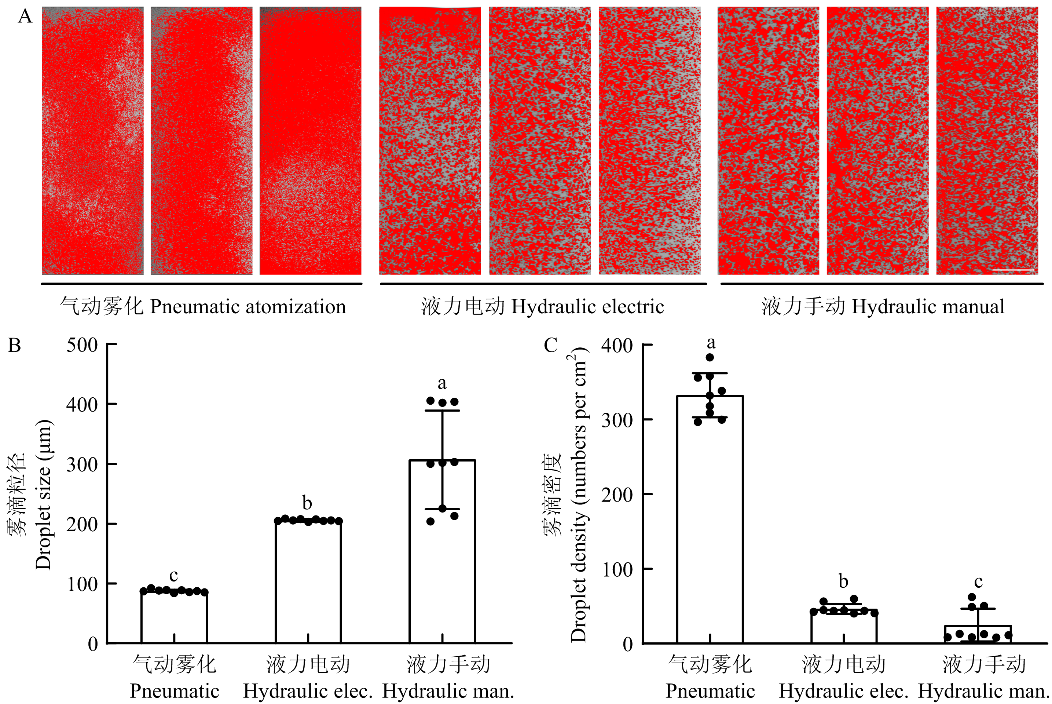
Fig. 2

Deposition distribution of pesticide solution on flower head surfaces by three spraying methods"

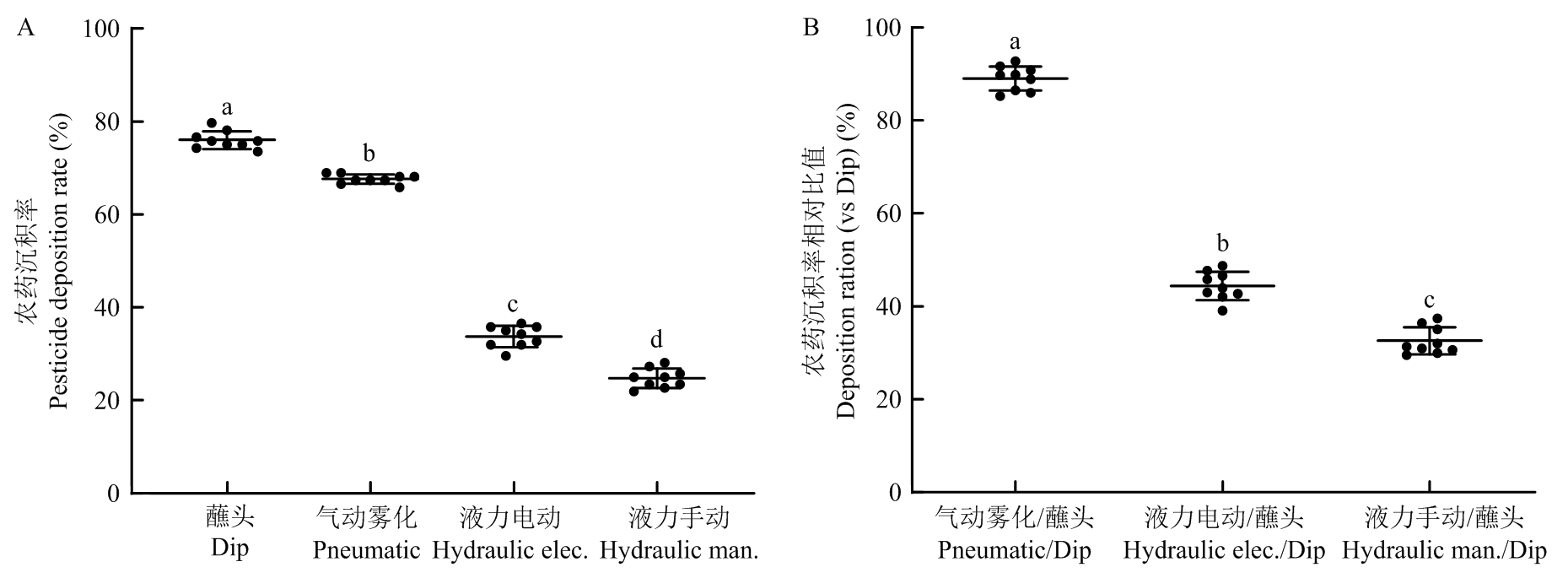
Fig. 3

Pesticide deposition rates of different application methods in cut rose flowers, and three spraying treatments compared with flower head dipping"

Fig. 4

Effects of different application methods on gray mold incidence and vase life of ‘Peach Avalanche’ during postharvest transport and vase life"

Table 2

Control efficacy of different application methods on cut flowers at various vase life periods"

处理
Treatment
病情指数Disease index 防效Control efficacy (%)
模拟运输后0 d
Day 0 after simulated transport
瓶插4 d
Day 4 of
vase life
瓶插8 d
Day 8 of
vase life
模拟运输后0 d
Day 0 after simulated transport
瓶插4 d
Day 4 of
vase life
瓶插8 d
Day 8 of
vase life
对照Control 30.56±6.74a 54.38±1.60a 89.11±5.34a
气动雾化Pneumatic atomization 5.55±1.92c 27.77±4.82b 56.44±2.04c 82.18±3.39a 58.96±1.20a 36.48±5.01a
蘸头处理Flower head dipping 4.44±1.93c 22.20±3.48b 51.78±3.67c 84.24±4.54a 59.26±5.56a 43.20±4.91a
液力电动Hydraulic electric 12.22±5.09b 45.92±5.13a 76.70±1.34b 61.29±8.93b 12.41±10.14b 13.70±6.64b
液力手动Hydraulic manual 22.22±1.92a 49.15±2.21a 86.00±2.00a 25.66±11.06c 9.49±6.77b 3.21±7.15b

Table 3

Multiple linear regression model for control efficacy with deposition rate and days in vase as independent variables"

因子
Factor
非标准化系数 Unstandardized coefficient 标准化系数
Standardized coefficient (Beta)
t
t value
P
P value
容差
Tolerance
方差膨胀因子
VIF
B Std. Error
常量Constant 6.191 3.637 1.702 0.094
沉积率Deposition rate 1.029 0.069 0.786 15.015 <0.001 1.000 1.000
瓶插天数Days in vase -4.114 0.452 -0.476 -9.093 <0.001 1.000 1.000

Fig. 5

Comparison of gray mold control efficacy of pneumatic atomization spraying and flower head dipping on ‘Jumilia’ and ‘Nightingale’"

Table 4

Control efficacy of different application methods on cut rose cultivars with different disease resistances at various vase- holding days"

品种
Cultivar
处理
Treatment
病情指数Disease index 防效Control efficacy (%)
瓶插6 d
Day 6 of vase life
瓶插8 d
Day 8 of vase life
瓶插10 d
Day 10 of vase life
瓶插6 d
Day 6 of vase life
瓶插8 d
Day 8 of vase life
瓶插10 d
Day 10 of vase life
艾莎
Jumilia
对照Control 87.33±1.15a 99.33±1.15a 100.00±0a
气动雾化Pneumatic atomization 28.33±7.64b 48.33±7.64b 56.50±0.87b 67.56±7.94a 51.34±7.57a 43.50±0.87a
蘸头处理Flower head dipping 21.67±7.64b 43.33±5.77b 52.50±2.50b 75.19±8.39a 56.38±5.47a 47.50±2.50a
紫霞仙子
Nightingale
对照Control 53.33±3.33a 93.33±1.15a 96.67±2.31a
气动雾化Pneumatic atomization 13.33±5.77b 23.33±2.89b 56.11±7.88b 74.53±12.60a 74.98±3.25a 42.02±7.26a
蘸头处理Flower head dipping 10.00±0b 23.33±5.77b 55.00±8.66b 81.20±1.18b 75.02±6.01a 42.94±10.47a
[1]
牟雪姣, 张强, 吴燕, 王雪娟. 切花月季保鲜技术研究进展[J]. 仲恺农业工程学院学报, 2023, 36(1): 63-70.
Mu X J, Zhang Q, Wu Y, Wang X J. Research progress on preservation technology of cut rose[J]. Journal of Zhongkai University of Agriculture and Engineering, 2023, 36(1): 63-70.(in Chinese)
[2]
Liu X, Cao X, Shi S, Zhao N, Li D, Fang P, Chen X, Qi W, Zhang Z. Comparative RNA-Seq analysis reveals a critical role for brassinosteroids in rose (Rosa hybrida) petal defense against Botrytis cinerea infection[J]. BMC Genetics, 2018, 19(1): 62.
[3]
陈宇春, 陈敏, 王其刚, 晏慧君, 唐开学, 邱显钦. 植物灰霉病及抗性研究进展[J]. 江苏农业科学, 2020, 48(15): 42-51, 63.
Chen Y C, Chen M, Wang Q G, Yan H J, Tang K X, Qiu X Q. Research progress of plant gray mold and resistance[J]. Jiangsu Agricultural Sciences, 2020, 48(15): 42-51, 63.(in Chinese)
[4]
谷莉莉, 陈长军, 陈永明, 马洪雨. 中国防治灰霉病杀菌剂的登记品种、现状与建议[J]. 农学学报, 2021, 11(11): 19-26.
Gu L L, Chen C J, Chen Y M, Ma H Y. Fungicides for controlling grey mold in China: Registered products, present situation and suggestions[J]. Journal of Agriculture, 2021, 11(11): 19-26.(in Chinese)
[5]
张永强, 王飞钊, 谢锦钿, 张景欣, 林壁润, 杨祁云, 沈会芳, 孙大元, 蒋成爱, 蒲小明. 不同植保器械在水稻不同生育期喷施农药的沉积率及雾滴参数[J]. 农药学学报, 2022, 24(2): 376-384.
Zhang Y Q, Wang F Z, Xie J T, Zhang J X, Lin B R, Yang Q Y, Shen H F, Sun D Y, Jiang C A, Pu X M. Pesticide deposition rates and droplet parameters of different plant protection instruments applied at different growth stages of rice[J]. Chinese Journal of Pesticide Science, 2022, 24(2): 376-384.(in Chinese)
[6]
袁会珠, 陈万权, 杨代斌, 齐淑华, 秦庆明. 药液浓度、 雾滴密度与氧乐果防治麦蚜的关系研究[J]. 农药学学报, 2000, 2(1): 58-62.
Yuan H Z, Chen W Q, Yang D B, Qi S H, Qin Q M. Relationship between the efficacy of wheat aphids control and the omethoate concentration, droplets density[J]. Chinese Journal of Pesticide Science, 2000, 2(1): 58-62.(in Chinese)
[7]
陈奕璇, 覃贵亮, 周晓欣, 黄军军, 蒙全, 吴俊辉, 闫晓静, 袁会珠. 不同植保机械喷施雾滴在水稻冠层沉积分布规律及对病虫害防效比较[J]. 中国水稻科学, 2022, 36(2): 207-214.
Chen Y X, Qin G L, Zhou X X, Hang J J, Meng Q, Wu J H, Yan X J, Yuan H Z. Deposition and distribution of droplets sprayed by different plant protection machinery in rice canopy and comparison of control effects on diseases and pests[J]. Chinese Journal of Rice Science, 2022, 36(2): 207-214.(in Chinese)
[8]
温晶, 陈杰新, 赵亚茹, 郑秋月, 郭云云. 5种植保机械在冬小麦田喷雾作业的效果评价[J]. 中国植保导刊, 2022, 42(1): 70-73, 82.
Wen J, Chen J X, Zhao Y R, Zheng Q Y, Guo Y Y. Evaluation of spraying performance of five plant protection machines in winter wheat fields[J]. China Plant Protection, 2022, 42(1): 70-73, 82.(in Chinese)
[9]
李颖, 祁兴华, 郑莹, 余朝阁, 赵小龙. 喷雾器喷头数量和喷雾压强对农药在番茄上的沉积率和防病效果的影响[J]. 农业工程技术, 2022, 42(10): 46-48.
Li Y, Qi X H, Zheng Y, Yu C G, Zhao X L. Effects of sprayer nozzle quantity and spraying pressure on pesticide deposition rate and disease control efficacy on tomato[J]. Agricultural Engineering Technology, 2022, 42(10): 46-48.(in Chinese)
[10]
陈盛德, 兰玉彬, 周志艳, 廖娟, 朱秋阳. 小型植保无人机喷雾参数对橘树冠层雾滴沉积分布的影响[J]. 华南农业大学学报, 2017, 38(5): 97-102.
Chen S D, Lan Y B, Zhou Z Y, Liao J, Zhu Q Y. Effects of spraying parameters of small plant protection UAV on droplet deposition distribution in citrus canopy[J]. Journal of South China Agricultural University, 2017, 38(5): 97-102.(in Chinese)
[11]
Wu L, Ma N, Jia Y C, Zhang Y, Feng M, Jiang C Z, Ma C, Gao J P. An ethylene-induced regulatory module delays flower senescence by regulating cytokinin content[J]. Plant Physiology, 2017, 173(1): 853-862.
[12]
崔丽, 王金凤, 秦维彩, 尹姣, 袁会珠. 机动弥雾法施用70%吡虫啉水分散粒剂防治小麦蚜虫的雾滴沉积密度与防效的关系[J]. 农药学学报, 2010, 12(3): 313-318.
Cui L, Wang J F, Qin W C, Yin J, Yuan H Z. Relationship between droplet density and field efficacy when applying imidacloprid 700WG against wheat aphids with knapsack mist-blower[J]. Chinese Journal of Pesticide Science, 2010, 12(3): 313-318.(in Chinese)
[13]
邱占奎, 袁会珠, 楼少巍, 纪明山, 于娟娟, 宋晓宇. 水溶性染色剂诱惑红和丽春红-G作为农药沉积分布的示踪剂研究[J]. 农药, 2007, 46(5): 323-325, 337.
Qiu Z K, Yuan H Z, Lou S W, Ji M S, Yu J J, Song X Y. The research of water soluble dyes of allura red and ponceau-G as tracers for determing pesticide spray distribution[J]. Agrochemicals, 2007, 46(5): 323-325, 337.(in Chinese)
[14]
Jensen P K, Olesen M H. Spray mass balance in pesticide application: A review[J]. Crop Protection, 2014, 61: 23-31.
[15]
国家市场监督管理总局、 国家标准化管理委员会. 主要切花产品采后处理技术规程: GB/T 23897-2024[S] (2024-03-15) [2026-03-11].
State Administration for Market Regulation, Standardization Administration of the People’s Republic of China. Technical code of practice for postharvest handling of major cut flower products: GB/T 23897-2024[S] (2024-03-15) [2026-03-11].(in Chinese)
[16]
中华人民共和国农业农村部. 农药田间药效试验准则(一)杀菌剂防治蔬菜灰霉病: GB/T17980.28-2000[S] (2000-02-01) [2026-03-11].
Ministry of Agriculture and Rural Affairs of the People’s Republic of China. Pesticide-guidelinesforthefieldefficacytrials(I)-Fungicidesagainstgreymouldofvegetables:GB/T17980.28-2000[S] (2000-02-01) [2026-03-11].(in Chinese)
[17]
Capdeville G, Paul N, Elad Y. Gray mold severity and vase life of rose buds after pulsing with citric acid, salicylic acid, calcium sulfate, sucrose and 8-hydroxyquinoline citrate[J]. Postharvest Biology and Technology, 2003, 29(2): 147-154.
[18]
Saffman P G, Meiron D I. Kinetic energy generated by the incompressible Richtmyer-Meshkov instability in a continuously stratified fluid[J]. Physics of Fluids A: Fluid Dynamics, 1989, 1(11): 1767-1771.
[19]
He L, Ding L, Zhang P, Li B, Mu W, Liu F. Impact of the equilibrium relationship between deposition and wettability behavior on the high-efficiency utilization of pesticides[J]. Pest Management Science, 2021, 77(5): 2485-2493.
[20]
Lee Y B, Kim W S. ClO2 dipping treatment inhibits gray mold on cut rose flowers during storage[J]. The Horticulture Journal, 2020, 89(4): 496-501.
[21]
Fisher R W, Menzies D I, Herne D C, Chiba M. Parameters of dicofol spray deposit in relation to mortality of European red mite[J]. Journal of Economic Entomology, 1974, 67(1): 124-126.
[22]
Munthali D C, Wyatt I J. Factors affecting the biological efficiency of small pesticide droplets against Tetranychus urticae eggs[J]. Pesticide Science, 1986, 17(2): 155-164.
[23]
Salyani M, Fox R D. Evaluation of spray quality by oil and water-sensitive papers[J]. Transactions of the ASAE, 1999, 42(1): 37-43.
[24]
袁会珠, 王国宾. 雾滴大小和覆盖密度与农药防治效果的关系[J]. 植物保护, 2015, 41(6): 9-16.
Yuan H Z, Wang G B. Effects of droplet size and deposition density on field efficacy of pesticides[J]. Plant Protection, 2015, 41(6): 9-16.(in Chinese)
[25]
刘秀娟, 周宏平, 郑加强. 农药雾滴飘移控制技术研究进展[J]. 农业工程学报, 2005, 21(1): 186-190.
Liu X J, Zhou H P, Zheng J Q. Research progress on pesticide droplet drift control technology[J]. Transactions of the Chinese Society of Agricultural Engineering, 2005, 21(1): 186-190.(in Chinese)
[26]
王国宾, 王十周, 陈鹏超, 韩小强, 单常峰, 陈盛德, 兰玉彬. 植保无人机喷施不同雾滴粒径药剂对其在棉花冠层沉积、穿透及脱叶催熟效果的影响[J]. 植物保护学报, 2021, 48(3): 493-500.
Wang G B, Wang S Z, Chen P C, Han X Q, Shan C F, Chen S D, Lan Y B. Effect of spraying droplet size with drones on deposition, penetration, and cotton harvest-aid efficacy[J]. Journal of Plant Protection, 2021, 48(3): 493-500.(in Chinese)
[27]
Grinstein A, Riven Y, Elad Y. Improved chemical control of botrytis blight in roses[J]. Phytoparasitica, 1997, 25(1): S87-S92.
[28]
Macnish A J, Morris K L, de Theije A, Mensink M G J, Boerrigter H A M, Reid M S, Jiang C Z, Woltering E J. Sodium hypochlorite: A promising agent for reducing Botrytis cinerea infection on rose flowers[J]. Postharvest Biology and Technology, 2010, 58(3): 262-267.
[29]
李辉辉, 朱晓锋, 赵莉, 秦坤焕, 徐兵强, 宋博, 陈浩宇. 不同施药方式防治枣瘿蚊的效果及效益分析[J]. 中国植保导刊, 2024, 44(9): 79-81.
Li H H, Zhu X F, Zhao L, Qin K H, Xu B Q, Song B, Chen H Y. Analysis of the effects and benefits of different pesticide application methods on the control of jujube gall mosquitoes[J]. China Plant Protection, 2024, 44(9): 79-81.(in Chinese)
[30]
王文慧. 切花月季花朵形态生理特性与灰霉病发生的关联分析[D]. 北京: 中国农业大学, 2024.
Wang W H. Analysis of the correlation between the morphological and physiological characteristics of cut rose flowers and the occurrence of gray mold disease[D]. Beijing: China Agricultural University, 2024.(in Chinese)
[1] ZHANG DongMei, ZHOU XinXin, XIAO GuiLin, ZENG XiangGuo, WANG ChunYan, WANG ZeXian, HAN YongChao. Phenotypic Characteristics of Strawberry Floral Organs in Response to Botrytis cinerea Infection and Methods for Gray Mold Resistance Evaluation [J]. Scientia Agricultura Sinica, 2026, 59(7): 1456-1466.
[2] HOU PuXing, WANG Yong, FENG JunTao, MA ZhiQing, WU Hua. Inhibitory Activities of Ethanol Extracts from 75 Plants Against Two Soil-Borne Pathogens [J]. Scientia Agricultura Sinica, 2026, 59(2): 322-335.
[3] SHI CaiHua, JIN Jie, HUA DengKe, HU JingRong, ZHANG YouJun, HUANG ShengLin, WU MingYue, KONG XiangYi, XIE Wen. Development and Application of Novel Physical Control Technologies Based on the Correlation Between Megalurothrips usitatus Outbreaks and Cowpea Flower Development Dynamics [J]. Scientia Agricultura Sinica, 2025, 58(21): 4382-4392.
[4] ZHAO YuLei, XIN JiaLu, LI ChengNan, LI Shan, XIE XuFei, YIN Xiao. Screening of Target Genes Downstream of VviERF045, a Transcription Factor Associated with Gray Mold Resistance in Vitis vinifera [J]. Scientia Agricultura Sinica, 2025, 58(13): 2578-2590.
[5] SHAO ShuJun,HU ZhangJian,SHI Kai. The Role and Mechanism of Linoleyl Ethanolamide in Plant Resistance Against Botrytis cinerea in Tomato [J]. Scientia Agricultura Sinica, 2022, 55(9): 1781-1789.
[6] Fen LU,RunJie MENG,Jie WU,JianJiang ZHAO,Yang LI,QiuYan BI,XiuYing HAN,JingHua LI,WenQiao WANG. Monitoring of Resistance Dynamics of Phytophthora infestans to Cymoxanil and Control Efficacy Validation of Cymoxanil-Containing Fungicides Against Potato Late Blight [J]. Scientia Agricultura Sinica, 2022, 55(18): 3556-3564.
[7] ZHOU JingLong,FENG ZiLi,WEI Feng,ZHAO LiHong,ZHANG YaLin,ZHOU Yi,FENG HongJie,ZHU HeQin. Biocontrol Effect and Mechanism of Cotton Endophytic Bacterium YUPP-10 and Its Secretory Protein CGTase Against Fusarium Wilt in Cotton [J]. Scientia Agricultura Sinica, 2021, 54(17): 3691-3701.
[8] XIE KunLun,LIU LiMing,LIU Mei,PENG Bin,WU HuiJie,GU QinSheng. Prokaryotic Expression of dsRNA of Zucchini yellow mosaic virus and Its Control Efficacy on ZYMV [J]. Scientia Agricultura Sinica, 2020, 53(8): 1583-1593.
[9] HuaFei ZHOU,HongFu YANG,KeBing YAO,YiQing ZHUANG,ZhaoLin SHU,ZhiYi CHEN. FliZ Regulated the Biofilm Formation of Bacillus subtilis Bs916 and Its Biocontrol Efficacy on Rice Sheath Blight [J]. Scientia Agricultura Sinica, 2020, 53(1): 55-64.
[10] CHUAI HongYun,SHI YanXia,CHAI ALi,YANG Jie,XIE XueWen,LI BaoJu. Development of 10% Diethofencarb·Procymidone Micropowder and Its Control Efficacy to Cucumber Corynespora Leaf Spot [J]. Scientia Agricultura Sinica, 2019, 52(6): 1009-1020.
[11] BAI RuXia,ZENG HuiWen,FAN Qian,YIN Jie,SUI ZongMing,YUAN Ling. Effects of Ceriporia lacerata on Gummy Stem Blight Control, Growth Promotion and Yield Increase of Cucumbers [J]. Scientia Agricultura Sinica, 2019, 52(15): 2604-2615.
[12] Bo LIU,QianQian CHEN,JiePing WANG,ChuanQing RUAN,YanPing CHEN,JiangPing XIA,JianMei CHE,Zheng CHEN,ZhiZhen PAN,Xiao WEN,YuJing ZHU,HaiFeng ZHANG,XueFang ZHENG. Proposition, Development and Application of the Integrated Microbiome Agent (IMA) [J]. Scientia Agricultura Sinica, 2019, 52(14): 2450-2467.
[13] HE LiFei, CHEN LeLe, XIAO Bin, ZHAO ShiFeng, LI XiuHuan, MU Wei, LIU Feng. Establishment of Sensitivity Baseline and Evaluation of Field Control Efficacy of Fludioxonil Against Fulvia fulva [J]. Scientia Agricultura Sinica, 2018, 51(8): 1475-1483.
[14] WEI XinYan, HUANG YuanYuan, HUANG YaLi, DU KeJiu. Antagonism of Bacillus methylotrophicus Strain BH21 to Botrytis cinerea [J]. Scientia Agricultura Sinica, 2018, 51(5): 883-892.
[15] HaiChao CAO,XiuHuan LI,XiaoKun WANG,HaiXiu BAI,Wei MU,Feng LIU. Control Efficacy of Pyraclostrobin and Triazole Fungicides Against Tomato Crown and Root Rot [J]. Scientia Agricultura Sinica, 2018, 51(21): 4065-4075.
Viewed
Full text


Abstract

Cited

  Shared   
  Discussed   
No Suggested Reading articles found!