Scientia Agricultura Sinica ›› 2026, Vol. 59 ›› Issue (11): 2468-2483.doi: 10.3864/j.issn.0578-1752.2026.11.012

• HORTICULTURE • Previous Articles     Next Articles

Genetic Diversity Analysis and Comprehensive Evaluation of Phenotypic Traits in 364 Cherry Tomato Germplasm Resources

ZHANG YueQing1(), ZHANG YuTing1, XUE ChenFei1, HAN QinYu1, HE YiRong1, XU ZiJuan1, FAN XiuMei1, WANG JunE1, LUO Dan1, FENG Xue2, SUN Sheng1()   

  1. 1 College of Horticulture, Shanxi Agricultural University/Shanxi Key Laboratory of Germplasm Resources Innovation and Utilization of Vegetable and Flower, Taigu 030801, Shanxi
    2 College of Plant Protection, Shanxi Agricultural University, Taigu 030801, Shanxi
  • Received:2026-01-06 Accepted:2026-03-07 Online:2026-06-01 Published:2026-06-03
  • Contact: SUN Sheng

Abstract:

【Objective】To analyze the genetic diversity of phenotypic traits in cherry tomato germplasm resources, conduct a comprehensive evaluation, and screen for superior cherry tomato materials. This aims to provide a basis for the selection, utilization, and breeding of core cherry tomato germplasm. 【Method】This study utilized 364 cherry tomato germplasm resources from domestic and international sources as experimental materials, measuring 41 phenotypic traits. Employing multivariate statistical analysis methods including genetic diversity indices, correlation analysis, principal component analysis, systematic clustering, and membership function analysis, the research conducted genetic diversity analysis, cluster classification, and comprehensive evaluation of cherry tomato germplasm phenotypes.【Result】The coefficient of variation (CV) for 364 cherry tomato phenotypic traits ranged from 9.72% to 45.18%, with the highest CV observed for single fruit weight. Genetic diversity indices ranged from 0.14 to 2.17. The results of the correlation analysis indicate that significant or highly significant correlations exist between quantitative traits. Principal component analysis extracted 13 principal components with a cumulative contribution rate of 70.525%, representing most trait information of cherry tomato germplasm. Through cluster analysis, the test materials were classified into eight categories. Based on the systematic clustering results, the test materials were divided into eight groups. GroupⅠ comprises 29 materials suitable as parental lines for high-yield breeding. GroupⅡ includes 25 materials that can be utilized as fresh-market varieties. GroupⅢ contains only one material, T12, exhibiting unique characteristics. GroupⅣ, comprising 27 materials, is suitable for developing varieties with excellent commercial traits and storage/transport tolerance. GroupⅤ, with 75 materials, serves as a key resource for improving fruit flavor and breeding high-sugar varieties. GroupⅥ, containing 49 materials, exhibits a high sugar-to-acid ratio and favorable taste profile, holding significant value for fresh-eating flavor enhancement. GroupⅦ comprises 150 materials, the largest group, demonstrating significant potential for early-maturing breeding. GroupⅧ contains only 8 materials with distinctive fruit shapes, suitable for developing specialty fresh-eating varieties or for processing into sauces. Comprehensive evaluation using weighted membership functions selected the top 29 cherry tomato germplasm materials based on overall phenotypic performance, identifying 23 key trait indicators. 【Conclusion】The 364 cherry tomato germplasm resources showed extensive phenotypic variation and genetic diversity. They were classified into eight groups by cluster analysis, with 23 key indicators identified via principal component analysis, and 29 germplasm materials with superior comprehensive traits selected through membership function analysis.

Key words: cherry tomato, germplasm resources, phenotypic traits, genetic diversity, comprehensive evaluation

Table 1

Genetic diversity analysis of quantitative traits in 364 cherry tomato germplasm resources"

性状
Trait
最小值
Minimum
最大值
Maximum
平均值
Mean
标准差
Standard deviation
变异系数
Coefficient of variation (%)
多样性指数
H
叶片长LLH (cm) 18.80 42.00 30.82 4.35 14.11 2.05
叶片宽LW (cm) 15.40 45.20 30.14 4.99 16.56 2.05
首花序节位NFI 4.00 10.00 5.85 1.10 18.77 1.87
第二花序节位NSI 6.80 18.20 9.23 1.46 15.84 1.86
单花序花数FLNPI 6.00 62.80 12.54 5.10 40.66 1.66
单花序果数FRNPI 5.20 36.40 11.26 3.50 31.11 1.85
坐果率FSR 0.26 1.00 0.92 0.09 9.82 1.62
果柄长度PL (mm) 6.83 16.91 10.20 1.59 15.62 2.02
节间长度IL (cm) 14.40 42.00 23.83 4.35 18.27 1.95
株高PH (cm) 46.40 178.20 85.24 17.51 20.54 1.91
单果重WPF (g) 2.71 54.10 16.59 7.50 45.18 1.93
商品果横径CFW (mm) 15.05 48.36 28.23 5.04 17.85 2.05
商品果纵径CFL (mm) 15.25 63.37 32.61 7.65 23.46 1.97
果形指数FSI 0.72 3.04 1.18 0.33 28.37 1.61
硬度FH (kg·cm-2) 0.59 4.70 2.16 0.68 31.46 1.88
可溶性固形物含量SSC (%) 3.70 12.27 7.36 1.58 21.49 2.05
酸含量AC (%) 0.20 0.96 0.58 0.18 30.54 2.07
糖酸比BAR 5.08 36.89 13.97 5.17 37.02 1.84
果肉厚FTH (mm) 0.99 6.60 3.03 0.94 31.21 2.05
心室数NL 2.00 3.33 2.10 0.23 11.03 0.60
平均Mean 23.94 1.84

Table 2

Genetic diversity analysis of qualitative traits in 364 cherry tomato germplasm resources"

质量性状Qualitytrait 多样性指数H 等级及频率Grade and frequency (%)
茎叶茸毛SLF 0.85 0(0.00);1(24.45);2(4.40);3(68.13);4(3.02)
叶片类型LT 0.68 1(14.29);2(0.27);3(26.37);4(59.07)
叶片形状LS 0.14 1(14.84);2(85.16)
叶裂刻LLO 0.94 0(0.00);1(15.66);2(63.46);3(20.88)
花序类型IT 0.77 1(0.00);2(69.51);3(6.59);4(23.90)
花柱长度SL 0.95 1(25.55);2(58.79);3(15.66)
花色FLOC 0.70 1(25.55);2(71.15);3(3.30)
成熟前果色CBR 1.26 1(43.68);2(39.56);3(2.47);4(3.57);5(4.40);6(6.04);7(0.27)
成熟果色CMF 2.17 1(0.27);2(0.82);3(2.47);4(10.99);5(4.40);6(5.22);7(46.15);8(1.10);9(0.55);10(3.30);11(0.55);12(1.10);13(2.47);14(0.55);15(0.82);16(2.75);17(1.10);18(0.82);19(1.92);20(1.10);21(1.10);22(7.69);23(0.27);24(0.27);25(0.82);26(0.55);27(0.55);28(0.27)
果面棱沟FRG 0.82 0(47.80);1(31.59);2(13.74);3(6.87)
果顶形状FAS 0.84 1(0.27);2(3.30);3(72.80);4(17.58);5(6.04)
果肩FSO 0.43 0(15.66);1(84.34)
果肩形状FTS 0.89 1(34.62);2(57.42);3(7.97)
果肩色FSC 1.48 1(48.53);2(25.08);3(13.36);4(13.03)
绿果肩大小GSS 0.86 1(33.52);2(44.23);3(4.12)
果形FSA 1.50 1(0.55);2(2.47);3(54.12);4(16.48);5(8.79);6(4.95);7(4.67);8(6.59);9(1.37)
果肉色FLEC 1.61 1(6.87);2(6.04);3(11.54);4(45.33);5(16.76);6(9.89);7(3.57)
胎座胶状物质颜色CPGS 1.79 1(7.97);2(26.92);3(11.54);4(14.29);5(23.63);6(12.64);7(3.02)
肉质FT 1.07 1(54.95);2(13.74);3(3.30);4(28.02)
裂果性FCS 0.97 0(64.29);1(20.88);2(12.09);3(2.75)
风味FL 1.35 1(15.11);2(31.87);3(23.08);4(29.95)
平均Mean 1.05

Fig. 1

Correlation analysis of quantitative traits in 364 cherry tomato germplasm resources"

Table 3

Principal component analysis of phenotypic traits in 364 cherry tomato germplasm resources"

性状
Trait
主成分Principal component
PC1 PC2 PC3 PC4 PC5 PC6 PC7 PC8 PC9 PC10 PC11 PC12 PC13
叶片长LLH 0.729 -0.220 0.089 0.122 0.230 0.071 0.010 0.032 -0.260 0.027 0.006 -0.162 0.016
叶片宽LW 0.702 -0.349 0.028 0.193 0.274 0.034 -0.014 0.046 -0.210 -0.004 -0.020 -0.116 0.048
首花序节位NFI 0.297 0.533 -0.327 -0.023 -0.029 0.389 0.246 -0.125 0.199 -0.149 -0.216 -0.111 -0.013
第二花序节位NSI 0.351 0.492 -0.427 -0.049 0.006 0.401 0.261 -0.045 0.207 -0.093 -0.183 -0.149 -0.005
单花序花数FLNPI 0.353 -0.086 -0.467 -0.558 0.032 -0.119 0.027 0.074 0.180 0.322 0.146 0.114 0.212
单花序果数FRNPI 0.287 -0.179 -0.438 -0.438 0.033 -0.107 0.018 -0.059 0.253 0.255 0.237 0.077 0.345
坐果率FSR -0.261 -0.098 0.140 0.410 0.012 0.234 0.042 -0.351 0.043 -0.160 0.155 -0.151 0.166
果柄长度PL 0.450 0.138 0.441 -0.216 0.077 -0.051 0.068 0.054 -0.315 -0.045 0.016 0.169 0.020
节间长度IL 0.676 0.213 -0.268 -0.272 0.034 -0.042 0.221 0.100 0.050 -0.085 0.109 -0.059 -0.130
株高PH 0.634 0.329 -0.334 -0.263 0.094 0.083 0.263 0.006 0.003 -0.131 0.038 -0.049 -0.093
单果重WPF 0.588 0.323 0.243 0.477 -0.058 -0.304 0.019 -0.141 -0.004 -0.061 -0.004 -0.005 0.083
商品果横径CFW 0.529 0.173 -0.047 0.632 -0.111 -0.332 0.077 -0.102 -0.041 -0.111 0.046 0.005 0.120
商品果纵径CFL 0.446 0.421 0.680 -0.068 0.156 -0.062 -0.068 -0.103 0.064 0.011 -0.008 0.051 0.060
果形指数FSI 0.055 0.267 0.670 -0.462 0.220 0.182 -0.114 -0.043 0.108 0.099 -0.053 0.040 -0.016
硬度FH 0.396 -0.001 0.210 -0.014 -0.331 -0.164 -0.140 -0.048 0.261 -0.200 0.216 0.163 0.002
可溶性固形物含量SSC -0.137 -0.230 0.112 -0.289 0.133 0.033 0.325 0.335 -0.159 -0.487 0.026 0.261 0.201
酸含量AC 0.220 0.146 0.009 -0.151 -0.561 0.308 -0.171 0.453 -0.304 -0.081 0.249 -0.091 0.019
糖酸比BAR -0.305 -0.248 -0.020 -0.039 0.581 -0.265 0.350 -0.205 0.189 -0.233 -0.213 0.247 0.083
果肉厚FTH 0.494 0.047 0.098 0.206 -0.127 -0.098 -0.220 0.032 0.150 -0.241 -0.015 0.133 0.374
心室数NL -0.055 0.028 0.111 0.063 0.035 -0.305 0.088 -0.055 0.035 0.248 0.271 -0.524 0.203
茎叶茸毛SLF 0.268 -0.130 0.042 0.184 0.005 -0.038 0.101 0.033 -0.263 0.354 -0.349 0.149 0.132
叶片类型LT 0.192 -0.399 0.090 0.349 0.241 0.606 0.039 -0.084 0.135 0.196 0.239 0.104 0.008
叶片形状LS 0.301 -0.475 0.145 0.402 0.239 0.473 0.063 0.010 0.108 0.181 0.157 0.138 -0.023
叶裂刻LLO 0.311 -0.202 -0.011 0.267 0.002 0.070 0.051 0.248 0.028 0.241 -0.370 0.146 -0.035
花序类型IT 0.229 -0.068 -0.122 -0.384 0.332 -0.213 0.023 -0.257 -0.007 0.122 0.066 -0.042 -0.198
花柱长度SL 0.003 0.327 -0.207 0.234 -0.095 -0.112 -0.075 0.036 0.319 0.139 0.024 0.247 0.050
花色FLOC -0.190 0.133 0.237 0.180 -0.044 -0.086 -0.032 0.189 0.403 0.120 0.026 0.052 0.099
成熟前果色CBR -0.192 0.733 -0.148 0.189 -0.095 0.058 -0.048 -0.096 -0.123 0.135 -0.138 0.110 0.114
成熟果色CMF -0.279 0.377 0.119 0.149 -0.002 0.032 0.346 -0.268 -0.073 0.146 0.199 -0.099 -0.123
果面棱沟FRG 0.299 0.104 0.407 -0.191 0.207 -0.075 -0.311 0.128 0.242 -0.024 -0.002 -0.003 -0.287
果顶形状FAS -0.010 0.235 0.583 -0.219 0.125 0.241 0.103 -0.094 -0.028 0.037 -0.043 -0.084 0.343
果肩FSO -0.166 0.320 -0.166 0.101 0.626 0.009 -0.199 0.432 -0.015 -0.020 0.084 -0.140 0.018
果肩形状FTS 0.355 -0.320 -0.148 0.276 0.154 -0.329 -0.006 0.035 0.069 -0.094 0.016 -0.133 -0.319
果肩色FSC -0.201 0.677 -0.230 0.243 0.348 -0.079 -0.109 0.134 -0.211 0.054 -0.020 0.004 0.052
绿果肩大小GSS -0.219 0.355 -0.202 0.324 0.524 -0.015 -0.134 0.408 0.062 0.047 0.184 0.067 0.055
果形FSA 0.045 0.336 0.608 -0.251 0.119 0.008 -0.062 -0.099 0.024 0.111 0.048 0.051 -0.155
果肉色FLEC -0.086 0.009 0.350 0.189 -0.068 -0.096 0.579 0.349 0.275 -0.022 0.109 -0.081 -0.119
胎座胶状物质颜色CPGS -0.086 -0.061 0.421 0.097 -0.298 -0.072 0.409 0.387 0.256 0.160 -0.099 -0.115 -0.021
肉质FT 0.054 0.015 -0.107 0.150 0.040 0.228 -0.365 -0.093 0.344 -0.309 0.081 0.015 -0.100
裂果性FCS -0.163 0.212 -0.005 0.098 0.089 -0.025 0.317 -0.096 -0.283 -0.060 0.510 0.315 -0.044
风味FL 0.147 0.262 -0.132 0.160 -0.246 0.001 0.046 -0.057 -0.062 0.257 0.102 0.416 -0.289
特征值Characteristic value 4.861 3.775 3.686 3.098 2.325 1.858 1.679 1.528 1.497 1.298 1.179 1.116 1.015
贡献率Contribution rate (%) 11.855 9.208 8.990 7.555 5.671 4.531 4.096 3.727 3.652 3.167 2.876 2.722 2.475
累计贡献率
Accumulating contribution rate (%)
11.855 21.063 30.053 37.608 43.279 47.810 51.907 55.633 59.285 62.452 65.328 68.049 70.525

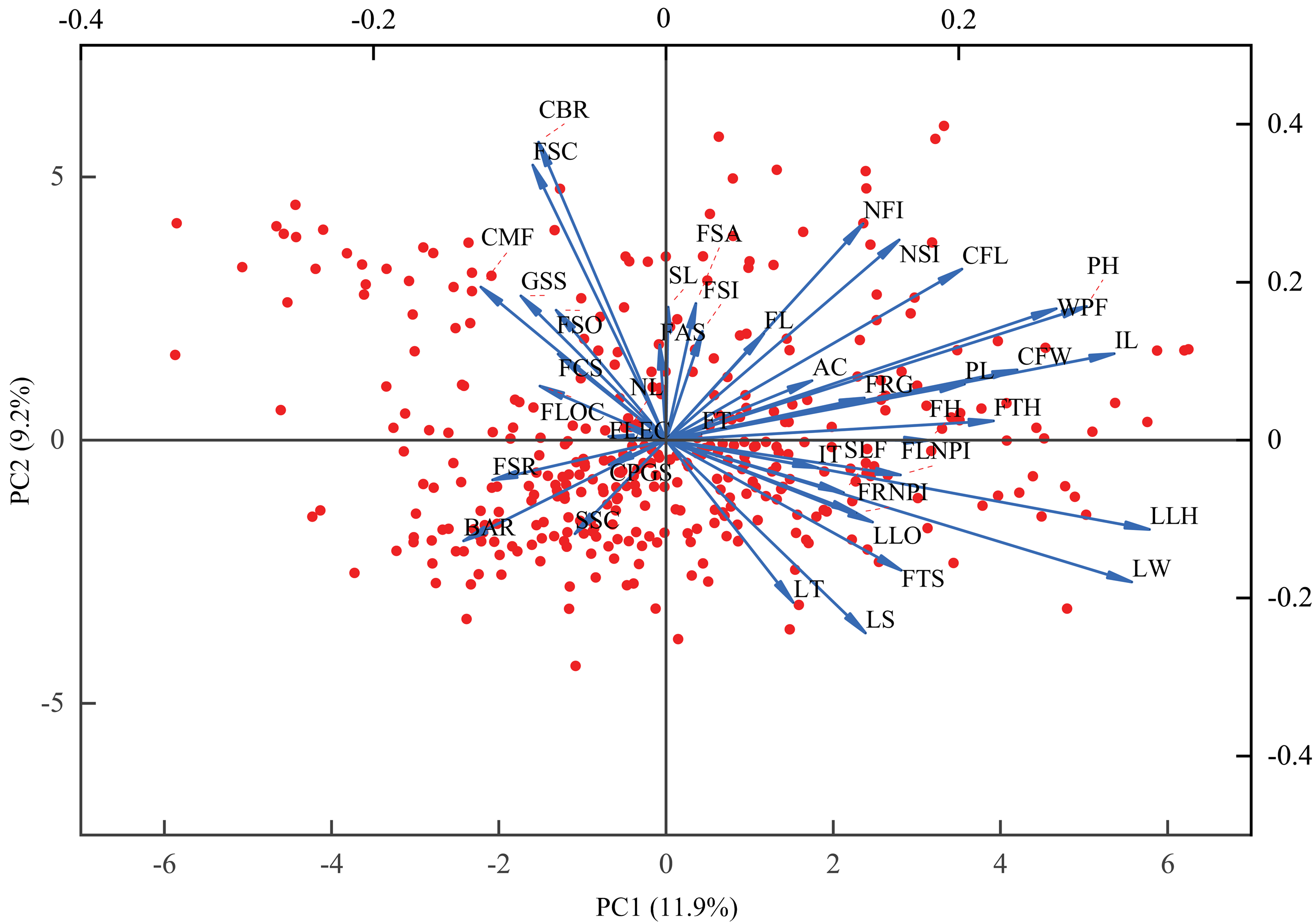
Fig. 2

Principal component analysis bivariate plot of 41 traits in 364 cherry tomato germplasm resources The red dots represent different cherry tomato germplasm materials, and the blue arrows represent the loading vectors of the traits"

Fig. 3

Cluster analysis of phenotypic traits in 364 cherry tomato germplasm resources The numbers in the figure correspond to those in Supplementary Table 1"

Table 4

Top 29 comprehensive ranking of phenotypic traits information table"

种质编号 Number 品种名称 Variety name FF value 排名 Ranking
B-12 黑-2 Black-2 0.6781 1
B-1 黑珍珠T501-1 Black Pearl T501-1 0.6586 2
S30 GT-1 0.6580 3
B-3 黑珍珠T501-2 Black Pearl T501-2 0.6555 4
S32 GT-3 0.6548 5
B-13 黑-3 Black-3 0.6523 6
B-8 黑珍珠9-2 Black Pearl 9-2 0.6471 7
B-11 黑1 Black 1 0.6434 8
B-2 黑珍珠T501-1 Black Pearl T501-1 0.6397 9
T124 绿洋梨Lvyangli 0.6394 10
B-4 红H2-1 Red H2-1 0.6382 11
S51 YT+P 0.6362 12
S87 191杂株191 Off-type 0.6355 13
S71 R-11 0.6325 14
B-5 红H2-2 Red H2-2 0.6273 15
S40 YG+P-2 0.6228 16
T118 绿桃XLFF2-02 Green Peach XLFF2-02 0.6179 17
T134 宏洋梨Hong Yangli 0.6164 18
T117 绿圣TY Green Sacred TY 0.6159 19
B-6 黑珍珠9-1 Black Pearl 9-1 0.6138 20
T113 绿洋梨XDX-G-03 Green Pear XDX-G-03 0.6103 21
B-10 黑珍珠1-2 Black Pearl 1-2 0.6073 22
S15 choc-2 0.6056 23
S47 GT+P-2 0.6040 24
B-7 黑珍珠9-3 Black Pearl 9-3 0.6039 25
S39 YG+P-1 0.6033 26
T313 72-1红小19.7.9 72-1 Red Small Fruit 19.7.9 0.6031 27
Y-1 CHERRY-1 0.6020 28
T304 63-1红小19.7.9 63-1 Red Small Fruit 19.7.9 0.6009 29
[1]
CHAUDHARY P, SHARMA A, SINGH B, NAGPAL A K. Bioactivities of phytochemicals present in tomato. Journal of Food Science and Technology, 2018, 55(8): 2833-2849.

doi: 10.1007/s13197-018-3221-z pmid: 30065393
[2]
原静云, 原让花, 李贞霞, 王晓玲. 我国番茄种质资源研究进展. 种业导刊, 2016(4): 9-14.
YUAN J Y, YUAN R H, LI Z X, WANG X L. Research progress of tomato germplasm resources in China. Journal of Seed Industry Guide, 2016(4): 9-14. (in Chinese)
[3]
乐素菊, 刘厚诚, 翟英芬, 谢勇. 樱桃番茄果实风味分析. 中国蔬菜, 2003(3): 15-17.
LE S J, LIU H C, ZHAI Y F, XIE Y. Studies on flavor of cherry tomato fruit. China Vegetables, 2003(3): 15-17. (in Chinese)
[4]
康建坂. 两个樱桃番茄新品种选育研究[D]. 福州: 福建农林大学, 2009.
KANG J B. Breeding of two new cherry tomato varieties[D]. Fuzhou: Fujian Agriculture and Forestry University, 2009. (in Chinese)
[5]
张琪. 樱桃番茄品种资源评价和影响樱桃番茄耐贮性因素的初探[D]. 长沙: 湖南农业大学, 2006.
ZHANG Q. Evaluations of cherry tomato variety resources and primary studies on the affect factors of long-storability[D]. Changsha: Hunan Agricultural University, 2006. (in Chinese)
[6]
吴丽艳, 龚亚菊, 黎志彬, 鲍锐, 钟利, 梁明泰. 樱桃番茄种质资源果实相关性状的多元统计分析. 西南农业学报, 2012, 25(5): 1818-1822.
WU L Y, GONG Y J, LI Z B, BAO R, ZHONG L, LIANG M T. Multivariate statistical analysis of fruit characters of cherry tomato germplasm resources. Southwest China Journal of Agricultural Sciences, 2012, 25(5): 1818-1822. (in Chinese)
[7]
李建华, 刘仲齐. 加工技术和育种技术对美国番茄生产的影响. 天津农业科学, 2010, 16(2): 97-101.
LI J H, LIU Z Q. Effects of processing and breeding techniques on production of tomato in America. Tianjin Agricultural Sciences, 2010, 16(2): 97-101. (in Chinese)
[8]
钱迎倩.生物多样性研究的原理与方法:生物多样性研究系列专著. 北京: 中国科学技术出版社, 1994.
QIAN Y Q. Principles and Methods of Biodiversity Research:A Series of Monographs on Biodiversity Research. Beijing: China Science and Technology Press, 1994. (in Chinese)
[9]
李正为. 番茄砧木种质资源的评价与嫁接研究[D]. 南宁: 广西大学, 2012.
LI Z W. Evaluation of germplasm resources of tomato stock and proof by grafting experiment[D]. Nanning: Guangxi University, 2012. (in Chinese)
[10]
JIN L, ZHAO L P, WANG Y L, ZHOU R, SONG L X, XU L P, CUI X, LI R, YU W G, ZHAO T M. Genetic diversity of 324 cultivated tomato germplasm resources using agronomic traits and InDel markers. Euphytica, 2019, 215(4): 69.

doi: 10.1007/s10681-019-2391-8
[11]
胡小荣, 陶梅, 周红立. 番茄种质资源遗传多样性研究进展. 现代农业科技, 2008(5): 6-8.
HU X R, TAO M, ZHOU H L. Research progress on genetic diversity of tomato germplasm resources. Modern Agricultural Science and Technology, 2008(5): 6-8. (in Chinese)
[12]
何伟明, 刘庞源, 孟淑春, 张宝海. 蔬菜种质资源收集评价和创新利用研究. 北方园艺, 2010(6): 87-90.
HE W M, LIU P Y, MENG S C, ZHANG B H. Vegetables germplasm resources collection, evaluation and innovative research status using. Northern Horticulture, 2010(6): 87-90. (in Chinese)
[13]
DU Y D, CAO H X, LIU S Q, GU X B, CAO Y X. Response of yield, quality, water and nitrogen use efficiency of tomato to different levels of water and nitrogen under drip irrigation in Northwestern China. Journal of Integrative Agriculture, 2017, 16(5): 1153-1161.

doi: 10.1016/S2095-3119(16)61371-0
[14]
ZHENG J R, CHEN H, WANG T L, MUSTAFA G, LIU L H, WANG Q M, SHAO Z Y. Quality improvement of tomato fruits by preharvest application of chitosan oligosaccharide. Horticulturae, 2023, 9(3): 300.

doi: 10.3390/horticulturae9030300
[15]
CHEN X, LIU Y Y, ZHENG F S, CHENG G X, GUO M, LI J S, WANG X M. Construction of a core collection of tomato (Solanum lycopersicum) germplasm based on phenotypic traits and SNP markers. Scientia Horticulturae, 2025, 339: 113855.

doi: 10.1016/j.scienta.2024.113855
[16]
刘维侠, 曹振木, 党选民, 张秀明. 番茄种质资源生物学性状的初步观察与评价. 植物遗传资源学报, 2008, 9(1): 110-114.
LIU W X, CAO Z M, DANG X M, ZHANG X M. Preliminary observation and evaluation on biological characters of tomato germplasm resources. Journal of Plant Genetic Resources, 2008, 9(1): 110-114. (in Chinese)
[17]
龚亚菊, 吴丽艳, 黎志彬, 鲍锐, 钟利. 大果番茄种质资源的遗传多样性和聚类分析. 西南农业学报, 2013, 26(6): 2447-2450.
GONG Y J, WU L Y, LI Z B, BAO R, ZHONG L. Genetic diversity and cluster analysis of big fruit tomato germplasm resources. Southwest China Journal of Agricultural Sciences, 2013, 26(6): 2447-2450. (in Chinese)
[18]
张静, 白瑞, 贾莹, 温仕达, 郎小平, 许小勇. 番茄种质资源的多样性和聚类分析. 中国瓜菜, 2018, 31(2): 11-14.
ZHANG J, BAI R, JIA Y, WEN S D, LANG X P, XU X Y. Diversity and cluster analysis of tomato germplasm resources. China Cucurbits and Vegetables, 2018, 31(2): 11-14. (in Chinese)
[19]
芮文婧, 王晓敏, 张倩男, 胡学义, 胡新华, 付金军, 高艳明, 李建设. 番茄353份种质资源表型性状遗传多样性分析. 园艺学报, 2018, 45(3): 561-570.
RUI W J, WANG X M, ZHANG Q N, HU X Y, HU X H, FU J J, GAO Y M, LI J S. Genetic diversity analysis of 353 tomato germplasm resources by phenotypic traits. Acta Horticulturae Sinica, 2018, 45(3): 561-570. (in Chinese)

doi: 10.16420/j.issn.0513-353x.2017-0274
[20]
袁东升. 266份番茄种质资源遗传多样性分析及番茄杂交组合的评价[D]. 银川: 宁夏大学, 2019.
YUAN D S. Analysis of genetic diversity of 266 tomato germplasm resources and evaluation of tomato hybrid combinations[D]. Yinchuan: Ningxia University, 2019. (in Chinese)
[21]
刘珮君, 王晓敏, 李国花, 郑福顺, 赵宇飞, 胡新华, 付金军, 高艳明, 李建设. 166份番茄种质资源的综合评价. 云南大学学报(自然科学版), 2020, 42(4): 792-803.
LIU P J, WANG X M, LI G H, ZHENG F S, ZHAO Y F, HU X H, FU J J, GAO Y M, LI J S. Comprehensive evaluation of 166 tomato germplasm resources. Journal of Yunnan University (Natural Sciences Edition), 2020, 42(4): 792-803. (in Chinese)
[22]
李景富, 崔亚男, 姜景彬, 杨欢欢, 赵婷婷, 许向阳. 抗旱番茄种质资源筛选及抗旱性评价. 东北农业大学学报, 2018, 49(4): 1-9.
LI J F, CUI Y N, JIANG J B, YANG H H, ZHAO T T, XU X Y. Screening of tomato drought resistance germplasm resources and evaluation of drought resistance. Journal of Northeast Agricultural University, 2018, 49(4): 1-9. (in Chinese)
[23]
李云洲, 闫见敏, 须文, 王勇, 梁燕. 番茄种质资源主要植物学性状的遗传多样性及相关性. 贵州农业科学, 2019, 47(2): 68-74.
LI Y Z, YAN J M, XU W, WANG Y, LIANG Y. Genetic diversity and correlation analysis of main botanical traits in tomato germplasm resources. Guizhou Agricultural Sciences, 2019, 47(2): 68-74. (in Chinese)
[24]
李玉姗, 肖菁, 马越, 田超, 赵连佳, 王帆, 宋羽, 蒋程瑶. 169份番茄种质资源表型性状遗传多样性分析及综合评价. 中国农业科学, 2024, 57(18): 3671-3683. doi: 10.3864/j.issn.0578-1752.2024.18.012.
LI Y S, XIAO J, MA Y, TIAN C, ZHAO L J, WANG F, SONG Y, JIANG C Y. Identification and evaluation of phenotypic characters and genetic diversity analysis of 169 tomato germplasm resources. Scientia Agricultura Sinica, 2024, 57(18): 3671-3683. doi: 10.3864/j.issn.0578-1752.2024.18.012. (in Chinese)
[25]
冯晶晶, 刘磊, 郑峥, 邓学斌, 刘希艳, 白金瑞, 舒金帅, 宋燕, 李君明. 醋栗番茄Solanum pimpinellifolium遗传多样性分析. 植物遗传资源学报, 2017, 18(4): 611-619, 628.

doi: 10.13430/j.cnki.jpgr.2017.04.002
FENG J J, LIU L, ZHENG Z, DENG X B, LIU X Y, BAI J R, SHU J S, SONG Y, LI J M. Genetic diversity of wild tomato species Solanum pimpinellifolium. Journal of Plant Genetic Resources, 2017, 18(4): 611-619, 628. (in Chinese)
[26]
LI N, HE Q, WANG J, WANG B K, ZHAO J T, HUANG S Y, YANG T, TANG Y P, YANG S B, AISIMUTUOLA P, et al. Super-pangenome analyses highlight genomic diversity and structural variation across wild and cultivated tomato species. Nature Genetics, 2023, 55(5): 852-860.

doi: 10.1038/s41588-023-01340-y pmid: 37024581
[27]
邓学斌. 加工番茄核心种质构建与重要农艺性状关联分析[D]. 北京: 中国农业科学院, 2015.
DENG X B. Correlation analysis between core collection construction and important agronomic characters of processing tomato[D]. Beijing: Chinese Academy of Agricultural Sciences, 2015. (in Chinese)
[28]
SIM S C, KIM M, CHUNG S M, PARK Y.Assessing the genetic variation in cultivated tomatoes (Solanum lycopersicum L.) using genome-wide single nucleotide polymorphisms. Horticulture, Environment, and Biotechnology, 2015, 56(6): 800-810.
[29]
KIM M, JUNG J K, SHIM E J, CHUNG S M, PARK Y, LEE G P, SIM S C. Genome-wide SNP discovery and core marker sets for DNA barcoding and variety identification in commercial tomato cultivars. Scientia Horticulturae, 2021, 276: 109734.

doi: 10.1016/j.scienta.2020.109734
[30]
THAKUR N, DOGRA B S, KAUR J, KUMAR R. Study on genetic variability and heritability in cherry tomato (Solanum lycopersicum var. Cerasiforme) for yield and quality traits. Agricultural Research Journal, 2022, 59(6): 1026-1033.

doi: 10.5958/2395-146X.2022.00144.2
[31]
TRIPODI P, D’ALESSANDRO R, COCOZZA A, CAMPANELLI G. Dissecting the genetic diversity of cultivated tomato (Solanum lycopersicum) germplasm resources: A comparison of ddRADseq genotyping and microsatellite analysis via capillary electrophoresis and high-resolution melting. 3 Biotech, 2024, 14(12): 296.
[32]
LABATE J A. DNA variation in a diversity panel of tomato genetic resources. Journal of the American Society for Horticultural Science, 2021, 146(5): 339-345.

doi: 10.21273/JASHS05066-21
[33]
李锡香, 杜永臣, 沈镝. 番茄种质资源描述规范和数据标准. 北京: 中国农业出版社, 2006.
LI X X, DU Y C, SHEN D. Descriptors and Data Standard for Tomato (Lycopersicon esculentum mill.). Beijing: China Agriculture Press, 2006. (in Chinese)
[34]
KEYLOCK C J. Simpson diversity and the Shannon-Wiener index as special cases of a generalized entropy. Oikos, 2005, 109(1): 203-207.

doi: 10.1111/oik.2005.109.issue-1
[35]
姜政, 杜丽慧, 张宇, 申磊, 杨旭. 茄果类蔬菜单性结实研究进展. 中国瓜菜, 2022, 35(3): 1-8.
JIANG Z, DU L H, ZHANG Y, SHEN L, YANG X. Progress on research of parthenogenesis of solanaceous vegetables. China Cucurbits and Vegetables, 2022, 35(3): 1-8. (in Chinese)
[36]
魏仕伟, 杨华, 张前荣, 陈海荣, 罗利军, 龙萍. 基于表型性状的叶用莴苣资源多样性分析. 植物遗传资源学报, 2016, 17(5): 871-876.

doi: 10.13430/j.cnki.jpgr.2016.05.012
WEI S W, YANG H, ZHANG Q R, CHEN H R, LUO L J, LONG P. The diversity of lettuce resource based on the analysis of phenotypic traits. Journal of Plant Genetic Resources, 2016, 17(5): 871-876. (in Chinese)

doi: 10.13430/j.cnki.jpgr.2016.05.012
[37]
阚云霞, 师海林, 张丹丹, 游茜, 尤园园, 舒金帅, 王帅, 毛秀杰. 基于农艺性状和InDel标记的矮生番茄种质资源遗传多样性分析. 农业生物技术学报, 2023, 31(6): 1122-1132.
KAN Y X, SHI H L, ZHANG D D, YOU X, YOU Y Y, SHU J S, WANG S, MAO X J. Genetic diversity analysis of dwarf tomato germplasm resources based on agronomic traits and InDel markers. Journal of Agricultural Biotechnology, 2023, 31(6): 1122-1132. (in Chinese)
[38]
李冬景. 番茄果实花青素合成调控基因ATROVIOLACIUM候选基因的功能验证与分析[D]. 广州: 华南农业大学, 2020.
LI D J. Functional verification and analysis of candidate genes of anthocyanin synthesis regulation gene ATROVIOLACIUM in tomato fruit[D]. Guangzhou: South China Agricultural University, 2020. (in Chinese)
[39]
王小娟, 陈健晓, 李雪峤, 伍壮生, 吴月燕, 高芳华. 13份矮生番茄种质资源表型性状遗传多样性分析. 分子植物育种, 2022, 20(6): 1955-1964.
WANG X J, CHEN J X, LI X Q, WU Z S, WU Y Y, GAO F H. Genetic diversity analysis of 13 dwarf tomato germplasm resources by phenotypic traits. Molecular Plant Breeding, 2022, 20(6): 1955-1964. (in Chinese)
[40]
何润铭, 黎振兴, 郭汉权, 黄智文, 田永红, 沈颖, 刘洪标. 基于表型性状的番茄品种遗传多样性分析. 湖北农业科学, 2021, 60(18): 115-120.
HE R M, LI Z X, GUO H Q, HUANG Z W, TIAN Y H, SHEN Y, LIU H B. Genetic diversity analysis of tomato varieties based on phenotypic traits. Hubei Agricultural Sciences, 2021, 60(18): 115-120. (in Chinese)
[41]
韩兰兰, 刘燕, 郑于莉, 王亮明, 李凯, 郭凯, 袁鹤, 包九月. 130份番茄种质资源表型性状的综合评价. 江苏农业科学, 2023, 51(18): 148-156.
HAN L L, LIU Y, ZHENG Y L, WANG L M, LI K, GUO K, YUAN H. Comprehensive evaluation of phenotypic characters of 130 tomato germplasm resources. Jiangsu Agricultural Sciences, 2023, 51(18): 148-156. (in Chinese)
[42]
吕维梧, 但忠, 苏银玲, 杜康华, 木万福, 张娟. 69份大果番茄种质资源的遗传多样性和聚类分析. 中国果菜, 2022, 42(12): 73-78.
W W, DAN Z, SU Y L, DU K H, MU W F, ZHANG J. Genetic diversity and cluster analysis of 69 large friut tomato germplasm resources. China Fruit & Vegetable, 2022, 42(12): 73-78. (in Chinese)
[43]
赵云霞, 颜秀娟, 王学梅, 杨冬艳, 苏慧. 246份番茄种质资源表型性状的遗传多样性. 江苏农业科学, 2021, 49(17): 134-140.
ZHAO Y X, YAN X J, WANG X M, YANG D Y, SU H. Genetic diversity of phenotypic characters of 246 tomato germplasm resources. Jiangsu Agricultural Sciences, 2021, 49(17): 134-140. (in Chinese)
[44]
朱晓林, 魏小红, 冯悦, 赵耀东. 基于多元统计分析的番茄性状研究. 江苏农业科学, 2020, 48(7): 174-181.
ZHU X L, WEI X H, FENG Y, ZHAO Y D. Study on tomato traits based on multivariate statistical analysis. Jiangsu Agricultural Sciences, 2020, 48(7): 174-181. (in Chinese)
[45]
江姚兰, 陈冠龙, 李涛, 孙保娟, 李植良, 游倩. 茄子种质资源表型遗传多样性分析及综合评价. 分子植物育种, 2024, 22(5): 1543-1558.
JIANG Y L, CHEN G L, LI T, SUN B J, LI Z L, YOU Q. Genetic diversity analysis and comprehensive evaluation of phenotypic traits of eggplant germplasm resources. Molecular Plant Breeding, 2024, 22(5): 1543-1558. (in Chinese)
[46]
袁东升, 王晓敏, 赵宇飞, 潘兵青, 白嫆嫆, 胡新华, 付金军, 高艳明, 李建设. 100份番茄种质资源表型性状的遗传多样性分析. 西北农业学报, 2019, 28(04): 594-601.
YUAN D S, WANG X M, ZHAO Y F, PAN B Q, BAI R R, HU X H, FU J J, GAO Y M, LI J S. Genetic diversity analysis of phenotypic traits in 100 tomato germplasm resources. Acta Agriculturae Boreali-Occidentalis Sinica, 2019, 28(4): 594-601. (in Chinese)
[47]
孙珍珠, 李秋月, 王小柯, 赵婉彤, 薛杨, 冯锦英, 刘小丰, 刘梦雨, 江东. 宽皮柑橘种质资源表型多样性分析及综合评价. 中国农业科学, 2017, 50(22): 4362-4372. doi: 10.3864/j.issn.0578-1752.2017.22.012.
SUN Z Z, LI Q Y, WANG X K, ZHAO W T, XUE Y, FENG J Y, LIU X F, LIU M Y, JIANG D. Comprehensive evaluation and phenotypic diversity analysis of germplasm resources in mandarin. Scientia Agricultura Sinica, 2017, 50(22): 4362-4372. doi: 10.3864/j.issn.0578-1752.2017.22.012. (in Chinese)
[48]
周福平, 史红梅, 张海燕, 杨彬, 闫凤霞. 应用模糊隶属函数法对高粱种质资源的农艺性状和品质性状进行综合评价. 种子, 2022, 41(1): 94-98.
ZHOU F P, SHI H M, ZHANG H Y, YANG B, YAN F X. Comprehensive evaluation of agronomic and qualitative traits of sorghum germplasm resources based on fuzzy membership function method. Seed, 2022, 41(1): 94-98. (in Chinese)
[49]
王红英, 谢宏鑫, 商榆, 周利凤, 李晓, 曹明明. 利用隶属函数法综合评价4个华北型黄瓜品种. 天津农业科学, 2024, 30(10): 16-21.
WANG H Y, XIE H X, SHANG Y, ZHOU L F, LI X, CAO M M. Comprehensively evaluate 4 North China type cucumber varieties using membership function method. Tianjin Agricultural Sciences, 2024, 30(10): 16-21. (in Chinese)
[50]
费丹, 谢敏, 徐俊, 周瑶敏, 广业兰, 汤泳萍, 涂田华, 熊晓晖. 基于主成分分析和隶属函数法对不同品种芦笋品质的综合评价. 江西农业学报, 2024, 36(4): 33-39.
FEI D, XIE M, XU J, ZHOU Y M, GUANG Y L, TANG Y P, TU T H, XIONG X H. Comprehensive quality evaluation of different varieties of Asparagus based on principal component analysis and membership function analysis. Acta Agriculturae Jiangxi, 2024, 36(4): 33-39. (in Chinese)
[51]
金杭霞, 郭丹丹, 杨清华, 郁晓敏, 傅旭军, 袁凤杰. 利用模糊隶属函数法综合评价大豆萌发期耐盐性. 分子植物育种, 2021, 19(24): 8265-8271.
JIN H X, GUO D D, YANG Q H, YU X M, FU X J, YUAN F J. Comprehensive evaluation of salt tolerance in soybean germination period by fuzzy subordinate function method. Molecular Plant Breeding, 2021, 19(24): 8265-8271. (in Chinese)
[52]
邹成林, 黄开健, 翟瑞宁, 黄爱花, 莫润秀, 韦新兴, 杨萌, 黄艳芬, 王呤燕, 卢红雨. 基于隶属函数法和主成分分析评价玉米萌发期抗旱性. 江苏农业科学, 2022, 50(13): 7-13.
ZOU C L, HUANG K J, ZHAI R N, HUANG A H, MO R X, WEI X X, YANG M, HUANG Y F, WANG L Y, LU H Y. Evaluation of drought resistance of maize during germination stage based on membership function method and principal components analysis. Jiangsu Agricultural Sciences, 2022, 50(13): 7-13. (in Chinese)
[53]
摆福红, 王晓敏, 胡新华, 王凯彬, 郭猛, 程国新, 付金军, 高艳明, 李建设. 基于主成分和隶属函数分析的露地大果番茄杂交组合综合评价. 中国瓜菜, 2024, 37(12): 88-95.
BAI F H, WANG X M, HU X H, WANG K B, GUO M, CHENG G X, FU J J, GAO Y M, LI J S. Comprehensive evaluation of open field large fruit tomato hybrid combinations based on principal component and membership function analysis. China Cucurbits and Vegetables, 2024, 37(12): 88-95. (in Chinese)
[54]
LUO Z X, YAO Z F, YANG Y l, WANG Z Y, ZOU H D, ZHANG X J, CHEN J Y, FANG B P, HUANG L F. Genetic fingerprint construction and genetic diversity analysis of sweet potato (Ipomoea batatas) germplasm resources. BMC Plant Biology, 2023, 23(1): 355-355.

doi: 10.1186/s12870-023-04329-1 pmid: 37434130
[1] WANG XiaoWei, DU FoLi, YAN HongCai, LANG ZhengDong, DANG ZhiJuan, LI BaoChun, WANG JunCheng, MA XiaoLe, WANG HuaJun, ZHANG Hong, YAO LiRong. Evaluation of Drought Resistance of 396 Spring Wheat Varieties at Grain Filling Stage and Maturity Stage [J]. Scientia Agricultura Sinica, 2026, 59(8): 1608-1621.
[2] GE YuBin, HE ChunGui, WANG Ning, ZHANG GuoQin, ZHANG ZhengYing, LÜ Xin. Genetic Diversity Analysis and Innovative Utilization of Introduced Tropical Sorghum Germplasm Resources Based on Phenotypic Traits [J]. Scientia Agricultura Sinica, 2026, 59(8): 1622-1638.
[3] YAO Lin, PENG LüWen, YANG Hong, RAO JiaYi, GAO HaoRan, TAO QianYi, XIE NianCi, CHEN YingYu, LI SaiJun, LIU ShuoQian, HUANG FeiYi. Polyphenolic Diversity and Genotypic Analysis of Tea Plants with Different Parents and Their F1 Progeny [J]. Scientia Agricultura Sinica, 2026, 59(8): 1760-1774.
[4] CUI JieHao, ZHANG Meng, WANG Qin, YU JiaYan, LIN Kun, LI ShangZe, LAN Heng, GENG YanQiu, ZHANG Qiang, GUO LiYing, SHAO XiWen. Evaluation of Lodging Resistance and Its Physiological Mechanisms in Japonica Rice Resources [J]. Scientia Agricultura Sinica, 2026, 59(7): 1420-1438.
[5] CHEN MinDong, QIU BoYin, HUANG Hao, LI YongPing, WEN QingFang. Evaluation of Curd Texture Quality in Loose-Curd Cauliflower Germplasm [J]. Scientia Agricultura Sinica, 2026, 59(6): 1302-1316.
[6] HAO Kun, CHEN HongDe, ZHANG Wei, ZHONG Yun, DANG MeiRong, ZHU ShiJiang, HUANG ZhiKun, JIN Ying. Comprehensive Evaluation of Water-Nitrogen Management Under Surge-Root Irrigation Based on Citrus Yield, Quality, and Water- Nitrogen Use Efficiency [J]. Scientia Agricultura Sinica, 2026, 59(4): 862-873.
[7] HE ZhiLin, SUN CuiXia, YUE HongLi, TAN YueXia, ZHANG YaoHai, WANG FuSheng, LIU SiTao, JIANG Dong. Genetic Diversity Analysis and GWAS of Alloocimene Based on Resequencing of Citron, Lemon Germplasm Resources [J]. Scientia Agricultura Sinica, 2026, 59(2): 386-401.
[8] XIE YongXiang, PAN YiMin, HUANG Rui, QIN HuiBin, HOU Sen, HE Qiang, LING Liang, MU ZhiXin, WANG HaiGang. Identification and Comprehensive Evaluation of the Barren-Tolerant Germplasm Resources of Foxtail Millet in Shanxi [J]. Scientia Agricultura Sinica, 2026, 59(11): 2325-2339.
[9] MIAO JunJie, XIE PingHua, LIAO XiaoHua, MAO HuiRong, XIE ChongChong, ZHOU Jing, TAN HongLi, WU LiPing, WANG YaNan, OUYANG Jing, YAN XueMing, CHEN Hao. The Whole Genome Data Revealed the Characteristics of Germplasm Resource and Genetic Diversity of Fengcheng Ducks [J]. Scientia Agricultura Sinica, 2026, 59(11): 2513-2525.
[10] LÜ Tao, SUN GuoQing, GUO DongCai, CHEN QuanJia, CAI YongSheng, FAN BiaoXing, QU YanYing, ZHENG Kai. Development and Effectiveness Evaluation of InDel Molecular Markers Closely Linked to Fiber Strength QTL in Gossypium barbadense [J]. Scientia Agricultura Sinica, 2025, 58(9): 1684-1701.
[11] XU YuJuan, ZHANG Jie, WANG TianYi, CHEN HaoYang, ZHAO JiaJia, WU BangBang, HAO YuQiong, LI XiaoHua, ZHENG XingWei, ZUO JingJing, ZHENG Jun. Identification of Glu-A3 and Glu-B3 of Low-Molecular-Weight Glutenin in Shanxi Wheat and Its Effect on Quality [J]. Scientia Agricultura Sinica, 2025, 58(24): 5110-5127.
[12] CHEN CaiJin, MA Lin, JIANG QingXue, LIU JinHui, MIAO Tong, ZHANG ZhiPeng, MENG Xiang, MA XiaoRan, ZHOU XinYue, ZHANG Jian, LIU WenHui, WANG XueMin. Genetic Diversity Analysis of Phenotypic Traits of 244 Forage Oat Germplasm Resources [J]. Scientia Agricultura Sinica, 2025, 58(23): 4825-4836.
[13] TIAN XianXian, FENG ShaoFang, WANG Qing, PAN ChenDong, LI Bo, FANG KaiXing, WU HuaLing, QIN DanDan. Biochemical Characteristics Analysis and Suitability Evaluation of Liannan Daye Tea Germplasm Resources [J]. Scientia Agricultura Sinica, 2025, 58(22): 4797-4812.
[14] WEI YiMin, ZHOU MeiLiang, TANG Yu. Origin, Evolution and Spread of Crop Buckwheat [J]. Scientia Agricultura Sinica, 2025, 58(21): 4305-4316.
[15] CHEN TianXiao, CAO Rong, SONG QianNan, HU LiangLiang, WANG SuHua, WANG LiXia, CHENG XuZhen, CHEN HongLin. Comprehensive Evaluation of Salt Tolerance at the Seedling Stage and Screening of Tolerant Germplasm in Adzuki Bean (Vigna angularis) [J]. Scientia Agricultura Sinica, 2025, 58(21): 4317-4332.
Viewed
Full text


Abstract

Cited

  Shared   
  Discussed   
No Suggested Reading articles found!