






中国农业科学 ›› 2026, Vol. 59 ›› Issue (12): 2656-2670.doi: 10.3864/j.issn.0578-1752.2026.12.009
张烨1( ), 王文宁1, 朱靓萍1, 陈语涵1, 韩燕1, 张润泽2, 胡昌录1(), 杨学云1, 张树兰1
收稿日期:2025-07-27
接受日期:2025-12-19
出版日期:2026-06-16
发布日期:2026-06-16
通信作者:
联系方式:
张烨,E-mail:zhangye24@nwafu.edu.cn。
基金资助:
ZHANG Ye1(), WANG WenNing1, ZHU LiangPing1, CHEN YuHan1, HAN Yan1, ZHANG RunZe2, HU ChangLu1(), YANG XueYun1, ZHANG ShuLan1
Received:2025-07-27
Accepted:2025-12-19
Published:2026-06-16
Online:2026-06-16
摘要:
【目的】为应对全球人口增长带来的粮食安全挑战,提升小麦产量及产量稳定性至关重要。尽管保护性耕作、地膜覆盖等土壤管理措施展现出巨大的增产潜力,但其效应受到气候、土壤条件与农业管理措施的影响,存在显著变异。因此,本研究通过全球尺度的综合分析,明确不同土壤管理措施对小麦产量及其稳定性的影响,并揭示其关键影响因素,旨在为全球小麦产能提升策略的制定提供科学依据。【方法】基于280篇文献中的1 755组数据,在全球尺度上,通过Meta分析方法评估不同气候条件、土壤性质和农业管理措施影响下,4种土壤管理措施(少耕/免耕、地膜覆盖、秸秆覆盖和秸秆还田)对小麦产量的效应,并分析产量稳定性和影响因素(气候、土壤性质和农业管理措施)对小麦产量变化的重要性。【结果】综合分析表明,地膜覆盖在显著增产(31.0%)和提升稳定性(21.0%)方面综合效果最优,尤其适用于中等气温(年均温15.1—20.0 ℃)、干旱(生育期降雨量<200 mm)、黏土、高土壤容重(>1.5 g·cm-3)、高肥力(有机质>20 g·kg-1,速效磷>30 mg·kg-1)及高密度种植(播种量>150 kg·hm-2)的环境;秸秆还田可增产6.1%(稳定性无显著变化),更适应干旱(生育期降雨量≤400 mm)、中低土壤容重(≤1.5 g·cm-3)及适宜施氮量(100—150 kg N·hm-2)的条件;秸秆覆盖虽增产幅度有限(4.1%),但产量稳定性较高,显著提升了28.7%,在中等气温、干旱、砂/壤土、高土壤容重及适宜秸秆投入量(5—8 t·hm-2)下表现最佳;少耕/免耕虽无增产效应,但能显著提升产量稳定性(23.1%),其增产效果仅在低温、干旱、砂/壤土、低施肥量(施氮<100 kg·hm-2,施钾<50 kg·hm-2)及低播种量(≤150 kg·hm-2)条件下才能达到显著水平。随机森林分析结果表明,各措施的产量效应受不同主导因子驱动:少耕/免耕主要受施磷量、生育期降雨量和年平均气温的影响;秸秆覆盖主要受生育期降雨量、播种量和年平均气温的影响;地膜覆盖主要受生育期降雨量、土壤有机质含量和年平均气温的影响;秸秆还田主要受秸秆投入量、年平均气温和土壤有机质含量的影响。【结论】地膜覆盖、秸秆还田和秸秆覆盖是提升小麦产量的有效措施,其中地膜覆盖增产效果最显著。基于气候条件、土壤特性及农业管理措施对各土壤管理措施增产效应的显著影响,在实际应用中,应结合区域气候、土壤特征,选择匹配的土壤管理措施,并配套优化农艺技术方案,以充分发挥其增产作用。
张烨, 王文宁, 朱靓萍, 陈语涵, 韩燕, 张润泽, 胡昌录, 杨学云, 张树兰. 土壤管理措施对小麦产量影响的全球Meta分析[J]. 中国农业科学, 2026, 59(12): 2656-2670.
ZHANG Ye, WANG WenNing, ZHU LiangPing, CHEN YuHan, HAN Yan, ZHANG RunZe, HU ChangLu, YANG XueYun, ZHANG ShuLan. Global Meta-Analysis of the Effects of Soil Management Practices on Wheat Yield[J]. Scientia Agricultura Sinica, 2026, 59(12): 2656-2670.
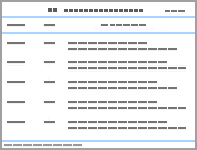
表1
本研究小麦试验地点的全球分布"
| 区域 Region | 国家数量 Number of countries | 纬度范围 Latitudinal range | 经度范围 Longitude range | 组数 Number of comparisons |
|---|---|---|---|---|
| 亚洲 Asia | 10 | 22.99°N—43.82°N | 34.70°E—140.10°E | 2708 |
| 非洲 Africa | 6 | 33.28°S—36.60°N | 7.59°W—38.48°E | 286 |
| 欧洲 Europe | 7 | 22.17°N—51.30°N | 4.52°W—73.54°E | 178 |
| 北美洲 North America | 3 | 20.52°N—55.72°N | 119.38°W—84.50°W | 314 |
| 南美洲 South America | 2 | 36.62°S—33.67°S | 72.40°W—57.95°W | 22 |
| 大洋洲 Oceania | 2 | 43.53°S—31.48°S | 118.20°E—172.06°E | 46 |
表2
不同土壤管理措施下影响小麦籽粒产量因素的梯度划分"
| 影响因素 Affecting factors | 亚组 Subgroup | ||||
|---|---|---|---|---|---|
| 气候因素 Climatic factor | 年平均气温 Mean annual temperature, MAT (℃) | <10 (很低 Very low) | 10—15 (低 Low) | 15.1—20 (中 Medium) | >20 (高 High) |
| 生育期降雨量 Growing season precipitation, GSP (mm) | <200 (低 Low) | 200—400 (中 Medium) | >400 (高 High) | ||
| 土壤性质 Soil property | 土壤质地 Soil texture | 砂土 Sandy | 壤土 Loam | 黏土 Clay | |
| 容重 Bulk density, BD (g·cm-3) | <1.3(低 Low) | 1.3—1.5(中 Medium) | >1.5(高 High) | ||
| 有机质 Soil organic matter, SOM (g·kg-1) | <15(低 Low) | 15—20(中 Medium) | >20(高 High) | ||
| 速效磷 Soil available phosphorus, AP (mg·kg-1) | <15(低 Low) | 15—30(中 Medium) | >30(高 High) | ||
| 农业管理措施Agricultural management practice | 施氮量 N rate (kg N·hm-2) | <100(低 Low) | 100—150(中 Medium) | >150(高 High) | |
| 施磷量 P rate (kg P2O5·hm-2) | <100(低 Low) | 100—150(中 Medium) | >150(高 High) | ||
| 施钾量 K rate (kg K2O·hm-2) | <50(低 Low) | 50—100(中 Medium) | >100(高 High) | ||
| 播种量 Seeding rate, SR (kg·hm-2) | ≤150(低 Low) | >150(高 High) | |||
| 秸秆投入量 Straw rate (t·hm-2) | <5(低 Low) | 5—8(中 Medium) | >8(高 High) | ||
| 灌溉 Irrigation | 是 Yes | 否 No | |||
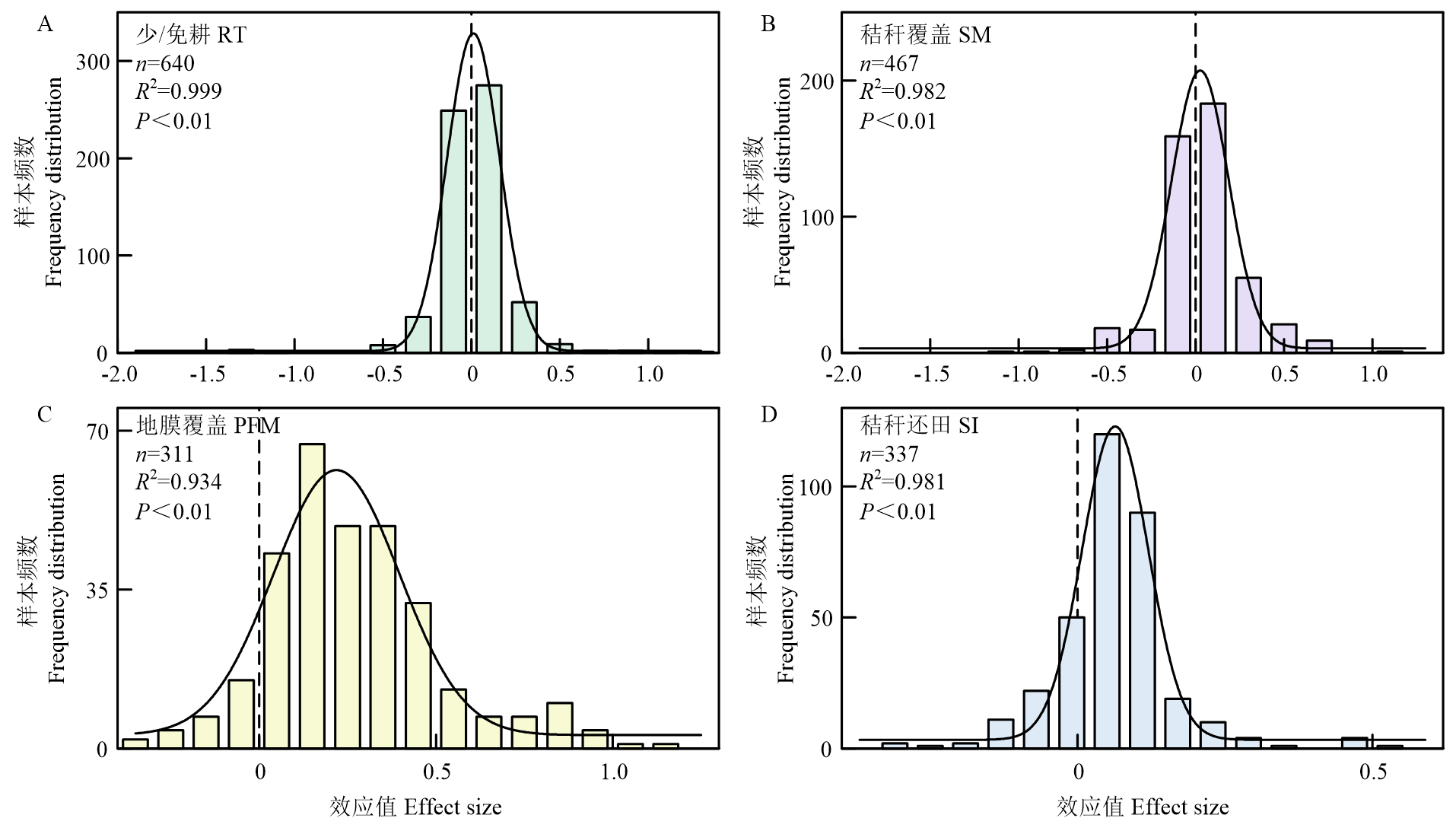
图1
不同土壤管理措施下小麦产量效应值的频数分布 曲线代表数据的高斯分布,P为显著性检验,虚线表示效应值为0。RT:少/免耕;SM:秸秆覆盖;PFM:地膜覆盖;SI:秸秆还田。下同"
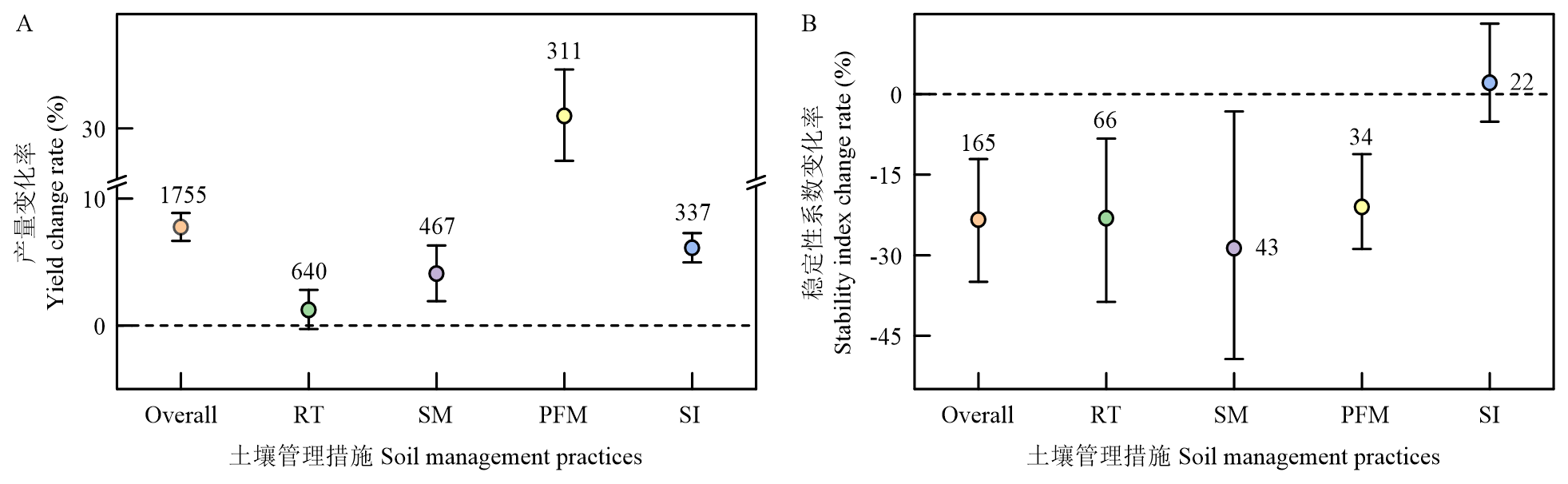
图2
不同土壤管理措施对小麦产量和产量稳定性的影响 点和误差线分别表示响应比和95%置信区间,误差线与零线不重合表示处理与对照之间存在显著差异,数值代表样本数。Overall:所有土壤管理措施(包括RT、SM、PFM和SI)。下同"
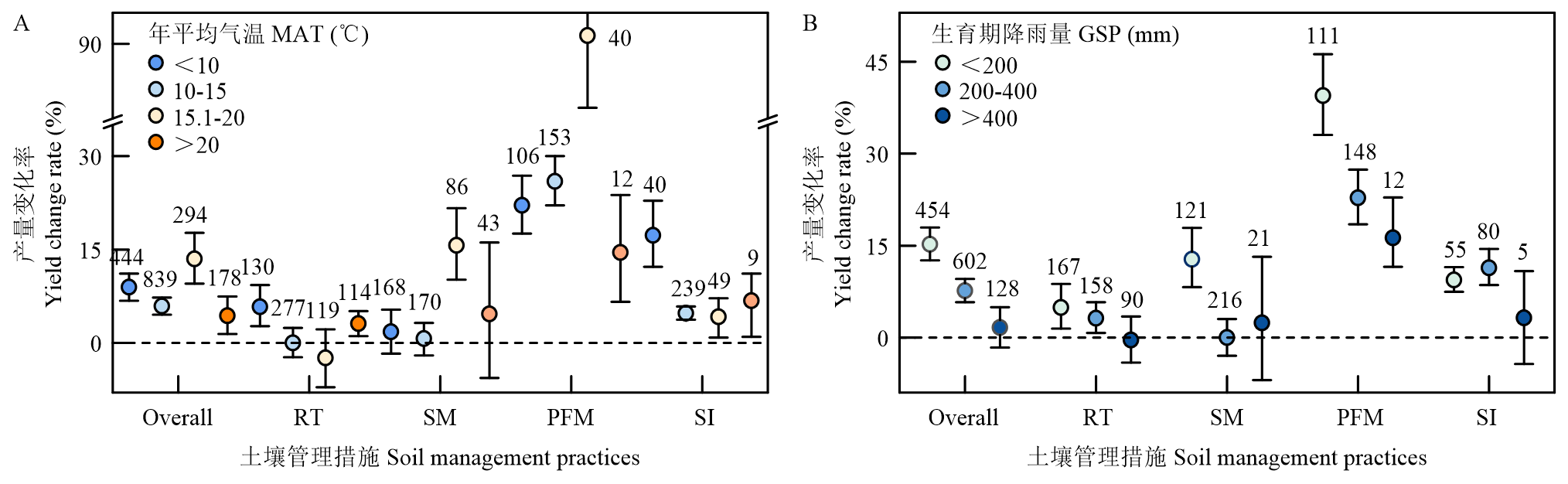
图3
不同气候因素下土壤管理措施对小麦产量的影响 MAT:年平均气温;GSP:生育期降雨量。下同"
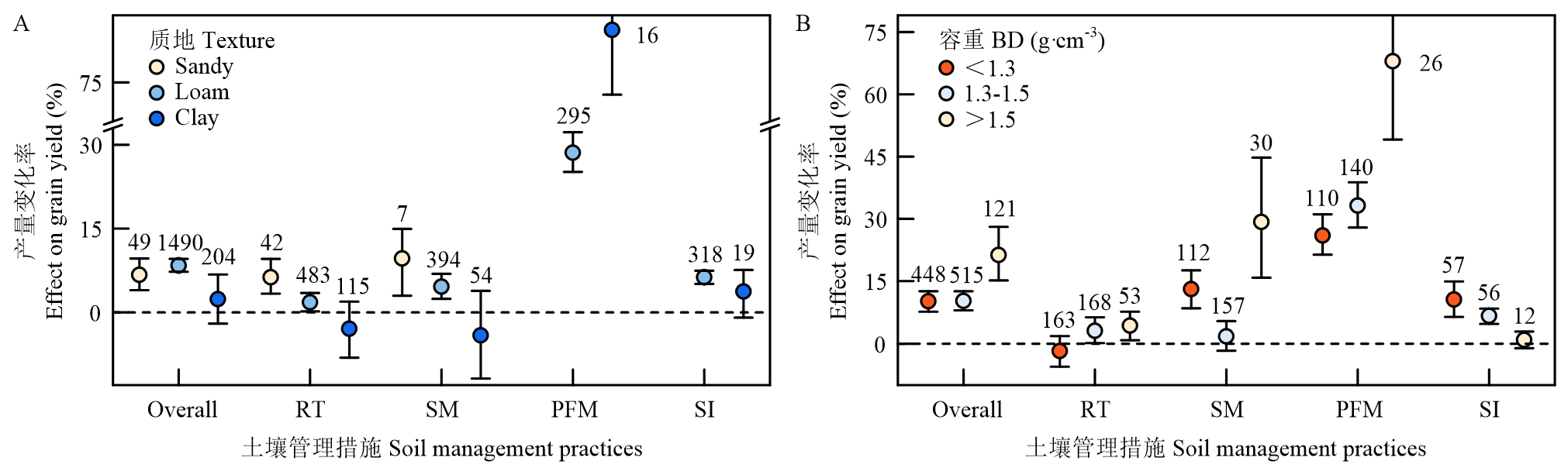
图4
不同土壤物理性质下土壤管理措施对小麦产量的影响"
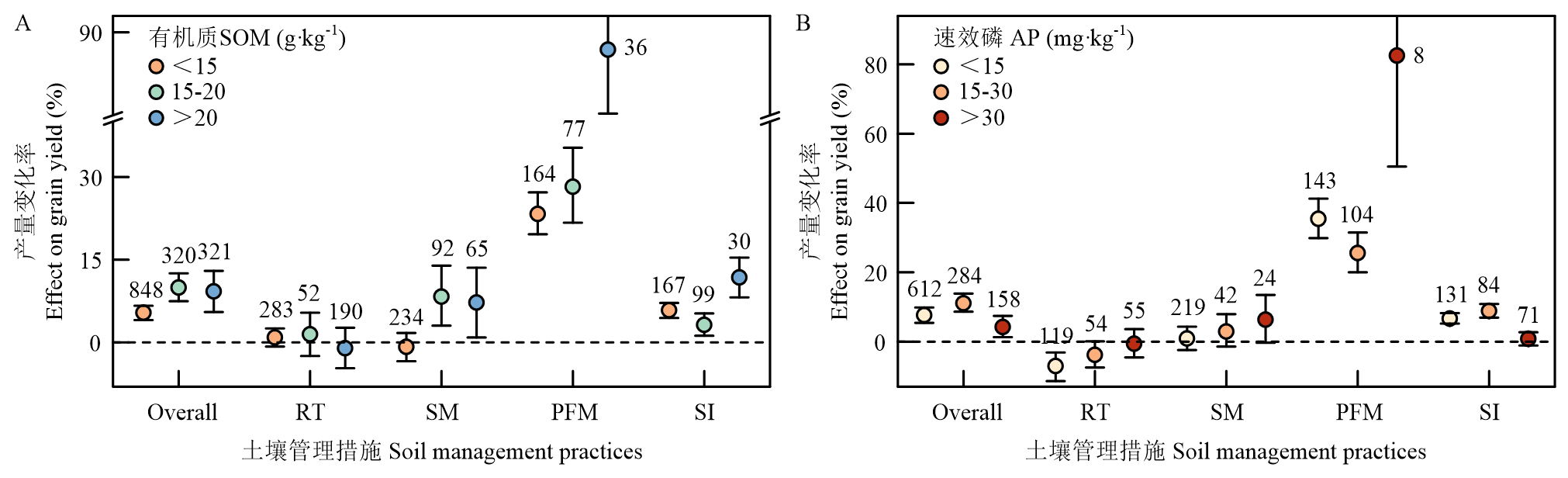
图5
不同土壤化学性质下土壤管理措施对小麦产量的影响"
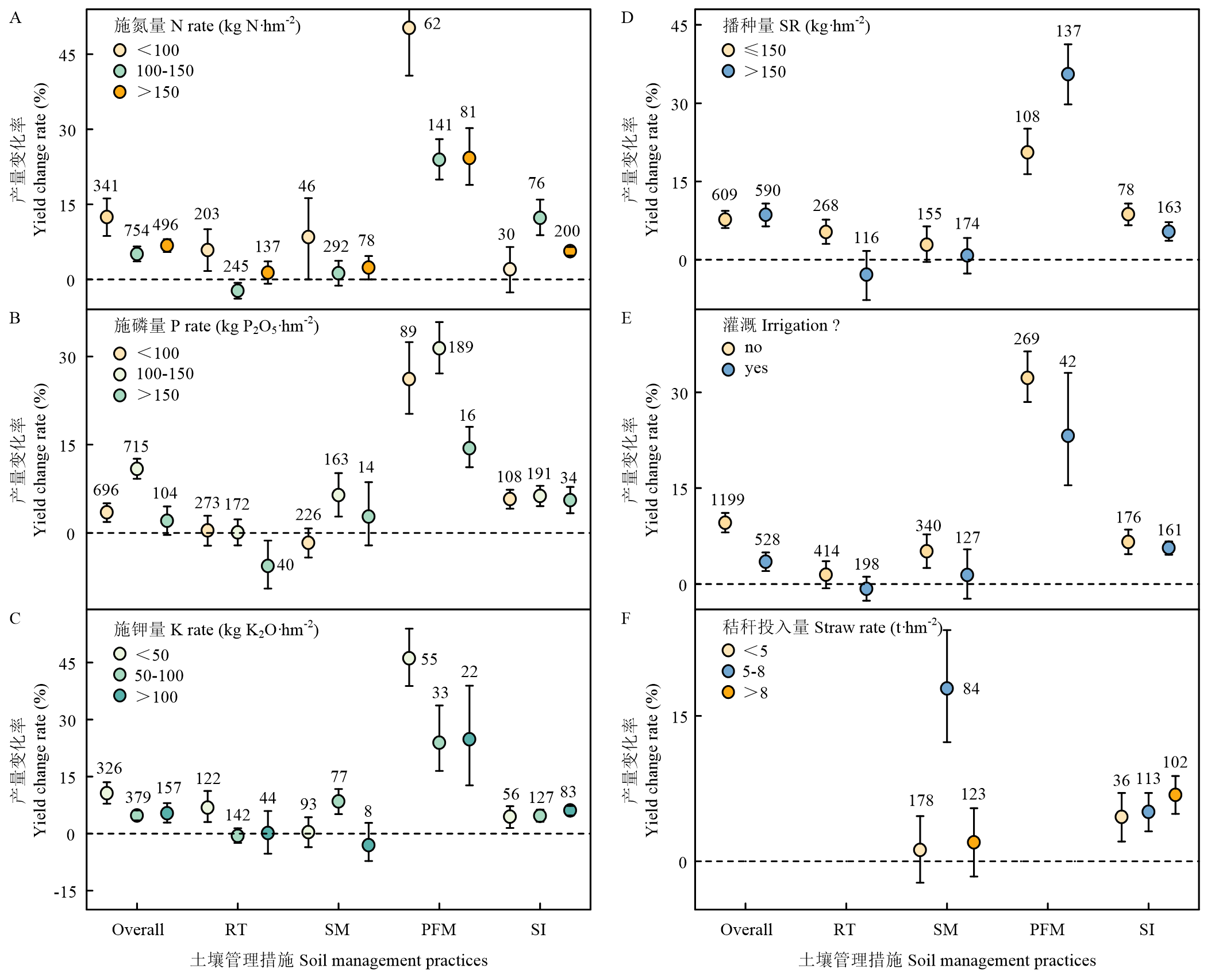
图6
不同农业管理措施下土壤管理对小麦产量的影响"
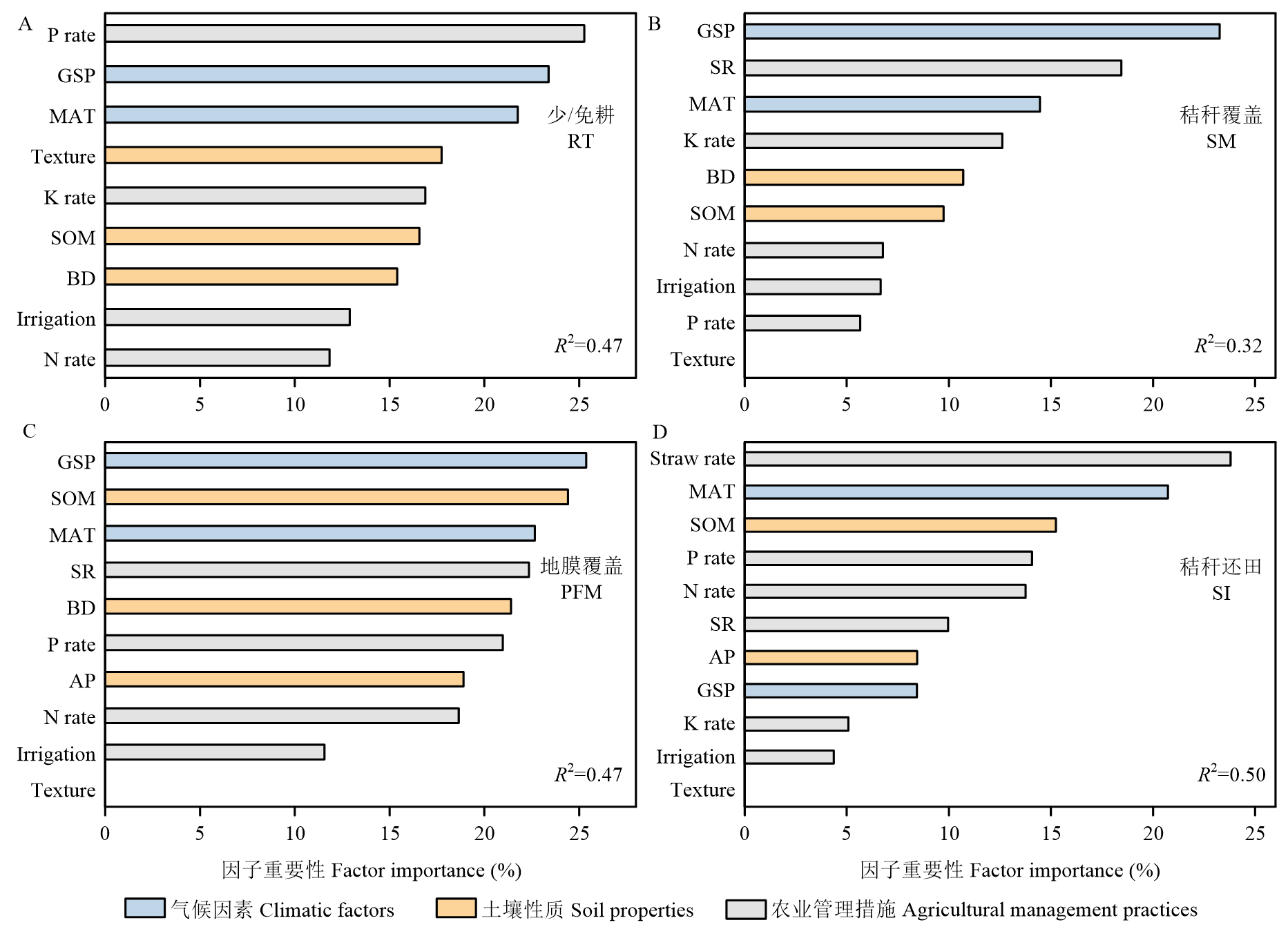
图7
影响土壤管理措施产量效应的因子贡献度"
| [1] |
|
| [2] |
|
| [3] |
doi: 10.3390/cli6020041 |
| [4] |
doi: 10.3389/fpls.2022.925548 |
| [5] |
doi: 10.31545/intagr/132363 |
| [6] |
doi: 10.1016/j.agwat.2018.01.021 |
| [7] |
|
| [8] |
|
| [9] |
doi: 10.1016/j.geoderma.2018.03.011 |
| [10] |
doi: 10.1016/j.agwat.2022.107910 |
| [11] |
|
| [12] |
王改玲, 郝明德, 许继光, 洪坚平. 保护性耕作对黄土高原南部地区小麦产量及土壤理化性质的影响. 植物营养与肥料学报, 2011, 17(3): 539-544.
|
|
|
|
| [13] |
doi: 10.1016/j.agee.2021.107650 |
| [14] |
|
| [15] |
张建军, 党翼, 赵刚, 王磊, 周刚, 王淑英, 李尚中, 樊廷录, 胡靖宇, 王鹤龄, 张文菊. 西北旱塬免耕的产量效应受降水特征和施肥显著影响. 植物营养与肥料学报, 2024, 30(9): 1694-1704.
|
|
|
|
| [16] |
doi: 10.1007/s10705-009-9252-0 |
| [17] |
陈素英, 张喜英, 孙宏勇, 邵立威. 华北平原秸秆覆盖冬小麦减产原因分析. 中国生态农业学报, 2013, 21(5): 519-525.
|
|
doi: 10.3724/SP.J.1011.2013.00519 |
|
| [18] |
何红霞, 李小涵, 包明, 李超, 马小龙, 何刚, 邱炜红, 王朝辉. 栽培模式对旱地小麦产量和土壤肥力的影响. 应用生态学报, 2019, 30(2): 573-582.
doi: 10.13287/j.1001-9332.201902.019 |
|
doi: 10.13287/j.1001-9332.201902.019 |
|
| [19] |
doi: 10.1016/j.agrformet.2018.08.015 |
| [20] |
doi: 10.1016/j.agwat.2006.08.005 |
| [21] |
doi: 10.1016/j.fcr.2024.109516 |
| [22] |
doi: 10.1016/j.fcr.2014.11.016 |
| [23] |
doi: 10.1016/j.fcr.2022.108447 |
| [24] |
doi: 10.1016/j.fcr.2021.108333 |
| [25] |
doi: 10.1002/ldr.v34.4 |
| [26] |
|
| [27] |
doi: 10.1007/s13593-023-00928-2 |
| [28] |
doi: 10.1016/j.fcr.2024.109518 |
| [29] |
王月梅, 田海梅, 王西娜, 郝雯悦, 吕喆铭, 于金铭, 谭军利, 王朝辉. 引黄灌区连续减施化肥对春小麦产量稳定性的影响. 中国农业科学, 2024, 57(3): 539-554. doi: 10.3864/j.issn.0578-1752.2024.03.009.
|
|
|
|
| [30] |
doi: 10.1016/j.jenvman.2023.117965 |
| [31] |
doi: 10.1016/j.scitotenv.2020.142299 |
| [32] |
张宝冲, 任志杰, 田艳艳, 杨雪, 叶优良, 张洁, 李任丰, 郭景丽, 赵亚南. 我国小麦和玉米施用腐植酸效果的整合分析. 植物营养与肥料学报, 2024, 30(12): 2318-2330.
|
|
|
|
| [33] |
doi: 10.1016/j.eja.2025.127628 |
| [34] |
doi: 10.3390/agronomy13102515 |
| [35] |
廖允成, 温晓霞, 韩思明, 贾志宽. 黄土台原旱地小麦覆盖保水技术效果研究. 中国农业科学, 2003, 36(5): 548-552. doi: 10.3864/j.issn.0578-1752.030513.
|
|
|
|
| [36] |
|
| [37] |
doi: 10.1038/s41598-018-26615-x pmid: 29802373 |
| [38] |
doi: 10.1038/srep10725 |
| [39] |
doi: 10.1016/j.scitotenv.2023.161865 |
| [40] |
李涛, 何春娥, 葛晓颖, 欧阳竹. 秸秆还田施氮调节碳氮比对土壤无机氮、酶活性及作物产量的影响. 中国生态农业学报, 2016, 24(12): 1633-1642.
|
|
|
|
| [41] |
doi: 10.1016/S1002-0160(11)60185-9 |
| [42] |
周明星, 代子俊, 樊军, 付威, 郝明德. 免耕结合覆盖措施对渭北旱塬黑垆土结构与团聚体有机碳含量的影响. 中国农业科学, 2023, 56(12): 2329-2340. doi: 10.3864/j.issn.0578-1752.2023.12.008.
|
|
|
|
| [43] |
郑凤君, 王雪, 李生平, 刘晓彤, 刘志平, 卢晋晶, 武雪萍, 席吉龙, 张建诚, 李永山. 免耕覆盖下土壤水分、团聚体稳定性及其有机碳分布对小麦产量的协同效应. 中国农业科学, 2021, 54(3): 596-607. doi: 10.3864/j.issn.0578-1752.2021.03.013.
|
|
|
|
| [44] |
doi: 10.1016/j.fcr.2013.12.015 |
| [45] |
doi: 10.1016/j.fcr.2020.107760 |
| [46] |
马建涛, 柴守玺, 程宏波, 常磊. 农田秸秆覆盖技术及其应用研究进展. 生态学杂志, 2022, 41(3): 597-602.
|
|
doi: 10.13292/j.1000-4890.202202.023 |
|
| [47] |
徐欣, 王笑影, 鲍雪莲, 王影, 刘亚军, 霍海南, 何红波, 解宏图. 长期免耕不同秸秆覆盖量对玉米产量及其稳定性的影响. 应用生态学报, 2022, 33(3): 671-676.
doi: 10.13287/j.1001-9332.202203.015 |
|
doi: 10.13287/j.1001-9332.202203.015 |
|
| [48] |
柏炜霞, 李军, 王玉玲, 王丽. 渭北旱塬小麦玉米轮作区不同耕作方式对土壤水分和作物产量的影响. 中国农业科学, 2014, 47(5): 880-894. doi: 10.3864/j.issn.0578-1752.2014.05.005.
|
|
|
|
| [49] |
王小彬, 蔡典雄, 金轲, 吴会军, 白占国, 张灿军, 姚宇卿, 吕军杰, 王育红, 杨波, Roger Hartmann, Donald Gabriels. 旱坡地麦田夏闲期耕作措施对土壤水分有效性的影响. 中国农业科学, 2003, 36(9): 1044-1049.
|
|
|
|
| [50] |
doi: 10.1111/jac.2016.202.issue-6 |
| [51] |
doi: 10.2134/agronj2012.0459 |
| [52] |
|
| [53] |
doi: 10.1016/j.fcr.2020.107785 |
| [54] |
doi: 10.1016/j.agrformet.2025.110383 |
| [55] |
doi: 10.1016/j.ecoenv.2018.05.014 |
| [56] |
陈鑫敏, 肖登攀, 路杨. 中国地表覆盖措施对土壤水热、温室气体排放及作物生长影响的研究进展. 中国农学通报, 2025, 41(12): 53-60.
doi: 10.11924/j.issn.1000-6850.casb2024-0595 |
|
doi: 10.11924/j.issn.1000-6850.casb2024-0595 |
|
| [57] |
张素瑜, 王和洲, 杨明达, 王静丽, 贺德先. 水分与玉米秸秆还田对小麦根系生长和水分利用效率的影响. 中国农业科学, 2016, 49(13): 2484-2496. doi: 10.3864/j.issn.0578-1752.2016.13.004.
|
|
|
|
| [58] |
doi: 10.1016/j.agwat.2024.109164 |
| [59] |
韩紫璇, 房静静, 武雪萍, 姜宇, 宋霄君, 刘晓彤. 长期秸秆配施化肥下土壤团聚体碳氮分布、微生物量与小麦产量的协同效应. 中国农业科学, 2023, 56(8): 1503-1514. doi: 10.3864/j.issn.0578-1752.2023.08.007.
|
|
|
|
| [60] |
doi: 10.1016/j.soilbio.2013.09.032 |
| [1] | 许杨浩峻, 陈丽明, 杨世奇, 唐奕凡, 谭雪明, 曾勇军, 潘晓华, 曾研华. 长期秸秆还田对双季稻田不同土层有机碳、养分和团聚体的影响[J]. 中国农业科学, 2026, 59(7): 1492-1506. |
| [2] | 王佳诺, 陈桂平, 李盼, 王丽萍, 南运有, 何蔚, 樊志龙, 胡发龙, 柴强, 殷文, 赵连豪. 免耕地膜两年覆盖提高绿洲灌区玉米产量的灌浆期光合生理机制[J]. 中国农业科学, 2026, 59(6): 1189-1202. |
| [3] | 刘梦阳, 刘洁, 陈翔, 王擎运, 罗来超, 齐永波, 田达, 李金才, 柴如山. 长期秸秆还田对砂姜黑土团聚体结构及磷组分分布的影响[J]. 中国农业科学, 2026, 59(3): 575-588. |
| [4] | 魏文龙, 王林林, 陈晓丽, 武凌彬, 李录芳, 解云婷, 王江文. 有机替代和地膜覆盖对旱地小麦根系生长、产量和水分利用效率的影响[J]. 中国农业科学, 2026, 59(11): 2340-2357. |
| [5] | 蒲丽霞, 张佳芮, 叶建萍, 黄秀兰, 樊高琼, 杨洪坤. 二氢赤霉素与秸秆覆盖对旱地小麦分蘖成穗与产量的影响[J]. 中国农业科学, 2025, 58(9): 1735-1748. |
| [6] | 张昊鑫, 于晟玥, 雷秋良, 杜新忠, 张继宗, 安妙颖, 樊秉乾, 罗加法, 刘宏斌. 基于RothC模型的东北旱地和稻田土壤有机碳动态变化模拟研究[J]. 中国农业科学, 2025, 58(8): 1564-1578. |
| [7] | 李绍兴, 宋稳锋, 魏泽煜, 周玉玲, 宋李霞, 任可, 马群, 王龙昌. 秸秆与紫云英覆盖对土壤肥力及甘薯产量的影响[J]. 中国农业科学, 2025, 58(8): 1591-1603. |
| [8] | 张明龙, 柴强, 韩梅, 樊志龙, 殷文, 范虹, 何蔚, 孙亚丽, 胡发龙, 谈燕. 氮肥减施及绿肥混作对土壤质量和小麦产量的影响[J]. 中国农业科学, 2025, 58(22): 4718-4731. |
| [9] | 张梦璇, 常芳弟, 魏禾雅, 李晓红, 伍林美, 张宏媛. 盐碱地麦后复种绿肥与氮肥减施对小麦产量、环境足迹及经济效益的协同效应[J]. 中国农业科学, 2025, 58(20): 4216-4230. |
| [10] | 卜容燕, 程文龙, 武际, 唐杉, 李敏, 鲁剑巍, 纪根学, 王慧, 朱睿, 蒋发辉, 汤萌萌, 韩上. 有机肥无机肥配施结合深耕提升稻油轮作系统生产力和养分利用效率[J]. 中国农业科学, 2025, 58(16): 3178-3189. |
| [11] | 方雯, 刘君权, 崔鑫, 刘嫒桦, 方娅婷, 丛日环, 陆志峰, 李小坤, 任涛, 鲁剑巍. 不同氮肥用量下稻油轮作系统作物产量、稳定性和氮素利用特征[J]. 中国农业科学, 2025, 58(16): 3220-3232. |
| [12] | 霍润霞, 方娅婷, 张艳科, 吴海亚, 刘桂生, 李小坤, 任涛, 陆志峰, 丛日环, 鲁剑巍. 长期秸秆还田条件下化肥减量对稻稻油轮作系统作物产量和土壤肥力的影响[J]. 中国农业科学, 2025, 58(16): 3267-3279. |
| [13] | 王安心, 方娅婷, 顿谦, 伍永清, 廖世鹏, 李小坤, 任涛, 陆志峰, 丛日环, 鲁剑巍. 秸秆直接还田与炭化还田对稻油轮作作物产量和氮素利用的影响[J]. 中国农业科学, 2025, 58(16): 3280-3292. |
| [14] | 熊志豪, 刘君权, 叶琳, 朱丹丹, 侯素素, 方娅婷, 丛日环, 任涛, 李小坤, 鲁剑巍. 稻油轮作系统秸秆直接还田与焚烧还田的作物产量和养分表观平衡特征[J]. 中国农业科学, 2025, 58(16): 3293-3303. |
| [15] | 宣泽鹏, 冯慧瑶, 陈美淇, 徐基胜, 刘梦璇, 赵炳梓, 张佳宝. 秸秆还田配施化肥对土壤生态系统多功能性的影响[J]. 中国农业科学, 2025, 58(14): 2821-2837. |
|
||
