






中国农业科学 ›› 2026, Vol. 59 ›› Issue (12): 2637-2655.doi: 10.3864/j.issn.0578-1752.2026.12.008
王萌涵1( ), 王登杰2, 梁兴慧3, 王恩东1, 张博1, 王海鸿1()
收稿日期:2026-02-13
接受日期:2026-04-14
出版日期:2026-06-16
发布日期:2026-06-16
通信作者:
联系方式:
王萌涵,E-mail:wangmeha1110@163.com。
基金资助:
WANG MengHan1(), WANG DengJie2, LIANG XingHui3, WANG EnDong1, ZHANG Bo1, WANG HaiHong1()
Received:2026-02-13
Accepted:2026-04-14
Published:2026-06-16
Online:2026-06-16
摘要:
【目的】在室内与田间条件下系统评估球孢白僵菌(Beauveria bassiana)对烟粉虱(Bemisia tabaci)的致病力、食诱剂对烟粉虱的引诱率,以及两者联合应用对烟粉虱的综合防治效果,筛选高致病力球孢白僵菌菌株与高效食诱剂配方。【方法】室内条件下,采用浸叶法和接触法分别测定球孢白僵菌菌株对烟粉虱若虫和成虫的致病力,并采用血球计数板法测定各菌株产孢量。利用Y型管趋性装置分析烟粉虱对植物源挥发物的趋性;并通过组分、配比、浓度、溶剂和缓释载体试验确定复合食诱剂的最优配方。在田间构建球孢白僵菌-食诱剂联合装置,验证装置悬挂位置和密度对烟粉虱诱集效果的影响;通过室内笼罩试验和田间调查测定烟粉虱孢子携带量及种群的动态变化。【结果】在1×10⁸孢子/mL浓度条件下,XJWLMQ-1菌株对烟粉虱2龄若虫和成虫的校正死亡率分别为93.16%和79.17%,致死中时(LT50)分别为3.78和7.12 d;在产孢培养基上产孢量达3.74×10⁸孢子/cm2。顺-3-己烯醛、芳樟醇和丁香酚按1﹕2﹕1比例组合形成的复合食诱剂诱集效果最佳,引诱率达90.0%。液体石蜡与正己烷混合溶剂、配合多孔硅胶棒作为缓释载体,表现出良好的持效性,在84 d时仍维持60.0%的引诱率;食诱剂装置悬挂于植株顶端位置诱捕数量显著高于中部及顶部以上20 cm处。笼罩试验表明,烟粉虱可通过接触联合应用装置获取并携带(1.50—4.34)×104孢子/头。在14 d内,虫体孢子携带量随暴露时间延长持续增加,在第14天达到峰值,为1.40×10⁵孢子/头。连续两年田间试验显示,处理组的烟粉虱成虫峰值分别为16.40和15.60头/叶,较对照组分别下降36.3%和37.6%(P<0.05)。【结论】筛选出对烟粉虱若虫和成虫均具高致病力且产孢量高的球孢白僵菌XJWLMQ-1菌株,复配出对烟粉虱引诱率显著的食诱剂配方(顺-3-己烯醛﹕芳樟醇﹕丁香酚为1﹕2﹕1),球孢白僵菌和食诱剂联合应用对烟粉虱具有良好的防控效果,可持续抑制烟粉虱种群增长,具备推广应用潜力。
王萌涵, 王登杰, 梁兴慧, 王恩东, 张博, 王海鸿. 球孢白僵菌与食诱剂联合应用对番茄上烟粉虱的防治研究[J]. 中国农业科学, 2026, 59(12): 2637-2655.
WANG MengHan, WANG DengJie, LIANG XingHui, WANG EnDong, ZHANG Bo, WANG HaiHong. Control of Bemisia tabaci on Tomato by the Combined Application of Beauveria bassiana and Food Attractants[J]. Scientia Agricultura Sinica, 2026, 59(12): 2637-2655.

表1
供试球孢白僵菌菌株来源信息"
| 菌株编号Strain ID | 寄主来源Host source | 采集地Collection location |
|---|---|---|
| LNTL-1 | 亚洲玉米螟Ostrinia nubilalis | 辽宁铁岭Tieling, Liaoning |
| LNTL-3 | 亚洲玉米螟Ostrinia nubilalis | 辽宁铁岭Tieling, Liaoning |
| LNTL-5 | 亚洲玉米螟Ostrinia nubilalis | 辽宁铁岭Tieling, Liaoning |
| JXNC-4 | 褐飞虱Nilaparvata lugens | 江西南昌Nanchang, Jiangxi |
| JXNC-5 | 褐飞虱Nilaparvata lugens | 江西南昌Nanchang, Jiangxi |
| JXNC-11 | 褐飞虱Nilaparvata lugens | 江西南昌Nanchang, Jiangxi |
| JXNC-12 | 褐飞虱Nilaparvata lugens | 江西南昌Nanchang, Jiangxi |
| HNLY-46 | 温室白粉虱Trialeurodes vaporariorum | 河南洛阳Luoyang, Henan |
| HNLY-47 | 温室白粉虱Trialeurodes vaporariorum | 河南洛阳Luoyang, Henan |
| JLGZL-1 | 亚洲玉米螟Ostrinia nubilalis | 吉林公主岭Gongzhuling, Jilin |
| JLGZL-2 | 亚洲玉米螟Ostrinia nubilalis | 吉林公主岭Gongzhuling, Jilin |
| JLGZL-3 | 亚洲玉米螟Ostrinia nubilalis | 吉林公主岭Gongzhuling, Jilin |
| JLGZL-9 | 亚洲玉米螟Ostrinia nubilalis | 吉林公主岭Gongzhuling, Jilin |
| SDDZ-13 | 亚洲玉米螟Ostrinia nubilalis | 山东德州Dezhou, Shandong |
| SDDZ-14 | 亚洲玉米螟Ostrinia nubilalis | 山东德州Dezhou, Shandong |
| SDDZ-20 | 亚洲玉米螟Ostrinia nubilalis | 山东德州Dezhou, Shandong |
| SDDZ-21 | 亚洲玉米螟Ostrinia nubilalis | 山东德州Dezhou, Shandong |
| XJWLMQ-1 | 亚洲玉米螟Ostrinia nubilalis | 新疆乌鲁木齐Urumqi, Xinjiang |
| XJWLMQ-33 | 亚洲玉米螟Ostrinia nubilalis | 新疆乌鲁木齐Urumqi, Xinjiang |
| XJWLMQ-36 | 亚洲玉米螟Ostrinia nubilalis | 新疆乌鲁木齐Urumqi, Xinjiang |
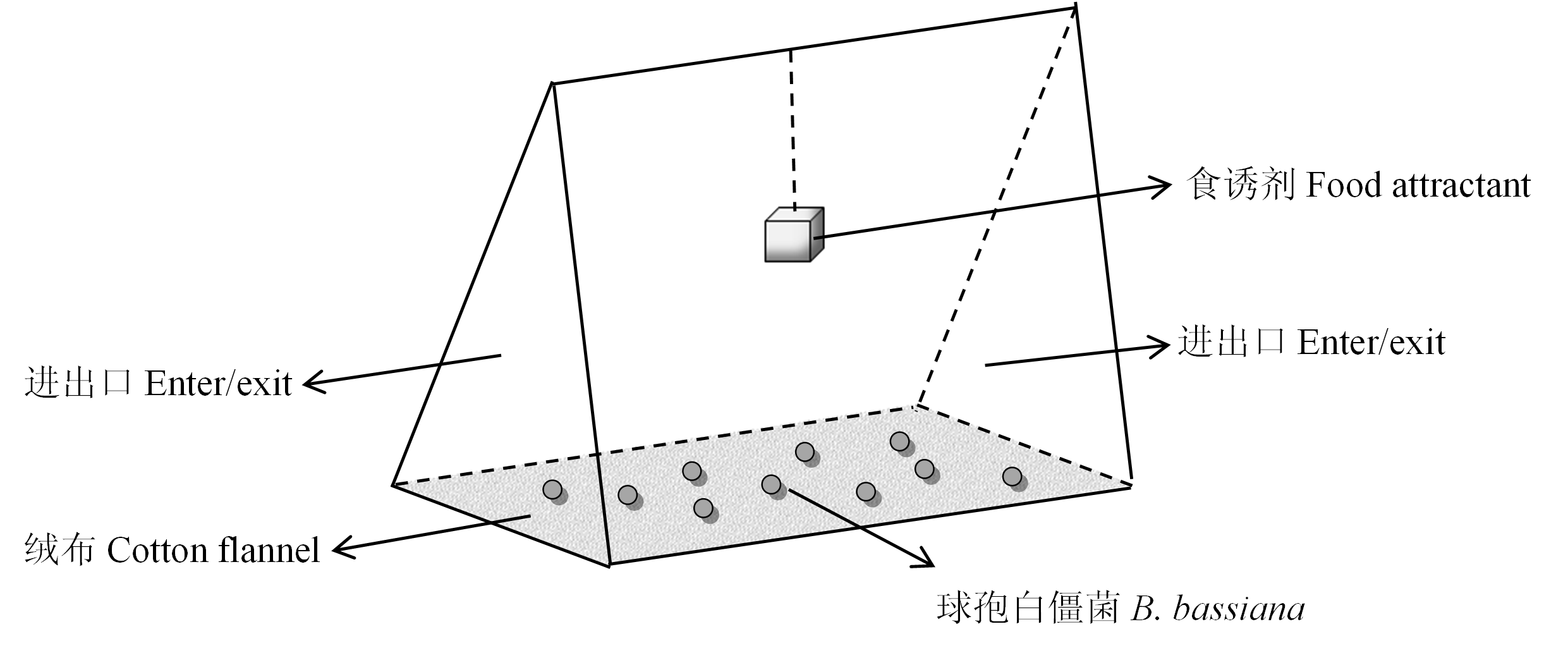
图1
球孢白僵菌联合食诱剂的装置示意图"
表2
植物源挥发物组合不同配比的处理"
| 处理 Treatment | 顺-3-己烯醛﹕芳樟醇﹕丁香酚 (Z)-3-hexenal﹕Linalool﹕Eugenol | 处理 Treatment | 顺-3-己烯醛﹕芳樟醇﹕丁香酚 (Z)-3-hexenal﹕Linalool﹕Eugenol | |
|---|---|---|---|---|
| B-1 | 1﹕1﹕1 | B-6 | 3﹕1﹕1 | |
| B-2 | 1﹕2﹕1 | B-7 | 1﹕3﹕3 | |
| B-3 | 1﹕1﹕3 | B-8 | 2﹕1﹕1 | |
| B-4 | 2﹕2﹕1 | B-9 | 1﹕2﹕3 | |
| B-5 | 1﹕1﹕2 |
表3
不同食诱剂组合的处理"
| 处理 Treatment | 形式 Form | 食诱剂成分 Ingredient of food attractants | 成分配比 Proportion of ingredients |
|---|---|---|---|
| 处理1 Treatment 1 | Y-1+4+5加粘虫板 Y-1+4+5 with yellow sticky trap | 顺-3-己烯醛+芳樟醇+丁香酚 (Z)-3-hexenal+linalool+eugenol | 1﹕2﹕1 |
| 处理2 Treatment 2 | Y-1+5加粘虫板 Y-1+5 with yellow sticky trap | 顺-3-己烯醛+丁香酚 (Z)-3-hexenal+eugenol | 1﹕1 |
| 处理3 Treatment 3 | Y-4+5加粘虫板 Y-4+5 with yellow sticky trap | 芳樟醇+丁香酚 Linalool+eugenol | 1﹕1 |
| 处理4 Treatment 4 | Y-1+2+3+5加粘虫板 Y-1+2+3+5 with yellow sticky trap | 顺-3-己烯醛+顺-3-己烯乙酸酯+对乙基苯乙酮+丁香酚 (Z)-3-hexenal+(Z)-hexenyl acetate+4-ethylacetophenone+eugenol | 1﹕1﹕1﹕1 |
| 处理5 Treatment 5 | Y-1+2+4加粘虫板 Y-1+2+4 with yellow sticky trap | 顺-3-己烯醛+顺-3-己烯乙酸酯+芳樟醇 (Z)-3-hexenal+(Z)-hexenyl acetate+linalool | 1﹕1﹕1 |
| 对照Control | 粘虫板Yellow sticky trap | — | — |
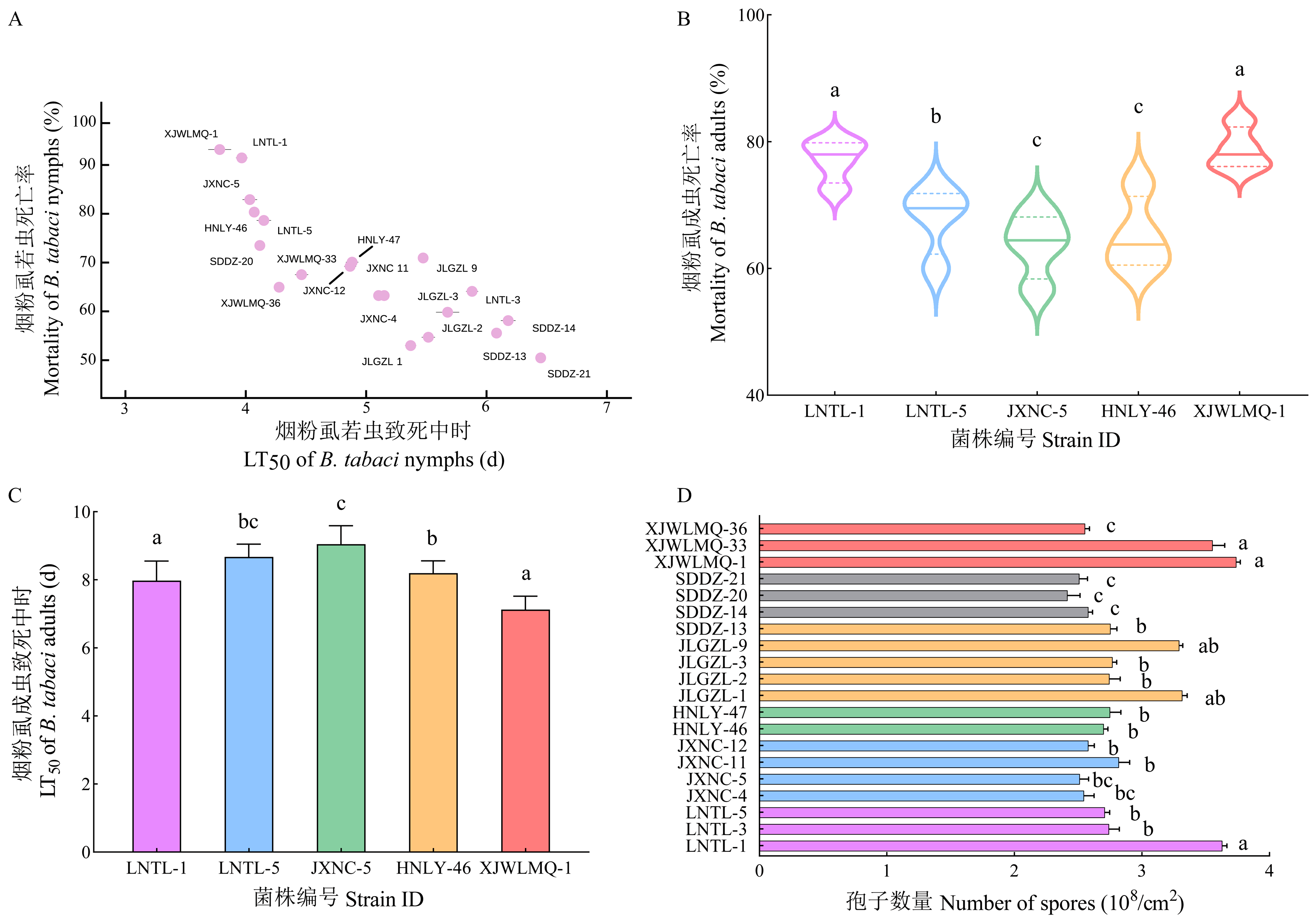
图2
球孢白僵菌不同菌株对烟粉虱若虫和成虫的致病力及产孢量 A:烟粉虱若虫的校正死亡率及LT50 Corrected mortality and LT50 of B. tabaci nymphs;B、C:分别为5株球孢白僵菌对烟粉虱成虫的校正死亡率及LT50 Corrected mortality and LT50 of five B. bassiana strains against B. tabaci adults, respectively;D:产孢量Conidial production 不同小写字母表示处理间差异显著(单因素方差分析,Duncan’s多重比较,P<0.05),图3同Different lowercase letters indicate significant differences among treatments (one-way ANOVA followed by Duncan’s multiple range test, P<0.05). The same as Fig. 3"
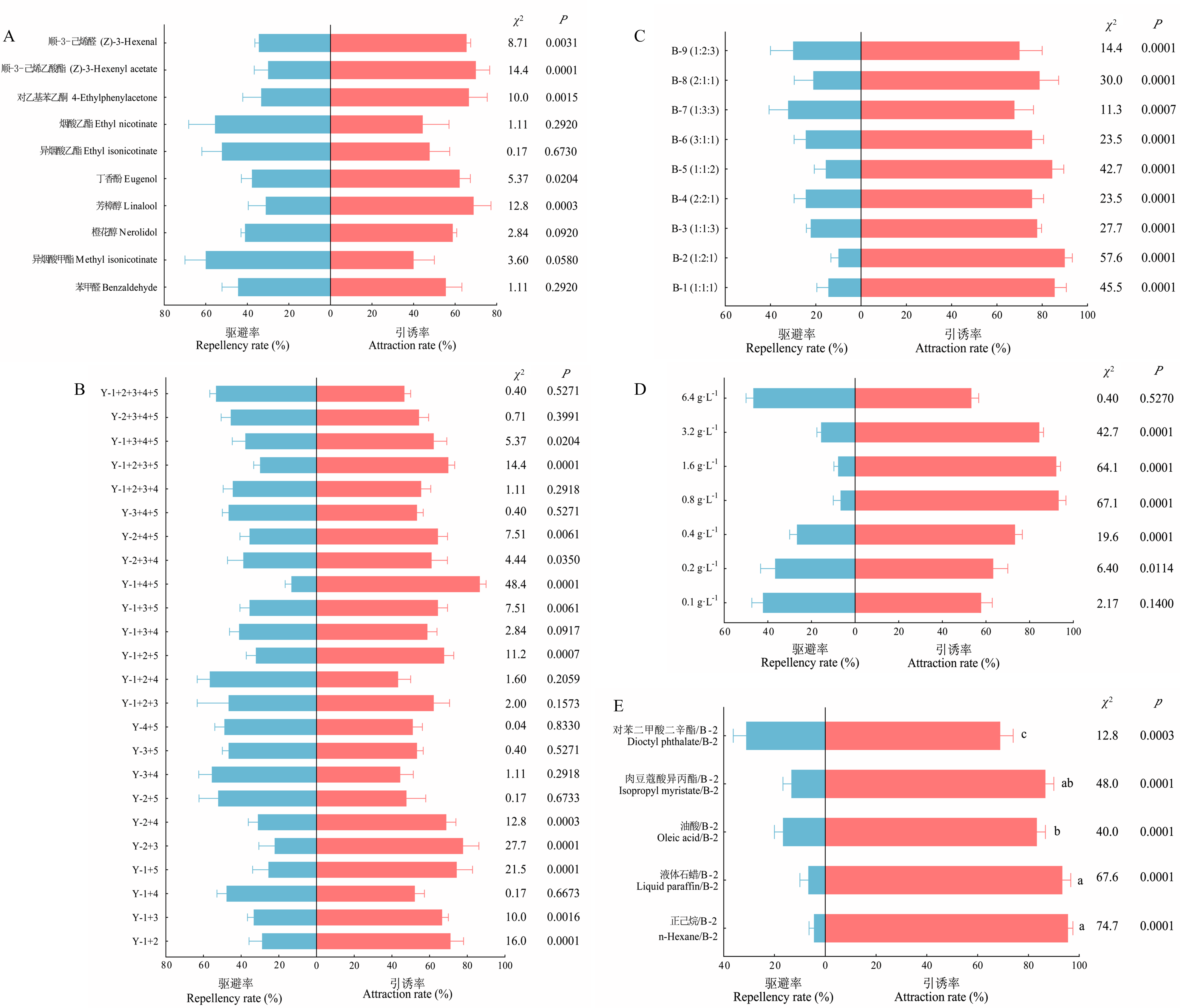
图3
植物挥发物组分及其组合对烟粉虱的诱集效果 A:单一植物挥发物Individual plant volatiles;B:不同挥发物组合Different volatile combinations;C:不同配比组合Different ratios of volatile combinations;D:不同浓度挥发物组合Volatile combinations at different concentrations;E:不同溶剂对挥发物组合B-2诱集效果的影响Effects of different solvents on the attractive effect of volatile combination B-2"
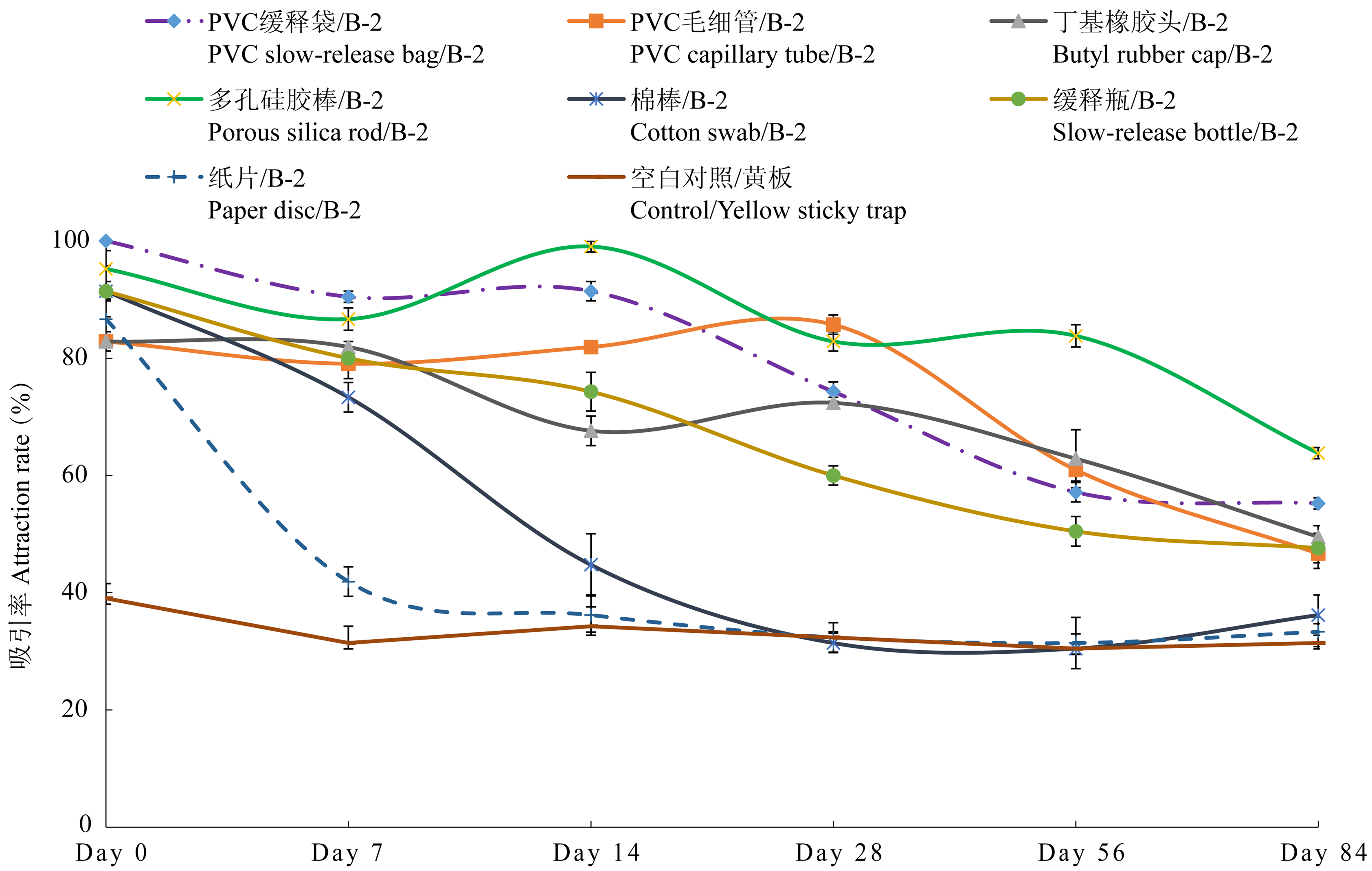
图4
不同缓释载体对植物源挥发物引诱效果的影响"
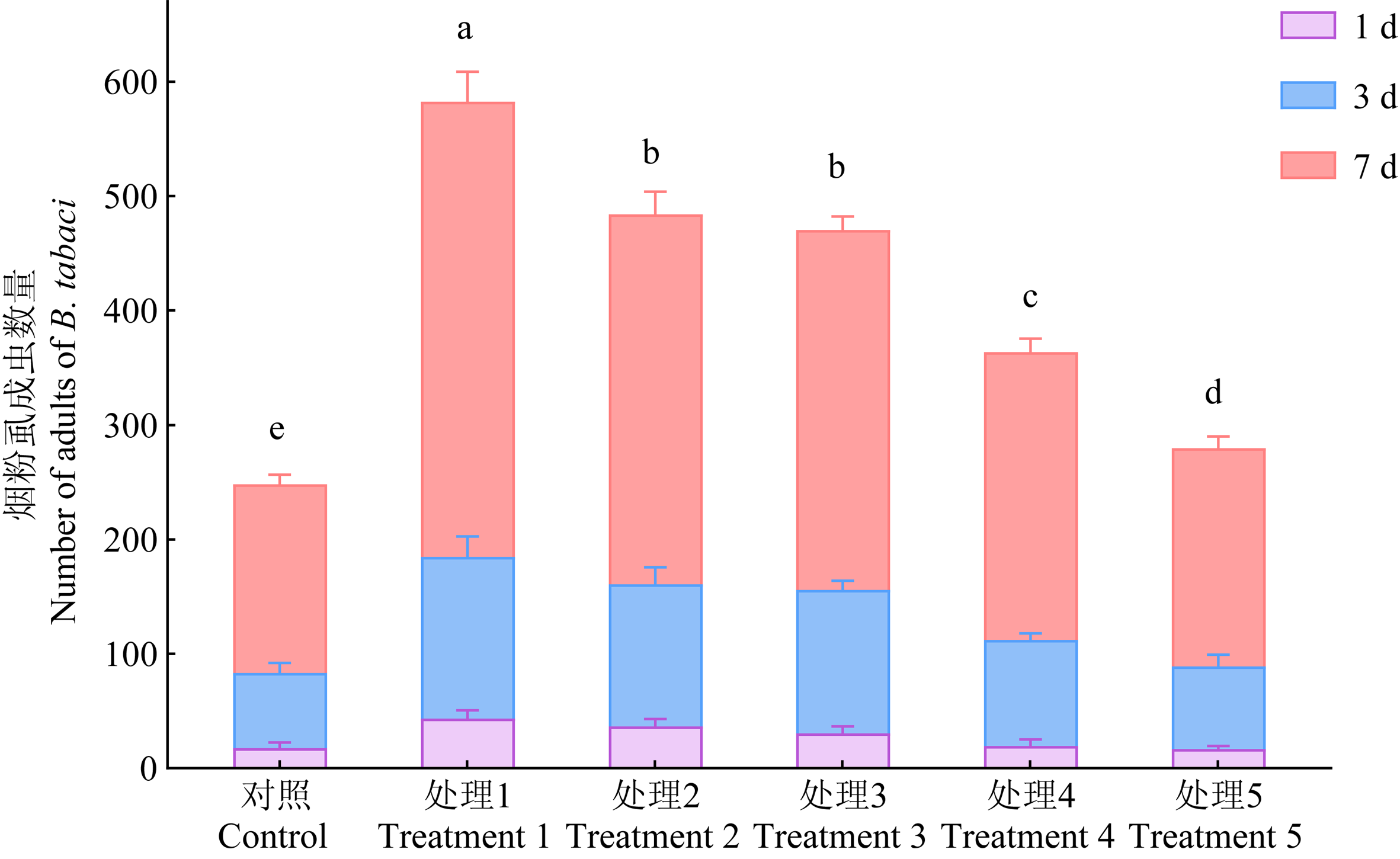
图5
不同食诱剂组合对烟粉虱的引诱效果 不同小写字母表示不同处理间累积差异显著(单因素方差分析,Duncan’s多重比较,P<0.05)"
表4
食诱剂投放位置对烟粉虱的引诱效果"
| 处理 Treatment | 投放位置 Position | 1 d诱集数量 Number of traps (1 d) | 3 d诱集数量 Number of traps (3 d) | 7 d诱集数量 Number of traps (7 d) |
|---|---|---|---|---|
| 处理1 Treatment 1 | 植株中部Middle of plant | 32.98±2.69b | 131.28±6.74b | 418.36±17.62b |
| 番茄顶端Top of tomato plant | 42.98±2.78a | 165.33±6.95a | 438.50±17.51a | |
| 番茄植株顶端20 cm处 20 cm above the top of tomato plant | 25.33±3.76c | 111.62±7.95c | 368.45±11.75c | |
| 处理2 Treatment 2 | 植株中部Middle of plant | 28.67±1.82b | 114.33±5.12b | 311.51±12.43b |
| 番茄顶端Top of tomato plant | 36.67±2.63a | 127.33±4.92a | 323.18±11.21a | |
| 番茄植株顶端20 cm处 20 cm above the top of tomato plant | 23.67±1.36c | 105.33±3.46c | 300.14±10.90c | |
| 处理3 Treatment 3 | 植株中部Middle of plant | 26.87±2.42b | 103.21±4.81b | 305.62±12.52b |
| 番茄顶端Top of tomato plant | 32.24±2.87a | 119.43±4.21a | 313.24±13.25a | |
| 番茄植株顶端20 cm处 20 cm above the top of tomato plant | 18.67±2.76c | 98.23±5.46c | 280.61±11.90c |
表5
食诱剂投放密度对烟粉虱的引诱效果"
| 处理 Treatment | 投放距离 Distance | 1 d诱集数量 Number of traps (1 d) | 3 d诱集数量 Number of traps (3 d) | 7 d诱集数量 Number of traps (7 d) |
|---|---|---|---|---|
| 处理1 Treatment 1 | 间隔10 m 10 m interval | 54.63±2.81a | 172.33±6.75a | 435.00±16.62a |
| 间隔7 m 7 m interval | 52.54±2.68a | 170.35±5.68a | 419.48±17.68a | |
| 间隔4 m 4 m interval | 51.56±2.16a | 164.48±6.54a | 421.36±17.59a | |
| 处理2 Treatment 2 | 间隔10 m 10 m interval | 35.17±1.63a | 117.23±5.25a | 333.00±15.23a |
| 间隔7 m 7 m interval | 33.67±1.16a | 121.35±3.67a | 335.00±15.57a | |
| 间隔4 m 4 m interval | 35.62±1.32a | 114.33±4.54a | 321.32±12.32a |
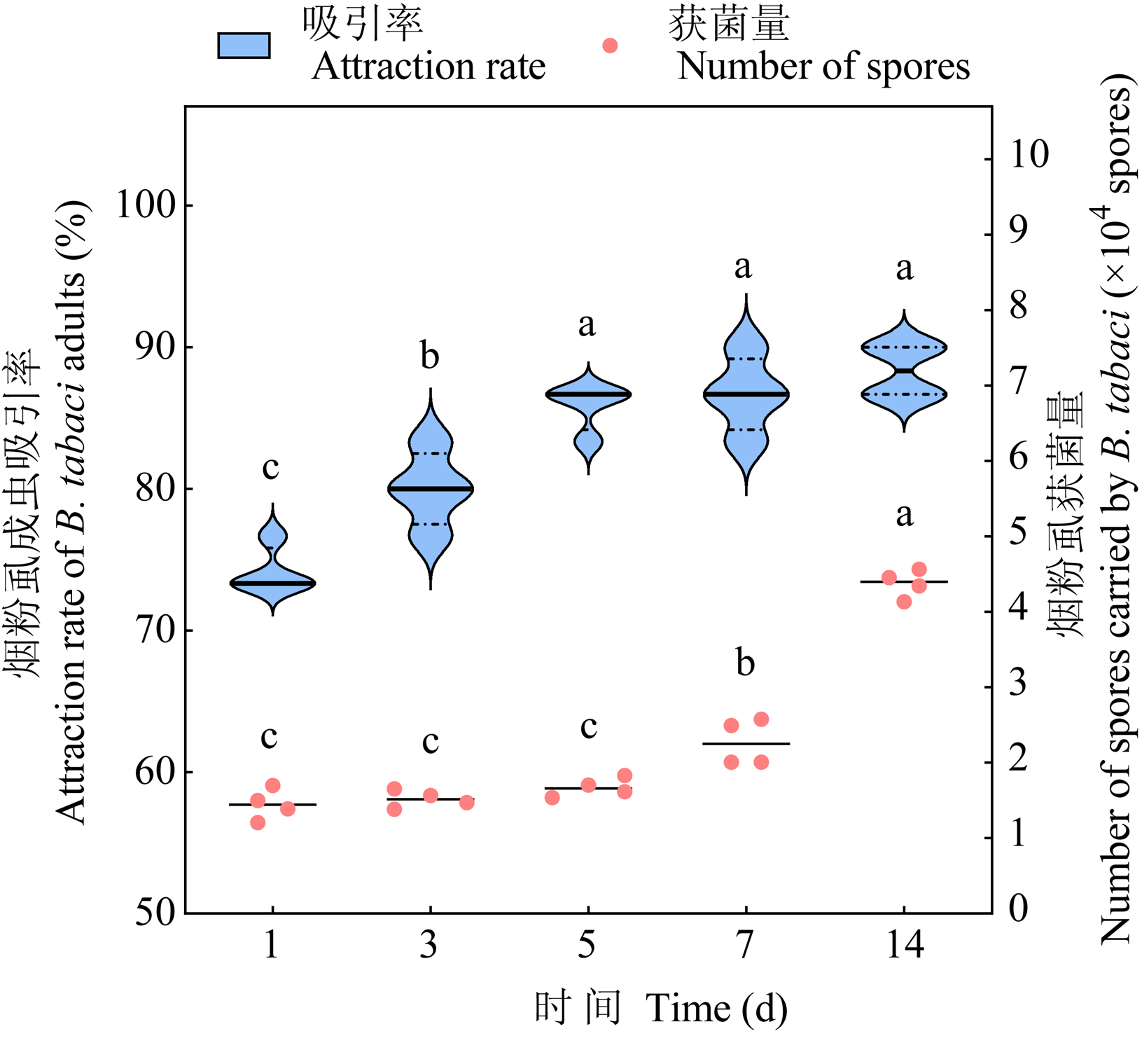
图6
装置吸引率和烟粉虱携带孢子量"

图7
田间试验烟粉虱携带孢子量"
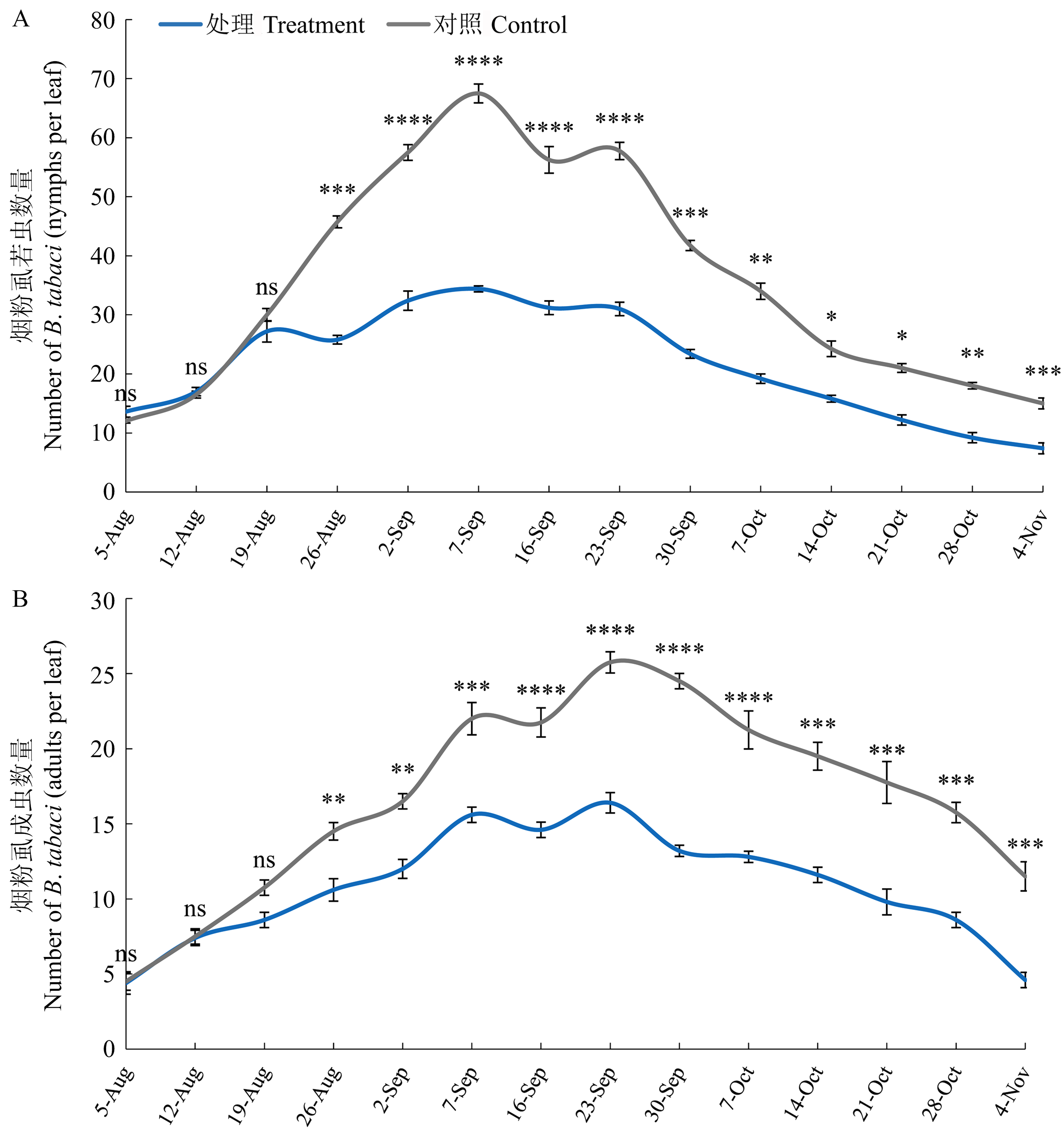
图8
2023年球孢白僵菌与食诱剂联合应用田间试验结果"
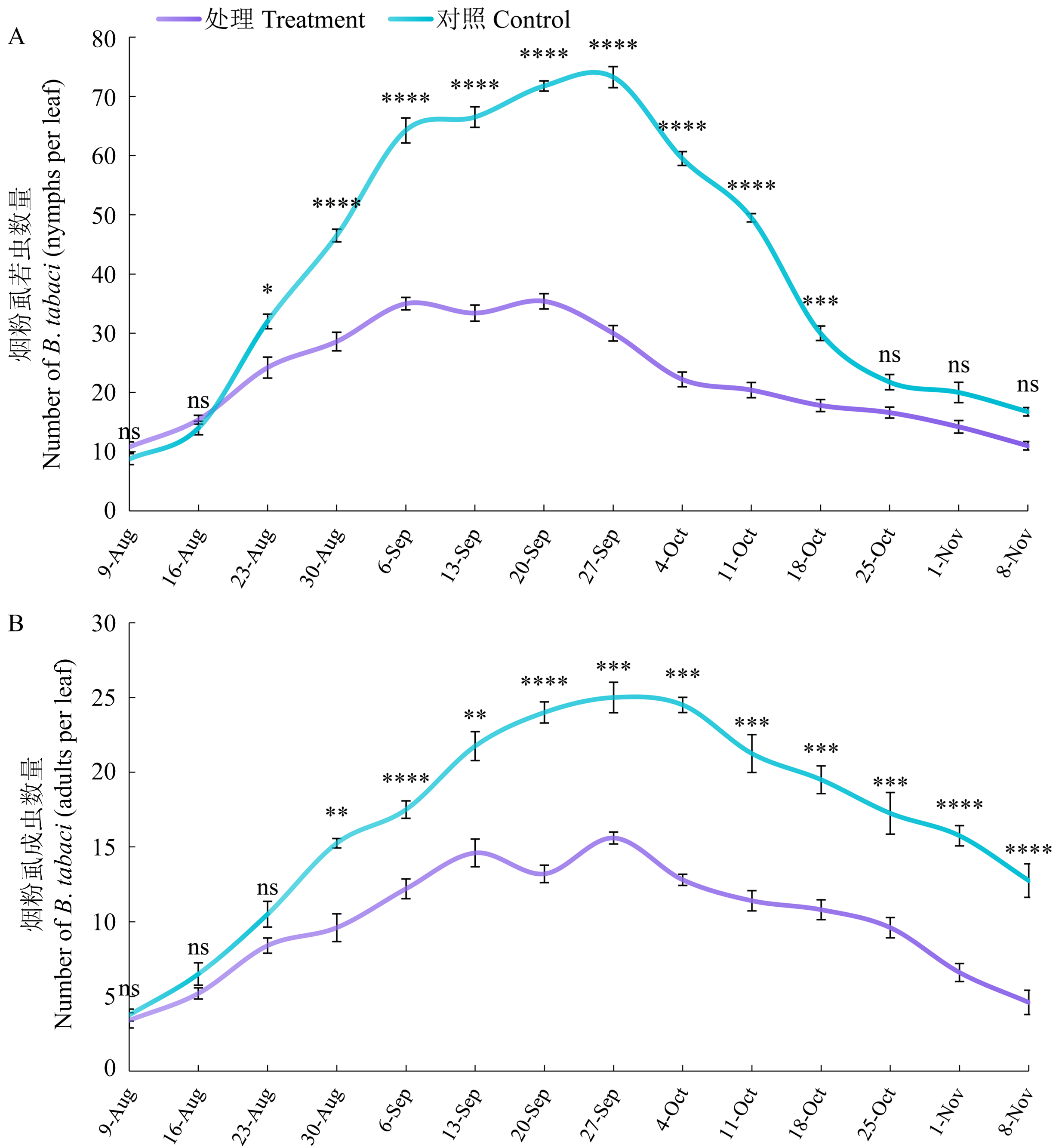
图9
2024年球孢白僵菌与食诱剂联合应用田间试验结果"
| [1] |
doi: 10.1146/annurev-ento-112408-085504 pmid: 20690829 |
| [2] |
doi: 10.1126/science.1149887 |
| [3] |
doi: 10.1007/s10340-020-01210-0 |
| [4] |
张帆, 李姝, 肖达, 赵静, 王然, 郭晓军, 王甦. 中国设施蔬菜害虫天敌昆虫应用研究进展. 中国农业科学, 2015, 48(17): 3463-3476. doi: 10.3864/j.issn.0578-1752.2015.17.013.
|
|
|
|
| [5] |
王恩东, 闫红, 张博, 徐学农. 捕食螨在蔬菜生产中的应用. 中国生物防治学报, 2025, 41(6): 1494-1508.
doi: 10.16409/j.cnki.2095-039x.2025.11.012 |
|
doi: 10.16409/j.cnki.2095-039x.2025.11.012 |
|
| [6] |
|
| [7] |
doi: 10.1186/s41938-019-0130-z |
| [8] |
doi: 10.1002/ps.v80.3 |
| [9] |
doi: 10.1007/s13744-022-00964-9 pmid: 35680781 |
| [10] |
doi: 10.1007/BF02921852 |
| [11] |
doi: 10.1007/s10526-009-9248-3 |
| [12] |
doi: 10.1023/A:1009927302916 |
| [13] |
doi: 10.1146/ento.1994.39.issue-1 |
| [14] |
doi: 10.1006/bcon.1995.1064 |
| [15] |
doi: 10.1016/j.micpath.2019.04.010 |
| [16] |
刘胜, 刘召, 王帅宇, 张起恺, 雷仲仁, 王海鸿. 球孢白僵菌与食诱剂对西花蓟马的联合作用. 中国生物防治学报, 2023, 39(2): 297-304.
doi: 10.16409/j.cnki.2095-039x.2022.03.017 |
|
|
|
| [17] |
doi: 10.3389/finsc.2022.991336 |
| [18] |
doi: 10.1303/aez.34.501 |
| [19] |
|
| [20] |
蔡晓明, 李兆群, 潘洪生, 陆宴辉. 植食性害虫食诱剂的研究与应用. 中国生物防治学报, 2018, 34(1): 8-35.
doi: 10.16409/j.cnki.2095-039x.2018.01.002 |
|
doi: 10.16409/j.cnki.2095-039x.2018.01.002 |
|
| [21] |
曹凤勤, 刘万学, 范中南, 万方浩, 程立生. B型烟粉虱对三种寄主植物及其挥发物的行为反应. 昆虫学报, 2008, 51(8): 830-838.
|
|
|
|
| [22] |
陈文斌. 烟粉虱对三种寄主植物的选择性及植株挥发物对其选择行为的影响[D]. 扬州: 扬州大学, 2021.
|
|
|
|
| [23] |
李姝, 赵静, 张晓曼, 王文君, 罗晨, 王甦. 烟粉虱MED隐种对13种植物挥发性物质的行为反应. 植物保护学报, 2016, 43(1): 105-110.
|
|
|
|
| [24] |
|
| [25] |
杨苗苗, 李英梅, 张淑莲, 洪波, 王晶玲, 陈志杰. 烟粉虱MED隐种对植物挥发物的趋性行为. 中国生物防治学报, 2018, 34(5): 663-669.
doi: 10.16409/j.cnki.2095-039x.2018.05.003 |
|
|
|
| [26] |
doi: 10.3390/insects15100750 |
| [27] |
doi: 10.1007/s11829-014-9302-7 |
| [28] |
|
| [29] |
doi: 10.1093/jee/toaa226 |
| [30] |
王登杰, 臧连生, 张烨, 王海鸿, 雷仲仁. 球孢白僵菌对烟粉虱后代生命表参数的亚致死影响. 中国农业科学, 2014, 47(18): 3588-3595. doi: 10.3864/j.issn.0578-1752.2014.18.007.
|
|
|
|
| [31] |
doi: 10.1590/S1519-566X2001000100015 |
| [32] |
doi: 10.1023/B:MYCO.0000003579.48647.16 |
| [33] |
侯茂林, 文吉辉, 卢伟. 烟粉虱成虫在日光温室内的分布和日活动规律. 生态学报, 2006, 26(5): 1431-1437.
|
|
|
|
| [34] |
梁兴慧. 两种蓟马的日活动规律及其对植物挥发物的趋性研究[D]. 北京: 中国农业科学院, 2010.
|
|
|
|
| [35] |
doi: 10.1603/EN09359 |
| [36] |
doi: 10.1007/s00253-024-13188-1 |
| [37] |
陈中琴, 梁文龙, 黄丽萍, 沈斌斌. 29株虫生真菌的鉴定及对烟粉虱的毒力. 华南农业大学学报, 2020, 41(4): 57-67.
|
|
|
|
| [38] |
赵梦. 57株昆虫病原真菌致病力和虫体产孢量研究[D]. 杨凌: 西北农林科技大学, 2018.
|
|
|
|
| [39] |
王海鸿, 王萌涵, 王登杰, 梁兴慧. 球孢白僵菌XJWLMQ-1及其在生物防治中的应用: CN118126847B[P]. (2024-07-23) [2026-02-13].
|
|
|
|
| [40] |
doi: 10.1016/j.jip.2012.05.008 |
| [41] |
刘美竹. 九种寄主植物挥发物对橘小实蝇雌虫的诱集作用[D]. 昆明: 云南农业大学, 2023.
|
|
|
|
| [42] |
宋晓兵, 彭埃天, 崔一平, 凌金锋, 程保平, 陈霞. 九里香挥发物对柑橘木虱的引诱效果及混配筛选试验. 植物保护学报, 2019, 46(3): 589-594.
|
|
|
|
| [43] |
doi: 10.1016/j.tplants.2005.04.003 pmid: 15949760 |
| [44] |
doi: 10.1016/j.phytochem.2011.04.011 |
| [45] |
doi: 10.3389/fphys.2019.00972 pmid: 31427985 |
| [46] |
doi: 10.1111/brv.2017.92.issue-2 |
| [47] |
doi: 10.1111/nph.2014.204.issue-2 |
| [48] |
doi: 10.1080/07352680600899973 |
| [49] |
李欣华, 王登杰, 雷仲仁, 王海鸿. 单头饲养和群体饲养的西花蓟马实验种群生命表比较. 中国农业科学, 2021, 54(5): 959-968. doi: 10.3864/j.issn.0578-1752.2021.05.008.
|
|
|
|
| [50] |
doi: 10.1146/ento.1991.36.issue-1 |
| [51] |
陈景芸. 五种斑潜蝇形态特征比较研究及重要种的遗传结构分析[D]. 扬州: 扬州大学, 2019.
|
|
|
|
| [52] |
doi: 10.1093/aesa/80.3.333 |
| [53] |
胡敦孝, 吴杏霞. 烟粉虱和温室白粉虱的区别. 植物保护, 2001, 27(5): 15-18.
|
|
|
|
| [54] |
doi: 10.3923/pjbs.2021.158.164 |
| [55] |
doi: 10.1006/bcon.1999.0799 |
| [56] |
doi: 10.1016/j.actatropica.2022.106627 |
| [57] |
|
| [58] |
|
| [59] |
雷仲仁, 吴圣勇, 王海鸿. 我国蔬菜害虫生物防治研究进展. 植物保护, 2016, 42(1): 1-6, 25.
|
|
|
|
| [60] |
王恩东, 吴圣勇, 吕佳乐, 姜晓环, 马兆义, 刘亚杰, 刘振州, 赵宏玉, 吴朔, 吴霞, 徐学农. 释放巴氏新小绥螨防治温室大棚番茄上的烟粉虱. 植物保护, 2020, 46(4): 234-238.
|
|
|
|
| [61] |
李姝, 劳水兵, 王甦, 郭晓军, 张帆. 东亚小花蝽和丽蚜小蜂对烟粉虱的协同控制效果研究. 环境昆虫学报, 2014, 36(6): 978-982.
|
|
|
|
| [62] |
王恩东, 张博, 赵佩佩, 徐学农, 闫红, 郝学敏. 捕食螨与爪哇虫草菌联合防治粉虱的方法: CN119563485A[P]. (2025-03-07) [2026- 02-13].
|
|
|
|
| [63] |
doi: 10.1002/ps.v81.7 |
| [1] | 江峰, 吴春燕, 王亦好, 杨泽众, 龚成, 罗晨. 烟粉虱MED脂肪酸延长酶基因家族鉴定和表达分析[J]. 中国农业科学, 2026, 59(4): 793-806. |
| [2] | 张亚封, 董伟进, 李启云, 路杨, 张正坤, 隋丽. 球孢白僵菌与钾元素互作对番茄果实品质的影响[J]. 中国农业科学, 2025, 58(6): 1131-1144. |
| [3] | 王愿, 都梦丹, 李正刚, 佘小漫, 于琳, 蓝国兵, 丁善文, 何自福, 汤亚飞. 广东省番茄白尖曲叶病病原鉴定及其致病性分析[J]. 中国农业科学, 2024, 57(12): 2350-2363. |
| [4] | 杨世琦. 基于国家粮食安全下的农业面源污染综合防治体系思考[J]. 中国农业科学, 2022, 55(17): 3380-3394. |
| [5] | 渠成,王然,李峰奇,罗晨. 烟粉虱味觉受体基因BtabGR1和BtabGR2的克隆与表达模式分析[J]. 中国农业科学, 2022, 55(13): 2552-2561. |
| [6] | 何云川,王新谱,洪波,张婷婷,周雪飞,贾彦霞. 四种杀虫剂LC25对Q型烟粉虱成虫取食行为的影响[J]. 中国农业科学, 2021, 54(2): 324-333. |
| [7] | 赵付枚,王爽,田雨婷,乔奇,王永江,张德胜,张振臣. 甘薯病毒病发生关键因素研究[J]. 中国农业科学, 2021, 54(15): 3232-3240. |
| [8] | 张磊,贾琦,巫蔚,赵路评,薛冰,刘欢欢,尚静,雍太文,李庆,杨文钰. 大豆高隆象致病球孢白僵菌菌株BEdy1的鉴定及毒力测定[J]. 中国农业科学, 2020, 53(14): 2974-2982. |
| [9] | 刘晓晨,吴圣勇,雷仲仁,王海鸿. 不同温度下两株球孢白僵菌侵染西花蓟马的生长动力学及其毒力[J]. 中国农业科学, 2018, 51(8): 1484-1492. |
| [10] | 丁天波, 刘晓蓓, 李洁, 魏可可, 褚栋. 番茄褪绿病毒实时荧光定量PCR检测技术的建立[J]. 中国农业科学, 2018, 51(10): 2013-2022. |
| [11] | 张慧,吴圣勇,王晓青,雷仲仁. 球孢白僵菌对葱蝇成虫血淋巴蛋白质及游离氨基酸的影响[J]. 中国农业科学, 2017, 50(3): 591-598. |
| [12] | 张 慧,吴圣勇,李 娟,张璐璐,张林雅,雷仲仁. 不同培养基继代培养球孢白僵菌对西花蓟马毒力和产孢量的影响[J]. 中国农业科学, 2016, 49(15): 2977-2987. |
| [13] | 李茂业,陈德鑫,林华峰,李世广,潘敬,吴圣勇. 黄绿绿僵菌悬乳剂与低剂量阿维菌素对Q型烟粉虱的联合防治作用[J]. 中国农业科学, 2016, 49(13): 2553-2560. |
| [14] | 张文平,刘佰明,张珊,万方浩,褚栋. 基于EPG技术的烟粉虱两个品系取食行为的比较[J]. 中国农业科学, 2016, 49(13): 2544-2552. |
| [15] | 于洁,王登杰,雷仲仁,王海鸿. 烟粉虱溶菌酶基因的鉴定及表达分析[J]. 中国农业科学, 2016, 49(13): 2534-2543. |
|
||
