






中国农业科学 ›› 2026, Vol. 59 ›› Issue (11): 2340-2357.doi: 10.3864/j.issn.0578-1752.2026.11.004
魏文龙1,2( ), 王林林1,2(), 陈晓丽1,3, 武凌彬1,2, 李录芳1,2, 解云婷1,2, 王江文1,2
收稿日期:2025-11-13
接受日期:2026-04-10
出版日期:2026-06-01
发布日期:2026-06-03
通信作者:
联系方式:
魏文龙,E-mail:1627979132@qq.com。
基金资助:
WEI WenLong1,2(), WANG LinLin1,2(), CHEN XiaoLi1,3, WU LingBin1,2, LI LuFang1,2, XIE YunTing1,2, WANG JiangWen1,2
Received:2025-11-13
Accepted:2026-04-10
Published:2026-06-01
Online:2026-06-03
摘要:
【目的】探析有机肥替代部分化肥和地膜覆盖对旱地小麦产量及水分利用效率的调控机制,为黄土高原旱作区春小麦高产高效生产提供理论依据。【方法】于2023—2025年在甘肃省定西市开展田间试验,设置单施化肥(NP,105 kg N·hm-2和105 kg P2O5·hm-2)、有机替代(MNP,80 kg N·hm-2和88 kg P2O5·hm-2,腐熟羊粪8 500 kg·hm-2,有机氮磷替代比例约为23.8%和16.2%)、地膜覆盖+单施化肥(FNP)及地膜覆盖+有机替代(FMNP)4个处理,分析各处理对春小麦根系性状、阶段水分利用、干物质积累、产量及水分利用效率(WUE)的影响。【结果】与不覆膜处理相比,地膜覆盖处理(FNP、FMNP)的播种期土壤贮水量平均显著增加了23.7 mm。与NP处理相比,FNP和FMNP处理的成熟期0—20 cm土层根长密度分别显著提高了25.7%和22.0%,而成熟期60—140 cm根长密度较NP处理分别显著提高了33.7%和45.9%。FNP和FMNP处理的拔节-开花阶段耗水量较NP处理分别显著提高了16.8%和24.5%,水分利用效率分别显著提高了34.3%和35.0%。与NP处理相比,MNP、FNP和FMNP处理的叶面积指数分别显著提高了12.5%、30.2%和38.7%。FNP和FMNP处理的成熟期地上干物质积累量较NP处理两年平均分别显著提高了35.1%和40.5%。相比NP处理,FNP和FMNP处理的产量平均分别显著提高47.0%和58.7%,籽粒产量水分利用效率(WUEg)平均分别显著提高了31.3%和41.7%,而MNP处理的籽粒产量和WUEg较NP处理提升不显著。随机森林和结构方程模型分析表明,有机替代结合地膜覆盖通过影响根系性状,进而调控了阶段水分利用和干物质分配,从而显著影响了产量和WUEg。【结论】有机替代结合地膜覆盖通过优化根系构型,促进小麦拔节-开花期的阶段水分利用,增加生物量积累,降低根冠比,促进光合产物向籽粒分配,从而提高了旱地春小麦产量与水分利用效率。
魏文龙, 王林林, 陈晓丽, 武凌彬, 李录芳, 解云婷, 王江文. 有机替代和地膜覆盖对旱地小麦根系生长、产量和水分利用效率的影响[J]. 中国农业科学, 2026, 59(11): 2340-2357.
WEI WenLong, WANG LinLin, CHEN XiaoLi, WU LingBin, LI LuFang, XIE YunTing, WANG JiangWen. Effects of Partial Organic Fertilizer Substitution and Plastic Film Mulching on Root Growth, Yield, and Water Use Efficiency of Spring Wheat in Dryland[J]. Scientia Agricultura Sinica, 2026, 59(11): 2340-2357.
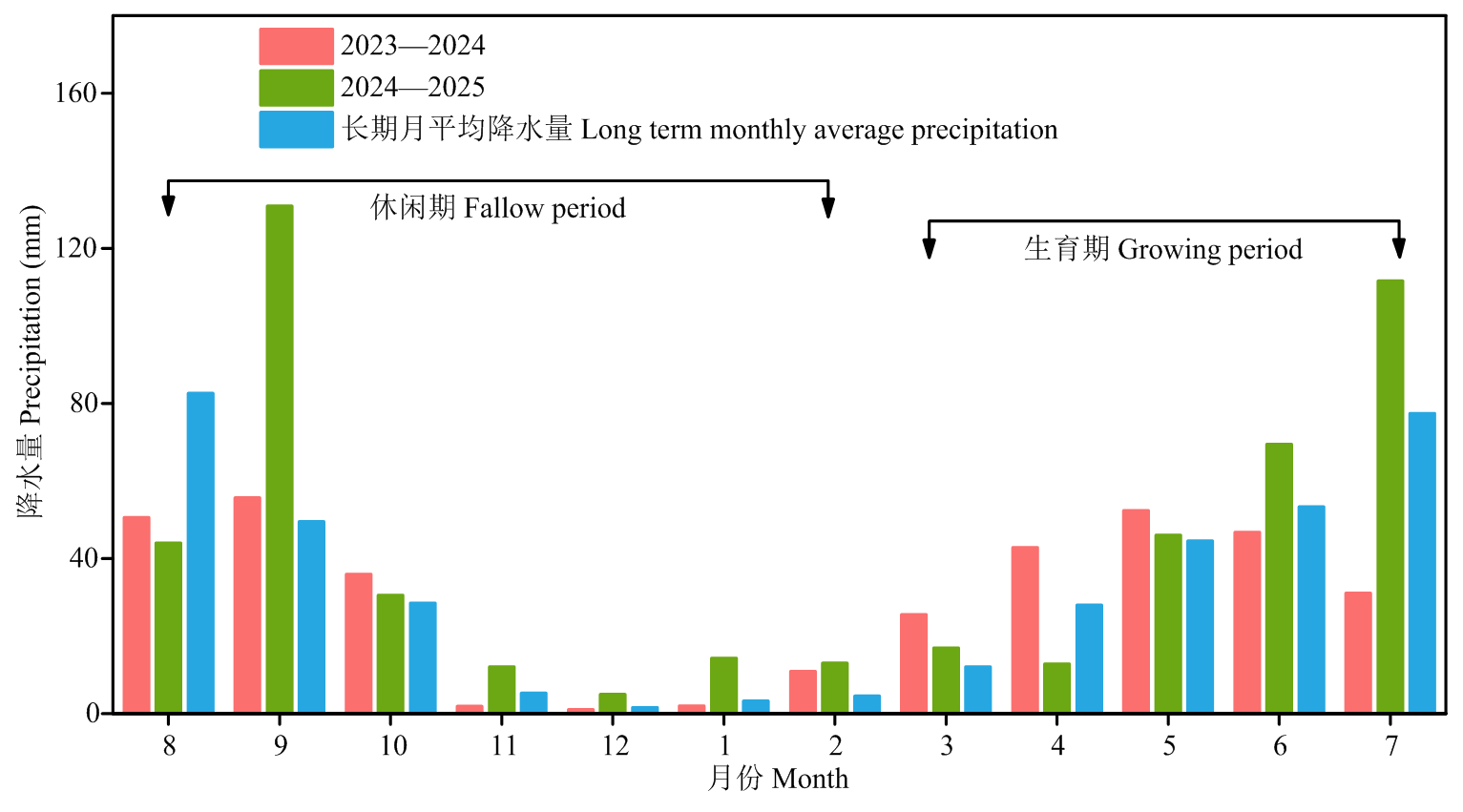
图1
试验期间试验区月降水量"
表1
试验设计"
| 处理Treatment | 氮肥Nitrogen fertilizer (kg·hm-2) | 磷肥Phosphorus fertilizer (kg·hm-2) | 有机肥Organic fertilizer (kg·hm-2) |
|---|---|---|---|
| NP | 105 | 105 | 0 |
| MNP | 80 | 88 | 8500 |
| FNP | 105 | 105 | 0 |
| FMNP | 80 | 88 | 8500 |
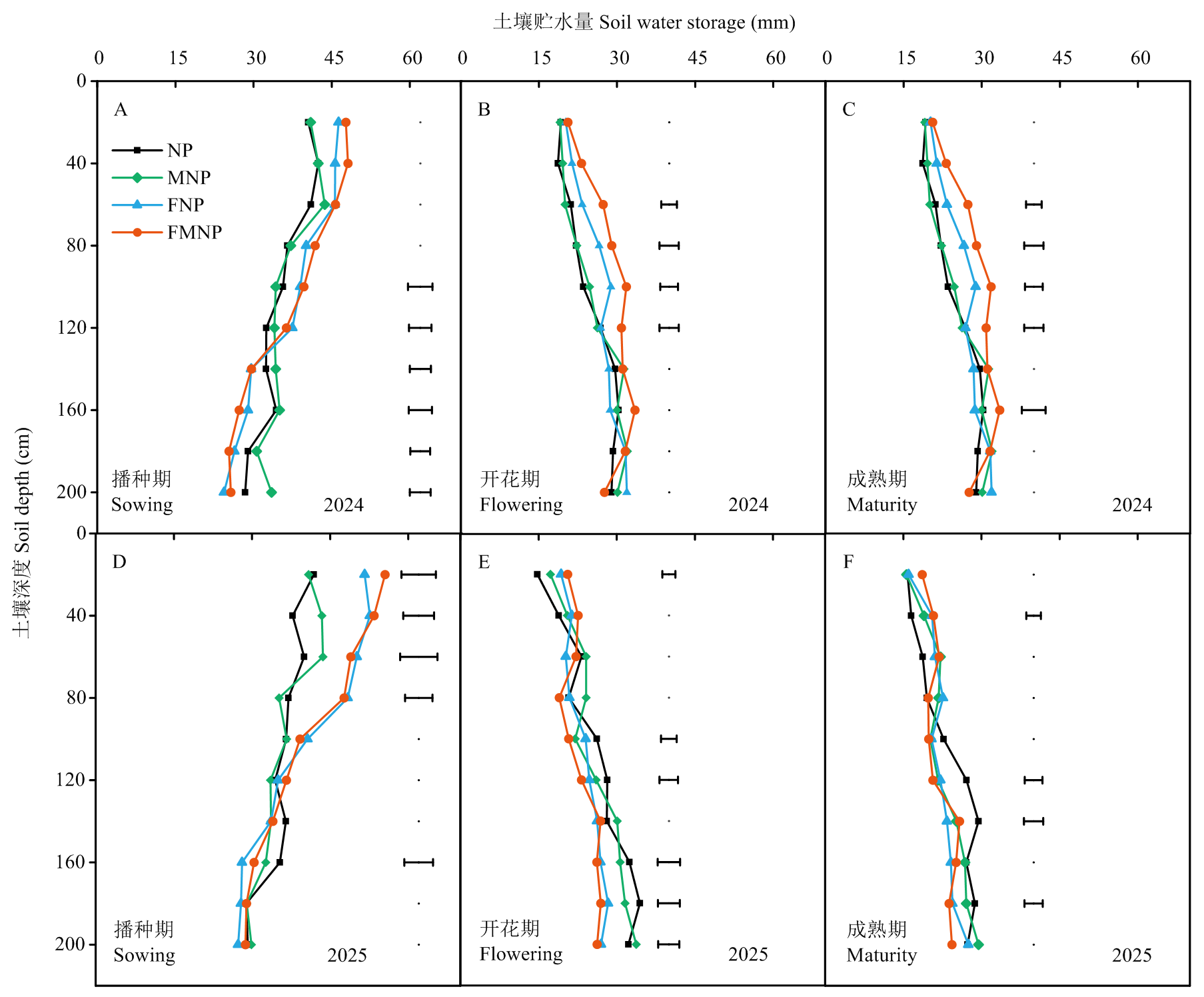
图2
有机替代和地膜覆盖对0—200 cm土层土壤贮水量的影响 水平误差棒为LSD0.05值。下同"
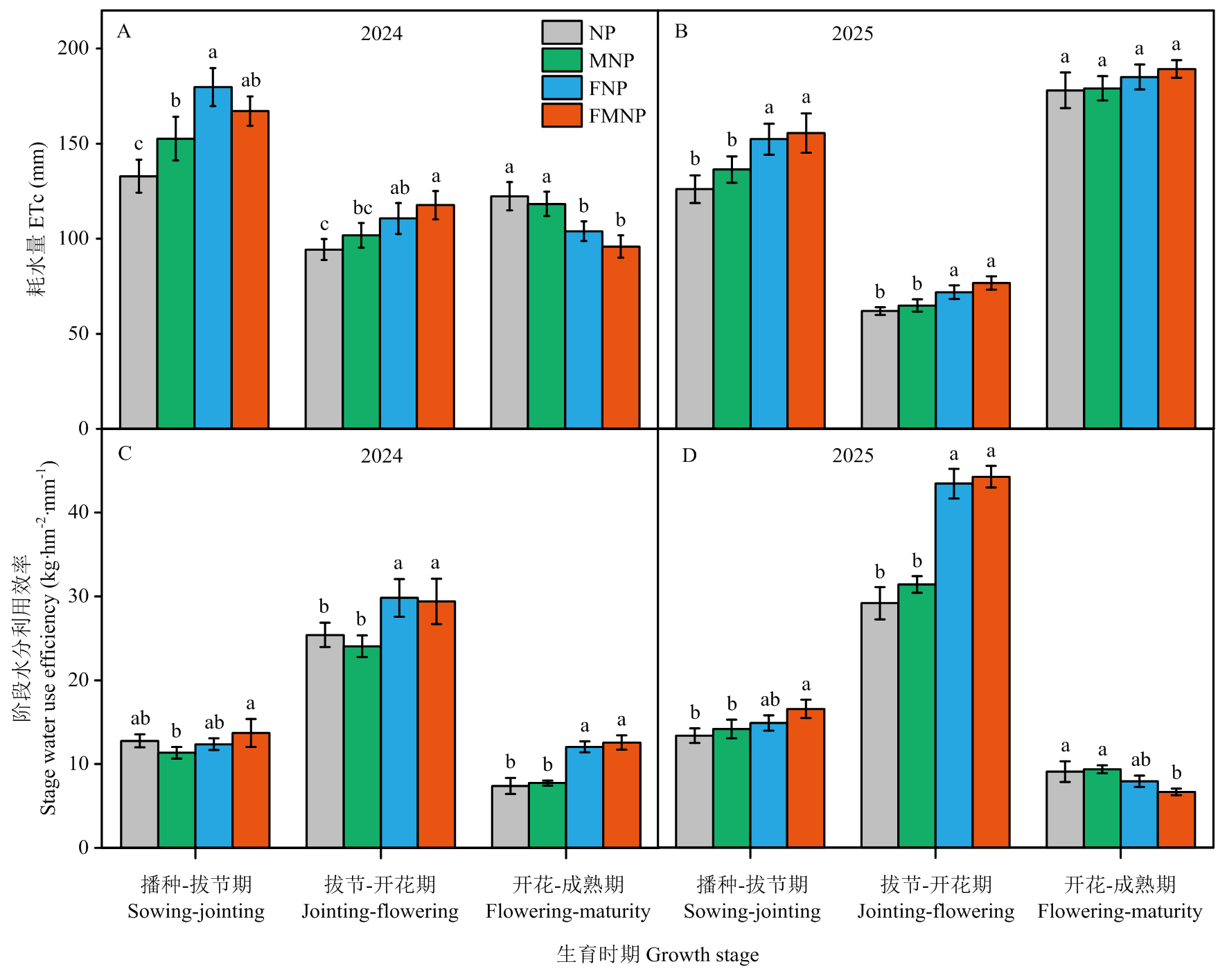
图3
有机替代和地膜覆盖对不同阶段水分利用的影响 JET:播种-拔节期的耗水量;FET:拔节-开花期的耗水量;GET:开花-成熟期的耗水量。JWUEb:播种-拔节期的阶段水分利用效率;FWUEb:拔节-开花期的阶段水分利用效率;GWUEb:开花-成熟期的阶段水分利用效率。图中不同小写字母表示各指标在P<0.05水平差异显著。下同"
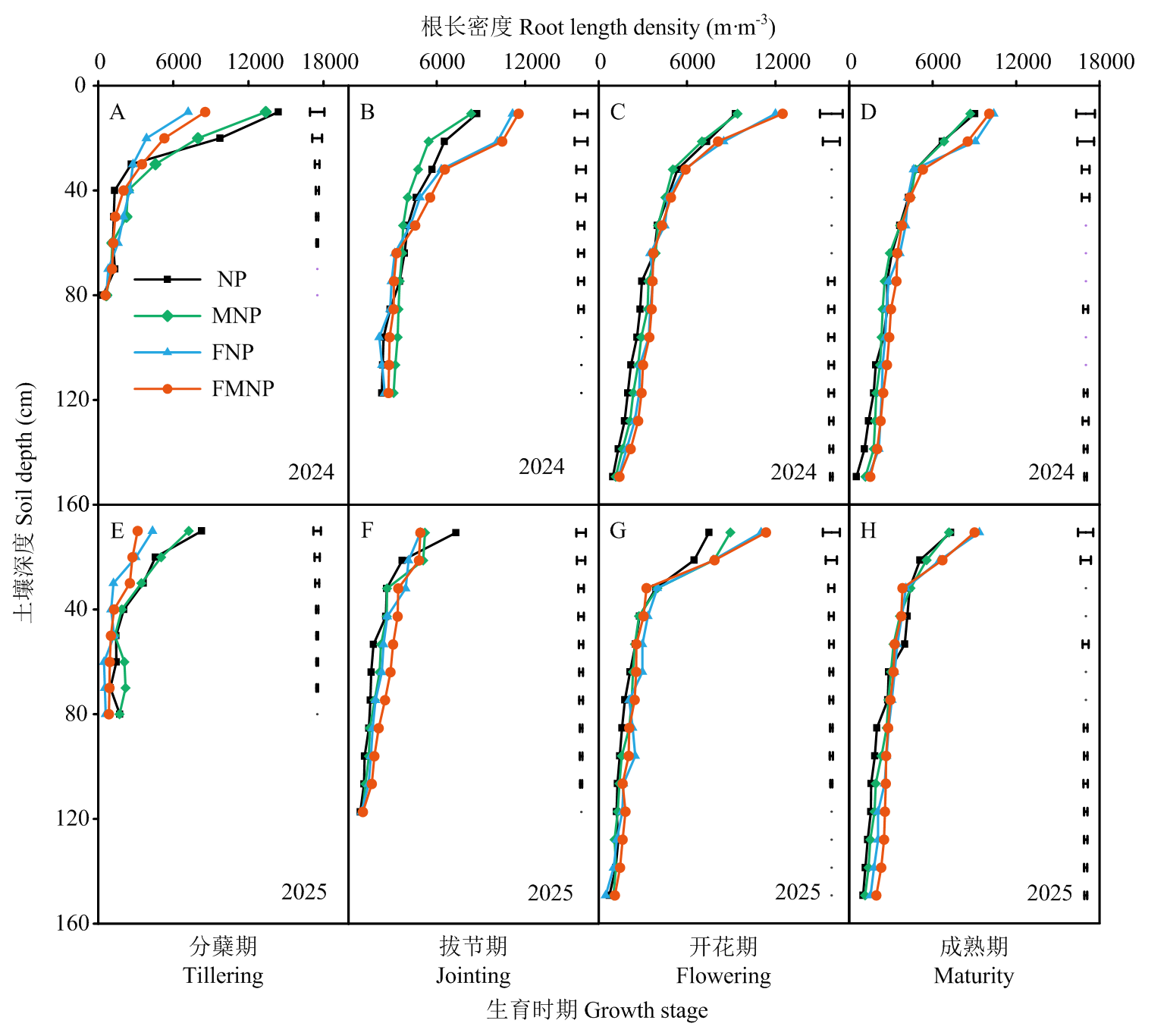
图4
有机替代和地膜覆盖对不同时期根长密度的影响"
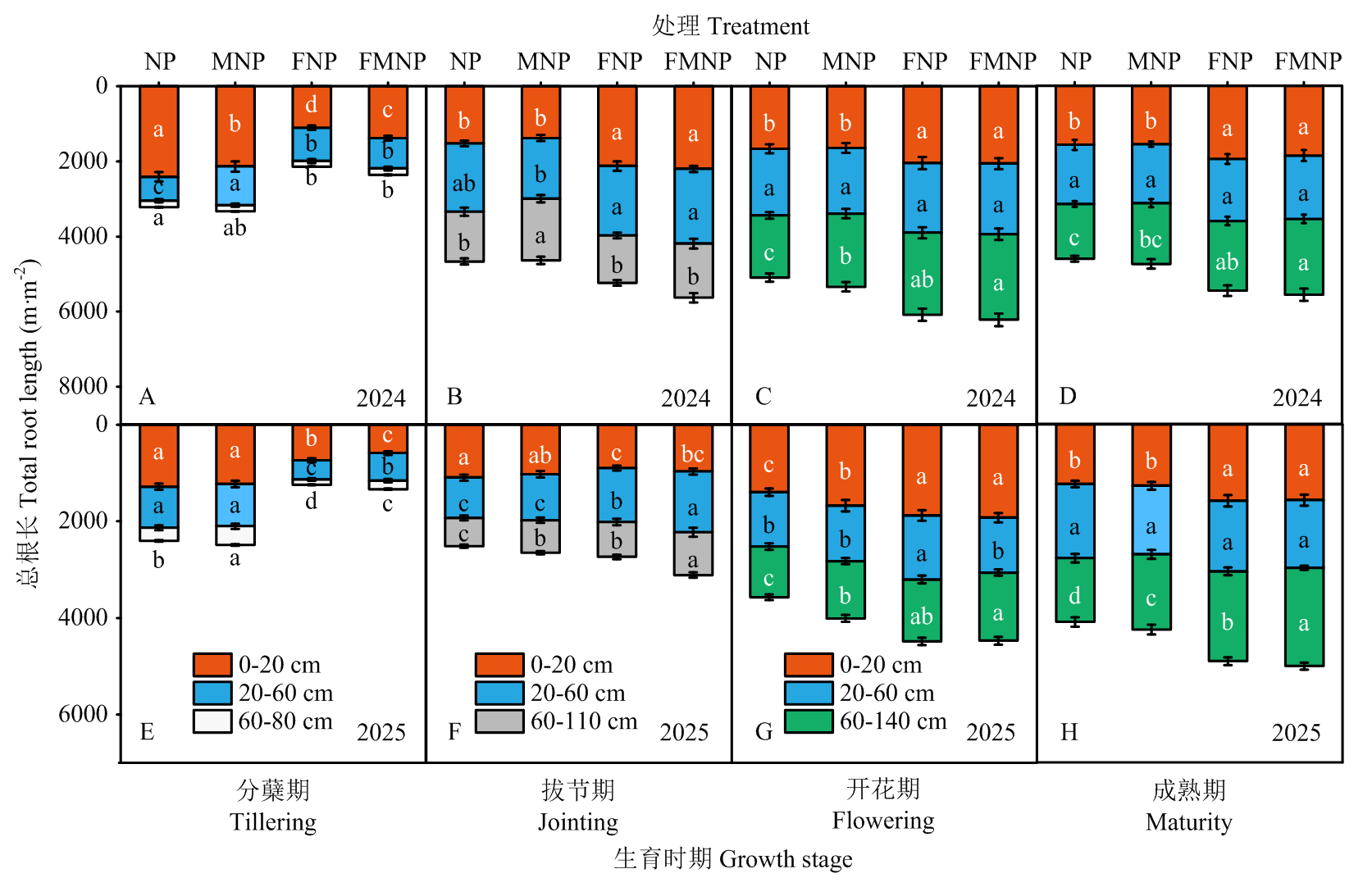
图5
有机替代和地膜覆盖对不同时期总根长的影响"
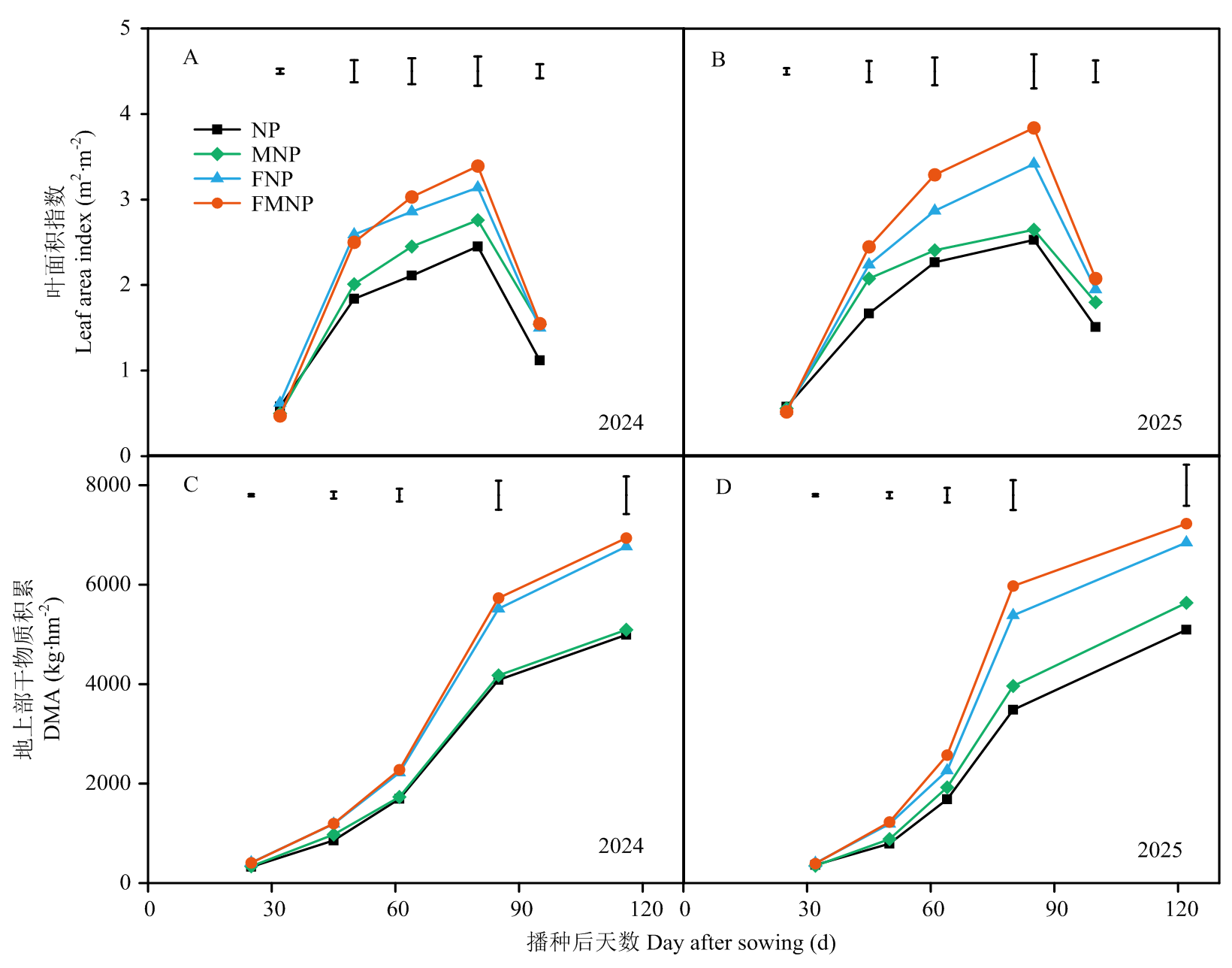
图6
有机替代和地膜覆盖对春小麦叶面积指数(LAI)及地上部干物质积累量的影响 DMA:地上部干物质积累"
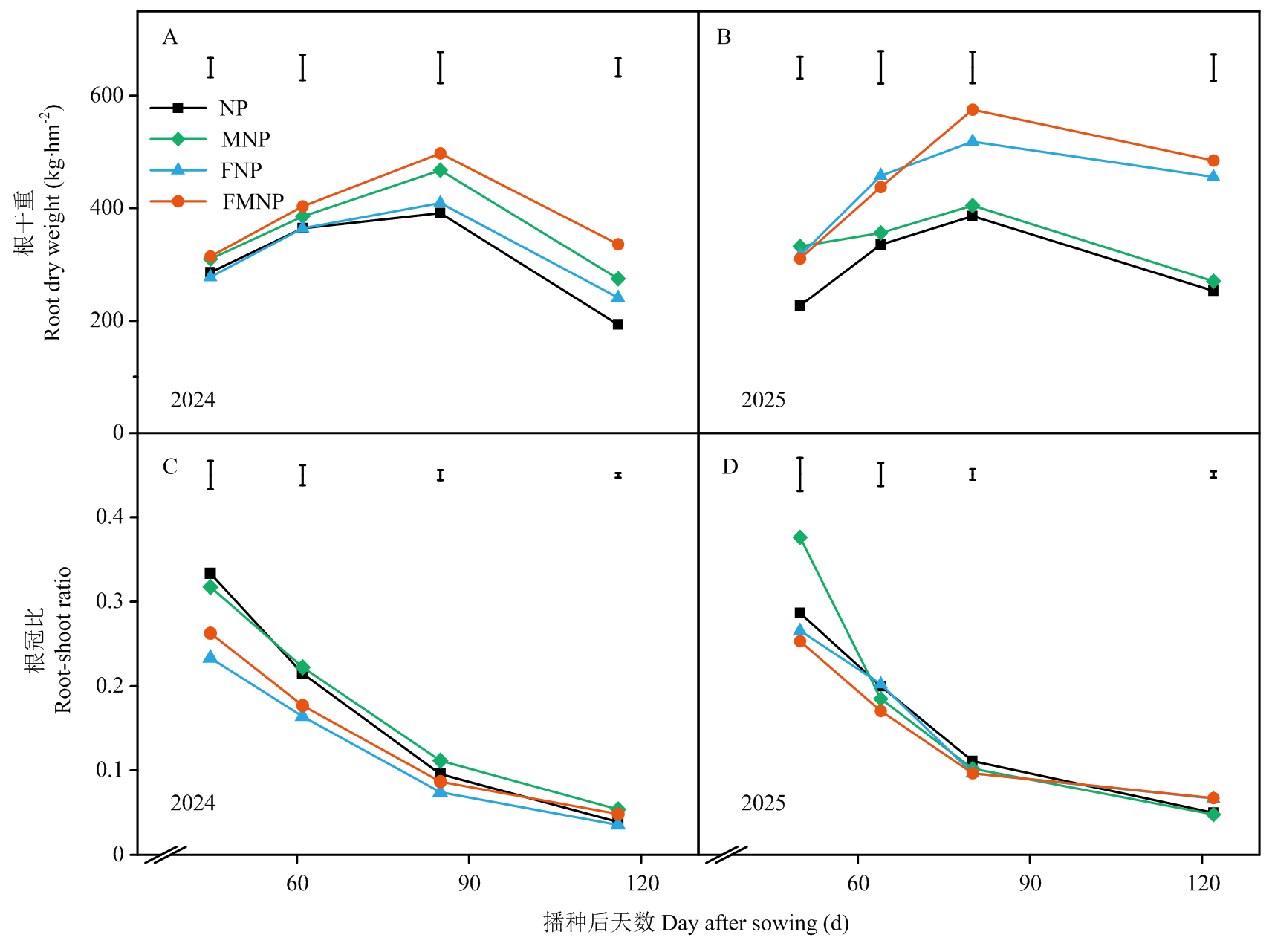
图7
有机替代和地膜覆盖对春小麦根干重和根冠比(R/S)的影响"
表2
有机替代和地膜覆盖对春小麦产量性状、产量及水分利用效率的影响"
| 年份 Year | 处理 Treatment | 耗水量 ETc (mm) | 穗数 Number of spikes (spike/m2) | 穗粒数 Grains per spike | 千粒重 TGW (g) | 生物量水分利用效率 WUEb (kg·hm-2·mm-1) | 收获指数 Harvest index (%) | 籽粒产量水分利用效率 WUEg (kg·hm-2·mm-1) | 籽粒产量 Grain yield (kg·hm-2) | 产量协同效应SEGY (%) | 水分利用效率协同效应 SEWUE (%) |
|---|---|---|---|---|---|---|---|---|---|---|---|
| 2024 | NP | 349±22b | 395±21ab | 24.6±1.5c | 39.0±2.1a | 14.3±0.9b | 33.9±2.4a | 4.8±0.3c | 1688±115b | — | — |
| MNP | 373±22ab | 382±23b | 25.5±2.2bc | 41.7±3.3a | 13.7±1.0b | 35.7±2.4a | 4.9±0.2c | 1814±130b | — | — | |
| FNP | 394±23a | 426±29a | 28.4±1.8ab | 38.2±2.9a | 17.2±1.1a | 36.3±2.3a | 6.2±0.3b | 2450±108a | — | — | |
| FMNP | 381±21ab | 429±13a | 31.8±1.7a | 37.4±2.8a | 18.2±1.2a | 38.0±2.4a | 6.9±0.4a | 2631±126a | 6.2 | 40.0 | |
| 2025 | NP | 366±20c | 412±14b | 26.0±1.6b | 42.1±2.3a | 13.9±1.0c | 34.6±2.2b | 4.8±0.3b | 1759±97d | — | — |
| MNP | 380±16bc | 426±15ab | 27.7±1.9b | 43.1±2.8a | 14.8±1.3bc | 34.9±2.3ab | 5.2±0.5b | 1965±109c | — | — | |
| FNP | 409±19ab | 444±19ab | 31.7±2.1a | 41.4±2.4a | 16.7±0.9ab | 38.3±2.6ab | 6.4±0.3a | 2617±102b | — | — | |
| FMNP | 421±18a | 449±18a | 33.0±2.0a | 40.6±2.4a | 17.1±0.9a | 39.4±2.4a | 6.7±0.3a | 2840±104a | 1.6 | -5.0 | |
| 平均 Average | NP | 358±21b | 404±18b | 25.3±1.6c | 40.6±2.6a | 14.1±0.9b | 34.3±2.1c | 4.8±0.3c | 1724±103c | — | — |
| MNP | 377±18ab | 404±30b | 26.6±2.2c | 42.4±2.8a | 14.3±1.2b | 35.3±2.1bc | 5.0±0.4c | 1890±135c | — | — | |
| FNP | 402±21a | 435±24a | 30.1±2.5b | 39.8±3.0a | 17.0±0.9a | 37.3±2.5ab | 6.3±0.3b | 2534±131b | — | — | |
| FMNP | 401±28a | 439±18a | 32.4±1.8a | 39.0±2.9a | 17.7±1.1a | 38.7±2.3a | 6.8±0.3a | 2736±154a | 3.7 | 17.6 | |
| 年份Year (Y) | * | ** | ** | ** | * | ns | ns | ** | |||
| 有机替代Organic substitution (OR) | ns | ns | ** | ns | * | ** | ** | ** | |||
| 地膜覆盖Film mulching (FM) | ** | ** | ** | ns | ** | ** | ** | ** | |||
| Y×OR | ns | ** | ns | ns | ns | ns | ns | ns | |||
| Y×FM | ns | * | ns | ns | ** | * | ns | ns | |||
| OR×FM | ns | ns | ns | ns | ns | ns | * | ns | |||
| Y×OR×FM | ns | * | ns | ns | ns | ns | ns | ns | |||
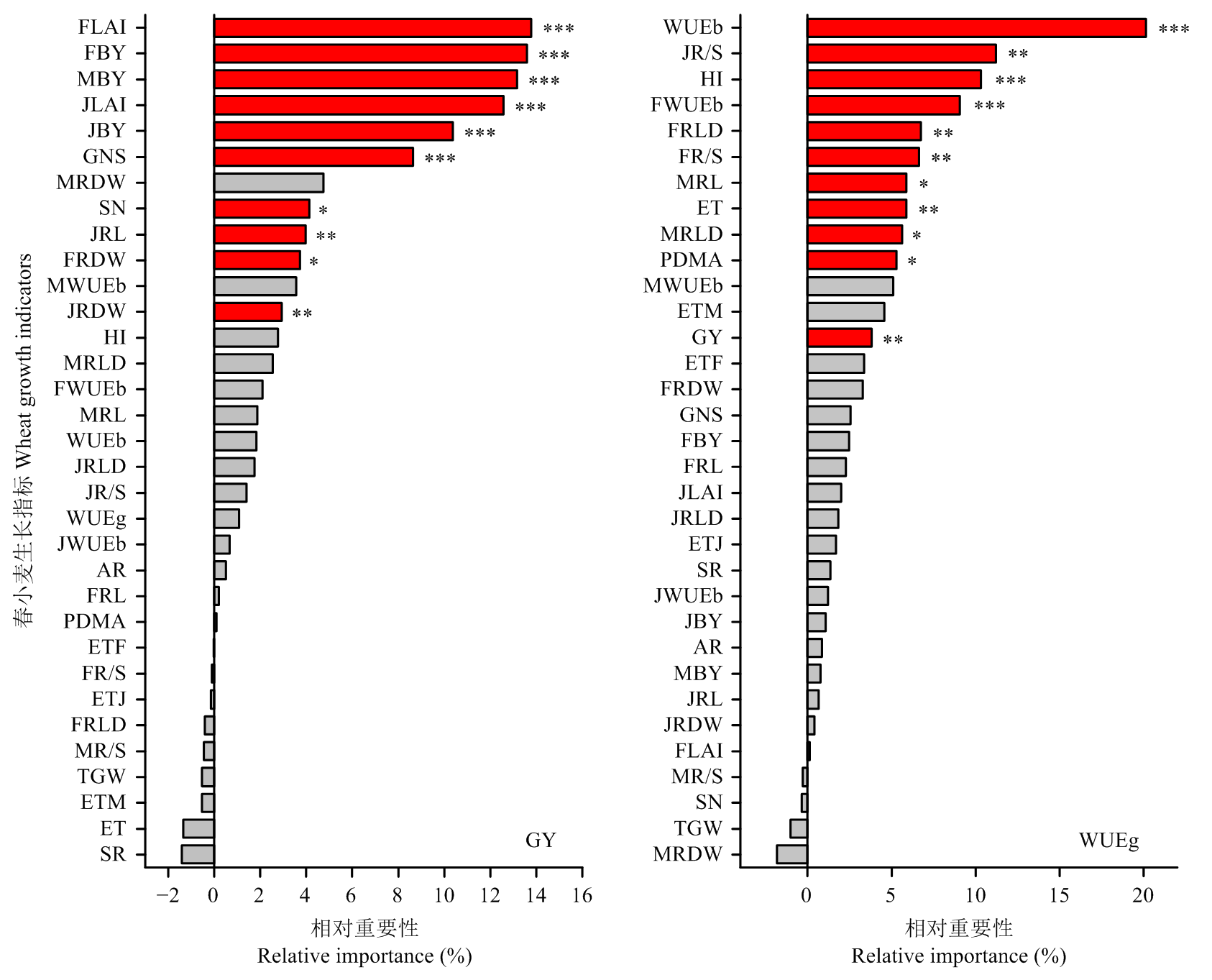
图8
基于随机森林算法分析春小麦各生长指标对产量(GY)和水分利用效率(WUEg)的相对重要性 ET:耗水量;SN:穗数;GNS:穗粒数;TGW:千粒重;HI:收获指数;JBY:拔节期生物量;FBY:开花期生物量;MBY:成熟期生物量;PDMA:花后生物量积累;JWUEb:播种-拔节期的水分利用效率;FWUEb:拔节-开花期的水分利用效率;MWUEb:开花-成熟期的水分利用效率;WUEb:生物量水分利用效率;JLAI:拔节期叶面积指数;FLAI:开花期叶面积指数;JRDW:拔节期根干重;FRDW:开花期根干重;MRDW:成熟期根干重;JR/S:拔节期根冠比;FR/S:开花期根冠比;MR/S:成熟期根冠比;JRL:拔节期根长;FRL:开花期根长;MRL:成熟期根长;JRLD:拔节期根长密度;FRLD:开花期根长密度;MRLD:成熟期根长密度;GY:籽粒产量;WUEg:籽粒产量水分利用效率;SR:生育期降水;AR:周年降水。***表示0.001水平有显著影响。下同"
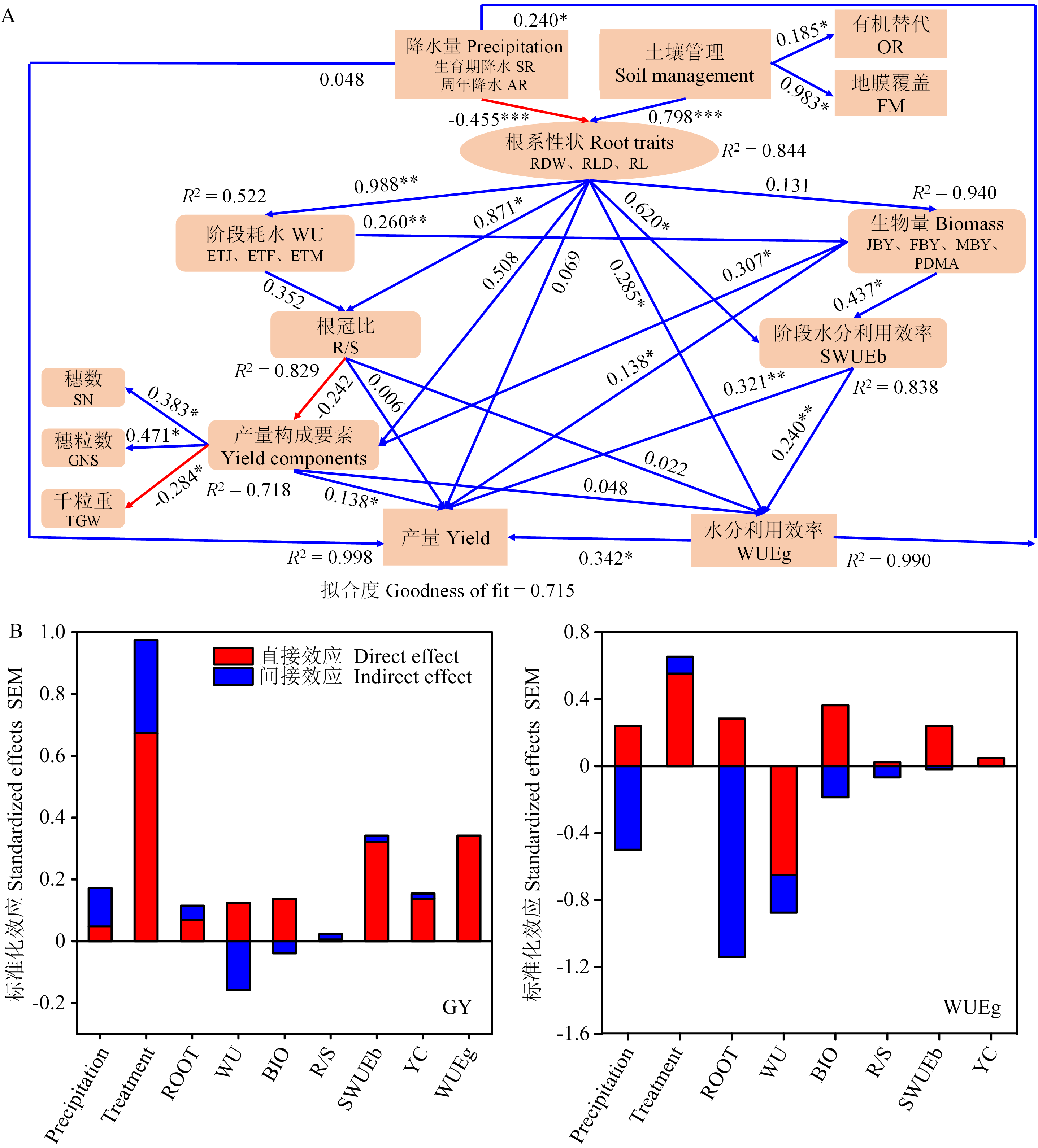
图9
偏最小二乘结构方程模型分析各指标与产量和WUE关系 A:降水量、土壤管理措施、根系性状、阶段耗水、生物量积累、根冠比、阶段水分利用效率和产量构成要素对春小麦产量及水分利用效率的影响;B:基于分段结构方程模型标准化效应(分为直接和间接效应)"
| [1] |
国家统计局. 国家统计局关于2025年夏粮产量数据的公告. 2025-07-11(1).
|
|
National Bureau of Statistics of China. Announcement of the National Bureau of Statistics on the 2025 Summer Grain Output Data. 2025-07-11(1). (in Chinese)
|
|
| [2] |
卢春燕. 我国小麦生产现状与提高小麦生产能力的思考. 南方农业, 2021, 15(30): 177-178.
|
|
|
|
| [3] |
杨文稼, 肖庆红, 王仕稳, 韦伟, 殷俐娜, 邓西平. 黄土高原旱作麦田深层土壤水利用与小麦产量及产量稳定性的关系. 干旱地区农业研究, 2023, 41(3): 41-48.
|
|
|
|
| [4] |
doi: 10.3390/agronomy14071404 |
| [5] |
doi: 10.1371/journal.pone.0180205 |
| [6] |
董莉霞, 李广, 燕振刚, 刘强. 秸秆覆盖量和施氮量对陇中春小麦的产量效应模拟. 湖南农业大学学报(自然科学版), 2024, 50(2): 18-23.
|
|
|
|
| [7] |
郝雯悦, 王西娜, 王月梅, 马建森, 谭军利. 小麦过量施肥的危害及化肥减施途径. 现代农业科技, 2022(24): 40-44, 48.
|
|
|
|
| [8] |
刘芳, 刘帅. 化肥施用量对中国粮食产量的影响分析. 中国农机化学报, 2021, 42(8): 92-100.
doi: 10.13733/j.jcam.issn.2095-5553.2021.08.13 |
|
|
|
| [9] |
doi: 10.1016/S2095-3119(13)60425-6 |
| [10] |
沈文远, 陈昕钰, 余徐润, 吴云飞, 陈刚, 熊飞. 根际温度胁迫对小麦根系形态及生理影响的研究进展. 作物杂志, 2022(6): 23-32.
|
|
|
|
| [11] |
doi: 10.1016/j.fcr.2022.108523 |
| [12] |
李中阳, 吕谋超, 樊向阳, 杜臻杰, 胡超. 不同类型保水剂对冬小麦水分利用效率和根系形态的影响. 应用生态学报, 2015, 26(12): 3753-3758.
|
|
|
|
| [13] |
姚佳璇, 俄胜哲, 袁金华, 时晓娟, 车宗贤. 施肥对灌漠土作物产量、土壤肥力与重金属含量的影响. 中国生态农业学报(中英文), 2020, 28(6): 813-825.
|
|
|
|
| [14] |
孙婴婴, 陈玉华, 陈士颖, 张岁岐. 不同栽培模式对旱作冬小麦根系生长时空分布及水分利用的影响. 中国农学通报, 2014, 30(30): 75-82.
doi: 10.11924/j.issn.1000-6850.2014-1325 |
|
doi: 10.11924/j.issn.1000-6850.2014-1325 |
|
| [15] |
韩宝, 于跃跃, 朱文, 徐凯, 郭宁. 有机肥不同量级对小麦产量和土壤培肥的影响. 中国农学通报, 2021, 37(24): 73-78.
doi: 10.11924/j.issn.1000-6850.casb2020-0681 |
|
doi: 10.11924/j.issn.1000-6850.casb2020-0681 |
|
| [16] |
鲁伟丹, 李俊华, 罗彤, 陈丽丽, 张磊, 刘硕康. 连续三年不同有机肥替代率对小麦产量及土壤养分的影响. 植物营养与肥料学报, 2021, 27(8): 1330-1338.
|
|
|
|
| [17] |
doi: 10.1016/j.agwat.2012.11.002 |
| [18] |
裴雪霞, 党建友, 张定一, 张晶, 高璐, 程麦凤, 王姣爱. 化肥减量配施有机肥对旱地小麦产量、品质和水分利用率的影响. 水土保持学报, 2021, 35(4): 250-258.
|
|
|
|
| [19] |
张科, 陈晓丽, 魏文龙, 李世清, 罗珠珠, 王林林. 有机无机肥配施对黄土高原旱地春小麦产量和水分利用效率的影响. 干旱地区农业研究, 2025, 43(5): 97-108.
|
|
|
|
| [20] |
王林林. 氮肥和有机肥对旱地小麦水氮利用的调控[D]. 杨凌: 西北农林科技大学, 2018.
|
|
|
|
| [21] |
周昌明, 李援农, 银敏华, 谷晓博, 赵玺. 液态地膜覆盖下种植方式对土壤水分和玉米生长的影响. 农业机械学报, 2016, 47(4):49-58.
|
|
|
|
| [22] |
宋文品, 黄菁, 陈晓丽, 王利春, 孙维拓, 王志敏, 薛绪掌, 郭文忠, 李友丽, 陈菲. 地膜覆盖与常规灌溉对冬小麦耗水特征和产量的影响. 中国生态农业学报, 2016, 24(11): 1445-1455.
|
|
|
|
| [23] |
程宏波, 牛建彪, 柴守玺, 常磊, 杨长刚. 不同覆盖材料和方式对旱地春小麦产量及土壤水温环境的影响. 草业学报, 2016, 25(2): 47-57.
doi: 10.11686/cyxb2015395 |
|
|
|
| [24] |
doi: 10.3390/agronomy15112607 |
| [25] |
刘英丽. 保护性耕作对旱地小麦根系生长及土壤水分利用的影响. 种子科技, 2025, 43(19): 204-206.
|
|
|
|
| [26] |
陈紫薇, 丁奠元, 董文俊, 王乃江, 李悦, 冯浩. 覆膜对不同播期冬小麦根系生长和产量的影响. 干旱地区农业研究, 2021, 39(6): 136-145.
|
|
|
|
| [27] |
陈利军, 宝哲, 林涛, 严昌荣, 汤秋香. 基于Meta-analysis的新疆主要作物地膜覆盖产量及水分利用效率分析. 生态学杂志, 2022, 41(4): 661-667.
|
|
doi: 10.13292/j.1000-4890.202203.032 |
|
| [28] |
doi: 10.1016/j.agwat.2017.11.010 |
| [29] |
doi: 10.2135/cropsci2012.07.0448 |
| [30] |
逯玉兰, 李广, 燕振刚, 聂志刚, 董莉霞. 旱地小麦在不同氮肥处理下叶面积指数变化的模拟模型研究. 甘肃农业大学学报, 2018, 53(3): 70-75.
|
|
|
|
| [31] |
doi: 10.1016/j.fcr.2023.108873 |
| [32] |
doi: 10.1016/j.fcr.2007.03.015 |
| [33] |
李占, 丁娜, 郭立月, 孟杰, 李静, 李宵, 郑延海, 吴光磊, 曾彦. 有机肥和化肥不同比例配施对冬小麦—夏玉米生长、产量和品质的影响. 山东农业科学, 2013, 45(7): 71-77, 82.
|
|
|
|
| [34] |
王荣荣, 陈天鹏, 尹豪杰, 蒋桂英. 不同抗旱性春小麦根系生长对干旱胁迫的响应及滴灌复水补偿效应. 中国农业科学, 2023, 56(24): 4826-4841. doi:10.3864/j.issn.0578-1752.2023.24.003.
|
|
|
|
| [35] |
张向前, 曹承富, 乔玉强, 李玮, 陈欢. 砂姜黑土小麦根系性状与冠层光合对不同灌水方式的响应. 中国农业科学, 2015, 48(8): 1506-1517. doi:10.3864/j.issn.0578-1752.2015.08.05.
|
|
|
|
| [36] |
王林林, 陈炜, 徐莹, 李红兵, 邓西平. 氮素营养对小麦干物质积累与转运的影响. 西北农业学报, 2013, 22(10): 85-89.
|
|
|
|
| [37] |
肖鹏, 易善银, 高建勇, 章丽超. 有机肥不同比例替代化肥对小麦产量和氮磷钾利用率的影响研究. 安徽农学通报, 2023, 29(10): 13-15.
|
|
|
|
| [38] |
王玉汝, 陈丽娜. 有机肥替代化肥对小麦氮素吸收利用效率、产量和经济效益的影响. 农业科技与信息, 2024(6): 56-59, 77.
|
|
|
|
| [39] |
doi: 10.1016/j.scitotenv.2022.158064 |
| [40] |
doi: 10.1016/j.agwat.2019.105934 |
| [41] |
曹伟. 化肥减量与增施有机肥对江阴市小麦农艺性状及产量的影响. 现代农业科技, 2023(23): 4-6.
|
|
|
|
| [42] |
doi: 10.1016/j.jenvman.2023.118494 |
| [43] |
doi: 10.3390/agronomy12092047 |
| [44] |
唐霓. 有机肥替代对冬小麦生长、水氮利用效率及产量的影响[D]. 杨凌: 西北农林科技大学, 2025.
|
|
|
|
| [45] |
李世涛, 罗华, 李光富, 乔艳, 胡诚, 张智. 有机替代对小麦产量和土壤理化性质的影响. 天津农业科学, 2025, 31(9): 31-37.
|
|
|
|
| [46] |
侯慧芝, 张绪成, 尹嘉德, 方彦杰, 于显枫, 王红丽, 马一凡. 覆盖对西北旱地春小麦旗叶光合特性和水分利用的调控. 应用生态学报, 2019, 30(3): 931-940.
doi: 10.13287/j.1001-9332.201903.021 |
|
|
|
| [47] |
王硕, 尹嘉德, 侯慧芝, 马明生, 梁进宇, 赵琦志, 张绪成, 谢军红. 基于Meta分析的地膜覆盖材料和水热条件对西北地区小麦水分利用及产量的影响. 甘肃农业大学学报, 2025. https://link.cnki.net/urlid/62.1055.S.20251011.1123.004.
|
|
|
|
| [48] |
doi: 10.1016/j.scitotenv.2020.141479 |
| [49] |
毛伟滔, 张绪成, 马明生, 柳燕兰, 尹嘉德. 有机肥部分替代化肥对旱地地膜冬小麦产量及水肥利用效率的影响. 麦类作物学报, 2023, 43(12): 1587-1598.
|
|
|
|
| [50] |
赵隽, 董树亭, 刘鹏, 张吉旺, 赵斌. 有机无机肥长期定位配施对冬小麦群体光合特性及籽粒产量的影响. 应用生态学报, 2015, 26(8): 2362-2370.
|
|
|
|
| [51] |
doi: 10.1016/j.fcr.2005.12.005 |
| [52] |
doi: 10.1038/s41598-022-15992-z |
| [53] |
doi: 10.2135/cropsci2014.09.0616 |
| [54] |
doi: 10.1016/j.fcr.2009.02.006 |
| [55] |
张淑芳, 柴守玺, 蔺艳春, 常磊, 杨长刚. 干旱年份地膜覆盖模式对春小麦土壤水分和产量的影响. 中国农业气象, 2011, 32(3): 368-374.
|
|
|
| [1] | 白晶晶, 章宇辰, 倪子捷, 高佳勇, 刘伟洋, 盖东升, 王雨行, 何佳庆, 张强, 邵玺文, 吴莹, 耿艳秋, 郭丽颖. 不同灌溉量对东北地区水稻抗倒伏特性及产量的影响[J]. 中国农业科学, 2026, 59(9): 1848-1868. |
| [2] | 蔡巧红, 周甜, 苏明, 洪自强, 李翻过, 李彤, 汪华, 康建宏, 吴宏亮. 宁夏引黄灌区减氮增钾施肥模式对玉米光合荧光特性及光合产物积累的影响[J]. 中国农业科学, 2026, 59(9): 1869-1886. |
| [3] | 祝培, 赵耀, 白岩, 张金盔, 李莓, 龙金佳, 杨龙, 罗丽娅, 许本波, 徐劲松, 张学昆. 氟唑菌酰羟胺对油菜的生理调控作用及其与咪鲜胺的复配效应[J]. 中国农业科学, 2026, 59(9): 1903-1915. |
| [4] | 王小玮, 杜佛力, 闫红财, 郎正东, 党志娟, 李葆春, 汪军成, 马小乐, 王化俊, 张宏, 姚立蓉. 396份春小麦灌浆期和成熟期抗旱性评价[J]. 中国农业科学, 2026, 59(8): 1608-1621. |
| [5] | 陈宣伊, 郭星星, 张向前, 路战远, 刘凌悦, 罗方, 李金龙, 张传玲, 张志青, 车曼青. 间作行比对玉米冠层光环境异质性和光合物质生产的影响[J]. 中国农业科学, 2026, 59(8): 1653-1671. |
| [6] | 侯慧芝, 尹嘉德, 马明生, 刘晓伟, 柳燕兰, 雷康宁. 耕作与增施有机肥对陇东马铃薯-玉米一年两熟制作物产量和水分利用的影响[J]. 中国农业科学, 2026, 59(8): 1672-1685. |
| [7] | 彭廷燊, 陆久焱, 吴美林, 严雨欣, 刘宏周, 南文斌, 秦小健, 李明, 龚俊义, 梁永书. 多年生水稻黄糯2号和长白7号产量相关性状的QTL分析[J]. 中国农业科学, 2026, 59(7): 1361-1379. |
| [8] | 王玉萍, 符质, 孙佳莹, 穆晓萌, 刘慧淋, 郭进云, 宋文菁, 侯雷平, 赵海亮. 苗期施用褪黑素对番茄短期低温胁迫的缓解作用与应用效果评价[J]. 中国农业科学, 2026, 59(7): 1523-1535. |
| [9] | 王佳诺, 陈桂平, 李盼, 王丽萍, 南运有, 何蔚, 樊志龙, 胡发龙, 柴强, 殷文, 赵连豪. 免耕地膜两年覆盖提高绿洲灌区玉米产量的灌浆期光合生理机制[J]. 中国农业科学, 2026, 59(6): 1189-1202. |
| [10] | 周新杰, 任昊, 陈应龙, 张吉旺, 赵斌, 任佰朝, 刘鹏, 王洪章. 过氧化钙对渍涝农田夏玉米根系形态及产量形成的影响[J]. 中国农业科学, 2026, 59(6): 1203-1216. |
| [11] | 何继航, 张擎, 吕相月, 薛吉全, 徐淑兔, 刘建超. 不同保绿型玉米杂交种氮效率评价[J]. 中国农业科学, 2026, 59(6): 1217-1230. |
| [12] | 焦文娟, 何万龙, 耿洪伟, 白斌, 李剑峰, 程宇坤. 155份春小麦品种(系)条锈病抗性评价与抗病基因分子检测[J]. 中国农业科学, 2026, 59(5): 937-950. |
| [13] | 郝琨, 陈洪德, 张威, 钟韵, 党美荣, 朱士江, 黄志坤, 金英. 基于柑橘产量、品质及水氮利用的涌泉根灌水氮综合评价[J]. 中国农业科学, 2026, 59(4): 862-873. |
| [14] | 郭富城, 唐海江, 郝馨怡, 马国林, 杨九菊, 黄霖锋, 田蕾, 王彬, 罗成科. 不同灌溉方式对宁夏盐渍化土壤水盐运移、水稻产量及水分利用效率的影响[J]. 中国农业科学, 2026, 59(4): 750-764. |
| [15] | 咸青林, 肖鉴珂, 高阿庆, 郜利闯, 刘杨. 种植方式结合测墒补灌下冬小麦产量及水分利用效率[J]. 中国农业科学, 2026, 59(3): 589-601. |
|
||
