Scientia Agricultura Sinica ›› 2026, Vol. 59 ›› Issue (7): 1380-1399.doi: 10.3864/j.issn.0578-1752.2026.07.002

• CROP GENETICS & BREEDING·GERMPLASM RESOURCES·MOLECULAR GENETICS • Previous Articles     Next Articles

Identification and Functional Characterization of β-Glucosidase Genes in Verticillium dahliae for Pathogenicity on Cotton

LI YuanJing(), YUAN RuiXiang(), LI YongTai, SUN TianGe, LIU Feng, LI YanJun, ZHANG XinYu*()   

  1. The Key Laboratory of Oasis Eco-Agriculture, Agriculture College, Shihezi University, Shihezi 832003, Xinjiang
  • Received:2025-08-29 Accepted:2025-10-27 Online:2026-04-08 Published:2026-04-08
  • Contact: ZHANG XinYu

Abstract:

【Objective】Verticillium dahliae is a major soil-borne pathogenic fungus that can infect more than 200 plant species, causing Verticillium wilt and leading to severe economic losses in global agricultural production. Cell wall-degrading enzymes (CWDEs) play a critical role in fungal pathogenesis. This study aimed to identify β-glucosidase genes in V. dahliae and explore their functions, thereby providing new molecular targets for cotton disease-resistant breeding.【Method】β-glucosidase genes were identified from the whole genome of V. dahliae through bioinformatic analysis, and their evolutionary relationships, conserved domains, and expression patterns were systematically analyzed. Host-induced gene silencing (HIGS) technology was used to silence Vdbg4 and Vdbg6 in cotton to evaluate the effects of this silencing on cotton disease resistance. Artificial small interfering RNAs (asiRNAs) targeting Vdbg4 (asiR1364) and Vdbg6 (asiR1444) were designed and co-cultured with V. dahliae, respectively. The growth and development, carbon source utilization and stress response abilities, and pathogenicity of V. dahliae in co-culture were investigated. The secretory activity of Vdbg6 was verified using a yeast signal peptide trapping assay, and whether the gene could trigger plant immune responses was detected using an Agrobacterium-mediated tobacco transient expression assay.【Result】A total of 18 β-glucosidase genes were identified from V. dahliae. Among them, the expression levels of Vdbg4 and Vdbg6 were significantly up-regulated after induction by root exudates of a susceptible cotton cultivar. Silencing Vdbg4, Vdbg6 alone, or silencing both genes simultaneously via HIGS, significantly alleviated the disease symptoms of cotton, reduced the disease index, and decreased the fungal biomass. The asiRNAs targeting Vdbg4 and Vdbg6 (asiR1364, asiR1444, and asiR1364+1444) could inhibit the fungal colony and mycelial growth, reduce the sporulation and spore germination rates, and impair the carbon source utilization and stress response abilities, and pathogenicity of V. dahliae. Vdbg6 exhibited secretory activity, but it could neither induce programmed cell death (PCD) nor suppress BAX-induced PCD in tobacco cells.【Conclusion】Both Vdbg4 and Vdbg6 are involved in the growth and development, carbon source utilization, stress response, and pathogenic processes of V. dahliae.

Key words: cotton, Verticillium dahliae, cell wall-degrading enzymes, β-glucosidase, host-induced gene silencing (HIGS), artificial small interfering RNA (asiRNA)

Table 1

Design of asiRNAs Targeting Vdbg4 and Vdbg6"

基因 Gene asiRNA 正义链 Sense strand (5′-3′) 反义链 Antisense strand (5′-3′)
Vdbg4 asiR1364 GGCUGAAGAUCACAACCAATT UUGGUUGUGAUCUUCAGCCTT
Vdbg6 asiR1444 CGAUUGUGGUCUUCCAUAATT UUAUGGAAGACCACAAUCGTT

Table 2

Identification of beta-glucosidase genes in V. dahliae"

基因ID
ID gene
基因
名称
Gene name
CDS长度
CDS
length
(bp)
蛋白长度
Protein
length
(aa)
染色体Chromosome 分子量
Molecular
weight
(kDa)
理论
等电点Isoelectric
point
跨膜结构
域数量Transmembrane domain number
亚细胞定位预测Subcellular localization prediction 基因描述
Gene
description
VDAG_00134 Vdbg1 2878 813 2 87.54 6.34 1 质膜
Plasma membrane
β-葡萄糖苷酶Beta-glucosidase
VDAG_01062 Vdbg2 3076 897 1 98.58 5.41 0 细胞质
Cytosol
耐热β-葡萄糖苷酶Thermostable Beta-glucosidase
VDAG_01263 Vdbg3 1886 611 1 66.56 6.28 0 细胞质
Cytosol
β-葡萄糖苷酶Beta-glucosidase
VDAG_02542 Vdbg4 2796 798 3 86.19 5.67 0 线粒体Mitochondrion 耐热β-葡萄糖苷酶Thermostable Beta-glucosidase
VDAG_05580 Vdbg5 2489 774 2 85.27 4.98 0 细胞质
Cytosol
β-葡萄糖苷酶Beta-glucosidase
VDAG_06279 Vdbg6 2758 683 8 74.29 5.54 0 细胞外
Extracellular
β-葡萄糖苷酶Beta-glucosidase
VDAG_08139 Vdbg7 2500 816 6 87.91 4.69 0 细胞外
Extracellular
β-葡萄糖苷酶Beta-glucosidase
VDAG_09280 Vdbg8 2605 823 4 89.29 5.93 0 细胞质
Cytosol
耐热β-葡萄糖苷酶Thermostable Beta-glucosidase
VDAG_09750 Vdbg9 3169 876 3 94.85 4.78 0 细胞外
Extracellular
β-葡萄糖苷酶Beta-glucosidase
VDAG_09393 Vdbg10 1943 609 4 67.13 4.88 0 细胞外
Extracellular
周质β-葡萄糖苷酶Periplasmic Beta-glucosidase
VDAG_05611 Vdbg11 2676 833 2 91.40 5.61 0 细胞质
Cytosol
β-葡萄糖苷酶Beta-glucosidase
VDAG_03973 Vdbg12 2598 803 3 104.64 5.51 0 细胞外
Extracellular
β-葡萄糖苷酶Beta-glucosidase
VDAG_02717 Vdbg13 2942 955 3 86.67 5.24 1 细胞质
Cytosol
β-葡萄糖苷酶Beta-glucosidase
VDAG_08263 Vdbg14 2313 746 6 78.45 4.77 0 细胞外
Extracellular
耐热β-葡萄糖苷酶Thermostable Beta-glucosidase
VDAG_08240 Vdbg15 2632 836 6 89.78 5.41 0 细胞质
Cytosol
耐热β-葡萄糖苷酶Thermostable Beta-glucosidase
VDAG_06333 Vdbg16 1995 476 8 53.78 4.87 0 细胞质
Cytosol
β-葡萄糖苷酶Beta-glucosidase
VDAG_02175 Vdbg17 2420 781 7 84.91 5.39 0 细胞外
Extracellular
β-葡萄糖苷酶Beta-glucosidase
VDAG_03143 Vdbg18 648 215 6 23.10 4.88 0 细胞质
Cytosol
β-葡萄糖苷酶Beta-glucosidase

Fig. 1

Analysis of conserved domains and phylogenetic tree of beta-glucosidase gene"

Fig. 2

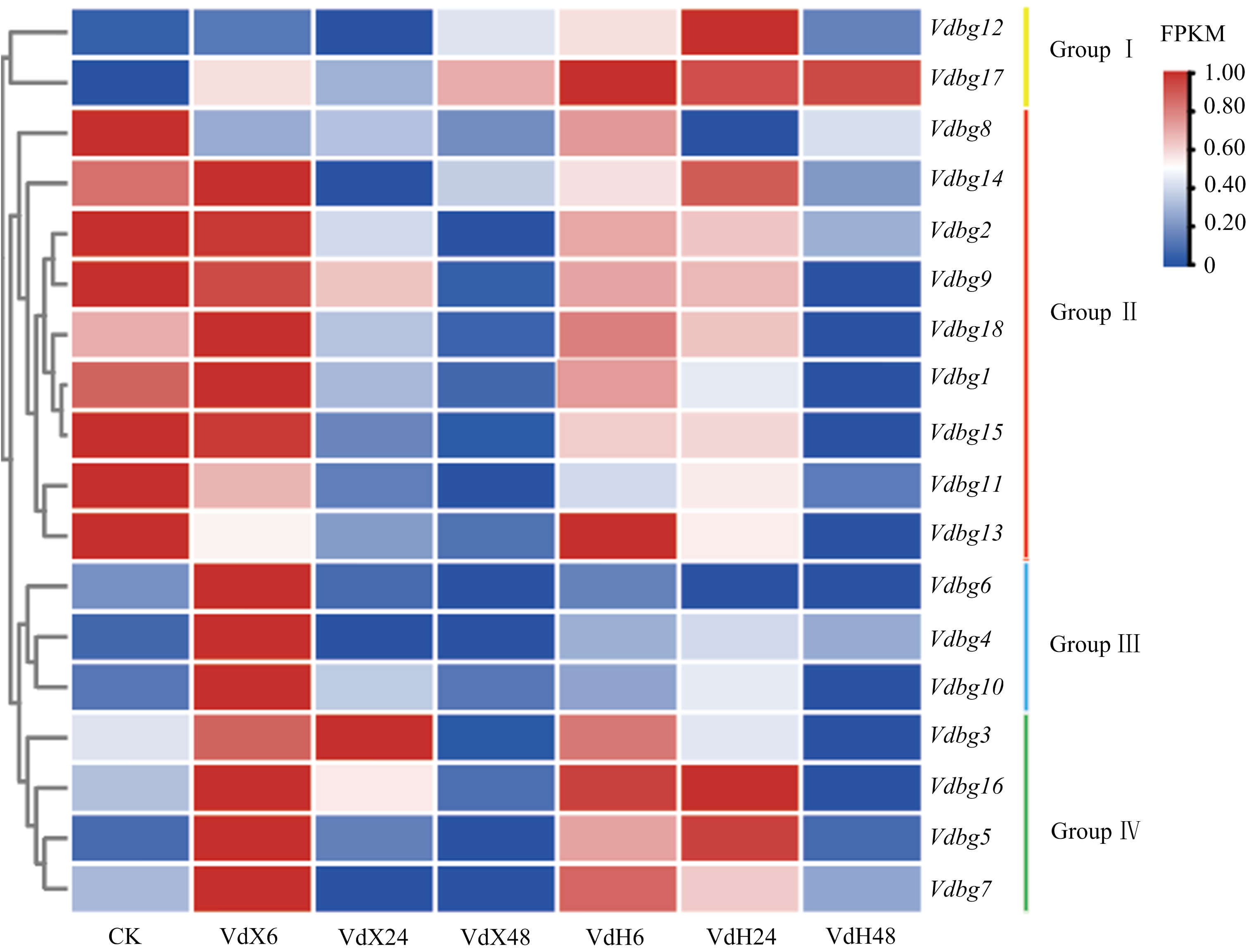
Analysis of Vdbgs gene expression patterns induced by root exudates from different cotton varieties VdX: Xinhailuzao 7; VdH: Hai 7124. The numeric suffixes indicate the time points (6, 24, and 48 hours) of root exudate treatment"

Fig. 3

Functional analysis of Vdbg4 and Vdbg6 in the pathogenicity of Verticillium dahliae using TRV-HIGS technology A: Disease symptoms; B: Longitudinal section of stem; C: Fungal recovery from stem segments; D: Fungal biomass in root, stem, and leaf; E: Disease index; F: Expression level of target gene; G: Expression levels of other Vdbgs genes in the GH3 family excluding the target gene. *: P<0.05; **: P<0.01; ***: P<0.001. The same as below"

Fig. 4

Effects of asiRNAs targeting Vdbg4 and Vdbg6 on the growth of Verticillium dahliae A: Colony morphology; B: Hyphal morphology; C: Colony diameter; D: Spore germination rate; E: Sporulation dynamics; F: Vdbg4 expression level; G: Vdbg6 expression level; H: β-glucosidase activity. CK: Untreated wild-type Vd991; NC: Negative control treated with nematode asiRNA. Different lowercase letters indicate statistically significant differences (P<0.05). The same as below"

Fig. 5

Effects of Vdbg4 and Vdbg6 on carbon source utilization by Verticillium dahliae A: Colony morphology; B: Colony diameter"

Fig. 6

Effects of Vdbg4 and Vdbg6 on the stress response of Verticillium dahliae to adverse conditions A: Colony morphology; B: Colony growth inhibition rate"

Fig. 7

Effects of asiRNAs targeting Vdbg4 and Vdbg6 on the pathogenicity of Verticillium dahliae A: Disease symptoms; B: Longitudinal sections of stems; C: Fungal recovery from stem segments; D: Fungal biomass in roots and stems; E: Disease index statistics; F: Relative expression levels of target genes"

Fig. 8

Signal peptide prediction, functional validation, and cell death-inducing activity assay of Vdbg6 A: Signal peptide prediction of Vdbg6; B: Signal peptide prediction of Vdbg4; C: Functional validation of Vdbg6 signal peptide; Avr1b: Positive control; Vdbg6Δsp: Negative control; D: Cell death-inducing activity assay of Vdbg6 in N. benthamiana"

[1]
SUNILKUMAR G, CAMPBELL L M, PUCKHABER L, STIPANOVIC R D, RATHORE K S. Engineering cottonseed for use in human nutrition by tissue-specific reduction of toxic gossypol. Proceedings of the National Academy of Sciences of the United States of America, 2006, 103(48): 18054-18059.
[2]
BILLAH M, LI F G, YANG Z E. Regulatory network of cotton genes in response to salt, drought and wilt diseases (Verticillium and Fusarium): Progress and perspective. Frontiers in Plant Science, 2021, 12: 759245.

doi: 10.3389/fpls.2021.759245
[3]
LI H Y, DAI J C, QIN J, SHANG W J, CHEN J Y, ZHANG L, DAI X F, KLOSTERMAN S J, XU X M, SUBBARAO K V, et al. Genome sequences of Verticillium dahliae defoliating strain XJ592 and nondefoliating strain XJ511. Molecular Plant-Microbe Interactions, 2020, 33(4): 565-568.

doi: 10.1094/MPMI-11-19-0320-A
[4]
SHORT D P G, SANDOYA G, VALLAD G E, KOIKE S T, XIAO C L, WU B M, GURUNG S, HAYES R J, SUBBARAO K V. Dynamics of Verticillium species microsclerotia in field soils in response to fumigation, cropping patterns, and flooding. Phytopathology, 2015, 105(5): 638-645.

doi: 10.1094/PHYTO-09-14-0259-R
[5]
TIAN J, KONG Z S. Live-cell imaging elaborating epidermal invasion and vascular proliferation/colonization strategy of Verticillium dahliae in host plants. Molecular Plant Pathology, 2022, 23(6): 895-900.

doi: 10.1111/mpp.v23.6
[6]
FRADIN E F, THOMMA B P H J. Physiology and molecular aspects of Verticillium wilt diseases caused by V. dahliae and V. albo-atrum. Molecular Plant Pathology, 2006, 7(2): 71-86.

doi: 10.1111/mpp.2006.7.issue-2
[7]
康立茹, 刘燕, 杨永峰, 王永, 王黎胜, 刘湘萍, 付崇毅, 狄洁增, 廉勇, 高婧. 大丽轮枝菌及其致病机制的研究进展. 现代农业, 2022, 47(3): 49-51.
KANG L R, LIU Y, YANG Y F, WANG Y, WANG L S, LIU X P, FU C Y, DI J Z, LIAN Y, GAO J. Research progress of Verticillium dahliae and its pathogenic mechanism. Modern Agriculture, 2022, 47(3): 49-51. (in Chinese)
[8]
TANG C, XIONG D G, FANG Y L, TIAN C M, WANG Y L. The two-component response regulator VdSkn7 plays key roles in microsclerotial development, stress resistance and virulence of Verticillium dahliae. Fungal Genetics and Biology, 2017, 108: 26-35.

doi: 10.1016/j.fgb.2017.09.002
[9]
CANTU D, VICENTE A R, LABAVITCH J M, BENNETT A B, POWELL A L T. Strangers in the matrix: Plant cell walls and pathogen susceptibility. Trends in Plant Science, 2008, 13(11): 610-617.

doi: 10.1016/j.tplants.2008.09.002 pmid: 18824396
[10]
KUBICEK C P, STARR T L, GLASS N L. Plant cell wall-degrading enzymes and their secretion in plant-pathogenic fungi. Annual Review of Phytopathology, 2014, 52: 427-451.

doi: 10.1146/annurev-phyto-102313-045831 pmid: 25001456
[11]
YANG Y K, ZHANG Y, LI B B, YANG X F, DONG Y J, QIU D W. A Verticillium dahliae pectate lyase induces plant immune responses and contributes to virulence. Frontiers in Plant Science, 2018, 9: 1271.

doi: 10.3389/fpls.2018.01271
[12]
CHEN J Y, XIAO H L, GUI Y J, ZHANG D D, LI L, BAO Y M, DAI X F. Characterization of the Verticillium dahliae exoproteome involves in pathogenicity from cotton-containing medium. Frontiers in Microbiology, 2016, 7: 1709.
[13]
GUI Y J, ZHANG W Q, ZHANG D D, ZHOU L, SHORT D P G, WANG J, MA X F, LI T G, KONG Z Q, WANG B L, et al. A Verticillium dahliae extracellular cutinase modulates plant immune responses. Molecular Plant-Microbe Interactions, 2018, 31(2): 260-273.

doi: 10.1094/MPMI-06-17-0136-R
[14]
WANG D, CHEN J Y, SONG J, LI J J, KLOSTERMAN S J, LI R, KONG Z Q, SUBBARAO K V, DAI X F, ZHANG D D. Cytotoxic function of xylanase VdXyn4 in the plant vascular wilt pathogen Verticillium dahliae. Plant Physiology, 2021, 187(1): 409-429.

doi: 10.1093/plphys/kiab274
[15]
MARUTHACHALAM K, KLOSTERMAN S J, KANG S, HAYES R J, SUBBARAO K V. Identification of pathogenicity-related genes in the vascular wilt fungus Verticillium dahliae by Agrobacterium tumefaciens-mediated T-DNA insertional mutagenesis. Molecular Biotechnology, 2011, 49(3): 209-221.

doi: 10.1007/s12033-011-9392-8
[16]
GUI Y J, CHEN J Y, ZHANG D D, LI N Y, LI T G, ZHANG W Q, WANG X Y, SHORT D P G, LI L, GUO W, et al. Verticillium dahliae manipulates plant immunity by glycoside hydrolase 12 proteins in conjunction with carbohydrate-binding module 1. Environmental Microbiology, 2017, 19(5): 1914-1932.

doi: 10.1111/emi.2017.19.issue-5
[17]
王艺潼, 李海博, 王雨晴, 吴志宏, 高贻宙. 层出镰刀菌分泌蛋白阿魏酸酯酶(FpESD)的鉴定及功能研究. 农业生物技术学报, 2025, 33(2): 386-399.
WANG Y T, LI H B, WANG Y Q, WU Z H, GAO Y Z. Identification and functional analysis of the secretory protein feruloyl esterase (FpESD) in Fusarium proliferatum. Journal of Agricultural Biotechnology, 2025, 33(2): 386-399. (in Chinese)
[18]
邢启凯, 王欣芳, 彭军波, 张玮, 燕继晔, 李永华. 可可毛色二孢菌全基因组非经典分泌蛋白的预测及致病相关性分析. 植物病理学报, 2024, 54(1): 102-115.

doi: 10.13926/j.cnki.apps.001625
XING Q K, WANG X F, PENG J B, ZHANG W, YAN J Y, LI Y H. Genome-wide prediction and pathogenic analysis of non-classical secreted proteins of Lasiodiplodia theobromae. Acta Phytopathologica Sinica, 2024, 54(1): 102-115. (in Chinese)
[19]
郑菲. 真菌第五家族纤维素酶的基因挖掘与分子改良研究[D]. 北京: 北京林业大学, 2019.
ZHENG F. Gene excavation and molecular engineering of glycoside hydrolyase amily 5 cellulase from fungi[D]. Beijing: Beijing Forestry University, 2019. (in Chinese)
[20]
徐金涛. 瑞氏木霉β-葡萄糖苷酶在纤维素酶诱导表达过程中作用机制的研究[D]. 济南: 山东大学, 2014.
XU J T. The study on the roles of β-glucosidases in induced expression of cellulase genes in Trichoderma reesei[D]. Jinan: Shandong University, 2014. (in Chinese)
[21]
XU M W, LI H W, LUO H Y, LIU J Y, LI K Q, LI Q Q, YANG N, XU D L. Unveiling the role of β-glucosidase genes in Bletilla striata’s secondary metabolism: A genome-wide analysis. International Journal of Molecular Sciences, 2024, 25(23): 13191.

doi: 10.3390/ijms252313191
[22]
林文细. 内生真菌Microsphaeropsis sp. S59 β-葡萄糖苷酶Bgl812酶学性质及其生物转化人参皂苷[D]. 南昌: 江西科技师范大学, 2024.
LIN W X. Endophytic fungi Microsphaeropsis sp. S59 enzymatic properties of β-glucosidase Bgl812 and its biotransformation of ginsenosides[D]. Nanchang: Jiangxi Science and Technology Normal University, 2024. (in Chinese)
[23]
邱萍. 基于多组学解析棉花与大丽轮枝菌的互作机制[D]. 武汉: 华中农业大学, 2023.
QIU P. Interaction mechanism analysis between cotton and Verticillium dahliae based on mμlti-omics[D]. Wuhan: Huazhong Agricultural University, 2023. (in Chinese)
[24]
PÉREZ-HERNÁNDEZ A, GONZÁLEZ M, GONZÁLEZ C, VAN KAN J A L, BRITO N. BcSUN1, a B. cinerea SUN-family protein, is involved in virulence. Frontiers in Microbiology, 2017, 8: 35.
[25]
JOURDAN S, FRANCIS I M, DEFLANDRE B, TENCONI E, RILEY J, PLANCKAERT S, TOCQUIN P, MARTINET L, DEVREESE B, LORIA R, et al. Contribution of the β-glucosidase BglC to the onset of the pathogenic lifestyle of Streptomyces Scabies. Molecular Plant Pathology, 2018, 19(6): 1480-1490.

doi: 10.1111/mpp.2018.19.issue-6
[26]
ZHANG X Y, CHENG W H, FENG Z D, ZHU Q H, SUN Y Q, LI Y J, SUN J. Transcriptomic analysis of gene expression of Verticillium dahliae upon treatment of the cotton root exudates. BMC Genomics, 2020, 21(1): 155.

doi: 10.1186/s12864-020-6448-9
[27]
张小雪. 黄萎病菌VdxyL3和VdITP1基因对棉花的抗病性影响[D]. 石河子: 石河子大学, 2021.
ZHANG X X. Effects of VdxyL3 and VdITP1 genes of Verticillium wilt on disease resistance of cotton[D]. Shihezi: Shihezi University, 2021. (in Chinese)
[28]
XIONG X P, SUN S C, ZHANG X Y, LI Y J, LIU F, ZHU Q H, XUE F, SUN J. Corrigendum: GhWRKY70D13 regulates resistance to Verticillium dahliae in cotton through the ethylene and jasmonic acid signaling pathways. Frontiers in Plant Science, 2020, 11: 1045.

doi: 10.3389/fpls.2020.01045
[29]
WANG H, CHEN B, TIAN J, KONG Z S. Verticillium dahliae VdBre1 is required for cotton infection by modulating lipid metabolism and secondary metabolites. Environmental Microbiology, 2021, 23(4): 1991-2003.

doi: 10.1111/emi.v23.4
[30]
CHEN L H, MA X H, SUN T G, ZHU Q H, FENG H J, LI Y T, LIU F, ZHANG X Y, SUN J, LI Y J. VdPT 1 encoding a neutral trehalase of Verticillium dahliae is required for growth and virulence of the pathogen. International Journal of Molecular Sciences, 2023, 25(1): 294.

doi: 10.3390/ijms25010294
[31]
LIVAK K J, SCHMITTGEN T D. Analysis of relative gene expression data using real-time quantitative PCR and the 2 (-Delta Delta C(T)) Method. Methods, 2001, 25(4): 402-408.

doi: 10.1006/meth.2001.1262
[32]
陈丽华. 棉花黄萎病菌糖代谢相关基因VdST和VdPT1的功能及RNAi研究[D]. 石河子: 石河子大学, 2023.
CHEN L H. Functional and RNAi studies of sugar metabolism related genes VdST and VdPT1 in Verticillium dahliae from cotton[D]. Shihezi: Shihezi University, 2023. (in Chinese)
[33]
李聪, 王允. 棘孢木霉糖苷水解酶3基因家族的生物信息学及表达模式分析. 微生物学通报, 2023, 50(1): 1-12.
LI C, WANG Y. Bioinformatics and expression analyses of glycoside hydrolase 3 genes in Trichoderma asperellum. Microbiology China, 2023, 50(1): 1-12. (in Chinese)
[34]
吕峻元. 大丽轮枝菌M35家族金属蛋白酶VdM35-1和VdASPF2的功能研究[D]. 北京: 中国农业科学院, 2023.
J Y. Functional analysis of VdM35-1 and VdASPF2 in Verticillium dahliae M35 family[D]. Beijing: Chinese Academy of Agricultural Sciences, 2023. (in Chinese)
[35]
DOU D L, KALE S D, WANG X, JIANG R H Y, BRUCE N A, ARREDONDO F D, ZHANG X M, TYLER B M. RXLR-mediated entry of Phytophthora sojae effector Avr1b into soybean cells does not require pathogen-encoded machinery. The Plant Cell, 2008, 20(7): 1930-1947.

doi: 10.1105/tpc.107.056093
[36]
MA A F, ZHANG D P, WANG G X, WANG K, LI Z, GAO Y H, LI H C, BIAN C, CHENG J K, HAN Y N, et al. Verticillium dahliae effector VDAL protects MYB 6 from degradation by interacting with PUB25 and PUB26 E3 ligases to enhance Verticillium wilt resistance. The Plant Cell, 2021, 33(12): 3675-3699.

doi: 10.1093/plcell/koab221
[37]
DEGLI ESPOSTI C, GUERRISI L, PERUZZI G, GIULIETTI S, PONTIGGIA D. Cell wall bricks of defence: the case study of oligogalacturonides. Frontiers in Plant Science, 2025, 16: 1552926.

doi: 10.3389/fpls.2025.1552926
[38]
NÜHSE T S. Cell wall integrity signaling and innate immunity in plants. Frontiers in Plant Science, 2012, 3: 280.

doi: 10.3389/fpls.2012.00280 pmid: 23248636
[39]
FONG M, BERRIN J G, PAËS G. Investigation of the binding properties of a multi-modular GH45 cellulase using bioinspired model assemblies. Biotechnology for Biofuels, 2016, 9(1): 12.

doi: 10.1186/s13068-016-0428-y
[40]
宁淑杰. 大丽轮枝菌内切葡聚糖酶基因沉默与分析[D]. 重庆: 西南大学, 2014.
NING S J. Silence and analysis of the endoglucanase genes in Verticillium dahliae[D]. Chongqing: Southwest University, 2014. (in Chinese)
[41]
BOUTROT F, ZIPFEL C. Function, discovery, and exploitation of plant pattern recognition receptors for broad-spectrum disease resistance. Annual Review of Phytopathology, 2017, 55: 257-286.

doi: 10.1146/annurev-phyto-080614-120106 pmid: 28617654
[42]
AHMAD S, MA H, AKHTAR M W, ZHANG Y P, ZHANG X Z. Directed evolution of Clostridium phytofermentans glycoside hydrolase family 9 endoglucanase for enhanced specific activity on solid cellulosic substrate. BioEnergy Research, 2014, 7(1): 381-388.

doi: 10.1007/s12155-013-9382-8
[43]
HENRISSAT B, DAVIES G J. Glycoside hydrolases and glycosyltransferases. Families, modules, and implications for genomics. Plant Physiology, 2000, 124(4): 1515-1519.

doi: 10.1104/pp.124.4.1515 pmid: 11115868
[44]
GUO B Y, SATO N, BIELY P, AMANO Y, NOZAKI K. Comparison of catalytic properties of multiple β-glucosidases of Trichoderma reesei. Applied Microbiology and Biotechnology, 2016, 100(11): 4959-4968.

doi: 10.1007/s00253-016-7342-x
[45]
MA Z C, SONG T Q, ZHU L, YE W W, WANG Y, SHAO Y Y, DONG S M, ZHANG Z G, DOU D L, ZHENG X B, et al. A Phytophthora sojae glycoside hydrolase 12 protein is a major virulence factor during soybean infection and is recognized as a PAMP. The Plant Cell, 2015, 27(7): 2057-2072.

doi: 10.1105/tpc.15.00390
[46]
JUNG S, SONG Y, KIM H M, BAE H J. Enhanced lignocellulosic biomass hydrolysis by oxidative lytic polysaccharide monooxygenases (LPMOs) GH61 from Gloeophyllum trabeum. Enzyme and Microbial Technology, 2015, 77: 38-45.

doi: 10.1016/j.enzmictec.2015.05.006
[47]
ZHENG Q. Effects of root exudates and phenolic acids from differently resistant cotton cultivars on. Cotton Science, 2012; 24(4): 363-369.
[48]
WU Y X, FANG W P, ZHU S J, JIN K Y, JI D F. The effects of cotton root exudates on the growth and development of Verticillium dahliae. Frontiers of Agriculture in China, 2008, 2(4): 435-440.

doi: 10.1007/s11703-008-0079-2
[49]
凌海春. VdNRPSl1在大丽轮枝菌生长发育及致病宿主过程中的功能研究[D]. 重庆: 西南大学, 2022.
LING H C. Functional study of VdNRPSl1 in the growth and pathogenesis of Verticillium dahliae[D]. Chongqing: Southwest University, 2022. (in Chinese)
[50]
CHEN L H, CHEN B, ZHU Q H, ZHANG X Y, SUN T G, LIU F, YANG Y L, SUN J, LI Y J. Identification of sugar transporter genes and their roles in the pathogenicity of Verticillium dahliae on cotton. Frontiers in Plant Science, 2023, 14: 1123523.

doi: 10.3389/fpls.2023.1123523
[51]
WANG Y, KAMAU S, SONG S L, ZHANG Y, ZHANG X Y. Identification of high-affinity nicotinic acid transporter genes from Verticillium dahliae and functional analysis based on HIGS technology. Journal of Cotton Research, 2025, 8(1): 20.

doi: 10.1186/s42397-025-00215-3
[52]
LIU S Y, CHEN J Y, WANG J L, LI L, XIAO H L, ADAM S M, DAI X F. Molecular characterization and functional analysis of a specific secreted protein from highly virulent defoliating Verticillium dahliae. Gene, 2013, 529(2): 307-316.

doi: 10.1016/j.gene.2013.06.089
[53]
TZIMA A K, PAPLOMATAS E J, RAUYAREE P, OSPINA- GIRALDO M D, KANG S. VdSNF1, the sucrose nonfermenting protein kinase gene of Verticillium dahliae, is required for virulence and expression of genes involved in cell-wall degradation. Molecular Plant-Microbe Interactions, 2011, 24(1): 129-142.

doi: 10.1094/MPMI-09-09-0217
[54]
ZHANG W Q, GUI Y J, SHORT D P G, LI T G, ZHANG D D, ZHOU L, LIU C, BAO Y M, SUBBARAO K V, CHEN J Y, et al. Verticillium dahliae transcription factor VdFTF 1 regulates the expression of multiple secreted virulence factors and is required for full virulence in cotton. Molecular Plant Pathology, 2018, 19(4): 841-857.

doi: 10.1111/mpp.2018.19.issue-4
[55]
陈星州. 果生刺盘孢效应蛋白CFEP15调控油茶免疫的分子机制研究[D]. 长沙: 中南林业科技大学, 2025.
CHEN X Z. Molecular mechanisms of Colletotrichum fructicola effector protein CFEP15 regulating immunity in Camellia oleifera anthracnose[D]. Changsha: Central South University of Forestry & Technology, 2025. (in Chinese)
[56]
GUO X Y, LI Y, FAN J, XIONG H, XU F X, SHI J, SHI Y, ZHAO J Q, WANG Y F, CAO X L, et al. Host-induced gene silencing of MoAP 1 confers broad-spectrum resistance to Magnaporthe oryzae. Frontiers in Plant Science, 2019, 10: 433.

doi: 10.3389/fpls.2019.00433
[57]
WANG M, WEIBERG A, LIN F M, THOMMA B P H J, HUANG H D, JIN H L. Bidirectional cross-Kingdom RNAi and fungal uptake of external RNAs confer plant protection. Nature Plants, 2016, 2: 16151.

doi: 10.1038/nplants.2016.151 pmid: 27643635
[58]
SONG Y, THOMMA B P H J. Host-induced gene silencing compromises Verticillium wilt in tomato and Arabidopsis. Molecular Plant Pathology, 2018, 19(1): 77-89.

doi: 10.1111/mpp.2018.19.issue-1
[59]
WANG Y P, CHENG X, SHAN Q W, ZHANG Y, LIU J X, GAO C X, QIU J L. Simultaneous editing of three homoeoalleles in hexaploid bread wheat confers heritable resistance to powdery mildew. Nature Biotechnology, 2014, 32(9): 947-951.

doi: 10.1038/nbt.2969 pmid: 25038773
[1] YAN TingLin, DU YaDan, HU XiaoTao, WANG He, LI XiaoYan, WANG YuMing, NIU WenQuan, GU XiaoBo. The Impacts of Nitrogen Fertilizer Organic Alternatives Under Aerated Drip Irrigation on Cotton Yield and Water Use Efficiency Under Deficit Irrigation Conditions [J]. Scientia Agricultura Sinica, 2026, 59(3): 602-618.
[2] GUO ChenLi, LIU Yang, CHEN Yan, HU Wei, WANG YouHua, ZHOU ZhiGuo, ZHAO WenQing. Effects of Phosphorus Fertilizer Postpone Under Nitrogen Reduction Condition on Yield, Phosphorus Fertilizer Utilization Efficiency of Drip-Irrigated Cotton [J]. Scientia Agricultura Sinica, 2025, 58(9): 1749-1766.
[3] WANG WeiMeng, WEI YunXiao, TANG YunNi, LIU MiaoMiao, CHEN QuanJia, DENG XiaoJuan, ZHANG Rui. Establishment and Rooting Optimization of Agrobacterium rhizogenes Transformation System in Cotton [J]. Scientia Agricultura Sinica, 2025, 58(8): 1479-1493.
[4] ZHAO YuXuan, MIAO JiYuan, HU Wei, ZHOU ZhiGuo. Effects of Low Temperature at Seedling Stage on Cotton Floral Bud Differentiation and Cotton Plant Yield [J]. Scientia Agricultura Sinica, 2025, 58(7): 1311-1320.
[5] TIAN LiWen, LOU ShanWei, ZHANG PengZhong, DU MingWei, LUO HongHai, LI Jie, PAHATI MaiMaiTi, MA TengFei, ZHANG LiZhen. Analysis of Problems and Pathways for Increasing Cotton Yield per Unit Area in Xinjiang Under Green and Efficient Production Mode [J]. Scientia Agricultura Sinica, 2025, 58(6): 1102-1115.
[6] WANG LiYuan, WANG Hui, WANG MuMu, WANG DongJian, LI RuYu, ZHENG YongSheng, ZHANG Han. Construction and Application of DNA Fingerprint Database for Known Varieties in Upland Cotton DUS Testing [J]. Scientia Agricultura Sinica, 2025, 58(22): 4570-4588.
[7] TANG ChaoYuan, LIU TaoFen, WU YanQin, ZHANG QiPeng, LI ZiLiang, CHEN YunRui, LEI ZhangYing, ZHANG YaLi, ZHANG WangFeng, DU MingWei, YANG MingFeng, TIAN JingShan. Relationship Between Boll Morphological Characteristics and Fiber and Kernel Quality of Gossypium hirsutum L. and Gossypium barbadense L. [J]. Scientia Agricultura Sinica, 2025, 58(15): 2980-2992.
[8] WEN Jin, NING YanFang, QIN Xin, LIU Yuan, ZHANG XiaoLing, ZHU YongHong, TIAN ShiMin, MA YanBin. Resistance Evaluation and Genetic Stability Analysis of Insect- Resistant and Glyphosate-Tolerant Transgenic Cotton Lines [J]. Scientia Agricultura Sinica, 2025, 58(12): 2291-2302.
[9] DONG Ming, QI Hong, ZHANG Qian, WANG Yan, WANG ShuLin, FENG GuoYi, LIANG QingLong, GUO BaoSheng. The Impact of Sowing Methods on the Seed Germination Environment and Cotton Emergence and Growth [J]. Scientia Agricultura Sinica, 2025, 58(12): 2346-2357.
[10] ZHANG YanJun, DAI JianLong, DONG HeZhong. On Multi-Objective Collaborative Cultivation in Cotton Production [J]. Scientia Agricultura Sinica, 2025, 58(10): 1908-1916.
[11] WU YuZhen, HUANG LongYu, ZHOU DaYun, HUANG YiWen, FU ShouYang, PENG Jun, KUANG Meng. Construction of SSR Fingerprint Library and Comprehensive Evaluation for Approved Cotton Varieties in China [J]. Scientia Agricultura Sinica, 2024, 57(8): 1430-1443.
[12] LEI JianFeng, YOU YangZi, ZHANG JinEn, DAI PeiHong, YU Li, DU ZhengYang, LI Yue, LIU XiaoDong. Screening of High-Efficient sgRNA for Targeted Knockout of GhAGL16 Gene in Cotton [J]. Scientia Agricultura Sinica, 2024, 57(6): 1023-1033.
[13] LI KaiLi, WEI YunXiao, CHONG ZhiLi, MENG ZhiGang, WANG Yuan, LIANG ChengZhen, CHEN QuanJia, ZHANG Rui. Red and Blue Light Promotes Cotton Callus Induction and Proliferation [J]. Scientia Agricultura Sinica, 2024, 57(4): 638-649.
[14] ZHANG YongLi, ZHANG Ning, XU Jiao, XU DouDou, CHENG Fang, ZHANG ChengLong, WU BiBo, GONG YangCang, HE YunXin, WEI ShangZhi, TU XiaoJu, LIU AiYu, ZHOU ZhongHua. Effects of Different Strip Intercropping Patterns on the Growth and Productivity in Cotton [J]. Scientia Agricultura Sinica, 2024, 57(22): 4444-4458.
[15] HE Jing, WANG ZhenHua, LIU Jian, MA ZhanLi, WEN Yue. Effects of Irrigation Water Temperature and Nitrogen Application Rate on Soil Hydrothermal Environment and Cotton Growth and Yield Under Mulched Drip Irrigation [J]. Scientia Agricultura Sinica, 2024, 57(2): 319-335.
Viewed
Full text


Abstract

Cited

  Shared   
  Discussed   
No Suggested Reading articles found!