Scientia Agricultura Sinica ›› 2024, Vol. 57 ›› Issue (2): 336-348.doi: 10.3864/j.issn.0578-1752.2024.02.009

• HORTICULTURE • Previous Articles     Next Articles

Identification of Salt Resistance Functional of Grape Transcription Factor VvERF2

DAI YingZi(), GUO HongYang, YANG ZhiFeng, WANG XianPu(), XU LiLi()   

  1. College of Agronomy, Shihezi University/Key Laboratory of Special Fruits and Vegetables Cultivation Physiology and Germplasm Resources Utilization Xinjiang Production and Construction Corps, Shihezi 832003, Xinjiang
  • Received:2023-06-16 Accepted:2023-11-09 Online:2024-01-16 Published:2024-01-19
  • Contact: WANG XianPu, XU LiLi

Abstract:

【Objective】 In order to give references for future study on the mechanism of the AP2/ERF superfamily on grapes, the protein bioinformatics analysis of grape transcription factor VvERF2 was performed. Additionally, the procedures of gene cloning and homologous genetic transformation were employed for exploring the function of VvERF2 under salt stress in grape callus. 【Method】 For the bioinformatics analysis of the VvERF2 protein, the NCBI Blast database (https://blast.ncbi.nlm.nih.gov/Blast.cgi) and additional online resources were utilized. The Thompson seedless (Vitis vinifera L.) callus was used as the material, and the grape homologous genetic transformation system of VvERF2 were constructed. The transgenic callus phenotype was determined by growth volume, total sugar, total acid, and other factors. Free proline, antioxidant enzyme activity, and other indices were used to assess the salt tolerance of transgenic callus. 【Result】 Based on the bioinformatical analysis of VvERF2 and the 7 most homologous orthologous protein sequences, the VvERF2 gene encoded 240 amino acids, which were quite similar to those of tomatoes and figs, with protein homology percentages of 78% and 67%, respectively. The amino acid residues in eight species varied from 240 to 348, their molecular weights from 26.43 to 38.60 kDa, their theoretical isoelectric points from 5.54 to 8.68, and their index of fatty amino acids were all belonged to unstable proteins, which was higher than 66%. The physicochemical properties of amino acid sequences in different species were quite different. In addition, the promoter of VvERF2 gene had a variety of cis-acting element related to abscisic acid and other transcription factors, such as MYB. Particularly, VvERF2 expressed specificity in different tissues, with callus exhibiting the lowest level of expression. Following salt stress, however, VvERF2 gene expression increased to three times that of the control group. Transgenic results showed that after overexpression of VvERF2 gene in grape callus, growth amount, total acid, total phenol content and antioxidant activity of DPPH (1, 1-diphenyl-2-trinitrophenylhydrazine) were significantly increased. The content of total protein and free proline in transgenic callus were almost higher than those in wild-type callus treated with different concentrations of NaCl. 【Conclusion】 The overexpression of VvERF2 promoted callus growth and accumulation of secondary metabolites, such as phenolic substances, and improved salt tolerance of grape.

Key words: grape, VvERF2, salt stress, functional identification

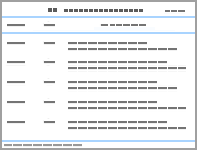
Table 1

Primer sequences for qRT-PCR"

名称 Name 上游引物 Forward primer (5′-3′) 下游引物 Reverse primer (5′-3′)
VvERF2 AACATCCTCATCACCCCTCCAT AACGGTGTCCATCCGACATCA
β-Actin CTTGCATCCCTCAGCACCTT TCCTGTGGACAATGGATGGA

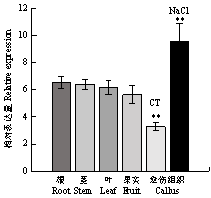
Fig. 1

Expressions of VvERF2 in grape organs and callus that have been treated with NaCl CT: The callus without NaCl treatment. One-way ANOVA and multiple comparisons were performed by Fisher’s LSD test. ** indicate extremely significant difference (P< 0.01). The same as below"

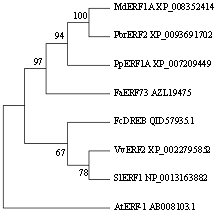
Fig. 2

Evolutionary tree analysis of the proteins encoding ERF2"

Table 2

Analysis of protein physicochemical properties encoding ERF2 in eight plants"

物种
Species
ID号
ID number
氨基酸残基数
Number of amino acid residue
分子量
Molecular weight
(kDa)
理论等电点
Theoretical isoelectric point
不稳定系数
Instability index
(%)
脂肪指数Aliphatic index 平均亲水性
Average hydrophilicity
葡萄 Vitis vinifera XP_002279585.2 240 26.43 6.94 62.32 68.67 -0.555
苹果 Malus domestica XP_008352414 276 29.62 8.45 57.23 70.98 -0.457
草莓 Fragaria ananassa AZL19475 295 31.60 6.76 56.57 71.80 -0.363
中国白梨 Pyrus bretschneideri XP_009369170.2 269 28.82 8.47 52.47 68.85 -0.455
Prunus persica XP_007209449 281 30.16 9.09 59.26 76.65 -0.411
无花果 Ficus carica QID57935.1 348 38.60 5.54 55.88 66.75 -0.570
拟南芥 Arabidopsis thaliana AB008103.1 266 28.97 8.68 56.72 67.86 -0.499
番茄 Solanum lycopersicum NP_001316388.2 242 26.76 7.68 71.59 69.34 -0.433

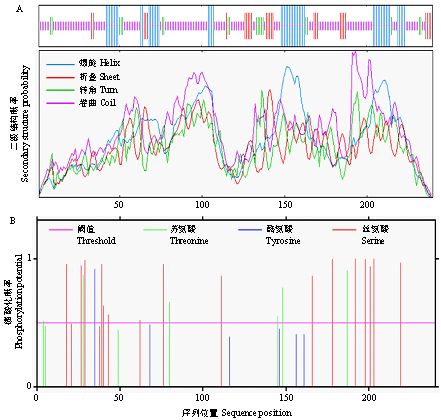
Fig. 3

Secondary structure and phosphorylation sites prediction of VvERF2 A: Secondary structure prediction (window width: 17, similarity threshold: 8, number of states, 4), The horizontal axis represents the amino acid sequence, and the vertical axis represents the formation probability of each secondary structure; B: Phosphorylation site prediction of VvERF2, The horizontal axis represents the amino acid sequence, and the vertical axis represents phosphorylation site predicted"

Table 3

Cis-acting elements prediction in the region of promoter aera of VvERF2"

元件 Motifs ABRE ARE MYB MYC Box4 CGTCA-motif MRE
数量 Quantity 2 2 4 6 7 4 2
功能
Function
参与脱落酸信号响应
Participate in abscisic acid signal response
厌氧诱导调控元件
Anaerobic induction regulatory element
参与光信号响应
Participate in optical signal response
茉莉酸甲酯响应
信号调控元件
Methyl jasmonate responsive signal regulatory element
参与光信号响应的MYB结合位点
MYB binding sites involved in optical signal response

Fig. 4

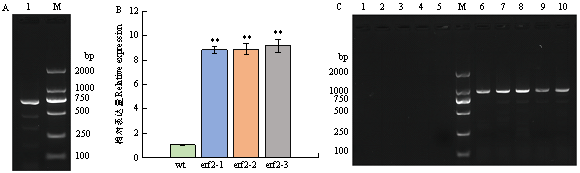
Gene cloning and positive identification of VvERF2 and relative expression identification A: The clone result of VvERF2, M represents Marker 2K; B: The relative expression of VvERF2 gene in transgenic lines (including erf2-1, 2, 3) and wild-type (wt) line; C: The identification of PCR production of positive genetic transformation lines. 1-5 represents the PCR results of wild-type (wt) lines. 6-10 represents the results of genetic transformation lines of erf2. One-way ANOVA and multiple comparisons were performed by Fisher’s LSD test. The same as below"

Fig. 5

Phenotypic identification of the transgenic callus resistant to salt stress The left side of the white line in the middle of all the petri dishes was wild type, and the right side was transgenic callus"

Table 4

Growth and content of total sugar, acid, phenolic and antioxidant capacity in grape callus"

愈伤组织
Callus
生长量
Growth
(g·dish-1 FW)
总糖
Total sugar
(mg·g-1 FW)
总酸
Total acid
(mg·g-1 FW)
总酚
Total phenol
(mg·g-1 FW)
DPPH抗氧化活性
DPPH antioxidant activity
(mg·g-1 FW)
FRAP抗氧化活性
FRAP antioxidant activity
(mg·g-1 FW)
ABTS抗氧化活性
ABTS antioxidant activity
(mg·g-1 FW)
wt 0.33±0.017 26.04±1.02 0.14±0.0088 0.13±0.0012 0.86±0.010 1.60±0.45 1.38±0.32
erf2-1 0.41±0.065* 27.48±1.98 0.11±0.0069** 0.17±0.0032** 1.22±0.012* 2.88±0.27* 1.75±0.12*
erf2-2 0.40±0.027* 26.99±1.34 0.08±0.0060* 0.18±0.0021* 1.33±0.021* 3.51±0.073** 2.38±0.23*
erf2-3 0.39±0.051* 28.02±2.18 0.10±0.0021* 0.18±0.0032** 1.40±0.030* 3.51±0.10** 2.45±0.10*

Fig. 6

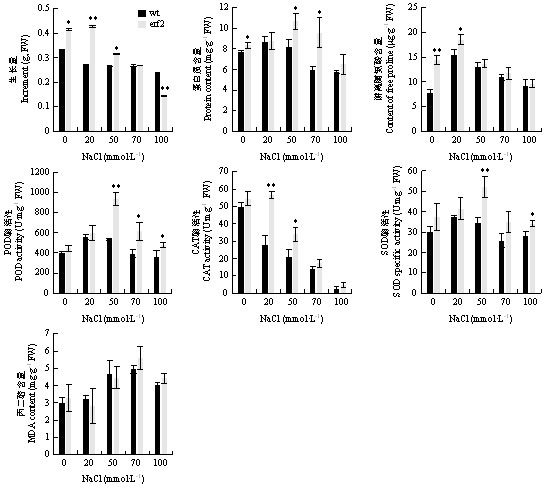
Effects of different salt stress concentrations on the growth of grape callus, activity of reactive oxygen scavenging enzymes, and content of protein and osmotic regulators"

[1]
LICAUSI F, GIORGI F M, ZENONI S, OSTI F, PEZZOTTI M, PERATA P. Genomic and transcriptomic analysis of the AP2/ERF superfamily in Vitis vinifera. BMC Genomics, 2010, 11(1): 1-16.

doi: 10.1186/1471-2164-11-1
[2]
NAKANO T, SUZUKI K, FUJIMURA T, SHINSHI H. Genome-wide analysis of the ERF gene family in Arabidopsis and rice. Plant Physiology, 2006, 140(2): 411-432.

doi: 10.1104/pp.105.073783
[3]
JOFUKU K D, DEN BOER B G, VAN MONTAGU M, OKAMURO J K. Control of Arabidopsis flower and seed development by the homeotic gene APETALA2. The Plant Cell, 1994, 6(9): 1211-1225.
[4]
FENG K, HOU X L, XING G M, LIU J X, DUAN A Q, XU Z S, LI M Y, ZHUANG J, XIONG A S. Advances in AP2/ERF super-family transcription factors in plant. Critical Reviews in Biotechnology, 2020, 40(6): 750-776.

doi: 10.1080/07388551.2020.1768509 pmid: 32522044
[5]
OH S J, SONG S I, KIM Y S, JANG H J, KIM S Y, KIM M, KIM Y K, NAHM B H, KIM J K. Arabidopsis CBF3/DREB1A and ABF3 in transgenic rice increased tolerance to abiotic stress without stunting growth. Plant Physiology, 2005, 138(1): 341-351.

doi: 10.1104/pp.104.059147
[6]
MAGHSOUDI K, EMAM Y, NIAZI A, PESSARAKLI M, ARVIN M J. P5CS expression level and proline accumulation in the sensitive and tolerant wheat cultivars under control and drought stress conditions in the presence/absence of silicon and salicylic acid. Journal of Plant Interactions, 2018, 13(1): 461-471.

doi: 10.1080/17429145.2018.1506516
[7]
BANDURSKA H, BREŚ W, ZIELEZIŃSKA M, MIELOSZYK E. Does potassium modify the response of Zinnia (Zinnia elegans jacq.) to long-term salinity? Plants, 2023, 12(7): 1439.

doi: 10.3390/plants12071439
[8]
吕笑言, 王宇光, 金英. 甜菜BvM14-CMO、BvM14-BADH基因的克隆、盐胁迫表达及生物信息学分析. 黑龙江大学自然科学学报, 2018, 35(1): 79-84.
X Y, WANG Y G, JIN Y. Cloning, salt stress expression and bioinformatics analysis of BvM14-CMO and BvM14-BADH genes in sugarbeet. Journal of Natural Science of Heilongjiang University, 2018, 35(1): 79-84. (in Chinese)
[9]
SEKULA B, DAUTER Z. Spermidine synthase (SPDS) undergoes concerted structural rearrangements upon ligand binding - A case study of the two SPDS isoforms from Arabidopsis thaliana. Frontiers in Plant Science, 2019, 10: 555.

doi: 10.3389/fpls.2019.00555
[10]
CHITNIS M V, MUNRO C A, BROWN A J P, GOODAY G W, GOW N A R, DESHPANDE M V. The zygomycetous fungus, Benjaminiella poitrasii contains a large family of differentially regulated chitin synthase genes. Fungal Genetics and Biology, 2002, 36(3): 215-223.

doi: 10.1016/S1087-1845(02)00015-4
[11]
MILLER E N, INGRAM L O. Sucrose and overexpression of trehalose biosynthetic genes (otsBA) increase desiccation tolerance of recombinant Escherichia coli. Biotechnology Letters, 2008, 30(3): 503-508.

doi: 10.1007/s10529-007-9573-5
[12]
王镭, 才华, 柏锡, 李丽文, 李勇, 朱延明. 转OsCDPK7基因水稻的培育与耐盐性分析. 遗传, 2008, 30(8): 1051-1055.
WANG L, CAI H, BAI X, LI L W, LI Y, ZHU Y M. Cultivation of transgenic rice plants with OsCDPK7 gene and its salt tolerance. Hereditas, 2008, 30(8): 1051-1055. (in Chinese)
[13]
FU S F, CHOU W C, HUANG D D, HUANG H J. Transcriptional regulation of a rice mitogen-activated protein kinase gene, OsMAPK4, in response to environmental stresses. Plant and Cell Physiology, 2002, 43(8): 958-963.

doi: 10.1093/pcp/pcf111
[14]
PIAO H L, LIM J H, KIM S J, CHEONG G W, HWANG I. Constitutive over-expression of AtGSK1 induces NaCl stress responses in the absence of NaCl stress and results in enhanced NaCl tolerance in Arabidopsis. The Plant Journal, 2001, 27(4): 305-314.

doi: 10.1046/j.1365-313x.2001.01099.x
[15]
SHOU H X, BORDALLO P, WANG K. Expression of the Nicotiana protein kinase (NPK1) enhanced drought tolerance in transgenic maize. Journal of Experimental Botany, 2004, 55(399): 1013-1019.

doi: 10.1093/jxb/erh129
[16]
ZHOU Y B, LIU C, TANG D Y, YAN L, WANG D, YANG Y Z, GUI J S, ZHAO X Y, LI L G, TANG X D, YU F, LI J L, LIU L L, ZHU Y H, LIN J Z, LIU X M. The receptor-like cytoplasmic kinase STRK1 phosphorylates and activates CatC, thereby regulating H2O2 homeostasis and improving salt tolerance in rice. The Plant Cell, 2018, 30(5): 1100-1118.

doi: 10.1105/tpc.17.01000
[17]
UMEZAWA T, YOSHIDA R, MARUYAMA K, YAMAGUCHI- SHINOZAKI K, SHINOZAKI K. SRK2C, a SNF1-related protein kinase 2, improves drought tolerance by controlling stress-responsive gene expression in Arabidopsis thaliana. Proceedings of the National Academy of Sciences of the United States of America, 2004, 101(49): 17306-17311.
[18]
ZHU J Q, ZHANG J T, TANG R J, LV Q D, WANG Q Q, YANG L, ZHANG H X. Molecular characterization of ThIPK2, an inositol polyphosphate kinase gene homolog from Thellungiella halophila, and its heterologous expression to improve abiotic stress tolerance in Brassica napus. Physiologia Plantarum, 2009, 136(4): 407-425.

doi: 10.1111/ppl.2009.136.issue-4
[19]
苏倩, 杜文宣, 马琳, 夏亚迎, 李雪, 祁智, 庞永珍. 紫花苜蓿MsCIPK2的克隆及功能分析. 中国农业科学, 2022, 55(19): 3697-3709. doi: 10.3864/j.issn.0578-1752.2022.19.002.
SU Q, DU W X, MA L, XIA Y Y, LI X, QI Z, PANG Y Z. Cloning and functional analyses of MsCIPK2 in Medicago sativa. Scientia Agricultura Sinica, 2022, 55(19): 3697-3709. doi: 10.3864/j.issn.0578-1752.2022.19.002. (in Chinese)
[20]
LATZ A, MEHLMER N, ZAPF S, MUELLER T D, WURZINGER B, PFISTER B, CSASZAR E, HEDRICH R, TEIGE M, BECKER D. Salt stress triggers phosphorylation of the Arabidopsis vacuolar K+ channel TPK1 by calcium-dependent protein kinases (CDPKs). Molecular Plant, 2013, 6(4): 1274-1289.

doi: 10.1093/mp/sss158
[21]
DUTILLEUL C, RIBEIRO I, BLANC N, NEZAMES C D, DENG X W, ZGLOBICKI P, PALACIO BARRERA A M, ATEHORTÙA L, COURTOIS M, LABAS V, GIGLIOLI-GUIVARC'H N, DUCOS E. ASG2 is a farnesylated DWD protein that acts as ABA negative regulator in Arabidopsis. Plant, Cell & Environment, 2016, 39(1): 185-198.
[22]
ZHOU X Y, LI J F, WANG Y Q, LIANG X Y, ZHANG M, LU M H, GUO Y, QIN F, JIANG C F. The classical SOS pathway confers natural variation of salt tolerance in maize. The New Phytologist, 2022, 236(2): 479-494.

doi: 10.1111/nph.v236.2
[23]
潘晓雪, 胡明瑜, 蒋晓英, 白文钦, 官玲, 吴红, 雷开荣. 过量表达盐芥TsIPK2基因增强转基因水稻耐盐性. 植物营养与肥料学报, 2019, 25(5): 741-747.
PAN X X, HU M Y, JIANG X Y, BAI W Q, GUAN L, WU H, LEI K R. Overexpression of the Thellungiella salsuginea TsIPK2 gene enhances salt tolerance of transgenic rice. Plant Nutrition and Fertilizer Science, 2019, 25(5): 741-747. (in Chinese)
[24]
SHI H Z, KIM Y, GUO Y, STEVENSON B, ZHU J K. The Arabidopsis SOS5 locus encodes a putative cell surface adhesion protein and is required for normal cell expansion. The Plant Cell, 2003, 15(1): 19-32.

doi: 10.1105/tpc.007872
[25]
DOU M Z, CHENG S, ZHAO B T, XUAN Y H, SHAO M L. The indeterminate domain protein ROC1 regulates chilling tolerance via activation of DREB1B/CBF1 in rice. International Journal of Molecular Sciences, 2016, 17(3): 233.

doi: 10.3390/ijms17030233
[26]
MARUYAMA K, TAKEDA M, KIDOKORO S, YAMADA K, SAKUMA Y, URANO K, FUJITA M, YOSHIWARA K, MATSUKURA S, MORISHITA Y, SASAKI R, SUZUKI H, SAITO K, SHIBATA D, SHINOZAKI K, YAMAGUCHI-SHINOZAKI K. Metabolic pathways involved in cold acclimation identified by integrated analysis of metabolites and transcripts regulated by DREB1A and DREB2A. Plant Physiology, 2009, 150(4): 1972-1980.

doi: 10.1104/pp.109.135327 pmid: 19502356
[27]
KIM S, KANG J Y, CHO D I, PARK J H, KIM S Y. ABF2, an ABRE-binding bZIP factor, is an essential component of glucose signaling and its overexpression affects multiple stress tolerance. The Plant Journal, 2004, 40(1): 75-87.

doi: 10.1111/tpj.2004.40.issue-1
[28]
HWANG K, SUSILA H, NASIM Z, JUNG J Y, AHN J H. Arabidopsis ABF3 and ABF4 transcription factors act with the NF-YC complex to regulate SOC1 expression and mediate drought-accelerated flowering. Molecular Plant, 2019, 12(4): 489-505.

doi: 10.1016/j.molp.2019.01.002
[29]
YOSHIDA T, FUJITA Y, SAYAMA H, KIDOKORO S, MARUYAMA K, MIZOI J, SHINOZAKI K, YAMAGUCHI-SHINOZAKI K. AREB1, AREB2, and ABF3 are master transcription factors that cooperatively regulate ABRE-dependent ABA signaling involved in drought stress tolerance and require ABA for full activation. The Plant Journal, 2010, 61(4): 672-685.

doi: 10.1111/tpj.2010.61.issue-4
[30]
WANG C L, LU G Q, HAO Y Q, GUO H M, GUO Y, ZHAO J, CHENG H M. ABP9, a maize bZIP transcription factor, enhances tolerance to salt and drought in transgenic cotton. Planta, 2017, 246(3): 453-469.

doi: 10.1007/s00425-017-2704-x pmid: 28474114
[31]
VERMA D, JALMI S K, BHAGAT P K, VERMA N, SINHA A K. A bHLH transcription factor, MYC2, imparts salt intolerance by regulating proline biosynthesis in Arabidopsis. The FEBS Journal, 2020, 287(12): 2560-2576.

doi: 10.1111/febs.v287.12
[32]
YOO J H, PARK C Y, KIM J C, DO HEO W, CHEONG M S, PARK H C, KIM M C, MOON B C, CHOI M S, KANG Y H, LEE J H, KIM H S, LEE S M, YOON H W, LIM C O, YUN D J, LEE S Y, CHUNG W S, CHO M J. Direct interaction of a divergent CaM isoform and the transcription factor, MYB2, enhances salt tolerance in Arabidopsis. Journal of Biological Chemistry, 2005, 280(5): 3697-3706.

doi: 10.1074/jbc.M408237200
[33]
OH J E, KWON Y, KIM J H, NOH H, HONG S W, LEE H. A dual role for MYB60 in stomatal regulation and root growth of Arabidopsis thaliana under drought stress. Plant Molecular Biology, 2011, 77(1/2): 91-103.

doi: 10.1007/s11103-011-9796-7
[34]
SUGANO S, KAMINAKA H, RYBKA Z, CATALA R, SALINAS J, MATSUI K, OHME-TAKAGI M, TAKATSUJI H. Stress-responsive zinc finger geneZPT2-3 plays a role in drought tolerance in petunia. The Plant Journal, 2003, 36(6): 830-841.

doi: 10.1046/j.1365-313X.2003.01924.x
[35]
KIM S H, HONG J K, LEE S C, SOHN K H, JUNG H W, HWANG B K. CAZFP1, Cys2/His2-type zinc-finger transcription factor gene functions as a pathogen-induced early-defense gene in Capsicum annuum. Plant Molecular Biology, 2004, 55(6): 883-904.

doi: 10.1007/s11103-005-2151-0
[36]
GAMBINO G, RUFFA P, VALLANIA R, GRIBAUDO I. Somatic embryogenesis from whole flowers, anthers and ovaries of grapevine (Vitis spp.). Plant Cell, Tissue and Organ Culture, 2007, 90(1): 79-83.

doi: 10.1007/s11240-007-9256-x
[37]
LIVAK K J, SCHMITTGEN T D. Analysis of relative gene expression data using real-time quantitative PCR and the 2-ΔΔCT method. Methods, 2001, 25(4): 402-408.

doi: 10.1006/meth.2001.1262
[38]
LI X L, WANG C R, LI X Y, YAO Y X, HAO Y J. Modifications of Kyoho grape berry quality under long-term NaCl treatment. Food Chemistry, 2013, 139: 931-937.

doi: 10.1016/j.foodchem.2013.02.038
[39]
XU L L, YUE Q Y, BIAN F E, SUN H, ZHAI H, YAO Y X. Melatonin enhances phenolics accumulation partially via ethylene signaling and resulted in high antioxidant capacity in grape berries. Frontiers in Plant Science, 2017, 8: 1426.

doi: 10.3389/fpls.2017.01426 pmid: 28868058
[40]
KATALINIĆ V, MOŽINA S S, SKROZA D, GENERALIĆ I, ABRAMOVIČ H, MILOŠ M, LJUBENKOV I, PISKERNIK S, PEZO I, TERPINC P, BOBAN M. Polyphenolic profile, antioxidant properties and antimicrobial activity of grape skin extracts of 14 Vitis vinifera varieties grown in Dalmatia (Croatia). Food Chemistry, 2010, 119(2): 715-723.

doi: 10.1016/j.foodchem.2009.07.019
[41]
RE R, PELLEGRINI N, PROTEGGENTE A, PANNALA A, YANG M, RICE-EVANS C. Antioxidant activity applying an improved ABTS radical cation decolorization assay. Free Radical Biology and Medicine, 1999, 26(9/10): 1231-1237.

doi: 10.1016/S0891-5849(98)00315-3
[42]
SUN B S, NEVES A C, FERNANDES T A, FERNANDES A L, MATEUS N, DE FREITAS V, LEANDRO C, SPRANGER M I. Evolution of phenolic composition of red wine during vinification and storage and its contribution to wine sensory properties and antioxidant activity. Journal of Agricultural and Food Chemistry, 2011, 59(12): 6550-6557.

doi: 10.1021/jf201383e pmid: 21561162
[43]
LI Z J, TIAN Y S, XU J, FU X Y, GAO J J, WANG B, HAN H J, WANG L J, PENG R H, YAO Q H. A tomato ERF transcription factor, SlERF84, confers enhanced tolerance to drought and salt stress but negatively regulates immunity against Pseudomonas syringae pv. tomato DC3000. Plant Physiology and Biochemistry, 2018, 132: 683-695.

doi: 10.1016/j.plaphy.2018.08.022
[44]
YOU S J, WU Y, LI W, LIU X F, TANG Q L, HUANG F K, LI Y, WANG H, LIU M C, ZHANG Y. SlERF. G3-Like mediates a hierarchical transcriptional cascade to regulate ripening and metabolic changes in tomato fruit. Plant Biotechnology Journal, 2023: 10.1111/pbi.14177.
[45]
ZHANG Y T, GUO C H, DENG M Y, LI S L, CHEN Y Y, GU X J, TANG G H, LIN Y X, WANG Y, HE W, LI M Y, ZHANG Y, LUO Y, WANG X R, CHEN Q, TANG H R. Genome-wide analysis of the ERF family and identification of potential genes involved in fruit ripening in octoploid strawberry. International Journal of Molecular Sciences, 2022, 23(18): 10550.

doi: 10.3390/ijms231810550
[46]
RUI L, ZHU Z Q, YANG Y Y, WANG D R, LIU H F, ZHENG P F, LI H L, LIU G D, LIU R X, WANG X F, ZHANG S, YOU C X. Functional characterization of MdERF113 in apple. Physiologia Plantarum, 2023, 175(1): e13853.

doi: 10.1111/ppl.v175.1
[47]
ZHANG X M, JIANG J W, MA Z W, YANG Y P, MENG L D, XIE F C, CUI G W, YIN X J. Cloning of TaeRF1 gene from Caucasian clover and its functional analysis responding to low-temperature stress. Frontiers in Plant Science, 2022, 13: 968965.

doi: 10.3389/fpls.2022.968965
[48]
ZHANG G Y, CHEN M, LI L C, XU Z S, CHEN X P, GUO J M, MA Y Z. Overexpression of the soybean GmERF3 gene, an AP2/ERF type transcription factor for increased tolerances to salt, drought, and diseases in transgenic tobacco. Journal of Experimental Botany, 2009, 60(13): 3781-3796.

doi: 10.1093/jxb/erp214
[49]
ZHANG G Y, CHEN M, CHEN X P, XU Z S, LI L C, GUO J M, MA Y Z. Isolation and characterization of a novel EAR-motif-containing gene GmERF4 from soybean (Glycine max L.). Molecular Biology Reports, 2010, 37(2): 809-818.

doi: 10.1007/s11033-009-9616-1
[50]
YANG Z, TIAN L N, LATOSZEK-GREEN M, BROWN D, WU K Q. Arabidopsis ERF4 is a transcriptional repressor capable of modulating ethylene and abscisic acid responses. Plant Molecular Biology, 2005, 58(4): 585-596.

doi: 10.1007/s11103-005-7294-5
[51]
LIU D F, CHEN X J, LIU J Q, YE J C, GUO Z J. The rice ERF transcription factor OsERF922 negatively regulates resistance to Magnaporthe oryzae and salt tolerance. Journal of Experimental Botany, 2012, 63(10): 3899-3911.

doi: 10.1093/jxb/ers079
[52]
ZHUANG J, JIANG H H, WANG F, PENG R H, YAO Q H, XIONG A S. A rice OsAP23, functioning as an AP2/ERF transcription factor, reduces salt tolerance in transgenic Arabidopsis. Plant Molecular Biology Reporter, 2013, 31(6): 1336-1345.

doi: 10.1007/s11105-013-0610-3
[53]
TIAN Z D, HE Q, WANG H X, LIU Y, ZHANG Y, SHAO F, XIE C H. The potato ERF transcription factor StERF3 negatively regulates resistance to Phytophthora infestans and salt tolerance in potato. Plant and Cell Physiology, 2015, 56(5): 992-1005.

doi: 10.1093/pcp/pcv025
[54]
李慧, 韩占品, 贺丽霞, 杨亚苓, 尤书燕, 邓琳, 王春国. 花椰菜BraERF023a的克隆及在响应盐和干旱胁迫中的功能. 中国农业科学, 2021, 54(1): 152-163. doi: 10.3864/j.issn.0578-1752.2021.01.011.
LI H, HAN Z P, HE L X, YANG Y L, YOU S Y, DENG L, WANG C G. Cloning and functional analysis of BraERF023a under salt and drought stresses in cauliflower (Brassica oleracea L. var. botrytis). Scientia Agricultura Sinica, 2021, 54(1): 152-163. doi: 10.3864/j.issn.0578-1752.2021.01.011. (in Chinese)
[55]
GUTTERSON N, REUBER T L. Regulation of disease resistance pathways by AP2/ERF transcription factors. Current Opinion in Plant Biology, 2004, 7(4): 465-471.

doi: 10.1016/j.pbi.2004.04.007 pmid: 15231271
[56]
SUN X M, ZHANG L L, WONG D C J, WANG Y, ZHU Z F, XU G Z, WANG Q F, LI S H, LIANG Z C, XIN H P. The ethylene response factor VaERF092 from Amur grape regulates the transcription factor VaWRKY33, improving cold tolerance. The Plant Journal, 2019, 99(5): 988-1002.

doi: 10.1111/tpj.14378 pmid: 31063661
[57]
TRAN L S P, NAKASHIMA K, SAKUMA Y, OSAKABE Y, QIN F, SIMPSON S D, MARUYAMA K, FUJITA Y, SHINOZAKI K, YAMAGUCHI-SHINOZAKI K. Co-expression of the stress-inducible zinc finger homeodomain ZFHD1 and NAC transcription factors enhances expression of the ERD1 gene in Arabidopsis. The Plant Journal, 2007, 49(1): 46-63.

doi: 10.1111/tpj.2007.49.issue-1
[58]
XUE G P, LOVERIDGE C W. HvDRF1 is involved in abscisic acid-mediated gene regulation in barley and produces two forms of AP2 transcriptional activators, interacting preferably with a CT-rich element. The Plant Journal, 2004, 37(3): 326-339.

doi: 10.1046/j.1365-313X.2003.01963.x
[59]
SALEH A, LUMBRERAS V, LOPEZ C, KIZIS E D P D, PAGÈS M. Maize DBF1-interactor protein 1 containing an R3H domain is a potential regulator of DBF1 activity in stress responses. The Plant Journal, 2006, 46(5): 747-757.

doi: 10.1111/tpj.2006.46.issue-5
[60]
宁蕾, 王曙光, 琚鹏举, 柏星轩, 葛林豪, 齐欣, 姜奇彦, 孙现军, 陈明, 孙黛珍. 过表达谷子SiANT1对水稻耐盐性的影响. 中国农业科学, 2018, 51(10): 1830-1841. doi: 10.3864/j.issn.0578-1752.2018.10.002.
NING L, WANG S G, JU P J, BAI X X, GE L H, QI X, JIANG Q Y, SUN X J, CHEN M, SUN D Z. Rice overexpression of millet SiANT1 gene increases salt tolerance. Scientia Agricultura Sinica, 2018, 51(10): 1830-1841. doi: 10.3864/j.issn.0578-1752.2018.10.002. (in Chinese)
[1] LU XueLi, GILLANI SyedaWajeeha, MENG Chen, LI XiaoBin, SONG YiRu, BAI Yu, WANG JuYing, FENG XiaoFei, LIU ChenChen, LI YiQiang, XU ZongChang. Effects of Different Types of Salt Stress on Seed Germination of Pennisetum alopecuroides and Study on Sodium-Regulated Transcriptome [J]. Scientia Agricultura Sinica, 2026, 59(7): 1400-1419.
[2] ZHANG ZhiLin, LIU Rong, ZONG XuXiao, HAO XiaoPeng, YANG Tao. Integrated Multi-Stage Evaluation of Salt Tolerance in Vicia faba L. and Itaconic Acid-Mediated Alleviation of Germination-Stage Salt Stress [J]. Scientia Agricultura Sinica, 2026, 59(6): 1172-1188.
[3] FENG WeiQing, NI YuanQian, FEI Teng, LI YouMei, XIE ZhaoSen. Differences in Vascular Bundle Morphological Structure, Distribution, and Water Transport Function in Grape Fruits of Different Shapes [J]. Scientia Agricultura Sinica, 2026, 59(1): 161-178.
[4] WANG SiQi, ZOU LiRen, BAI RuiWen, YAN Ke, WANG SiYang, QI XiaoGuang, SHEN HaiLin, WEN JingHui. Screening of Key Genes Related to Gibberellic Acid Regulation of Rachis Hardening in Honey Grapes [J]. Scientia Agricultura Sinica, 2026, 59(1): 179-189.
[5] TAN XiBei, LAN XuYing, LIU ChongHuai, FAN XiuCai, JIANG JianFu, SUN Lei, LI Peng, YU ShuXin, ZHANG Ying. Changes of Secondary Metabolites in Grapes with Different Resistance Levels in Response to White Rot Infection [J]. Scientia Agricultura Sinica, 2025, 58(9): 1767-1778.
[6] TANG XueShen, DANG ShiZhuo, ZHOU Juan, LI JiaHao, LI MeiHua, HU Hao, ZHANG YaHong. Analysis of VvBES1-1 Involvement in Flower Bud Differentiation of Red Globe Grape Based on Red and Blue Light Regulation [J]. Scientia Agricultura Sinica, 2025, 58(8): 1650-1662.
[7] YANG CaiLi, LI YongZhou, HE LiangLiang, SONG YinHua, ZHANG Peng, LIU ZhaoXian, LI PengHui, LIU SanJun. Genome-Wide Identification and Analysis of TPS Gene Family and Functional Verification of VvTPS4 in the Formation of Monoterpenes in Grape [J]. Scientia Agricultura Sinica, 2025, 58(7): 1397-1417.
[8] TENG MengXin, XU Ya, HE Jing, WANG Qi, QIAO Fei, LI JingYang, LI XinGuo. Identification and Functional Analysis of Ca2+-ATPase Gene Family in Banana [J]. Scientia Agricultura Sinica, 2025, 58(7): 1418-1433.
[9] GUO AoLin, LIN JunXuan, LAI GongTi, HE LiYuan, CHE JianMei, PAN Ruo, YANG FangXue, HUANG YuJi, CHEN GuiXin, LAI ChengChun. Effect of VdF3′5′H2 Overexpression on the Accumulation of Anthocyanin Composition in Spine Grape Cells [J]. Scientia Agricultura Sinica, 2025, 58(4): 802-818.
[10] ZHANG XiangKun, LI JiaYing, QIAO RuMeng, HE JingLei, WANG Li, SHI XiaoXin, DU GuoQiang. Effects of GFabV Under Different Zn Levels on Photosynthetic Efficiency and Photosynthesis-Related Gene Expression of ‘Shine Muscat’ Grapevine [J]. Scientia Agricultura Sinica, 2025, 58(24): 5190-5200.
[11] LÜ HuanHuan, LI RuYue, LIU QingSong, XU Lei, XU YanRan, YU HaoJie, GUO ChangHong, LONG RuiCai. Cloning and Salt Tolerance Function Analysis of MsKTI3 Gene in Alfalfa [J]. Scientia Agricultura Sinica, 2025, 58(21): 4497-4511.
[12] WANG Di, HAN ShouAn, ZHANG Wen, WANG Min, SHI HuiDong, ZHU XueHui, BAI ShiJian, LIU XuPeng, TIAN Jia, XIE Hui. Effects of Different Plant Growth Regulators on Fruit and Raisin Quality of Thompson Seedless Grapes [J]. Scientia Agricultura Sinica, 2025, 58(18): 3767-3782.
[13] YU Huan, LIN Ling, GUO RongRong, CAO XiongJun, WANG Bo, FANG JingGui, XIE ShuYu, HUANG XiaoYun, HAN JiaYu, BAI XianJin. Investigation and Evaluation of Inflorescence Attachment and Quality of Grape Germplasm Resources in The Hot Zone Guangxi [J]. Scientia Agricultura Sinica, 2025, 58(17): 3503-3515.
[14] WANG HuiLing, ZHANG YingYing, YAN AiLing, WANG XiaoYue, LIU ZhenHua, REN JianCheng, XU HaiYing, SUN Lei. Multi-Omics Analysis Reveals the Changes of Monoterpenes and Anthocyanins Accumulation During Veraison in Red Muscat-Type Grape [J]. Scientia Agricultura Sinica, 2025, 58(13): 2645-2662.
[15] DENG LiCheng, LI Cheng, HE Lei, AN HongQiang, WANG CaiLin, ZHANG YaDong, ZHAO ChangJiang, LU Kai. Physiological Characteristics in Response to Salt Stress and Allelic Variation and Expression of Salt-Responsive Genes in Seedling Stage of Nangeng Rice Varieties with Salt-Tolerance Ability [J]. Scientia Agricultura Sinica, 2025, 58(12): 2275-2290.
Viewed
Full text


Abstract

Cited

  Shared   
  Discussed   
No Suggested Reading articles found!