Scientia Agricultura Sinica ›› 2026, Vol. 59 ›› Issue (8): 1653-1671.doi: 10.3864/j.issn.0578-1752.2026.08.005

• TILLAGE & CULTIVATION·PHYSIOLOGY & BIOCHEMISTRY·AGRICULTURE INFORMATION TECHNOLOGY • Previous Articles     Next Articles

Impacts of Intercropping Row Patterns on the Heterogeneity of the Light Environment and Photosynthetic Product Production in Maize Canopy

CHEN XuanYi1,2(), GUO XingXing3, ZHANG XiangQian1,2,3,*(), LU ZhanYuan1,2,3,*(), LIU LingYue4, LUO Fang4, LI JinLong4, ZHANG ChuanLing4, ZHANG ZhiQing5, CHE ManQing5   

  1. 1 Inner Mongolia Academy of Agricultural and Animal Husbandry Sciences/Key Laboratory of Black Soil Protection and Utilization, Ministry of Agriculture and Rural Affairs, Hohhot 010031
    2 College of Life Sciences, Inner Mongolia University, Hohhot 010021
    3 College of Agriculture, Inner Mongolia Agricultural University, Hohhot 010018
    4 Agricultural Development Center of A'rongqi, Hulunbuir 162750, Inner Mongolia
    5 Agricultural Technology Promotion Center of Hulunbuir, Hulunbuir 162650, Inner Mongolia
  • Received:2025-09-08 Accepted:2026-03-23 Online:2026-04-16 Published:2026-04-21
  • Contact: ZHANG XiangQian, LU ZhanYuan

Abstract:

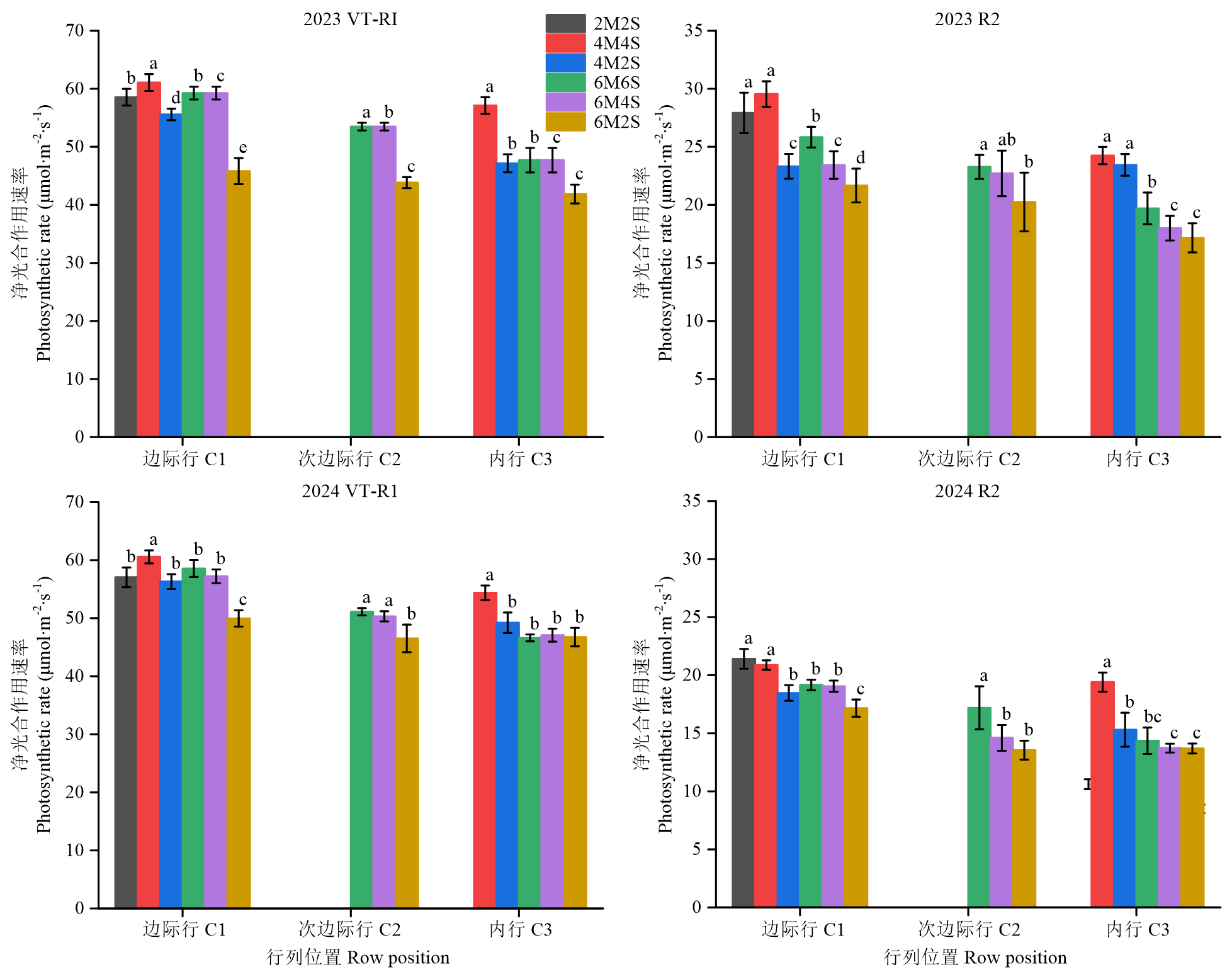
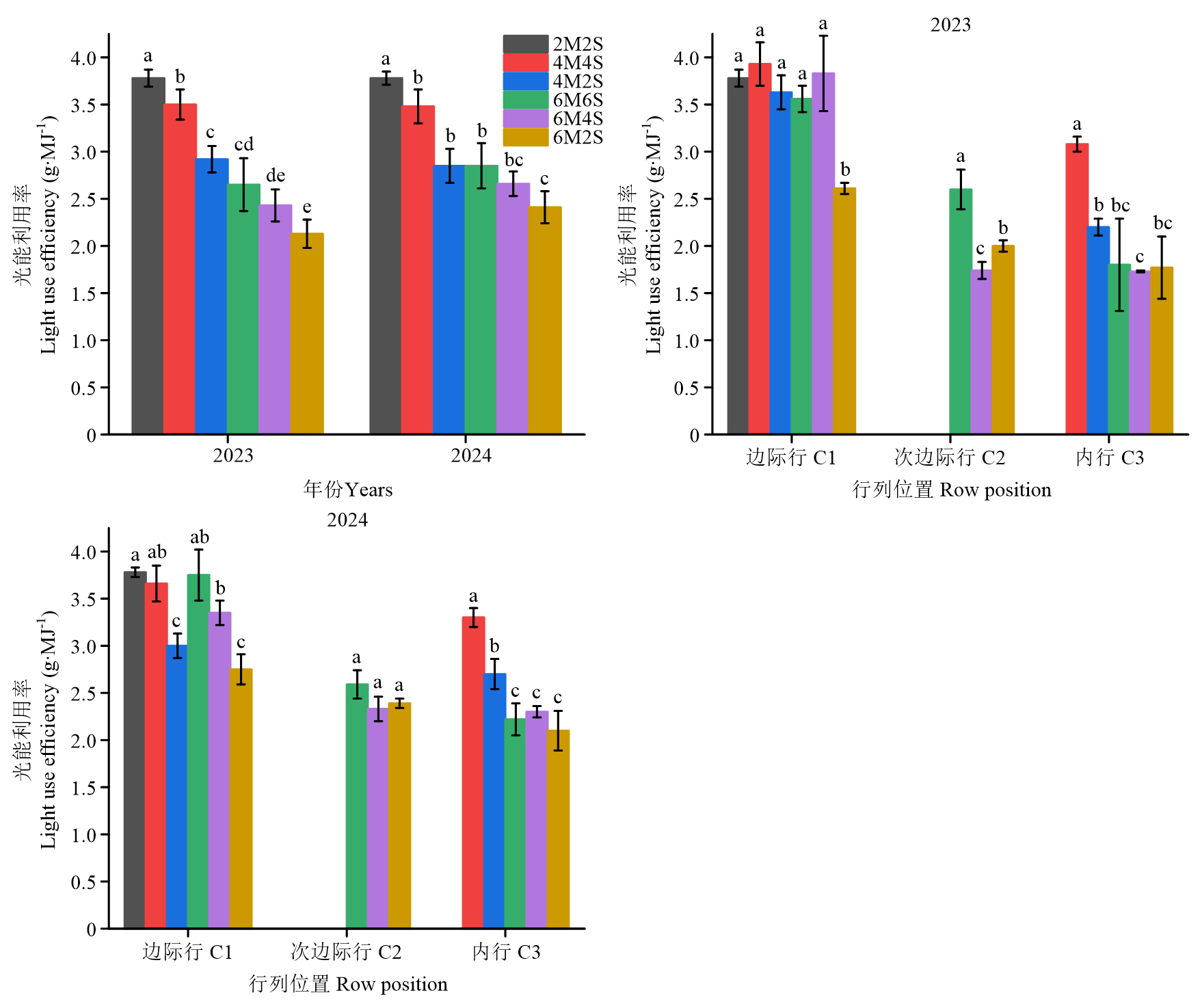
【Objective】This study aimed to elucidate the effects of maize-soybean intercropping patterns on canopy light heterogeneity, light use efficiency, and yield formation in maize rows, and to identify an intercropping configuration suitable for mechanized operations in the black soil region along the foothills of the Greater Khingan Range, so as to enhance regional agricultural productivity.【Method】Field experiments were conducted during 2023-2024 in the black soil region along the eastern foothills of the Greater Khingan Mountains (Arong Banner, Inner Mongolia, China), using maize (Yinongyu 12) and soybean (Dongsheng 19) as test cultivars. The canopy light environment of maize was visualized. Six maize-soybean intercropping configurations were established, including two rows maize-two rows soybean (2M2S), four rows maize-four rows soybean (4M4S), four rows maize-two rows soybean (4M2S), six rows maize-six rows soybean (6M6S), six rows maize-four rows soybean (6M4S), and six rows maize-two rows soybean (6M2S), and differences in canopy structure, light-use characteristics, and yield formation were systematically evaluated.【Result】(1) The 4M4S configuration exhibited the most favorable canopy structural characteristics due to enhanced light penetration in marginal rows and improved light conditions within inner rows, followed by 2M2S. Consequently, light-use efficiency and leaf photosynthetic rate during the tasseling-silking and grain-filling stages were significantly higher under 4M4S and 2M2S than that under the other intercropping treatments. (2) Maize yield under 4M4S did not differ significantly from that under 2M2S, whereas soybean yield was significantly higher under 4M4S, leading to the highest land equivalent ratio (LER), reaching 1.61 and 1.60 over the two years. LER values for the remaining treatments ranged from 1.31-1.56 and 1.28-1.53, respectively. Moreover, owing to better compatibility with agricultural machinery and lower operational costs, 4M4S achieved the highest benefit-cost ratio (6.61), exceeding those of other treatments by 7.39%-32.28%.【Conclusion】The upper canopy layer (L160 and L200) was identified as a key functional zone regulating photosynthesis in intercropped maize, with pronounced gradient differentiation in the relationships among canopy structure, photosynthetic performance, and yield across spatial row positions, where marginal rows exhibited the strongest advantage. Mantel analysis further revealed a strong coupling between light environmental structure and photosynthetic efficiency, forming a continuous pathway of “light acquisition-photosynthetic conversion-yield formation”. Owing to enhanced marginal effects and improved light distribution within inner rows, maize yield under the 4M4S configuration did not differ significantly from that under the conventional 2M2S pattern, whereas soybean yield was significantly increased (P<0.05), resulting in the highest land equivalent ratio and a greater benefit-cost ratio. Therefore, in the black soil region along the eastern foothills of the Greater Khingan Mountains, the 4M4S intercropping system represented an effective strategy to simultaneously enhance productivity and economic returns while facilitating fully mechanized cultivation and promoting sustainable agroecosystem development.

Key words: maize-soybean intercropping, canopy structure, light energy utilization, yield benefits, land equivalent ratio

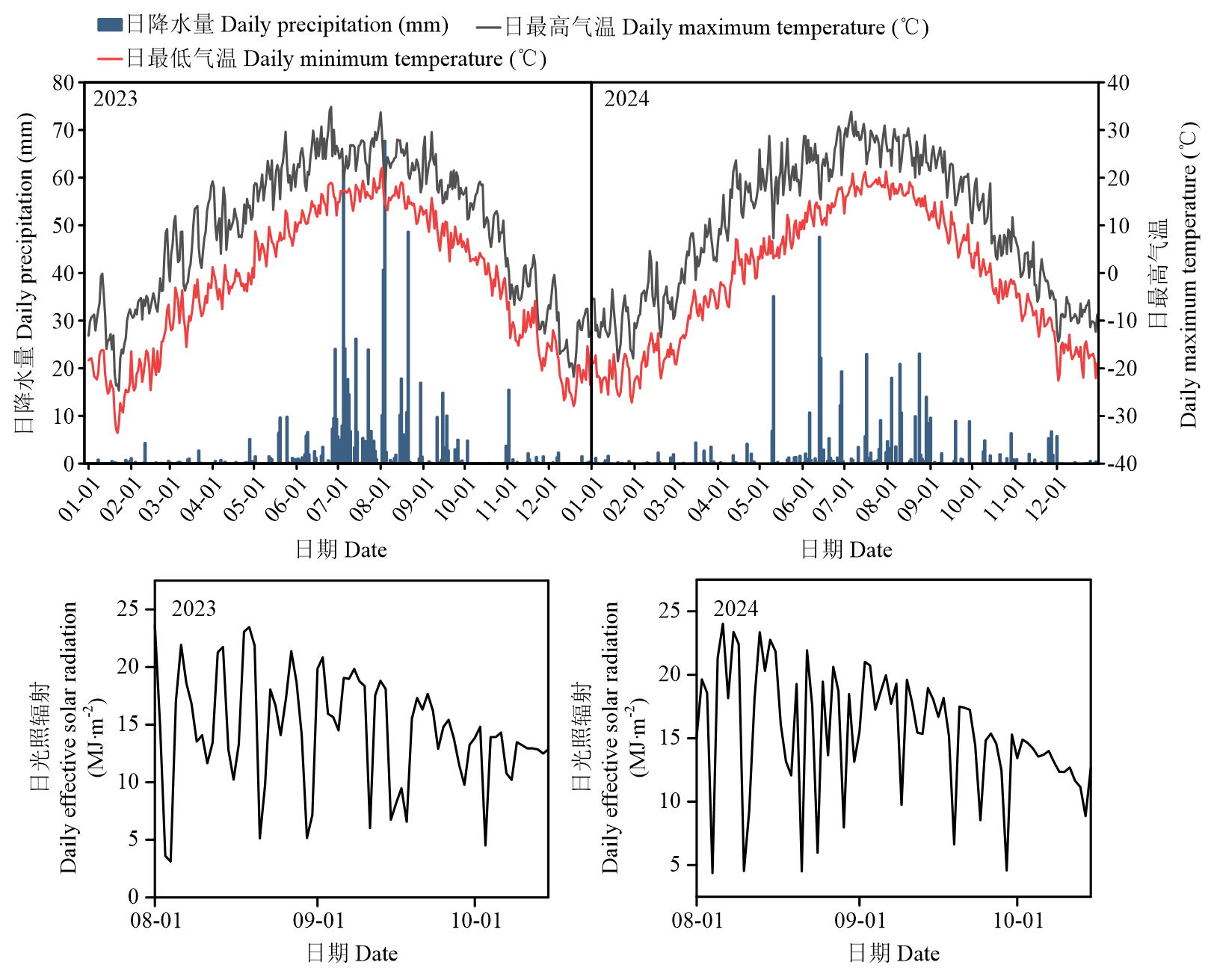
Fig. 1

Daily precipitation, temperature, and solar radiation variations at the experimental site in 2023-2024"

Table 1

Experimental design of field allocation in different ratio modes"

处理
Treatment
玉米种植密度
Maize planting density
(plants/hm2)
大豆种植密度
Soybean planting
density
(plants/hm2)
带宽
Band width
(cm)
小区种植
面积
Plot planting area (m2)
玉米大豆
行比
Maize-soybean row ratio
同垄行距
Same ridge row spacing (cm)
垄间行距
Row spacing between ridges (cm)
玉米株距
Maize plant spacing
(cm)
大豆株距
Soybean plant spacing (cm)
2M2S 54570 127500 220 880 2﹕2 45 65 16.6 7.1
4M4S 54570 127500 440 1760 4﹕4 45 65 16.6 7.1
4M2S 72765 85000 330 1320 4﹕2 45 65 16.6 7.1
6M6S 54570 127500 660 2640 6﹕6 45 65 16.6 7.1
6M4S 65490 102000 550 2200 6﹕4 45 65 16.6 7.1
6M2S 81855 63750 440 1760 6﹕2 45 65 16.6 7.1

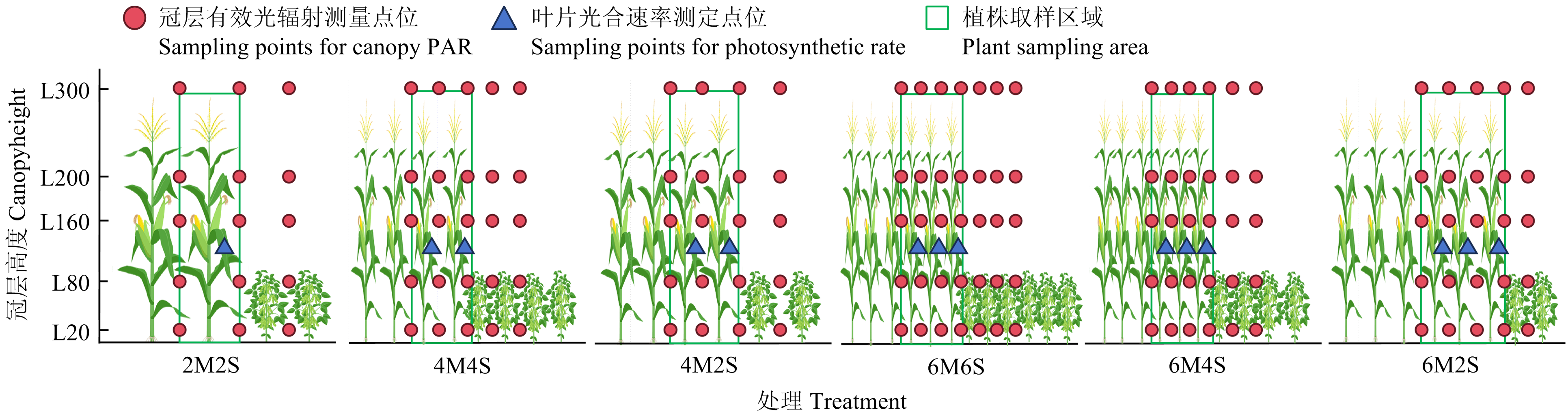
Fig. 2

Schematic diagram of sampling positions for photosynthetically active radiation, leaf photosynthetic rate, and agronomic traits under different intercropping patterns 2M2S indicates 2 rows of maize intercropped with 2 rows of soybean; 4M4S indicates 4 rows of maize intercropped with 4 rows of soybean; 4M2S indicates 4 rows of maize intercropped with 2 rows of soybean; 6M6S indicates 6 rows of maize intercropped with 6 rows of soybean; 6M4S indicates 6 rows of maize intercropped with 4 rows of soybean; and 6M2S indicates 6 rows of maize intercropped with 2 rows of soybean. L20, L80, L160, L200, and L300 represent the canopy heights of maize at 20, 80, 160, 200, and 300 cm, respectively. The same as below"

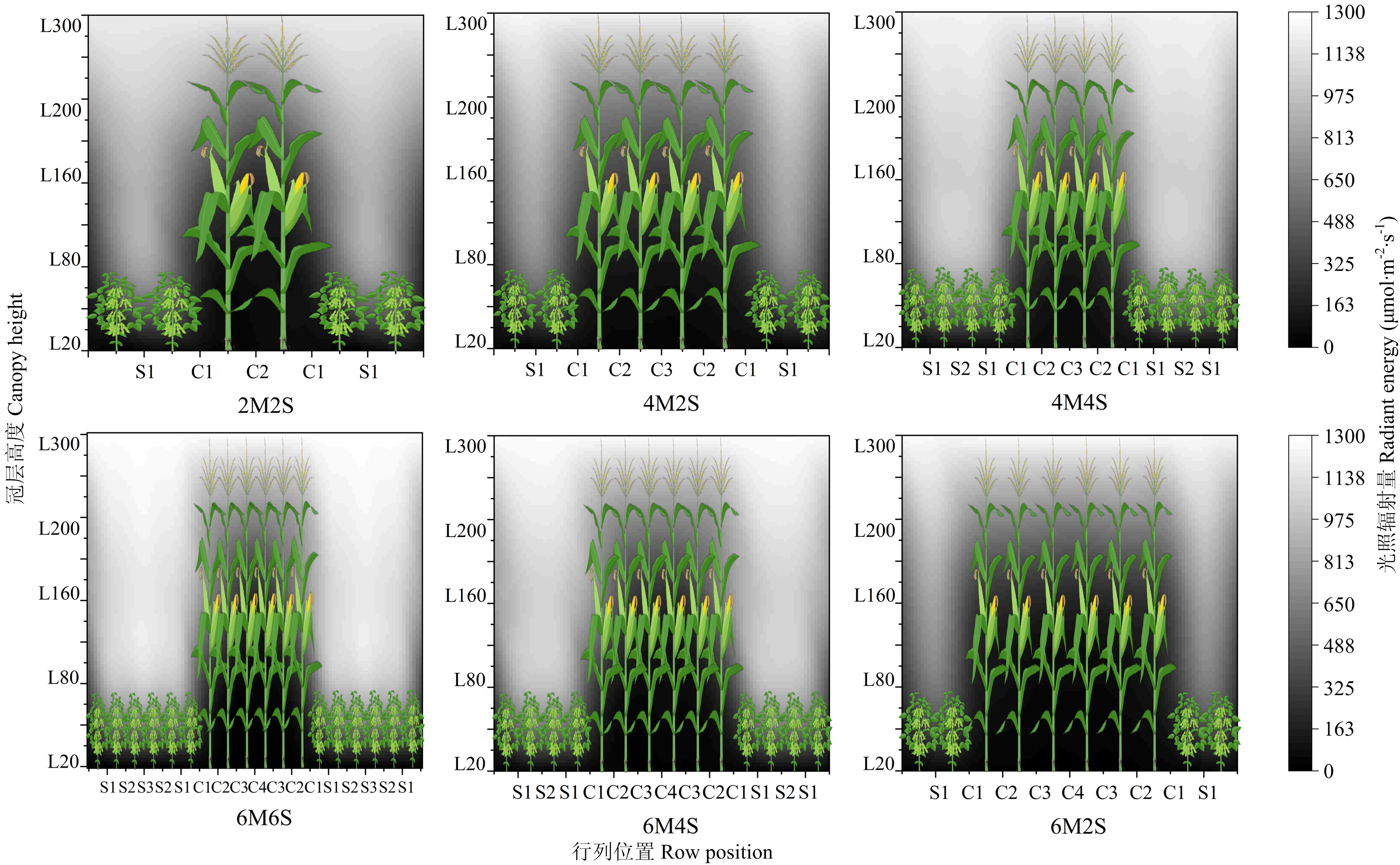
Fig. 3

Distribution of canopy light radiation in maize under different intercropping patterns Under the 2-row maize intercropping pattern, C1 represents the outer side of the border row, and C2 represents the inner side of the border row; Under the 4-row maize intercropping pattern, C1 represents the outer side of the border row, C2 represents the inner side of the border row (outer side of the inner row), and C3 represents the inner side of the inner row; Under the 6-row maize intercropping pattern, C1 represents the outer side of the border row, C2 represents the inner side of the border row (outer side of the secondary border row), C3 represents the inner side of the secondary border row (outer side of the inner row), and C4 represents the inner side of the inner row. The same as below"

Fig. 4

Canopy structural characteristics of maize under different intercropping patterns A represents canopy transmittance, B represents extinction coefficient, and C represents canopy light interception rate. In the radar chart (A/B/C), from left to right are the marginal row, sub-marginal row, and inner row at different heights. The data points for each treatment in the figure are the average values during VT-R1 and R2 over two years. Different lowercase letters indicate significant differences (P<0.05). The same as below"

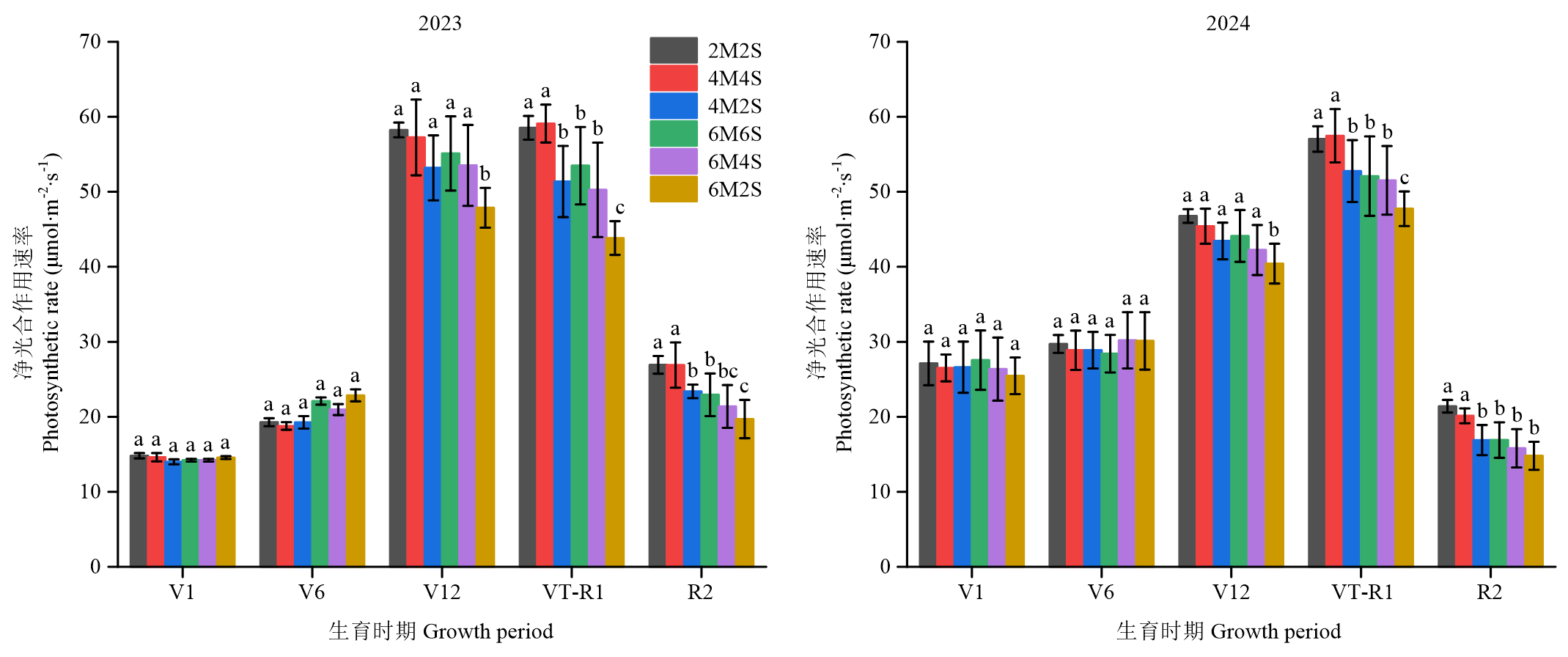
Fig. 5

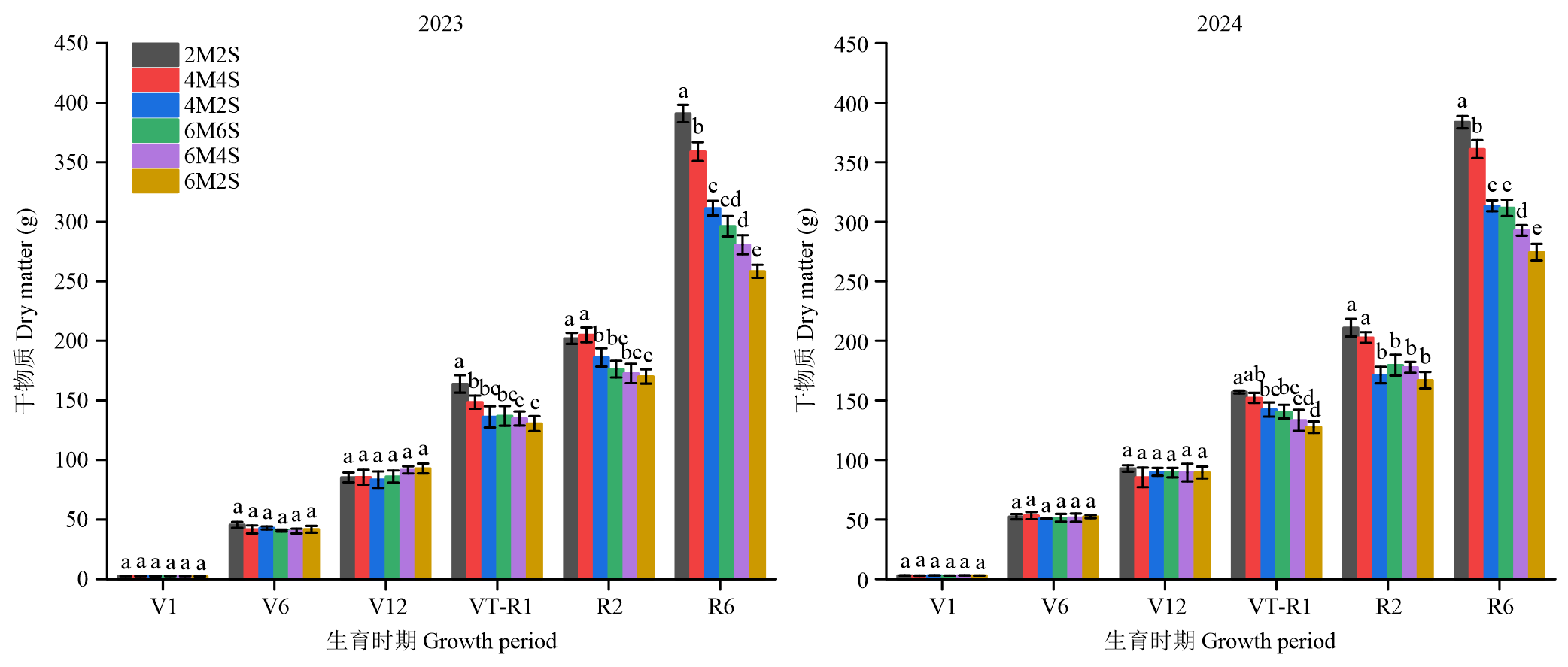
Leaf net photosynthetic rate of maize at different growth stages under different intercropping patterns during 2023 to 2024 The leaf net photosynthetic rate at this position represents a weighted mean of maize leaf net photosynthetic rates from different rows under each intercropping row-ratio treatment. V1, V6, V12, VT-R1, R2, and R6 represent the maize seedling stage, jointing stage, big flare stage, tasseling-silking stage, grain-filling stage, and maturity stage, respectively. The same as below"

Fig. 6

Row-level net photosynthetic rate of maize at the VT-R1 and R2 stages under different intercropping patterns during 2023 to 2024"

Fig. 7

Light use efficiency at canopy and row levels in maize under different intercropping patterns"

Fig. 8

Dynamic changes in maize dry matter accumulation under different intercropping patterns during 2023 to 2024 R6 represent the maize maturity stage, respectively. The same as below"

Fig. 9

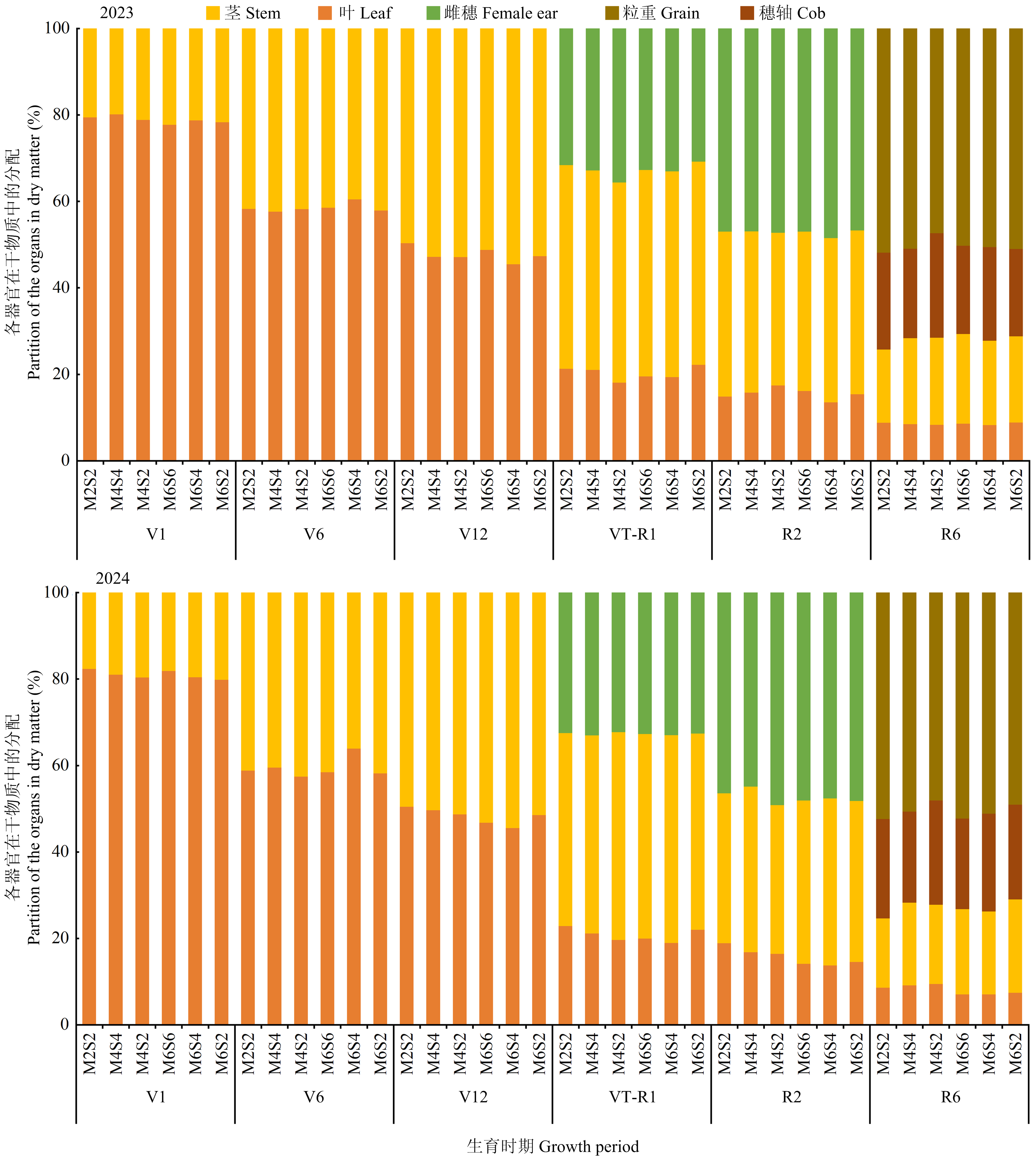
Dry matter distribution among maize organs under different intercropping patterns in 2023 to 2024"

Table 2

Effects of intercropping row ratios on maize per-plant yield in different rows and average row yield"

年份
Year
处理
Treatment
边际行单株产量
Outer row yield (g)
次边际行单株产量
Adjacent row yield (g)
内行产单株产量
Inner row yield (g)
平均行列单株产量
Mean row yield (g)
2023 2M2S 204.56±6.32b - - 204.56±6.32a
4M4S 208.43±6.90ab - 154.86±6.49a 181.65±6.7b
4M2S 180.32±3.73c - 118.89±2.43b 149.61±3.08cd
6M6S 214.46±1.38a 135.38±3.30a 114.48±1.80c 154.77±2.16c
6M4S 192.54±3.77b 122.89±2.64b 115.01±6.60bc 143.48±4.34d
6M2S 145.38±2.46d 114.88±3.96c 119.70±3.88b 126.65±3.43e
2024 2M2S 198.77±6.77a - - 198.77±6.77a
4M4S 200.44±5.86a - 167.35±3.67a 183.90±4.77b
4M2S 153.90±4.19c - 142.78±1.86b 148.34±3.03cd
6M6S 193.10±4.97a 139.65±8.06a 137.06±1.81bc 156.60±4.95c
6M4S 171.39±6.39b 135.51±2.29a 137.07±5.52bc 147.99±4.73cd
6M2S 150.39±5.90c 138.97±6.34a 130.24±4.30c 139.87±5.51d

Table 3

Effects of intercropping row ratios on maize-soybean system yield and LER"

处理 玉米产量 Maize yield (kg·hm-2) 大豆产量 Soybean yield (kg·hm-2) 土地当量比 LER
2023 2024 2023 2024 2023 2024
2M2S 11534.66±739.70a 11529.00±576.45a 971.24±49.21c 1053.99±30.47c 1.56 1.53
4M4S 10157.31±692.43a 10446.48±522.40a 1610.65±29.52a 1606.25±64.27a 1.61 1.60
4M2S 11137.63±840.58a 10481.36±524.07a 553.91±47.55d 535.77±60.62d 1.39 1.26
6M6S 7778.72±479.19c 8059.35±268.64c 1649.01±77.19a 1635.49±30.72a 1.36 1.36
6M4S 9077.41±332.57b 9402.52±313.42b 1334.97±94.30b 1239.96±40.44b 1.41 1.37
6M2S 10916.42±566.66a 11215.46±373.85a 398.29±40.07e 384.41±20.61e 1.31 1.28

Table 4

Two-year average production, inputs, and economic returns of different intercropping row ratio systems"

处理
Treatment
复合农资成本
Agricultural supplies (yuan/hm2)
复合劳动成本
Labor cost (yuan/hm2)
复合毛利润
Product value (yuan/hm2)
复合净利润
Net profit (yuan/hm2)
复合产投比
Profit margin
2M2S 2587.50 2075.71 28714.52 24051.31 6.16
4M4S 2587.50 1728.07 28537.68 24222.12 6.61
4M2S 2910.00 1931.67 25258.07 20416.40 5.22
6M6S 2587.50 1690.48 23600.77 19322.79 5.52
6M4S 2781.00 1773.44 24959.73 20405.29 5.48
6M2S 3071.25 1964.57 25174.99 20139.17 5.00

Fig. 10

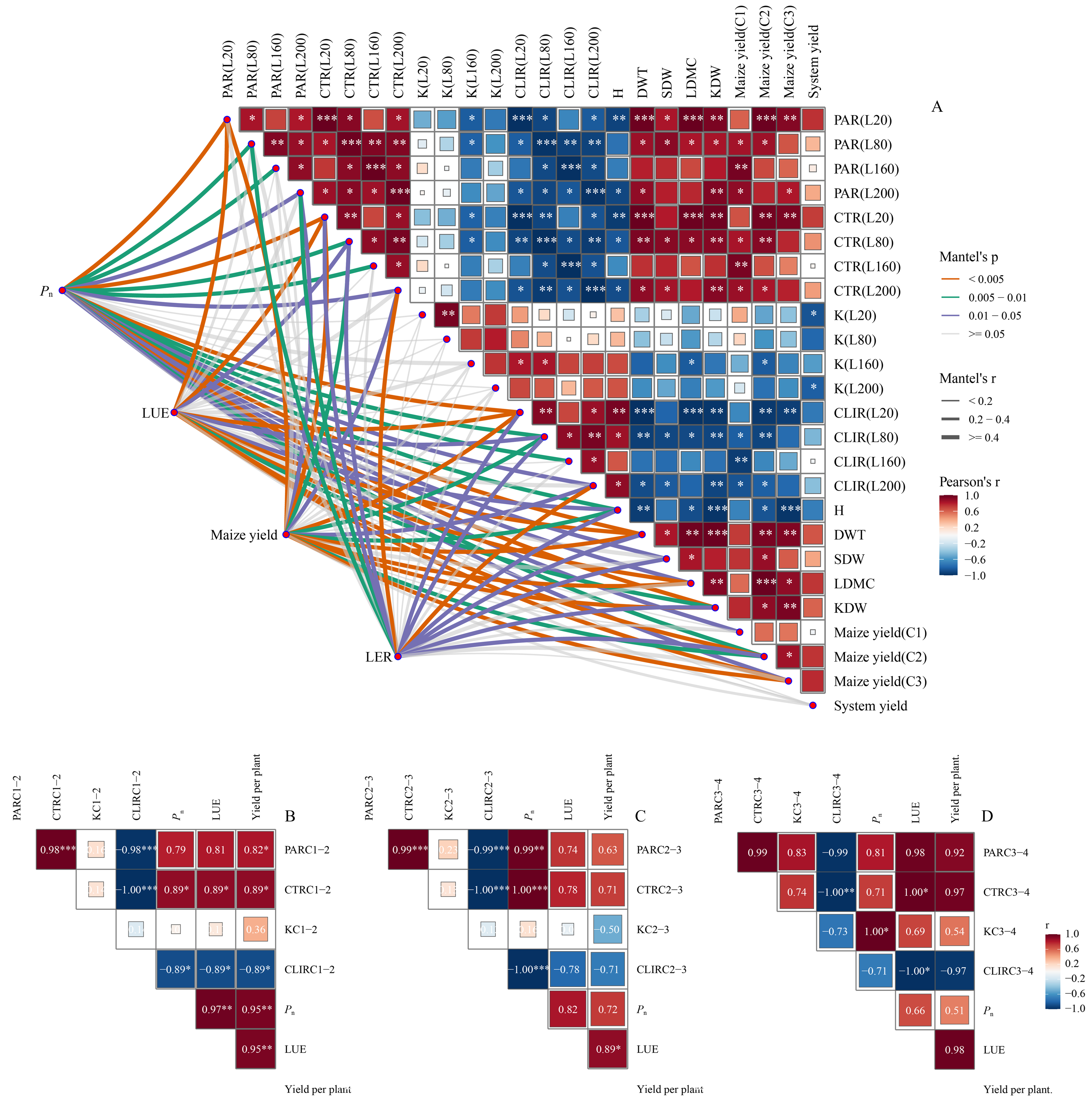
Correlation analysis of maize canopy light environment, canopy structure, photosynthetic material production and yield Figure A shows the correlation analysis between canopy effective light radiation (PAR), canopy transmittance (CTR), canopy extinction coefficient (K), canopy light interception rate (CLIR), plant height (H), total dry weight (DWT), stem dry weight (SDW), leaf dry weight (LDMC), grain dry weight (KDW), intercropped outer-row maize single-plant yield (Maize yield (C1)), intercropped second outer-row maize single-plant yield (Maize yield(C2)), intercropped inner-row maize single-plant yield (Maize yield (C2)), soybean-maize intercropping system yield (System yield), net photosynthetic rate (Pn), maize light-use efficiency (LUE), average maize single-plant yield (Maize yield) across treatments, and land equivalent ratio (LER) at different canopy heights (L20, L80, L160, and L200). Figures B, C, and D respectively show the correlation analysis between canopy effective light radiation (PAR), canopy transmittance (CTR), canopy extinction coefficient (K), canopy light interception rate (CLIR), net photosynthetic rate (Pn), maize light-use efficiency (LUE), and single-plant yield (Yield per plant) for the marginal rows, second marginal rows, and inner rows of maize strips"

[1]
李国景, 罗其友. 我国耕地资源保护与利用体系、挑战与对策. 山西农业大学学报(社会科学版), 2023, 22(6): 9-15.
LI G J, LUO Q Y. The system, challenges and countermeasures of the protection and utilization of China’s cultivated land resources. Journal of Shanxi Agricultural University (Social Science Edition), 2023, 22(6): 9-15. (in Chinese)
[2]
陈源源, 孙艺. 未来30年我国粮食增产潜力与保障能力研究. 四川农业大学学报, 2022, 40(3): 312-318.
CHEN Y Y, SUN Y. Study on the production increasing potential and guarantee capability of grain in China in the next 30 years. Journal of Sichuan Agricultural University, 2022, 40(3): 312-318. (in Chinese)
[3]
刘凯, 王欢, 穆月英. 中国大豆进口风险分散及进口来源结构优化: 基于替代性与依赖性视角. 中国油脂, 2025, 50(2): 1-7, 22.
LIU K, WANG H, MU Y Y. Risk dispersion and optimization of soybean imports for China: Based on substitution and dependence risks. China Oils and Fats, 2025, 50(2): 1-7, 22. (in Chinese)
[4]
陈诗雨. 吉林省农户玉米大豆轮作参与意愿及比价研究[D]. 长春: 吉林大学, 2024.
CHEN S Y. Study of farmers’ willingness to participate in corn-soybean crop rotation and price ratio in Jilin Province[D]. Changchun: Jilin University, 2024. (in Chinese)
[5]
李宗新, 陈源泉, 杨峰, 杨舒淇, 臧华栋, 钱欣, 刘开昌. 黄淮地区玉米大豆复合种植丰产增效技术研发. 中国农业科学, 2025, 58(23): 4837-4840. doi:10.3864/j.issn.0578-1752.2025.23.003.
LI Z X, CHEN Y Q, YANG F, YANG S Q, ZANG H D, QIAN X, LIU K C. Research and development of technology for enhanced productivity and efficiency in maize-soybean intercropping in the Huang-Huai Region. Scientia Agricultura Sinica, 2025, 58(23): 4837-4840. doi:10.3864/j.issn.0578-1752.2025.23.003. (in Chinese)
[6]
冉漫雪, 孙东宝, 丁军军. 种植模式对作物产量及间作系统种间关系的影响. 干旱地区农业研究, 2024, 42(6): 61-68, 79.
RAN M X, SUN D B, DING J J. Effects of cropping patterns on crop yields and interspecific relationships in intercropping systems. Agricultural Research in the Arid Areas, 2024, 42(6): 61-68, 79. (in Chinese)
[7]
BROOKER R W, BENNETT A E, CONG W F, DANIELL T J, GEORGE T S, HALLETT P D, HAWES C, IANNETTA P P M, JONES H G, KARLEY A J, et al. Improving intercropping: A synthesis of research in agronomy, plant physiology and ecology. New Phytologist, 2015, 206(1): 107-117.

pmid: 25866856
[8]
崔爱花, 刘帅, 黄国勤. 棉田间作系统的农田小气候特征及光合特性. 湖北农业科学, 2021, 60(13): 18-25.
CUI A H, LIU S, HUANG G Q. Microclimatic and photosynthetic characteristics of cotton field intercropping systems. Hubei Agricultural Sciences, 2021, 60(13): 18-25. (in Chinese)
[9]
李俊祥, 宛志沪. 淮北平原杨-麦间作系统的小气候效应与土壤水分变化研究. 应用生态学报, 2002, 13(4): 390-394.
LI J X, WAN Z H. Microclimatic effect and soil moisture change of poplar-wheat intercropping systems in Huaibei Plain. Chinese Journal of Applied Ecology, 2002, 13(4): 390-394. (in Chinese)
[10]
房健, 秦召纪, 于园园, 于宁宁, 赵斌, 刘鹏, 任佰朝, 张吉旺. 大豆玉米带状间作下不同行比配置对作物个体和群体产量及效益的影响. 中国农业科学, 2025, 58(23): 4841-4857. doi:10.3864/j.issn.0578-1752.2025.23.004.
FANG J, QIN Z J, YU Y Y, YU N N, ZHAO B, LIU P, REN B Z, ZHANG J W. Impacts of varying row ratio arrangements on plant performance, stand yield, and comprehensive benefits in soybean- maize strip intercropping. Scientia Agricultura Sinica, 2025, 58(23): 4841-4857. doi:10.3864/j.issn.0578-1752.2025.23.004. (in Chinese)
[11]
DU S N, BAI G S, YU J. Soil properties and apricot growth under intercropping and mulching with erect milk vetch in the loess hilly-gully region. Plant and Soil, 2015, 390(1): 431-442.

doi: 10.1007/s11104-014-2363-7
[12]
雷雲翔, 应晓成, 沈新平, 刘斌, 蒋敏. 玉米-大豆间作经济与环境效应研究进展. 灌溉排水学报, 2023, 42(S1): 56-60.
LEI Y X, YING X C, SHEN X P, LIU B, JIANG M. Research progress on economic and environmental effects of corn-soybean intercropping. Journal of Irrigation and Drainage, 2023, 42(S1): 56-60. (in Chinese)
[13]
MURCHIE E H, BURGESS A J. Casting light on the architecture of crop yield. Crop and Environment, 2022, 1(1): 74-85.

doi: 10.1016/j.crope.2022.03.009
[14]
杨姝, 白伟, 蔡倩, 杜桂娟. 玉米‖紫花苜蓿间作群体光分布特征及对植物性状和产量的影响. 作物学报, 2025, 51(9): 2514-2526.

doi: 10.3724/SP.J.1006.2025.53004
YANG S, BAI W, CAI Q, DU G J. Characteristics of light distribution in maize‖alfalfa intercropping systems and their effects on plant traits and yield. Acta Agronomica Sinica, 2025, 51(9): 2514-2526. (in Chinese)

doi: 10.3724/SP.J.1006.2025.53004
[15]
董奎军, 张亦涛, 刘瀚文, 张继宗, 王伟军, 温延臣, 雷秋良, 文宏达. 玉米大豆间作减量施氮对当季作物农艺性状、经济效益和后茬小麦产量的影响. 中国农业科学, 2024, 57(22): 4495-4506. doi:10.3864/j.issn.0578-1752.2024.22.009.
DONG K J, ZHANG Y T, LIU H W, ZHANG J Z, WANG W J, WEN Y C, LEI Q L, WEN H D. Effects of nitrogen reduction application of summer MaizeSoybean intercropping on agronomic traits and economic benefits as well as its yield of subsequent wheat. Scientia Agricultura Sinica, 2024, 57(22): 4495-4506. doi:10.3864/j.issn.0578-1752.2024.22.009. (in Chinese)
[16]
李双伟, 朱俊奇, Jochem BEVERS, Wopke VAN DER WERF, 郭焱, 李保国, 马韫韬. 基于植物功能-结构模型的玉米-大豆条带间作光截获行间差异研究. 智慧农业(中英文), 2022, 4(1): 97-109.
LI S W, ZHU J Q, BEVERS J, WERF Wopke VAN DER, GUO Y, LI B G, MA Y T. Estimating the differences of light capture between rows based on functional-structural plant model in simultaneous maize-soybean strip intercropping. Smart Agriculture, 2022, 4(1): 97-109. (in Chinese)

doi: 10.12133/j.smartag.SA202202002
[17]
武晶, 陈梦, 汪直华, 杨继芝, 李燕丽, 吴雨珊, 杨文钰. 带状间作不同带间距对玉米光能利用的影响. 中国农业科学, 2023, 56(23): 4648-4659. doi:10.3864/j.issn.0578-1752.2023.23.007.
WU J, CHEN M, WANG Z H, YANG J Z, LI Y L, WU Y S, YANG W Y. Effect of different strip distances on light energy utilization in strip intercropping maize. Scientia Agricultura Sinica, 2023, 56(23): 4648-4659. doi:10.3864/j.issn.0578-1752.2023.23.007. (in Chinese)
[18]
刘席文, 马淑梅, 余常兵, 王淑彬, 魏亚凤, 王小春, 杨文钰. 长江流域田间配置对玉米-大豆带状复合种植群体产量和气候资源利用效率的影响. 四川农业大学学报, 2024, 42(4): 724-734.
LIU X W, MA S M, YU C B, WANG S B, WEI Y F, WANG X C, YANG W Y. Effects of field configuration on yield and climate resource utilization efficiency of maize-soybean strip intercropping in the Yangtze River Basin. Journal of Sichuan Agricultural University, 2024, 42(4): 724-734. (in Chinese)
[19]
FENG L, YANG W T, ZHOU Q, TANG H Y, MA Q Y, HUANG G Q, WANG S B. Effects of interspecific competition on crop yield and nitrogen utilisation in maize-soybean intercropping system. Plant, Soil and Environment, 2021, 67(8): 460-467.

doi: 10.17221/665/2020-PSE
[20]
袁晓婷, 汤松, 罗凯, 蒋靖怡, 杨文钰, 雍太文. 大豆玉米带状复合种植产量与效益分析: 基于全国16个示范省(市、区)的调查数据. 四川农业大学学报, 2023, 41(5): 834-841, 872.
YUAN X T, TANG S, LUO K, JIANG J Y, YANG W Y, YONG T W. Yield and benefit analysis of soybean and maize strip compound planting: Based on survey data of 16 demonstration provinces (municipalities, autonomous regions). Journal of Sichuan Agricultural University, 2023, 41(5): 834-841, 872. (in Chinese)
[21]
许吟隆, 居辉, 熊伟, 林而达. 气候变化对中国农业影响评估和适应性研究的回顾与展望. 中国农业科学, 2007, 40(S1): 41-48.
XU Y L, JUN H, XIONG W, LIN E D. Review and prospect of research of climate change impacts on agriculture and adaptation in Chinese. Scientia Agricultura Sinica, 2007, 40(S1): 41-48. (in Chinese)
[22]
GAO Y, DUAN A W, QIU X Q, SUN J S, ZHANG J P, LIU H, WANG H Z. Distribution and use efficiency of photosynthetically active radiation in strip intercropping of maize and soybean. Agronomy Journal, 2010, 102(4): 1149-1157.

doi: 10.2134/agronj2009.0409
[23]
LESOING G W, FRANCIS C A. Strip intercropping of corn-soybean in irrigated and rainfed environments. Journal of Production Agriculture, 1999, 12(2): 187-192.

doi: 10.2134/jpa1999.0187
[24]
武晶. 不同玉米带间距离对带状间作玉米光能利用的影响[D]. 雅安: 四川农业大学, 2023.
WU J. Effect of different distance between maize strips on light energy utilization of strip intercropped maize[D]. Yaan: Sichuan Agricultural University, 2023. (in Chinese)
[25]
范虹, 殷文, 柴强. 间作优势的光合生理机制及其冠层微环境特征. 中国生态农业学报(中英文), 2022, 30(11): 1750-1761.
FAN H, YIN W, CHAI Q. Research progress on photo-physiological mechanisms and characteristics of canopy microenvironment in the formation of intercropping advantages. Chinese Journal of Eco- Agriculture, 2022, 30(11): 1750-1761. (in Chinese)
[26]
高阳, 段爱旺, 刘祖贵, 申孝军. 玉米和大豆条带间作模式下的光环境特性. 应用生态学报, 2008, 19(6): 1248-1254.
GAO Y, DUAN A W, LIU Z G, SHEN X J. Light environment characteristics in maize-soybean strip intercropping system. Chinese Journal of Applied Ecology, 2008, 19(6): 1248-1254. (in Chinese)
[27]
赵德强, 李彤, 侯玉婷, 元晋川, 廖允成. 玉米大豆间作模式下干物质积累和产量的边际效应及其系统效益. 中国农业科学, 2020, 53(10): 1971-1985. doi:10.3864/j.issn.0578-1752.2020.10.005.
ZHAO D Q, LI T, HOU Y T, YUAN J C, LIAO Y C. Benefits and marginal effect of dry matter accumulation and yield in maize and soybean intercropping patterns. Scientia Agricultura Sinica, 2020, 53(10): 1971-1985. doi:10.3864/j.issn.0578-1752.2020.10.005. (in Chinese)
[28]
LIU S P, WANG L X, KHAN I, LI G L, REHMAN A, SUO R, CHANG L, ALABBOSH K F, ALI KHAN K. Comparative study of straw mulching and interplanting patterns on water use efficiency and productivity of the maize-soybean cropping system. Environment, Development and Sustainability, 2025, 27(7): 16883-16911.

doi: 10.1007/s10668-024-04617-2
[29]
FENG L, SHI K, LIU X, YANG H, PU T, WU Y S, YONG T W, YANG F, WANG X C, VAN GROENIGEN K J, YANG W Y. Optimizing trade-offs between light transmittance and intraspecific competition under varying crop layouts in a maize-soybean strip relay cropping system. The Crop Journal, 2024, 12(6): 1780-1790.

doi: 10.1016/j.cj.2024.10.010
[30]
陈宣伊, 师晶晶, 张向前, 路战远, 葛国龙, 杜香玉, 陈丽荣, 郝永河. 灌水量对玉米抽雄—吐丝期光合特性及干物质积累的影响. 灌溉排水学报, 2024, 43(9): 39-48.
CHEN X Y, SHI J J, ZHANG X Q, LU Z Y, GE G L, DU X Y, CHEN L R, HAO Y H. Effect of irrigation amount on photosynthesis and dry matter accumulation of maize in tasseling-silking stage. Journal of Irrigation and Drainage, 2024, 43(9): 39-48. (in Chinese)
[31]
田艺心, 朱金英, 李春燕, 朱冠雄, 高祺, 王春雨, 华方静, 高凤菊. 间作模式对玉米/大豆间作系统光合、产量及种间竞争力的影响. 核农学报, 2025, 39(8): 1775-1785.

doi: 10.11869/j.issn.1000-8551.2025.08.1775
TIAN Y X, ZHU J Y, LI C Y, ZHU G X, GAO Q, WANG C Y, HUA F J, GAO F J. Effects of intercropping patterns on photosynthesis, yield and interspecific competitiveness of maize/soybean intercropping system. Journal of Nuclear Agricultural Sciences, 2025, 39(8): 1775-1785. (in Chinese)

doi: 10.11869/j.issn.1000-8551.2025.08.1775
[32]
祝庆, 袁超, 张国伟, 许瀚元, 李淑芬, 柴文波, 王军. 玉米品种和密度对大豆玉米间作群体结构和产量的影响. 中国油料作物学报, 2025, 47 (4): 980-992.

doi: 10.19802/j.issn.1007-9084.2025077
ZHU Q, YUAN C, ZHANG G W, XU H Y, LI S F, CHAI W B, WANG J. Effects of maize varieties and plant density on soybean- maize intercropping population structure and yield. Journal of Chinese Oil Crops, 2025, 47 (4): 980-992. (in Chinese)
[33]
TIAN J G, WANG C L, CHEN F Y, QIN W C, YANG H, ZHAO S H, XIA J L, DU X, ZHU Y F, WU L S, et al. Maize smart-canopy architecture enhances yield at high densities. Nature, 2024, 632(8025): 576-584.

doi: 10.1038/s41586-024-07669-6
[34]
吴昊楠, 王学文, 胡静, 吴忠亮, 刘建勋, 李永彬, 杨尚博, 潘睿杰, 勾玲. 大豆-玉米复合间作种植模式对玉米光合特征及产量形成的影响. 西北农林科技大学学报(自然科学版), 2026, 54(2): 33-44.
WU H N, WANG X W, HU J, WU Z L, LIU J X, LI Y B, YANG S B, PAN R J, GOU L. Effects of soybean-maize composite intercropping pattern on photosynthetic characteristics and yield formation of maize. Journal of Northwest A & F University (Natural Science Edition), 2026, 54(2): 33-44. (in Chinese)
[35]
蔡倩, 孙占祥, 郑家明, 王文斌, 白伟, 冯良山, 杨宁, 向午燕, 张哲, 冯晨. 辽西半干旱区玉米大豆间作模式对作物干物质积累分配、产量及土地生产力的影响. 中国农业科学, 2021, 54(5): 909-920. doi:10.3864/j.issn.0578-1752.2021.05.004.
CAI Q, SUN Z X, ZHENG J M, WANG W B, BAI W, FENG L S, YANG N, XIANG W Y, ZHANG Z, FENG C. Dry matter accumulation, allocation, yield and productivity of maize-soybean intercropping systems in the semi-arid region of western Liaoning Province. Scientia Agricultura Sinica, 2021, 54(5): 909-920. doi:10.3864/j.issn.0578-1752.2021.05.004. (in Chinese)
[36]
杨科, 徐红丽, 许靖宜, 杨新田, 吴玲玲, 杜永娜. 玉米大豆带状复合种植模式产量与效益研究. 安徽农业科学, 2021, 49(17): 40-42.
YANG K, XU H L, XU J Y, YANG X T, WU L L, DU Y N. Study on yield and benefit of zonal compound planting pattern of maize and soybean. Journal of Anhui Agricultural Sciences, 2021, 49(17): 40-42. (in Chinese)
[37]
雍太文, 杨文钰. 玉米大豆带状复合种植技术的优势、成效及发展建议. 中国农民合作社, 2022(3): 20-22.
YONG T W, YANG W Y. Advantages, effects and development suggestions of strip compound planting technology of corn and soybean. China Farmers’ Cooperatives, 2022(3): 20-22. (in Chinese)
[38]
刘燕, 陈彬, 于庆旭, 裴亮, 缪友谊, 陈小兵, 谭本垠. 大豆玉米带状复合种植机械化技术与装备研究进展. 中国农机化学报, 2023, 44(1): 39-47.
LIU Y, CHEN B, YU Q X, PEI L, MIAO Y Y, CHEN X B, TAN B Y. Research progress of mechanization technology and equipment of soybean and corn strip compound planting. Journal of Chinese Agricultural Mechanization, 2023, 44(1): 39-47. (in Chinese)

doi: 10.13733/j.jcam.issn.20955553.2023.01.006
[39]
江景涛, 王东伟, 杨文卿, 卢玉伦, 王大奇. 我国间作播种机械化技术及装备探析. 江苏农业科学, 2021, 49(14): 40-44.
JIANG J T, WANG D W, YANG W Q, LU Y L, WANG D Q. Analysis of technology and equipment of intercropping and seeding mechanization in China. Jiangsu Agricultural Sciences, 2021, 49(14): 40-44. (in Chinese)
[1] ZHAO Yao, CHENG Qian, XU TianJun, LIU Zheng, WANG RongHuan, ZHAO JiuRan, LU DaLei, LI CongFeng. Effects of Plant Type Improvement on Root-Canopy Characteristics and Grain Yield of Spring Maize Under High Density Condition [J]. Scientia Agricultura Sinica, 2025, 58(7): 1296-1310.
[2] YANG ShuQi, ZHAO YingXing, QIAN Xin, ZHANG XuePeng, MENG WeiWei, SUI Peng, LI ZongXin, CHEN YuanQuan. Comprehensive Evaluation of the Maize-Soybean Intercropping Pattern in the Huang-Huai Region [J]. Scientia Agricultura Sinica, 2025, 58(23): 4936-4951.
[3] ZHANG MengYu, HE ZaiJu, WANG XingXing, REN Hao, REN BaiZhao, LIU Peng, ZHANG JiWang, ZHAO Bin. The Influences of Different Plant Height Combinations of Maize Varieties on Light Distribution in the Canopy and the Photosynthetic Characteristics of Maize Under Maize-Soybean Strip Intercropping Pattern [J]. Scientia Agricultura Sinica, 2025, 58(23): 4886-4904.
[4] SONG XuHui, ZHAO XueYing, ZHAO Bin, REN BaiZhao, ZHANG JiWang, LIU Peng, REN Hao. Effects of Row Ratio Allocation on Light Distribution and Photosynthetic Production Capacity of Maize-Soybean Strip Intercropping [J]. Scientia Agricultura Sinica, 2025, 58(23): 4858-4871.
[5] ZHOU YeYing, XIE ZiWen, ZHONG PeiGe, LI ShuangWei, MA YunTao. Quantification of Row Orientation Effects on Radiation Distribution in Maize-Soybean Intercropping Based on Functional-Structural Plant Model [J]. Scientia Agricultura Sinica, 2024, 57(10): 1882-1899.
[6] WU Jing, CHEN Meng, WANG ZhiHua, YANG JiZhi, LI YanLi, WU YuShan, YANG WenYu. Effect of Different Strip Distances on Light Energy Utilization in Strip Intercropping Maize [J]. Scientia Agricultura Sinica, 2023, 56(23): 4648-4659.
[7] REN JunBo, YANG XueLi, CHEN Ping, DU Qing, PENG XiHong, ZHENG BenChuan, YONG TaiWen, YANG WenYu. Effects of Interspecific Distances on Soil Physicochemical Properties and Root Spatial Distribution of Maize-Soybean Relay Strip Intercropping System [J]. Scientia Agricultura Sinica, 2022, 55(10): 1903-1916.
[8] Qian CAI,ZhanXiang SUN,JiaMing ZHENG,WenBin WANG,Wei BAI,LiangShan FENG,Ning YANG,WuYan XIANG,Zhe ZHANG,Chen FENG. Dry Matter Accumulation, Allocation, Yield and Productivity of Maize- Soybean Intercropping Systems in the Semi-Arid Region of Western Liaoning Province [J]. Scientia Agricultura Sinica, 2021, 54(5): 909-920.
[9] LI Jing,WANG HongZhang,XU JiaYi,LIU Peng,ZHANG JiWang,ZHAO Bin,REN BaiZhao. Effects of Different Cultivation Modes on Canopy Structure and Photosynthetic Performance of Summer Maize [J]. Scientia Agricultura Sinica, 2020, 53(22): 4550-4560.
[10] BAI Jing,ZHANG ChunYu,DING XiangPeng,ZHANG JiWang,LIU Peng,REN BaiZhao,ZHAO Bin. Effects of Row Spacing and Mulching Reflective Film on the Yield and Light Utilization of Summer Maize [J]. Scientia Agricultura Sinica, 2020, 53(19): 3942-3953.
[11] DING XiangPeng,BAI Jing,ZHANG ChunYu,ZHANG JiWang,LIU Peng,REN BaiZhao,ZHAO Bin. Effects of Line-Spacing Expansion and Row-Spacing Shrinkage on Population Structure and Yield of Summer Maize [J]. Scientia Agricultura Sinica, 2020, 53(19): 3915-3927.
[12] PIAO Lin,LI Bo,CHEN XiChang,DING ZaiSong,ZHANG Yu,ZHAO Ming,LI CongFeng. Regulation Effects of Improved Cultivation Measures on Canopy Structure and Yield Formation of Dense Spring Maize Population [J]. Scientia Agricultura Sinica, 2020, 53(15): 3048-3058.
[13] ZHAO DeQiang,LI Tong,HOU YuTing,YUAN JinChuan,LIAO YunCheng. Benefits and Marginal Effect of Dry Matter Accumulation and Yield in Maize and Soybean Intercropping Patterns [J]. Scientia Agricultura Sinica, 2020, 53(10): 1971-1985.
[14] XIAO JiBing,LIU Zhi,KONG FanXin,XIN ZongXu,WU HongSheng. Effects of Planting Pattern and Density on Population Structure and Yield of Sorghum [J]. Scientia Agricultura Sinica, 2018, 51(22): 4264-4276.
[15] CAO YiBing, HUANG ShouBing, WANG YuanYuan, XIA YuQing, MENG QingFeng, TAO HongBin, WANG Pu. Dynamic Simulation of Relationship Between Light Interception and Growth of Maize Population and Its Application [J]. Scientia Agricultura Sinica, 2017, 50(11): 1973-1981.
Viewed
Full text


Abstract

Cited

  Shared   
  Discussed   
No Suggested Reading articles found!