Scientia Agricultura Sinica ›› 2026, Vol. 59 ›› Issue (7): 1552-1563.doi: 10.3864/j.issn.0578-1752.2026.07.013

• FOOD SCIENCE AND ENGINEERING • Previous Articles     Next Articles

Aroma Formation and Key Volatile Compounds in Coriander Leaves Across Growth Stages Based on GC-MS and E-Nose

ZHONG RongYang(), WEI ShouHui, WANG XiaoShan, SHI DuiHong, MIN LeiGuo, WANG WenHua, WANG JiangBo, XIAO XueMei*()   

  1. College of Horticulture, Gansu Agricultural University, Lanzhou 730070
  • Received:2025-09-14 Accepted:2026-01-13 Online:2026-04-08 Published:2026-04-08
  • Contact: XIAO XueMei

Abstract:

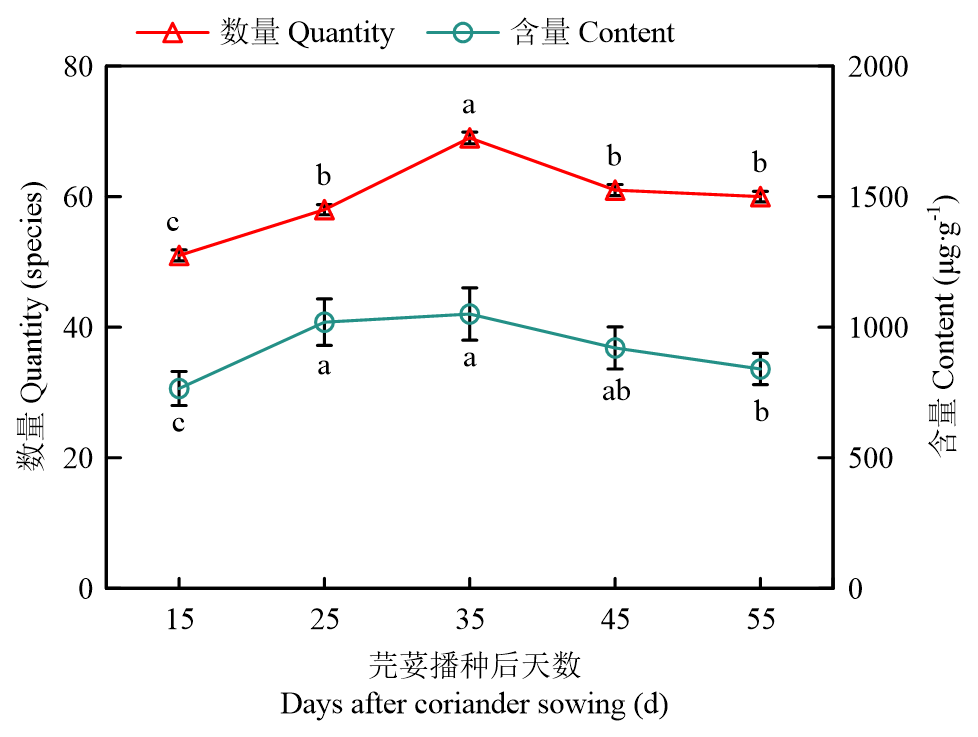
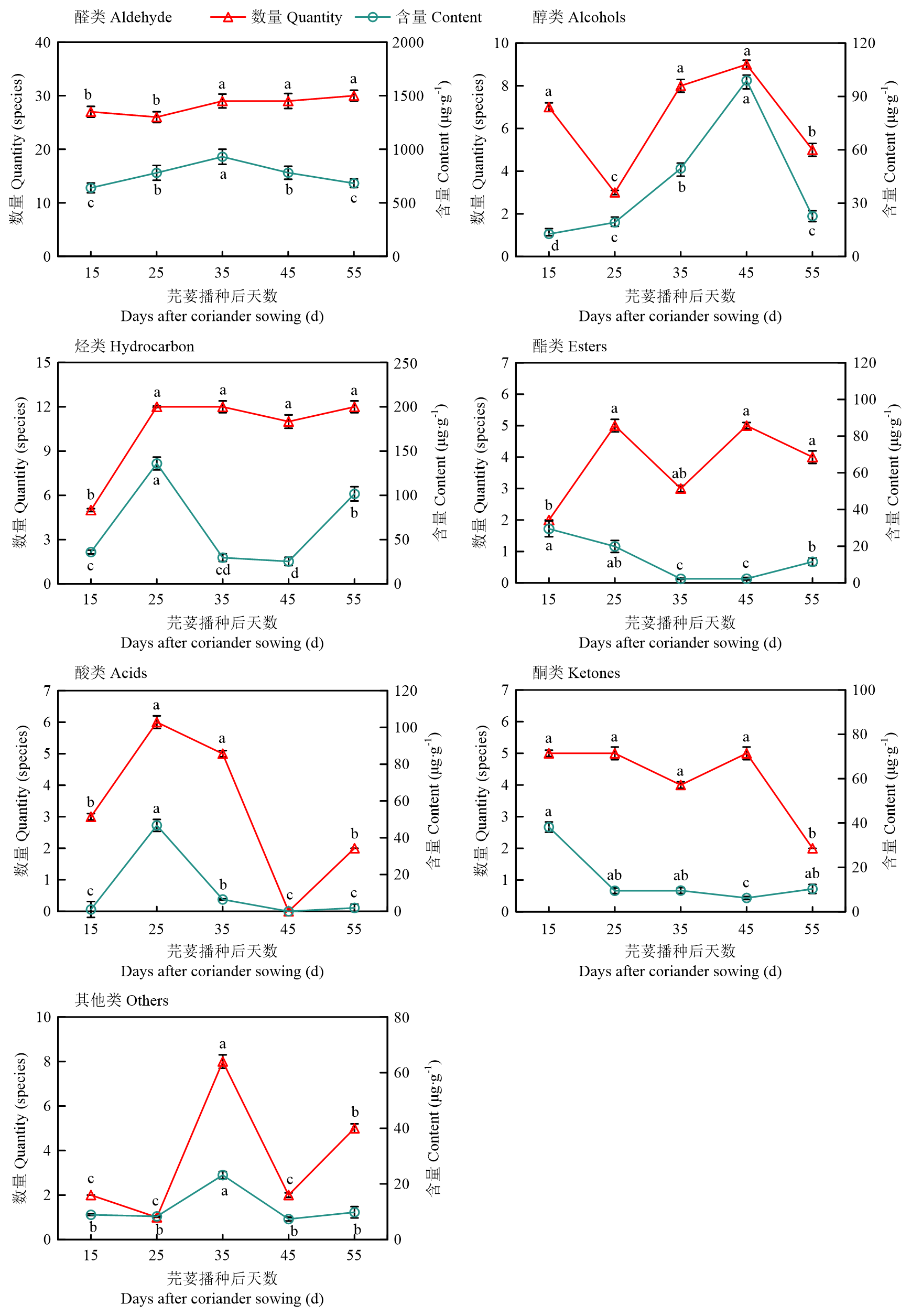
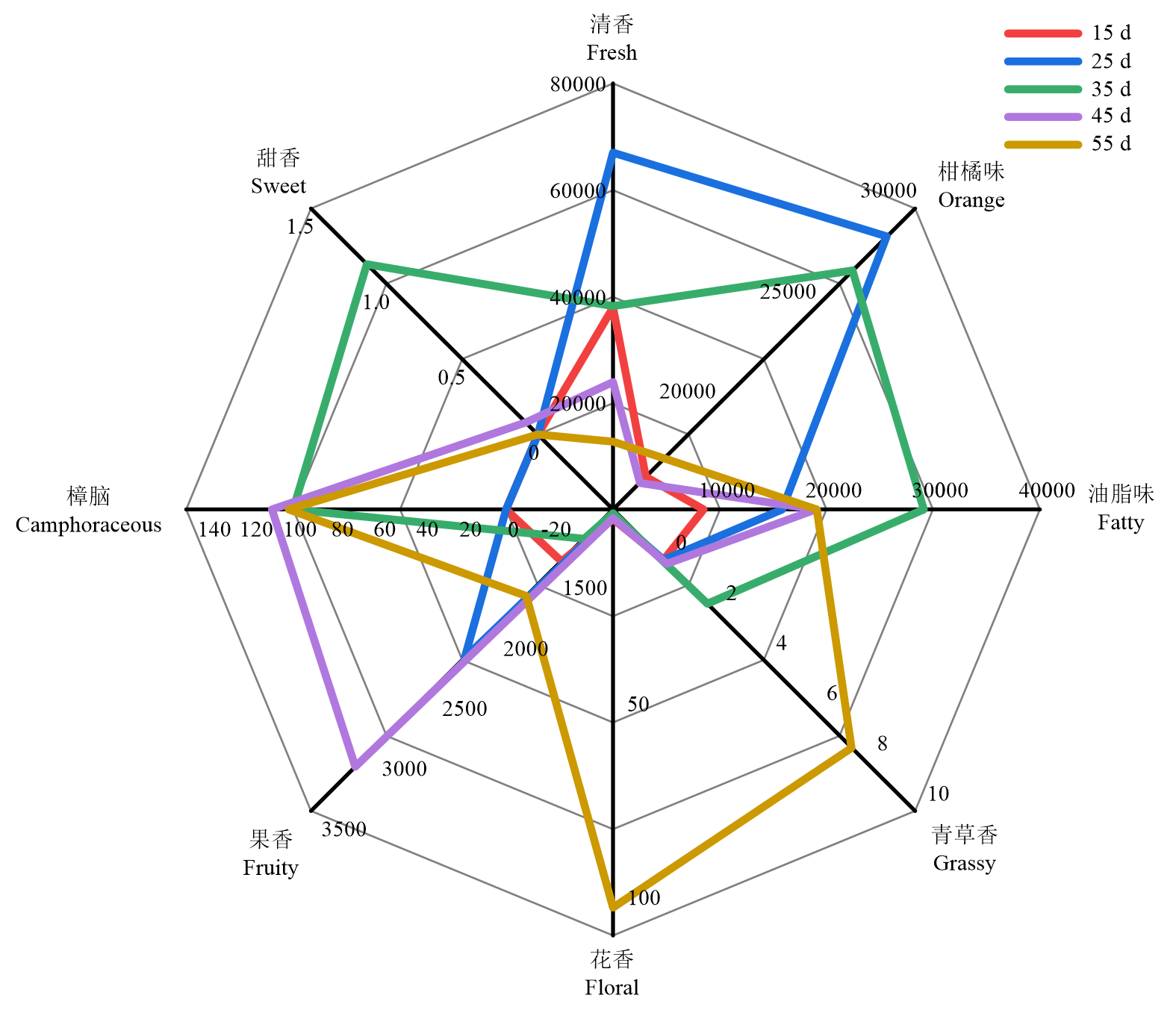
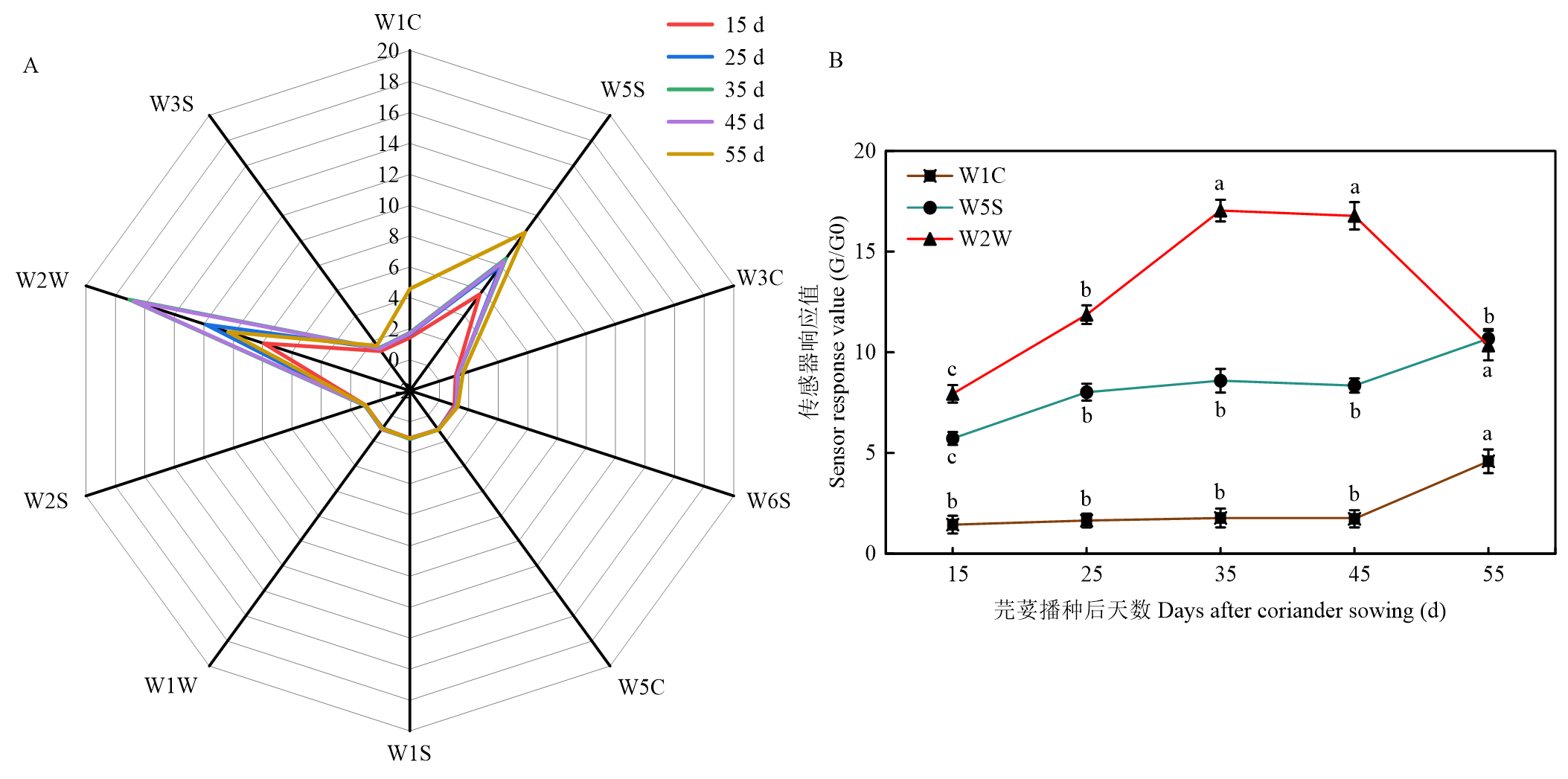
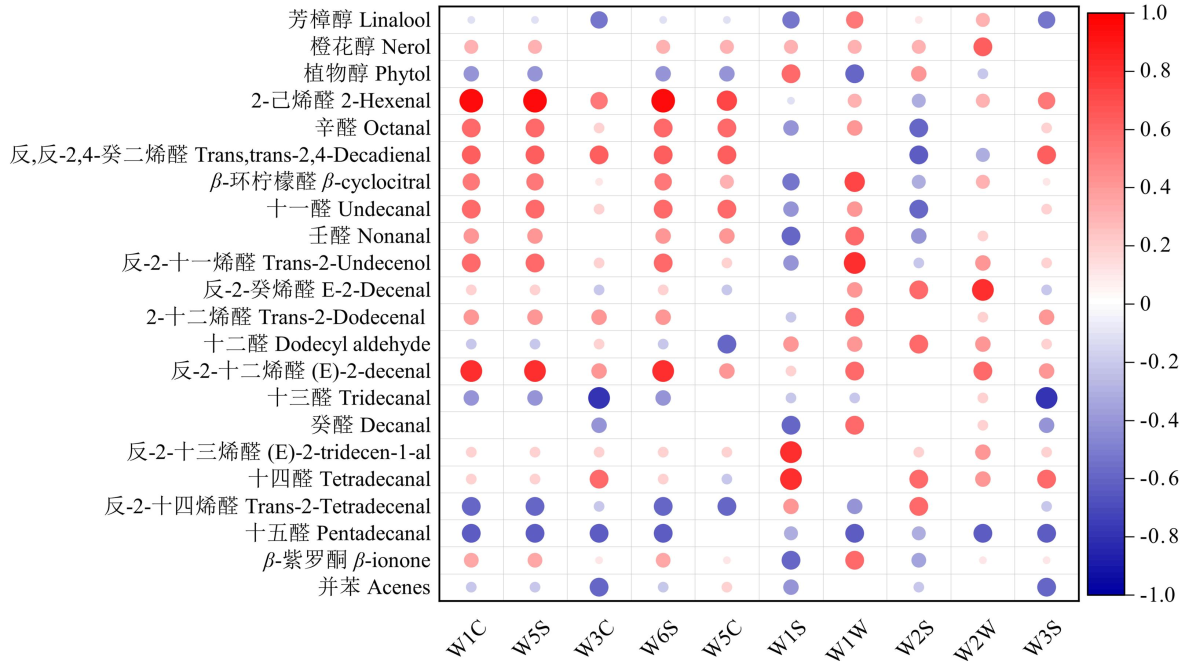
【Objective】This study aimed to systematically investigate the dynamic changes in volatile aroma compounds of coriander (Coriandrum sativum L.) leaves at different growth stages, and identify key aroma-active substances and critical developmental periods for aroma formation, so as to provide a scientific basis for high-quality cultivation, optimal harvest timing, and value-added processing of coriander. 【Method】 ‘Siji Dayouye’ coriander was used as the experimental material. Leaf samples were collected at five growth stages (15, 25, 35, 45, and 55 days after sowing). Volatile compounds were extracted using headspace solid-phase microextraction and analyzed by gas chromatography-mass spectrometry (HS-SPME/GC-MS), and overall aroma profiles were evaluated using an electronic nose (E-Nose) system. Key aroma compounds were identified based on odor activity values (OAV>1). Pearson correlation analysis was applied to explore relationships between volatile compounds and E-Nose sensor responses. 【Result】A total of 119 volatile compounds were identified, including aldehydes (38), alcohols (17), hydrocarbons (25), esters (8), acids (10), ketones (8), and other compounds (13). Both the number and total content of volatile compounds increased initially and then declined, reaching a maximum at 35 days, with total volatile content 37.3% higher than that at 15 days. Aldehydes were the predominant compounds, showing a 45.5% increase at 35 days, mainly attributed to trans-2- tetradecenal and trans-2-decenal. E-Nose analysis revealed that sensors W2W, W5S, and W1C exhibited the strongest responses, with significant variations among growth stages. 17 key aroma-active compounds (OAV>1) were identified, 15 of which were aldehydes. Trans-2-tetradecenal showed the highest OAV (175 850) at 25 days and was the principal contributor to the characteristic “fresh” and “citrus-like” aroma of coriander. Radar fingerprint analysis demonstrated distinct aroma profiles at different stages: “fresh” notes at 15 days; enhanced “citrus-like” and “oily” aromas at 25-35 days; prominent “fruity” and “camphor-like” notes at 45 days; and a notable “floral” aroma at 55 days. Correlation analysis indicated significant associations between key aldehydes and E-Nose sensor responses.【Conclusion】The combined application of GC-MS and E-Nose effectively characterized aroma variation in coriander leaves across different growth stages, established correlations between sensor responses and volatile compounds, and elucidated the aroma evolution mechanism of coriander leaves.

Key words: coriander, volatile compounds, gas chromatography-mass spectrometry (GC-MS), electronic nose (E-Nose), odor activity value (OAV)

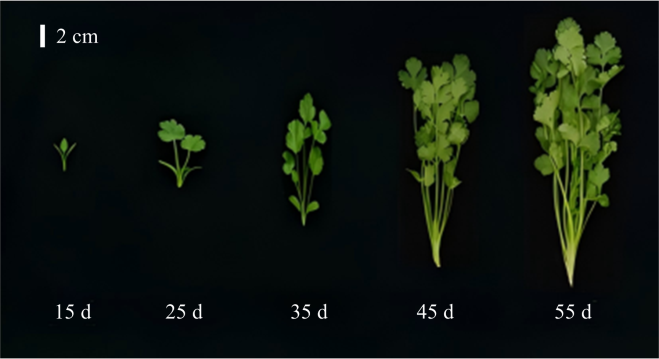
Fig. 1

Morphological photos of coriander at different growth stages"

Table 1

Formula for the use of Hogland nutrient solution"

化合物
Compound
化合物质量浓度
Concentration of compound (mg·L-1)
A液 KNO3 505.5
Ca(NO)3·4H2O 1180.9
B液 MgSO4·7H2O 492.94
KH2PO4 136.09
C液 H3BO3 2.78
MnCl4·4H2O 1.98
ZnSO4·7H2O 0.23
H2MoO4 0.06
CuSO4·5H2O 0.08
铁盐
Ferric salt
EDTA铁钠盐
EDTA ferric-sodium salt
7.45

Table 2

Performance description of electronic nose sensors"

序号 Serial number 传感器名称 Sensor name 性能描述 Performance description
1 W1C 对芳香成分、苯类灵敏 Sensitive to aromatic components and benzene compounds
2 W5S 对氮氧化物灵敏 Sensitive to nitrogen oxides
3 W3C 对氨类、芳香成分灵敏 Sensitive to ammonia and aromatic components
4 W6S 对氢化物灵敏 Sensitive to hydrogen
5 W5C 对短链烷烃、芳香成分灵敏 Sensitive to hydrocarbons and aromatic components
6 W1S 对甲烷类灵敏 Sensitive to methane
7 W1W 对硫化物、萜烯类灵敏 Sensitive to sulfides and terpenoids
8 W2S 对醇类、部分醛酮类灵敏 Sensitive to alcohols and some aldehydes and ketones
9 W2W 对有机硫化物、芳香成分灵敏 Sensitive to organic sulfur and aromatic components
10 W3S 对长链烷烃灵敏 Sensitive to long-chain alkanes

Fig. 2

The total quantity and total content of volatile substances in coriander at different growth stages Different lowercase letters indicate significant difference (P<0.05). The same as below"

Fig. 3

The quantity and content of various volatile substances in coriander at different growth stages"

Table 3

Different aroma of coriander at different growth stages OAV"

名称
Name
类型
Type
香气描述
Description of the aroma
阈值
Threshold
(μg·g-1)
OAV
15 d 25 d 35 d 45 d 55 d
γ-松油烯 γ-Terpinene 烯烃类 Olefin 柑橘味 Orange 1 <1
β-石竹烯 β-Caryophyllene 烯烃类 Olefin 留兰香、油脂味、芳香和辛香
Spearmint, Fatty, Fragrant, Spicy
64 <1
芳樟醇 Linalool 醇类 Alcohols 柑橘、铃兰香、花香
Orange, Muguet, Floral
0.22 2.05 4.32 9.14
橙花醇 Nerol 醇类 Alcohols 果香、花香、甜香
Fruity, Floral, Sweet
0.4 1.13
植物醇 Phytol 醇类 Alcohols 油脂、青草香 Fatty, Grassy 0.64 2.94 4.47 <1 <1
苯乙醛Phenylacetaldehyde 醛类 Aldehydes 花香、甜香 Floral, Sweet 6.3 <1 <1
2-己烯醛 2-Hexenal 醛类 Aldehydes 果香、青草香 Fruity, Grassy 0.85 1.76 <1 7.48
反-2-己烯醛 Trans-2-Hexenal 醛类 Aldehydes 油脂、青草香 Fatty, Grassy 0.424 <1 <1
辛醛 Octanal 醛类 Aldehydes 柑橘香气 Orange 0.056 23 22 31 40 58
反,反-2,4-癸二烯醛Trans,trans-2,4-Decadienal 醛类 Aldehydes 油脂 Fatty 0.07 50.57
β-环柠檬醛 β-cyclocitral 醛类 Aldehydes 樟脑气味 Camphoraceous 0.005 100 110 102
壬醛 Nonanal 醛类 Aldehydes 柑橘香气、清香 Orange,Fresh 3.5 <1 <1 1.90 1.55
苯甲醛 Benzaldehyde 醛类 Aldehydes 杏仁气味 Almond 41.7 <1 <1 <1 <1
十一醛 Undecanal 醛类 Aldehydes 花香、柑橘香气 Floral, Orange 5 1.04 1 2.06 3.20 3.49
反-2-十一烯醛
Trans-2-Undecenol
醛类 Aldehydes 果香、柑橘香气 Fruity, Orange 0.005 1430 2230 3720 9100 5018
反-2-癸烯醛 E-2-Decenal 醛类 Aldehydes 油脂、柑橘香气 Fatty, Orange 0.01 4148 4411 8659 5328 2784
2-十二烯醛 Trans-2-Dodecenal 醛类 Aldehydes 油脂 Fatty 0.0014 4700 12364 8585 25878 15850
十二醛 Dodecyl aldehyde 醛类 Aldehydes 柑橘香气、清香 Orange, Fresh 0.01 286 25119 1524 2915 1069
反-2-十二烯醛 (E)-2-decenal 醛类 Aldehydes 油脂、柑橘香气 Fatty, Orange 0.0014 27435 38900 104364 94071 96307
癸醛 Decanal 醛类 Aldehydes 柑橘香气 Orange 10 5.9 4.60 7.09 7.93 5.03
十三醛 Tridecanal 醛类 Aldehydes 柑橘香气、清香 Orange, Fresh 0.07 76 47 74 68 40
反-2-十三烯醛
(E)-2-tridecen-1-al
醛类 Aldehydes 油脂、柑橘香气 Fatty, Orange 0.0008 14662 39375 53012 7812 37700
十四醛 Tetradecanal 醛类 Aldehydes 油脂 Fatty 0.11 21 204 113 45 86
反-2-十四烯醛
Trans-2-Tetradecenal
醛类 Aldehydes 清香、柑橘香气 Fresh, Orange 0.002 151585 175850 151375 92850 50025
十五醛 Pentadecanal 醛类 Aldehydes 甜香 Sweet 0.43 3.35
β-紫罗酮 β-ionone 酮类 Ketones 果香、花香 Fruity, Floral 0.007 296 121

Fig. 4

Radar fingerprint of coriander volatiles in different periods"

Fig. 5

Electronic nose radar map (A) and dynamic graph of sensor response value (B) of coriander volatile substances"

Fig. 6

Correlation analysis of volatile substances of coriander in different periods and electronic nose sensors"

[1]
AMIRIPOUR A, JAHROMI M G, SOORI M K, TORKASHVAND A M. Changes in essential oil composition and fatty acid profile of coriander (Coriandrum sativum L.) leaves under salinity and foliar-applied silicon. Industrial Crops and Products, 2021, 168: 113599.

doi: 10.1016/j.indcrop.2021.113599
[2]
DAKHLAOUI S, WANNES W A, SARI H, BEN HMIDA M, FROUJA O, LIMAM H, TAMMAR S, BACHKOUEL S, BEN JEMAA M, JALLOULI S, HESSINI K, MSAADA K. Combined effect of essential oils from lavender (Lavandula officinalis L.) aerial parts and coriander (Coriandrum sativum L.) seeds on antioxidant, anti-diabetic, anti-cancer and anti-inflammatory activities. Journal of Essential Oil Bearing Plants, 2022, 25(1): 188-199.

doi: 10.1080/0972060X.2022.2049892
[3]
REDSHAW E S, HOUGEN F W, BAKER R J. Distillation technique for isolation of volatile materials for gas chromatographic analysis and its application to coriander seed (Coriandrum sativum). Journal of Agricultural and Food Chemistry, 1971, 19(6): 1264-1266.

doi: 10.1021/jf60178a018
[4]
刘信平, 张驰, 谭志伟, 于爱农. 香菜地上部分挥发活性成分研究. 食品科学, 2008, 29(8): 517-519.
LIU X P, ZHANG C, TAN Z W, YU A N. Study on determination of chemical components in volatile oil from Coriandrum sativum leaves and stem. Food Science, 2008, 29(8): 517-519. (in Chinese)
[5]
ZHOU Z F, CHEN L Y, SHEN M, MA A D, YANG X M, ZOU F. Analysis of the essential oils of Coriandrum sativum Using GC-MS coupled with chemometric resolution methods. Chemical & Pharmaceutical Bulletin, 2011, 59(1): 28-34.
[6]
NOUIOURA G, EL FADILI M, EL HACHLAFI N, MAACHE S, MSSILLOU I, ABUELIZZ H A, LAFDIL F Z, ER-RAHMANI S, LYOUSSI B, DERWICH E. Coriandrum sativum L., essential oil as a promising source of bioactive compounds with GC/MS, antioxidant, antimicrobial activities: in vitro and in silico predictions. Frontiers in Chemistry, 2024, 12: 1369745.

doi: 10.3389/fchem.2024.1369745
[7]
WEI S H, WEI L J, XIE B J, LI J, LYU J, WANG S Y, KHAN M A, XIAO X M, YU J H. Characterization of volatile profile from different coriander (Coriandrum sativum L.) varieties via HS-SPME/ GC-MS combined with E-nose analyzed by chemometrics. Food Chemistry, 2024, 457: 140128.

doi: 10.1016/j.foodchem.2024.140128
[8]
余亦婷, 赵乙萌, 袁曦, 曹丽娟, 李西文, 陆兔林, 严国俊. Heracles Neo超快速气相电子鼻对不同产地、生长年限及采收期黄芪药材品质评价研究. 中草药, 2022, 53(5): 1328-1337.
YU Y T, ZHAO Y M, YUAN X, CAO L J, LI X W, LU T L, YAN G J. Quality evaluation of Astragali Radix from different origins, growth years and harvesting periods by Heracles Neo ultra-fast gas phase electronic nose. Chinese Traditional and Herbal Drugs, 2022, 53(5): 1328-1337. (in Chinese)
[9]
FENG J Z, ZHANG B B, ZHANG H N, WU Z C, LI M Y, WANG D M, WANG C. Combining with E-nose, GC-MS, GC-IMS and chemometrics to explore volatile characteristics during the different stages of Zanthoxylum bungeanum maxim fruits. Food Research International, 2024, 195: 114964.

doi: 10.1016/j.foodres.2024.114964
[10]
RASOULI F, NASIRI Y, ASADI M, HASSANPOURAGHDAM M B, GOLESTANEH S, PIRSARANDIB Y. Fertilizer type and humic acid improve the growth responses, nutrient uptake, and essential oil content on Coriandrum sativum L. Scientific Reports, 2022, 12: 7437.

doi: 10.1038/s41598-022-11555-4
[11]
张一昊, 宗梦婷, 刘艳红, 唐兴莹, 方林江, 马兆成. 基于HS-SPME-GC-MS的临沧普洱生茶与传统绿茶香气差异分析. 生物资源, 2025, 47(5): 456-469.
ZHANG Y H, ZONG M T, LIU Y H, TANG X Y, FANG L J, MA Z C. Analysis of aroma differences between Lincang Pu-er raw tea and traditional green tea based on HS-SPME-GC-MS. Biotic Resources, 2025, 47(5): 456-469. (in Chinese)
[12]
SHENG X F, LI X, LU X X, LIU X H, TANG W Y, YU Z H, LIU X Z, ZHANG F, HUANG Q, HUANG M Z. Characterization and perceptual interaction of key aroma compounds in Rosa roxburghii Tratt by sensomics approach. Food Chemistry: X, 2024, 24: 101892.

doi: 10.1016/j.fochx.2024.101892
[13]
WANG L, CHEN Z, HAN B, WU W X, ZHAO Q L, WEI C Q, LIU W Y. Comprehensive analysis of volatile compounds in cold-pressed safflower seed oil from Xinjiang, China. Food Science & Nutrition, 2019, 8(2): 903-914.

doi: 10.1002/fsn3.v8.2
[14]
WANG J J, OUYANG W, ZHU X Z, JIANG Y W, YU Y Y, CHEN M, YUAN H B, HUA J J. Effect of shaking on the improvement of aroma quality and transformation of volatile metabolites in black tea. Food Chemistry: X, 2023, 20: 101007.

doi: 10.1016/j.fochx.2023.101007
[15]
杜玲玲, 孟晓伟, 胡伊涵, 刘荣华, 张寿文, 钟凌云, 朱卫丰, 梁永强. 不同陈化年份陈皮(樟头红)挥发成分差异的电子鼻与HS-GC-MS对比分析. 食品科学, 2025, 46(11): 253-262.
DU L L, MENG X W, HU Y H, LIU R H, ZHANG S W, ZHONG L Y, ZHU W F, LIANG Y Q. Integration of electronic nose and headspace gas Chromatography-mass spectrometry for differentiating the volatile compositions of citri reticulatae pericarpium made from Citrus reticulata blanco var. zhany shuensis f. Aged for different years. Food Science, 2025, 46(11): 253-262. (in Chinese)
[16]
FANG Y J, ZHANG J, MA C, XING L J, WANG W X, ZHANG W G. Ultrasound-induced modifications of beef flavor characteristics during postmortem aging. Ultrasonics Sonochemistry, 2024, 108: 106979.

doi: 10.1016/j.ultsonch.2024.106979
[17]
魏守辉. 芫荽挥发性物质萃取方法优化及外源茉莉酸甲酯对其调控的机理研究[D]. 兰州: 甘肃农业大学, 2023.
WEI S H. Optimization of extraction method for volatile compound from coriander and study on the regulation mechanism of exogenous methyl jasmonate[D]. Lanzhou: Gansu Agricultural University, 2023. (in Chinese)
[18]
XU S, SHI D J, CHEN H J, MA F W, TAO G C, MENG L S, LIN D, WU S Y, FEI Q. Comparison of the flavor characteristics in three kinds of strawberry fruits. Food Research International, 2024, 198: 115363.

doi: 10.1016/j.foodres.2024.115363
[19]
XIAO Z B, CHEN L N, NIU Y W, ZHU J C, ZHANG J, DENG J M. Evaluation of the interaction between esters and sulfur compounds in pineapple using feller’s additive model, OAV, and odor activity coefficient. Food Analytical Methods, 2021, 14(8): 1714-1729.

doi: 10.1007/s12161-021-02001-8
[20]
DU J Y, XU Z X, SUN H B, ZHU Y F, ZHANG J, HUANG M Q, LIU Y, LIU H Q, SUN B G, WU J H. Effect of a new sea-aging method on the flavor of Baijiu. Food Research International, 2025, 212: 116442.

doi: 10.1016/j.foodres.2025.116442
[21]
ALENYOREGE E A, MA H L, AHETO J H, AGYEKUM A A, ZHOU C S. Effect of sequential multi-frequency ultrasound washing processes on quality attributes and volatile compounds profiling of fresh-cut Chinese cabbage. LWT, 2020, 117: 108666.

doi: 10.1016/j.lwt.2019.108666
[22]
WEI L J, WEI S H, HU D L, FENG L, LIU Y Y, LIU H W, LIAO W B. Comprehensive flavor analysis of volatile components during the vase period of cut lily (Lilium spp. ‘Manissa’) flowers by HS-SPME/GC- MS combined with E-nose technology. Frontiers in Plant Science, 2022, 13: 822956.

doi: 10.3389/fpls.2022.822956
[23]
JIANG Z H, LI X J, PENG S T, LI X B, ZHOU C Y, ZHAO X Y. Effects of temperature on the physicochemical properties and volatile profiles of ‘Shine Muscat’ grape during postharvest storage. Food Chemistry, 2025, 469: 142546.

doi: 10.1016/j.foodchem.2024.142546
[24]
LEVENT O. A detailed comparative study on some physicochemical properties, volatile composition, fatty acid, and mineral profile of different almond (Prunus dulcis L.) varieties. Horticulturae, 2022, 8(6): 488.

doi: 10.3390/horticulturae8060488
[25]
李威龙, 王顺, 李晓燕, 崔文嘉, 张诗翌, 林文浩, 李梦瑶. 芹菜不同品种生长时期挥发性有机物质成分分析. 四川农业大学学报, 2024, 42(2): 322-329, 338.
LI W L, WANG S, LI X Y, CUI W J, ZHANG S Y, LIN W H, LI M Y. Analysis of volatile organic compounds in different varieties of celery at different growth stages. Journal of Sichuan Agricultural University, 2024, 42(2): 322-329, 338. (in Chinese)
[26]
陈建英, 吕迪瑚, 杨春. 基于HS-SPME-GC-MS和感官评价分析不同时期木枣的挥发性物质. 食品与发酵工业, 2025, 51(1): 330-336.

doi: 10.13995/j.cnki.11-1802/ts.038327
CHEN J Y, D H, YANG C. Analysis of volatile substances in different periods of Muzao by HS-SPME-GC-MS and sensory evaluation. Food and Fermentation Industries, 2025, 51(1): 330-336. (in Chinese)

doi: 10.13995/j.cnki.11-1802/ts.038327
[27]
李大龙, 郭潇雨, 李铁梅, 王泽珉, 宇航, 张鹏, 王佳明, 杨国慧. 利用电子鼻评价树莓果实香气. 东北农业大学学报, 2022, 53(7): 78-87.
LI D L, GUO X Y, LI T M, WANG Z M, YU H, ZHANG P, WANG J M, YANG G H. Evaluation of aroma in raspberry fruit by electronic nose. Journal of Northeast Agricultural University, 2022, 53(7): 78-87. (in Chinese)
[28]
OUAKHSSASE A, FATINI N, AIT ADDI E. Modified-QuEChERS- LC/MS method for the analysis of aflatoxins and ochratoxin A in coriander seeds. Food Additives & Contaminants: Part A, 2023, 40(3): 425-433.
[29]
WAHBA H E, ABD RABBU H S, IBRAHIM M E. Evaluation of essential oil isolated from dry coriander seeds and recycling of the plant waste under different storage conditions. Bulletin of the National Research Centre, 2020, 44(1): 192.

doi: 10.1186/s42269-020-00448-z
[30]
AL-KHAYRI J M, BANADKA A, NANDHINI M, NAGELLA P, AL-MSSALLEM M Q, ALESSA F M. Essential oil from Coriandrum sativum: A review on its phytochemistry and biological activity. Molecules, 2023, 28(2): 696.

doi: 10.3390/molecules28020696
[31]
方灵, 孔宝玉, 韦航, 颜孙安, 刘文静, 司瑞茹, 史梦竹, 梁启富, 任丽花, 傅建炜. 不同发育阶段黄金百香果挥发性成分差异性研究. 果树学报, 2022, 39(12): 2376-2389.
FANG L, KONG B Y, WEI H, YAN S A, LIU W J, SI R R, SHI M Z, LIANG Q F, REN L H, FU J W. Study on variation of volatile components in Golden Passion Fruit at different development stages. Journal of Fruit Science, 2022, 39(12): 2376-2389. (in Chinese)
[32]
FU Q J, XU D, HOU S, GAO R, ZHOU J, CHEN C, ZHU S N, WEI G Q, SUN Y G. Comprehensive identification and expression profiling of lipoxygenase genes in sweet cherry during fruit development. Horticulturae, 2024, 10(12): 1361.

doi: 10.3390/horticulturae10121361
[33]
TANG Y, ZHOU C G, YU Z Y, JIANG M, CHEN Y, WANG H Y, YANG Z. Formation of lipid-derived volatile products through lipoxygenase (LOX)- and hydroperoxide lyase (HPL)-mediated pathway in oat, barley and soy bean. Food Chemistry: X, 2024, 22: 101514.

doi: 10.1016/j.fochx.2024.101514
[34]
LIU W L, ZHANG L Y, WU D R, LIN S, XIE J X, LI J. Analysis of changes in volatile metabolites of pickled radish in different years using GC-MS, OAV and multivariate statistics. Food Chemistry, 2025, 478: 143760.

doi: 10.1016/j.foodchem.2025.143760
[35]
YE G D, GUAN L N, ZHANG M, LI S X, MI Y J. Analysis of key differential aroma compounds in thirty Japonica rice cultivars from Northeast China by integrating GC-O-MS, OAV, and chemometrics. Journal of Food Composition and Analysis, 2025, 140: 107201.

doi: 10.1016/j.jfca.2025.107201
[36]
阳景阳, 陈远权, 梁贤智, 王明释, 骆妍妃, 覃潇敏, 廖春文, 巫虹颖. HS-SPME-GC-MS结合OAV对乌龙茶树品种制花香型红茶的香气评价. 食品工业科技, 2025, 46(6): 315-324.
YANG J Y, CHEN Y Q, LIANG X Z, WANG M S, LUO Y F, QIN X M, LIAO C W, WU H Y. HS-SPME-GC-MS coupled with OAV to evaluate the aroma of flowery black tea made from oolong tea varieties. Science and Technology of Food Industry, 2025, 46(6): 315-324. (in Chinese)
[1] ZHOU DeGang, XU BinYan, WANG QingXia, ZHU Xia, YANG XueShan. Effects of Cell-to-Cell Contact Between Torulaspora delbrueckii and Saccharomyces cerevisiae on the Flavor and Quality of Cabernet Sauvignon Wine [J]. Scientia Agricultura Sinica, 2024, 57(16): 3264-3282.
[2] WU ShiHao, HUANG TianRan, HUANG Ming. Effect of Heat Treatment on the Warmed-Over Flavor of Nanjing Water-Boiled Salted Duck Detected by HS-SPME-GC-MS Technology and Electronic Nose [J]. Scientia Agricultura Sinica, 2023, 56(17): 3435-3451.
[3] ZHANG YuanYuan,LIU WenJing,ZHANG BinBin,CAI ZhiXiang,SONG HongFeng,YU MingLiang,MA RuiJuan. Characterization of the Lactone Volatile Compounds in Different Types of Peach (Prunus persica L.) Fruit and Evaluations of Their Contributions to Fruit Overall Aroma [J]. Scientia Agricultura Sinica, 2022, 55(10): 2026-2037.
[4] LIU Qiang,LIU JiWei,TIAN Tian,YAN Wei,LIU Bing,ZHAO SiQi,HU QiuHui,DING Chao. Dynamic Analysis for the Characteristics of Flavor Fingerprints for Brown Rice in Short-Term Storage Under High Temperature Stress [J]. Scientia Agricultura Sinica, 2021, 54(2): 379-391.
[5] ZHANG Fang,WEI ZhiSheng,WANG Peng,LI KaiXuan,ZHAN Ping,TIAN HongLei. Using Neural Network Coupled Genetic Algorithm to Optimize the SPME Conditions of Volatile Compounds in Korla Pear [J]. Scientia Agricultura Sinica, 2018, 51(23): 4535-4547.
[6] SONG Wei, HU WanJun, XU ZongJi, LIU Bing, FAN Yan, NI Yang, YANG HuiPing . Volatile Components of Main Indica Rice Cultivars from Hunan Province [J]. Scientia Agricultura Sinica, 2017, 50(2): 348-361.
[7] CUI KaiDi, HUANG XuePing, HE LeiMing, ZHAI YongBiao, MU Wei, LIU Feng. The Inhibition Effect of Microbial Volatile Compound Benzothiazole on Botrytis cinerea [J]. Scientia Agricultura Sinica, 2017, 50(19): 3714-3722.
[8] FANG Yong, WANG Hong-pan, PEI Fei, MA Ning, TANG Xiao-zhi, YANG Wen-jian, HU Qiu-hui. Effect of Extrusion on Digestion Properties and Volatile Compounds in Germinated Brown Rice Compounded of Flammulina velutipes Flour [J]. Scientia Agricultura Sinica, 2016, 49(23): 4606-4618.
[9] ZHANG Ke-kun, WANG Hai-bo, WANG Xiao-di, SHI Xiang-bin, WANG Bao-liang, ZHENG Xiao-cui, LIU Feng-zhi . Evolution of Volatile Compounds During the Berry Development of ‘Ruidu Xiangyu’ Grape [J]. Scientia Agricultura Sinica, 2015, 48(19): 3965-3978.
[10] YANG Xiao-Fan, GAO Yuan, HAN Mei-Mei, PENG Zhen-Xue, PAN Qiu-Hong. Accumulation Characteristics of Volatile Compounds in Wine Grape Berries Grown in High Altitude Regions of Yunnan [J]. Scientia Agricultura Sinica, 2014, 47(12): 2405-2416.
[11] QI Mu-Ge-Su-Du, GUO Zhuang, WANG Ji-Cheng, MENG He-Bi-Li-Ge, ZHANG He-Ping. 益生菌Lactobacillus casei Zhang对凝固型发酵乳质构和挥发性风味物质的影响 [J]. Scientia Agricultura Sinica, 2013, 46(3): 595-605.
[12] GUO Ya-Juan, DENG Yuan-Yuan, ZHANG Rui-Fen, ZHANG Ming-Wei, WEI Zhen-Cheng, TANG Xiao-Jun, ZHANG Yan. Comparison of Volatile Components from Different Varieties of Dried Litchi (Litchi chinensis Sonn.) [J]. Scientia Agricultura Sinica, 2013, 46(13): 2751-2768.
[13] YU QIAO Bi-jun XIE Yan ZHANG Hai-yan ZHOU Si-yi PAN. Study on Aroma Components in Fruit from Three Different Satsuma Mandarins Varieties [J]. Scientia Agricultura Sinica, 2008, 41(5): 1452-1458 .
Viewed
Full text


Abstract

Cited

  Shared   
  Discussed   
No Suggested Reading articles found!