Scientia Agricultura Sinica ›› 2026, Vol. 59 ›› Issue (5): 996-1007.doi: 10.3864/j.issn.0578-1752.2026.05.006

• PLANT PROTECTION • Previous Articles     Next Articles

A Novel Plasmid pEA60 of Erwinia amylovora Enhances the Pathogenicity of Strains by Regulating the Synthesis of Virulence Factors

DONG Yu(), WU Qian, FENG Xuan, ZHENG YinYing, CUI BaiMing()   

  1. College of Life Sciences, Shihezi University, Shihezi 832003, Xinjiang
  • Received:2025-11-10 Accepted:2025-12-21 Online:2026-03-01 Published:2026-03-06
  • Contact: CUI BaiMing

Abstract:

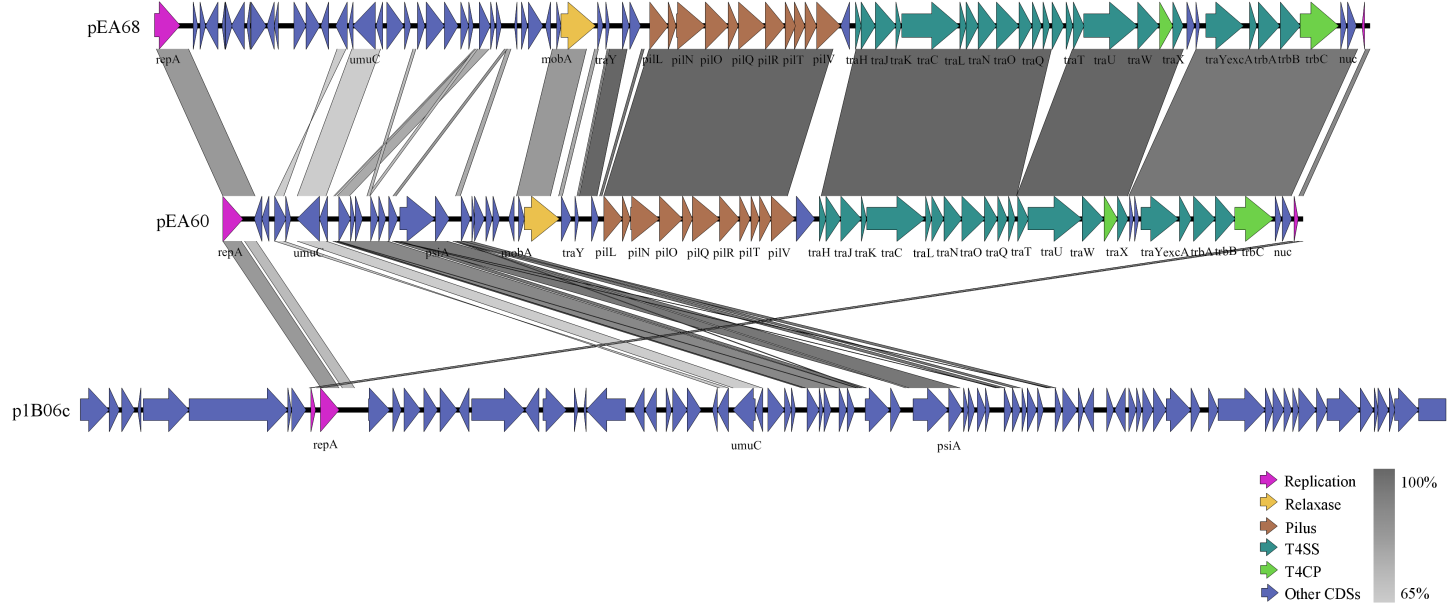
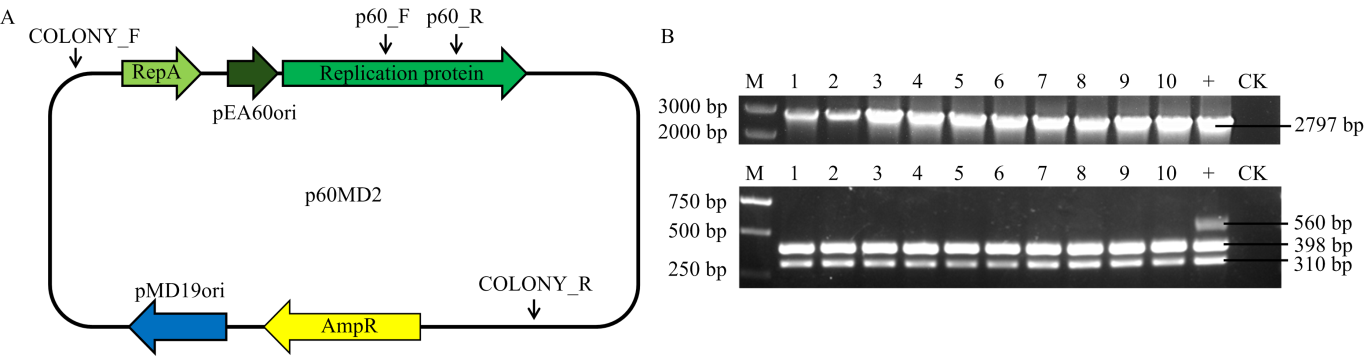
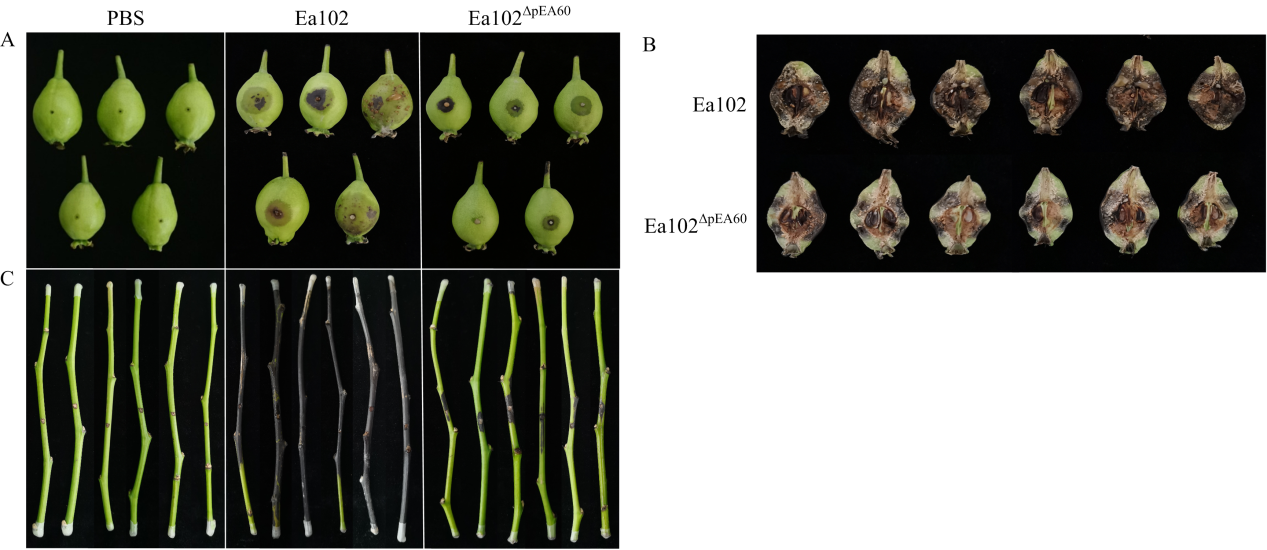
【Background】 Fire blight poses a serious threat to the development of the Korla fragrant pear industry in Xinjiang. Its pathogen, Erwinia amylovora, often carries diverse plasmids, which are key factors leading to phenotypic differences among strains, such as pathogenicity and antibiotic resistance. Recently, a novel plasmid pEA60 was identified from the E. amylovora strain Ea102 which was isolated from Xinjiang Korla fragrant pear.【Objective】 The objective of this study is to investigate the origin, function of E. amylovora plasmid pEA60 and its impact on pathogenicity of the pathogen.【Method】 The genome of Ea102 was sequenced using PacBio and Illumina and assembled with SPAdes. Functional annotation was performed using tools such as PAGP, while BLASTN was used for comparative genomic analysis, and MLST for plasmid typing. The replication region was identified using plasmid incompatibility, and a pEA60-cured mutant was constructed. Conjugation experiments were conducted to assess its self-transfer capability. In terms of functional verification, the effect of the plasmid on bacterial pathogenicity was systematically evaluated by quantitative determination of exopolysaccharide production and immature fruit and in vitro shoots test of pear.【Result】 pEA60 is a conjugative plasmid with a size of 61 198 bp, containing 65 predicted CDSs primarily involved in three functional modules: replication and stability, pilus formation, and conjugation. No known antibiotic resistance genes or virulence-related genes were identified. Comparative analysis revealed that the pilus formation and conjugation functional regions of pEA60 are highly similar to those of the E. amylovora plasmid pEA68 (average nucleotide identity: 97.04%), while its replication and stability regions resemble those of the Erwinia aphidicola plasmid p1B06c, suggesting that pEA60 likely originated from a recombination event. pEA60 is an IncFII-type plasmid, and its 2 610 bp fragment harboring the replication protein gene and the origin of replication is sufficient to maintain plasmid viability. The plasmid influenced exopolysaccharide synthesis and pathogenicity in E. amylovora. Curing of pEA60 resulted in reduced amylovoran production and levansucrase activity, increased cellulose production, and attenuated symptoms on both pear shoots and immature fruits.【Conclusion】 pEA60 is a novel, conjugative IncFII plasmid in E. amylovora. It affects exopolysaccharide synthesis and enhances the pathogenicity of its host strain. This study provides new insights into the pathogenic mechanisms of E. amylovora and plasmid-mediated evolution of virulence.

Key words: Erwinia amylovora, Korla fragrant pear, fire blight, pEA60 plasmid, exopolysaccharide, pathogenicity

Table 1

Primers used in this study"

引物名称
Primer name
引物序列
Sequence of primers (5′-3′)
用途
Usage
EaU_F ACCAGTTGCACCGAAAAGT 检测解淀粉欧文氏菌染色体
Detection of E. amylovora chromosome
EaU_R ATGTAAACTGGTGCGCAGAC
p60_F AAGTGATGCTTCCGGTCGAA 检测pEA60质粒的复制起点
Detection of the origin of replication of the plasmid pEA60
p60_R GACGACCCAGCGCTTTATTT
p29_F CGTTTGCTGAACCTTGCTCT 检测pEA29质粒
Detection of the plasmid pEA29
p29_R CATCCAGTCAAGTGCCAGTG
p60ori_F ACTTCTCTGGCCGGGCT 扩增pEA60质粒的复制调控区
Amplification of the replication regulatory region of the plasmid pEA60
p60ori_R CCCCTGAATGTCTAACGGGG
COLONY_F CGGCTCGTATGTTGTGTGGA 检测p60MD2质粒
Detection of the plasmid p60MD2
COLONY_R GTAACGCCAGGGTTTTCCCA
p60C6_F ATCTGGCAAAGGGGGTGTTC 检测pEA60质粒
Detection of the plasmid pEA60
p60C6_R GAGGGTGGTTTCCTCACTGG
kanori_F ATCAGGAAGTCGGCATCAGAGCAGATTG 扩增pET28a(+)载体的卡那霉素抗性基因和复制起点
Amplification of the kanamycin resistance gene and ori of the vector pET28a(+)
kanori_R TCCTGTGTGATTCAGGTGGCACTTTTCG
19MCS_F GCCACCTGAATCACACAGGAAACAGCTATG 扩增pMD19载体的多克隆位点
Amplification of the multiple cloning site of the vector pMD19
19MCS_R GAATGATCAGCCAGTCACGACGTTGTAAAAC
29ori_F TCGTGACTGGCTGATCATTCCTCTTTTGTG 扩增pEA29质粒的复制起始区
Amplification of the replication origin region of the plasmid pEA29
29ori_R TCTGATGCCGACTTCCTGATGATCGTGC

Fig. 1

The genome map of plasmid pEA60 The inner side of the circle shows positions in kb, arrows on the outside of the circle display CDSs. Purple arrows represent replication related proteins, light green arrows represent type IV coupling proteins, dark green arrows represent the main proteins of type IV secretion system, yellow arrow represents relaxase, and brown arrows represent pilus proteins"

Fig. 2

Sequence comparison of the plasmid pEA60 Arrows indicate the predicted CDSs. Gray shading indicates nucleotide similarity, with darker shading indicating higher similarity"

Fig. 3

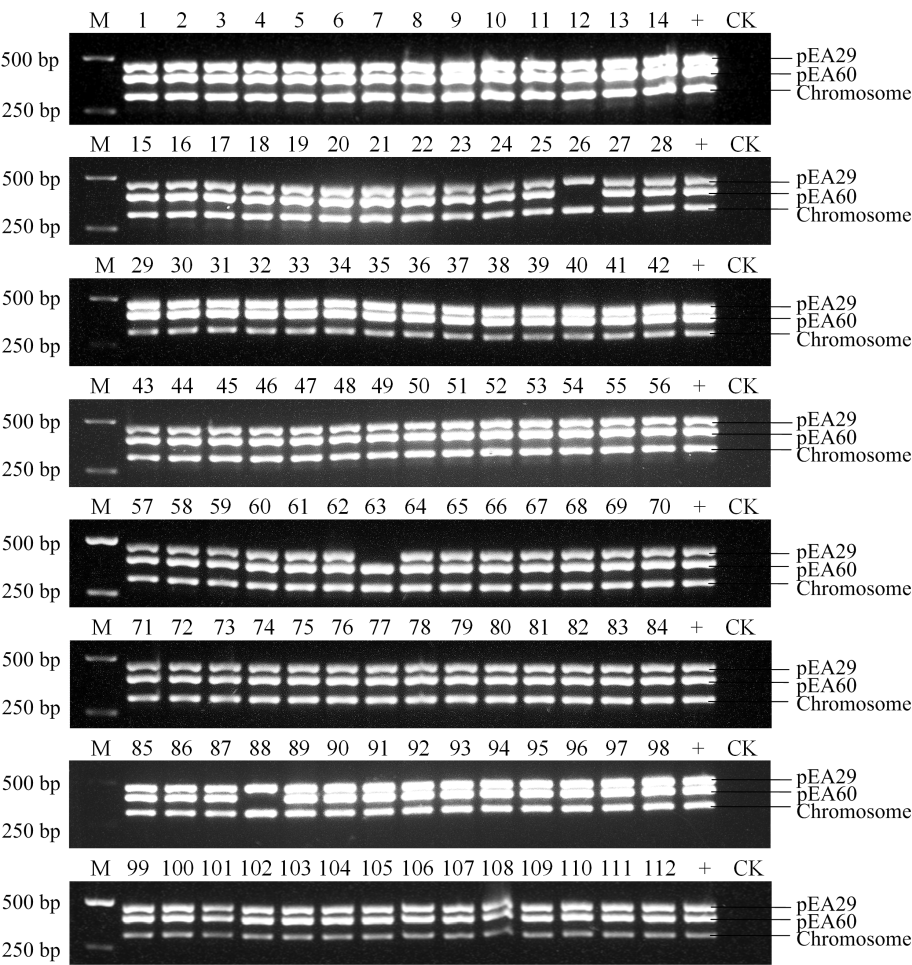
Stability detection of plasmid pEA60"

Fig. 4

Identification of the replication regulatory region in plasmid pEA60"

Fig. 5

Conjugation detection of plasmid pEA60"

Fig. 6

Determination of exopolysaccharide production"

Fig. 7

Inoculation of Korla fragrant pear immature fruits and detached shoots"

[1]
SUN W, GONG P, ZHAO Y, MING L, ZENG Q, LIU F. Current situation of fire blight in China. Phytopathology, 2023, 113(12): 2143-2151.

doi: 10.1094/PHYTO-05-23-0170-RVW pmid: 37505073
[2]
MOMOL M T, MOMOL E A, DANKERS W. A severe outbreak of fire blight in woody ornamental Rosaceae plants in North Florida and South Georgia. Plant Disease, 2000, 84(10): 1153.
[3]
JOCK S, DONAT V, LÓPEZ M M, BAZZI C, GEIDER K. Following spread of fire blight in Western, Central and Southern Europe by molecular differentiation of Erwinia amylovora strains with PFGE analysis. Environmental Microbiology, 2002, 4(2): 106-114.

doi: 10.1046/j.1462-2920.2002.00277.x
[4]
BASTAS K K, OZTURK A Y. First report of fire blight caused by Erwinia amylovora on crabapple (Malus floribunda) in Turkey. Plant Disease, 2013, 97(9): 1244.
[5]
RHOUMA A, HELALI F, CHETTAOUI M, HAJJOUJI M, HAJLAOUI M R. First report of fire blight caused by Erwinia amylovora on pear in Tunisia. Plant Disease, 2014, 98(1): 158.
[6]
TALHI L, BARBÉ S, NAVARRO-HERRERO I, SEBAIHIA M, MARCO-NOALES E. Intraspecific diversity of Erwinia amylovora strains from northern Algeria. BMC Microbiology, 2024, 24(1): 389.
[7]
FEI N, YANG Y, SONG B, ZHU X, GUAN W, ZHAO T. Complete genome sequence of Erwinia amylovora strain 99east-3-1, isolated from Pyrus sinkiangensis in China. Microbiology Resource Announcements, 2023, 12(7): e0016123.
[8]
LIM Y J, HAM H, LEE M H, PARK D S, ROH E, PARK D H, LEE Y H. First report of fire blight on Chinese hawthorn (Crataegus pinnatifida) caused by Erwinia amylovora in Korea. Plant Disease, 2023, 107(10): 3275.
[9]
REZZONICO F, BOBUSHOVA S, GAGANIDZE D, KONURBAEVA M, MUKHANOV S, JORDAN S, SADUNISHVILI T, DRENOVA N, SMITS T H M, DOOLOTKELDIEVA T. Epidemiological description of fire blight introduction patterns to Central Asia and the Caucasus region based on CRISPR spacer typing and genome analysis. Phytopathology Research, 2024, 6(1): 66.
[10]
KIM W S, HILDEBRAND M, JOCK S, GEIDER K. Molecular comparison of pathogenic bacteria from pear trees in Japan and the fire blight pathogen Erwinia amylovora. Microbiology, 2001, 147(11): 2951-2959.

doi: 10.1099/00221287-147-11-2951
[11]
PIQUÉ N, MIÑANA-GALBIS D, MERINO S, TOMÁS J M. Virulence factors of Erwinia amylovora: A review. International Journal of Molecular Sciences, 2015, 16(6): 12836-12854.

doi: 10.3390/ijms160612836
[12]
杨金花, 徐叶挺, 张校立. 梨火疫病研究进展. 分子植物育种, 2022, 20(3): 1003-1013.
YANG J H, XU Y T, ZHANG X L. Advances of fire blight in pear. Molecular Plant Breeding, 2022, 20(3): 1003-1013. (in Chinese)
[13]
YUAN X, MCGHEE G C, SLACK S M, SUNDIN G W. A novel signaling pathway connects thiamine biosynthesis, bacterial respiration, and production of the exopolysaccharide amylovoran in Erwinia amylovora. Molecular Plant-Microbe Interactions, 2021, 34(10): 1193-1208.

doi: 10.1094/MPMI-04-21-0095-R
[14]
MANN R A, SMITS T H, BÜHLMANN A, BLOM J, GOESMANN A, FREY J E, PLUMMER K M, BEER S V, LUCK J, DUFFY B, RODONI B. Comparative genomics of 12 strains of Erwinia amylovora identifies a pan-genome with a large conserved core. PLoS ONE, 2013, 8(2): e55644.
[15]
PARCEY M, GAYDER S, MORLEY-SENKLER V, BAKKEREN G, ÚRBEZ-TORRES J R, ALI S, CASTLE A J, SVIRCEV A M. Comparative genomic analysis of Erwinia amylovora reveals novel insights in phylogenetic arrangement, plasmid diversity, and streptomycin resistance. Genomics, 2020, 112(5): 3762-3772.

doi: 10.1016/j.ygeno.2020.04.001
[16]
ZENG Q, CUI Z, WANG J, CHILDS K L, SUNDIN G W, COOLEY D R, YANG C H, GAROFALO E, EATON A, HUNTLEY R B, YUAN X, SCHULTES N P. Comparative genomics of Spiraeoideae-infecting Erwinia amylovora strains provides novel insight to genetic diversity and identifies the genetic basis of a low-virulence strain. Molecular Plant Pathology, 2018, 19(7): 1652-1666.

doi: 10.1111/mpp.2018.19.issue-7
[17]
LLOP P, CABREFIGA J, SMITS T H, DREO T, BARBÉ S, PULAWSKA J, BULTREYS A, BLOM J, DUFFY B, MONTESINOS E, LÓPEZ M M. Erwinia amylovora novel plasmid pEI70: Complete sequence, biogeography, and role in aggressiveness in the fire blight phytopathogen. PLoS ONE, 2011, 6(12): e28651.
[18]
BERESWILL S, BUGERT P, BRUCHMÜLLER I, GEIDER K. Identification of the fire blight pathogen, Erwinia amylovora, by PCR assays with chromosomal DNA. Applied and Environmental Microbiology, 1995, 61(7): 2636-2642.

doi: 10.1128/aem.61.7.2636-2642.1995
[19]
SUNDIN G W, PENG J, BROWN L E, ZENG Q, FÖRSTER H, ADASKAVEG J E. A novel IncX plasmid mediates high-level oxytetracycline and streptomycin resistance in Erwinia amylovora from commercial pear orchards in California. Phytopathology, 2023, 113(12): 2165-2173.

doi: 10.1094/PHYTO-06-23-0190-SA
[20]
黄伟, 盛强, 罗明, 马德英, 张春竹. 新疆库尔勒香梨火疫病的发生特点及防控建议. 植物保护, 2022, 48(6): 207-213, 231.
HUANG W, SHENG Q, LUO M, MA D Y, ZHANG C Z. Occurrence status of fire blight on Korla fragrant pear in Xinjiang and the control proposals. Plant Protection, 2022, 48(6): 207-213, 231. (in Chinese)
[21]
李洪涛, 张静文, 盛强, 唐章虎, 张祥林, 张春竹, 罗明. 我国20个梨品种(种质)对国外梨火疫病菌的抗病性评价. 果树学报, 2019, 36(5): 629-637.
LI H T, ZHANG J W, SHENG Q, TANG Z H, ZHANG X L, ZHANG C Z, LUO M. Resistance evaluation of 20 pear varieties (germplasms) in China to foreign strains of Erwinia amylovora. Journal of Fruit Science, 2019, 36(5): 629-637. (in Chinese)
[22]
ARDUI S, AMEUR A, VERMEESCH J R, HESTAND M S. Single molecule real-time (SMRT) sequencing comes of age: Applications and utilities for medical diagnostics. Nucleic Acids Research, 2018, 46(5): 2159-2168.

doi: 10.1093/nar/gky066 pmid: 29401301
[23]
BANKEVICH A, NURK S, ANTIPOV D, GUREVICH A A, DVORKIN M, KULIKOV A S, LESIN V M, NIKOLENKO S I, PHAM S, PRJIBELSKI A D, et al. SPAdes: A new genome assembly algorithm and its applications to single-cell sequencing. Journal of Computational Biology, 2012, 19(5): 455-477.

doi: 10.1089/cmb.2012.0021 pmid: 22506599
[24]
ZHAO Y, WU J, YANG J, SUN S, XIAO J, YU J. PGAP: Pan-genomes analysis pipeline. Bioinformatics, 2012, 28(3): 416-418.

doi: 10.1093/bioinformatics/btr655 pmid: 22130594
[25]
FELDGARDEN M, BROVER V, HAFT D H, PRASAD A B, SLOTTA D J, TOLSTOY I, TYSON G H, ZHAO S, HSU C H, MCDERMOTT P F, et al. Validating the AMRFinder tool and resistance gene database by using antimicrobial resistance genotype-phenotype correlations in a collection of isolates. Antimicrobial Agents and Chemotherapy, 2019, 63(11): e00483-19.
[26]
GRANT J R, STOTHARD P. The CGView Server: A comparative genomics tool for circular genomes. Nucleic Acids Research, 2008, 36(Web Server issue): W181-W184.
[27]
RICHTER M, ROSSELLÓ-MÓRA R, GLÖCKNER F O, PEPLIES J. JSpeciesWS: A web server for prokaryotic species circumscription based on pairwise genome comparison. Bioinformatics, 2016, 32(6): 929-931.

doi: 10.1093/bioinformatics/btv681 pmid: 26576653
[28]
SULLIVAN M J, PETTY N K, BEATSON S A. Easyfig: A genome comparison visualizer. Bioinformatics, 2011, 27(7): 1009-1010.

doi: 10.1093/bioinformatics/btr039 pmid: 21278367
[29]
FOSTER G C, MCGHEE G C, JONES A L, SUNDIN G W. Nucleotide sequences, genetic organization, and distribution of pEU30 and pEL60 from Erwinia amylovora. Applied and Environmental Microbiology, 2004, 70(12): 7539-7544.

doi: 10.1128/AEM.70.12.7539-7544.2004
[30]
ISMAIL E, BLOM J, BULTREYS A, IVANOVIĆ M, OBRADOVIĆ A, VAN DOORN J, BERGSMA-VLAMI M, MAES M, WILLEMS A, DUFFY B, STOCKWELL V O, SMITS T H, PUŁAWSKA J. A novel plasmid pEA68 of Erwinia amylovora and the description of a new family of plasmids. Archives of Microbiology, 2014, 196(12): 891-899.

doi: 10.1007/s00203-014-1028-5
[31]
QUAN J, TIAN J. Circular polymerase extension cloning for high-throughput cloning of complex and combinatorial DNA libraries. Nature Protocols, 2011, 6(2): 242-251.

doi: 10.1038/nprot.2010.181 pmid: 21293463
[32]
WANG Y, YU Z, DING P, LU J, KLÜMPER U, MURRAY A K, GAZE W H, GUO J. Non-antibiotic pharmaceuticals promote conjugative plasmid transfer at a community-wide level. Microbiome, 2022, 10(1): 124.
[33]
WANG D, KORBAN S S, ZHAO Y. The Rcs phosphorelay system is essential for pathogenicity in Erwinia amylovora. Molecular Plant Pathology, 2009, 10(2): 277-290.

doi: 10.1111/mpp.2009.10.issue-2
[34]
HILDEBRAND M, ALDRIDGE P, GEIDER K. Characterization of hns genes from Erwinia amylovora. Molecular Genetics and Genomics, 2006, 275(3): 310-319.

doi: 10.1007/s00438-005-0085-5
[35]
CASTIBLANCO L F, SUNDIN G W. Cellulose production, activated by cyclic di-GMP through BcsA and BcsZ, is a virulence factor and an essential determinant of the three-dimensional architectures of biofilms formed by Erwinia amylovora Ea1189. Molecular Plant Pathology, 2018, 19(1): 90-103.

doi: 10.1111/mpp.2018.19.issue-1
[36]
VILLA L, CARATTOLI A. Plasmid typing and classification. Methods in Molecular Biology, 2020, 2075: 309-321.

doi: 10.1007/978-1-4939-9877-7_22 pmid: 31584172
[37]
COSTA T R D, HARB L, KHARA P, ZENG L, HU B, CHRISTIE P J. Type IV secretion systems: Advances in structure, function, and activation. Molecular Microbiology, 2021, 115(3): 436-452.

doi: 10.1111/mmi.v115.3
[38]
WALTERSON A M, STAVRINIDES J. Pantoea: Insights into a highly versatile and diverse genus within the Enterobacteriaceae. FEMS Microbiology Reviews, 2015, 39(6): 968-984.

doi: 10.1093/femsre/fuv027 pmid: 26109597
[39]
FEI N, SONG B, YAN J, WEI H, ZHAO T, GUAN W, JI W, YANG Y. Phylogenetic diversity and quantitative PCR detection of Erwinia amylovora in Xinjiang, China. Agronomy, 2025, 15(5): 1065.
[40]
ARES-ARROYO M, NUCCI A, ROCHA E P C. Expanding the diversity of origin of transfer-containing sequences in mobilizable plasmids. Nature Microbiology, 2024, 9(12): 3240-3253.

doi: 10.1038/s41564-024-01844-1
[41]
贾雅婷, 胡慧慧, 翟亚军, 赵冰, 何坤, 潘玉善, 胡功政, 苑丽. 核蛋白H-NS调控多重耐药鸡大肠埃希菌IncFII质粒接合转移的分子机制. 中国农业科学, 2022, 55(18): 3675-3684. doi: 10.3864/j.issn.0578-1752.2022.18.016.
JIA Y T, HU H H, ZHAI Y J, ZHAO B, HE K, PAN Y S, HU G Z, YUAN L. Molecular mechanism of regulation by H-NS on IncFII plasmid transmission of multi-drug resistant chicken Escherichia coli. Scientia Agricultura Sinica, 2022, 55(18): 3675-3684. doi: 10.3864/j.issn.0578-1752.2022.18.016. (in Chinese)
[42]
GETINO M, DE LA CRUZ F. Natural and artificial strategies to control the conjugative transmission of plasmids. Microbiology Spectrum, 2018, 6(1): MTBP-0015-2016.
[43]
JIANG J, WANG L, HU Y, CHEN X, LI P, ZHANG J, ZHANG Y, SU J, XU X, XIAO Y, et al. Global emergence of carbapenem-resistant hypervirulent Klebsiella pneumoniae driven by an IncFII (K34) KPC-2 plasmid. eBioMedicine, 2025, 113: 105627.

doi: 10.1016/j.ebiom.2025.105627
[44]
YUAN X, ELDRED L I, SUNDIN G W. Exopolysaccharides amylovoran and levan contribute to sliding motility in the fire blight pathogen Erwinia amylovora. Environmental Microbiology, 2022, 24(10): 4738-4754.

doi: 10.1111/emi.v24.10
[45]
COVER T L, LACY D B, OHI M D. The Helicobacter pylori cag type IV secretion system. Trends in Microbiology, 2020, 28(8): 682-695.

doi: 10.1016/j.tim.2020.02.004
[46]
ROOP R M, BARTON I S, HOPERSBERGER D, MARTIN D W. Uncovering the hidden credentials of Brucella virulence. Microbiology and Molecular Biology Reviews, 2021, 85(1): e00021-19.
[1] CONG QiQi, ZHANG JingYi, MENG XiangLong, DAI PengBo, LI Bo, HU TongLe, WANG ShuTong, CAO KeQiang, WANG YaNan. Identification of Hypovirus in Apple Ring Rot Fungus Botryosphaeria dothidea and Detection of Virus-Carrying Status in China [J]. Scientia Agricultura Sinica, 2025, 58(3): 478-492.
[2] TONG ZhaoYang, LIU WenHua, ZHANG GuoXin, DONG ChunYan, ZHANG YanXia, XU XiaoWei, HE Dong, LIU HeChun, LI Yang, WANG FengTao, FENG Jing, YAO XiaoBo, LIU MeiJin, LIN RuiMing. The Relationship Between Occurrence of Hulless Barley Ear Rot and Population Migration of Grass Mite (Siteroptes spp.) [J]. Scientia Agricultura Sinica, 2025, 58(3): 493-506.
[3] WANG Long, WANG Jun, JIANG Jing, LIU Hao, LIU DeZhao, LI JiuSheng. Effects of Nitrogen and Potassium Application Rate on Soil Salinity, Yield and Quality of Korla Fragrant Pear Under Drip Irrigation in Southern Xinjiang [J]. Scientia Agricultura Sinica, 2025, 58(17): 3473-3487.
[4] YANG WenJuan, GAO JiaCheng, WANG YanTing, LI Yan, GUO Ming, WANG JunCheng, MENG YaXiong, WANG HuaJun, SI ErJing. Function of Effector Pg00778 Regulation on the Pathogenicity of Pyrenophora graminea to Barley [J]. Scientia Agricultura Sinica, 2025, 58(15): 3020-3035.
[5] DONG ZaiFang, DING TengTeng, SHAN YiXuan, LI HongLian, CHEN LinLin, XING XiaoPing. Autophagy-Related Gene FpAtg3 Involves in Growth and Pathogenicity of Fusarium pseudograminearum [J]. Scientia Agricultura Sinica, 2024, 57(6): 1080-1090.
[6] ZHANG AiHong, YANG Fei, ZHAO YuanYe, ZHAO YiHan, DI DianPing, MIAO HongQin. Pathogenicity and Epidemic Risk of Barley Yellow Striate Mosaic Virus [J]. Scientia Agricultura Sinica, 2024, 57(23): 4686-4697.
[7] CHEN Niu, YU ChengMin, CUI BaiMing, REN CaiXia, YANG LiYing, DONG Yu, LIU Lin, ZHENG YinYing. Isolation, Genome Determination and Lysis Function Analysis of Phage Kuerle of Erwinia amylovora [J]. Scientia Agricultura Sinica, 2024, 57(2): 295-305.
[8] WANG Yuan, DU MengDan, LI ZhengGang, SHE XiaoMan, YU Lin, LAN GuoBing, DING ShanWen, HE ZiFu, TANG YaFei. Identification of Pathogen Causing Tomato White Tip and Curl Leaf Disease and Its Pathogenicity in Guangdong Province [J]. Scientia Agricultura Sinica, 2024, 57(12): 2350-2363.
[9] ZHANG Jian, ZHAO BinSen, FENG Hao, HUANG LiLi. Function and Mechanism Analysis of Vm-milRN7 Regulating the Pathogenicity of Valsa mali [J]. Scientia Agricultura Sinica, 2024, 57(10): 1930-1942.
[10] GAO XiaoXiao, TU LiQin, YANG Liu, LIU YaNan, GAO DanNa, SUN Feng, LI Shuo, ZHANG SongBai, JI YingHua. Construction of an Infectious Clone of Tobacco Mild Green Mosaic Virus Isolate Infecting Pepper from Jiangsu Based on Genomic Clone [J]. Scientia Agricultura Sinica, 2023, 56(8): 1494-1502.
[11] GONG AnDong, LEI YinYu, WU NanNan, LIU JingRong, SONG MengGe, ZHANG YiMei, YANG Guang, YANG Peng. The Effect of 3-Oxyacyl ACP Reductase Gene FgOAR1 on the Growth, Development and Pathogenicity of Fusarium graminearum [J]. Scientia Agricultura Sinica, 2023, 56(24): 4854-4865.
[12] LI HuiXin, SONG WenPing, HAN ZongXi, LIU ShengWang. Isolation and Pathogenicity of Fowl Adenovirus Serotype 8a Strain [J]. Scientia Agricultura Sinica, 2023, 56(16): 3226-3236.
[13] YANG ShiMan, XU ChengZhi, XU BangFeng, WU YunPu, JIA YunHui, QIAO ChuanLing, CHEN HuaLan. Amino Acid of 225 in the HA Protein Affects the Pathogenicities of H1N1 Subtype Swine Influenza Viruses [J]. Scientia Agricultura Sinica, 2022, 55(4): 816-824.
[14] HUANG JiaQuan,LI Li,WU FengNian,ZHENG Zheng,DENG XiaoLing. Proliferation of Two Types Prophage of ‘Candidatus Liberibacter asiaticus’ in Diaphorina citri and their Pathogenicity [J]. Scientia Agricultura Sinica, 2022, 55(4): 719-728.
[15] ZHANG JinLong,ZHAO ZhiBo,LIU Wei,HUANG LiLi. The Function of Key T3SS Effectors in Pseudomonas syringae pv. actinidiae [J]. Scientia Agricultura Sinica, 2022, 55(3): 503-513.
Viewed
Full text


Abstract

Cited

  Shared   
  Discussed   
No Suggested Reading articles found!