Scientia Agricultura Sinica ›› 2026, Vol. 59 ›› Issue (22): 5140-5155.doi: 10.3864/j.issn.0578-1752.2026.22.013

• SOIL & FERTILIZER·WATER-SAVING IRRIGATION·AGROECOLOGY & ENVIRONMENT • Previous Articles     Next Articles

Optimize Nitrogen, Phosphorus, and Potassium Fertilizer Application Rate in Wheat Under Straw Return Based on Apparent Nutrient Balance

DANG HaiYan1(), ZHANG Feng1(), TIAN Yi1, WANG WenXiang1, GUO RongBo1, MA Yue1, LI WenHu1, SHE WenTing1, LI XiaoHan1, QIU WeiHong1, WANG ZhaoHui1,2   

  1. 1 College of Natural Resources and Environment, Northwest A&F University/Key Laboratory of Plant Nutrition and Agro-Environment in Northwest China, Ministry of Agriculture and Rural Affairs, Yangling 712100, Shaanxi
    2 State Key Laboratory for Crop Stress Resistance and High-Efficiency Production, Northwest A&F University, Yangling 712100, Shaanxi
  • Received:2026-01-06 Accepted:2026-05-15 Online:2026-11-16 Published:2026-11-19
  • Contact: WANG ZhaoHui

Abstract:

【Objective】Through multi-year and multi-location experiments, this study aimed to clarify the relationships among wheat yield, grain protein content, nutrient input-removal, and soil nutrient status in the main wheat-producing regions, for providing the theoretical and technical support for optimizing fertilizer application and achieving high-yield, high-quality, and green wheat production. 【Method】 From 2018 to 2024, six consecutive growing seasons of monitored fertilization experiments were conducted in the major wheat-producing areas of eight provinces (Gansu, Heilongjiang, Inner Mongolia, Ningxia, Qinghai, Shanxi, Shaanxi, and Xinjiang) in northern China. The study investigated the relationships among wheat yield, grain protein content, nutrient surplus ratio (defined as the ratio of nutrient input to nutrient removal), and soil nutrient status. 【Result】 In northern China, nitrogen (N), phosphorus (P), and potassium (K) input could be balanced with wheat grain N, P, and K removal theoretically when the N, P, and K application rates were 47.5-211.4, 8.4-33.6, and 8.1-37.0 kg·hm-2, respectively. Beyond these ranges, the balance could not be achieved. Under the same fertilization level, grain yield gradually decreased as the N surplus ratio increased from 0.7 to 1.7, the P surplus ratio from 0.7 to 2.0, and the K surplus ratio from 0.7 to 1.7. In contrast, grain protein content showed no significant correlation with the nutrient surplus ratio. When the N, P, and K surplus ratios fell within the ranges of 0.9-1.1, 1.1-1.3, and 0.9-1.1, respectively, high-yielding sites achieved average yields of 9 591, 9 485, and 8 971 kg·hm-2 by improving biomass, spike number, grain nutrient uptake, and nutrient harvest index, respectively. 【Conclusion】 To synergistically achieve high yield, high quality, and soil nutrient balance in northern wheat production, it was recommended to maintain N, P, and K fertilizer application rates at 47.5-211.4, 8.4-33.6, and 8.1-37.1 kg·hm-2, respectively, and keeping surplus ratios of N, P, and K at 0.9-1.1, 1.1-1.3, and 0.9-1.1, respectively.

Key words: wheat, nitrogen, phosphorus, and potassium fertilizer, yield, grain protein, apparent nutrient surplus, soil nutrient

Table 1

Precipitation, temperature and basic physicochemical properties in 0-20 cm soil layer"

试验地点
Experimental site
小麦类型
Wheat type
年降水
Apre (mm)
年均温
AVT (℃)
有机质
OM (g·kg-1)
pH 全氮
TN
(g·kg-1)
矿质氮
MN (mg·kg-1)
有效磷
AP (mg·kg-1)
速效钾
AK (mg·kg-1)
甘肃天水Tianshui Gansu 冬小麦# Winter wheat 702 9.1 11.7 8.4 0.7 9.62 28.2 139.5
甘肃通渭1 Tongwei-l Gansu 春小麦# Spring wheat 585 7.0 10.9 8.6 0.6 3.72 11.6 134.2
甘肃通渭2 Tongwei-2 Gansu 冬小麦# Winter wheat 585 7.0 10.0 8.6 0.7 5.64 7.3 134.9
甘肃通渭3 Tongwei-3 Gansu 冬小麦# Winter wheat 585 7.0 9.0 8.9 0.6 4.90 12.0 161.0
甘肃通渭4 Tongwei-4 Gansu 冬小麦# Winter wheat 585 7.0 10.5 8.6 0.6 9.26 8.0 121.0
甘肃武威Wuwei Gansu 春小麦# Spring wheat 220* 7.8 13.9 8.6 0.8 23.23 27.0 145.6
甘肃张掖Zhangye Gansu 春小麦# Spring wheat 223* 7.4 17.4 9.2 0.9 19.28 38.2 97.6
甘肃庄浪Zhuanglang Gansu 冬小麦# Winter wheat 624 7.6 14.5 8.4 0.9 31.62 26.4 135.7
黑龙江黑河1 Heihe-l Heilongjiang 春小麦# Spring wheat 567 0.2 38.2 5.5 2.1 18.54 33.9 166.5
黑龙江黑河2 Heihe-2 Heilongjiang 春小麦# Spring wheat 567 0.2 41.0 5.5 2.0 12.74 31.1 115.7
黑龙江克山1 Keshan-l Heilongjiang 春小麦# Spring wheat 523 2.6 31.2 6.6 1.6 14.08 68.6 296.9
黑龙江克山2 Keshan-2 Heilongjiang 春小麦# Spring wheat 523 2.6 34.5 6.9 1.6 13.51 33.8 305.4
内蒙古临河Linhe Inner Mongolia 春小麦# Spring wheat 151* 8.8 15.1 8.6 0.8 23.98 70.3 206.9
内蒙古五原Wuyuan Inner Mongolia 春小麦# Spring wheat 178* 8.3 7.4 8.4 0.4 57.64 4.4 59.8
内蒙古海拉尔Hailaer Inner Mongolia 春小麦 Spring wheat 402 -0.6 31.9 8.3 1.6 18.54 47.1 208.1
宁夏贺兰Helan Ningxia 春小麦# Spring wheat 218* 9.2 13.3 8.4 0.6 11.86 20.7 129.7
宁夏永宁1 Yongning-l Ningxia 春小麦# Spring wheat 219* 10.1 12.4 8.6 0.7 23.36 18.0 144.6
宁夏永宁2 Yongning-2 Ningxia 春小麦# Spring wheat 219* 10.1 14.6 8.6 0.8 16.94 29.0 135.9
宁夏永宁3 Yongning-3 Ningxia 春小麦# Spring wheat 219* 10.1 12.8 8.4 0.7 17.31 21.2 95.4
宁夏永宁4 Yongning-4 Ningxia 春小麦# Spring wheat 219* 10.1 18.2 8.7 0.9 15.51 38.9 124.1
青海湟中Huangzhong Qinghai 春小麦# Spring wheat 524 1.6 18.1 8.6 1.2 14.77 28.8 103.2
山西洪洞1 Hongtong-l Shanxi 冬小麦# Winter wheat 558 12.4 11.3 7.9 0.7 112.03 4.8 158.9
山西洪洞2 Hongtong-2 Shanxi 冬小麦# Winter wheat 558* 12.4 18.7 8.4 1.0 16.58 8.8 129.0
山西洪洞3 Hongtong-3 Shanxi 冬小麦# Winter wheat 558* 12.4 33.8 8.7 1.4 23.58 17.1 171.5
山西临汾Linfen Shanxi 冬小麦# Winter wheat 558* 12.4 19.0 8.5 0.8 13.59 11.7 160.0
山西闻喜1 Wenxi-1 Shanxi 冬小麦# Winter wheat 607 13.6 14.0 8.2 0.7 12.59 5.6 121.3
山西闻喜2 Wenxi-2 Shanxi 冬小麦# Winter wheat 607* 13.6 18.1 8.5 1.0 20.41 12.3 131.3
山西永济Yongji Shanxi 冬小麦# Winter wheat 629* 14.0 14.8 8.5 0.8 14.23 10.1 145.5
陕西彬县Binxian Shaanxi 冬小麦# Winter wheat 697 11.2 12.3 8.3 0.3 33.92 16.1 181.2
陕西大荔Dali Shaanxi 冬小麦# Winter wheat 640 14.6 10.7 8.8 0.3 117.77 14.8 201.7
陕西合阳Heyang Shaanxi 冬小麦# Winter wheat 623 13.5 12.6 8.2 0.7 35.60 10.5 237.7
陕西蒲城Pucheng Shaanxi 冬小麦# Winter wheat 655 14.0 18.0 8.2 0.7 31.49 9.4 169.5
陕西岐山1 Qishan-1 Shaanxi 冬小麦# Winter wheat 765 13.1 12.1 7.8 0.6 71.77 12.2 122.2
陕西岐山2 Qishan-2 Shaanxi 冬小麦# Winter wheat 765* 13.1 18.2 8.5 1.1 7.23 7.7 119.8
陕西乾县Qianxian Shaanxi 冬小麦# Winter wheat 726 13.5 10.9 8.4 0.4 74.68 14.2 98.5
试验地点
Experimental site
小麦类型
Wheat type
年降水
Apre (mm)
年均温
AVT (℃)
有机质
OM (g·kg-1)
pH 全氮
TN
(g·kg-1)
矿质氮
MN (mg·kg-1)
有效磷
AP (mg·kg-1)
速效钾
AK (mg·kg-1)
陕西武功1 Wugong-l Shaanxi 冬小麦# Winter wheat 725* 14.1 19.2 8.3 1.2 19.66 23.0 257.6
陕西武功2 Wugong-2 Shaanxi 冬小麦# Winter wheat 725* 14.1 17.2 8.3 1.1 18.23 19.4 128.2
陕西永寿1 Yongshou-l Shaanxi 冬小麦# Winter wheat 732 11.8 12.0 8.1 0.7 92.00 9.8 178.0
陕西永寿2 Yongshou-2 Shaanxi 冬小麦# Winter wheat 732 11.8 10.5 8.2 0.5 47.38 9.6 139.2
陕西永寿3 Yongshou-3 Shaanxi 冬小麦# Winter wheat 732 11.8 13.5 8.3 0.8 27.28 15.6 80.7
陕西永寿4 Yongshou-4 Shaanxi 冬小麦# Winter wheat 732 11.8 11.1 8.4 0.6 49.27 13.4 116.5
新疆泽普1 Zepu-1 Xinjiang 冬小麦# Winter wheat 38* 13.9 14.4 8.6 0.7 12.92 29.2 126.4
新疆木垒 Mulei Xinjiang 春小麦# Spring wheat 92* 6.5 9.6 8.3 0.7 17.50 7.0 198.1
新疆奇台 Qitai Xinjiang 冬小麦# Winter wheat 121* 7.1 12.9 8.5 0.8 24.18 20.9 462.1
新彊塔城1 Tacheng-1 Xinjiang 冬小麦# Winter wheat 279* 5.9 31.1 8.3 1.8 28.24 47.8 285.0
新疆塔城2 Tacheng-2 Xinjiang 春小麦# Spring wheat 279* 5.9 20.1 8.8 1.2 9.09 15.0 212.5
新疆石河子Shihezi Xinjiang 春小麦# Spring wheat 141* 8.8 15.5 8.3 0.9 32.33 36.2 391.2
新疆泽普2 Zepu-2 Xinjiang 冬小麦 Winter wheat 38* 13.9 9.7 8.7 0.6 12.03 22.5 95.9
新疆泽普3 Zepu-3 Xinjiang 冬小麦 Winter wheat 38* 13.9 15.7 8.9 0.5 21.49 34.3 68.4

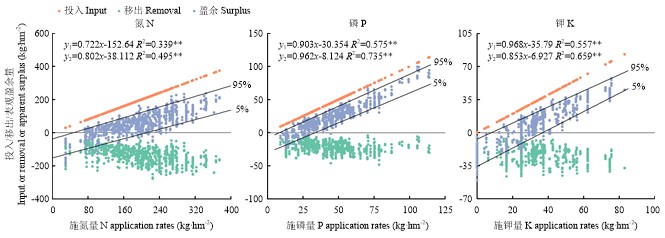
Fig. 1

Relationships between fertilizer application rate and nutrient input, removal, and apparent surplus in northern China Data represent results from farmer fertilization practices and monitored fertilization treatments across all experimental sites (n=963). The 5% and 95% labels indicate linear regression lines between nutrient surplus and fertilizer application rates at the 5th and 95th percentiles, respectively. Equations y1 and y2 correspond to the 5th and 95th percentile regression lines. ** Denotes significance at P<0.01, * at 0.01≤P<0.05, where y represents nutrient surplus and x represents fertilizer rate"

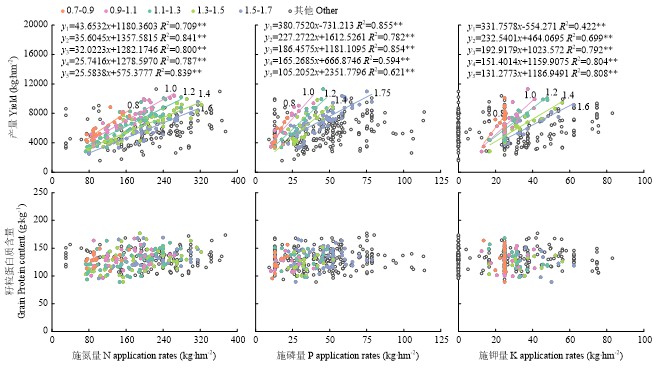
Fig. 2

Relationships between nutrient surplus ratios and wheat yield/protein content in northern China The solid points in dark orange, pink, dark green, yellow-green, and gray-blue colors represent grain yield and protein content at nutrient surplus ratios of 0.7-0.9, 0.9-1.1, 1.1-1.3, 1.3-1.5, and 1.5-1.7 (or 1.5-2.0), respectively, while the black circles denote yield and protein content when the nutrient surplus ratio is below 0.7 or above 1.7 (or above 2.0). The N surplus ratio ranges of 0.7-0.9, 0.9-1.1, 1.1-1.3, 1.3-1.5, and 1.5-1.7 contained 19, 32, 58, 53, and 42 samples, respectively; the P surplus ratio ranges of 0.7-0.9, 0.9-1.1, 1.1-1.3, 1.3-1.5, and 1.5-2.0 contained 12, 14, 18, 24, and 65 samples, respectively; The K surplus ratio ranges of 0.7-0.9, 0.9-1.1, 1.1-1.3, 1.3-1.5, and 1.5-1.7 contained 21, 26, 33, 25, and 17 samples, respectively, respectively. The dashed lines labeled 0.8, 1.0, 1.2, 1.4, and 1.6 (1.75) represent linear regressions between yield and fertilizer rates under nutrient surplus ratios of 0.7-0.9, 0.9-1.1, 1.1-1.3, 1.3-1.5 and 1.5-1.7 (or 1.5-2.0), respectively. y1, y2, y3, y4, and y5 represent linear regression equations between yield and fertilizer application rates under nutrient surplus ratios of 0.7-0.9, 0.9-1.1, 1.1-1.3, 1.3-1.5 and 1.5-1.7 (or 1.5-2.0), respectively. ** Indicates significance at P<0.01, * at P<0.05. Where y denotes yield and x denotes fertilizer application rate"

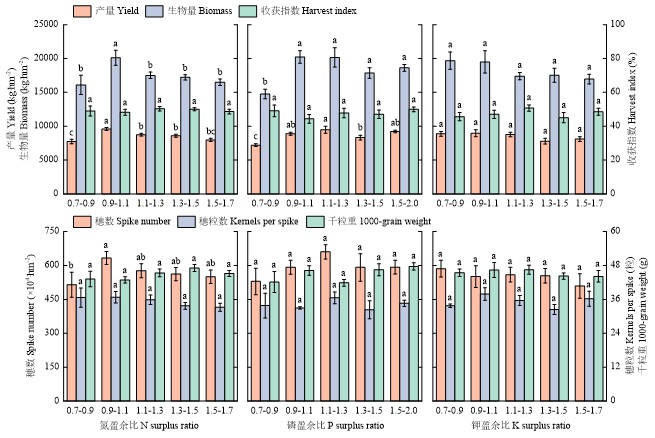
Fig. 3

Yield, aboveground biomass, harvest index, and yield components for high-yielding sites under different nutrient surplus ratios in northern China Labels 0.7-0.9, 0.9-1.1, 1.1-1.3, 1.3-1.5, and 1.50-1.7 (or 1.5-2.0) indicate mean values of agronomic parameters from the top 25% yielding sites within each surplus ratio category. Different lowercase letters denote significant differences (P<0.05) among surplus ratio groups. The N surplus ratio ranges of 0.7-0.9, 0.9-1.1, 1.1-1.3, 1.3-1.5, and 1.5-1.7 contained 5, 8, 15, 13, and 11 samples, respectively; the P surplus ratio ranges of 0.7-0.9, 0.9-1.1, 1.1-1.3, 1.3-1.5, and 1.5-2.0 contained 3, 4, 5, 6, and 16 samples, respectively; the K surplus ratio ranges of 0.7-0.9, 0.9-1.1, 1.1-1.3, 1.3-1.5, and 1.5-1.7 contained 5, 7, 8, 6, and 4 samples, respectively. The same as below"

Table 2

The N, P, and K uptake and use efficiency of high-yielding sites under different nutrient surplus ratios in northern China"

氮盈余比
N surplus
ratio
籽粒氮吸收量
Grain N uptake
(kg·hm-2)
地上部氮吸收量
Aboveground
N uptake (kg·hm-2)
氮收获指数
N harvest index
(%)
氮生理效率
N physiological efficiencies (kg·kg-1)
氮肥偏生产力
N partial factor
Productivity (kg·kg-1)
0.7-0.9 173.3b 217.4a 79.9a 36.0a 54.1a
0.9-1.1 212.3a 262.2a 81.1a 36.8a 43.6b
1.1-1.3 179.8b 217.2a 83.2a 41.8a 41.8b
1.3-1.5 185.0b 224.8a 82.7a 39.4a 33.6c
1.5-1.7 179.1b 223.7a 80.4a 36.2a 28.3d
磷盈余比
P surplus ratio
籽粒磷吸收量
Grain P uptake
(kg·hm-2)
地上部磷吸收量
Aboveground P uptake
(kg·hm-2)
磷收获指数
P harvest index
(%)
磷生理效率
P physiological efficiencies (kg·kg-1)
磷肥偏生产力
P partial factor productivity (kg·kg-1)
0.7-0.9 27.5b 33.3a 82.7b 217.7a 343.8a
0.9-1.1 30.8ab 34.7a 89.1a 261.1a 292.6b
1.1-1.3 35.3a 40.8a 86.6ab 233.1a 217.8c
1.3-1.5 29.0ab 33.4a 87.0ab 259.1a 212.5c
1.5-2.0 33.4ab 37.5a 89.3a 251.2a 160.7d
钾盈余比
K surplus ratio
籽粒钾吸收量
Grain K uptake
(kg·hm-2)
地上部钾吸收量
Aboveground K uptake (kg·hm-2)
钾收获指数
K harvest index
(%)
钾生理效率
K physiological efficiencies (kg·kg-1)
钾肥偏生产力
K partial factor productivity (kg·kg-1)
0.7-0.9 31.7a 219.9a 15.2b 42.2a 356.3a
0.9-1.1 34.6a 182.3ab 19.6ab 50.9a 270.4b
1.1-1.3 33.5a 157.2b 22.3a 59.1a 226.4c
1.3-1.5 30.5a 200.7ab 16.5ab 43.4a 183.7d
1.5-1.7 31.4a 175.4ab 18.8ab 49.3a 164.5d

Fig. 4

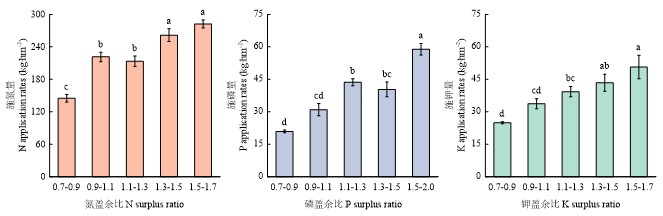
The N, P, and K fertilizer application rate of high-yielding sites under different nutrient surplus ratios in northern China"

Fig. 5

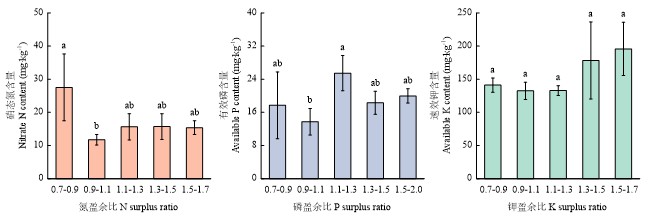
Nitrate N, available P, and available K contents in 0-20 cm soil layer of high-yielding sites under different nutrient surplus ratios in northern China"

[1]
Mottaleb K A, Kruseman G, Frija A, Sonder K, Lopez-Ridaura S. Projecting wheat demand in China and India for 2030 and 2050: Implications for food security[J]. Frontiers in Nutrition, 2022, 9: 1077443.
[2]
黄晓萌, 徐新朋, 何萍, 王秀斌, 杨兰芳, 仇少君, 赵士诚, 周卫. 长江流域冬小麦氮磷钾肥增产效应及其影响因素[J]. 植物营养与肥料学报, 2020, 26(6): 1059-1068.
Huang X M, Xu X P, He P, Wang X B, Yang L F, Qiu S J, Zhao S C, Zhou W. Yield response to NPK fertilization and the main impacts in production of winter wheat in Yangtze River catchments of China[J]. Journal of Plant Nutrition and Fertilizers, 2020, 26(6): 1059-1068. (in Chinese)
[3]
黄倩楠, 党海燕, 黄婷苗, 侯赛宾, 王朝辉. 我国主要麦区农户施肥评价及减肥潜力分析[J]. 中国农业科学, 2020, 53(23): 4816-4834. DOI: 10.3864/j.issn.0578-1752.2020.23.009.
Huang Q N, Dang H Y, Huang T M, Hou S B, Wang Z H. Evaluation of farmers' fertilizer application and fertilizer reduction potentials in major wheat production regions of China[J]. Scientia Agricultura Sinica, 2020, 53(23): 4816-4834. DOI: 10.3864/j.issn.0578-1752.2020.23.009. (in Chinese)
[4]
米东明, 周佐艳, 张晓妍, 范振杰, 孙培杰, 黄潇, 任爱霞, 孙敏, 任永康. 施氮量对黑小麦物质运转与蛋白质含量的影响[J]. 作物杂志, 2025(2): 155-161.
Mi D M, Zhou Z Y, Zhang X Y, Fan Z J, Sun P J, Huang X, Ren A X, Sun M, Ren Y K. Effects of nitrogen application rate on matter transfer and protein content in black wheat[J]. Crops, 2025(2): 155-161. (in Chinese)
[5]
刘朋召, 周栋, 郭星宇, 于琦, 张元红, 李昊昱, 张琦, 王旭敏, 王小利, 王瑞, 李军. 不同降雨年型旱地冬小麦水分利用及产量对施氮量的响应[J]. 中国农业科学, 2021, 54(14): 3065-3076. DOI: 10.3864/j.issn.0578-1752.2021.14.012.
Liu P Z, Zhou D, Guo X Y, Yu Q, Zhang Y H, Li H Y, Zhang Q, Wang X M, Wang X L, Wang R, Li J. Response of water use and yield of dryland winter wheat to nitrogen application under different rainfall patterns[J]. Scientia Agricultura Sinica, 2021, 54(14): 3065-3076. DOI: 10.3864/j.issn.0578-1752.2021.14.012. (in Chinese)
[6]
蒋小忠, 封超年, 郭文善. 施磷量与磷肥基追比对弱筋小麦产量和品质的影响[J]. 耕作与栽培, 2013, 33(5): 7-10.
Jiang X Z, Feng C N, Guo W S. Effects of phosphate fertilizer rate and ratios of base and topdressing phosphate fertilizer on yield and quality of weak gluten wheat[J]. Tillage and Cultivation, 2013, 33(5): 7-10. (in Chinese)
[7]
杨胜利, 马玉霞, 冯荣成, 吕海英. 磷肥用量对强筋和弱筋小麦产量及品质的影响[J]. 河南农业科学, 2004, 33(7): 54-57.
Yang S L, Ma Y X, Feng R C, Lü H Y. Influence of P application rate on yield and quality of strong gluten and weak gluten wheat[J]. Journal of Henan Agricultural Sciences, 2004, 33(7): 54-57. (in Chinese)
[8]
张慎举, 郭振升, 侯乐新. 豫东砂壤土区强筋小麦施钾增产保优效应研究[J]. 中国农学通报, 2013(3): 47-52.
Zhang S J, Guo Z S, Hou L X. The research about high quality effect to potassium yield of strong gluten wheat in sandy loam area of Yudong[J]. Chinese Agricultural Science Bulletin, 2013(3): 47-52. (in Chinese)
[9]
赵会杰, 薛延丰, 徐立新. 氮磷钾肥施用量及其配比对小麦品质的影响[J]. 河南农业大学学报, 2004, 38(4): 374-378, 399.
Zhao H J, Xue Y F, Xu L X. Effects of the level and proportion of nitrogen, phosphorus and potassium on the wheat quality[J]. Journal of Henan Agricultural University, 2004, 38(4): 374-378, 399. (in Chinese)
[10]
杨传文, 邢帆, 朱建春. 中国秸秆资源的时空分布、利用现状与碳减排潜力[J]. 环境科学, 2023, 44(2): 1149-1162.
Yang C W, Xing F, Zhu J C. Temporal and spatial distribution, utilization status, and carbon emission reduction potential of straw resources in China[J]. Environmental Science, 2023, 44(2): 1149-1162. (in Chinese)
[11]
农业农村部科学技术司. 秸秆去哪里,“五化”告诉你[EB/OL]. (2025/10/17) [2026/4/17]. https://kjs.moa.gov.cn/hbny/202510/t20251017_6478240.htm.
Department of Science and Technology, Ministry of Agriculture and Rural Affairs. Where does straw go? The "Five-Utilizations" tell you[EB/OL]. (2025/10/17) [2026/4/17]. https://kjs.moa.gov.cn/hbny/202510/t20251017_6478240.htm. (in Chinese)
[12]
黄倩楠, 王朝辉, 黄婷苗, 侯赛宾, 张翔, 马清霞, 张欣欣. 中国主要麦区农户小麦氮磷钾养分需求与产量的关系[J]. 中国农业科学, 2018, 51(14): 2722-2734. DOI: 10.3864/j.issn.0578-1752.2018.14.010.
Huang Q N, Wang Z H, Huang T M, Hou S B, Zhang X, Ma Q X, Zhang X X. Relationships of N, P and K requirement to wheat grain yield of farmers in major wheat production regions of China[J]. Scientia Agricultura Sinica, 2018, 51(14): 2722-2734. DOI: 10.3864/j.issn.0578-1752.2018.14.010 (in Chinese)
[13]
章孜亮, 刘金山, 王朝辉, 赵护兵, 杨宁, 杨荣, 曹寒冰. 基于土壤氮素平衡的旱地冬小麦监控施氮[J]. 植物营养与肥料学报, 2012(6): 1387-1396.
Zhang Z L, Liu J S, Wang Z H, Zhao H B, Yang N, Yang R, Cao H B. Nitrogen recommendation for dryland winter wheat by monitoring nitrate in 1 m soil and based on nitrogen balance[J]. Journal of Plant Nutrition and Fertilizers, 2012(6): 1387-1396. (in Chinese)
[14]
黄宁, 王朝辉, 王丽, 马清霞, 张悦悦, 张欣欣, 王瑞. 我国主要麦区主栽高产品种产量差异及其与产量构成和氮磷钾吸收利用的关系[J]. 中国农业科学, 2020, 53(1): 81-93. DOI: 10.3864/j.issn.0578-1752.2020.01.008.
Huang N, Wang Z H, Wang L, Ma Q X, Zhang Y Y, Zhang X X, Wang R. Yield variation of winter wheat and its relationship to yield components, NPK uptake and utilization of leading and high yielding wheat cultivars in main wheat production regions of China[J]. Scientia Agricultura Sinica, 2020, 53(1): 81-93. DOI: 10.3864/j.issn.0578-1752.2020.01.008. (in Chinese)
[15]
刁超朋, 王朝辉, 李莎莎, 刘璐, 王森, 黄宁. 旱地高产小麦品种籽粒氮含量差异与氮磷钾吸收利用的关系[J]. 植物营养与肥料学报, 2018, 24(2): 285-295.
Diao C P, Wang Z H, Li S S, Liu L, Wang S, Huang N. Differences in grain nitrogen contents of high-yielding wheat cultivars and relation to NPK uptake and utilization in drylands[J]. Journal of Plant Nutrition and Fertilizers, 2018, 24(2): 285-295. (in Chinese)
[16]
惠晓丽, 马清霞, 王朝辉, 张翔, 罗来超. 基于旱地小麦高产优质的氮肥用量优化[J]. 植物营养与肥料学报, 2020, 26(2): 233-244.
Hui X L, Ma Q X, Wang Z H, Luo L C. Optimization of nitrogen rate based on grain yield and nutrient contents in dryland wheat production[J]. Journal of Plant Nutrition and Fertilizers, 2020, 26(2): 233-244. (in Chinese)
[17]
巨晓棠, 谷保静. 氮素管理的指标[J]. 土壤学报, 2017, 54(2): 281-296.
Ju X T, Gu B J. Indexes of nitrogen management[J]. Acta Pedologica Sinica, 2017, 54(2): 281-296. (in Chinese)
[18]
Wang J J, Qian R, Li J X, Wei F N, Ma Z M, Gao S S, Sun X, Zhang P, Cai T, Zhao X N, Chen X L, Ren X L. Nitrogen reduction enhances crop productivity, decreases soil nitrogen loss and optimize its balance in wheat-maize cropping area of the Loess Plateau, China[J]. European Journal of Agronomy, 2024, 161: 127352.
[19]
Lei S, Raza S, Irshad A, Jiang Y, Elrys A S, Chen Z J, Zhou J B. Long-term legacy impacts of nitrogen fertilization on crop yield, nitrate accumulation, and nitrogen recovery efficiency[J]. European Journal of Agronomy, 2025, 164: 127513.
[20]
Zhang X, Li X H, Luo L C, Ma Q X, Ma Q, Hui X L, Wang S, Liu J S, Wang Z H. Monitoring wheat nitrogen requirement and top soil nitrate for nitrate residue controlling in drylands[J]. Journal of Cleaner Production, 2019, 241: 118372.
[21]
Wu W, Ma B L, Fan J J, Sun M, Yi Y, Guo W S, Voldeng H D. Management of nitrogen fertilization to balance reducing lodging risk and increasing yield and protein content in spring wheat[J]. Field Crops Research, 2019, 241: 107584.
[22]
Mangin A, Brûlé-Babel A, Flaten D, Wiersma J, Lawley Y. Maximizing spring wheat productivity in the eastern Canadian Prairies: I. Yield, yield components, and lodging risk[J]. Agronomy Journal, 2022, 114(3): 1731-1751.
[23]
Lenoir A, Slafer G A, Siah A, Dumont B. Plasticity of wheat yield components in response to N fertilization[J]. European Journal of Agronomy, 2023, 150: 126933.
[24]
Liu Y, Liao Y C, Liu W Z. High nitrogen application rate and planting density reduce wheat grain yield by reducing filling rate of inferior grain in middle spikelets[J]. The Crop Journal, 2021, 9(2): 412-426.
[25]
Malik A H, Kuktaite R, Johansson E. Combined effect of genetic and environmental factors on the accumulation of proteins in the wheat grain and their relationship to bread-making quality[J]. Journal of Cereal Science, 2013, 57(2): 170-174.
[26]
Muqaddasi Q H, Brassac J, Ebmeyer E, Kollers S, Korzun V, Argillier O, Stiewe G, Plieske J, Ganal M W, Röder M S. Prospects of GWAS and predictive breeding for European winter wheat’s grain protein content, grain starch content, and grain hardness[J]. Scientific Reports, 2020, 10: 12541.
[27]
Zhang P P, Ma G, Wang C Y, Lu H F, Li S S, Xie Y X, Ma D Y, Zhu Y J, Guo T C. Effect of irrigation and nitrogen application on grain amino acid composition and protein quality in winter wheat[J]. PLoS ONE, 2017, 12(6): e0178494.
[28]
蒋会利, 温晓霞, 廖允成. 施氮量对冬小麦产量的影响及土壤硝态氮运转特性[J]. 植物营养与肥料学报, 2010, 16(1): 237-241.
Jiang H L, Wen X X, Liao Y C. Effects of nitrogen application on winter wheat yield and translation of soil NO3--N[J]. Journal of Plant Nutrition and Fertilizers, 2010, 16(1): 237-241. (in Chinese)
[29]
McDowell R W, Pletnyakov P, Haygarth P M. Phosphorus applications adjusted to optimal crop yields can help sustain global phosphorus reserves[J]. Nature Food, 2024, 5(4): 332-339.
[30]
黄玉芳, 张辉, 张立花, 张红燕, 张雯雯, 赵亚南, 叶优良. 施磷量对高磷土壤小麦磷素吸收和土壤磷平衡的影响[J]. 麦类作物学报, 2022, 42(2): 211-219.
Huang Y F, Zhang H, Zhang L H, Zhang H Y, Zhang W W, Zhao Y N, Ye Y L. Effects of phosphorus(P) fertilizer rates on wheat P uptake and soil P balance in high-P soil[J]. Journal of Triticeae Crops, 2022, 42(2): 211-219. (in Chinese)
[31]
刘冲, 贾永红, 张金汕, 孙鹏, 罗四维, 王欢, 李鹏, 石书兵. 施磷量对不同播种方式下冬小麦干物质转运及养分吸收利用的影响[J]. 植物营养与肥料学报, 2020, 26(5): 975-986.
Liu C, Jia Y H, Zhang J S, Sun P, Luo S W, Wang H, Li P, Shi S B. Effects phosphorus application rates on dry matter translocation and nutrient uptake and utilization of winter wheat under different seeding patterns[J]. Journal of Plant Nutrition and Fertilizers, 2020, 26(5): 975-986. (in Chinese)
[32]
陈磊, 王盛锋, 刘荣乐, 汪洪. 不同磷供应水平下小麦根系形态及根际过程的变化特征[J]. 植物营养与肥料学报, 2012, 18(2): 324-331.
Chen L, Wang S F, Liu R L, Wang H. Changes of root morphology and rhizosphere processes of wheat under different phosphate supply[J]. Plant Nutrition and Fertilizer Science, 2012, 18(2): 324-331. (in Chinese)
[33]
惠凯善, 冉庆赏, 石玉, 张振, 于振文, 张永丽. 补灌条件下施磷量对小麦不同茎蘖13C同化物分配及其成穗的影响[J]. 应用生态学报, 2024, 35(4): 942-950.
Hui K S, Ran Q S, Shi Y, Zhang Z, Yu Z W, Zhang Y L. Effects of phosphorus application rate on 13C assimilate distribution and ear formation of different tillers in wheat under supplementary irrigation[J]. Chinese Journal of Applied Ecology, 2024, 35(4): 942-950. (in Chinese)
[34]
李巧丽, 刘朋召, 师祖姣, 刘苗, 陈跻, 李慧, 王小利, 王瑞, 李军. 关中平原冬小麦临界磷浓度稀释曲线的构建与磷营养诊断[J]. 植物营养与肥料学报, 2022, 28(11): 2011-2019.
Li Q L, Liu P Z, Shi S J, Liu M, Chen J, Li H, Wang X L, Wang R, Li J. Construction of critical phosphorus concentration dilution curve and phosphorus nutrition diagnosis of winter wheat in Guanzhong plain[J]. Journal of Plant Nutrition and Fertilizers, 2022, 28(11): 2011-2019. (in Chinese)
[35]
吉庆凯, 王栋, 杨文宝, 韩彦茹, 马文奇, 魏静. 长期施磷对玉米-小麦轮作系统作物产量和磷素吸收及土壤磷积累的影响[J]. 应用生态学报, 2021, 32(7): 2469-2476.
Ji Q K, Wang D, Yang W B, Han Y R, Ma W Q, Wei J. Effects of long-term phosphorus application on crop yield, phosphorus absorption, and soil phosphorus accumulation in maize-wheat rotation system[J]. Chinese Journal of Applied Ecology, 2021, 32(7): 2469-2476. (in Chinese)
[36]
冯媛媛, 申艳, 徐明岗, 田应兵, 任凤铃, 段英华. 施磷量与小麦产量的关系及其对土壤、气候因素的响应[J]. 植物营养与肥料学报, 2019, 25(4): 683-691.
Feng Y Y, Shen Y, Xu M G, Tian Y B, Ren F L, Duan Y H. Relationship between phosphorus application amount and grain yield of wheat and its response to soil and climate factors[J]. Journal of Plant Nutrition and Fertilizers, 2019, 25(4): 683-691. (in Chinese)
[37]
Liu L, Yan R, Zhu L, Yang Y, Gao Z Y, Yang W J, Liu J S. Balanced phosphorus fertilization enhances soil bacterial network complexity to maintain multifunctionality and plant production in dryland agricultural systems[J]. Agriculture, Ecosystems & Environment, 2023, 356: 108647.
[38]
娄梦玉, 薛华龙, 郭彬彬, 汪江涛, 昝志曼, 马超, 郭大勇, 焦念元, 付国占. 施磷水平与冬小麦产量和土壤有效磷含量的关系[J]. 植物营养与肥料学报, 2022, 28(9): 1582-1593.
Lou M Y, Xue H L, Guo B B, Wang J T, Zan Z M, Ma C, Guo D Y, Jiao N Y, Fu G Z. Relationship of phosphorus application rate, winter wheat yield and soil available phosphorus content[J]. Journal of Plant Nutrition and Fertilizers, 2022, 28(9): 1582-1593. (in Chinese)
[39]
柳开楼, 都江雪, 马常宝, 曲潇琳, 韩天富, 刘淑军, 黄晶, 李亚贞, 申哲, 张璐, 李冬初, 张会民. 中国主要旱作粮食耕地土壤钾素的时空演变特征[J]. 土壤学报, 2023, 60(3): 673-684.
Liu K L, Du J X, Ma C B, Qu X L, Han T F, Liu S J, Huang J, Li Y Z, Shen Z, Zhang L, Li D C, Zhang H M. Spatio-temporal evolution characteristics of soil potassium in main dry-farming grain arable land of China[J]. Acta Pedologica Sinica, 2023, 60(3): 673-684. (in Chinese)
[40]
谭德水, 金继运, 黄绍文, 刘兆辉, 江丽华. 长期施钾及小麦秸秆还田对北方典型土壤固钾能力的影响[J]. 中国农业科学, 2010, 43(10): 2072-2079. DOI: 10.3864/j.issn.0578-1752.2010.10.013.
Tan D S, Jin J Y, Huang S W, Liu Z H, Jiang L H. Effect of long-term application of K fertilizer and wheat straw to soil on potassium fixation capacity of selected soils from northern China[J]. Scientia Agricultura Sinica, 2010, 43(10): 2072-2079. DOI: 10.3864/j.issn.0578-1752.2010.10.013. (in Chinese)
[41]
Wang X S, Mi X T, Sun L Q, He G, Wang Z H. Straw return cannot prevent soil potassium depletion in wheat fields of drylands[J]. European Journal of Agronomy, 2023, 143: 126728.
[42]
Liu D Y, Jiao Q J, Liu H T, Fan L N, Yu P Y, Jiang G Y, Chen Y L, Agathokleous E, Jie X L, Liu S L, Fahad S, Alotaibi N M, Abou-Elwafa S F, Zhang J J, Li G Z. Wheat roots adapt to potassium deficiency through coordinated antioxidant, hormonal, and metabolic reprogramming: Insight from morpho-physiological, biochemical, and transcriptomic analysis[J]. Plant Stress, 2025, 18: 101109.
[43]
Zhan A, Zou C Q, Ye Y L, Liu Z H, Cui Z L, Chen X P. Estimating on-farm wheat yield response to potassium and potassium uptake requirement in China[J]. Field Crops Research, 2016, 191: 13-19.
[44]
Kaur H, Gill R S, Dheri G S. Response of wheat to potassium and its fractions in Punjab soils[J]. The Indian Journal of Agricultural Sciences, 2021, 91(4): 629-633.
[45]
武际, 郭熙盛, 王允青, 汪建来, 杨晓虎. 不同土壤供钾水平下施钾对弱筋小麦产量和品质的调控效应[J]. 麦类作物学报, 2007, 27(1): 102-106.
Wu J, Guo X S, Wang Y Q, Wang J L, Yang X H. Effects of potassium on grain yield and quality of soft-gluten wheat on soil with different K supplying levels[J]. Journal of Triticeae Crops, 2007, 27(1): 102-106. (in Chinese)
[46]
Limon-Ortega A, Munguia-Lopez J P, Espitia-Rangel E. Foliar K application to rainfed wheat in a soil testing high K as an option to improve K use efficiency, grain yield and yield components[J]. Journal of Plant Nutrition, 2020, 43(8): 1080-1090.
[47]
Zhang Z Y, Liu D B, Wu M Q, Xia Y, Zhang F L, Fan X P. Long-term straw returning improve soil K balance and potassium supplying ability under rice and wheat cultivation[J]. Scientific Reports, 2021, 11: 22260.
[48]
Duncan E G, O’Sullivan C A, Roper M M, Palta J, Whisson K, Peoples M B. Yield and nitrogen use efficiency of wheat increased with root length and biomass due to nitrogen, phosphorus, and potassium interactions[J]. Journal of Plant Nutrition and Soil Science, 2018, 181(3): 364-373.
[49]
Dargie S, Girma T, Chibsa T, Kassa S, Boke S, Abera A, Haileselassie B, Addisie S, Amsalu S, Haileselassie M, Soboka S, Abera W, Weldesemayat S G. Balanced fertilization increases wheat yield response on different soils and agroecological zones in Ethiopia[J]. Experimental Agriculture, 2022, 58: e23.
[50]
Wang Y L, Song H, Irfan M, Lu D J, Chen X Q, Wang H Y, Zhou J M. Enhancing crop productivity and mitigating greenhouse gas emissions through synergistic potassium management in intensive wheat production[J]. Agriculture, Ecosystems & Environment, 2025, 394: 109899.
[1] BAI JingJing, ZHANG YuChen, NI ZiJie, GAO JiaYong, LIU WeiYang, GAI DongSheng, WANG YuHang, HE JiaQing, ZHANG Qiang, SHAO XiWen, WU Ying, GENG YanQiu, GUO LiYing. Effects of Different Irrigation Volumes on Lodging Resistance Characteristics and Yield of Rice in Northeast China [J]. Scientia Agricultura Sinica, 2026, 59(9): 1848-1868.
[2] CAI QiaoHong, ZHOU Tian, SU Ming, HONG ZiQiang, LI FanGuo, LI Tong, WANG Hua, KANG JianHong, WU HongLiang. Effects of Nitrogen Reduction and Potassium Enhancement Fertilization Mode on Photosynthetic Fluorescence Characteristics and Photosynthetic Product Accumulation of Maize in Ningxia Yellow Irrigation Area [J]. Scientia Agricultura Sinica, 2026, 59(9): 1869-1886.
[3] ZHU Pei, ZHAO Yao, BAI Yan, ZHANG JinKui, LI Mei, LONG JinJia, YANG Long, LUO LiYa, XU BenBo, XU JinSong, ZHANG XueKun. Physiological Regulation of Pydiflumetofen on Rapeseed (Brassica napus) and Its Combined Effect with Prochloraz [J]. Scientia Agricultura Sinica, 2026, 59(9): 1903-1915.
[4] WANG XiaoWei, DU FoLi, YAN HongCai, LANG ZhengDong, DANG ZhiJuan, LI BaoChun, WANG JunCheng, MA XiaoLe, WANG HuaJun, ZHANG Hong, YAO LiRong. Evaluation of Drought Resistance of 396 Spring Wheat Varieties at Grain Filling Stage and Maturity Stage [J]. Scientia Agricultura Sinica, 2026, 59(8): 1608-1621.
[5] CHEN XuanYi, GUO XingXing, ZHANG XiangQian, LU ZhanYuan, LIU LingYue, LUO Fang, LI JinLong, ZHANG ChuanLing, ZHANG ZhiQing, CHE ManQing. Impacts of Intercropping Row Patterns on the Heterogeneity of the Light Environment and Photosynthetic Product Production in Maize Canopy [J]. Scientia Agricultura Sinica, 2026, 59(8): 1653-1671.
[6] HOU HuiZhi, YIN JiaDe, MA MingSheng, LIU XiaoWei, LIU YanLan, LEI KangNing. Effects of Tillage and Organic Fertilizer Application on Crop Yield and Water Use in a Potato-Maize Double Cropping System in the Longdong Region [J]. Scientia Agricultura Sinica, 2026, 59(8): 1672-1685.
[7] WANG CaiYu, LIU XiaoLi, LI WenGuang, YANG WenPing, YANG ZhenPing, GAO ZhiQiang. Effects of Different Substitution Rates of Organic Fertilizers on Soil Multifunctionality and Its Microbial Driving Mechanisms [J]. Scientia Agricultura Sinica, 2026, 59(8): 1712-1726.
[8] PENG TingShen, LU JiuYan, WU MeiLin, YAN YuXin, LIU HongZhou, NAN WenBin, QIN XiaoJian, LI Ming, GONG JunYi, LIANG YongShu. QTL Analysis of Yield-Related Traits in Both Huangnuo2# and Changbai7# of Perennial Chinese Rice [J]. Scientia Agricultura Sinica, 2026, 59(7): 1361-1379.
[9] ZHU Qi, JIA ZhenPeng, Tahir SHAH, XU ChenSheng, LI ZhiQi, LÜ HuiShuai, ZHU PengChao, WEI XiaoMin, HUANG DongLin, SUN YanNi, CAO WeiDong, GAO YaJun, WANG ZhaoHui, ZHANG DaBin. Green Manure Crops Combined with Enhanced-Efficiency Products Reduced Greenhouse Gas Emissions and Carbon Footprints in Dryland Wheat Fields [J]. Scientia Agricultura Sinica, 2026, 59(7): 1507-1522.
[10] WANG YuPing, FU Zhi, SUN JiaYing, MU XiaoMeng, LIU HuiLin, GUO JinYun, SONG WenJing, HOU LeiPing, ZHAO HaiLiang. Evaluation of the Mitigating Effect and Application Efficacy of Melatonin Applied at the Seedling Stage on Short-Term Chilling Stress in Tomato Plants [J]. Scientia Agricultura Sinica, 2026, 59(7): 1523-1535.
[11] WANG JiaNuo, CHEN GuiPing, LI Pan, WANG LiPing, NAN YunYou, HE Wei, FAN ZhiLong, HU FaLong, CHAI Qiang, YIN Wen, ZHAO LiaoHao. Photo-Physiological Mechanism at Grain Filling Stage of No-Tillage with Plastic Re-Mulching to Increase Maize Yield in Oasis Irrigation Areas [J]. Scientia Agricultura Sinica, 2026, 59(6): 1189-1202.
[12] ZHOU XinJie, REN Hao, CHEN YingLong, ZHANG JiWang, ZHAO Bin, REN BaiZhao, LIU Peng, WANG HongZhang. Effects of Calcium Peroxide on Root Morphology and Yield Formation of Summer Maize in Waterlogging Farmland [J]. Scientia Agricultura Sinica, 2026, 59(6): 1203-1216.
[13] HE JiHang, ZHANG Qing, LÜ XiangYue, XUE JiQuan, XU ShuTu, LIU JianChao. Evaluation of Nitrogen Efficiency of Different Stay-Green Maize Hybrids [J]. Scientia Agricultura Sinica, 2026, 59(6): 1217-1230.
[14] LI YongJuan, ZHANG YueTong, WANG YiBo, ZHAO ChangJiang, SONG Jie, CHEN XueLi, YAO Qin. Effects of Biochar Application on the Abundance and Community Composition of Nitrogen-Fixing Microbial nifH Gene in Soybean Rotation and Continuous Cropping Systems [J]. Scientia Agricultura Sinica, 2026, 59(6): 1272-1285.
[15] LI WenHu, LI HaiFeng, DU YuPeng, DING YuLan, LUO YiNuo, LI YuKe, SHE WenTing, ZHANG Feng, TENG Yu, ZHANG SiQi, HUANG Cui, LI XiaoHan, LIU JinShan, WANG ZhaoHui. Regional Differences in Wheat Zinc Uptake and Translocation Responses to Soil Zinc Fertilization [J]. Scientia Agricultura Sinica, 2026, 59(5): 1034-1047.
Viewed
Full text


Abstract

Cited

  Shared   
  Discussed   
No Suggested Reading articles found!