Scientia Agricultura Sinica ›› 2026, Vol. 59 ›› Issue (21): 4904-4923.doi: 10.3864/j.issn.0578-1752.2026.21.014

• HORTICULTURE • Previous Articles     Next Articles

Comprehensive Stage-Specific Evaluation of Salt-Alkali Tolerance and Tetraploidization Effects in Diploid and Tetraploid Non-Heading Chinese Cabbage

TANG WeiHua1(), ZHANG ZhiLin2, YAN ZhiMing1, LIU TongKun2, HOU XiLin2()   

  1. 1 School of Agronomy and Horticulture, Jiangsu Vocational College of Agriculture and Forestry, Zhenjiang 212400, Jiangsu
    2 College of Horticulture, Nanjing Agricultural University, Nanjing 210095
  • Received:2026-06-05 Accepted:2026-06-29 Online:2026-11-01 Published:2026-11-06
  • Contact: HOU XiLin

Abstract:

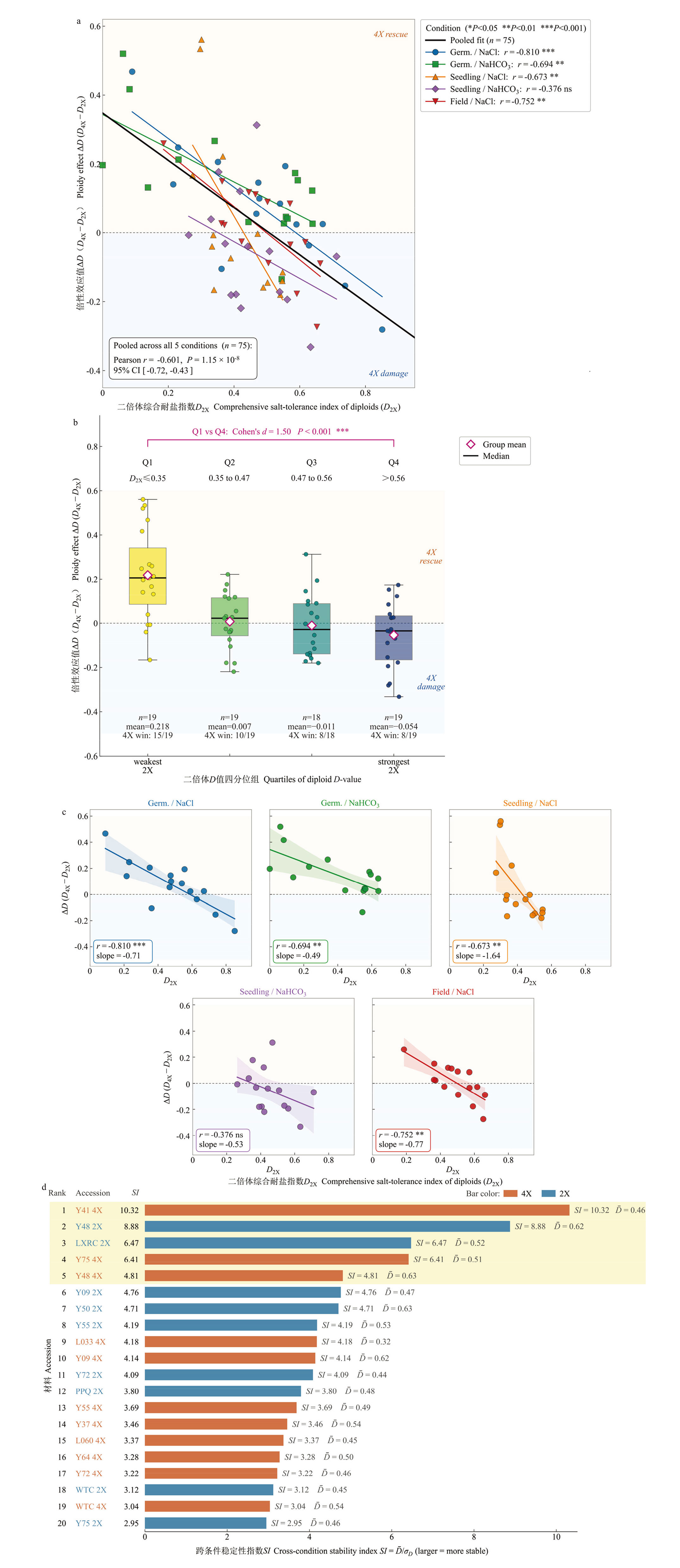
【Objective】This study aimed to clarify the differences in salt-alkali tolerance between diploid and tetraploid non-heading Chinese cabbage with the same genetic background across different salt types and developmental stages, to determine the effects of tetraploidization and its dependence on genetic background, and to identify elite materials combining stress tolerance, yield performance, and breeding potential, thereby providing a basis for germplasm evaluation and ploidy improvement in non-heading Chinese cabbage. 【Method】Fifteen pairs of diploid and tetraploid (2X/4X) non-heading Chinese cabbage with corresponding genetic backgrounds were used as experimental materials. NaCl and NaHCO3 stresses were applied at the germination and seedling stages, respectively, and NaCl drip-irrigation stress was imposed throughout the whole growth period under field conditions. Concentration gradients of NaCl and NaHCO3 were established at the germination stage; 450 mmol·L-1 NaCl and 80 mmol·L-1 NaHCO3 were applied at the seedling stage; and 200 mmol·L-1 NaCl was supplied by drip-irrigation in the field, with soil EC1:5 monitored to characterize salinity intensity. Germination, morphological, physiological, photosynthetic, and yield-related traits were measured. Salt-tolerance coefficients (STCs) were calculated, and a comprehensive salt-tolerance index (D-value) was obtained using principal component analysis combined with the membership function method. The MGIDI index, Fernandez four-quadrant method, paired t-tests, correlation analysis, and regression analysis were further used to evaluate material tolerance, yield performance, and ploidy effects. 【Result】Salt-alkali tolerance in non-heading Chinese cabbage showed clear salt-type differences and developmental-stage specificity. At the germination stage, NaHCO3 stress caused stronger overall inhibition than NaCl stress. Treatment with 250 mmol·L-1 NaCl effectively enlarged differences among materials; under NaHCO3 stress, 40 mmol·L-1 was sufficient to reveal material differentiation, whereas 60 mmol·L-1 produced greater overall dispersion and a wider D-value distribution, making it more suitable for comprehensive evaluation at the germination stage. At the seedling stage, responses to NaCl and NaHCO3 were not fully consistent, and some materials with advantages at the germination stage showed reduced tolerance at the seedling stage, indicating that germination-stage results can not directly substitute for evaluations at the seedling stage or throughout the whole growth period under field conditions. In the field evaluation, D-value rankings were largely consistent with MGIDI rankings (Spearman ρ=-0.775, P=4.87×10⁻⁷), demonstrating good robustness of the multi-trait D-value evaluation. However, Fernandez yield correction showed that most materials with high D-values did not fall into the high-yield and stress-tolerant Group A, suggesting that high comprehensive tolerance does not necessarily indicate high yield under salt stress. The ploidy effect was strongly condition-dependent. Only under NaHCO3 stress at the germination stage did 4X materials show significantly higher D values than 2X materials (ΔD=0.149±0.164, P=0.004), whereas no significant difference between 4X and 2X was observed under the other four conditions. Pooled analysis across the five conditions showed a significant negative correlation between ΔD and diploid tolerance D2X (r=-0.601, P=1.15×10⁻⁸), suggesting that the gain from tetraploidization tended to occur in genetic backgrounds with weaker diploid tolerance. After field yield correction, LXRC 2X, PPQ 4X, and L060 2X combined favorable comprehensive salt tolerance with good potential yield and stress yield. 【Conclusion】Salt-alkali tolerance in non-heading Chinese cabbage is jointly regulated by salt type, developmental stage, and genetic background, and tetraploidization does not consistently improve tolerance. A stepwise evaluation strategy integrating preliminary screening at the germination stage, rescreening at the seedling stage, and validation throughout the whole growth period under field conditions, together with yield correction, can improve both screening efficiency and the accuracy of breeding-oriented selection.

Key words: non-heading Chinese cabbage (Brassica rapa ssp. chinensis), salt stress, alkali stress, tetraploidization, comprehensive evaluation, yield correction, germplasm screening

Fig. 1

Effects of NaCl and NaHCO3 stress on seed germination parameters of tetraploid (4X) and diploid (2X) non-heading Chinese cabbage"

Table 1

Principal component analysis of the STCs of seven germination indices under 250 mmol·L-1 NaCl treatment"

指标Trait PC1 PC2 PC3 h2
发芽率Germination rate (GR) 0.418 -0.327 -0.149 0.960
发芽势Germination energy (GE) 0.418 -0.319 -0.165 0.958
发芽指数Germination index (GI) 0.393 -0.349 -0.278 0.924
活力指数Vigor index (VI) 0.364 0.379 -0.370 0.893
胚根长Radicle length (RL) 0.280 0.712 -0.233 0.933
子叶长Cotyledon length (LL) 0.380 0.126 0.569 0.971
子叶宽Cotyledon width (LW) 0.376 0.059 0.599 0.973
特征值Eigenvalue 4.769 1.017 0.827 —
贡献率Variance contribution (%) 68.13 14.53 11.81 —
累计贡献率Cumulative contribution (%) 68.13 82.66 94.47 —

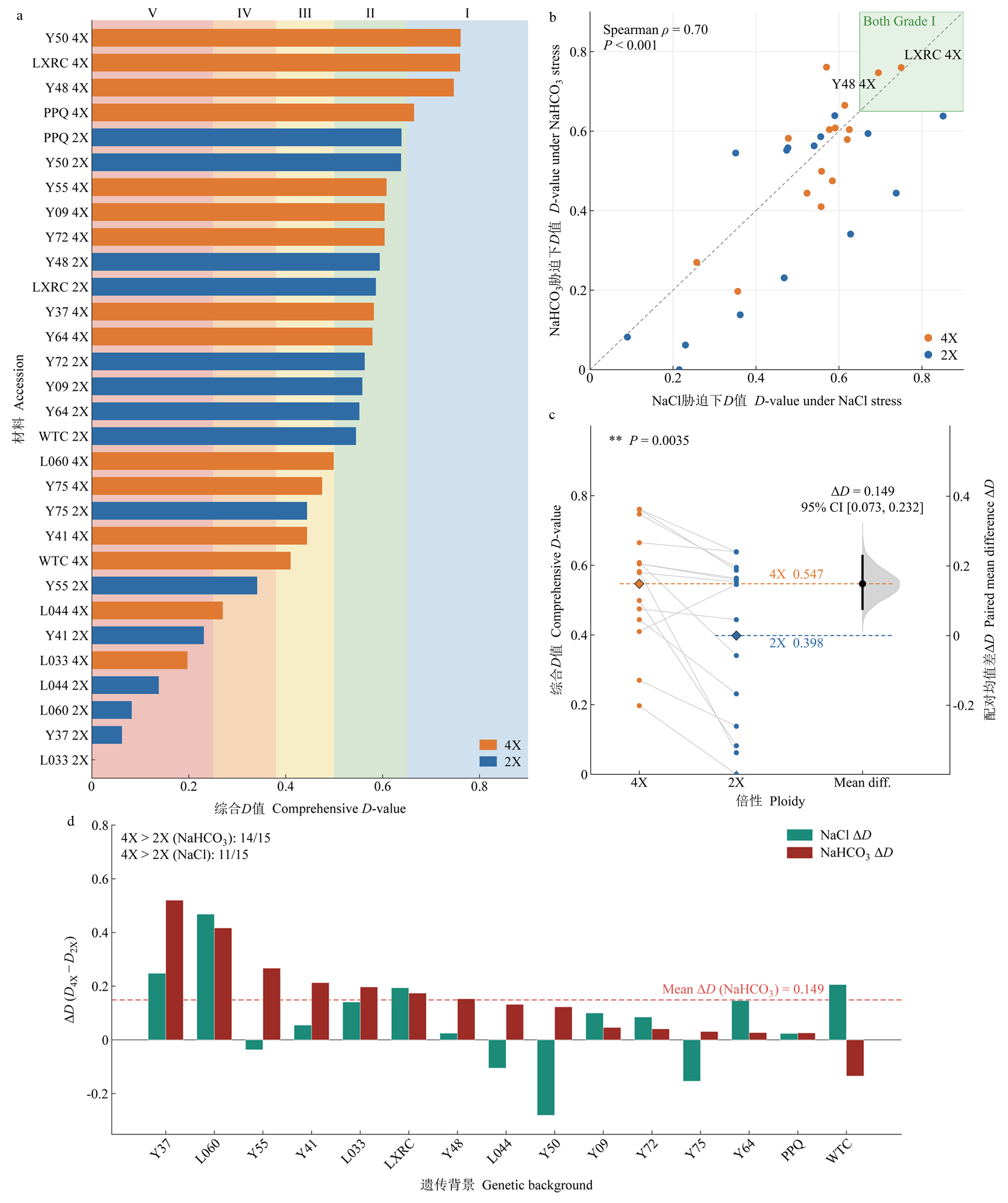
Fig. 2

Comprehensive evaluation of salt-alkali tolerance at the germination stage"

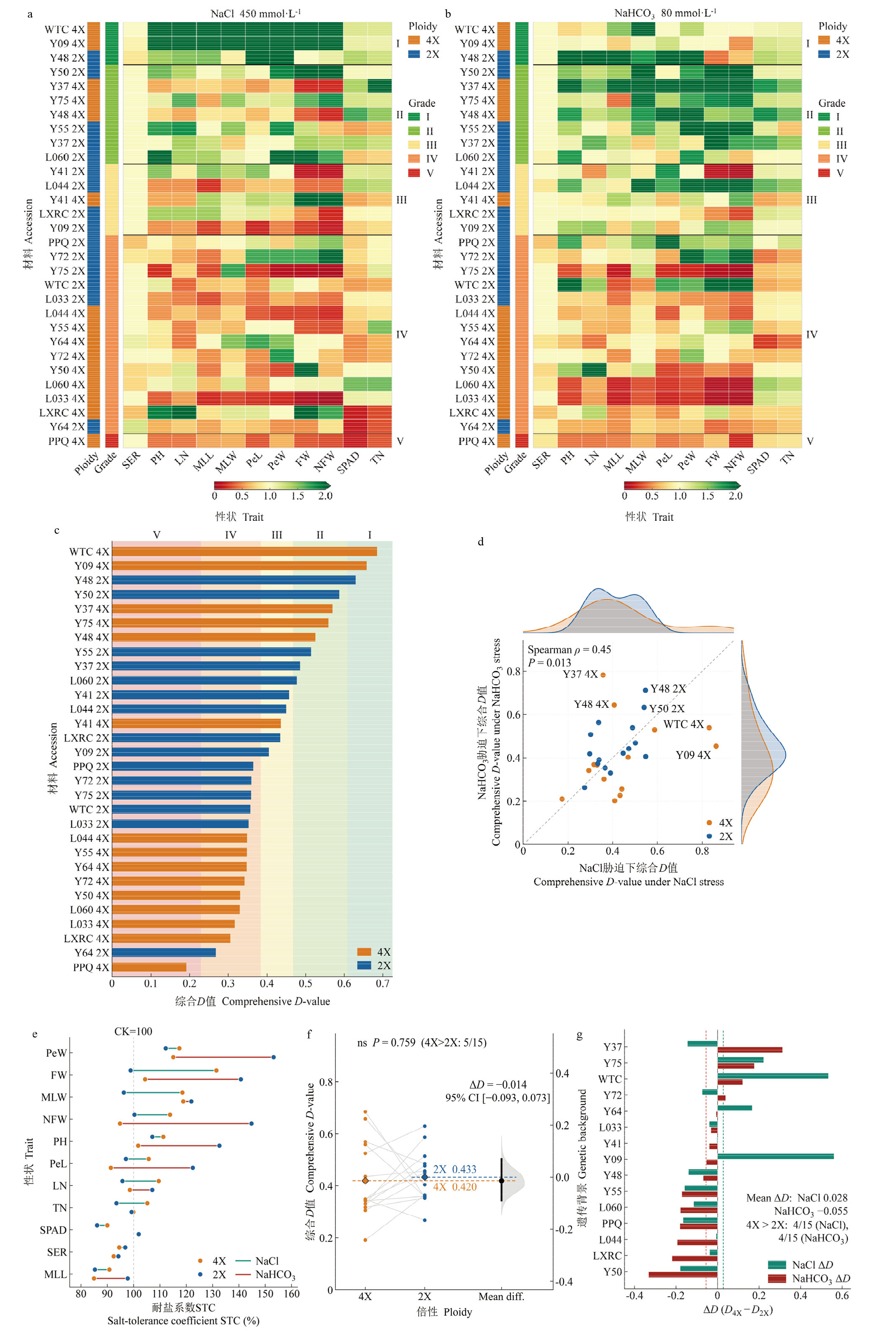
Fig. 3

Comprehensive evaluation of salt-alkali tolerance at the seedling stage"

Table 2

Principal component analysis of 11 STCs at the seedling stage under 450 mmol·L-1 NaCl treatment"

指标Trait PC1 PC2 PC3 h2
成苗率Seedling establishment rate (SER) -0.049 -0.147 0.938 0.972
株高Plant height (PH) 0.366 -0.068 -0.073 0.902
叶片数Leaf number (LN) 0.332 -0.005 -0.243 0.793
最大叶长Maximum leaf length (MLL) 0.341 -0.002 0.081 0.780
最大叶宽Maximum leaf width (MLW) 0.364 -0.054 0.071 0.891
叶柄长Petiole length (PeL) 0.352 0.005 0.050 0.826
叶柄宽Petiole width (PeW) 0.346 -0.036 0.112 0.810
单株鲜重Fresh weight per plant (FW) 0.351 -0.047 0.018 0.823
净菜重Net fresh weight per plant (NFW) 0.360 -0.039 0.073 0.868
叶绿素含量Chlorophyll content (SPAD) 0.085 0.688 0.076 0.908
全氮含量Total nitrogen content (TN) 0.031 0.702 0.130 0.913
特征值Eigenvalue 6.640 1.803 1.042 —
贡献率Variance contribution (%) 60.36 16.39 9.47 —
累计贡献率Cumulative contribution (%) 60.36 76.75 86.23 —

Table 3

Principal component analysis of 11 STCs at the seedling stage under 80 mmol·L-1 NaHCO3 treatment"

指标Trait PC1 PC2 PC3 h2
成苗率Seedling establishment rate (SER) 0.095 -0.025 0.761 0.691
株高Plant height (PH) 0.369 0.141 -0.194 0.788
叶片数Leaf number (LN) 0.254 -0.043 -0.422 0.537
最大叶长Maximum leaf length (MLL) 0.342 -0.197 -0.180 0.720
最大叶宽Maximum leaf width (MLW) 0.337 -0.076 -0.016 0.601
叶柄长Petiole length (PeL) 0.385 -0.094 -0.051 0.787
叶柄宽Petiole width (PeW) 0.364 0.159 -0.052 0.742
单株鲜重Fresh weight per plant (FW) 0.248 0.521 0.185 0.916
净菜重Net fresh weight per plant (NFW) 0.260 0.512 0.162 0.922
叶绿素含量Chlorophyll content (SPAD) 0.289 -0.370 0.280 0.803
全氮含量Total nitrogen content (TN) 0.257 -0.478 0.169 0.846
特征值Eigenvalue 5.170 2.072 1.111 —
贡献率Variance contribution (%) 47.00 18.84 10.10 —
累计贡献率Cumulative contribution (%) 47.00 65.84 75.94 —

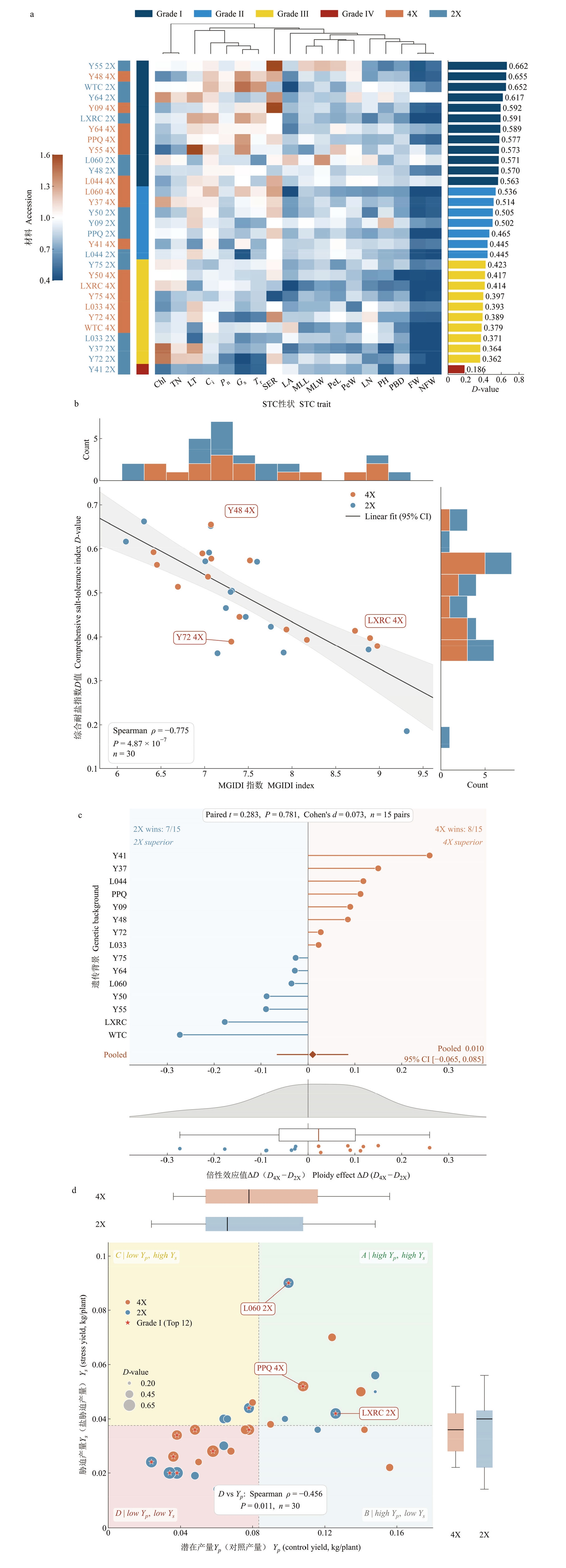
Fig. 4

Comprehensive evaluation of salt tolerance across the whole growth period under field conditions"

Table 4

Comprehensive D-values and Fernandez yield categories of 12 Grade-I accessions"

材料
Accession
排名
Rank
D值
D-value
潜在产量
Yp (kg/plant)
胁迫产量
Ys (kg/plant)
Fernandez分组
Fernandez group
Y55 2X 1 0.662 0.038 0.020 D
Y48 4X 2 0.655 0.058 0.028 D
WTC 2X 3 0.652 0.034 0.020 D
Y64 2X 4 0.617 0.024 0.024 D
Y09 4X 5 0.592 0.078 0.036 D
LXRC 2X 6 0.591 0.126 0.042 A*
Y64 4X 7 0.589 0.036 0.026 D
PPQ 4X 8 0.577 0.108 0.052 A*
Y55 4X 9 0.573 0.048 0.036 D
L060 2X 10 0.571 0.100 0.090 A*
Y48 2X 11 0.570 0.078 0.044 C
L044 4X 12 0.563 0.038 0.034 D

Table 5

Paired t-test and regression of ΔD on D2X for 15 paired backgrounds across 5 conditions"

条件Condition Δ$\text{\bar{D}}$ t P Cohen’s d 4X wins/n r (D2X, ΔD)
萌发期NaCl Germination/NaCl 0.074 1.596 0.133 0.412 11/15 -0.810***
萌发期NaHCO3 Germination/NaHCO3 0.149 3.506 0.004** 0.905 14/15 -0.694**
苗期NaCl Seedling/NaCl 0.028 0.447 0.662 0.115 4/15 -0.673**
苗期NaHCO3 Seedling/NaHCO3 -0.055 -1.266 0.226 -0.327 4/15 -0.376ns
大田期NaCl Field/NaCl 0.010 0.283 0.781 0.073 8/15 -0.752**

Fig. 5

Stage-specificity of the tetraploidization effect on salt tolerance and its dependence on diploid tolerance"

[1]
杨劲松, 姚荣江, 王相平, 谢文萍, 张新, 朱伟, 张璐, 孙瑞娟. 中国盐渍土研究: 历程、现状与展望[J]. 土壤学报, 2022, 59(1): 10-27.
Yang J S, Yao R J, Wang X P, Xie W P, Zhang X, Zhu W, Zhang L, Sun R J. Research on salt-affected soils in China: History, status quo and prospect[J]. Acta Pedologica Sinica, 2022, 59(1): 10-27. (in Chinese)
[2]
陈佩, 王金涛, 董心亮, 田柳, 张雪佳, 刘小京, 孙宏勇. 蔬菜咸水灌溉研究进展[J]. 中国生态农业学报, 2022, 30(5): 799-808.
Chen P, Wang J T, Dong X L, Tian L, Zhang X J, Liu X J, Sun H Y. Research progress on saline water irrigation of vegetables[J]. Chinese Journal of Eco-Agriculture, 2022, 30(5): 799-808. (in Chinese)
[3]
侯喜林, 李英, 黄菲艺. 不结球白菜(Brassica campestris ssp. chinensis)主要性状及育种技术的分子生物学研究新进展[J]. 园艺学报, 2020, 47(9): 1663-1677.
Hou X L, Li Y, Huang F Y. New advances in molecular biology of main characters and breeding techniques of non-heading Chinese cabbage (Brassica campestris ssp. chinensis)[J]. Acta Horticulturae Sinica, 2020, 47(9): 1663-1677. (in Chinese)
[4]
侯喜林, 李英, 刘同坤. 不结球白菜遗传育种与分子生物学研究进展[J]. 南京农业大学学报, 2022, 45(5): 864-873.
Hou X L, Li Y, Liu T K. Advance in genetic breeding and molecular biology of non-heading Chinese cabbage[J]. Journal of Nanjing Agricultural University, 2022, 45(5): 864-873. (in Chinese)
[5]
徐芬芬, 俞晓凤, 韩金多. 不结球白菜耐盐品种筛选[J]. 河南农业科学, 2016, 45(11): 87-91.
Xu F F, Yu X F, Han J D. Screening of non-heading Chinese cabbage cultivars with salinity tolerance[J]. Journal of Henan Agricultural Sciences, 2016, 45(11): 87-91. (in Chinese)
[6]
Tang J, Wang F, Wang Z, Huang Z, Xiong A, Hou X. Characterization and co-expression analysis of WRKY orthologs involved in responses to multiple abiotic stresses in pak-choi (Brassica campestris ssp. chinensis)[J]. BMC Plant Biology, 2013, 13: 188.

doi: 10.1186/1471-2229-13-188 pmid: 24267479
[7]
Wang F, Hou X, Tang J, Wang Z, Wang S, Jiang F, Li Y. A novel cold-inducible gene from pak-choi (Brassica campestris ssp. chinensis), BcWRKY46, enhances the cold, salt and dehydration stress tolerance in transgenic tobacco[J]. Molecular Biology Reports, 2012, 39(4): 4553-4564.

doi: 10.1007/s11033-011-1245-9
[8]
Wang X H, Zhang S, Hu D, Zhao X J, Li Y, Liu T K, Wang J J, Hou X L, Li Y. BcPMI2, isolated from non-heading Chinese cabbage encoding phosphomannose isomerase, improves stress tolerance in transgenic tobacco[J]. Molecular Biology Reports, 2014, 41(4): 2207-2216.

doi: 10.1007/s11033-014-3072-2 pmid: 24430300
[9]
Yuan S L, Hu D, Wang Y, Shao C, Liu T K, Zhang C W, Cheng F, Hou X L, Li Y. BcWRKY1 confers salt sensitivity via inhibiting reactive oxygen species scavenging[J]. Plant Molecular Biology, 2022, 109(6): 741-759.

doi: 10.1007/s11103-022-01272-x pmid: 35553313
[10]
Wu H, Song X, Lyu S, Ren Y, Liu T, Hou X, Li Y, Zhang C. Integrated analysis of Hi-C and RNA-seq reveals the molecular mechanism of autopolyploid growth advantages in pak choi (Brassica rapa ssp. chinensis)[J]. Frontiers in Plant Science, 2022, 13: 905202.

doi: 10.3389/fpls.2022.905202
[11]
Pavlović I, Mlinarić S, Tarkowská D, Okleskova J, Novák O, Lepeduš H, Bok V V, Brkanac S R, Strnad M, Salopek-Sondi B. Early Brassica crops responses to salinity stress: A comparative analysis between Chinese cabbage, white cabbage, and kale[J]. Frontiers in Plant Science, 2019, 10: 450.

doi: 10.3389/fpls.2019.00450 pmid: 31031786
[12]
Qiu N, Liu Q, Li J, Zhang Y, Wang F, Gao J. Physiological and transcriptomic responses of Chinese cabbage (Brassica rapa L. ssp. pekinensis) to salt stress[J]. International Journal of Molecular Sciences, 2017, 18(9): 1953.

doi: 10.3390/ijms18091953
[13]
Li N, Zhang Z H, Gao S, Lv Y, Chen Z, Cao B, Xu K. Different responses of two Chinese cabbage (Brassica rapa L. ssp. pekinensis) cultivars in photosynthetic characteristics and chloroplast ultrastructure to salt and alkali stress[J]. Planta, 2021, 254(5): 102.

doi: 10.1007/s00425-021-03754-6
[14]
Du X, Yu R, Shi C, Wang Y, Meng R, Shi W, Jin M, Wei X, Sun T. Comparative transcriptomics reveals osmotic and ionic stress key genes contributing to the difference in the salinity tolerance of two pak choi cultivars[J]. Environmental and Experimental Botany, 2021, 191: 104621.

doi: 10.1016/j.envexpbot.2021.104621
[15]
Liu Q, Kang J, Du L, Liu Z, Liang H, Wang K, He H, Zhang X, Wang Q, Hong Y, Cheng Q, Liu X, Ma W, Zhao J. Single-cell multiome reveals root hair-specific responses to salt stress[J]. New Phytologist, 2025, 246(6): 2634-2651.

doi: 10.1111/nph.v246.6
[16]
Park H K, Kim S H, Lee J H, Kim K Y, Sim J E, Jang D C, Park S M. Physiological responses of pak choi (Brassica rapa subsp. chinensis) genotypes to salt tolerance[J]. Horticulturae, 2023, 9(11): 1161.

doi: 10.3390/horticulturae9111161
[17]
Ashraf M, Nazir N, McNeilly T. Comparative salt tolerance of amphidiploid and diploid Brassica species[J]. Plant Science, 2001, 160(4): 683-689.

pmid: 11448743
[18]
Zhang G, Zhou J, Peng Y, Tan Z, Li L, Yu L, Jin C, Fang S, Lu S, Guo L, Yao X. Genome-wide association studies of salt tolerance at seed germination and seedling stages in Brassica napus [J]. Frontiers in Plant Science, 2022, 12: 772708.

doi: 10.3389/fpls.2021.772708
[19]
Zhang G, Peng Y, Zhou J, Tan Z, Jin C, Fang S, Zhong S, Jin C, Wang R, Wen X, Li B, Lu S, Zhou G, Fu T, Guo L, Yao X. Genome-wide association studies of salt-alkali tolerance at seedling and mature stages in Brassica napus [J]. Frontiers in Plant Science, 2022, 13: 857149.

doi: 10.3389/fpls.2022.857149
[20]
Hu Y, Schmidhalter U. Opportunity and challenges of phenotyping plant salt tolerance[J]. Trends in Plant Science, 2023, 28(5): 552-566.

doi: 10.1016/j.tplants.2022.12.010 pmid: 36628656
[21]
Zhang J, Ai Y, Liang H, Zhang D, Liu Y, Li L, Qi S, Ma H, Zhao S, Xue J, Zhao Y, Fan X, Ma W, Zhao J. A salt-tolerance evaluation system for Chinese cabbage using multispectral image data fusion and fine-tuned, pruned convolutional-LSTM-ResNet networks[J]. Computers and Electronics in Agriculture, 2025, 231: 110005.

doi: 10.1016/j.compag.2025.110005
[22]
汤伟华, 刘叶琼, 张子楠, 王金鸽, 刘同坤. 高产优质同源四倍体不结球白菜新材料的创制与评价[J]. 南京农业大学学报, 2025, 48(2): 312-320.
Tang W H, Liu Y Q, Zhang Z N, Wang J G, Liu T K. Creation and evaluation of a new material of high yield and quality autotetraploid non-heading Chinese cabbage[J]. Journal of Nanjing Agricultural University, 2025, 48(2): 312-320. (in Chinese)
[23]
Meng H B, Jiang S S, Hua S J, Lin X Y, Li Y L, Guo W L, Jiang L X. Comparison between a tetraploid turnip and its diploid progenitor (Brassica rapa L.): The adaptation to salinity stress[J]. Agricultural Sciences in China, 2011, 10(3): 363-375.

doi: 10.1016/S1671-2927(11)60015-1
[24]
Maguire J D. Speed of germination—Aid in selection and evaluation for seedling emergence and vigor[J]. Crop Science, 1962, 2(2): 176-177.

doi: 10.2135/cropsci1962.0011183X000200020033x
[25]
Ren Y, Wang W, He J, Zhang L, Wei Y, Yang M. Nitric oxide alleviates salt stress in seed germination and early seedling growth of pakchoi (Brassica chinensis L.) by enhancing physiological and biochemical parameters[J]. Ecotoxicology and Environmental Safety, 2020, 187: 109785.

doi: 10.1016/j.ecoenv.2019.109785
[26]
农业农村部. 植株全氮含量测定自动定氮仪法: NY/T 2419—2013[S]. (2013-09-10) [2026-06-05].
Ministry of Agriculture and Rural Affairs. Determination of total nitrogen in plant: Automatic Kjeldahl apparatus method: NY/T 2419—2013[S]. (2013-09-10) [2026-06-05]. (in Chinese)
[27]
IRRI. Standard Evaluation System for Rice[M]. 5th ed. Manila: International Rice Research Institute, 2013.
[28]
Wu H, Guo J, Wang C, Li K, Zhang X, Yang Z, Li M, Wang B. An effective screening method and a reliable screening trait for salt tolerance of Brassica napus at the germination stage[J]. Frontiers in Plant Science, 2019, 10: 530.

doi: 10.3389/fpls.2019.00530
[29]
Li W, Zhang H, Zeng Y, Xiang L, Lei Z, Huang Q, Li T, Shen F, Cheng Q. A salt tolerance evaluation method for sunflower (Helianthus annuus L.) at the seed germination stage[J]. Scientific Reports, 2020, 10: 10626.

doi: 10.1038/s41598-020-67210-3
[30]
Chen X, Min D, Yasir T A, Hu Y G. Evaluation of 14 morphological, yield-related and physiological traits as indicators of drought tolerance in Chinese winter bread wheat revealed by analysis of the membership function value of drought tolerance (MFVD)[J]. Field Crops Research, 2012, 137: 195-201.

doi: 10.1016/j.fcr.2012.09.008
[31]
Bakirov A, Zhang Y, Zhang Q, Seitahmetovna S A, Yu X, Shi Y, Xu Y, Wang K, Qin M, Xu A, Huang Z. Screening of salt tolerance traits and the salt tolerance evaluation method in Brassica napus at the seed germination stage[J]. Italian Journal of Agronomy, 2022, 17: 2011.

doi: 10.4081/ija.2022.2011
[32]
Aggarwal G, Edhigalla P, Walia P, Jindal S, Sandal S S. A method for screening salt stress tolerance in Indian mustard (Brassica juncea) (L.) Czern & Coss at seedling stage[J]. Scientific Reports, 2024, 14: 12705.

doi: 10.1038/s41598-024-63693-6 pmid: 38831025
[33]
Zhang R, Hussain S, Wang Y, Liu Y, Li Q, Chen Y, Wei H, Gao P, Dai Q. Comprehensive evaluation of salt tolerance in rice (Oryza sativa L.) germplasm at the germination stage[J]. Agronomy, 2021, 11(8): 1569.

doi: 10.3390/agronomy11081569
[34]
Ward J H. Hierarchical grouping to optimize an objective function[J]. Journal of the American Statistical Association, 1963, 58(301): 236-244.

doi: 10.1080/01621459.1963.10500845
[35]
Olivoto T, Nardino M. MGIDI: Toward an effective multivariate selection in biological experiments[J]. Bioinformatics, 2021, 37(10): 1383-1389.

doi: 10.1093/bioinformatics/btaa981 pmid: 33226063
[36]
Olivoto T, Diel M I, Schmidt D, Lúcio A D. MGIDI: A powerful tool to analyze plant multivariate data[J]. Plant Methods, 2022, 18: 121.

doi: 10.1186/s13007-022-00952-5 pmid: 36371210
[37]
Olivoto T, Lúcio A D. Metan: An R package for multi-environment trial analysis[J]. Methods in Ecology and Evolution, 2020, 11(6): 783-789.

doi: 10.1111/2041-210X.13384
[38]
Fernandez G C J. Effective selection criteria for assessing plant stress tolerance[C]//Kuo C G. Adaptation of Food Crops to Temperature and Water Stress:Proceedings of the International Symposium. Taiwan, China: Asian Vegetable Research and Development Center (AVRDC), 1992: 257-270.
[39]
Fischer R A, Maurer R. Drought resistance in spring wheat cultivars. I. Grain yield responses[J]. Australian Journal of Agricultural Research, 1978, 29(5): 897-912.

doi: 10.1071/AR9780897
[40]
Bouslama M, Schapaugh W T. Stress tolerance in soybeans. I. Evaluation of three screening techniques for heat and drought tolerance[J]. Crop Science, 1984, 24(5): 933-937.

doi: 10.2135/cropsci1984.0011183X002400050026x
[41]
Friedman M. The use of ranks to avoid the assumption of normality implicit in the analysis of variance[J]. Journal of the American Statistical Association, 1937, 32(200): 675-701.

doi: 10.1080/01621459.1937.10503522
[42]
Efron B, Tibshirani R J. An Introduction to the Bootstrap[M]. New York: Chapman & Hall, 1993.
[43]
Finlay K W, Wilkinson G N. The analysis of adaptation in a plant-breeding programme[J]. Australian Journal of Agricultural Research, 1963, 14(6): 742-754.

doi: 10.1071/AR9630742
[44]
Benjamini Y, Hochberg Y. Controlling the false discovery rate: A practical and powerful approach to multiple testing[J]. Journal of the Royal Statistical Society, Series B (Methodological), 1995, 57(1): 289-300.
[45]
Li J, Yang Y Q. How do plants maintain pH and ion homeostasis under saline-alkali stress?[J]. Frontiers in Plant Science, 2023, 14: 1217193.

doi: 10.3389/fpls.2023.1217193
[46]
Liang H, Shi Q L, Li X, Gao P P, Feng D L, Zhang X M, Lu Y, Yan J S, Shen S X, Zhao J J, Ma W. Synergistic effects of carbon cycle metabolism and photosynthesis in Chinese cabbage under salt stress[J]. Horticultural Plant Journal, 2024, 10(2): 461-472.

doi: 10.1016/j.hpj.2022.09.003
[47]
Wang H Y, Li Z B, Ren H B, Zhang C W, Xiao D, Li Y, Hou X L, Liu T K. Regulatory interaction of BcWRKY33A and BcHSFA4A promotes salt tolerance in non-heading Chinese cabbage [Brassica campestris (syn. Brassica rapa) ssp. chinensis][J]. Horticulture Research, 2022, 9: uhac113.
[48]
van de Peer Y, Ashman T L, Soltis P S, Soltis D E. Polyploidy: An evolutionary and ecological force in stressful times[J]. The Plant Cell, 2021, 33(1): 11-26.

doi: 10.1093/plcell/koaa015 pmid: 33751096
[49]
Tossi V E, Martínez Tosar L J, Laino L E, Iannicelli J, Regalado J J, Escandón A S, Baroli I, Causin H F, Pitta-Álvarez S I. Impact of polyploidy on plant tolerance to abiotic and biotic stresses[J]. Frontiers in Plant Science, 2022, 13: 869423.

doi: 10.3389/fpls.2022.869423
[50]
Wang L F, Cao S, Wang P T, Lu K N, Song Q X, Zhao F J, Chen Z J. DNA hypomethylation in tetraploid rice potentiates stress-responsive gene expression for salt tolerance[J]. Proceedings of the National Academy of Sciences of the United States of America, 2021, 118(13): e2023981118.
[51]
Song X, Zhang M, Wang T T, Duan Y Y, Ren J, Gao H, Fan Y J, Xia Q M, Cao H X, Xie K D, Wu X M, Zhang F, Zhang S Q, Huang Y, Boualem A, Bendahmane A, Tan F Q, Guo W W. Polyploidization leads to salt stress resilience via ethylene signaling in citrus plants[J]. New Phytologist, 2025, 246(1): 176-191.

doi: 10.1111/nph.v246.1
[52]
Xue H, Zhang F, Zhang Z H, Fu J F, Wang F, Zhang B, Ma Y. Differences in salt tolerance between diploid and autotetraploid apple seedlings exposed to salt stress[J]. Scientia Horticulturae, 2015, 190: 24-30.

doi: 10.1016/j.scienta.2015.04.009
[53]
Mansour E, Moustafa E S A, Desoky E M, Ali M M A, Yasin M A T, Attia A, Alsuhaibani N, Tahir M U, El-Hendawy S. Multidimensional evaluation for detecting salt tolerance of bread wheat genotypes under actual saline field growing conditions[J]. Plants, 2020, 9(10): 1324.

doi: 10.3390/plants9101324
[1] WANG XiaoWei, DU FoLi, YAN HongCai, LANG ZhengDong, DANG ZhiJuan, LI BaoChun, WANG JunCheng, MA XiaoLe, WANG HuaJun, ZHANG Hong, YAO LiRong. Evaluation of Drought Resistance of 396 Spring Wheat Varieties at Grain Filling Stage and Maturity Stage [J]. Scientia Agricultura Sinica, 2026, 59(8): 1608-1621.
[2] LU XueLi, GILLANI SyedaWajeeha, MENG Chen, LI XiaoBin, SONG YiRu, BAI Yu, WANG JuYing, FENG XiaoFei, LIU ChenChen, LI YiQiang, XU ZongChang. Effects of Different Types of Salt Stress on Seed Germination of Pennisetum alopecuroides and Study on Sodium-Regulated Transcriptome [J]. Scientia Agricultura Sinica, 2026, 59(7): 1400-1419.
[3] CUI JieHao, ZHANG Meng, WANG Qin, YU JiaYan, LIN Kun, LI ShangZe, LAN Heng, GENG YanQiu, ZHANG Qiang, GUO LiYing, SHAO XiWen. Evaluation of Lodging Resistance and Its Physiological Mechanisms in Japonica Rice Resources [J]. Scientia Agricultura Sinica, 2026, 59(7): 1420-1438.
[4] ZHANG ZhiLin, LIU Rong, ZONG XuXiao, HAO XiaoPeng, YANG Tao. Integrated Multi-Stage Evaluation of Salt Tolerance in Vicia faba L. and Itaconic Acid-Mediated Alleviation of Germination-Stage Salt Stress [J]. Scientia Agricultura Sinica, 2026, 59(6): 1172-1188.
[5] HAO Kun, CHEN HongDe, ZHANG Wei, ZHONG Yun, DANG MeiRong, ZHU ShiJiang, HUANG ZhiKun, JIN Ying. Comprehensive Evaluation of Water-Nitrogen Management Under Surge-Root Irrigation Based on Citrus Yield, Quality, and Water- Nitrogen Use Efficiency [J]. Scientia Agricultura Sinica, 2026, 59(4): 862-873.
[6] YIN XiaoKang, FENG JiaYi, LI XuKang, ZHANG ZhaoXu, MA Chi, WANG RuoYu, BAI JiaQian, LAN LuoBing, ZHANG LiangFeng, LIU YiKe, ZHU ZhanWang, DING FuGong, LIU DaTong, WANG ShuPing, FANG ZhengWu, ZHANG YingXin. Identification of Excellent High Temperature Tolerant Resources in Wheat and Their Association Analysis with Agronomic Traits [J]. Scientia Agricultura Sinica, 2026, 59(21): 4710-4728.
[7] QIANG XiaoMan, LIU ShengXing, ZHANG XianBo, WANG JingLei, WANG ChunTing, ZHU TianTian, WANG BoJuan, LIU Hao. Effects of Irrigation Level and Nutrient Solution Concentration on Yield, Quality, and Water-Fertilizer Use Efficiency of Tomato Growing in Coconut Coir Bag Culture [J]. Scientia Agricultura Sinica, 2026, 59(21): 4882-4903.
[8] LIU DanDan, DING WenTao, CHENG QiCan, ZHANG Yu, XING AiShuang, GUO XiangLong, XING Han, GUO Na, ZHAO JinMing. Genetic Diversity and Genome-Wide Association Study of Amino Acid Content in Soybean Seeds at the R6 Stage [J]. Scientia Agricultura Sinica, 2026, 59(20): 4461-4475.
[9] LIU ZeYang, LIANG YaNing, CHEN Qi, TAN MengQi, ZHANG HuiXian, YUAN ZiYu, YANG Yong, ZHANG Fei, XU Qiang, DENG XiuXin, CHEN JiaJing, XU Juan. Research Progress and Prospect of Medicinal Citrus Application [J]. Scientia Agricultura Sinica, 2026, 59(20): 4547-4569.
[10] SU WanLong, REN HaiYan, XUE XiaoFang, SHI MeiJuan, LIU Li, ZHAO AiLing, LI Yi, WANG YongKang. Comprehensive Evaluation of Jujube Fruit Quality Based on Sensory, Texture, and Physicochemical Analysis [J]. Scientia Agricultura Sinica, 2026, 59(18): 4135-4148.
[11] DING Qian, HE LiLian, QIAN ZhenFeng, WU QiBin, ZHAO ChangZu, LIN PeiXia, NONG WeiYou, WANG YuJie, ZHANG YuanYuan, QUE YouXiong, LI FuSheng. Comprehensive Evaluation of Defoliation Ability of Different Sugarcane Varieties/Lines and Analysis of Cell Morphology and Physiological Differences in Leaf Sheath Abscission Zone [J]. Scientia Agricultura Sinica, 2026, 59(15): 3315-3327.
[12] MA XiaoYing, QU XiaoYu, LI Tao, LIU WeiFan, LIU Hao, MA FengLan, WAN MengHu, WU Na, LIU JiLi. Analysis of Physiological and Metabolic Response Mechanisms in Maize Varieties with Different Salt Tolerances Under Salt Stress [J]. Scientia Agricultura Sinica, 2026, 59(13): 2815-2827.
[13] XIE YongXiang, PAN YiMin, HUANG Rui, QIN HuiBin, HOU Sen, HE Qiang, LING Liang, MU ZhiXin, WANG HaiGang. Identification and Comprehensive Evaluation of the Barren-Tolerant Germplasm Resources of Foxtail Millet in Shanxi [J]. Scientia Agricultura Sinica, 2026, 59(11): 2325-2339.
[14] ZHANG YueQing, ZHANG YuTing, XUE ChenFei, HAN QinYu, HE YiRong, XU ZiJuan, FAN XiuMei, WANG JunE, LUO Dan, FENG Xue, SUN Sheng. Genetic Diversity Analysis and Comprehensive Evaluation of Phenotypic Traits in 364 Cherry Tomato Germplasm Resources [J]. Scientia Agricultura Sinica, 2026, 59(11): 2468-2483.
[15] TENG MengXin, XU Ya, HE Jing, WANG Qi, QIAO Fei, LI JingYang, LI XinGuo. Identification and Functional Analysis of Ca2+-ATPase Gene Family in Banana [J]. Scientia Agricultura Sinica, 2025, 58(7): 1418-1433.
Viewed
Full text


Abstract

Cited

  Shared   
  Discussed   
No Suggested Reading articles found!