Scientia Agricultura Sinica ›› 2026, Vol. 59 ›› Issue (21): 4882-4903.doi: 10.3864/j.issn.0578-1752.2026.21.013

• SOIL & FERTILIZER·WATER-SAVING IRRIGATION·AGROECOLOGY & ENVIRONMENT • Previous Articles     Next Articles

Effects of Irrigation Level and Nutrient Solution Concentration on Yield, Quality, and Water-Fertilizer Use Efficiency of Tomato Growing in Coconut Coir Bag Culture

QIANG XiaoMan(), LIU ShengXing, ZHANG XianBo, WANG JingLei, WANG ChunTing, ZHU TianTian, WANG BoJuan, LIU Hao()   

  1. Institute of Farmland Irrigation, Chinese Academy of Agricultural Sciences/Key Laboratory of Crop Water Use and Regulation, Ministry of Agriculture and Rural Affairs, Xinxiang 453002, Henan
  • Received:2026-04-16 Accepted:2026-06-03 Online:2026-11-01 Published:2026-11-06
  • Contact: LIU Hao

Abstract:

【Objective】This study aimed to investigate the effects of irrigation levels and nutrient solution concentrations on the growth characteristics, yield, fruit quality, and water-fertilizer use efficiency of tomato growing in coir bag culture, and to determine an appropriate water and nutrient management mode for coir-grown tomatoes, so as to provide a reference for irrigation scheduling and nutrient solution application in coir bag culture. 【Method】Two factors, namely irrigation lower limit and nutrient solution concentration, were set in the experiment. The irrigation lower limit included three levels: 60% (W1), 70% (W2), and 80% (W3) of the water-holding capacity (FC) of the coir bag. The nutrient solution concentration also included three levels: 0.8-fold (F1), 1.0-fold (F2), and 1.2-fold (F3) of the Hoagland formula. The effects of different treatments on tomato growth and development, photosynthetic characteristics, nutrient accumulation and utilization, yield, fruit quality, water use efficiency and fertilizer partial factor productivity were systematically analyzed. In addition, a comprehensive evaluation system was established by integrating the entropy weight method, analytic hierarchy process (AHP), and TOPSIS method to optimize irrigation and nutrient solution management indicators. 【Result】Both irrigation level and nutrient solution concentration significantly affected tomato plant height, leaf area index, aboveground biomass, and photosynthetic parameters, as well as nitrogen, phosphorus and potassium accumulation. Increasing irrigation level significantly promoted plant growth and enhanced photosynthetic capacity. Under medium and high irrigation conditions, appropriately increasing nutrient solution concentration was beneficial to nutrient uptake and biomass accumulation. In the two-year experiment, W3F3, W3F2 and W2F2 all produced relatively high yields, with no significant differences among them (P>0.05). Among these treatments, W2F2 maintained a relatively high yield, while achieving the highest water use efficiency in both years, together with relatively good partial factor productivity of fertilizer and overall fruit quality. The TOPSIS comprehensive evaluation showed that the relative closeness coefficients of W2F2 were 0.7654 and 0.8177 in the two years, respectively, ranking first among all treatments. 【Conclusion】Under the experimental conditions, the W2F2 treatment, with an irrigation lower limit of 70% FC combined with a 1.0-fold Hoagland nutrient solution, could better coordinate tomato yield, fruit quality and resource use efficiency, and thus could be recommended as a relatively suitable fertigation management mode for greenhouse tomato growing in coir bag culture.

Key words: tomato, coir bag culture, yield, quality, water use efficiency, partial factor productivity of fertilizer, comprehensive evaluation

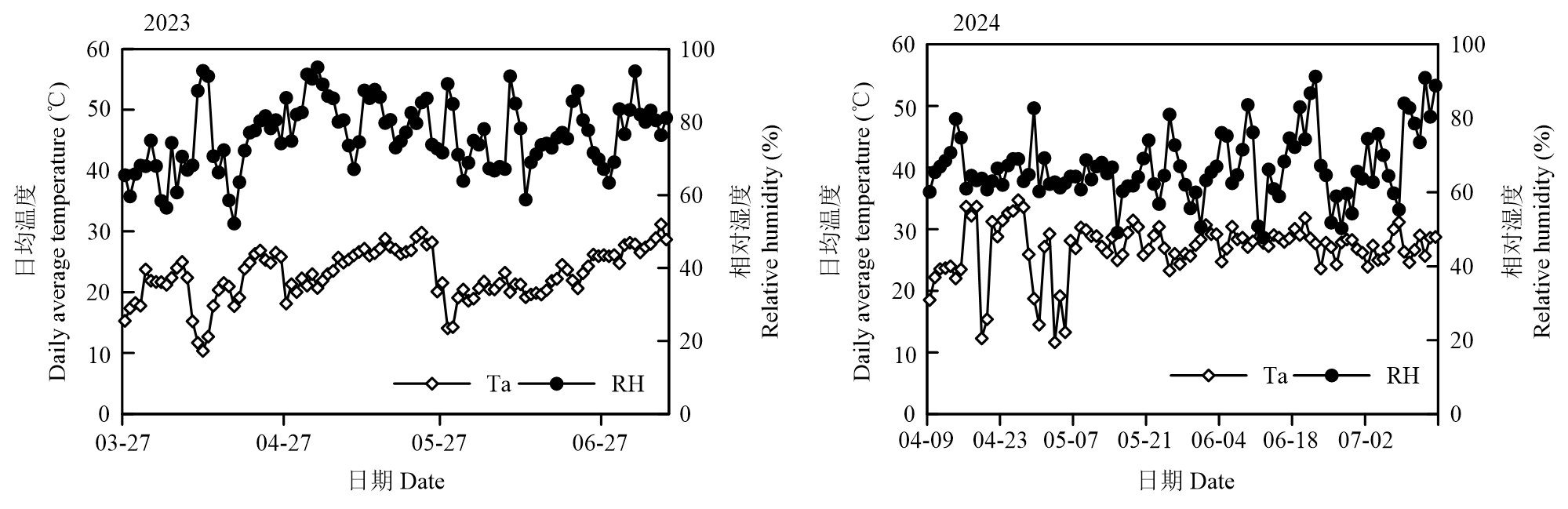
Fig. 1

Daily average temperature and relative humidity variation in the greenhouse in 2023 and 2024"

Fig. 2

Schematic diagram of tomato cultivation in coir bags and small-scale weighable lysimeter system"

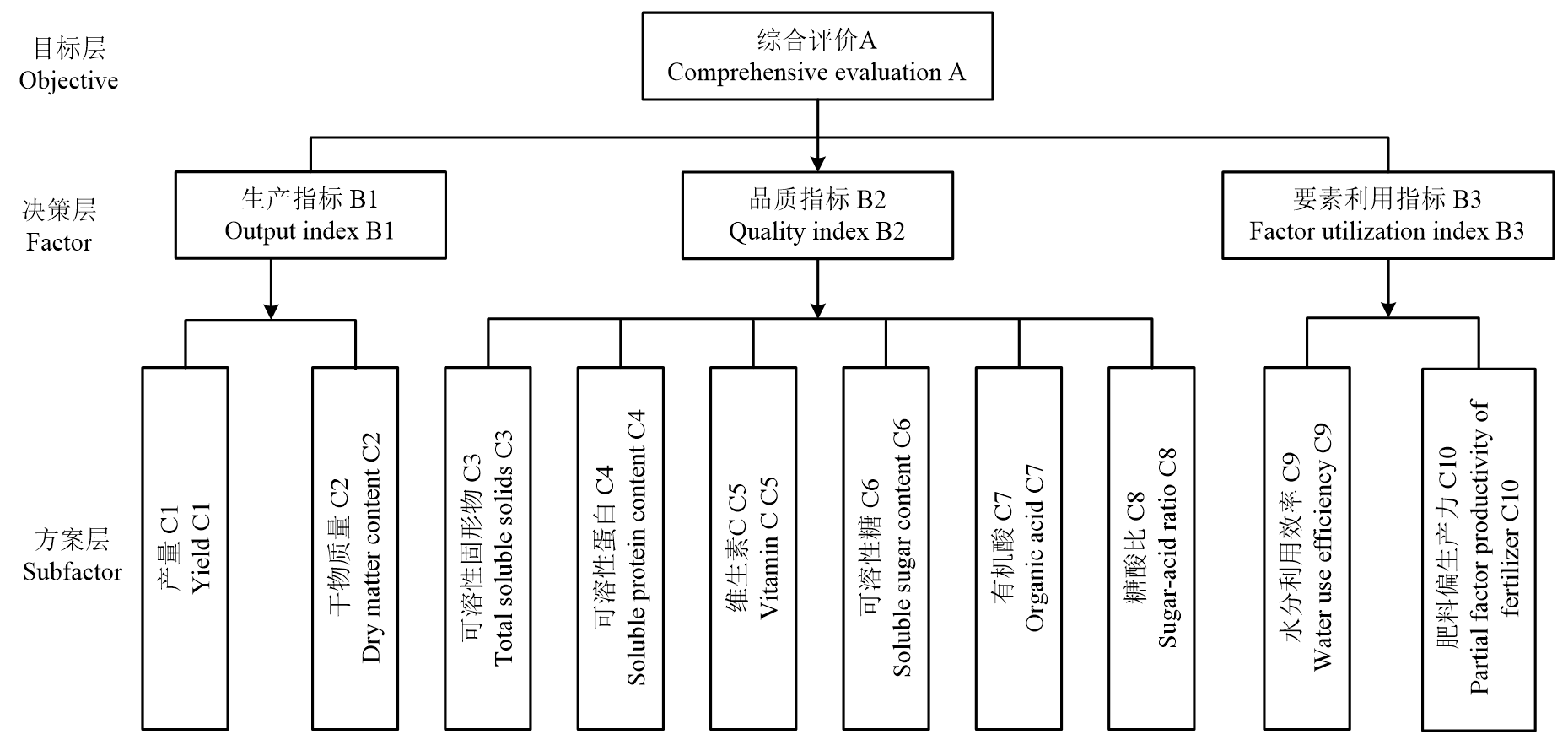
Fig. 3

Hierarchical analysis structure model"

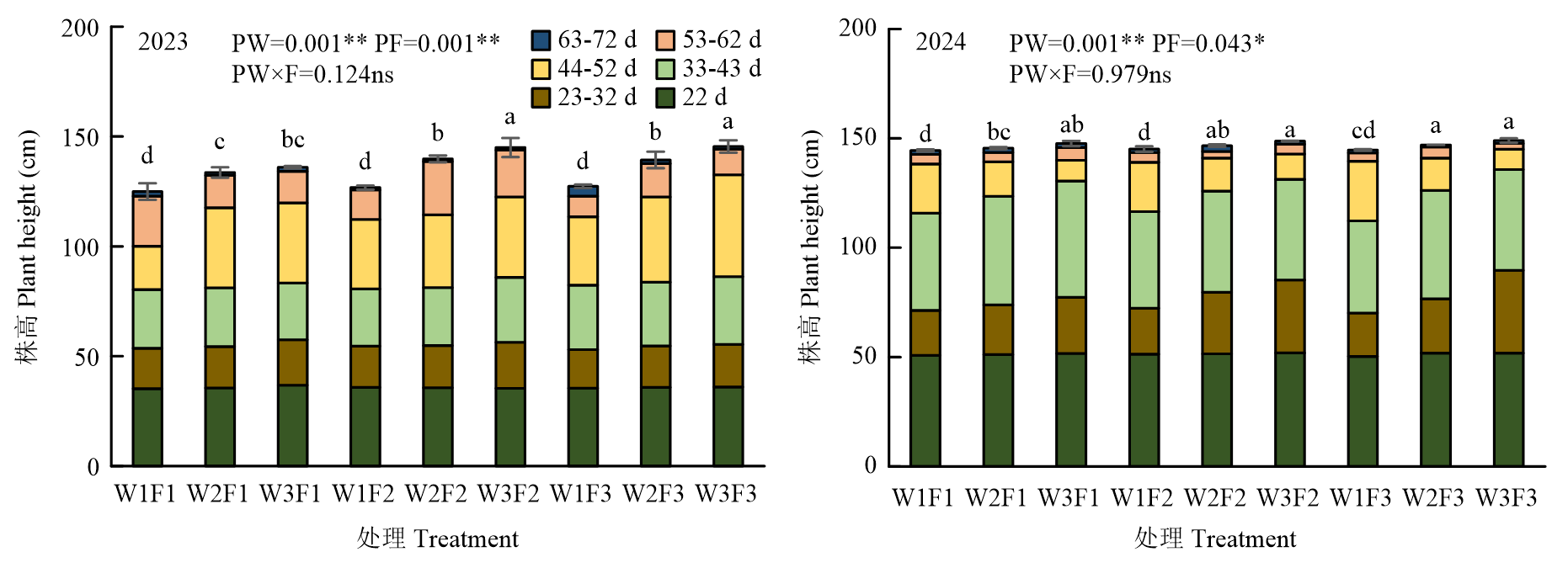
Fig. 4

Plant height of tomatoes growing in coconut coir bags under different treatments Different lowercase letters indicate significant differences among treatments (P<0.05). The same as below"

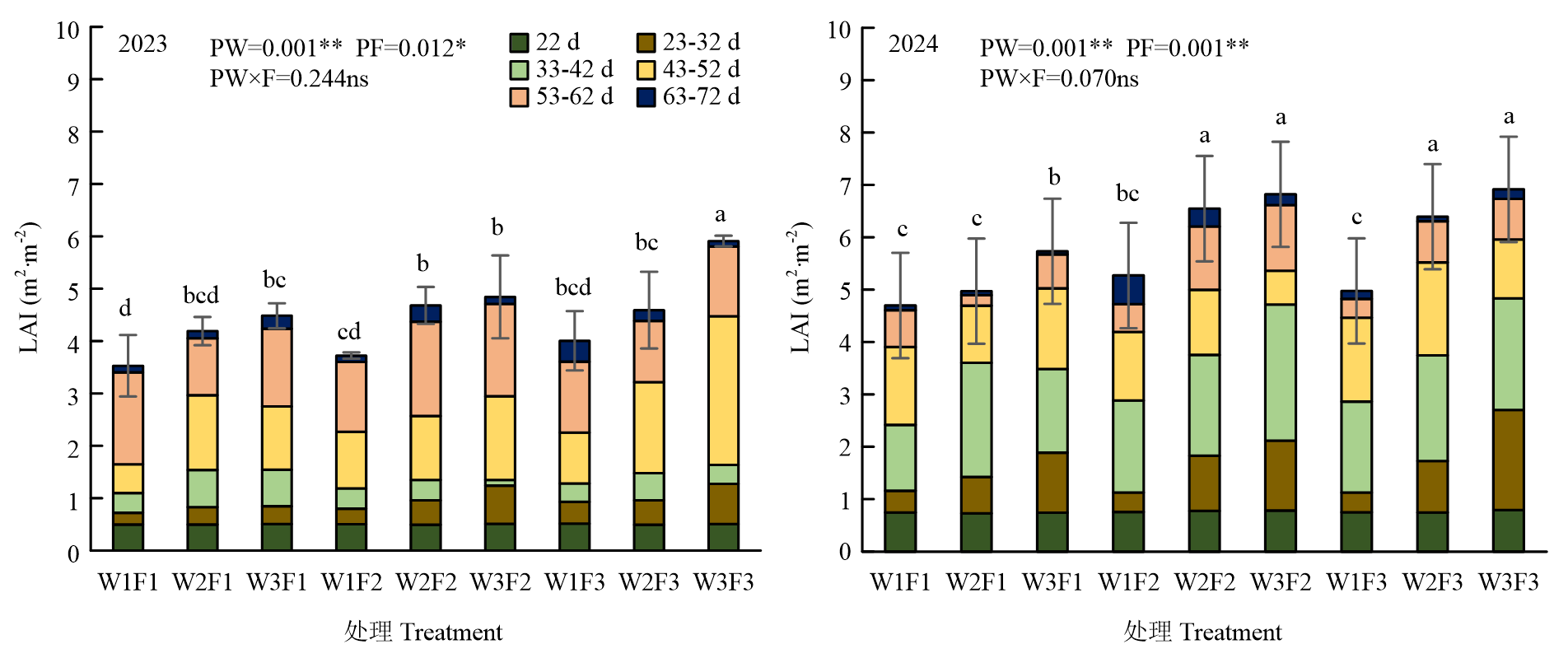
Fig. 5

Changes in leaf area index of tomatoes grown in coconut coir bags under different treatments"

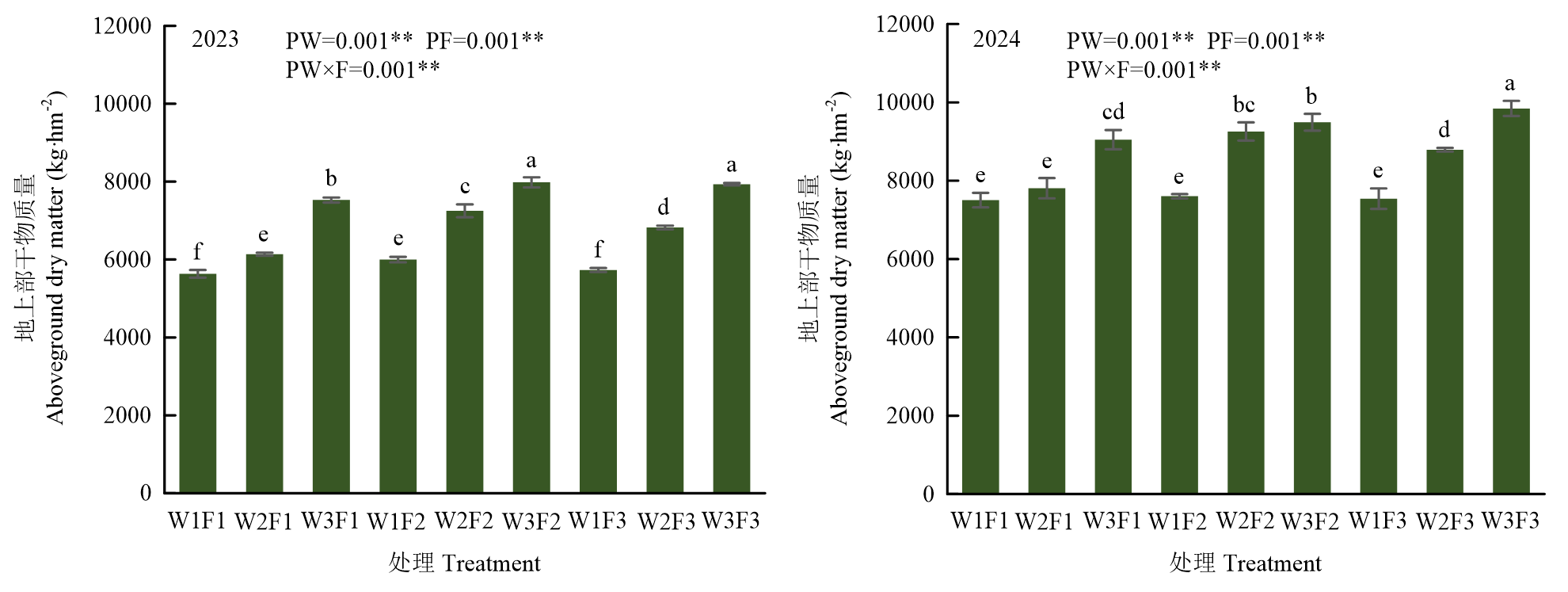
Fig. 6

Changes in aboveground dry matter accumulation of tomatoes growing in coconut coir bags under different treatments"

Table 1

Harvest index of tomato cultivated in coconut coir bags under different treatments"

处理
Treatment
收获指数 Harvest index (%)
2023 2024
W1F1 45.57c 38.19d
W2F1 46.95b 41.10c
W3F1 43.85c 41.15c
W1F2 49.61ab 40.56c
W2F2 51.80a 46.15a
W3F2 47.10b 43.10b
W1F3 44.35c 40.48c
W2F3 49.49ab 43.01b
W3F3 48.34b 42.56b

Table 2

Effects of different treatments on net photosynthetic rate, stomatal conductance and transpiration rate of tomatoes grown in coconut coir bag culture"

处理Treatment 净光合速率
Net photosynthetic rate (μmol·m-2·s-1)
气孔导度
Stomatal conductance (mol·m-2·s-1)
蒸腾速率
Transpiration rate (mmol·m-2·s-1)
2023 2024 2023 2024 2023 2024
开花坐果期Flowering and fruit- setting stage 成熟期Maturity
stage
开花坐果期Flowering and fruit- setting stage 成熟期Maturity stage 开花坐果期Flowering and fruit- setting stage 成熟期Maturity stage 开花坐果期Flowering and fruit- setting stage 成熟期Maturity stage 开花坐果期Flowering and fruit- setting stage 成熟期Maturity stage 开花坐果期Flowering and fruit- setting stage 成熟期Maturity stage
W1F1 19.86c 12.42f 25.20c 13.39e 0.43b 0.46d 0.52de 0.30e 7.18c 9.82f 10.04d 6.87b
W2F1 22.32b 14.17e 26.88ab 19.61bc 0.62a 0.61c 0.64c 0.35cd 9.63ab 10.63e 11.69ab 8.34a
W3F1 22.98b 14.94d 26.98ab 20.11bc 0.64a 0.70b 0.73b 0.34d 9.64ab 10.72e 11.64ab 8.64a
W1F2 19.49cd 14.13e 25.65bc 18.43c 0.44b 0.50d 0.56d 0.37b 7.25c 11.44d 10.84c 8.30a
W2F2 23.04b 19.26b 27.07ab 20.45ab 0.60a 0.65c 0.64c 0.38ab 9.32b 13.44bc 11.57b 8.41a
W3F2 23.22b 20.30a 27.92a 21.28ab 0.61a 0.77a 0.75ab 0.38ab 9.50ab 14.04ab 11.63ab 8.57a
W1F3 18.14d 14.98d 24.66c 16.05d 0.46b 0.49d 0.49e 0.34d 6.76c 10.64e 10.86c 6.58b
W2F3 23.32b 18.60c 27.92a 21.19ab 0.61a 0.64c 0.66c 0.34bc 9.33b 13.04c 11.86ab 8.39a
W3F3 25.26a 20.77a 28.24a 22.24a 0.64a 0.78a 0.77ab 0.39a 9.87a 14.17a 11.92a 9.16a
显著性检验F值 F value
W 167.22** 405.03** 25.49** 72.42** 74.38** 206.09** 217.94** 24.39** 230.21** 99.33** 130.07** 23.56**
F 1.87ns 377.34** 1.41ns 15.18** 0.68ns 8.85** 1.64ns 49.25** 0.80ns 131.97** 13.60** 2.33ns
W×F 11.27** 26.83** 1.52ns 4.62** 0.31ns 0.49ns 4.83** 5.02** 2.14ns 10.15** 6.56** 4.68**

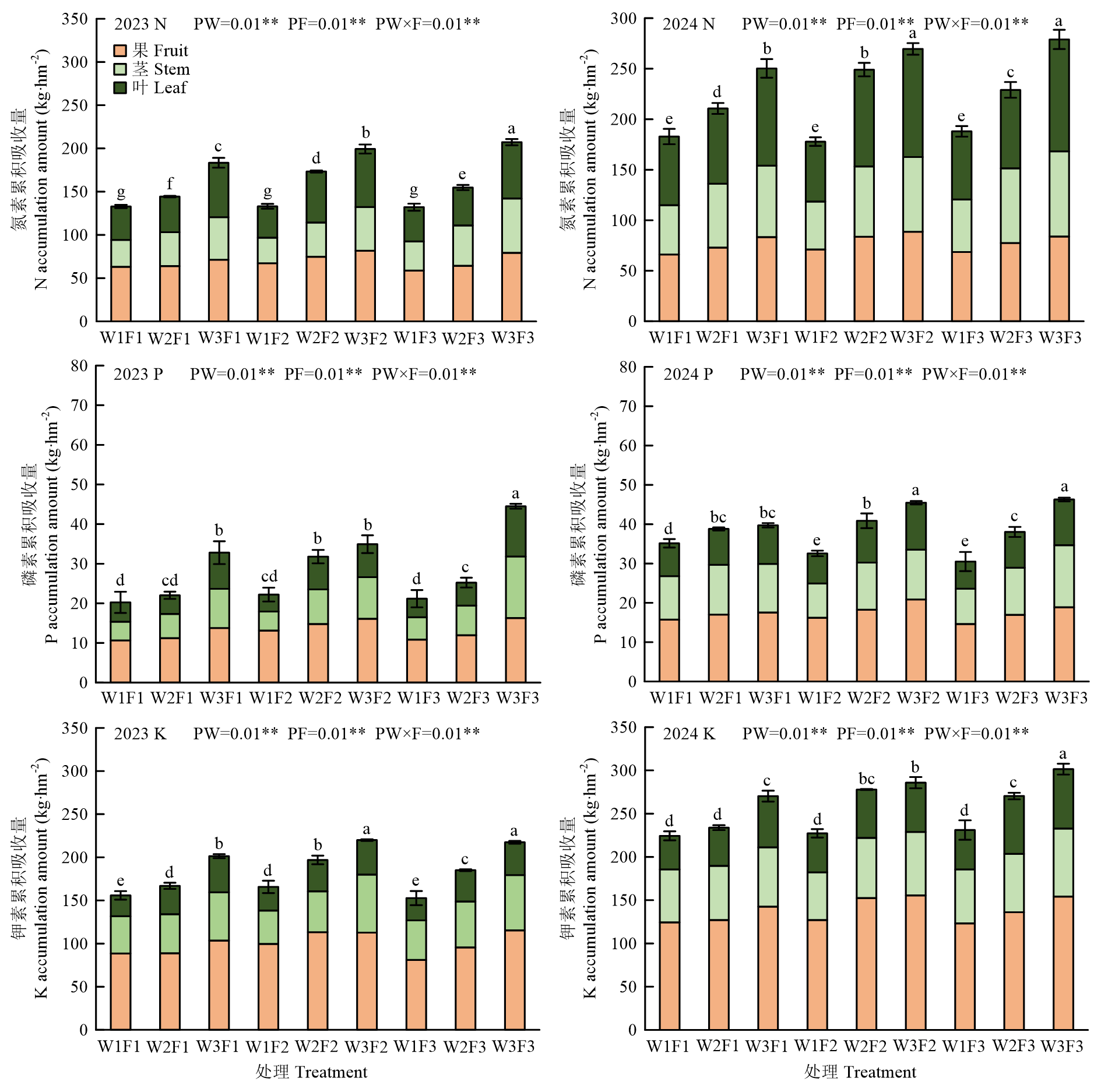
Fig. 7

Dynamics of nutrient accumulation in tomato under coconut coir bag cultivation with different treatments"

Table 3

Effects of different treatments on nutrient internal use efficiency of tomato in coconut coir bag cultivation"

处理Treatment N (kg·kg-1) P2O5 (kg·kg-1) K2O (kg·kg-1)
2023 2024 2023 2024 2023 2024
W1F1 390.47bc 287.61b 2588.55a 1495.34cd 332.85ab 234.13bcd
W2F1 379.01cd 270.50cd 2486.09a 1468.79d 327.74b 243.71ab
W3F1 314.55e 235.95f 1766.70b 1485.73cd 286.46c 218.41e
W1F2 426.72a 324.75a 2563.71a 1773.00a 342.88a 254.06a
W2F2 367.44d 270.33cd 2007.17b 1650.06b 323.51b 242.25ab
W3F2 320.12e 253.42de 1830.89b 1502.72cd 290.02c 239.03bc
W1F3 398.33b 286.62bc 2498.87a 1771.87a 344.71a 233.20bcd
W2F3 385.25c 266.30d 2367.00a 1602.72bc 322.22b 225.45cd
W3F3 313.82e 246.46ef 1461.76c 1484.20cd 299.16c 227.93cde
显著性检验F值 F value
W 379.45** 78.12** 62.24** 19.64** 98.42** 7.61**
F 4.67* 10.52** 2.72ns 16.10** 1.63ns 14.66**
W×F 11.61** 4.47** 4.10* 4.52** 1.67ns 4.16*

Fig. 8

Effects of different treatments on yield, water use efficiency and partial factor productivity of fertilizer in coconut coir bag culture"

Table 4

Regression analysis of the response of yield to water and fertilizer supply"

年份
Year
因变量
Dependent
variable, Z
回归方程
Regression equation
R² Z最大时处理组合
Water and fertilizer combination at maximum Z
x (mm) y (kg·hm-2) Zmax
2023 产量Yield (t·hm-2) Z=-99.58+1.59928x-0.00040y+0.00092xy-0.00673x2-0.00007y2 0.923 207.58 1296.27 66.28
2024 产量Yield (t·hm-2) Z=-368.66+4.16055x-0.14651y+0.00155xy-0.01252x2-0.00008y2 0.928 270.67 1691.14 71.98

Table 5

Effects of different treatments on the quality of tomatoes grown in coconut coir bag culture"

年份Year 处理
Treatment
可溶性固形物
Soluble solids (%)
可溶性蛋白
Soluble protein (mg·g-1)
维生素C
Vitamin C (mg·kg-1)
可溶性糖
Soluble sugar (%)
有机酸
Organic acid (%)
糖酸比
Sugar-acid ratio
2023 W1F1 5.38abc 2.89cd 142.34e 2.71a 0.57ab 4.76ab
W2F1 5.29abc 3.32b 152.65d 2.50b 0.58a 4.30d
W3F1 4.91d 3.19b 162.06b 2.28d 0.55bc 4.18d
W1F2 5.41ab 3.81a 158.78c 2.67a 0.55abc 4.83a
W2F2 5.12bcd 3.84a 166.49a 2.58b 0.54bc 4.75ab
W3F2 5.10cd 2.67d 134.96f 2.38c 0.53c 4.52c
W1F3 5.51a 3.05bc 157.89c 2.72a 0.56ab 4.85a
W2F3 5.37abc 3.26b 134.42f 2.56b 0.56ab 4.58bc
W3F3 4.52e 3.62a 128.57g 1.96e 0.47d 4.13d
W 34.33** 9.40** 204.75** 247.04** 28.04** 43.32**
F 6.20** 9.09** 304.34** 16.51** 12.99** 12.49**
W×F 6.39** 30.99** 478.88** 24.27** 6.08** 3.52*
2024 W1F1 5.33bcd 3.83b 126.93d 2.80b 0.46c 6.15a
W2F1 5.20cde 4.30ab 127.34d 2.63c 0.43d 6.06a
W3F1 5.10de 3.97b 147.13b 2.42d 0.44d 5.55c
W1F2 5.55b 3.60b 141.84c 3.16a 0.51a 6.17a
W2F2 5.51b 5.07a 153.36a 3.14a 0.51a 6.13a
W3F2 5.10de 3.84b 106.32e 2.71bc 0.46bc 5.86b
W1F3 5.85a 3.51b 152.96a 2.84b 0.52a 5.43c
W2F3 5.38bc 3.82b 126.59d 2.65c 0.48b 5.55c
W3F3 5.05e 4.37ab 98.06f 2.15e 0.47bc 4.61d
W 32.83** 6.42** 286.71** 103.65** 36.89** 74.75**
F 7.00** 0.84ns 39.52** 90.62** 72.04** 143.76**
W×F 4.76** 3.37* 322.25** 4.60** 6.79** 7.28**

Table 6

Determination of weights for tomato evaluation indices based on the entropy weight method"

年份Year 产量Yield
(C1)
干物质量
Dry matter accumulation (C2)
可溶性固形物 Soluble
solids (C3)
可溶性蛋白Soluble protein (C4) 维生素C
Vitamin C (C5)
可溶性糖 Soluble
sugar (C6)
有机酸 Organic acid
(C7)
糖酸比
Sugar-acid ratio (C8)
WUE
(C9)
PFP
(C10)
2023 0.117 0.138 0.056 0.091 0.101 0.057 0.051 0.104 0.135 0.150
2024 0.101 0.149 0.130 0.120 0.071 0.061 0.118 0.048 0.122 0.080

Table 7

Determination of weights for tomato evaluation indices based on the AHP method"

判断矩阵
Judgment matrix
局部权重
Local weight
最终权重
Ultimate weight
一致性检验
Consistency parameters
B1 B2 B3
目标层A
General goal A
B1 1 1 1 0.333 0.333 CR=0.0002<0.1
λmax=3.0002
B2 1 1 1 0.333 0.333
B3 1 1 1 0.333 0.333
C1 C2 CR=0<0.1
λmax=2.0000
生产指标B1
Output index B1
C1 1 4 0.800 0.267
C2 0.25 1 0.200 0.067
C3 C4 C5 C6 C7 C8 CR=0.001<0.1
λmax=6.009
品质指标B2
Quality index B2
C3 1 3 1.5 1 3 3 0.271 0.090
C4 0.333 1 0.5 0.333 1 1 0.090 0.030
C5 0.667 2 1 0.5 2 2 0.173 0.058
C6 1 3 2 1 3 3 0.285 0.095
C7 0.333 1 0.5 0.333 1 1 0.090 0.030
C8 0.333 1 0.5 0.333 1 1 0.090 0.030
C9 C10 CR=0<0.1
λmax=2.0000
要素利用指标B3
Factor utilization index B3
C9 1 1 0.500 0.167
C10 1 1 0.500 0.167

Table 8

Calculation of comprehensive weights"

年份
Year
指标
Index
客观权重值
Objective weight value
主观权重值
Subjective weighting value
综合权重值
Combined weight value
2023 产量 Yield (C1) 0.117 0.267 0.280
干物质量 Dry matter accumulation (C2) 0.138 0.067 0.083
可溶性固形物 Soluble solids (C3) 0.056 0.090 0.045
可溶性蛋白 Soluble protein (C4) 0.091 0.030 0.025
维生素C Vitamin C (C5) 0.101 0.058 0.052
可溶性糖 Soluble sugar (C6) 0.057 0.095 0.048
有机酸 Organic acid (C7) 0.051 0.030 0.014
糖酸比Sugar-acid ratio (C8) 0.104 0.030 0.028
WUE (C9) 0.135 0.167 0.202
PFP (C10) 0.150 0.167 0.223
2024 产量 Yield (C1) 0.101 0.267 0.266
干物质量 Dry matter accumulation (C2) 0.149 0.067 0.099
可溶性固形物 Soluble solids (C3) 0.130 0.090 0.117
可溶性蛋白 Soluble protein (C4) 0.120 0.030 0.036
维生素C Vitamin C (C5) 0.071 0.058 0.040
可溶性糖 Soluble sugar (C6) 0.061 0.095 0.058
有机酸 Organic acid (C7) 0.118 0.030 0.035
糖酸比Sugar-acid ratio (C8) 0.048 0.030 0.014
WUE (C9) 0.122 0.167 0.202
PFP (C10) 0.080 0.167 0.132

Table 9

Comprehensive index evaluation results of tomato in coconut coir bag cultivation based on TOPSIS"

处理
Treatment
2023 2024
Ci 排名Ranking Ci 排名Ranking
W1F1 0.47131189 6 0.36591396 9
W2F1 0.41463743 7 0.37875061 8
W3F1 0.49574163 5 0.40645193 6
W1F2 0.59618812 2 0.48296109 5
W2F2 0.76536295 1 0.81772144 1
W3F2 0.49942929 4 0.48859225 4
W1F3 0.33953186 9 0.39134891 7
W2F3 0.40165597 8 0.49685063 3
W3F3 0.50177811 3 0.53594042 2

Table 10

TOPSIS comprehensive evaluation ranking of tomato in coconut coir bags cultivation under different production target scenarios"

年份
Year
处理
Treatment
S1 S2 S3
Ci 排名Ranking Ci 排名Ranking Ci 排名Ranking
2023 W1F1 0.4016260 7 0.49612902 4 0.5182525 3
W2F1 0.3765976 8 0.4463619 7 0.4214148 7
W3F1 0.5020034 5 0.49625129 3 0.4897459 4
W1F2 0.5638779 4 0.66123922 2 0.6826799 2
W2F2 0.7488171 1 0.73903628 1 0.6902059 1
W3F2 0.5739612 3 0.48671010 5 0.4352891 6
W1F3 0.2976215 9 0.41318643 9 0.3034854 9
W2F3 0.4367597 6 0.43128466 8 0.3422981 8
W3F3 0.5770874 2 0.45947624 6 0.4624740 5
2024 W1F1 0.3136673 9 0.38003330 8 0.40231931 8
W2F1 0.3503793 7 0.37670400 9 0.40629161 7
W3F1 0.4209347 6 0.38900040 7 0.40923752 6
W1F2 0.4334601 5 0.52294120 2 0.49315400 4
W2F2 0.8262928 1 0.80218160 1 0.8253623 1
W3F2 0.5647440 3 0.45387690 6 0.44050531 5
W1F3 0.3420456 8 0.46130070 5 0.36273802 9
W2F3 0.5049749 4 0.48305360 3 0.50188214 3
W3F3 0.6055426 2 0.47343090 4 0.52636890 2
[1]
农业农村部. 关于发展现代设施农业的指导意见[Z]. 农计财发[2023]10号, 2023-06-20.
Ministry of agriculture and rural affairs of the people's republic of China. Guiding opinions on developing modern protected horticulture[Z]. Nongjicaifa, [2023] No.10, 2023-06-20. (in Chinese)
[2]
卢维宏, 张乃明, 包立, 张丽, 秦太峰. 我国设施栽培连作障碍特征与成因及防治措施的研究进展[J]. 土壤, 2020, 52(4): 651-658.
Lu W H, Zhang N M, Bao L, Zhang L, Qin T F. Study advances on characteristics, causes and control measures of continuous cropping obstacles of facility cultivation in China[J]. Soils, 2020, 52(4): 651-658. (in Chinese)
[3]
刘红叶, 宋汶珈, 杨尧钰, 张锡岩, 母玉祥, 魏珉, 张大龙. 设施蔬菜土壤障碍特征、诱因及其生态防控技术研究进展[J]. 中国蔬菜, 2025(5): 32-43.
Liu H Y, Song W J, Yang Y Y, Zhang X Y, Mu Y X, Wei M, Zhang D L. Research progress on the characteristics, inducement and ecological control technology of soil obstacle in protected vegetable production[J]. China Vegetables, 2025(5): 32-43. (in Chinese)
[4]
李天来. 设施蔬菜产业发展(一) 我国设施蔬菜产业发展现状及展望[J]. 中国蔬菜, 2023(9): 1-6.
Li T L. Development status of China’s facility vegetable industry and outlook[J]. China Vegetables, 2023(9): 1-6. (in Chinese)
[5]
王文选, 刘明池, 陈婕, 武占会, 丁海凤, 王宝驹, 王丽萍, 季延海. 栽培基质和供液方式对番茄产量、品质及根区离子积累的影响[J]. 植物营养与肥料学报, 2025, 31(1): 176-187.
Wang W X, Liu M C, Chen J, Wu Z H, Ding H F, Wang B J, Wang L P, Ji Y H. Effects of cultivation substrate and liquid supply method on yield, quality and ion accumulation in root zone of tomato[J]. Journal of Plant Nutrition and Fertilizers, 2025, 31(1): 176-187. (in Chinese)
[6]
张婧, 吴慧, 程云霞, 陈奕琳, 燕存尧, 贾凯, 彭宇. 椰糠复合基质对番茄穴盘幼苗生长效应的综合评价[J]. 土壤通报, 2021, 52(5): 1156-1164.
Zhang J, Wu H, Cheng Y X, Chen Y L, Yan C Y, Jia K, Peng Y. Comprehensive evaluation of the growth effect of coconut-bran compound substrate on tomato plug seedling[J]. Chinese Journal of Soil Science, 2021, 52(5): 1156-1164. (in Chinese)
[7]
李瑞珍. 椰糠基质对设施番茄产量和品质的提升效应研究[J]. 安徽农学通报, 2025, 31(20): 42-44.

doi: 10.16377/j.cnki.issn1007-7731.2025.20.010
Li R Z. Research on the effect of coir substrate on yield and quality improvement of facility tomatoes[J]. Anhui Agricultural Science Bulletin, 2025, 31(20): 42-44. (in Chinese)

doi: 10.16377/j.cnki.issn1007-7731.2025.20.010
[8]
Mogale J T, Maluleke M K. The effect of varying coconut coir substrates and loam soil on the physiology, and biochemical constituents of tomato (Solanum lycopersicum var. esculentum) grown under greenhouse environment[J]. Discover Sustainability, 2025, 6(1): 143.

doi: 10.1007/s43621-025-00933-3
[9]
Gruda N S. Increasing sustainability of growing media constituents and stand-alone substrates in soilless culture systems[J]. Agronomy, 2019, 9(6): 298.

doi: 10.3390/agronomy9060298
[10]
胡晓辉, 高子星, 马永博, 薛建康, 谢志龙, 李雪, 张林阳, 王君正, 马雪强, 屈锋, 张佼. 基于产量品质及水肥利用率的袋培辣椒水肥耦合方案[J]. 农业工程学报, 2020, 36(17): 81-89.
Hu X H, Gao Z X, Ma Y B, Xue J K, Xie Z L, Li X, Zhang L Y, Wang J Z, Ma X Q, Qu F, Zhang J. Coupling scheme of water and fertilizer based on yield, quality, use efficiency of water and fertilizer in bag pepper growing[J]. Transactions of the Chinese Society of Agricultural Engineering, 2020, 36(17): 81-89. (in Chinese)
[11]
张玉鑫, 蒯佳琳, 马彦霞, 王晓巍, 康恩祥, 张俊峰. 非耕地日光温室番茄基质栽培灌溉制度研究[J]. 干旱地区农业研究, 2025, 43(2): 215-225.
Zhang Y X, Kuai J L, Ma Y X, Wang X W, Kang E X, Zhang J F. Study on irrigation system of tomato substrate cultivation in non-arable land solar greenhouse[J]. Agricultural Research in the Arid Areas, 2025, 43(2): 215-225. (in Chinese)
[12]
张佳丽, 路希, 李建明. 灌溉量与有机营养液配方耦合对设施番茄产量、品质及水分利用效率的影响[J]. 应用生态学报, 2025, 36(5): 1431-1439.

doi: 10.13287/j.1001-9332.202505.016
Zhang J L, Lu X, Li J M. Influence of coupling irrigation volume and organic nutrient solution formula on yield, quality, and water utilization efficiency of greenhouse tomatoes[J]. Chinese Journal of Applied Ecology, 2025, 36(5): 1431-1439. (in Chinese)

doi: 10.13287/j.1001-9332.202505.016
[13]
柳美玉, 曹红霞, 杜贞其, 杜娅丹, 王萍. 营养液浓度对番茄营养生长期干物质累积及养分吸收的影响[J]. 西北农林科技大学学报(自然科学版), 2017, 45(4): 119-126, 133.
Liu M Y, Cao H X, Du Z Q, Du Y D, Wang P. Effects of nutrient concentration on dry matter accumulation and nutrients absorption of tomato[J]. Journal of Northwest A & F University (Natural Science Edition), 2017, 45(4): 119-126, 133. (in Chinese)
[14]
Caruso G, Villari G, Melchionna G, Conti S. Effects of cultural cycles and nutrient solutions on plant growth, yield and fruit quality of alpine strawberry (Fragaria vesca L.) grown in hydroponics[J]. Scientia Horticulturae, 2011, 129(3): 479-485.

doi: 10.1016/j.scienta.2011.04.020
[15]
赵文举, 马锋, 曹伟, 马芳芳, 韩丽. 水肥耦合对基质栽培番茄产量及品质的影响[J]. 农业工程学报, 2022, 38(2): 95-101.
Zhao W J, Ma F, Cao W, Ma F F, Han L. Effects of water and fertilizer coupling on the yield and quality of tomatoes[J]. Transactions of the Chinese Society of Agricultural Engineering, 2022, 38(2): 95-101. (in Chinese)
[16]
Zhang J, Xiang L, Liu Y, Jing D, Zhang L, Liu Y, Li W, Wang X, Li T, Li J. Optimizing irrigation schedules of greenhouse tomato based on a comprehensive evaluation model[J]. Agricultural Water Management, 2024, 295: 108741.

doi: 10.1016/j.agwat.2024.108741
[17]
王振华, 陈潇洁, 吕德生, 李文昊, 王天宇, 魏驰林. 水肥耦合对加气滴灌加工番茄产量及品质的影响[J]. 农业工程学报, 2020, 36(19): 66-75.
Wang Z H, Chen X J, Lü D S, Li W H, Wang T Y, Wei C L. Effects of water and fertilizer coupling on the yield and quality of processing tomato under aerated drip irrigation[J]. Transactions of the Chinese Society of Agricultural Engineering, 2020, 36(19): 66-75. (in Chinese)
[18]
张帆, 陈梦茹, 邢英英, 党菲菲, 李源, 王秀康. 基于熵权法和TOPSIS对马铃薯施肥和滴灌量组合的优化[J]. 植物营养与肥料学报, 2023, 29(4): 732-744.
Zhang F, Chen M R, Xing Y Y, Dang F F, Li Y, Wang X K. Optimization of fertilizer and drip irrigation levels for efficient potato production based on entropy weight method and TOPSIS[J]. Journal of Plant Nutrition and Fertilizers, 2023, 29(4): 732-744. (in Chinese)
[19]
郭芮萤, 王成霞, 孙虎. 番茄基质栽培营养液配方筛选[J]. 安徽农学通报, 2022, 28(2): 80-81, 135.
Guo R Y, Wang C X, Sun H. Selection of nutrient solution formula for tomato substrate cultivation[J]. Anhui Agricultural Science Bulletin, 2022, 28(2): 80-81, 135. (in Chinese)
[20]
王柳, 丁小明, 李恺, 张凌风, 裴庆余, 尹义蕾, 王春辉, 侯永, 潘守江, 田婧, 鲁少尉. 椰糠条栽培番茄的蒸腾反馈智能灌溉系统研制[J]. 农业工程学报, 2021, 37(8): 133-142.
Wang L, Ding X M, Li K, Zhang L F, Pei Q Y, Yin Y L, Wang C H, Hou Y, Pan S J, Tian J, Lu S W. Development of transpiration feedback intelligent irrigation system for tomato under coconut coir slabs cultivation condition[J]. Transactions of the Chinese Society of Agricultural Engineering, 2021, 37(8): 133-142. (in Chinese)
[21]
Liu S, Qiang X, Liu H, Han Q, Yi P, Ning H, Li H, Wang C, Zhang X. Effects of nutrient solution application rates on yield, quality, and water-fertilizer use efficiency on greenhouse tomatoes using grown-in coir[J]. Plants, 2024, 13(6): 893.

doi: 10.3390/plants13060893
[22]
刘浩, 孙景生, 段爱旺, 孙磊, 梁媛媛. 基于AutoCAD软件确定番茄与青椒叶面积的简易方法[J]. 中国农学通报, 2009, 25(5): 287-293.
Liu H, Sun J S, Duan A W, Sun L, Liang Y Y. Simple model for tomato and green pepper leaf area based on AutoCAD software[J]. Chinese Agricultural Science Bulletin, 2009, 25(5): 287-293. (in Chinese)

doi: 10.11924/j.issn.1000-6850.2008-1244
[23]
Cheng M, He J, Wang H, Fan J, Xiang Y, Liu X, Liao Z, Tang Z, Abdelghany A E, Zhang F. Establishing critical nitrogen dilution curves based on leaf area index and aboveground biomass for greenhouse cherry tomato: a Bayesian analysis[J]. European Journal of Agronomy, 2022, 141: 126615.

doi: 10.1016/j.eja.2022.126615
[24]
李欢欢, 宋嘉雯, 孙景生, 王景雷, 强小嫚, 刘浩, 郑明, 娄玉军. 不同水氮供应对温室番茄各穗层果实养分和产量构成的影响[J]. 灌溉排水学报, 2023, 42(6): 1-9.
Li H H, Song J W, Sun J S, Wang J L, Qiang X M, Liu H, Zheng M, Lou Y J. Effects of water and nitrogen applications on yield components and nutritional composition of greenhouse tomatoes in different trusses[J]. Journal of Irrigation and Drainage, 2023, 42(6): 1-9. (in Chinese)
[25]
Qu F, Peng T, Jia Y, Yang M, Meng X, Mao S, Zhou D, Hu X. Adjusting leaf nitrogen allocation could promote photosynthetic capacity, and nitrogen accumulation in Cucumis sativus L[J]. Environmental and Experimental Botany, 2022, 198: 104855.

doi: 10.1016/j.envexpbot.2022.104855
[26]
Luo H, Li F. Tomato yield, quality and water use efficiency under different drip fertigation strategies[J]. Scientia Horticulturae, 2018, 235: 181-188.

doi: 10.1016/j.scienta.2018.02.072
[27]
Liu J, Si Z, Wu L, Shen X, Gao Y, Duan A. High-low seedbed cultivation drives the efficient utilization of key production resources and the improvement of wheat productivity in the North China Plain[J]. Agricultural Water Management, 2023, 285(C): 108357.
[28]
Liu H, Li H, Ning H, Zhang X, Li S, Pang J, Wang G, Sun J. Optimizing irrigation frequency and amount to balance yield, fruit quality and water use efficiency of greenhouse tomato[J]. Agricultural Water Management, 2019, 226: 105787.

doi: 10.1016/j.agwat.2019.105787
[29]
Kaur C, Walia S, Nagal S, Walia S, Singh J, Singh B B, Saha S, Singh B, Kalia P, Jaggi S, Sarika. Functional quality and antioxidant composition of selected tomato (Solanum lycopersicon L.) cultivars grown in Northern India[J]. LWT - Food Science and Technology, 2013, 50(1): 139-145.

doi: 10.1016/j.lwt.2012.06.013
[30]
Wang C, Gu F, Chen J, Yang H, Jiang J, Du T, Zhang J. Assessing the response of yield and comprehensive fruit quality of tomato grown in greenhouse to deficit irrigation and nitrogen application strategies[J]. Agricultural Water Management, 2015, 161: 9-19.

doi: 10.1016/j.agwat.2015.07.010
[31]
Dou Z, Abdelghany A E, Zhang H, Feng H, Zhang Y, Yu S, Zhang F, Li Z, Fan J. Exogenous silicon application improves fruit yield and quality of drip-irrigated greenhouse tomato by regulating physiological characteristics and growth under combined drought and salt stress[J]. Scientia Horticulturae, 2023, 321: 112352.

doi: 10.1016/j.scienta.2023.112352
[32]
Liu Z, Jiang Z, Xu C, Cai G, Zhan J. Assessment of provincial waterlogging risk based on entropy weight TOPSIS-PCA method[J]. Natural Hazards, 2021, 108(2): 1545-1567.

doi: 10.1007/s11069-021-04744-3
[33]
农业农村部, 国家发展改革委, 科技部, 自然资源部, 生态环境部, 国家林草局. “十四五”全国农业绿色发展规划[Z]. 农规发[2021]8号, 2021-08-23.
Ministry of Agriculture and Rural Affairs, National Development and Reform Commission, Ministry of Science and Technology, Ministry of Natural Resources, Ministry of Ecology and Environment, National Forestry and Grassland Administration. The 14th Five-Year Plan for National Agricultural Green Development[Z]. Nongguifa[2021]No. 8, 2021-08-23. (in Chinese)
[34]
农业农村部, 国家发展改革委, 财政部, 自然资源部. 全国现代设施农业建设规划(2023—2030年)[Z]. 农计财发[2023]6号, 2023-06-09.
Ministry of Agriculture and Rural Affairs, National Development and Reform Commission, Ministry of Finance, Ministry of Natural Resources. National Modern Facility Agriculture Construction Plan (2023-2030) [Z]. Nongjicaifa[2023]No. 6, 2023-06-09. (in Chinese)
[35]
周罕觅, 马林爽, 孙旗立, 陈佳庚, 李纪琛, 苏裕民, 陈诚, 吴奇. 基于多目标综合评价的苹果水氮综合调控[J]. 中国农业科学, 2024, 57(18): 3654-3670. DOI: 10.3864/j.issn.0578-1752.2024.18.011.
Zhou H M, Ma L S, Sun Q L, Chen J G, Li J C, Su Y M, Chen C, Wu Q. Optimization of integrated water and nitrogen regulation system in apple based on multi-objective comprehensive evaluation[J]. Scientia Agricultura Sinica, 2024, 57(18): 3654-3670. DOI: 10.3864/j.issn.0578-1752.2024.18.011. (in Chinese)
[36]
何诗行, 何堤, 许春林, 赵立军, 权龙哲, 陈亚. 岩棉短程栽培模式中营养液对番茄生长及果实品质的影响[J]. 农业工程学报, 2017, 33(18): 188-195.
He S H, He D, Xu C L, Zhao L J, Quan L Z, Chen Y. Effects of nutrient solution on growth and quality of short-term cultivation tomatoes grown in rockwool[J]. Transactions of the Chinese Society of Agricultural Engineering, 2017, 33(18): 188-195. (in Chinese)
[37]
赵文举, 吴克倩, 俞海英, 王之君, 马宏. 水肥耦合对炭基质栽培番茄产量品质的影响及驱动因子[J]. 农业工程学报, 2025, 41(3): 199-207.
Zhao W J, Wu K Q, Yu H Y, Wang Z J, Ma H. Effects and driving factors of water and fertilizer coupling on the yield and quality of tomato cultivated in carbon substrate[J]. Transactions of the Chinese Society of Agricultural Engineering, 2025, 41(3): 199-207. (in Chinese)
[38]
王鹏勃, 李建明, 丁娟娟, 刘国英, 潘铜华, 杜清洁, 常毅博. 水肥耦合对温室袋培番茄品质、产量及水分利用效率的影响[J]. 中国农业科学, 2015, 48(2): 314-323. DOI: 10.3864/j.issn.0578-1752.2015.02.11.
Wang P B, Li J M, Ding J J, Liu G Y, Pan T H, Du Q J, Chang Y B. Effect of water and fertilizer coupling on quality, yield and water use efficiency of tomato cultivated by organic substrate in bag[J]. Scientia Agricultura Sinica, 2015, 48(2): 314-323. DOI: 10.3864/j.issn.0578-1752.2015.02.11. (in Chinese)
[39]
孙茜, 王湛, 徐凡, 郭文忠, 姚宇升, 李灵芝, 王保明. 设施番茄营养液调控技术研究现状与展望[J]. 中国瓜菜, 2023, 36(4): 12-18.
Sun Q, Wang Z, Xu F, Guo W Z, Yao Y S, Li L Z, Wang B M. Research status and future prospect of nutrient solution control in tomato facility cultivation[J]. China Cucurbits and Vegetables, 2023, 36(4): 12-18. (in Chinese)
[40]
白振涛, 张红鑫, 范军亮, 曹红霞, 李志军, 张富仓. 滴灌水量和灌溉频率对温室番茄光合荧光特性与产量品质的影响[J]. 农业机械学报, 2025, 56(12): 677-686.
Bai Z T, Zhang H X, Fan J L, Cao H X, Li Z J, Zhang F C. Effects of irrigation amount and frequency on photosynthetic fluorescence characteristics, fruit yield and quality of drip-irrigated greenhouse tomato[J]. Transactions of the Chinese Society for Agricultural Machinery, 2025, 56(12): 677-686. (in Chinese)
[41]
蔡东升, 李建明, 樊翔宇, 李惠, 孔政, 张鑫. 基质栽培营养液氮磷钾补充水平对番茄养分吸收及产量品质影响[J]. 东北农业大学学报, 2017, 48(1): 7-14.
Cai D S, Li J M, Fan X Y, Li H, Kong Z, Zhang X. Effect of nitrogen, phosphorus and potassium supplementation on nutrient uptake, yield and quality of tomato in substrate culture[J]. Journal of Northeast Agricultural University, 2017, 48(1): 7-14. (in Chinese)
[42]
张小兰, 徐阳, 张金伟, 吴晓阳, 孙周平. 不同配比的控释肥对日光温室袋培番茄基质养分及其生长、产量和品质的影响[J]. 水土保持学报, 2018, 32(3): 309-314.
Zhang X L, Xu Y, Zhang J W, Wu X Y, Sun Z P. Effects of controlled release fertilizer with different ratio on the substrate nutrient, growth, yield and quality of tomato cultured in bags in solar greenhouse[J]. Journal of Soil and Water Conservation, 2018, 32(3): 309-314. (in Chinese)
[43]
王军伟, 黄科, 毛舒香, 徐浩然, 吴秋云. 基质栽培番茄营养液中氮、钾最佳浓度研究[J]. 植物营养与肥料学报, 2019, 25(11): 2019-2028.
Wang J W, Huang K, Mao S X, Xu H R, Wu Q Y. Optimum levels of nitrogen and potassium in the irrigation water for best growth and quality of tomato in soilless culture[J]. Journal of Plant Nutrition and Fertilizers, 2019, 25(11): 2019-2028. (in Chinese)
[44]
张文静, 吴春祥, 徐东波, 吴润, 郭再华, 田宇佳, 余德芳. 优化灌溉施肥对设施番茄产量、品质及水肥利用的影响[J]. 灌溉排水学报, 2025, 44(11): 10-17.
Zhang W J, Wu C X, Xu D B, Wu R, Guo Z H, Tian Y J, Yu D F. Optimizing irrigation and fertilization to improve yield, quality and resource use efficiency of greenhouse tomatoes[J]. Journal of Irrigation and Drainage, 2025, 44(11): 10-17. (in Chinese)
[45]
Wang C, Li H, Zhang X, Yang G, Li X, Qiang X. Effects of water and nitrogen regulation on greenhouse cucumbers in North China plain[J]. Scientia Horticulturae, 2026, 355: 114604.

doi: 10.1016/j.scienta.2025.114604
[46]
李建明, 于雪梅, 王雪威, 张俊威, 焦晓聪, 黄茜. 基于产量品质和水肥利用效率西瓜滴灌水肥制度优化[J]. 农业工程学报, 2020, 36(9): 75-83.
Li J M, Yu X M, Wang X W, Zhang J W, Jiao X C, Huang Q. Optimization of fertigation scheduling for drip-irrigated watermelon based on its yield, quality and fertilizer and water use efficiency[J]. Transactions of the Chinese Society of Agricultural Engineering, 2020, 36(9): 75-83. (in Chinese)
[47]
Wang Z, Zhang H, Wang Y, Zhou C. Integrated evaluation of the water deficit irrigation scheme of indigowoad root under mulched drip irrigation in arid regions of northwest China based on the improved TOPSIS method[J]. Water, 2021, 13(11): 1532.

doi: 10.3390/w13111532
[48]
Liang C, Yu S, Zhang H, Wang Z, Li F. Economic evaluation of drought resistance measures for maize seed production based on TOPSIS model and combination weighting optimization[J]. Water, 2022, 14(20): 3262.

doi: 10.3390/w14203262
[1] BAI JingJing, ZHANG YuChen, NI ZiJie, GAO JiaYong, LIU WeiYang, GAI DongSheng, WANG YuHang, HE JiaQing, ZHANG Qiang, SHAO XiWen, WU Ying, GENG YanQiu, GUO LiYing. Effects of Different Irrigation Volumes on Lodging Resistance Characteristics and Yield of Rice in Northeast China [J]. Scientia Agricultura Sinica, 2026, 59(9): 1848-1868.
[2] CAI QiaoHong, ZHOU Tian, SU Ming, HONG ZiQiang, LI FanGuo, LI Tong, WANG Hua, KANG JianHong, WU HongLiang. Effects of Nitrogen Reduction and Potassium Enhancement Fertilization Mode on Photosynthetic Fluorescence Characteristics and Photosynthetic Product Accumulation of Maize in Ningxia Yellow Irrigation Area [J]. Scientia Agricultura Sinica, 2026, 59(9): 1869-1886.
[3] ZHU Pei, ZHAO Yao, BAI Yan, ZHANG JinKui, LI Mei, LONG JinJia, YANG Long, LUO LiYa, XU BenBo, XU JinSong, ZHANG XueKun. Physiological Regulation of Pydiflumetofen on Rapeseed (Brassica napus) and Its Combined Effect with Prochloraz [J]. Scientia Agricultura Sinica, 2026, 59(9): 1903-1915.
[4] WANG ZhiGao, LI LiuBin, XU Ying, JU ChengHui, HE Rong. Image Processing-Based Detection Method for Corn Damage Ratio and Synchronous Analysis of Quality Variation [J]. Scientia Agricultura Sinica, 2026, 59(9): 1987-2001.
[5] HUANG GuoQin. The Strategic Path of Enhancing Grain Production Capacity in Southern China [J]. Scientia Agricultura Sinica, 2026, 59(9): 2029-2041.
[6] WANG XiaoWei, DU FoLi, YAN HongCai, LANG ZhengDong, DANG ZhiJuan, LI BaoChun, WANG JunCheng, MA XiaoLe, WANG HuaJun, ZHANG Hong, YAO LiRong. Evaluation of Drought Resistance of 396 Spring Wheat Varieties at Grain Filling Stage and Maturity Stage [J]. Scientia Agricultura Sinica, 2026, 59(8): 1608-1621.
[7] LI ZhiWei, WANG ZiQi, GAO YaMeng, GAO RunHong, CHEN Xue, YANG Zhu, KAN WenJie, JIAN ShuangLing, YAN ShengNan, TANG CaiGuo, WU LiFang. Effects of Different Light Quality on Growth Acceleration and Photosynthetic Characteristics of Barley [J]. Scientia Agricultura Sinica, 2026, 59(8): 1639-1652.
[8] CHEN XuanYi, GUO XingXing, ZHANG XiangQian, LU ZhanYuan, LIU LingYue, LUO Fang, LI JinLong, ZHANG ChuanLing, ZHANG ZhiQing, CHE ManQing. Impacts of Intercropping Row Patterns on the Heterogeneity of the Light Environment and Photosynthetic Product Production in Maize Canopy [J]. Scientia Agricultura Sinica, 2026, 59(8): 1653-1671.
[9] HOU HuiZhi, YIN JiaDe, MA MingSheng, LIU XiaoWei, LIU YanLan, LEI KangNing. Effects of Tillage and Organic Fertilizer Application on Crop Yield and Water Use in a Potato-Maize Double Cropping System in the Longdong Region [J]. Scientia Agricultura Sinica, 2026, 59(8): 1672-1685.
[10] PENG TingShen, LU JiuYan, WU MeiLin, YAN YuXin, LIU HongZhou, NAN WenBin, QIN XiaoJian, LI Ming, GONG JunYi, LIANG YongShu. QTL Analysis of Yield-Related Traits in Both Huangnuo2# and Changbai7# of Perennial Chinese Rice [J]. Scientia Agricultura Sinica, 2026, 59(7): 1361-1379.
[11] CUI JieHao, ZHANG Meng, WANG Qin, YU JiaYan, LIN Kun, LI ShangZe, LAN Heng, GENG YanQiu, ZHANG Qiang, GUO LiYing, SHAO XiWen. Evaluation of Lodging Resistance and Its Physiological Mechanisms in Japonica Rice Resources [J]. Scientia Agricultura Sinica, 2026, 59(7): 1420-1438.
[12] WANG YuPing, FU Zhi, SUN JiaYing, MU XiaoMeng, LIU HuiLin, GUO JinYun, SONG WenJing, HOU LeiPing, ZHAO HaiLiang. Evaluation of the Mitigating Effect and Application Efficacy of Melatonin Applied at the Seedling Stage on Short-Term Chilling Stress in Tomato Plants [J]. Scientia Agricultura Sinica, 2026, 59(7): 1523-1535.
[13] WANG JiaNuo, CHEN GuiPing, LI Pan, WANG LiPing, NAN YunYou, HE Wei, FAN ZhiLong, HU FaLong, CHAI Qiang, YIN Wen, ZHAO LiaoHao. Photo-Physiological Mechanism at Grain Filling Stage of No-Tillage with Plastic Re-Mulching to Increase Maize Yield in Oasis Irrigation Areas [J]. Scientia Agricultura Sinica, 2026, 59(6): 1189-1202.
[14] ZHOU XinJie, REN Hao, CHEN YingLong, ZHANG JiWang, ZHAO Bin, REN BaiZhao, LIU Peng, WANG HongZhang. Effects of Calcium Peroxide on Root Morphology and Yield Formation of Summer Maize in Waterlogging Farmland [J]. Scientia Agricultura Sinica, 2026, 59(6): 1203-1216.
[15] HE JiHang, ZHANG Qing, LÜ XiangYue, XUE JiQuan, XU ShuTu, LIU JianChao. Evaluation of Nitrogen Efficiency of Different Stay-Green Maize Hybrids [J]. Scientia Agricultura Sinica, 2026, 59(6): 1217-1230.
Viewed
Full text


Abstract

Cited

  Shared   
  Discussed   
No Suggested Reading articles found!