Scientia Agricultura Sinica ›› 2026, Vol. 59 ›› Issue (2): 250-264.doi: 10.3864/j.issn.0578-1752.2026.02.003

• CROP GENETICS & BREEDING·GERMPLASM RESOURCES·MOLECULAR GENETICS • Previous Articles     Next Articles

Genetic Improvement and Configuration Analysis of High-Yield Rapeseed Lines in the Upper Reaches of the Yangtze River

YANG Rui1, CHEN JingDong1, HUANG Ying1, XIE LingLi1, ZHANG XueKun1,2, ZHOU DengWen3, LIU QingYun4, XU JinSong1, XU BenBo1   

  1. 1 College of Agronomy, Yangtze University/Key Laboratory of Green and Efficient Crop Production in the Middle Reaches of the Yangtze River, Ministry of Agriculture and Rural Affairs/Engineering Research Center of Wetland Ecology and Agricultural Use, Ministry of Education, Jingzhou 434025, Hubei
    2 Yuelu Mountain Laboratory/Institute of Crops, Hunan Academy of Agricultural Sciences, Changsha 410128
    3 Agricultural Technology Extension Center of Jingzhou, Jingzhou 434020, Hubei
    4 Agricultural Technology Extension Center of Xishui County, Huanggang 438200, Hubei
  • Received:2025-08-20 Accepted:2025-10-07 Online:2026-01-16 Published:2026-01-22
  • Contact: XU BenBo

Abstract:

【Objective】 The upper reaches of the Yangtze River represent one of China’s major rapeseed-producing regions, playing a pivotal role in ensuring the national supply of edible vegetable oil and improving the self-sufficiency rate of oil crops. However, the region is characterized by complex and variable climatic conditions, and traditional genetic improvement evaluation methods are highly susceptible to environmental interference, making it difficult to accurately track trends in varietal genetic potential. This study aimed to establish a method for tracing genetic improvement using annually top-yielding lines as representatives, thereby systematically revealing the genetic progress trajectory and agronomic trait evolution of rapeseed lines in the upper reaches of the Yangtze River from 2004 to 2023. The goal was to clarify the synergistic regulatory mechanisms of key agronomic traits in high-yield lines and provide theoretical support for high-yield and stable-yield rapeseed breeding. 【Method】 Annual top-yielding lines from the National Winter Rapeseed Regional Trials conducted in the upper reaches of the Yangtze River from 2004 to 2023 were selected as the study objects. A mixed linear model was used to separate environmental effects via the best linear unbiased prediction (BLUP) model. Linear regression, Pearson’s correlation analysis, standardized path analysis, and principal component analysis (PCA) were integrated to comprehensively assess yield genetic progress trends and trait variation patterns over the past two decades, and to construct a multi-trait synergistic regulation network. 【Result】 Both actual yield and BLUP-based yield of the rapeseed lines showed a significant upward trend from 2004 to 2023. The improvement of traits in high-yield lines exhibited clear stage-specific changes: from 2004-2013, breeding strategies emphasized compact plant type, with significant reductions in branching number, siliques per plant, and whole growth period; from 2014-2023, strategies shifted toward seed number type, with marked increases in siliques per plant and thousand-seed weight. Correlation and path analyses revealed that yield per plant is the core direct driving factor for enhancing population yield, while silique number per plant and branching number primarily contribute to population yield through indirect pathways via their effects on yield per plant. PCA revealed that the first five principal components all had eigenvalues greater than 1, cumulatively explaining 76% of the total variance. The PC1 axis, predominantly characterized by structural traits such as silique number per plant, branching number, and plant height, accounted for 29% of the variance, representing the primary dimension underlying inter-varietal differentiation, indicating a breeding trend from “single-trait breakthroughs” to “multi-factor synergy”. 【Conclusion】 The breeding focus for rapeseed in the upper Yangtze River has shifted from early-stage optimization of plant architecture toward late-stage enhancement of seed number. The study identified a high-yield model centered on yield per plant, supported by the coordinated improvement of branching number and siliques per plant, with balanced allocation to seed size traits. The lack of promotion area for high-yield varieties in the upper reaches of the Yangtze River from 2004 to 2013 indicates that the breeding direction in this region should comprehensively consider oil production and lodging resistance, in order to achieve sustained break throughs in rapeseed yield under different ecological and management conditions in the upper reaches of the Yangtze River.

Key words: rapeseed, BLUP, genetic improvement, high-yielding line, synergistic mechanism

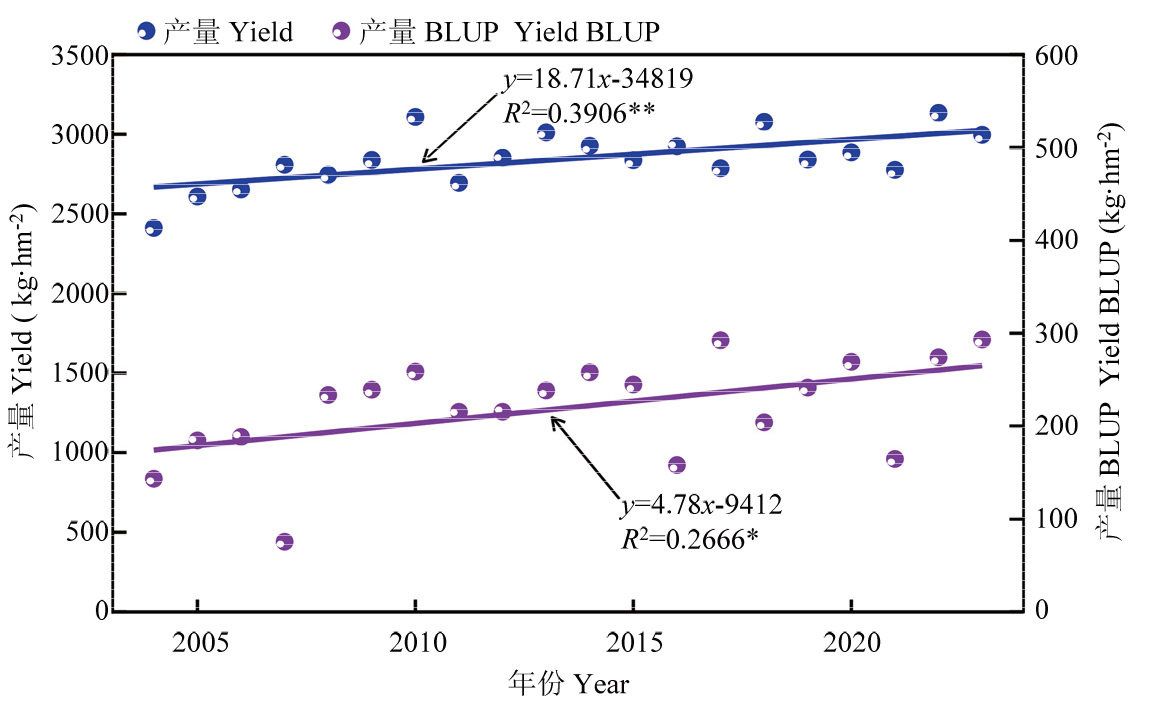
Fig. 1

Trends in actual yield and BLUP-based genetic yield of the highest-yielding rapeseed lines in the upper reaches of the Yangtze River (2004-2023) indicates *: P<0.05, **: P<0.01, ***: P<0.001; Values without asterisks are not significant (P≥0.05). The same as below"

Table 1

Statistical characteristics and coefficients of variation for major agronomic traits of the highest-yielding rapeseed lines in the upper reaches of the Yangtze River (2004-2023)"

年份
Year
菌核病
病指
Sclerotium index
株高
Plant height
(cm)
分枝数
Branching number
单株角果数
Silique number
per plant
每角粒数
Seed number per silique
千粒重
Thousand seeds weight (g)
单株产量
Yield per plant (g)
全生育期
Whole growth period (d)
硫甙含量
Glucosinolate content (µmol·g-1)
含油量
Oil content (%)
产量
Yield
(kg·hm-2)
2004 2.03 210.02 9.10 486.10 15.75 3.34 24.31 229.67 24.64 36.88 2411.50±152.39
2005 3.35 205.02 9.92 429.22 18.37 3.56 24.66 227.00 109.98 44.14 2608.83±168.98
2006 1.31 212.72 9.15 430.52 20.16 3.24 28.42 222.50 20.02 39.44 2653.33±132.24
2007 3.34 194.60 8.72 509.38 18.07 3.72 30.85 226.83 27.70 40.83 2808.33±135.13
2008 4.36 197.43 9.62 445.82 18.83 3.57 29.42 223.83 35.69 40.51 2745.83±121.48
2009 3.59 207.20 8.60 483.90 16.97 4.05 30.77 224.00 29.57 39.78 2838.83±131.54
2010 5.14 195.32 8.67 450.27 16.84 4.23 28.01 230.50 29.72 40.39 3108.67±167.14
2011 1.01 203.75 7.73 366.24 19.91 3.77 23.61 224.17 20.73 40.74 2694.83±199.79
2012 1.27 186.26 7.24 308.22 20.62 4.04 23.38 220.00 21.08 43.12 2852.80±215.20
2013 1.84 192.35 6.70 265.55 18.83 4.13 20.58 221.00 22.55 37.28 3011.50±251.33
2014 2.20 187.03 7.22 319.93 21.42 3.16 21.73 206.50 21.17 40.75 2927.40±180.34
2015 7.88 202.35 6.72 320.18 17.77 3.40 18.52 216.83 19.57 42.06 2837.17±233.09
2016 5.01 191.78 8.93 347.47 16.52 3.69 19.27 215.17 28.08 41.85 2924.17±283.79
2017 3.57 202.52 7.78 318.16 25.38 3.13 19.86 214.80 20.76 42.46 2786.40±150.37
2018 2.51 208.68 5.82 255.10 17.72 4.15 17.10 214.00 39.35 44.12 3078.33±196.57
2019 0.89 196.17 7.45 216.48 20.63 4.19 12.88 209.33 34.58 46.14 2841.17±177.64
2020 4.67 196.40 7.62 268.64 20.98 3.49 17.90 216.00 20.81 42.95 2886.00±132.45
2021 5.48 185.52 6.20 300.34 18.96 4.21 17.66 209.40 39.26 45.35 2776.60±117.67
2022 17.85 205.08 9.42 398.32 20.10 3.24 20.16 219.40 49.68 39.00 3134.80±422.14
2023 15.99 193.23 9.28 425.15 21.28 3.40 22.48 213.83 34.29 41.86 2996.50±238.17
平均值 Average 4.66 198.67 8.09 367.25 19.26 3.69 22.58 219.24 32.46 41.48 2846.15
最大值 Maximum 17.85 212.72 9.92 509.38 25.38 4.23 30.85 230.50 109.98 46.14 3134.80
最小值 Minimum 0.89 185.52 5.82 216.48 15.75 3.13 12.88 206.50 19.57 36.88 2411.50
标准差 STDEV 4.56 8.13 1.21 86.98 2.21 0.39 4.98 6.89 20.03 2.44 177.08
变异系数
CV (%)
97.81 4.09 14.89 23.68 11.49 10.48 22.04 3.14 61.70 5.87 6.22

Table 2

Annual changes in BLUP-estimated values of major agronomic traits of annually highest-yielding rapeseed lines in the upper reaches of the Yangtze River"

性状
Trait
斜率Slope
2004-2023 2004-2013 2014-2023
菌核病病指Sclerotium index 0.0090 -0.0746 0.0675
株高Plant height 0.0071 -0.4473 -0.2764
分枝数Branching number 0.0089 -0.0742* 0.0379
单株角果数Silique number per plant 0.9342* -3.7045** 1.7955**
每角粒数Seed number per silique -0.0215 0.0838 -0.2311
千粒重Thousand seeds weight -0.0129 0.0401* 0.0256
单株产量Yield per plant -0.0204 -0.0096 -0.0363
全生育期Whole growth period 0.0322 -0.2791* 0.2387**
硫甙含量Glucosinolate content -0.6253 -3.8843 1.9544
含油量Oil content 0.1496* 0.2122 0.2011
产量Yield 4.7836* 11.7442 5.6638

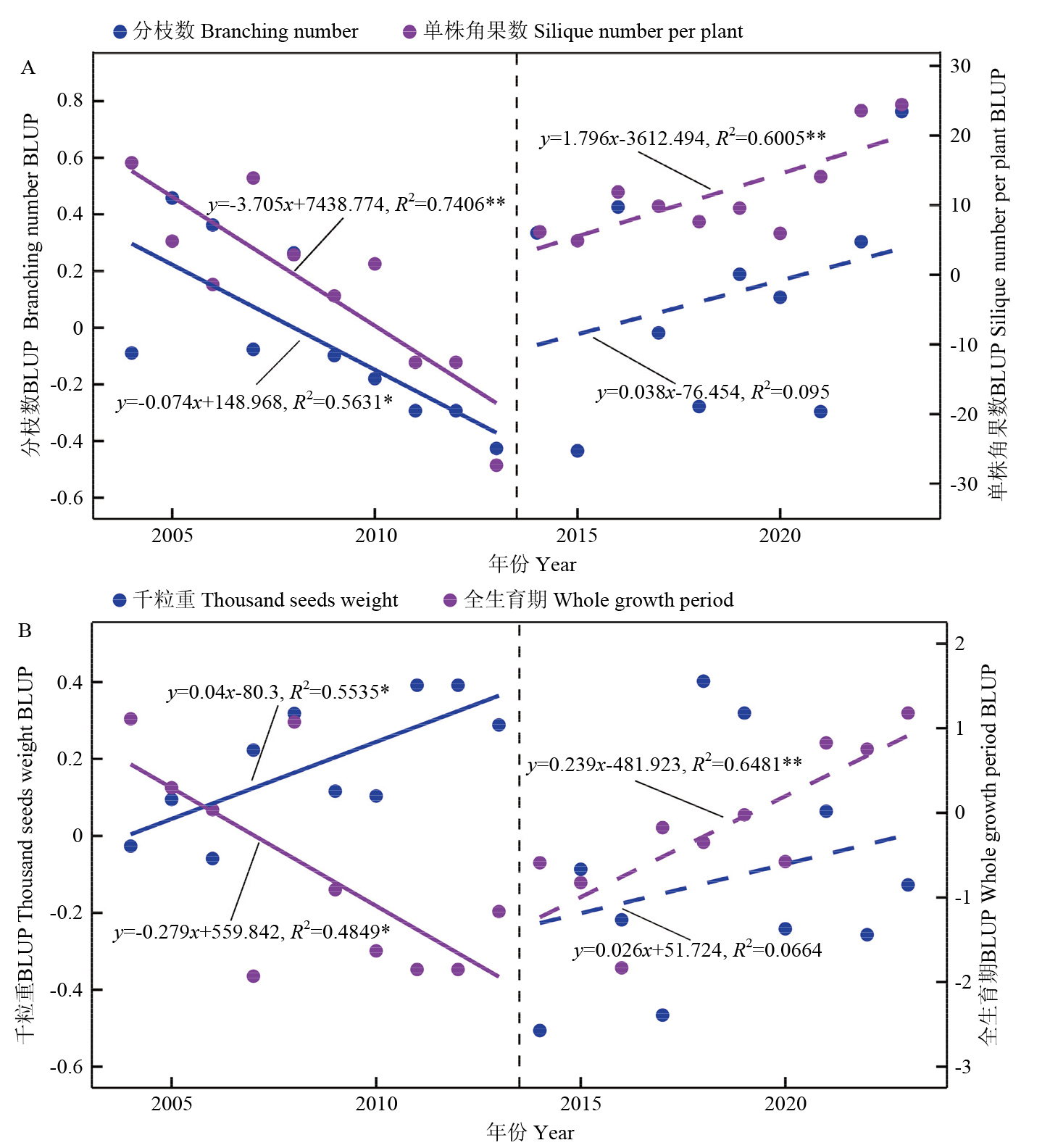
Fig. 2

Period-specific trends of BLUP-estimated important agronomic traits of annually highest-yielding rapeseed lines in the upper reaches of the Yangtze River (2004-2013 vs 2014-2023) A: Period-specific trends of branching number and silique number per plant BLUP; B: Period-specific trends of thousand seed weight and whole growth period BLUP. The vertical dashed line marks the 2013/2014 boundary"

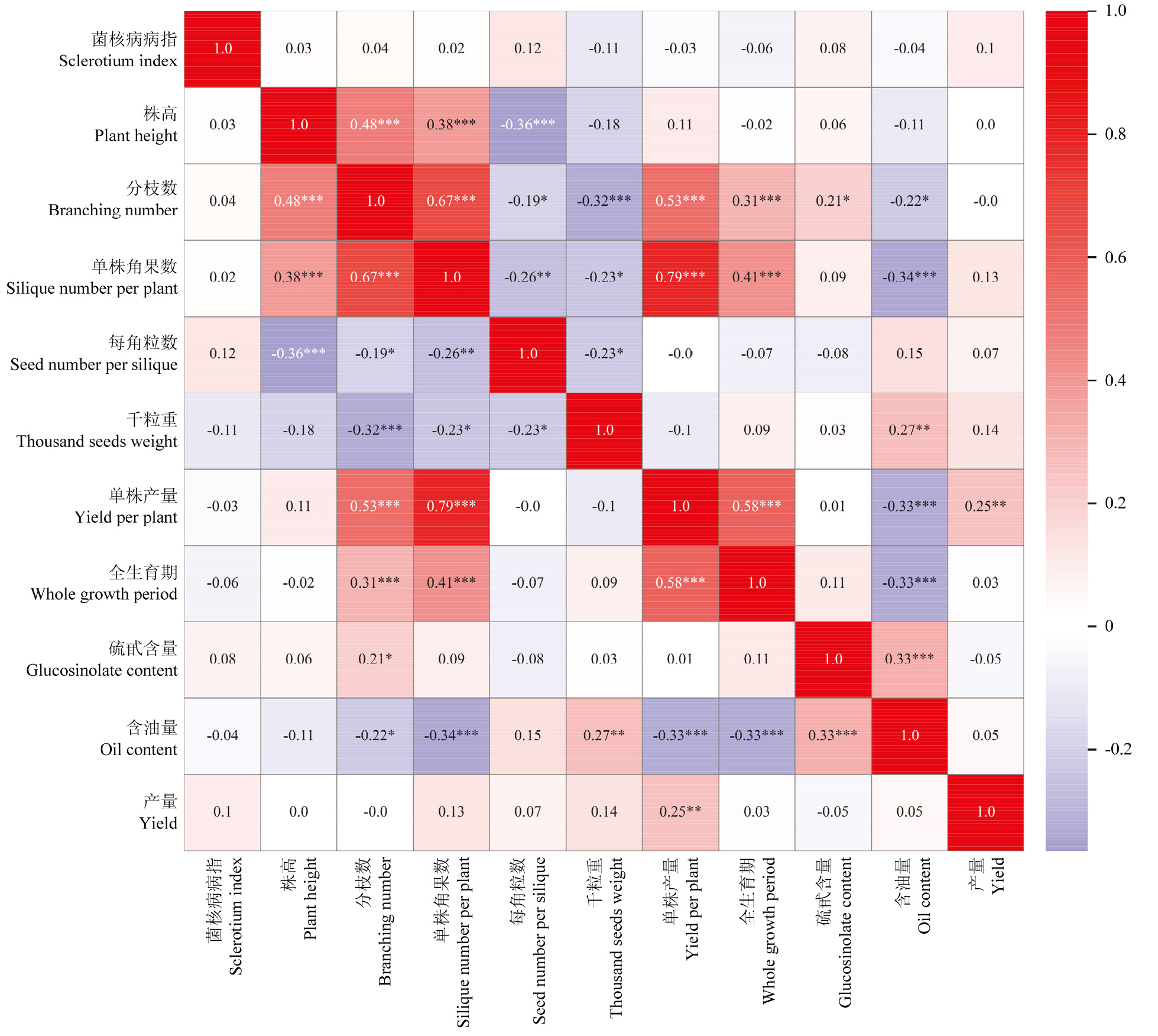
Fig. 3

Correlation analysis between major agronomic traits and yield of annually highest-yielding rapeseed lines in the upper reaches of the Yangtze River during 2004-2023"

Table 3

Path analysis between major agronomic traits and yield of annually highest-yielding rapeseed lines in the upper reaches of the Yangtze River during 2004-2023"

Table 4

Principal component analysis of major agronomic traits of annually highest-yielding rapeseed lines in the upper reaches of the Yangtze River during 2004-2023"

主成分
Principal component
特征值
Eigenvalue
贡献率
Contribution (%)
累计贡献率
Accumulative contribution rate (%)
PC1 3.21 29 29
PC2 1.47 13 42
PC3 1.41 13 55
PC4 1.30 12 67
PC5 1.09 10 76
PC6 0.86 8 84
PC7 0.54 5 89
PC8 0.46 4 93
PC9 0.32 3 96
PC10 0.30 3 99
PC11 0.12 1 100

Fig. 4

Principal component eigenvectors of 11 agronomic traits of annually highest-yielding rapeseed lines in the upper reaches of the Yangtze River"

[1]
王汉中. 以新需求为导向的油菜产业发展战略. 中国油料作物学报, 2018, 40(5): 613-617.

doi: 10.7505/j.issn.1007-9084.2018.05.001
WANG H Z. New-demand oriented oilseed rape industry developing strategy. Chinese Journal of Oil Crop Sciences, 2018, 40(5): 613-617. (in Chinese)
[2]
谢伶俐, 李永铃, 许本波, 张学昆. 油菜耐渍机理解析及遗传改良研究进展. 作物学报, 2025, 51(2): 287-300.

doi: 10.3724/SP.J.1006.2025.44121
XIE L L, LI Y L, XU B B, ZHANG X K. Progress on waterlogging tolerance mechanism and genetic improvement in rapeseed. Acta Agronomica Sinica, 2025, 51(2): 287-300. (in Chinese)

doi: 10.3724/SP.J.1006.2025.44121
[3]
宁宁, 莫娇, 胡冰, 李大双, 娄洪祥, 王春云, 白晨阳, 蒯婕, 汪波, 王晶, 等. 长江流域不同生态区油菜籽关键品质比较研究. 作物学报, 2023, 49(12): 3315-3327.

doi: 10.3724/SP.J.1006.2023.34017
NING N, MO J, HU B, LI D S, LOU H X, WANG C Y, BAI C Y, KUAI J, WANG B, WANG J, et al. Comparative study on the processing quality of winter rape in different ecological zones of the Yangtze River valley. Acta Agronomica Sinica, 2023, 49(12): 3315-3327. (in Chinese)

doi: 10.3724/SP.J.1006.2023.34017
[4]
JANNAT A, ISHIKAWA-ISHIWATA Y, FURUYA J. Does climate change affect rapeseed production in exporting and importing countries evidence from market dynamics syntheses. Sustainability, 2022, 14(10): 6051.

doi: 10.3390/su14106051
[5]
李谷成, 牛秋纯, 冷博峰, 丁逸飞, 童婷, 范丽霞. 新时代十年: 我国油菜产业发展与路径选择. 中国油料作物学报, 2024, 46(2): 228-235.

doi: 10.19802/j.issn.1007-9084.2023248
LI G C, NIU Q C, LENG B F, DING Y F, TONG T, FAN L X. The decade of rapeseed industry in the new era: Development and its path choice. Chinese Journal of Oil Crop Sciences, 2024, 46(2): 228-235. (in Chinese)
[6]
MOHAMED I A A, SHALBY N, EL-BADRI A M, AWAD-ALLAH E F A, BATOOL M, SALEEM M H, WANG Z K, WEN J, GE X H, XU Z H, et al. Multipurpose uses of rapeseed (Brassica napus L.) crop (food, feed, industrial, medicinal, and environmental conservation uses) and improvement strategies in China. Journal of Agriculture and Food Research, 2025, 20: 101794.

doi: 10.1016/j.jafr.2025.101794
[7]
殷艳, 廖星, 余波, 王汉中. 我国油菜生产区域布局演变和成因分析. 中国油料作物学报, 2010, 32(1): 147-151.
YIN Y, LIAO X, YU B, WANG H Z. Regional distribution evolvement and development tendency of Chinese rapeseed production. Chinese Journal of Oil Crop Sciences, 2010, 32(1): 147-151. (in Chinese)
[8]
谢雄泽, 谢捷, 褚乾梅, 尹羽丰, 余小红, 王盾, 冯鹏. 长江流域冬油菜需水量及水分盈亏特征分析. 作物学报, 2024, 50(7): 1829-1840.

doi: 10.3724/SP.J.1006.2024.34190
XIE X Z, XIE J, CHU Q M, YIN Y F, YU X H, WANG D, FENG P. Analysis of water requirement and water surplus/deficit characteristics of winter rapeseed in Yangtze River Basin. Acta Agronomica Sinica, 2024, 50(7): 1829-1840. (in Chinese)

doi: 10.3724/SP.J.1006.2024.34190
[9]
YU Z E, LUO L X, ZHANG F, HONG M Y, ZHANG X X, GUO R X. Evaluation of yield, stability and adaptability of national winter rapeseed regional trials in the Upper Yangtze River region in 2017-2018. Oil Crop Science, 2020, 5(3): 121-128.

doi: 10.1016/j.ocsci.2020.07.001
[10]
PIEPHO H P, MÖHRING J, MELCHINGER A E, BÜCHSE A. BLUP for phenotypic selection in plant breeding and variety testing. Euphytica, 2008, 161(1): 209-228.

doi: 10.1007/s10681-007-9449-8
[11]
HOBBY D, TONG H, HEUERMANN M, MBEBI A J, LAITINEN R A E, DELL’ACQUA M, ALTMANN T, NIKOLOSKI Z. Predicting plant trait dynamics from genetic markers. Nature Plants, 2025, 11(5): 1018-1027.

doi: 10.1038/s41477-025-01986-y pmid: 40247143
[12]
ZHUANG L, LIU H X, HOU J, JIAN C, LIU Y C, LI H F, XI W, ZHAO J, HAO P G, LIU S J, et al. Genetic improvement of important agronomic traits in Chinese wheat breeding over the past 70 years. BMC Plant Biology, 2024, 24(1): 1151.
[13]
SECK F, COVARRUBIAS-PAZARAN G, GUEYE T, BARTHOLOMÉ J. Realized genetic gain in rice: Achievements from breeding programs. Rice, 2023, 16(1): 61.

doi: 10.1186/s12284-023-00677-6 pmid: 38099942
[14]
KING K, FERELA A, VYN T J, TRIFUNOVIC S, EUDY D, HURBURGH C, LAMKEY K R, ARCHONTOULIS S V. Genetic gains in short-season corn hybrids: Grain yield, yield components, and grain quality traits. Crop Science, 2024, 64(2): 710-725.

doi: 10.1002/csc2.v64.2
[15]
ÅSTRAND J, ODILBEKOV F, VETUKURI R, CEPLITIS A, CHAWADE A. Leveraging genomic prediction to surpass current yield gains in spring barley. Theoretical and Applied Genetics, 2024, 137(12): 260.

doi: 10.1007/s00122-024-04763-1 pmid: 39503804
[16]
PATHY T L, MOHANRAJ K. Estimating best linear unbiased predictions (BLUP) for yield and quality traits in sugarcane. Sugar Tech, 2021, 23(6): 1295-1305.

doi: 10.1007/s12355-021-01011-4
[17]
ZORIĆ M, GUNJAČA J, GALIĆ V, JUKIĆ G, VARNICA I, ŠIMIĆ D. Best linear unbiased predictions of environmental effects on grain yield in maize variety trials of different maturity groups. Agronomy, 2022, 12(4): 922.

doi: 10.3390/agronomy12040922
[18]
常世豪, 耿臻, 杨青春, 舒文涛, 李金花, 李琼, 张保亮, 张东辉. 基于BLUP值的夏大豆产量与农艺性状的相关分析. 作物杂志, 2023(5): 10-15.
CHANG S H, GENG Z, YANG Q C, SHU W T, LI J H, LI Q, ZHANG B L, ZHANG D H. Correlation analysis of yield and agronomic traits of summer soybean based on BLUP value. Crops, 2023(5): 10-15. (in Chinese)
[19]
HABTEGEBRIEL M H. Adaptability and stability for soybean yield by AMMI and GGE models in Ethiopia. Frontiers in Plant Science, 2022, 13: 950992.

doi: 10.3389/fpls.2022.950992
[20]
PEZESHKPOUR P, KARIMIZADEH R, MIRZAEI A, BARZALI M. Analysis of yield stability of lentil genotypes using AMMI method. Journal of Crop Breeding, 2021, 13(37): 132-145.

doi: 10.52547/jcb.13.37.132
[21]
SUPRIADI D, BIMANTARA Y M, ZENDRATO Y M, WIDARYANTO E, KUSWANTO K, WALUYO B. Assessment of genotype by environment and yield performance of tropical maize hybrids using stability statistics and graphical biplots. PeerJ, 2024, 12: e18624.
[22]
OLIVOTO T, LÚCIO A D C, DA SILVA J A G, MARCHIORO V S, DE SOUZA V Q, JOST E. Mean performance and stability in multi-environment trials I: Combining features of AMMI and BLUP techniques. Agronomy Journal, 2019, 111(6): 2949-2960.

doi: 10.2134/agronj2019.03.0220
[23]
BOCIANOWSKI J, LIERSCH A. Multi-environmental evaluation of winter oilseed rape genotypic performance using mixed models. Euphytica, 2021, 217(5): 80.

doi: 10.1007/s10681-020-02760-1
[24]
LI Z J, WU W. Genotype recommendations for high performance and stability based on multiple traits selection across a multi-environment in rapeseed. European Journal of Agronomy, 2023, 145: 126787.

doi: 10.1016/j.eja.2023.126787
[25]
ZHANG H, WANG T, GU J W, HONG D F. Mutation of ERECTA homologous genes confers ideal plant architecture in Brassica napus. aBIOTECH, 2025, 6(2): 249-262.
[26]
ZHAO C J, CUI X B, XIE M L, ZHANG Y, ZENG L Y, HUANG J Y, ZHANG X, TONG C B, HU Q, et al. Chromosome-scale genome assembly-assisted identification of Brassica napus BnDCPA1 for improvement of plant architecture and yield heterosis. Plant Communications, 2024, 5(7): 100854.

doi: 10.1016/j.xplc.2024.100854
[27]
LIU S Y, RAMAN H, XIANG Y, ZHAO C J, HUANG J Y, ZHANG Y Y. De novo design of future rapeseed crops: Challenges and opportunities. The Crop Journal, 2022, 10(3): 587-596.

doi: 10.1016/j.cj.2022.05.003
[28]
LI Q, LUO T, CHENG T, YANG S T, SHE H J, LI J, WANG B, KUAI J, WANG J, XU Z H, ZHOU G S. Evaluation and screening of rapeseed varieties (Brassica napus L.) suitable for mechanized harvesting with high yield and quality. Agronomy, 2023, 13(3): 795.

doi: 10.3390/agronomy13030795
[29]
GU J W, CHEN J Y, XIA J, HONG D F. BnaUBP15s positively regulates seed size and seed weight in Brassica napus. Oil Crop Science, 2023, 8(3): 149-155.
[30]
RABOANATAHIRY N, CHAO H B, HOU D L, PU S, YAN W, YU L J, WANG B S, LI M T. QTL alignment for seed yield and yield related traits in Brassica napus. Frontiers in Plant Science, 2018, 9: 1127.
[31]
NIU K X, CHANG C Y, ZHANG M Q, GUO Y T, YAN Y, SUN H J, ZHANG G L, LI X M, GONG Y L, DING C H, et al. Suppressing ASPARTIC PROTEASE 1 prolongs photosynthesis and increases wheat grain weight. Nature Plants, 2023, 9(6): 965-977.

doi: 10.1038/s41477-023-01432-x
[32]
CROCE R, CARMO-SILVA E, CHO Y B, ERMAKOVA M, HARBINSON J, LAWSON T, MCCORMICK A J, NIYOGI K K, ORT D R, PATEL-TUPPER D, et al. Perspectives on improving photosynthesis to increase crop yield. The Plant Cell, 2024, 36(10): 3944-3973.

doi: 10.1093/plcell/koae132 pmid: 38701340
[33]
张天宇, 刘丽君, 杨刚, 武军艳, 蒲媛媛, 马骊, 王旺田, 路晓明, 马愿强, 孙万仓. 2006—2022年北方白菜型冬油菜农艺性状遗传增益分析. 中国农业科学, 2025, 58(11): 2081-2095. doi: 10.3864/j.issn.0578-1752.2025.11.003.
ZHANG T Y, LIU L J, YANG G, WU J Y, PU Y Y, MA L, WANG W T, LU X M, MA Y Q, SUN W C. Genetic gain analysis of agronomic traits of Brassica rapa L. in northern China from 2006 to 2022. Scientia Agricultura Sinica, 2025, 58(11): 2081-2095. doi: 10.3864/j.issn.0578-1752.2025.11.003. (in Chinese)
[34]
RADIC V, BALALIC I, KRSTIC M, MARJANOVIC-JEROMELA A. Correlation and path analysis of yield and yield components in winter rapeseed. ABI Genetika, 2021, 53(1): 157-166.
[35]
SADAT HASHEMI P, MOHAMMADI A, ALIZADEH B, MOSTAFAVI K, AMIRI OGHAN H. Simultaneous selection of oil yield and other agronomic characteristics in winter rapeseed hybrids. Journal of Crop Breeding, 2023, 15(45): 60-68.

doi: 10.61186/jcb.15.45.60
[36]
PAL L, SANDHU S K, BHATIA D, SETHI S. Genome-wide association study for candidate genes controlling seed yield and its components in rapeseed (Brassica napus subsp. napus). Physiology and Molecular Biology of Plants, 2021, 27(9): 1933-1951.

doi: 10.1007/s12298-021-01060-9
[37]
JAN S A, SHINWARI Z K, SHINWARI A K, IQBAL A, HUSSAIN Z. Multivariate analysis of yield related traits in Brassica rapa germplasm. Pakistan Journal of Botany, 2024, 56(4): 1491-1495.
[38]
王贺亚, 孟玲, 李怀胜, 艾海峰, 贾东海. 塔额垦区甘蓝型油菜主要性状与产量的相关性及通径分析. 种子, 2023, 42(4): 127-132.
WANG H Y, MENG L, LI H S, AI H F, JIA D H. Correlation and path analysis of the main traits and yields of Brassica napus L. in Ta’erken area. Seed, 2023, 42(4): 127-132. (in Chinese)
[39]
尚丽平, 赵卫国, 郭凯红, 张立坚, 罗斌, 赵亚军, 王灏. 甘蓝型油菜主要农艺性状的主成分分析. 中国农学通报, 2021, 37(28): 9-13.

doi: 10.11924/j.issn.1000-6850.casb2020-0808
SHANG L P, ZHAO W G, GUO K H, ZHANG L J, LUO B, ZHAO Y J, WANG H. Principal component analysis of main agronomic traits in Brassica napus population. Chinese Agricultural Science Bulletin, 2021, 37(28): 9-13. (in Chinese)
[40]
郑本川, 张锦芳, 蒋俊, 崔成, 柴靓, 黄友涛, 周正鉴, 李浩杰, 蒋梁材. 不同熟期“川油”系列甘蓝型油菜品种主要性状与产量的相关分析. 中国农学通报, 2022, 38(7): 7-17.

doi: 10.11924/j.issn.1000-6850.casb2021-0430
ZHENG B C, ZHANG J F, JIANG J, CUI C, CHAI L, HUANG Y T, ZHOU Z J, LI H J, JIANG L C. Correlation analysis of main traits and yield of Brassica napus ‘Chuanyou’ Varieties with different maturity stages. Chinese Agricultural Science Bulletin, 2022, 38(7): 7-17. (in Chinese)
[41]
LI F, CHEN B Y, XU K, GAO G Z, YAN G X, QIAO J W, LI J, LI H, LI L X, XIAO X, et al. A genome-wide association study of plant height and primary branch number in rapeseed (Brassica napus). Plant Science, 2016, 242: 169-177.

doi: S0168-9452(15)00137-5 pmid: 26566834
[42]
SHAH S, KARUNARATHNA N L, JUNG C, EMRANI N. An APETALA1 ortholog affects plant architecture and seed yield component in oilseed rape (Brassica napus L.). BMC Plant Biology, 2018, 18(1): 380.

doi: 10.1186/s12870-018-1606-9
[43]
QUAN Y J, LIU H D, LI K X, XU L, ZHAO Z G, XIAO L, YAO Y M, DU D Z. Genome-wide association study reveals genetic loci for seed density per silique in rapeseed (Brassica napus L.). Theoretical and Applied Genetics, 2025, 138(4): 80.

doi: 10.1007/s00122-025-04857-4
[44]
WANG X D, CHEN L, WANG A N, WANG H, TIAN J H, ZHAO X P, CHAO H B, ZHAO Y J, ZHAO W G, XIANG J, et al. Quantitative trait loci analysis and genome-wide comparison for silique related traits in Brassica napus. BMC Plant Biology, 2016, 16: 71.
[45]
ZHANG C P, GONG R L, ZHONG H, DAI C Y, ZHANG R, DONG J G, LI Y S, LIU S, HU J H. Integrated multi-locus genome-wide association studies and transcriptome analysis for seed yield and yield-related traits in Brassica napus. Frontiers in Plant Science, 2023, 14: 1153000.
[46]
HE Y H, ZHANG Z R, XU Y P, CHEN S Y, CAI X Z. Genome-wide identification of rapid alkalinization factor family in Brassica napus and functional analysis of BnRALF 10 in immunity to Sclerotinia sclerotiorum. Frontiers in Plant Science, 2022, 13: 877404.
[47]
LIN G B, WANG L, LI Y Y, LI J, QIAN C, ZHANG X, ZUO Q S. Optimal planting density increases the seed yield by improving biomass accumulation and regulating the canopy structure in rapeseed. Plants, 2024, 13(14): 1986.

doi: 10.3390/plants13141986
[48]
LUO Y Q, JIANG H Y, HU Y, LIU L, GHAFFOR K, JAVED H H, PENG X, GUO X, WU Y C. Effects of nitrogen application and planting density interaction on the silique-shattering resistance and yield of direct-seeding rapeseed (Brassica napus L.) in Sichuan. Agronomy, 2024, 14(7): 1437.
[49]
吴亚军, 李莓, 汤松, 陈于婷, 张莹莹, 徐劲松, 许本波, 张哲, 张学昆. 影响我国油菜主栽品种推广面积的因素分析. 中国油料作物学报, 2025: 1-8. https://link.cnki.net/doi/10.19802/j.issn.1007-9084.2025008.
WU Y J, LI M, TANG S, CHEN Y T, ZHANG Y Y, XU J S, XU B B, ZHANG Z, ZHANG X K. Analysis of factors affecting the popularization area of main rape cultivars in China. Chinese Journal of Oil Crop Sciences, 2025: 1-8. https://link.cnki.net/doi/10.19802/j.issn.1007-9084.2025008. (in Chinese)
[1] YANG Long, ZHANG XueKun, CHEN AiWu, LI Mei, CHENG Tai, MA WuHui, XU BenBo, XU JinSong. Effects of Variety, Over-Winter Regulation, and Pest and Disease Control on Rapeseed Yield [J]. Scientia Agricultura Sinica, 2025, 58(21): 4333-4345.
[2] ZHAO Jian, REN Tao, FANG YaTing, YANG Xin, SHENG QianNan, LI XiaoKun, ZHU Jun, LU JianWei. Effect of Nitrogen Application on Organic Nitrogen Mineralization Functional Genes in Rapeseed and Wheat Rhizosphere Soils Under Different Rotation Patterns [J]. Scientia Agricultura Sinica, 2025, 58(19): 3919-3931.
[3] WANG AnXin, FANG YaTing, DUN Qian, WU YongQing, LIAO ShiPeng, LI XiaoKun, REN Tao, LU ZhiFeng, CONG RiHuan, LU JianWei. Effects of Direct and Biochar-Based Straw Incorporation on Crop Yield and Nitrogen Uptake and Utilization in a Rice-Rapeseed Rotation System [J]. Scientia Agricultura Sinica, 2025, 58(16): 3280-3292.
[4] XIONG ZhiHao, LIU JunQuan, YE Lin, ZHU DanDan, HOU SuSu, FANG YaTing, CONG RiHuan, REN Tao, LI XiaoKun, LU JianWei. Characterization of Crop Yield and Nutrient Apparent Balance Between Direct and Burning Straw Return in Rice-Rapeseed Rotation System [J]. Scientia Agricultura Sinica, 2025, 58(16): 3293-3303.
[5] FANG YaTing, ZHAO Jian, SHENG QianNan, LI KaiXu, WANG XiangHua, ZHANG YangYang, ZHU Jun, CONG RiHuan, LU ZhiFeng, LI XiaoKun, REN Tao, LU JianWei. Effects of Long-Term Chemical Fertilizer and Organic Material Application on Crop Yield and Nutrient Utilization in Rice-Rapeseed Rotation System [J]. Scientia Agricultura Sinica, 2025, 58(16): 3164-3177.
[6] BU RongYan, CHENG WenLong, WU Ji, TANG Shan, LI Min, LU JianWei, JI GenXue, WANG Hui, ZHU Rui, JIANG FaHui, TANG MengMeng, HAN Shang. Organic-Inorganic Fertilization Application and Deep Tillage Enhance Productivity and Nutrient Use Efficiency in Rice-Rapeseed Rotations [J]. Scientia Agricultura Sinica, 2025, 58(16): 3178-3189.
[7] MENG ZiZhen, REN Tao, LIU Chen, WANG KunKun, LIAO ShiPeng, LI XiaoKun, CONG RiHuan, LU ZhiFeng, FANG YaTing, LU JianWei. Balanced Application of Nitrogen, Phosphorus and Potassium Fertilizer in Rice-Rapeseed Rotation System Improves Crop Yield and Nutrient Utilization [J]. Scientia Agricultura Sinica, 2025, 58(16): 3190-3200.
[8] DONG YunQi, HUANG Jian, CHAI YiXiao, YANG ShiChao, WANG Min, MENG XuSheng, GUO ShiWei. Changes in Annual Yield and Soil Fertility of Rice-Rapeseed Rotation Under Different Fertilization Modes [J]. Scientia Agricultura Sinica, 2025, 58(16): 3201-3219.
[9] FANG Wen, LIU JunQuan, CUI Xin, LIU AiHua, FANG YaTing, CONG RiHuan, LU ZhiFeng, LI XiaoKun, REN Tao, LU JianWei. Characteristics of Crop Yield, Stability and Nitrogen Utilization in Rice-Rapeseed Rotation System Under Different Nitrogen Application Rates [J]. Scientia Agricultura Sinica, 2025, 58(16): 3220-3232.
[10] LIU Chen, FANG YaTing, REN Tao, WANG KunKun, REN YuFang, MENG ZiZhen, LIAO ShiPeng, LU JianWei. The Impact of Annual Nitrogen Fertilizer Management on Crop Yield and Nitrogen Utilization in Rice-Rapeseed Rotation System [J]. Scientia Agricultura Sinica, 2025, 58(16): 3233-3244.
[11] GAO ZiYi, WU HaiYa, LIU JunQuan, CUI Xin, LIU AiHua, FANG YaTing, REN Tao, LI XiaoKun, LU JianWei. Characteristics of Potassium Utilization and Crop Yield Formation in Rice-Rapeseed Rotation System Under Different Potassium Fertilizer Application Rates [J]. Scientia Agricultura Sinica, 2025, 58(16): 3245-3255.
[12] YE XiaoLei, TIAN GuiSheng, LIU JunQuan, GENG GuoTao, FANG YaTing, REN Tao, LI XiaoKun, CONG RiHuan, LU ZhiFeng, LU JianWei. Magnesium Fertilization Effects and Application Recommendations in the Rice-Rapeseed Rotation System [J]. Scientia Agricultura Sinica, 2025, 58(16): 3256-3266.
[13] HUO RunXia, FANG YaTing, ZHANG YanKe, WU HaiYa, LIU GuiSheng, LI XiaoKun, REN Tao, LU ZhiFeng, CONG RiHuan, LU JianWei. Effects of Fertilizer Reduction on Crop Yield and Soil Fertility Under Long-Term Straw-Return Conditions in Rice-Rice-Rapeseed Rotations [J]. Scientia Agricultura Sinica, 2025, 58(16): 3267-3279.
[14] ZHENG MinHua, CHEN Luo, XING JiaLe, XIE YueLan, JIANG XianYa, NIE Shuai, CAI FuGe, WU HaoXiang, LU ZhanHua, SUN Wei, HUO Xing, BAI Song, ZHAO JunLiang, YANG Wu. Genome-Wide Association Study and Genetic Improvement Study of Rice Blast Resistance [J]. Scientia Agricultura Sinica, 2025, 58(14): 2707-2719.
[15] HE YongQiang, ZHANG JinKui, XU JinSong, DING XiaoYu, CHENG Yong, XU BenBo, ZHANG XueKun. Effect of 14-Hydroxylated Brassinosteroids Growth Regulator on Growth and Yield of Rapeseed [J]. Scientia Agricultura Sinica, 2024, 57(8): 1444-1454.
Viewed
Full text


Abstract

Cited

  Shared   
  Discussed   
No Suggested Reading articles found!