Scientia Agricultura Sinica ›› 2026, Vol. 59 ›› Issue (14): 3056-3069.doi: 10.3864/j.issn.0578-1752.2026.14.005

• TILLAGE & CULTIVATION·PHYSIOLOGY & BIOCHEMISTRY·AGRICULTURE INFORMATION TECHNOLOGY • Previous Articles     Next Articles

Effects of Maize-Soybean Ridge-Furrow Intercropping on Crop Yield and Water Use in Semiarid Regions

ZHANG XinBo1(), FAN Zhen1, WU YuLin1, WANG JiaHao1, LUO Xuan1, LIN YanRong1, QIANG BinBin1, REN XiaoLong1, CHEN XiaoLi1,2()   

  1. 1 College of Agronomy, Northwest A&F University, Yangling 712100, Shaanxi
    2 Key Laboratory of Crop Physio-Ecology and Tillage Science in Northwestern Loess Plateau, Ministry of Agriculture and Rural Affairs, Yangling 712100, Shaanxi
  • Received:2025-12-01 Accepted:2026-04-15 Online:2026-07-16 Published:2026-07-21
  • Contact: CHEN XiaoLi

Abstract:

【Objective】Aiming at the low water use efficiency in rain-fed farmlands of the semi-arid region in Northwest China, this study explored the effects of ridge-furrow intercropping (RFIC) of maize and soybean on soil hydrothermal conditions, crop yield and water utilization, and clarified its advantages in optimizing crop growing environments and improving water use efficiency.【Method】A two-year consecutive located field experiment was conducted from 2023 to 2024 in Yangling, Shaanxi, a typical rain-fed agricultural area in the semi-arid zone of Northwest China. Four planting patterns were set up, including sole maize (SM), sole soybean (SS), conventional intercropping with a maize-soybean row ratio of 2:4 (IC), and ridge-furrow intercropping (RFIC), where maize was planted in furrows and soybean on ridges with the same row ratio as IC. Soil temperature, soil water content, soil evaporation, crop photosynthetic physiology, leaf area index (LAI) and dry matter accumulation were measured during the growing period. Grain yield was determined at harvest. Land equivalent ratio (LER), water use efficiency (WUE) and water equivalent ratio (WER) were calculated to comprehensively evaluate the performance of different planting patterns in crop production and water utilization.【Result】Compared with IC, RFIC significantly increased maize LAI (by 8.5%), net photosynthetic rate (by 7.2%), and dry matter accumulation (by 10.4%). Relative to SM and SS, RFIC significantly increased maize yield without causing a significant reduction in soybean yield. The LER ranged from 1.14 to 1.18, indicating improved land-use efficiency under RFIC. By reshaping surface microtopography, RFIC reduced non-productive evaporation; during the maize jointing stage, soil water content in the 0-20 cm layer under RFIC was significantly higher than that under IC by 11.2% and 6.8% in 2023 and 2024, respectively. Although RFIC did not reduce total water consumption, WUE increased by 7.9%-9.2% relative to IC. Over the two years, the WER ranged from 1.06 to 1.18, demonstrating more effective water use under RFIC.【Conclusion】Overall, compared with IC, RFIC created a more favorable early-season growth environment by reducing surface-layer evaporation and improving the thermal regime during early growth stages. Under RFIC, maize-having a competitive advantage-achieved higher yield, while interspecific competitive suppression of soybean was alleviated, thereby enhancing overall land-use efficiency. Given the increasing global constraints on land and water resources, RFIC showed promise for optimizing cropping systems and promoting sustainable agricultural development in Northwest China.

Key words: ridge-furrow planting, maize-soybean intercropping, water-use efficiency, yield, land equivalent ratio

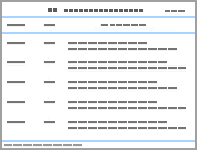
Table 1

Basic physical and chemical properties of soil"

土壤层
Soil layer
(cm)
有机质
Organic matter
(g·kg-1)
总氮
Total nitrogen
(g·kg-1)
速效氮
Available nitrogen
(mg·kg-1)
总磷
Total phosphorus
(g·kg-1)
速效钾
Available potassium
(mg·kg-1)
土壤容重
Soil bulk density
(g·cm-3)
pH
0—20 12.22 1.29 49.20 1.13 107.57 1.35 8.25
20—40 12.88 1.23 50.73 1.16 102.18 1.40 8.06
40—60 12.48 1.15 43.43 1.07 73.22 1.46 8.55
60—80 11.90 1.15 40.28 1.07 70.00 1.60 8.96
80—100 10.23 1.09 34.04 0.99 82.10 1.68 8.23

Fig. 1

Diagram of different maize-soybean planting patterns SM: Sole maize; SS: Sole soybean; IC: Maize-soybean intercropping; RFIC: Maize-soybean ridge-furrow intercropping. The orange cylinder indicates the soil sampling point for soil constituents. The same as below"

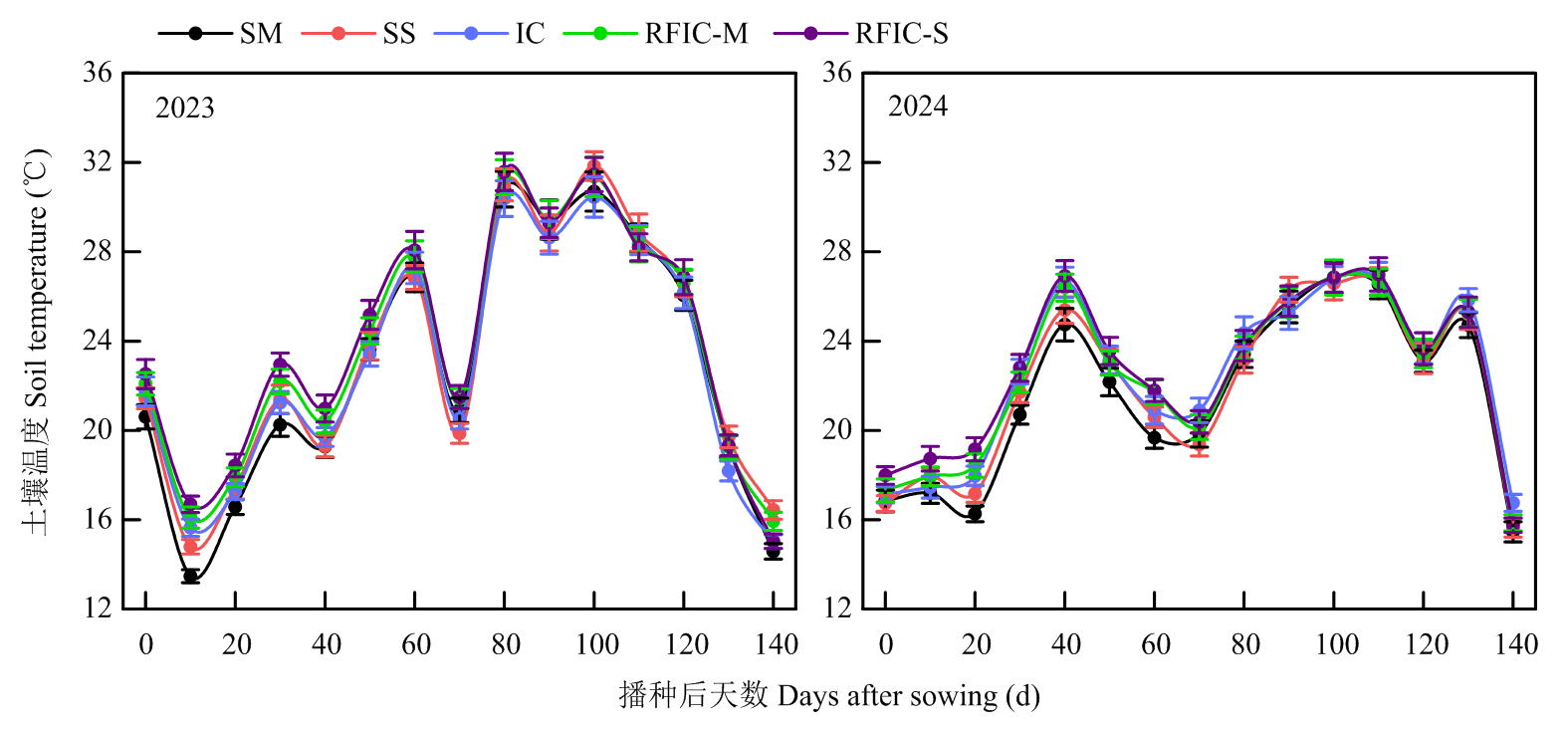
Fig. 2

Effects of different planting patterns on soil temperature in 2023-2024 The bars showed the least significant difference at 5% leaves. The same as below"

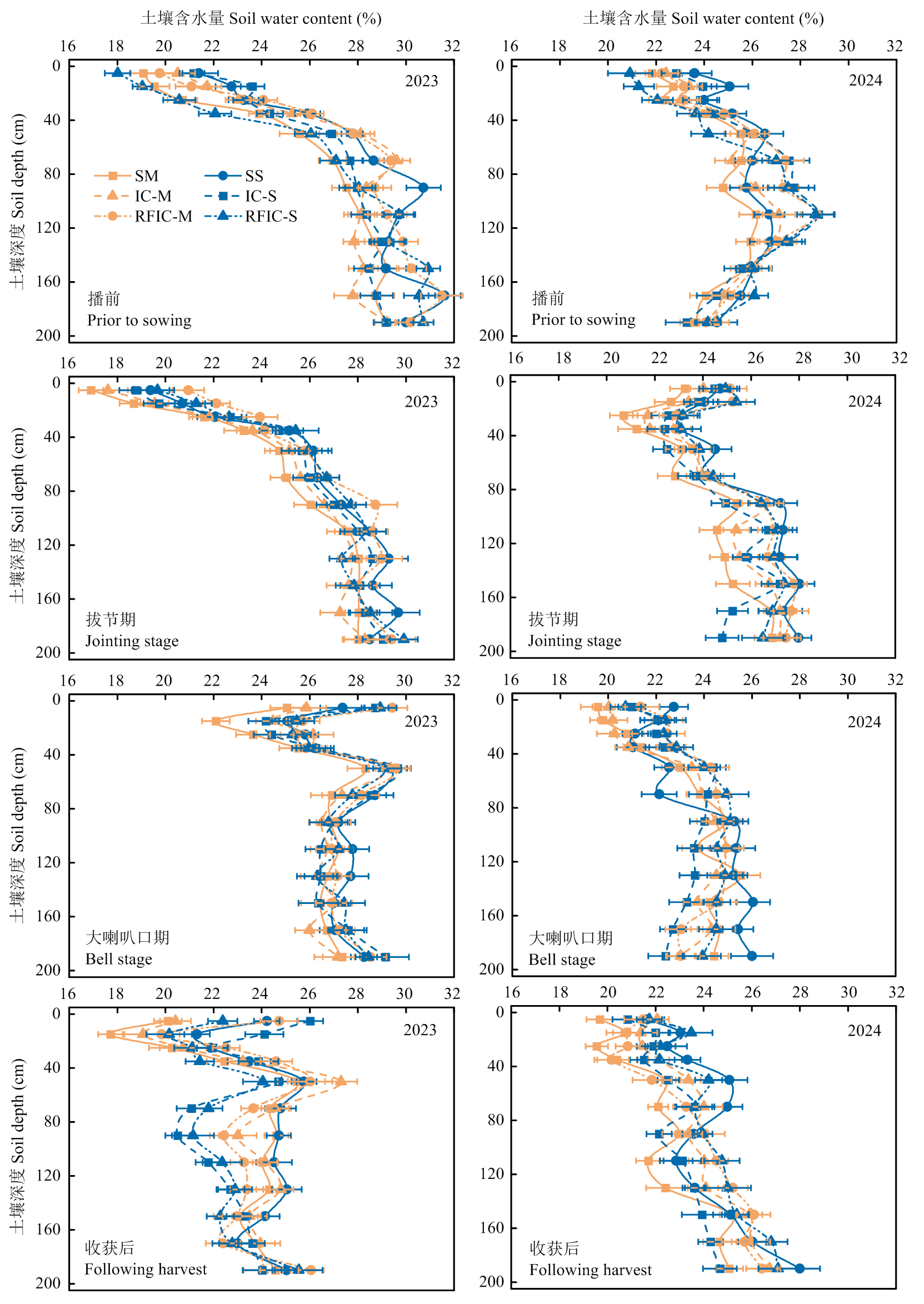
Fig. 3

Effects of different planting patterns on soil water content in 2023-2024"

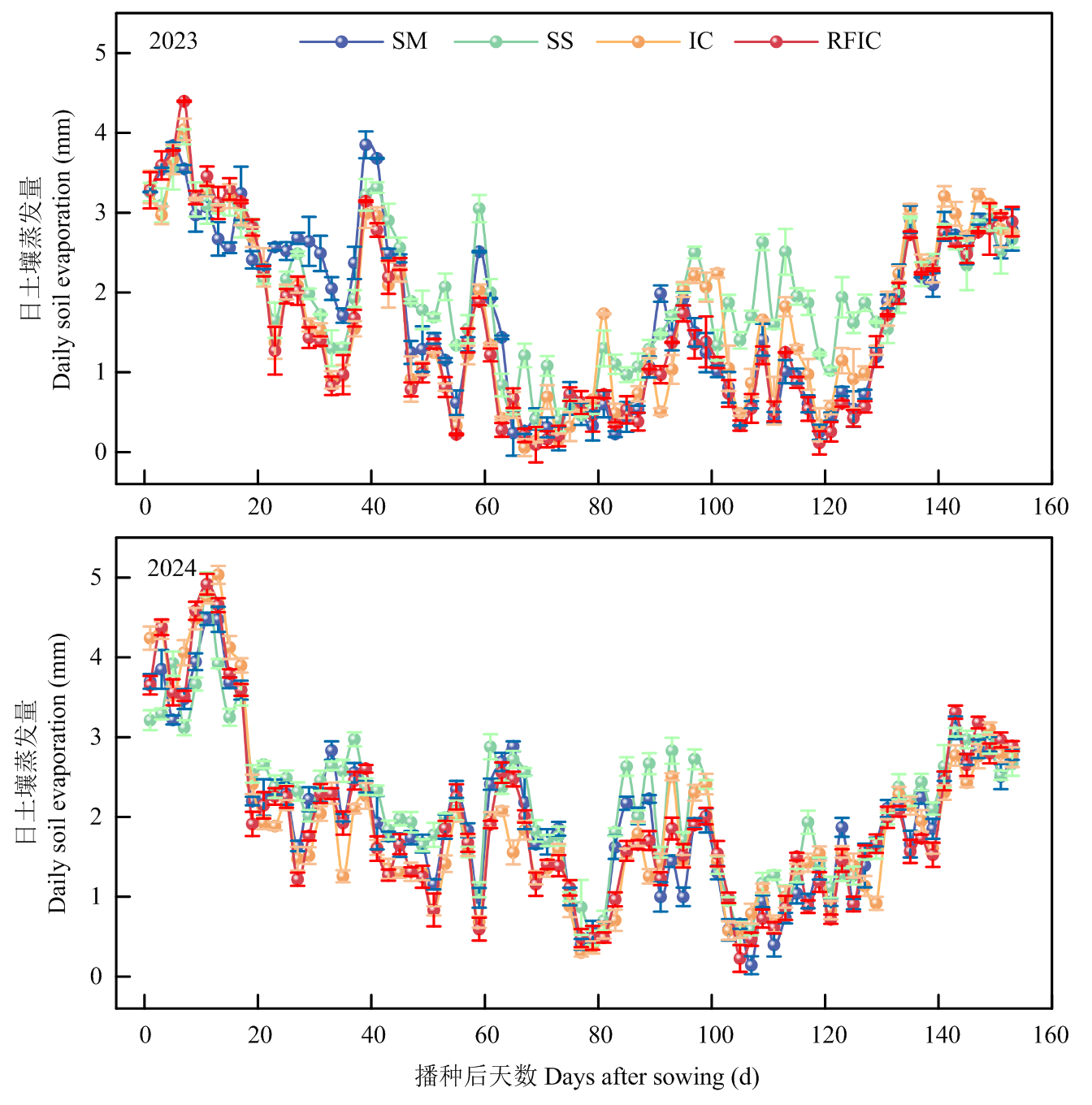
Fig. 4

Average daily soil evaporation of various planting modes in 2023-2024"

Table 2

Daily evaporation at different growth periods in 2023-2024 (mm·d-1)"

年份
Year
处理
Treatment
生育时期 Growth period
播种 Sow—V1 V1—V6 V6—V12 V12—R1 R1—R6 E/ET
2023 SM 3.18±0.31a 2.22±0.25a 0.70±0.06b 1.09±0.10b 1.79±0.04b 0.48±0.04a
SS 3.30±0.27a 2.13±0.13ab 1.03±0.05a 1.80±0.19a 2.14±0.05a 0.52±0.02a
IC 3.34±0.17a 1.71±0.16b 0.70±0.03b 1.33±0.11b 2.00±0.07ab 0.46±0.03a
RFIC 3.51±0.18a 1.71±0.14b 0.57±0.07b 1.00±0.05b 1.74±0.03b 0.41±0.05a
2024 SM 3.85±0.18b 2.12±0.22a 1.65±0.14a 1.71±0.14a 1.98±0.04a 0.51±0.01ab
SS 3.66±0.35b 2.29±0.31a 1.76±0.12a 1.62±0.16a 2.11±0.04a 0.56±0.03a
IC 4.32±0.21a 1.81±0.22b 1.23±0.07b 1.38±0.11b 1.95±0.05a 0.48±0.02ab
RFIC 4.13±0.12ab 1.92±0.21ab 1.35±0.14b 1.23±0.13b 1.90±0.02a 0.44±0.05b

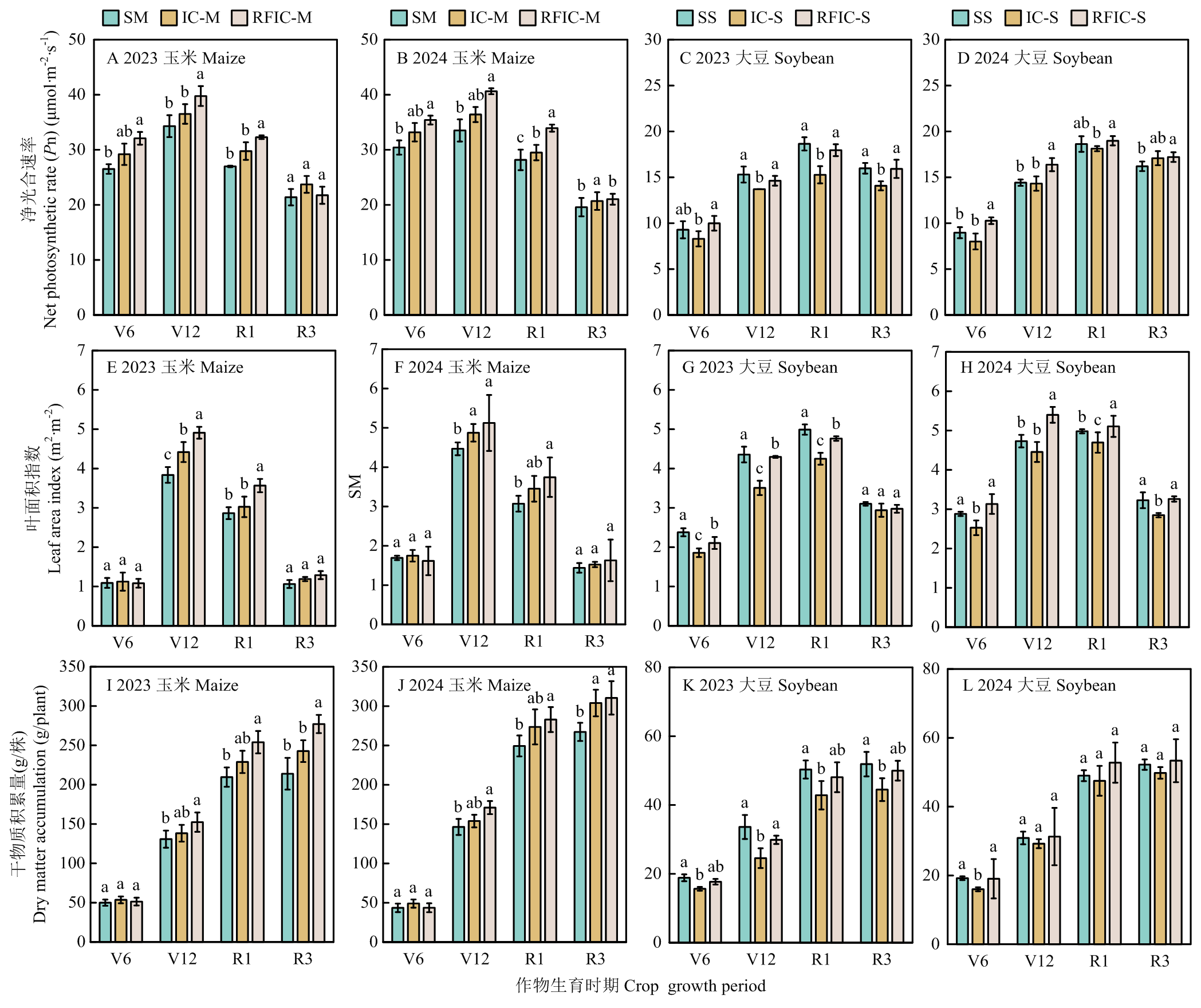
Fig. 5

Effects of different planting patterns on net photosynthetic rate, leaf area index and dry matter accumulation in 2023-2024"

Table 3

Grain yields and land equivalent ratio of maize and soybean for different cropping systems in 2023-2024"

年份
Year
种植模式
Planting pattern
籽粒产量 Grain yield (kg·hm-2) 总产量
Total Yield (kg·hm-2)
偏土地当量比 Partial LER 总土地当量比
Total LER
玉米 Maize 大豆 Soybean 玉米 Maize 大豆 Soybean
2023 SM 9327.1±154.8c
SS 2238.6±261.5a
IC 10905.6±423.6b 2058.8±167.4b 6128.5±115.1b 0.53±0.02b 0.50±0.16b 1.03±0.00b
RFIC 11946.7±282.3a 2292.0±263.7a 6733.2±177.7a 0.58±0.03a 0.55±0.02a 1.14±0.02a
2024 SM 10695.2±436.6c
SS 2650.1±455.1
IC 13209.5±304.1b 2612.5±251.2a 7595.2±144.2b 0.57±0.13b 0.54±0.01b 1.11±0.02b
RFIC 13972.3±353.0a 2918.8±367.5a 8000.5±125.9a 0.60±0.02a 0.57±0.14a 1.17±0.00a
P 年份 Year (Y) 0.001** 0.000*** 0.000*** 0.019** 0.000*** 0.000***
处理 Treatment (T) 0.000*** 0.001** 0.002** 0.002** 0.003** 0.001**
年份×处理 Y×T 0.241ns 0.045** 0.513ns 0.647ns 0.373ns 0.122ns

Table 4

Water use efficiency and water equivalent ratio of maize and soybean for different planting patterns in 2023-2024"

年份
Year
种植模式
Planting pattern
水分利用效率 WUE (kg·hm-2·mm-1) 偏水分当量比 Partial WER 总水分当量比
Total WER
玉米 Maize 大豆 Soybean 总计 Total 玉米 Maize 大豆 Soybean
2023
SM 17.80±0.29a
SS 4.42±0.12a
IC 9.763±0.28b 2.23±0.07b 11.96±0.22b 0.53±0.027b 0.46±0.015b 1.00±0.008b
RFIC 10.44±0.33b 2.49±0.06b 12.74±0.33a 0.56± 0.031a 0.49±0.013a 1.06±0.037a
2024
SM 18.32±0.74a
SS 4.65±0.09a
IC 10.21±0.23c 2.67±0.04b 12.89±0.24b 0.56±0.022b 0.58±0.010b 1.11±0.029b
RFIC 11.13±0.27b 2.81±0.06b 13.85±0.21a 0.60± 0.026a 0.52±0.013a 1.18±0.003a
P 年份 Year (Y) 0.041** 0.000*** 0.002** 0.008** 0.000*** 0.000***
处理 Treatment (T) 0.000*** 0.001** 0.790ns 0.827ns 0.668ns 0.529ns
年份×处理 Y×T 0.914ns 0.186ns 0.000*** 0.002** 0.003** 0.000***

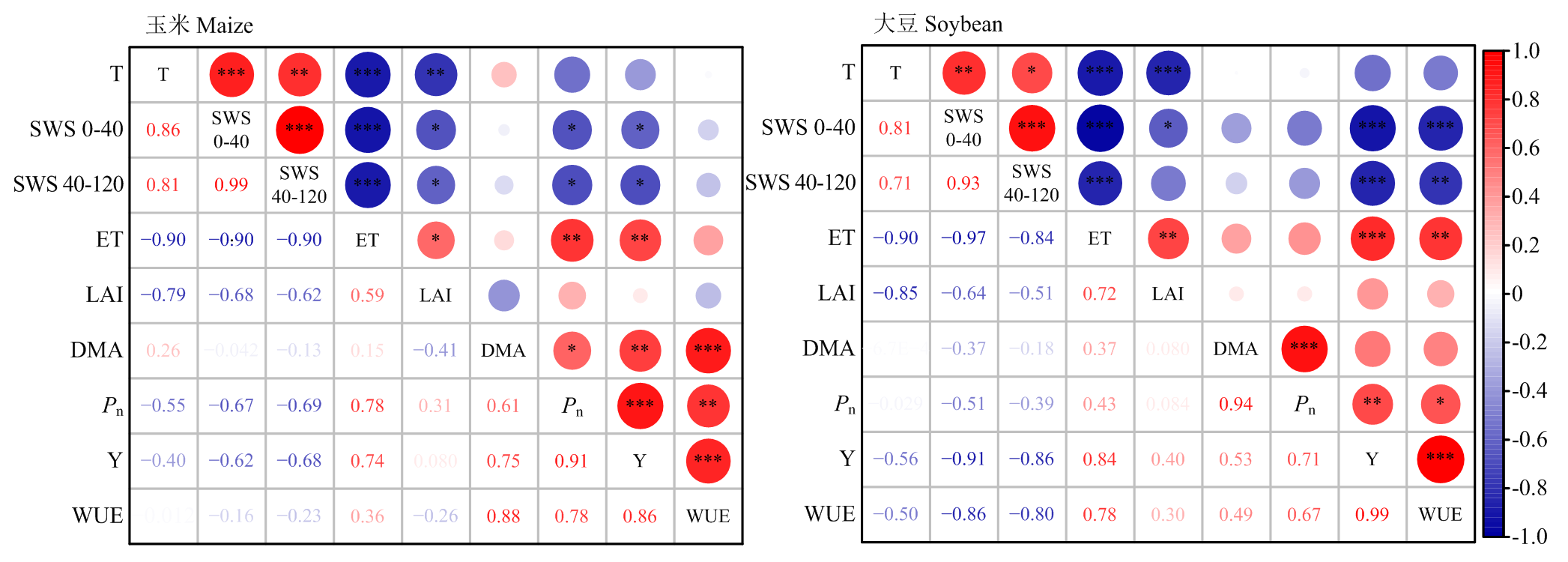
Fig. 6

Correlation analysis between growth indices and water indices of maize and soybean under different cropping patterns T represents soil temperature, SWS 0-40 represents 0-40 cm soil water storage, SWS 40-120 represents 40-120 cm soil water storage, LAI represents the leaf area index, Y represents grain yield, DMA represents the aboveground dry matter accumulation, Pn represents the net photosynthetic rate, and WUE represents the water use efficiency"

[1]
Food and Agriculture Organization of the United Nations. FAOSTAT statistical database:Land use. Rome: Food and Agriculture Organization of the United Nations, 2022 [2026-01-05].
[2]
The World Bank. World development indicators: Arable land (hectares per person). Washington, DC: The World Bank, 2023 [2026-01-05].
[3]
万向元. 发展种业新质生产力, 提高作物产量, 保障国家粮食安全[J]. 科学通报, 2025, 70(19): 3009-3011.
Wan X Y. Development of new quality productive forces in the seed industry to enhance crop output and ensure national food security[J]. Chinese Science Bulletin, 2025, 70(19): 3009-3011. (in Chinese)
[4]
Ma L S, Li Y J, Wu P T, Zhao X N, Chen X L, Gao X D. Coupling evapotranspiration partitioning with water migration to identify the water consumption characteristics of wheat and maize in an intercropping system[J]. Agricultural and Forest Meteorology, 2020, 290: 108034.

doi: 10.1016/j.agrformet.2020.108034
[5]
邵晓梅, 严昌荣. 黄河流域主要农作物的降水盈亏格局分析[J]. 中国农业气象, 2007, 28(1): 40-44.
Shao X M, Yan C R. Study on the pattern of water requirements of main crops and rainfall in the Yellow River Basin[J]. Chinese Journal of Agrometeorology, 2007, 28(1): 40-44. (in Chinese)
[6]
戴彤, 王靖, 赫迪, 王娜. 1961—2010年气候变化对西南冬小麦潜在和雨养产量影响的模拟分析[J]. 中国生态农业学报, 2016, 24(3): 293-305.
Dai T, Wang J, He D, Wang N. Impact simulation of climate change on potential and rainfed yields of winter wheat in Southwest China from 1961 to 2010[J]. Chinese Journal of Eco-Agriculture, 2016, 24(3): 293-305. (in Chinese)
[7]
王剑. 黄淮海平原不同种植制度的生产生态效益及可持续性评价[D]. 北京: 中国农业科学院, 2024.
Wang J. Production-ecological benefits and sustainability assessment of different cropping systems in the Huang-Huai-Hai Plain[D]. Beijing: Chinese Academy of Agricultural Sciences, 2024. (in Chinese)
[8]
王彦婷, 逄蕾, 赵建华, 郑浩飞, 麻文浩. 玉米配置不同豆科作物对间作体系产量稳定性的影响[J]. 作物学报, 2025, 51(12): 3292-3303.

doi: 10.3724/SP.J.1006.2025.53036
Wang Y T, Pang L, Zhao J H, Zheng H F, Ma W H. Effects of different legume configurations with maize on yield stability of inter-cropping systems[J]. Acta Agronomica Sinica, 2025, 51(12): 3292-3303. (in Chinese)

doi: 10.3724/SP.J.1006.2025.53036
[9]
Yin W, Chai Q, Zhao C, Yu A Z, Fan Z L, Hu F L, Fan H, Guo Y, Coulter J A. Water utilization in intercropping: A review[J]. Agricultural Water Management, 2020, 241: 106335.

doi: 10.1016/j.agwat.2020.106335
[10]
Bright M B H, Diedhiou I, Bayala R, Assigbetse K, Chapuis-Lardy L, Ndour Y, Dick R P. Long-term Piliostigma reticulatum intercropping in the Sahel: Crop productivity, carbon sequestration, nutrient cycling, and soil quality[J]. Agriculture, Ecosystems & Environment, 2017, 242: 9-22.

doi: 10.1016/j.agee.2017.03.007
[11]
崔爱花, 胡启星, 王淑彬, 刘帅, 孙巨龙, 白志刚, 黄国勤. 玉米大豆带状间作对资源利用效率及土壤养分含量的影响[J]. 江苏农业科学, 2023, 51(10): 236-242.
Cui A H, Hu Q X, Wang S B, Liu S, Sun J L, Bai Z G, Huang G Q. Effects of maize and soybean intercropping on resource utilization efficiency and soil nutrient content[J]. Jiangsu Agricultural Sciences, 2023, 51(10): 236-242. (in Chinese)
[12]
Ali Raza M, Feng L Y, van der Werf W, Cai G R, Bin Khalid M H, Iqbal N, Hassan M J, Ahmad Meraj T, Naeem M, Khan I, Rehman S U, Ansar M, Ahmed M, Yang F, Yang W Y. Narrow-wide-row planting pattern increases the radiation use efficiency and seed yield of intercrop species in relay-intercropping system[J]. Food and Energy Security, 2019, 8(3): e170.

doi: 10.1002/fes3.2019.8.issue-3
[13]
魏艳骄, 张慧艳, 朱晶. 新发展格局下中国大豆进口依赖性风险及市场布局优化分析[J]. 中国农村经济, 2021(12): 66-86.
Wei Y J, Zhang H Y, Zhu J. AnAnalysis of dependence risk and market layout optimization for soybean import of China under the new development pattern[J]. Chinese Rural Economy, 2021(12): 66-86. (in Chinese)
[14]
Ma Z K, Zhou M L, Hu Z Y, Monteith F, Shao B X, Xiang J H. The impact of geomorphological settings and environmental influences on crop utilization in the mid-to-late neolithic period in Shaanxi Province, northwest China[J]. Land, 2025, 14(2): 234.

doi: 10.3390/land14020234
[15]
任媛媛, 赵兰兰, 张岁岐. 旱区间作水分高效利用机制探讨[J]. 干旱地区农业研究, 2023, 41(3): 55-62.
Ren Y Y, Zhao L L, Zhang S Q. Mechanism of high-efficient water use of intercropping in arid regions[J]. Agricultural Research in the Arid Areas, 2023, 41(3): 55-62. (in Chinese)
[16]
Qiu Y, Wang Z Y, Sun D B, Lei Y L, Li Z Y, Zheng Y. Advances in water and nitrogen management for intercropping systems: Crop growth and soil environment[J]. Agronomy, 2025, 15(8): 2000.

doi: 10.3390/agronomy15082000
[17]
李倩倩, 王星运, 李孟浩, 陈小莉, 任小龙, 赵西宁. 小麦玉米间作和氮肥对作物耗水特性及水分利用的影响[J]. 西北农业学报, 2021, 30(6): 819-828.
Li Q Q, Wang X Y, Li M H, Chen X L, Ren X L, Zhao X N. Effects of wheat/maize strip intercropping and nitrogen fertilizer on crops water consumption and water use[J]. Acta Agriculturae Boreali-occidentalis Sinica, 2021, 30(6): 819-828. (in Chinese)
[18]
罗键, 尹忠, 郑子成, 何淑勤, 李廷轩. 不同降雨条件下紫色土横垄坡面地表微地形变化特征[J]. 中国农业科学, 2016, 49(16): 3162-3173. DOI: 10.3864/j.issn.0578-1752.2016.16.010.
Luo J, Yin Z, Zheng Z C, He S Q, Li T X. Variation characteristics of microtopography of ridge tillage of purple soil under different rainfall patterns[J]. Scientia Agricultura Sinica, 2016, 49(16): 3162-3173. DOI: 10.3864/j.issn.0578-1752.2016.16.010. (in Chinese)
[19]
朱上卿, 赵桂茹, 安曈昕, 李海, 郭锦涛, 格茸吾姆, 吴伯志. 不同播种方式微地形差异对坡耕地水土流失的影响[J]. 水土保持学报, 2023, 37(3): 43-51.
Zhu S Q, Zhao G R, An T X, Li H, Guo J T, Ge R, Wu B Z. Effects of microtopography difference of different sowing patterns on soil and water loss in sloping farmland[J]. Journal of Soil and Water Conservation, 2023, 37(3): 43-51. (in Chinese)
[20]
张月荷, 梁霞, 曹浚铂, 张雨晴, 刘小利, 王金金, 任小龙. 垄沟集雨种植的研究进展[J]. 节水灌溉, 2022(10): 23-30.

doi: 10.12396/jsgg.2022.135
Zhang Y H, Liang X, Cao J B, Zhang Y Q, Liu X L, Wang J J, Ren X L. Research progress of ridge-furrow rainwater harvesting systems effect effect effect of incision arthroplast[J]. Water Saving Irrigation, 2022(10): 23-30. (in Chinese)
[21]
Zhang G X, Dai R C, Ma W Z, Fan H Z, Meng W H, Han J, Liao Y C. Optimizing the ridge-furrow ratio and nitrogen application rate can increase the grain yield and water use efficiency of rain-fed spring maize in the Loess Plateau region of China[J]. Agricultural Water Management, 2022, 262(C): 107439.
[22]
谷晓博, 李援农, 周昌明, 杜娅丹, 任全茂, 吴国军. 垄沟集雨补灌对冬油菜根系、产量与水分利用效率的影响[J]. 农业机械学报, 2016, 47(4): 90-98, 112.
Gu X B, Li Y N, Zhou C M, Du Y D, Ren Q M, Wu G J. Effects of ridge and furrow rain harvesting cultivation with supplemental irrigation on root, yield and water use efficiency of winter oilseed rape (Brassica napus L.)[J]. Transactions of the Chinese Society for Agricultural Machinery, 2016, 47(4): 90-98, 112. (in Chinese)
[23]
张少斌, 梁开明, 郭靖, 罗颢. 基于生态位角度的农作物间套作增产机制研究进展[J]. 福建农业学报, 2016, 31(9): 1005-1012.
Zhang S B, Liang K M, Guo J, Luo H. Yield improvement by intercropping-viewed from a niche perspective[J]. Fujian Journal of Agricultural Sciences, 2016, 31(9): 1005-1012. (in Chinese)
[24]
Lithourgidis A S, Dordas C A, Damalas C A, Vlachostergios D N. Annual intercrops: An alternative pathway for sustainable agriculture[J]. Australian Journal of Crop Science, 2011, 5(4): 396-410.
[25]
郭乔, 王冬梅, 张鹏, 李志梅. 垄沟种植对干旱半干旱地区作物水分利用效率和产量的影响: 基于Meta分析[J]. 水土保持通报, 2024, 44(3): 190-200.
Guo Q, Wang D M, Zhang P, Li Z M. Effects of ridge-furrow planting on crop water use efficiency and yield in arid and semi-arid regions based on meta-analysis[J]. Bulletin of Soil and Water Conservation, 2024, 44(3): 190-200. (in Chinese)
[26]
Ren X L, Chen X L, Cai T, Wei T, Wu Y, Ali S, Zhang P, Jia Z K. Effects of ridge-furrow system combined with different degradable mulching materials on soil water conservation and crop production in semi-humid areas of China[J]. Frontiers in Plant Science, 2017, 8: 1877.

doi: 10.3389/fpls.2017.01877 pmid: 29163602
[27]
HJ 613—2011 土壤干物质和水分的测定重量法[S].
HJ 613—2011 Soil-Determination of dry matter and water content-Gravimetric method[S]. (in Chinese)
[28]
蒙强, 刘静霞, 李玉庆, 张文贤, 潘苏向, 李敏杰, 尼玛次仁. 土壤水分下限调控灌溉对春青稞生长、产量和水分利用的影响[J]. 干旱地区农业研究, 2020, 38(1): 173-182.
Meng Q, Liu J X, Li Y Q, Zhang W X, Pan S X, Li M J, Nimaciren. Effects of regulated irrigation of lower limits of soil moisture on growth, yield and water use efficiency of spring highland barley[J]. Agricultural Research in the Arid Areas, 2020, 38(1): 173-182. (in Chinese)
[29]
王建林, 于贵瑞, 房全孝, 齐华, 王秋凤. 作物水分利用效率的制约因素与调节[J]. 作物杂志, 2007(2): 9-11.
Wang J L, Yu G R, Fang Q X, Qi H, Wang Q F. Restricted factors and regulations of water use efficiency of crops[J]. Crops, 2007(2): 9-11. (in Chinese)
[30]
孙建好, 赵建华, 李伟绮, 吴科生, 陈亮之, 杨新强, 何旭刚, 郑浩飞. 施氮对玉米||大豆间作产量稳定性的影响[J]. 中国生态农业学报(中英文), 2025, 33(6): 1138-1145.
Sun J H, Zhao J H, Li W Q, Wu K S, Chen L Z, Yang X Q, He X G, Zheng H F. Effect of nitrogen application on yield stability of maize||soybean intercropping system[J]. Chinese Journal of Eco-Agriculture, 2025, 33(6): 1138-1145. (in Chinese)
[31]
Ibarrola Rivas M J, Nonhebel S. Assessing changes in availability of land and water for food (1960-2050): An analysis linking food demand and available resources[J]. Outlook on Agriculture, 2016, 45(2): 124-131.

doi: 10.1177/0030727016650767
[32]
Zhu J Q, Vos J, van der Werf W, van der Putten P E, Evers J B. Early competition shapes maize whole-plant development in mixed stands[J]. Journal of Experimental Botany, 2014, 65(2): 641-653.

doi: 10.1093/jxb/ert408 pmid: 24307719
[33]
张德, 龙会英, 金杰, 樊博, 赵秀梅, 韩学琴. 豆科与禾本科牧草间作的生长互作效应及对氮、磷养分吸收的影响[J]. 草业学报, 2018, 27(10): 15-22.

doi: 10.11686/cyxb2017475
Zhang D, Long H Y, Jin J, Fan B, Zhao X M, Han X Q. Effects of growth interaction effect of Leguminous and Gramineous pasture intercropping and absorption of nutrient and phosphorus on pasture expression[J]. Acta Prataculturae Sinica, 2018, 27(10): 15-22. (in Chinese)

doi: 10.11686/cyxb2017475
[34]
纪瑞鹏, 于文颖, 冯锐, 武晋雯, 张玉书, 王茜. 作物对干旱胁迫的响应过程与早期识别技术研究进展[J]. 灾害学, 2019, 34(2): 153-160.
Ji R P, Yu W Y, Feng R, Wu J W, Zhang Y S, Wang Q. Advance in the response process of crops and early identification technologies to drought stress[J]. Journal of Catastrophology, 2019, 34(2): 153-160. (in Chinese)
[35]
Takács G, Gergely I, Ördög V, Vörös L, Iváncsics J. Approaches to studying wheat and maize drought stress responses[J]. Plant and Soil, 2025, 516(1): 115-132.

doi: 10.1007/s11104-025-07789-6
[36]
赵雪娇, 孙东宝, 王庆锁. 玉米‖甘蓝间作对土壤水分时空分布及水分利用效率的影响[J]. 中国农业气象, 2012, 33(3): 374-381.
Zhao X J, Sun D B, Wang Q S. Effect of intercropped models of maize and cabbage on the temporal and spatial distribution of soil moisture and water use efficiency[J]. Chinese Journal of Agrometeorology, 2012, 33(3): 374-381. (in Chinese)
[37]
苟志文, 殷文, 柴强, 樊志龙, 胡发龙, 赵财, 于爱忠, 范虹. 干旱灌区小麦间作玉米麦后复种绿肥的可持续性分析[J]. 中国农业科学, 2022, 55(7): 1319-1331. DOI: 10.3864/j.issn.0578-1752.2022.07.005.
Gou Z W, Yin W, Chai Q, Fan Z L, Hu F L, Zhao C, Yu A Z, Fan H. Analysis of sustainability of multiple cropping green manure in wheat-maize intercropping after wheat harvested in arid irrigation areas[J]. Scientia Agricultura Sinica, 2022, 55(7): 1319-1331. DOI: 10.3864/j.issn.0578-1752.2022.07.005. (in Chinese)
[38]
高阳, 段爱旺, 刘战东, 王和洲, 陈金平, 刘安能. 玉米/大豆间作条件下的作物根系生长及水分吸收[J]. 应用生态学报, 2009, 20(2): 307-313.
Gao Y, Duan A W, Liu Z D, Wang H Z, Chen J P, Liu A N. Crop root growth and water uptake in maize/soybean strip intercropping[J]. Chinese Journal of Applied Ecology, 2009, 20(2): 307-313. (in Chinese)
[39]
Hui F, Xie Z W, Li H G, Guo Y, Li B G, Liu Y L, Ma Y T. Image-based root phenotyping for field-grown crops: An example under maize/ soybean intercropping[J]. Journal of Integrative Agriculture, 2022, 21(6): 1606-1619.

doi: 10.1016/S2095-3119(20)63571-7
[40]
刘水苗, 关小康, 刘长硕, 王艳丽, 吴鹏年, 高晨凯, 李煜铭, 乔毅博, 赵志恒, 邵京, 于昊霖, 王同朝. 适宜耕作模式提高黄淮海平原冬小麦产量并改善土壤水肥状况[J]. 农业工程学报, 2023, 39(18): 82-91.
Liu S M, Guan X K, Liu C S, Wang Y L, Wu P N, Gao C K, Li Y M, Qiao Y B, Zhao Z H, Shao J, Yu H L, Wang T C. Appropriate tillage regime for the improvement of winter wheat yield, soil water, and nutrients condition in Huanghuaihai Plain of China[J]. Transactions of the Chinese Society of Agricultural Engineering, 2023, 39(18): 82-91. (in Chinese)
[41]
张凤云. 间作垄沟灌溉作物水分调控试验研究[D]. 杨凌: 中国科学院研究生院(教育部水土保持与生态环境研究中心), 2013.
Zhang F Y. Experimental study on crop water regulation of ridge-furrow irrigated intercropping system[D]. Yangling: Graduate University of Chinese Academy of Sciences (Ministry of Education Research Center for Soil and Water Conservation and Ecological Environment), 2013. (in Chinese)
[42]
Chen P P, Gu X B, Li Y N, Qiao L R, Li Y P, Fang H, Yin M H, Zhou C M. Effects of different ridge-furrow mulching systems on yield and water use efficiency of summer maize in the Loess Plateau of China[J]. Journal of Arid Land, 2021, 13(9): 947-961.

doi: 10.1007/s40333-021-0081-6
[43]
韩新生, 刘广全, 许浩, 于艺鹏, 郭永忠, 万海霞, 安钰, 王月玲, 董立国. 宁夏南部半干旱黄土区3种土地利用类型的土壤水分时空变化特征[J]. 水土保持学报, 2022, 36(6): 250-259.
Han X S, Liu G Q, Xu H, Yu Y P, Guo Y Z, Wan H X, An Y, Wang Y L, Dong L G. Temporal and spatial variation characteristics of soil moisture under three land use types in the semi-arid loess region of southern Ningxia[J]. Journal of Soil and Water Conservation, 2022, 36(6): 250-259. (in Chinese)

doi: 10.1080/00224561.1981.12436117
[44]
李白玉, 陈金平, 刘安能, 武鹏举, 王和洲. 土壤增温对冬小麦生长特性、产量及耗水量的影响[J]. 灌溉排水学报, 2021(6): 21-27.
Li B Y, Chen J P, Liu A N, Wu P J, Wang H Z. Soil warming changed growth, yield and water consumption of winter wheat[J]. Journal of Irrigation and Drainage, 2021(6): 21-27. (in Chinese)
[45]
靳乐乐, 乔匀周, 董宝娣, 杨红, 王亚凯, 刘孟雨. 起垄覆膜栽培技术的增产增效作用与发展[J]. 中国生态农业学报(中英文), 2019, 27(9): 1364-1374.
Jin L L, Qiao Y Z, Dong B D, Yang H, Wang Y K, Liu M Y. Crop yield increasing and efficiency improving effects and development of technology of ridge-furrow cultivation with plastic film mulching[J]. Chinese Journal of Eco-Agriculture, 2019, 27(9): 1364-1374. (in Chinese)
[46]
郭海斌, 张军刚, 王文文, 薛志伟, 许海涛, 冯晓曦, 王斌功, 王成业. 夏玉米光合特性、根系生长和产量对砂姜黑土深松增密的响应[J]. 作物杂志, 2024(3): 109-118.
Guo H B, Zhang J G, Wang W W, Xue Z W, Xu H T, Feng X X, Wang B G, Wang C Y. Response of photosynthetic characteristics, root growth and yield of summer maize to subsoiling and increasing density in lime concretion black soil[J]. Crops, 2024(3): 109-118. (in Chinese)
[47]
安颖蔚, 史书强, 冯良山, 张鹏. 玉米/大豆间作提高农田生产力和水分利用效率研究[J]. 园艺与种苗, 2016, (9): 80-83.
An Y W, Shi S Q, Feng L S, Zhang P. Productivity enhancement and water use efficiency of maize-soybean intercropping[J]. Horticulture & Seed, 2016, (9): 80-83. (in Chinese)
[48]
陈宣伊, 张健伟, 张向前, 葛国龙, 路战远, 郭星星, 马子惠, 李欣艺, 陈立宇. 大豆玉米不同条带间作对玉米带水热时空动态变化及玉米产量效益的影响[J]. 作物学报, 2026, 52(1): 178-190.

doi: 10.3724/SP.J.1006.2026.53050
Chen X Y, Zhang J W, Zhang X Q, Ge G L, Lu Z Y, Guo X X, Ma Z H, Li X Y, Chen L Y. Study on the impact of different soybean-maize strip intercropping patterns on the spatio-temporal dynamics of water and heat in maize strips and on maize yield and economic returns[J]. Acta Agronomica Sinica, 2026, 52(1): 178-190. (in Chinese)

doi: 10.3724/SP.J.1006.2026.53050
[49]
Zhang Y, Sun Z X, Su Z C, Du G J, Bai W, Wang Q, Wang R N, Nie J Y, Sun T R, Feng C, Zhang Z, Yang N, Zhang X, Evers J B, van der Werf W, Zhang L Z. Root plasticity and interspecific complementarity improve yields and water use efficiency of maize/soybean intercropping in a water-limited condition[J]. Field Crops Research, 2022, 282: 108523.

doi: 10.1016/j.fcr.2022.108523
[50]
Duan C X, Chen G J, Hu Y J, Wu S F, Feng H, Dong Q G. Alternating wide ridges and narrow furrows with film mulching improves soil hydrothermal conditions and maize water use efficiency in dry sub-humid regions[J]. Agricultural Water Management, 2021, 245(C): 106559.
[1] BAI JingJing, ZHANG YuChen, NI ZiJie, GAO JiaYong, LIU WeiYang, GAI DongSheng, WANG YuHang, HE JiaQing, ZHANG Qiang, SHAO XiWen, WU Ying, GENG YanQiu, GUO LiYing. Effects of Different Irrigation Volumes on Lodging Resistance Characteristics and Yield of Rice in Northeast China [J]. Scientia Agricultura Sinica, 2026, 59(9): 1848-1868.
[2] CAI QiaoHong, ZHOU Tian, SU Ming, HONG ZiQiang, LI FanGuo, LI Tong, WANG Hua, KANG JianHong, WU HongLiang. Effects of Nitrogen Reduction and Potassium Enhancement Fertilization Mode on Photosynthetic Fluorescence Characteristics and Photosynthetic Product Accumulation of Maize in Ningxia Yellow Irrigation Area [J]. Scientia Agricultura Sinica, 2026, 59(9): 1869-1886.
[3] ZHU Pei, ZHAO Yao, BAI Yan, ZHANG JinKui, LI Mei, LONG JinJia, YANG Long, LUO LiYa, XU BenBo, XU JinSong, ZHANG XueKun. Physiological Regulation of Pydiflumetofen on Rapeseed (Brassica napus) and Its Combined Effect with Prochloraz [J]. Scientia Agricultura Sinica, 2026, 59(9): 1903-1915.
[4] CHEN XuanYi, GUO XingXing, ZHANG XiangQian, LU ZhanYuan, LIU LingYue, LUO Fang, LI JinLong, ZHANG ChuanLing, ZHANG ZhiQing, CHE ManQing. Impacts of Intercropping Row Patterns on the Heterogeneity of the Light Environment and Photosynthetic Product Production in Maize Canopy [J]. Scientia Agricultura Sinica, 2026, 59(8): 1653-1671.
[5] HOU HuiZhi, YIN JiaDe, MA MingSheng, LIU XiaoWei, LIU YanLan, LEI KangNing. Effects of Tillage and Organic Fertilizer Application on Crop Yield and Water Use in a Potato-Maize Double Cropping System in the Longdong Region [J]. Scientia Agricultura Sinica, 2026, 59(8): 1672-1685.
[6] PENG TingShen, LU JiuYan, WU MeiLin, YAN YuXin, LIU HongZhou, NAN WenBin, QIN XiaoJian, LI Ming, GONG JunYi, LIANG YongShu. QTL Analysis of Yield-Related Traits in Both Huangnuo2# and Changbai7# of Perennial Chinese Rice [J]. Scientia Agricultura Sinica, 2026, 59(7): 1361-1379.
[7] WANG YuPing, FU Zhi, SUN JiaYing, MU XiaoMeng, LIU HuiLin, GUO JinYun, SONG WenJing, HOU LeiPing, ZHAO HaiLiang. Evaluation of the Mitigating Effect and Application Efficacy of Melatonin Applied at the Seedling Stage on Short-Term Chilling Stress in Tomato Plants [J]. Scientia Agricultura Sinica, 2026, 59(7): 1523-1535.
[8] WANG JiaNuo, CHEN GuiPing, LI Pan, WANG LiPing, NAN YunYou, HE Wei, FAN ZhiLong, HU FaLong, CHAI Qiang, YIN Wen, ZHAO LiaoHao. Photo-Physiological Mechanism at Grain Filling Stage of No-Tillage with Plastic Re-Mulching to Increase Maize Yield in Oasis Irrigation Areas [J]. Scientia Agricultura Sinica, 2026, 59(6): 1189-1202.
[9] ZHOU XinJie, REN Hao, CHEN YingLong, ZHANG JiWang, ZHAO Bin, REN BaiZhao, LIU Peng, WANG HongZhang. Effects of Calcium Peroxide on Root Morphology and Yield Formation of Summer Maize in Waterlogging Farmland [J]. Scientia Agricultura Sinica, 2026, 59(6): 1203-1216.
[10] HE JiHang, ZHANG Qing, LÜ XiangYue, XUE JiQuan, XU ShuTu, LIU JianChao. Evaluation of Nitrogen Efficiency of Different Stay-Green Maize Hybrids [J]. Scientia Agricultura Sinica, 2026, 59(6): 1217-1230.
[11] GUO FuCheng, TANG HaiJiang, HAO XinYi, MA GuoLin, YANG JiuJu, HUANG LinFeng, TIAN Lei, WANG Bin, LUO ChengKe. Effects of Different Irrigation Methods on Water-Salt Transport, Rice Yield, and Water Use Efficiency in Saline Soil in Ningxia [J]. Scientia Agricultura Sinica, 2026, 59(4): 750-764.
[12] HAO Kun, CHEN HongDe, ZHANG Wei, ZHONG Yun, DANG MeiRong, ZHU ShiJiang, HUANG ZhiKun, JIN Ying. Comprehensive Evaluation of Water-Nitrogen Management Under Surge-Root Irrigation Based on Citrus Yield, Quality, and Water- Nitrogen Use Efficiency [J]. Scientia Agricultura Sinica, 2026, 59(4): 862-873.
[13] YAN TingLin, DU YaDan, HU XiaoTao, WANG He, LI XiaoYan, WANG YuMing, NIU WenQuan, GU XiaoBo. The Impacts of Nitrogen Fertilizer Organic Alternatives Under Aerated Drip Irrigation on Cotton Yield and Water Use Efficiency Under Deficit Irrigation Conditions [J]. Scientia Agricultura Sinica, 2026, 59(3): 602-618.
[14] YANG Rui, CHEN JingDong, HUANG Ying, XIE LingLi, ZHANG XueKun, ZHOU DengWen, LIU QingYun, XU JinSong, XU BenBo. Genetic Improvement and Configuration Analysis of High-Yield Rapeseed Lines in the Upper Reaches of the Yangtze River [J]. Scientia Agricultura Sinica, 2026, 59(2): 250-264.
[15] CHEN GuiPing, WEI JinGui, GUO Yao, LI Pan, WANG FeiEr, QIU HaiLong, FENG FuXue, YIN Wen. Synergistic Effects of Wide-Narrow Row and Density Enhancement on the Photosynthetic Characteristics and Resource Utilization of Maize in Oasis Irrigation Areas [J]. Scientia Agricultura Sinica, 2026, 59(2): 278-291.
Viewed
Full text


Abstract

Cited

  Shared   
  Discussed   
No Suggested Reading articles found!