Scientia Agricultura Sinica ›› 2026, Vol. 59 ›› Issue (10): 2123-2137.doi: 10.3864/j.issn.0578-1752.2026.10.005

• TILLAGE & CULTIVATION·PHYSIOLOGY & BIOCHEMISTRY·AGRICULTURE INFORMATION TECHNOLOGY • Previous Articles     Next Articles

Regulatory Mechanisms of Spring Nitrogen Topdressing on Yield Components and Photosynthetic Resource Utilization in Winter Wheat

WANG YuanYuan1(), WANG Qi1, MU JunYi1, MI DongMing1, XIE XiaoTing1, HA QiQi1, ZHOU Peng1, REN AiXia1, SUN Min2, GAO ZhiQiang1,2()   

  1. 1 College of Agriculture, Shanxi Agricultural University, Taigu 030801, Shanxi
    2 Functional Agriculture Research Institute, Shanxi Agricultural University, Taigu 030801, Shanxi
  • Received:2025-10-16 Accepted:2026-04-17 Online:2026-05-16 Published:2026-05-20
  • Contact: GAO ZhiQiang

Abstract:

【Objective】To clarify the precise management of water and fertilizer based on spring growth stages, and to reveal the mechanism of optimizing yield components through efficient light energy utilization, thereby contributing to the increase in grain yield of winter wheat.【Method】The field experiment was conducted at the TaiGu Winter Wheat Experimental Station in Jinzhong, Shanxi Province, from 2021 to 2023. A split-plot design was adopted, with two spring nitrogen top-dressing rates (90 kg·hm-2, N90; 120 kg·hm-2, N120) as main plots, and four top-dressing times after regreening (10 d, 20 d, 30 d, and 40 d) as sub-plots. Through systematic surveys of tillering dynamics and measurements of canopy photosynthetic active radiation interception, combined with the fitting of the grain-filling process using the Richards model, we systematically analyzed the effects of different nitrogen topdressing treatments on the winter wheat population structure, canopy light distribution, and grain-filling characteristics. Correlation analysis was conducted to clarify the intrinsic relationships among population photosynthetic performance, tillering dynamics, and yield components.【Result】Compared with other treatments, applying 120 kg·hm-2 of nitrogen at 30 days after regreening reduced the peak tiller number, delayed the occurrence of the tillering peak, and decreased the tiller senescence rate by 28%-43%. It also decreased the number of ineffective tillers (50-70 days after regreening) by 15%-30%, thereby significantly increasing the tiller-to-spike ratio by 10%-23%. Significantly increased the canopy PAR interception rate and extinction coefficient during the anthesis and mid-grain-filling stages, while significantly reducing the decline rate of lower-layer PAR interception during the anthesis-to-grain-filling period. Significantly increased the theoretical maximum 1000-grain weight, initial filling potential, average and maximum grain-filling rates, the time to reach maximum grain-filling rate, the duration of the gradual-increasing phase, and the grain-filling rates during the rapid-increasing and slow-increasing phases; significantly increased spike length by 3%-10%, spike weight by 8%-14%, and seed setting rate by 2%-12%.Significantly increased the number of spikes by 4%-10%, the number of grains per spike by 3%-10%, and the 1000-grain weight by 5%-10%, resulting in an increase in grain yield of 7%-20%.The Population Photosynthetic Potential during the booting-anthesis period showed a significant positive correlation with the tiller number at 45-70 days after regreening; meanwhile, the tiller number at 45-70 days after regreening was significantly and positively correlated with the spike number at maturity.The radiation interception rate in the lower layer of the canopy at the mid-grain-filling stage showed a significant positive correlation with the tiller number at 50-55 days after regreening; meanwhile, the tiller number at 50-55 days after regreening was significantly and positively correlated with the number of grains per spike. The PAR interception rate in the canopy at anthesis and mid-grain-filling stages showed a positive correlation with the tiller number at 50-55 days after regreening; meanwhile, the population photosynthetic potential during the booting-anthesis period was significantly and positively correlated with the tiller number at 50-55 days after regreening, and the tiller number at 50-55 days after regreening was significantly and positively correlated with the 1000-grain weight.【Conclusion】Application of 120 kg·hm-2 nitrogen topdressing 30 days after regreening achieved a synergistic improvement in the number of effective spikes, grains per spike, and 1000-grain weight, thereby significantly increasing grain yield. This was realized by suppressing and delaying the tillering peak, optimizing the post-anthesis canopy light distribution, and enhancing the grain-filling process. Furthermore, correlation analysis further confirmed that the population photosynthetic potential before anthesis and the canopy photosynthetic performance after anthesis, by influencing spikelet formation and grain filling, jointly determined the final grain yield. This study provides a critical nitrogen management strategy for achieving high-yield and efficient cultivation of winter wheat in the irrigation area of the Loess Plateau by improving the population photosynthetic efficiency through integrated water and fertilizer management.

Key words: winter wheat, spring nitrogen topdressing, tiller-to-spike ratio, yield and its components, fertilization based on tiller number

Table 1

Basic soil properties at the experimental sites before sowing (0-20 cm)"

年份
Year
有机质
Organic matter (g·kg-1)
碱解氮
Alkaline hydrolyzable nitrogen (mg·kg-1)
有效磷
Available phosphorus (mg·kg-1)
速效钾
Available potassium (mg·kg-1)
2021—2022 12.55 41.67 13.64 201.35
2022—2023 12.76 42.25 14.46 205.70

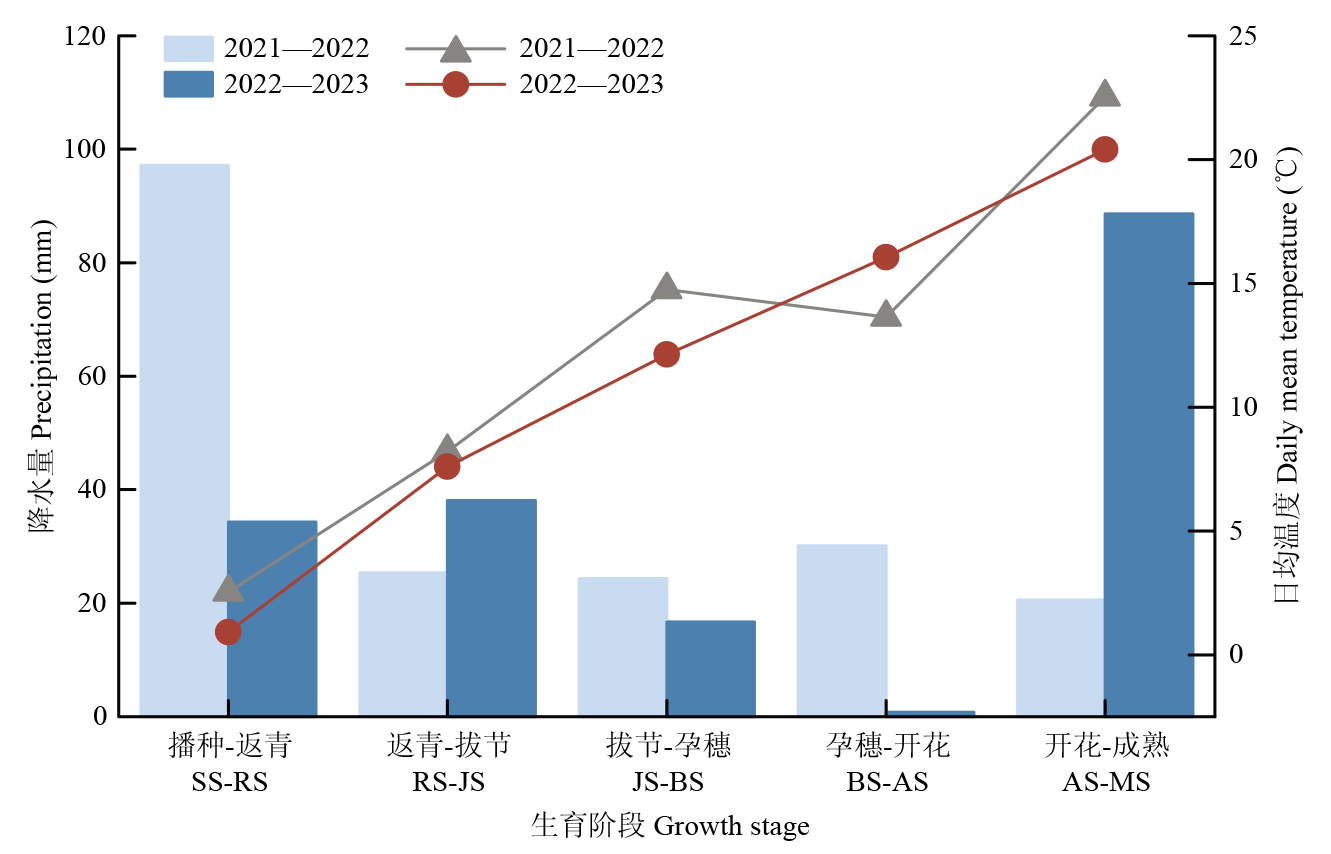
Fig. 1

Precipitation and daily mean temperature at different growth stages of winter wheat (2021-2023) The growth stages of winter wheat during the experimental years were as follows: regreening, jointing, booting, heading, and maturity occurred on March 8, April 1, May 5, May 18, and June 18 in 2021-2022, respectively; and on March 1, March 25, May 1, May 15, and June 22 in 2022-2023, respectively"

Table 2

Spring nitrogen topdressing dates at the experimental sites"

年份
Year
返青期(月-日)
Regreening (Month-Day)
拔节期(月-日)
Jointing (Month-Day)
追肥时间Topdressing date
D10(月-日)
(Month-Day)
D20(月-日)
(Month-Day)
D30(月-日)
(Month-Day)
D40(月-日)
(Month-Day)
2021—2022 03-08 04-01 03-18 03-28 04-07 04-17
2022—2023 03-01 03-25 03-11 03-21 03-31 04-10

Table 3

Correspondence of topdressing time treatment to leaf age and main growth stage"

处理
Treatment
返青后天数
Days after regreening
对应主茎叶龄范围
Corresponding main stem leaf age range
对应生育时期范围
Corresponding growth stage
D10 10 春生第1—2叶展开
Elongation of the 1st to 2nd spring leaves
返青期-起身初期
Regreening to early erecting stage
D20 20 春生第3—4叶展开
Elongation of the 3rd to 4th spring leaves
起身后期-拔节初期
Late erecting to early jointing stage
D30 30 春生第5—6叶展开
Elongation of the 5th to 6th spring leaves
拔节中期-孕穗初期
Mid jointing to early booting stage
D40 40 旗叶展开前后Around flag leaf elongation 孕穗期Booting stage

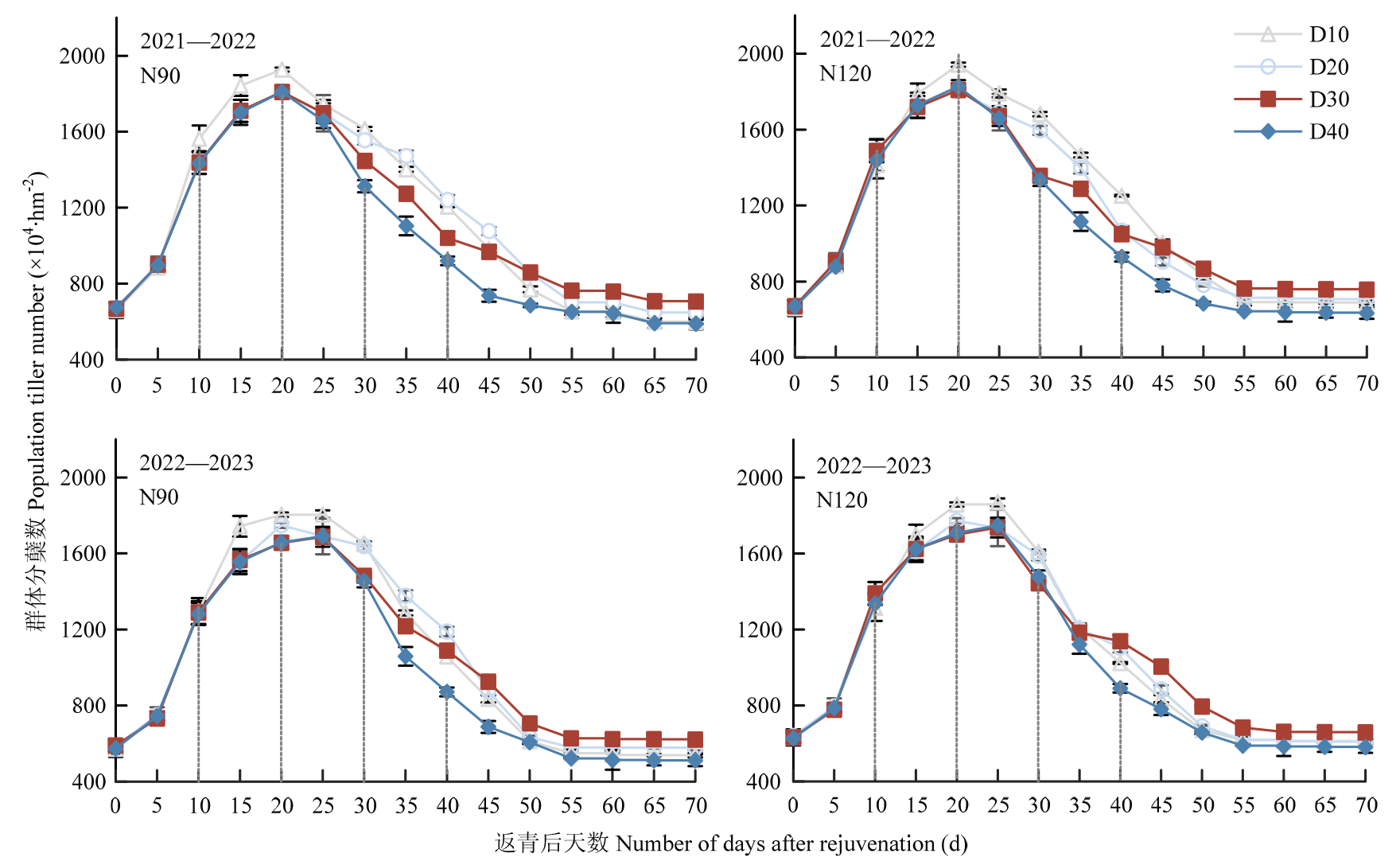
Fig. 2

Effect of spring nitrogen fertilization on the dynamics of tiller number in winter wheat populations (2021-2023) The intersection points of the dashed lines with the horizontal axis indicate the actual dates of nitrogen top-dressing. In the 2021—2022 season, the jointing, booting, and heading stages corresponded to the 23, 57 and 69 days after green-up,respectively; Whereas in the 2022—2023 season, these stages occurred on the 24, 56, and 70 days after green-up, respectively. D10, D20, D30,and D40 represent the nitrogen top-dressing treatments applied 10, 20, 30, and 40 days after green-up in this experiment, respectively. The same as below"

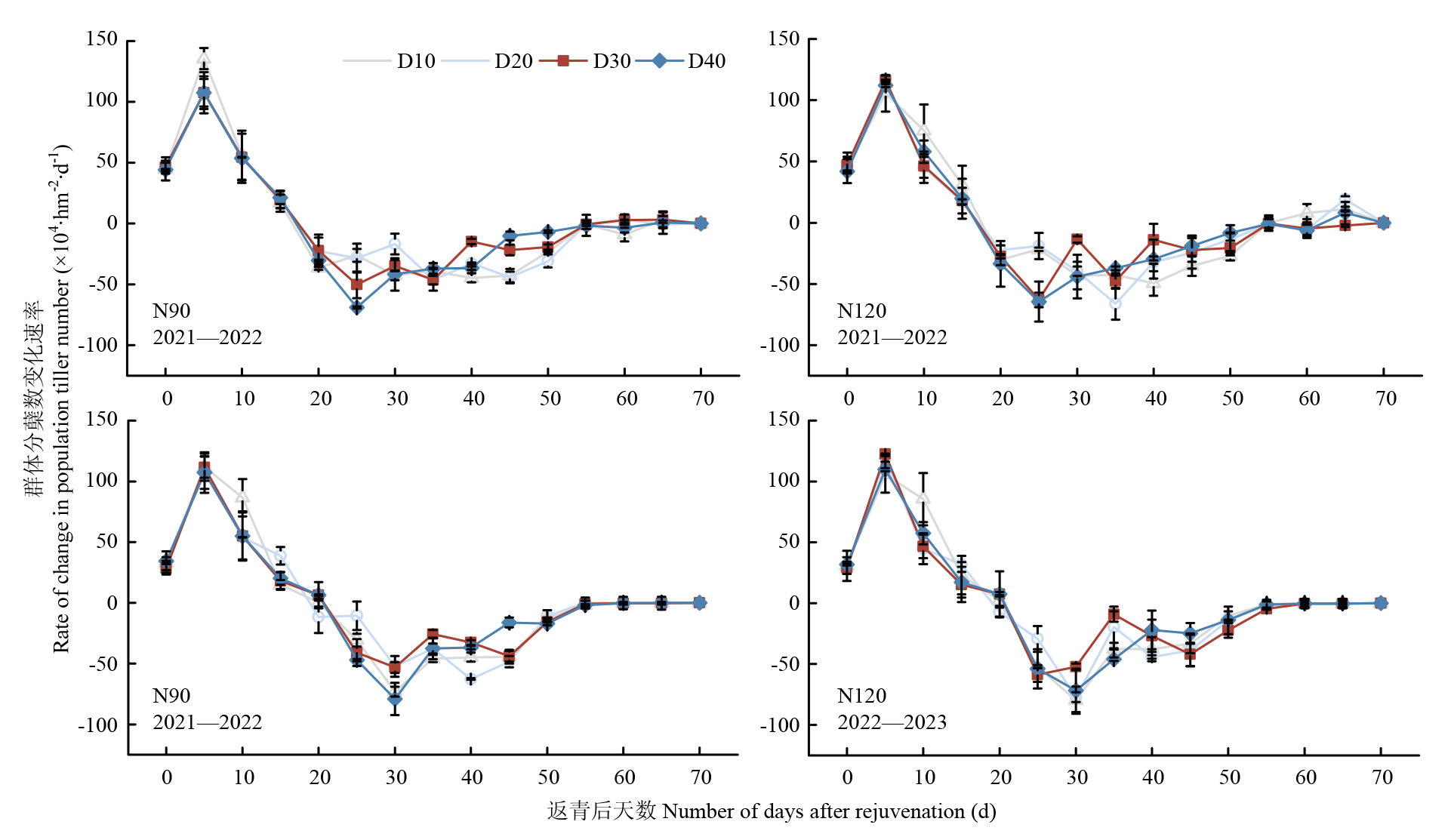
Fig. 3

Effect of spring nitrogen fertilization on the rate of change in tiller number of winter wheat populations (2021-2023)"

Fig. 4

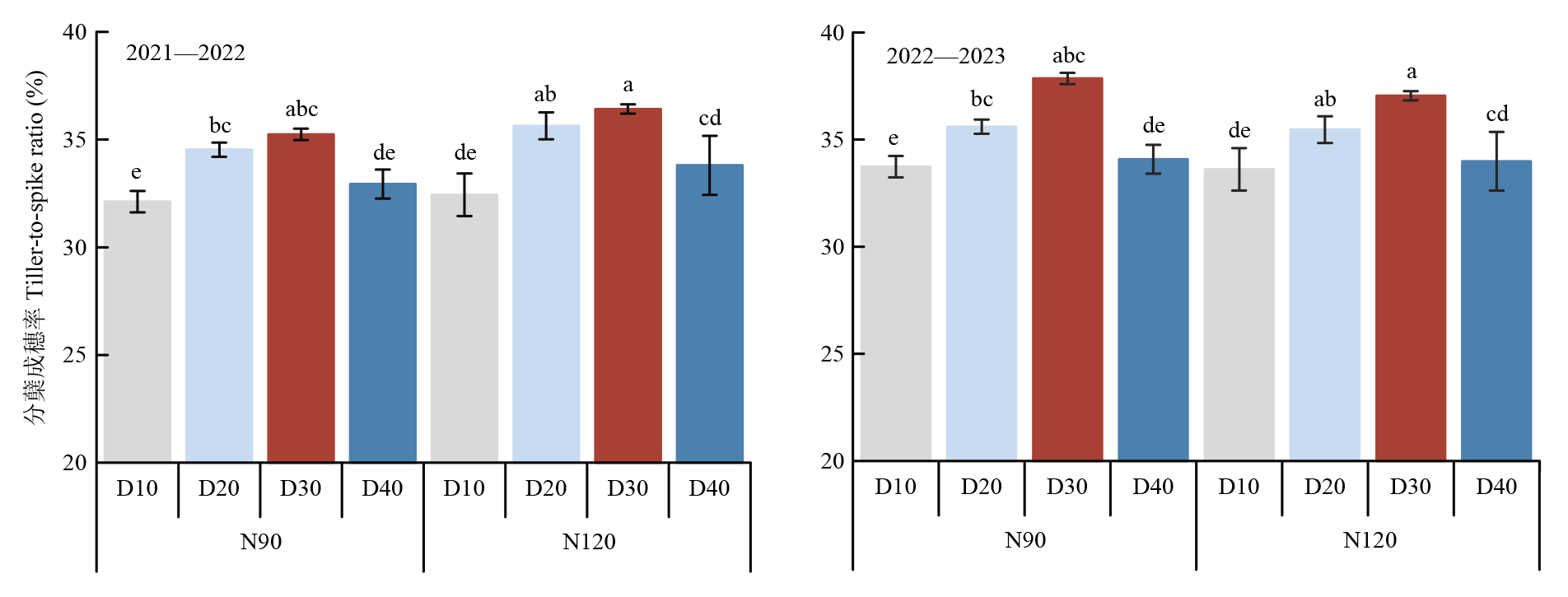
Effect of spring nitrogen fertilization on the tiller-to-spike ratio in winter wheat (2021-2023) Different lowercase letters indicate significant differences among treatments at P<0.05. The same as below"

Fig. 5

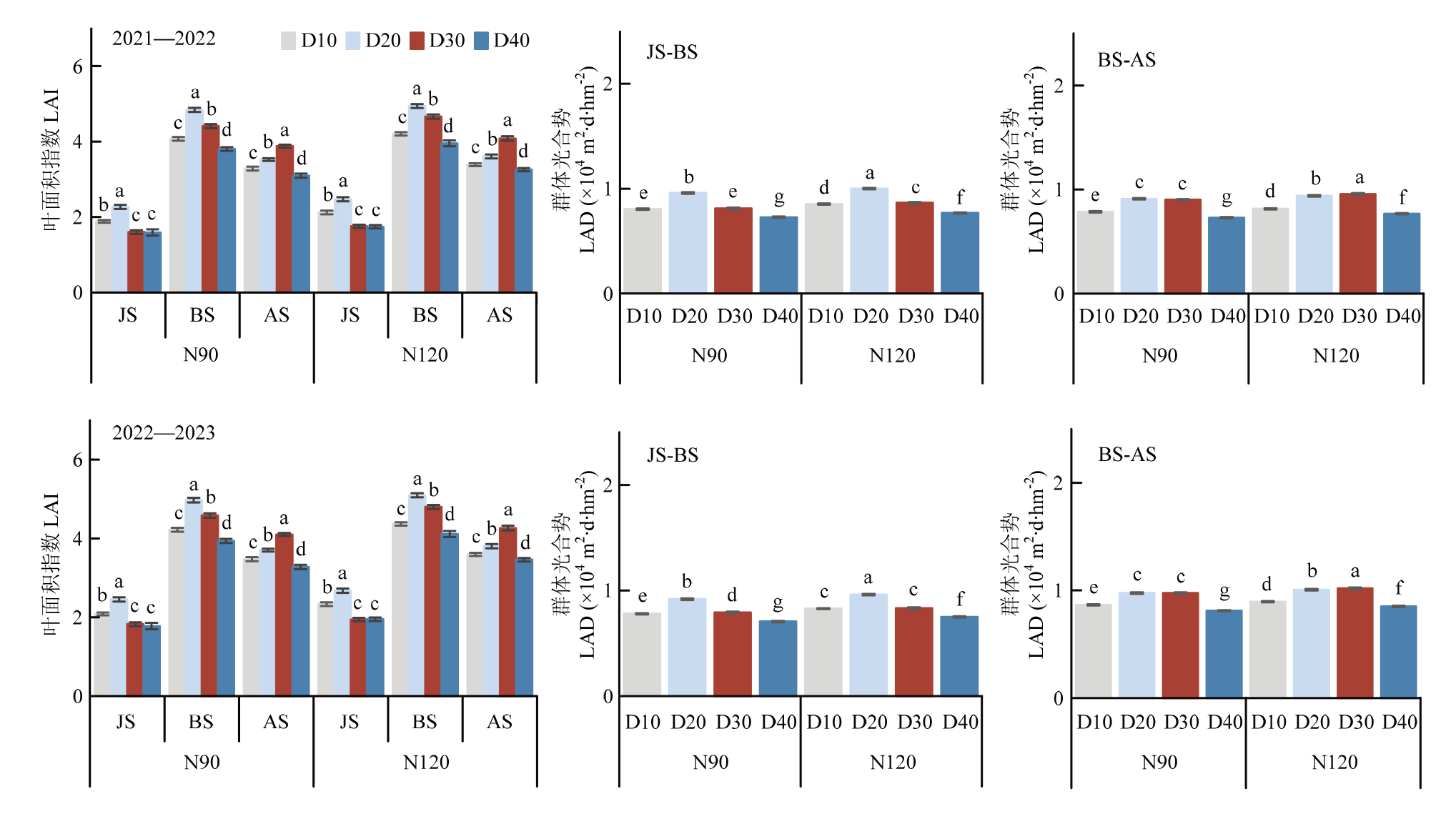
Effect of spring nitrogen fertilization on pre-anthesis leaf area index and population photosynthetic potential in winter wheat (2021-2023) JS, BS, and AS correspond to the jointing, booting, and heading stage, respectively"

Fig. 6

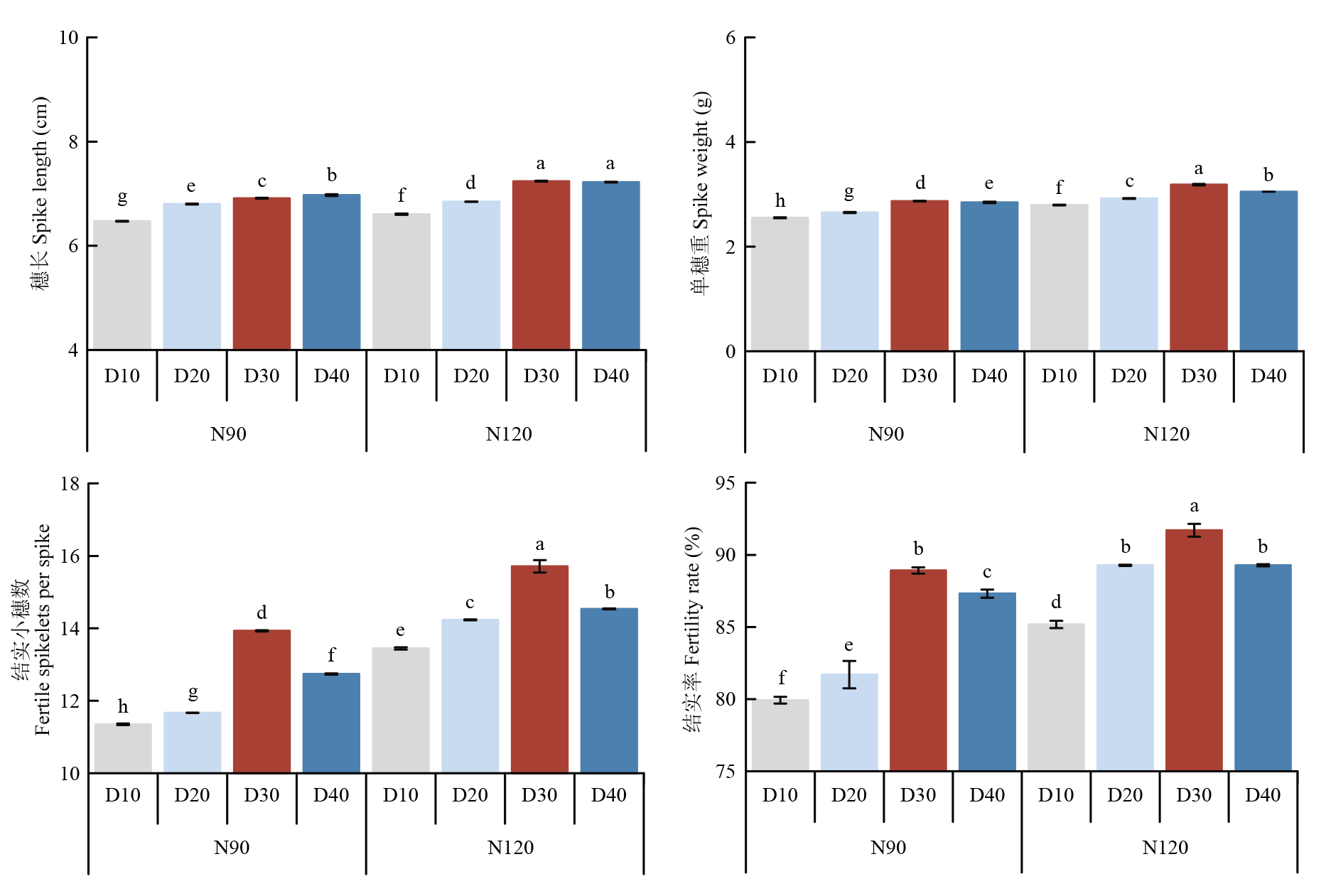
Effect of spring nitrogen fertilization on spike morphological traits in winter wheat at maturity (2021-2022)"

Fig. 7

Effect of spring nitrogen fertilization on effective radiation interception by the canopy in winter wheat after anthesis (2022-2023)"

Fig. 8

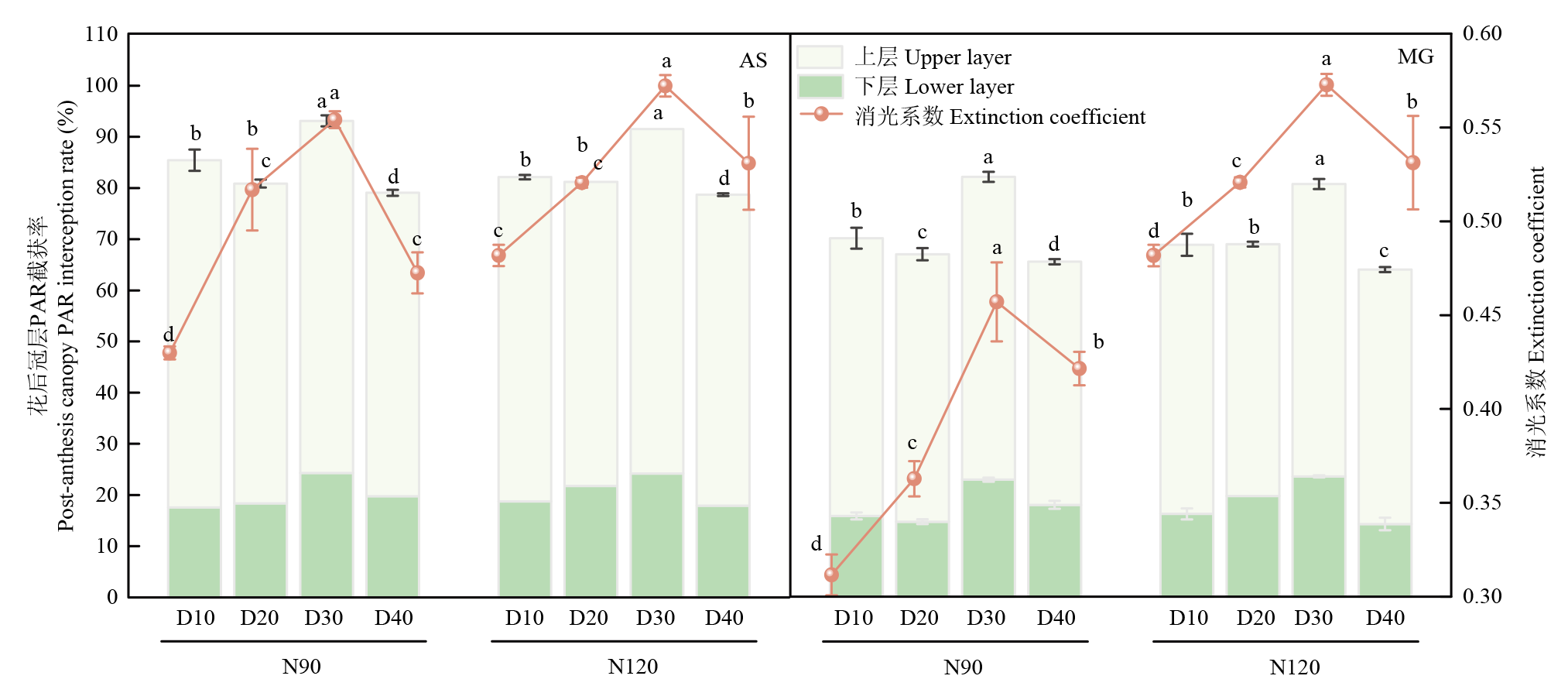
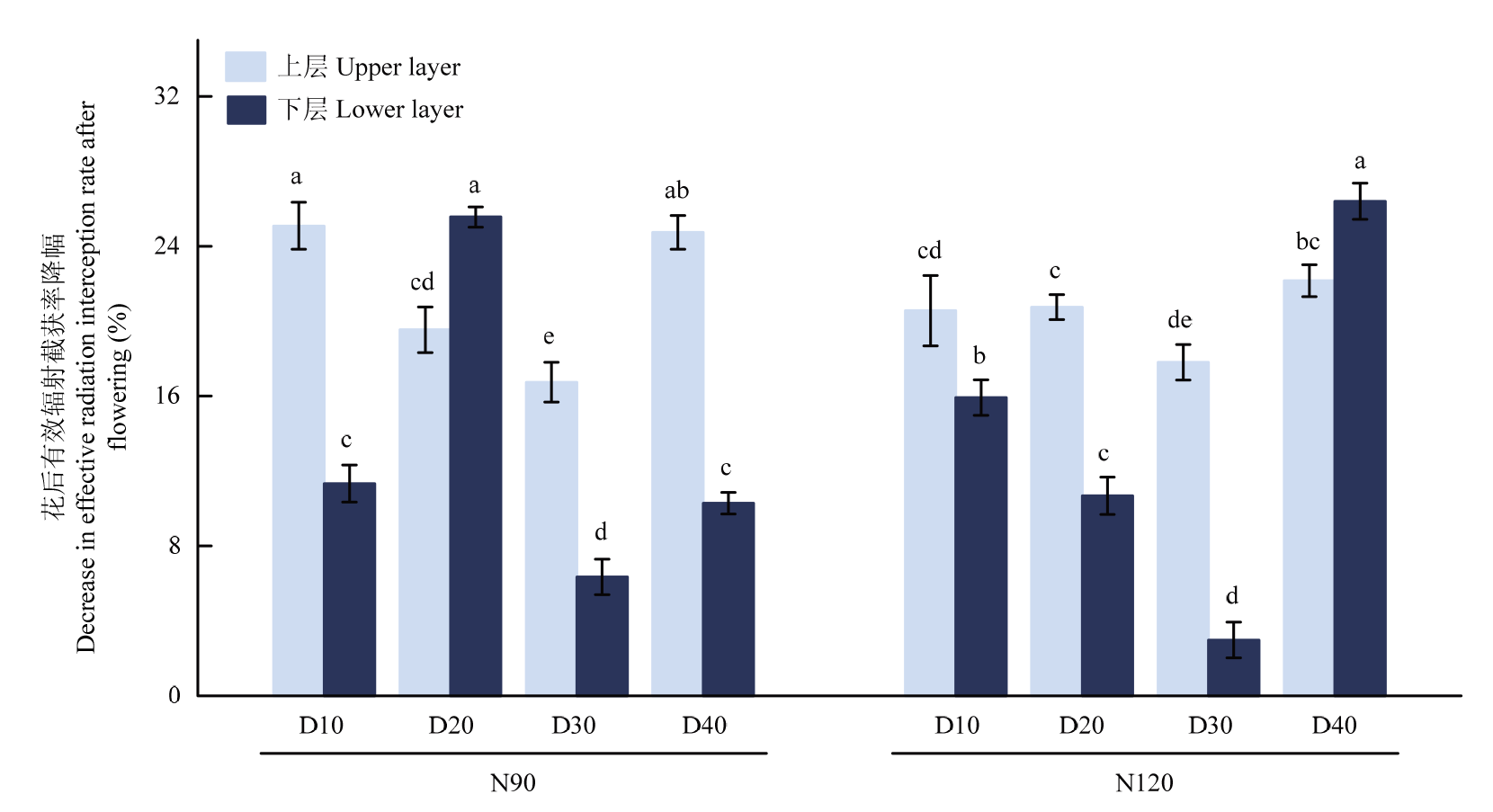
Effect of spring nitrogen fertilization on the decline in effective radiation interception by the canopy in winter wheat after anthesis (2022-2023) AS: Anthesis stage; MG: Milk grain stage"

Fig. 9

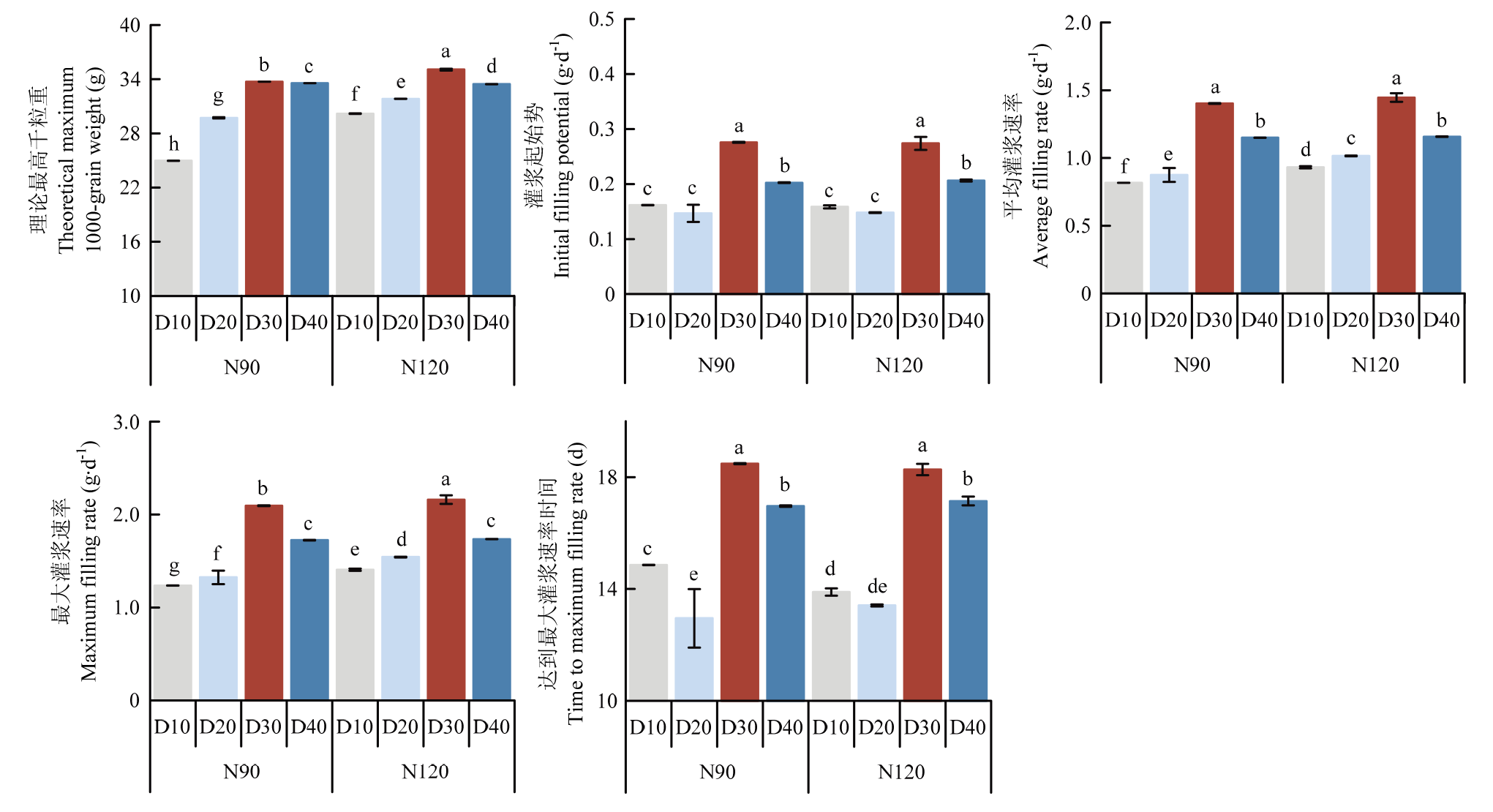
Effect of spring nitrogen fertilization on grain filling parameters in winter wheat (2022-2023)"

Fig. 10

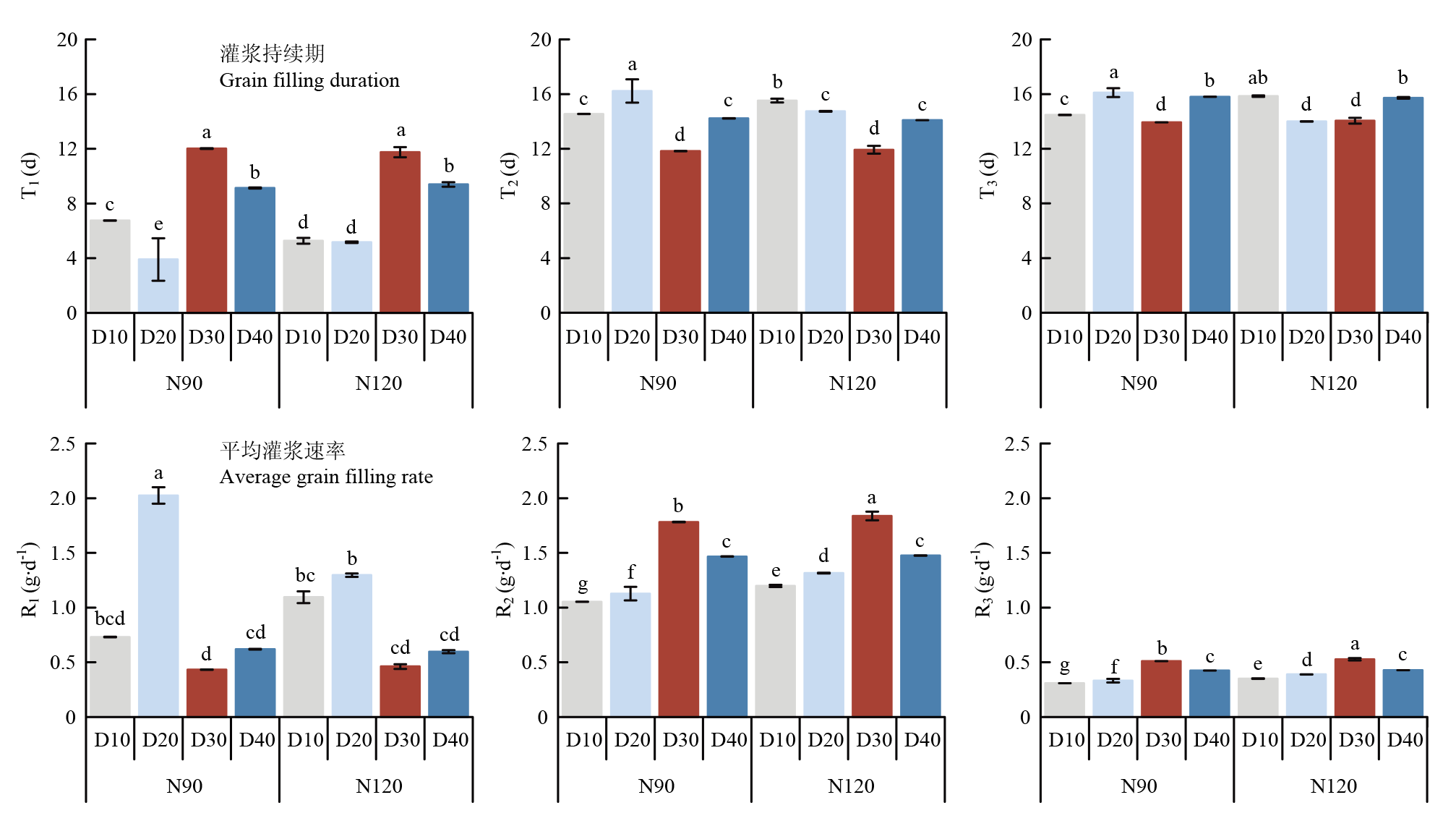
Effect of spring nitrogen fertilization on grain filling characteristics in winter wheat (2022-2023) T1, T2, and T3 represent the durations of the slow, rapid, and decelerating grain filling stages, respectively; whereas R1, R2, and R3 represent the corresponding filling rates during these periods"

Table 4

Effect of spring nitrogen application on winter wheat yield and its components (2021-2023)"

年份
Year
追氮量
Nitrogen application (kg·hm
-2)
追氮时间
Time of application
穗数
Spikes
(×104·hm-2)
穗粒数
Grain number per spike
千粒重
1000-grain weight

(g)
产量
Yield

(kg·hm-2)
2021—2022 N90 D10 618.76±3.25f 41.61±1.10cd 30.80±0.02c 7155.39±59.88g
D20 624.76±4.00e 42.50±0.50bcd 31.18±0.92c 7417.15±8.11e
D30 637.51±2.25c 43.50±0.90abc 32.99±0.22abc 7622.16±13.10d
D40 595.51±0.75g 40.76±0.20d 31.98±0.65bc 6377.21±22.01h
N120 D10 629.26±1.25d 43.02±0.35abcd 32.35±0.78bc 7671.57±3.69c
D20 642.51±2.75b 44.77±0.43ab 33.24±1.10abc 8399.89±15.48b
D30 658.76±0.50a 45.42±2.84a 35.03±0.99a 8927.93±21.66a
D40 616.26±2.25f 42.68±0.84bcd 33.93±0.01ab 7236.95±8.58f
2022—2023 N90 D10 609.01±1.50d 38.98±0.63e 31.04±0.40e 6939.93±19.74g
D20 622.36±1.35c 39.02±0.67e 32.09±0.45e 7507.37±80.28e
D30 638.51±2.00ab 43.51±0.52bc 34.64±0.35bc 7957.89±46.99c
D40 575.51±1.15f 41.69±0.71d 33.03±0.46d 6778.27±34.14h
N120 D10 628.51±1.00bc 43.07±0.39c 32.29±0.55c 7770.68±47.35d
D20 616.51±4.50cd 44.10±0.34b 33.04±0.55b 8216.44±36.68h
D30 643.51±2.00a 46.62±0.12a 34.89±0.60a 8897.26±74.13a
D40 593.76±2.75e 45.98±0.52a 33.52±0.32a 7313.08±72.50f

Fig. 11

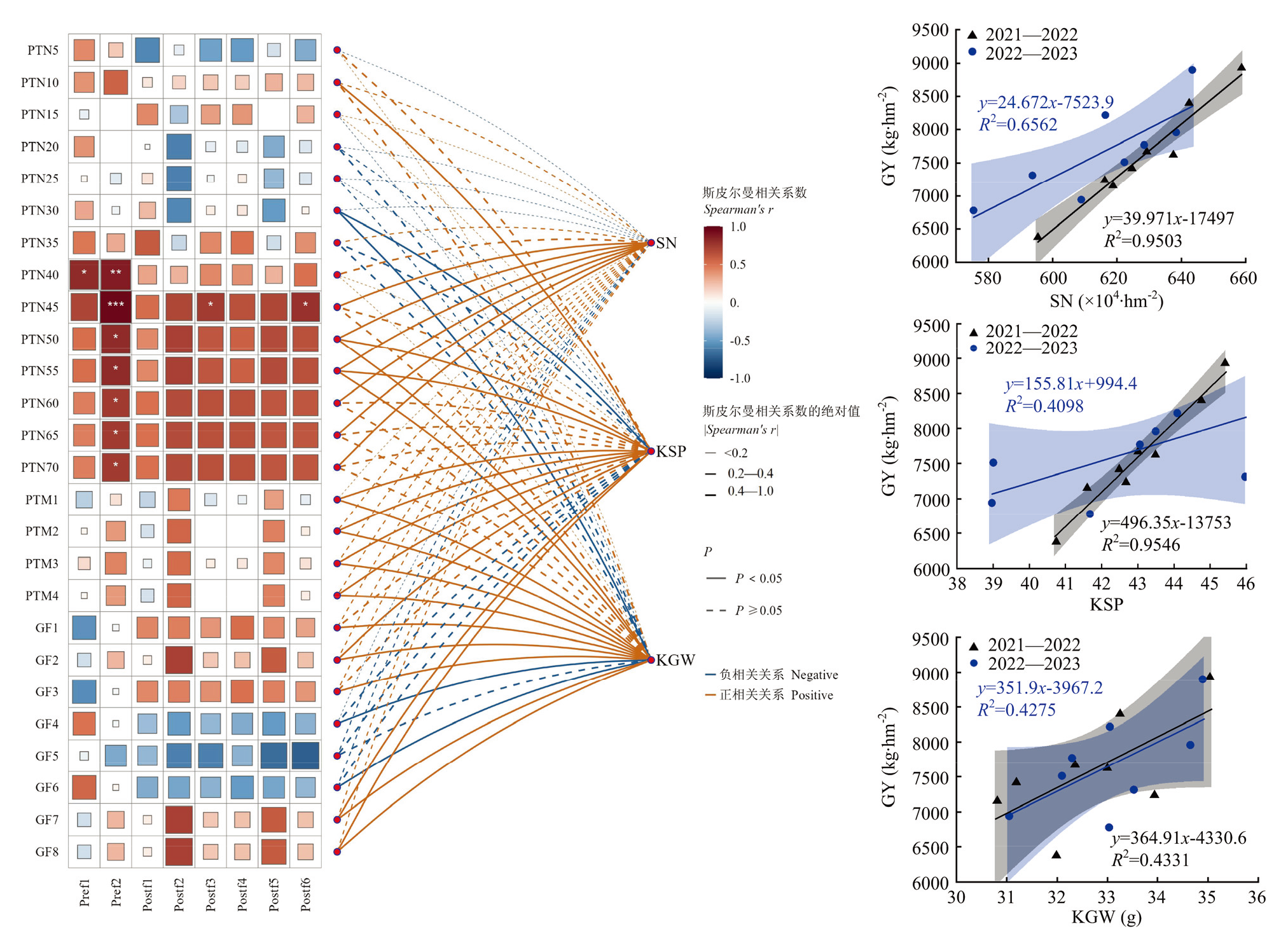
Analysis of driving factors regulating yield components in winter wheat PTN represents the population tiller number, with the following numbers indicating days after green-up; PTM represents spike morphological traits at maturity, including spike length, spike weight, fertile spikelet number, and seed setting rate; GF represents grain filling parameters, comprising the initial filling potential, average filling rate, durations of the slow, rapid, and decelerating filling stages, as well as the corresponding stage filling rates; Pref1 and Pref2 represent the population photosynthetic potential during the jointing-to-booting and booting-to-heading periods, respectively; Postf1-6 represent post-anthesis effective radiation interception parameters, specifically the upper, lower, and total canopy effective radiation interception rates at anthesis and milk grain stages; SN, KSP, and KGW represent spike number, grains per spike, and 1000-grain weight, respectively; GY indicates grain yield"

[1]
代新俊, 夏清, 杨珍平, 高志强. 氮肥后移对强筋小麦氮素积累转运及籽粒产量与品质的影响. 水土保持学报, 2018, 32(3): 289-294.
DAI X J, XIA Q, YANG Z P, GAO Z Q. Effects of postponing nitrogen application on accumulation and transport of nitrogen and yield and quality of grain in strong-gluten wheat. Journal of Soil and Water Conservation, 2018, 32(3): 289-294. (in Chinese)
[2]
王婷, 常旭虹, 王艳杰, 刘希伟, 杨玉双, 王德梅, 石书兵, 赵广才. 冬小麦群体结构及产量对播期和追氮时期的响应. 麦类作物学报, 2025, 45(3): 395-403.
WANG T, CHANG X H, WANG Y J, LIU X W, YANG Y S, WANG D M, SHI S B, ZHAO G C. Population structure and yield response of winter wheat to sowing date and nitrogen topdressing stage. Journal of Triticeae Crops, 2025, 45(3): 395-403. (in Chinese)
[3]
闫锦涛, 冯利平, 李扬, 陈先冠, 余卫东. 播期和播深对冬小麦越冬前生长性状的影响. 农业机械学报, 2022, 53(2): 327-335.
YAN J T, FENG L P, LI Y, CHEN X G, YU W D. Effects of sowing date and sowing depth on winter wheat growth before overwintering. Transactions of the Chinese Society for Agricultural Machinery, 2022, 53(2): 327-335. (in Chinese)
[4]
赵庆玲, 林文, 任爱霞, 张蓉蓉, 李蕾, 孙敏, 高志强. 春季追肥对冬小麦群体构建和籽粒灌浆进程的影响. 作物杂志, 2021(3): 99-105.
ZHAO Q L, LIN W, REN A X, ZHANG R R, LI L, SUN M, GAO Z Q. Effects of topdressing in spring on population construction and grain filling process of winter wheat. Crops, 2021(3): 99-105. (in Chinese)
[5]
张军, 胡川, 周起晖, 任开明, 董誓言, 刘傲寒, 吴金芝, 黄明, 李友军. 减氮及有机肥替代对旱地冬小麦干物质积累、转运、分配和产量的影响. 作物学报, 2025, 51(1): 207-220.
ZHANG J, HU C, ZHOU Q H, REN K M, DONG S Y, LIU A H, WU J Z, HUANG M, LI Y J. Effects of nitrogen reduction and organic fertilizer substitution on dry matter accumulation, translocation, distribution, and yield of dryland winter wheat. Acta Agronomica Sinica, 2025, 51(1): 207-220. (in Chinese)

doi: 10.3724/SP.J.1006.2025.41025
[6]
张永强, 陈传信, 徐其江, 聂石辉, 雷钧杰, 刘昌文. 氮肥增效剂与氮肥减量配施对冬小麦叶片生理及产量的影响. 新疆农业科学, 2023, 60(6): 1319-1325.

doi: 10.6048/j.issn.1001-4330.2023.06.003
ZHANG Y Q, CHEN C X, XU Q J, NIE S H, LEI J J, LIU C W. Effects of combined application of nitrogen enhancer and nitrogen reduction on leaf physiology and yield of winter wheat. Xinjiang Agricultural Sciences, 2023, 60(6): 1319-1325. (in Chinese)

doi: 10.6048/j.issn.1001-4330.2023.06.003
[7]
肖强, 刘东生, 刘建斌, 武凤霞, 衣文平. 减氮条件下配施控释尿素对冬小麦-夏玉米氮素利用及产量的影响. 华北农学报, 2023, 38(2): 160-169.

doi: 10.7668/hbnxb.20193572
XIAO Q, LIU D S, LIU J B, WU F X, YI W P. Effects of combined application of urea and controlled release urea on nitrogen utilization and yield of winter wheat-summer maize under nitrogen reduction conditions. Acta Agriculturae Boreali-Sinica, 2023, 38(2): 160-169. (in Chinese)

doi: 10.7668/hbnxb.20193572
[8]
杨晓梅, 尹昌斌, 李贵春, 南云不二男. 氮肥减量及秸秆替代过量氮肥下冬小麦/夏玉米轮作体系氮素淋失风险研究. 中国农业资源与区划, 2016, 37(7): 116-122.
YANG X M, YIN C B, LI G C, MINAMI Kojiro. Effects of reducing nitrogen application and replacing part of nitrogen fertilizer by crop residue on nitrogen leaching in winter wheat-summer corn system. Chinese Journal of Agricultural Resources and Regional Planning, 2016, 37(7): 116-122. (in Chinese)
[9]
丛鑫, 庞桂斌, 张立志, 徐征和, 杨金梁, 牟晓宇. 减氮适水对冬小麦光合特性与土壤水氮分布的影响. 农业机械学报, 2021, 52(6): 324-332.
CONG X, PANG G B, ZHANG L Z, XU Z H, YANG J L, MOU X Y. Effects of nitrogen-reducing and suitable water on photosynthetic characteristics of winter wheat and distribution of soil water and nitrogen. Transactions of the Chinese Society for Agricultural Machinery, 2021, 52(6): 324-332. (in Chinese)
[10]
卢殿君, 陈新平, 张福锁, 崔振岭, 贺明荣, 王振林. 花后营养调控对冬小麦灌浆期物质生产、氮素吸收及再运移的影响. 中国农学通报, 2013, 29(9): 57-60.
LU D J, CHEN X P, ZHANG F S, CUI Z L, HE M R, WANG Z L. Effect of post-anthesis nutrient regulation on dry matter production, nitrogen uptake and nitrogen remolilization during grain-filling in winter wheat. Chinese Agricultural Science Bulletin, 2013, 29(9): 57-60. (in Chinese)

doi: 10.11924/j.issn.1000-6850.2012-1595
[11]
SHE Y J, LI P, QI X B, GUO W, RAHMAN S U, LU H F, MA C C, DU Z J, CUI J X, LIANG Z J. Effects of shallow groundwater depth and nitrogen application level on soil water and nitrate content, growth and yield of winter wheat. Agriculture, 2022, 12(2): 311.

doi: 10.3390/agriculture12020311
[12]
邓丽娟, 焦小强. 氮管理对冬小麦产量和品质影响的整合分析. 中国农业科学, 2021, 54(11): 2355-2365. doi:10.3864/j.issn.0578-1752.2021.11.009.
DENG L J, JIAO X Q. A meta-analysis of effects of nitrogen management on winter wheat yield and quality. Scientia Agricultura Sinica, 2021, 54(11): 2355-2365. doi:10.3864/j.issn.0578-1752.2021.11.009. (in Chinese)
[13]
WANG K K, LIU H J, GAO Z Z. Effects of nitrogen application at different levels by a sprinkler fertigation system on crop growth and nitrogen-use efficiency of winter wheat in the North China Plain. Plants, 2024, 13(12): 1714.

doi: 10.3390/plants13121714
[14]
HUANG T, JU X T, YANG H. Nitrate leaching in a winter wheat-summer maize rotation on a calcareous soil as affected by nitrogen and straw management. Scientific Reports, 2017, 7: 42247.

doi: 10.1038/srep42247 pmid: 28176865
[15]
谢迎新, 刘宇娟, 张伟纳, 董成, 赵旭, 贺德先, 王晨阳, 郭天财, 王慎强. 潮土长期施用生物炭提高小麦产量及氮素利用率. 农业工程学报, 2018, 34(14): 115-123.
XIE Y X, LIU Y J, ZHANG W N, DONG C, ZHAO X, HE D X, WANG C Y, GUO T C, WANG S Q. Long-term application of biochar in fluvio-aquatic soil improving wheat yield and nitrogen utilization. Transactions of the Chinese Society of Agricultural Engineering, 2018, 34(14): 115-123. (in Chinese)
[16]
姜丽娜, 张凯, 宋飞, 张新敏, 蒿宝珍, 李春喜. 拔节期追氮对冬小麦产量、效益及氮素吸收和利用的影响. 麦类作物学报, 2013, 33(4): 716-721.
JIANG L N, ZHANG K, SONG F, ZHANG X M, HAO B Z, LI C X. Effects of nitrogen topdressing at jointing stage on grain yield, benefit, absorption and utilization of nitrogen in winter wheat. Journal of Triticeae Crops, 2013, 33(4): 716-721. (in Chinese)
[17]
彭科研, 赵凯男, 周发宝, 刁延宾, 陈广周, 李升东. 氮肥减量后移对冬小麦-夏玉米两熟体系籽粒产量和氮素吸收利用的影响. 华北农学报, 2025, 40(1): 133-145.

doi: 10.7668/hbnxb.20194705
PENG K Y, ZHAO K N, ZHOU F B, DIAO Y B, CHEN G Z, LI S D. Effects of nitrogen fertilizer reduction and postponing on grain yield and nitrogen absorption and utilization of wheat-maize double cropping system. Acta Agriculturae Boreali-Sinica, 2025, 40(1): 133-145. (in Chinese)

doi: 10.7668/hbnxb.20194705
[18]
翟苗苗. 基于地面激光雷达的小麦生物量和分蘖数估算研究[D]. 南京: 南京农业大学, 2018.
ZHAI M M. Estimating wheat biomass and tiller number based on terrestrial laser scanning[D]. Nanjing: Nanjing Agricultural University, 2018. (in Chinese)
[19]
杜蒙蒙, 李民赞, 姬江涛, Ali Roshanianfard. 基于无人机图像混合像元分解模型提高小麦基本苗数的反演精度. 农业工程学报, 2022, 38(17): 142-149.
DU M M, LI M Z, JI J T, ROSHANIANFARD A L. Improving the accuracy of wheat basic seedling number inversion based on the mixed pixel decomposition model for remote sensing image of drone. Transactions of the Chinese Society of Agricultural Engineering, 2022, 38(17): 142-149. (in Chinese)
[20]
李晓州, 郝明德, 赵晶, 王哲, 付威, 刘增照. 不同降水年型下长期施肥的小麦产量效应. 应用生态学报, 2018, 29(10): 3237-3244.

doi: 10.13287/j.1001-9332.201810.025
LI X Z, HAO M D, ZHAO J, WANG Z, FU W, LIU Z Z. Effect of long-term fertilization on wheat yield under different precipitation patterns. Chinese Journal of Applied Ecology, 2018, 29(10): 3237-3244. (in Chinese)

doi: 10.13287/j.1001-9332.201810.025
[21]
陈怡平, 陈东, 刘强, 毋俊华, 郭家宏, 张静, 闽东红, 张安静, 李瑞国, 郑颖娟, 等. 冬小麦突变新品系'白鹿181'的遗传构成、品质分析及栽培技术. 中国生态农业学报(中英文), 2024, 32(10): 1679-1688.
CHEN Y P, CHEN D, LIU Q, WU J H, GUO J H, ZHANG J, MIN D H, ZHANG A J, LI R G, ZHENG Y J, et al. Genetic composition, quality analysis, and cultivation techniques of a new winter wheat line’Bailu 181'. Chinese Journal of Eco-Agriculture, 2024, 32(10): 1679-1688. (in Chinese)
[22]
马瑞琦, 王德梅, 陶志强, 王艳杰, 杨玉双, 赵广才, 常旭虹. 追氮量对不同筋型小麦品种产量及农艺性状的调控效应. 作物杂志, 2023(2): 131-137.
MA R Q, WANG D M, TAO Z Q, WANG Y J, YANG Y S, ZHAO G C, CHANG X H. Effects of topdressing nitrogen amount on yield and agronomic traits of different gluten type wheat cultivars. Crops, 2023(2): 131-137. (in Chinese)
[23]
裴自友, 温辉芹, 张立生, 程天灵, 李雪, 卢成达, 朱玫. 大赖草染色体对小麦光合特性和产量性状的效应研究. 农学学报, 2014, 4(7): 8-12.
PEI Z Y, WEN H Q, ZHANG L S, CHENG T L, LI X, LU C D, ZHU M. Effect of chromosomes of Leymus racemosuson photosynthesis and yield character in wheat. Journal of Agriculture, 2014, 4(7): 8-12. (in Chinese)
[24]
郑梦瑶, 欧行奇, 尹宇龙, 李豪杰, 郑会芳, 崔振岭. 不同施氮处理对百农207光合特性及氮肥利用效率的影响. 环境工程技术学报, 2024, 14(5): 1459-1466.
ZHENG M Y, OU X Q, YIN Y L, LI H J, ZHENG H F, CUI Z L. Effect of different nitrogen application treatments on the photosynthetic characteristics and nitrogen fertilizer use efficiency of Bainong 207. Journal of Environmental Engineering Technology, 2024, 14(5): 1459-1466. (in Chinese)
[25]
刘哲文, 郭丹丹, 常旭虹, 王德梅, 杨玉双, 刘希伟, 王玉娇, 石书兵, 王艳杰, 赵广才. 氮肥追施时期和比例对强筋小麦籽粒灌浆及其生理机制的影响. 作物杂志, 2024(1): 174-179.
LIU Z W, GUO D D, CHANG X H, WANG D M, YANG Y S, LIU X W, WANG Y J, SHI S B, WANG Y J, ZHAO G C. Effects of nitrogen dressing time and proportion on wheat grain filling and its physiological mechanism. Crops, 2024(1): 174-179. (in Chinese)
[26]
赵长星, 马东辉, 王月福, 林琪. 施氮量和花后土壤含水量对小麦旗叶衰老及粒重的影响. 应用生态学报, 2008, 19(11): 2388-2393.
ZHAO C X, MA D H, WANG Y F, LIN Q. Effects of nitrogen application rate and post-anthesis soil moisture content on the flag leaf senescence and kernel weight of wheat. Chinese Journal of Applied Ecology, 2008, 19(11): 2388-2393. (in Chinese)
[27]
郭天财, 岳艳军, 马冬云, 查菲娜, 宋晓, 朱云集, 王晨阳, 王永华, 韩巧霞. 追氮时期对冬小麦籽粒灌浆及淀粉特性的影响. 麦类作物学报, 2007, 27(5): 836-840.
GUO T C, YUE Y J, MA D Y, ZHA F N, SONG X, ZHU Y J, WANG C Y, WANG Y H, HAN Q X. Effect of nitrogen fertilizer application at different growth stages on grain filling and starch properties in winter wheat. Journal of Triticeae Crops, 2007, 27(5): 836-840. (in Chinese)
[28]
曹彩云, 党红凯, 郑春莲, 郭丽, 李科江, 马俊永. 灌浆期高温胁迫对小麦灌浆的影响及叶面喷剂的缓解作用. 中国生态农业学报, 2016, 24(8): 1103-1113.
CAO C Y, DANG H K, ZHENG C L, GUO L, LI K J, MA J Y. Impact of high temperature stress on grain-filling and the relief effect of foliage sprays during grain-filling stage of wheat. Chinese Journal of Eco-Agriculture, 2016, 24(8): 1103-1113. (in Chinese)
[29]
李世清, 邵明安, 李紫燕, 伍维模, 张兴昌. 小麦籽粒灌浆特征及影响因素的研究进展. 西北植物学报, 2003, 23(11): 2030-2038.
LI S Q, SHAO M A, LI Z Y, WU W M, ZHANG X C. Review of characteristics of wheat grain fill and factors to influence it. Acta Botanica Boreali-occidentalia Sinica, 2003, 23(11): 2030-2038. (in Chinese)
[30]
DIAS A, LIDON F. Bread and durum wheat tolerance under heat stress: A synoptical overview. Emirates Journal of Food and Agriculture, 2010, 22(6): 412.

doi: 10.9755/ejfa.
[1] WANG CaiYu, LIU XiaoLi, LI WenGuang, YANG WenPing, YANG ZhenPing, GAO ZhiQiang. Effects of Different Substitution Rates of Organic Fertilizers on Soil Multifunctionality and Its Microbial Driving Mechanisms [J]. Scientia Agricultura Sinica, 2026, 59(8): 1712-1726.
[2] ZHU Qi, JIA ZhenPeng, Tahir SHAH, XU ChenSheng, LI ZhiQi, LÜ HuiShuai, ZHU PengChao, WEI XiaoMin, HUANG DongLin, SUN YanNi, CAO WeiDong, GAO YaJun, WANG ZhaoHui, ZHANG DaBin. Green Manure Crops Combined with Enhanced-Efficiency Products Reduced Greenhouse Gas Emissions and Carbon Footprints in Dryland Wheat Fields [J]. Scientia Agricultura Sinica, 2026, 59(7): 1507-1522.
[3] QIAN Jin, LI YingXue, WU Fang, ZOU XiaoChen. Improved Leaf Phosphorus Content Estimation of Winter Wheat Using Ensemble Hyperspectral Dimensionality Reduction Method [J]. Scientia Agricultura Sinica, 2026, 59(4): 781-792.
[4] KONG Yuan, CUI ShaSha, LI Mei, LI Jian, YANG SiYu, FANG Feng, LIU ShuaiShuai, LIU MingPing, ZENG Yan, GAO XingXiang, BAI LianYang. Spatiotemporal Distribution Dynamics of Five Grass Weed Species Including Lolium multiflorum in Winter Wheat Fields of the Huang- Huai-Hai Region [J]. Scientia Agricultura Sinica, 2026, 59(4): 807-823.
[5] XIAN QingLin, XIAO JianKe, GAO AQing, GAO LiChuang, LIU Yang. Effects of Planting Patterns Combined with Soil Moisture Measurement and Supplementary Irrigation on the Yield and Water Use Efficiency of Winter Wheat [J]. Scientia Agricultura Sinica, 2026, 59(3): 589-601.
[6] LÜ XuDong, SUN ShiYuan, LI YaNan, LIU YuLong, WANG YanQun, FU Xin, ZHANG JiaYing, NING Peng, PENG ZhengPing. Effects of Intelligent Mechanized Layered Fertilization on Root-Soil Nutrient Distribution and Yield in Wheat Fields [J]. Scientia Agricultura Sinica, 2026, 59(1): 129-146.
[7] PU LiXia, ZHANG JiaRui, YE JianPing, HUANG XiuLan, FAN GaoQiong, YANG HongKun. The Combined Effects of 16, 17-Dihydro Gibberellin A5 and Straw Mulching on Tillering and Grain Yield of Dryland Wheat [J]. Scientia Agricultura Sinica, 2025, 58(9): 1735-1748.
[8] SHI Fan, LI WenGuang, YI ShuSheng, YANG Na, CHEN YuMeng, ZHENG Wei, ZHANG XueChen, LI ZiYan, ZHAI BingNian. The Variation Characteristics of Soil Organic Carbon Fractions Under the Combined Application of Organic and Inorganic Fertilizers [J]. Scientia Agricultura Sinica, 2025, 58(4): 719-732.
[9] FANG KangRui, DING ShiJie, CHEN YuShan, YANG BingGeng, GUO TengFei, XU XinPeng, ZHAO ShiCheng, WANG XiuBin, HUANG ShaoMin, QIU ShaoJun, HE Ping, ZHOU Wei. In-Season Release Rate of Nitrogen and Phosphorus in Manure Fertilizers During the Wheat Season in Typical Fluvo-Aquic Soil Under the Combined Application of Chemical and Manure Fertilizers [J]. Scientia Agricultura Sinica, 2025, 58(24): 5234-5246.
[10] SHE YingJun, ZHOU ZiZhe, WU Ming, GUO Wei, SHI ChangJian, HU Chao, LI Ping. Effects of Groundwater Depth and Nitrogen Application on the Distribution of Soil Water and Salt and the Nutrient Absorption and Utilization of Winter Wheat [J]. Scientia Agricultura Sinica, 2025, 58(20): 4285-4304.
[11] WANG RongRong, XU NingLu, HUANG XiuLi, ZHAO KaiNan, HUANG Ming, WANG HeZheng, FU GuoZhan, WU JinZhi, LI YouJun. Effects of One-Off Irrigation and Nitrogen Fertilizer Management on Grain Yield and Quality in Dryland Wheat [J]. Scientia Agricultura Sinica, 2025, 58(1): 43-57.
[12] GAO XingXiang, KONG Yuan, ZHANG YaoZhong, LI Mei, LI Jian, JIN Yan, ZHANG GuoFu, LIU ShuaiShuai, LIU MingPing, ZENG Yan, BAI LianYang. Analysis on Distribution and Change of Weed Community in Winter Wheat Field in Henan Province [J]. Scientia Agricultura Sinica, 2025, 58(1): 91-100.
[13] ZANG ShaoLong, LIU LinRu, GAO YueZhi, WU Ke, HE Li, DUAN JianZhao, SONG Xiao, FENG Wei. Classification and Identification of Nitrogen Efficiency of Wheat Varieties Based on UAV Multi-Temporal Images [J]. Scientia Agricultura Sinica, 2024, 57(9): 1687-1708.
[14] GAO ChenKai, LIU ShuiMiao, LI YuMing, ZHAO ZhiHeng, SHAO Jing, YU HaoLin, WU PengNian, WANG YanLi, GUAN XiaoKang, WANG TongChao, WEN PengFei. The Related Driving Factors of Water Use Efficiency and Its Prediction Model Construction in Winter Wheat [J]. Scientia Agricultura Sinica, 2024, 57(7): 1281-1294.
[15] GAO ShangJie, LIU XingRen, LI YingChun, LIU XiaoWan. Effects of Biochar and Straw Return on Greenhouse Gas Emissions and Global Warming Potential in the Farmland [J]. Scientia Agricultura Sinica, 2024, 57(5): 935-949.
Viewed
Full text


Abstract

Cited

  Shared   
  Discussed   
No Suggested Reading articles found!