Scientia Agricultura Sinica ›› 2025, Vol. 58 ›› Issue (5): 840-850.doi: 10.3864/j.issn.0578-1752.2025.05.002

• CROP GENETICS & BREEDING·GERMPLASM RESOURCES·MOLECULAR GENETICS • Previous Articles     Next Articles

Cloning of the Promoters and Analysis of Expression Patterns of Maturity Genes E1 and E2 in Soybean

LIU LuPing1(), HU XueJie1, QI Jin1, CHEN Qiang1, LIU Zhi1, ZHAO TianTian1, SHI XiaoLei1, LIU BingQiang1, MENG QingMin1, ZHANG MengChen1, HAN TianFu2(), YANG ChunYan1()   

  1. 1 Institute of Cereal and Oil Crops, Hebei Academy of Agriculture and Forestry Sciences/Hebei Laboratory of Crop Genetis and Breeding/Huang-Huai-Hai Key Laboratory of Biology and Genetic Improvement of Soybean, Ministry of Agriculture and Rural Affairs, Shijiazhuang 050035
    2 Institute of Crop Sciences, Chinese Academy of Agricultural Sciences/Key Laboratory of Soybean Biology (Beijing), Ministry of Agriculture and Rural Affairs, Beijing 100081
  • Received:2024-07-02 Accepted:2024-08-05 Online:2025-03-07 Published:2025-03-07
  • Contact: HAN TianFu, YANG ChunYan

Abstract:

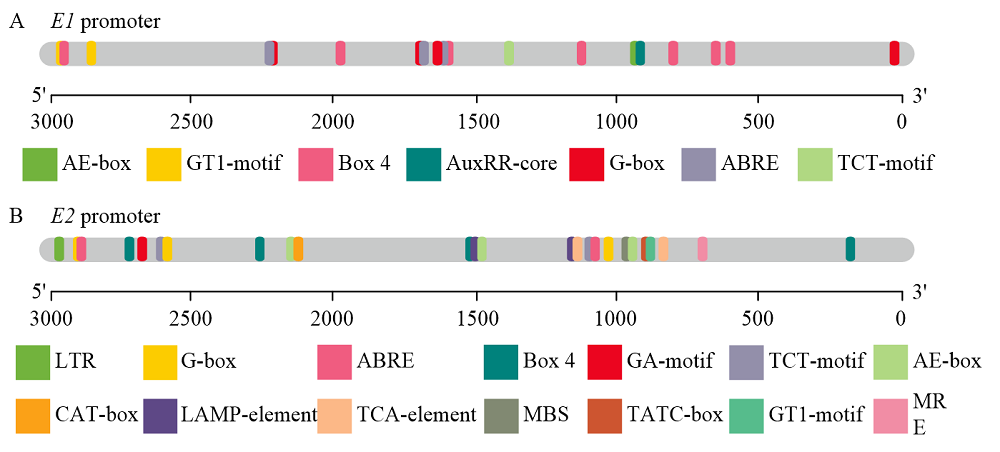
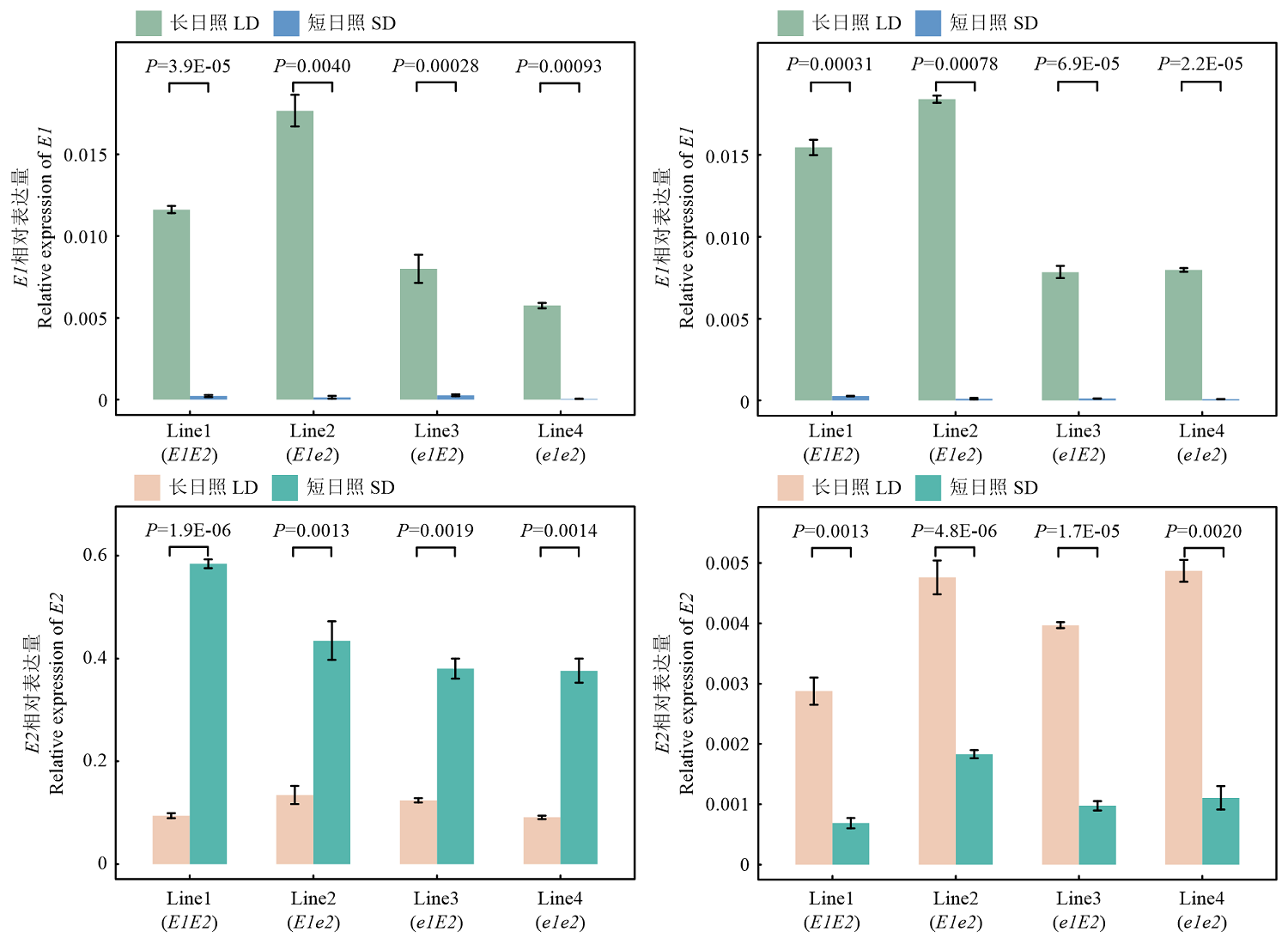
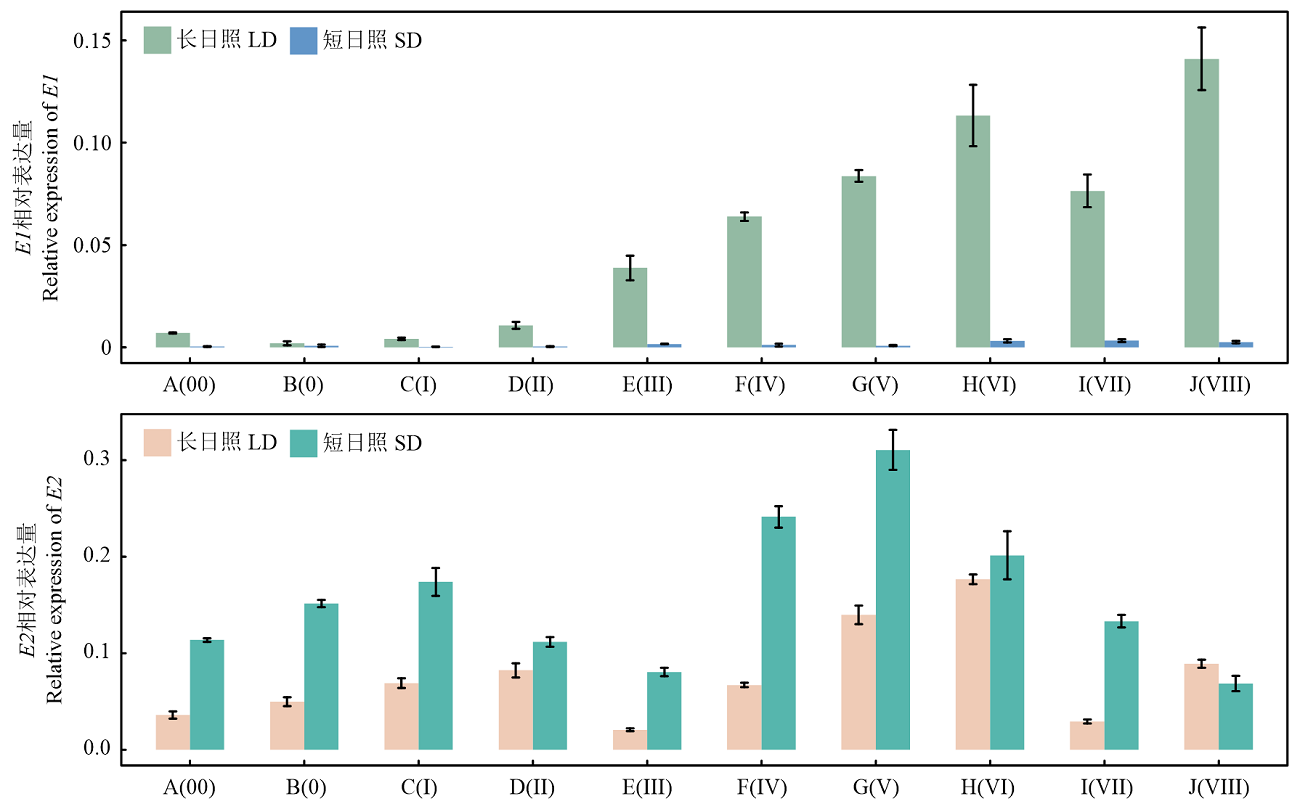
【Objective】Maturity time is an essential phenotypic measure of ecological adaptability of soybean and an important trait related to its yield formation. The study of promoters and expression patterns of major maturity genes E1 and E2 would provide basis for the study of gene function and molecular regulatory network of maturity time and lay foundation for adaptability improvement and yield increase in soybean.【Method】The promoter sequences of major maturity genes E1 and E2 were analyzed through the promoter cis-element analysis website PlantCARE, and the important regulatory elements were detected. The promoters of E1 and E2 were cloned, the GUS vectors were constructed, and transformation of Arabidopsis was performed to detect GUS activity in different tissues and organs of transgenic plants. Under low light and strong light conditions, the expression levels of E1 and E2 were compared between long day and short day conditions. The expression levels of E1 and E2 were detected in soybean varieties of different maturity groups, which is for the analysis of correlation between expression levels and maturity time of soybean varieties.【Result】Both E1 and E2 promoters contained multiple photoresponsive elements such as AE-box, Box4 and G-box, E1 promoter also contained auxin-response, abolic acid-response elements, and E2 promoter also contained low temperature-response, drought-response elements and meristem expression elements. In GUS activity detection of transgenic Arabidopsis, E1 promoter had strong transcriptional activity in all organs of the plant, and transcriptional activity of E2 promoter in fibrovascular tissues of seedling hypocotyl, leaf and root was relatively strong. Under both low light and strong light conditions, the expression level of E1 was significantly higher in long day than in short day. Under low light conditions, the expression level of E2 was higher in short day than in long day. Under strong light conditions, the expression level of E2 was higher in long day than in short day. With the increase of maturity time of different soybean varieties, expression level of E1 increased gradually, while E2 expression level did not change regularly.【Conclusion】The promoter of E1 gene was a widely expressed promoter, and its expression level was significantly regulated by photoperiod and significantly correlated with the maturity time of soybean varieties. The promoter of E2 was strongly expressed in vascular tissues of various organs, the photoperiodic regulation mode of this gene was different under strong light and low light conditions, and there was no significant correlation between expression level of E2 and maturity time.

Key words: soybean, maturity time, maturity gene E1, maturity gene E2, promoter, expression pattern

Table 1

Primers used for cloning of soybean E1 and E2 promoters and expression analysis"

引物名称Primer name 引物序列Primer sequence (5′-3′) 用途Purpose
proE1-F CTTCAGACTCAGATGGTAGG E1启动子克隆
Cloning of E1 promoter
proE1-R GTTGGAAGAGATGAATAGGGTC
proE2-F CTTAGTACCACACCCTGGAC E2启动子克隆
Cloning of E2 promoter
proE2-R CTATTTACTTTCAAGGTATTG
E1PT-F CTTCAGACTCAGATGGTAGG E1启动子转基因拟南芥检测
Detection of E1 promoter transgenic Arabidopsis
E1PT-R AGTGTGACTCTACGTTCTCC
E2PT-F AAGTGCAAACTTTATGGAGTA E2启动子转基因拟南芥检测
Detection of E2 promoter transgenic Arabidopsis
E2PT-R CCTCCTATGCAGCTTCAATC
qE1-F CCACCATATGCGAAGCCTCTA E1表达量检测
Detection of E1 expression level
qE1-R GGTGCATGGATTTGGTGTCC
qE2-F CCAAAAATTGAGAATGAATACTCGG E2表达量检测
Detection of E2 expression level
qE2-R TAGTCACTTCGAATACCTACTGGTG
qGmActin-F CGGTGGTTCTATCTTGGCATC 大豆荧光定量内参基因
Reference gene of qRT-PCR in soybean
qGmActin-R GTCTTTCGCTTCAATAACCCTA
qGUS-F CGAAGCGAGCAATGTGATGG GUS表达量检测
Detection of GUS expression level
qGUS-R GATCCGCAAGACGCATCAAC

Fig. 1

The cis-regulatory elements of soybean E1 and E2 promoters A: Cis-regulatory elements of E1 promoter; B: Cis-regulatory elements of E2 promoter. The number below the axis represents the number of bases from the start codon"

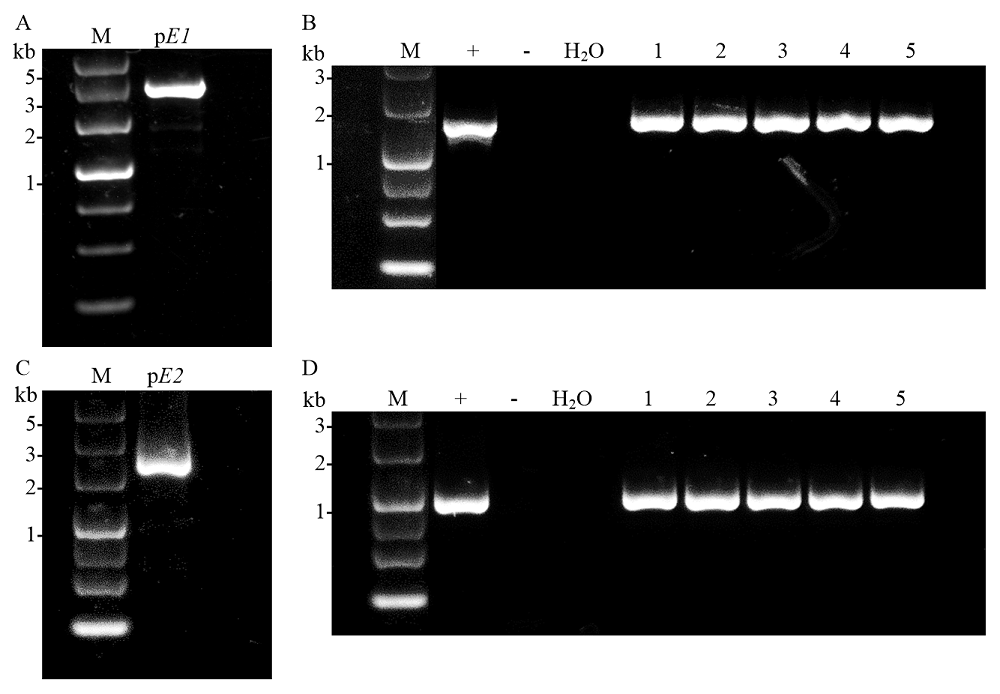
Fig. 2

Cloning of soybean E1 and E2 promoters and identification of transgenic Arabidopsis A: Cloning of E1 promoter; B: Identification of pE1 transgenic Arabidopsis; C: Cloning of E2 promoter; D: Identification of pE2 transgenic Arabidopsis. M: DNA Marker; pE1: E1 promoter; pE2: E2 promoter. +: Positive control, the promoter vector is used as the amplification template; -: Negative control, DNA of wild type Arabidopsis is used as the amplification template; H2O: Blank control, water is used as a PCR amplification template; 1-5: The transgenic Arabidopsis plants"

Fig. 3

Chemical staining in different tissues of transgenic Arabidopsis WT: Wild type of Arabidopsis; pE1-GUS: pE1-GUS transgenic Arabidopsis; pE2-GUS: pE2-GUS transgenic Arabidopsis. Bar=1 mm"

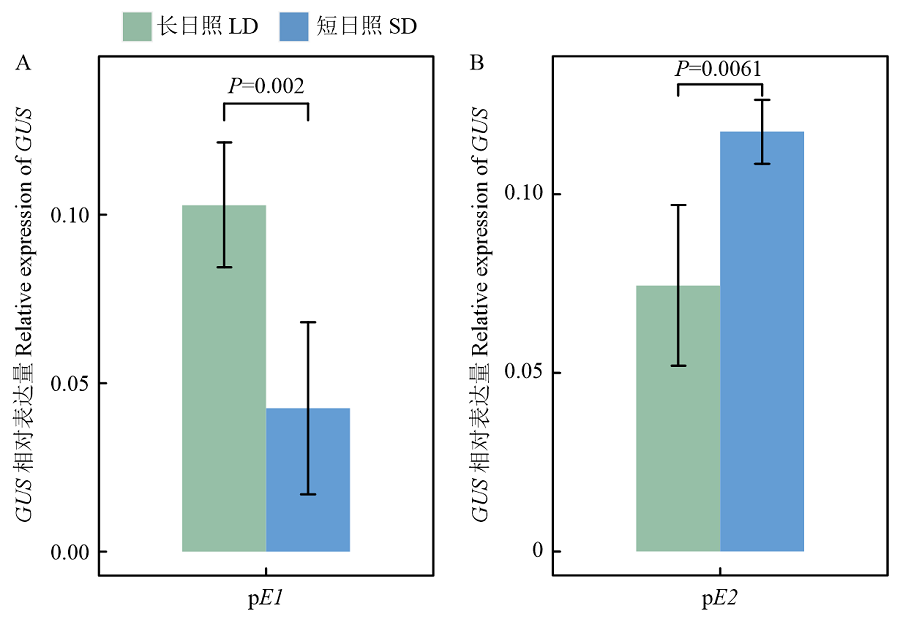
Fig. 4

Transcriptional activity of E1 and E2 promoters in transgenic Arabidopsis under long day and short day conditions A: Expression levels of GUS driving by E1 promoter; B: Expression levels of GUS driving by E2 promoter. LD: Long day; SD: Short day. The same as below"

Fig. 5

Expression levels of soybean E1 and E2 under long day and short day conditions A-B: Expression levels of E1 under low light (A) and strong light (B) conditions; C-D: Expression levels of E2 under low light (C) and strong light (D) conditions. Line1-Line4: Near-isogenic lines of E1and E2"

Fig. 6

The expression levels of E1 and E2 in varieties of different maturity groups A-J: Soybean varieties of different maturity groups; A: Heihe 9 (MG 00); B: Fengshou 12 (MG 0); C: Changjihuangdou (MG Ⅰ); D: Huangbaozhu (MG Ⅱ); E: Jidou 12 (MG Ⅲ); F: Yuejin 5 (MG Ⅳ); G: Edou 2 (MG Ⅴ); H: Nannong 493-1 (MG Ⅵ); I: Pingguohuangdou (MG Ⅶ); J: Zigongdongdou (MG Ⅷ). MG: Maturity group"

[1]
ZHAO L, LI M M, XU C J, YANG X, LI D M, ZHAO X, WANG K, LI Y H, ZHANG X M, LIU L X, DING F Q, DU H L, WANG C S, SUN J Z, LI W B. Natural variation in GmGBP1 promoter affects photoperiod control of flowering time and maturity in soybean. The Plant Journal, 2018, 96(1): 147-162.
[2]
LI X M, FANG C, YANG Y Q, LV T X, SU T, CHEN L Y, NAN H Y, LI S C, ZHAO X H, LU S J, DONG L D, CHENG Q, TANG Y, XU M L, ABE J, HOU X L, WELLER J L, KONG F J, LIU B H. Overcoming the genetic compensation response of soybean florigens to improve adaptation and yield at low latitudes. Current Biology, 2021, 31(17): 3755-3767.
[3]
KANTOLIC A G, SLAFER G A. Development and seed number in indeterminate soybean as affected by timing and duration of exposure to long photoperiods after flowering. Annals of Botany, 2007, 99(5): 925-933.

doi: 10.1093/aob/mcm033 pmid: 17452381
[4]
韩天富, 盖钧镒, 邱家驯. 中国大豆不同生态类型代表品种开花前, 开花后光周期反应的比较研究. 大豆科学, 1998, 17(2): 129-134.
HAN T F, GAI J Y, QIU J X. A comparative study on pre- and post- flowering photoperiod response in various ecotypes of soybeans. Soybean Science, 1998, 17(2): 129-134. (in Chinese)
[5]
SONG W W, SUN S, IBRAHIM S E, XU Z J, WU H Y, HU X G, JIA H C, CHENG Y X, YANG Z L, JIANG S B, WU T T, SINEGOVSKII M, SAPEY E, NEPOMUCENO A, JIANG B J, HOU W S, SINEGOVSKAYA V, WU C X, GAI J Y, HAN T F. Standard cultivar selection and digital quantification for precise classification of maturity groups in soybean. Crop Science, 2019, 59(5): 1997-2006.
[6]
SONG W W, LIU L P, SUN S, WU T T, ZENG H Y, TIAN S Y, SUN B C, LI W B, LIU L J, WANG S M, XING H, ZHOU X A, NIAN H, LU W C, HAN X Z, WANG S Y, CHEN W Y, GUO T, SONG X Q, TIAN Z Y, CHENG Y X, SONG S H, FU L S, WANG H C, LUO R P, LIU X Y, LIU Q, ZHANG G H, LU S H, XU R, LI S Z, LU W G, ZHANG Q, WANG Z B, JIANG C G, SHEN W L, ZHANG M R, ZHU D H, WANG R Z, CHEN Y, WANG T J, ZHU X T, ZHAN Y, JIANG B J, XU C L, YUAN S, HOU W S, GAI J Y, WU C X, HAN T F. Precise classification and regional delineation of maturity groups in soybean cultivars across China. European Journal of Agronomy, 2023, 151(3): 126982.
[7]
XIA Z J, WATANABE S, YAMADA T, TSUBOKURA Y, NAKASHIMA H, ZHAI H, ANAI T, SATO S, YAMAZAKI T, S X, WU H Y, TABATA S, HARADA K. Positional cloning and characterization reveal the molecular basis for soybean maturity locus E1 that regulates photoperiodic flowering. Proceedings of the National Academy of Sciences of the United States of America, 2012, 109(32): E2155- E2164.
[8]
WATANABE S, XIA Z J, HIDESHIMA R, TSUBOKURA Y, SATO S, YAMANAKA N, TAKAHASHI R, ANAI T, TABATA S, KITAMURA K, HARADA K. A map-based cloning strategy employing a residual heterozygous line reveals that the GIGANTEA gene is involved in soybean maturity and flowering. Genetics, 2011, 188(2): 395-407.
[9]
WATANABE S, HIDESHIMA R, XIA Z J, TSUBOKURA Y, SATO S, NAKAMOTO Y, YAMANAKA N, TAKAHASHI R, ISHIMOTO M, ANAI T, TABATA S, HARADA K. Map-based cloning of the gene associated with the soybean maturity locus E3. Genetics, 2009, 182(4): 1251-1262.
[10]
LIU B H, KANAZAWA A, MATSUMURA H, TAKAHASHI R, HARADA K, ABE J. Genetic redundancy in soybean photoresponses associated with duplication of the phytochrome A gene. Genetics. 2008, 180(2): 995-1007.

doi: 10.1534/genetics.108.092742 pmid: 18780733
[11]
BONATO E R, VELLO N A. E6, a dominant gene conditioning early flowering and maturity in soybeans. Genetics and Molecular Biology, 1999, 22(2): 229-232.
[12]
COBER E R, VOLDENG H D. A new soybean maturity and photoperiod-sensitivity locus linked to E1 and T. Crop Science, 2001, 41(3): 698-701.
[13]
COBER E R, MOLNAR S J, CHARETTE M, VOLDENG H D. A new locus for early maturity in soybean. Crop Science, 2010, 50(2): 524-527.
[14]
KONG F J, NAN H Y, CAO D, LI Y, WU F F, WANG J L, LU S J, YUAN X H, COBER E R, ABE J, LIU B H. A new dominant gene E9 conditions early flowering and maturity in soybean. Crop Science, 2014, 54(6): 2529-2535.
[15]
SAMANFAR B, MOLNAR S J, CHARETTE M, SCHOENROCK A, DEHNE F, GOLSHANI A, BELZILE F, COBER E R. Mapping and identification of a potential candidate gene for a novel maturity locus, E10, in soybean. Theoretical and Applied Genetics, 2017, 130(2): 377-390.
[16]
WANG F F, NAN H Y, CHEN L Y, FANG C, ZHANG H Y, SU T, LI S C, CHENG Q, DONG L D, LIU B H, KONG F J, LU S J. A new dominant locus, E11, controls early flowering time and maturity in soybean. Molecular Breeding, 2019, 39(5): 70.
[17]
LU S J, DONG L D, FANG C, LIU S L, KONG L P, CHENG Q, CHEN L Y, SU T, NAN H Y, ZHANG D, ZHANG L, WANG Z J, YANG Y Q, YU D Y, LIU X L, YANG Q Y, LIN X Y, TANG Y, ZHAO X H, YANG X Q, TIAN C G, XIE Q G, LI X, YUAN X H, TIAN Z X, LIU B H, WELLER J L, KONG F J. Stepwise selection on homeologous PRR genes controlling flowering and maturity during soybean domestication. Nature Genetics, 2020, 52(4): 428-436.
[18]
DONG L D, LI S C, WANG L S, SU T, ZHANG C B, BI Y D, LAI Y C, KONG L P, WANG F, PEI X X, LI H Y, HOU Z H, DU H P, DU H, LI T, CHENG Q, FANG C, KONG F J, LIU B H. The genetic basis of high-latitude adaptation in wild soybean. Current Biology, 2023, 33(2): 252-262.
[19]
DONG L D, CHENG Q, FANG C, KONG L P, YANG H, HOU Z H, LI Y L, NAN H Y, ZHANG Y H, CHEN Q S, ZHANG C B, KOU K, SU T, WANG L S, LI S C, LI H Y, LIN X Y, TANG Y, ZHAO X H, LU S J, LIU B H, KONG F J. Parallel selection of distinct Tof5 alleles drove the adaptation of cultivated and wild soybean to high latitudes. Molecular Plant, 2022, 15(2): 308-321.
[20]
LI H Y, DU H P, HE M L, WANG J H, WANG F, YUAN W J, HUANG Z R, CHENG Q, GOU C J, CHEN Z, LIU B H, KONG F J, FANG C, ZHAO X H, YU D Y. Natural variation of FKF1 controls flowering and adaptation during soybean domestication and improvement. The New Phytologist, 2023, 238(4): 1671-1684.
[21]
LI H Y, DU H P, HUANG Z R, HE M L, KONG L P, FANG C, CHEN L Y, YANG H, ZHANG Y H, LIU B H, KONG F J, ZHAO X H. The AP2/ERF transcription factor TOE4b regulates photoperiodic flowering and grain yield per plant in soybean. Plant Biotechnology Journal, 2023, 21(8): 1682-1694.
[22]
DONG L D, FANG C, CHENG Q, SU T, KOU K, KONG L P, ZHANG C B, LI H Y, HOU Z H, ZHANG Y H, CHEN L Y, YUE L, WANG L S, WANG K, LI Y L, GAN Z R, YUAN X H, WELLER J L, LU S J, KONG F J, LIU B H. Genetic basis and adaptation trajectory of soybean from its temperate origin to tropics. Nature Communications, 2021, 12(1): 5445.

doi: 10.1038/s41467-021-25800-3 pmid: 34521854
[23]
KOU K, YANG H, LI H Y, FANG C, CHEN L Y, YUE L, NAN H Y, KONG L P, LI X M, WANG F, WANG J H, DU H P, YANG Z Y, BI Y D, LAI Y C, DONG L D, CHENG Q, SU T, WANG L S, LI S C, HOU Z H, LU S J, ZHANG Y H, CHE Z J, YU D Y, ZHAO X H, LIU B H, KONG F J. A functionally divergent SOC1 homolog improves soybean yield and latitudinal adaptation. Current Biology, 2022, 32(8): 1728-1742.
[24]
LU S J, ZHAO X H, HU Y L, LIU S L, NAN H Y, LI X M, FANG C, CAO D, SHI X Y, KONG L P, SU T, ZHANG F G, LI S C, WANG Z, YUAN X H, COBER E R, WELLER J L, LIU B H, HOU X L, TIAN Z X, KONG F J. Natural variation at the soybean J locus improves adaptation to the tropics and enhances yield. Nature Genetics, 2017, 49(5): 773-779.
[25]
TSUBOKURA Y, WATANABE S, XIA Z J, KANAMORI H, YAMAGATA H, KAGA A, KATAYOSE Y, ABE J, ISHIMOTO M, HARADA K. Natural variation in the genes responsible for maturity loci E1, E2, E3 and E4 in soybean. Annals of Botany, 2014, 113(3): 429-441.
[26]
LIU L P, SONG W W, WANG L W, SUN X G, QI Y P, WU T T, SUN S, JIANG B J, WU C X, HOU W S, NI Z F, HAN T F. Allele combinations of maturity genes E1-E4 affect adaptation of soybean to diverse geographic regions and farming systems in China. PLoS ONE, 2020, 15(7): e0235397.
[27]
ZHAI H, S X, WU H Y, ZHANG Y P, ZHANG X Z, YANG J Y, WANG Y Y, YANG G, QIU H M, CUI T T, XIA Z J. Diurnal expression pattern, allelic variation, and association analysis reveal functional features of the E1 gene in control of photoperiodic flowering in soybean. PLoS ONE, 2015, 10(8): e0135909.
[28]
DISSANAYAKA A, RODRIGUEZ T O, DI S K, YAN F, GITHIRI S M, RODAS F R, ABE J, TAKAHASHI R. Quantitative trait locus mapping of soybean maturity gene E5. Breeding Science, 2016, 66(3): 407-415.
[29]
刘路平. 大豆生育期基因单倍型鉴定及地理分布规律研究[D]. 北京: 中国农业大学, 2020.
LIU L P. Identification of soybean maturity gene haplotypes and study of their geographic distribution[D]. Beijing: China Agricultural University, 2020. (in Chinese)
[30]
CHANG S S, PARK S K, KIM B C, KANG B J, KIM D U, NAM H G. Stable genetic transformation of Arabidopsis thaliana by Agrobacterium inoculation in planta. The Plant Journal, 1994, 5(4): 551-558.
[31]
LIN X Y, LIU B H, WELLER J L, ABE J, KONG F J. Molecular mechanisms for the photoperiodic regulation of flowering in soybean. Journal of Integrative Plant Biology, 2021, 63(6):981-994.

doi: 10.1111/jipb.13021
[32]
胡雪洁, 刘路平, 王凤敏, 韩玉华, 孙宾成, 马启彬, 黄志平, 冯燕, 陈强, 杨春燕, 张孟臣, 张锴, 秦君. 利用大豆生育期基因E1E2构建适宜不同生态区的ms1基础轮回群体. 中国农业科学, 2024, 57(17): 3305-3317. doi:10.3864/j.issn.0578-1752.2024.17.001.
HU X J, LIU L P, WANG F M, HAN Y H, SUN B C, MA Q B, HUANG Z P, FENG Y, CHEN Q, YANG C Y, ZHANG M C, ZHANG K, QIN J. Construction of ms1 basic recurrent populations adapted to different ecological regions using maturity genes E1 and E2 in soybean. Scientia Agricultura Sinica, 2024, 57(17): 3305-3317. doi:10.3864/j.issn.0578-1752.2024.17.001. (in Chinese)
[33]
LI Y L, HOU Z H, LI W W, LI H Y, LU S J, GAN Z R, DU H, LI T, ZHANG Y H, KONG F J, CHENG Y H, HE M L, MA L X, LIAO C M, LI Y R, DONG L D, LIU B H, CHENG Q. The legume-specific transcription factor E1 controls leaf morphology in soybean. BMC Plant Biology, 2021, 21(1):531.

doi: 10.1186/s12870-021-03301-1 pmid: 34773981
[34]
WAN Z, LIU Y X, GUO D D, FAN R, LIU Y, XU K, ZHU J L, QUAN L, LU W T, BAI X, ZHAI H. CRISPR/Cas9-mediated targeted mutation of the E1 decreases photoperiod sensitivity, alters stem growth habits, and decreases branch number in soybean. Frontiers in Plant Science, 2022, 13: 1066820.
[35]
MISHRA P, PANIGRAHI K C. GIGANTEA-an emerging story. Frontiers in Plant Science, 2015, 6: 8.
[36]
MARTIN-TRYON E L, KREPS J A, HARMER S L. GIGANTEA acts in blue light signaling and has biochemically separable roles in circadian clock and flowering time regulation. Plant Physiology, 2007, 143(1): 473-486.
[37]
ZHAO X H, LI H Y, WANG L S, WANG J H, HUANG Z R, DU H P, LI Y R, YANG J H, HE M L, CHENG Q, LIN X Y, LIU B H, KONG F J. A critical suppression feedback loop determines soybean photoperiod sensitivity. Developmental Cell, 2024, 59(13): 1750-1763.
[38]
LI F, ZHANG X M, HU R B, WU F Q, MA J H, MENG Y, FU Y F. Identification and molecular characterization of FKF1 and GI homologous genes in soybean. PLoS ONE, 2013, 8(11): e79036.
[39]
吕世祥. 调控大豆E1基因表达的分子机理研究[D]. 长春: 中国科学院东北地理与农业生态研究所, 2015.
S X. Studies on molecular mechanism regulating the expression of E1 in soybean [Glycine Max (L.) Merr.][D]. Changchun: Northeast Institute of Geography and Agroecology, Chinese Academy of Science, 2015. (in Chinese)
[40]
LIU W, JIANG B J, MA L M, ZHANG S W, ZHAI H, XU X, HOU W S, XIA Z J, WU C X, SUN S, WU T T, CHEN L, HAN T F. Functional diversification of Flowering Locus T homologs in soybean: GmFT1a and GmFT2a/5a have opposite roles in controlling flowering and maturation. The New Phytologist, 2018, 217(3): 1335-1345.
[41]
WANG Y, GU Y Z, GAO H H, QIU L J, CHANG R Z, CHEN S Y, HE C Y. Molecular and geographic evolutionary support for the essential role of GIGANTEAa in soybean domestication of flowering time. BMC Evolutionary Biology, 2016, 16: 79-91.

doi: 10.1186/s12862-016-0653-9 pmid: 27072125
[42]
CAO D, TAKESHIMA R, ZHAO C, LIU B H, JUN A, KONG F J. Molecular mechanisms of flowering under long days and stem growth habit in soybean. Journal of Experimental Botany, 2017, 68(8): 1873-1884.

doi: 10.1093/jxb/erw394 pmid: 28338712
[1] LI YongJuan, ZHANG YueTong, WANG YiBo, ZHAO ChangJiang, SONG Jie, CHEN XueLi, YAO Qin. Effects of Biochar Application on the Abundance and Community Composition of Nitrogen-Fixing Microbial nifH Gene in Soybean Rotation and Continuous Cropping Systems [J]. Scientia Agricultura Sinica, 2026, 59(6): 1272-1285.
[2] LIU FangDong, SUN Lei, WANG WuBin, ZHAO JinMing, GAI JunYi. Changes of Cropping System and Suggestions on Ecological Cultivation Regions of Soybeans in China [J]. Scientia Agricultura Sinica, 2026, 59(3): 486-498.
[3] CAI TingYang, ZHU YuPeng, LI RuiDong, WU ZongSheng, XU YiFan, SONG WenWen, XU CaiLong, WU CunXiang. Effects of Leaf-Cutting at Seedling Stage on Photosynthetic Characteristics, Pod Distribution and Yield Formation in Soybean in the Huang-Huai-Hai Region [J]. Scientia Agricultura Sinica, 2026, 59(2): 292-304.
[4] WU Qiong, XIE XiangTing, WANG Lei, MOU Yong, LI JinWei. Development and Validation of Event-Specific PCR Method for the Quantification of Genetically Modified Soybean DBN8205 [J]. Scientia Agricultura Sinica, 2026, 59(1): 29-40.
[5] WEI Ping, PAN JuZhong, ZHU DePing, SHAO ShengXue, CHEN ShanShan, WEI YaQian, GAO WeiWei. The Function of OsDREB1J in Regulating Rice Grain Size [J]. Scientia Agricultura Sinica, 2025, 58(8): 1463-1478.
[6] ZHENG Yu, CHEN Yi, TI JinSong, SHI LongFei, XU XiaoBo, LI YuLin, GUO Rui. Evaluation of Carbon Footprint and Economic Benefit of Different Tobacco Rotation Patterns [J]. Scientia Agricultura Sinica, 2025, 58(4): 733-747.
[7] ZHANG Qi, XUE FuZhen, YANG XiuJie, JIANG SuYang, HUANG XueJuan, MA JiaYi, ZHANG ZheWen, XU JieFei. Study on the Function of Soybean Nicotinamide Enzyme GmNIC1 Gene Under Saline Alkali Stress [J]. Scientia Agricultura Sinica, 2025, 58(24): 5128-5142.
[8] MA HeXiao, GE GuoLong, ZHANG XiangQian, LU ZhanYuan, WANG ManXiu, RONG MeiRen, SHI JingJing, ZHANG DeJian, SUN XuePing. Effects of Different Crop Rotation Systems on Soil Readily Oxidized Organic Carbon and Carbon Pool Activity Differences [J]. Scientia Agricultura Sinica, 2025, 58(24): 5201-5215.
[9] GAO ChunHua, ZHAO HaiJun, ZHAO FengTao, KONG WeiLin, JU FeiYan, LI ZongXin, SHI DeYang, LIU Ping. Effect of Growth Regulators on the Stem Characteristics and Yield of Summer Maize in Maize-Soybean Strip Intercropping [J]. Scientia Agricultura Sinica, 2025, 58(23): 4920-4935.
[10] YANG ShuQi, ZHAO YingXing, QIAN Xin, ZHANG XuePeng, MENG WeiWei, SUI Peng, LI ZongXin, CHEN YuanQuan. Comprehensive Evaluation of the Maize-Soybean Intercropping Pattern in the Huang-Huai Region [J]. Scientia Agricultura Sinica, 2025, 58(23): 4936-4951.
[11] FANG Jian, QIN ZhaoJi, YU YuanYuan, YU NingNing, ZHAO Bin, LIU Peng, REN BaiZhao, ZHANG JiWang. Impacts of Varying Row Ratio Arrangements on Plant Performance, Stand Yield, and Comprehensive Benefits in Soybean-Maize Strip intercropping [J]. Scientia Agricultura Sinica, 2025, 58(23): 4841-4857.
[12] SONG XuHui, ZHAO XueYing, ZHAO Bin, REN BaiZhao, ZHANG JiWang, LIU Peng, REN Hao. Effects of Row Ratio Allocation on Light Distribution and Photosynthetic Production Capacity of Maize-Soybean Strip Intercropping [J]. Scientia Agricultura Sinica, 2025, 58(23): 4858-4871.
[13] SHI DeYang, GAO ChunHua, LI YanHong, ZHAO HaiJun, XIA DeJun. Effects of Row Spacing Configuration on the Canopy Characteristics and Grain Yield of the Intercropping Maize [J]. Scientia Agricultura Sinica, 2025, 58(23): 4872-4885.
[14] ZHANG MengYu, HE ZaiJu, WANG XingXing, REN Hao, REN BaiZhao, LIU Peng, ZHANG JiWang, ZHAO Bin. The Influences of Different Plant Height Combinations of Maize Varieties on Light Distribution in the Canopy and the Photosynthetic Characteristics of Maize Under Maize-Soybean Strip Intercropping Pattern [J]. Scientia Agricultura Sinica, 2025, 58(23): 4886-4904.
[15] KONG WeiLin, GAO ChunHua, ZHAO FengTao, JU FeiYan, LI ZongXin, ZHAO HaiJun, LIU Ping. Effects of Nitrogen Application Rate Combined with Drip Irrigation Amount After Sowing on Yield, Economic Benefit, Water Use Characteristics of Maize-Soybean Strip Intercropping Planting System [J]. Scientia Agricultura Sinica, 2025, 58(23): 4905-4919.
Viewed
Full text


Abstract

Cited

  Shared   
  Discussed   
No Suggested Reading articles found!