Scientia Agricultura Sinica ›› 2026, Vol. 59 ›› Issue (1): 29-40.doi: 10.3864/j.issn.0578-1752.2026.01.003

• CROP GENETICS & BREEDING·GERMPLASM RESOURCES·MOLECULAR GENETICS • Previous Articles     Next Articles

Development and Validation of Event-Specific PCR Method for the Quantification of Genetically Modified Soybean DBN8205

WU Qiong1(), XIE XiangTing2, WANG Lei2, MOU Yong2, LI JinWei1,*()   

  1. 1 Beijing Chuangzhong Technology Co., Ltd., Beijing 100194
    2 Beijing Dabeinong Biotechnology Co., Ltd., Beijing 100194
  • Received:2025-07-23 Accepted:2025-10-02 Online:2026-01-01 Published:2026-01-07
  • Contact: LI JinWei

Abstract:

【Objective】The genetically modified soybean DBN8205 event has been approved for a biosafety certification (for commercial application) in China, and its derived varieties are nearing commercial planting. This study aimed to establish an event-specific detection method for DBN8205 to support the implementation of biosafety regulations and the threshold labeling policy for genetically modified organisms. 【Method】Event-specific primers and probes were designed based on the unique molecular characteristics of the DBN8205 event. The optimal primer/probe set was selected by comparing the amplification curves and Ct values of multiple combinations. The performance of the DBN8205 event-specific PCR method, including specificity, limit of detection (LOD), limit of quantification (LOQ), dynamic range, and quantitative accuracy, was thoroughly evaluated on both real-time quantitative PCR (qPCR) and droplet digital PCR (ddPCR) platforms. A collaborative trial was conducted across eight laboratories to validate the qPCR method, with the resulting data statistically analyzed to evaluate its repeatability and reproducibility. 【Result】The primer/probe combination DBN8205-QF/QR/QP was identified as optimal, producing a 120 bp amplicon specifically identified as optimal the DBN8205 event with high specificity. On the qPCR platform, the LOD and LOQ were 10 and 40 copies, respectively. The standard curve exhibited excellent linearity (R2>0.99) over a dynamic range from 40 to 8.2×10⁴ copies, allowing for accurate quantification of samples with DBN8205 content as low as 0.1%. The collaborative validation of eight laboratories confirmed that the qPCR method demonstrated good repeatability and reproducibility. On the ddPCR platform, the LOD and LOQ were identical to those of qPCR. The duplex ddPCR assay also showed a good linear correlation between measured and expected values within the range of 40 to 8.0×10⁴ copies and provided more precise quantification for low-concentration samples (0.1%) compared to qPCR. A t-test indicated no significant difference between the quantitative results obtained from qPCR and ddPCR, demonstrating good consistency between the two platforms. 【Conclusion】The established DBN8205 event-specific PCR method enables unambiguous identification and accurate quantification of the DBN8205 event in products on both qPCR and ddPCR platforms.

Key words: genetically modified soybean, DBN8205 event, real-time quantitative PCR, duplex digital PCR, quantification

Table 1

Primers and probes for DBN8205 event and Lectin reference gene"

靶标
Target
引物/探针
Primer/probe
序列
Sequence (5′-3′)
扩增子大小
Amplicon size (bp)
来源
Reference
DBN8205 DBN8205-QF TTGAGGGGGTTACGCAATGTT 120 自主研制
Self-developed
DBN8205-QR GCGGGGGTCATAACGTGAC
DBN8205-QP FAM-TCAGATTGTCGTTTCCCGCCTTCAG-BHQ
lectin lectin-QF GCCCTCTACTCCACCCCCA 118 [25]
lectin-QR GCCCATCTGCAAGCCTTTTT
lectin-QP HEX-AGCTTCGCCGCTTCCTTCAACTTCAC-BHQ

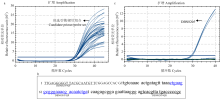
Fig. 1

Screening and specificity testing of event- specific primer/probe combinations a: Selection of the optimal primer/probe combination; b: Positions of primers and probes on the junction between T-DNA and flanking genomic DNA, where 1-32 bp represents the flanking genomic sequence in uppercase letters, and 33-120 bp represents the inserted T-DNA sequence in lowercase letters, primer sequences are highlighted by underlined letters, and the probe sequence is indicated by blue letters with a wavy underline; c: Specificity testing of the primer/probe combination DBN8205-QF/QR/QP"

Table 2

Standard curves of DBN8205 event and Lectin reference gene"

重复 Replication 靶标 Target 曲线斜率 Slope 扩增效率 Amplification efficiency (%) 决定系数 R2
Rep1 DBN8205 -3.245 103.30 0.997
lectin -3.302 100.80 0.997
Rep2 DBN8205 -3.341 99.20 0.998
lectin -3.277 101.90 0.998
Rep3 DBN8205 -3.394 97.10 0.999
lectin -3.445 95.10 0.999

Table 3

LOQ testing of DBN8205 event-specific qPCR method"

重复
Replicate
S5(100 copies, 0.25%) S6(40 copies, 0.10%) S7(20 copies, 0.05%) S8 (10 copies, 0.025%)
DBN8205拷贝数
DBN8205 copies (copies)
百分比
Copy number ratio (%)
DBN8205拷贝数
DBN8205 copies (copies)
百分比
Copy number ratio (%)
DBN8205拷贝数
DBN8205 copies (copies)
百分比
Copy number ratio (%)
DBN8205拷贝数
DBN8205 copies (copies)
百分比
Copy number ratio (%)
1 124 0.309 44 0.123 38 0.102 14 0.037
2 128 0.331 35 0.103 23 0.066 13 0.044
3 104 0.325 40 0.095 29 0.079 10 0.024
4 103 0.288 47 0.117 27 0.079 12 0.039
5 97 0.244 37 0.107 28 0.087 10 0.034
6 99 0.235 40 0.119 13 0.040 6 0.022
7 101 0.274 43 0.128 25 0.079 13 0.040
8 97 0.216 47 0.139 21 0.070 6 0.021
9 115 0.302 40 0.114 21 0.067 16 0.050
10 88 0.242 44 0.126 20 0.060 13 0.038
平均值
Average
106 0.277 42 0.117 25 0.073 11 0.035
相对偏倚
Biasr (%)
5.60 10.64 4.25 17.10 22.50 46.13 13.00 39.60
标准差
SD (%)
12.74 0.04 4.00 0.01 3.30 0.01 3.30 0.010
相对标准差
RSD (%)
12.06 14.66 9.60 11.08 29.22 27.80 29.22 27.80

Table 4

Accuracy analysis of DBN8205 event-specific quantitative PCR method"

样品
Sample
方法
Method
预期含量
Expected
content (%)
重复 Replicate 平均值
Average
(%)
相对偏倚
Biasr
(%)
标准差
SD
(%)
相对标准差
RSD
(%)
P
P value
Rep1 Rep2 Rep3
S1 qPCR 5.0 5.05 5.61 4.95 5.20 4.07 0.39 7.49 0.29
ddPCR 5.04 4.86 4.93 4.94 -1.15 0.11 2.19
S2 qPCR 3.0 3.20 2.93 2.91 3.01 0.44 0.17 5.68 0.95
ddPCR 3.04 2.93 3.05 3.01 0.24 0.07 2.35
S3 qPCR 1.0 1.03 1.13 1.09 1.08 8.33 0.06 5.45 0.27
ddPCR 1.06 1.05 1.02 1.04 4.43 0.02 2.31
S4 qPCR 0.5 0.50 0.55 0.55 0.53 6.67 0.03 5.54 0.19
ddPCR 0.52 0.49 0.50 0.50 0.85 0.01 2.75
S6 qPCR 0.10 0.09 0.11 0.10 0.10 0.00 0.01 11.81 0.06
ddPCR 0.13 0.11 0.13 0.12 24.50 0.01 9.21

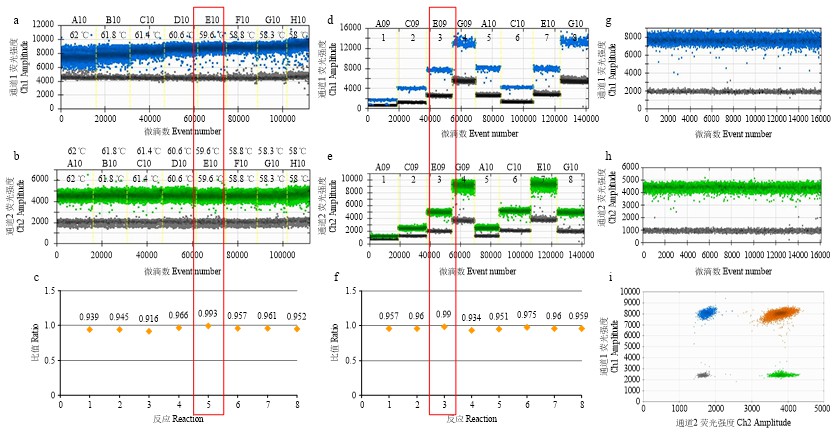
Fig. 2

Optimization of primer/probe concentration and annealing temperature for DBN8205/Lectin duplex ddPCR a: One-dimension (1-D) plots of the DBN8205 eventacross an annealing temperature gradient from 58 to 62 ℃; b: Lectin reference gene across an annealing temperature gradient from 58 to 62 ℃; c: The corresponding DBN8205/Lectin copy number ratios measured at each temperature; d: 1-D plots of the DBN8205 event for optimization of primer/probe concentration; e: 1-D plots of the Lectin reference gene for optimization of primer/probe concentration; f: The resulting DBN8205/Lectin copy number ratios under different concentration schemes, where 1-4, identical concentrations for both assays (100/50, 200/100, 400/200, 800/400 nmol·L-1), 5-8, different concentrations for DBN8205 (400/200, 200/100, 400/200, 800/400 nmol·L-1) and Lectin (200/100, 400/200, 800/400, 400/200 nmol·L-1); g: 1-D plots of the DBN8205 event under the final optimized reaction conditions; h: 1-D plots of the Lectin reference gene under the final optimized reaction conditions; i: 2-D plot of DBN8205 event and Lectin reference gene under the final optimized reaction conditions"

Table 5

Measured copy number and ratio of serial diluted DNA solution by the DBN8205/Lectin duplex ddPCR"

靶标
Target
预期模板量
Expected amount (copy/reaction)
测量值 Measured value (copy/reaction )
Rep1 Rep2 Rep3 均值
Mean
标准差
SD
相对标准差
RSD (%)
相对偏倚
Biasr (%)
DBN8205 8.0×10⁴ 78000 77000 83000 79333 2624.67 3.31 -0.83
1.0×10⁴ 10540 10680 10240 10487 183.55 1.75 4.87
1.0×10³ 1384 1330 1430 1381 40.87 2.96 38.13
500 506 502 504 504 1.63 0.32 0.80
50 60 66 60 62 2.83 4.56 24.00
40 46 40 52 46 4.90 10.65 15.00
Lectin 8.0×10⁴ 79600 80000 86400 82000 3115.55 3.80 2.50
1.0×10⁴ 10800 10760 10700 10753 41.10 0.38 7.53
1.0×10³ 1440 1428 1462 1443 14.08 0.98 44.33
500 488 470 498 485 11.59 2.39 -2.93
50 56 56 58 57 0.94 1.66 13.33
40 40 38 42 40 1.63 4.08 0.00
DBN8205/
Lectin
8.0×10⁴ 0.98 0.96 0.96 0.97 0.01 0.90 -3.23
1.0×10⁴ 0.98 0.99 0.96 0.98 0.01 1.49 -2.48
1.0×10³ 0.96 0.93 0.98 0.96 0.02 2.02 -4.31
500 1.04 1.07 1.01 1.04 0.02 2.21 3.90
50 1.07 1.18 1.03 1.09 0.06 5.58 9.48
40 1.15 1.05 1.24 1.15 0.08 6.60 14.69

Fig. 3

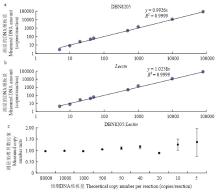
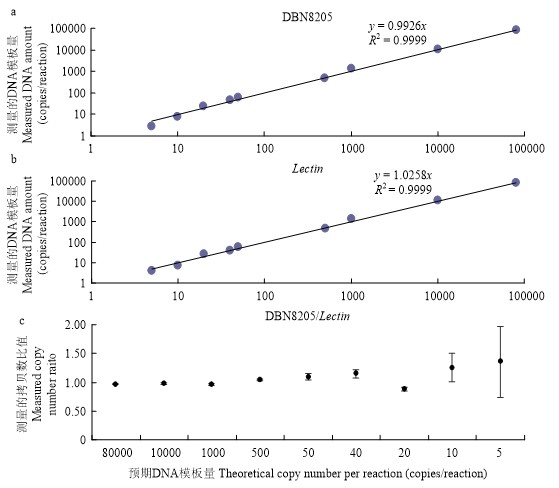
Dynamic range of DBN8205/Lectin duplex ddPCR a: Linearity of the duplex ddPCR assay for DBN8205 with a dynamic range of 40 to 8.0×10⁴ copies/reaction; b: Lectin with a dynamic range of 40 to 8.0×10⁴ copies/reaction; c: The measured DBN8205/Lectin copy number ratios across different template quantities"

Table 6

The statistical analysis of collaborative validation results of eight laboratories"

样品
Samples
预期值 Expected value (%)
5.0 3.0 1.0 0.5 0.1
返回数据实验室数Labs reporting results 8 8 8 8 8
每个实验室平行样品个数Replicate 3 3 3 3 3
离群值数Replicate 0 1 0 0 0
平均值Average (%) 5.583 3.292 1.102 0.528 0.107
重复性标准差sr (%) 0.201 0.117 0.109 0.036 0.009
重复性相对标准差RSDr (%) 3.599 3.547 9.852 6.751 8.241
再现性标准差sR (%) 0.337 0.177 0.124 0.046 0.008
再现性相对标准差RSDR (%) 6.028 5.391 11.205 8.741 7.920
偏倚Bias (%) 0.583 0.292 0.102 0.028 0.007
相对偏倚Biasr (%) 11.660 9.742 10.224 5.695 7.297
[1]
AGBIOINVESTOR GM MONITOR. Global GM Crop Area Review. (2025-04-01) [2025-06-05]. https://gm.agbioinvestor.com.
[2]
WUNDERLICH S, GATTO K A. Consumer perception of genetically modified organisms and sources of information. Advances in Nutrition, 2015, 6(6): 842-851.

doi: 10.3945/an.115.008870 pmid: 26567205
[3]
GRUÈRE G P, RAO S R. A review of international labeling policies of genetically modified food to evaluate India’s proposed rule. AgBioForum, 2007, 10(1): 51-64.
[4]
BRUTON S V. GMO food labeling// Encyclopedia of Food and Agricultural Ethics. Dordrecht: Springer Netherlands, 2019: 1463-1468.
[5]
SOGA K, NAKAMURA K, EGI T, NARUSHIMA J, YOSHIBA S, KISHINE M, MANO J, KITTA K, TAKABATAKE R, SHIBATA N, et al. Development and validation of a new robust detection method for low-content DNA using ΔΔCq-based real-time PCR with optimized standard plasmids as a control sample. Analytical Chemistry, 2022, 94(41): 14475-14483.

doi: 10.1021/acs.analchem.2c03680 pmid: 36205585
[6]
SHIN M K, JEON S M, PARK J S. Quantitative real-time PCR analysis of four genetically modified soybean events using plasmid and genomic DNA calibrators. Food Science and Biotechnology, 2024, 33(4): 991-998.

doi: 10.1007/s10068-023-01392-0 pmid: 38371688
[7]
HOLST-JENSEN A, RØNNING S B, LØVSETH A, BERDAL K G. PCR technology for screening and quantification of genetically modified organisms (GMOs). Analytical and Bioanalytical Chemistry, 2003, 375(8): 985-993.

doi: 10.1007/s00216-003-1767-7
[8]
MIRAGLIA M, BERDAL K G, BRERA C, CORBISIER P, HOLST-JENSEN A, KOK E J, MARVIN H J P, SCHIMMEL H, RENTSCH J, VAN RIE J P P F, et al. Detection and traceability of genetically modified organisms in the food production chain. Food and Chemical Toxicology, 2004, 42(7): 1157-1180.

pmid: 15123385
[9]
BONFINI L, VAN DEN BULCKE M H, MAZZARA M, BEN E, PATAK A. GMOMETHODS: The European Union database of reference methods for GMO analysis. Journal of AOAC International, 2012, 95(6): 1713-1719.

pmid: 23451388
[10]
DEMEKE T, JENKINS G R. Influence of DNA extraction methods, PCR inhibitors and quantification methods on real-time PCR assay of biotechnology-derived traits. Analytical and Bioanalytical Chemistry, 2010, 396(6): 1977-1990.

doi: 10.1007/s00216-009-3150-9 pmid: 19789856
[11]
GRELEWSKA-NOWOTKO K, ŻURAWSKA-ZAJFERT M, ŻMIJEWSKA E, SOWA S. Optimization and verification of droplet digital PCR even-specific methods for the quantification of GM maize DAS1507 and NK603. Applied Biochemistry and Biotechnology, 2018, 185(1): 207-220.

doi: 10.1007/s12010-017-2634-x
[12]
DUBE S, QIN J, RAMAKRISHNAN R. Mathematical analysis of copy number variation in a DNA sample using digital PCR on a nanofluidic device. PLoS ONE, 2008, 3(8): e2876.

doi: 10.1371/journal.pone.0002876
[13]
HUGGETT J F. The digital MIQE guidelines update: Minimum information for publication of quantitative digital PCR experiments for 2020. Clinical Chemistry, 2020, 66(8): 1012-1029.

doi: 10.1093/clinchem/hvaa125 pmid: 32746458
[14]
HUGGETT J F, FOY C A, BENES V, EMSLIE K, GARSON J A, HAYNES R, HELLEMANS J, KUBISTA M, MUELLER R D, NOLAN T, et al. The digital MIQE guidelines: Minimum information for publication of quantitative digital PCR experiments. Clinical Chemistry, 2013, 59(6): 892-902.

doi: 10.1373/clinchem.2013.206375 pmid: 23570709
[15]
DEMEKE T, MALABANAN J, HOLIGROSKI M, ENG M. Effect of source of DNA on the quantitative analysis of genetically engineered traits using digital PCR and real-time PCR. Journal of AOAC International, 2017, 100(2): 492-498.

doi: 10.5740/jaoacint.16-0284 pmid: 28118137
[16]
RAČKI N, DREO T, GUTIERREZ-AGUIRRE I, BLEJEC A, RAVNIKAR M. Reverse transcriptase droplet digital PCR shows high resilience to PCR inhibitors from plant, soil and water samples. Plant Methods, 2014, 10(1): 42.

doi: 10.1186/s13007-014-0042-6 pmid: 25628753
[17]
LI J, GAO H F, LI Y J, ZHAI S S, XIAO F, WU G, WU Y H. The development of a series of genomic DNA reference materials with specific copy number ratios for the detection of genetically modified maize DBN9936. Foods, 2024, 13(5): 747.

doi: 10.3390/foods13050747
[18]
DEMEKE T, DOBNIK D. Critical assessment of digital PCR for the detection and quantification of genetically modified organisms. Analytical and Bioanalytical Chemistry, 2018, 410(17): 4039-4050.

doi: 10.1007/s00216-018-1010-1 pmid: 29574561
[19]
LI J, GAO H F, LI Y J, XIAO F, ZHAI S S, WU G, WU Y H. Event-specific PCR methods to quantify the genetically modified DBN9936 maize. Journal of Food Composition and Analysis, 2022, 105: 104236.

doi: 10.1016/j.jfca.2021.104236
[20]
BHAT S, EMSLIE K R. Digital polymerase chain reaction for characterisation of DNA reference materials. Biomolecular Detection and Quantification, 2016, 10: 47-49.

pmid: 27990349
[21]
COTTENET G, BLANCPAIN C, CHUAH P F. Performance assessment of digital PCR for the quantification of GM-maize and GM-soya events. Analytical and Bioanalytical Chemistry, 2019, 411(11): 2461-2469.

doi: 10.1007/s00216-019-01692-7 pmid: 30810790
[22]
BOGOŽALEC KOŠIR A, DEMŠAR T, ŠTEBIH D, ŽEL J, MILAVEC M. Digital PCR as an effective tool for GMO quantification in complex matrices. Food Chemistry, 2019, 294: 73-78.

doi: S0308-8146(19)30827-1 pmid: 31126507
[23]
INTERNATIONAL ORGANIZATION FOR STANDARDIZATION. Biotechnology requirements for evaluating the performance of quantification methods for nucleic acid target sequence-qPCR and dPCR. ISO 20395:2019, Geneva: International Organization for Standardization, 2019. https://www.iso.org/standard/67899.html.
[24]
LI J, LI L, ZHANG L, ZHANG X J, LI X Y, ZHAI S S, GAO H F, LI Y J, WU G, WU Y H. Development of a certified genomic DNA reference material for detection and quantification of genetically modified rice KMD. Analytical and Bioanalytical Chemistry, 2020, 412(25): 7007-7016.

doi: 10.1007/s00216-020-02834-y pmid: 32740822
[25]
全国农业转基因生物安全管理标准化技术委员会. 转基因植物及其产品成分检测大豆内标准基因定性PCR方法:农业部2031号公告-8-2013. 北京: 中国农业出版社, 2013: 1-6.
National Technical Committee for Standardization of Biosafety Management of Agricultural Genetically Modified Organisms. Detection of genetically modified plants and derived products-target-taxon- specific qualitative PCR method for soybean:Announcement by the Ministry of Agriculture No.2031-8-2013. Beijing: China Agriculture Press, 2013: 1-6. (in Chinese)
[26]
ARUMUGANATHAN K, EARLE E D. Nuclear DNA content of some important plant species. Plant Molecular Biology Reporter, 1991, 9(3): 208-218.

doi: 10.1007/BF02672069
[27]
HORWITZ W. Protocol for the design, conduct and interpretation of method-performance studies: Revised 1994 (Technical Report). Pure and Applied Chemistry, 1995, 67(2): 331-343.
[28]
Accuracy (trueness and precision) of measurement methods and results- Part 2: Basic method for the determination of repeatability and reproducibility of a standard measurement method: ISO 5725-2:2025. https://www.iso.org/standard/90054.html.
[29]
EUROPEAN COMMISSION. Definition of minimum performance requirements for analytical methods of GMO testing. 2015. [2025- 11-20]. https://gmo-crl.jrc.ec.europa.eu/doc/MPR%20Report%20Application% 2020_10_2015.pdf.
[1] HONG RunJing, ZHOU Hong, LIN HuiXing, FAN HongJie. Establishment and Application of Sandwich ELISA Method for Detecting Lawsonia intracellularis [J]. Scientia Agricultura Sinica, 2025, 58(5): 1032-1042.
[2] ZHANG Ying, YUAN QingYun, REN Fang, HU GuoJun, FAN XuDong, DONG YaFeng. Establishment of RT-qPCR Detection Technology for GINV and Its Spatial and Temporal Distribution in Different Grape Rootstocks [J]. Scientia Agricultura Sinica, 2024, 57(14): 2771-2780.
[3] LI Jun, SHAN LuYing, XIAO Fang, LI YunJing, GAO HongFei, ZHAI ShanShan, WU Gang, ZHANG XiuJie, WU YuHua. Development of A Set of Matrix Reference Materials in Different Mass Fractions of Genetically Modified Maize MON87427 [J]. Scientia Agricultura Sinica, 2023, 56(8): 1444-1455.
[4] CAO Peng, XU JianJian, LI ChuXin, WANG XinLiang, WANG ChunQing, SONG ChenHu, SONG Zhen. Real-Time Quantitative PCR Detection of Citrus Yellow Mosaic Virus and Its Spatial and Temporal Distribution in Host Plants [J]. Scientia Agricultura Sinica, 2023, 56(18): 3574-3584.
[5] LI YunJing, XIAO Fang, WU YuHua, LI Jun, GAO HongFei, ZHAI ShanShan, LIANG JinGang, WU Gang. Establishment and Standardization of Event-Specific Real-Time Quantitative PCR Detection Method of Stress-Resistant Soybean IND-ØØ41Ø-5 [J]. Scientia Agricultura Sinica, 2023, 56(13): 2443-2460.
[6] CHEN Yang,XU MengZe,WANG YuHong,BAI YouLu,LU YanLi,WANG Lei. Quantitative Study on Effective Accumulated Temperature and Dry Matter and Nitrogen Accumulation of Summer Maize Under Different Nitrogen Supply Levels [J]. Scientia Agricultura Sinica, 2022, 55(15): 2973-2987.
[7] XIAO Fang,LI Jun,WANG HaoQian,ZHAI ShanShan,CHEN ZiYan,GAO HongFei,LI YunJing,WU Gang,ZHANG XiuJie,WU YuHua. Establishment and Application of A Duplex ddPCR Method to Quantify the NK603/zSSIIb Copy Number Ratio in Transgenic Maize NK603 [J]. Scientia Agricultura Sinica, 2021, 54(22): 4728-4739.
[8] CHENG Kun, YUE Qian, XU Xiang-rui, YAN Ming, PAN Gen-xing. Characterizing and Quantifying Soil Resilience for Ecosystem Services [J]. Scientia Agricultura Sinica, 2015, 48(23): 4621-4629.
[9] WANG Ying-chao, GAN Qin-hua, LI Yan, JI Ying, WU Xing-hai, SHAO Xiu-ling. Detection of Embellisia allii Using Real-Time Quantitative PCR Based on Glyceraldehyde-3-Phosphate Dehydrogenase Gene [J]. Scientia Agricultura Sinica, 2015, 48(2): 390-397.
[10] WANG Yan, LI Da-qi, LIU Xiao-jian, LI Tao, MA En-bo, FAN Ren-jun, ZHANG Jian-zhen. Molecular Characterization and RNAi-Based Functional Analysis of Obstructor Family Genes in Locusta migratoria [J]. Scientia Agricultura Sinica, 2015, 48(1): 73-82.
[11] WANG Xin, LI Yi, CHEN Quan-Mei, YI Qi-Ying, XIE Kang, WU Yong, ZHAO Ping. Bioinformational Analysis and Expression Pattern of V-ATPase in Silkworm (Bombyx mori) [J]. Scientia Agricultura Sinica, 2014, 47(8): 1611-1621.
[12] YU Chun-Mei, DIAO You-Xiang, TANG Yi, CUI Jing-Teng, GAO Xu-Hui, ZHANG Ying, JU Xiao-Jun, WU Li-Li. Fluorescence Quantitative RT-PCR Assay for Detection of Tembusu Virus [J]. Scientia Agricultura Sinica, 2012, 45(21): 4492-4500.
[13] SONG Wen-wen,LI Wen-bin,HAN Xue,GAO Mu-juan,WANG Ji-an
. Analysis of Gene Expression Profiles in Soybean Roots Under Drought Stress
[J]. Scientia Agricultura Sinica, 2010, 43(22): 4579-4586 .
[14] CHEN Shuai,LIU Guan-shan,ZHOU Jia,YANG Ai-guo,WANG Yuan-ying,SUN Yu-he
. Cloning and Analysis of an Aspartic Protease Gene Ntasp Induced by PVY in Tobacco (Nicotiana tabacum)
[J]. Scientia Agricultura Sinica, 2010, 43(16): 3331-3339 .
[15] HUANG Shui-jin,QIN Wen-jing,CHEN Qiong
. Cloning and mRNA Expression Levels of Cytochrome P450 Genes CYP4M14 and CYP4S9 in the Common Cutworm Spodoptera litura (Fabricius)
[J]. Scientia Agricultura Sinica, 2010, 43(15): 3115-3124 .
Viewed
Full text


Abstract

Cited

  Shared   
  Discussed   
No Suggested Reading articles found!