Scientia Agricultura Sinica ›› 2025, Vol. 58 ›› Issue (23): 4841-4857.doi: 10.3864/j.issn.0578-1752.2025.23.004

• RESEARCH AND DEVELOPMENT OF TECHNOLOGY FOR ENHANCED PRODUCTIVITY • Previous Articles     Next Articles

Impacts of Varying Row Ratio Arrangements on Plant Performance, Stand Yield, and Comprehensive Benefits in Soybean-Maize Strip intercropping

FANG Jian(), QIN ZhaoJi(), YU YuanYuan, YU NingNing, ZHAO Bin, LIU Peng, REN BaiZhao*(), ZHANG JiWang*()   

  1. College of Agronomy, Shandong Agricultural University, Taian 271018, Shandong
  • Received:2025-05-08 Accepted:2025-09-17 Online:2025-12-01 Published:2025-12-09
  • Contact: REN BaiZhao, ZHANG JiWang

Abstract:

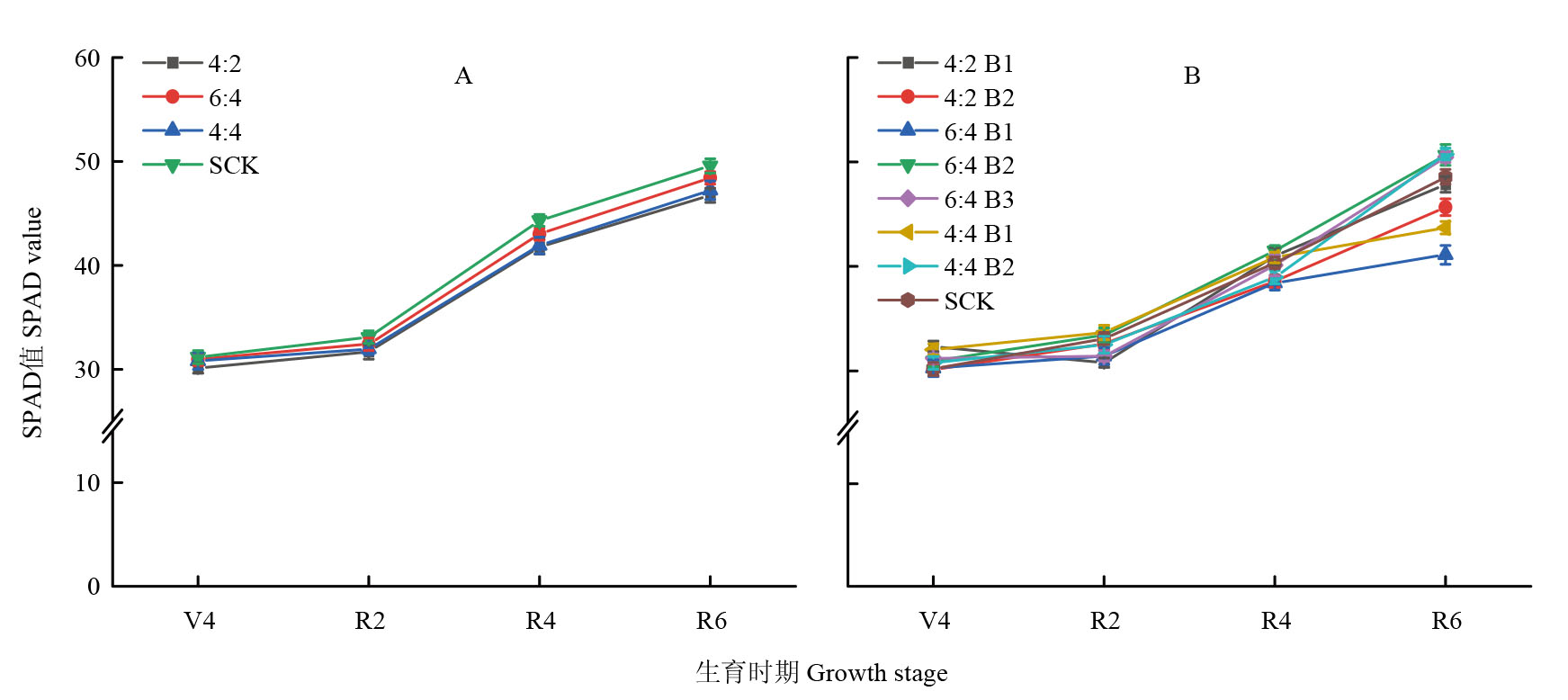
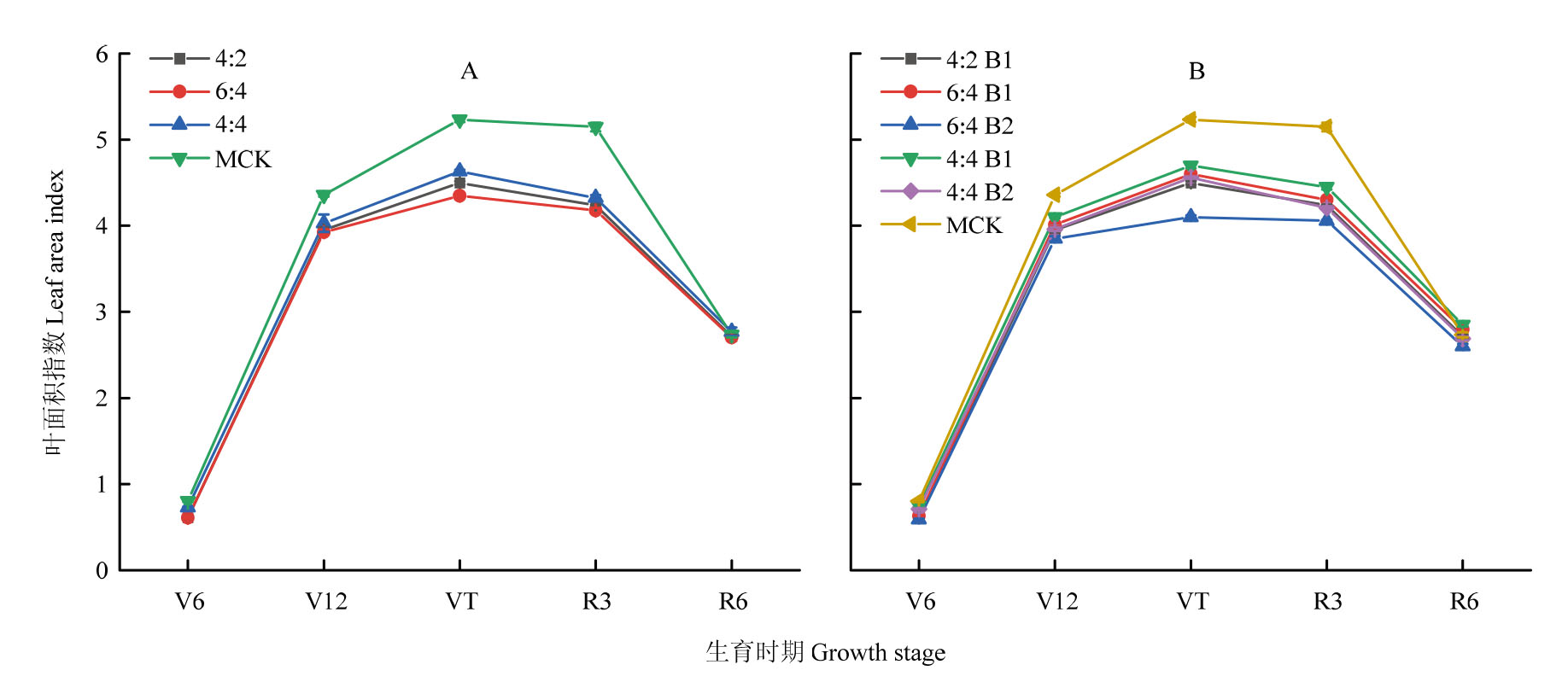
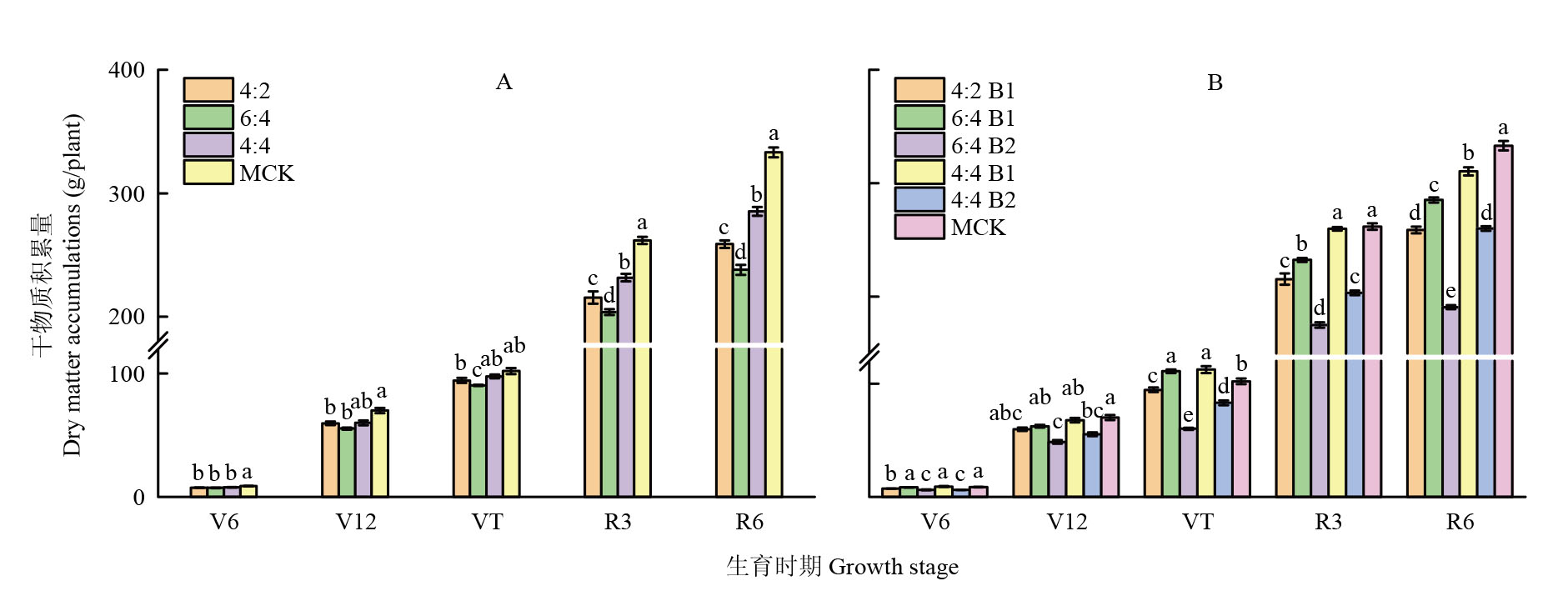
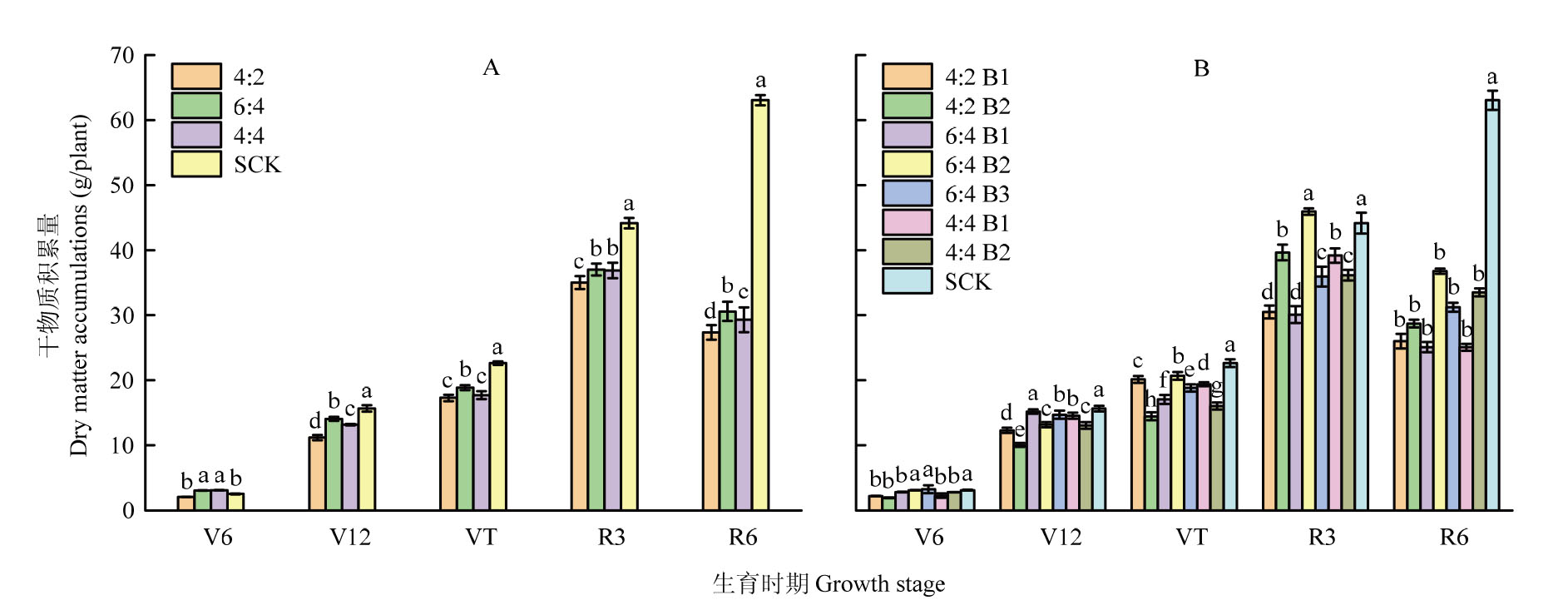
【Objective】 To optimize the soybean-maize intercropping system in the Huang-Huai-Hai region, this study aimed to evaluate the effects of different row ratio configurations on crop agronomic traits, canopy structure of the population, yield components, edge effects, and overall economic benefits. The goal was to identify suitable row ratio configurations, thereby improving land resource use efficiency and economic returns. 【Method】 Three row ratio configurations were implemented: 4 rows of soybean intercropped with 2 rows of maize (4:2), 6 rows of soybean intercropped with 4 rows of maize (6:4), and 4 rows of soybean intercropped with 4 rows of maize (4:4), using monoculture soybean (SCK) and monoculture maize (MCK) as controls. Crop dry matter accumulation, leaf area index (LAI), relative chlorophyll content (SPAD), canopy light transmittance, and yield components were measured. The inner and outer row sampling approach was adopted to evaluate edge effects and overall economic benefits. 【Result】 Compared with monoculture, intercropping significantly decreased per-plant dry matter accumulation in maize during the filling, milking, and maturity stages, and in soybean during the full flowering, full pod, grain filling, and full maturity stages. Among the row ratio configurations, maize exhibited maximum per-plant dry matter accumulation under the 4:4 pattern, whereas soybean achieved its highest accumulation under the 6:4 pattern. Row ratio configurations significantly influenced inter-row variations in dry matter accumulation and yield for both crops. Maize yield followed the order 4:4 pattern>4:2 pattern>6:4 pattern, representing reductions of 15.22%, 18.02%, and 12.62% relative to MCK, respectively; soybean yield followed the order 6:4 pattern>4:4 pattern>4:2 pattern, corresponding to reductions of 55.99%, 50.43%, and 56.00% compared with SCK, respectively. Intercropped maize exhibited pronounced edge advantage, with border row maize yields significantly exceeding those of inner rows. Within the intercropping system, both maize and soybean demonstrated lower canopy light transmittance, LAI, and SPAD values compared with their monoculture counterparts. Maize canopy light transmittance, LAI, and SPAD values followed the consistent ranking: 4:4 pattern>4:2 pattern>6:4 pattern; soybean canopy light transmittance followed 4:4 pattern>6:4 pattern>4:2 pattern, while its LAI and SPAD values mirrored the ranking pattern observed in maize. Maize LAI was significantly influenced by row ratio configuration, whereas no significant inter-row variations were detected for maize SPAD values or for soybean LAI and SPAD values. In evaluations of economic returns and intercropping advantages, the 4:4 pattern configuration demonstrated superior performance, achieving the highest values for land equivalent ratio (LER), relative crowding coefficient (K), and economic benefits. Maize in intercropping exhibited higher LER and K values relative to soybean, with the maize competition ratio (CRm) being significantly greater than that of soybean (CRs) (CRm>1, CRs<1), demonstrating maize's competitive dominance in interspecific competition. 【Conclusion】 Although intercropping reduced per-plant dry matter accumulation, LAI, and SPAD values for both crops compared with monoculture, it significantly increased the land equivalent ratio (LER) and overall economic benefits. Under the experimental conditions, the 4:4 pattern exhibited more optimal canopy architecture, with maize demonstrating pronounced edge advantage. This system maintained maize yield while generating additional soybean income, thereby achieving the synergistic enhancement of total productivity and economic returns.

Key words: soybean-maize intercropping, row-ratio pattern, marginal effect, yield, economic efficiency

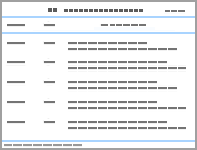
Table 1

Experimental design of field allocation in different ratio modes"

大豆玉米种植行比
Soybean-maize planting row ratio
带宽
Strip width
(cm)
玉米行距
Maize row spacing
(cm)
大豆玉米行距
Soybean-maize row spacing
(cm)
大豆行距
Soybean row spacing
(cm)
玉米株距
Maize plant spacing
(cm)
大豆株距
Soybean plant spacing
(cm)
玉米密度
Maize planting density
(×104 plants/hm2)
大豆密度
Soybean planting density
(×104 plants/hm2)
4﹕2 285 40 70 35 10 12 6.75 12
4﹕4 365 40 70 35 16 9 6.75 12
6﹕4 435 40 70 35 14 12 6.75 12

Fig. 1

Schematic diagram of intercropping pattern planting"

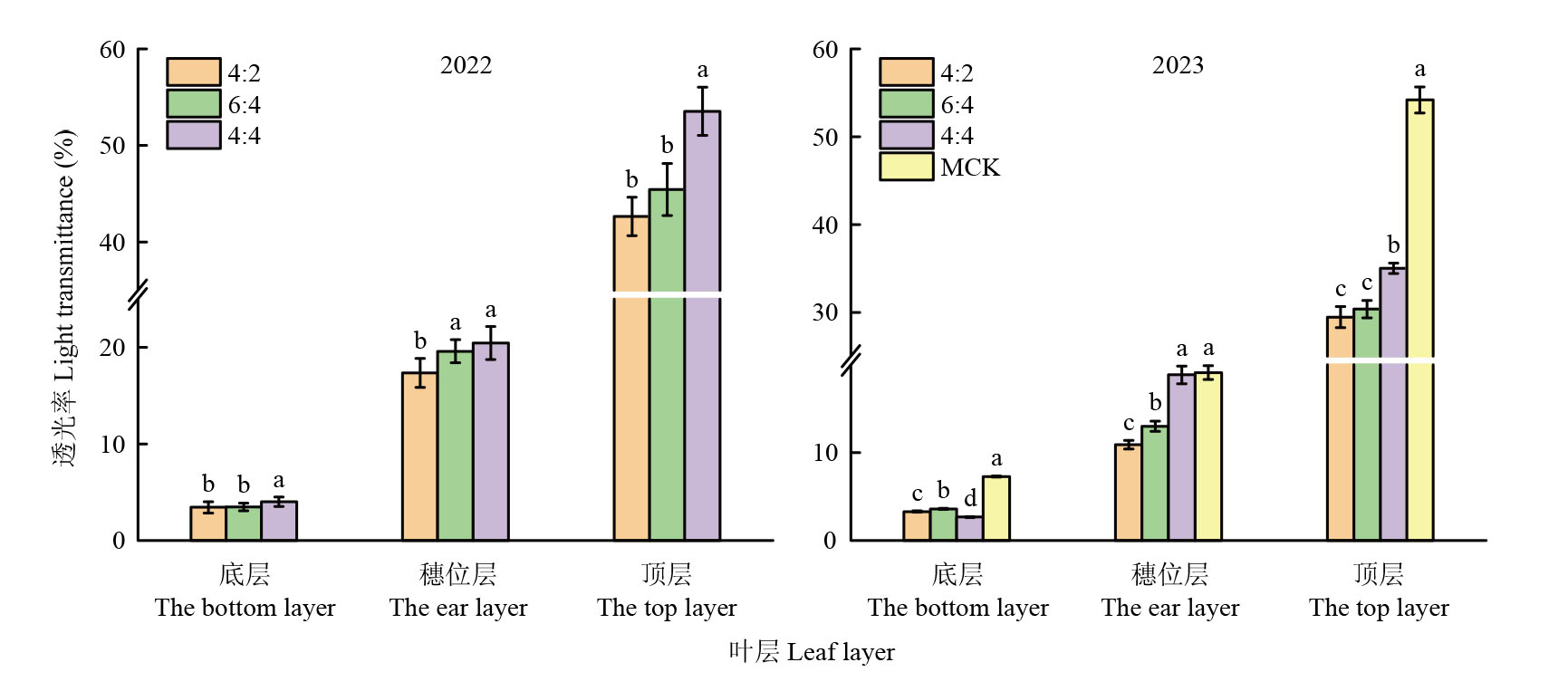
Fig. 2

Influences of different ratio models on light transmittance of maize canopy"

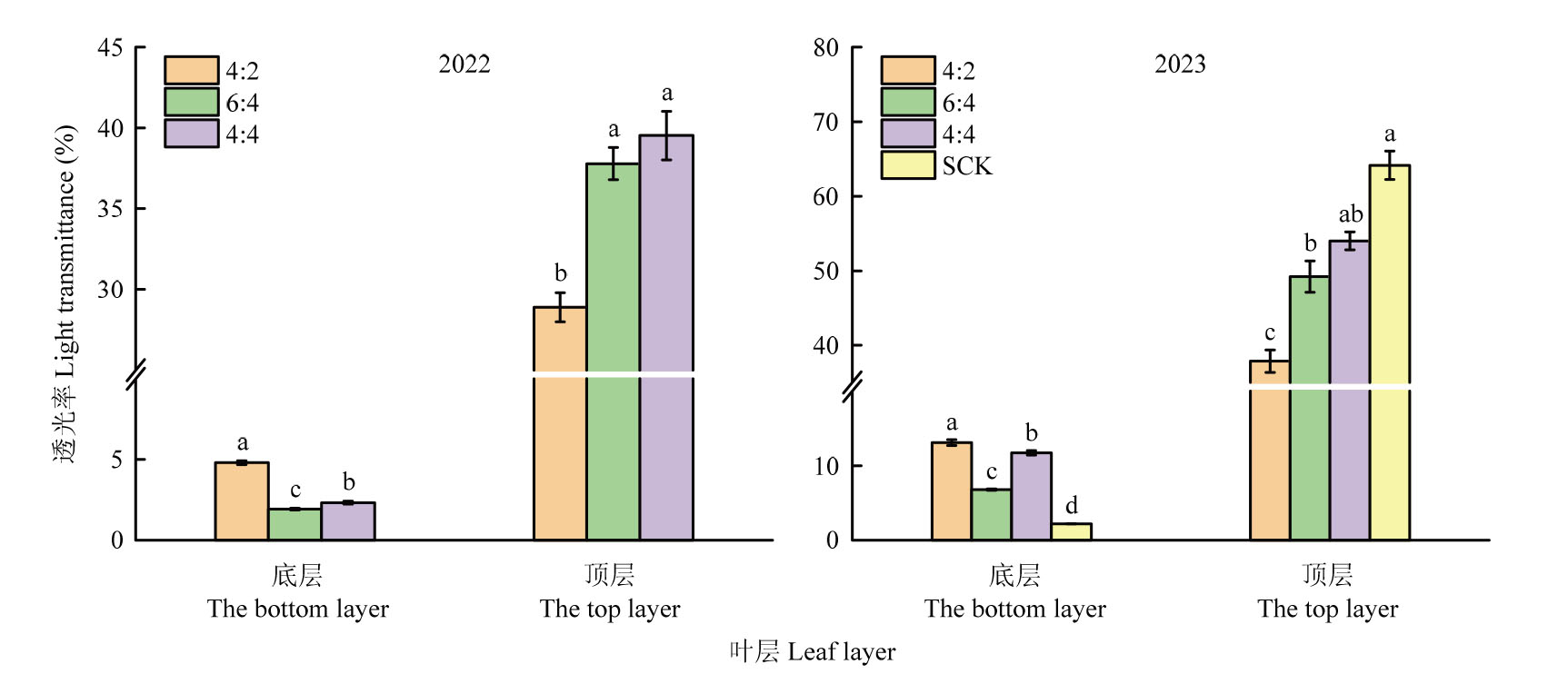
Fig. 3

Influences of different ratio models on light transmittance of soybean canopy"

Table 2

Effects of different ratio models on soybean and maize yield and its components"

年份
Year
处理
Treatment
玉米公顷穗数/大豆公顷株数
Ear number(ears/hm2)/plant number (plants/hm2)
玉米穗粒数/大豆株粒数
Grains per ear/grains per plant
玉米千粒重/大豆百粒重
1000-grain weight
(g)/100-grain weight (g)
产量
Yield
(kg·hm-2)
总产量
Total yield
(kg·hm-2)
2022 玉米
Maize
4﹕2 63630 528ab 341.21a 11464b 13599
6﹕4 62790 517b 341.72a 11093c 13565
4﹕4 64230 535a 340.76a 11710a 13956
大豆
Soybean
4﹕2 115335 83b 22.21b 2135c -
6﹕4 115335 93a 23.13a 2472a -
4﹕4 116310 86b 22.54b 2246b -
2023 玉米
Maize
4﹕2 61395 529b 381.68b 12396c 14431
6﹕4 60840 518c 380.33b 11986d 14303
4﹕4 62460 532b 384.52b 12777b 14834
MCK 63645 581a 395.40a 14621a 14621
大豆
Soybean
4﹕2 123750 61c 26.95b 2034b -
6﹕4 123990 71b 26.32c 2317b -
4﹕4 115080 66c 27.08b 2057b -
SCK 193620 87a 27.75a 4674a 4674

Table 3

Effects of different row ratio models on soybean and maize yield and its composition"

处理
Treatment
玉米公顷穗数/大豆公顷株数
Ear number(ears/hm2)/
plant number (plants/hm2)
玉米穗粒数/大豆株粒数
Grains per ear/grains per plant
玉米千粒重/大豆百粒重
1000-grain weight
(g)/100-grain weight (g)
公顷产量
Yield
(kg·hm-2)
玉米
Maize
4﹕2 B1 61395 529c 381.68b 12396c
6﹕4 B1 62835 566b 392.39a 13955b
B2 58845 471e 368.28c 10207d
4﹕4 B1 65760 573ab 388.23ab 14629a
B2 63930 492d 380.82b 11978c
MCK 63645 581a 395.40a 14621a
大豆
Soybean
4﹕2 B1 121650 64c 27.16ab 2115bcd
B2 125850 58c 26.73ab 1951d
6﹕4 B1 120930 75b 26.90ab 2440 bc
B2 124605 75b 26.66ab 2491b
B3 126450 61c 25.40b 1959d
4﹕4 B1 112875 68bc 27.05ab 2076cd
B2 117270 64c 27.11ab 2035d
SCK 193620 87a 27.75a 4674a

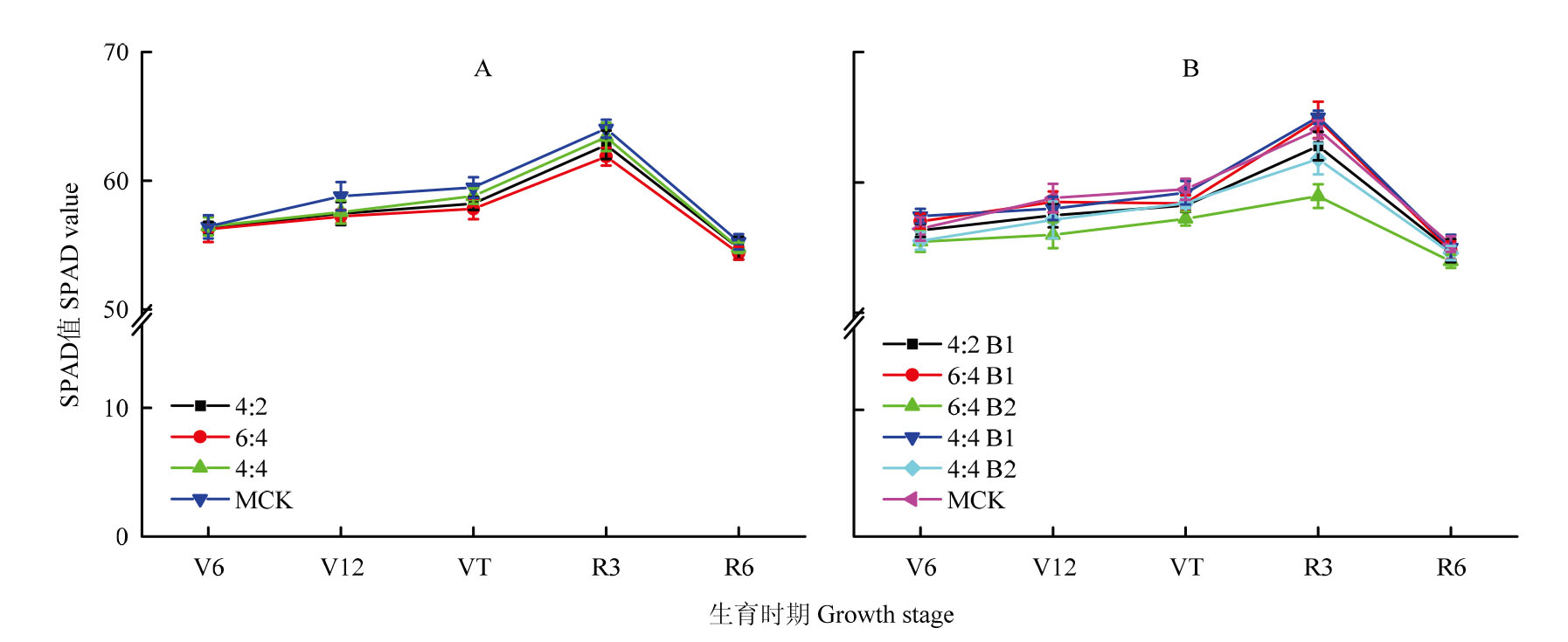
Fig. 4

Effects of different row ratio patterns on SPAD values of maize"

Fig. 5

Effect of different row ratio patterns on SPAD values of soybean"

Fig. 6

Effects of different row ratio patterns on leaf area index of maize"

Fig. 7

Effects of different row ratio patterns on leaf area index of soybean"

Fig. 8

Effects of different row ratio patterns on dry matter accumulation in maize"

Fig. 9

Effects of different row ratio patterns on dry matter accumulation in soybean"

Fig. 10

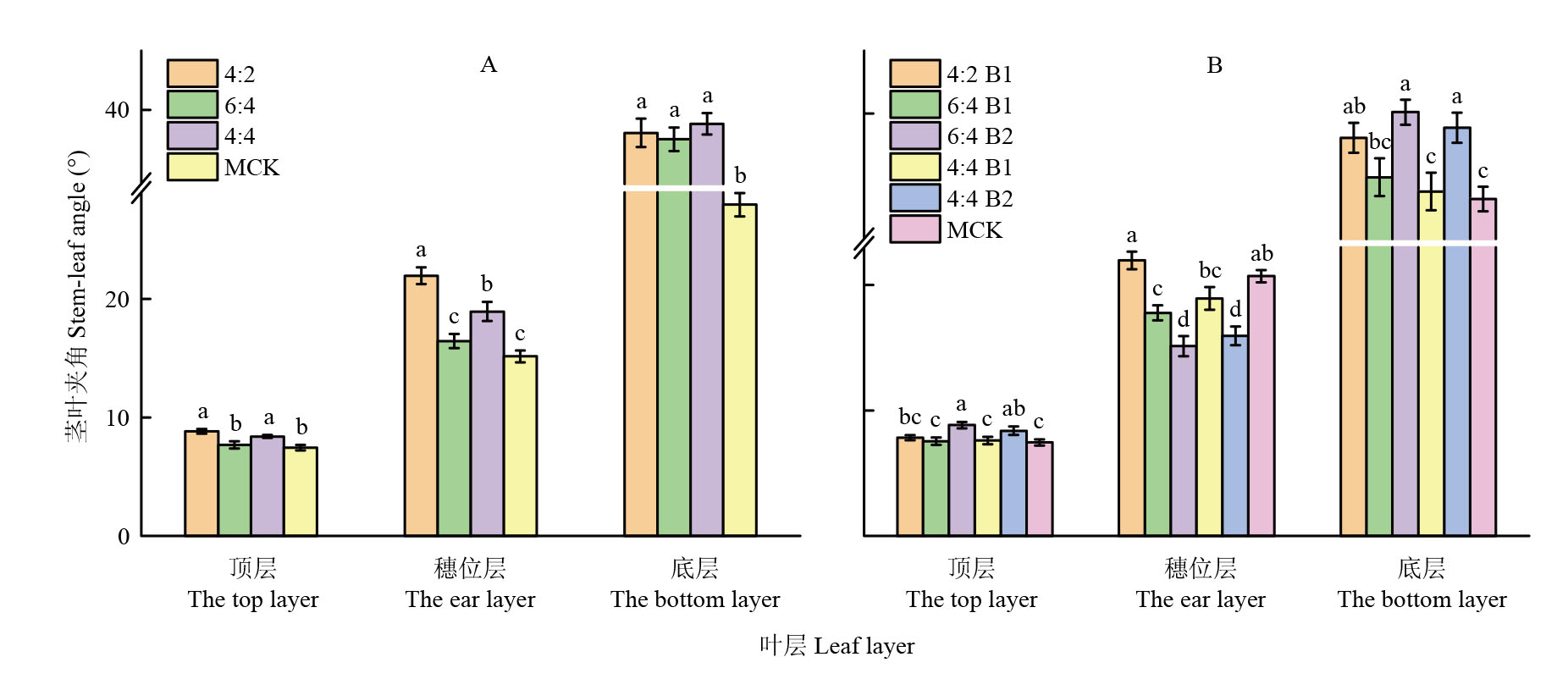
Effects of different row ratio patterns on the angle between stems and leaves of maize"

Fig. 11

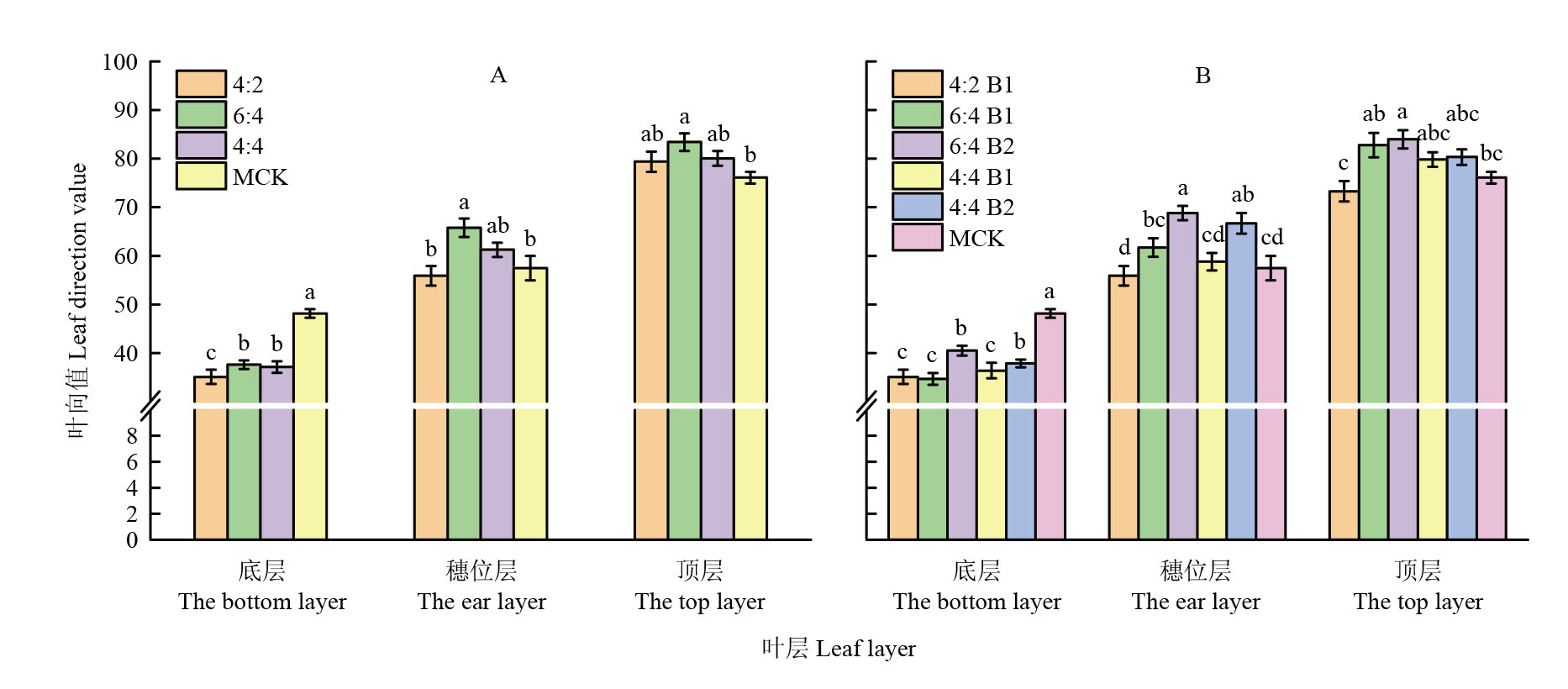
Effects of different parallel ratio models on leaf direction values of maize"

Fig. 12

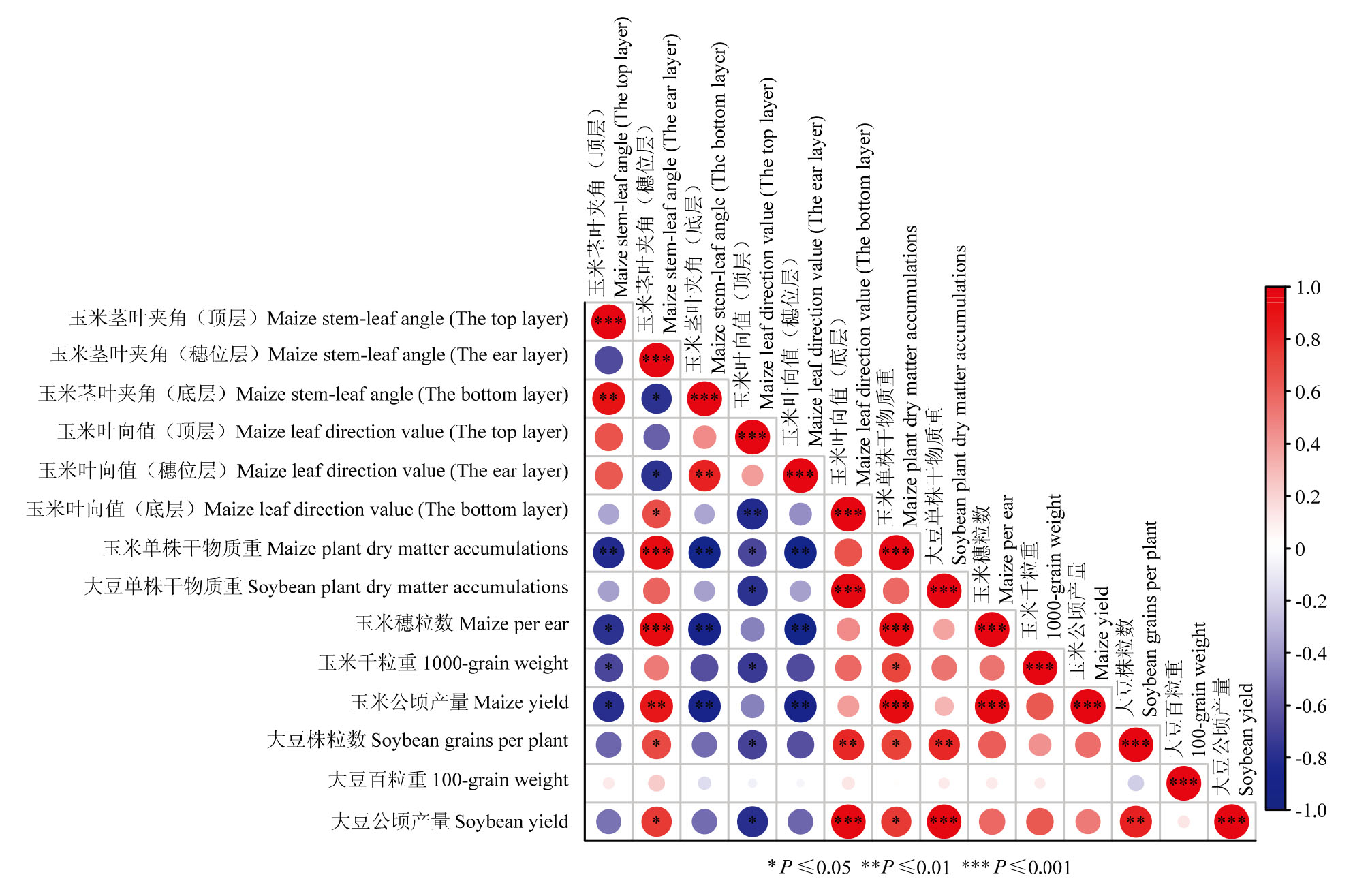
Correlation heatmap for the soybean-maize 4:4 intercropping configuration"

Table 4

Effects of different ratio models on land equivalent ratio (LER) and relative congestion coefficient (K)"

间作方式
Intercropping pattern
土地当量比 Land equivalent ratio 相对拥挤系数 Relative crowding coefficient
LERm LERs LER Km Ks K
4﹕2 0.848b 0.435c 1.283a 1.320b 0.183b 0.241d
6﹕4 0.820b 0.496b 1.316a 1.119c 0.242b 0.271c
4﹕4 0.874b 0.440c 1.314a 1.729a 0.196b 0.339b
MCK 1.000a - 1.000b 1.000d - 1.000a
SCK - 1.00a 1.000b - 1.000a 1.000a

Table 5

Effects of different peer ratio models on encroachment (A) and competition ratio (CR)"

间作方式
Intercropping pattern
侵占力Aggressivity 竞争比Competitive ratio
Am As CRm CRs
4﹕2 0.060c -0.119b 3.099a 0.323c
6﹕4 0.079b -0.079c 2.132b 0.469b
4﹕4 0.244a -0.244a 1.829c 0.547a

Table 6

Effects of different ratio models on crop economic efficiency"

年份
Year
处理Treatment 总收入
Total income
(yuan/hm2)
投入 Input (yuan/hm2) 净收入
Net income
(yuan/hm2)
机械Machinery 大豆种子Soybean seed 玉米种子Maize seed 肥料Fertilizer 人工Artificial 农药
Pesticide
总和
Sum
2022 4﹕2 38227a 2100 1200 975 2550 1125 1500 9450 28777ab
6﹕4 39158a 2100 1200 975 2550 1125 1500 9450 29708ab
4﹕4 39395a 2100 1200 975 2550 1125 1500 9450 29945a
2023 4﹕2 39868a 2250 1200 975 2670 1200 1425 9720 30148ab
6﹕4 40420a 2250 1200 975 2670 1200 1425 9720 30700a
4﹕4 40883a 2250 1200 975 2670 1200 1425 9720 31163a
MCK 34213b 1800 - 975 2100 640 975 6490 27723b
SCK 24959c 1800 1200 - 600 800 1200 5600 19359c
[1]
SWINTON S M, LUPI F, ROBERTSON G P, HAMILTON S K. Ecosystem services and agriculture: Cultivating agricultural ecosystems for diverse benefits. Ecological Economics, 2007, 64(2): 245-252.
[46]
LI Z X, WANG J W, YANG W T, SHU L, DU Q, LIU L L. Benefit of sweet corn/soybean intercropping in Guangdong Province. Chinese Journal of Eco-Agriculture, 2010, 18(3): 627-631. (in Chinese)
李志贤, 王建武, 杨文亭, 舒磊, 杜清, 刘丽玲. 广东省甜玉米/大豆间作模式的效益分析. 中国生态农业学报, 2010, 18(3): 627-631.
[45]
MIDEGA C A O, SALIFU D, BRUCE T J, PITTCHAR J, PICKETT J A, KHAN Z R. Cumulative effects and economic benefits of intercropping maize with food legumes on Striga hermonthica infestation. Field Crops Research, 2014, 155: 144-152.
[44]
QIN Y, GUO H J, YANG J, ZHAO Y K, YANG H, HAN Q X, LI L. Analysis on waxy corn/soybean intercropping pattern and economic benefit. Journal of Anhui Agricultural Sciences, 2015, 43(25): 55-56. (in Chinese)
秦燕, 郭泓鋆, 杨进, 赵永康, 杨洪, 韩庆新, 李兰. 鲜食糯玉米/大豆间作模式及经济效益分析. 安徽农业科学, 2015, 43(25): 55-56.
[43]
JING B, SHI W J, CHEN T. Maize/soybean intercropping with nitrogen reduction: A pathway for improved nitrogen efficiency and reduced environmental impact in Northwest China. Soil and Tillage Research, 2025, 253: 106696.
[42]
SHEN L, WANG X Y, LIU T T, WEI W W, ZHANG S, KEYHANI A B, LI L H, ZHANG W. Border row effects on the distribution of root and soil resources in maize-soybean strip intercropping systems. Soil and Tillage Research, 2023, 233: 105812.
[41]
CHENG B, LIU W G, WANG L, XU M, QIN S S, LU J, GAO Y, LI S X, Ali RAZA, ZHANG Y, et al. Effect of planting density on photosynthesis, yield and stem resistance to inversion in soybean under corn-soybean strip intercropping. China Agricultural Science, 2021, 54(19): 4084-4096. doi:10.3864/j.issn.0578-1752.2021.19.005. (in Chinese)
程彬, 刘卫国, 王莉, 许梅, 覃思思, 卢俊, 高阳, 李淑贤, Ali RAZA, 张熠, 等. 种植密度对玉米-大豆带状间作下大豆光合、产量及茎秆抗倒的影响. 中国农业科学, 2021, 54(19): 4084-4096. doi:10.3864/j.issn.0578-1752.2021.19.005.
[40]
LITHOURGIDIS A S, VLACHOSTERGIOS D N, DORDAS C A, DAMALAS C A. Dry matter yield, nitrogen content, and competition in pea-cereal intercropping systems. European Journal of Agronomy, 2011, 34(4): 287-294.
[39]
KOU C L, WANG Q J, WU J C, WANG Y Q, LI X D. Research on the optimal allocation model of maize peanut intercropping system. Tillage and Cultivation, 2000(6): 14-15. (in Chinese)
寇长林, 王秋杰, 武继承, 王永歧, 李新端. 玉米花生间作系统优化配置模式研究. 耕作与栽培, 2000(6): 14-15.
[38]
GU Y, ZHENG H Y, LI S, WANG W T, GUAN Z Y, LI J Z, MEI N, HU W H. Effects of narrow-wide row planting patterns on canopy photosynthetic characteristics, bending resistance and yield of soybean in maize-soybean intercropping systems. Scientific Reports, 2024, 14: 9361.
[37]
WANG Q, SUN Z X, BAI W, ZHANG D S, ZHANG Y, WANG R N, VAN DER WERF W, EVERS Jo B, STOMPH T-J, GUO J P, ZHANG L Z. Light interception and use efficiency differ with maize plant density in maize-peanut intercropping. Frontiers of Agricultural Science and Engineering, 2021, 8(3): 432-446.
[36]
LIU Y K, YAN X D, XU Y P, YUE M Q, XIAO Y, LIU Z K. Study on maize and soybean intercropping pattern and economic benefit. Journal of Hebei Agricultural Sciences, 2012, 16(3): 23-26. (in Chinese)
刘艳昆, 闫旭东, 徐玉鹏, 岳明强, 肖宇, 刘忠宽. 玉米-大豆间作模式与经济效益研究. 河北农业科学, 2012, 16(3): 23-26.
[35]
LUO C S, GUO Z P, XIAO J X, DONG K, DONG Y. Effects of applied ratio of nitrogen on the light environment in the canopy and growth, development and yield of wheat when intercropped. Frontiers in Plant Science, 2021, 12: 719850.
[34]
LIU X, RAHMAN T, SONG C, SU B Y, YANG F, YONG T W, WU Y S, ZHANG C Y, YANG W Y. Changes in light environment, morphology, growth and yield of soybean in maize-soybean intercropping systems. Field Crops Research, 2017, 200: 38-46.
[33]
LI N, ZHAI Z X, LI J M, DUAN L S, LI Z H. Effect of sowing date and density on sink/source relationship and canopy light transmission of summer maize (Zea mays L.). Chinese Journal of Eco-Agriculture, 2010, 18(5): 959-964. (in Chinese)
李宁, 翟志席, 李建民, 段留生, 李召虎. 播期与密度组合对夏玉米群体源库关系及冠层透光率的影响. 中国生态农业学报, 2010, 18 (5): 959-964.
[32]
ZHU M, SHI Z S, LI F H, WANG Z B. The initial report about different maize genotypes intercropping. China Journal of Seeds, 2010, (8): 63-65.
[31]
LIU T X, LI C H, FU J, YAN C H. Population quality of different maize (Zea mays L. genotypes intercropped.). Acta Ecologica Sinica, 2009, 29(11): 6302-6309. (in Chinese)
刘天学, 李潮海, 付景, 闫成辉. 不同基因型玉米间作的群体质量. 生态学报, 2009, 29(11): 6302-6309.
[30]
CUI X P, ZHENG J H, HU D M. Research progress on the effects of sowing date and density on soybean growth and development. Heilongjiang Agricultural Sciences, 2021(9): 123-128. (in Chinese)
崔晓培, 郑金焕, 胡冬梅. 播期与密度对大豆生长发育影响的研究进展. 黑龙江农业科学, 2021(9): 123-128.
[29]
CAO M J, WANG J Y, CUI Y, BLESSING D, LI S, CHEN X F, GU Y. Effects of different maize and soybean intercropping ratios on photosynthetic characteristics and yield of soybean. Soybean Science, 2023, 42(1): 48-54. (in Chinese)
曹曼君, 王婧瑜, 崔悦, BLESSING D, 李双, 陈喜凤, 谷岩. 不同玉米大豆间作行比对大豆光合特性及产量的影响. 大豆科学, 2023, 42(1): 48-54.
[28]
WU J. Effect of different distance between maize strips on light energy utilization of strip intercropped maize[D]. Yaan: Sichuan Agricultural University, 2023. (in Chinese)
武晶. 不同玉米带间距离对带状间作玉米光能利用的影响[D]. 雅安: 四川农业大学, 2023.
[27]
BAI J, ZHANG C Y, DING X P, ZHANG J W, LIU P, REN B Z, ZHAO B. Effects of row spacing and mulching reflective film on the yield and light utilization of summer maize. Scientia Agricultura Sinica, 2020, 53(19): 3942-3953. doi:10.3864/j.issn.0578-1752.2020.19.008. (in Chinese)
白晶, 张春雨, 丁相鹏, 张吉旺, 刘鹏, 任佰朝, 赵斌. 行距配置和覆反光膜对夏玉米产量及光能利用的影响. 中国农业科学, 2020, 53(19): 3942-3953. doi:10.3864/j.issn.0578-1752.2020.19.008.
[26]
DORNHOFF G M, SHIBLES R M. Varietal differences in net photosynthesis of soybean leaves. Crop Science, 1970, 10(1): cropsci1970.0011183X001000010016x.
[25]
YIN F W, WANG W X, GU S B, WANG D. Effect of planting distance configuration repression on wheat yield formation with wide planting. Journal of Triticeae Crops, 2018, 38(6): 710-717. (in Chinese)
殷复伟, 王文鑫, 谷淑波, 王东. 株行距配置对宽幅播种小麦产量形成的影响. 麦类作物学报, 2018, 38(6): 710-717.
[24]
CHEN C X, TANG J H, CHEN J J, WANG N, FU X W, DU X J, XU W X. Effect of planting patterns on photosynthetic capacity and grain filling characteristics of summer soybean at seed-filling stage. Agricultural Research in the Arid Areas, 2018, 36(3): 101-105. (in Chinese)
陈传信, 唐江华, 陈佳君, 王娜, 符小文, 杜孝敬, 徐文修. 种植方式对夏大豆鼓粒期叶片光合能力及籽粒灌浆特性的影响. 干旱地区农业研究, 2018, 36(3): 101-105.
[23]
PENG J L, ZHANG Y Q, TANG J H, ZHANG N, SU L L, LI Y J, XU W X. Effect of plant-row spacing on photosynthetic characteristics and yield of summer soybean. Soybean Science, 2015, 34(5): 794-800, 807. (in Chinese)
彭姜龙, 张永强, 唐江华, 张娜, 苏丽丽, 李亚杰, 徐文修. 株行距配置对夏大豆光合特性及产量的影响. 大豆科学, 2015, 34(5): 794-800, 807.
[22]
LIU Z H, PAN G F, CHEN W, QIN M G, CAO C G, CHANG C L, ZHAN M. Effects of varieties collocation between crop seasons on the yield and resource use efficiency of maize-late rice cropping in Hubei Province. Acta Agronomica Sinica, 2020, 46(12): 1945-1957. (in Chinese)
刘志辉, 潘高峰, 陈文, 秦明广, 曹凑贵, 常昌龙, 展茗. 品种搭配对湖北省玉米-晚稻复种产量及资源效率的影响. 作物学报, 2020, 46(12): 1945-1957.
[21]
WANG J K. Distance between adjacent rows of maize and pea affect nitrogen facilitation and competition in intercropping systems[D]. Lanzhou: Gansu Agricultural University, 2014. (in Chinese)
王建康. 间距对玉米间作豌豆氮素竞争互补的调控效应[D]. 兰州: 甘肃农业大学, 2014.
[20]
ZHU J. The controlling effect and mechanism of maize density on theintercropping peas “N min inhibitory effect”[D]. Lanzhou: Gansu Agricultural University, 2012. (in Chinese)
朱静. 玉米密度对间作豌豆“氮阻遏”的调控效应及机制[D]. 兰州: 甘肃农业大学, 2012.
[19]
DHIMA K V, LITHOURGIDIS A S, VASILAKOGLOU I B, DORDAS C A. Competition indices of common vetch and cereal intercrops in two seeding ratio. Field Crops Research, 2007, 100(2/3): 249-256.
[18]
AGEGNEHU G, GHIZAW A, SINEBO W. Yield performance and land-use efficiency of barley and faba bean mixed cropping in Ethiopian Highlands. European Journal of Agronomy, 2006, 25(3): 202-207.
[17]
GHOSH P K. Growth, yield, competition and economics of groundnut/cereal fodder intercropping systems in the semi-arid tropics of India. Field Crops Research, 2004, 88(2-3): 227-237.
[16]
XU L N, YAN Y, MEI P P, CHEN S L, HUANG S B, WANG P. Canopy light distribution and humidity analysis of different maize varieties. Acta Agriculturae Boreali-Sinica, 2020, 35(6): 106-112. (in Chinese)
徐丽娜, 闫艳, 梅沛沛, 陈士林, 黄收兵, 王璞. 不同玉米品种冠层光分布和湿度比较研究. 华北农学报, 2020, 35(6): 106-112.
[15]
CHEN Y X, PENG D D, HU F, HU Y Q, BAI S H, XU K W. Effects of different plant types and planting densities of maize on the yield, nutrient uptake, and utilization of intercropped soybean. Pratacultural Science, 2021, 38(1): 136-146. (in Chinese)
陈远学, 彭丹丹, 胡斐, 胡月秋, 白世豪, 徐开未. 玉米不同株型及种植密度对间作大豆产量和养分吸收利用的影响. 草业科学, 2021, 38(1): 136-146.
[14]
CHEN G R, YANG W Y, ZHANG G H, WANG L M, YANG R P, YONG T W, LIU W G. Effects of potato/soybean intercropping on photosynthetic characteristics and yield of three soybean varieties. Chinese Journal of Applied Ecology, 2015, 26(11): 3345-3352. (in Chinese)
陈光荣, 杨文钰, 张国宏, 王立明, 杨如萍, 雍太文, 刘卫国. 马铃薯/大豆套作对3个大豆品种光合指标和产量的影响. 应用生态学报, 2015, 26(11): 3345-3352.
[13]
CUI L, SU B Y, YANG F, YANG W Y. Effects of photo-synthetically active radiation on photosynthetic characteristics and yield of soybean in different maize/soybean relay strip intercropping systems. Scientia Agricultura Sinica, 2014, 47(8): 1489-1501. doi:10.3864/j.issn.0578-1752.2014.08.005. (in Chinese)
崔亮, 苏本营, 杨峰, 杨文钰. 不同玉米-大豆带状套作组合条件下光合有效辐射强度分布特征对大豆光合特性和产量的影响. 中国农业科学, 2014, 47(8): 1489-1501. doi:10.3864/j.issn.0578-1752.2014.08.005.
[12]
YANG C J, TAN C Y, CHEN J Q, LIU Z Y, GONG L N, ZHU X T. Effects of corn and soybean interplanting on yield, agronomic traits and dry matter accumulation of soybean during seed filling period. Guizhou Agricultural Sciences, 2015, 43(11): 38-42. (in Chinese)
杨春杰, 谭春燕, 陈佳琴, 刘作易, 龚丽娜, 朱星陶. 间作玉米对大豆鼓粒期产量与农艺性状及干物质积累的影响. 贵州农业科学, 2015, 43(11): 38-42.
[11]
UNDIE U L, UWAH D F, ATTOE E E. Effect of intercropping and crop arrangement on yield and productivity of late season maize/ soybean mixtures in the humid environment of south southern Nigeria. Journal of Agricultural Science, 2012, 4(4): 37-50.
[10]
CHEN X. F, SUN N, GU Y. Photosynthetic and chlorophyll fluorescence responses in maize and soybean strip intercropping system. International Journal of Agriculture&Biology, 2020, 24(4): 799-811.
[9]
ZHAO J H, SUN J H, CHEN L Z, LI W Q. Growth and interspecific competition of crops as affected by maize row spacing in soybean/ maize intercropping system. Soybean Science, 2019, 38(2): 229-235. (in Chinese)
赵建华, 孙建好, 陈亮之, 李伟绮. 玉米行距对大豆/玉米间作作物生长及种间竞争力的影响. 大豆科学, 2019, 38(2): 229-235.
[8]
TANG F Y, CHEN W J, WEI Q Y, GUO X H, LIANG J, CHEN Y. Effects of row ratio and maize plant type on yield and benefit of maize soybean intercropping. Soybean Science, 2019, 38(5): 726-732. (in Chinese)
汤复跃, 陈文杰, 韦清源, 郭小红, 梁江, 陈渊. 不同行比配置和玉米株型对玉米大豆间种产量及效益影响. 大豆科学, 2019, 38(5): 726-732.
[7]
REN Y Y, WANG Z L, WANG X L, ZHANG S Q. The effect and mechanism of intercropping pattern on yield and economic benefit on the Loess Plateau. Acta Ecologica Sinica, 2015, 35(12): 4168-4177. (in Chinese)
任媛媛, 王志梁, 王小林, 张岁岐. 黄土塬区玉米大豆不同间作方式对产量和经济收益的影响及其机制. 生态学报, 2015, 35(12): 4168-4177.
[6]
YANG H, ZHOU Y, CHEN P, DU Q, ZHENG B C, PU T, WEN J, YANG W Y, YONG T W. Effects of nutrient uptake and utilization on yield of maize-legume strip intercropping system. Acta Agronomica Sinica, 2022, 48(6): 1476-1487. (in Chinese)
杨欢, 周颖, 陈平, 杜青, 郑本川, 蒲甜, 温晶, 杨文钰, 雍太文. 玉米-豆科作物带状间套作对养分吸收利用及产量优势的影响. 作物学报, 2022, 48(6): 1476-1487.
[5]
LUO W Y, TANG Z J, REN Y F, YANG W Y, WANG X C. Effects of bandwidth and row ratio on population yield and benefit of fresh maize intercropping with fresh soybean. Journal of Sichuan Agricultural University, 2019, 37(4): 442-451. (in Chinese)
罗万宇, 唐庄峻, 任永福, 杨文钰, 王小春. 带宽、行比对鲜食玉米间作鲜食大豆群体产量效益的影响. 四川农业大学学报, 2019, 37(4): 442-451.
[4]
POWER A G. Ecosystem services and agriculture: Tradeoffs and synergies. Philosophical Transactions: Biological Sciences, 365(1554, Food security: Feeding the world in 2050): 2959-2971.
[3]
SERAN T H, BRINTHA I. Review on maize based intercropping. Journal of Agronomy, 2010, 9(3): 135-145.
[2]
GAO Y, DUAN A W, QIU X Q, SUN J S, ZHANG J P, LIU H, WANG H Z. Distribution and use efficiency of photosynthetically active radiation in strip intercropping of maize and soybean. Agronomy Journal, 2010, 102(4): 1149-1157.
[1] PU LiXia, ZHANG JiaRui, YE JianPing, HUANG XiuLan, FAN GaoQiong, YANG HongKun. The Combined Effects of 16, 17-Dihydro Gibberellin A5 and Straw Mulching on Tillering and Grain Yield of Dryland Wheat [J]. Scientia Agricultura Sinica, 2025, 58(9): 1735-1748.
[2] GUO ChenLi, LIU Yang, CHEN Yan, HU Wei, WANG YouHua, ZHOU ZhiGuo, ZHAO WenQing. Effects of Phosphorus Fertilizer Postpone Under Nitrogen Reduction Condition on Yield, Phosphorus Fertilizer Utilization Efficiency of Drip-Irrigated Cotton [J]. Scientia Agricultura Sinica, 2025, 58(9): 1749-1766.
[3] LIU JinSong, WU LongMei, BAO XiaoZhe, LIU ZhiXia, ZHANG Bin, YANG TaoTao. Effects of a Short-Term Reduction in Nitrogen Fertilizer Application Rates on the Grain Yield and Rice Quality of Early and Late-Season Dual-Use Rice in South China [J]. Scientia Agricultura Sinica, 2025, 58(8): 1508-1520.
[4] WEI WenHua, LI Pan, SHAO GuanGui, FAN ZhiLong, HU FaLong, FAN Hong, HE Wei, CHAI Qiang, YIN Wen, ZHAO LianHao. Response of Silage Maize Yield and Quality to Reduced Irrigation and Combined Organic-Inorganic Fertilizer in Northwest Irrigation Areas [J]. Scientia Agricultura Sinica, 2025, 58(8): 1521-1534.
[5] XUE YuQi, ZHAO JiYu, SUN WangSheng, REN BaiZhao, ZHAO Bin, LIU Peng, ZHANG JiWang. Effects of Different Nitrogen Forms on Yield and Quality of Summer Maize [J]. Scientia Agricultura Sinica, 2025, 58(8): 1535-1549.
[6] LI ShaoXing, SONG WenFeng, WEI ZeYu, ZHOU YuLing, SONG LiXia, REN Ke, MA Qun, WANG LongChang. Effects of Straw and Milk Vetch Mulching on Soil Fertility and Sweet Potato Yield [J]. Scientia Agricultura Sinica, 2025, 58(8): 1591-1603.
[7] YIN Bo, YU AiZhong, WANG PengFei, YANG XueHui, WANG YuLong, SHANG YongPan, ZHANG DongLing, LIU YaLong, LI Yue, WANG Feng. Effects of Green Manure Returning Combined with Nitrogen Fertilizer Reduction on Hydrothermal Characteristics of Wheat Field and Grain Yield in Oasis Irrigation Area [J]. Scientia Agricultura Sinica, 2025, 58(7): 1366-1380.
[8] CHEN GuiPing, LI Pan, SHAO GuanGui, WU XiaYu, YIN Wen, ZHAO LianHao, FAN ZhiLong, HU FaLong. The Regulatory Effect of Reduced Irrigation and Combined Organic- Inorganic Fertilizer Application on Stay-Green Characteristics in Silage Maize Leaves After Tasseling Stage [J]. Scientia Agricultura Sinica, 2025, 58(7): 1381-1396.
[9] TIAN LiWen, LOU ShanWei, ZHANG PengZhong, DU MingWei, LUO HongHai, LI Jie, PAHATI MaiMaiTi, MA TengFei, ZHANG LiZhen. Analysis of Problems and Pathways for Increasing Cotton Yield per Unit Area in Xinjiang Under Green and Efficient Production Mode [J]. Scientia Agricultura Sinica, 2025, 58(6): 1102-1115.
[10] ZHANG HongCheng, XING ZhiPeng, ZHANG RuiHong, SHAN Xiang, XI XiaoBo, CHENG Shuang, WENG WenAn, HU Qun, CUI PeiYuan, WEI HaiYan. Characteristics and Technical Approaches of Integrated Unmanned High-Yield Cultivation of Wheat [J]. Scientia Agricultura Sinica, 2025, 58(5): 864-876.
[11] ZHANG Han, ZHANG YuQi, LI JingLai, XU Hong, LI WeiHuan, LI Tao. Effects of LED Supplementary Lighting on Production and Leaf Physiological Properties of Substrate-Cultivated Strawberry in Chinese Solar Greenhouse [J]. Scientia Agricultura Sinica, 2025, 58(5): 975-990.
[12] CHEN Ge, GU Yu, WEN Jiong, FU YueFeng, HE Xi, LI Wei, ZHOU JunYu, LIU QiongFeng, WU HaiYong. Effects of Fallow Weeds Returning to the Field on Photosynthetic Matter Production and Yield of Rice [J]. Scientia Agricultura Sinica, 2025, 58(4): 647-659.
[13] SU Ming, LI FanGuo, HONG ZiQiang, ZHOU Tian, LIU QiangJuan, BAN WenHui, WU HongLiang, KANG JianHong. Antioxidant Characterization of Nitrogen Application for Mitigating Potato Senescence Post-Flowering Under High Temperature Stress [J]. Scientia Agricultura Sinica, 2025, 58(4): 660-675.
[14] SHI Fan, LI WenGuang, YI ShuSheng, YANG Na, CHEN YuMeng, ZHENG Wei, ZHANG XueChen, LI ZiYan, ZHAI BingNian. The Variation Characteristics of Soil Organic Carbon Fractions Under the Combined Application of Organic and Inorganic Fertilizers [J]. Scientia Agricultura Sinica, 2025, 58(4): 719-732.
[15] LUO YiNuo, LI YanFei, LI WenHu, ZHANG SiQi, MU WenYan, HUANG Ning, SUN RuiQing, DING YuLan, SHE WenTing, SONG WenBin, LI XiaoHan, SHI Mei, WANG ZhaoHui. Iron Concentrations in Grain and Its Different Parts of Newly Developed Wheat Varieties (Lines) in China and Influencing Factors [J]. Scientia Agricultura Sinica, 2025, 58(3): 416-430.
Viewed
Full text


Abstract

Cited

  Shared   
  Discussed   
No Suggested Reading articles found!