Scientia Agricultura Sinica ›› 2020, Vol. 53 ›› Issue (11): 2305-2320.doi: 10.3864/j.issn.0578-1752.2020.11.016

• RESEARCH NOTES • Previous Articles    

Diversity of Endophytic Fungi in Transgenic Rice Seeds from Different Planting Sites Based on PTN System

ZHAO Yan,WANG TianQi,ZHU JunLi   

  1. College of Food Science and Biotechnology, Zhejiang Gongshang University, Hangzhou 310018
  • Received:2019-10-09 Accepted:2020-02-18 Online:2020-06-01 Published:2020-06-09

Abstract:

【Objective】To provide scientific bases for study of the unintended variation in seed endophytic fungi community structure of genetically modified (GM) rice and explore the causing factors of variation, comparative analysis of the richness and biodiversity of seed endophytic fungi were conducted, using GM rice relative near-isogenic lines of different varieties in different cultivation sites as materials. 【Method】 Collect transgenic rice line which harboring the glyphosate resistant 2mG2-epsps gene (T) and its corresponding parent variety (P) and non-transgenic tissue culture regeneration control line (NR) to make parent control-transgenic plant line-non-transgenic control (PTN) near-isogenic line. The parent japonica rice Nipponbare (P1) and its corresponding transgenic line T23 and the NR control line NR18 formed the P1 near-isogenic line (P1L), the P2 near-isogenic line (P2L) composed of parent japonica rice PJ574 (P2) and its corresponding transgenic line T23 and the NR control line NR18. All rice samples were planted in two plantations including Hainan province (H) and Fuyang city of Zhejiang province (F) and the resulting seeds were harvested. The rice endophytic fungi were isolated by tissue separation method, strains were classified and identified with morphology and molecular biology methods. The isolation rate (IR), isolation frequency (IF), richness Margalef index (D), diversity Shannon-Wiener index (H') and Evenness index (E) were used to reflect the structure and distribution of rice seed endophytic fungi, and Sorenson similarity coefficient (Cs) and Fisher’s exact test were employed to describe the composition difference of endophytic fungi between rice samples. 【Result】A total of 121 endophytic fungi strains were isolated from rice seed samples of P1L and P2L near-isogenic lines that harvested in Hainan (H) and Zhejiang (F) plantations, they were identified as 15 genera, of which Curvularia, Dendryphiella, Epicoccum, Fusarium were confirmed as the dominant flora, with Fusarium as the common dominant genus of both H and F plantations. The total RF (4.61%) of endophytic fungi from Zhejiang-grown rice seeds is 5.05 times than that of Hainan-grown rice samples (0.83%). The richness Margalef index (D=2.29), Shannon-Wiener diversity index (H'=1.63) and Evenness index (E=0.66) of endophytic fungi flora from rice seeds in F plantation were higher than that (D=1.67, H'=0.63, E=0.29) of samples in H plantation. The seed endophytic fungi communities of P1L and P2L in H plantation had a similarity coefficient of 0.615, and that was 0.737 in F plantation, showing moderate similarity, and the Fisher’s exact test analysis suggested that there were no significant difference (P>0.05) between them. The GM lines except HT16 showed moderate similarity to their corresponding parent controls referring seed endophytic fungi communities, with similarity coefficient ranged between 0.500 and 0.667. But compared with their corresponding parents, the GM rice lines showed notably unintended variations in IF and genus numbers of endophytic fungi, the variation direction and amplitude of IF varied between different plantations. Also, the GM line FT16 increased 2 additional fungi genera Phaeosphaeria and Nigrospora, HT23 and FT23 respectively added 1 genus Letendraea helminthicola and 2 genera including Curvularia and Cladosporium. These genera increasing variations of endophytic fungi in GM rice seeds were derived from transgenic insertion mutation, whose safety needs to be focused on. While the genera decreasing variations of endophytic fungi in GM rice seeds were derived from somaclonal variation of tissue culture, which were safer. The variation amplitude order of total IF of rice endophytic fungi were as follows. Difference between H and F plantations referring to P1 and P2 (30.58%)>Difference between P1 and P2 varieties (27.28%)>Variation of NR lines (23.14%)>Variation of GM lines (22.32%). The genus number variations of rice endophytic fungi ranked as follows. Difference between H and F plantations referring to P1 and P2 (9)>Difference between P1 and P2 varieties (8) = Variation of NR lines (8) = Variation of GM lines (8). 【Conclusion】Rice seeds have abundant and diverse endophytic fungi, with majority of the culturable stains belong to Ascomycetes. Composition of rice seed endophytic fungi community shows geographical differences, and Fusarium is very common dominant genus in rice seeds grown both in Hainan and Zhejiang. The structure of endophytic fungi flora in rice seeds are affected by transgenic manipulation as well as tissue culture technology, while their unintended variation effects are less than that of rice growing locations and variety differences. The genera increasing variations of endophytic fungi in GM rice seeds are derived from transgenic insertion mutation, and the safety needs to be assessed.

Key words: transgenic rice seed, culturable endophytic fungi, unintended variation, PTN system, diversity

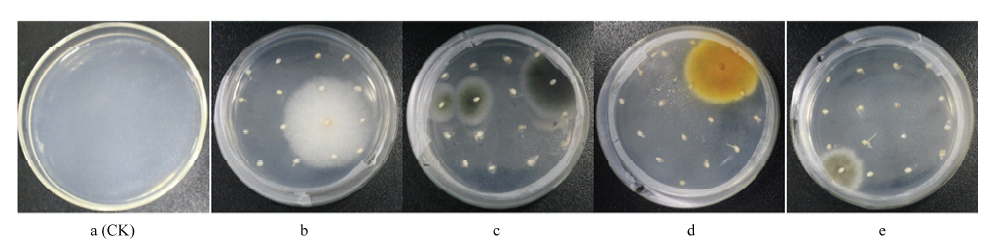
Fig. 1

Partial separation mapping of endophytic fungi from rice seeds a: Control; b, c, d, e: Colony separation diagram"

Fig. 2

Colony morphology of endophytic fungi from rice seeds on PDA plates Upper: Petri dish front; Bottom: Petri dish reverse side"

Table 1

Identification results of culturable endophytic fungi in rice seeds"

编号
Number

Class

Order

Family

Genera
比对相似种
Compare similar species
覆盖率
Coverage
(%)
相似度
Similarity
(%)
比对结果
Comparison result
IR
(%)
WF6 Ascomycetes Pleosporales Pleosporaceae Curvularia Curvularia lunata strain S3-2 97 99 Curvularia lunata strain WF6 0.54
WF44 Curvularia lunata isolate E16 97 99 Curvularia lunata isolate WF44 0.08
合计Total 0.63
WF17 Pleosporales Pleosporales sp. strain APBSDSF36 97 100 Pleosporales sp. strain WF17 0.04
合计Total 0.04
WF22 Phaeosphaeria Phaeosphaeriopsis musae isolate DFFSCS029 99 99 Phaeosphaeriopsis musae strain WF22 0.04
WF55 Phaeosphaeria papayae isolate LQ122404 98 99 Phaeosphaeria papayae isolate WF55 0.04
合计Total 0.08
WF40 Setophoma Setophoma vernoniae strain CPC 23123 92 93 Setophoma vernoniae strain .WF40 0.13
合计Total 0.13
WF39 Ascomycetes Pleosporales Pleosporaceae Ophiosphaerella Ophiosphaerella agrostidis strain MFLUCC 11-0152 95 99 Ophiosphaerella agrostidis strain.WF39 0.13
WF58 Ophiosphaerella agrostidis isolate MFLUCC 16-0895 94 99 Ophiosphaerella agrostidis isolate WF58 0.04
合计Total 0.17
WF41 Dendryphiella Dendryphiella sp. crri.34 98 99 Dendryphiella sp. WF41 0.83
WF42 Dendryphiella sp. crri.34 97 99 Dendryphiella sp. WF42 0.75
WF45 Dendryphiella sp. crri.34 98 99 Dendryphiella sp.WF45 0.08
WF46 Dendryphiella sp. crri.34 98 99 Dendryphiella sp.WF46 0.08
WF59 Dendryphiella sp. crri.34 98 99 Dendryphiella sp. WF59 0.13
合计Total 1.88
WF48 Bipolaris Bipolaris oryzae isolate BO1 97 99 Bipolaris oryzae isolate WF48 0.04
WF62 Bipolaris sorokiniana strain A0606 95 97 Bipolaris sorokiniana strain WF62 0.04
合计Total 0.08
WF49 Pithomyces Leptosphaerulina chartarum strain DH08111quan1 98 99 Leptosphaerulina chartarum strain WF49 0.04
合计Total 0.04
WF43 Didymellaceae Epicoccum Epicoccum sorghinum strain BJ-F1 97 99 Epicoccum sorghinum strain.WF43 0.08
WF47 Epicoccum sorghinum isolate M3 98 99 Epicoccum sorghinum isolate WF47 0.13
WF52 Epicoccum sorghinum isolate M3 97 99 Epicoccum sorghinum isolate WF52 0.38
WF53 Epicoccum sorghinum isolate M3 96 99 Epicoccum sorghinum isolate WF53 0.04
合计Total 0.63
WF51 Leptosphaeriaceae Leptosphaeria Leptosphaeria sp. SL14 99 99 Leptosphaeria sp. WF51 0.04
WF61 Leptosphaeria sp. isolate LQ122416 98 99 Leptosphaeria sp. isolate WF61 0.04
WF64 Leptosphaeria sp. isolate LQ122417 98 99 Leptosphaeria sp. isolate WF64 0.04
合计Total 0.13
WF20 Moniliales Dematiaceae Nigrospora Nigrospora sp. JL4-CGL24 99 99 Nigrospora sp. WF20 0.04
WF57 Nigrospora sp. HCH267 98 99 Nigrospora sp. WF57 0.04
WF60 Nigrospora oryzae strain APBSMLF76 98 99 Nigrospora oryzae strain WF60 0.04
合计Total 0.13
WF3 Cladosporium Cladosporium oxysporum isolate DFFSCS018 100 99 Cladosporium sp. WF3 0.04
WF19 Cladosporium oxysporum strain SCAU101 99 99 Cladosporium oxysporum strain WF19 0.04
WF63 Cladosporium xanthochromaticum 98 99 Cladosporium xanthochromaticum WF63 0.08
WF65 Cladosporium tenuissimum strain APBSDSF6 99 99 Cladosporium tenuissimum strain WF65 0.04
合计Total 0.21
WF4 Alternaria Alternaria sp. H6_E08_1104035148Q 100 99 Alternaria sp.WF4 0.04
WF18 Alternaria alternata strain EN24 98 100 Alternaria alternata strain WF18 0.04
WF31 Alternaria longissima strain CLB44 98 99 Alternaria longissima strain WF31 0.04
合计Total 0.13
WF9 Tuberculariaceae Fusarium Fusarium chlamydosporum NBAIM:236 98 100 Fusarium chlamydosporum strain WF9 0.04
WF14 Fusarium chlamydosporum isolate LrSF22 99 99 Fusarium chlamydosporum strain WF14 0.04
WF15 Fusarium sp.
AL-14 IRH-2012a
98 99 Fusarium sp. WF15 0.04
WF16 Fusarium equiseti strain CP16 99 99 Fusarium equiseti strain WF16 0.04
WF38 Fusarium sp. Z13-09 96 99 Fusarium sp.WF38 0.08
WF50 Fusarium sp.
AL-15 IRH-2012b
98 99 Fusarium sp.WF50 0.38
WF54 Fusarium proliferatum isolate MC-23-F 99 99 Fusarium proliferatum isolate WF54 0.04
WF56 Fusarium proliferatum isolate 10R-7 98 99 Fusarium proliferatum isolate WF56 0.04
WF66 Fusarium proliferatum isolate LrBF18 99 99 Fusarium proliferatum isolate WF66 0.04
合计Total 0.75
WF23 Fungi Imperfecti Hypocreales Hypocreaceae Letendraea helminthicola Letendraea helminthicola strain B1A0062SNA2CC1081 88 100 Letendraea helminthicola strain WF23 0.04
合计Total 0.04
总分离率Total IR(%) 5.04

Table 2

Comparison of isolation frequency (IF) (%) of endophytic fungi in rice seeds from different planting sites (%)"


Genera
海南省Hainan (H) 浙江省富阳市Fuyang, Zhejiang (F)
HP1L HP2L FP1L FP2L
HP1 HT16 HNR25 HP2 HT23 HNR18 FP1 FT16 FNR25 FP2 FT23 FNR18
Curvularia 1.65 1.65 0.83 5.79 2.48
Pleosporales 0.83
Phaeosphaeria 0.83 0.83
Setophoma 1.65 0.83
Ophiosphaerella 2.48 0.83
Dendryphiella 12.40 5.79 8.26 3.31 0.83 6.61
Bipolaris 0.83 0.83
Pithomyces 0.83
Epicoccum 3.31 1.65 0.83 0.83 4.96 0.83
Leptosphaeria 0.83 0.83 0.83
Nigrospora 0.83 0.83 0.83
Cladosporium 0.83 0.83 2.48
Alternaria 0.83 0.83 0.83
Fusarium 1.65 0.83 0.83 3.31 4.13 1.65 1.65 0.83
Letendraea helminthicola 0.83
合计分离频率
Sum of IF
(%)
0.00 5.79 1.65 4.96 2.48 1.65 30.58 14.05 9.09 8.26 13.22 8.26
7.44 9.09 53.72 29.75
16.53 83.47

Table 3

The endophytic fungal diversity indexes of rice seeds from PTN near-isogenic lines in Hainan (H) and Fuyang, Zhejiang (F) cultivation sites"

样本
Samples
海南省Hainan (H) 浙江省富阳市Fuyang, Zhejiang (F)
菌株数
No. of
strains
属数
No. of
genus
丰富度指数
Margalef
index (D)
多样性指数
Shannon-
Wiener
index(H')
均匀度指数
Evenness
index (E)
菌株数
No. of
strains
属数
No. of
genus
丰富度指数
Margalef
index (D)
多样性指数
Shannon-
Wiener
Index (H')
均匀度指数
Evenness
index (E)
P1 0 0 37 9 1.92 1.32 0.60
T16 7 5 1.82 1.40 0.87 17 6 1.20 0.74 0.41
NR25 2 1 0.00 0.33 11 2 0.24 0.35 0.51
P1L 9 6 1.67 1.14 0.64 65 11 2.17 1.35 0.56
P2 6 5 1.67 1.18 0.73 10 6 1.40 0.80 0.45
T23 3 3 0.83 0.65 0.60 16 6 1.40 1.07 0.60
NR18 2 2 0.42 0.44 0.63 10 3 0.56 0.53 0.49
P2L 11 7 0.30 1.34 0.69 36 8 1.52 0.99 0.48
合计Tatol 20 9 1.67 0.63 0.29 101 12 2.29 1.63 0.66

Table 4

Similarity coefficients (Cs) of endophytic fungi of rice seeds from PTN near-isogenic line samples in different cultivation places"

样本
Samples
海南省Hainan (H) 浙江省富阳市Fuyang, Zhejiang (F)
P1 T16 NR25 P2 T23 NR18 P1 T16 NR25 P2 T23 NR18
P1 1.00 1.00
T16 0.00 1.00 0.53 1.00
NR25 0.00 0.00 1.00 0.36 0.50 1.00
P2 0.00 1.00 0.67 1.00
T23 0.50 1.00 0.67 1.00
NR18 0.29 0.00 1.00 0.67 0.67 1.00
HP2L FP2L
P1L 0.62 0.74
F
H 0.57

Table 5

Analysis the differences (P) composition of endophytic fungi of rice seeds from PTN near-isogenic line samples in different cultivation places "

样本
Samples
海南省Hainan (H) 浙江省富阳市Fuyang, Zhejiang (F)
P1 T16 NR25 P2 T23 NR18 P1 T16 NR25 P2 T23 NR18
P1 1.00 1.00
T16 1.00 0.23 1.00
NR25 0.09 1.00 0.38 0.07 1.00
P2 1.00 0.33 1.00
T23 1.00 1.00 0.05 1.00
NR18 0.86 1.00 1.00 0.61 0.00 1.00
HP2L FP2L
P1L 0.86 0.18
F
H 0.00

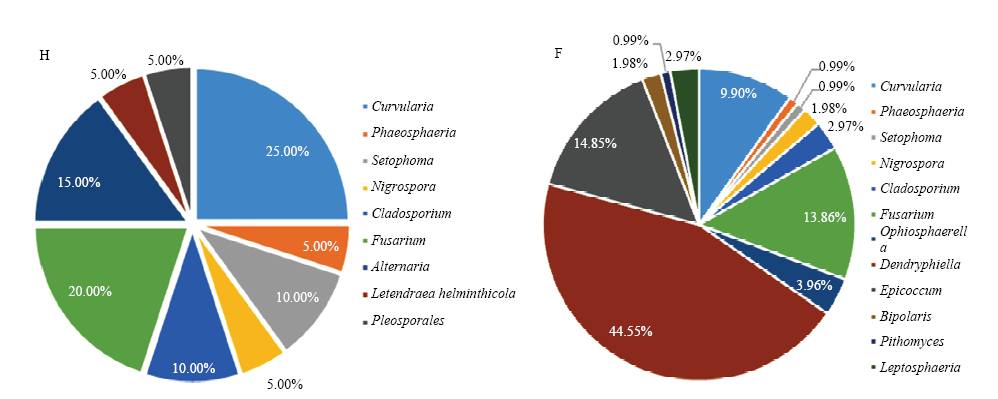
Fig. 3

Relative isolation frequency ( RF ) of endophytic fungi from rice seeds grown in Hainan (H) and Fuyang, Zhejiang (F) "

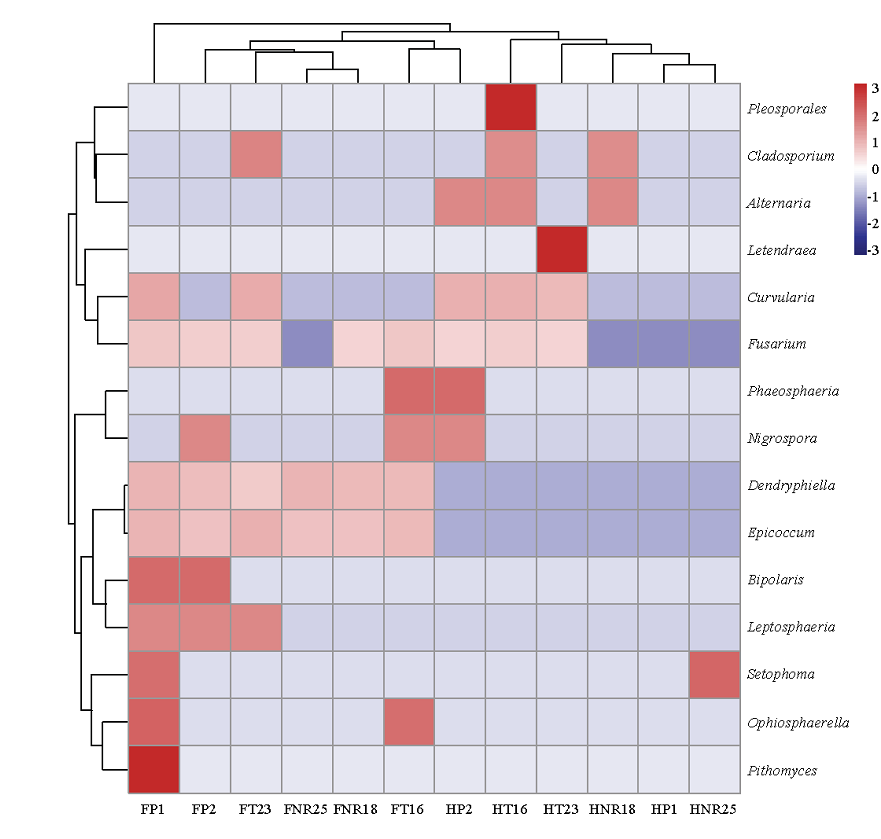
Fig. 4

The cluster analysis of endophytic fungi composition of rice seeds from the 6 samples planted in Hainan (H) and Fuyang, Zhejiang (F) "

[1] PARK S Y, KIM J K, JANG J S, LEE S Y, OH S, LEE S M, YANG C I, YEO Y . Comparative analysis of nutritional composition between the disease-resistant rice variety OsCK1 and conventional comparators. Food Science and Biotechnology, 2015,24(1):225-231.
[2] 赵艳, 李燕燕 . 利用PTN系统快速解析转基因水稻种子可溶性蛋白非预期变异的来源. 中国农业科学, 2015,48(22):4397-4407.
ZHAO Y, LI Y Y . Rapid identify the sources of unintended variations of seed soluble proteins in genetically modified rice by using PTN system. Scientia Agricultura Sinica, 2015,48(22):4397-4407. (in Chinese)
[3] JIAO Z, SI X X, LI G K, ZHANG Z M, XU X P . Unintended compositional changes in transgenic rice seeds (Oryza sativa L.) studied by spectral and chromatographic analysis coupled with chemometrics methods. Journal of Agricultural and Food Chemistry, 2010,58(3):1746-1754.
[4] ALMEIDA T T, ORLANDELLI R C, AZEVEDO J L, PAMPHILE J A . Molecular characterization of the endophytic fungal community associated with Eichhornia azurea (Kunth) and Eichhornia crassipes (Mart.) (Pontederiaceae) native to the Upper Paraná River floodplain, Brazil. Genetics & Molecular Research GMR, 2015,14(2):4920-4931.
[5] WANG X, CAI M Y, ZHOU Y . Biological influence of cry1Ab gene insertion on the endophytic bacteria community in transgenic rice. Turkish Journal of Biology, 2018,42(3):231-239.
[6] PAN J J, BAUMGARTEN A M, MAY G . Effects of host plant environment and Ustilago maydis infection on the fungal endophyte community of maize (Zea mays). New Phytologist, 2008,178(1):147-156.
doi: 10.1111/j.1469-8137.2007.02350.x
[7] 刘月廉, 郭建夫, 袁红旭, 李玥仁, 李伟, 黄永相 . 两个转抗真菌基因水稻根部内生真菌群落变化的分析. 生物过程, 2012,2:105-110.
LIU Y L, GUO J F, YUAN H X, LI Y R, LI W, HUANG Y X . Analysis of endophytic fungal community changes in roots of two transgenic antifungal genes. Biology Process, 2012,2:105-110. (in Chinese)
[8] CUI J L, GUO T T, REN Z X, ZHANG N S, WANG M L . Diversity and antioxidant activity of culturable endophytic fungi from alpine plants of Rhodiola crenulata, R. angusta, and R. sachalinensis. PLoS ONE, 2015,10(3):e0118204.
[9] WEISING K, NYBOM H, PFENNINGER M, WOLFF K, MEYER W . DNA Fingerprinting in Plants and Fungi. Florida: CRC press, 1994.
[10] 柴新义, 柴钢青, 向玉勇, 张微微, 殷培峰 . 青檀叶片内生和附生真菌组成及生态分布. 生态学报, 2016,16:5163-5172.
doi: 10.5846/stxb201501290233
CHAI X Y, CHAI G Q, XIANG Y Y, ZHANG W W, YIN P F . Composition and ecological distribution of endophytic and epiphytic fungi in leaves of P. chinensis. Chinese Journal of Ecology, 2016,16:5163-5172. (in Chinese)
doi: 10.5846/stxb201501290233
[11] 李盼盼, 袁晓龙, 李金海, 申国明, 高林, 李青城, 高加明, 张鹏 . 湖北烟草内生真菌生物多样性和种群结构分析. 微生物学报, 2018,58(10):169-179.
LI P P, YUAN X L, LI J H, SHEN G M, GAO L, LI Q C, GAO J M, ZHANG P . Biodiversity and population structure analysis of endophytic fungi from tobacco in Hubei Province. Acta Microbiologica Sinica, 2018,58(10):169-179. (in Chinese)
[12] 王梦亮, 贾岩, 崔晋龙, 王俊宏 . 锁阳及其寄主白刺内生真菌的生态分布及遗传关系. 应用生态学报, 2017,28(3):815-820.
WANG M L, JIA Y, CUI J L, WANG J H . Ecological distribution and genetic relationship of endophytic fungi from Cynomorium and its host white thorn. Chinese Journal of Applied Ecology, 2017,28(3):815-820. (in Chinese)
[13] RAJAGOPAL K, MEENASHREE B, BINIKA D, JOSHILA D, TULSI P S, ARULMATHI R, KATHIRAVAN G, TUWAR A . Mycodiversity and biotechnological potential of endophytic fungi isolated from hydrophytes. Current Research in Environmental and Applie Myclogy, 2018,8(2):172-182.
[14] TIAN X L, CAO L X, TAN H M, ZENG Q G, JIA Y Y, HAN W Q, ZHOU S N . Study on the communities of endophytic fungi and endophytic actinomycetes from rice and their antipathogenic activities in vitro. World Journal of Microbiology & Biotechnology, 2004,20(3):303-309.
doi: 10.1023/B:WIBI.0000023843.83692.3f
[15] 王拱辰, 陈鸿逵 . 水稻恶苗病病原菌的研究. 植物病理学报, 1990,2:93-97.
WANG G C, CHEN H K . Studies on pathogens of rice blight disease. Chinese Journal of Plant Pathology, 1990,2:93-97. (in Chinese)
[16] 史建荣, 刘馨, 仇剑波, 祭芳, 徐剑红, 董飞, 殷宪超, 冉军舰 . 小麦中镰刀菌毒素脱氧雪腐镰刀菌烯醇污染现状与防控研究进展. 中国农业科学, 2014,47(18):3641-3654.
doi: 10.3864/j.issn.0578-1752.2014.18.012
SHI J R, LIU X, QIU J B, JI F, XU J H, DONG F, YIN X C, RAN J J . Research status and prevention and control of Fusarium toxin deoxynivalenol contamination in wheat. China Agricultural Science, 2014,47(18):3641-3654. (in Chinese)
doi: 10.3864/j.issn.0578-1752.2014.18.012
[17] 薛庆婉, 牛永春, 邓晖 . 常见瓜类植物的内生真菌多样性. 菌物学报, 2015,34(2):196-203.
doi: DOI: 10.13346/j.mycosystema.140030
XUE Q W, NIU Y C, DENG H . Endophytic fungal diversity of common melon plants. Journal of the Physiology, 2015,34(2):196-203. (in Chinese)
doi: DOI: 10.13346/j.mycosystema.140030
[18] 贾彤, 任安芝, 魏茂英, 尹立佳, 高玉葆 . 不同传播方式的内生真菌感染对羽茅的生理生态影响. 植物生态学报, 2015,39(1):72-80.
doi: 10.17521/cjpe.2015.0008
JIA T, REN A Z, WEI M Y, YIN L J, GAO Y B . Physiological and ecological effects of endophytic fungal infections with different propagation patterns on P. chinensis. Chinese Journal of Plant Ecology, 2015,39(1):72-80. (in Chinese)
doi: 10.17521/cjpe.2015.0008
[19] DANIELSEN L, THURMER A, MEINICKE P, BUEE M, MORIN E, MARTIN F, PILATE G, DANIEL R, POLLE A, REICH M . Fungal soil communities in a young transgenic poplar plantation form a rich reservoir for fungal root communities. Ecology and Evolution, 2012,2(8):1935-1948.
doi: 10.1002/ece3.305
[20] HEUER H, KROPPENSTEDT R M, LOTTMANN J, BERG G, SMALLA K . Effects of T4 lysozyme release from transgenic potato roots on bacterial rhizosphere communities are negligible relative to natural factors. Applied and Environmental Microbiology, 2002,68(3):1325-1335.
doi: 10.1128/AEM.68.3.1325-1335.2002
[21] SILVA R D A, DOURADO M N, FÁVARO L C L, MENDES R, FERREIRA A, ARAUJO W L . Diversity of cultivated fungi associated with conventional and transgenic sugarcane and the interaction between endophytic Trichoderma virens and the host Plant. . PLoS ONE, 2016,11(7):e0158974.
doi: 10.1371/journal.pone.0158974
[22] LEE S H, KIM C G, KANG H . Temporal dynamics of bacterial and fungal communities in a genetically modified (GM) rice ecosystem. Microbial Ecology, 2011,61(3):646-659.
doi: 10.1007/s00248-010-9776-5
[23] RASCHE F, HODL V, POLL C, KANDELER E, GERZABEK M H, ELSAS J D V, SESSITSCH A . Rhizosphere bacteria affected by transgenic potatoes with antibacterial activities compared with the effects of soil, wild-type potatoes, vegetation stage and pathogen exposure. FEMS Microbiology Ecology, 2010,56(2):219-235.
doi: 10.1111/fem.2006.56.issue-2
[24] EMILIA H S, WIETSE D B, JOHANNES V V, KEVIN M C . A 3-year study reveals that plant growth stage, season and field site affect soil fungal communities while cultivar and GM-trait have minor effects. PLoS ONE, 2012,7(4):e33819.
doi: 10.1371/journal.pone.0033819
[25] LIU W, LU H H, WU W, WEI Q K, CHEN Y X, THIES J E . Transgenic Bt rice does not affect enzyme activities and microbial composition in the rhizosphere during crop development. Soil Biology & Biochemistry, 2008,40(2):475-486.
doi: 10.1016/j.soilbio.2007.09.017
[1] HE ZhiLin, SUN CuiXia, YUE HongLi, TAN YueXia, ZHANG YaoHai, WANG FuSheng, LIU SiTao, JIANG Dong. Genetic Diversity Analysis and GWAS of Alloocimene Based on Resequencing of Citron, Lemon Germplasm Resources [J]. Scientia Agricultura Sinica, 2026, 59(2): 386-401.
[2] BAI YuXin, LIU LingZhi, AN TingTing, LI ShuangYi, WANG JingKuan. Eeffects of Long-Term Fertilization on Bacterial Community Structure and Carbon Metabolic Functions in Brown Soil [J]. Scientia Agricultura Sinica, 2025, 58(8): 1579-1590.
[3] XU YuJuan, ZHANG Jie, WANG TianYi, CHEN HaoYang, ZHAO JiaJia, WU BangBang, HAO YuQiong, LI XiaoHua, ZHENG XingWei, ZUO JingJing, ZHENG Jun. Identification of Glu-A3 and Glu-B3 of Low-Molecular-Weight Glutenin in Shanxi Wheat and Its Effect on Quality [J]. Scientia Agricultura Sinica, 2025, 58(24): 5110-5127.
[4] CHEN CaiJin, MA Lin, JIANG QingXue, LIU JinHui, MIAO Tong, ZHANG ZhiPeng, MENG Xiang, MA XiaoRan, ZHOU XinYue, ZHANG Jian, LIU WenHui, WANG XueMin. Genetic Diversity Analysis of Phenotypic Traits of 244 Forage Oat Germplasm Resources [J]. Scientia Agricultura Sinica, 2025, 58(23): 4825-4836.
[5] WEI YiMin, ZHOU MeiLiang, TANG Yu. Origin, Evolution and Spread of Crop Buckwheat [J]. Scientia Agricultura Sinica, 2025, 58(21): 4305-4316.
[6] LIU XiaoXu, ZHONG ZeXin, QIU JiaRen, YANG ChunXiao, ZHANG YongJun, XIE Wen, ZHANG YouJun, PAN HuiPeng. GENETIC DIVERSITY OF MTCO1 IN DIFFERENT GEOGRAPHICAL POPULATIONS OF MEGALUROTHRIPS USITATUS [J]. Scientia Agricultura Sinica, 2025, 58(21): 4361-4371.
[7] XIE HaiPeng, LIN JunXu, LIU Yong, MAI XianJun, LUO Feng, WANG XueWu, XIE Wen, LI ShaoKa, KONG XiangYi, WU XiaoYan. Effects of Different Organic Fertilizers on the Control of Cowpea Wilt by Bacillus velezensis SD13 [J]. Scientia Agricultura Sinica, 2025, 58(21): 4405-4420.
[8] TANG GuiMei, LI WeiDong, ZHOU YuXia, KONG YouHan, XIAO XiaoLing, PENG YingShu, ZHANG Li, FU HongYan, LIU Yang, HUANG GuoLin. Genetic Diversity Analysis of Cymbidium faberi Germplasm Resources Based on Phenotypic Traits [J]. Scientia Agricultura Sinica, 2025, 58(2): 339-354.
[9] GUO MengZe, ZHANG Lei, SUN PingPing, JIANG Biao, YAN JinQiang, LI ZhengNan. Molecular Characterization and Evolutionary Dynamics of Tomato Leaf Curl New Delhi Virus Isolate from Wax Gourd (Benincasa hispida) in Guangdong [J]. Scientia Agricultura Sinica, 2025, 58(19): 3890-3904.
[10] LI XueFeng, WANG Hui, ZHANG NingBo, JIN TaiHua, ZHANG ShuEr, ZHENG QuanSheng, TAO JiaShu, LI QingKe, LÜ ShenJin, LI YongZhu. Prediction and Analysis of Feeding Density on Production Performance, Cecal Flora Diversity, Short-Chain Fatty Acid Content and Microbial Differential Function of Langya Chickens [J]. Scientia Agricultura Sinica, 2025, 58(17): 3544-3560.
[11] LIU PengPeng, LI JiangBo, XU HongJun, NIE YingBin, HAN XinNian, KONG DeZhen, SANG Wei. Genetic Diversity Analysis of Protein Fractions and Quality in Xinjiang Winter Wheat Cultivar Resources [J]. Scientia Agricultura Sinica, 2025, 58(15): 2948-2959.
[12] WANG Hui, DING BaoPeng, LI YuXian, REN QuanRu, ZHOU Hai, ZHAO JunLiang, HU HaiFei. Research Progress and Prospects on Crop Pan-Genomics [J]. Scientia Agricultura Sinica, 2025, 58(11): 2045-2061.
[13] PAN Jing, MENG ZhiHao, WANG Sen, WANG HaiBo, HE Ping, CHANG YuanSheng, ZHENG WenYan, LI LinGuang, WANG Chen, WANG Ping, HE XiaoWen. Diversity Analysis and Comprehensive Evaluation of Fruit Quality Traits in Reciprocal Cross Progenies of Apple Golden Delicious and Fuji Nagafu No.2 [J]. Scientia Agricultura Sinica, 2024, 57(24): 4945-4963.
[14] LI Pei, HE ZhiLin, TAN YueXia, ZHAO WanTong, FENG JinYing, CHEN GuiHu, YAN Chi, WANG ZiHao, HUANG Ping, JIANG Dong. Genetic Diversity Analysis of Mandarin and Excellent Germplasm Screening Based on Whole-Genome Resequencing Data and Phenotypic Traits [J]. Scientia Agricultura Sinica, 2024, 57(23): 4761-4773.
[15] SU LanXi, PU QiuJie, BAI TingYu, WU YueXian, WU Gang, TAN LeHe, HU YaLi. Effects of Soil Texture on Rhizosphere Microbial Carbon Source Utilization, Nematode Community and Fruit Sugar of Jackfruit [J]. Scientia Agricultura Sinica, 2024, 57(2): 349-362.
Viewed
Full text


Abstract

Cited

  Shared   
  Discussed   
No Suggested Reading articles found!