Scientia Agricultura Sinica ›› 2026, Vol. 59 ›› Issue (20): 4588-4599.doi: 10.3864/j.issn.0578-1752.2026.20.011

• FOOD SCIENCE AND ENGINEERING • Previous Articles     Next Articles

Effects of Polyethylene Microplastic on Biological Characteristic and Spoilage Potential of Pseudomonas fragi

ZHAO Yue(), WANG YongKang, JIANG Yue, YU JiaYi, CHENG QingHua, WANG GuangYu(), QIU WeiFen   

  1. College of Food Science and Engineering/Collaborative Innovation Center for Modern Grain Circulation and Safety, Nanjing University of Finance and Economics, Nanjing 210023
  • Received:2026-04-10 Accepted:2026-08-31 Online:2026-10-16 Published:2026-10-21
  • Contact: WANG GuangYu

Abstract:

【Objective】This study examined how polyethylene microplastics (PE-MPs) affected the physiological traits, surface colonization, and spoilage potential of Pseudomonas fragi (P. fragi) and explored the processes involved at microbe-food interfaces. 【Method】The strongly spoilage-associated strain P. fragi NMC25 was selected as the model organism. Based on field data from meat-processing environments, two environmental relevant concentrations were tested: a meat-migration concentration (35 μg·mL-1) and a cutting-board residual concentration (700 μg·mL-1). Effects across key stages of microbial spoilage were systematically assessed using growth curve analysis, motility assays, biofilm quantification, microscopy, and spoilage-indicator measurements. 【Result】PE-MPs did not significantly affect the growth capacity of P. fragi, even at the cutting-board residual concentration. This finding indicated that PE-MPs did not directly impair bacterial proliferation. At the cutting-board residual concentration, PE-MPs significantly enhanced swimming, swarming, and twitching motility (P<0.05). They also promoted bacterial adhesion to and colonization of stainless-steel surfaces. At the meat-migration concentration, only twitching motility increased significantly (P<0.05). These findings indicated that PE-MPs could stimulate local surface translocation, with a greater effect at the higher concentration. Scanning electron and confocal laser scanning microscopy revealed that bacterial cells accumulated around microplastic particles and secreted abundant extracellular polymeric substances that enveloped the cells. Together, these cell-particle assemblages formed complex three-dimensional reticular biofilm structures. At the cutting-board residual concentration, the biofilms exhibited increased extracellular polymeric substance production, with more compact architecture and clustered spatial distribution. Regarding spoilage potential, PE-MPs at the residual concentration significantly increased extracellular protease activity. This increase was accompanied by significantly greater rises in total volatile basic nitrogen (TVBN) and pH than that in the control. These changes accelerated sensory deterioration in chilled meat samples. 【Conclusion】At the cutting-board residual concentration, PE-MPs promoted dense biofilm formation and accelerated proteinaceous-substrate spoilage without altering bacterial growth. These effects were associated with enhanced motility, surface adhesion, and protease activity. High PE-MP loaded on cutting boards might therefore facilitate spoilage-bacterial colonization and food spoilage in food-processing environments. These findings provide a basis for incorporating microplastic-mediated microbial effects into food-safety risk assessments.

Key words: polyethylene, microplastics, Pseudomonas fragi, biological characteristics, spoilage potential

Fig. 1

Effects of PE-MPs exposure on the growth and motility of P. fragi NMC25 Different lowercase letters indicate significant differences among treatment groups (P<0.05). The same as below"

Fig. 2

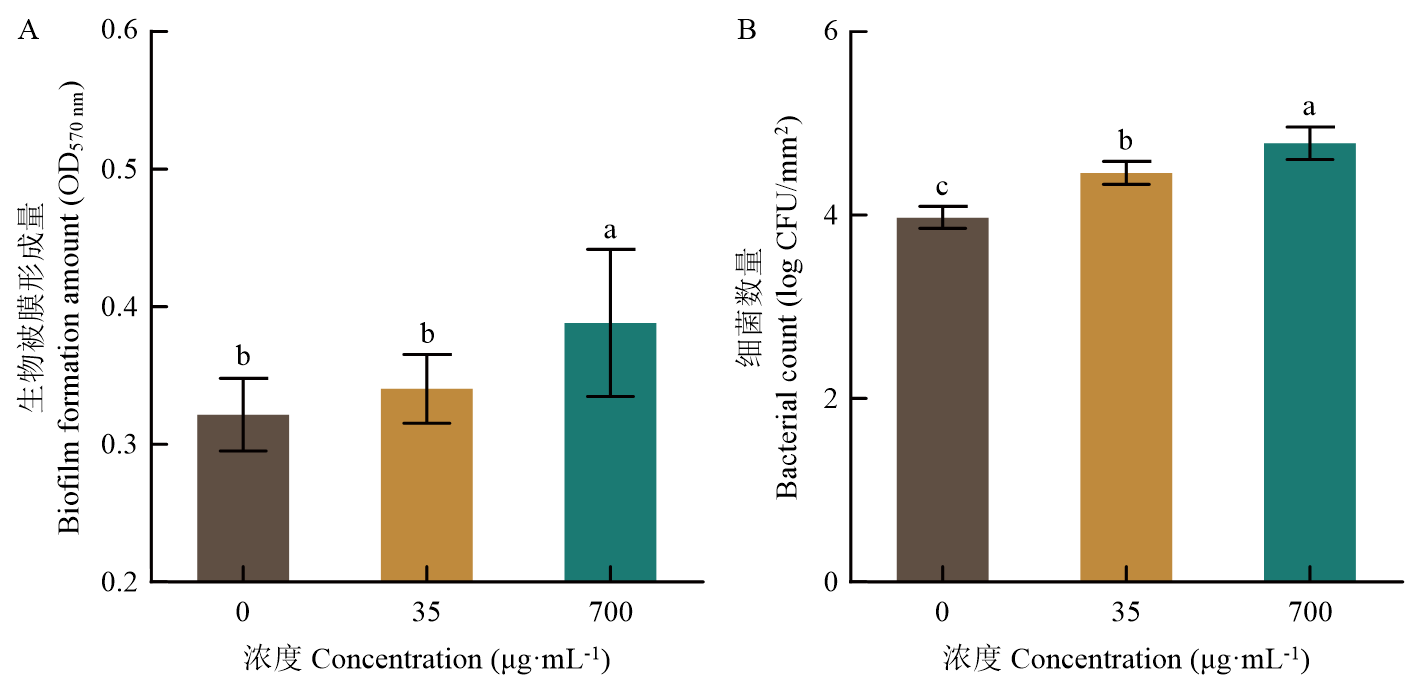
Effects of PE-MPs on biofilm formation and surface attachment of P. fragi NMC25"

Fig. 3

CLSM and SEM images of the biofilm on the stainless steel surface of P. fragi NMC25 under different concentrations of PE-MPs A-C: Confocal laser scanning microscopy (CLSM) images showing the microstructure and morphology of the biofilms. D-F: Scanning electron microscopy (SEM) images of biofilms stained with SYTO9/PI fluorescent dyes (green: live bacteria; red: dead bacteria)"

Fig. 4

SDS-PAGE analysis of sarcoplasmic and myofibrillar proteins treated with P. fragi NMC25 extracellular protease under varying PE-MPs concentrations S: Untreated sarcoplasmic proteins (control); S-0, S-35, S-700 means sarcoplasmic proteins incubated with extracellular protease in the presence of 0, 35, and 700 μg·mL-1 PE-MPs, respectively; M: Untreated myofibrillar proteins (control); M-0, M-35, M-700 means myofibrillar proteins incubated with extracellular protease in the presence of 0, 35, and 700 μg·mL-1 PE-MPs, respectively"

Fig. 5

Effects of PE-MPs on quality changes of samples during storage"

[1]
Thompson R C, Olsen Y, Mitchell R P, Davis A, Rowland S J, John A W, McGonigle D, Russell A E. Lost at sea: Where is all the plastic?[J]. Science, 2004, 304(5672): 838.

pmid: 15131299
[2]
Su H C, Xu W J, Hu X J, Xu Y, Wen G L, Cao Y C. The impact of microplastics on antibiotic resistance genes, metal resistance genes, and bacterial community in aquaculture environment[J]. Journal of Hazardous Materials, 2025, 489: 137704.

doi: 10.1016/j.jhazmat.2025.137704
[3]
Zettler E R, Mincer T J, Amaral-Zettler L A. Life in the “plastisphere”: Microbial communities on plastic marine debris[J]. Environmental Science & Technology, 2013, 47(13): 7137-7146.

doi: 10.1021/es401288x
[4]
Sun X M, Booth A M, Sui Q, Zhu L, Yu Y X, Xia B, Meng S L, Xing B S. Potential impact of marine-derived plastisphere as a Vibrio carrier on marine ecosystems: Current status and future perspectives[J]. Journal of Hazardous Materials, 2025, 495: 138927.

doi: 10.1016/j.jhazmat.2025.138927
[5]
Perveen S, Pablos C, Reynolds K, Stanley S, Marugán J. Growth and prevalence of antibiotic-resistant bacteria in microplastic biofilm from wastewater treatment plant effluents[J]. Science of the Total Environment, 2023, 856: 159024.

doi: 10.1016/j.scitotenv.2022.159024
[6]
Fu L F, Guo Y X, Tang J L, Yang M D, Huang L, Xiao J E, Fan Z Y, Wang Z Y, Zhi J Y, Huang Z W, Fang H Y, Li P. Comparative analysis of microplastic and microbial communities in varied aquatic environments: Disparities in occurrence, interconnections, and ecological implications[J]. Journal of Hazardous Materials, 2025, 495: 138795.

doi: 10.1016/j.jhazmat.2025.138795
[7]
Klun B, Starin M, Novak J, Putar U, Čelan Korošin N, Binda G, Kalčíková G. Biofilm formation on polyethylene and polylactic acid microplastics in freshwater: Influence of environmental factors[J]. Journal of Environmental Chemical Engineering, 2025, 13(5): 118689.

doi: 10.1016/j.jece.2025.118689
[8]
Sun X Y, Zhuang Y, Wang Y B, Zhang Z B, An L H, Xu Q J. Polyethylene terephthalate microplastics affect gut microbiota distribution and intestinal damage in mice[J]. Ecotoxicology and Environmental Safety, 2025, 294: 118119.

doi: 10.1016/j.ecoenv.2025.118119
[9]
Kaur M, Sharma A, Sharma K, John P, Bhatnagar P. Teratological, neurochemical and histomorphic changes in the limbic areas of F1 mice progeny due to co-parental polystyrene nanoplastic exposure[J]. Toxicology, 2025, 511: 154043.

doi: 10.1016/j.tox.2024.154043
[10]
Cui H Y, Jiang X F, Cao J, Yang W S, Yang B, Li M. Comparative analysis of metabolic dysfunctions associated with pristine and aged polyethylene microplastic exposure via the liver-gut axis in mice[J]. ACS Nano, 2025, 19(14): 14272-14283.

doi: 10.1021/acsnano.5c00945
[11]
Deng W B, Wang Y J, Fu M Y, Wang Z H, Di X Y, Wang J, Liu W J. The spatiotemporal successions of bacterial and fungal plastisphere communities and their effects on microplastic degradation in soil ecosystems[J]. Environmental Science & Technology, 2025, 59(29): 15408-15419.

doi: 10.1021/acs.est.5c06662
[12]
张金瑞, 任思洋, 戴吉照, 丁凡, 肖谋良, 刘学军, 严昌荣, 葛体达, 汪景宽, 刘勤, 王锴, 张福锁. 地膜对农业生产的影响及其污染控制[J]. 中国农业科学, 2022, 55(20): 3983-3996. DOI: 10.3864/j.issn.0578-1752.2022.20.010.
Zhang J R, Ren S Y, Dai J Z, Ding F, Xiao M L, Liu X J, Yan C R, Ge T D, Wang J K, Liu Q, Wang K, Zhang F S. Influence of plastic film on agricultural production and its pollution control[J]. Scientia Agricultura Sinica, 2022, 55(20): 3983-3996. DOI: 10.3864/j.issn.0578-1752.2022.20.010. (in Chinese)
[13]
李凯贺, 门聪, 程世昆, 李子富. 土壤中微塑料与抗生素吸附、迁移及复合毒性研究进展[J]. 环境科学, 2025, 46(8): 5271-5282.
Li K H, Men C, Cheng S K, Li Z F. Research progress on adsorption, migration, and compound toxicity of microplastics and antibiotics in soil[J]. Environmental Science, 2025, 46(8): 5271-5282. (in Chinese)

doi: 10.1021/es301646m
[14]
Miloloža M, Bule K, Prevarić V, Cvetnić M, Ukić Š, Bolanča T, Kučić Grgić D. Assessment of the influence of size and concentration on the ecotoxicity of microplastics to microalgae Scenedesmus sp., bacterium Pseudomonas putida and yeast Saccharomyces cerevisiae[J]. Polymers, 2022, 14(6): 1246.

doi: 10.3390/polym14061246
[15]
Casabianca S, Basili M, Capellacci S, Ricci F, Penna A, Manini E. Temporal dynamics of communities on plastic debris in a polluted marine habitat[J]. Marine Pollution Bulletin, 2025, 214: 117763.

doi: 10.1016/j.marpolbul.2025.117763
[16]
韦婧, 涂晨, 杨杰, 刘颖, 黄硕霈, 卜元卿, 骆永明. 微塑料对农田土壤理化性质、土壤微生物群落结构与功能的影响[J]. 生态与农村环境学报, 2023, 39(5): 644-652.
Wei J, Tu C, Yang J, Liu Y, Huang S P, Bu Y Q, Luo Y M. Impact of microplastics on the physicochemical properties, microbial community structure, and functions of farmland soils[J]. Journal of Ecology and Rural Environment, 2023, 39(5): 644-652. (in Chinese)
[17]
Liu B S, Wang S L, Ren J Y, Zhang Z W, Ma J Z, Li T, Zhou Q, Sun J K. Impacts of non-spherical polyethylene nanoplastics on microbial communities and antibiotic resistance genes in the rhizosphere of pea (Pisum sativum L.): An integrated metagenomic and metabolomic analysis [J]. Journal of Hazardous Materials, 2025, 500: 140425.

doi: 10.1016/j.jhazmat.2025.140425
[18]
杨杰, 涂晨, 袁宪正, 骆永明. 土壤-植物系统中微/纳塑料的环境过程和生态效应[J]. 化学进展, 2025, 37(1): 89-102.

doi: 10.7536/PC240801
Yang J, Tu C, Yuan X Z, Luo Y M. Environmental processes and ecological effects of micro-and nano-plastics in soil-plant systems[J]. Progress in Chemistry, 2025, 37(1): 89-102. (in Chinese)

doi: 10.7536/PC240801
[19]
Wang X X, Li H, Chen Y, Meng X Q, Dieketseng M Y, Wang X M, Yan S, Wang B Z, Zhou L X, Zheng G Y. A neglected risk of nanoplastics as revealed by the promoted transformation of plasmid-borne ampicillin resistance gene by Escherichia coli[J]. Environmental Microbiology, 2022, 24(10): 4946-4959.

doi: 10.1111/emi.v24.10
[20]
Sun X J, Chen X, Ming J, Lin Z Q, Li Y Z, Ni B J, Ni S Q. Surface-modified nanoplastics facilitate the dissemination and persistence of antibiotic resistance genes[J]. Journal of Hazardous Materials, 2025, 499: 140036.

doi: 10.1016/j.jhazmat.2025.140036
[21]
Jiang A R, Pei W X, Zhang R, Shah K J, You Z Y. Toxic effects of aging mask microplastics on E. coli and dynamic changes in extracellular polymeric matter[J]. Science of the Total Environment, 2023, 899: 165607.

doi: 10.1016/j.scitotenv.2023.165607
[22]
Wang Y C, Luo X H, Yue M, Song B, Karhu K, Razavi B S. Rhizosphere keystone microbiomes promote invasive plant growth under PLA and PVC microplastic stress: A comparative study with native species[J]. Environmental Science & Technology, 2025, 59(38): 20201-20215.

doi: 10.1021/acs.est.5c06285
[23]
Zhang J, Shao Y H, Shao Y Y, Yang W L, Xuan N, Geng Y, Bian F, Zhang Y X, Chen G. Pretreated polystyrene is degraded by a microbial consortium enriched from wetland plastic waste[J]. Journal of Hazardous Materials, 2024, 480: 136143.

doi: 10.1016/j.jhazmat.2024.136143
[24]
Habib R Z, Poulose V, Alsaidi R, al Kendi R, Iftikhar S H, Mourad A I, Kittaneh W F, Thiemann T. Plastic cutting boards as a source of microplastics in meat[J]. Food Additives & Contaminants: Part A, 2022, 39(3): 609-619.
[25]
Luo Y L, Chuah C, Al Amin M, Khoshyan A, Gibson C T, Tang Y H, Naidu R, Fang C. Assessment of microplastics and nanoplastics released from a chopping board using Raman imaging in combination with three algorithms[J]. Journal of Hazardous Materials, 2022, 431: 128636.

doi: 10.1016/j.jhazmat.2022.128636
[26]
Wang Y K, Zhao Y, Jiang Y, Xie M H, Ma F, Wang G Y. Polyethylene cutting board-derived microplastics: Mechanical abrasion in retail meat processing and concentration-dependent modulation of meat microbial spoilage[J]. Food Research International, 2026, 231: 118677.

doi: 10.1016/j.foodres.2026.118677
[27]
Wang G Y, Li M, Ma F, Wang H H, Xu X L, Zhou G H. Physicochemical properties of Pseudomonas fragi isolates response to modified atmosphere packaging[J]. FEMS Microbiology Letters, 2017. DOI: 10.1093/femsle/fnx106.
[28]
Wu Y J, Ma F, Tan S, Niu A J, Chen Y P, Liu Y X, Qiu W F, Wang G Y. The aprD-mutated strain modulates the development of Pseudomonas fragi population but has limited effects on the spoilage profiles of native residents[J]. Food Microbiology, 2025, 128: 104708.

doi: 10.1016/j.fm.2024.104708
[29]
Buensuceso R N C, Daniel-Ivad M, Kilmury S L N, Leighton T L, Harvey H, Howell P L, Burrows L L. Cyclic AMP-independent control of twitching motility in Pseudomonas aeruginosa[J]. Journal of Bacteriology, 2017, 199(16): e00188-00117.
[30]
王光宇. 气调包装对冷鲜鸡肉中莓实假单胞菌致腐效应的抑制机制[D]. 南京: 南京农业大学, 2018.
Wang G Y. Inhibition mechanisms of map against chilled chicken spoilage associated with Pseudomonas fragi[D]. Nanjing: Nanjing Agricultural University, 2018. (in Chinese)
[31]
Pang X Y, Wong C, Chung H J, Yuk H G. Biofilm formation of Listeria monocytogenes and its resistance to quaternary ammonium compounds in a simulated salmon processing environment[J]. Food Control, 2019, 98: 200-208.

doi: 10.1016/j.foodcont.2018.11.029
[32]
Winkelströter L K, Gomes B C, Thomaz M R S, Souza V M, De Martinis E C P. Lactobacillus sakei 1 and its bacteriocin influence adhesion of Listeria monocytogenes on stainless steel surface[J]. Food Control, 2011, 22(8): 1404-1407.

doi: 10.1016/j.foodcont.2011.02.021
[33]
Panebianco F, Alvarez-Ordóñez A, Oliveira M, Ferreira S, Lovisolo S, Vono C, Cannizzo F T, Chiesa F, Civera T, Di Ciccio P. Effect of neutral electrolyzed water on biofilm formed by meat-related Listeria monocytogenes: Intraspecies variability and influence of the growth surface material[J]. International Journal of Food Microbiology, 2025, 431: 111064.

doi: 10.1016/j.ijfoodmicro.2025.111064
[34]
Pang X Y, Chen L, Yuk H G. Stress response and survival of Salmonella enteritidis in single and dual species biofilms with Pseudomonas fluorescens following repeated exposure to quaternary ammonium compounds[J]. International Journal of Food Microbiology, 2020, 325: 108643.

doi: 10.1016/j.ijfoodmicro.2020.108643
[35]
Kang Z L, Wang P, Xu X L, Zhu C Z, Zou Y F, Li K, Zhou G H. Effect of a beating process, as a means of reducing salt content in Chinese-style meatballs (Kung-Wan): A dynamic rheological and Raman spectroscopy study[J]. Meat Science, 2014, 96(2): 669-674.

doi: 10.1016/j.meatsci.2013.09.024
[36]
Zhang X X, Wang H H, Li N, Li M, Xu X L. High CO2-modified atmosphere packaging for extension of shelf-life of chilled yellow-feather broiler meat: A special breed in Asia[J]. LWT-Food Science and Technology, 2015, 64(2): 1123-1129.

doi: 10.1016/j.lwt.2015.07.039
[37]
Gross N, Muhvich J, Ching C, Gomez B, Horvath E, Nahum Y, Zaman M H. Effects of microplastic concentration, composition, and size on Escherichia coli biofilm-associated antimicrobial resistance[J]. Applied and Environmental Microbiology, 2025, 91(4): e0228224.

doi: 10.1128/aem.02282-24
[38]
Wadhwa N, Berg H C. Bacterial motility: Machinery and mechanisms[J]. Nature Reviews Microbiology, 2022, 20(3): 161-173.

doi: 10.1038/s41579-021-00626-4
[39]
Otton L M, da Silva Campos M, Meneghetti K L, Corção G. Influence of twitching and swarming motilities on biofilm formation in Pseudomonas strains[J]. Archives of Microbiology, 2017, 199(5): 677-682.

doi: 10.1007/s00203-017-1344-7
[40]
Feng T, Han Y, Li B Q, Li Z Q, Yu Y M, Sun Q Y, Li X Y, Du L C, Zhang X H, Wang Y. Interspecies and intraspecies signals synergistically regulate Lysobacter enzymogenes twitching motility[J]. Applied and Environmental Microbiology, 2019, 85(23): e01742-e01719.
[41]
He L, Zhao L M, Li Q, Huang L X, Qin Y X, Zhuang Z X, Wang X R, Huang H B, Zhang J N, Zhang J L, Yan Q P. Flagellar gene fliP contributes to the virulence of Pseudomonas plecoglossicida by regulating its motility[J]. Aquaculture, 2023, 576: 739874.

doi: 10.1016/j.aquaculture.2023.739874
[42]
郭建慧, 何沿沿, 陈荣浩, 吴卫辉, 金守光, 靳永新. 铜绿假单胞菌mexS基因对其运动能力的影响[J]. 南开大学学报(自然科学版), 2015, 48(5): 44-50.
Guo J H, He Y Y, Chen R H, Wu W H, Jin S G, Jin Y X. Influence of mexS gene on motility in Pseudomonas aeruginosa[J]. Journal of Nankai University (Natural Science), 2015, 48(5): 44-50. (in Chinese)
[43]
Zhang M Y, He L, Qin J M, Wang S, Tong M P. Influence of flagella and their property on the initial attachment behaviors of bacteria onto plastics[J]. Water Research, 2023, 231: 119656.

doi: 10.1016/j.watres.2023.119656
[44]
Qin P, Cui H, Li P X, Wang S T, Fan S, Lu J, Sun M, Zhang H, Wang S G, Su X Y, Fu H H, Hu X L, Lin J S, Zhang Y Z, Ding W, Zhang W P. Early stage of biofilm assembly on microplastics is structured by substrate size and bacterial motility[J]. iMeta, 2023, 2(3): e121.

doi: 10.1002/imt2.121 pmid: 38867926
[45]
阎波, 张玥, 郭安. 微塑料上生物膜的形成及其环境行为[J/OL]. 天津科技大学学报. https://doi.org/10.13364/j.issn.1672-6510.20250085.
Yan B, Zhang Y, Guo A. Biofilm formation on microplastics and their environmental behaviour[J/OL]. Journal of Tianjin University of Science & Technology. https://doi.org/10.13364/j.issn.1672-6510.20250085. (in Chinese)
[46]
Ding Y, Wang J, Chen Y H, Yang Y N, Liu X W. Natural transformation of antibiotic resistance genes and the enhanced adaptability in bacterial biofilm under antibiotic and heavy metal stresses[J]. Journal of Hazardous Materials, 2025, 490: 137740.

doi: 10.1016/j.jhazmat.2025.137740
[47]
Jashrapuria K, Singh S P. Biofilm inhibition by laser-induced graphene: Impact of surface texture on rod-shaped E. Coli and coccus-shaped Staphylococcus[J]. ACS Applied Materials & Interfaces, 2025, 17(14): 21819-21829.
[48]
Liu H, Wang X, Wang Z J, Shen Y. Evaluation of bacterial biofilm, smear layer, and debris removal efficacy of a hydro-dynamic cavitation system with physiological saline using a new ex vivo model: A CLSM and SEM study[J]. BMC Oral Health, 2025, 25(1): 95.

doi: 10.1186/s12903-025-05463-y pmid: 39827354
[49]
Li H B, Zhou E Z, Zhang D W, Xu D K, Xia J, Yang C G, Feng H, Jiang Z H, Li X G, Gu T Y, Yang K. Microbiologically influenced corrosion of 2707 hyper-duplex stainless steel by marine Pseudomonas aeruginosa biofilm[J]. Scientific Reports, 2016, 6: 20190.

doi: 10.1038/srep20190
[50]
Anderson G G, James S, Kovvali S, Dang F W, Vishwakarma A, Gagnon M C, Goulet N, Racine F, Labrie P, Eppihimer M, Weeks J W, Haas B, Pandey R. Comparison of two models of biofilm formation on reusable stainless steel medical device material[J]. Journal of Hospital Infection, 2026, 168: 23-30.

doi: 10.1016/j.jhin.2025.10.034
[51]
Wang L Y, Luo Z X, Zhen Z, Yan Y, Yan C Z, Ma X F, Sun L, Wang M, Zhou X Y, Hu A Y. Bacterial community colonization on tire microplastics in typical urban water environments and associated impacting factors[J]. Environmental Pollution, 2020, 265: 114922.

doi: 10.1016/j.envpol.2020.114922
[52]
Ayush P T, Ko J H, Oh H S. Characteristics of initial attachment and biofilm formation of Pseudomonas aeruginosa on microplastic surfaces[J]. Applied Sciences, 2022, 12(10): 5245.

doi: 10.3390/app12105245
[53]
Lobelle D, Cunliffe M. Early microbial biofilm formation on marine plastic debris[J]. Marine Pollution Bulletin, 2011, 62(1): 197-200.

doi: 10.1016/j.marpolbul.2010.10.013 pmid: 21093883
[54]
Zheng Z J, Huang Y, Liu L N, Wang L, Tang J C. Interaction between microplastic biofilm formation and antibiotics: Effect of microplastic biofilm and its driving mechanisms on antibiotic resistance gene[J]. Journal of Hazardous Materials, 2023, 459: 132099.

doi: 10.1016/j.jhazmat.2023.132099
[55]
Matilla M A, Velando F, Monteagudo-Cascales E, Krell T. Flagella, chemotaxis and surface sensing[J]. Advances in Experimental Medicine and Biology, 2022, 1386: 185-221.

doi: 10.1007/978-3-031-08491-1_7 pmid: 36258073
[56]
Wang L Y, Wong Y C, Correira J M, Wancura M, Geiger C J, Webster S S, Touhami A, Butler B J, O’Toole G A, Langford R M, Brown K A, Dortdivanlioglu B, Webb L, Cosgriff-Hernandez E, Gordon V D. The accumulation and growth of Pseudomonas aeruginosa on surfaces is modulated by surface mechanics via cyclic-di-GMP signaling[J]. npj Biofilms and Microbiomes, 2023, 9: 78.

doi: 10.1038/s41522-023-00436-x
[57]
Yew W H, Kumaran N, Dykes G A. Control of attachment of Pseudomonas aeruginosa and Burkholderia cepacia to surfaces by shear force[J]. Water Environment Research: A research Publication of the Water Environment Federation, 2016, 88(11): 2040-2046.

doi: 10.2175/106143016X14504669767292
[58]
Wang G Y, Liu Y X, Ma F, Qiu W F. Insights into meat-microbiome interactions: From community assembly to meat spoilage[J]. Food Microbiology, 2026, 136: 105010.

doi: 10.1016/j.fm.2025.105010
[59]
Yan C H, Zhan Y F, Chen H, Herman R A, Xu Y, Khurshid M, Gong L C, You S, Wang J. Coupling of gene regulation and carrier modification manipulates bacterial biofilms as robust living catalysts[J]. Bioresource Technology, 2024, 399: 130604.

doi: 10.1016/j.biortech.2024.130604
[60]
Díaz-Pascual F, Lempp M, Nosho K, Jeckel H, Jo J K, Neuhaus K, Hartmann R, Jelli E, Hansen M F, Price-Whelan A, Dietrich L E, Link H, Drescher K. Spatial alanine metabolism determines local growth dynamics of Escherichia coli colonies[J]. eLife, 2021, 10: e70794.
[61]
吴亚婕, 谭松, 陈愉平, 牛阿娟, 柳雨欣, 王光宇, 徐幸莲, 邱伟芬. 冷藏条件下肉源莓实假单胞菌nuoB对其生物被膜形成和细胞代谢的影响[J]. 中国农业科学, 2023, 56(11): 2172-2185. DOI: 10.3864/J.ISSN.0578-1752.2023.11.011.
Wu Y J, Tan S, Chen Y P, Niu A J, Liu Y X, Wang G Y, Xu X L, Qiu W F. Effects of nuoB on the biofilm formation and cellular metabolism of meat-borne Pseudomonas fragi during chilled storage[J]. Scientia Agricultura Sinica, 2023, 56(11): 2172-2185. DOI: 10.3864/J.ISSN.0578-1752.2023.11.011. (in Chinese)
[62]
Wang S C, Zhao Y T, Breslawec A P, Liang T T, Deng Z F, Kuperman L L, Yu Q N. Strategy to combat biofilms: A focus on biofilm dispersal enzymes[J]. npj Biofilms and Microbiomes, 2023, 9: 63.

doi: 10.1038/s41522-023-00427-y pmid: 37679355
[63]
Evans E, Brown M R, Gilbert P. Iron Chelator, exopolysaccharide and protease production in Staphylococcus epidermidis: A comparative study of the effects of specific growth rate in biofilm and planktonic culture[J]. Microbiology, 1994, 140(Pt 1): 153-157.

doi: 10.1099/13500872-140-1-153
[64]
Wang G Y, Ma F, Zeng L Y, Bai Y, Wang H H, Xu X L, Zhou G H. Modified atmosphere packaging decreased Pseudomonas fragi cell metabolism and extracellular proteolytic activities on meat[J]. Food Microbiology, 2018, 76: 443-449.

doi: 10.1016/j.fm.2018.07.007
[1] FENG YingMing, NONG Wei, CHEN XingYun, HAN HongXiang, ZHENG YuXin, TIAN Xiao, TANG Jiao, GUO YiWei, HUANG ChaoZheng, LI XueWen, SHI Lei, YU Min. Physiological Mechanism of Aluminum Tolerance of Rice Root Border Cells and Root Tips Induced by Nano Silica Biomineralization Deposition [J]. Scientia Agricultura Sinica, 2024, 57(24): 4871-4883.
[2] WU YaJie, TAN Song, CHEN YuPing, NIU AJuan, LIU YuXin, WANG GuangYu, XU XingLian, QIU WeiFen. Effects of nuoB on the Biofilm Formation and Cellular Metabolism of Meat-Borne Pseudomonas fragi During Chilled Storage [J]. Scientia Agricultura Sinica, 2023, 56(11): 2172-2185.
[3] ZHANG JinRui,REN SiYang,DAI JiZhao,DING Fan,XIAO MouLiang,LIU XueJun,YAN ChangRong,GE TiDa,WANG JingKuan,LIU Qin,WANG Kai,ZHANG FuSuo. Influence of Plastic Film on Agricultural Production and Its Pollution Control [J]. Scientia Agricultura Sinica, 2022, 55(20): 3983-3996.
[4] WANG GuangYu,LI Qing,TANG WenQian,WANG HuHu,XU XingLian,QIU WeiFen. Effects of nuoB on Physiological Properties of Pseudomonas fragi and Its Spoilage Potential in Chilled Chicken [J]. Scientia Agricultura Sinica, 2021, 54(8): 1761-1771.
[5] ZHANG Lei,JIA Qi,WU Wei,ZHAO LuPing,XUE Bing,LIU HuanHuan,SHANG Jing,YONG TaiWen,LI Qing,YANG WenYu. Species Identification and Virulence Determination of Beauveria bassiana Strain BEdy1 from Ergania doriae yunnanus [J]. Scientia Agricultura Sinica, 2020, 53(14): 2974-2982.
[6] MA Ning,WANG ChaoFan,FANG DongLu,DING MengTing,YAO JiaLei,YANG WenJian,HU QiuHui. Flavor Variation of Flammulina velutipes in Polyethylene Film Packaging During the Cold Storage [J]. Scientia Agricultura Sinica, 2019, 52(8): 1435-1448.
[7] SUN Ke,ZHU HaoDan,HE KongWang,WANG DanDan,ZHOU JunMing,YU ZhengYu,Lü LiXin,NI YanXiu. Biological Characteristics of Transcriptional Regulator GalR in Streptococcus suis Serotype 4 [J]. Scientia Agricultura Sinica, 2019, 52(19): 3485-3494.
[8] QI Lin, WANG YuXiang, WANG Ning, DUAN YiMing, ZHANG Ying, WANG Ya, XIAO LuLu, LI XiaoGang. Film Formation and Biological Properties of 40% Thiamethoxam·Pyraclostrobin Flowable Concentrate for Seed Coating [J]. Scientia Agricultura Sinica, 2017, 50(9): 1624-1634.
[9] YANG BingYe, FU Dan, HU FangPing, CAI XueQing. Function Analysis of Flagellar Gene fliS in Acidovorax citrulli [J]. Scientia Agricultura Sinica, 2017, 50(15): 2946-2956.
[10] LUO Yan-tao, MENG Run-jie, ZHAO Jian-jiang, HAN Xiu-ying, MA Zhi-qiang, WANG Wen-qiao, ZHANG Xiao-feng. Acquisition and Biological Characteristics of Fluopicolide-Resistant Isolates in Phytophthora infestans [J]. Scientia Agricultura Sinica, 2016, 49(19): 3733-3745.
[11] WANG Wen-Bin-1, 2 , ZHANG Rong-Sheng-2, LUO Chu-Ping-2, YIN Xiao-Le-2, LIU Yong-Feng-2, LU Fan-1, 2 , CHEN Zhi-Yi-1, 2 . Biological Characteristics and Genetic Diversity of Ustilaginoidea virens from Rice Regions in China [J]. Scientia Agricultura Sinica, 2014, 47(14): 2762-2773.
[12] CAO Yun, CHANG Zhi-Zhou, MA Yan, YANG Hao, FU Guang-Qing. Effects of Application of Anaerobically Digested Slurry on Suppression of Pepper (Capsicum frutescens L.) Blight and Soil Biological Characteristics [J]. Scientia Agricultura Sinica, 2013, 46(3): 507-516.
[13] ZHANG Zheng, DAI Wei-Min, ZHANG Chao-Bin, QIANG Sheng. Investigation of the Biological Characteristics and Harmfulness of Weedy Rice (Oryza sativa L. f. spontanea) Occurred in the Regions Along the Yangtze River of Jiangsu Province [J]. Scientia Agricultura Sinica, 2012, 45(14): 2856-2866.
[14] DONG Xu-bing,BI Huan-gai,LIU Ye-xia,YU Jun-hui,AI Xi-zhen
. Relationship Between Cross Adaptation to Drought-Low Temperature and Osmoregulation in Cucumber Seedlings
[J]. Scientia Agricultura Sinica, 2011, 44(2): 335-340 .
[15] GU Chun-bo,JIANG Li-li,WANG Kai-yun,SHI Xiao-bin,DUAN Hai-ming,LIN Cai-hua
. Induction and Characteristics of Fusarium oxysporum f. sp. fragariae ZY-W Resistant to Tebuconazole
[J]. Scientia Agricultura Sinica, 2010, 43(14): 2897-2904 .
Viewed
Full text


Abstract

Cited

  Shared   
  Discussed   
No Suggested Reading articles found!